Host: Imagine having significant ownership in multiple small businesses. Imagine you aren't operating any of them directly, but have trusted operators in place to lead each business. You're more behind the scenes. You have flexibility in your schedule. So much flexibility, in fact, that you have the bandwidth to do more of these deals. Actually, your portfolio of businesses is generating enough cash that you could even hire a team around yourself to support doing yet more of these acquisitions. Sound good? Welcome to the life of the Independent sponsor. Now, I didn't really know what being an independent sponsor meant until not too long ago. Maybe you're the same, maybe you still don't. Well, today you're going to learn. And you're going to learn from Nicholas James, someone who started as a self funded searcher like many of you and evolved into being an independent sponsor. Which is great because Niklas deeply, personally understands the differences, the pros and cons of the two models. And there are a lot of pros to the independent sponsor model. You might even find yourself saying, huh, I should do that. Especially if you're harboring fantasies of your own Holdco. Being an independent sponsor, one who's done multiple deals, feels a lot like having a Holdco and in many ways better. Nicholas and I also discuss two of the hottest target industries in search, SaaS and H Vac. Niklas has bought businesses in both and you'll learn why SaaS isn't as appealing as it seems, while H Vac, despite high multiples, continues to be a great industry in which to buy businesses. I I learned a ton from Nicholas in this interview and you will too. Here is Nicholas James, founder of Citis Group and sponsor of seven home service deals since 2016. Welcome to Acquiring Minds, a podcast about buying businesses. My name is Will Smith. Acquiring an existing business is an awesome opportunity for many entrepreneurs and on this podcast I talk to the people who do it. I want to share an update on the Acquisition Lab. As you know, the Lab is a highly vetted cohort based accelerator and community for people serious about buying a business. After going through the Lab's month long intensive, you have ongoing access to almost daily Q and A sessions with advisors, regular live deal reviews with Walker Deibel, author of Buy, then Build Potential Deal, Team Introductions and a very active Slack group with other searchers on the path. Well, the update is that the Lab recently passed 60 businesses acquired and for well over $100 million in aggregate transaction value. Also, all members now enjoy lifetime access to the Lab because when you buy a business, it's often just the first of many and The Lab wants to support you in every deal, not just your first. Lastly, check out my recent interview with Shane Ursum. Episode 105. Shane acquired a business with over $1 million in EBITDA in just six months, and he attributes a lot of his deal success to what he learned in the lab. Check out acquisitionlab.com or email the lab's director, Chelsea Wood. Chelseieve Build Nicholas James welcome to Acquiring Minds. Thank you very much Will Nicholas, you've got a great story for a lot of reasons, but among them how you've evolved from a searcher to an independent sponsor. Now the independent sponsor model is not one I've really addressed directly on the pod. It does come up in passing from time to time. So you are the perfect person to explain to us searchers, us acquisition entrepreneurs, what exactly the independent sponsor model is all about, how it's different, who should consider it. And you're doing this in the H Vac, the H VAC industry, which we hear a lot about in our world of buying businesses. So we'll also have the opportunity to spend some time on getting the basics of the H Vac industry. But let's start as we always do. Nicholas, with some background on you, please.
[4:26] Guest: Yeah. Fantastic. Thank you again Wayel and it's exciting to be here today. The first thing you'll notice is that I have an accent. I'm from Norway originally, so I grew up in a small picturesque town called the Stavanger, Norway. I went to college there and then did a Master's degree in London. Started my career in Bain where I was mostly in their private equity due diligence group. After Bain I had a quick stint working in venture capital before I did my MBA at HBS. And then after my MBA I moved to Texas where I've been for 10 years now. Just got back from my HBS reunion here a couple of days ago and in Texas I first worked in the oil and gas industry for a few years. This was when fracking was booming and oil price was 110. And then as soon as I got my green card I had been very inspired by a lot of my HBS brands who had done search funds and acquired businesses by then. So I left my job and started a career as self employed and since then I've been in this search fund independent sponsor space now for seven or eight years, been involved in a number of things and excited to be here to talk more about it.
Host: Great. Now let me ask something on the side here Nicholas, when I would imagine a reunion at HBS could be of all of the kind of high school or college reunions you could have. That would be an anxiety inducing reunion if you're not, you know, the prime minister or president of a country yet you feel like you're underachieving. What's the vibe like at an HBS reunion?
[6:03] Guest: That's a great question. And this is actually a topic of conversation when you go to these reunions. There are certainly a lot of people who've done very impressive things by the time you get to the 10 year mark. But I also think by the time you get to the 10 year mark, everyone has experienced life in different ways and that can be on the personal side or on the professional side, but everyone has had ups and downs. So, you know, the story at HBS goes that. And in fact, one of my professors departing, words from him was, do not go to your five year reunion. Because at the five year reunion everyone is just five years out. People haven't quite formed, started to have families yet or had any health issues. Everyone is really into their careers and supercharged and doing well. So it's, it's pretty intense. But by the time we get to 10 years, and apparently it gets even softer as we get older, you know, it's more about, you know, how many kids do you have and where do you live these days and you know, what, what are you experiencing and less so about kind of who is doing, who is earning the most money. Um, so yeah, I would say it was a really affable atmosphere all weekend long and, and the school does a fantastic job of putting on a great show with good speakers and I had a fantastic experience.
Host: That's great. That's great. Well, it's nice to hear that even, even in, in the, the August world of hbs that, you know, everybody gets a little bit softer as with age. That's reassuring for me. Okay, well, you have touched search in a number of ways. I know your story, but let's give a little bit more to the audience. You initially set out to do a traditional search fund, actually tell us that story.
Guest: Sure. So I was still employed in the oil industry and this was back in 2014, 2015. A few of my friends, as I said from HBS, had graduated and gone on to do search funds and acquire businesses. So they would give me tours of their facilities, which was very inspiring. And you know, look at them and say, what do they have that I can't do? And my answer was, I can probably have a crack at this as well, you know, out of hbs there are two models that you can pursue. There are also kind of a professor sponsored, but similar to a traditional search fund that you could go, but I hadn't been in that class, so that was not an avenue for me. And then it was the traditional search fund and I started networking with people who had gone that route. I spent a couple of months traveling the country. I was still employed, I think, when I met a lot of the investors in the search fund space. So I raised the fund 400,000, or maybe it was 450,000. And as you know, the fund is meant to give you a salary of, call it 90,000 a year, and then also a budget for two years. And in exchange, you lock in for two years or they own your deal flow and they have first dips at any deal you may pursue. So I raised the fund and then I actually made the decision to not cash those checks. So I called back to all the investors and I said, love meeting you, look forward to having you as a mentor, would love to have you as a capital partner if and when I find a deal. But at this stage, I don't need to lock myself in for a $90,000 salary. And there are a number of reasons for that, but that was the calculus I made. And why? Well, first of all, my wife was working. I was also a couple of years out of HBS, so I didn't really. I wasn't desperate for $90,000. And I realized that I would give up some economics down the line, potentially by going the traditional search model. It's a very specified, you know, formula for what kind of economics you get, but they actually own your deal flow and you're not really as independent as I maybe was hoping to be. Also, and this was important, I was talking to a company about a position that was quite interesting just at that decision point that they were maybe looking to hire me for. And that made me realize that it would be nice to be flexible. I've just quit my job by now, and who knows what's going to come up in the next two months or two years. But it's nice to be autonomous and be able to be flexible. So those were kind of the reasons behind why. And more than anything, I think I understood early on that the major bottleneck in private equity is not capital, it's deal flow. So I trusted that if I do find a good target and get it under loi, then I will be able to find a capital for it. And I think I, along with many others, have found this to be true.
[11:00] Host: Well, that's something that my audience has heard a lot on here. If you have a deal, the capital is there for you. It's not as intimidating as raising capital can be to a first timer. This was what actually this past Monday's episode was all about with Kevin Bieberhausen. If you actually have a good deal, you put one foot in front of the other raising, you do some outreach and it's actually not that difficult connect to connect with people who would be more than happy to, to help you with your deal. So that's a great, that's a great point for you to emphasize. And just out of curiosity, Nicholas, how did, how did your traditional search fund investors react when you called them back and said, actually I, I'm going to send you back your check or I'm going to tear up the check? I, I, yeah, I mean, what was the reaction there?
Guest: I think most of them didn't react. You know, they are busy and didn't reply to that email. Most, those that did react, you know, for the most part reacted positively. And one reacted with some disappointment, but also reaffirmed that, yes, you know, please let us know about your deal flow and we'll take a look. Which kind of reaffirmed my belief that it's all about the deals that you bring to the table.
[12:10] Host: Okay. And so in this decision, Nicholas, you, it sounds like there were, you weren't actually sure what you were going to do. You had this, this very nice W2 offer, which you did. I don't think you ended up taking. You had the traditional search fund money. Then you were contemplating, I guess going self funded. So, so how did all of that shake out? And where are you living at the moment?
Guest: Sure. So the self funded model, or that terminology hadn't yet been established. So this was 2015. So I'd never heard the term self funded search, but that is what I ended up doing. I ended up pursuing a search. I was sponsoring the search itself myself and then not taking a salary. And so I was living in Houston, Texas at the time and I started, you know, just like any other searchers, building the infrastructure and reaching out into intermediaries in particular, I would say my search also one thing that distinguished me was that I had been in the oil and gas space. I'd also spent quite a bit of time in oil and gas while I was in Bain. I'm from an oil and gas town in Norway and my thesis going into this was actually a little bit more specialized. I saw that in 2014 there had been a huge Crash in the oil market. Oil had gone from $105 down to $26. And it was because of the activity happening in Texas. So fracking had taken off. There was a lot more production happening in the US and the US was on its way to becoming energy independent. And I saw that this activity in the us it's going to sustain and it's going to be at the expense of more expensive production areas around the world, such as Venezuela or Canada or Brazil. So my thesis was that this is a great time. The oil industry is down, but activity long term in the US and in Texas will be strong. So that was kind of my thesis going into it. And so initially I spent probably half of my time focused on finding oil and gas deals. And I would love to talk more about the benefits of specialization, but that was the initial thesis that I was trying to garner support for when I was raising money. And yeah, I do want to repeat that. It was not deliberate that I didn't cash those checks. It was my intention to raise a traditional search fund. But as part of meeting 15, 20 investors, you're also learning about the model. And one question that I would ask each and every one of them was, you're in this space already, you're very experienced with this, you see dealflow every day. How can you help me generate deals? And the answer was always, well, that's your job. And that's why we're investing in a search fund, which is fair enough. But I also realized that's the bottleneck for all of us. So if they're not going to help me with anything but a modest sum of money, I would say then let me have a crack at it on my own and maybe I can negotiate something interesting down the line that is more bespoke, so to speak.
[15:09] Host: Okay, so you are spending half your time in your search looking at oil and gas around a particular thesis, given your experience in that industry. And I guess half the time kind of as a generalist, looking, looking at anything and everything. Take us up to the deal that you found.
Guest: Yeah, sure. So in the initial time period there, you look at everything that comes across your desk, Right? So I found a couple of deals on oil and gas. I actually got them under LOI, or close to loi, but the industry was just really suffering and it was really hard to actually find capital for those deals once I found them. So I ended up eventually moving away from oil and gas entirely just because it took longer for the market to recover. And I believed in the deals, but the capital was just not there. People were scared. So I diversified as we got through 2016 and I was under LOI first with one software company in Florida that didn't close. I walked away from it after a couple of months and then I eventually got under LOI with another company late in 2016, which was in the edtech space. It was a SaaS business where the customers were school districts nationwide. And that deal ended up closing a few months later and I took the reins as CEO. And yeah, it was really quite similar to what you hear today is the kind of prototype self funded search model deal.
Host: So, and just to spoiler for the audience, this is actually not the business that we're going to spend most of our conversation on today. This is actually and another deal that you've closed and have experience in. But we should give this story a little bit of attention, so let's spend a few minutes on it as well. Nicholas, so you said it's kind of prototypical. Can you, can you fill that out at all? Can you give us some bullet points, numbers?
Guest: Yeah. So it's an edtech business, SaaS business, recurring revenue from, from school districts and private schools. And the EBITDA was advertised as around 1.2 million. It had maybe a dozen employees, most of them were engineers. And it had been around for I think six or seven years. I can't quite remember. I closed the deal with the SBA loan and also with just investors from the search space. Coincidentally, none of the investors were the ones I had had upfront 18 months earlier. But, but they were in that search space, all of them. And most of them had specific knowledge with software deals.
Host: And just curious why none of the investors from the, from your traditional search fund raise came in. Because traditional search fund investors love SaaS. Well, everybody loves SaaS, but particularly traditional search fund investors.
[18:02] Guest: Yeah, I was going to say I can't remember, but actually I do remember it was my terms. So of course by now I had a good deal and I wanted, I did an SBA loan which enables you to raise less equity. Right. And so I wanted a higher portion and majority control for myself. And that was something that the funds in the search space were less comfortable with and the individuals and kind of like family office style investors were more flexible to take a look at. So that was the reason, if you've
Host: ever been to an ETA conference at one of the business schools, you noticed it was mostly focused on traditional search funds. Well, the self Funded Search association wants to address that bias. This fall they are launching the first annual Conference devoted to self funded search the weekend of September 30th in Dallas. This is a not for profit event, meaning tickets are a very accessible 395 and that all proceeds are going just to cover expenses. The first day of the two day event will consist of panels with industry experts and successful searchers. I'll be moderating a couple of those. Day two will be filled with tactical sessions on everything from sourcing to raising capital, be it SBA or investors. And speaking of the sba, one of the keynote speakers is the president of Live Oak bank, the largest SBA lender in the country and the largest lender to self funded searchers. For more information, go to self fundedsearchconference.com self fundedsearchconference.com no hyphens or click the link in the notes. Nicholas, this sounds like the dream is a little bit strong, but SaaS, I mean hard to find a hotter industry. Except maybe H Vac. Your other industry SaaS. Everyone wants a SaaS deal. One doing a million dollars in EBITDA or a little bit over a million dollars EBITDA at least advertised as SaaS such in EdTech. I don't actually know if that's considered a good or bad, but it's basically, it's B2B. I mean you're selling to, to private schools and in educational in school systems and you did, you were able, I mean it, it wasn't at such an egregious multiple that you were able to, to finance it with an SBA loan. So these are all this sounds like a unicorn. I happen to know that it wasn't as good as it seems. So let's continue.
Guest: I was very excited and nothing beats the acceleration of closing a deal and meeting the employees on day one. And yeah, it was fun and just going through the process. It's tough when you're in a deal. By the time you get to closing, you're kind of so numb that you're almost at the verge of being indifferent on whether it happens or not because it's just been so tough to deal with creditors and investors and seller and insurance and everything going on. But, but of course once you get it across the finish line, it's, it's a major milestone. In this particular case, however, I would say we learned pretty quickly that the, you know, the business wasn't going to have the growth trajectory that we were hoping for and the, the core reasons, you know, I could write a book about this but the revenue really wasn't as sticky as expected and that was both because of company issues that you would always expect. There are always some skeletons in the closet and also because of the contracts that were there. And then also we were hitting some issues, macro issues in the industry that were just starting to emerge. I was cognizant of them prior to the deal. They were part of the pitchbook to the investors. It's not that we didn't know, but they became a lot more pressing a lot sooner and more dramatically than we expected. So it was just, there were headwinds in the industry after that just happened quite quickly after we closed. In fact, on the day I closed, Google announced that they were entering the space. And that's just not great when they come in with a free product. So. So that was one of the issues as well. So we experienced a significant customer churn right out of the gate and cash flow got pretty tight very quickly. So, yeah, it was, it was a little bit of a troubled investment from the start. I think that's the, the kind of situation where you learn the most. And yeah, it became a learning experience from that point onward.
[22:32] Host: Immediately. I mean, day one news, Google is entering your space. That's sounds pretty terrifying and it continues to be challenging. Why don't, why don't you just kind of accelerate us through the whole experience? How does it, how does it end? How long do you spend on it?
Guest: Sure, I think, you know, many people encounter bad deals. This is why private equity funds have portfolios, because they know that every now and then a deal isn't going to work out. I quickly understood that this is a recovery mission. And the one thing that I'm happy about looking back on it, is that it happened quickly at the time. Of course, that feels terrible because you just closed and within a month or two of closing, you're kind of spiraling downwards. But the benefit of that is that you're eventually able to move on faster. It's better that way than being stuck for 10 years. Right. So anyway, it was a recovery mission and that of course sucks. But we had a lull and that then becomes the priority. And it sucks because your incentives start to misalign with the investors. They've invested equity, they want to see 3x return on that. The bank, they want obviously to get their money back. And then you also have to deal with fiduciary obligations to both creditors and shareholders. So it's really a tough balancing act there. And just to give you an example on how that kind of materializes, you go six or 12 months into this, the bank Wants to play it safe, be lean, don't you know, hire more salespeople, just continue to produce cash to service the debt. The investors who are seeing that there's not going to be a good return unless we do something dramatic, they will encourage you to take the route of doing a Hail Mary, invest a lot, see if it works out. And if it doesn't, then too bad. But at least we gave it a real shot and for them. And a good investor will have a portfolio of deals. So of course they want to maximize what they can get out of every, any given deal. But the creditors are not a concern of theirs. So everyone is acting rationally. But in, in a troubled situation, that also means that the incentive starts to misalign. And that became a real challenge and something I learned a lot from dealing with.
[24:44] Host: Nicholas, when I hear you talk about the investor motivations here and you know, they have a portfolio so they just really want, there's less risk for them in doing a Hail Mary. There is so much risk for you with as an SBA borrower and a personal guarantee. I can understand, you know, an event in a VC in a venture environment where the same thing, venture capitalists have portfolios and only, you know, it's, it's, it's one unicorn that pays back the other 19 bad deals. And so kind of Silicon Valley style VC is all about Hail Mary's, but in those cases the entrepreneur can really resist that as well because they don't think it's the right thing. But the entrepreneur doesn't have a personal guarantee, so, so their downside is limited. Your downside, the SBA borrower's downside is, is no joke and there are real ramifications to that. So can you, can you respond to that at all?
Guest: Yeah, and I agree with you. I think the search traditional search fund model has really moved more in that direction of bc. And let me explain what I mean by that. I think if you go back 15, 20 years, you know, you hear about how they would support, you know, construction companies or tow truck companies was a big success obviously. Right. And they were happy to invest in businesses where they could get the 3x return. And it was fun for them to access that. But then the tech boom happened, the whole decade of the 2010s, that's where the valuations were rising. And I think more and more the investors started viewing it as a portfolio and they wanted to pursue 10x opportunity deals, realizing that not all of them will happen. And I think that a little bit conflicts with the interest of the search funder, because the search funder will have a good outcome and a good track record if they can close a deal that eventually does 3x and that will set them up for the next stage of their career. But however, if they do it tech deal, for instance, they tend to be, you know, have, have a broader range of outcomes. It's more risky for them. And when you're a searcher, you only do one deal, so that, that and you're committing a lot of time to that deal both before you close to them and of course, running it for five years. So I, I think that that's also another reason why, by the way, I like to be self funded, is that I wasn't going to be pushed so hard towards tech deals, even though I ended up doing one in this case. But yeah, more specifically to, to your question there, you know, we did our due diligence on this deal. Remember, I spent the early part of my career doing due diligence for private equity. And looking back on it, I don't, you know, regret the decisions that we made. We were working with the information we had at the time. I had really smart people advising me. I had really smart people putting their money into this. And it was actually an easy deal to raise money for. So that tells me the thesis was strong and credible. And it's just a matter of fact that you don't always know what the outcome is going to be down the line. And this is true for every fund out there. So I learned that the hard way. And that being the first deal out of the gate, that's obviously not what you dreamed for, but you certainly learn a lot. And I would say for subsequent deals, I hear from investors now that it's almost safer to invest than me now because I know what it is to go through a trouble deal as opposed to someone who is 28 years old. It's a little oblivious of how tough it is to go through this. Even if they understand what it looks like on a spreadsheet, they don't know emotionally the drain it will have on you. And of course, when you've been through it, you have a much higher aversion to ever encountering that again. So, so that's kind of the story that I like to present now to investors. So I've had by now both sides of the coin experiences and I think
[28:29] Host: that really strengthens your perspectives and so you believe that of yourself as well. Because it, you know, I guess the conventional interpretation would be, oh, somebody has a quote, unquote, Failure. I use that. I, I put that term in quotes. But this didn't go the way you wanted. You know that that would be bruising to your ego, to your confidence. I assume you probably had both. You probably, yes, it was bruising to your ego and confidence, but at the same time, it also, like you just said, it gave you some armor, it gave you some experience to kind of on the, on the other side of the ledger, grow your confidence and feel much more equipped to go out and do this again.
Guest: Yes. The key, as we said earlier here, is to be able to make it happen. I was able to source a deal, finance a deal, close the deal, and then I operated it. And even the operations phase, I'm proud of what we did as a team. I think we managed this company well. We implemented some new things that could have been good growth opportunities. I basically did the Hail Marys that was wanted from the investors on a shoestring budget. So I'm proud of what we did and going back on it. You make decisions with the information you have and at the time you have to make them, and the outcome will fluctuate from situation to situation. But if you put yourself in situations where there can be upside or downside, then eventually you're going to get a situation that is good. Again, going back to why it's so important with portfolios and investing in general, as far as capital raising goes, yes, when your most recent deal as a sponsor or a search funder wasn't a great narrative, it makes it a little bit more of an uphill batt, but it's, I think, more emotional than anything. First of all, I believe that most investors invest first and foremost in the deal. Over time, maybe they will just trust you so much that they will invest in you as a person and everything you vouch for, they will go for. But they always look at the deal. So that's going to be a large percentage of their calculus on whether they want to do it or not. So if you have a deal, they will evaluate it on its own premises. But then as I got to future deals and I shared my most recent deal, it went a little sideways. Here's what I learned from it. I think that, first of all, it made me very trustworthy because I disclosed it and that instantly connected them to me. Secondly, it gives you credibility because you've been through it and you know what you're talking about. You know why this deal you're now working on will contrast that. And as I said, I think that builds a bond and also Some trust that if anything, I've had really good reception from investors when I disclose both the ups and downs that I've been through as a searcher.
[31:04] Host: Okay, Nicholas, let's round out the story of the SaaS business acquisition. How did you ultimately wind it down and finger things out?
Guest: Yeah, that's a great question and a long story. There was a lot of hard work involved here. It was an intense experience. You know, you're not only trying to solve a real business problem, but meanwhile you're also managing a team and you're trying to continue to keep customers happy. None of this is easy, even in a day to day business when things are going well. So you learn a lot about business. Meanwhile, I was also working a lot with, you know, our various stakeholders, creditors, investors, making sure we were doing things by the book, which means you have to have attorneys involved. So, you know, there's a lot of ups and downs every day with this kind of stuff. And you just, you don't have predictability long term. You can only see what's right ahead of you. You can't really plan where we're going to be in two years. Right. So it's not strategic, it's mostly tactical about how do you block and tackle with this specific conversation you're going to have? I will spare you the whole story. We wouldn't have time for that here. But the punchline luckily is that we eventually were able to divest the assets and then it was a major relief, of course for me when we settled the debt. There was a lot of back and forth and ups and downs before we got to that point. But that's how it finally got concluded. And that was the point where I was able to really move forward with my life and with my career. And I learned a lot from that. Many things that I have taken on and have made me better at what I do and then many things that I look forward to not repeating. But you know, one thing we talked about here is you can only make decisions with the information you have. And I think the key as an entrepreneur is to put yourself in a position where you have opportunities to make decisions. And then you need to recognize that not all of them will go your way. But over time, if you have smart people around you and you do the diligence, then your, the decisions will start to go in your direction in the long term. And that's what I've learned. Sometimes the outcome isn't what you expected, but you got to solve it the best you can and then move on. To the next one and keep doing that. And I'm really happy about the experience I had overall just because of the learnings and the way I can apply it today and for all my future deals, I think that's super valuable.
[33:38] Host: Speaking of what you did, move on to. Let's get to that. But I do want to thank you for sharing all of that, Nicholas. I know revisiting difficult times in business. I've had a number of guests do that and it's always, I'm just very appreciative as the audience is when they're able to do that. So thank you.
Guest: Yeah, of course. And I would say before we move on there, as I said about the HBS reunion here at the start, you know, I was at my tenure reunion and everyone has had ups and downs now and I've had ups, but this was probably my biggest down in those 10 years. But being at that reunion, you know, everyone has had them now. And even if you're a partner at McKinsey, you know, it's a super stressful profession from time to time. Even though we as entrepreneurs think that can be a stable and predictable path. Everything is stressful one way or the other. And this was it for me. Yep, great.
Host: I have a bunch of things here I want to get to. Before we get too far away from it in the conversation, I want to circle back to what you were just saying about how search fund investor motivations started being influenced by the returns being seen in tech and how kind of their, their approach to each individual deal changed a little bit. I just want to highlight how, use that opportunity to highlight how important it is that if you raise money from investors for your self funded deal or, or otherwise you re. But particularly if you're self funded, you really understand the motivations of your investors.
Guest: Right.
Host: Because they, they have different motivations, they have different time horizons for their capital. Some will, you know, kind of have a more kind of private equity model where they will want to see a liquidity event within X number of years. Others may kind of have a permanent equity model and be fine just, you know, collecting dividends from, from you and the business you buy indefinitely. So, and that's a very, very different approach by investors. And so you need to figure out what you want and then you need to make sure you understand what the investors want and that they align. Cost of Dio talked about this on the panel at SM Bash and yeah, I mean he, he laid this out, he wrote this down for himself. He had it very clear in his mind so he could communicate that transparently and clearly to the investors and only select and only work with investors who were similarly aligned. So that's very important. Okay. The other thing, just before we move off of this story, Nicholas, that I wanted, I wanted you to just speak to is SaaS. So, you know, you bought in the hottest of hot industries. Everyone loves SaaS for the reasons that we know there. You know, there's no marginal cost to a sale, recurring revenue, everything. You know, software is eating the world, etc. Etc. What? And yet it was a very challenged experience for you. What, what did you learn about the truth about SaaS? Maybe that isn't obvious to the rest of us who think it's just, you know, the best possible business, type of business you can buy.
[36:42] Guest: There are a lot of people who know a lot more about software than me. So this is just my opinion, of course, But I think SaaS, first of all, I think the valuations these days are very, very high and can only be justified if you accomplish their strong growth. That growth is not guaranteed in any deal. And in my experience, you know, I learned that stickiness or recurring revenue is not as sticky as you maybe expect or calculate or anticipate. So I learned that the hard way. And why is that? Well, it's because technology changes much faster than any other industry, right? I mean, that's the whole premise of technology. And I think you never quite know where the industry is going to be in 10 years from today. Google just had a red alert earlier this year because of ChatGPT. That can really compromise their search, business Meta or Facebook. They lost 80% of their market cap in 2022. They've recovered some since. But this just shows you that even the biggest and most powerful companies are vulnerable to technology development that happen outside of their control. And so when you're a small SaaS player, you're always at the mercy of some competitor coming in. And of course, if you're really successful, you're going to attract competition as well. I understand software can be very successful and it is sticky for many, but not always. And I think that's something to understand. And if it's 98% recurring revenue today and sticky today, that doesn't mean it'll be 98% in three years from today. So I think, because there's a lot of upside, there's a risk reward profile out there, right? And yes, there's a lot of upside with software companies that are easy to scale because they're not, they don't have bottlenecks like many other industries do. But for me, that also means the risk is higher overall. And if you're again a portfolio investor, like a search fund and you do, or search fund investor, I should say, right, you do 20 of these deals, it's going to work out in your favor. But if you're a searcher and you only do one deal, I'm not saying I'm never going to do a software deal again. But, you know, there is something very comforting about in my case now I'm working in the home services industry. I know for sure people will need funding in 10 years from today. So I know demand will be there. I don't know exactly what it will be, but it will be within a small band. And I don't actually know for sure that Facebook's advertising revenue will be there in 10 years from today. Right. And so you can then downplay that to any other software company. So that's just a perspective that I've developed over time.
[39:15] Host: That's well put. Thank you. You had said that this hard experience with, with the SaaS acquisition, you did emerge from it wiser, smarter, stronger, and frankly proud of what you'd accomplished. But, but, but let me ask. You know, you talked much earlier about how you had friends, friends from hbs who did search funds, and you fell in love with a model. The idea of buying your own business, then going through it and having your first experience be, be quite difficult. Did. Were you at all disillusioned with the whole concept, the whole idea that you would buy a business and put all your eggs in one basket, or were you like, you know, I, I did the best I could, but I still love this concept. I still want to go out and do it again. Because you did. Go ahead.
Guest: I did, yeah. I think it's a little bit yes and no. And I would say I was, I, I didn't lose my kind of confidence in the model and private equity overall and, and the upside potential that you can have in. But I had become more familiar with the risks and by now I had children. So I had to ask myself, am I ready to take on similar risks in the future or do I want a more stable life? I mean, when you're in a troubled business situation, it consumes you night and day. And in my case, I'd wake up really early in the morning just because I was so stressed. This never happens in my life, but it did happen at this period of my life. So it becomes a personal question whether or not it's still a fit for Me. But overall for the model, I would say I still very much believed in it. Nothing had dissuaded that. I knew that it was situational, not structural. So I guess I was happy that I gave it another try. And I guess this will probably be your follow up question, so I'll just go straight into. Wasn't only by choice that I continue to do the same thing. What I also learned as I started talking to executives, recruiters recruit, you know, started applying for jobs perhaps in this little interim phase where I had transitioned out of the SaaS business and I hadn't really made my mind yet about whether I was going to start a fully fledged search for a new business to buy. I think I just learned that they couldn't appreciate what I'd been through. I had sourced companies and talked to business owners nationwide in every imaginable industry, learned so many things. I negotiated with them. I had finance the deal, I'd close the deal. I then work with creditors and attorneys and investors. And you've managed the workforce, you've developed new products. I mean, you do so much and it's on a day to day basis. So exciting. Everything you get to be involved in. But a recruiter couldn't really appreciate that. And my experience was that if I just stayed those extra two or three years in consulting, that would have actually been more valuable from the recruiter's perspective because my resume would be more clean. They didn't even know it was a bad deal or good deal. I didn't even go there. I was just saying this is what I've spent my career on doing. And so I found that my career would really, if I went that route of going for a W2 job again, it was really like going two or three years back in time as far as which positions I could access. So that was only modestly exciting and a little haphazardly. You know, when you're a searcher, you continue to get, you know, emails about deal flow. And so I at least looked at whatever came through and just kind of got going again with that. It wasn't necessarily as deliberate as it just happened that way. And nothing else more attractive had come up. So I started engaging in deals and. And then it kind of snowballed from there.
[43:01] Host: Great. Well, let's get into the snowball first. What year are we in at this point?
Guest: Late 2018.
Host: Late 2018. You're flirting with interviewing, looking at W2s, but you still got deal flow coming in and those are enticing. So what happens between that period and finding your first acquisition.
Guest: Yeah, sure. So I connected. My wife started working. She had also been in consulting forever, and she started working at Lennox International, which is a large manufacturing company that manufactures H vac equipment. She was quite senior, reporting directly to the CEO, and that gave me a front row seat to an industry that I hadn't considered specifically before, but that looked compelling. And within a few weeks of her taking that job, I connected through a broker with a business owner in the Dallas area. And we just really hit it off. He was five years older than me, and I thought he had kind of a good platform that, with my help, could be taken to the next level. So that was really the genesis of how I got into age that. So how did it go from there? So he had a business. It was called K and S Heating and Air, based in Garland, Texas, was what, 17, $18 million of revenue and maybe 10% profit margin, but it was majority new construction. And I realized that, or I knew that investors don't like cyclical businesses, right? So I was like, okay, how do I raise money for this? I have the seller. I have a deal here, but I don't know how to raise capital for it. So I tried. I could only get very onerous terms. I was pretty honest with the seller. Like, these are the terms. I can close that deal and do a recap, and we can partner together. But I'm not sure it's in the best interest of the company. How about. I said, and by now we're in 2019. How about I help you out for a couple of days a week through the summer season this year and see if we can get our revenue mix to be a little bit more palatable for investors. And then we do a recap and start, like, a more formal partnership within the next 12 months. So I essentially became a consultant to this business that I really liked. Gave me a very nice offer. I essentially became like a minority equity partner at this time of the business. And within a few months, we acquired another company that was fully focused on in our business. We have two businesses, actually. We do new construction where the builder is our customer, and then we do service where a homeowner is our customer. So we acquired a business that did only service, and that really helped change the revenue mix. But more importantly, it became a fantastic case study because we were able to, through our purchasing power on the new construction side, where we did a lot more scale, we were able to really enhance their EBITDA margins. And then on their side, they were, you know, their bread and Butter was doing retail or doing service to homeowners. They were really, all their technicians were trained on getting reviews and maximizing each ticket. So when they came over to the platform company, they were able to double that service department within six months just by being much better at closing rates and average tickets. So it was a great marriage. And so that fall I went back out to investors. I still had to deal with the CEO. We had upped it a little bit, of course, because we had grown by now. And I said, look, we've all, look, we've accomplished. We have a good platform and we have a great add on. We want to do more of that. Do you want to be our investor? And. Yep.
[46:45] Host: Great. Let me, let me stop you there, Nicholas, because I got a bunch of follow up questions. So just going back to your initial goal with this person. So, so I understand that it evolved in the way that you just told us, but you initially approached him with the idea that you would buy his business outright or that he would always stay involved. What was the initial, the initial pitch? Because I know it changed.
Guest: He was looking for a change to the status quo. I think he was feeling pretty lonely in his business. It had become a lifestyle business and he was ready to kind of do something else and, or get someone else into the team that could help take it to the next level. So I think as he initially, I think he had engaged a broker to sell it and do something else. But as he got to know me and we really had good chemistry, I think he got more and more excited about the prospects of continuing to work on it and grow it. So that evolved a little bit. And this, I guess maybe this is where you're going, but maybe this is the key. And where my mindset went from being a search funder, where I'm going to run this business to being more of an independent sponsor. Where your mindset is I'm gonna grow this business but not necessarily be the day to day CEO because that will now be his role. So, so I would more, you know, I would support him in that. Right. And so that's where that transition happens.
[48:12] Host: And Nicholas, I mean, but you, so I understand what he wanted and meeting you, you guys got along, it seemed like you could do something interesting together that would keep him, you know, we scratch the itch that whatever he was kind of dissatisfied with in his business. But what about you? Because a self funded searcher typically sees themselves as becoming the loan CEO and the, the seller leaving after a transition. So did you also have to adjust what you were looking for?
Guest: No, no, I don't think so. I, I thought it was a great fit in that I had a skill set with strategy and kind of that industry perspective from Linux also I could see where this business can go and he knew the day to day stuff. Even to this day I'm quite mediocre on the technical items within H Vac. So I like the idea of relying on someone else to help me manage the operations. So I don't know that I was looking for something else. I mean really at the core of it, as a searcher, as an independent sponsor, what you're looking for is a great target to buy. And in my mind how it's governed and managed has to be customized for each situation. And when you're a searcher you're looking specifically for situations where the CEO is transitioning out, which actually reduces the number of opportunities you can look at. If you take a broader view, you can also look at other more like recap situations and partnership opportunities. And so by taking a broader view we could create a win win which is of course a model that we have emulated many times since, with a lot of add ons since then.
Host: Great. And I want to. Well first, why did you like the business now? Well, you just answered that like that you saw potential of what, what could be kind of corrected. But looking at it from the perspective of kind of the traditional parameters, the fact that it was heavy construction is, is yes. Some searchers will say well that that's the opportunity is to take it is to. Is to increase the quality of revenue to make it more maintenance. But most people will just walk, they'll just say no, I just rather not do that deal, period. So how did you reconcile that in your own mind?
Guest: Absolutely. By now I've been pretty well versed in selling why construction isn't so bad to investors and whoever. But my view was that construction in Dallas is going to be a decent industry to be in. There are some macro trends that you really can believe in. One of them is population growth. At the time there were 6 million people in Dallas Fort Worth. By 2045 there are apparently going to be 9 million people in Dallas Fort Worth. And that may not be a straight line, but I knew that migration trends like that tend to come through. And if that's the case for Dallas construction will overall be a great spot to be in. I can't tell you what 2024 is going to look like, but I can tell you what the 2020s are going to look like overall as a decade. So if you take a long term perspective and you have a fine balance sheet, there is opportunity there, there's going to be activity. That was kind of my macro view. And then on the micro level, with this particular business, I saw an opportunity because they already had built out essentially a back office. I mean it was a pretty sizable business, 17, 18 million of revenue. So they had a lot of like the AR and AP team right in place to scale it, which is not what you see on the service side. Too much of. They're much smaller typically. And then they of course are doing two and a half thousand homes per year where they can put their sticker on it. And they've been doing that for decades. So can you harvest those customers who are homeowners moving in and your system is the one they're enjoying and down the road they become homeowner clients? That's a lead generation source. So your cost per lead can be lower. Another thing is construction. It's cyclical, but it's not seasonal. H Vac is very seasonal. You know, the summer season is great for us. The winter season is really slow for us. Homeowners don't need AC in the winter. So it's very seasonal business. But by having construction, which is kind of even throughout the year, it helps with cash flow in the winter. And then the fourth argument that I like to bring up is it's also a fantastic training ground for our technicians. So especially some of those that are newer, they can go and do warranty calls or work with builders who are kind of long term relationships. And it's a safe space where they can really hone their technical skills before they go to homeowners, where it's not only technical skills needed, but you also really need to have that customer service and interpersonal skill set to add on to it. So I actually saw a lot of benefits with having construction and service together. I stand to. I still believe this thesis is correct, but you have to be in the right geographies. I wouldn't do it in certain other geographies in the US but being in Texas, I'm sure if you're in Florida, there are some really good markets to do it in, but you got to be selective on that.
[53:17] Host: Thanks, Nicholas.
Guest: That's great.
Host: Now you mentioned recap. So this is going to be a very basic question to anyone coming from a finance background or private equity. But there are going to be other people in the audience who don't really. They kind of vaguely understand what that means when you say you you met this gentleman, you guys hit it off, you worked with him for a while, kind of on a consulting basis. You saw that there was an opportunity to come in as a, as a formal partner, and so you did a recap. What exactly is a recap?
Guest: Sure, a recapitalization is really another word for selling, to be honest. But it's more technical in that you're talking about recapitalizing your balance sheet. Your balance sheet has a certain structure today with debt and equity. And so by recapping, you are recapitalizing what that balance sheet looks like. So that's the technical approach to it, and it's just a word that is used a lot. There are two types of recap. It's a majority recap and a minority recap. And if you're above 50%, it's a majority recap. And if you're below, it's a minority recap. And this is a big, you know, distinction line with some funds will only do majority recap because they want control of everything they do. That was also the case for me. And then there are some investors who only do minority recaps. So they're like investing for its growth. They're backing a management team. So you'll see a lot of that. And kind of when you look, when they pass the VC stage and they're looking for growth equity, that's technically a minority recap. They're taking on more. More equ to grow a business. And then I would say there are, in the growth equity model, that money is injected into the company to be used by the company for growth. In the private equity world, that money is injected in to be taken out as dividends for whoever was the selling shareholder. So, yeah, that's a recap.
[55:15] Host: Great. And so in your case, what the recapitalization was meant to do was it was give you equity. So you bought into the business. So you, on the other side of the recap, you are now a part owner of this business. Your seller, now partner, has sold you some equity. So presumably he pulls some. He has a partial liquidity event. He puts some cash in his pocket. And through all of this, there's also investors whose, whose cash and equity is, is what's being infused into to, to allow him to take money out of, out of the business, to infuse the business with some growth capital and to. And yeah, and. And then they also, I guess the investors, of course, also take some of the equity. So on the other side of this, it's, you know, every business is different. So this could, you know, this gets very particular and complex quickly. But you've got equity, he's got equity. If reduced, the investors have equity and there's more cash in the balance sheet to go out there and grow. Is that kind of the gist?
Guest: Yes. Great summary. And I would just emphasize every deal is different. So in some cases all the cash is taken out because the seller, that's the proceeds. In other cases all the cash is left in the business to grow the company. And in those cases the seller has particularly or he has sold a portion of the company. Right. In order to infuse cash that will help him to grow. Which is what you see at bc. Right. They sell a portion in order to fund continued operations so they can continue to grow. In the private equity world, I would say it's less about that and more about taking out previous owners.
Host: So before we move on to your subsequent acquisitions, of which there are a handful, this, this first acquisition where, where this business brought all of this, all of these best practices around running a home services business. Right. So at what was it asking for reviews and kind of all of the things that you're supposed to do to, to, to, to I guess position the home services business well on the Internet, among consumers, increase leads. This business had those, those best practices and, and so, and that was one of the big values of this, of this acquisition, this first acquisition. But I'm struck that it that you were able to import those norms into the platform, your original business so quickly and effectively because all we hear about here from my guests is how difficult doing any sort of change, any sort of cultural change is in, in a business. So, so you were, but in your case you were able to take these practices and import them into your platform business relatively, relatively quickly and have them have that be the new normal across the, the entire combined entity.
[58:04] Guest: Yes, I would say so. And there are a lot of H Vac roll ups out there. So I'm not going to say that we're the best or the worst or where we rank in that order and everyone probably does it in different ways. But the overall one of the reasons why H Vac is hot and why the multiples have been high and continue to be high is because this integration playbook has been I think, largely perfected. And I think there are a number of reasons for that. A major one would be software. If you go back 15, 20 years, most companies would do pen and paper. When you call, they would put it on a whiteboard and that would be their scheduling Right. In fact, I came across one of those targets there last year that was still doing it that way. But most companies today use software for this. And in fact most companies use a fairly small two or three different software programs and you can easily then transition them on. You then have all their customers in one database. So the integration of the system and processes is easy. And also because of software, processes have been very standardized or maybe company did things very differently before. Today everyone uses the same software, so the steps they follow are more or less the same. So I think because of that, the risk has come down. And then on the back end, with size and scale, people are able to get more. When you roll up, you're able to get more out of the marketing, more out of the insurance, and more out of the procurement. So this is how you can enhance the margins, which we often talk about, not only adjusted ebitda, but we talk about synergized adjusted ebitda. So while our multiples are crazy high, when we do add ons for ebitda, they're pretty ridiculous still when you talk about adjusted ebitda. But if you look at synergized adjusted ebitda, which I know it's a lot to compound there, but it starts to look more rational when you do add on acquisitions and especially when you know that the risk of losing that revenue stream is relatively well managed.
[1:00:09] Host: Great. So returning to the story. So you're now a partner in the first platform business. You've done an acquisition and I think you had, you had stopped by saying you could demonstrate to the market and to the potential investors that there was a successful integration, that you'd done what you'd learned and that you could, with some capital, kind of do it again and again and again. Is, is that where things were going to. Please pick back up the story.
Guest: Yeah. So, you know, why is H Vac very popular for private equity players today? It's, it's an extremely fragmented market. There are thousands, tens of thousands of H Vac contractors nationwide. Most of them are very small, some of them are very big. But most of them or many of them are kind of decent size and good add on targets that give you a new footprint and all that stuff. Right. So it's a large fragmented market with a lot of targets. And what do deal guys like to do? They like to do deals. So here you have a vertical with a lot of deal opportunities. Another reason I think private equity has gone after it is because it's relatively well compared to software. Right. It's relatively unsophisticated It's a lot of people who founded their business because they've been a technician and this is the way they've done it. But they've never taken kind of the private equity corporate skill set of strategy and applied that in a systematic way that you're now seeing at a high level. Things are being done. I've been in the industry for a few years now. This is changing pretty rapidly. I'm amazed by what I see some companies do today on the big scale. But, you know, when you meet smaller targets, they don't have the resource or capacity or experience to apply that sophistication. So going back to why multiples are high is because you can add that sophistication and get a lot more value out of the targets when you acquire them. You already have that playbook running great.
Host: And so returning to your story, you are, you've now done two acquisitions. How does. What. What are you and your partner then kind of decide the future should look like? And how do you then proceed to start doing more and more and more?
Guest: Okay, yeah, sure. Yeah, sure. Let me tell you more about the story, how it evolved. So we closed in the summer of 2020. It's almost been three years now. It took a little longer to close because of COVID I think the investors said, let's wait and see what happens here. And what happened was that everyone was at home and wanted home services. So turned out to be okay. So we closed in the summer. The first thing we discussed was do we divest our new construction? Do we grow it or do we keep it stable? Just because we knew strategically this may harm our own valuation prospects down the road. And we made the decision to kind of keep it steady state, focus on maximizing profitability in that department, but continue to get the benefits that we are getting today. And then since then, all our focus has been on growing the service side. And by service, I mean when you pick up the phone and you need service, right as a homeowner. So that will be your maintenance that you should do twice a year or the service that you need whenever something goes wrong or the replacement you're going to need every 10 to 12 years. And that's frankly where the margins are the highest and the growth potential is the most kind of predictable and also most exciting. So our focus has been on growing that like it is for every other H Vac roll up. We've also added plumbing along the way because we have a huge intrinsic database. We have a call center, we have a software so adding home services to the same platform makes sense. Typically we'll see the trifecta of H vac, plumbing and electrical will be the third one. And then once you do that, people layer in different directions if they decide to add anything. So we've added plumbing and we focused a lot on organic growth. We have built out a marketing team here and then we have done six add on acquisitions to date since we closed three years ago. So there has been a nice combination of organic growth and inorganic growth. And of course with the inorganic targets, I'll tell you, some of them are not frankly that profitable because you know, it's someone who's managing a business and paying themselves whatever net income they have. They're smaller targets, but we can come in and we have purchasing power that is a lot better than them which dramatically either improves their margin or improves their competitiveness and pricing. And then we can insource a lot of the administrative tasks that this one person typically does on accounting, hr, sales, call center, insurance, marketing. So by doing that we're then able to get that entrepreneur, if he continues to stay with us, the founder, he can now be fully focused on his field team and customer experience. And so then you kind of get this margin improvement on the back end, revenue improvement by having marketing, our in house marketing take care of it and then experience improvement I guess I will call it for both our team and our customers by having the now general manager or founder be fully focused on those aspects of the business. So, so yeah, that's the model again. We're not the only one pursuing it but, but it is working and it's been really exciting to see the growth and the story we've had so far. It's been a lot of fun.
[1:05:35] Host: And so Nicholas, to be absolutely clear, when you for these bolt ons, they the seller, founder, owner, manager, person typically stays on.
Guest: It's been a mix. Some have stayed on for a period and then transition. Now some are still with us. You know, some are fantastic matches, others have, you know, the culture alignment hasn't been 100%. So you know, every situation is different but we have systems in place to take them out if that's what they want. But if the upfront conversation is that, hey, a lot of them come to me and say, I'm just tired, I've been doing this for 20 years on my own, I'm just 50 today. But I'm tired of dealing with techs that are leaving because it's a labor shortage out there right now or the supply chain issues that happen in 2021. It's just a lot to deal with or I feel very lonely. There is a theme of topics that continue to come up. Right. So I can then say we have the administrative back office to help you take care of that so that you can then focus on what you enjoy the most, which is managing the team and taking care of the customer. Would you like to be part of that journey so it becomes part of the pitch if that's the direction they want to do.
[1:06:50] Host: And when you refer to all of this back office that the, the payroll, the accounting, the marketing, all of this insourcing that you know they can do, give, put in your hands and then you'll do for them and do better and, and do better than they were doing likely. So do you have. So there's a mothership, I mean there's a, there's a central, a centralized entity that does all of that. And as a follow up question, are you subsuming all of these bolt ons under a single brand?
Guest: Yes, we do have a headquarters where most of that, the operations happen and then satellite offices around North Texas in our case or for those satellite offices that we have acquired. Remind me of the second part of your questionnaire.
Host: So if you have this, if you sort of a centralized services model, what about the brand does. Is there a single brand that everything becomes subsumed under?
Guest: Yeah, this is kind of ongoing decision discussion. It's also part of the premise, you know, in some of the cases with the business owner, I will be very deliberate and say we're going to preserve your brand and build on what you've built already. In other cases I'm probably softer on that language because I, and thinking that down the line we will incorporate the brand so it changes a little bit from case to case for us specifically. Generally I would say the industry is moving more and more towards having mega brands. But it's interesting because there was a roll up kind of period that happened 20 years ago when a big roll up, kind of infamous at this stage did that and it backfired. So they would take all these family run local businesses and just day one change the brand. And it actually didn't work out particularly well for this private equity company. So for many years in our industry the common knowledge has been don't do that because you don't want to lose the connection with the, with the, with the customer. But I think it's reversing back because there are operational challenges with having a lot of different brands, especially if it's the same geographic market and you don't get the benefit of having one big brand that you kind of push all the time. So. So probably see more of that going forward than we have. And that includes ourselves with future add on acquisitions. We'll probably do more. Yeah, bolt on would be or tuck in more than add on.
[1:09:11] Host: Ah, I didn't realize you were making a distinction there. That's good to know. Okay, and going back to your first acquisition where you found this, the seller owner and you guys effectively partnered in growing his business. Are the two of you working in tandem to do this roll up now or have you kind of stepped above and are the one at the top doing most of this kind of higher level acquisition and integration activity?
Guest: Yeah, we've had a fantastic partnership and we still have a lot of fun. But he was in charge of day to day operations and that's been the case throughout. In the initial period, first year in particular, I was very hands on. We didn't yet have really a marketing department so I would do a lot of that working with the agencies directly. We also didn't have a CFO yet, so I kind of took the reins on that a little bit for a while. But by now we have built out the team and so my focus over the last couple of years has shifted towards being more M and A and strategy and more stereotypical independent sponsor. So today I still run our M and A, but that's kind of the main day to day activity that I do with the company. The operations per se are taken care of by the team and so when we do an add on acquisition, I'm the front figure until we close. But we've actually transitioned to a point where I'm not there the day we announce it to their employees because we don't want to send too many people there and scare them off and that they're not going to actually work with me on a day to day basis. I always make sure we don't say get to know later of course, but on that day one we make sure to send our head of service and the CEO who they will be seeing and dealing with. And then I'm more in the background, I guess, more as the private equity sponsor, which is what I am in
Host: this deal with Nicholas, I think I missed a little bit where you evolved from your relationship with the first seller that you worked with. You were kind of a self funded searcher, but then you meet him and you see this opportunity to work with him effectively, partner with him and kind of really grow and transform his business. So then you've already shifted a little bit away from what we think of as a searcher acquisition entrepreneur. And but there's been continued to be this shift all the way to now an independent sponsor. Can you, can you fill in the gap there? When did you, has it just been this kind of very gradual process or was there a moment where it crystallized in your mind like, okay, I'm going to step up out of hands on operations and I'm going to be kind of a sponsor sponsor, a sponsor of a real kind of private equity play here?
Guest: Sure. It's been more gradual and I would say even when I was in the EdTech company and I actually looked at deals that were adjacent and synergistic with that deal. And so that's not very common for a search fund to do. But one of my board members said that a good way to overcome a not so good investment is to do a good investment even within the same kind of deal. So if we could have bought a company like an add on acquisition, that could have given us kind of a lifeline out of it. Right. So I would actively have conversations even back when I was still the CEO of that business and of course when I was running that business, it became a question, well, how are we going to manage this business which is in a different state? So I guess I familiarize myself with the concept of having conversations approaching sellers with not the intent that I necessarily would be the CEO, but I would be the new owner, but not necessarily the new CEO. And frankly, I think the conversation is almost easier when you say, well, let me flip it around. If you're hell bent on being a CEO and you're 29 years old and you're straight out of business school, you don't have experience in that industry or specific skill sets that you can point to. When I can go and meet a seller and I say, look, we're going to hire and in fact, here is a Rolodex I may have already prepared before the meeting of people that will sit on the board for this deal and we're going to hire someone who's been in the industry for 10, 20, 30 years, who's going to help us run it, that really speaks to them because they're getting a whole team, an orchestra of people who are very familiar with this industry and business. And so it gives you more credibility, not less, to not have the hubris of saying I am the one who's going to be the best to run this business. Now it's Nice to be able to say I have run businesses before and I can be a backstop and support the CEO and if he's hit by the bus, I can step in and take care of the business and govern it. That's always good to say. But the having a broader approach to that I think is well received by CEOs in general. Back to your question about kind of the gradual approach. I think also the independent sponsor world started to blossom at least last years of the last decade. Macguire woods is a law firm. They do a fantastic job. I think in fact they coined the term independent sponsor. They claim previous to that it was called a fundless sponsor but nobody wanted to be f so never took off. But everyone wants to be independent. So then they really took off and and they have an annual conference in Dallas in October. It's an excellent conference. They do an amazing job, great for networking. It's exclusively to investors and independent sponsors. And when I went to that the first time in 2018, I think there was, you know, 120 people and you kind of got to know everyone over two days. And this past October I think there was 1500 people there. So space itself has blown up, which means intermediaries are more familiar with it. So they will start to prep their target companies with this is the kind of buyer you're dealing with here. Investors are more comfortable looking at deals that there is going to be an intermediary that has like a deal by deal economic structure. So that has also helped educated me and kind of I've grown up in the industry as it's grown up and matured itself, so to speak. But people have always bought companies. I would say I have one investor and he says this is kind of what I did 25 years ago. I found a company and bought it. People have always done it just like people have always flipped houses. So whether it has a new terminology around it, it's still the same thing. All you're looking for is a great asset to buy. You have a seller and you buy it and then you just need to solve for how to manage and grow it. And that's a constant effort, by the way.
[1:15:42] Host: Well, that was a very concise answer to my next question, which was let's define independent sponsor explicitly. It's a lot of syllables and it's kind of has a fancy label but it's really doesn't need to be. Let me take a stab at the definition. Somebody who goes out and finds an acquisition business to buy probably has investors that they're talking to, but they don't actually have committed capital yet. They find a target and, and then they bring that acquisition opportunity to their investors. And then this is all negotiated deal by deal. So it's not, I'm sure there's some kind of market standards here, but it's not super well defined. That's all negotiated and the independent sponsor puts the deal together, they earn money at close, they get some of the equity of the business. They then of course the, the capital that they raised. Those, those folks are the LPs, the Limited Partners who are now also part owners in this business. And then in terms of governance, in terms of operations, that's a little murkier. Maybe the independent sponsor actually comes in as the operator. Usually not. Right. Usually either the existing seller continues operating or like you said, the independent sponsor is bringing a Rolodex and puts into place a new manager or management. I think I covered everything as I understand it. Did that all sound right?
Guest: It did sound right and I'm looking for gaps to fill in, but I think it's a good summary. It's private equity, but on a deal by deal basis. And also you call yourself a general partner just like a private equity fund would and your economics are modeled based on private equity. So you don't actually get equity, which is something you get as a self funded searcher. You get equity literally in the business, which is what I had with my first deal. In these situations you can invest and be an LP alongside your other LPs, but your reward is going to be carried. Carried interest is the private equity. And so it's a nuanced difference and has some different tax implications, but effectively the same thing. Right. You get a piece of the upside. You know, we can contrast it to search funds, we can dig into that if you want. But the, but the general thing for, for an independent sponsor, how are you compensated? Right. It's. There are three main components and I've heard about other components you can have if you're very good at it and can add on to it. But you get a closing fee which is going to be typically 1 to 2% of the enterprise value. In most cases that's rolled into the DLS capital. And then you get a management fee which in search terms would be very similar to taking a salary, but instead of it being a W2 salary, you're going to get the 1099 payout. So nuanced difference there because you're not taxed on it up front and that will typically have like a floor and ceiling and then be a percentage of EBITDA, call it 5 or 6% of EBITDA with a floor and ceiling. And then lastly you get carried interest where 20% is the standard private equity and there tends to be kind of a ladder where if you do really well you can get it up to 30% or more. So those are the three main components and the most standard approach based on the market terms that I've heard a
[1:19:09] Host: couple follow ups there. So the second bucket of compensation, the management fee, is that based on you doing. Based on what? Based on being a board member or just being there as an advisor or what. What if you, you actually, I mean might you actually have a formal role within the business? Like what is that compensating you for? Precisely?
Guest: No, that's a great question. It's, it's, it's actually not very well defined. It's for governing a company and making sure that you know you're staying on top of management. You're providing reporting, you're putting together board, I mean, I guess you call it like a chairman fee or board fee. But the management fee is the money that you get for overseeing this investment and it's loosely defined what that entails. Independent sponsors will range from very hands on, which I've been with this deal, to very hands off and have many, many, many deals. And so that's a case by case. But management fee is the recurring revenue that you get for overseeing a company that is in your portfolio. And so an independent sponsor, this is typically where they will fund all their operating expenses and also fund future deals but as well as live off of that.
Host: And on the third piece of compensation, the carry, which is where you know the, the real interesting numbers would come from. That also presupposes to your point, this is private equity. So that there is going to be some sale of these business of the business that you've acquired. So that, that's actually an important difference with search because in at least in self funded search, many self funded searchers might want to hold onto the business indefinitely. And the independent sponsor model, you will be expected to sell, sell the businesses at some point to, to, to realize your carry. Correct?
[1:21:05] Guest: That's. Yeah. Unless you communicate it otherwise up front. That would be the expectation. There are some independent sponsors out there who very deliberately take a different model from that and they raise capital from sources here are happy to support that. But the default expectation would be that it's a five to seven year hold. But I know people who buy deals and their goal is to get to cash flow where they get dividends and the carry then kicks in after the investors have gotten their money back plus typically an 8% return on that money. And then after that happens, that's when there is a divide. Call it 80, 20 or 70, 30 based on what your carry is. And so if you're as an independent sponsor, get to that point where your investors are fully repaid and you have not only your management fee, but now you get 20, 30, 40, whatever percent off annual dividends. I mean that's a sweet spot as an independent sponsor too because then you have more to funnel into your next deals. Yes, you don't have a liquidity event, but you have a recurring revenue and that is nice for the stability of your operations.
Host: I still want to kind of dwell on the difference here between self funded searchers, people listening to this. Primarily, one of the things in our world that is considered so challenging is, is being an operator, particularly with the transition, particularly as you're learning the business that you've bought. I mean there's so much risk there, there's so much you don't know, no matter how, how thorough your diligence was. So a lot of people like to operate, they want to be an operator. That's, that's certainly going to be a lot of the people listening to this. It's not something they're trying to escape. Others are they want to buy a business. They love the idea of buying a business and they are fully willing to operate it. But the end goal is not to be the operator. The end goal is to learn the business operator and then put in an operator so they can step up or out of the business and do whatever they want, buy another business or who knows what. And, and for those folks who like really don't want to be operators, it's kind of like the necessary step to their grander plan. I'm looking at you or the kind of the independent sponsor model and it feels like is the way to do search without ever having to be an operator. I know you did, you did get your hands dirty for a couple of years, but that was particular to your case. And I'm getting the impression that in general that doesn't have to happen. And indeed it may not happen. Like you may be the exception, not the rule. So. So is the independent sponsor model the answer to being able to buy a business without actually and being able to skip the operations?
Guest: Yes. And I, you know, I frequently talk to friends. In fact, just at my reunion here the other day, I have A friend who bought a business a year ago, it's going well, he's hired a president, he's still a CEO, but you know, he sees a future, I don't know, two years or 10 years, I don't know the timeframe he has in mind, but where that president will essentially take over all his responsibilities as a CEO as well. And then he has in his case a business that he owns. He did more in the self funded search direction actually. Right, but so that's what I'm saying. Even in the self funded world, a goal can easily be that they, that they want to step out eventually and they're sitting on a good asset. At the end of the day that's what everyone is looking for, a good asset. And some people, when they're sitting on one, they like to hold on to that.
[1:24:38] Host: Yeah, yeah. Well, I guess I'm just trying to understand or make it clear for the audience like is. Is should they consider instead of being a self funded searcher, if they don't really like the idea of being an operator? Yes, they're willing to do it, but they'd rather not. Should they consider being an independent sponsor, period. So they're just kind of the deal person and, and really just the one kind of moving the pieces around. Yeah, because that's really what a lot of people will want.
Guest: Yeah, I think so. I think a lot of people will want that. I think also there are people out there who want another job. They're mid career and they're becoming a searcher because they don't particularly like the career they're in or the job they have. They're looking for a new job and they essentially buy that new job for themselves. In those cases they generally enjoy the operations and maybe their ambition was never to do a lot of deals or become like a serial deal maker. They're happy to run a business for decades. Right. So I think this really depends on the person and on the deal. But that's really the beauty of independent sponsor. Every deal is customized, which is where I think self or search funds are very prescribed and how they're approached and done. And so the pitch to intermediaries and to owners is going to be fairly standardized. But I don't. And in many cases that will be the right answer, but not in every case.
Host: Yeah, and just what you just said about like a serial deal maker and just think so, kind of making it clear for people what type of personality, what the distinction there is between an independent sponsor and a searcher. I've kind of been hammering that a searcher kind of more likely should like operations. Is it fair to say that that somebody who likes the art of the deal, even searching, negotiation, etc. Finance that, that, that that you like. You're going to need to be that type of person to be an effective independent sponsor. Is that a fair generalization?
Guest: I think a skill set that you often see independent sponsors have is business development. They're good at pitching and sales because you have to sell yourself to intermediaries. You have to sell yourself or your concept to business owners and then to investors and then to a new team that you've onboarded. So business development is a big skill set in addition to those that you mentioned there. But then you have personality types who are, I'm just going to call them more like engineer mindset or they like to solve practical problems or solve problems or sell them to customers or solve business problems, so to speak, for a customer and get gratification for that. And I think we all get gratification from both. But they really bear towards that and thrive as a CEO and love being in that position where they are the one running things. An independent sponsor is not the number one guy ever, if that makes sense.
[1:27:34] Host: Yeah, you're behind the scenes, you are.
Guest: Yes. So you're not the front face of anything. Yes, the CEO is working with you or reporting to you, but he's still the person in charge and you rely that's more even more on him than the other way around. If you want to look more broadly at the difference between search fund and independent sponsors, you know, and I'm going to say traditional search funds here maybe in particular, you know, as an independent sponsor, you control your own deal flow. Nobody has paid you upfront to own that deal flow. So that's an important thing. Number two, you have autonomy of your life. Meaning you haven't signed up for a full time search job. But also your fiduciary duty is not to be a day to day operator. After you close, you're responsible for everything that happens and the results. But you know, I'm European. When I went to college, nobody took count of where I was the whole year. There was an exam at the end of the year and I'm accountable for my grade in that final exam. There is no follow up or anything throughout. You can go through the auditorium and sit and pick seminars throughout, but that's the model there. So you're responsible but on a day to day basis you have a lot of autonomy. When my wife went to college here in the U.S. you know, it's homework assignments every week and kind of tests on a monthly basis and there's a lot of follow up throughout, which is what we have in high school, frankly. So there you don't have a lot of autonomy but you're still responsible in the same way. So I enjoy the more autonomous route. I like the responsibility, but I also like having the flexibility around that. And then I would also say great analogy as a searcher, you've signed up for or especially traditional. Right. But believe that's a self funded search or your pitch to the investors. I'm going to be the CEO, I'm going to run this company. So you signed up for that and that's what you're doing until you exit. Unless the board, and I've never heard this happen, but finds that you are an inferior solution to whatever they can find instead. Right. So you've signed up for that and hence your career is on the line too and you're occupied with that until you're out of it. And that can be a multi year situation. So your flexibility of your career is also diminished versus if you're an independent sponsor, you're responsible for governing that company and that can also be a multi year responsibility but it may not take up your day to day in the same way, which gives you capacity to do other things and also you can actually sell that responsibility to someone. Someone. Right. You, you have a GP position in something. It's, it's a role and responsibility that can be traded. I don't hear that's happening, but theoretically you could. Versus the self funded searcher, you're a little bit more locked in there.
[1:30:28] Host: Right.
Guest: And you know, just to double down on that, you know, the expectations are different too, right? You're, if you're managing the operations, that is the expectation from the, from the board and from the investors versus if you're overseeing the deal, you're going to try to find investors who are like, okay, this looks like a good deal. We also kind of want to help you oversee it. We have some expertise in this industry and they kind of take a little bit more of an ownership mentality. Versus hey, you're our W2 employee, go implement this. It's more like, okay, these are our ideas and they'll funnel them through me, so to speak. So the expectations are different there. The capacity that I said to have autonomy, most independent sponsors will funnel that into doing more deals. In my case, about 18 months ago I was really close to closing 6 million with the electrical contractor I'm still better at close, but a strategic came in just and we were two weeks from closing. So it was what it was. But I had had capacity to find a deal, negotiate the deal and diligence a deal. I had raised the capital for the deal and it was fairly synergistic with my existing deal in H Vac because it's also a contractor. They were servicing different type of customers. But it was an easy sell both to the owner and to investors that look, I have a portfolio company that is, you know, it's labor intensive, it's blue collar supply chain issues, right? So I had the story down and I had capacity to take on another deal. That particular one didn't close, but maybe one will in the future. And that's the beauty. Most independent sponsors, that's what they do, they go and do multiple deals.
Host: Can I actually jump in with a question? Make sure you remember where you are, Nicholas, because I want to return to where you are. But before we get off the multiple deals, are the multiple deals presumed in the case of an independent sponsor to be some sort of roll up where they're all synergistic, like what you're doing or could you have an eclectic portfolio as an independent sponsor?
Guest: It becomes there are some big guys out there by now and you meet them at this conference and they'll have 50 deals. These are the biggest guys. And imagine that you have 50 deals where you get a management fee from each and every one of them. And this is the beauty really, because if you're a private equity fund and you raise a $500 million fund, great, you're going to get the one and a half percent management fee every year, which is a lot of cash flow and you get it right out of the gate and you then build a team around it. But when you have raised a fund, your obligations are to manage that fund and it's a 10, 12 year event, right? So it's a job, right? You've gotten yourself into a job when you raise the fund. If you however do 50 deals, each and every one of those is going to the kicking out management piece, which is how you've now hired a big team and you're able to do more and more deal. It's a snowballing effect, but technically speaking, at least you're not locked into it because it's all deal by deal. So if you wanted to, you could step out or you still have that autonomy. You're not expected to spend 50 hours a week managing a fund. You're obligation to those who have given you capital is still just to manage each deal on a deal by deal basis and you have then done that for each deal. So I actually think down the line, if you can build this kind of scale, it's even better than private equity because you have that flexibility and you don't have to be anxious about raising your next fund which is entirely contingent of the returns of your previous funds. It's always a deal by deal basis. If you find a good deal, you're going to get it closed. Even if you had three bad ones out of the last 10, it's always going to be contingent on that deal. So I wouldn't be surprised if. Well, I'm not surprised to see that the independent sponsors base is growing as it is and I wouldn't be surprised if you see larger and larger deals being done this way.
[1:34:36] Host: Thank you. Can you return to the point where you were.
Guest: Yeah. As we were talking about the differences between search funds and independent sponsors, as I mentioned before, an independent sponsor is going to have an inclination to try to find an experienced manager CEO of the company. That's how they pitch it to investors, that's how they pitch it to the owner and that becomes part of the whole governance arrangement that they put in place. I wouldn't say one thing that that forces is an independent sponsor has to look for bigger deals typically because there has to be cash flow in order to pay bring someone in versus a self funded searcher, they'll, you know, pay themselves. I have a friend who's paying himself 120,000 a year. He's on a great pathway to build net worth but it's not a huge drain on the company. So cannot afford to have a smaller company and buy a smaller company. And with an independent sponsor, if you're going to hire a management team, you need cash, cash flow for that. And if you want to get a management fee, 5 to 6% of EITA, you want it to be a little higher. Right. So, so that's a nuance too for sure. And anyway, so the inclination to find experienced managers, that that would be a big difference. And then another point, I would say in my opinion you come across more professional to sellers. If you're a guy or says these are my investors, this is who I would put on the board. These are the ideas I would have around what a new CEO should look like. And this is what I'm going to spend my time on to help the business grow. We're going to do add on acquisitions and really be focused Strategically, not operationally, on taking it to the next level. I think that's a stronger pitch. If I was a business owner, I think that's a stronger pitch than if someone comes to me and it's gleaming across their LinkedIn. I'm looking for one single company to buy and that's all I am doing, all I'm going to do. And you may be the lucky winner of my search. I think that's passionate and as a business owner, you obviously want to find a buyer who is passionate about taking over your business. That's going to take good care of it, but it's not necessarily confidence inducing in the same way as someone who has more of a infrastructure way to put it together.
[1:37:05] Host: Yeah, that's a great, that's a great point, Nicholas, because searchers, you know, we, we, we're told that our, our pitch, the way we, in fact, the way we differentiate from a private equity buyer is, you know, I'm going to bring my whole self to this business. I'm going to, you know, take care of your legacy and it's going to be me. And while that, that has a certain emotional resonance. Yeah. It may not be, it may not be what, what a seller wants to hear or not necessarily what they want. It just may not be what they want. And just circling quickly back to, to put a pin on your point about flexibility, Nicholas, you could do, despite the fact that, that your acquisitions, I believe, are all in North Texas, you could be fulfill your role as independent sponsor from anywhere.
Guest: That is correct. And independent sponsors search for deals nationwide and they have to travel regularly to oversee their deals. Of course, when they do that. But you're not locked in to move to that one location where the company is based. It's of course an advantage to be there, but it's not necessary. And no private equity funds are ever in the same city as all the holding companies. Right.
Host: So yeah.
Guest: Similar mindset.
Host: Yeah. Okay. In the search world, the other kind of trendy concept is a Holdco. So buying a business then stepping out and having multiple, so having a portfolio of businesses and it. And I, I think the appeal of that is because, well, it's bigger. It sounds like Warren Buffett. It's diversification, which really is the, the original reason for a holds co. A conglomerate is, is to diversify, to have a portfolio that's diversified. I'm not sure that's why people think, you know, the people on Twitter talk about having a Holdco. I'm not sure a pure diversified diversification strategy is really what's driving them. I think it just seems cool, which is fine, it does seem cool. But it's starting to feel like, you know, I guess, I guess the question is now contrast the lucky few who do become Holdco owners who have four or five small businesses that they own outright or you know, some large piece of versus an independent sponsor who's in five or ten deals. Because that starts to feel even very similar, even more similar than an independent sponsor and a self funded searcher.
[1:39:30] Guest: I agree, I agree. And it goes back to what we just discussed where I have some self funded search brands who have a goal of transitioning, finding someone to take their day to day job. Right. And so it's really the same concept. I agree with you. It's not a black and white. It's really a spectrum of things. And a deal is one thing up front, but also over time it can evolve. And yeah, I agree with you. That's a very similar approach. So just different terminology and that's quite consequential because if you call it something else, you're going to miss out on the literature and conferences that exist about whatever you're missing out on. Right.
Host: Nicholas, is there anything that you thought we would talk about that I have failed to ask you about?
Guest: No, I think it's a very rewarding pathway and it's accelerating to continue to kind of encounter business situations. I think independent sponsor the model, it keeps you kind of on the offense in the sense that you're always going to be able to encounter new situations as opposed to being stuck in one deal that even if it's going well and growing 15% a year, it's, that's what you're doing year in and year out. I think this is very dynamic on a year to year basis and I like that about it. I foresee myself continuing to do more of the same. I've been since for the last 18 months I've been pretty heads down with doing add on acquisitions and making sure we optimize the returns on this one acquisition that I'm in now. But I do look forward to doing more of the same in the future and meeting good partners on the way to accomplish that both in wholesale system beyond.
Host: Well, it's, it's, it's pretty intriguing, Nicholas. It's going to be new to a lot of my audience. It's new to me. Even though there's as, as we've been kind of touching on this whole time, there's actually a lot of overlap. But there's this whole conference devoted to independent sponsorship that, that I wasn't aware of until recently. That's been grow, that's grown 10 times in the last few years. A lot of my audience will not have heard of that. That's again, that's McGuire, the McGuire woods conference in Dallas.
Guest: Yes.
Host: Great. So, so this is, this is going to be, I'm really glad that we did a real deep dive here because as I said, I've glanced off of, of independent sponsor the term many times in the pod, but never addressed it head on. And, and it's really kind of eye opening and I'm sure, I'm sure people listening will feel the same. So thank you sir, for so much time and so much transparency about what you're doing. Congratulations so far on what you built already and yeah, let's check in in a year and see where things stand.
[1:42:12] Guest: Thank you so very much.
Host: Will Nicholas, how can people reach you? What's your preferred way?
Guest: I would welcome people to connect with me on LinkedIn and my personal email address is nicholas.jamesmail.com I actively invest in deals as an LP so it's always great to hear from people and hear about new opportunities. Please reach out.
Host: Great. So any searchers listening that have a live deal, particularly in your area of expertise, home services, should be welcome and encouraged to reach out to you.
Guest: Absolutely. I would love that.
Host: Well, expect some impounds. Thanks Nicholas.
Guest: Thank you as well. Page.


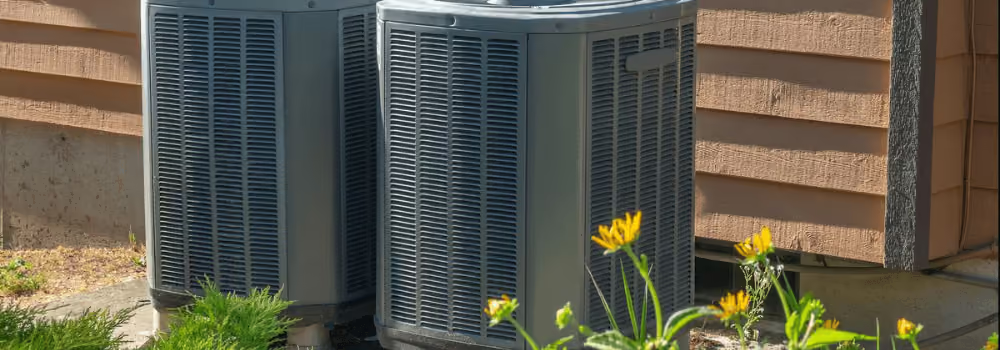
























%20-%20thumbnail.avif)




%20-%20thumbnail.avif)

%20-%20thumbnail.avif)

.avif)


%20-%20thumbnail.avif)