Host: One of the ways that acquisition entrepreneurship differs from zero to one entrepreneurship is that you need to adopt the mindset of an investor. Think about all those considerations we talk about here when evaluating which business to buy. Quality of revenue, longevity of the business, strength of the brand, customer concentration, return on assets, market tailwinds and headwinds, etc. We're doing the analysis of an investor. There are, of course, even more considerations for the acquisition entrepreneur, who will also be the one actually leading and living in the business. But when you're taking a first look at the SIM of a business for sale, most of the time you're thinking like an investor. And today we're going to lean into that. It was a pleasure to interview Rafael Quinn. Rafael is American born and raised, but in his 20s sold all his belongings on Craigslist and moved to his mother's native Panama. He's been there ever since. Over the last 13 years, he and his partner have built a holdco of three businesses in Panama and have more recently raised almost $30 million to look for larger opportunities back here in the States. What you're going to hear today is what this path of buying small businesses could look like if taken to the investor extreme. If you wanted to live here in SMB land but never be an operator, you just wanted to buy and hold businesses. It is possible. But it requires discipline and extreme patience, which are two qualities that Warren Buffett talks about a lot. And it's no accident that Raphael and his partner are aficionados of the Oracle of Omaha. So today's guest has a bit of a different profile than my usual guest, but plays in the same sandbox and has a lot to share about it. Here's Rafael Quinn, president of Alternative Holdings. Quick announcement everyone. An event you should know about In May, the M and A Launchpad Conference is bringing together searchers, experienced business buyers, owners and private equity investors for one day to go deep on buying businesses. Walker Deibel, author of Buy Then Build, is one of the keynotes and 30 other experts will be on hand sharing their expertise. It's happening May 11th in Houston. The organizers are running a promotion just for US$200. Off with the code acquiring minds. Go to malaunchpad.com and use the code acquiring minds. All one word or use the link in the show notes. Welcome to Acquiring Minds, a podcast about buying businesses. My name is Will Smith. Acquiring an existing business is an awesome opportunity for many entrepreneurs, and on this podcast I talk to the people who do it. A PEO run by a searcher for searchers. If you're running a company with less than 100 employees in providing health insurance, you could secure better benefit plans at a 15 to 30% discount through a professional employer organization or PEO. Aspen HR, run by search fund veteran Mark Sinatra, understands the needs of search operators and could be a great solution for you to receive HR compliance and diligence support. A powerful HR tech platform and Fortune 500 caliber benefits, all for a fraction of the cost. Check out aspenhr.com or contact Mark directly at mark aspenhr.com Raphael Quinn welcome to Acquiring Minds.
[4:07] Guest: Happy to be here, Will. Thanks for having me.
Host: Rafael, you've got a fascinating story both professionally and personally. You're sitting in your office looking out over the Panama City skyline there.
Guest: That's correct.
Host: Bit of a teaser. We've had two pre calls and there's so much to cover beyond just your story, as good as it is. So a lot of philosophy and learnings that have come from your 12, 13, 14 year adventure here. So let's get right into it. Start us off please, Rafael, with some background on you.
Guest: Sure. So my name is Rafael Quinn. I grew up in Santa Cruz, California, went to school at UC San Diego, studied economics. You know, growing up I was always interested in business. I, I remember I love trading cards, but not only just the trading cards, like the baseball cards for the images and whatnot. I loved tracking the stats on the back and I love most of all my Beckett price guide. So every month we'd get the Beckett physical price guide and I could actually see they'd had little arrows going up and down on the baseball cards. And that to me was like my mini stock market. So my first business I ever did was actually renting tables at card shows. Was probably about 11, 12, 13 years old. My mom would drive me up to some, you know, kind of hotel, little lobby room and they would have their tables out there and I would buy and sell my cards. So, so that to me was my first intro to business. Steady economics, Rafael.
Host: We are very close to the same age and I remember those card shows. I remember Beckett Monthly. I remember tearing into those Beckett monthlies enthusiastically to check the prices of my, the enterprise value, if you will, of my collection of baseball cards against what the current market value was. So just, just a couple of kids in the 80s, a couple of aspiring
[6:02] Guest: business guys in the 80s, upper deck came out with its baseball set, the Ken Griffey Ken Griffey rookie card card number one of that year. And that was just a defining moment in my life. You know So I was always into that, into investing, stock market, studied economics and went to work in financial services. I worked at Fisher Investments, they're a high net worth ass manager out of, out of San Francisco. And you know, my mom is Panamanian. So growing up I spent my entire childhood in the US But I would travel to Panama every year to visit my grandparents, my uncles, my cousins. And I always had this idea that this is where I wanted to end up living. I was really, you know, I wanted my kids to grow up with a big family around them. I knew that that's what I was looking for. So at, you know, 25, 26 years old, I came down to Panama. I interviewed for some jobs in investment banking and asset management and quit my job at Fisher, sold everything, I remember listing everything on Craigslist and made the move to Panama. You know, so at 25, 26 and you've been there since 2005. That was 2005. So I was probably had just turned 26 years old when I did the move and initially worked again in high net worth asset management, but at a bank down here in Panama. Within about two years that bank got bought by hsbc. So there I had a, at that moment that was a major liquidity event in my life. I look back on it, it wasn't that major, but to me it was, it was interesting. I had some stock in the bank, they had had some employee stock plans especially for people in the investment group. So I received some cash there. And you know, back then that was like 2007, 2008. Panama was just booming. We were going through just this massive real estate construction boom. There was a moment in time when the country ran out of concrete. They could not produce enough concrete to build all the apartment buildings they were building. You would look around the skyline and you just see those huge cranes for putting up all this, all the, all the high rises all over the place. And it was a moment where if you were into investing, there were a lot of opportunities from buying pre sale apartments and then flipping them as they would go up in value. There was just a lot of speculation in the market. And I did that for a couple years after I left the bank. Once the bank was bought, I just kind of invested my money and would put together deals with investors in different projects here.
Host: Well, I, I kind of actually remember that time as well. I, I, I may have been, that may have been when I visited Panama City, but I went to Panama for about a week and, and, and yeah, I mean it was the skyline of Panama City is, is really distinguished in Central America. It was at that time, I assume it still is. I mean it's, it's really impressive. Lots of tall buildings, you know, it, it, so, so it, it really kind of screams the business and development. This is, this is kind of 15 year old. My image of Panama City is 15 years old.
[9:13] Guest: It still does. It looks closer to Miami than it does to any other Central American city. I would put it that way. You know, it is a highly developed city. A lot of action, a lot of business going on here. I love it, I love living here. So yeah, you know, it was, it was through those investments and, and putting deals together that a buddy of mine called me up and said, hey, I know this guy, he's doing a real estate project. He's going to do about 250 mid income homes. And he's got the land, he's got his part of the equity, but he needs to raise 50% of the capital for the project. And I put together an investment group. We went into that project but I was the representative of the group. So, so the developer and I would meet on a supposedly monthly basis. But we really hit it off. We, you know, he was a huge Warren Buffett fan. He'd been to Berkshire at that point like eight, nine, ten times already. He had read everything he'd written. We shared an affinity for investing and those monthly meetings turned into weekly meetings. And we now weren't really talking about the real estate project. We were talking about all these other things that we wanted to do and we wanted to invest in. And well, he's my business partner today. That's how we met. So you know, one day.
Host: Is he a native Panamanian?
Guest: He was actually born in Colombia, but he's lived here in Panama since he was about 7 years old. So for all intensive purposes, he's Panamanian at this point. And one day he was, you know, it's funny, somebody asked me the other day, they live outside the US and they were saying, you know, how do you find businesses to buy outside the US And I was letting you know, I said, you know, it's funny because if you're in the U.S. if that's the only place you've looked for companies, you don't really know how good you have it. There's such a, an elaborate deal flow network to find opportunities that doesn't exist in Panama. And especially 13 years ago, you know, it did not exist. He was really walking down the road and he saw a flyer kind of pasted up on, on a billboard thing that said, you know, I sell businesses. And it was a Gmail email. And he emailed the guy and he got a list of like eight things and you know, it was, whatever it was, it was a fruit stand. It was, they weren't very highly sophisticated businesses. But he looked through all of them and one of them was an industrial sales company selling lubricants and filters, B2B here in Panama. And he had an initial meeting and then he invited me to look at the opportunity with him. And I knew nothing about lubricants, I knew nothing about filters, but the company was selling for about, you know, three and a half X on earnings. And I was so used to looking at the stock market where everything was 15 to 25x, or looking at real estate investing, commercial real estate, where back then I was Getting maybe an 8% cap rate here in Panama. And I look at this at three and a half times earnings and I go, this, this is a no brainer, we can't lose, right? I always say we were, we were more lucky than good back then. We were so naive in what we were doing, we didn't even see how it could go wrong, right? And after a few meetings we did a due diligence, we acquired that business and we didn't, he continued developing houses, I continued running my other investment projects that I was doing in that sense. We didn't quit our day jobs because we simply owned this as an investment. It wasn't a holding company, it wasn't any of those things. It was just an investment, a one
[12:32] Host: off investment between two guys who hit it off and, and wanted to do a, do a deal together.
Guest: And for me that was something I was doing in general. I was meeting people, doing investments. So it was very much what my day to day was like as during that time of my life. But when we bought that first business and I got to give him a lot of credit because these were his two rules, not mine. And again, he was coming from that Warren Buffett school. He said, one, we're not going to work there so we're going to delegate management. And that made plenty of sense to me because I wouldn't have known what to do running a lubricant business. And two, we weren't going to collect a dividend so we were going to retain our earnings which again we had taken on a bunch of debt to buy that first company. So there weren't going to be many earnings to distribute anyway. We needed to be paying off our debt. But those two rules guided us and those two rules are very much Buffett's philosophy. If you go down to it in the sense of he delegates his management to CEOs, he retains his earnings to continue building financial stability and acquiring more companies. And that was how we began about, I would say, nine months into that acquisition. We were really enjoying it. You know, we, we bought a business, the owner, operator, left the company, but he had a general manager, CEO type role that we promoted to be the number one at the business. He had about 10 years experience there, and we promoted him and he was running the company for us and it was performing as had been advertised, you know, and we were beginning to make payments on our debt and, and, and moving forward.
Host: I want to ask some follow ups here. Yeah. So first, going deep back into your personal story and your motivation for moving to Panama, you said you, you liked the idea of a big family. Say more about that. What does that mean?
Guest: Yeah, well, so my mom was from Panama, so her entire family lived in Panama. My dad grew up in Rhode island, so he had family back on the east coast, but he lived in California. And you know, I grew up as an only child. I have a half brother, but he was born when I was already 10 years old. So I spent those first 10 years of my life as an only child focused on my Beckett Price Guide and my, and my baseball cards, you know, and, and I remember coming to Panama and you know, my mom has three brothers, they each have three and four kids. So it, it's a large family of cousins and seeing them all be able to interact together and grow up together, and that was something that was just very appealing to me. The grass is always greener on the other side. Coming from being an only child, that looked great to me. You know, they were probably sitting there going, boy, I'd love to live in California. Right. And I wanted that for my kids. You know, I knew that I wanted to get married, have kids, and I wanted them to grow up with other cousins and siblings around them. And that's where I've ended up. You can see the pictures behind me. I've got, you know, married, I have three kids. My cousins down here are, we're very close. So my kids play with their kids, we go on trips together, we spend weekends together. And it's just, I, this was the right fit for me on, in more, in more ways than one. You know, professionally, obviously it worked out well. Lifestyle, it worked out well. Family, it worked out well. But I'm so glad I, I made that choice to just put everything on Craigslist and move, you know.
[16:00] Host: Well, it's interesting, Rafael, because you made this big personal. You made a big decision based on kind of a personal, family, kind of emotional reason.
Guest: Right?
Host: And but for a guy who was so business oriented, entrepreneurial from such a young age, you did in some sense make a sacrifice. You're obviously crushing it. So in retrospect, it wasn't a sacrifice, but us being at least, at least by reputation, the Mecca of business, you were leaving for a guy who saw himself getting into business, having a career in business, you were leaving the mecca of where your career would naturally draw you or draw anybody who really just wants to be a capitalist, a career capitalist. Because I guess the, this desire for a big Latin family was stronger.
Guest: It was. And to also follow that professional line. Fisher is a great company. I had a very good entry level position at Fisher. I had a great couple years there. And I also, I didn't enjoy my quality of life much. And now I always tell people entry level positions suck in general. Right. No one enjoys their quality of life at entry level, especially in asset management or finance. But I would look at my boss's boss and while he was making a ton of money and had a ton of nice things, I didn't think he had the greatest quality of life for me. So if there was a decision there as well, on the professional side of I am leaving this because I don't see a future here that's going to really give me happiness. Yes, it's going to give me a lot of economic benefit, but not happiness. And when I moved to Panama, I obviously took a big pay cut because the pay scale in Panama is much lower than it would be in the U.S. that being said, cost of living is also much lower. So when I comped it all out and looked, I said, yeah, I'm going to make less. My total take home pay will be lower here than it was in the US But I actually think I'm going to live a better life. And I don't think I was thinking far enough ahead to actually know. It's funny how you just said that. I mean, it all, it all comes back in a circle. We ended up investing in the U.S. and we're building our holding company back in the U.S. i ended up going back to the Mecca of capitalism anyway to invest with my partner, but this is where I chose to live.
[18:18] Host: It seems like you basically are having your cake and eating it too, right? You got the family that you wanted and the lifestyle that you wanted and also the economic Opportunity you ultimately have not had to really make a sacrifice there.
Guest: We did not. We did not.
Host: Yeah, cool. Awesome. Thank you for that digression. August Felker is a two time successful searcher. First with a traditional search fund. The second time around he did a self funded search. Today August runs Oberle Risk Strategies, an insurance firm with a dedicated practice group for searchers and acquisition entrepreneurs like you. If you've got a business under loi, Oberle will provide complimentary due diligence on that business's insurance and benefits program. A great no risk way to get to know August and team. They love helping searchers. They've worked with hundreds. Oberle is a specialty insurance brokerage for searchers by a former searcher. Check out oberle-risk.com O B E R L E- risk.com link in the show notes. All right, now back to this business. Tell us a little bit more about the terms of the, of the business. So the size of the business and revenue employees. Give us more of a picture of that if you can. And then how you put a deal together in Panama. What are the sources of leverage in equity, etc.
Guest: Right. So that company had about 25 employees back then, two locations. Again it was, it's a distributor. You know, Panama is a small country. We don't manufacture much here. So we, but we're a logistics hub. So we import a lot and then we distribute those products. So we bring filters from the U.S. we bring lubricants from Spain and we sell those B2B to businesses in Panama. Construction, transport, the canal, sugar refining, hydroelectric dams. Those are the types of clients that we're selling to. So the business had about 25 employees, was doing, I want to say about 5 million in revenue and was earning about 350,000 a year. This was 13 years ago. But those are the numbers I have at the top of my head. We paid about 3 1/2 x for it. We put 10% cash down, we financed 90%.
Host: Where did that 90% come from?
Guest: Private lender here in Panama. Again I had been putting together deals at that point for about three years. I had a pretty good network of people that I had raised capital from. So we offered or we received terms of 5 years interest only bullet payment at the end. But we could prepay the loan as we went and we had to give up 100% of the shares of the company as collateral plus personal guarantees of our own to pay it back. I would never Recommend Anyone do 90% leverage on a transaction. I've never done. 90% leverage on a transaction again, and I just would not recommend it. So many things can go wrong in a deal where you're just going to be out of the game really quick at that leverage, you know, at that level of leverage. We, I mentioned earlier, we were, we were lucky. You know, the one thing we did very well on that deal is we paid a very good price. We paid three and a half X. That gives you a lot of, of room to move around for things to go a bit wrong, and you can still at least make your interest payments. Also, getting at interest only for those first five years is critical because you're not having to amortize that capital down. Therefore, the cash flow being pulled out of the company wasn't too high.
[21:58] Host: But were you going to, were you expecting to refinance at the balloon payment or literally pay the whole thing, be
Guest: able to pay the whole thing off? And we began paying it off by the second year. You know, once we got our feet under us in that first year, we open a second distribution center for the company. We opened two more retail locations for the company. That's kind of where we use that organic cash flow in that first year. And then from then we focus on repayment.
Host: Okay, and one other thing for the audience who may not know, Panama is on the US Dollar. So when you say these dollar amounts, you literally mean everything's in dollars.
Guest: Correct. We don't even, we don't have a currency of our own. We've been dollarized since the country was founded.
Host: And just, just the visual that this was on, that this listing was on a flyer taped to the side of a. What, a wall, a fence, a telephone pole?
Guest: I wasn't there when he saw it, but it was just kind of plastered up and it, what, didn't have the listing of the company. It just said, I sell companies. And the guy was, I mean, that's a whole other story. That guy who brought us the deal, so he was a business broker. It was funny just to get the sim. So the information on the company, he wanted us to pay him $100 to make sure we were serious. So I remember we paid the hundred dollars for the sim, we actually closed the deal and he got his commission right. And then I don't know, probably six, nine months later, let's say we want another SIM from him and he asked us for another hundred dollars.
Host: Come on, guys, haven't we proven that
Guest: we're serious at this point? We just bought a company through you, you know, but yeah, it wasn't it wasn't as organized as the US Market.
Host: Yeah, yeah, I'll put it down for sure. Okay. And so the. And 25 employees, 5 million in revenue. That's again, let's do some contrast between US and Panama. That's I assume, a bigger company in the universe of the Panamanian economy than it would be here.
[24:00] Guest: It is a decent sized company. It's definitely not a big company by any means. It's still a small and medium sized business. Where I put where I've found this is through experience. The line in the sand of kind of small and medium sized business is in Panama is at a million dollars in earnings, pre tax earnings.
Host: Okay.
Guest: So in the US you can still be buying stuff pretty much up to maybe 3,4 million in earnings and you're still paying that 4 to 5,5 and a half x multiple. Right. And then as you start going up the scale in size, those multiples start creeping up and you start competing with bigger players here in Panama that starts to occur at like $1 million in earnings. So if you want to put it in perspective, that that was our experience. We were able to do three acquisitions in Panama, all of them kind of moving up, you know, 350,000 in earnings. I think the next one was like 380 or so in earnings. Then we did one of 800,000 in earnings and we were able to pay similar multiples. You know, they, they went up, but they didn't go up too far. Once we hit $1 million in earnings once where that was our line in the sand. We want something over a million dollars. The multiples just expanded. It was, it was very difficult. We have, we are still yet to buy a company that earned a million pre transaction here in Panama because the multiples didn't make sense to us.
Host: Okay, thanks, Rafael. And then, yeah, the not going to work there. So the, that your partner learned from Buffett, although it's not, it's not necessarily a big, you know, Warren Buffett doesn't have a monopoly on that concept. Indeed. On the other side of the spectrum, less serious people also kind of have this unrealistic fantasy that, oh, buy a business, put in an operator and the thing will just kick off cash. It'll be great. And of course that is something that we tried to disabuse everybody of on this podcast. And in the world of capital s search in the US the understanding for the most part is that the buyer is going to get in there and own and operate at least for a while. They're going to have their Hands all over all. You know, they're going to be in the business and then probably eventually work themselves to be working on the business, then maybe even, maybe out. But we don't, we don't even entertain the fancy fantasy much that you can buy a business and have an operator run it. Now that all said, of course that model can and does work. I've had guests that demonstrates that it works. Demonstrate that it works. Every business of any size is essentially business units, self contained business units that are being run by, by somebody who is not the owner. So, so there, there, there are, there are examples of this working everywhere throughout the economy. So just respond to all of that maybe and maybe orient, orient your response to the first time person who's thinking about buying a business and wants to do what you guys did, which is not work in the business.
Guest: Right. I think the easiest way to attack that or to look at that is the highest hurdle we still have to overcome to acquire a new company is the management continuity. So we look at hundreds of opportunities a year and what cancels, what filters the majority of them out is there is no management team that we would want to work with going forward or feel confident in delegating our business to going forward post transaction. So I can tell you yes, it can be done because we've done it and we've done it now on major transactions six different times. So yes, it can happen and no, it's not easy to find and you have to be very, very patient to find it. That's the easiest way to answer that. So I would say the part of our job that is the least numerical or black and white, and it's much more subjective, it's much more of an art, is, is this person who's going to remain running this company doing it for the right reasons, aligned with our values and can we work with them and can we trust them to run the business? And that takes time and mistakes and lessons learned to see what you don't want to then start to figure out what you do want. Yeah, in my experience as well as you move up in size, you inherit better management teams. That's not always the case, but in general you do because you simply have more money to invest in that because you just have a higher revenue business, let's say. So you're going to get higher quality of people and a deeper bench of people and that's going to enable you to, to feel a lot more comfortable about that decision. Okay. When you're buying, let's say sub a million dollars in earnings, you got to be careful. A lot of times you're gonna majority of those businesses are gonna be owner, operator and then just a very flat horizontal org chart of employees all reporting up to them and if that person wants to leave. And that's just a very easy no for us. Right. We need to have somebody there at least for sure. Option one and generally also a secondary option after in case that option one doesn't work. A bench depth of who we would feel comfortable with turning the company over to that person will usually for us either be. Nowadays they are the CEO. So everything we've done in the US for example, is the owner literally selling to us, is staying on running the company even post transaction. They are not rolling equity. They're just continuing to run the business. Previously in Panama, the three transactions we did were the owner stepped out, but had a number two. They were always in the operations side of the business because what we were looking for wasn't, I'm buying this, I'm paying 8, 10x. I need a ton of growth. It was much more. I'm buying this, I'm paying 3 and a half to 5x. I simply need it to do what it's been doing for this to be a good investment for me. So in that case, I'm going to lean more to an operations type person than say a commercial type person. Because that operations person, while they may not be able to have the strategic thinking you're looking for to just multiply the revenue of the company, they can keep the ship going in the direction it's going. Right.
[30:28] Host: Which is, which is more important for you according to your kind of mandate?
Guest: It is because of the multiples that we pay.
Host: Yeah.
Guest: You know, if you're paying 4 to 5x or even 5 and a halfx, I mean you're getting, let's just call it 20% unlevered returns. Right. So now if you're focusing on a business that has been around a long time, that does matter. I know people say, well, you can't just look at the past, you have to look at the future. Yes and no. You know, something that's been around 50, 60 years just has a kind of tendency to just keep moving on and going forward.
Host: Sure.
Guest: I know we have these big high profile cases of Kodak and Blockbuster that get disrupted. But let's be clear, the vast majority of businesses, once they've passed that, let's call it those first 10 years of entrepreneurial death zone, once they've gotten past that, they usually stick around as long as they are managed financially, conservatively. Right. They're not over leveraged, for example.
Host: Well, and then you. And one of the things many of my guests often talk about is you look for the soft underbelly where, where such a business could be vulnerable to disruption. So in a case of Blockbuster or Kodak, their business models were fundamentally disrupted. So you'll hear commonly from guests like the two big threats that everybody worries about are, are. Sorry, the three where that could completely up into business would be China 1, 2, Amazon 3, AI. So as you kind of, you layer those three on top and you say to yourself, could either of those three fundamentally disrupt the business model here? And if no, proceed.
Guest: Yeah. And I would. And I would add to that of thinking of how easy is it to kill this company? So not just disrupted in the sense that somebody's going to come in and build a better mousetrap or a cheaper mousetrap. Right. But also how easy is it to kill the company? We're always thinking about that. So that's going to come down a lot to customer diversification. So does any one customer represent a very high percentage of your gross profit? It's going to come down to provider concentration. So especially if I'm a distributor, how many brands am I distributing? Am I dependent on just one or two? And if they change their business model or decide to go a different route, is that going to kill my company? Are there any regulatory issues that I might be facing that could also disrupt this from the inside? As you can slowly start eliminating those risks or minimizing those risks. Add on a product that's being offered that you believe at least 10 years out is still going to be needed. So lubricants and filters, I mean, this was over 10 years ago. Now everyone would be saying, well, electric cars, electric cars could be an issue. I feel safer for our model because we still focus on B2B. I'm not seeing a lot of yet electric, you know, the massive turbines in hydroelectric dams, for example. These things still need lubricants and filters to function. Or the processing of sugar, the large agricultural equipment. That type of stuff still needs lubricants and filters. Or in the US water heating. You know, I always say people are going to need hot water in Alaska and that's where we sell water heaters. So I don't think that'll change in the next 10 years. So as long as you can find those companies, make sure they're difficult to kill. Make sure you have a very solid, trustworthy, capable management team in place. And then pay a fair valuation. You don't need much more to go right. For that thesis to work. You just have to be patient and really wait to check all those boxes before doing the acquisition. That's where the difficulty comes. It's the sitting on your hands for years sometimes because you haven't found anything that checks all the boxes is where this gets difficult.
[34:18] Host: Yeah. Which, by the way, is. Is also classic Warren Buffett that, that so much of the game is the discipline to be inactive, the discipline to. To not make bets and to wait for the, you know, the fat pitch down, down the home plate.
Guest: Correct.
Host: So and so, perfect segue to return to the narrative here. Rafael, pick us up. So it was going well. You guys got lucky. Your own word that you were lucky. Things were going well. Nine months in, and you say to yourselves, huh, this model's interesting. Carry on.
Guest: Yeah, we liked what we were doing. We liked what we were doing. And I remember we decided this is what we want to focus on. I'm looking at multiple different investments. He's looking at real estate development. And we're seeing the returns here are better. This can be done. No one else is doing it in Panama. So we assume there would be other companies available for purchase. And we make this decision of, this is the path we want to go for. We want to build a holding company where we use these retained earnings to buy other businesses. There was funny in the beginning, we called ourselves a holding company, but we only owned one business, right. So it wasn't much of a holding.
Host: A lot of people like that on Twitter. Rafael, you guys aren't alone, Right?
Guest: At least now when I'm on Twitter, I can say that I have multiple companies. Right. But what changed for us was we started actually introducing ourselves. We had a name now, Alternative Holdings. We had business cards. And we actually began when I would go to a meeting, let's say, and somebody would say, what do you do? I buy private companies. And there was a mental change in the way I would present myself, let's say. And in one of those meetings, guy says, I have a friend, he's looking to sell a majority stake in his company, Call Center. Business process outsourcing. And my business partner and I went, we met with them, and we negotiated our second acquisition. So we bought a business process outsourcing business that was focused in three different areas. One was call center. The second is what I would call manpower contracts. So it's where you're actually putting physical people to do services for a company that they don't Want to hire out. And the third part of it was what you all in the US call billing management for hospitals. Down here, we call it medical claims processing. So it's handling the insurance claims for a hospital or a doctor or a clinic with the insurance companies getting them their payment. So the easy way to sum this company up is you're doing things the client could do themselves, but they don't want to. And so we handle it for them. And we bought a majority position in that company. It was not 100% of it.
[37:02] Host: How big was that business? Give us a picture.
Guest: It was a little bit bigger than the other. Again, it was about $380,000 in earnings, but it was a smaller overall dollar transaction because we didn't buy 100% of it. The founder wanted to maintain equity and he had a capital partner who'd invested with him that wanted to maintain equity in that business going forward. So that was. We did that deal and for us it worked out. We were still very early in it. We didn't have a ton of excess cash to be investing in other things. So. So it worked for us.
Host: And what year was that?
Guest: 2012.
Host: Oh, that was 2012. And when, when was the industrial lubricant?
Guest: 2011. 2011 is when we began.
Host: Oh, okay. I thought there was the. The gap is yet to come.
Guest: Okay, the gap is about to come right now.
Host: And so on this business that the BPO business process, outsourcing business, did you guys yet have this rigorous filter of leadership? Leadership. We need to, we need to find somebody.
Guest: No. Who's a good leader. No, no, no. I wish we, you know, that company, when we bought it, the founder actually stayed. He maintained shares. He was a director and he stayed as CEO initially and about nine months in. Both sides could see that it wasn't going to work. Our model of cash flow driven maintain the ship was very different. He was and is a born entrepreneur. He's somebody who is just always looking for the next business line to start. And all of them were draining cash from the company. And we were looking at going, look, we bought this based on producing this amount of cash. We at least need this amount of cash. Yes, we can analyze deals, but it's or investments because it's going to be a much slower process. And that didn't work with his speed. So we promoted somebody shortly thereafter from inside operations again to take over. He stepped down as CEO and went to run. He had other outside businesses that he could run as an entrepreneur and he remained though a shareholder and a director of the company. So we still have a great relationship with him today, but that was how that business moved forward.
[39:11] Host: A good, a good moment to really emphasize this point that you self identify as an investor, not as an entrepreneur. I see somebody who's built 100 building a holdco that feels like kind of, it's gray. But I would call you entrepreneurial but really right. If you, you know, look in the mirror, you see your. And with Buffett as your kind of as your guiding light, you guys are investors first and foremost. Foremost well ahead of self identifying as entrepreneurs.
Guest: That is correct. And I would say if you ask my partner, he would say the same thing. You know, I, if tomorrow the stock market provided us an opportunity to buying top flight companies at six or seven times earnings, I would have no issue and I'm sure he would have no issue either diverting our cash flows to buy those stocks rather than another private company. So we will go where the attractive return is. That being said, we are very focused. So it's not that I'm sitting here looking at any type of investment that's around. That's not what we do. What we have determined that as of today, in the space that we're playing in this size of company, the most attractive returns are buying majority to 100% stakes in private companies, selling it 4 to 6x let's call it. We believe with our background and skill set to identify the right company to buy and the right management team to continue taking it forward, we've shown that that's a high likelihood of providing us a good return.
Host: Carry on. Rafael. Tell us how it went with the BPO business.
Guest: Yeah, I mean that company again in the, the first nine months were a little, I don't want to say rocky because the underlying business was solid. We did have some issues. I mean this is not, I say, you know, especially on Twitter, this everything. I try to paint a very honest and transparent view of this, of doing this on Twitter. I don't want to make this sound easy to anyone. So here's some of those horror stories. You know, two weeks after buying the second company, the CFO quit. That is never a good sign when your head of accounting, your head of finance quits shortly after a transaction. That's not what you want to see. And we went in and the books on the surface were perfect. And again, we had done a light audit. The reason we did a light audit there is actually our auditor of our first company was the auditor of this second company. So they'd been doing their books for years. So we simply back channel them. See, is this clean? Yeah, this is clean. Everything's fine. We've already been auditing them, so we didn't feel the need to do a full fledged due diligence on this. You know, chalk that up again to mistake. Never. We never did that again after this experience when we went in, when he quits and I actually go into the accounting department and look at, at the books. What I find is on the surface everything looks fine, but behind it he had what's called a bridge account where he was matching things and just throwing the numbers in there to make sure that they all look good on the surface. So the first thing I assumed was this could be a fraud. And it was concerning, to say the least. So for the next six months I worked in the accounting department. I was the head of accounting. I had a junior. She, she kind of did all the registry stuff for me. So I would look at it, I would try and start unwinding what he had done to make it make sense. Rebuilding our financial statements going back a couple years. She would help me with the data entry. She hadn't even graduated yet, didn't have her, her CPA license. What's funny is today she is for that whole group of bpo, she's our head of finance.
[42:53] Host: Oh, nice.
Guest: So she's still with us today. I have a super good relationship with her because we spent those six months just in this tiny little accounting office working through all these issues. I remember I used to sleep with a notepad by my bed because sometimes I'd wake up at night and I would have an idea in my head of how we could mix, unravel something and I would jot it down to then execute it the next day. And that, that was a blessing because I had taken accounting classes in school, I had studied stocks, I looked at financials, but I'd never done accounting. And accounting is so important in business, especially if you're going to delegate management. Understanding financial statements, truly understanding them, being able to read them, being able to pick out any types of errors is a superpower to have. And I really learned that by being in that accounting department, doing that accounting. It ended up not being a fraud. It just ended up being a lot of disorganization from the head of finance's part. We were able to reconstruct those. There was no issue and we moved forward. That company today has about 350 employees. We now continue to do call center, we continue to do medical claims processing, we do the manpower contracts. And we also do logistics services for the financial sector in Panama. So Panama still we don't have a great national mail system. It's pretty much non existent. So if you, it's a small country. So if you need a new credit card or a credit card being renewed that gets delivered to you in person in Panama. Also the checks, all the documents that need to go through clearing the clearinghouse every evening are done physically transported around. It's not all scanned like it is in the US yet. So we provide those services to the majority of the banks in Panama and that company has, it's nearly 3x'd since we got it. So that's been a, that's been a solid performer for us.
Host: Where was revenue in 2012, did you
Guest: say revenue on that business was, it was lighter. It was probably about 4 million. They had decent margins and they were earning about between 350 and 400,000 or so.
[45:07] Host: So I guess you're calling 10% or high single digits decent margins because you're comparing it to a distribution business which has notoriously lower margins.
Guest: That is that, that is correct. And again, let's be clear, business process outsourcing is not a high margin business either. Because your client knows exactly what this would cost to do. They could do it themselves. I mean, yes, some of it can start to have more complexity, but if I'm literally putting employees into your company for you because you don't want to have to hire them, you know what those people are going to cost. So it's not like I can mark this up a ton. Where the word the economics of that business get interesting is always being very constrained on your management group and building out, you know, economies of scale over that management group. If you can be efficient there and continue to add on all these contracts and oversee them with a very tight knit management group, that's where that business can become decently profitable.
Host: So it's doing, call it 12ish million today.
Guest: It's doing a bit less on the revenue side, but we've picked up better efficiencies. When I said 3x it was more on the profit side. It's doing just a hair under a million dollars in profit now.
Host: Okay, Rafael, we're in 2012. You've survived the transition after six months
Guest: where things get really boring.
Host: Yeah. So take us into your dry spell here and what you learned from the that.
Guest: Yeah, we, I'm not going to say we were bored because we were taking meetings almost every day of every week to look at companies, you know, now we were starting to build a bit of a reputation as somebody who would buy companies. Now what starts to come to us, lots of companies that aren't doing very well. So everyone hears about these guys who have now bought these two businesses in Panama and now any company that's failing, they want to offload it to us. They assume that we're turnaround artists. So we start getting a lot of those. We start getting startups, we're just getting offered. We start getting deal flow. It just starts to become deal flow. It's not the deal flow we want, but it rarely is. It's just you get flow. This is a numbers game. You know, I say a lot is you need especially early on work, put the reps in, get your repetitions done, focus on just seeing as many opportunities as you can so you can quickly begin to identify what you don't want so you can get through them quickly to then move on to what you do want. So the value of those years was huge for us now because we saw so many different opportunities and so many things that we didn't want to buy. We weren't bored because we were also continuing to oversee our two companies trying to improve on them. Some things were going well, some things weren't going well. Trial and error. And you know, it's funny, back then, you know, my business partner and I would go to everything together because there wasn't much more to do. We only had two businesses and we're looking at deals all the time. So we would like. I would spend more time with him than I would spend with my wife. And we would just be always together. Our offices are right next to each other. We're in the car together going to meetings. We're in the car together going to meet with our CEOs.
Host: Rafael, how are you guys paying yourselves at this time? Are you taking salary out of the two businesses you've acquired?
[48:04] Guest: We're taking salaries and they are very light. Yeah. So we still have never paid a dividend out of the company. And I don't call our salary. It's not like, oh, I get a salary, but it's a quasi dividend. We pay a salary that we believe if you combine the two, is what it would cost to hire a CEO to do what we're doing for the Holdco. We were both still young, you know, I was 32, he was 29. We didn't have kids. And it was a time of our lives when we could do that. We weren't living the big life or anything like that. And we drew A salary. That's still how we get paid today in the sense that we draw our management company, that we have bills out to each of our subsidiaries, a monthly amount, and then that goes to pay for this office and the employees that are here. It's a very small office that we have at the corporate level, and it pays our two salaries, our travel expenses to go see new opportunities, et cetera. That's how we do it. We don't. We've never taken a dividend. So we're looking at all the opportunities and we're not buying anything. And that's 2013 and 2014 and 2015. So you can imagine you're three years looking at things, you still only own the two companies. I remember at one point our wives would joke and say we were retired because there wasn't much action. You know, we're not running the businesses. If people say, oh, so. But you're the CEO of the lubricant business. No, I'm not. That's this guy. Okay, so what. What do you do all day? I mean, it was. It was a running joke. And I remember there was a moment where we sat down, I still have that document. And we again reanalyzed what we were building. And we said, there's three options. We can you become the CEO of lubricants, and I'll become the CEO of outsourcing. And we're going to build those two companies to be the biggest they can be in the region. Right. That was one option. We can continue our plan, this Berkshire Hathaway type model where we're just going to continue conserving cash flow, we're paying off our debt, obviously. We're also trying to conserve cash flow and prepare ourselves for that next acquisition where we're going to continue preparing and eventually that deal is going to come or we're going to do. I don't know if You've heard of 3G Capital. 3G Capital is a Brazilian firm. They have AB, InBev. They've done the Burger King deal. They also did Kraft Heinz with Buffett. So where they do more, instead of it being one holding company, it's more major transactions, let's say, with different investment groups. Okay. And we wrote those three options on a piece of paper. We wrote the pros and cons of what they would look like and what our lives would look like. You know, we were very pragmatic in that sense. And. And I remember sitting there and going, I don't want to be the CEO of a lubricant. Company like that isn't what I grew up wanting to be. I want to be an investor. And he was like I don't want to be CEO of a lubricant company either. You know, so that one it was easy to kind of get rid of. And, and I think we kind of left the 3G capital on the table as a possibility. It was more, let's just see what comes up. That was more of a, well, imagine a bigger opportunity comes and we can't get majority of it, we can't buy it all. Would we be willing to maybe do something outside of the holding company with other investors and run it like that? And we said well we, we're going to leave that on the table. That could happen but we're going to continue on our path, you know, of building this mini Berkshire, let's say. And I say that in the most humble way possible because you know, anyone who really knows Berkshire understands that is the combination of an insurance company with a float and the greatest stock picking mind of our generation is what has made that we want to just have the part of the private companies which is like just a piece of what he's done.
[51:58] Host: Did you guys sit down to decide, hey, what are we doing here? What is, what is going to be our philosophy approach going forward out of frustration or desperation that three years had come and gone or no, that just happened to happen in this time frame
Guest: was out of free time, I would imagine. We had a lot of time to talk. We would talk a lot. I mean we would just, it was how we met. We would talk about investing and talk about ideas and talk about different ways and different stocks and we would look at stocks and we would. Those were our conversations. We spent a lot of time together. So naturally the what are we doing here? Also came in. But it wasn't so much like we haven't found anything in three years. We're freaking out. We have to lay a path. That was not the, the impetus of that conversation. It was much more just through our natural just spending a lot of time together and talking that it came out. But I remember because I actually I still have that document today of what we wrot note down of what our kind of our paths could be. And we once again decided this is what we want to do. You know, there was a big part of what we've built has been based on where the two of us wanted to end up in the quality of life that we wanted to have. And that's why we're doing it. It's so important to understand that it's. We didn't do this because we saw a bunch of other people doing it and it looked like a way to get a lot of money. We did this because we really wanted to build this. We wanted to be investors. And this was the niche where we saw ourselves being able to do that and earn those outsized return and actually be a true investor.
Host: And Rafael, when you said you wanted to be investors, is what draws you to that self view because for a lot of people, I think being investors appealing because there's a lot of money in being a successful investor. But you're actually saying you want to be investors, professional investors, you love investing, but it's not actually the money piece that turns you on. Is it just the intellectual game of it? Is it just the what the work entails is fun for you sort of thing?
Guest: Yeah. You know, I remember, I forget who, who said this, but you know, think back to what you did as a kid just for fun and if you could figure out how to do that for work, that's what you should do. Obviously, that's like there's Beckett Muslim again. Yeah. It doesn't. Correct. I loved sitting there tracking the cards and, and, and organizing them and then reorganizing them and then seeing the stats and seeing the prices and I, I could do that for hours alone in my room. I do the same thing today, except today it's a bunch of Excel spreadsheets of a bunch of different companies that I look at in different ways. I still, I have, there's no analysts that work in this office. We don't have an analyst. We still do all of our own deal flow. We analyze every opportunity. We, we, we make all the investment decisions. And while I have accounting departments and CFOs who send me Excels, I still build. I still have my own, you know, off grid file of Excels of how I break down my companies and look at their KPIs and measure them and track them and try and glean insights of how that performance is going to come. And that's something that I could do for hours alone in this office and not get bored. I would just get lost in them. It's pleasurable in that sense to me. So when I say I wanted to be an investor, it's simply because that, you know, when I wanted to be an investor and I was at college, I remember my first internship was at Morgan Stanley Dean Witter, and I was an assistant to a stockbroker. And I quickly learned I didn't really think I wanted to be a stock broker. So then I went to work at Fisher Investments and High Net Worth Asset Management. And in essence I was just a sales, a back sales support because a lot of that business is simply selling. You know, I was assuming I was going to go be, I don't know, Gordon Gekko and trading stocks for Ken Fisher. And I realized that's not what that is. And I saw the trading desk of a Fisher Investments at that point managing about, you know, $50 billion and it wasn't that either. And I continued looking and then I moved into High Net Worth Asset Management in Panama and it wasn't that either. And, and this was the niche I was able to find that actually fulfilled that kind of day to day tax of what I enjoy doing. Right.
[56:06] Host: It's great. This is so, this is great. Rafael, I love the way you're putting this. It's so clear. And maybe it took a while for you to arrive at this clarity, but now it's very clear. And by the way, you know, your point about you just got to put in the reps. Helpful when those reps are pleasure for you. Because when we say put, when we say put in the reps, typically we mean just suffer the grind.
Guest: But it's kind of gritty work no one wants to do, but kind of for you.
Host: You know, you're Arnold Schwarzenegger in the gym. I mean he's, he's having a good time in there. He's not suffering.
Guest: I was at, I was at Holdco Conference in Cleveland. My partner and I were there last year and there was a searcher who was there and she was, you know, she was young and she was recently out of, out of college and she was a searcher and she had her committed investors, great school, et cetera. And I remember talking with her because she was only looking at off market deals. And I said, well, why aren't you looking at broker deals? Why aren't you looking at all market deals? Oh no, you know, the multiples and they don't add value and this. And I go, yeah, but you just want to get your reps in. I mean brokers have deals, even if you don't ever do any of them, look at them and keep looking at them and analyzing them and engage and speak to business owners and speak to the brokers and learn it because that's what you need to be doing at this point in time and continuously. So she's asking, well, what's it like once you already own something? And I go Well, I still look at sims every day and talk to brokers and talk to business owners. I mean, that's what I'm doing all the time. She goes, so you're just always in search mode? And I go, I mean, I never really thought about it like that, but I guess, yeah. And the look on her face was just abject. It was like, that's the last thing she wanted to be doing. She's like, I don't want to have to be in search mode for the rest of my life. I was like, well, that's what this is. I mean, unless you're simply going to buy one company and you're going to build that one company, of course the search mode will eventually end. But if you're, if you're going to do the structure that we have and I'm not going to go day by day working in the companies, well, then I need to be adding value. And if I'm going to add value and how I'm going to really move the meter is spending a lot of time looking at a lot of deals that don't work. But on average, if we can close one a year or one every two years, that will massively move the meter. And I know it will add way more value than what I could add if I was day by day trying to sell lubricants and filters.
[58:27] Host: Yeah.
Guest: You know, I would be a terrible salesman. So that's where we add our value. And luckily I enjoy it, you know, and I think my business partner does too, because I see him when I go into his office, if he's not looking at a sim of a private company, he's researching some stock. I mean, he spends all day long as well, just reading about stocks and reading about business is what we enjoy doing.
Host: Yeah.
Guest: So.
Host: Well, that is such a great moment that you had at hold coconf and distillation of you versus so many searchers because, yeah, I've never really thought that there could be any other interpretation of the search process than it's just something you got to get through. Nobody enjoys it. How wrong I was. If you're an investor, the search is the fun part, actually.
Guest: It is, it is. There is a bit of excitement when you close the deal. I won't lie. It's when you close that deal, there's excitement. It's a lot less exciting now than it was back then because now I know all the things that could go wrong starting the next day in the operating company. So I don't really start feeling good until I Start seeing those consistent continuous cash flows entering into the holding company account every month. Once that starts going clean and we're minimizing our underwriting risk on the transaction, that's when I, I, I, I, I take a breath, I take a breath and I go, okay, that was, that was a good one. But the day by day enjoyment of it is the search and also the tracking of the, of the OPCOs that we have underneath us and seeing how they're growing and how they're developing and how different investment plans are functioning. You know, the CEOs bring us ideas and we invest in them. And I track those just like I would track a company we just bought and they have their ROIC tables and what they promised us and what they're delivering to us. I almost look at it like a little report card for each of my CEOs because then the next time they come and ask for money to do something, I go back and I see, well, the last time you asked for money, you promised me this and this is what you delivered. Oh great, let's go forward with this. You know, well, no, this didn't really work out. Why didn't that work out? Let's have that conversation. Let's see if this next one we're going to learn from our past mistakes or maybe. No, just stick running what you're running and let's just, you know, we'll look for something somewhere else to invest that money.
[1:00:35] Host: Great, Rafael. Okay, so let's get back to the story. 2013 and 14 in 15 pass. Somewhere along the way, what you guys are building crystallizes. By the way, that piece of paper you wrote it down on, I assume at some point it'll end up framed on that wall behind you. Sounds like kind of an epic piece of paper in your life. And then what?
Guest: And then in 2016. Let me backtrack one sec. During one of those multiple conversations we would have, my partner and I, we would also talk about what businesses, what industries do we want and what industries do we not want. Okay. And in those conversations back then, again, we were very focused on cash flow. So heavy capex businesses were a no. We didn't want to be in construction. Heavy machinery manufacturing. Again, manufacturing in Panama is pretty non existent, so that wasn't going to be an issue. But we knew what we didn't want to invest in. And we're pretty much open to look at anything else just to see if it would work. But one of the industries we said that we probably wouldn't want to invest in Was restaurants. Why? Because restaurants have a high likelihood of failure. It's the story you always hear. Whatever, nine out of 10 restaurants fail in the first year. I don't know whatever that stat is. But when we had that conversation, there were three restaurants in Panama we said we would consider buying. And they are three. I'm sure you have these in your hometown of just. They've been there forever. It's like a part of the local community knitted into the fabric. Yeah, they just. Everyone goes there, from the receptionist to the CEO, the grandpa, the grandkids. It's just the place you go to. And it might not have the best service or the best decor, but it's got good food, it's consistent food, a good price point, and people love it. Well, there were three of those that we identified in Panama and said if any of those three ever came up for sale, we would buy them. Fast forward to 2016. An attorney reaches out to us and says, hey, a client of mine is interested in selling his business and he is very particular about who buys it. He says that he'll only sell it to somebody who guarantees they will not fire anybody and they won't change anything. And I told him, I know these two guys and that's what they do. They don't even work at the companies. They just buy them and they let them go and they let them continue doing what they're doing. So I think you guys should meet. And it was the owner of one of those companies. It's called Athens Pizza. It's a Greek pizza restaurant. So just think of pizza, salads and giros.
[1:03:04] Host: Okay?
Guest: And there were three locations and he'd been around about 25 years. And the logo of it is this guy with this big handlebar mustache. By this point, he trimmed the mustache down, but that was. That is the owner, the logo of the company. And I would eat there once or twice a week before we bought it. I loved this place. And it was one of those three restaurants we'd said we would buy if it ever came up, it came up for sale. We went to the meeting. He showed us his financial statements. He said he was asking. He showed us his right hand woman who had been there with him for about 12 years, who was gonna stay running the business going forward. We shook hands and that deal was done in 90 days. I mean, we didn't have to negotiate price. We didn't have to. It was just his ask was fair. Everything was fair. He was a straight shooter. He really was. He was. He was a very class act guy in that transaction. And, and we bought Athens Pizza. And you know, that business was doing $800,000 and we paid about 5x for it.
Host: 800 in earnings?
Guest: Yeah, earnings before taxes. I don't use EBITDA for when I'm valuing a acquisition of a company because I'm focused much more on cash flow. His restaurants were heavily depreciated at that point because he'd only done those three locations and they had now been open for multiple years. A restaurant company with rapid growth or recent growth, especially if it's high versus the base it's coming from, EBITDA is an interesting number to look at because there will be just heavy depreciation initially that will then tail off in that company. It didn't really matter because most of his assets were fully depreciated or were very light depreciation at that point. And that was a game changer for us. That was a big transaction. In essence. We had just doubled the size of the Holdco. It took us four years of looking for a deal, 2012 to 2016 and a lot of patience. But making that acquisition, it really moved them. It moved, it moved the needle, you know, and it put us on the map. That was an institution. It is an institution in Panama at that point. Then you can imagine the next day we started getting every single restaurant that was not doing well, came knocking on our door to sell. We were just inundated. Everyone just assumed we were restaurant owners at that because it was such a well known place. When people found out we bought it, it was, it was news in that sense.
Host: Well, that's, that's one of those, those businesses too. That's kind of. Not that you are checking this box, but you could have that. It's kind of a vanity acquisition as well. Fun to own. You know, the favorite neighborhood institution, a pizza place. Your kids, you know, you can take them, you know, dad can take the kids to the pizza place that he owns. You probably, you know, have part of your celebratory dinner there the night you close on the transaction.
Guest: All of it. You know, the part of the kids definitely entered into my mind when we did the acquisition. But as far as the vanity part, I just, I want to touch on that word because I think some people can think of, you know, a restaurant and this beautiful. The ambiance and you're going in and you're saying hi to the people and that type of stuff. This isn't that type of restaurant. Okay, this. And that's what it appealed to us. We Love this business. This is important to touch on is we always say we're industry agnostic, so we don't really care about the industry. But we're very focused on the business economics of the company that we're buying. And this restaurant is a perfect example. These restaurants had pretty low cost furniture. They are not a highly fashionable place. It, it just isn't. That's the reality. We've now done an upgrade and made them a bit more, but they're still relatively inexpensive to open. And that is really important when you're going to take a risk for new openings. Because the only way to really grow a restaurant quickly is new locations. Correct. So if those each cost a million dollars to open, that is going to get really expensive if you make some mistakes. But we've been able to open our locations at about $300,000 in Panama. A U.S. version would cost more just because of construction costs. But to open that at that, at that cost level allows you to take risks and to grow your business. That was one. Another interesting thing was that the types of food that we sell are in essence the same 20 or 30 ingredients just mixed differently. You know, a salad and a giro are pretty much the same thing. It's just one has the bread on the bottom and the tomato on the top and it just kind of goes like. So you don't have a lot of food waste. You have good cost of goods sold in that sense. Because you aren't having a wide variety of different foods that then don't move like you would maybe in a high cuisine type restaurant. The price point per person average ticket was eight to nine dollars. Anyone could eat there. Panama is a growing country where low income is moving into middle income. And you want to have that tailwind behind you as those people can move up and start to move from eating the street cart food to that first fast casual food. You want to be in that price point. If you're doing it $20 a person, you're gonna have a much more limited market of who you can sell to. And then the process in the kitchen. This wasn't a restaurant with some chef who understood all the recipes and was directing everyone. This was an assembly line kitchen where everyone had their position. This guy, you know, chopped this guy, added this guy put in the oven and it just moved. On this assembly line, he had designed the menu so that every dish came out within 13 minutes of being ordered. Because his whole concept was on everyone getting served at once and fast rotation of the tables. So when you look at the business Economics of that. That's why that restaurant was interesting. Add to it the fact that it had already been open, you know, say 25, 20, 25 years. So it had that built in loyalty of the customer base. And that is your moat. At the end of the day, you know, consumer facing brands and products, especially food or drink, your moat is that brand loyalty. Imagine you go to a brand new restaurant, just open up down the street and you get served horrible dish, your first time. You're never going back. Now imagine the place you've gone to, you know, 10 times a year for the last 20 years and you get a bad plate, you're going to give it another chance. You'll probably give it two or three chances before you go. Boy, this place has just gone downhill. You know, you've got that built. I mean the best example is Chipotle. My God, Chipotle gave people E. Coli like three different occurrences over multiple years. And people still are going back to the burritos and they're still growing. And it's because they have that brand loyalty that is their moat. You know, start Starbucks has that moat. Starbucks could serve you a bad coffee for a year straight and you're probably still going to go back and give it another chance just because you've had so many good experiences there. And that was why that restaurant made sense. We were then offered a bunch of other restaurants and they did not have those economics and they did not make sense. So we didn't buy them. And that, yeah, that was, that was 2016.
[1:10:03] Host: And now that business has actually grown a lot as well. Even though that wasn't in, as I understand, never is your aim. In fact it has. What's happened with, what's happened with pizza?
Guest: We, we now have 20 locations. 15 are corporate, five are franchise. The, the franchise model built out more of a necessity of cash flow than anything else. We were offered a location very early. Post transaction. We had decided to build one more location. We found a great corner locale that became available and we wanted to open there. And we were offered a second location in a mall. And Athens had never opened in a mall. We didn't have the money to do it because we had taken on debt for the acquisition. We were already building one and the mall actually brought us a franchise operator and said he would like to franchise the location from you. So that's why we developed it. And we've gone on to have that same individual open four different franchise locations with us.
Host: So a single franchisee.
Guest: Yeah, we have one other that has one Location, but it's very close to the Costa Rican border. That's more just for distance of management. It makes much more sense to have somebody physically up in that area. It's called Davit. It's a city up near Costa Rica. He just has one single location. And together those are the five franchises. Okay, so, so yeah, it, it has grown.
Host: What's the, what's this, what's this hesitation in your voice?
Guest: Well, it wasn't easy. We went that growth story. There's a good lesson in this. You know, we looked at that business. You have to backtrack a bit to understand it, to see where we get to. Basically 2016 occurs and we go another four years without a major transaction. Okay. After the, after buying the restaurant, we do three bolt on acquisitions, so smaller acquisitions, but they didn't consume a lot of capital. So we start, you know, getting towards the pandemic, let's say, and we've accumulated a good cash position now off, off the holdco. And at this point we've already branched off and begun looking into the US because we're just not finding anything. We touched on this in the beginning. We're not finding anything that earns over a million. And that was our new kind of line in the sand of what we wanted to buy. And we're not finding it in Panama. So we start to look in the US we still haven't found anything yet though. We have this cash and we look at Athens and we say, you know, there, there is room to grow this business. This business has proven itself. The economics of it, we can do that. But we did not feel comfortable with our management team. We'd promoted an operations head to be the CEO and we did not feel comfortable that they would know how to run 15 locations. Let's say we brought in an outside CEO with a lot of experience of growing restaurants. He came in and took over the company. And the pandemic hits. We're not going to open any restaurants during the pandemic, obviously. But he, you know, pivots delivery, third party apps, maintain the ship. And he, we had hired him with a plan of let's get from five to 20 locations. At that point, we were at five. We had our three original. The one we opened in that one franchise location. Let's go from 5 to 20 over five years. That was our goal. And he came back to us during pandemic and he said, let's get there in two years. And here's why so many restaurants have shut down in pandemic. That we are going to get an opportunity to get prime locations and what are called second generation locales, which means that it was already a restaurant. Therefore your capex is going to be much lower. Therefore we're going to do it faster but cheaper and we're going to end up getting a much better roi. And we did that, we executed that. I think if you take, I don't think I know this. If you take each of those locations and study their ROIs, they were all highly successful. So the, the thesis there played out. What we didn't bake into is the operational headache of going from 5 to 20 that fast is, it's disruptive, it's, it's a lot. It was not an easy process. You have to build a whole production center, a logistics chain. You have to have all your admin put together, you have to be building out processes and you're just going very fast, you're running very fast. I look back and I go, it was the right idea to go from 5 to 20. Without a doubt. I think both my partner and I would say if we could do it again, we would have taken the initial five years even if it cost us a little more because we probably ended up paying that and then some and mistakes on the operational side because of those growing pains. Plus add on the amount of stress it caused of facing that. And I wouldn't recommend going at that pace again. You know, my hat's off to the people who can grow that quickly or who choose to grow that quickly, but it's not our personality. Again, I think that would be the one change, you know.
[1:15:06] Host: Yeah, well, and that not your personalities. And it also just reinforces I think the, the long term patient capital compounding oriented model that you have. You're not in a rush to make, to get rich. You're getting rich slowly a la Warren Buffett.
Guest: That's right. And if, if that had been represented to us and it was just let's get there in two years because let's get there in two years, we would have said no. The reason we said yes is because when we saw the plan, the returns on that investment made so much more sense because of those second gen locations that it seemed like a no brainer on looking as just as an investor. It was a no brainer to run that fast. But we didn't weigh the operational headache that that could become. Well, it worked out.
Host: Two, two reactions.
Guest: It's fine, you know.
Host: Yeah, well, two reactions to that. First you, you probably in your defense, it was also this very much this moment in time, you thought that you had this window of opportunity where Covid had decimated all this real estate was coming online. And so it was either strike now or lose this great buying opportunity. And Warren Buffett, you know, he would say, buy. You know, buy when there's blood in the streets. Right. So. So you probably perceived a good buying opportunity. And, and so. And that wasn't going to last very long.
Guest: Yeah. And if I look back, I would still say the locations that we were able to. To get then would probably not have been available now. So in that sense, there was an added value. As long as those locations remain open for a very long time, you'll pick that up. You know, I'm looking at this still. We're about four years into that plan. So I still can't say that if in six more years you asked me, God, I was. It was so worth the stress of the two years, you know, three years, because look how it's paid out right now. We're just coming out of all the stress. And so it's still a little stretch in my mind, which is why you saw, yeah. You saw the PTSD kind of hesitation there. My face. Right.
Host: Well, and then the other thing to just call out, as you put it, was like, you know, on paper, it looked great. The economics of this investment looked great. We underestimated the operational lift that it would be. I feel like that's a perfect encapsulation of search itself. I mean, so many people come into this space where they do the napkin math and they're like, wow, that is amazing. Let's. Let's go. Not, not realizing what it's actually like to get in and run a 30 person plumbing company. It ain't easy.
Guest: And then. Or even more so, they do one and they go, wow, that, yeah, this seems easy. And three months later they do another one. And I'm always like, how do you have the bandwidth to handle that? You know, I think it's also one of the caveats with a delegated management. I mean, we were assuming that that operation had been baked in because we're delegating that operation. And, hey, it worked out. The restaurants are open. They're. They're all hitting their investment numbers. It was just a bit more traumatic experience on the inside to get here than maybe it needed to be, but I would still do the growth.
[1:18:11] Host: Okay, so that takes us up to, I guess now. Has there been any. Have there been any other acquisitions there?
Guest: Well, well, in Panama, no. So, you know, after 2016, we did three what I call bolt ons, which were, you know, we always wanted to go bigger. So we bought 350,000 of, of of income. Then we bought, you know, 380. Then we bought 800. Then we said the next one we have to buy is a million and we weren't finding it. So we did bolt ons and that. We bought three companies that were earning much less. And it was funny, they ended up, actually it was one for each of our verticals in Panama. We bought the Cinnabon franchise in Panama. They had about 10 locations. And we bolted it onto restaurants. We bought a steel cable distributor that sells to the canal, to the tuna fishing, to the ports. We bolted it onto industrial sales. And we bought a logistics company that was focused on the finance industry. Bolted that onto business process outsourcing. And I mentioned what they do earlier when I look back on that time, you know, my partner and I have discussed this a lot. Would we do those again? And I can say Cinnamon's been okay, cables have been okay, and the logistics company has been excellent. It really, that's been a great investment. But would we do them again versus simply again being patient, preserving our capital and waiting for that next big strike, that next big acquisition? And we both lean to the latter because while they did, while I can look at them as isolated cases and say, well, it was a decent return or an excellent return on a percentage basis, the dollar amount of what they were earning, even with growth, didn't really move the meter for the entire Holdco. And at the end of the day, what we need to be focused on is the entire holding company. So we would have probably been better served focusing on being patient and waiting for our next big acquisition. So we did those in 2017, beginning of 2018, the three of them. And it was right around that time that again, we're looking for million dollar acquisitions, we're not finding them in Panama. And we start to look to diversify outside of the country. And the first place we looked was Costa Rica and Colombia. I mean, there are neighboring countries, they're much larger than us, bigger economies. We figured we could find something there. We looked at a few opportunities, nothing came, came to fruition. And in one of those trips, we were talking saying, you know, we're having to get on a plane and fly to Colombia, fly to Costa Rica. We could just as easily get on a plane and fly to Miami. And if we're going to invest, why take the currency risk of these two other countries? Why not invest in dollars? Why not invest in The US much more dynamic economy. Let's just go there. And that was 2018ish. We decided, said we're going to diversify to the United States. So initially it was southeast U.S. it was Florida, you know, maybe Georgia, that general area. And boy, it was hard. This was pre pandemic, so zoom. And these video calls weren't popular. So it was like, where are you from? Panama. No, don't worry about it. And they would just kind of hang up on us. No one wanted to give us deal information. They wanted us to fly up there first before they would share anything. So it was slow going. But we spent a couple years just grinding, just looking for opportunities in the US we were still looking for stuff in Panama, but we really made this commitment to this is the future. And it was just before the pandemic, late 2019, early 2020 deal flow had begun to finally arrive. We were starting to see things we wanted to buy. We brought in that CEO for the restaurant group. Another part of that was not only the growth, but it was beginning to professionalize a bit more. Our CEO group in Panama, we actually over that 12 month period changed all three of our CEOs from those operations people we'd internally promoted to professional CEOs with experience running companies. Because we said, we're going to buy something soon in the US it's going to take our attention away. We're not going to be able to be so focused here. We need to have improved management. Even if it's going to cost us a bit more, it'll be worthwhile to free up that bandwidth space to focus on the US and we found something in the US to buy. And that was where we had another, you know, one of those talks. And it was a big decision to make and it was, are we going to do what we've done up until now, which, you know, I haven't mentioned outside capital because there was an outside capital up until now. My partner and I own Panama 50 50. We had just taken financing up to this point and it was, are we just going to simply buy a company making a million dollars in Florida with the money we've had reserved and a bit of financing and continue the same path, or are we going to raise capital and do something bigger again? I give him the credit on this. He was the push of, let's go bigger. We need to get out of our comfort zone. We met with an investment bank down here, came up with an offering, which is a convertible debt offering, and, and we structure our US Holdco so Before,
[1:23:44] Host: before you even had an acquisition. I don't know, you built a Holdco shell.
Guest: We did not have an acquisition yet. We built the shell. I mean at this point, at this point we had a website. It actually had the address of my dad's office in Santa Cruz so that if anyone went to like Google Street View, they would kind of see like a strip mall office complex. Because we had to build these website things because it was the only way to get sims because we had, you know, I had a, I still have a Skype number in the US so they could call me on it because it was the only way to kind of act like we're in the US so we could get information from them. We had enough. We didn't have an LOI sign, but we had stuff that was hot and it was, it was going to close and it was again, are we going to buy one of these or are we actually going to do something bigger? And we get with this investment group, we put together an offering and we set up C Corp in the US So it's a completely separate hold co structure. And the concept that we pitched the investors was we are going to do exactly what we've done in Panama at this point. We have, you know, 10 years doing it. This is what we've built, this is what we've invested, this is what it earns today. You all know the companies we own here. You, you eat at our restaurants, you buy from our industrial sales company. We're going to replicate this exact same thesis in the US we're going to buy boring businesses with long track records and management teams that we want to work with and we're going to pay 4 to 5x for them. And we raised that money again via a convertible debt offering. So the way that that worked was you loan me money, I pay you 8% from day one. You get to see what I'm buying. So as I go buying these businesses, I'm sharing the information of what I'm buying with you. And once I've deployed the capital, you have a decision where you have a warrant that you can convert up to 20% of your debt into common stock in the holding company. And you get to convert at the price paid so there is no revaluation. Okay. So you get to, in essence, it's a blind pool like a private equity would be, but only on the financing side. You to convert to equity will actually see what we already own at that point. And along with that we raised 70% of the money via this product and 30% of the money we put up ourselves as capital. So that went in. So it was, it was a 30, 70 equity to debt ratio, but the debt came via these investors.
[1:26:14] Host: So let's put some fake numbers around this and, and do some easy math. So say I'm one of your investors and I stroke you a check for a million dollars.
Guest: You are paying, you are $80,000 a year from day, from your first year.
Host: 8% you're earning. I'm earning 8% on the million dollars until you pay me back. And when you pay me back I have the option to take.
Guest: Not when I pay you back, sorry. When you give me $1 million, I have to invest that million dollars.
Host: Oh, right.
Guest: Once I'm fully invested. I've been paying you your 8% every year as I'm investing. Right. Once I'm fully invested, you get a choice and you say it's called the conversion window. So you have a three month period where you can decide if you want to convert to equity or not. You can convert a maximum of $200,000 of the debt into equity in the holding company at par value, same valuation my partner and I entered into. You're either going to still have $800,000 remaining of debt or a million if you chose not to convert. I continue paying you 8% on your outstanding balance and I amortize that debt from then going forward, I pay you back.
[1:27:25] Host: Okay, and when does the conversion window happen? Sorry? When you deploy all the money was
Guest: a total capital amount of $40 million. That's what we have to invest in total. So it's either when the 40 million has been invested or five years from the first acquisition, whichever happens first. So if we make it five years in and we haven't finished the 40 million, there's a cap there for them. So they know that this won't go on indefinitely as far as when they can convert and then starting from that point, that conversion date, we start to pay back the capital. So as an investor, what did you get? You got 8% on your money. Remember this is back in 2020 when 8% was a lot. Nowadays not so much, but back then it was a lot. You're getting 8%, you've got this upside warrant to convert into a holdco that we're showing you the economics of what that will look like. So that's your upside. So in essence, when you do the blended return on that over a 10 year period, you're getting a 3x MOIC. It's private equity like returns, but you're not in a blind pool. You're getting money up front. You're not fully committing all of your capital. What did we get? One, we don't charge a performance fee. We do charge the same salaries you charge any of our companies. We buy. We're very transparent on that. But what did we get? We got very well negotiated debt. Okay, so that debt, if I pay you interest, as long as I have EBITDA to cover that interest payment, if I don't, it accumulates to the next period, but it's not a default. So I remove that default mechanism. Once the debt payback occurs after the conversion I pay, I have to minimum every year pay back at least 20% of my earnings before taxes, has to be designated to pay back debt, but it's not a set amount every year. Again, that removes the default. So I was able to acquire about $28 million in debt under terms where I have in essence not removed completely, but minimize the likelihood of a default. And that was why we did it. We were looking for well negotiated leverage. We're going to make our money on our equity investment that we get to put in. We're putting in $12 million of equity and we have enough confidence that that'll be worth enough when this is done.
Host: And Rafael, a couple follow ups. So you said removing the threat of default is because these aren't, because these aren't term loans.
[1:30:00] Guest: Because the interest is paid. There's a clause that in essence says I owe you 8% as long as I have EBITDA to cover the interest. If I don't, your 8% accumulates to the next period and then I owe it to you in the next period. It doesn't say and if I don't, I default. Yeah, yep, that's critical. And then it says starting in year six, you will begin getting amortized. But it doesn't say I have to pay you back $2 million every year. It says I have to pay you back at least 20% of my earnings before taxes every year.
Host: It's basically based on the performance. So you're cover if it poor performance of the investments. You're.
Guest: You're correct. And from the investor side you go, why would they take those terms? Well, because they're getting the upside of the equity and because we're showing them what we're buying in the sense of our thesis. I'm buying companies that have been around for 20, 30, 60 years, cash flow positive. I cannot pay a dividend during that time until post conversion. So all the cash has to Stay within the company. And I have a track record of doing this in Panama. That, that made sense to them. All that being said, when we structure this, my business partner and I assumed we would be batting, you know, beating people away because they just wanted to hand us their money. I remember having a talk saying, we're just gonna have to go to like five big family offices and we'll raise this money, no problem. It was a, it was nails clawing to get this money. I mean, you know, people, we assumed we were offering the best of both worlds. You're getting your fixed income and your equity return. What ended up happening is the fixed income guys said, I don't want the equity, just pay me 10 or 12%. And the equity guys said, I don't want the 8%, I want more equity. And eventually we found our niche of investor that this is what they wanted. They go, yeah, I've got a deposit at a bank making 2% right now. I'll take that 8. And hey, I've got the upside. I don't want to have all my money in equity in this hold co, but I can give you a million dollars and I'll have $200,000 of equity. That sounds reasonable. And, and that's how it worked out. But it wasn't easy and I never want to have to do it again. So that's why I will not be a private equity guy. That the. As much as I enjoy looking at the numbers and looking at deals, I really do not enjoy raising capital.
Host: And one other dynamic here for that I need to understand and I probably am still not understanding the full structure here. But by the way, thank you for that transparency. This is something that people in the audience can study and think about when they're in a position to build a holdco. The, the valuation, the $200,000 that they can convert. If in our million dollar example, that they can. Can convert into equity. How did you decide on the initial valuation that they'd be buying at?
Guest: Oh, it's the valuation we paid for the companies.
Host: Okay, okay.
Guest: So in the sense that, so in the sense that. How much? So if we use the numbers again, 28 and 12.
[1:33:00] Host: Correct. Yeah.
Guest: So 12 is going in as equity from day one. So there's only. Imagine that goes in at a thousand dollars a share. So we've been issued, you know, 12,000 shares. Yeah, right. And they're going to convert 20% of their piece. It's going to go in at the same thousand dollars a share. It's a par value. There is no, in essence there's no valuation or anything like that. It's just what we value the shares at. From day one when we had nothing, that's what they're going in at. Then going forward, if we ever had to raise capital again or if we were ever going to list the company, etc. Then there would obviously be another mechanism to revalue those shares based on what the company is actually worth. They're going in just a pure book value of the Holdco par value.
Host: And so yet to make a purchase with a Holdco. Yet to make an acquisition?
Guest: Oh no, no, no, no. So our first acquisition was 2021. We bought a furniture retailer in Hickory, North Carolina. Again, this was very popular when we, when we went to present what we were going to buy, you know, pandemic brick and mortar furniture retailer. I mean, half the people looked at us like we were completely insane. You know, Wayfair is going to kill you. Amazon's going to kill you. What are you doing? Retail is one of the most difficult businesses. Why would you get involved in that? Right. Go back to business economics. I don't know how familiar you are with the furniture industry in North Carolina, but North Carolina has historically been the furniture center of the United States. Initially manufacturing. A lot of that manufacturing unfortunately has gone offshore, but it has converted itself into a commercial destination for furniture shopping. So you have two towns, High Point and Hickory. Both of them have malls that are dedicated 100% to buying furniture. And we bought one of the anchors in the mall in Hickory. We have about 100,000 square feet of showroom. Company's been around, you know, over 30 years. And what makes the economics of that furniture retailer so good is one customer diversification. 45% of its sales are out of state. People drive to Hickory to buy their furniture for their entire home. So we're not reliant on just that local economy. Number two, manufacturer diversification. We rep 50 to 80 brands of furniture at the store. The proximity to either the manufacturer or if they've gone offshore to their warehouse distribution centers, which they mainly did keep near North Carolina, allows us to have a lower lead time when we're ordering inventory, which allows us to rotate our inventory much faster than say a retailer here in Panama which has to buy all their stuff and hold it for months and months to see when they sell it. The price point of our furniture, three to $10,000. You know, it's not competing with Ikea and Wayfair. It's also not competing with that high end luxury Italian brand It's a price point we believe is continuing. That middle class continues to grow and will be the growth going forward. And also because of that price point in general, that furniture is customized. So you go in, you want the sofa, but you want a different fabric and you want it to be a three seater instead of a two seater. So the way that works is you give us a 30% deposit, we order your furniture, we get it on credit, and we get cash on delivery when we deliver it to you. So it's one of the few retailers you'll find that has no debt and is actually sitting on a decent float of cash from the customer deposits. That's what made. Again, I don't know if we'll ever buy another furniture retailer, but that furniture retailer had very good business economics about it. The owner operator said to the broker that brought it to us, he said he'll only sell if you guarantee him a five year labor contract because he's looking to ensure his retirement, get his nest egg prepared, but he does not want to stop working. And for guys like us, I was like, oh, I'll guarantee you a 10 year contract if it means you'll stay. So we are three years into that labor agreement at this point. And while we haven't signed a second contract, everything says he's going to stay on for at least another three to five years once this contract expires. You know, it's. He gets to keep doing what he's done for the last 30 years. He goes in and he's still the boss. We're not there, we're not micromanaging him. He goes in and it's his store in that sense. The only difference is the profits are sent to a different bank account. He gets a very attractive base salary and he gets an incentive plan based on distributions to the holding company. So. So that has worked out well for us.
[1:37:52] Host: What's the name of the store?
Guest: Hickory Park.
Host: Great. Cool.
Guest: Yeah. Located in the Hickory Furniture Mart. So.
Host: Well, also very Buffett esque. Doesn't he have a famous furniture retailer? The Russian. The Russian immigrant.
Guest: Yeah, yeah. Yes, yes, yes, yes. So I mean, that, that definitely helps. It helped convince us that maybe there was something here when we saw it. And then a year later, in 2022, we bought our second business, which is water heating distribution. So similar business model to what we do in Panama in the sense that we buy from manufacturers and then we distribute a lot of B2B. We also have wholesale, but it's selling water heaters. So water heaters, boilers, pumps, etc. And we rep about 40 to 50 different manufacturers and we cover Washington State, Oregon and Alaska with that company. So that was our second acquisition.
Host: And your customer, your end customer is like an H Vac company.
Guest: So it's going to depend. It can be a gc, so it can be a general contractor H Vac company doing the installation, and then it's just going to depend on the size of the project. So, for example, installation Seattle, the Seattle Kraken, the hockey team, so they play where the Supersonics used to play, the basketball team. And they had to redo that entire boiler system because now not only are you producing the hot water, but it has to be done in a way that maintains the ice at its temperature. So, for example, we did that whole project so they would be working with the engineers and the designers and, and, and the H Vac people, everyone to, to. To understand the specs of what that type of project needs when selling those boilers. But it's a nice business. Again, I believe that going forward, people will still need hot water in Alaska and Washington and Oregon. And while the technology may change of how that water is heated or the manufacturers may change, somebody will need to sell that and get that to the end user. And this company has been around 65 years doing that, and we maintain the entire management team. And so far, so good. Again, it's been a little over a year with them, but the results have delivered to what we were expecting and it's a lot of fun for us. It's an interesting company to watch.
[1:40:18] Host: How much have you deployed of the 40 million then, Rafael?
Guest: Right. So we have actually just closed our third acquisition as well in the US and with that third acquisition, we are now just about 70% deployed. So I would say we have one more to do. It's going to depend on the size, but considering we probably want to go bigger next time, we're going to probably have one more acquisition to do and then that would finish our deployment. The third acquisition, the bullet points this was. I love this story of how it got to us. It was at a conference for water heaters for all the manufacturers. My business partner was with our CEO and they're speaking with another distributor and he's telling him a story of, you know, I've got a business partner looking to exit the business and retire, and I have to make the decision of, do I buy him out? Do we sell the company? I want to keep working. How do I do this? You know, and. And our CEO says we were just facing that and we sold to this group and they let us, the ones who wanted to stay continued running the business with no interference. And it was a really easy transaction. And my business partner actually met the seller of this third acquisition. And so it is also water heating distribution, very similar manufacturers of the ones that we do on the west coast, except now we cover Minnesota, Wisconsin, North Dakota and South Dakota. So at this point we do water heating distribution in seven states.
Host: You know, it sounds like you're an appealing buyer because you don't have new expectations of your companies or of your leaders. Whereas a private equity fund is going to be very growth oriented. Like clock starts ticking from the moment, you know, the ink dries. In your case, it's like we want seamlessness, we don't want change. Right. I mean, this is kind of, this is the directive.
[1:42:19] Guest: It's definitely. Yeah. And it, it get like everything, it speaks to some sellers and not to others. Right. The seller who wants to stay on running their company, which is the seller we're looking for, I think this speaks to them, the seller who's simply looking to exit their business and wants top dollar. The reality is they're probably going to get a bit more from the private equity.
Host: In the case where it's a private equity fund that doesn't expect them to roll a lot of equity and stay to stay.
Guest: Right, but a lot. Correct, correct. But still they're going to get top dollar from it. So if what you're looking for is to max that dollar amount and you're willing to trust that process with a private equity, then go for it. But when you start paying 7, 8, 9, 10 time multiples or higher for a business, you better be building growth into that thesis to get a good ROI. Especially with what debt costs now. Maybe back 5 years ago when debt was so cheap you didn't need it, but now with what debt costs plus that type of multiple, you have to have growth. The reason we're able to allow the company to simply continue operate the way it does is because of the debt that we negotiated previously and having that, you know, four to five and a half X multiple, we're already getting a sufficient return on our money based on past performance. I just need to ensure that their past performance converts into cash flow and actually gets distributed out to the holding company. That's what we most focus on post transaction.
Host: And so take this home for us. Rafael, I'm looking at the time. We only have a few more minutes. Yeah, so for example, with your Holdco, you, you do another acquisition. Let's say you find your fourth company, let's say I'm sure you will, you find your fourth business, you acquire it. You've now deployed $40 million. 12 of that 40 million was your own equity, but you're permanent holders. So, so how does that. So basically.
Guest: Well, no, no, no.
Host: So just to, let's, let's dip our toes in the water of the math again a little bit. So that 12 million, basically what you're doing is getting a phenomenal return on the 12 million year after year after year after year. And that's also. And so, so that money is just compounding from an IRR perspective there may. Correct. Maybe at some point in the future there will be an exit. But you're not exit oriented. You're, you're just cash flow oriented and seeing this annual return on your equity.
Guest: That's correct. Okay, so our Panama Holdco, which is the majority owner of the U.S. holdco, the plan for Panama is to remain a private company. My partner and I own it. It stays private. We have no plans to raise capital for it, bring on outside investors, take it public or anything. It's just we see it more like a family business in that sense. The U.S. holding company, we have outside investors. Obviously the ones who are going to convert have asked the question, okay, and I convert for what? You say you don't want to pay a dividend, I don't get a salary. What's the point of all this? And what we've told them is, so let's imagine it takes us exactly five years to deploy the 40. I mean, at the pace we're going, it'll probably happen a little sooner, but you never know. We've said by year 10, so conversion plus five, we will either direct list to a public market in the US Providing liquidity for our investors, or we will create a share repurchase program annually and that will have a set multiple based on trailing 12 months earning before taxes at a multiple we've already discussed with them and we would begin. So who wants liquidity can have liquidity. But our plan A is to list and that's what we're going to do. So again, when we list, the plan is not for us to sell our equity, we just want to keep growing the company. But it would provide liquidity for those that do. It would also open up a lot more ways of financing growth going forward being a public listed company.
[1:46:18] Host: And so the model will be rinse and repeat by profile of company that we've already talked about a lot and maybe larger and larger and larger, but really a public company whose service that it provides is buying private companies and distributing those cash flows.
Guest: That's what it seems like for now. And I mean, as, as I mentioned before, you know, we continue to do this because we love doing it. And if in 10 years we decide now the way to continue going forward is to buy public stocks, we would also have that flexibility to do it. At the end of the day, we're investors. And this is a vehicle that right now makes a lot of sense on a return perspective to continue investing this way. I don't know what that would look like in five more years or in 10 or 15 more years, but I do know that we would continue applying the same criteria and discipline and thoughtfulness to the investments that we make, regardless of in what markets they appear in. I think once you're public, you also give a lot of freedom to the shareholder to decide if they're still vision aligned with you, because if they're not, they can simply sell their stock and say, you're not doing what I want you to do. It's one. I mean, Buffett's keys has been he's stayed consistent for 60 years building this. That being said, he's also changed along the way. He, he started buying tech stocks. Right. He buys Apple, and that was something that he was never going to do. And then he does it. So there have been slight changes. They've had obviously always phenomenal results for him. Yeah, it's hard to know exactly how the future will be, but yes, we will be a holding company focused on investing and compounding our capital at high rates of return going forward.
[1:48:11] Host: Rafael, I want to close this out with some themes that emerged from our previous two conversations, from this conversation that you and I emailed about a little bit, and they've already come up many of them, so I'm going to rattle through them and give you the opportunity to say more if you feel like you haven't said enough already and you may have. First name of the game is not blowing up. Protecting downside. Anything more you need to say on that? Are we good?
Guest: If you are investing for the long run, what you're looking to do is compound. And compounding takes place over many years. You don't see the benefits of compounding in the first five or 10 or 15 years, but at year 20 and 25 and 30, it gets really amazing. The only way that works is if you can stay in the game. So you. The first thing you have to do is ensure that you're not going to blow up. How do you do that, in my opinion, is three ways. One, don't overpay for an asset. Don't chase. Two, hold on to cash. You can never have too much cash. Buffett likes to say, cash to a company is like oxygen. When you have it, you don't even think about it. But when it's not there and you need it, it's the only thing you're thinking about. Right. And the third one is don't over leverage yourself. If you're gonna take on debt, make sure you take on a reasonable amount and then also focus on how you negotiate it. That was what we learned. We didn't blow up in Panama, but we had some. There were some nervous moments and especially when we saw the pandemic hit and we thought, imagine if we had been sitting on a bunch of bullet payments coming due right now, we could have lost everything. And that was when we really made that focus of we're going to raise this convertible debt and that's how we're going to get our benefit from it. Instead of being a performance fee, we're going to get our benefit by negotiating debt in a way that we can't have that blow up occur to us. So that's how I think you can ensure that you stay in the game.
Host: Spend time thinking where you want to end up. This is when you guys sat down and you looked at your three. Three directions, I guess.
Guest: Yeah. And I think not only then, but also when we decided to enter the U.S. you know, we've had, we've had two or three moments in time when we very much, you know, sat down and put a break on everything that was going on and just spent time discussing where do we want to be in five to 10 years. We've always been very honest with each other as business partners in that sense. When we went into the U.S. i said, I don't want to be the one who travels. I'll be happy to go look at a new opportunity or close a deal, but I don't want to be the guy that all the CEOs reported to, traveling a lot. I already lived in the US I moved to Panama for a reason, and I'd rather not have to do that. And my business partner was okay with that. He wanted to be that engine overseeing the US So we both, aside from analyzing businesses and investments, etcetera, we are managing partners. I run Panama, he runs the US in that sense, as a managing partner, where the CEOs report to that takes thought, you know, don't just get caught up in acting. It's worth it to take some time, especially in the beginning. You're sitting here going, I want to start a Holdco. I want to buy a business because I read a book or I saw somebody on Twitter who's doing it. That's great. It's a great way to make a living. But spend some time really thinking about where you want to end up. Because two things, once you take on outside money and once you take on debt, those things are very hard to undo. You've got to see it through. So you better be sure before you do it that you want to see it through. Because there's no, you don't get to call time out in the middle of that and just, and walk away. You know, when we decided to take outside capital for the U.S. we in essence were signing over 10 years of our life to taking this to fruition. Because I'm not going to go and look at those investors in the face and say, ah, you know, I just, I got kind of bored of this. I want to, I want to go do something else now. That's not okay. They trusted us. So if you're going to make those decisions, make sure you put a lot of thought into it before you do. And even buying a company, I mean, buying a company, it's not just, you're not just buying a piece of paper. It's people's lives, it's people's jobs. I know a lot of people say that and, but it's real. When you own the business and you have to make payroll and, and, and you have to fire people and you hire people and this affects people's lives. I mean, make that decision with at least some thought put into it. Not just because it's, it's the thing that people are doing right now, you
[1:52:48] Host: must put in the reps. Yeah, I think we covered that.
Guest: We covered that. Yeah. I mean I would. If you're starting out in this, or even if you're not, I would be looking at, I still review every teaser that is sent to me by every broker or every other source that we have for off market deals. I look at all of them, I reply to most of them. If it's a personal email sent to me that wasn't just a mass emailing, let's say, even if I'm not interested, I reply to every single one. And the reason I do that is because you never know when that broker is going to find the one that is the one I want to buy. And I Want to be the guy that always says not interested. And I usually give them even one or two senses of why, because I see this or this, because that can also help them direct, maybe an improvement of how they pitch it to somebody else or also improve their filter of what they send to me. And that is just putting in those reps. You know, it's just, it's just doing it daily inconsistently.
Host: I'm going to take the liberty of adding to. You must put in the repetitions and it, it helps if you love whatever the repetitive task is.
Guest: It definitely does. It definitely does. If you don't, then I would look to do something else for sure.
Host: You know, be careful of taking on debt. And it's corollary you can never have too much cash.
[1:54:05] Guest: I think we covered that.
Host: Yeah, I think we covered that. And then last but not least, we've probably also covered be patient. That and I think you meant that specifically in making moves, buying businesses. But also I think that obviously plays a role in the compounding effect and how long for the real wealth to come this project takes.
Guest: Yeah, I think being patient is an overarching theme for all the ones we just talked about. You know, you've got to be patient to put in the reps. You've got to be patient by hoarding your cash and not taking on too much leverage and not just chasing the next shiny object that's out there. You know, just being disciplined. Waiting for that pitch, like you mentioned, that says you're waiting for your fat pitch to come across and knocking it out of the park. It even comes down to, and this is one I'm still learning today, to be more patient. I used to love to look at weekly sales numbers. Then I started focusing on monthly financial statements. I'm trying, it's really hard for me because I love looking at my financials. I'm trying to wait for quarterlies now. You know, just being patient. Businesses zig and zag. You're not going to be able to course correct every four weeks. Let three months go by, compare it to the budget, sit down with your CEOs, be patient. The further out you can get yourself from the weeds, the better decisions you're going to make. And if you're not an operator, which I'm not and my partner is not, we're investors. We get paid for making correct decisions. We don't get paid for making lots of decisions. We're not here to be doing being active. We're here to do something right once a year, once every two years. Honestly. But there's a lot that goes into that, to preparing yourself for that decision. And some of it is just giving yourself the space to really see the field and understand what's going on. And I love it. I mean it's, it's again, I always say I've got the best job in the world. I absolutely enjoy being here, enjoy who I work with, enjoy what we're building. And, and we both say this, we'll keep doing it as long as that's how we feel. The day that this really becomes work and a grind, we'll have to start having another conversation like we've had in the past of, well, what are we going to do next? Where are we going to take this thing? But until then, I plan on just, you know, keep reading my sims and collecting my financials like I did as a kid with my baseball cards.
Host: Well, that reminds me of probably my favorite buffettism, which doesn't even have to do with finance. And it's about finding the thing that you love doing every day. His expression tap dancing to work every morning.
Guest: I love you. There's a video of him going into work and he, you know, he goes to McDonald's drive thru every morning for breakfast on his way to work and he checks the stock market before he leaves his house and if the stock market is up, he gets sausage McMuffin and if the stock market's down, he only gets the egg McMuffin. So I mean, I hope to be, you know, 90 years old and still enjoying it this much like I do now and living like that, that'd be great.
[1:57:20] Host: What a, what a, a tour of, of a exciting and unusual journey. Rafael, thank you for sharing it with us. If people want to reach out again, I could see people wanting to reach out to you for any number of reasons. How is the best way you prefer to get in touch?
Guest: Yeah, I mean Twitter is at Rafaquin and AlternativeHoldings.com is our website, so that's the easiest way to do it.
Host: So DMT and Twitter you like as
Guest: opposed to DM and Twitter and also, you know, read along. I try and post every day and they're usually medium length to long length posts about the process that we're going through or lessons that we've learned. So I hope that they add value for people and yeah, DM me on Twitter or, or go to the website. There's a way to contact me on there.
Host: Rafael Quinn, thanks so much, sir. Congratulations on your, your financial and professional success, but more importantly, your having found a way to just love what you do. That is. That is should be the goal for all of us.
Guest: Amen to that, man. Thanks, Will. I appreciate it.


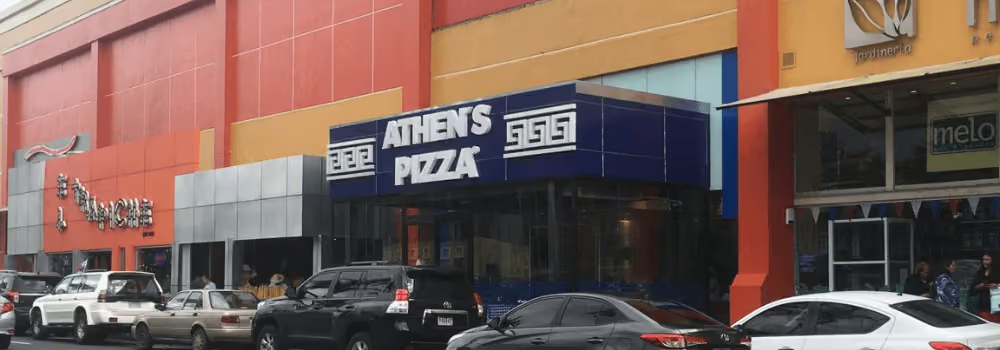





%20-%20thumbnail.avif)

%20-%20thumbnail.avif)

%20-%20thumbnail.avif)
.avif)

%20-%20thumbnail.avif)