Host: Low Capex, like recurring revenue, is one of those boxes that searchers hope to check. And like recurring revenue, this preference can be applied too crudely. Oh, high capex, says the searcher. I'll pass. Well, when Reed Tylston saw Giddings Hawkins, a liquid waste company, he did not dismiss it, even though the factor trucks the business relied on can cost $800,000 a pop. Instead, Reid dug in to really understand these capital expenditures, and he ultimately got comfortable with and bought this High Capex business today, rather than see these trucks as an unhappy cost center. Reid loves them. Money making machines, he calls them affectionately. And he also got his CDL so he'd be able to actually drive them. There's a lot more in this interview than Capex, including Reid's exit making him a millionaire, how he did right by the employees during that exit, and the book he's publishing about the whole experience. Grit it done. You can pre order a copy of that for 99 cents@grititdone.com and if you happen to be at SM Bash in Salt Lake City today through Saturday, Reid is here. Grab him to ask about Capex or his book or what he's working on next. I'm also here, so say hi to me too. Okay, here's Reed Tylston, former owner of Giddings Hawkins. Welcome to Acquiring Minds, a podcast about buying businesses. My name is Will Smith. Acquiring an existing business is an awesome opportunity for many entrepreneurs, and on this podcast I talk to the people who do it. What do the following Acquiring Minds guests all have in common? Doug Johns, Morley Desai, Tim Erickson, Chirag Shah, Shane Ursam. They all went through the Acquisition Lab, the accelerator in community for people serious about buying a business. But they represent just a sliver of the Lab's success stories. The number of deals across the lab's cohorts now stands at over 120, with over $300 million in aggregate transaction value. The Acquisition Lab was founded by Walker Deibel, author of Buy Then Build, the book that introduced so many of you to the very idea of buying a business. The Lab offers a month long, intensive, almost daily Q and A sessions with advisors, live deal reviews with Walker, Deal team introductions, and in an active community of serious searchers. Check out acquisition lab.com link in the notes or email the Lab's co founder, Chelsea wood. Chelsea buy then build.com Reed Tylson welcome to Acquiring Minds.
[3:07] Guest: Thank you. Super happy to be here. Will appreciate you having me on today.
Host: Reid, you are a successful acquisition entrepreneur. You bought, grew and sold a sweaty Gritty business. You are an evangelist of entrepreneurship through acquisition eta. You are a teacher of eta and now you're an author. On the topic of eta, we want to hear about all of it. Please start us off with some background on you, Reid.
Guest: Yeah, absolutely. First and foremost, just high level. I've been lucky enough to live my American dream. Okay. I bought and sold a business, became a multimillionaire, got to race up the world's tallest staircase in Switzerland. Now I am stoked because I get to work with you and help you, you and your audience achieve their American dream as well. So that's just a really high level. I couldn't be more. I could not be more stoked to be here and talk about it. But yeah. I'm from Northern California originally. My parents met at the starting line of a running race over Vaseline. So I have outdoors and endurance in my DNA. Went to UC Berkeley undergrad. Go Bears. Got a job in finance in San Francisco. Did pretty well with it. So I was able, by the time I was in my early 20s, 23, actually had $100,000 in the bank. Okay. Didn't quite know what I wanted to do next, but I was out at happy hour at the Old Ship Saloon, second oldest pub in San Francisco. I know it on Battery Street. Yes. It has a mast from a ship during the gold rush that sunk in 1851. So pretty cool place to be hanging out. I was there at happy hour with two private equity pros. They were looking at deal sourcing in the franchise space at their. Their phone was looking to buy a franchisor Anytime Fitness out of Minnesota. This is way back in 2007, before it was a huge concept. They didn't do the deal for their private equity firm, but will like these two individuals, both pretty smart guys, one of which is my older brother, looked at these franchise locations and they're like, these things can do exceptionally well. You can put in like a quarter of a million bucks, most of which we can finance. These things can, like hump out 10, 15k of EBITDA like per month. This is a great investment. And I'm sitting there thinking, you know, I love fitness. It's how my parents met. After all, I'm. I'm not really liking, like the spreadsheet jockey thing and let's. Sounds kind of cool. So I became what I'll call an equity employee. We all took our, you know, a little bit of money. We had pooled it together. I quit my job at the in finance in San Francisco, kept the salary That I was going to, you know, getting paid there. And I went out and we were going to open up dozens of clubs around Sacramento, make our millions of dollars and dance off into the sunset. December 2007, okay, one great recession hit. That didn't help too. I had no idea how to run a business, so I had to learn that. But the biggest thing is we didn't listen to the franchisor. We decided we wanted to go to a bigger, more competitive market. When it turns out with anytime fitness clubs, you're much better off going to a fringe market with no competition anyways. Made some mistakes there, had some tough relationships with those two individuals. And that's where I got my identity from being what I'll call an equity employee to a business owner. So I went out through some fortuitous financing, which I can talk more if you want to hear the story. Was able to open up a club in a rural market with no competition. Absolutely crushed it. Then I went on to be a multi unit, top performing owner operator in that system. Had a great time with that. With clubs doing very well, I wanted to get a little more to life. I kind of got a little, what I'll call some lonely owner syndrome with my, you know, fitness clubs in the Central Valley and my managers and trainers and salespeople. But I was feeling empty. I wanted to get more education. I want to travel around the world. So what did I do? I applied to business school, got into Chicago, Booth, somehow some way moved to Chicago.
[7:01] Host: Let me stop you with a couple of follow up questions on your on your gym adventure. So how many units did you get
Guest: to at any given time? I had three and I bought and sold a number during that time.
Host: And would you consider any of that part of your story eta? It sounds like if you bought some, you bought some existing locations.
Guest: I consider franchising, buying a franchise license and then building it from the ground up. I consider that to be in my personal definition of eta. And the term that I think about entrepreneurship through acquisition, from which I more transition it to, which is kind of congruent to my story, is I really actually think about the first fitness club as eta because then I was an equity employee and I didn't actually control the company. Right. That's like a traditional type of setup. I think about a more nuanced form of eta, which I'll call entrepreneurial business ownership, which I talk a lot about in the book, which is the idea that one, you, you know, you're self funded so you control the company. But more importantly you don't work in. You don't work in the business. The business doesn't own you. You work on the business, and you can really have what we might call absentee ownership or the ability to really work on things. So you're actually building equity value for yourself and not being what we'll call a traditional business owner where you're. Where the business really owns your life. So that's how I think about that.
Host: And so you, in your first gym acquisition or your. When you. Your first gym license licenses, you were more of the working in the business, out on the business, and you learned to work on the business absentee.
Guest: Yeah, absolutely. The way I. The way I like to explain to people is the first business I owned, I was a business owner, right? Struggling business owner, we'll say with the first one. Eventually it made a little bit of money, you know, spit off a couple thousand bucks a month, but it was never a great irr or return on the investment. Second club that I opened, I was more of a business owner, but I was a pretty successful and actually made really good money off that club. Later, when I scaled it up to three, that's when I became an entrepreneurial business owner, where that miniature fitness empire, we'll call it, completely ran itself and I was free to go off and do whatever else I wanted, right. And in which case I decided to go to business school. So that's how I.
[9:14] Host: How much were those earning when you had those three? And it was kind of at the peak of that. That empire.
Guest: Let's just say I wasn't making enough to buy a really good house in, like, Pacific Heights in San Francisco. But at that point in my life, and I wasn't making seven figures yet either, but I was very well into the six figures for someone that was in, like, my mid-20s. So it was a good outcome.
Host: Right. Well, Reed, a little personal aside here, you and I first met in another life, actually, in this period in San Francisco. We were in the same Toastmasters Club. I think I saw you maybe once or twice, but you were the president of the club at some point. And so I knew you. I knew of you we met, but I also knew of you just by reputation because you were president of the club and one of the best practitioners in the. In the group. And, and I. And I remember at the time hearing about you like, oh, he's got some gyms or something. He owns some gyms somewhere or some. And I remember being intrigued. This was well before I knew what ETA was, but I was always interested in entrepreneurial entrepreneurship. So I was intrigued by that. But we never really had the chance to truly meet and have a. Have a chat. And then coincidentally, we get on each other's radar here a year or so ago, just purely through eta. And I connect the dots and realize you're the very same retailerson from, from those Toastmasters days. So that's why maybe I'm so interested in understanding this gym empire, because I had actually heard about this empire through the grapevine.
Guest: We got to mention at some point in this interview, but Golden Gate Toastmasters, the club that we met at, I think is one of the best organizations in all of San Francisco. Dianne Feinstein was a member, Nancy Pelosi was a member. And the culture exists in that club around just having fun and building a strong community is absolutely fantastic. So for anyone that lives in San Francisco and wants to level up their public speaking and just meet a really fun group of people, Golden Gate Toastmasters, check it out. And it's such a great thing that it's eventually what brought Will and I together. It's what brought us together here. So nothing but positive things to say about, about that club. Even though I'm in Salt Lake now and I'm not no longer around in. In ggtm, but got to love Golden Gate Toastmaster, which brings a huge smile to my face as we talk about it for sure.
Host: And I. And I second all of that. It was a really, really valuable experience for me to be part of that club on many levels. And then, Reid, I wanted to. I think you said that you're the two individuals at the Old Ship Saloon, those two guys, one of them your brother. So things did not end up going well with them. You got. You went your separate ways from a business perspective. Did I hear that?
Guest: Yeah. Yeah. What ended up happening is when I was more successful with the later clubs because they had the opportunity to invest in future endeavors, they chose not to. But I made them whole on their investments years later because ultimately I really credit them for getting me to think about the benefits of going down this acquisition entrepreneur, this entrepreneurial business ownership route that I went down. So I want to do the right thing with them because at the end of the day, both the biggest pleasure and the biggest pain of the entrepreneurial business ownership journey comes from people. And I always advise people to be very thoughtful about who you take money from. I like to say those that have the gold make the rules right and operating businesses can be straining on the relationship side. So be thoughtful about that. It also Percolates down to team members as well. The most fulfilling part about business ownership for me has always been what I'll call the entrepreneurial employees that I've just met along the way. I was opening a fitness center in a small town in Northern California, and I had a wrapped car at this time with Anytime Fitness. So it was pretty easy to know when the Anytime Fitness individual was in town. And I was at the coffee shop. I was actually running some numbers on 10 improvement budgeting because I like to hang out in the town and just get a sense of what's going on, meet people and just hear things and everything. And out of nowhere I'm like, I'm sitting there, Will, typing on my surface and this one grabs my biceps. And I was like, oh, what's that? She's like, hey. And she's in like her late 50s, red hair. He's like, are you the guy opening the fitness center? And I'm like, yeah, that's the plan. And she's like, well, my name's Gwen and I'm really excited to join your club. I want to be the first member, so you let me know when you sign up. That will started a 12 year long relationship where I eventually hired her to manage the club. And she's run that business for me for so long with almost no responsibility on my part, while I've gone off and done a lot of other things. And we are very well connected to this day. Even after I sold the business, she's a close connection for me. We have a great relationship. So when I think about what the real fulfillment from business ownership is about, it is about the resident relationships that come across from the people that I meet in this process. And when I think about the real pain of it, it's on the other side. It's about the frayed relationships, right? Whether it be with team members, family members, all nine yards from there. So that's both the pleasure and it's the pain as well.
[14:26] Host: And the pain. Yeah, that's well put, Reed. Okay, thank you for indulging my questions. Let's hear you go to Booth. You get in, you go to Booth.
Guest: Complete luck, right? When I get there, Booth. Booth has a couple people that have been thinking about traditional search funds and entrepreneurship through acquisition, but it's not really well developed. At Booth. This part time student, someone named Alex Hodgkin, absolutely great guy, comes to Booth and he says, hey, he owns a quality of earnings and evaluation firm at that time in Denver. And he's like, listen, Booth, Stanford and Harvard have been doing these search fund things for like 30 years. And he saw some of the deal flow by virtue of the valuation and quality of earnings work he was doing. He's like, why doesn't Booth do this? Like, Booth should build this whole thing out. And he convinced a couple high powered professors at Booth, along with the entrepreneurship center, to start launching this whole ETA thing. And so a lot of people at Booth were critical in building that out. Me personally, I actually credit this guy named Alex Hodgkin because he just came there with a head full of steam, like, let's do this. Then I was there at the exact same time. And I owned these businesses for six years. I knew people that were doing traditional search funds. I knew about the space. So just through complete luck, it made sense for me to get really involved in it. So I got to run the first real ETA student group at Booth, which was super cool. In with the support of the Polsky Center, I got to help plan the first ETA conference at Booth, which is going on 11 years now and, you know, sells out every year. And it's absolutely fantastic. And most importantly, I got to be one of the TAs for the very first class at Chicago Booth on ETA that was taught by two awesome adjunct professors. And will that for me, which turned into no joke, there's four of us involved in that class, 40 hours a week, easily for each of us. It's a ton of work building curriculum from the ground up, especially when you're doing it for Chicago Booth students who are pretty high caliber and like to ask a lot of tough questions and really push things. Completely transformational for me, though, and that inspired me to want to continue to go down the ETA path. And I also made a vow to myself at that point that I'd been successful with the fitness clubs, you know, but I was hungry to do more. And I said, you know what? After my next endeavor, if I really crush it, I really want to go into adjunct teaching. So left. Booth ultimately bought an industrial services business in Milwaukee. Fantastic business bought. It grew, it sold to a private equity backed strategic.
[16:51] Host: Well, Reed, hold on a second. That's what we're here to talk about is that story.
Guest: Yeah, yeah, let's go. Let's go to the fun details.
Host: The. The. Your interest in ETA at Booth was, was based on what? Because you saw, based on your gym experience, that that was the model that was most powerful. Why not everybody at Booth fell in love with ETA and became a TA at the first class. Why did you?
Guest: Oh, because I'd Been a business owner for six years. I'm very passionate about small business and I looked at ETA as a way to continue that journey. And listen, Small businesses are 43.5% of US GDP, right? They have 46.4% of US employment. They are like the backbone of the American economy. And what I look at is that there's just so many great opportunities for individuals, particularly high caliber individuals to get in these small businesses and a do well with them financially. But more importantly, just they have the opportunity, you have the opportunity to have a great sense of freedom and autonomy. And that's why I think people do it. But what really actually inspires me about it is that you can get in there and really invest in the team members. And if you for example, think I think that wage inequality is a bad thing in the US then go buy a business and train your people to make more money. Right. When I operated the industrial services business, like the best part for me was, you know, working with individuals, helping them get driver's licenses, helping them solve the commercial driver's license shortage in the US by training people to get their CDLs. I have one great team member who just say that he had a moment with the IRS number of years ago that prompted him to decide not to pay his taxes anymore. Okay. He had, he had a knee jerk reaction which he very much regrets. If I told you the story, you'd be empathetic to it, right? But you know, I didn't want to pay his taxes so I worked with him and I, you know, helped him file his taxes for the last couple of years and I work with him and filed an offer and compromise with the irs. Right. And in doing that we just both learned a lot about how the plumbing of our country actually works. So it's that kind of fun stuff. It's like the people projects in these small businesses which are super cool. So I think when it comes to, we'll talk about the context of, of MBAs doing ETA. I think that MBAs doing ETA is great because of the positive impact that they can have for people and they don't necessarily always teach that in MBA programs. And then me personally, that part of it exists. And then also too owning or operating a small business, the pile of paperwork is a lot of your guests can attest to is like this high. You see how the plumbing of the country works and you can't help but not become more civic minded in that process. So let's take a step back. You can feel freedom and autonomy if you do it. Right. And you follow the advice that so many of your guests give. And there's really not a whole lot more great advice that I can give aside from what you already know and your guests already know. But I wrote a book about it. So if you want to learn more, you can follow the steps that are outlined in there. You can minimize the risk relative to your alternatives, so you can make good money from it, you can improve people's lives and you can become more civic minded. I mean, you can live your American dream if you do this in the right way. So I just feel blessed because I've been able to do that for 16 years across the fitness business. I've done it with the industrial services business. I've been involved in other ventures and not full ownership capacity as well. And I'm just feel stoked because now we get the chance to help your audience achieve that same thing as well together. So happy as a clam. Happy to be here. And ultimately that's, that's why I wrote the book.
[20:35] Host: An SBA loan broker, as opposed to a direct lender, doesn't work for a particular bank. Instead, the broker pairs you with the right SBA lender for your deal based on industry terms, risk thresholds, then helps you navigate the process better than many lenders themselves do. Matthias Smith of Pioneer Capital Advisory is just such a broker. Matthias worked at two of the country's top 10 SBA lenders. So he's been on the inside of the SBA process and knows well the pitfalls and hurdles and how to avoid them. He struck out on his own to laser focus on the ETA and search space. Our niche is his niche. You'll see Matthias at all the ETA conferences. He's closed over 30 search deals since starting Pioneer in May of 2022, including some acquiring minds guests. To learn more and get in touch, go to pioneer capitaladvisory.com or click the link in the notes. Well, read and tell us. But because we're. Let's plug the book now so we can. So we don't wait till the end to give people a URL in the name.
[21:46] Guest: Yeah, just grit it done.com it'll be 99 grit done grititdone.com it'll be 99 cents through the end of May. So go there, check it out. And most now. Yeah, available for preorder now. It'll be released on May 13th.
Host: Great, cool, thanks. I'm sure it'll, it'll keep coming up, but thank you for that, Reid. Okay, so you, you, we need to now unpack your 10 second story of buying, growing and selling the industrial services business, tell us a little bit about your search, which I think you might have been doing when, when, when our paths crossed back in San Francisco. Go ahead.
Guest: Yeah, yeah, I think I was at that point my background was in fitness and franchising. I love both of those spaces. So my plan was I'm going to spend at least 80% of my time in either fitness or franchising. So that let's say that I don't find the right next company to buy. At least I'm going to grow my network and expand my knowledge in those spaces so that my career is going to be better off. I reserve 20% of that time for interesting opportunities that would come up that fit the criteria that I was, you know, the basic criteria, fragmented customer base, recurring revenue, stable management team. The criteria that, you know, every private equity investor and every searcher wants to go through. Right. So I was looking for that as well in case it came up. And my game plan is simple. 50% proprietary, 50% intermediary. I think that working with intermediaries is absolutely fantastic. I think it's very important that you diligence the intermediaries that you work with. I think it's very important that you invest the time to become credible to intermediaries. Because what are intermediaries jobs at the courts to convince sellers to sell their business? They have great relationships, the good ones have good relationships, they're credible, they know what they're doing. So make sure to diligence them. Also make sure to come prepared, like, don't waste their time. Ultimately, when you're talking intermediaries, you need to realize that they talk to a lot of people just like you. And if you come across as not being credible, as not being all in, they're just not going to want to invest their time in working with you. So be very thoughtful about, about how you do that. So 50% working with brokers, intermediaries, 50% doing proprietary searching, had an awesome deal flow going. A lot of cool fitness concepts, lot of, a lot of franchising concepts. A lot of businesses I thought would have made fantastic franchises. So I was playing around in that space and then through generational equity because I look at their pitchbook, I saw this very. And I was, by the way, I love California. I'm a native Californian. I think California is the most innovative state at making it difficult to run small businesses. So I was more than happy, you know, more than happy to go anywhere and do Anything. I like small towns, I like rural America. I think it's a great lifestyle. So I was very happy to go anywhere and do anything. So I was completely flexible in my, in my search. I'd always had a bucket list item to live in San Francisco and I was training for an ironman during this time as well, which I did up in Napa. So I was, I was knocking out some lifestyle stuff while I was searching down there as well. It's pretty fun life actually. And of course president of Toastmasters. So now you kind of know what things look like there. Ultimately came across a great business up in Milwaukee through Generational Equity. Just got the pitchbook looked the same. I'm like. And I have a tool that I use called the Double diamond where I basically, it's my scorecard to rate opportunities. It's in the book. You can access it by going to griddedone.com, just put in your email, you can access it. A lot of tools out there to do these things. I'm not going to tell you that one is right and one is wrong. Just find the one that resonates with you and that you're comfortable using and works. Other key takeaway if you have a metric scorecard of some kind, do not just keep it to yourself and like one other person. Share it with people. Like share it with other people that know what they're doing. Like share it with you will share it with other investors, share it with other operators. You want to be able to get critical feedback and get out of those biases in your head. It's easy for you to rate, oh, one out of ten. Ten. Right. Because I want to do the deal, you know. But get out of your biases with it. Take that feedback on the front end because what you do not discover during diligence, as a lot of your guests can attest to, you're definitely going to discover when the operations come out. So be very thoughtful early on the process and engage your peer group. Peer groups are critical both during searching and, and during operating. I will tell you, by the way my life might have turned out. I'm not going to say better or worse because hey, life's pretty good. I got no complaints during the fitness business. I think the biggest struggle that I had is I got lonely running the business. I had the franchise and I had the franchisor and like the conferences and the peer group and that was kind of cool in that sense. But I never joined like a Vistage or an EO or. And I wasn't big enough for YPO at that point, but I never joined a group like that. I strongly advise practitioners to find that group. Find the right fit for you and join one, join two, join a couple. The power of those relationships and it could be industry wide, it could be, you know, industry agnostic, whole nine yards. The power of those relationships that will develop over time as you get to know those people and the kind of feedback that they can give you strategically on your business and of course, on your life overall. Absolutely. Absolutely invaluable. And like joining the Toastmasters club, hey, there's no right club. There's no wrong club. You know, Golden Gate Toastmasters is great for some people, but not great for others. But invest the time to find that fit and do it while you're searching. Right. So find that peer group while you're searching. And business schools do a great job of that. There's incubators, I'm a part of that. Do a great job of that. But then find it when you're operating too. I think that that is a critical way to achieving that. What I'll call entrepreneurial business owner mindset and being able to again, work on the business versus versus in the business. So yeah, found the industrial services business. It basically like hit most metrics pretty well. I go through the detailed examples in the book and then basically did a couple calls with the owner. Things seemed to make sense, went out. I'm very big on. Yep. You had a question you were asking.
[27:46] Host: Yeah, Reid, tell us about what the business does, please.
Guest: Oh, absolutely. It does the work that keeps America running. This is dirty work. Well, grease trap pumping, kitchen grease, exhaust hood cleaning vactor trucks sucking out parking lot drains, working at big manufacturers to. To clean machines, to clean furnaces, to. To do things like that. So it's pumping industrial maintenance, all that good stuff.
Host: So, and, and tell people what a vector truck is. For those who don't know, vector truck
Guest: is think about a vacuum truck as something that costs brand new, $800,000 plus or minus. And this thing is just a money making machine. You're talking like 70 to 80% gross margins. Okay. At least in the markets that I operated with. It definitely varies case by case. There's a lot of nuances to it. That does things like suck out parking lot drains, that does things like water jetting. So you'll see them around cities. Right. Let's say there's a big storm and one of the drains on a city street is overflowing. Right. And there's water everywhere. And you know you're upset because you're driving. You got to go through this like big puddle of water and you see that truck on the side that has a boom and is trying to like suck that thing out, that's a factor truck.
Host: So. So they basically suck waste from, from certain particular cases. Or they'll also sort of plunge waste in a backed up sewer under a parking lot, in a grease. And then also then the kind of the industrial waste and grease waste suckage as well. That use case as well.
Guest: Yeah, I mean, we're getting technical. Like you have pumper trucks for grease traps. So like grease traps are a typical tanker truck with a, you know, a tank on back and a vacuum.
Host: Right.
Guest: That's like one side of the business, which is fantastic. Different side of the business though, is actually the factors. So Vacors do the drain cleaning. They also do a lot of like construction work. So if you're driving down the freeway and you see a truck with a boom that's like sucking, you know, dirt out of a hole, that's also a backer truck. So there's a lot of unique ways for these things to operate. But at the bottom line, for the purpose of our audience, just think about them as a lot of capex, right? And most operators do not buy them new. Municipalities buy them new. Most operators will buy them after their 10 years in the secondary market for much lower amounts of money. But just think about them as a high capex item, right. That can make a lot of money at very high margins doing dirty work across a variety of settings. So they are absolutely, absolutely fantastic. So it had businesses like that.
[30:21] Host: It's interesting to hear you say, Reid, that your enthusiasm for the high capex, because high capex is, is actually one of the boxes, one of the things to avoid traditionally in search. But you're, you're painting a picture for how appealing and it can actually be. Talk to people who have a capex aversion and why you were actually so drawn to it.
Guest: Yeah, it goes to diligence. Right. So I was very scared by the capex of the business overall, both on the grease trap side and on this and on the vector side as well. And there's other parts of the business that made it compelling that were pretty low capex. But it's all about diligence, right. So you hear, oh this. And by the way, I'm telling you, 800,000 now with inflation, it was not quite as high when I bought the business. But it all comes out of diligence. So I'm like, all right, if I have to, if I have to budget for capex, how am I going to do this? How as an operator, am I actually going to go out and buy these trucks? So I just simply. And I, believe me, I'm not a handy person. I didn't even know what the term mechanically inclined meant before I bought a business like this. Okay, that's give you a sense of how bad it is. But I will not going to hold. Well, maybe I'll hold it up now. I have so much pride because after I bought the business, I like to, you know, relate. I got my CDL now, Class V cdl. So proud of that for a variety of reasons. But I wanted to hear more about that. Yeah, I didn't know anything about back to trucks or pumper trucks or how to buy them or who to buy them from. So I just simply called the people that sell pumper trucks and back to trucks, and I called the people that maintain them both in that market and other markets. And I said, hey, you know, if I want to buy one of these things, like, how much does it cost? Like, you know, when do you buy them? Do you buy them new? Like, who maintains them, what are the headaches around it and everything. So as part of my diligence process, I could credibly tell you. And again, things changed post 2019 with the pandemic and the vehicle shortage. But I could tell you how much these vehicles cost in the secondary market, who you could buy them from, how much time it took to deliver them. The real pain points about hiring drivers, what usually breaks down, how much it costs to break down, what the repair networks are like. More importantly, what do you do if you have a small business and it has, let's just say it has like two of these trucks, right? And a growth strategy is, hey, I want to buy the business. And I see these trucks are operating at 50% capacity, but I know there's demand to have them going at 90% capacity. It's just, you know, operational issues or maybe a lack of a driver that's driving that. So I'm going to say, hey, I want to buy the business. I want to get, you know, capacity higher. But if we get capacity higher and the truck breaks down, what happens right now you're in real trouble. So figuring out, okay, if one of the trucks breaks down now what am I going to do? Well, it turns out there's services that exist that you can literally rent trucks like this from for a pretty penny. But you think about every single contingency of what can happen. So that when I'm in the trenches, right, you know, especially during that first hundred days and I got to deal with the paperwork and I got to deal with the unforeseen stuff like maybe a driver's going to quit or, you know, who knows what's going to happen during the first hundred days. It's always, always a quagmire. The day the truck breaks down, I want to know what exactly I'm going to be able to do to mitigate that. So you asked about Capex. I knew again before the pandemic. I knew exactly how much these trucks are going to cost. I knew how I was going to get them from. I knew how long it would take to deliver them. So I was able to budget for it. And when I thought about how I'm going to bid on this business and the valuation behind it, bada bing, bada bang, it made complete sense to me. So the challenge with searching is that you don't want to fall in love with deals, right? Because we all know they fall apart for so many reasons. The attorney issues the emotions, seller changes their mind, buyer change their mind, Diligence comes up, all that good stuff. You know, the inherent challenge in balance assertion is you want to be super diligent and have that level of. I always think about diligence, by the way, as not at a 10 out of 10 scale. It's literally an 11 out of 10 scale. You can't actually get to 11 because you're just going to find things when you get in the trenches that you didn't expect, obviously, but you want to get as close to 10 as possible. But the key is having the discipline to balance that all in diligence level that you, that I think you need to do with the fact that you have to keep other opportunities alive and well and kicking before your deal actually closes. I think that is like the critical part of searching is through no matter what happens, have that discipline to keep your backup deals alive. Even when you're in love with that one company that you, you really want to get across the finish line. So that's how I think about Capex. I literally put it out to where I knew I had a pretty good idea of what exactly I had to budget. And with diligence too. You know, I hired. They had to come in on a Sunday, ironically, an outsourced mechanic, right, to go down and look at every single vehicle. And again, I'm not a handy mechanical guy at all. So I really carefully diligenced the Mechanics that I had go out to do this work to make sure they knew what they were talking about. And they knew the. They knew vactor trucks, they knew pumping trucks, they knew everything went out and had a detailed inspection of everything, every single vehicle. And then boom. The mechanic says, all right, here's the issues. Here's what I think might break down. Here's what I would worry about. Have this really cool spreadsheet Adam build me. And now, now the mechanic, right, knows the details. So when these trucks break down, you're going to guess who I'm going to send them to. Right. He's already going to know what the issues are. And this business in particular, a lot in this space would have an internal mechanic that would do a lot of this work. And some of the maintenance work was done in house. But again, I want to make sure that I had an outsourced option as well. So that kind of diligence will is how you're able to control for something like capex. Because if you're going to go look and say, oh, this business clearly has a capex issue, great, that might turn some people off. And you should be concerned about capex. Although capex also has great tax benefits to it. Right. But when you drill down, you can understand if it's actually manageable or if it's not manageable. And then outside of that and the
[36:05] Host: owner, when you, when you went to the owner and you said, I'd like to bring in my own third party expert here mechanic to look at the fleet, the owner was of course fine with that.
Guest: Yeah. And the owner had a very competent intermediary who I think advised him that you're going to have to, you know, allow this kind of diligence. But this business, you know, operates, I won't say 24 hours a day, but it does do a lot of late night and early morning work. And time is money. Right. And especially when you're selling a business. You know, I'm not taking the trucks off the street for some like inspection to come by. Could have this factor truck out here making 800 bucks an hour. Right. I'm gonna lose this money to do this. And he also didn't want his. Didn't want someone to come by and inspect the vehicles during business hours. So we literally had to schedule it on a Sunday, right? On a Sunday. And of course the mechanic, like, what mechanic wants to work on a Sunday? So I had to. Had to pay him a pretty penny to go out there and actually do this. And you know, the owner Wasn't going to give us all day to do it. So the inspection had to be done over like a three hour period. But here's the funny part of the story. So we do all of this detailed negotiation prep work about this vehicle inspection so that, you know, I understand what the capex is going to be. And there's minimal surprises and all that good stuff. One of the technicians lives really close to the business. Okay. So you can guess where the story is going. So as part of this inspection, they obviously get in the trucks and they drive them all around the block to make sure they shift well, make sure all the stuff works. Whole nine stress test them. What happens? One of the key team members sees someone driving a truck. And this team member in particular had been in the business for a long time and he knew everybody that worked there who could drive a truck. Right. You know, I'm not gonna say he could recognize everybody if he just saw him in like a pickup truck, but he knew all the ones that could drive for the big trucks. He's like, why is somebody at 3 o' clock on a Sunday driving like driving the truck?
Host: What's going on?
Guest: So he calls the owner and he's like, oh, I got like this inspection thing. So despite all of the preparation done to like prevent, you know, anyone from finding that about the sale, ironically, the vehicle inspection did that anyway. So it's, it's instructive though for both buyers and sellers that no matter how, no matter how linear you are in thinking about things, because sellers always think about, you know, should I tell the team members and should I not? Or should I not? And some of the academic research I'm doing now as part of my PhD is around seller satisfaction with sales. And it's so interesting to understand the psychology of the choice to tell your employees versus not tell your employees, and then to actually regress and correlate that against fulfillment from the sales. And what I can tell you is that sometimes it's as bad as you think. People have told their employees before and the employees have held the deals hostage to get better economic terms, and it's just frayed relationships. So those, those happen. On the flip side, also, some owners tell their employees they're very open and collaborative about it, and it's worked out insanely, insanely well. And I would tell you that what's really surprising is that my guess would have been that was more reflective of the company culture. If you had a good relationship with your team members and you sell them, then it would all be happy Go lucky. But if you have a bad relationship and you tell them it's not going to go well. But it's actually been the case. I can come to point to a couple anecdotal examples where owners telling their team members in what I consider to be a very strong trusting culture before actually tainted the whole sale process and destroyed that culture both for the. And these deals eventually got done. But I think it had a very negative impact on the transition and how things played out going forward.
[39:37] Host: Tell me more about the business size, how many, what the revenue was, you know, all the kind of bullet points. And then I'll follow that up with another question.
Guest: Yeah, sounds good. So the business, when I bought it was doing a little bit less than a million dollars in, in adjusted EBITDA, right. Total team members, so about 12 employees, but a ton of temp labor. So the business actually brought people on through their temp labor. So overall like equivalence was about two dozen. Two dozen team members overall,
Host: two dozen.
Guest: Great.
Host: So 20. So 24. But some of that was temp. And when you say temp, say more about that because I remember there was an interesting detail to how the. It wasn't just temp, it was temp plus.
Guest: Yeah. So what happens is if you want to get a job at this, at this company, and this is just such a great way to onboard people, you have to go through a temp agency. And then typically the onboarding process to get hired as an employee is about a year. So in order to get, you know, the quirks, the perks that come with full time employment, the health benefits, you know, the paid time off and everything, you have to earn it as a temp for a year first. So this company had a very high bar to getting hired, which is so interesting because it's inherently a dirty business. Right. And you know, the biggest challenge of the business is is hiring people and retaining them. So I was astounded during diligence that they were able to have such a slow, methodical onboarding process for a job that is so hard to hire for. And that's some of the cultural DNA of what really attracted me to this business as I continued to do the diligence.
Host: And so what, what was say more about that process? And is that something that you've encountered elsewhere or is it a model that maybe the, the audience who gets into kind of a sweaty blue collar business can implement themselves? And once you were on the inside, did you see that it was particularly effective? Like sounds pretty intriguing. Say more please.
Guest: Yeah, I think that the overall philosophy to keep in mind, which a lot of your guests hit on. So it's just great to have the repetition. Hire slowly and fire quickly. It is as simple as that. Bringing people on needs to be a methodical process. And I think that team members that go through that really respect the position more than team members that are just brought on quickly. My personal style is that if I have the opportunity to, I like to actually know the job really well that I'm hiring for so that I can train and mold the person with the habits that I want. I really don't want previous experience or previous bad habits that they might have from other places. I want to build them up in the culture that I want. So one example is I was hiring. I'll give an office manager example. I was hiring for an office manager. Could have done the job myself. But she was great. She literally came down with a laminated resume, having seen the job on Craigslist. And I gave her an on the spot interview. Just goes to show the power of doing things in person, even in the world that we live in. And then with her, it was a temp time. And then during that temp time had the chance to kind of prove if she was the right fit culturally for the company. And employment at the end of it was like the good thing to work for. Like, here's a nice benefits that you get, but you're not going to get those on day one. In her case, you're going to get them 90 days after you've been a temp worker for. And it was great because I brought her on during those 90 days. I mean, she showed up 15 minutes early every single day will not 90% of days, not 99% of days, every single day. And by week three, she was bringing sliders for the technicians to snack on when they were out in the field. Because part of her job responsibilities, part of them were she had to scrutinize the work that they were doing because she was sending out invoices with pictures and things like that. So I'm very big on all office workers for this business, at least spending time in the field, right. So the technicians, you know, get it. But with her during her temp time, one thing that was critical is that I had her go out on what I call a field day. And the field day in particular was doing kitchen exhaust cleaning, which entails going on a roof and cleaning a fan. And she's in her mid-50s and, you know, she's of average physical shape. So let's just Say that I didn't tell her to go on the roof, I didn't tell her not to. But she physically chose to go up there on the roof and help the technician clean grease off of a fan. And doing that during her first 90 days endowed her with the technicians, endowed her with me. And she turned out to be a fantastic fit for the time that I owned the business and a great fit for the individual, for the group that I sold it to afterwards. And I attribute a lot of that to the slow, methodical hiring process that I went through. Starting her with a temp, making her earn, right, making her earn that, those benefits and earn that full time team member and earn that title of yeah, you know, I'm, I. Here's a title I'm getting and I think that leads to longer term retention. That's one experience share. I go through a number of them in the book. I have a cool similar one about the crazy lady who grabbed my arm, you know, at the coffee shop, did a similar onboarding thing with her. So one thing that attracted me to the business is that I'd seen that work really well with the fitness centers. I'd seen that work in other businesses that I invested in. I'd seen it work through the, you know, through the peer groups that I joined later with experience shares with other individuals that have done things like that. So during the diligence time when I saw that long onboarding process, I'm like, this is good. This is like this business has great good DNA to it. The fact that he spent all these years to figure out this is the right way to onboard technicians for this dirty business, this is solid. So it was a, it was an important diligence item for me. And it was things like that that there's definitely low hanging fruit with the business. Right. But there's also things like that that just work and there's no reason to change. So that's something that really enthralled me and attracted me during the diligence phase and I really kept it going during the pandemic when the labor shortage hit.
[45:37] Host: Well, and so that's the obvious question is it sounds great to hire slow and methodically, but when labor is extremely tight in your own needs at the business are acute, it would be easy to relax your own standards and just get somebody in the seat. Any tips on how to balance that?
Guest: Just my personal experience share is that so when I bought the business, I grew it significantly and you're talking like 20 to 30% per month. Right. So I really Hit the pedal on the growth big time. I will tell you that I could have grown that business even more if I had, if I could have hired more people. And I, I bumped up wages for I When I bought the business, I thought the wages were too low, so I budgeted to bump up the labor even before the labor crunch on the low end of the work. So I bumped up wages to where they were market, where they were competitive. But ultimately I didn't really relax like the hiring style. I brought people on as temps and I made them earn for full time employment. And because of I, and here's my Hypothesis, just my 2020 hindsight, this is my bet. And so I think it actually played out. I didn't relax the hiring standards, I didn't lower the hiring standards. I kept to it. I chose to maintain the culture of the business and grit it done. By the way, that whole term came from a team member interaction that wasn't the business's term when I bought it. It actually came out during my time owning it, which was like pretty cool, um, as an organic experience. But I didn't relax those standards. I stuck with them. And because of that, I was able to grow the business, keep the profit margins where they were, maintain that culture. Because I think that if I had lowered the standards and just brought more bad laborers in there, then it wouldn't have, it wouldn't have worked out quite as well. So I was reasonably, reasonably disciplined with it.
Host: Well, and I guess the point about we, we've, we've all heard higher, slow, fire, fast, but I guess the point is the, the temp piece where you actually are, you are getting somebody into the seat pretty quickly. So you're getting that manpower, that person power quickly, but you're not actually giving them a W2 offer until they kind of earn it and prove it out. So you're kind of having the best of both worlds. You're, you're, you're filling the seats maybe more quickly than you would otherwise by just handing out W2s, but to actually really become a part of the team and get the W2 and become a proper employee, that is what takes a long time. But in the meantime, you're getting the labor that you need. You as a business owner.
[48:02] Guest: Yeah, absolutely. And thank you for clarifying that. I was, I wasn't totally clear with that. Yeah, you get the labor immediately. And the real critical part to this, which was again, diligence in good detail, is the relationships you have with the staffing firms that can actually provide that labor and provide it on very short, credible notice. So this company had staffing firms that they used, one in particular, that there was supplier concentration. Concentration there. But again, how does the conversation go? Right? You have those conversations and you research that before you buy the business. And this relationship was very long standing, in my judgment, stable. So, yeah, you need laborers. They, they get them there the next morning, all good to go. But then in order, then you. In work like this, and I think with any company, but in particularly work like this, I really don't care what I hear during a job interview. I've heard it all. I'm going to grow sales 50%. You know, I'm gonna do this, I'm going to do that, right? Even checking references, it's great, it's useful, it's all good. But there's no way to know what someone's going to do until they're actually in the driver's seat, right? So it's like, oh, yeah, I'm really handy. Cool. Awesome. Great. I always show up on time. I'm going to have so much fun jumping up into a kitchen hood or moving a hose around. Talk is cheap. All right, cool. I'll see you tomorrow morning at 7am okay, here's a shirt. Go out and show me. Okay, show me for a week. Awesome. Okay. Three weeks later, you're not doing it anymore. Now you're tired. Six months later, you still doing it. That's a keeper. That's someone I will pay good wages to. That's someone who's earned those benefits. And that's the kind of person that I want training those temps, right? Because the good technicians, they're the best. They'll come in and be like, that guy's terrible. Get him out of here. Or they're like, you know what? That guy's solid. I mean. And I say guy intentionally. There's not many females that are doing dirty technician work like this. A couple came through here and there. And I'd love to see them more, you know, but be crystal clear, it's don't mean it's a definitely a male centric. Centric business.
Host: Yeah, yeah.
Guest: So you, you earn.
Host: Okay, Reed. So. So you're telling us, you're telling us the reasons that you fell in love with the business. It's got this, this great kind of cultural DNA of the way it hires the factor. You, you love you. Turns out you love the Capex, this company's particular kind of Capex model, the Vactor trucks, the pumping trucks. You diligence that fleet. You had Said the revenue was about 2 million and EBITDA just over 800,000. So those are great margins, right? My back of the napkin sound like great margins.
Guest: And, and Tapex adjusted too for what I thought it would take to keep the fleet where it was at.
Host: Now how is it that you're able so, so 800 over 2 million is. Is call it. Well it was more than 800, so call it 40 to 40% margins including capex. So how is a blue collar business, sweaty gritty business able to support such margins? Now this is probably going to return back to why you're so in love with factory trucks. Because it all comes down to the scarcity of these vehicles or what?
[51:00] Guest: No, it comes down to a discipline on the owner's part. The owner had a strategic advisor, I think it was his accountant at Walmart Point that said, listen, I want to keep it really simple for you. How to, how to do pricing. Basically just make sure that your, that your cost percentage is never higher than 33%. So your gross margins are always going to be, you know, at least 67%. Now the business ended up achieving margins higher than that because what would happen is the owner just would never do, to never do jobs over the years that were ever below that 33% cost percentage. Some jobs 95% and these are not like the business, no concentration issues on revenue or customer or business line or anything like that. Some of these jobs just would make money like you wouldn't believe. And the owner diligently had people in the office scrutinize every single job and with pencil and paper, by the way, scrutinize every single job for cost percentage. And in sticking to that discipline around the 33% cost percentage, the margins just turned out to be that high. And it is absolutely insane. So you're going to guess when I bought the business, okay, did not change that rule. And I looked. But what I also found is that there was, I mean there's almost countless revenue opportunities to grow this business. But what I started to realize is that the real way to grow this is there's actually opportunities. If you focus on those really high margin jobs and do more of those, you can find those that are like the 80, 90, 95% ones. And a lot of those were the factor jobs, but not all of them. A lot of them were just these really niche jobs that this company had been doing for like 20 years that really nobody else in the space could actually do. I mean, shouldn't say that others in the space could, could spend the learning curve to invest the time to learn how to do them. But there was a real stickiness to this, to the work this business was doing. And the kind of work this business does, which a lot of your other guests can relate to, is they've had like similar businesses is it's work that no one wants to think about and no one wants to do. They just want someone that's going to solve it and not make it a headache. So they're willing to pay pretty good money for a service company that's just going to come in and take this headache off of their mind because their team members don't want to do it. They don't want to worry about it. It's a compliance issue. They just want someone that's going to do it. So if you take care of it, you take care of it credibly, you get the job done. If the price is not completely unreasonable and you can definitely juice margins but not completely unreasonable, then, hey, you're going to be all set and good to go. And this company, this type of, this
Host: type of business, is it a. You called it industrial services, which is a very broad term. Is this a type of business or was this. Basically you guys have this, this fleet of vehicles that could do, provide this service and, and where you made revenue was kind of a hodgepodge of whoever needed this service. You know what I'm saying? Like, is it a tightly. Like, if I wanted to find such this kind of business like yours in Northern Virginia to buy, what would I Google? What would I even search for?
[54:14] Guest: It's interesting that you asked that. It's the business, like the core part of the business which is most lucrative to me was a pumping business. The grease trap pumping. And the factor pumping, right. The. The grease trap was the biggest part of the business. And that's a business that when I actually bought it, I wanted to grow that part of it and I wanted to grow the factor part. I understood those businesses the most. I thought that they had the best competitive niche there. I like those businesses because of the recurring service part of them. I like a lot of things about it. Those are the two areas that I thought were the best. And the grease trap business was the biggest business. The risk in grease trap pumping is disposal. And we had good disposal options. We ran into some challenges with that going forward. But what I loved about this business and all those grease trap pumping jobs, by the way, fit that same criteria. Okay. These companies been doing it for a long time. They were experts in it. They're credible in it, they're all good to go. But there's also, in addition to that business, this is one reason I loved it. There was other business models that had equally good margins that I knew if there was a challenge in the grease business or if there was a challenge in the vaktor business. Okay. The businesses that I really liked and I wanted to grow and align to the strategics that I thought I might be able to sell this to going forward if there was a challenge there. And I had to get into what I call plan Z, right, You know, the unforeseen stuff happening that I could lean on these other businesses to continue to have that profit margin and continue to have the kind of growth that I needed. So what I discovered after I owned it is that a lot of those other jobs were actually pretty lucrative. And they had that same, you know, recurring. They had that same recurring revenue side to them. They had the same like relationship side to them. They were actually great candidates to get those customers on service agreements as well. But when I went into it, I actually thought about those businesses as being like a backup plan that I wasn't going to prioritize. But then when the pandemic hit and one of our main grease disposal sites ended up closing and that was a whole process to go through, which is, you know, fun, fun stories to deal with. Then I kept. I found other places to dispose of that were a little higher cost and we kept the grease business going. But ultimately, actually in order to keep growing because I expanded margins when I bought the business too, I actually leaned more on the industrial services side, which is like factory maintenance and some of the kitchen hood cleaning than I originally. Then was originally my thesis when I bought the business. But I knew enough during diligence to know that I could do that if I wanted to. And ultimately, given what happened with the disposal sites, I ended up needing to. And it worked out, and it worked out well. And I always aligned because I talked to strategics that I knew I could. Well, you never know anything with certainty, but that I knew would be attracted to a business like this. And a really funny story that I tell from San Francisco, I sold to a private equity backed strategic. And the associate that worked at the private equity firm that backed the strategic literally worked in an office in the Embarcadero Building, which was all of three blocks from where I was searching for this business a number of years before. So you had two individuals in San Francisco searching, you know, like looking at this grease trap pumping business in the middle of Milwaukee. I Just find, like, the irony of that situation. Totally. And we're both, like, you know, diligency and, like, the same items. Tell me about the trucks. Tell me about the disposal. Tell me about this. Tell me about that. I just. I can never get over the fact of how small. How small the world is. So.
[57:36] Host: So, Reed. So it's a. It's a. If I wanted to find a business like this, it's a grease trap business or kitchen hood cleaning business, or vector truck. What? Sewer pumping or drainage pumping business. Are these kind of the headline categories? Like NAICS code here? Like what. What. You know, what is the headline category? Sorry, sorry to belabor this point, but I'm just trying to slot it into my. My, My, my taxonomy here.
Guest: Yeah, great question. You want the next code? It's building maintenance, strictly speaking, but in terms of, like, actual spaces that it plays in. Right. It's primarily a pumping company, and pumping encompasses both the grease trap and the vector work. But as. As you can find, which is ironic. Something to say, because a lot of this work is done below ground. When you start to look below ground, you just find a lot of other really high margin ways to make money. And I think it's important to have a focus and a core of what the business is about. And this business is about pumping at its core. A lot of the other services, such as the more complex water jetting and things like that, we would outsource, essentially. But, yeah, at its core, it's pumping, but going below the surface, you find a lot of cool other ways to make money there.
Host: Great. Okay, Reid. And so. And you've now touched on the fact that there were a lot of these contracts were recurring. So this is really high margin and high quality revenue. Give me a percentage of the revenue that was recurring.
Guest: So we got a different between true recurring revenue and reoccurring revenue. So the way that this revenue worked is that in the SIM, it said 85% recurring revenue. What does that mean? So I asked the intermediary for. I'm like, I want to verify this. I want you to send me every transaction that you have for every customer since the beginning of time, so I can verify this customer concentration thing. So the broker, to his credit, actually found me every single transaction in a spreadsheet from 2007. Customer names were anonymous. Right. So you have, like, customer number. You have, like, you know, job revenue from job everything. And I just spent the time to literally. And I say me, I like, because I didn't trust someone else to do this analysis. I Spent the time to go through and actually do the analytics on all those numbers since 2007. And what I found out is that I looked at two metrics. One was what the customer repeat rate was year over year, and then what the revenue repeat rate was. Turns out it was actually 87% for customers and 91% for revenue. And the crazy part is that these customers were long time customers, longtime customers, some of them 30 plus years. But I looked at like, you know, median and average length above 10 years for almost all of them. And even if customers skipped a year, and this is not even in the 87 or 91%, even if a customer would skip a year, or skip two years, or skip three years, like year four, they would come back and like spend more money. And even if you adjust for inflation, like the amount that customers typically spent was increasing too. So you start to see this really interesting revenue story where it's like, whoa, they're doing this consistent work. They're managing to like get more money out of their customers. The customers are usually coming back year after year because it's compliance for grease and the kitchen hood stuff. Those that aren't are oftentimes coming back later. This revenue profile is just insanely good. I mean, how could this be, right? It's like that good. So I looked at those numbers and I could verify that, you know, since 2007, this business and the business, by the way, grew. The business. The growth looked too good to be true. It had grown 5% since inception, basically. And including. And by. This is the business that does the majority of its work in the food service. The business grew, doing the majority of its work in the food service business. Okay. And I mean, it grew during the Great Recession. Sorry, it grew during The Great Recession. 2% revenue. And then amazingly, I bought a business that, you know, over 50% of the work was around 50%. A little bit more was based in food service. And revenue for this business grew significantly through the pandemic, even though half of it was in food service, which got hammered. I mean, the revenue profile of this business was. Was that strong. And I knew that because I did the analytics. I never told the seller. I actually haven't told him yet. Maybe I have that the. I'm like, I'm like intermediary. You got that 85% number wrong. It's actually higher. I didn't, they didn't know that till after the deal closed. I didn't, I didn't feel the need to tell them that. So that's. That was A recurrent part.
[1:02:12] Host: Speaking of the deal, Reid, what did it look like? What. What did you pay for the business? And how did you. How did you put the acquisition price together?
Guest: Yeah, this is a big. This is a big challenge with it. So I had a good relationship with the intermediary. Nothing but good stuff to say about him. We were very close. And I just said, hey, listen, I like this business. I love this business. I've done the diligence on it. I know you have other strategics at play that might be able to pay a lot of money for that, know the space better than me, who doesn't even know what mechanically inclined means. But I like this business. I'm. I'm convinced that I can get in here and run it really well. I got the. You know, I got my equity. I got lenders lined up. I'm credible. I want this deal. You just got to tell me what I have to do to win this deal. I will outbid the strategics on it. Right. And I had a really bold. Yeah. And the key, though, is I want to go back to something I said earlier. So I want to have. In the right peer group, I had a great network of individuals from business school that I had helping coach me through this process. So, of course, I was hesitant and fearful being like, why would I outpace someone that actually knows this space? I've done my diligence. I've talked to a lot of people, and I talked to some really credible people, some of which I found on searchfunder.com, some which I found through other extended networks that explain the space to me in no uncertain terms. Hey, Greece is about disposal. Here's how I think about trucks. Like, I knew all this stuff, but I was like, why would I outbid strategics for this? And, you know, I got. I had good people around me to give me coaching on why it would make sense to go that route and everything like that. So it wasn't the own voices in my head, which are useful sometimes, and they're great. But again, it's key to run these things by other people to get their unbiased feedback on it. So I had people that were coaching me through this process, and I'm like, listen, I want this deal. You just tell me what I have to do to. To get it. And we talked about some multiples, but he said the biggest thing. He's like, where are you going to differentiate yourself from the other people that are looking at it and what the owner really wants? Just his personality type, which is a huge red flag, not for his personality type, but what he really wants is he just wants all cash and a quick transition, right? Just what. What a lot of owners want. He wanted that. So, you know, the broker said, listen, if you want to differentiate yourself and you really want to back up what you're telling me here, I would make an offer that is all cash with a really short transition time, which makes no sense for the person that has no background in the space. Right? I mean, I want the. That's exactly what I do not want to do. But ultimately I did it. My plan actually was to, you know, make an all cash offer, which I was happy to stick to and just overcome that with really good diligence. But I actually wanted the owner to stay around longer. But my plan was because I'd done enough of these deals over the. Or I'd been involved enough of these deals over the years and I'd had enough of my own, you know, get to the finish line and not go through to know that, you know, generally sellers are open to staying on longer if it. If a deal point comes up during diligence. And the broker kind of told me, yeah, he's probably open to staying on longer, potentially. So I kind of thought that due diligence, I would. If I found something I didn't like, I'd be like, how about this? As opposed to short transition? Why don't you stay on for six months or a year? You know, that was like my base case thinking. I found stuff during diligence that lowered the purchase price, which was great, but I was not able to actually get that to him staying on longer. So I took on the risk.
[1:05:16] Host: And what did he want to say on Reed? How long?
Guest: I ended up, no joke, four weeks for 20 hours a week. So I had 80 hours of transition time with him, which is why I overcompensated. I shouldn't say overcompensated. That's why I was so intent upon doing so much diligence, because I knew that when I was in there, he wasn't. He was not going to be around for a year to help with the transition. And I corrected for that. I was ready for that. But I did that because that's what I thought I had to do to win the deal. And ultimately it's what I did in terms of financing, I put. I put about $500,000 of my own equity into it, and then I levered up with an SBA loan for what I still consider to be, especially in this market, insane. I thought it was insane back then. I didn't believe it was going to happen until we got across the finish. I think it was insane. Now I got 85% of the purchase price at a fixed 5% rate.
[1:06:09] Host: And how'd you get fixed? That's uncommon.
Guest: Yeah, basically because I asked for it and you know, I had a long term relationship. Well, I said in a long term, I'd met the lender that actually did the deal for me. Looking at other deals before I liked them, they liked me. So I just cut them in the loop as things came out, I cultivated that relationship and you know, when push came to shove, they, they got, they got the deal done. And I think it's critical as you're going through this process again about the relationships and the people. Just be thoughtful about who you're interacting with. Both on the peer group side, both on the strategic advisor side. There is great ones in the space. There's great ones. I'm not super involved in SMB Twitter yet, but there's great ones on like SMB Twitter, right? Like be thoughtful, go out there and interact with the people that know how to do deals like this. Have the experience and also that you just like and you can develop a good relationship with. I had that with the banker that I ultimately used. I've had that with other advisors that I've used. I've had opposite ones with ones I no longer use. But just be so thoughtful on who you surround yourself with in the process. It can pay dividends. I've seen it pay dividends for me. I've seen it pay dividends for others, both positive dividends and negative dividends in ways that I would not have expected. So I had that relationship with the lenders and they just really wanted to do the deal with me. Like they liked the business, they like the business a lot, but they also just liked me. They were like, Reed, whether he buys this company or buys another one, we just like him. He's like a good operator. Like, we want to back this guy. It's going to be a good situation. And then because the other best deal I got was, you know, more traditional, I think it was 80% at. I think I got it. When I really pushed him, I think he actually, the quote was, you know, prime plus 1.75. I think I could have pushed him to prime plus 1.5 and I could have gotten 80%, but it was going to be floating. So I managed to get fixed, which was obviously great, you know, given the interest rate that we also probably Liked that you were.
Host: Had so much skin in the game. Half a, half a million bucks of your own cash is not insignificant.
Guest: Yeah.
Host: And, and so by all cash, it also meant that the seller was completely against any sort of seller note. So there was no seller note. And the bank, the bankers, your lender was also cool with that. Again, probably because you had this good relationship with them and they trusted. They were based. It was basically a vote of confidence in you that they. And that they were willing to forego the seller note.
Guest: The key takeaway for the listeners is that if you get one banker that really believes in you and wants to do a deal with you because the bankers have to go to their, I mean, they have to cover, you know, debt service coverage ratios, you know, make sure the deal passes SBA sops and everything. So there's. You got to dot the I's and cross the T's. But ultimately the banker, they want to get the deal done, but they're going in front of credit committee. Right? And you know, credit does their best to separate themselves from the actual buyers. But having the banker behind you and really investing in you and being enthusiastic about you, I mean, let's be clear, like, that matters and these banks have like internal politics and that stuff matters. So you can cultivate the right relationship with the right lender. It can just pay fantastic, fantastic dividends for you. That's a great point.
[1:09:14] Host: I'm not saying that I've never heard that the lender that you're working with or really the sales person at the bank is, is also kind of your advocate with. Will be your advocate within, within the bank when they're talking to the, when whenever the underwriting committee is. I, I'm over my pay grade here, so, so maybe that's not how it works, but it sounds like that's what you're saying that you, they're kind of going to be your internal advocate if the, the underwriting committee expresses doubt about the deal.
Guest: Always be selling, right? Because that, that business development officer, whatever their title is, they are selling you to credit. There's a reason that, you know, oftentimes credit doesn't get to talk to someone like me because they don't want to get charmed and get overwhelmed. Right? So you have to kind of sell yourself through the loan officer that you're working with because they, they're, they're, they're creating the deck, right? They're presenting the deck. They are presenting you. So always be selling yourself and also to the intermediaries, they're Presenting you to the business owner, right? Yeah, like always be selling. Which goes back to my point earlier. When you're talking to intermediaries, when you're talking to attorneys, even QoE advisors, anybody, you want to be thoughtful about how you're coming across in that process. Because I think that the country benefits from more small business owners, more entrepreneurial business owners. It has been great. To me, it is a great way to have freedom, wealth generation, whole nine yards in there. I'm a shameless advocate of it. We can talk about the silver tsunami and the supply side and all those issues, but ultimately there's a lot of people getting into the space right now, which I'm excited about. I think the pie is more than, more than big enough. And I don't know that there's more credible searchers than there were, you know, 10 years ago type of thing. But ultimately you need to differentiate yourself from the buyers and there's the buyer space out there. Because you have sophisticated private equity people, right? You have strategic acquirers, you have individuals that have done this numerous times. You have hold codes, you have a lot of sophisticated buyers out there. When you are coming across, you need to come across as credible. Like you have the ability to actually do this deal. Both financially, right. Both skill set wise, both just mentality wise. You got to show that you're all into doing this. Like, hey, I'm working at, you know, Salesforce making, whatever people at Salesforce make now. I don't know, 300,000 bucks a year, whatever the number is, right. I want to leave my job at Salesforce. I'm, I'm going to go buy this, you know, whatever company, right. You need to be able to credibly show that you're going to do the deal because people want to invest, right. Their time and their resources and people they think can get deals done. And that percolates through every part of the process. Searching, lending, closing and ultimately operating. Right. Your team members want an operator who's all into doing this, you know, so I think having that all in mentality and coming across as credible is one of the key takeaways that I want your listeners to get out of this time together.
Host: Thank you for that. And so what was the final enterprise value? The final purchase price?
[1:12:01] Guest: Final purchase price of the business? I ended up paying essentially five times seller discretionary earnings for it. So you can do some of the, do some of the numbers on that, on that to get there. I'm always confident because I signed a non disclosure agreement with the seller about the Financial term. So I was like, could be a little bit, you know, if. And on that. But you can do some math there to get it figured out.
Host: Great. Okay, Reid, well, we just have a few minutes left, but we have also a few topics that I want to hit. Some big ones are part of your story. We're going to have to accelerate, accelerate through your ownership, but give us the bottom line of how you grew the business and then why you ultimately chose to sell. What it. What did the adventure of actually being an operator and owner of this business look like?
Guest: Yeah. Most fulfilling so far. One of the most fulfilling, if not the most fulfilling experiences of my life. You want to buy a business that you can obviously not play an active day to day role in. Okay. So that you own the business and the business does not own you. You want to make yourself completely redundant in the ideal world. That is critical to being a natural business owner. Okay. And I cannot stress enough that people always want to run the business like it's for sale. You hear it all the time. It's hard to do, but if you don't actually try to do it, you're never going to achieve it. Right. So for me though, with that being said, I think the key to actually growing this business is the fact that I was so happy and enthusiastic about being hands on. I got my CDL so I could lead by example and build credibility with the team. When I bought the business, it was literally all the scheduling was done out of a red book, which if I have it around here, I'd show you where did the red book go? And it was done out of a red book with pencil. So you had a business that was doing this much EBITDA that was scheduled out of a red book. So a big growth area was taking it to the cloud. But to take a business like this to the cloud. Hey, technician, I want you to do everything on your cell phone now, right? I want you to take pictures, I want you to log it all there. The only way to make a transition like that effective, I think is actually know what the technician life is. So I had so much fun going out in the field, spending time with the technicians, understanding that. Then I took the business to the cloud, which created all kinds of awesome efficiencies. There was plenty of challenges in that. I'll tell a funny story about how I tried to, you know, switch how we did meal breaks in the field for everybody, which led to. It's led to two things, a couple. It led to some basis points off of profit margins for sure. Because now technicians were, you know, not logging their breaks but still taking them. And it also led to some cultural trust issues because now they thought I didn't trust them. So I tell people it's good to buy businesses with high margins because when you have high margins, you're going to make mistakes as an operator, right? Likely. Especially if you don't have experience in the space or you've owned a business before, you're going to make mistakes with almost 100% certainty which are going to eat into your margins. So make sure the margins are big enough that they can budget some mistakes without, you know, getting you to a critical, A critical cash. Critical cash situation. So I got really involved in the business, like, more than happy to go all into it. I was in a serious relationship at the time, and I made crystal clear to my significant other, hey, this is what my life's gonna look like, right? Especially in these early days as I get in here and learn this business. So just be ready for that. Always loop the people that matter in your life around that stuff. It's critical. It's a team journey. So got really involved in the business. The business had organic growth and it had like, organic high margin growth. A real challenge was getting the right people in the right seats to go out and get in the trucks and do the, do the dirty work. So I was able to invest a lot of time in doing that and it was helpful that I started to learn how to do the work on my own. So I knew exactly what I was hiring for. It's one thing for someone to tell you, hey, we need to hire people that are athletic. Well, why? All right, well, because you actually have to go climb a ladder and, you know, get up in like a, you know, get up in an exhaust system. So I kind of understood more about what, how the business actually run, like what metrics really mattered. And then hired people took it to the cloud, bought some new trucks, focused on the high margin businesses, even though the margins were already high. And I got some margin basis points around improving operations, I raised prices as well during diligence. I just straight up asked a lot of customers, are you gonna stick with, are you gonna stick with us? You know, and secondly, how do you think about price? So I kind of realized during diligence that a lot of these customers, like, they weren't super price sensitive. So I had pretty high confidence that when I got in the seats, I could actually increase prices. And I ended up doing that. The business, it turns out we talked about the recurring reoccurring revenue. Most of it was actually, believe it or not, customers like literally calling in and asking for service. Very few customers were actually proactively scheduled. It was like, hey, sometimes the team members would call, but oftentimes customers would call in and actually proactively schedule. There was almost no service agreements, which I knew before I bought it. So took it to the cloud and got everybody, not everybody, but I made it a huge priority to get customers on service agreements, you know, with a quarterly monthly annual schedule, whatever it was, the business did a great job of, you know, because of the old owner, which I love them to death for, of doing checks, Right. So there we got a lot of checks coming in, but I just simply took it a point of whenever I could to turn those checks into ach automatic payments. So I got a good amount of customers on that and I just built a ton of momentum. You know, I went to all the industry conferences. I had a good sense of what strategics that might acquire the business we were going to look for. So I tried to focus the business on that, which was more on the pumping side and more on the vector side. The big challenge is that our biggest grease trap disposal site ended up stopping, taking our grease and eventually closing down. I really wanted to buy it, quite frankly, because we had a symbiotic relationship. They would have spills and problems there all the time. We'd go there and clean them up. Great source of revenue. So we had a very happy relationship. And I really wanted to buy the disposal site owned by an Indian tribe that had a casino there. I mean, the grease trap site was here. The casino is right here. I wanted to buy it. But you know what they did instead though, will, they turned it into a parking lot. I'm not making that up. They knocked it down and turned it into a parking lot. It's almost too good to make up. But if I could have bought that, oh, it would have been a great situation. So that was my plan there.
[1:17:54] Host: Ultimately, it's a technical driven business getting everything into the cloud and experiencing some resistance there. What would you advise the audience about tech change management? Putting. Putting an old business into rolling in tech. How could you have done it better?
[1:18:11] Guest: Yeah, so what I would recommend, I mean, first and foremost, I think shared vision is always key. When we rolled this thing out, I experimented with a variety of field service management. I ultimately settled on one and I physically went out in the field with all of these to see if they work, because it's easy to talk to a salesperson from field Service management and have them tell you how great it is. And I can't tell you how many times, even with the ultimate provide one I chose. But the ones I didn't chose, it does this. Oh, cool. I would take it out in the field and then it wouldn't do it and it would completely malfunction. And then I would call the salesperson from the field and be like, hey, you said this, it's not the case. Oh, let me look at that. And you could. And these are, these are credible companies. I'm not talking. It's like a mom and pop shop of two people and an engineer off in India. These are like credible companies, big companies. So I would just diligence on myself and just call BS on it, right? And then I'd move on to the next one that actually, you know, move on to the next one. So I physically did it on my own. And time is the ultimate commodity. You're like, why are you spending time doing this as the owner? But going to cloud is a pretty important, it's a pretty important initiative, right? So I think that you just got to allocate your time to what matters. So I personally went through it, I personally did it. And by the time I had and there was pain points, don't get me wrong, but by the time I had one chosen, I was pretty sure that it was going to work. Then I just set a high vision. I said, listen, here's what we're doing, I want your feedback on it. But here's the goal, guys, here's the goal. We're going to make this transition to the cloud, the smoothest transition that this company, not our company, but this provider has ever had in its history. That's our vision, like, let's make this happen. And of course that does sound kind of corny and cheesy, but just having that positivity around it genuinely helps, you know. And then the real critical part is, you know, getting obviously like the field manager, the best technicians and the general manager on board with it, getting them using it and then it, and then it trickles down from there and just taking that feedback, the things that don't work. And oftentimes, you know, people say, oh, this shouldn't, it should work just like this. It's like, yeah, well let me show you how to do it, right? The fact I knew how to do it, I owned it, kind of made it work and everything like that. So I think it's critical for important initiatives like that to just take the most possible hands on approach that you as an owner can do. I have seen goes back to the peer group experience shares a very common occurrence. I don't know if anyone's talked about it on your podcast yet, but I'm guessing they have. I just haven't listened to every. I listen when I can. I haven't listened to every single one, though. I can't tell you how many times I see people go into businesses and budget, like, it's going to take this much money and this much time to go to the cloud and it's going to, like, improve margins this much to have that not at all be the case. It's a disaster. You gotta go with, like, three different providers. It costs a lot. It's stressful. It sounds super easy to do, and I think that most people just. Just mess it up. So I can't give you, like, a great formula for how to do. I can tell you how I did it and a couple ways I've seen successful people do it, but honestly, it's just more of a quagmire that's painful and is sucks to go through. And just be prepared for that, that whatever your expectations on it are, it's probably going to be four times harder than you actually think it's going to be. So budget that, budget that accordingly. And, you know, reach out to me if you want to talk more about some of the more nuanced approaches around that across different industries and everything like that.
[1:21:28] Host: So, Reid, tell us what you. The growth, how that manifested itself in hard numbers. It was at 8,825ebitda when you bought it, and then what was it when you sold it and why did you choose to sell?
Guest: I can't disclose the exact thing that I set it to, except to say that, like, I consistently was able to grow the business, like 20 to 30% per month. And after the LOI was signed with a.
Host: Per month.
Guest: Yeah, I mean, month over month. Per month. Month over month, per month. That makes sense.
Host: So, I mean, per year then.
Guest: Yeah, yeah, yeah. But it was growing on a monthly basis per year. Yeah. Correct.
Host: Okay.
Guest: Yeah.
Host: I mean, still, it's great.
Guest: Yeah, yeah, that would be great, right? And then even after I signed the LOI with the strategic, then that growth got ramped up even more because what's the best currency to have when you're selling a business as a seller? It's that the business is doing insanely well. So that added some motivation. I actually wanted to do an ESOP for the deal. I think that with businesses, I think that employee Ownership is great and I think with businesses that are dirty like this that the team members should be the ones owning it. And I actually got an ESOP estimate.
Host: Reed, give us a primer on what ESOP is. Yeah. For people who don't know, give us kind of the 60 second definition and then tell us what your experiment looked like here.
Guest: Yeah, so it's employee stock ownership plan. It's basically when the employees of the company own the business and they accrue their ownership through essentially working at the business as a benefit over time. So you work at the business, you accrue ownership and it becomes an employee owned company. So when you're driving down your street and you see like a corner bakery and it says employee owned, it generally means that it's an ESOP owned company. So great about ESOPs, if you don't like taxes, you'll love ESOPs. Key takeaway for the team member, for your listeners there. So the way it works is that the employees own it. So I got an ESOP deal set up through SBA 7A financing. And for your listeners that know a lot about either ESOPs or SBA, it's a very complex process to get an SBA ESOP set up. The SBA has made it a little bit easier recently, but it's almost equivalent to climbing like Mount Everest and then climbing K2 the day later. I can't stress that enough. It's really just deep in the nasty regulatory side of like America and it's tough. And there's a lot of people on ESOPs that are kind of the gatekeepers, the attorneys, the service providers that make a lot of, lot of money off this stuff and they need to, because it's really complex to go through. So, you know, you want to buy a business, look at an ESOP service provider. I think it's a cool niche to explore. Anyways, with that being said, I got a, you know, I got a deal approved through Len, through a lending committee, like through credit. Okay, so we talked about sba. So I got a deal approved through credit. So no BS at a very big SBA lender to do an ESOP deal. Now the kicker to this is. This is going to sound insane to you. The business had a higher valuation certainly than when I bought it. Right. So the business valuation is higher, the loan amount, because I use SBA to buy it. The loan amount of this SBA loan is significantly higher. Okay. And the interest rate situation has changed. So the interest rates and also the credit risk has changed because now I'm not going to be personally guaranteeing it anymore. The business is, you know, doing well, but. But it's changed because you go into an esop, it kind of increases some of the risk. So anyway, I don't have that same 5% fixed rate. We'll just say that the interest rate's higher. So principal's higher, interest rate is higher, loan amounts bigger, whole nine yards. And ESOPs have compliance costs to them. You have to do like an annual valuation. I would argue, although some will disagree, that you basically have to hire somebody full time to manage the ESOP internally. So call that 80,000 bucks a year, right? I mean, people, people will argue with that, but that's just my opinion. So there's a lot of compliance costs. So these costs are stacking up, right? But here's the deal. ESOPs are the only instrument I know of in the US and I might be wrong about that, where you can deduct the principal debt payments. They are pre tax. So think about this. The cash flows, even after all those costs that I talked about to the business increase, cash flow increases by selling it to an esop, because the principal, through a unique dividend payment called the ESOP exception, is tax free. So I could have improved cash flows of the business just by this unique financing thing. And the team members would have, you know, accrued ownership. And the best part, no, because the big risk with ESOP's one risk is that team members can, you know, work for two years, get a nice equity chunk, right? Then what do you do with that? I'm out of here, baby. I'm going to go move to Hawaii and retire or go buy my own truck and do this. But amazingly, if you do ESOPs through the SBA, no team member can get liquidity for 10 years because that's the term of the SBA loan. And with ESOPs, if you use a loan to buy the business, no one can leave till the loan's paid off. So it would have guaranteed retention for like 10 years, right? Because no one could leave. It could leave and get their benefit, which would have meaningful money for 10 years. So I'm like, this is awesome. No one can leave for 10 years. So you solve a huge retention issue. Cash flows improved to the business, right? Because of the debt structure. I would have. I would have been me selling the business. So I would have made a ton of money. The ESOP would have owned it, right? I would have gotten the good exit that I wanted to. It's kind of a dream situation. I didn't end up Doing it. What I ended up doing is I knew what I could get from the esop. Then I reached out to the issue I wrestled with is is this the right business for employee ownership? Is it too small? Maybe, maybe not. That's not what blocked it. What really got me is that the business does well with the governance structure of like a single owner with an esop. It's controlled by a board. Right. And I could never get comfortable with the fact that with a board controlling this business, it would have the same agility to like go to the high margin things in case a recession happened. Just like the politics and things of having like a three person board. And I was very thoughtful about who would go on that board, but I could never quite get comfortable. And then what I really realized about it, which is the key to having peer groups, is that I was doing the ESOP because I thought it was cool to do an ESOP for like employee ownership, you know, if and, and I could rationalize it with the improved cash flows, but wasn't really the best thing for like the company or the team team members. It was probably the best thing for Reid, but not monetarily, but intrinsically. But it may not have been the best thing for the company. So I went to option B. I knew what I could get financially for me selling the business. And then I went out to the Strategics and others in the space and I basically asked him for a price that would have made me about the same off, but I could have just paid all the team members as opposed to employee ownership. I took the present value of the employee ownership, but I thought it'd be worth assuming some growth assumptions made the present value of it. And I'm like, I'm going to pay all the team members this amount of money in cash today as opposed to doing the esop. Then I asked a strategic one that I was most familiar with for a purchase price, all cash that would hit that number where I would be on the margin a little bit better off than doing the esop, but not a lot, but just a little bit. And now I could pay the team members the present value of all of the. Of what they would have gotten from employee ownership. So I asked them for that purchase price. They agreed to it. I continued to grow the business even more than I was before. They still tried to retrade, by the way, based on some other issue which just I went crazy after. But anyways, I knew that was coming. So we kept. And then it's like if you want to retrade like, great, let's increase the purchase price. Like, the business has grown even more. But deal closed at that amount. And they were on board with the retention bonuses too, because the risk is that technician centric business. Right. If you pay a team member retention bonus, they very well might leave. So we were thoughtful in how we rolled it out. They were on board to pay it. Deal closed, Everyone got the retention bonus. And I got a pretty short transition. Everybody. And amazingly, not amazingly, but everybody's happy. Team members are happy. All the ones have stayed. Business has kept on growing. Strategic acquirer is happy. They keep me around to do. I still am a signatory for some of the compliance stuff, so they keep me around for that. And yeah, happy go lucky. So it was a great.
[1:29:44] Host: Retention bonuses are we're material amounts of money for your employees.
Guest: Yeah, yeah, they would. And you're talking about a certain wage class here. I would, yeah, they were very, very meaningful. I would define them as life changing. They were definitely. They were definitely meaningful and they all got paid. I was very important to diligence that point of it as a diligence, diligent that point of it as well. And also if the team and I can't go through the details of how they were paid, like the actual structure of them, I mean, they were guaranteed, but, you know, there was timing aspects to it. But I was also very clear that if they didn't get paid, then that money was not going to the acquirer's pocket. Right. It was going to be, you know, kind of put back and everything like that. So, yeah, it's great. So again, just to kind of sum it up earlier, I'm blessed, okay. I got to live my American dream. I bought and sold the business, became a multimillionaire, then I went to go climb the world's tallest staircase afterwards. Now I'm just like, blessed enough to be able to help and teach other people, hopefully some of your listeners, how to, how to go off and do similar things so that, you know, everyone can, can go off and, and live their American dream as well. This process is hard work. This process, I would tell you it's lower risk than the alternatives out there, but it is risky. A lot can go wrong. If we're talking about the sba, we're talking about personal guarantees, and this is like hard work doing this stuff. Like, let's be crystal clear, it is not easy in any capacity. With that being said, I am a huge proponent of this career track. I'm a huge proponent of it for MBAs, but really, I mean, I teach MBAs how to do this stuff already, right. I'm a big proponent of it just for going out and buying a business that's doing 400 or 500,000 of sell discretionary earnings, lever up with the SBA, 80% of the purchase price, you know, fill the equity gap on your own with friends and family. I will invest if you want me to and help you fill that equity gap. I think it's better not to have investors, quite frankly. But if money's an issue, there's a lot of people, me included, that can happily do that. You run the numbers on it, you know, you'll make okay money while you're running it. And especially if you're the person, by the way, who's making the median US wage in the US 1118 a week. So gross it up to 70k a year with benefits. You go out and buy a business making 500k, even 400k, you're going to make more money, right, than you were in your job. And then grow it for 10 years. Don't even grow it for 10 years, just keep it the same on a, you know, inflation adjusted basis. Pay off your debt, you know, sell it for what you bought it for. No multiple expansion. You're going to have pre tax like, you know, in seven figures. So you go from making 70k a year all in to making more than that and then in 10 years, you know, being a, you know, being a quote unquote millionaire. The process isn't easy. It's a ton of work, but it is so inherently achievable. And listen, there's a lot of people in this space now, but there is literally 6 million businesses out there with at least one employee and a lot of other ones too, because 26 million businesses also have one employee, but like 10 contractors. So they're kind of like a pretty similar thing in that regard. There's a lot of businesses out here and there's also just de novo franchises you can buy and open as well. So I think that this path is fantastic for high educated, you know, people that want to go make tons and tons and tons of money. It is a great path though, just for someone who's making the median US wage and just wants to level up their life. And you get, you can get good freedom and good autonomy if you work on the business, right? It'll take some time to get there, but you can get there and have that freedom that you desire in addition. And no one talks about this enough, but you know, you're gonna have a lot of pain with the people that you work with, for sure. I can promise you that. But you'll also find a ton of fulfillment with the people you meet along the way and I think you'll become more civic minded in the process. So that's, that's my quick thing.
[1:33:23] Host: And yeah, Reid, the so you put in 500,000 and you did, you bought it for 5x SDE you said what can you tell us what the, what revenue margins and multiple look like when you sold for people to do their own math?
Guest: Yeah, I will say that the, the adjusted EBITDA margin was well above, was well above 50% and that, you know, I think that there's a lot of dry powder in private equity and there's a lot of dry powder and strategics and when a company aligns to, you know, a roll up plan, in which case this company did align to that, then there is significant opportunities for multiple expansion. That when I first heard about them, you know, years ago, you know, in business school or before, I was like, there's no way that like someone would pay that much for a business like this. And then I started to realize how they actually think about what they will sell the business for like after they do their roll up later on. And you hear what some of those multiples are and it's like whoa, like 18x like really like credibly you'll sell a business for like that much and, and that's just, you know, not saying that's the case or not. Then you realize, wow, that's actually happened in the Marketplace or like a 12x exit. Then you start to realize, okay, if you're rolling these up and that's what you want to sell it for, then that's why you'd be willing to pay this much money towards it. So that's, and again, I can't disclose the exact numbers on it for confidentiality, but you can kind of, you know, take that space and listen to what some of your other guests have talked about with that. And if you know, people in private equity just kind of put it all together and there can be very compelling opportunities to, to do that.
Host: And, and Reid, you owned it for how long?
Guest: Only three years. Three amazing years.
Host: And you were growing it 20 to 30% a year. This is great. Reid, tell us one more time about your book and what's in it.
Guest: Yeah, Grid it Done. Low Risk Guide to Entrepreneurial Success. You can find it@griddedone.com $0.99 before the end of May. There's a lot. There's fantastic books in this space. I love Buy and Build. I love the HBR Guide to Buying a Small Business. Those are fantastic things to do. This is just designed to build upon that. The one thing that, you know, gets me excited is actually owning and operating the business and doing it from like step one all the way to close. So I just laid out nine steps that do that and take like the fundamental lessons that are in those and just add more of that personal anecdotal experience in it so that readers can get a sense of what it's actually like in the trenches and just basically take everything that I think is relevant. Over the 16 years I've been doing this, both with the fitness business, with the industrial services business, with some of the other ones I've been involved in as well, and just give you all the stuff that I think that you need to know to make this as low risk and high chance of success as possible. And ultimately, in my opinion, especially if you get it for 99 cents, it is the MO and it'll take you about three hours to read. It is just the most time efficient first step that someone can take in this process. Even before you decide that you're gonna listen to, you know, your podcast will every time it comes out or you're gonna go and do one of the weekend workshops or attend like SM bash or anything like that, or go get an mba. You know, I just think this is like a really good first step, the best, most efficient first step in figuring out what that second, third and fourth step, you know, means for you, means for you going forward. So that's a big reason that I wrote it. And also too, I will always, always a hundred percent do, do the calls with people that want to learn about this space, 30 to 45 minutes, because people did them for me when I needed it all throughout. So I will always do those calls. I think this community is built on that inherent, you know, just give, give back because it's, you know, a lot of it's rooted in Stanford search funds and the kind of collaborative nature of Silicon Valley back in the day. So I will always do those calls. What I find though is not 90% of the time, to be frank, people that do the calls, it's not a good use of their time or my time because they just don't know enough about the process. Some have listened to like all your podcasts and they know, they know the questions I asked and I get excited about them, but about 90% really don't. So now the prereq is going to be cool. Hey, spend 99 cents and three hours of your time like read this book and then book the call with me and then we'll talk about what the next steps like look like. Ask me specific questions, ask me about industries if you want me to invest, then like that's obviously a prereq as well. So now it's like read the book and then do the call and then we're going to get a lot more, A lot more value, A lot more value out of it. So super excited about it.
[1:37:43] Host: Great, great advice everybody from Reed, that when, when you're asking for calls for people, you gotta already be have educated yourself quite a bit. People, people don't on the other side of that phone or zoom don't want to be the ones answering really basic questions. Come having read the books, listen to this podcast or others, just educated yourself so you so you're not asking them the rudimentary stuff. You should be beyond that before you start reaching out. Yeah, I think that's a. Because I see that a lot too. So it's a great point.
Guest: Perfect.
Host: Reid, your business was in Milwaukee. You were searching from California. Where are you today? I heard you meant, you meant. I heard you mention S.M. bash. So you can see where I'm going with this.
Guest: Yeah, I'm in, I'm in Salt Lake City currently. I'm a very big believer that what gets focus in life gets done. And I like to be if I'm not all in, I'm in the way. So my shortcomings in life have been around relationships. I don't have any kids, I am once divorced. I've had two broken off engagements. So my priority in life right now, this is all very important stuff, but it's all kind of secondary. The teaching, the research, the investing, the boards I serve on, all that stuff. I am focused on filling the family gap in life. So I'm in Utah, actively searching for my soulmate as we currently chat here. So that's where things are at.
[1:39:02] Host: And so if you're in Utah, you looking for a soulmate, then I assume that means you're have joined the Church of Latter Day Saints.
Guest: Yes, that is correct. So after I sold the business, I started thinking about okay, how am I going to set myself up for success in the world that we live in where I can find a partner that is family oriented and family minded and like aligns to a lot of my political beliefs and just a lot of my personality type things. I stopped drinking five years ago. I don't smoke. I don't do drugs. I'm an Eagle Scout. I'm reasonably conservative. 7.5 out of 10. I love the mountains and my sweet spot in life, like, my cheat stuff is always sweets and desserts, right? And I started thinking, I'm like, on paper, you know, what institutions like, align to that. And the Mormon Church kind of came to that list. And I've known people in the church throughout my life. I grew up watching Steve Young play football and Mark Matson play basketball, and I've had a lot of friends in the church. So I started to be like, you know, I believe in the power of identity groups. In the same way that when you're buying a business, you want to find a group of people that are also buying businesses, right? So you'll learn from them and you'll level up your game and hang out with business owners, you know, and find that right. Peer group. Same thing applies to searching for, you know, a partner and trying to fill the family gap. So I was thinking about it from like a, an institution standpoint, and that led me to research the church, and that led me to ultimately join the church, and that's led me to move out to Utah. So I'm. I'm actively dating, doing, doing that whole thing because, listen, I've been lucky enough to have had some fulfillment on the professional side. There was a lot more that I want to do and then more that I am doing. But if I was to go and, well, I'll joke about it in the, in the tree, if I was driving one of my trucks, which I very much miss, by the way, and that was the end of read, that would be the only regret that I would have is not having filled that family gap. So I am actively, actively having fun like that. And a lot of parallels between deal sourcing and between this process as well, which is a whole topic for a different podcast, I suppose. But it'd be to go well, you
Host: know, you wouldn't be the first person to compare dating to searching for a business to buy, that's for sure. Well, Reid, you are nothing if not somebody who goes after it. Good for you on, on the business front, clearly, and then also on your personal life. So I just applaud your setting your eyes on. Setting your sights on a goal and, and moving. Moving right after it uncompromisingly, and moving wherever. Wherever the. Achieving the goal needs you to be. At Milwaukee or Salt Lake City or wherever you go next, you'll be SM Bash is going to be in Salt Lake City this year at the end of April. Don't quote me on the exact dates, but smbash.com everybody can find out. You'll be there? I'll be there for my third time. Great group of people. Never been in Salt Lake before, so it'll be fun. The conference has not been in Salt Lake before, so it'll be fun to have it be there. I haven't been in Salt Lake myself for years and years. It'll be fun to get back and see you and your adopted habitat and get an update on the dating scene there. Yeah, I look forward to that one. I'll be drinking a beer as we talk. Maybe you won't be, but.
[1:42:15] Guest: Well, I had a last thing I'll share, I promise. I had a birthday party recently and I come from a non church background, so I associate birthdays with having shots, right. And I wanted people in the church to experience the idea of having a shot. So I made the birthday party theme to bring your own hot chocolate. And people brought like super unique hot chocolates. I mean epic ones. Japanese hot chocolate, Mexican hot chocolate, thick French hot chocolate, you know, you name it. Like people. Maple syrup themed hot chocolate, you name it. Like people brought like epic ones and it was big. There was like probably 70, 75 people there. But the theme of it is I gave everybody shot glasses and we took shots of hot chocolate all night long. And I can tell you will, from being someone who loves alcohol that you can actually get a hangover from too much hot chocolate. In addition, you know, I was up until 5 o' clock in the morning actually skiing on the streets of Salt Lake, which is a whole different story. Jacked up on all the sugar that I had from all this. All these, you know, 20 hot chocolate shots that I took. So I wanted to bridge my unique background of, you know, birthday parties with shots of alcohol with, you know, the sweets of the Mormon Church and, and basically share it, bring, bring both those worlds together. So always about having fun and the
Host: opportunities that we find a sober way to, to get a buzz. So that's a, that is a good tip for the audience. Reed Towson Grid, it done is is probably where you'd like to direct people. I'll have your LinkedIn and your Twitter. It sounds like you're, you're dipping your toe in the water of SMB Twitter. So we'll get those in the, in the show notes for you.
Guest: Such a great resource. I wish I'd gotten involved in it earlier and just such a great thing for all your listeners that are out there. Some great stuff goes on, on there.
Host: Thank you very much for coming on. Reid and everybody, go, go download or register to download Reid's book, which will be coming out in May. Grit it. Done. Reed Towelson. Thank you, sir.
Guest: Thank you.


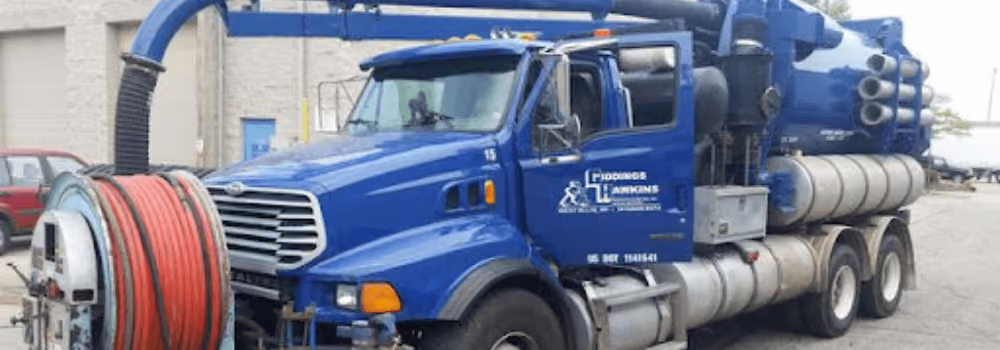




















































%20-%20thumbnail.avif)





%20-%20thumbnail.avif)


%20-%20thumbnail.avif)

.avif)




%20-%20thumbnail.avif)