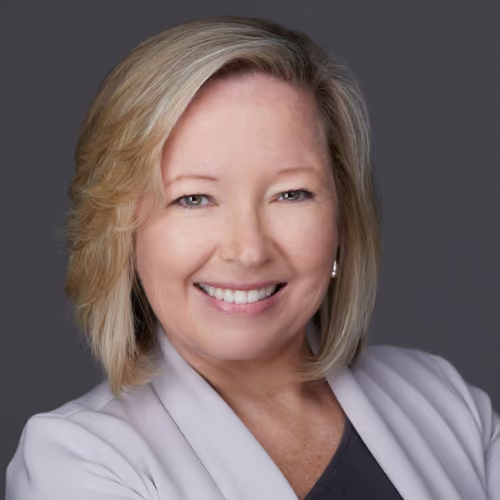
Host: $15 million in EBITDA. It's a number few self funded searchers ever reach. Today's guests, Robert Graham and Aaron Blick have gotten there in four years. In this interview we'll show you how I want to call out a few topics to listen for. These are all key elements to Robert and Aaron's success with Pillar Health Group. First, buying businesses with operators. You don't get to EBITDA of 15 million working in your business. You've got to focus on higher leverage work. So you need an operator in each acquisition as soon as possible, preferably from day one. Key point though, this is not buy a business, hire an operator. The business runs itself and you get mailbox money. No, you are extremely involved, but just at a higher level. You've delegated the daily blocking and tackling to your operator. Second, choosing your industry. Robert actually recommends against identifying an industry to pursue a roll up in, but when considering a particular business to buy, one of your criteria should be does the industry of the business have roll up potential? It's important for the potential to be there, but that shouldn't be your leading criterion. An important distinction there. Third, the structure. For me, this was the most eye opening bit of the interview. So typically a roll up does not use SBA loans, at least not beyond the first acquisition or so. Instead, the capital the roll up uses to buy businesses is a combination of a lot of equity and conventional debt, non SBA debt. But Robert and Aaron are blending a self funded search with a roll up model by coming up with a way to use SBA debt for their acquisitions. End result, they've raised relatively little equity and used much more and cheaper leverage to build the entire Pillar Health Group empire. They've only raised about $3 million, whereas a conventional roll up might raise $30 million in equity to get to the same place. There are nuances to this and many more personal guarantees involved than you would see in a conventional roll up, but still very powerful. That and much, much more in today's interview with Robert Graham and Aaron Blick of Pillar Health Group. Welcome to Acquiring Minds, a podcast about buying businesses. My name is Will Smith. Acquiring an existing business is an awesome opportunity for many entrepreneurs, and on this podcast I talk to the people who do it. An SBA loan broker, as opposed to a direct lender, doesn't work for a particular bank. Instead, the broker pairs you with the right SBA lender for your deal based on industry terms risk thresholds, then helps you navigate the process better than many lenders themselves do. Matthias Smith of Pioneer Capital Advisory is just such a broker. Matthias worked at two of the country's top 10 SBA lenders. So he's been on the inside of the SBA process and knows well the pitfalls and hurdles and how to avoid them. He struck out on his own to laser focus on the ETA and search space. Our niche is his niche. You'll see Mathias at all the ETA conferences. He's closed over 30 search deals since starting Pioneer in May of 2022, including some acquiring Minds guests. To learn more and get in touch, go to PioneerCapitalAdvisory.com or click the link in the notes. Robert Graham and Aaron Blick. Welcome to Acquiring Minds guys.
[4:03] Guest 2: Thanks for having us, Will.
Guest 3: Yeah, thanks for having us.
Host: The two of you have had an eventful last four years. In 2019, you partnered to do something of a conventional self funded SBA search and you looked up four years or so later and you've done five more acquisitions and EBITDA across your businesses stands at over 3, $15 million. And so we all want to know how you did this, but first let's get some background on the both of you. Robert, if you go first, then Aaron will go to you. Robert, a little bit of your backstory, please.
Guest 2: Sure, Will. So Aaron and I have actually known each other since we've been probably seven or eight years old. We grew up in Houston together and played T ball and soccer together growing up. And then we both went to A and M and I studied industrial distribution, which is like in the engineering school, it's kind of like industrial engineering, and went to go work for a company called Eaton, was in a variety of management roles and then got lucky and got into Harvard Business School, got my MBA there and then went to work in private equity for a fund in Houston. And so my background was very much industrial and, and then investing. So at a high level that. That's it.
Host: Robert, were you an entrepreneurial kid?
Guest 2: Not really. I had a dog sitting business and, you know, some other silly things that kids do.
Host: But, you know, was it inevitable that you get into business in one way or another?
Guest 2: Yeah, that's a good question. I think that I always wanted to own my own business and, and so that's actually why I went into private equity. I wanted to learn how to buy and sell businesses. Turns out private equity is actually not that great of a training ground for owning a small business, but I learned how to buy them, so that was good training.
[6:01] Host: Yeah, well, you and many other Acquiring Minds guests cut their teeth buying businesses in a Private equity environment. Aaron, to you.
Guest 3: Yeah. So not a private equity guy, thank God, No. So my background is largely in healthcare, so my dad's a physician in Houston. Robert kind of mentioned that owns his own practice. Well, part of a group of physicians there. When I came out of undergrad, they asked me to come manage their practice. They had some a former manager embezzling, but at that point the bar was so low, they offered me the job. So for about the first four years of my work career, I went and worked at a physician's clinic off 12 physicians there in Houston. As time went on, eventually I left the practice. I was only supposed to be there for about six months. Ended up sticking around for three years, much to my chagrin, but eventually left and started some physical therapy clinics and pharmacies, as well as an accountable care organization. But fast Forward to about 2019. I was exiting those. Those clinics we had built about eight at that time. And it was clear that that was kind of the end of the road for that project that I was working on. And one of my good buddies, Robert and I had been grabbing sushi lunch as a spot we love down in Houston and would go to pretty consistently. And eventually we kind of came to a similar conclusion that we were both looking for change. And at that point we partnered. That was probably January, February of 2019, that we said, look, let's go, you know, buy business together and go from there and see where it takes us.
Host: Aaron, couple follow ups. So these clinics and pharmacies and what was the third business?
Guest 3: An accountable Care organization. Yeah, okay. It's also called Medicare CEO.
Host: That's, yeah, still unfamiliar to me. Probably a lot of, a lot of the audience. You started these. Aaron?
Guest 3: Yeah, so I did not start the accountable care organization. I was just a partner there. But the physical therapy clinics were ground up. Entrepreneurship, find a space, get a loan, knock on doors, ask orthopedic surgeons for referrals. They were more high end. We didn't actually take Medicare or Medicaid, so more kind of the weekend warrior. We had extended hours, worked, you know, weekends, hired the best therapists in town. But yes, that was what. What that was.
Host: And were those successful businesses? And then the exit. Was that successful?
Guest 3: They were, yes. And the exit was successful. What happened there is I had a partner that had another separate business that he ended up selling and he no longer wanted to participate in growing the PT clinic business. And I wasn't interested in doing that by myself. It was a lot of work. And so it, it kind of came to the Came to a conclusion. We had somebody for a while that was kind of asking us to buy our clinics when we, you know, when that day came. So we didn't go through a rigorous, you know, exit process. We really just exited. And I knew that that was the right thing to do at the time.
[9:03] Host: And I can't move on. Aaron, before I ask you about seminary, which I see on your LinkedIn, so you, you, as Robert said yesterday, you almost went to the good side before going to the dark side. So give us a little bit on that.
Guest 3: Yeah, so interestingly enough, my undergrad is in philosophy and communications. And for a while I thought that I would get a, you know, higher level education kind of in seminary and maybe teach at some point. And I got married and early on in my life, my wife said, you know, if there's anything else you want to do, education wise, go ahead and do it now. Because we knew we wanted to have a family. So I did, I went to seminary. This would have been 2011, so a long time ago.
Host: Yeah.
Guest 3: But ultimately, you know, my life kind of took a different direction. I did get a master's and was and proud of that, but we kind of went in a different direction and been super happy with where I've been. You know, you kind of find your place and you go with it. And this is where I am.
Guest 2: Sure.
Host: Yeah, sure. Great. Well, thank you for that, guys. Robert, you came from private equity and so by in what attracted you to private equity was learning how to buy and sell businesses, although not operate them, as you said. But Aaron, you who had done zero to one stuff, why was the next project the thing that the two of you wanted to partner on? Buying businesses versus another zero to one project?
Guest 3: Yeah, that's a great question. So I knew a little bit about eta, but I wasn't nearly as versed as Robert was. Robert took classes in school and had a couple classmates that had done this. And so, you know, operating businesses was something I was very comfortable with, but buying them, not so much. And of course that's something Robert, you know, was good at. And, and likewise I had, you know, experiences that would, you know, benefit our relationship that, you know, he wouldn't have to go reinvent the wheel. Right. And you know, buying a health care business, you know, it, you know, kind of the way the conversation with Robert, I went is, you know, when I'd like to buy a health care business, but I have no clue anything about health care business. I'm an industrials guy, you know, and I said, well, you're in luck. I know way too much about health care businesses and that's kind of how we, we started, you know, and we. There's been a trend for some years in health care toward the, in home care space. So I definitely knew that that was something that we wanted to move toward. I was a little tired of brick and mortar. Brick and mortar is really, really tough. And it takes a really long time to grow those clinics and get cash flow positive and, you know, start getting people happy. So kind of the, the zero to one experience I'd been through and you know, I like, I. I used to have a real pretty head of hair. Well, it went away going through all those, you know, those years in that experience. So I was ready for the one to two experience and Robert was certainly ready to make that jump as well. And so that's what we did.
Host: Robert, why were you ready? Was there something in your life at this moment that made now the time, or was it really Aaron's availability that kind of prompted you to jump?
[12:07] Guest 2: Yeah, that's a good question. I think that I always wanted to own my own business and it was just kind of a matter of when. And I had learned everything I needed to, I think, in the roles that know. I did an internship in investment banking and then spent a year in private equity. And I had learned all that and the operations piece I think I had learned in my prior operating roles. And then, you know, Aaron and I obviously, you know, we're close and Aaron was interested and had the OPS background in healthcare and so it just kind of made a lot of sense at the time. Yeah, so it just kind of, it just worked out.
Host: Did you like private equity, Robert?
Guest 2: I would say that not a lot of people like private equity or investment banking for a variety of reasons. So it wasn't the right fit for me. But I learned a lot while I was there, certainly.
Host: Great. And so it sounds like you guys essentially had a thesis that it was going to be a health care focused search, correct?
Guest 2: I think so. It was a little industry agnostic at first, and then we kind of drifted into more focusing on health care. We got this deal, this home health, home care, hospice deal under loi. We were really excited about it. And then we started spending a lot more time on the space and actually started talking to some other targets pretty early while we still had this deal under loi. Some of those targets we ended up actually buying much later, which we'll talk about later. So the search evolved for sure. It started out very much industry agnostic. And then Aaron came on board and then I started probably spending 50% of my time on healthcare with Aaron. We looked at some non healthcare things together too, you know. So when I started it was a solo search also. And I didn't catch that.
Host: Okay, you started solo.
Guest 2: Started solo.
Host: Okay.
Guest 2: Brought Aaron on board, started focusing, you know, probably 50, 60, 70% of the time on healthcare. Got under LOI with this home health, home care, hospice company, this group of companies and then really started focusing in that industry quite a bit actually even before we had closed.
Host: How long did this search did your. Would you say your search took understanding
Guest 2: right out of here from, from starting a search to closing on a deal
Host: and give us a little bit more of the criteria of your search. Industry agnostic but quickly dialed in on health care. What else was size wise? I mean any economics that you can share or financial parameters that you can share.
Guest 2: A million of EBITDA plus. So I think we were really focused on like 1 to 3 million of EBITDA and then less than a 5x purchase multiple. All the check marks of what a good self funded leverage buyout looks like. Right. So like everything a lender's gonna like. Right. Non cyclical, no customer concentration. The basics. Right. But other than that, pretty much industry agnostic and geographically agnostic too. Oh yeah, yeah.
[15:06] Host: You, you got, you guys are from Texas. Were in Texas at the time. Aaron, you were in Texas, right?
Guest 3: Yep.
Host: Yeah. You were having lunch together every day or excuse me, every, what was it, once a week or.
Guest 2: Yeah, once every couple weeks. Yeah.
Host: Okay, so. But you were willing to move.
Guest 2: We were, yeah. Yeah.
Host: And Aaron, you subsequently have. Which we'll get to. Robert, you're well known in, in our world for being somebody who advocates larger businesses don't buy small, buy large. The argument is pretty simple. Regular listeners will have heard it countless times. The bigger the business, the actually less risky. It is somewhat counterintuitive to people who are new to this. The more capital you have to play with to make improvements to the business. I mean a lot of stuff just kind of works out but the more management layer it's likely to have, not necessarily likelier so that you can be working on the business rather than in the business. So goes the theory. And you've been very vocal about this. Sounds like you knew that from day one or you knew that from private equity. That that has always been. I mean I, I almost think that the million dollar SDE thing in my own mind that was thanks to you that you were so you're you, you're you're so strong on that point. And we've had conversations since my earliest days in this, but it sounds like that was already gospel.
Guest 2: It's a good question, Will. I mean, it's not like I came up with that on my own, right? I mean there's a lot of searchers and mentors that, you know, push me in that direction. And then honestly, I mean a lot of people disagree, but for me it's, it's obvious, you know, I mean if you. And a million dollars of SDE is kind of arbitrary because every business is different, right? There are million dollar SDE or EBITDA businesses where the, the owner is like doing day to day operations and is in the job and you know, and
Host: then there are, and that's why it's a million dollars because they're not, they're not paying for people to help.
Guest 2: Oftentimes, yes, that, that's a serious constraint on growth. Then, then there are, there are 500 EBITDA businesses where the owner is not involved in day to day operations. So it's an arbitrary number. But you know, I think what it helps with is generally weeding out companies where it's a job rather than you as a buyer taking an ownership position rather than taking a really a job. And also the opportunity for wealth creation, right. So with a million EBITDA business, if you just run it and it continues and really, I mean every time we buy a business, whether that's SIG or pillar, the kind of thesis going in is this has to work, this has to do well, even if we don't knock it out of the park, right. If we just grow this thing kind of like it always has, we should be getting a return that makes up for the risk we're taking because buying a small business is very risky. And so, you know, I tell everybody I talk to and you know, I, a lot of people call me about ETA and I tell everybody, you know, if you're going to take this risk, you should be compensated for it. And if you're buying a company with 300k of EBITDA, you probably could make more money just working at McKinsey and not taking a personal guarantee and you know, and not being up at three in the morning thinking you're not going to make your debt payment or payroll, you know, so that's my opinion on it.
[18:32] Host: The thing is, a lot of W2 folks, Robert, are not in W2s that pay like McKinsey. So they might be making 70 or 100 grand a year. And so making 130 or 150 at their own business, while riskier is a big step up and means autonomy and big upside.
Guest 2: I would not do this. I would not do this for an incremental 50k. I gotta say Aaron, you're a ETA entrepreneur. Would you do this for an incremental 50k or just keep your job?
Guest 3: I had to cut my job.
Guest 2: Yeah, yeah. So but yeah, yeah, I mean risk reward, right, you know.
Host: Yep. A PEO run by a searcher for searchers. If you're running a company with less than 100 employees in providing health insurance, you could secure better benefit plans at a 15 to 30% discount through a professional employer organization or PEO. Aspen HR, run by search fund veteran Mark Sinatra, understands the needs of search operators and could be a great solution for you to receive HR compliance and diligence support. A powerful HR tech platform and Fortune 500 caliber benefits, all for a fraction of the cost. Check out aspenhr.com or contact Mark directly@markspenhr.com Give us a little bit about what the search was like. The, the mechanics of your search. Proprietary, especially if you were geographically agnostic. I mean that, that, that's a wide net. So how'd you approach it?
Guest 2: Oh, it was like a hundred percent brokered. So 100 through business brokers or investment banks. We didn't do any proprietary sourcing really at all. And the vast majority of self funded deals, if you look at the study Sig did for example, which is on our website, you know, you can see the vast majority of self funded deals are through some kind of intermediary. They're not proprietary and there's a lot of reasons for that. But you know, if you go direct to business owners, it's very difficult to tease out whether it's even a business you want to buy because a lot of business owners don't even know what their EBITDA is. EBITDA is not a word that most business owners use in a day to day basis. And then knowing or if they're really ready to sell. Exactly, yeah. If they really have an intent to sell and then even figuring out if their financials are correct or if there's anything seriously wrong with the business can take months. So it's not a very efficient way of searching for a business. I think the biggest argument for going the proprietary route is that there are good deal. You can get a better deal than you'd get if you were going through an intermediary. But the truth of the matter is is there are fantastic Deals on the intermediary side. And you know, we'll talk about one of those later today. I mean there just are, there are a lot of really good deals. It's a very inefficient market. You know, any below 3, 2, 3 million of EBITDA, it's, it's an extremely inefficient market in my opinion.
[21:40] Guest 3: Yeah. And Will, to answer your question a little more directly, I mean Robert and I were sourcing all day. Right, right. So you know, up at 7, down at 7, there's you know, brokers on the east coast and on the west coast. We accommodated their schedule as best possible. We're having those conversations, each of us 12 hours a day. I mean it is as much as we could get on calls with brokers. We would be, we had a couple deals under exclusivity that you know, of course didn't make it. But when we did have that, we were on a plane and you know, flying to those locations and shaking, you know, know, sellers hands and seeing if it would be a deal that we could get done. But we were very aggressive in our, in our, in our surge and aggressive in our, you know, diligence, aggressive in our, you know, offers, aggressive in our, you know, attitudes toward them. And we made it very clear that we were, you know, we were going to get a deal done no matter what. And so yeah, it happened to be that, you know, the deal we closed was in was four hours away and you know, dfw, which was great. We were happy about that. But I mean we, we flew to, you know, Utah, North Carolina. I mean we, we, we, we did a lot.
Guest 2: Yeah.
Guest 3: To get there.
Host: This, this aggressive aggressiveness with which you approached your search was that just because you just, you knew that that's what it would take or. Yes, you were just eager to get in the seat. And, and the search part is just the thing to, to power through. So the harder you, the harder you work, the quicker your power through it.
Guest 3: Yeah, both, I mean we discussed this thoroughly that this was a full time job and so we approached it in that same way. So we were organized like that, we were responsive like that and we weren't trying to search for two years. That was not my plan or Robert's plan at the time. I had young children so that wasn't going to happen. So this is also to Robert's earlier point about a brokered search. We had time that we were not going to waste and so we were, you know, we were searching a binary result here. We were going to do it or not. And in our case, it was going to happen. Yeah.
Host: Yep.
Guest 2: Yeah, I was working, I was working probably a comparable amount of hours as a searcher as I was in private equity. So. And I think that's how most people should probably approach it.
[24:01] Host: And once you had narrowed down to healthcare, I assume then your search was just in that industry. So you were talking to intermediaries just within that industry, targeting owners just within that industry, or sims just with that industry.
Guest 2: It was probably 70% healthcare, would you say, Aaron?
Guest 3: Yeah, I would, yeah. You know, we could speak a little more intelligently to the industry. So it made those conversations with sellers beneficial for us just because we kind of had a feel for what, you know, what an EOB was and you know, what lengths of stay are. So there's certain, you know, just, you know, conversations that we could have. I think that probably other searchers or folks talking to these guys maybe weren't having. So, you know, that was probably helpful. But we, we were still looking at other, at other businesses, for sure. Yeah.
Host: And were you going to take investor capital for the equity injection or were. Was this all going to cut? You were.
Guest 2: Yeah, yeah, always. Yeah. We knew we were going to buy a business with over a million of ebitda. So it was kind of like, well, we're not going to put every dollar that we own into this, you know, so, and it, you know, we knew what the terms were probably going to be in the equity market, you know, in this space. And so and we were still going to be able to maintain control of the company and majority ownership. And we thought that was, you know, very likely based on, you know, what my classmates had experienced and what we'd seen with other searchers. So to us, it was a no brainer, I think, to take outside equity.
Host: Well, it's funny, Robert, that's. This is another example where I feel like a large, a sense of my, my own sense of what self funded terms are with respect to investors comes from early conversations with you and on behalf of sig, you really have tried to educate the market that you can do a self funded deal, a sizable self funded deal, and still own well over half of it. Again, it sounds like you didn't invent this. These were already terms that were out there. You've just helped amplify that point.
Guest 2: Yeah, I think that, I think that's fair. Yeah.
Host: Yeah.
Guest 3: Amplify is a nice way to say that.
Guest 2: Yeah, I've got a lot, a lot of opinions.
Guest 3: That's right.
Host: Okay, great, guys. Well, let's hear about the business that you found, or businesses as the case may be. Tell us, tell us about it.
Guest 3: It was a trio of companies, same ownership, three different companies there in the DFW area really three service lines, home health, home care and hospice. So three different, you know, services to, you know, kind of a typical, similar, you know, patient clientele, if you will. About 1.2 million of EBITDA I believe is what it ended up being. Robert. And we, we paid under four times for that deal and we were, you know, very happy with that. It was a bit of a sleepy business in that, you know, earnings were pretty consistent. We didn't see a whole lot of growth. The owners were, you know, very comfortable in, you know, in what they had. And it's probably not an uncommon story. You know, they spent time, you know, traveling to Europe and you know, would kind of come back and you know, take care of the business and then take off again. But relatively owner centric. They did have some, some middle management, um, again probably because they were a little bit larger of a business. They did have kind of an administrator that was in the business all the time and, and one of the owners was a nurse, so she did a little bit of nursing in the field. And then the other owner really, you know, cut some checks and you know, was really interested in his real estate business. But you know, it looked, it really looked like ripe for opportunity. Been been around since, I don't know, I think it was 95 or something like that. So, you know, legacy type of business, pretty good reputation, particularly on the east side of dfw. But that was, that was our first acquisition and it was pretty much, pretty much down the fairway for what a self funded deal would look like.
[28:03] Host: 1.2 give or take of EBITDA and the revit. What does revenue look like on a business like that?
Guest 2: It was about 6 million in revenue.
Host: Okay, so and that's perfect. 20% margins. Is that kind of standard in this world?
Guest 2: It's a little high, but not too high.
Host: And so what was the big vision guys to do? Be kind of conventional self funded searchers. Grow it like you can then maybe exit in five, eight years or not, whatever. Have the optionality or was it to build something really big like you have?
Guest 2: I think it was always to build something big and to own our own business and to do a roll up. Honestly, I think we still would have done an acquisition in a space that didn't make sense for a roll up. But that was definitely something that was in particular Attractive about the space I had read about. Have you ever heard of Wayne Huzunga before, Will?
Host: Yeah, the waste management.
Guest 2: Waste management blockbuster guy, you know, Miami Blockbuster too. Yes. So I mean, that's the thing about, you know, a lot of self funded search ends up with somebody buying a company that they grow organically and you know, they just own one company and that's what a lot of self funded searches look like. But if you can buy a company in a fragmented industry where a rollup makes sense and there's a few factors that would, you know, make that make sense, then self funded search can be, you know, really interesting and returns can be amplified significantly.
Host: Now Robert, what's interesting so I on stage at your own conference in Dallas last year, there was a conversation about roll ups and you advocated actually not setting out to do a roll up where you identify an industry. You, you do all this industry research, identify an industry that seems ripe for a roll up and then just go after that industry. I'm putting words in your mouth so you'll correct me. So, so if that's, if my interpretation of what you said is correct, it sounds like what, what this was, was you found a business you liked and, and the cherry was that it's also in an industry that, that seemed ripe for rollup, but that wasn't actually one of your criteria filters.
[30:35] Guest 2: I think that that's, you put it really well, Will. I think it's really important for searchers and when searchers work with us at S in Sig in our accelerator, we, we push them to be industry agnostic and geographically agnostic as much as possible because I think you need to have a wide filter. The truth of the matter is, is that it's just very difficult to find and acquire a good company. It really is. And if you limit yourself to one industry, it makes it that much harder, significantly harder, I believe and reduces your probability of getting it done in 24 months or however long your search Runway is. The company we bought, being in an industry where doing a roll up made sense, was the cherry on top. I think we still would have acquired a company that didn't have roll up potential, that had organic growth potential and a lot of self funded searchers are perfectly successful without doing roll ups. You know, it's just kind of. That was the cherry on top for us for sure.
Host: Although 15 million EBITDA is likely to be the headline of this episode. So if, if people see that and they have a big appetite and a lot of ambition and they want to see similar numbers for themselves after a four, six or so years. It seems like choosing an industry where there's roll up potential is the only way or not. The, I never say never, but the most likely way to get there. Growing from a million dollars ish of EBITDA that you guys had with this first acquisition to 15 organically was not going to happen in four years. So, so I, so I take all your points, Robert, but I guess I'm pushing to say if you really want to go big, then maybe you do choose an industry where there's roll up potential because you can't go that big that fast through organic growth.
Guest 2: No, I think that's, I think that's fair. A lot of our growth to 15 million of EBITDA was organic. I want to make that point right that the Texas business has tripled in size. The Arizona business has almost doubled in size. The Oklahoma business has also done fantastically. And those are the acquisitions we've just had for a while. The newer acquisitions are doing well also organically. They're just brand new. So we're just getting into the swing of things. But I think that it's difficult to grow 10x for example, in four years if you're not doing some M and A or unless you're in a very unique environment where maybe you bought something on the cusp of, you know, some new trend. Like Assurian would be an example. Right. Where yeah, you just, it's kind of, there's some luck there and some, you know, what's the, what's the word? The stars kind of align for you. I think if you're going to grow that fast, generally with a, with a higher probability, you know, roll up is probably the way to go.
[33:30] Host: Yeah, well, in the Assurian case where it's kind of just, you're almost creating a new market. You've, you've kind of gotten into kind of tech, tech startup land. Even though you might not have realized it, that's essentially what that venture ends up looking like. And it's really like you said, Robert, really hard to, to architect that from the beginning. Yeah, well, as I hear you say as we talk about this Robert, I'm reminded of something else from the, the, the self funded search conference in Dallas that Kent Weaver said in our, my conversation with him on stage, which was the real magic is when you have organic in and inorganic together.
Guest 2: Yes.
Host: Because then you're just, I mean you're getting amplification to use to. This seems to be the theme of the episode. You're getting that much More amplification. You're just getting it on two fronts. And it's just the numbers get big quickly.
Guest 3: Yeah. And, and Will, it's a common theme with each one of these acquisitions that we've made at Pillar. That story of just kind of. And I don't say lazy owner as if they're not working, but they're very comfortable owners. Right. These are typically people ready to retire. They've got, you know, it's turned into a lifestyle business. They've got grandchildren or traveling they want to do. And so, you know, typically when we're buying these businesses, you're not seeing a whole lot of growth. But when we come in, I mean, that's what we're doing. I mean, we really are, I mean, bringing in like a marketing arm if it, if that's what it needs, extra management, if that's what it needs. You know, typically, you know, we've bought a business that we didn't have any type of PNLs. We built them. So. Yeah, I mean, these are, you know, these are typically businesses that are, you know, they're just, you know, they're owned by, you know, folks that are in a different stage of life and, you know, kind of we're coming in and bringing in a whole new energy. And so usually the teams there are also really appreciative of that. So we've seen that at every acquisition we've had, actually.
Host: Yeah. And so just circling back to an earlier point, Robert, you said about the risk reward of doing this, that when you look at acquisitions, they need to do perform well, even if you don't knock it out of the park. But that wasn't to say that you're not going to try to knock it out of the park. You guys were very growth oriented the whole time, very aggressive. But, but, but, but what you're doing is covering your downside so that even if these growth plans didn't pan out, it still would have been a very nice.
Guest 2: Yeah.
Host: Investment.
Guest 3: That's right.
Guest 2: Margin of safety. Right, Will? I mean, that's how we have a margin of safety. Yeah. Great.
Host: And so the roll up thing, what, what about this industry, did you see that made it ripe for roll up? Small mom and pop fragmentation are usually the two things you, the two criteria you hear. And I think those are the case here. Anything else?
[36:10] Guest 2: I mean, fragmentation is the number one. Right. And also fragmentation, where you've got an M and A market at reasonable multiples. Right.
Host: Reasonable multiples.
Guest 2: Right. There's other dynamics too. Right. So for us, we're doing leverage buyouts of every deal we do. So does the industry, is it conducive to leverage? Right. And the home health, home care industry, I would argue overall is for the most part. Do you, do you have some benefits to scale? Right. That's another big consideration for roll ups. You know, you might also look and see are other people doing roll ups in the same space? Have roll ups ever been done before? And if not, why? And if so, you know, can I do one also? You know, is there a, you know, is there a active M and A market for these? Right. Because if you can't find targets, you know, that are of good size also. Right. So here's another example. I wouldn't want to do a roll up in many industries that have, you know, the average businesses, you know, 300k of EBITDA, because that would just be a ton of work, you know, how many you'd have to buy. I mean, and buying a company is a lot of work. I would argue it's the same amount of work to buy 300k EBITDA company if you're doing it the right way as it is to buying a million EBITDA company, everything else the same. It's probably about the same amount of work. So you know, are there, are there sizable targets that are available at a reasonable valuation expectation? And a lot of those targets, you know, those are all kind of the things to think about.
Host: Anything to add, Aaron, does that sound right?
Guest 3: No, I think that sounds about right. I, you know, the price is key here too, right? I mean, then, and you're able to do what we're able to do because we're paying, you know, three, four, under five times on these deals, you know, when you start getting any of these, you know, businesses that are larger, although we did, you know, have a larger acquisition at a lower multiple, you know, typically you're not going to find them. Right. So those businesses are going to trickle out of your, out of your range very quickly.
Host: And what about the role of private equity in, in your chosen market? Because on the one hand, the existence of private equity suggests, Robert, to one of your criteria that, that there's M and A activity, a good thing, and that there's going to be buyers for what you're building potentially. On the other hand, the existence of private equity is, it's got to be like a sweet spot because if there's too much private equity interest in a category, right, then the multiples already will have been driven up. So there's a window of opportunity. I Feel like there is absolutely. That's exactly right. On the other side. No. Private equity is a bad sign, we assume too, because who are you going to sell your business to if that's the path you choose to go?
[39:06] Guest 2: Yeah, potentially. I mean, if you want to sell, you know, a lot of searchers want to run their business forever, you know, and what I would say, I think you hit the nail on the head though. When private equity gets caught on to an industry for a roll up, it just ruins everything for people like me and Aaron. So, you know, there's been so many spaces like that. Vet clinics, dental clinics. Right now, H Vac, H Vac used to be able to find these small H Vacs for like really reasonable multiples. And then just in the last few years here, they've just been blown through the, through the sky. I mean, so you got to get there. I think definitely if you can develop a thesis on an industry for a roll up ahead of that happening, it helps. So I do agree with that.
Host: And so where are we in your industry for the life cycle of private equity interest?
Guest 2: Well, I'm biased, of course, but I don't think that the secret's out yet about how great this industry is and how much it's a fit for a roll up. So that's my opinion.
Guest 3: Yeah, I mean there are some larger players in the space, you know, that are publicly traded. There are some, you know, privately held organizations that do what we do. So they do exist. But to the point being made earlier, you know, we're still able to get these for reasonable multiples, which is good.
Guest 2: Yeah, yeah.
Host: Well, the secret sure seems to be out among searchers because you guys will have been the third, if not the fourth guest who's, who's bought home care, home health care style business.
Guest 2: Well, let me, you know, caveat that I just, I wanted to mention, I think several other guests have bought franchise private pay home cares. Right.
Host: Which is, you know, one dig a Romeo one.
Guest 2: Okay. It was just one. Okay, well then, you know, I, I stand corrected. I, I think that that is quite different of a space than where we are for the most part. So.
Host: Well, Robert, I, I want to do the whole story, but then before we leave, toward the end of our conversation, I'll want, I'll ask you guys for a primer on the industry and we'll get into all of that, the different shapes and sizes and categories and sub niches and so on, because there, this is a, an industry that's easy to generalize about. But as you've pointed out many times the nuances from one subcategory to the other are make them very, very different for one another.
Guest 2: Absolutely.
Guest 3: Great.
Host: So you guys, okay, so you acquire this business for under 4x for 1.2 million in EBITDA. You, it has these great characteristics. Four hours away. You're not scared to jump on a plane, clearly. But now that you're buying this business, are you moving to DFW or are you going to run it four hours away?
[42:02] Guest 2: We ran it four hours away. We hired a president to help us run day to day operations the day we bought the company or actually a little bit beforehand. So we didn't have to be there every day. But for the first six months, we pretty much were there every single day. And then we, you know, Covid happened. Actually not that much, not that far after we bought the business. And so, you know, about a year later, Covid happened. And so at that point, it made a lot of sense. We transitioned a lot of the employees to working remotely and we started working remotely. And it just kind of was a natural thing when the pandemic happened. And then since then, we've pretty much managed that business remotely with obviously we have a president who's also an owner in that business who's been very instrumental in the organic growth we've had. We had always planned to, at some point, transition to not being day to day on the ground. Because if you are day to day on the ground, you can't do acquisitions. You can't think really long term. Right. You're worried about paying invoices and, you know, things like that. Day to day stuff. That's, that's, you know, that's the reason you would need to be in an office all day, every day, which are very necessary tasks. It's just that you can't focus on working on the business if that's what you're doing every day. Which is, you know, kind of alluding to what you were saying earlier.
Host: Well, the nature of this business too is actually such that being in the office, there are not that many people who are in the office to manage because everybody's out in the field or the vast majority of the work.
Guest 2: Yes.
Host: So a lot of the stuff that's happening at the office is just back office stuff.
Guest 3: That's right.
Host: And okay.
Guest 3: Yeah.
Host: All right.
Guest 2: That is right.
Host: Do people, do people in this world, again, lots of nuance for all the different categories, but generally check in at the office every morning like they would at a H Vac or a field service. Business or.
Guest 2: No, no, the clinicians do not come into the office every day. They come in, okay, you know, maybe once a month or once a quarter for trainings usually, or maybe some paperwork or supplies. Yeah.
Host: So this is a, this is a workforce. The clinicians, at least that are very independent, very autonomous. They'll go weeks without seeing anybody else
Guest 3: at the organization if they're doing their job right.
Guest 2: Potentially.
Guest 3: Yeah. Potentially, yeah.
Guest 2: Okay.
Host: And then on this point about hiring a president. So common theme of the POD is that it is a fantasy to, I don't mean to say realistic, but it is the hope and dream of many people to buy a business that's generating a million dollars of cash and, and also not have to actually get in the day to day and just hire an operator, hire a president, have them do it. We generally try to disabuse folks of that, at least as a first step because you should just expect that you're going to really need to get your arms around the business and be in there and be a leader and learn things and so on. Then on the other hand, of course, delegation is seen throughout the business world. So the idea that you would have a business unit or an entire business that's run by somebody other than the person who owns it is actually how the world functions. So it's not that crazy. And, and I've had guests who have, who have done it from day one. They buy a business and, and as they're, as they're closing on the business, they're hiring an operator or a GM or a president and intend to put that person in and then do. And it works. Although I haven't had them back for the second episode, just, just their first one. So, so respond to all of that. It doesn't sound like you guys were, it sounds, it sounds like you had a lot of confidence that you'd be able to do that. Respond to all that. And then, and then I'll ask a follow up.
[46:00] Guest 2: Yeah, I, I guess I'll respond. I think that being able to delegate in this space, if you want to get past a million of ebitda, if you want to get past the business that you just bought as a searcher, you're going to have to be able to delegate. And if you cannot do that, then you're probably going to continue managing a million EBITDA business or a 300k EBITDA business or whatever it is. It's so important to be able to delegate. And we've been really lucky to have hired and also partnered with the Presidents, you know, and, and management in our company, we've been, we've just been lucky to find really good people to work with and that's helped us have incredible organic growth on top of the growth through acquisition.
Guest 3: Yeah, I, I do think will, it's important too, especially with, in our first acquisition, you know, it wasn't that we bought the business and threw a president in there and closed our eyes and hope for the best. Right. We were still very intimately involved. And as time went on and as we got comfortable with him and he got comfortable with the business and, you know, we established what the KPIs needed to be and what we were looking for and expecting and what he was, you know, what his goals were for the business as well. You know, then that was where we could have a little less of that day to day involvement. But you know, for the first, you know, for the first six months, it's definitely, you know, you really do need to get to know the team that you're working with because you are a new face for, you know, a group of folks that probably work for the same person for 5, 10, 15 years in some cases.
Host: You know, so in your case, Robert, you're needing to learn the industry. And Aaron, you knew the industry somewhat, but maybe you didn't know this particular industry within health.
Guest 3: Yeah.
Host: So you, you guys both needed to just be learning kind of this.
Guest 2: Yes.
Host: Learning the industry.
Guest 3: Yes.
Guest 2: I don't think anyone should have the expectation that they can just hire a president and not be on the ground day one. Every searcher we work with at sig, we tell them, plan to be day to day at a very minimum of a year. Yeah, at a minimum of a year. So you need to move to the city where the acquisition is and plan to go into the office every single day for a year.
[48:12] Guest 3: Yeah. First one and last one out.
Guest 2: Yeah.
Host: Well, you know, this is such a, this is such an important distinction that I feel like I fail to make whenever I talk about the two options here. It's not that where, where we should be skeptical is putting in an operator and then not. And then acting like you don't have to think about the business. And I do think that that is a fantasy that also exists that I'm going to buy a business and keep my W2 and just have somebody else run the business for me. And this is, this is the dangerous, this is the dangerous notion. But the idea that you would buy a business and be expecting to be working on it, whatever, in, on, around, on top of the business Full time, but just not doing the operations, just not doing the blocking and tackling. That is what your president or your operator is for. That is, that's right, kosher.
Guest 2: It works for us. Maybe it worked very, very well for us because it's kind of like, you know, ying and yang. Right. If, if, if you don't have ying, which is day to day operations and leadership, you're not going to be able to focus on the Yang piece, which is long term growth plan, strategic projects, M and A, things like that. You have to have those two components for the, the second piece to be successful at all. And I'll tell you, Michael's our president in the Texas division, and last year, organically, that business grew EBITDA 50%. So it's just he's, he's been wildly successful in his role as president and he was that.
Host: He was the person that you hired from day one.
Guest 2: No, not from day one, but he started with us probably a year after.
Guest 3: Yeah.
Guest 2: So we, we ended up changing presidents about a year into it because the other, the other president had a personal life situation and had to move across the country. But it's gone very well. We're lucky to have the team members we have.
Host: Yeah. Anything else to say about the transition?
Guest 3: So, you know, we, we've kind of skipped ahead to the great horror story time. Horror story. We got to jump all of the great stuff and, and, and the cream. But, you know, yeah, getting there, there were certainly challenges. You know, we, we, we bought that first business. Unfortunately, the, the seller was, you know, dishonest in a lot of ways. And so, you know, Robert and I were the beneficiaries of, you know, some sleepless nights at the beginning, let's just put it that way, you know, and not to get into too many issues, but there was, you know, paperwork that wasn't filed with the government. So, you know, within a couple weeks of owning the business, we're receiving a demand letter from the IRS for $650,000, something like that. There was another form that wasn't filed that was a seller's responsibility with the state of Texas. So they decided to hold our funds for almost six months. It was a rough couple.
[51:11] Host: Let's unpack those real quick. So the IRS saying you owe $650,000. How did that resolve itself? Well, first of all, how, how can this be? Could this have been diligence? Was this oversight in, in your all diligence or not, it just. Some of the stuff is going to slip through.
Guest 3: Yeah, it was diligence it was, it was. It was not disclosed properly by the seller. So one of the questions is, have you filed, you know, all this paperwork that is required for the Accountable Care Act ACA of which this company was, you know, qualified for? He said, yes, it was, and it. And it wasn't. But, you know, going. So basically it was from, you know, two or three years back that, you know, they had not received paperwork that should have been filed. So, you know, thankfully, we remedied that situation. I mean, we got the paperwork done and sent it over. So that was, know, it was an achievable, you know, problem that we fixed. But, you know, it's not pleasant when you're working on everything else in the business and, you know, you open your, your mail one day and you're like, holy cow, what is this? But we, we got on top of that, we work with the payroll provider and got the paperwork filed. I mean, he, he was doing what he was supposed to, just not telling the government that he was right. Okay, so we did get that remedied. The vendor hold was really probably the most unpleasant situation in the vendor hall.
Host: This was the second issue where some paperwork hadn't been filed with the state of Texas. And vendor hold means what?
Guest 3: Yeah, so vendor hold means the government will hold the payments that they. That is due to you until the situation is remedied, which we went to remedy it right away. But you're working, you know, with a lot of bureaucracy, and so it takes a lot of time to get that fixed.
Host: So your customer or your payer is the government, the state of Texas, one
Guest 3: of our payers, correct? Yeah, we have a variety. So that was one line of business where they're now holding our payments until we get this fixed and we sent in the proper paperwork, I want to say the day of the next day that was required. But there's a whole process that they have to go through on their side of the fence. So in the meantime, you know, we're trying to pay folks to do their job and not receiving revenues for that service that's being provided. So it was very, very unpleasant.
Host: And did you have to. Did you just have to manage cash super, super tightly or at some point did you have to have outside cash to come in and give you the working capital to get through?
Guest 3: Great question. We did not have to inject any more cash. We were able to make it through that. We did have other business lines that were not being held under a vendor hold, but, you know, probably could have gone a whole lot longer than that. Yeah, that's right.
Host: Back taxes to the irs, which you handle. Missing paperwork to Texas, which means you're not getting paid by one of your big payers customers, if you will. Any anything else delightful about this transition?
[54:14] Guest 2: Well, I mean, another issue was generally, you know, when you do a stock purchase of a company, the bank accounts come with the company. In our purchase agreement, we had spelled out that the bank accounts were coming with the purchase, but the seller refused to come off the bank accounts as a signer, which was really an irregular thing to do and had us worried because we were in a position where the seller, after selling the business to us, could have gone and wired all the money out of the account or really done anything with the money in the account because he was still a signer in the accounts, which shouldn't really ever happen except in really extenuating circumstances. But he was very difficult about that. And so we were in a position where how are we going to force somebody off the bank account without getting an attorney involved? And at the same time we needed this person who just sold their business to us to train us and to get us into other systems and things like that. So it was a very difficult position to be in. Absolutely.
Host: Well, it's such a perfect example of this, how dramatically the dynamic shifts when you're the buyer pre, pre. Close and you can negotiate and push and walk and you always have the leverage of being able to just walk. And then the moment the business becomes yours, you need that seller and, and that seller has so much leverage over you usually. I mean, if the seller is going to be helping you with a transition, which 99 times out of 100 they are, then all of a sudden they have all this leverage because you, because you need them to play ball with you and help you. So, so how do you, how do you. Lawyering up obviously, is just going to completely alienate them and, and create animosity and they're not going to give you any more help and maybe cause even more trouble. So that does seem like the wrong path. How do you deal with it?
Guest 2: Well, delicately. Yeah, yeah, it's a really difficult thing to do. And sometimes you've got a 90 day training plan or whatever it is, and you need to get what you need to get from a seller before you do anything. And you just got to kind of play nice sometimes, you know, and for us, you know, we got this horrible letter from the IRS and we realized there was a pretty good chance that this relationship was not going to continue being positive. But we didn't do or say anything because we were in a very difficult position. We needed passwords and usernames and training and you know, you're in a difficult spot when that kind of thing happens. So you just kind of have to do what you, you have to be a diplomat to some degree. And that's what we did. Yeah. The other, the other thing was, I mean, a few months after we bought the company, the seller's daughter actually started a competing business very nearby the business that we had purchased. And that competing business ended up hiring away some key employees, which was also a very difficult thing to go through and extremely frustrating. But you know, so it was just an extremely stressful transition.
[57:20] Host: This seller's daughter. So, so there would have been obviously a non compete for the seller, but not one for the rest of his family. So the seller's daughter and she hires key people away from his old team. So while she's presumably within her rights to hire somebody, it sure feels like there's some sort of not upholding the spirit of the, of the non compete there. I know you probably don't want to make any accusations, but it sure smells that way. My interpretation, you don't, you don't have to, you don't have to respond unless you want to.
Guest 2: Yeah, well, you know, the non compete was with the seller. And so I think that the lesson for searchers to take away from this is that you need to think about who the seller's relatives are and close friends and confidants because if those are people likely to start a competing business, you need to have your eyes open for that. Right. If the seller's son or daughter is working in the business currently and has a bunch of responsibilities and when they sell you the business, the seller and daughter or son are going to leave, how likely is it that the son or daughter goes and starts a competing business down the street? You need to think about that as a seller, as a buyer.
Host: Well, actually it's a great. I'm glad you made that follow up point, Robert, because it actually has not necessarily anything to do with the family. It's anybody at the business. And so this is actually not uncommon that you'll hear the GM or the owner's lieutenant or right hand man.
Guest 2: Yes.
Host: Goes off and starts something day one. I mean there, I've had a couple of horror stories on the pod where that happened.
Guest 2: Yes.
Host: So. And there's just no, there's just really no preventing that. I guess there are what it should force you.
Guest 2: Absolutely. There are mitigations. Right. And things you can do to protect yourself against that. So if you have a really key employee that you think would have a high likelihood of doing that, you know, in the first, in the first place, you know, month of buying the business, think about giving that person some kind of a retention plan. Right. You know, where if they're with the business for the next five, ten years, they, they get some really nice bonuses, but they have to stay with the business. That's an example. Have them sign a, an employment agreement with a non compete, non solicit, you know, and other clauses in it that protect you as a, as a business. Um, so there's, there's quite a few things you can do to protect yourself in a situation from a situation like that and to mitigate it if it happens.
Host: Okay.
Guest 2: But it's something every searcher should think about because it's a, it's, it is not that uncommon and it is a significant risk.
[1:00:04] Host: Yeah. And the risk probably is mostly that they're going to steal. Not that there's just a new competitor because in most of these businesses in our world, these small businesses, there's lots of competition. So this isn't, you know, tech land where there's intellectual property and a single competitor can completely, you know, really undermine your business. But it's the, either the key people at your team, them stealing them or the, the, this person starting a business and stealing the key people or stealing key customers.
Guest 2: Yes.
Host: So that's, and that's, and that's really so often what you're buying is the team and the customer.
Guest 2: Exactly.
Host: So they can swipe that away. So it was a rocky transition, but I guess you were undeterred. At what point are, are you then looking to kind of execute on this rollup and, and do the next acquisition? We don't have time. So to be clear for, for the audience, you bought eight businesses technically, but this first acquisition was three, and then you've done five more, so kind of six acquisition processes, let's call it. We're not going to go through all of them obviously, but we are going to hear the story of one more, which was a big one. Aaron, you're now at that business. So to lead us into that, when did you start going again on this roll up plan?
Guest 3: So we never stopped searching. Okay. So throughout this entire process and the horror story that we just disclosed, we never stopped searching. So actually business that's, that's here in Arizona that we acquired, we actually founded in about October of 2019, actually believe it or not, and is that before
Host: you'd closed on the.
Guest 3: We closed right about the same time. So we. We closed. We're under exclusivity on another opportunity. But then, of course, Covet hit. So we. We. We tried to get that. That second deal done there. Let's call it January, February of 2020. But, you know, at this point, you know, you're starting to. Sky's starting to fall around everyone, you know, and, you know, the business takes care of, you know, a lot of vulnerable people. And so, you know, the seller got to a point where she said, look, I got to focus on, like, my core business right now. Like, there's no way we can transact. And, yeah, she was right. So, you know, kind of fast forward through Covid. We continued, you know, continue to dialogue. We weren't under any contract or anything like that. We just, you know, developed a really positive relationship with the seller of that business. And, you know, it took a little while to, you know, let Covid do its thing and, you know, get past that, you know, era for the entire world. And eventually the seller called and said, I think we're good now. You know, things are stabilized. And they were. And actually, through Covet, that business continued to grow. And so fast forward a couple, what, about a year and a half, we then went back under exclusivity to make that transaction happen. Business never went back to market. You know, we continued a dialogue that was, you know, very healthy. And she, you know, sent over updated financials, and, you know, we rewrote another, you know, loi and eventually a purchase agreement and bought that business as well.
[1:03:17] Host: And the growth that it had experienced in the meantime, did that mean that the. That your original offer needed to be. Take that into account?
Guest 3: It did. Not a whole lot, but it did. There was. There was growth. The seller had a number that. That. That she wanted to be paid. She was very specific about a figure. Typically when we're doing these deals, we're bidding on a multiple of earnings. And that really wasn't how this seller was thinking about what she wanted out of the deal. She had a number that she wanted, so we were focused on getting her, you know, what she was looking for.
Host: Usually, Aaron, when a seller has a number, it's unrealistic and inflated, but. But it sounds like maybe in this case it works in your favor as buyers.
Guest 3: Yeah, that's correct. It did, and that is exactly true. Typically it is, you know, out of reach and, you know, asking, I say, Cadillac prices for a Camry.
Host: Right.
Guest 3: In this case, you know, the seller, you Know, this, you know, and this is a seller that was certainly, you know, business savvy, but, you know, a social worker at heart was very concerned with, you know, the folks that she took care of. You know, at some point, she had spoken to, you know, the suits in New York, I like to call them, that, you know, were interested, and she just wasn't. That wasn't what she wanted for her business. She wanted somebody that, you know, had a little more compassion and understand this, understood the space and how, you know, how important the people were. You know, dollars, of course, are important as well, but for her, that there were certain priorities that she had that were maybe a little different than some sellers. So we did. We did. We did have a. We were happy with the purchase price for the. For the business. Can you.
Host: Can you share any of the numbers about that business and about the transaction, Robert?
Guest 3: Would you like to share that?
Guest 2: You know, I think we probably, you know, should keep that confidential. But, you know, I'll tell you that the size of the business, it was, you know, it was. It was probably four times the size of the Texas business. So, you know, it was a sizable acquisition, for sure.
Host: It was four times the size.
Guest 2: I like to brag about this. It was the largest SBA deal that Live Oak bank had ever done at the time. And. And as you know, Live Oak bank is the largest SBA lender in the country. So the founder of Live Oak bank actually flew in on his private jet and. And shook our hands at. In the boardroom at one of the private jet landing strips over here in Dallas. It was pretty cool.
Guest 3: But how does the SBA even.
Host: I mean, this is such a big transaction. You've already spent some of your SBA money on your previous acquisition. Oh, and, oh, by the way, is this your second acquisition or were there ones in between?
[1:06:04] Guest 3: Well, let me actually. Yeah, go ahead.
Guest 2: Let me politically answer this. So, okay, so first. The first piece here is that Aaron did not PG the first deal, only I did. Right? They're separate deals. They're separate companies. Right? So the Texas deal is Pillar Health Group, and the Arizona deal is Pillar Health Group, too. And Aaron is the guarantor for that deal. I'm the guarantor for the Texas deal. So we didn't use up any of our $5 million SBA guarantee threshold.
Guest 3: So.
Host: So to be. So to be clear, Robert, that what that means is if you're partnered, then you basically have 5 million bucks of SBA to work, debt to work with per partner.
Guest 2: If you structure it the right way. That's how we've built Pillar Health Group, actually, which we'll talk about later, I guess. But we have quite a few partners in Pillar Health Group. All the presidents are partners pretty much. And so anyway, I think that the other thing here is that we were able to utilize parapassu debt, which is conventional debt that lenders like Live Oak bank and a couple others will extend for deals that they feel strongly about that they have a lot of, you know, belief behind. So we were able to get some conventional debt underneath the 7A debt and then we had a seller note and then we had equity, preferred equity that we raised. So that's how we were able to structure the transaction.
Host: And to be the largest SBA deal that Live Oak has had ever done, means the sba slug of 5 million plus the parapassu. Yes, that's what I mean.
Guest 2: And when I say SBA deal, I mean a deal involving SBA financing. It was the largest deal that they had done involving SBA financing at the time.
Host: And this parapassu, is there anything more to say about that? So it's just to repeat what you said, it's essentially if your lender, your SBA lender feels really strongly about your deal and you need, and it's a larger deal, so you need more maybe than the SBA loan allows, this is a way for them, an instrument for them to extend you more debt. Is it just another million or two or can it go all the way to 10, you know, another 10 million giving you fully 15 million? Like give us more about it.
Guest 2: Well, it's really at the discretionary of the lender because this is, I mean that's, that's the lender's debt that they're extending to you. So okay, theoretically it could be any amount. I don't.
Host: Okay, you know, so it's just conventional debt behind an SBA loan.
Guest 2: Yes, but they call it parapassu debt because it's really on the same terms as the SBA debt, which makes it incredibly attractive. For example, you have a 10 year principal amortization, you know, ah, versus conventional
[1:09:01] Host: conventional debt, which the amortization is much shorter.
Guest 2: It would be shorter and you would have to have a larger equity injection. Most likely you would also have financial covenants. So with parapassu debt, you really would have very few financial covenants like 7 ADAT has.
Host: So, and financial covenants for the audience are your business. When you take debt and there are covenants, your business needs to perform, hit certain KPIs.
Guest 2: Yes.
Host: To be compliant with the debt agreement. So it's not just versus SBA where it's like the SBA is not looking over your shoulder, making sure you're performing. As long as you get them their check, they're totally not, not paying attention to you. That's actually less common in the world of lending. Often lenders are watching the performance of the, of the asset or the business that they've lent into to make sure it's performing according to the criteria that have been agreed to.
Guest 2: Exactly. And you can be in default of your loan even though you've been making your payment. That's not the case in SBA loans or with para pursuit debt by default.
Host: Well, congratulations on, on the Arizona acquisition. Hanging around the hoop. So good. I guess the obvious lesson here is, you know, just keep reaching out to people. Don't never, never stop, never let the, the relationship fizzle.
Guest 3: Yeah.
Host: And.
Guest 3: Well, to be, you know, to be very clear, we also didn't stop searching even while those relationships were continuing with the Arizona opportunity.
Guest 2: Yeah.
Guest 3: Right. So we, we know if that was ever going to happen. Right. We just continued a dialogue. In the meantime, we did, we did with a partner, buy a business in Oklahoma and then, you know, of course, since then, you know, made a couple other acquisitions. But yeah, I, I don't normally recommend sticking around the hoop and just crossing your fingers and hoping the business that you'll be able to buy a business and you know, in two years. But in this situation, you know, we did continue to, to search for deals and source deals and run, you know, the day to day operations and support our president there in Texas.
Host: Well, and to be clear, sticking around the hoop, hanging around the hoop doesn't mean that's the only thing you're doing. You're doing that in parallel with all of your other.
Guest 3: Exactly, exactly.
Host: But just keep, keep, keep relationships alive.
Guest 3: Yes, for sure.
Host: Great. So you did Texas, the first three that we covered. Then you did Oklahoma, which we didn't cover. Then you did Arizona and then you've done three others.
Guest 3: Yes, that's correct.
Host: You're losing track there, so.
Guest 3: No, that's correct. We, yeah, we partnered with searchers and bought businesses in Oregon and Pennsylvania and then another acquisition there in Texas to grow the footprint in Texas.
Guest 2: We have two more under LOI right
Host: now and just going back to Arizona. Well, and Oklahoma and Oregon. So your geographic agnosticism has never faltered your buyers across the country.
Guest 3: That's correct.
Host: Same model, obviously, President on the ground. You manage the president closely, you make your presence felt at the locations but you are. The president is really, is really the, is the operator. And you're sitting above that. Continuing to do M A. But, but Aaron, you, you moved to Arizona. Why did you move to Arizona and not to Oakland or to Oregon? What was, what was strategic about being in Arizona?
[1:12:18] Guest 3: Well, number one, Arizona was very large. So, you know, we found it necessary that, you know, boots on the ground would be very important. You know, this company did have infrastructure, you know, to the, again, to the comments made earlier in the call here, but. So there were supervisors and directors, but, you know, yes, it was, we found it necessary that I move out to the desert.
Host: Where are you?
Guest 3: I pulled the short straw. Yeah, I'm in Phoenix. Yes, sir. Yeah, we are, we are, we are throughout the entire state though. We have offices in Tucson and Flagstaff and Peoria. So, you know, we do service the entire state. It's a, it's a large, It's a large company.
Host: Yeah. And Aaron, how big is your family?
Guest 3: I've got two kids. I've got a 10 year old and an 8 year old and a wife, school teacher wife. And we packed up and I guess that would have been two years ago now and moved out here and made friends and found a little community and went to school and church and the whole nine. All right, so yeah, we fit in really well, I think. Great, great.
Host: That's your neighbors.
Guest 3: That's right. Exactly.
Host: Okay. All right, guys. Well, we're, let's. Oh, last question just on, on the mechanics of this whole project. Then I want to remind people where you are today and kind of ask what the future looks like. And then we'll close out with just a quick primer on the industry. So last mechanical question, equity. Just give us a picture of what that has looked like. You said on your first deal that you were going to have equity, that you're going to have investors, which you did. Was that the only time you took equity? Took outside equity or what?
Guest 2: We've taken outside equity three times for the Texas acquisition, for the Oklahoma acquisition and for the New Mexico acquisition. Excuse me, the Arizona acquisition and total raised was I think just over 3 million of equity. The rest of the acquisitions have been funded with cash off the balance sheet.
Host: Fantastic.
Guest 2: Yeah.
Host: So just $3 million raised to have a business now, that's 15.5 million. Run rate of 15 and a half million. EBITDA. Pretty. And how do your investors, what, what are their returns look like? That was a softball.
Guest 2: Well, we've returned, we've returned. We've returned all the capital that was initially invested and I think they're pretty happy. So.
Guest 3: Yeah.
Guest 2: Yeah.
Host: Okay.
Guest 2: I think so.
Host: Okay. And, and so, guys, this is a little bit more on roll ups, but so is the way roll ups typically work. We won't get too technical here, but give us two minutes on. So each of these acquisitions is its own independent business. You raise equity for that particular deal, essentially, that's it. And then there's an umbrella Holdco, basically.
[1:15:08] Guest 2: Well, not exactly. Every one of the acquisitions is a separate company technically. So we have Pillar Health Group, Pillar Health Group two, Pillar Health Group three, Pillar Health Group four. You know, I, I don't know how many. I think there's six pillar health groups formed as of today, and each one is a separate SBA loan and each one is, you know, a separate equity injection. Some of those equity injections were from outside investors. Some of those equity injections were from the other pillar health group entities.
Host: And the. Go. Now let's circle back, Robert, to the. What you'd mentioned as many of your presidents are partners in the business. So these acquisitions all have independent SBA loans. So the person, your president on the ground there is a park owner, is a, is the personal guarantor of the low. Tell us more about what that structure looks like, because that seems like perhaps not so common. That seems like in, in roll up land.
Guest 2: Although, I don't know, it's very uncommon. It's a very uncommon structure. So tell us about it. The initial presidents in each acquisition are the person who, who has personally guaranteed the SBA loan. And so, you know, that that person who's the initial president, you know, has equity in the business and, and then, you know, a salary. And so like actually for the Texas business, originally I was the president, like technically at the very beginning, the initial hire we had was a general manager. So I said we hired a president at the beginning, but the person fulfilled that role, but was in a general manager role. And then we eventually hired a president and I stepped out of that role. But it's a very unique structure. You know, we have all these different SBA loans and different entities. Pillar Health Group entities. But what that's allowed us to do, there's downsides to that and that's that the presidents have had to take personal guarantees on the debt. The upside to that, and it's a bit of a complicated structure, right? You have all these separate legal entities. So those, I'd say those are the complicated and those are the downsides to the structure. The upside to the structure is what you talked about Earlier. The leverage we've been able to achieve, while it's high leverage in terms of percentage of the cap structure, it's still reasonable and you know, I would say relatively a conservative level of leverage when you think about in terms of risk and debt service coverage. We've been able to only put in just over 3 million of equity to build a company with 15 million of EBITDA. There is no way you could have done that using conventional debt, not SBA debt, and without it just being like a complete organic growth play, like a startup, you know, and so that's, that's pretty amazing and has allowed, you know, us to maintain self funded search type terms. Right?
[1:18:15] Host: Yeah.
Guest 2: Whereas if we did a traditional search, for example, and use conventional that, that'd be totally different. We wouldn't have control of the business and you know, we would own a much smaller portion of the business.
Host: Yeah, yeah, yeah, yeah. So, so maybe so just by contrast, give us if you can like a more conventional roll up that's not using this, this structure that you guys have kind of innovated what it would look like for the principles for the entrepreneurs. You guys, you'd have less than 50% of the business. You would have raised a ton of money. Right. And you'd be buying the businesses with a lot of equity and, and maybe seller note, there'd be no SBA anywhere. Right?
Guest 2: Yeah, I mean, so I'll just, I'll just do some round numbers. Okay, so let's say you wanted to do a roll up in this space and you, we'll take organic growth out of the picture because that kind of muddies the water. Let's just say it was, it was all growth through acquisition and you wanted to build a 15 million EBITDA company through acquisition. Okay, so you would as an entrepreneur, if you wanted to do that, acquire eight companies to get to 15 million of EBITDA. What you would need to do initially probably is go around to investors and raise a blind pool of capital. And blind pools of capital. If you're going to get to 15 million of EBITDA on a, let's say 4x average purchase multiple, that'd be 60 million total. And with conventional debt, you're probably going to get 50% LTV. So 50% leverage, that means you need to raise 30 million of equity. So you would need to go around to investors and raise a blind pool, a blind pool fund of $30 million. And what kind of terms are you going to get with that? Well, there's a big market for that type of security. And the terms are that the person putting it together, the sponsor is going to end up with, you know, somewhere near 2 and 20, right. A 2% management fee and 20% carry. You can get a little more attractive than that if you find the right investors or if you do, you know, like a traditional search. Traditional search terms are, you know, you can get up to 25% ownership, but you know, that's a very different thing. Raising $30 million of equity and getting 2 and 20 is a very different proposal than basically doing a self funded search and raising 3 million. And the expected returns to equity are extremely magnified when you only put in 3 million of equity for a company generating 15 million of EBITDA, absolutely amplified. So the terms are understandably extremely different.
[1:21:02] Host: That was great, Robert. That was very helpful. This structure is, was I right to use the word innovation? That, that the way you guys have figured out how to do this is, is really quite clever when you compare traditional roll up structures like the example you just gave.
Guest 2: I have never seen another group use a structure like ours. So I would call it innovative. And this might be the one thing you give me credit for, for innovating today, Will, But I think that this was, you know, this was kind of a pretty innovative thing about what we put together. Aaron, have you seen anything like this before?
Guest 3: I haven't, no, not at all.
Host: But I think that was a great distillation to Robert of, of, of. To do something like this in the conventional way would mean $30 million of equity. And you guys have done it with $3 million of equity. Now let's do circle back up to one of the downsides you acknowledge to the model, Robert, which is that all of your presidents are, have to, have to accept personal guarantees which is, is going to be something that turns off a lot of people. And even for those that doesn't turn off, it means you're going to have to incentivize them back to our risk reward. You're going to have to incentivize them with a nice chunk of the business. So you're, you're going to be giving up more equity to them than you would to the presidents that you'd have in the conventional roll up situation, correct?
Guest 2: Yes, that is true. A personal guarantee is not something to laugh off. I mean, it's a serious thing, right? And if something bad did happen, which, you know, knock on wood, and we're, we're very lucky and blessed that it hasn't, we haven't had a, you know, a company unable to repay debt. But if in a situation like that, the person who had personally guaranteed the debt would be personally liable. And that's a very serious commitment. And so, you know, you, you get compensated for that because that's something that will keep you up at night. Absolutely. It's, it's a serious thing.
Host: Yeah. Well, and, but I assume one of the, the things that mitigates their risk somewhat is that they are part of this larger organization. So if there, if one of the, if Oregon got into dire straits, the rest of the, the mothership would help out.
Guest 2: Absolutely.
Host: We all.
Guest 3: That's right.
Guest 2: Absolutely.
Guest 3: That's right.
Guest 2: Yeah. And that's, that's part of it. Right. Is like, you know, we know how to bill, we know how to pay payroll, we know how to manage people. You know, we know this game. And, and we also have resources as a larger organization that absolutely helps with
Guest 3: the risk aspect that Robert and I did not have any in 2019. Yeah, yeah, that's right.
Guest 2: Yeah.
Host: And are these. So actually, before I ask that question, the equity that you give to the presidents, is it in their entity or is it in Pillar Mothership?
[1:24:11] Guest 2: Their entity.
Host: In their entity. Interesting. And do you, is there standard terms that you offer and what are they?
Guest 2: It varies by entity, you know, but to some degree.
Host: So this segues to my, my follow up, which was there's been a little bit of overlap here with SIG because some of the SIG searchers that. Searchers that have gone. Worked with sig, partnered with sig, have ended up buying businesses that are now part of the Pillar. The Pillar brand, right?
Guest 2: Yeah.
Host: So they were searchers who, who. They were kind of searchers that found the deal or you found the deal. Talk to us about how that's worked versus just you and Aaron doing your own M and A activity, your own searching to find more targets.
Guest 2: So.
Host: And then find presence.
Guest 2: SIG is like an accelerator for self funded searchers. Right. And they come, they're, they're folks who want to do a self funded search. They come on board with us. We help them source, you know, submit Lois. We help them get through due diligence, we help them raise capital, the whole shebang, right from start to finish. I want to find a business to buy to, closing on the business. And several of the presidents of Pillar Health Group were formerly searchers with SIG and we ended up finding home or healthcare companies, you know, home care or home health companies or hospice companies, and then they became presidents of those businesses under the Pillar Health Group umbrella. So there's Overlap there. That works out really interestingly. Yeah, yeah. That's also a very unique aspect to the model.
Host: Which piece?
Guest 2: Well, that we have several searchers under SIG who are looking for home health, home care and hospice companies all the time. And if they end up acquiring one, often they would want to become a president within pillar and that company would fall under pillar then. So that's a very unique model.
Host: All right, guys, we got to start wrapping up here, but still got a couple minutes, so. All right, where are you today? Remind us, give us the EBITDA number. The audience has already heard, but tell it to us again. The revenue number, employees, all the, all the pretty metrics.
Guest 2: So five, fifteen and a half million of adjusted EBITDA on a, on a TTM basis, 60 million of revenue and about 1500 employees. So we're very, we're very lucky and happy with how it's gone so far.
Guest 3: Yeah, two, two additional acquisitions hoping to close in the next, you know, 30 to 60 days, you know, again, if all goes well.
Host: And what will those do to revenue, Aaron?
Guest 3: At about another two and a half million of EBITDA.
Host: Mm.
Guest 2: We're hoping to end 24.
Host: Oh, sorry.
Guest 3: Yeah.
Host: Oh, fantastic.
Guest 2: We're hoping to end 24 at close to 20 million of EBITDA if organic growth and projects and acquisitions come through.
[1:27:07] Host: Yeah, we talked about, about private equity in this market earlier that, you know, so that's, that's always in the back of one's mind doing a roll up. But you guys are just having so much success continuing to buy and seems like operate these businesses. So what's the game plan? What do you think is next for not just next year, but beyond that?
Guest 2: I think that we have so many opportunities in front of us at Pillar. It's really exciting. I'll give you an example. I mean, our hospice division, when we acquired it four years ago, had like three patients and today it's 150. That's just one example. We have growth opportunities in really pretty much every one of the markets that we're in. And, you know, we're really excited about the future potential of Pillar, you know, organic growth and both, you know, opportunities for M and A. So I think hopefully we, you know, continue to grow and do a great job of taking care of our patients and clients and continue offering additional services and continue to, you know, our commitment to offering high quality services as well. So I think that, you know, we've got a lot of Runway in front of us and we're really excited about that. Aaron did I miss anything?
Guest 3: Yeah, I mean, no, we have a great time doing what we do well. We've got, you know, presidents that we get along with very well personally as well as professionally. I mean, obviously we're young guys. We're all on the same page, you know, looking for the growth opportunities. I mean, one of those acquisitions we talked about happens to be a competitor for one of the, you know, business units that we have that approached us. They said, I see you're doing a great job. I'm ready to retire. Would you guys like to buy our business? We said, sure. Yeah. So to Robert's point, I mean, you know, when we started this a few years ago, we didn't necessarily recognize all the opportunity that we see today in front of us. And so we anticipate continuing to be opportunistic in our growth.
Host: Well, just for the audience to have a sense when you had a business with 15 million of EBITDA and maybe 20 by the end of the year, the multiples on the valuation of that business, the multiples are going to be themselves into the double digits, very likely. So I'll leave the audience to do the math on the overall enterprise value of what pillar could be at the end of this year. Guys, let's, let's close out with just a quick education on the industry. We've, we don't have a lot of time now and so we're not going to go as deep on this as, as I might have liked. But let's start with one, let's start with one thing which is just the nature of the work. That's the service that's being delivered, which is people who in the case of hospice are at the end of life. It's a, an incredibly difficult and sensitive moment time for them. And the actual. Yeah, so the actual service that's being delivered is really not something to be widgetized, you know, So I don't know. And I'll maybe I'll make this a clearer question by saying that Jerome, who we referred to earlier, who bought a couple home healthcare businesses in North Carolina, talked about that the employees in these businesses are really people who are drawn to this world, the clinicians, because they're just, they want to help. It's, they're kind of like the social worker mentality. And that's beautiful. And also can sometimes be, it can sometimes be difficult because they're maybe not the most business oriented people. So just, I just put all of that out there to respond to. Let's not forget what this work really is.
[1:30:56] Guest 2: Yeah, that's, I mean, we, we actually say something similar to what you just said. Well, we're not delivering pizzas. Right. We are, we are providing care for some of the most vulnerable members of our society and we take that very seriously. And, and so there's, there's a high, I guess, expectation in terms of quality customer service and the types of people we want on our team are the people who this is a mission for. Right. And it's a mission for us too. And I think that's something that we pride ourselves on, you know, every day we realize that we're making serious differences in people's lives and we take it extremely seriously. And there's, you know, a high level, like I said, a high expectation for the type of care, the, the care we give. So. And I'll say this also, I mean, there is the business side of it too. And I talked earlier about the ying and the yang. Right. If you don't have a profitable, if you don't have a profitable, well run business back office and things like that, you're not going to be able to on the front side provide excellent and reliable care. So those two things are. And you're not going to have a successful business and a profitable business if you don't provide the good care. Right. So those two things are very much, you know, dependent on each other.
Host: Yeah.
Guest 3: It's also a very reputational business. You know, in all of our, in all of our, you know, different states and different regions, you know, we, we carry a very, like Robert said, a very high level of conviction with the work that we do. And so we take every complaint very seriously. We expect all of our staff to go above and beyond. And they do. And we don't have to tell them that. They know that well and they know how important the folks are that we take care of. And so we're very engaged in the community, we're very engaged in other community events and we want to be a part of that, you know, A to Z. So reputation is a lot of what we're buying here as well. I mean, these are businesses that have been in these, you know, spaces for 15, 20 years. And so, you know, that's, that's another, you know, weight that we're carrying when we make these acquisitions is we want to maintain those reputations.
[1:33:22] Host: One of the things now, now going back to just strictly looking at kind of the, the business opportunity here, one of the things that this industry attracts people opportunistically to this industry is the growth in demand because of the aging boomers, which are, of course, a giant demographic swell. Is that, is that really kind of the story underpinning the growth of this business? Are there other, this industry, Are there other things to at play here?
Guest 2: That's certainly, you know, part of the thesis. We serve a lot of individuals outside of the geriatric community, though we serve individuals in the disabled community as well and other communities also. And so that's not, you know, I wouldn't tell you that a core of our thesis is that, you know, more people are aging. You know, it certainly is a tailwind that people point to, you know, but that's one of many tailwinds that the businesses benefiting from.
Host: You know, so what other tailwinds?
Guest 2: You know, I think that there's additional funding for a lot of the services that we provide because there's more focus on it. For example, in Oklahoma, the state government decided that they weren't going to have. No longer were they going to have a large backlog of clients wanting to receive home care services that couldn't get them. And so they allocated more funds to the programs that we participate in, which is a great thing for the community, you know, for, for the people we take care of and, and also even for our employees who rely on those funds to be able to take care of those people. So it was a huge win for everyone. And, you know, I think a lot of states are moving that direction, realizing that, hey, look, the more we spend on things like home care, the less we will have to spend on things like hospital stays, institutions, things like that. Right. And it's good for everyone.
Guest 3: Earlier we talked about how I, I've kind of wanted to stay away from brick and mortar. That was a prior life I was in. This is a big trend you're seeing right now as well. I mean, you know, the government payers, you know, even individuals are recognizing there's so much more benefit to being, you know, taken care of. In, in home. We call that aging in place or getting support inside the home. So all of our services are in the home or in the community. We're, we are really, you know, trying to stay away from that brick and mortar model. And I think that's the trend, you know, across the industry.
[1:36:04] Guest 2: Better put by Aaron.
Host: Yes, they do sound like good tailwinds. On the other hand, I'm. They. They surface the point that there's pen stroke risk to the business. Right. A lot of this is. Yes, your fortunes are very, are very tied to legislation. Legislation that is true.
Guest 2: I mean, luckily, the Services we're providing are critical and it's, it's politically sensitive to cut the services that we provide because the folks we're providing these services to are 100% dependent on them. Right. And so, you know, we certainly don't think that would be the right decision. And I think a lot of constituents involved in a decision like that would certainly disagree with a, you know, significant cut to those services also.
Host: Last few questions. A very quick breakdown of the industry. Hospice, healthcare, home healthcare, and then, and then maybe the different communities. Break those down for us, please.
Guest 2: I'm going to break it into like three, I think categories or ways of thinking about it. I think the first way of thinking about it is what service are you providing? And the spaces we play in are hospice, home health and home care. Hospice is, you know, end of life care. Right. Home health is going to be skilled care in the home. So generally nursing or therapy in the home. There are some unskilled services provided under home health, but it's not most of what the care is. And then home care would be the, you know, aid type services where you don't have like a clinician actually providing the care. It would be, you know, like an aide, for example. That would be an example title. Helping with assistance. Yeah.
Host: Or daily living activities, Shopping, bathing, cleaning,
Guest 2: medicine, those types of things. Yeah, yeah. So that's one way of dividing this industry up. And you could argue that those are three separate sub industries but you know, they're all in home care. Right. Very similar in some ways. The other way to divide them up is by payer source. And so you've got private pay is a payer source. So where people pay out of pocket, you've got Medicare, which is for the most part for, you know, geriatric population. You've got Medicaid, which is really for the lower income population. You've got commercial insurance and you've got like the VA for example, you've got workers comp. You've got a few other payers as well. So that's another way of kind of filtering the industry. And then I guess the last way I would think about is the conditions of the population. Right. So you've got the geriatric population which has a different set of conditions than the disabled population, which has a different set of conditions and needs than the pediatric population. And. And so those are the three ways I would probably divide it up that are going to give you the. The big difference is. I don't know, Aaron, did I miss anything?
[1:39:25] Guest 3: Yeah, we also a part of Our business as well is what's called vocational rehabilitation.
Guest 2: Yes.
Guest 3: So that's helping folks get jobs.
Guest 2: Yeah.
Guest 3: Right. So if you, you know, if you see somebody, you know, sacking groceries at a grocery store, you know, typically that's another state program that supports folks and teaches them like life skills and how to work in the community. So that's another part of what we do. But yes.
Host: Great. And for searchers out there who might want to buy a business in this very broad industry, are there any particular ones that you would say that are particularly. You don't like those businesses. You as acquirers, don't like those businesses for some reason. And on the other end of the spectrum, you do particularly like them.
Guest 2: I mean, mine. What's that?
Guest 3: I'll let you go for. I got a big one.
Guest 2: But I think we probably have the same one. But I might be wrong. I think franchise private pay home care is not a good place to be in general for a variety of reasons. So I would steer way clear of that space if I was a searcher. Aaron, were you going to mention something else?
Guest 3: That was one, I've got another one. Group homes. Oh, yeah, that's another. We just, you know, that's, again, it's kind of a brick and mortar. It typically is a state payer. There's a lot of liability. It's a very difficult, Very, very difficult business.
Guest 2: Tough to staff you get.
Guest 3: Yeah, tough to staff you can get in hot water. Very, very. So we don't, we don't go anywhere near that.
Guest 2: Yeah.
Host: What about the distinction between just, just the broad bright line between skilled and unskilled? So home care on the one side and then home health and hospice on the other, how to think about that.
Guest 2: Well, they're very different. We don't have a concern, obviously, crossing over between those lines because we do skilled and unskilled care in our business. But I think there are significant differences. For example, on the skilled side, most likely you're going to have a government payer. On the unskilled side, it's a mix. There's a lot of private pay. On the unskilled side, there's also government payments payers, but it's mostly Medicaid instead of Medicare. So you're worried about state budgets rather than federal budgets. Yeah. So I mean, there's a lot of considerations between the two. And then on, on the skilled side, you've got, you're going to have more of a, you know, a clinical focus, which is different than the, on the, on the unskilled side for sure.
Host: And in terms of who the payer is, either private pay, so the patient paying out of pocket versus all of the other options, either insurance companies or the government, either states or feds. Any preference there? I assume paying out of pocket is better.
[1:42:13] Guest 2: No, I wouldn't say so. You know, one really nice thing about being paid by the government is they pretty much pay on time and pretty fast, actually. So Medicare and Medicaid, they usually reimburse us in like 10 days. That's amazing. Right. And if you're on the private pay side, you may have to chase down your clients to pay you and you
Guest 3: will have bad debt.
Guest 2: You will have bad debt. Yeah, we don't really have that issue in a very large portion of our business.
Guest 3: Also a lot of that on the Medicaid side, that is an entitlement. So when those individuals are qualify for that support, they get that support. And we're going to be there to support that, the government and giving them that care that they'll need.
Host: Yeah. Yep. You mean they don't have the same kind of discretionary thought, should I pay for this? Should I? Not that a private.
Guest 2: That argument could be made, certainly.
Guest 3: Yeah. Great.
Host: Guys, in one little minor detail, I meant to ask much earlier, but I heard you say stock sale versus asset sale. So that's not typically the way, the way we do things here, buying businesses. Why. Why do you do stock sales? In this industry?
Guest 2: In this industry, keeping the license and con, you know, payer contracts and licenses is very important. And so almost all of our purchases are for legal purposes, stock sales, but you know, for tax purposes, maybe asset sales, because we do an election. But you know, our, our other acquisitions, like through sig, we're industry agnostic. We do a bunch of asset purchases through sig, you know, just depends on what the industry is and the particular situation.
Host: All right, guys, well, congratulations on building something really large and meaningful. And it feels like the momentum is only increasing. So very impressive to hear this whole story and what you've built. I think it'll make a lot of people interest, a lot of listeners interested in this, this industry. So thank you guys for coming on and sharing.
Guest 3: It encourages people. Will. Yeah, we appreciate you having us.





























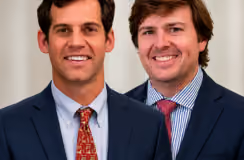



























%20-%20thumbnail.avif)





%20-%20thumbnail.avif)


%20-%20thumbnail.avif)

.avif)




%20-%20thumbnail.avif)