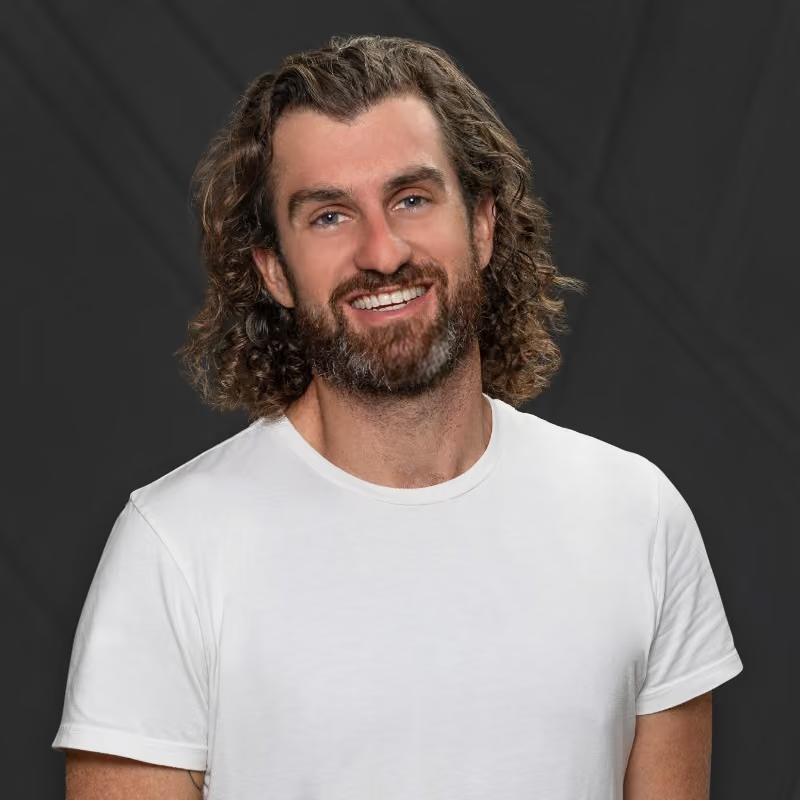
Host: The tech industry. So much to love about it. So much to not love about it. Today's guest, Taylor Wallace spent a decade in the startup trenches and like 99.9999% of his compatriots, did not become a billionaire. By the time Covid hit, Taylor was over tech and now he and a partner have acquired two doggie daycares in Tampa and have much more planned. You're going to hear all about that in this interview and Taylor and I also spend quite a bit of time on how it feels to go from tech to small business. They are such different animals. Tech is sexy and promises riches, but for many, many people is ultimately empty. Meanwhile, owning a small business, you already know that sexy it ain't, but impactful, dynamic, inhuman it is. Not to mention a much more likely path to riches. Such a fun conversation with Taylor Wallace of PAWS and Rec Doggy daycares. Enjoy. Welcome to Acquiring Minds, a podcast about buying businesses. My name is Will Smith. Acquiring an existing business is an awesome opportunity for many entrepreneurs and on this podcast I talk to the people who do it. August Felker is a two time successful searcher, first with a traditional search fund. The second time around he did a self funded search. Today August runs Oberle Risk Strategies, an insurance firm with a dedicated practice group for searchers and acquisition entrepreneurs like you. If you've got a business under loi, Oberle will provide complimentary due diligence on that business's insurance and benefits program. A great no risk way to get to know August and team. They love helping searchers, they've worked with hundreds. Oberly is a specialty insurance brokerage for searchers by a former searcher. Check out oberle-risk.com oberle risk link in the show notes Taylor Wallace. Thank you for joining me today on Acquiring Minds.
Guest: It's good to be here. Excited to spend some time with you today.
Host: Taylor. You have been in tech, you've been nomadic and today you run two doggy daycares in Tampa, both of which you acquired. I've spent time in tech myself so I love hearing stories about people who found ETA and small business via tech. So we're going to really get into that piece of this. But start us off Taylor, wherever you think. Well actually why don't you start us off in our pre call you had told me how in college at least you were the least, you know, business seemed like the least likely thing you might end up doing and yet here you are. So start us there if you think that would is a good is A good place to do so.
[3:06] Guest: Yeah, I mean, I think probably 15, 16, you're trying to figure out what you want to be when you grow up. And I was a book nerd as a kid. I love novels and in my high school we had sort of the opportunity to specialize towards our last few years there. So I really kind of stopped taking math and science classes and was focused on kind of literature, philosophy and language and wanted to study literature in college. And my dad basically said, over my dead body. He's a CPA turned entrepreneur and was like, you're going to study business. And you know, eventually I won and I went to the University of St. Andrews in Scotland and studied literature there and you know, spent four years.
Host: I think eventually he won Taylor, by the way. Well, yeah, eventually, eventually, eventually, eventually.
Guest: Yeah, yeah, I think we compromised. We definitely have very different approaches, I think to business today based on our backgrounds. But yeah, so went to, went to the University of St. Andrews and in the uk the college experience educationally is quite different where you hyper specialize early on. So I took three classes the entire time I was in college. I took English, German and philosophy. So I've never had an accounting class. I think I took one management class as an elective. And we started a T shirt company naturally. And towards the end of my time there I got pretty involved in theatrical production, so I was producing plays. And that combined with a sci fi class, which really kind of got me thinking about the future and working with teams and thinking, do I really want to sit in a cabin in the woods and write books for the rest of my life or do I want to figure out ways to work with groups of people and invent the future? I started to become fascinated with the idea of the Internet and the power of storytelling on the Internet and what could that look like? I wasn't one of these guys that was, was very Internet savvy in college. I mean, I knew how to use Facebook and you know, could work my way around Google, but had no real foundational understanding of tech or software. So I just kind of tried to find the first startup that would hire me right out of school. And I landed in New York City working for an ad tech company there. It was like maybe 15 people in a windowless office in lower Manhattan. And you know, that was kind of a trial by fire of really just like learning how the Internet worked. And it was, it was an awesome experience because within a couple of months I'm going into Google's office and Yahoo and we were a data Management platform. So we sort of had hooks and all these interesting ad tech players in the space. And what year is this now, Taylor? 2011 to 2012.
Host: Okay,
Guest: so yeah, spent a year doing that and I was fascinated by tech. I really didn't love ad tech. I thought sort of the way that the Internet was monetized was interesting, but it was, it was a bit soul crushing of just like trying to move data from point A to B so we could better target ads was like, you know, this isn't really my, my reason to be. So after about a year there, I was kind of looking like, okay, how do I, how do I move into something a little bit more creative? And I was actually approached by my uncle and my cousin and my uncle's a tech entrepreneur and they had this idea for a mobile app and my cousin was still in school and my uncle was running another company and they were like, we want to do this and we need somebody that can kind of like be the first guy in the trenches. So I left that job and we started building what was at the time like a photo and video sharing app for events. A bunch of products kind of tried to tackle this. I mean, Apple's basically solved the problem now with shared albums, but at the time, I mean, Instagram had kind of just launched. Hashtags on Instagram weren't a thing yet. So like going to a concert or a sporting event and like trying to find all that content, you'd see like a million phones in the air and, and you really couldn't, you couldn't pull together like your friends, pictures and videos very easily. So we sort of started trying to tackle that, that problem and eventually moved down to Tampa. We were working with a development shop here and spent, yeah, like two and a half years raised, raised about a million dollars kind of building out prototypes, trying to get that, get that to go viral. Like that was our goal at the time was you were seeing these crazy valuations for Snapchat and WhatsApp. And it was sort of like the heyday of trying to build a consumer product that would go viral and you'd get a bunch of funding. And eventually we got to a point where like, okay, that's probably isn't a good business plan. So we pivoted into building an enterprise product that was very akin to Slack for photo and video content around corporate culture. So we would do things like video intros for new hires. Like you join a company and you'd make this like mashed up video of who you were and get shared out with your team and recruiting events and we'd build out these like cool landing pages for corporate culture that was all crowdsourced content from their teams. I did a little bit better with that, you know, sort of generating some real revenue and raised, raised some more money and spent another kind of two and a half years on that. And we got to a point where it just like it wasn't hockey sticking and we kind of sat down as a team and we're like, hey, are we going to continue to pour money and time into this? And at this point, you know, my, my partner and I had spent five years on it and we were just, I think burnout and kind of ready to do something different. So that was 2017 and I'm 27 years old. I have done really nothing but this for most of my career. And you know, I'm trying to figure out now, like, what do I do now? And that's, that's a recurring theme of my life. I tend to have these moments of like after college, like what do I do now? And after, after the startup, like what's next? And I went to a friend's wedding in Siberia and was like, that was awesome, I want to do that more. So I started kind of thinking about how to get, get married in Siberia. Like no go to weddings in Siberia. So yeah, I wanted to figure out how I could kind of travel and work simultaneously. I was applying for like product manager jobs at Google, which apparently are really hard to get. And just the big company thing like wasn't really resonating with me at the time. So I found a small tech focused investor relations firm that needed like a head of comms marketing guy part time and they were distributed. So I was like, if I work for you guys, can I be in Berlin? And they said yes. So I bought a one way ticket to Berlin and for the next three years I basically proceeded to just chase consulting gigs all over the world and went from Berlin to Israel to Jackson Hole, Wyoming to la, San Francisco, Miami, and can kind of elaborate on any of those pit stops along the way if you'd like.
[10:13] Host: Well, we'll probably touch on them. You just named a couple of my favorite cities. But what so but to take us up to the decision then to stop being a nomadic consultant and actually go get into small business.
Guest: Yeah, so the last kind of my line was always I'd be in these job interviews and they'd ask me, you know, how soon can you move to San Francisco or Miami? And I'd be like, well I can move in 48 hours. And they'd be like, 48 hours. I'm like, my whole life is in a suitcase. If you pay me this amount of money, I will be there in two days. So the last company to hire me to move was Magic Leap in Miami, which is a big multibillion dollar funded AR startup. So I moved to Miami in 2019 and I was feeling it out. My MO at that point had been six months to a year somewhere, and then I'm gone. And I spent about a year there and was like, okay, this is interesting. The company was very chaotic, but the tech was really fascinating. It was the biggest company I'd ever worked for. I had about 2,000 employees. And in February I was like, I'm leasing an apartment for a year for the first time in years and I'm going to buy a bed. And this is February 2020. So within a month, the whole city locks down. You can't go outside. And the first month into the pandemic magically, basically fired everyone except core engineering. So I'm sitting in this like, beautiful apartment in Miami with my new bed and no job, and I don't really know many people in Miami and I can't go outside. Anyway, so I started. I have a lot of family in Tampa, so I started kind of coming up here just so I had people to see in the early days of COVID And I reconnected with my former roommate who ran a doggy daycare. And we had sort of spitballed for years over, over this idea of doing a doggy daycare together. And simultaneously I was getting recruited by a private equity firm in the pet tech space. So that sort of got my wheel spinning on, like, you know, what's this pet space really all about? And started kind of diving into just researching the pet space and got pretty excited about the idea of doing something in it. And. And then my former roommate and I said, hey, let's do a doggy daycare. And we started looking for an entry point. And that was the summer of 2020.
[12:38] Host: Interesting. So you, unlike many of my guests, did not learn about ETA or the buy then build model and then go out and say, what categories, what industries do I want to buy a business in? You were going to do something in pet and you were looking for an entry point, and eta, buy then build ended up being that entry point. Is that right?
Guest: Yeah, I mean, I like, again, I probably worked for over 100 startups, so the idea of like starting up didn't scare me at all. And really our search kind of initially, and I say search meaning like our search for an entry point started at the franchise level. My partner worked for one of the big franchise players in the space. So we explored potentially just buying a territory in that franchise system. We explored potentially buying out his owner that he worked for. And then we looked at a couple other franchise systems and we had this kind of interesting disagreement where he would see a franchise system and love the operation side of it and I would hate the marketing and we'd see another one where I would love the marketing and kind of the business side and who the franchisees were and he would hate the operations. So we couldn't find a system that we both agreed on. And the more that we looked at these, these franchises, the more we felt like we could, we sort of had all the pieces. It was like, he knows how to work with dogs and to run a facility and I know how to raise money and how to sell and market. So maybe we should do this on our own. So we were sort of coming around to the idea of just starting up on our own when we found an independent for sale. Just kind of like fell in our lap. And it checked a lot of the boxes and we ran it by some of our advisors and potential investors and they were like, yeah, it's a lot easier to buy something than it is to build it from scratch, so this might be a good entry point for you guys. So, yeah, I mean, I didn't even know what search or ETA were probably until six months after I did it.
Host: And so now. But now I see your posts on LinkedIn, you're active with baton. Dylan is actually who introduced us. So you're actually quite a believer and an evangelist of eta. So I assume you've read the books. Total art.
Guest: Yeah. I've gone from, again, spending the first 10 years of my career really working at startups that were, for all intents and purposes chasing product market fit. You know, even Magic Leap has raised $4 billion. I think at this point, like, they don't have product market fit yet. The startup I worked on for, for five years was, was that was really what we were doing was, was trying to create something that, that had a market. And through eta, it's like you, you step into product market fit, it's already there. So it's a very different, I think, experience as an entrepreneur to try to invent something versus try to. And I think without realizing it, like, I always really wanted to optimize and grow something and that's what I've sort of found through ATA now is that if that's where you want to focus your energy, if you don't want to be an inventor and you want to be a true operator and someone focused on growth like ETA is an awesome path.
[15:39] Host: Yeah, no, I couldn't have said it better myself and coming from tech and having kind of started my own ideas that flounder never really went anywhere, worked with others who have gone through the same pain. It's one of the things that I think for those of us who have experienced that or come from tech that is so magical about ETA is this whole giant question in tech is you know, the Y combinator question. Build something people want that's answered like yeah, you know you're already doing. There's already product market fit. Now you know, we could get into the weeds about what tech defined product market fit is and they're talking about something with enormous traction and growth potential and obviously a lot of kind of small businesses, ETA businesses are not that. But you do still the point remains that you're looking at buying businesses that have people who are, that are providing a service or a product that people want they're paying you for. And it's just that is such a precious and elusive quality in tech. So I think, you know, you and I really, really appreciate that fact.
Guest: Well, I think the thing that's so interesting and like one of the things I try to talk to because I'm like the biggest evangelist for people in tech that are like what do I do with my life? And I'm over tech. I'm like go buy a small business.
Host: Wouldn't it be great to have experts at your back when buying a business? People to help you polish up your pitch and processes as you go to market as a searcher then help you evaluate opportunities once you get some deal flow. Such experts exist buy side advisors. But they'll cost you to the tune of tens of thousands, even hundreds of thousands of dollars. But another option exists, the acquisition lab. The lab is a do it with you buy side advisory service, not do it for you. Founded by Walker Deibel, author of Buy Then Build, the lab represents Walker's vision for what is most needed to make a searcher successful and available at an accessible price. It's cohort based and you will come out the other side of your cohort prepared to go to market as a savvy searcher with a tight message and process so brokers take you seriously. Pre approved for a loan and and with an entire community at your disposal to Help you along the journey to buying a business. To learn more, check out acquisitionlab.com link in the show notes.
Guest: You know, I saw a tweet today that was like, you know, if you want to buy a small business, like find a business that still uses a fax machine and do that. And it's this idea like by coming in with, you know, very basic processes that are kind of second nature to someone who spent a lot of time in technology. You know, bring in a best in class CRM, thinking about marketing automation, you know, applying like OKRs or KPIs to a business and bringing in a book like Traction or something is like most small business owners haven't done that. So you can, you can very quickly grow an acquisition by sort of implementing things that feel like table stakes in tech companies.
[18:41] Host: Well, let's drill into that a little bit because that is kind of the key pitch what you just said, like layer in normal best practices stuff from the tech industry or more sophisticated industries into an old fax machine business. But I do feel like that can be oversold, that it's not always. First of all, many of these small businesses out there are not as unsophisticated as all that. They have the reputation for the fax machine. But let's give these boomers some credit. You know, they're using email, they're using, they have websites, many of them know what SEO is. So I do feel like that can be a little bit oversold. You only can speak to your own business experience. But on this point, what have you found?
Guest: Yeah, I mean I think there's a couple pillars, right? And like one is that is just sort of best in class like marketing and operational efficiency that you often see in tech startups that involve systems and systems thinking. But I think the other piece of this that we have really found is especially for SMB is like customer service, right? Is we really emphasize putting the customer first. Customer almost always being right, trying to build a staff that really thinks that way, building a culture then that is very customer centric. And I think that that can get a bit lost sometimes with existing small business operators. Right. Of, of, of. I don't know if I could point to a why, but we've all used, you know, lawn services companies, etc. That are either too small that they don't care or too big that they don't care. And I think we're really trying to hit that, that niche of like we can be a growing large scale company but at the same time really have this culture of like customer first and then. Yeah, I mean, I think sort of pulling interesting financial levers as well, centered around growth. Like that's really what we're trying to do now. A lot of the small business owner operators that we talk to like potentially want to grow, but they don't really know how to either raise money or get financially creative to really kind of pour gas in the fire of the thing that they've created. So I think we bring that to the equation as well. That, you know, if you come from sort of the VC world at all, we talk to a ton of people that, that we could raise money from just because of the way that we've approached it and sort of how we're thinking about it. So I think that's another asset that, that people kind of overlook is, is, you know, you can, you can arbitrage multiples, which is something that we're thinking about.
[21:21] Host: Well, one of the other things that you'd said in our pre call that you think your tech experience gives you, gives you an advantage in is your ambition, that you come from an industry that thinks big and maybe a lot of kind of traditional small businesses don't think as big and just kind of shooting for the stars. That sort of ambition can really pull more out of a. That ambition alone can sometimes pull more out of a business than otherwise. What are your thoughts on that?
Guest: Yeah, it's funny, my partner and I, so we've done two acquisitions in the last really two years and we're currently building our first greenfield. So hopefully we'll have three under the belt in three years. And we're actively trying to acquire at least two more. And we're constantly like, how can we be doing more? And we had the conversation last week of like, objectively we've done a lot and when we tell anyone else that we've done too and sort of what we've managed to build in the last two years, like, everyone's like, wow, that's, that's phenomenal. And we're sort of really hungry to be doing more. And I think that's juxtaposed with this idea that I really came into SMB with, was that like, I was tired of trying to get astronauts to the moon. You know, most of these tech startups I've worked out have been like, we're going to change the world with our widget. And I got a little burnt out on sort of that, like endless optimism without a lot of actual impact. So when we got into this, it was like, let's try to build something really big, but at the same time, like, that's very impactful on the individual and the local level. So instead of kind of trying to grow for the sake of growth, it's like, let's grow in a way that, like, we can have great jobs for our employees, that we can provide a great service for our customers, that we can build a sustainable lifestyle for ourselves so that we're not working 120 hours a week. And, you know, people ask us all the time, like, you know, what's your exit strategy? And, you know, where do you want to be in five years? And for the first time in my life, I'm like, I don't really care. Like, I'm really focused on, like, the next two years and how do we build a really great company. And I think if we can do that, like, the end result will net out to be awesome.
Host: That's awesome. Taylor, man, all this, your response to the world of tech is really speaking my language. And your draw to eta, the when you talk to people in tech who say, what should I do with my life? Or how should I pivot my career? And you tell them about buying a small business, do they do their eyes light up or do they have what I would kind of consider the normal tech person reaction, which is that's, that's too small potatoes. That's not, you know, that's. That's not in line with the, you know, the tech perspective of the world. That it's got to be about putting a dent in the universe. It's got to be about putting astronauts on Mars. Yeah. How well received is your message? Because it was a process for you. You had to kind of burn out on tech probably to arrive at where you're at now. And if somebody is pre burnout, they probably, you know, we know how tech is. They probably don't think doggy daycares are as cool as AR technology.
[24:34] Guest: Yeah, I mean, it's. I was. When we did our first acquisition, I came on halftime when we had the first facility and I was spending the other half of my time consulting for a VC fund. And it kind of became clear to me when we were thinking about buying a second, like, okay, I'm either going to be a VC or I'm going to run doggy daycares. So I kind of had to make that decision even after we've made the first acquisition. And the feedback is very mixed. Right. And I think as you're asking me the question, I'm processing it. It's like you talk to someone who's early in their career and like super starry eyed still and they're like, why are you playing with dogs? Like you have all this tech experience like you should be, you know, working at Google or whatever, right? You talk to someone that is kind of where I was at, where they've worked for a bunch of different startups and maybe haven't had a home run and they're all like that's awesome. How do I do this right? I think there's definitely like, for lack of a better word, like a middle manager class of, of tech worker that was sort of promised the billion dollar exit that was going to set them up forever, that really just became a high paid employee over the last 10 years, maybe jumped around a bit and I think that's burning a lot of people out and I think many of them are sort of exploring ways they can do something different and don't just continue working for startups for the rest of their career. And then you talk to a lot of the sort of more seasoned like the partners at the VC fund, etc. And I think most of them, many of them really get it. They're like, you know, you can be excited about any business and, and the one that we chose was tech. And you know, if you're excited about this, I mean there's, there's no reason you can't grow this to be something huge. And you know, I think there's a bit of wisdom there as well that kind of comes into play that you don't see in sort of the two younger audiences of, of of, you know, go do something that makes you happy and that impacts others and you know, be smart about it financially and you can make it work.
Host: You know, that's so interesting. That's counterintuitive to me. I would not have guessed that the VCs are the ones that kind of have the wise response to you because my impression always was, you know, that kind of the phrase lifestyle business, which you know, in Silicon Valley is kind of said with a bit of a sneer. My impression was always that like the VCs were kind of the, the ones to introduce the, the idea of a lifestyle business being, you know, not interesting and that it just kind of trickled down through the rest of the tech industry. So, so anyway, interesting to hear that in fact the VCs are, have a more enlightened view about business and kind of say, you know, choose your business and go after your business. Could be tech, could be doggy daycares.
[27:16] Guest: Yeah, I mean, it's like we work with. Well, I don't work with him. He's, he's a customer and a friend and an investor in my former startup and he's leading. He's the CEO now of a multi billion dollar SaaS company and he also runs a nonprofit that's focused on mentoring kids through their careers. And he's like, let's start a fund and fund blue collar companies. And I'm like, people do that. That's the thing. He's like, really? I think that's awesome. And I think his experience has been like, he's been in tech his entire career. He's probably in his 50s. And I think he's seen such a massive gap in what great small business can provide in terms of jobs and community resources. And I think a lot of intelligent investors have seen that over their career and how, yeah, software is eating the world, but maybe that's not the best thing.
Host: Great. So interesting. Well, I want to stay on kind of these philosophical topics for a second. The other big contrast in your life decision here to buy the doggy daycares is going from nomadic bachelor who doesn't own a bed to a guy who owns very physical, very irl, very brick and mortary businesses. I don't say lifestyle business in the sense that, oh, it affords a certain lifestyle. I mean, this really dictates your lifestyle and really force you to commit to location. I went through a phase of digital nomadism way back and loved it, but it ran its course anyway. How do you feel about incredible geographic freedom to really, not to scare you, but really being anchored in Tampa, and I'm sure you've thought about this already, but to really being truly anchored to one place.
Guest: Yeah, it's definitely part of my logic in initially making the decision was I was pretty burnt out on digital nomadism, right? It's like I was, you know, over the course of my life, I think I did the math one time I've lived in like 35 cities and at one point, I mean, probably at the age of 30, I had never stayed in a house for more than like 18 months. And many times it was like a couple months. So, you know, I was, I was exhausted and a piece of that was just not like when I lived in Tampa Originally from 2012 to 2017, I got super plugged in and had a ton of friends and was really involved in the business and the startup community and you know, Tampa at the time, Tampa's changed a lot. But at the time, like you'd sit in a coffee shop in downtown Tampa, and every other person that walked in the door, you would know. And on the one hand, I really valued that, but on the other hand, I was like, if I don't leave and go travel, like, I'm going to get really comfortable and never leave. And I think everywhere I went, I was trying to kind of recreate that community and over the course of my travels, recognize that, like, the only way to really recreate that is to, like, be in one place and to really have a community and a great group of, like, IRL friends and, you know, to do. To do work that impacts the community, whether that's with your business and. Or kind of nonprofit volunteer work, like, you have to sit still for some time. So I had planned on doing that in Miami, and then life happened, and I sort of was like, I have this amazing network already in Tampa that I've built. It's a solid place to live. It's comfortable. At the time, was more affordable than it is now. Why don't we go back there and try to build a life where maybe I travel often, but not full time. I met this guy during my travels, and he asked me, he's like, where do you park your skis? And I was like, I don't. And he was like, what do you mean? I was like, well, I don't own skis, and I don't park anything anywhere. He was, like, baffled by this, and he was like, well, surely you, like, you go back somewhere. And I was like, not really, man. And I kind of grabbed onto that concept of, like, maybe it's time to have somewhere to park your skis. And, you know, I still travel often. You know, I'm lucky that I work on the side of the business that doesn't really require me to be in the facilities all that often, but to kind of round out this point, it's funny, at my. My girlfriend just took her remote job for the first time, and she's traveling a lot. She's like, you know, let's just go. Let's go here, let's go there. And I'm like, I have three businesses we're working on within 15 miles of here. Like, I can't really just drop everything and leave every other weekend with you. So it's. Yeah, I mean, it's been a contrast, but I'm enjoying kind of like building in a. In a place again.
[31:55] Host: Yeah, yeah. No, it's very different, but it just makes you realize. And I think this kind of some wisdom comes from this. That total, complete, unfettered freedom has its appeal, no doubt, but also has its limits. You can fatigue of it, and you also are sacrificing things. The things that require commitment are also the things that are rewarding. So that's, you know, we can. We can apply this not only to digital nomadism, but to marriage, to, you know, business, to building a community, friends, all of it.
Guest: So, yeah, it's a very clear example. Is like, one of the things I've wanted to do forever is like, work with work, mentor a high school kid, right? And if you try to do that through, like, Big Brothers, Big Sisters or any similar organizations, like, they require you to say, I'm going to be in this place for a year. And if you talk to anyone that's done that, they're like, I started working with this kid when he was 14, and it took me a year to build a connection, and then another three to four years to really work with him, to grow and foster that. And it's just like, you can't do that type of work if you're constantly moving. Dating was the same thing. I would go on a date with someone in Berlin and they'd be like, oh, what do you do? I'm like, travel. And they're like, when are you leaving? I'm like, I don't know. Tomorrow. And it's not very appealing. Um, yep. So, yeah, at the same time, I bought. I bought two doggy daycares, a house, and. And I have a very serious girlfriend and a dog now, so I'm like, very, very here.
[33:27] Host: You swing from extremes to extremes, Taylor, it seems.
Guest: Yeah, I tend to do that.
Host: Okay, before we. Before we leave this topic, which I could talk for a lot longer about, but we want to get into the nuts and bolts of your business. Just tell me of these 35 cities, or at least the cities that you lived in during this nomadic period. Top two, favorite two.
Guest: I love Berlin. I spent a lot of time studying German, kind of like a World War II history buff. And that coupled with like, Berlin is one of the more progressive cities in the world. I think you can really let any freak flag that you could fly fly there. And it's also like a hideously ugly city architecturally, but just like the people and the art, and it's very full of contrasts. And it's also a place that, like, gives me a lot of hope, because if you look at pictures of it in 1945, it was essentially decimated, and then it spent the next 40 years split in two between communism and capitalism. And you know, you go there today and it's awesome and progressive and you know, I wrote an essay about this. But like, you see situations like what's happening in Ukraine and with Russia right now and it's like, you know, humanity comes back. You know, we do these terrible things to ourselves. But. But you go to a city like Berlin and you're like, you know, there's, there's always hope and, and we'll evolve and change. And Berlin reminds me of that. And then in the us I, I really enjoyed living in la. I spent about a year there. I lived on, just off Venice Beach. The weather's like unprecedented. It's always perfect. There's enough going on, but it's not like overwhelming. It's not like a New York or even a San Francisco where you're like super urban. But it definitely has a lot of downsides. I mean like the homelessness thing is pretty crazy. Living in California is expensive. But the tech community is great there too. I mean there's definitely like an entrepreneurial thread that really lives in la, which is cool.
Host: Yeah. Yeah, cool. Great choices. Yeah. Berlin. I went for the first time in 21st and only time in 2017, but was also coming kind of coming off of a World War II binge of audiobooks and just ate it up there for three or four days. But you're right, I mean you could just go there and just focus on the 1940s and eat for days on that. But it's important to just keep very much in view what Berlin has become and what it is today, which is an incredibly dynamic, artistic product, progressive, exciting town. I mean, what a great place.
[36:07] Guest: So yeah, it's very cool.
Host: All right, back to doggy daycares now. Okay, so all of the stuff that we were talking about, the opportunity in ETA and how the bringing in best practices from tech and from more forward industries did. Your seller was all that low hanging fruit there. Who is your seller?
Guest: Yeah, so the first seller, he was actually. It's kind of a fun story. He was also a tech entrepreneur. He'd started a couple companies, he'd had an exit and sort of between his last exit and like his next tech venture, he decided his wife and him love dogs and he thought there was a gap in the market in Tampa, so they decided to sort of start the business that we ended up acquiring with the focus of being like absentee owners. And this thing would just cash flow and they would do their thing. And so he had set up a lot of systems that we still use. The business model is very similar. We haven't really changed the brand at all. He's more of an engineer than I am, so there were some instances where he kind of over engineered some things where we came in and kind of dialed and simplified them back. But what we saw and what got us kind of really excited about the acquisition is, you know, I can look at the business from, from the side I just described and then my partner can really look at the business from the operation side of like, how are they moving dogs, how are they managing dogs? How many dogs can they fit in a facility? And I felt like there was enough to build on with what he created on kind of the branding and the marketing side. And my partner was like, there's a ton we can improve on with, with the way that we can manage dogs and how many dogs we can fit in this facility. So when we took over, you know, a lot of searchers will kind of say, and you'll see this online of like, you know, don't do anything for, you know, 90 days. We hot. We were like, you know, we immediately gave all the employees raises. We do that every time we do an acquisition. And I always tell that to people is like, you want to win some goodwill, especially with hourly employees, like give them a dollar raise right away and tell them that the expectation is going to change. We really honed in on kind of normalizing a lot of the pricing and the communications with the customers. He had built out kind of a semi custom, like full ERP system almost that was like, it had CRM, it had marketing automation, it had all the accounting software. And we scrapped that pretty, pretty shortly after the acquisition because it was going to be a heavy development cost. And I've just done enough software development to know that like, I didn't want to manage that. So we sort of brought in off the shelf tech solutions to support that, which we're continuing to evolve. And then, yeah, on the, on the operations front, I mean, we, I think my partner spent a little bit more time kind of watching how they were doing things, but pretty quickly changed the way that we work with the dogs pretty dramatically. And that enabled us to double the capacity within the first six months of that facility.
[39:09] Host: Wow. Well, I want to hear about that. But first, you know, it's funny because we were talking about the sellers and the fax machines and the lack of best practices and stuff. Here you are. Your first acquisition is from a guy who is entrepreneurial, a proven entrepreneur, probably on the younger side, I assume, or he's not, you know, he's not looking at retirement. So, you know, a savvy builder, operator and so tech savvy that he actually developed custom software for his business. So really the other to complete like reverse of what of, of that kind of boomer, non tech stereotype. And yet still, even with a seller like that, you found lots of opportunity in there to go in and, and, and, and, and improve things quickly. So doubling revenue in six months because of kind of how you re shifted, basically you, you increased the number of dogs that you can, you can accept at any given time. Talk us through that.
Guest: Yeah, so some of that's a bit of our secret sauce. But I mean, basically when, when we look at a lot of doggy daycares are started by people that love dogs. Like, like this couple, right? And my partner, his name's Mike, he's an amazing guy, one of my closest friends and he spent 10 years working with, you know, in a 10,000 square foot facility with hundreds of dogs a day. And he was trained in one of the bigger franchise systems. So that type of experience I think is, is really hard to get on your own. So again, most of the acquisition targets we look at are a couple or someone who's obsessed with dogs says, hey, I'm going to rent a space and I'm going to start a doggy daycare. And they kind of just wing it. And you get to a point where more than 30, 40, 50 dogs and you really kind of got to know what you're doing and you got to figure out how to move them safely through the facility. You got to train staff to manage them safely and they just didn't have that experience. So we kind of came in and really just sort of upped the standard of care, I think, which enabled us to bring in a lot more dogs safely. Because what ends up happening is if you can manage 50 or 60 dogs sort of by the seat of your pants, you can't do that with 150 dogs. And that's closer to kind of the scale that we have today.
Host: Okay. And when you had said the thing about how people online say don't change anything for 90 days or six months or whatever, and you guys came in and started changing things very quickly. I will just point out that I think when people say don't, don't touch anything, don't, you know, until you really learn is because you have three, six months of learning to do. Because in many cases you've acquired into an industry that you may not really know much about at all. But you guys, you know, via your partner, have 10 years of operating experience, so there is that important differentiator in the two of you.
Guest: Yeah. And I think. I think what we did that we changed on both sides of the business, and I think we. We do a pretty good job of kind of like staying in our lanes. Right. So, like, if I were coming in as a sole acquirer, right, Like, I probably wouldn't have done anything different on the dog ops for a while, but I would have changed the marketing and the communications and some of the pricing and the business model, like, pretty, pretty. Because I. I've done that for 10 years. Right. I think similar to him, like, if he would have done this on his own, he would have come in and sort of left the marketing and communications and everything as it was and changed the safety standards and the way he was training and handling staff right away. So I think that if you know how to do something better than what the prior owner was doing, like, don't hesitate to do it better.
[42:46] Host: Fair enough. Fair enough. Taylor, tell us if you can, whatever you can about the size of the business, any numbers that you can share. So we're still on the first acquisition. Keep referring to your acquisition, but you've done two. But we're talking about the first one. So what can you share about size?
Guest: Yeah, so when we bought that, we paid, you know, high six figures for it, roughly three and a half times, you know, net income, sd, ebitda, sort of however you want to slice that. And our. Our initial goal was to get that to seven figures in the first year. And we got the run rate there probably in five months. And we're. We'll do probably two and a half times that number this year. In the second year we've owned it.
Host: Wow. Phenomenal. From that one location or partly because you've made the second acquisition?
Guest: No, from that. From that one location.
Host: Wow. Two and a half times the original revenue. Or two and a half times the seven figure. Two and a half times the original.
Guest: Two and a half times the original revenue. Yeah, yeah. Just probably, just shy. Probably 2.2.
Host: That's great.
Guest: Yeah. And the thing that's interesting about dog daycare and this is sort of how we think about it, right. Is the facilities have a cap. Right. The closest comparison is self storage. Right. Where you can only sort of get so much revenue out of a space. You can only fit so many dogs into a location. So we get to a point with these facilities where it's like, unless we start adding additional Services on top, like they're, they're kind of capped out. So now we're baking that into sort of our model. And our thesis of like, okay, if we can go in and we can buy these locations that we, and we think we can increase the capacity, that's where there's a huge opportunity for us.
Host: Yeah, I mean, it seems like what it would be for you guys. And maybe this is what you just said, essentially. But like, you, you, you now have a playbook to, let's call it double or more than double. Kind of the people who, the operators who don't have this insight that you guys did about how you can really increase the scale of a particular facility. So you just go around Florida and neighboring markets looking for similarly kind of like undersized facilities or under monetized, for lack of a better term facilities, and you acquire them and then you take your model into these, into 10 and 20 and 30 acquisitions. Is that basically what you plan to do for the next few years?
[45:26] Guest: Yeah, I mean, that's, that's been the goal. I think finding those targets is as we, I think we got, we haven't quite figured out why, but I think we got a little lucky with the speed we were able to do the first two. We've been running a pretty active search for the last, for the last almost year. And it's, it's been harder to find targets in sort of the geographic focus we've had. And I think that's frankly just because everybody got dogs during COVID and the businesses are doing well. So we've been sort of branching out from that strategy a bit. And we've definitely looked at some units where it's very clear we can't improve top line revenue or not by much anyway, that like, hey, these are very well run. You know, they've kind of maxed out their capacity and you know, maybe we can eke a little bit more out of it. But you know, at that point it really becomes, hey, are we just, are we adding EBITDA to the bottom line by, by bolting this on? But that's also why we decided to build one. We're figuring, hey, you know, maybe if we can't find these acquisition targets, maybe we just go build our own. So, yeah, we're continuing to kind of pursue additional acquisitions, but also, you know, very creatively thinking about other ways we can grow.
Host: So. So business number three, the third business that you've, you're building in three years is another one of these. But from the. But a ground up Yeah, I mean
Guest: it's a pre existing warehouse that we're kind of building out. We don't buy the real estate, so we look for kind of good long term leases and you know, found a good landlord, good location and we're actually submitting the paperwork for the building permits today. So that's, it's, you know, it's fully designed at this point and now we're just kind of dealing with the politics to get it done.
Host: Cool. Cool. And what is the name of your. For people watching on video, they'll see your T shirt, but for those listening on audio, what is the name of your, of your business?
Guest: It's pause and rec. Letter and rec. Pause. You can check us out on pause and rec dot com.
Host: Cool. Going back to the size of the first acquisition. So you said you acquired a high six figures. So for easy math, let's call that $1 million less than $1 million, but let's say $1 million. Three and a half, three and a half multiple. So that's what, $300,000 in SD? You don't have to give me the exact number, but the point is, if it's in that range, that's a, that, you know, that's a pretty small acquisition, particularly for partners. So you're splitting, you know, let's call it $300,000 of SDE between the two of you just to kind of get to a normal tech salary. And that leaves nothing left over to invest. So how did you get comfortable with a relatively small acquisition, particularly with a partner when you're doing this? Partner?
[48:03] Guest: Yeah, I mean, I think the piece we sort of left out is like the partnership journey Mike and I had, which is worth talking about. But you. We've been friends for a long time. I mentioned we were roommates and when we were living together, he started working at this doggy daycare as like an interim job. Just didn't want to work in an office. Was trying to figure out what to do with his life. And the owner there, they changed ownership hands right after he started and it was pretty distressed. And the new owner that came in was kind of known in that franchise system for turning facilities around. And she recognized that Mike was a smart guy and she made him the gm. So over the next couple of years, he turned the facility around with her, but she was fully absentee. So he would see her twice a year and would talk to her on the phone kind of once a week. And I'm running the software company, so we're coming home every day and I'M comparing notes about managing all these crazy engineers and he's telling me about managing all these 21 year old dog obsessed people. And you know, we're kind of like, you know, master classing, if you will, like our separate business problems. And I was just super impressed with like what he had built and frankly felt like he was underpaid and had always told him for years, like, hey, whenever you're ready, like, let's figure out how to do this for you. So the first acquisition was like, yeah, like let's do this. But it was much more from my standpoint, like, I don't know if I'm going to do this full time. It was like, let's, let's, let's set Mike up with a job and a piece of a company that he owns and something that I can be involved in. But we kind of went into it being like, this may be the only one and maybe we'll do more, maybe we'll grow, but let's see how this goes. So we weren't really, I mean, we evaluated the acquisition more from the standpoint of looking at what the franchise comps were. So we kind of knew what it would cost to build the franchise units that we were thinking about and this fit in that range. And the SDE was frankly roughly 10% higher because we didn't have franchise fees. So when we bought it, it was like, I wasn't full time so it didn't really need to support me. And then when we bought the second one, that was when we made the decision. And when we also had the, we had the financials now, we had doubled revenue on the first one and you know, had the additional income coming in from the second one that we also thought we could double that. It made sense for us both to be involved.
Host: Great. Well, it makes more sense. And so now tell us please about the second acquisition. Whatever you can on size, numbers and so on.
Guest: Yeah, so the second acquisition was, you know, about double the first in most, with most metrics, like double the size, physically double the sale price a little bit less. We paid a higher multiple for the second one. The seller kind of knew that there was a lot of potential there and pushed us a little harder there. But we felt the second one was closer to the type of facility that we wanted from a real estate standpoint. So we were willing to pay a little bit more for it. And it kind of solidified geographically, like owning a very specific piece of Tampa that we wanted. So we have kind of like the core of Tampa covered with those two locations. And that growth has been also awesome. It hasn't been quite as fast as the first one, but it's trending to be, you know, around 2x within the first kind of 18 months based off of what we paid for it.
[51:51] Host: And is that thanks to the same tweak, that same kind of figuring out how to go from 50 to 150 dogs? Not those numbers exactly, but really increasing your supply?
Guest: Basically, Yeah. I think the issues were different. We rebranded that one and we had some kind of brand equity that we had built up with the first one. So I think that helped. I think the location is. The first one we bought is, like, right near downtown Tampa. It's like the core of our customer base, like, really lives very close. It's super convenient. We usually have long wait lists to get in there because of that. The second one is not as convenient, but there's a lot of growth happening kind of in and around that area. So we sort of knew that this might be a little bit of a slower, slower ramp than the first one was. Yeah, but it was a similar playbook. I mean, it was. It was. We had sort of learned on the first one, so I think we were a bit more efficient with. With sort of how we handled the transition. But it was different because the rebranding effort.
Host: Yeah, yeah.
Guest: And the thing that's nice, like, the thing that's nice about doing it again. And. And I just wrote an article for Baton about kind of the idea of platform acquisitions is you have a playbook. Right. Like, you figure it out on the first one, and then, you know, we didn't have to figure out which software to use. We didn't have to figure out how to communicate this to the customers. We didn't figure out how to. How to transition the business model or increase price. Like, we'd already done all of that. So we're literally, like, pulling up the same email templates. And at this point now, we've kind of documented all of that. So if we buy another one tomorrow, like, it's even easier than the first one was.
Host: Yeah, yeah. Well, you just explained how. How you arrived at the first acquisition and kind of the size and it only needed to support your partner and so on. And it was a small acquisition, smaller than the convent. Conventional wisdom should says that you should
Guest: buy,
Host: but given what you just said about the benefits of just, you know, having done one acquisition and how that makes number two and three and four easier, do you have any thoughts about buying big versus buying small? Like, knowing What? You know, now having been a small business operator and being more sophisticated, just about ETA broadly, do you subscribe to this, this wisdom that you should, you know, a serious searcher should only target, you know, 700,000 in SDE and above?
[54:15] Guest: I think it depends on what your goal is. And I think one of the things that I see often is this private equity mentality of I'm going to buy this thing, I'm going to grow it and I'm going to flip it. That's definitely not where we're coming at it from. And we're sort of trying to draw the line between are we building a lifestyle business or are we building something that has real enterprise value long term? And I think that's kind of an interesting place to be. I think if you're like, if your goal is, hey, I want to buy a business, I want to spend three to five years on it and then I want to sell it to a bigger PE firm, like, yeah, buy something big. If your goal is like you want to sort of buy yourself a job that has growth potential, I would focus less on the size of the acquisition and more on why you're uniquely positioned to grow it.
Host: Excellent. We are pushing up on time here, Taylor, but I still have a bunch of things I want to ask you. Let's see, in no particular order, going back to how you found that your first acquisition, that was basically you were plugged into the kind of, you'd already been looking at some of the franchises and in that doing that research, you found the opportunity that you did or how did you find it?
Guest: Yeah, it was basically like through that research we kind of heard through the grapevine that this place was potentially thinking about selling and we just reached out, we just kind of cold reached out to them and they were like, yep, we have all the financials package, we're talking to buyers and you can come see it next week. So from kind of initial outreach to close was probably 90 days max. The second one was we actually had another target under LOI between the first and the second that we walked away from because we couldn't make the relationship with the pre existing landlord work. So that was definitely a learning of like, hey, as we're going through this, you know, get the landlord involved earlier if needed because yeah, that fell apart there, which was a bummer for the seller. But yeah, the second one was again, it was actually one of our investors, he used to go there and he kind of knew the owner and there's only so many daycares in Tampa. And we were kind of hyper focused in Tampa at that point. So we were really just kind of calling locally and he had a relationship with this guy from when he used to take his dog there and called him up and said, hey, we're buying these places. Do you have any interest in selling? And with him the negotiations took a little bit longer. I think we started talking in August and we closed like mid November. So probably 120 days with him.
[57:03] Host: Yeah, yeah, still great. You know, interesting that you have that you found acquisition two and then almost, you know, another one in Tampa that didn't ultimately pan out, but that you had these two really hot, like really warm deals, one of which came to fruition in Tampa quickly and yet, you know, finding other opportunities subsequent to that has been difficult. So it seems like you were probably, you've probably been a little disappointed because you're probably like, all this Tampa, we're
Guest: going to be, we're going to be
Host: able to stamp this thing out.
Guest: Yeah, yeah, yeah, yeah. It's definitely that. I mean I think, I think part of it was Covid. Right. I think when we were looking in 20 and then even 21 people hadn't fully rebounded. Right. Like the first two valuations we had to do, I mean you're looking at 2019 financials and then you're looking at 2020 was a while. Everyone's like, we're not selling if you want to value it on 2020. And frankly they were right. You're seeing top line revenue cut more than in half at most of these places. But in 21 you're starting to see it really creep back up and normalize. So yeah, I think we sort of hit the timing right. I wish we would have had a $15 million search fund in the summer of 2020 because you probably could have bought a lot of them then. But yeah, I think now, I mean the ones that are well run or they're making money and I mean there's a multi unit not far from my house that I would love to acquire and we've talked to her a few times and she's like, you know, I'm making money, why would I sell? Yeah. So I think and that, I mean we have a great M and A advisor that works with us and you know, what we hear from him and others is like if you're playing a long game, just every six months, reach out, you never know what happens. And we're starting to even see a little bit of that where people will change their minds after some Time. Yep.
Host: Yep. The fact that you. Some of the first opportunities that you looked at but didn't end up going with were franchises, but ultimately you bought this independent. Any thoughts on. On buy through the perspective of ETA buying a franchise versus buying an independent?
Guest: Yeah, I mean, I think for us, like, we really had both pieces of the puzzle, and we talk about this all the time. It was like, if. If Mike was going to do this on his own, I think he would have benefited from the franchise structure just in terms of having help with the marketing and the finances and figuring out how to fund it and talking to a good, healthy franchise system from that perspective, I think is great. And then even from my standpoint is like, if I was super obsessed with dogs and wanted to do a doggy daycare and I had all this business experience but, like, really didn't know how to work with 100 dogs in a location or how to build a doggy daycare, I think they can add a lot of value. There's. But I would really look at, like, what is the franchise providing? And in the daycare space, like, they don't really have the Halo McDonald's effect, where you really are buying, like, this massive brand and most of them will charge you a marketing fee that, like, is that really benefiting you, especially on the local business side. So, you know, I think it's interesting. I mean, there's. There's plenty of case studies of people that have, like, rolled up a lot of franchisees and made. Made money doing that, but we're both pretty creative and entrepreneurial, and we just kind of wanted to run our own thing.
[1:00:35] Host: Cool. At the risk of encouraging other people to get into your space. Assuming I'm in California or in Virginia or in Maine, is this an interesting space that I should be looking at?
Guest: If you have a mic. If you don't have a mic, don't do it. I think there's no way that we could be anywhere near as successful. And I couldn't run one of these facilities by myself. Not at scale. So it's, it's, it's. And I think that's been an interesting lesson for me personally. Just sort of as we look at, you know, the rest of my career and, you know, do we do this again with other businesses? It's like, know your lane and don't be afraid to kind of find someone in another lane that can really support you and work with you as a partner. Because I think, again, we complement each other really well where it's like, we can't grow without each other, and we trust each other. We have a relationship we've built over time. So, yeah, I mean, we look at groups all the time. I mean, even some of the big franchisees, and we're like, you know, how are they going to be able to manage multiple locations without the experience of working with dogs for years? So, yeah, I mean, and don't compete with me, because we want to buy them all.
Host: No, it really does sound like, you know, one of the things that's talked about in ETA is, and you kind of. You said it yourself, like, figuring out where you. It's a puzzle, right? And you're up one puzzle piece, and the business that you acquire is the other puzzle piece. And you want two pieces that, you know, that fit like, you know, like puzzle pieces need to. And in your case, it was kind of like three puzzle pieces. I mean, you and Mike are very complimentary. You already had. But, you know, a lot of partners say that they have complementary skill sets. But you also had 10 years of friendship and history that you could lean on. So you had, you know, trust that you can't accelerate. It was just, you know, it was baked into this 10 years. It's invaluable. And then, you know, and then. And then seeing an opportunity in pets and him having all this operational experience. So it was really an alignment of a lot of different stars to make this all come together. So. Pretty cool. Last question for you, Taylor. One of the things that my audience is telling me I need to be asking more is about the reality of small business life in small business operations. And, you know, those of us who are kind of in ETA media, to the extent that such a thing exists, are really excited about the opportunity that ETA and that search provides, but sometimes lose sight of the fact that, like, running a small business is not glamorous. So I want to ask my guests this question more often, but you in particular, because you're also coming from the aforementioned nomadic glory and cushy tech. So I feel like you more than a lot of people might really feel the slap in the face that can be small business ownership once you get in the seat. Your thoughts?
[1:03:46] Guest: Yeah, I mean, I think about this a lot. Right. And, like, people warned me about it before. I, you know, even my parents were like, you know, is this going to be able to, like, scratch your. The intellectual side of your brain enough? Yeah, and it's, it's, you know, I was documenting SDKs and APIs for augmented reality systems at my last job, right. Like, and today I was handling A call because a dog broke a toe and we're installing a fence and you know, it's. It's a. Definitely. The problem set is so different. Right? And I think where I see a lot of people in small business get frustrated is where they don't. They don't spend enough time kind of working on. On the business in interesting ways, right? So, like, I work in the business a decent amount, but Mike's really the one working in the business. That's his passion. That's what he's good at. And I get to spend a lot of my time kind of working at a higher level kind of on the business. So, yeah, I think understanding that reality, right, of like, are you buying yourself a job and is it a job you want to do or is there enough bandwidth and kind of space in what you're acquiring where you can really kind of scratch some of the itches that you want? And I think the counterpoint to that, right, is like we, we get to have these, these much kind of deeper, richer, more meaningful relationships, I think, with. With our employees and our co workers and our customers then, you know, than I got to have in tech. Like, you know, I hardly ever met my customers at these tech startups I worked at. Now I go stand in my lobby at the end of the day and, you know, I meet all kinds of cool people in the community and, you know, we have a staff member who has an issue and we can help her out and, you know, get to see how that impacts her life and, and that stuff is that that brings meaning, right? Like, I think that's what I ultimately, I'm looking for now is like, less about like scratching an intellectual itch. And it's like, how do I create meaning in my own life and meaning in the lives of others? And I think small business creates an amazing opportunity to do that.
Host: Yeah, yeah. I'm reminded of when we. I really addressed this question of kind of like the intellectual itch scratching and to the extent that it exists in small business with the Chenmark. Are you familiar with the Chenmark folks?
[1:06:04] Guest: Yeah, I listened to your one about the. They bought that boat tour company.
Host: Sure. Yeah. Yep. Yeah. So that was with one of the Chenmark partners. And then her husband and partner and his brother were on an earlier episode from January and. And Palmer Higgins was talking about how. Yeah, the, the. The impact of chenmark. They have 400 plus employees. Employees just really can't be overstated like that. It's hard to articulate, but it's just very, very meaningful. You know, impact, because, you know, Elon Musk and tech and, you know, they will talk about impact in terms of kind of like number. Number of lives touched. You know, like my widget is being used by 500,000 people. And so in some respects that's. You're impacting 500,000 people, but in a very transactional software way. And I think what you and what Palmer are talking about is like, you know, in a. In a more human way, and so maybe fewer people, but in a way that really, you really feel the impact, which is ultimately what is ultimately the impact you want, the kind you feel.
Guest: Yeah, I mean, it's. I sort of felt like at the end of my time in tech, and I think part of it was like the layoff experience I went through was that like, I and everyone else involved in the ecosystem was essentially disposable. Right? Like, if one customer left, who cares? Like if. If one employee leaves, oh, well, if we have to lay off half the company, whatever, you know, And I'm kind of overemphasizing, I think, the lightness with which people do take. Take those experiences. But I felt like there was so much emphasis on the, on the, the macro that, like, we forgot about the micro and like humanity lives in these micro interactions. We live in small communities, we live in family units, and. And small business really has an opportunity to kind of impact the micro. And I sort of have this thesis that, like, if more smart people spent time working on the micro, like, it would ratchet up to the macro in really amazing ways. So, yeah, I mean, I look at what we get to do today in terms of, you know, especially with what we're trying to do with our staff and trying to bring them tools and resources and career opportunities. And it gets me really excited and again, kind of provides that meaning. I think that I was missing in tech, that I'm excited to continue to try to build a company that can be very meaningful to people.
Host: Great. What a perfect point to end on, Taylor. Really, really cool. How can people get in touch with you, ask you questions, give you feedback?
Guest: Yeah, you can find me on Twitter Aewall spelled like it sounds. And yeah, I do a bunch of writing on Baton Marketplaces blog, writing about a lot of the topics we've talked about today. So you go check some of that out. They're doing some interesting things with small business valuations.
[1:09:05] Host: So, yeah, give Baton a plug, Taylor.
Guest: Yeah, so Baton is essentially building the Zillow for SMB, connecting buyers and sellers, but primarily through providing free valuations to any small business that wants to know what they think their business is worth. So I constantly am getting approached by sellers of other businesses that are like, hey, can you help me figure out how I sell my online media company or my flower store and I point them to Baton and in a couple days they have evaluation on their business and Baton can help connect them with buyers. So if you're a searcher, Baton's another good place to go to potentially find
Host: some leads and is get getbaton.com it's
Guest: baton batonmarket.com okay, thanks a lot sir.
Host: This has been a really fun conversation. Thanks for sharing your experience and let's have you back on in a year and hear where Paws and Rec is at that point.
Guest: Awesome. Hopefully we got at least three. Sam.



































%20-%20thumbnail.avif)

%20-%20thumbnail.avif)

%20-%20thumbnail.avif)

.avif)



%20-%20thumbnail.avif)