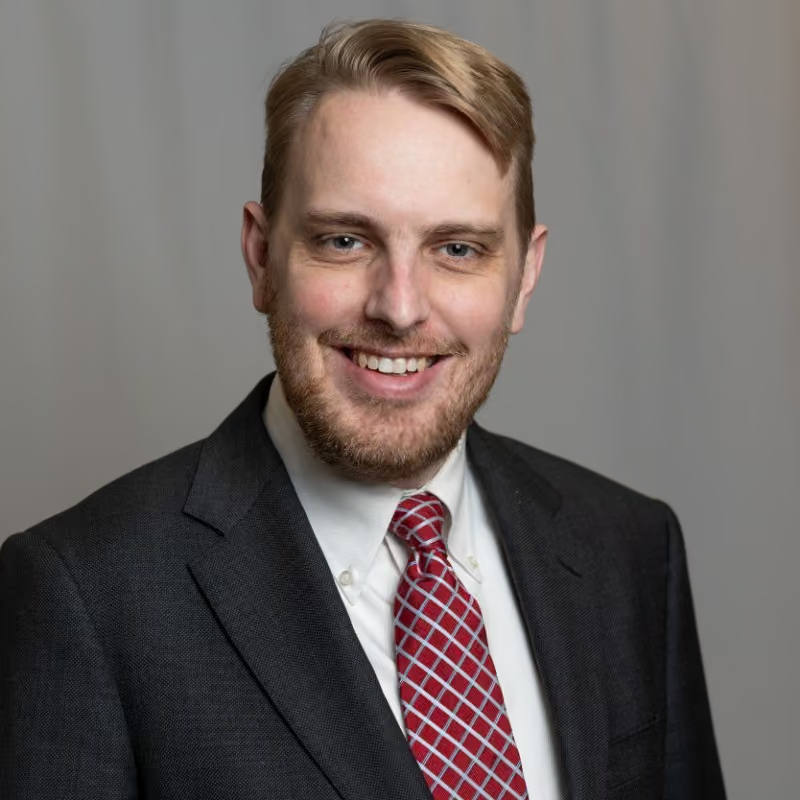
Host: Holdcos are hot. The idea of buying and holding multiple businesses is an alluring one for many acquisition entrepreneurs, so it's always fun to speak with someone actually doing it. Trevor Behm is an operating partner at Saturn V, which I hadn't heard of but has been quite active the last few years acquiring small businesses in Colorado and Texas. They've got 15 acquisitions under their belts, everything from landscaping to nursery and garden centers to concrete and paving to whitewater rafting tourism. Their history is also interesting. This is another set of entrepreneurs who moved away from tech and toward traditional small businesses. Lots of important themes in my conversation with Trevor what makes a good owner operator of a small business, why boring businesses are anything but, and advice to other entrepreneurs who want to build a Holdco. That and much, much more with Trevor Boehm of Saturn 5. Welcome to Acquiring Minds, a podcast about buying businesses. My name is Will Smith. Acquiring an existing business is an awesome opportunity for many entrepreneurs and on this podcast I talk to the people who do. Wouldn't it be great to have experts at your back when buying a business? People to help you polish up your pitch and processes as you go to market as a searcher, then help you evaluate opportunities once you get some deal flow. Such experts exist buy side advisors, but they'll cost you to the tune of tens of thousands, even hundreds of thousands of dollars. But another option exists, the Acquisition Lab. The Lab is a do it with you buy side advisory service, not do it for you. Founded by Walker Deibel, author of Buy Then Build, the Lab represents Walker's vision for what is most needed to make a searcher successful and available at an accessible price. It's cohort based and you will come out the other side of your cohort prepared to go to market as a savvy searcher with a tight message and process so brokers take you seriously, pre approved for a loan and with an entire community at your disposal to help you along the journey to buying a business. To learn More, check out acquisitionlab.com, link in the show notes Trevor Behm welcome to Acquiring Minds.
Guest: Thanks for having me Trevor.
Host: You're an operating partner at Saturn 5. Saturn V is an acquirer and operator of small businesses, an SMB HoldCo. Really, HoldCos are hot and a dream of many acquisition entrepreneurs, so I'm sure my audience is as eager as I am to learn what you and your partners are up to. Before we get into that though, Trevor, how about some background on you first please?
Guest: Yeah, happy to share. I have been an operator of small businesses or early stage venture for the last decade plus and then an investor as well. My background originally was not in the world of small business entrepreneurship at all. It was in writing and international development. And I kind of stumbled my way into, into building companies. First as an agency small business that was focused on content development and, and then into the venturing startup world and ran a social commerce company and eventually stepped into the accelerator investor world, worked with social venture accelerator and eventually got brought into the the bigger accelerator named Techstars and worked there for several years investing in 40, 50 companies and through that process started to think about the kind of more broader Main street economy, the opportunity within small business, the big transition that was happening from the baby boomer generation and some of the opportunity there. And that's what really sparked my journey into the SMB acquisition world and then my journey at Saturn V. Great.
[4:17] Host: Well, I love talking to people who have been in or around tech and have found their way to the world of SMB. Probably just egoistically because that's kind of been my own path. But I just think it's also interesting because tech is supposed to be where all the sexy appeal is. And so if SMB is strong enough to draw people's attention away from tech, I want to hear their story. Okay, so how did. So then your involvement with Saturn V? What is Saturn V? Take us from there.
Guest: Yep. Saturn V is a family of enduringly profitable companies. We have an aspiration of working with usually legacy minded owners, purchasing their companies and then working with them to take care of their employees and take care of their customers. And we're a long term hold model. So the vision is to have these companies for the long haul and to partner with great leaders to then operate and grow those companies. We're about 15 small businesses to date and the majority of them are based in the Colorado area, but we're focused nationally, especially more recently. And our team is based in both Colorado and Texas. I'm in Austin, Texas. Most of our team's in Denver.
Host: Well, and give us some of the history on Saturn V because it didn't start out as a operator and holder of small businesses.
Guest: You got it? Yeah. Our original vision was more of a venture studio model. So we, we started with an aspiration to launch big sort of sexy, systemic change, kind of world changing ventures. And the idea was we'll launch these ventures and kind of see them off into the world. But the challenge of that model is that it's pretty difficult to fund in the short term. So even if you've Got something that really works. It's gonna take a long time before you start to see meaningful return from those companies. So our solution to that problem was well we'll go buy a cash flowing, more traditional services based kind of boring small business and that'll kick off cash and that'll pay for the day to day operations of the venture studio and it'll be perfect. And what we figured out as we got into it is that these kind of boring cash flowing, what was supposed to be this sort of side thing was actually really interesting. There was from a risk adjusted basis the returns are really attractive. From just an opportunity perspective. There's a lot of interesting businesses that are going to be seeking a sale just because of the generational dynamics and there's a lot of opportunity for real kind of social community impact. If you think about the, the impact that you can have on your employees lives and the local community that you're tied to, there's a lot to play with there. And I think all of those things were attractive to us and really started guiding or pulling our attention until more and more of our activity has been focused that way. And now that's really what the bulk of our focus is on.
[7:42] Host: Just so people have a sense you still have a couple of the traditional or the, what was traditional for you guys? Ventures. Right. But only about 5 or 10% of your activity is there and fully 90% is doing the SMB. Acquiring and operating.
Guest: Yeah, the bulk of our focus is on acquiring and operating small businesses and we have done some early stage investments in the past and still have a portfolio of that.
Host: Yeah. And Trevor, did you all hear about capital S search or entrepreneurship through acquisition eta or did you kind of learn about, you know, the opportunity that all of this presents on your own by sniffing around?
Guest: I think it's a little bit of both. Our team all kind of comes at this journey from different places. Some have been in the small business buying and selling company world for a long time and that's kind of where they, where they've cut their teeth. Some of us have, like myself are pretty recent to it and have discovered it only in the last few years. And then one of our, another partner of ours, one of our founding partners, Max has, he took the HBS course that was focused on buying a business years ago back when he was in, he was in business school and so I think that was when some of his first sort of inclinations of the opportunity came in. So it was really quite a mix. Some of us knew about it and have sort of learned about and were attracted to the world by some of the early thinkers and doers in this space. And then others have just sort of backed into it.
[9:33] Host: And you keep referring to us and we. You've now mentioned Max, but who is kind of the team or the brain trust here that is Saturn V. Yeah, good question.
Guest: So we're a small team that's focused both across the deal acquisition side and portfolio management, founded by two people, Max Anderson and Evan Loomis. And we're pretty collaborative so we'll work both in supporting the leaders of our companies and then finding and doing new deals. It's important to note just as our Holdco model, the way that it works is we collaborate with or partner with leaders who are embedded in the companies that are operating them on a day to day basis. So they're really kind of the front lines day to day operations of the companies. And I end up getting way more operationally involved. I think we all do than you might imagine or expect, which I actually love. But it's really those CEO' those that are, that are managing and executing on the day to day and that make the businesses work.
Host: Well, we're going to, we're going to dive pretty deeply into that, but I'm going to put a pin in it for the moment. Obviously doing the Holdco model is all about finding leaders, good leaders to run, run your businesses. And that's a common bottleneck. We'll return to it. I do want to ask just about your evolution from tech, Saturn 5's own evolution from a venture studio.
Guest: You.
Host: Why didn't you guys see the traditional raising VC as the answer to funding a startup that was getting traction?
Guest: Well, it is the short answer. But as a venture studio, the way that you can participate in some of that funding is different. The venture itself. Right. Can pursue venture funding and that's easy to go out and sell from a fundraising perspective. But the venture studio is a different thing. So we definitely, the ventures that we have either launched or made investments into have gone on to raise additional venture capital, some of which substantial amounts of it. But as we think about how do we then do that on repeat. Right. Launch these investments over and over again? What pays our salaries? Right. From a day to day basis.
[12:07] Host: Yeah, okay, right, yeah. Because unlike a Holdco where One of the SMBs is probably sending some of its cash up to headquarters, in a venture studio that's not going to be happening likely, at least not in the early days.
Guest: Yeah, there's a bunch of different models, but yeah, right. You don't have the same kind of cash flow dynamics that you do in small businesses. And so startups are cash vacuums. They suck cash instead of the opposite instead of kicking them off.
Host: And I want to hear you said something to me in our pre call about your opinion of startups these days as opportunities. Do you recall August Felker is a two time successful searcher first with a traditional search fund. The second time around he did a self funded search. Today August runs Oberle Risk Strategies, an insurance firm with a dedicated practice group for searchers and acquisition entrepreneurs like you. If you've got a business under Loi, Oberly will provide complementary due diligence on that business's insurance and benefits program. A great no risk way to get to know August and team. They love helping searchers. They've worked with hundreds. Oberle is a specialty insurance brokerage for searchers by a former searcher check out oberle-risk.com O B E R L E- risk.com link in the show notes.
Guest: Yeah yeah.
Host: How do you feel about, you know, your buddy going off and doing a startup? What would you tell said buddy?
Guest: Yeah and I've said this for years even when I spent a lot more time in the startup world and the general advice I would give with talking with early, particularly sort of early aspiring entrepreneurs and this is not intended to discourage the right people from and by right I mean sort of the audacious and ambitious and crazy enough to actually do it. But what I usually say is it's a bad idea starting a company, especially an early stage venture, backable company. It's a crazy endeavor. It does not make sense from a pure kind of probabilistic standpoint. And it's also miserable. Just from an emotional sort of psychological standpoint. It is an extremely taxing experience. And I think anyone who's actually been in it or is honest to others who have been in it will reflect that. That is a fundamental part of the dynamic. There are lots of high highs and it can be beautiful and the returns can be phenomenal but there are also lots of low lows and more likely than not the business is going to fail because that is the default. I heard someone say this to me years ago. The default state of a startup is death. And so you're constantly just trying to inject cash and energy into it to try to get it out of to get it into out of the gravitational pull of death and into orbit or beyond. And so default alive. Yeah, that's right. Default alive.
[15:43] Host: Trying to get to default Alive.
Guest: Yeah, exactly. And so that's a hard undertaking. And for some they don't have any other sort of way or path to pursue. So it's kind of like they don't have a choice. They're so burdened either by their, by the thing that they know the opportunity that they see, or they have something driving them that pushes them into that kind of, that sort of special version of insanity. And so I guess that's the kind of, the high level of it. I think the other piece here is that speaking about venture specifically, which is its own kind of part of the world, there are startups and then there are venture backed startups and they each have their own pluses and minuses. I think there's a huge amount of opportunity and interesting work and meaningful work happening in the VC world. I think a lot of what entrepreneurs and even investors have become to realize over the last several years is that not every company is a good fit for venture funding and in fact many aren't. And so we, we can push a particular narrative on a particular opportunity or a particular entrepreneur that may not suit it. Is this company really going to become a billion dollar, $10 billion, $100 billion company? And it probably doesn't need to, to see really meaningful outcomes. If you set your expectations right, if you raise capital in a way that thoughtful right on each stage of the journey, then you can see a really meaningful outcome for, for the people that are involved. That doesn't have to hit those kind of stratosphere numbers.
Host: Right? Right. Yeah. So we're talking about new ventures that aren't going to be the next Uber, but could still be completely viable companies. Maybe they're just, you know, 50 million companies, $50 million companies as opposed to, you know, $5 billion companies. And that's a pretty great outcome. It's just, it just doesn't, it just doesn't give the VCs the economics they need for their, you know, invest in, you know, a portfolio of 20 startups, 19 fail and one is a giant success. Like that's their model.
[18:10] Guest: Sure. Yep.
Host: Trevor, returning back to Saturn 5 now. So you give us a sense now of scale. How many companies are in the portfolio again, please? I know, you said it. And then give us a sense of kind of. How long have you been at this? How many acquisitions are you doing a year? I'll stop there. So how many, how many in the portfolio?
Guest: Yep, 15 companies, small businesses in the portfolio to date we started in 2017 that have been much more active over the last few years. And are pretty active right now. So we're in active acquisition mode right now. I don't know exactly how many deals we'll do, but we're definitely active in terms of doing more deals, bringing more companies into the portfolio. And just to give you a sense of the type of company, we tend to focus on more services based, which you think of as kind of potentially traditional search type companies. So we're industry agnostic, but we have a handful of companies in the landscaping and construction spaces like landscaping, installation, commercial and residential. We've got nursery and garden center and, and we have some businesses in the adventure tourism space as well. So whitewater rafting, ATV tours and snowmobile tours.
Host: Fifteen is, that's a pretty sizable portfolio. Can you give us a sense of what your target size is for acquisitions?
Guest: Yeah, yeah, we target. So we, we look at businesses on an EBITDA basis. So we're looking at profitability and from 1 to 5 million is usually what we target.
Host: And how are, do you find that? They're like, are you developing a playbook with, you know, with 15, with 15 turns at bat at this point? Are you seeing patterns? Are you developing some sort of special sauce to improve these legacy businesses and grow them? Or is each one, small businesses so messy and idiosyncratic that each one is its own adventure?
Guest: Yes, to all of the above, I'd say one of the biggest things we are learning and aspiring to get really good at is how we can be value add both to the companies and the teams that we partner with when we buy these businesses, but also the leaders that we're partnering with who lead them. So how do we become a community of support that allows them to do what they do best and really execute on taking care of their customers and, and building their companies. How that plays out is definitely a constant learning experience and can be very different depending on each individual business. So we focus a lot on how we might first do no harm. We first buy a company. We know that there's a lot more that we don't know than there is that we do know. And there's a lot of opportunity to break things. You think about this idea of enduringly profitable companies. Well, they've been enduringly profitable for a long time. And the only variable that will have changed once you've bought them is you. You're the new thing that just got entered into this somewhat stable, resilient system. And so being aware of your own likeliness or likelihood, excuse me, to cause harm rather than cause or create growth, I think is the first biggest challenge. And so we tend to be pretty cautious in those first few months, even through the year and beyond, to say, let's make no major changes right away, unless we have to, because we really want to make sure we understand the particular dynamics of this business. And then once we do, then we can start to look at where are the levers for growth and how do we exercise those in a thoughtful way that allows us to play the long game.
[22:36] Host: Yeah. The geography in which you operate. You said you're based in Austin. A lot of the folks are based in Colorado, Denver, typically, to do a search and to find a great search candidate, a searcher, or not typically, but often they need. The tighter the geography, the less likely it is they'll find good opportunities. For obvious reasons, good opportunities are rare. And if you narrow that down even further geographically, it's going to become even harder. You all appear to have done that quite successfully, operating primarily, really two markets, Texas and Colorado, and you've acquired 15 businesses. So Square that circle.
Guest: For me, I think that. Or I wonder that this. The assumption that constraining yourself geographically is a hindrance, it's a disadvantage, is actually there are reasons for which that is true, and there are other reasons for which it maybe is not as true as you might think it is. When you start to dig deep into a single geography, you start to build greater relationships. You start to understand the dynamics and the opportunities within that market. You start to know people, you know brokers, you know sellers, you know bankers, you know, you know, all kinds of groups that. That really start to form their own version of kind of direct or proprietary search. And I think for all of those reasons, it can be really beneficial to go deep in a given place. And one of the things that we. Another kind of common requirement for the traditional search model is that you're looking all across the nation.
[24:36] Host: Exactly.
Guest: And we think there are a lot of leaders and a lot of opportunities for that. If you were to focus yourself geographically, you could find some great companies and you could partner with some great leaders who maybe don't have as much flexibility. And so we like the opportunity to say we can focus directly on the geography we need or the geographies we like, but then we also have the opportunity to work with a leader who wants to stay in their geography and knows it really well. Or if we find something that's national and it looks great, awesome. Go there.
Host: Trevor, the businesses that you've acquired, these 15, are they generally selling? Are the sellers generally retiring or. Yeah. Is it the baby Boomer retiring phenomenon in general or are there other reasons why people are selling to Saturn V?
Guest: We often work with retiring owners and sometimes that will be a kind of quick transition, but sometimes it'll be a longer one where we'll work with an owner as the aspiration to retire over a certain period of time and then we'll work with them in the business for two, three, five years over a period. But generally most of these companies are run by owner operators who have been in the business for 10, 20, 30, you know, 40 years. And this is the legacy that they've built. And they're looking for a way to make sure that that's, that's cared for and while also seeing, you know, this is kind of their nest egg and, and their opportunity for retirement. So our hope is that we're able to partner with them and, and offer a little bit of both of those things.
Host: And what is the overall strategy? Is it kind of a permanent equity model? Just hold on to every acquisition indefinitely? Never say never, but essentially an indefinite hold period?
Guest: You got it.
Host: Okay. And investors are obviously recognized that. I mean, typically why you find that model less is because investors want to see their capital returned after seven years in a traditional private equity model. But you have found your investors or investor investor capital out there that's open minded to this kind of being locked up for an indefinite amount of time and then just receiving dividends on all these acquisitions again indefinitely.
[27:09] Guest: Yeah, so there is a, I think there's a big opportunity actually in thinking about the, it's the same structure, I guess, or opportunity that owner operators think about. That I think is, is likely true from an investment standpoint, which is there aren't a lot of opportunities where you get kind of predictable or ongoing returns on an investment that you make. And I think these, what's, what's beautiful about small businesses, and I think this is something that family offices have known for a long time is, you know, holding these assets can provide, you know, a meaningful stream of returns while also sort of maintaining the underlying value of what you have.
Host: Okay, Trevor, let's get into the operations of each of these. So you just touched on the fact that some of the seller operators will stay in the business for a number of years. So that kind of answers the question for those businesses. They, you're, you know, you basically have the operators stay so you don't have to go find somebody to manage them. What are you doing in the case where the seller owner wants to step out and hand the keys over to you and walk away. And just as an asterisk, the way that you and I met is I saw a post on Search Funder by you looking to hire operators. So maybe I've just answered my own question. You hire somebody in there. But talk me through how you guys think about this. And am I correct in thinking that finding operators is really one of the key bottlenecks of building up a Holdco?
Guest: Yeah, that's right. And I'll start with that last question first, which is when you think about how to do a model like ours. Well, you have to really have to have three things. The first is you have to have capital to buy companies. The second is you have to have companies to buy. And the third is you have to have leaders, people to operate those companies because I can't physically be at a nursery and on the job of some construction site and in the sales floor somewhere else all at the same time. And of those three things, the people side, the leaders are definitely the most difficult as well as I think present the biggest opportunity for growth and for impact. So we think about our, the people we partner with, right, the CEOs of those companies as our greatest asset and the thing that we want to develop and invest in the most. And that can happen in a few different ways. You mentioned hiring operators externally. And that is definitely something that we are doing and are looking to do more of in the future. That can come up in two ways. One is in existing portfolio companies that we have, we can place them into one of our current companies where they can jump hit the ground running into an existing operating company that's already kind of a part of our process and operations. Other times we'll work with leaders to partner with them on businesses that they may have found or businesses that we have just found. And so we're actually coming together with them on day one of acquisition where they're stepping in and running the company. And then the third piece is not as sort of externally focused, but we pay close attention to trying to develop internally the people that, that we have in our existing companies to say where might there be opportunity for people who haven't yet had the chance or opportunity to level up? And can we help paint that path a little bit for them?
[31:10] Host: Yeah, let's double click on that second one which was, I guess a searcher has found an opportunity and brings it to you. And, and so flesh that out. That'll be interesting to the audience. So if somebody listening has an opportunity, should they come to Saturn 5 and what would that conversation and opportunity look like?
Guest: Yeah, absolutely. So we are a couple things we are and a couple things we aren't. We're not search fund investors, so we're not making investments into searchers who want to raise a fund and then go out and use that capital to search and buy a company. What we are and what we love doing is partnering with searchers. So either self funded searchers or people who are out looking to buy businesses right now and would say, hey, if I find something that could be, or within your wheelhouse that could be really attractive that I could run on a day to day basis. If they were to ask would this be interesting to you? I'd say absolutely. And I think on their end what's unique about this opportunity is there aren't a lot of, there are more and more of these, but there aren't a lot of opportunities where you can have a more constrained search. So let's say non traditional search in terms of the type of business you're looking for or where you're looking to buy them and have the opportunity of both the agency and autonomy of being the CEO, being the owner operator of the company while also having the support and community of a group that's done this a bunch of times. And I won't say we're certainly not perfect in providing that kind of insight and we're certainly not, we don't have the crystal ball. It's going to be hard no matter what, but it's a lonely journey and being able to have a peer group of like minded CEOs and insight on others who have both on the, on the deal negotiation and execution side, but probably even more importantly on the operating side right after you bought these companies, it's hard to kind of over, hard to overvalue just how useful that can be to an operator.
[33:42] Host: Okay. And for a searcher like this, can you speak at all to the economics that Saturn V might offer for somebody who brings a deal your way?
Guest: Yeah. So we don't have a kind of baked structure in terms of how we work with, with CEOs, but when we partner with CEOs we work to make sure that they have a meaningful stake in the company in a way that has them motivated sort of alongside us. So it's a combination of structuring it in a way that allows them the autonomy, agency and ultimately upside that can really motivate them while also providing them with a source of capital and potentially the ability to buy a company that would be a lot larger than you might be able to if you were doing An SBA backed deal, for instance. Sure, sure.
Host: So you would be an alternative to an SBA loan, Saturn V. Yeah, that's right.
Guest: Not exclusively. I would say there's, there's lots of. I guess I won't say no in terms of like the different kinds of opportunity or never in terms of the different kinds of opportunities we might look at. But typically we're not, we're not investing alongside SBA debt.
Host: Okay, let's talk a little bit more about what, what an op, like kind of an ideal operator. At least what you found is, is there a typical Persona that you have found that thrives as an operator of a Saturn V held business? Yeah, I'll leave it there.
Guest: Yep. So I'll think about it or I'll speak to it in terms of what the day to day experience looks like and what people have to be good at in that day to day experience and then I'll speak to the sort of capacity, capabilities, competencies, the more kind of what are the characteristics of the kinds of people that we love working with from a day to day perspective? I think the important things to know, especially for people who are listening, who are interested in search or interested in buying a small business, particularly our kind of small business, which is usually more local services based companies, is that these are very on the ground companies. They're usually, it can be quite seasonal which means that your time, especially in the early days is difficult to control. So you have to kind of love being on the ground, in the field, on the factory floor. That has to drive you in a way that gets you excited about getting up in the morning. It's not that you don't have. I think a lot of people get into this opportunity thinking like, I'll get to own my time. I can imagine. Like, you know, eventually I won't have to work at all. I'll just have this like cash, you know, this, this business that runs itself, which you know may be true in the long term but certainly will not be true when you, when you first buy a company. And so if you don't learn how to love that kind of day to day experience of working with your team in, in the field, I think things are going to be tough. So that would be the first thing I would say is we love working with CEOs who love working with their teams. They know how to manage a team of people, often a diverse group of people, perhaps people that aren't like themselves. If you're looking at someone who's come out of a top five business School, they may be working with a group of people that have never been to college and a different, you know, set of experiences and backgrounds. And so the ability to relate, to, connect with, motivate, inspire the team is a huge part of it. The second piece is really, it's an ability to figure out what it is that needs to be done and then go do it. You know, one of the challenges of a small business is especially being the CEO of one, is there's no, despite what everyone sort of might want to tell you or what others might want to tell you, there really is no playbook. Right. There's not like a do this, then do that, then do that in your particular business and context. You've got to figure out what's important right now and everything will feel important, everything will feel existential because a lot of it is right. These are businesses that have high key man risk. They don't have a lot of systems and processes. A lot of your work will be figuring out how to build in some of that redundancy and resilience because often the businesses have been successful just purely out of the hustle of the owner, operator, the founder that was there beforehand. And so your job is to then engage and immerse yourself into that world and then figure out how do I affect it, what do I need to do right now? And then how do I begin to build the systems, the processes, the ways of acting and thinking that help to create repeatable growth in this company over time. And then the third thing that we look for on a more maybe kind of values aligned basis or from a more characteristics perspective is we're looking for leaders that have a deep humility, a strong sense of curiosity, and a strong drive. So are you willing to be curious about the company that you're trying to understand and learn about? And then does that curiosity and humility drive you to continually solve problems, to figure out what's next, to have a more growth mindset to what you're taking on? Those are the kinds of people, if we've got somebody who loves being in the field, loves working with their team, can understand the system that they're operating with, and can figure out what needs to be done, and then has that curiosity and humility and in drive we can do a lot of stuff together.
[40:28] Host: Yeah. And have you found that there is a particular background or otherwise other kind of Persona that checks all those boxes or is it quite a. Like many different paths might lead to such a person?
Guest: I don't think there's one path I Do think there are a few things, that there are some benefits and drawbacks of different types of paths so often or I should say that I think the two most broad ones are people who grew up in the trades or the type of industry or business that we're working with and those who are kind of coming from outside of it. And you will, for those who have come out from the world outside, say they've gone to a business school and they got introduced to the idea of ETA or they're mid career, they've been in kind of middle management at a big successful company for a while. There will be a big learning curve as they figure out how to switch into the day to day operations and just in terms of the industry and market knowledge figuring out how does this business work, how does this world work? And I don't think that's a, there's not a, that person can actually be quite successful in a business like the ones that we run. But it can take a little bit of a learning curve to figure out what it is that they don't know that they don't know. And so I think that's the, you know, the potential benefit for them is once they've done that, once they've started to figure out how this business works, once they've had the humility and curiosity to, you know, to understand where they are, then there's huge potential. They can take their learning and their knowledge and their experience from other contexts and embed it, engage within their current one. And so there's a lot to be done there. They just have to, they have to kind of persist, right, keep at it until you can get there. The other type that I mentioned is someone who actually does grow up more in a kind of in the trade or in the industry. And often these are people who are very good at executing the task. I don't know if you've ever read this. There's a book called E Myths Revisited and they have this, you know, this concept of the technician, the manager and the entrepreneur. The technician is the person who bakes the pies or you know, actually does the work on the car or whatever. And the manager is the one who manages that person. And the entrepreneur is really the visionary and, and sort of works on the company, not in the company. And the challenge for people who have pursued a path of more kind of direct industry background and experience is they've been in the business for a long time and it's difficult for them to get outside of the day to day tasks and start to look up and think about what might this become? How do I build the business, how do I inspire and lead my team? The dream for us is that we can find someone who has both. Right. You've got some sort of industry expertise that you can lean into and you've got kind of the exposure and growth experiences that would allow you to look up and build that company.
[43:54] Host: Yeah, yeah, that's a great insight. It's kind of like the person coming from the trades is maybe like all experience, no vision. Of course, I don't mean to sound too harsh, but all experience, no vision. Whereas the person coming from the professional world with no trades experience is, you know, no experience at all. Vision. They're just going to buy this business and, you know, move pieces around on the chessboard and have this incredible acquisition story. So, right sweet spot is if you can, you know, take the positives of both and find that person. I want to also talk about, you've mentioned loneliness and this is something that has come up with my guests time and time again. And just in one of the interviews that aired today, my interview with Andrew Harbin that aired last week, one of those things that people hear about, they know about, they know that, oh, buying a small business and operating it is lonely, but you only really sense it when you actually do it. It's all abstract until you feel it and then you really feel it acutely. Like it's, it's something that really that people who do this need to get over because they're, they're just not used to it. So respond to that, please. And as a, as a tack on to that, something we discussed in the pre call, I think the context of, we had talked about loneliness in the pre call was would you recommend to a friend who came to you and said, I want a small business, would you say, yeah, go do it, it's awesome. Or would you say pump the brakes a little bit?
[45:32] Guest: Yeah, I think the answer to the second question is similar to my answer with people who are interested in doing a startup or entrepreneurship. And the answer is don't do it. There are a lot of reasons for which it can be really, really interesting, really motivating. I think the, the challenge is to go into it eyes wide open and often that takes a fair amount of sort of skepticism, sort of, that needs to be applied to your own self right around like, how might I really experience this world once I get into it? Because I know that it's, it's going to be different in ways that I can't kind of predict or imagine right now. And I think part of that too is your life is going to change over the period of owning this company as your life changes. You might get married, you might have a kid, you may change locations if you're looking for a national search. All those things are sort of fundamental world shaking experiences that you may come out of with a different set of values. And those values may or may not align with your day to day experience now running this company. And so how are you going to wrestle with that when you get to it is I think a really helpful question to ask yourself. And I think one of those pieces which will be a through line for just about everybody is that it's a lonely journey. And I think the reasons for which it's lonely are a few. One is these are usually companies that don't have sort of strong and sustainable leadership. The problems will come pretty much unilaterally to you and the decisions, the biggest ones in the company will need to be made ultimately by you. And that can feel like a burdensome task. And it doesn't have to be that way forever. There's a way in which you begin to build yourself out of that dependency or that version of keyman risk. But often it is the case at the beginning. And so you just have to kind of. My sense, both being in this position in previous worlds and working with our CEOs is that there's a degree to which you just have to accept to your point, the fact of that reality that we're here, this is where I am, this is going to feel lonely and that's okay, that's where we're at. I think the other piece there is figuring out, okay, knowing that so much of this is just like you don't have the right context, you don't have full knowledge, you don't have all the information or data that you want. You definitely don't have somebody else to point the finger at to make the decision. How can you begin to surround yourself with community of people who are wrestling with the same thing? And then how can you try to learn from those who have experienced similar things in the past? And so I do think that sense of community combined with experience, just doing it for a little while starts to make the, the, the feelings, right, the sort of, the highs and lows of, of that loneliness just a little less acute.
[49:06] Host: Yeah, yeah, that's, that's well said. I, I want to plug something that appeared in one of the many interviews that I aired today. Cassie Niekamp bought a fencing business A small fencing business, knew nothing about fencing. One of the things that she's done done in the last 18 months of ownership is when she went to a fencing owner conference, she found who she considered to be successful other, you know, other fencing owners and so on, and said, hey, let's be in a mastermind. Let, let's, let's start a mastermind. She effectively started a mastermind with these more experienced other fencing business owners around the country. Just a zoom call and it's worked wonders. And so she feels less lonely. She's learned at a much more accelerated rate. And it's just a wonderful hack for her in terms of her learning to learn an industry that she was completely green to, as well as taking the edge off that loneliness.
Guest: I love that. I also think if you talk to a lot of more established owner operators, the people that have been in this space for a while, often the kinds of people that are selling these companies, you'll notice that they built a lot of those communities for themselves. Naturally, over time to some degree, they may have gotten used to that kind of feeling experience of loneliness. But they also have their buddies, right? They've got their industry people that they've gotten to know and they've kind of grown up with. And I think that's if you can start to build that early on to help accelerate your own learning. It has a huge impact.
Host: Yeah. Yeah. Trevor, I want to ask circle back to one of my favorite themes coming from tech and now in doing small businesses, you know, this, this world is. Small businesses are also affectionately called, ironically called boring businesses these days on the Internet. How do you find boring businesses versus doing, you know, supposedly sexy tech startupy businesses? Do they deserve the moniker boring or what? Respond to that.
[51:20] Guest: I love this question and I used that language in the earlier parts of our interview and I actually think it's not necessarily accurate or helpful and definitely not appropriate depending on who you're talking to. It's sort of an easy thing to distinguish yourself or to communicate when you're talking to the people who are more familiar with TechCrunch or who are growing up in Google or Facebook or whatever. But these are just businesses for most of us, right? And these are the businesses that have been around for a long time and they do quite well and they also have a lot going on, meaning that there's lots of interesting opportunities to pursue and there are lots of challenges. They are anything but boring from a day to day experience. I think where they tend to fall, I think where the boring moniker kind of works is when you're thinking about what tends to be attractive to people who are just trying to get into either investments that are thinking high risk, high return opportunities which can feel more, you know, less boring or more sexy or just people who maybe just don't have enough context for what these businesses look like. I think another way to think about this sort of traditionally maybe a more appropriate to frame it is these are often overlooked. Right. These are the type of things that a lot of people coming out of business school or middle management or doing well at Google or Facebook just wouldn't have thought to look at. That doesn't mean that there haven't been people looking here, playing here and working here for a long time and actually doing quite well as a result,
Host: going back to hold coast and eta. So there's kind of two opportunity paths here. There's just buying one, an individual acquisition entrepreneur buying a business which is the vast majority of folks listening. But there are those even hungrier people who want to start a Holdco. And the idea of the mini Berkshire Hathaway and so on is, I mean, it's alluring. Of course it is. Would you help people think about the path to doing a Holdco? If I'm a. Would be acquisition entrepreneur, is it, look, just buy your first business first man or woman, you know, let's, let's. You're not, you're not Warren Buffett yet. Just buy first business, prove that you can get a deal done, prove that you can operate and grow the thing and then we'll talk hold goes. Or is it like, well, if you want to be a Holdco eventually, like, don't like start figuring out how to be a Holdco now and you'll screw up a lot. But like, better to start doing the thing that you aspire to do sooner than later. And maybe you don't need the intermediate step of actually operating the business because your goal is to not ever be an operator. Your goal is to be kind of a capital allocator and provide operating support. Yeah. Respond to all of that. I'm somebody who wants, who kind of has the fantasy of a Holdco of small businesses. But I got, you know, I haven't done my first deal yet. What do you advise me?
[55:03] Guest: Yep. Yeah, great question. And I don't know if I have a direct answer. I think the. I'm tempted to give the advice that is a version of what you said at the beginning, which is hold your horses, let's go do one deal and then see what happens. And I think there's definitely some wisdom to that approach. I also think that if you're, I think the question to ask yourself if you're thinking about what would it look like to have a portfolio of these companies and a hold holding company model. And I think the first question is why? What is it that that attracts you to that idea? And I think the insight that you can get from answering that question can, can sometimes be pretty revealing. And if it's, and if it's because you just don't want to kind of engage in the day to day operations, if you don't actually kind of have an appreciation or respect, sometimes even kind of a love for the work of these companies, the day to day you're going to have trouble because those problems will bubble up to you no matter what. You're going to have to wrestle with those. And then if you don't have that motivation that's also connected to the day to day work, it's going to be difficult for you to see the rest of what you want when you're thinking about why you want to have this. So I think there's a lot that you can learn from just asking yourself what is it about this Hoka model that is attractive to me? What is it that I really want to get out of it? What do I imagine myself loving? What do I imagine myself regretting? And then the second piece I would say is to begin to ask yourself. You can hear my little 3 year old in the background, so hopefully it's not too distracting. That's fine.
[57:07] Host: We are not cutting that. I love it.
Guest: The second thing is you have to ask yourself what is it that I need to be good at? When I think about having a Holdco model, what do I have to be excellent at in this particular model and do I have the capacity capability to execute on those things now? And if not, what do I need to be doing to develop them? And I think that's a good question to ask. And I think it probably is distinct from operating one company and it may be, it's definitely related to you, but it may also be distinct from buying one company. There are other kinds of competencies you've got to figure out and get right. And thinking about those, how they're going to be funded, what your growth path will be, what will it look like to do not just one deal over a period of time, but multiple. Do you want to focus on single industry or do you want to be industry agnostic? All those questions can be helpful to at least wrestle with now, not to figure out because you could spend a lot of time designing a system that will work for nothing except for what happens in your mind but to try to at least develop some assumptions around what you might need to go test or develop. Now
Host: Trevor, I want to start wrapping up but I got to ask and I mean this with all respect. Chenmark is a buy and hold small businesses well known name in this world. Permanent equity, Brent be sure is very well known in this world and outside this world and it's brought a lot of attention to the world. Saturn 5, you guys have done 15 acquisitions in a relatively short amount of time and it took you posting me happening upon your post on search funder for me to to learn about Saturn 5. So have I just been living under a rock or have you guys been been quiet or you seem like you're really, really active but I'm only now hearing about you. Whose fault is that, mine or yours?
Guest: That is our fault for sure. We have been heads down focusing on our companies and I think the big thing for us is let's figure out how to operate well, how to do the work well. And we haven't spent a lot of attention looking up. We know and respect all those people that you mentioned and have a great amount of admiration for the people who are doing really meaningful work here. So we could probably stand to spend more time engaging in the community. And one of the things we've got on our minds in the coming months and years is to do more of that, especially as we think about how do we build a more meaningful pipeline of talent and operators that we can use to engage in our company. So our hope is to begin to do more of that as the months and years come and yeah see what we can do to kind of listen to and speak into the the growing community that's here already.
[1:00:31] Host: Let's end with just a couple kind of thoughts about the future, Trevor. First, macroeconomic climate. Can you just respond to that or what's that doing? Are multiples coming down and is this good or bad for acquisition entrepreneurs? So weigh into what you guys are feeling about that. And then secondly, just respond to this. You guys must be pretty excited. I mean you've done 15 acquisitions. You know you probably some of the hardest kind of operating figure this out is kind of behind you. Presumably you've got kind of a lot of dry powder. You've got this great track record so far and we've still got another 10 years of baby boomers retiring like from where I'm sitting, you know, you guys Are you guys are pretty psyched about what, you know, where you're at for the next decade? So as a last question, respond to that. But first, please, what do you think about this impending recession?
Guest: Yeah, we're thinking a lot about the macroeconomic dynamics and what it might do to the companies we're currently operating, how that might change the operating environment and then what it might look like for new acquisitions. And I think that a lot of things are going to be happening, you know, over the next several months as the result of that, some of which will be good, some which will be challenging. And I think the key thing is to focus on what's within our control and just to kind of keep our, our focus narrowly on those and maybe, you know, care a little bit less about what's, what's exogenous to us. You know, on the, on the deal side. I think this is, this is not, I'm giving advice that was someone else on our team was saying earlier. But I think generally what you'll see is as the economy, if and as the economy doesn't do well, you're going to see a lot of businesses that were sellable in a low interest, high growth economy that just aren't sellable anymore. They're just going to be less, less buyers for that. And so I think for those who are sort of interested in waiting in those territories, like they probably could get something for a pretty cheap deal, whether or not that deal's worth buying is a different question. I think there's going to be great companies that are going to be coming into the market as there always is. And I think for those, they tend to be kind of resistant to individual market dynamics. And so I don't think you'd see a lot of movement there just in terms of price because of when you have sort of deep value, fundamental value in those companies that I think you tend to see, maybe there's some movement, but I think they'll probably trade pretty close to where they're trading on a typical business or a typical, I guess when you think about today or in the past. But I also think. It's going to be interesting. I think we'll see there's different kinds of debt will be a factor, but I don't know if it's going to be for us anyway. Maybe for people who are buying highly leveraged companies, it has a much bigger impact in terms of what it takes. So I would be thinking about it a lot if I'm trying to do an 80% SBA funded deal because I would look at my assumptions and try to figure out if I'm wrong. When do things go bad and how bad do they get? I think speaking sort of shifting gears and speaking to the operating world a little bit, this is a great time to focus on building up your balance sheet or paying down debt. This is a good time to be thinking through who are the people that you really value and care about and how do you make sure you're investing in those and protecting that you can keep them through a hard season. And I think it's good just to do some kind of high level scenario planning just to say what if we for 25% down in revenue this year? What happens if we're 50% down, what happens? You know, what can I do? What's available to me in those scenarios?
[1:05:01] Host: Yeah.
Guest: To your long term. Yeah, yeah, yeah, yeah. To your second question around long term I and we're quite bullish on the opportunity long term I do think there are sort of fundamental dynamics that are still at play. Like you said there's still a lot of companies that this generational shift is still happening. I think that there's been more energy into this space and I think that's overall is a good thing. It creates some competition but it also creates some more support for people who are interested in engaging in this world. And I think the work and the task is to execute well to build a good reputation no matter where you are in your journey. And I think if you can do those two things you're going to see some my hope is that we'll all see some meaningful impact.
[1:06:05] Host: Great. Well let's leave it there. Trevor. This has been really, really great to hear about what Saturn V is up to. I'm so glad to be bringing some some attention to to you guys. Really impressive holdco that I was unaware of until just a couple months ago. So eager to have you back on and hear how things are going in another 12 months or so. Thanks for very much for coming on Will.
Guest: This has been a ton of fun. Thanks for having me.
Host: Pa.

















































%20-%20thumbnail.avif)





%20-%20thumbnail.avif)

%20-%20thumbnail.avif)

.avif)




%20-%20thumbnail.avif)