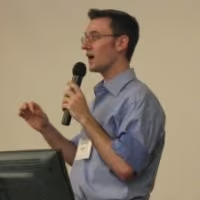
Host: Regular Acquiring Minds listeners know that building a Holdco is hot these days. Being the owner of not just one small business, but multiple lots of searchers in 2023 actually set out to do just that. Well, not today's guest who started his career in acquisition entrepreneurship back in 2013. He did ultimately build a Holdco, but sort of by accident. After spending his 20s in flashy corporate and consulting jobs and Adam Duggans and his wife returned to his hometown of Greensboro, North Carolina to settle down and raise their family and buy a business. Now, if you think that buying a business is an unusual path today, 10 years ago it was far more so. Undaunted by the questioning looks and sometimes outright discouragement, Adam attacked his search with gusto. That first year of searching, he met with literally 650 people in person throughout his small city, talking to absolutely everyone he could to get a lead on a business to buy. And he did find one. A structural steel fabricator doing about 12 million in sales with just under 30 employees. Flash forward and Adam and his Partner have acquired three more businesses in North Carolina's Triad region and their portfolio does 75 million in top line sales across the four companies with 220 employees in total. This is a longer interview, but we cover so much good stuff. How Adam found his partner and how he structured their ownership How Adam became a Holdco without really meaning to how motivating blue collar workers versus White collar careerists is different why Adam prefers working with blue collar versus White collar Buying businesses in overlooked geographies A bit about each of Adam's four businesses and so much more. I think you'll agree. Adam's got a great story and it's super fun to listen to him tell it. Here is Adam Duggins of New Page Capital. Welcome to Acquiring Minds, a podcast about buying businesses. My name is Will Smith. Acquiring an existing business is an awesome opportunity for many entrepreneurs and on this podcast I talk to the people who do it. Listeners of Acquiring Minds know that for almost any business you acquire, its success comes down to the people and how you develop and manage them as their new leader. Thing is, in addition to management, there is also a lot of process and bureaucratic work when it comes to your new employees. Payroll, compliance, HR technology, hiring to name but a few. These processes are crucial to get right, but at the same time distract from where you want to be putting your energy in leadership. So Aspen HR is an HR firm and PEO that takes this work off your plate and handles it with the care it demands. Aspen is owned and run by Mark Sinatra, himself a successful former searcher. So Aspen's own leadership understands the HR challenges that searchers have. Post acquisition, the firm is offering Acquiring Minds listeners a complimentary pre acquisition HR and PEO review for your target business. Check out aspenhr.com or contact Mark directly@markspenhr.com Adam Duggans, welcome to Acquiring Minds.
[3:36] Guest: Great to be here, Will. I'm excited to be here.
Host: Adam. I was connected to you by Jacob Lee, a previous guest. Jacob was a student at Darden uva's business school and was first exposed to buying businesses by a guest lecturer in one of his Darden classes. That guest lecturer was none other than you and it really made an impression on him. He after school he went off to work in consulting, but you had planted a seed in his mind about buying a business that he would later return to. So today you'll be talking to an audience a bit bigger than a classroom and, and not just about buying a business, but about building a holdco. You're about 10 years into building your Holdco New Page Capital, which is a Holdco regionally focused in North Carolina's triad. So let's get into it. Adam, start us off with a little background on you, please.
Guest: Well, first, thanks for having me, Will. This is always fun to share our story and share what we've been able to do. So I'm a, I'm a North Carolina native, Greensboro, North Carolina, which you know, for most folks might be the occasional home of the ACC tournament. It was a, it was a great place to grow up, great place to be raised, but wasn't something that is a place that I necessarily sought to come back to. I played basketball. You can't tell this on the camera, but I'm 6:10, so I played basketball at William Mary up in Virginia and so had the height and got to use it and got a free education out of it, which wasn't a bad deal. And then after William and Mary went to what was at the time called MCI WorldCom, which was a pretty prominent telecom company in the early 2000s that declared bankruptcy a week after I got my job offered. You know, was a fascinating time. Worked there for three years in corporate finance. There was a lot of fraud that had happened prior to me being there. I was not part of the fraud. I was part of the team that was kind of tasked with uncovering it. And so was there for three years, great experience, and then went back to uva, to Darden, to the business school. Didn't really know what I wanted to do, which is why consulting was a perfect kind of segue for me, because if you don't know what you want to do, consulting is a. Is a great fit. And so chose the consulting route out of. Out of Darden. But a lot of seeds were planted there in terms of, you know, ultimately what I ended up doing, and even seeds I don't think I actually realized were being planted. Went to Bain Co. Down in Atlanta. Works predominantly, worked as consulting, but worked predominantly in the private equity group. So that can be a little bit convoluted. So our clients were all the private equity firms that you hear about. And spent a lot of my weeks in the Northeast and Northern California advising private equity clients on different deals. It was an incredible experience. Very demanding, demanding experience. But for me, I started when I started at Bean. We had our. My wife and I, we had our oldest son and then had twins 15 months later. And so having more control over my life and kind of what I was going to do was starting to become more prominent of where we wanted to live and what we wanted to do. And so got an opportunity to go take a kind of a VP of operations role at a healthcare services business up in the Triangle, not to be confused with the Triad, just north of Durham, and did that for about a year and then. And then started New Page. And so that's. That's my. That's my kind of quick story of how I ultimately got to starting New Page.
[7:40] Host: And then I wanted to ask. There was also about how you ended up in Greensboro, specifically. Yeah, there was a conversation with your. With your wife, where it was. It still wasn't quite on your radar as a place to settle down. Tell us about that.
Guest: Yeah, it's interesting, when we got engaged, we have all those big life decisions and life conversations. How many kids do you want to have? Where do you want to live? And one of the agreements that we made was we would never live in each other's hometown. Not because we didn't have great upbringings and didn't love our families. Just wanted to.
Host: A balance of power thing.
Guest: That's right. That's right. And so I remember thinking we would probably end up in Raleigh or Richmond, which was kind of, you know, kind of a middle point between where our families were and areas that we knew pretty well. And we were visiting Greensboro one time, and my wife kind of said to me, you know, like, Greensboro would be a pretty good place to raise a family. And I was like, it wasn't even on my radar. You know, we had kind of said we weren't going to end up being here. And also what had happened was as I started to think about doing a search, I talked to people who were doing this in Richmond and talked to people who were doing it in Raleigh and there were a good amount. There were probably five to ten individuals in each of those metros doing it. So it was going to be competitive. But I couldn't find anyone in the triad. Now that's for some good reason, some not so good reason. The reason why is this area has had a bit of a talent drain to the two larger metropolitan areas in Raleigh and Charlotte. So a lot of the young talent is drawn towards those, those metro areas. But there's still a lot of good legacy businesses here. And so for, for the search I started to think, well maybe while everybody's going in this direction, maybe I'll go in a different direction. And then when my wife Laura said hey, I think it would be great to raise our family in Greensboro, it was seemed like the stars had aligned and we decided to quit my job and move here and kind of on a whim.
[9:56] Host: Wow. Well, at least she broke the agreement in your favor.
Guest: That's right.
Host: That's right.
Guest: If it had been the opposite, it might have been a little trickier.
Host: Yeah. Now what year is this?
Guest: This would be 2013.
Host: So I just got a call out. So if 2013, so long time ago in search years as we often a theme that, you know, it's gotten more competitive in a hot thing in the last kind of five, seven years, 2013, 10 years ago, even before that. And you already, you felt like five to 10 other searchers in Richmond and Raleigh, medium sized cities was a lot. You know, I suspect there's that much more today. So you're probably scaring a little, scaring people a little bit who are in medium sized markets because there's probably 20 or 25 in those cities today.
Guest: Yeah, I think that's right. I mean it was. Richmond would get the benefit of D.C. you'd get people who lived in D.C. who wanted to come down. And then Raleigh's obviously got tremendous universities around it. And I say searchers. It was a little different back then. You know like searching might be, might constitute searching while I still have a job. And I thought that was, I feel like that was a little more common back then. It was interesting. I don't know, I don't remember what I called what I was doing early on, but like a search fund because we didn't have a fund but like searching was Kind of what the terminology we used. But it was ultimately I was like, I just wanted to find a business to buy. Coming out of a school like UVA and Darden, I could only find a handful of grads who had done anything remotely close to this. And that has changed dramatically the last 10 years. The most people I knew of doing this were from some of the more kind of what I'd call prominent schools of a Harvard or Stanford and some guys who I'd known at Bain, one or two had gone down this path. But it was not very well defined at all at that point.
[12:09] Host: So how did it occur to you, I know from our pre call that your exposure to private equity is part of that answer.
Guest: Yeah, it is. So when I was in Atlanta, I would be on these cases up in the Northeast and there were three things that stood out. One, private equity firms would only look at opportunities with an EBITDA above a certain threshold. At that time it was like 5 million. Even the smaller funds, maybe they'd creep down to 3 or 4 million in EBITDA. But I kept thinking, gosh, what about a business that does a million in ebitda? That's a good solid business. And there just wasn't a lot of attention being paid. The other thing was, I can't tell you, this probably happened. I bet this happened more than a handful of times. We'd be working hard on a case and then some partner would go, well, how are we going to replace that 65 year old owner, founder who started the business? And no one would have a good answer. And so this idea of secession planning really started to just kind of. I sold small deals and big deals get really derailed because they didn't have a good plan for the secession planning. And then I distinctly remember being in New York with a private equity client, the biz Dev guy, the guy who was out looking for the deals was talking to me and he said, hey, I'm going down to North Carolina. And I kind of perked up and I'm like, I'm from there, where are you going? He's like, I'm flying into Raleigh and looking at some deals there. And then I'm driving over to Charlotte and I'm like, man, you're driving through my hometown. Are you looking at anything in the triad? And he said, you know, kind of really quickly he's like, yeah. He's like, we don't, we don't really think there's a lot there and it's kind of hard to get to. And I mean we have six or seven flights to LaGuardia every day. But the perception is that it's a little bit outside of a primary market and it kind of just, it happened. And at the time I was like, that's weird. Why would he think that? But I think like oftentimes deals do get kind of swayed by, you know, if they're in a certain market or in a certain. And I get it right, you want to be able to attract young talent. You want any company you buy to be in a hot area. But you know, there's, you know, one and a half million people that live in the triad. This, it's not a small place. And so for me it kind of settled of like, well, I'm not sure, maybe they're not looking there. And that happened probably 18 months before I ultimately made the jump. But it, it planted that seed of no one's looking, no one's looking here. And, and that's, that's kind of how that all transpired from those private equity guys.
[15:09] Host: You already know that business owners are making amazing use of virtual assistants, often based in the Philippines. And while virtual assistants are helpful, virtual professionals are transformative. More Staffing is a boutique agency that hires a players in the Philippines not for task execution but for deep competency work. Think controllers, operators, supply chain managers. More Staffing helped an e commerce company build their entire supply chain analytics and finance team. It saved them over $400,000 and enabled them to build the in house expertise of a much larger business. Global staffing is increasingly the norm and building the muscle within your business to take advantage of it will be crucial in the years ahead. So if you're sourcing the next management hire within your business, make sure you speak with More Staffing first about the pool of capable, affordable managers they can connect you with. Check out MoreNow co. That's MoreNow Co. And going back to your point about the succession planning and how you saw deals die because they didn't have a good answer for who would operate. It was your thought that your answer to finding such an opportunity would be that you'd be the operator or that you'd be able to hire an operator better than they were able to at that point.
Guest: It was that I would be the operator. So I was, you know, we're talking, I was probably 30, 31, 32 at this point. And it struck me that a lot of the deals, you know, would get derailed because of that. And so the idea was, well, what, you know, could I step in and be that person to be that successor for the prior owner. Because you can't ever replace an original founder owner. You can't. And I think it's a fool's errand to try to replace that person. But I do think you can backfill that person in a way that maybe is different. And so that was the original idea. The original idea was definitely that I would be the one stepping in. As I was starting to think about what. And I didn't even call. It wasn't called New Page then. It was just an idea of like, could I buy a business? Could I be that person who takes over a business and go from there?
Host: And you had the confidence that you, you could be the answer. Even though you didn't have operational experience. Yes, you had corporate experience and consulting experience. But a lot of people in, you know, SMB operator land, which you now probably know, kind of look derisively at the consultants and, you know, it's like these, these folks, their, you know, their knowledge of business is very abstract. You know, dealing with the hungover, you know, employees or whatever, you know, all the myriad headaches that small business really means is not something they're necessarily equipped to do. But you felt confident that you could.
[18:11] Guest: I was incredibly naive. And, you know, the one thing that Bain taught me was we would have these short duration cases of three to four weeks and you know, the client would come or the partner would come to our team and say, hey, I need us to solve this problem or size this market. And you would sometimes get these problems and you're like, this is impossible to do in three weeks. Like I can, there's no way we can do this us. And time and time again, you figured it out. And so I think that gave me great confidence in that I could, through hard work and through just kind of persistence, I could figure things out. Now, I will tell you, leaving Bain, I was not ready. Working in that VP of Ops role for that year really grounded me in a meaningful way. And I'm very thankful I did that for a year before I started doing this. Because it is different, right? You're going from managing very, very motivated individuals who in some ways you have to almost reign in some of the hard work because they're willing to do whatever work, whatever hours to, I'm not going to say less motivated, differently motivated people, because a Bain consultant versus an hourly sheet metal mechanic, they're both very motivated. They're just differently motivated. And I think for me, as a manager, as a leader, I had to learn the different levers that I wanted to pull and the type of leader I wanted to be with all types. And so that year of kind of post Bain before I started this was kind of instrumental in me kind of testing that out a little bit and figuring out what that was going to
Host: feel like and remind me what that business was and how many employees did it have.
Guest: Yeah, so it was a business called Care Services, still exist. It's a pharmacy benefit management company. Long term pharmacy. Pharmacy benefit management company. So PBM had. We were essentially doing a merger integration of three different companies and kind of pulling them together. So the total company had about 100 employees, mostly hourly. A lot of call center administration type work. So not pure blue collar, not using your hands more at a computer and whatnot. But still, you know, still definitely at an hourly workforce. And you know, I think that that was, you know, like I said, just a great experience to make sure that it was grounding right. Because when I say I was in the Triangle, I was actually in a small town called Oxford, North Carolina, which is about 40 minutes north of Durham. And you just experience different things than being in, you know, Buckhead in Atlanta and the shiniest office. And then you go to this place. And I think for me it made me realize I really liked the quote unquote hourly worker. The more blue collar worker. I actually enjoyed working with them more.
[21:41] Host: Really?
Guest: Yeah, because to me it was. They had better perspective on life in general. And you know, it's interesting, before this, before I got on with you today, I was down at our steel plant. And I love nothing more than walking out into the plant and just talking to the guys and hearing what's going on with them, hearing their concerns, hearing what's happening. Because, you know, the perspective they have is I'm putting in the hard work, I'm doing this and that. But they have, you know, strains in their life as well. And for me that's always very grounding to make sure that I've got the right perspective of why am I doing this, why are we doing this, who are we taking care of, who are we giving opportunities to? And you know, I love kind of going down there. I mean, that's my happy place, truly when I get out there on the plant floor.
Host: That's, that's so interesting and kind of hopeful when you say that kind of blue collar folks have a little bit better perspective than shiny people. Is it just they're just shiny people. I'll just go with that phrase. Shiny people can be just over focused on their, on work essentially. Is it Kind of distilled to that or is it elaborate, please.
Guest: Yeah, yeah, yeah. I think that I love the shiny people. That's a good way to put it. I think the shiny people sometimes get so engulfed in their own ambition of what their career is, what promotion they're gonna get. They get very self focused and I've just been amazed by the folks in our workforce. They're focused on themselves and their families, but they're also worried about other families too. And, and it's more familial, it's more community. And I think that to me is just the perspective that I love. And it's not to say that there's not good shiny people. There are and they are, but I think sometimes when you're sitting in a really fancy office in a financial district, when you're working in New York or Boston or San Francisco, it's hard to have perspective on what 97% of this country is actually like, which is, you know, there's still, I know more people live in cities than not in this country, but there's still a lot of people who live in rural areas. And they're real people and they're good people. And so I've just, I've really kind of found myself drawn to. Drawn more towards, more towards those individuals.
[24:36] Host: Well, that's, that's really, this is a really great conversation. I probably am going to want to circle back particularly on how you learn to motivate people who are, who are differently motivated than the shiny types. But let's, let's come back to it. So we haven't even gotten into. So you're in, you and your wife decide that in fact you will go, you will settle in your hometown. You've kind of had this insight, working close to private equity that maybe, you know, there's all these, there's all these opportunities that private equity isn't looking at or isn't executing on for one reason or another. And you feel like you could what then what?
Guest: Yeah. So, you know, I have a conversation with my wife and I say, hey, I want to search for a business. And we had already kind of landed on. We wanted to be in the triad, but we were still kind of trying to figure out what it is. And I said, hey, I'm going to quit my job and I'm just going to look full time. And you know, this is one of those moments. Even now I get kind of chills thinking about this moment because it was a scary moment for me. I was really putting it on the line and My wife's a processor. And so she kind of sat there and thought about it for all of about 10 seconds. And then she said, hey, how do you make money looking for a business full time? And I said, you don't. But we had saved, and I said, we've got some savings. We'll live off of that for a certain amount of time. And she kind of paused and thought about it, and then she's like, all right, I'm in. And it was one of those moments for me where, you know, I think about, my gosh, I chose the right partner in life and. And. And I chose someone who has total trust in me. And what a. What an incredible gift that is. So.
Host: So we.
Guest: We were kind of, you know, we made that decision probably in May, I think. I announced my resignation a couple months later, started to lay the groundwork. You know, I remember the little things that people were telling me I needed to do, like, you need to have a website, you need to have business cards, you know, which was. And it seems you need to have an email address, right? And it's like these little things that in my life, someone had always done those things for me. So it was. It was kind of a whole fun learning process of like, okay, I gotta. I gotta build a website. You know, I gotta. Who do I get business cards from? You know, what do I get an email address? I gotta get a. You know, all this. All these things that you don't think about. And so we move on Labor Day of 13, and I just started looking, and I was probably pretty unstructured at first and realized I needed to kind of really frame what I was doing. Now, our kind of thesis, or my thesis at that time was instead of. Because I was so geographically specific, I couldn't narrow what I wanted and what I didn't want. I needed to look at anything. And so the idea was I wasn't out there raising money, so people were willing to talk to me. When you're raising money, people are always a little bit more hesitant, but I wasn't. And all I was trying to do was trying to find businesses and started to network. And I kind of felt like within an area, that's. Call it a million million people. In the triad, there were probably 1500-2000 people that really mattered for my search. And those were attorneys, accountants, insurance agents, any sort of business aggregators of relationships. And I started just networking pretty. And I was fortunate. I had a couple people who helped me kind of get there. A lot of people thought, oh, you're from here, it'll be easy for you to network in. But I hadn't lived in Greensboro 15 years. I had no professional network at all. And so it helped a little bit sometimes. I'm not sure it helped. Sometimes it was like, oh, you're from here. Did something happen? Is something wrong? Why are you doing this? It's interesting. When I described what I was doing, some people got it, some people didn't, and I don't think cared to. And some people just thought I was crazy, including probably my parents. I'm not sure they knew. They really could understand what it was I was trying to do. I remember distinctly a recruiter who I had worked with in a prior role. About three or four years after I started New Page, he kind of pulled me aside and he said, hey, man, I need to admit something to you. When you left your job and started doing this search thing, I thought you had lost your mind, and I thought you were going to fail miserably. And I. I almost said something to you, but I didn't know what to say. And he said, but now I get what you were trying to do. And I was like. And I really appreciated him saying that. It took a lot for him to say that he was wrong. Not that he was wrong, but he was just. He was confused. And so that first couple months was a lot about me getting my pitch down, a lot about figuring out how do I tell my story in 30 seconds, how do I tell my story in 5 minutes and 10 minutes and 15 minutes, and buying a lot of lunches. And, I mean, one of. One of my investors told me early on, they said, buy lunch every single time. And that was kind of painful. I mean, I had no income, and so I'm like, oh, gosh, this launch, I guess I'll pick it up. I'll pick it up. And people will always let you buy their launch. You know, most of the time, you go to grab the bill, they're like, okay, fine, free lunch. But I think it was a really effective way to get someone to buy in a little more. You know, it was little things like that. And I remember I was the one asking them for something, so I should buy the lunch. And so that's. That's like, a small tidbit that probably cost. I don't know, I probably spent 15 grand in lunches that first year. And that was the best money I probably ever could spend, because I got, you know, from my standpoint, I got a lot of folks, you know, who wanted to help.
[31:28] Host: 15 grand.
Guest: I bet.
Host: I bet.
Guest: I'm telling you.
Host: Wait, so let's say. Let's just be super conservative and say each lunch was $100.
Guest: It wasn't a hundred dollars.
Host: It was ten times. It was even less. Right. So wait, what's my math? 10 times 15? 150 lunches, but probably more like 200. 250.
Guest: Oh, I had a lot. I mean, if every sing. So I met with. I tracked this. I met with 650 people the first year.
Host: Wow.
Guest: And so I was, I was. I mean, in my. Cause my ask in every meeting was connect me to three to five people who, you know, who I might be able to connect with. And I would take meetings that. What was interesting is sometimes you would take a meeting that you would think, I'm not going to get anything from it. And those were sometimes the best connections. And then other times you would take a meeting of a really well connected individual who was known in the community and nothing would come from it because oftentimes they don't have the time to help you. I found the perfect mix of person was someone who was maybe a little less known in the community, a little less demands on their time, who really wanted to help. But yeah, I mean, and I say, you know, it was breakfast, it was coffee, and I would try to have, you know, I would try to hit 60 meetings a month. It was my goal. And every month I would try to have 60 meetings in person each day. In person. In person. Yeah.
[33:00] Host: Wow, that is impressive.
Guest: Well, and I think that also speaks to this area. I think if I had been doing it in Atlanta, I don't think you can do that many in person. One, just because Atlanta's more spread out. But also I think people are maybe a little, in a bigger city, a little busier, they're going to be a little less willing to grab a lunch with someone. But in a smaller community like Greensboro or like Winston Salem or High Point, people are open to that. And so, yeah, it was, I mean, I think the most. I think I had seven in one day. And I remember thinking like that was too much. Like, I was like, I'm kind of bleary in terms of what I was saying. But it was interesting. It was also the first time my eventual business partner told me this. At the time, he said. I said, I don't have any sales experience. And he goes, what do you think you've been doing for the entire search? And it was, it was invigorating. It was scary. You know, there were all sorts of bumps along the way. But. But yeah, it was a lot of meetings that first year. I was everywhere.
Host: Well, you must have had, you know, baristas and waitresses who knew you by name and knew exactly, you know, how you liked your coffee. I mean.
Guest: Well, it's funny. I don't drink coffee. So.
Host: So.
Guest: So I don't drink coffee. And it's just something I've never done. But you kind of. Sometimes you're like, okay, I got to figure out what I'm going to drink. I can't just have this person get a coffee and be sitting here drinking water. There's a Panera near where we live, and I would live there. I mean, I would just every meeting because I didn't have an office or anything like that. And so that was a lot of fun. A lot of fun that year.
Host: Well, and when you're there so often, coupled with your height, I mean, the staff was all, there's the tall guy again.
Guest: It's like, oh, he's still here. He's still here drinking his one drink. I probably got, like, an iced tea or something, and I drank an iced tea all day or something like that.
Host: Well, so on this theme of how things have changed a lot in these last 10 years, of course, what you were doing, we. We call proprietary search today, not using, you know, websites or brokered. Brokered listings. And typically, people are going to be doing blanket emails, email blasts. That would be the 2013 version of what you did. Do you have any. Contrasting the two? Do you have any thoughts on that? Like, do. Would you, like. If you. If you were to do today what you did, if you were confronted with doing today, arriving in Greensboro and drumming up a deal flow, would you do it the same way again, or would you use the technology tools?
Guest: I would not use the technology tools. And I'll tell you why. I'm now on the other end of this, where I get those hits from the technology tools, and I get hit a lot. And that was often the hit rate on those is always low. Right. But my hit rate on being able to, like, if I found the business, for the most part, I could figure out one or two ways, like one or two connections. It's kind of like, you know, I'm gonna date myself a little bit here, but six degrees of Kevin Bacon, you know, you can always connect to Kevin Bacon. And it's a little bit like that. In a community like this, where I was always probably two at the most, three connections away from any given business. And a warm lead in from an introduction to me is infinitely better than an email. And we tried the email, I did a little bit of that and occasionally was successful in getting in and talking to the business. But there was a lack of trust there initially and it was just always hard to overcome as opposed to so and so's accountant, you know, introduces me into the business. That person trusts, trusts that accountant and trusts that I'm not wasting their time. And so I think I would do it similarly, I think geographically, when you do a geographic search like we did, like I did that first year, even today, I think you can still network kind of the old fashioned way of networking your way in to most businesses. I mean I talk to a lot of folks who are doing this now and, and even in larger markets, I still think that's a more effective way because you have to think about who you're targeting. You're targeting 55 to 7, 80 year olds and this is less so now, but it's still true. Where email is not their kind of primary form of communication. They still like to shake hands, they still like to get together, they want to put a face to a name. And ultimately that's the most important person you're targeting is that eventual business owner that you're trying to convince to, to sell their business, to sell that they'll sell their business to you.
[38:17] Host: The 650. I mean you, you, you didn't know it at the time. As we said at the top, like you didn't set out to build a Holtzco. But those 650 meetings also had the added benefit that it just sets you up very nicely to what would, what we now know, what comes over these intervening 10 years.
Guest: What is absolutely wild is all four businesses that we've eventually bought, I uncovered in that first year, all four, and some even very early on. Like the most recent acquisition we did was one of the first deals we had heard of. And you're right, it built this network. Now, unfortunately for us, we've been distracted by buying businesses. So I don't always cultivate that network as well as I should. But yeah, it planted a lot of seeds. And some of those seeds beared fruit in the first year. Some took 10 years to bear fruit, but eventually they did.
[39:19] Host: I still want to dwell on this for a second. The 650 were you, you had said you were at least initially meeting with the people who would give you access to the owners, the attorneys and the accountants and so on. Of those 650, how many were actually with business owners?
Guest: So we looked at in that first year, probably 150, 160 different deals. I may not have met with all those owners, but I probably got introduced or spoke with them. And I think the learning I had early on also was my time was not that valuable from the standpoint of.
Host: You didn't say. I'm sure you didn't say that to your wife at the time.
Guest: I didn't say that to my wife,
Host: but clock is ticking, waiting.
Guest: She's like, let's go, let's go. Um, but my time wasn't so valuable. I would meet with anyone, anyone, and. And, you know, it was anybody in the business community. I'm just going to meet with them because if I've learned anything, it's like, you just never know what connection is going to get you to that spot. To that spot. Right. And, you know, and actually, it was something that my wife and I talked about because she was new to this community. She was meeting people, too. She didn't, you know, it was a little awkward for her to say what her husband was doing because, you know, it was. It was like, wait, your husband, is he unemployed? No. Well, he's not really unemployed. He's. Look, he's searching for. So he's getting paid. No, he's not really getting paid. So he's unemployed. Yeah. You know, and she got very good at knowing how to convey that story to others because there's people she would meet that she, you know, that they might be connected to someone or they might be someone that we would want to talk to. So it was. Yeah, you know, and I reflect back on that year. This is a wild kind of wild part of it. People often ask, like, what was I incredibly stressed about money? Was I incredibly stressed about, you know, finding something? It's actually the least I've probably worried about money in my entire adult life. And the reason being is I just stopped looking at what was happening to our savings because it was so. It was kind of depressing. So I just stopped looking. And I was like, I know it's going down. I don't need to look at it. And I'm one of these people. I look at that stuff, and I just stopped looking. And I was like, you know what? I'm putting my head down. I'm going to find something, and this is going to be fine. And I think that I talk about being a little bit delusional in what you have to do. You have to have a little bit of that. And I did, and probably still do a little bit, but just being delusional. Of, hey, I know, like there's people who say this isn't going to work. I know this isn't going to work. I'm going to make this work because I have to. Because I had a young family. My wife got pregnant during that first year, which made so with our fourth. So the numbers were not getting any easier for us to manage. And so it was a challenging, challenging time. But, but gosh, you know, I look back on it now and I look back on it with a smile. It was an incredible, incredible time and I think I had fun with it and I think that's hard.
[43:01] Host: I was going to say you're smiling and you're clearly, yeah, you reflect back on it with some nostalgia. But in the moment where you, I guess you kind of just answered that when you were watching your savings tick down, that stressed you out, you stopped doing that. Were you, I mean, what were you, did you have anxiety? I'm sure you had some, but I mean like, what was your, what was your mood during these this year?
Guest: For the, I think, you know, 90% of the time it was very hopeful. It was, it was very,
Host: it was
Guest: very, things are going to be okay. It was optimistic. About every 10 meetings, I would have a bad meaning, actually. And what do I define as a bad meaning? I define a bad meaning as someone who's not only are they not going to help you, but they're going to tell you how you're going to fail. And I remember a couple of those where someone almost went out of their way to kind of really want to point out that you're going to fail. And part of that came from, I met a lot of individuals who were 10 to 15 years older than me that said, oh yeah, I was going to do that or I'm going to do that. And they would claim that they had been looking while having a full time job, but then they would want to kind of knock you down. And there were a couple of those calls that were pretty tough to take. A couple of those meetings where you got out and you're like, oh my gosh, is that person right? Did I make a horrible choice? And for me, I would let that feeling sink in for about 30 seconds and I would say, you know, I'd kind of get down a little bit. And then I would say, you know what if that, like, no, like that guy's not going to tell me, I can't make this work, I'm going to make it work. And in some ways that motivated me even more. Like those meetings Were actually, it's funny, my. My business partner would laugh after I would have them because he would see I would get more fired up after those to make this work. And so you had a little chips on shoulders, on shoulder. I love a good chip on the shoulder. I love a good chip on the shoulder. And that goes back to my playing days. I just, I love someone telling me I can't do something because it's a good motivator.
[45:27] Host: And do you really think that these haters were people who were behaving that way to validate their own lack of executing on this plan?
Guest: I think it was a little bit of that, and I think it was also a hint of. Maybe a hint of jealousy, of, gosh, I wish I had. I wish I had tried to do this. But also, also, I think there were some people who genuinely were like, no, you're going to fail. I think there were a couple who were. Who are trying to be like, hey, you've made a mistake. Like, don't do this, and trying to be genuinely helpful. But for me, it was, you know, it was. It was. I had to. I had to keep going. I had to keep going. I didn't have a choice at that point.
Host: Well, you probably had failed to tell those people that you were meeting, having two and, you know, three meeting and seven meetings a day, and that they were in the presence of somebody who was going to go on to have 650 meetings in a single year.
Guest: So that.
Host: That makes it kind of a cut above. Well, we are 45 minutes in, and we haven't even gotten to acquisition number one. So we are not going. Obviously, we're not going to have time to spend on all the acquisitions, but we, we definitely should get the whole. The whole span of the entire story. So maybe let's do this. Adam. Well, you just mentioned your partner. We need to hear that.
Guest: Yep.
Host: So let's talk about your partner ship. And then let's kind of quickly go through the last 10 years, and then we'll get into some more themes. Your partner. Great.
Guest: Yeah, I'm running in my neighborhood. That we were. We were renting this little house in our neighborhood, and I'm running in it, and I look over and I see a familiar face who is a year ahead of me at dart. I hadn't talked to him in five, six years, and it was a guy named Rick Ramsey. And, you know, hey, Rick, why are you in Greensboro? You know, and he was working for a Danaher health company at that point. And he, he said, what are you doing? And I started telling him and he was like, that's really interesting. I would love to hear more. And we went through. And that was about six weeks into the search. And I had realized pretty quickly, I need social. I need someone in the boat with me. And I wasn't sure what that was going to look like, but it was, you know, whatever, you know, higher power, whatever put Rick in that spot. I was like, oh, my gosh, like, this is. And I think he felt the same way. You know, Rick always jokes that Rick's a little bit the yin yang, my yang, and that if he had never met me, he probably never makes the jump. And if I had met him, I probably would be bankrupt because I would have done try to do too many deals. And so we. We kind of offset each other in a really, really cool way. He's a very different. We have similar backgrounds from the standpoint. We both went to uva, but he's an investment. He was a former investment banker, worked in operations, so had a pretty different background than I did from that standpoint. And it's just he and I will go to a meeting and we'll write down 10 questions coming out of that meeting, and they'll be 10 different. They'll all be different. And so, you know, and that was one of the things that was hard was early on it was like, okay, well, how are we going to be partners? How are you going to divide it? And I had taken the chance he hadn't. And we worked out a way in the deal fee in the initial deal that I got a greater proportion. But, you know, he was pretty adamant, and I'm thankful he was, that once we did the deal, everything was 50, 50. And. And I mean everything we do is 50, 50. And I think that has really simplified our partnership in creating just pure alignment of. No one ever has a little bit more than the other. And I think for us, that was a really smart thing we did early on that has built a really strong foundation to our partnership.
[49:29] Host: But I think I missed it. You had a little bit more of the first deal and then 5050 after. Say it again, please.
Guest: Yeah, yeah, yeah. So. So we. We had to somehow account for the fact that I was searching. I had to get paid for. You know, like once we had a deal fee, I had to get some benefit for that. So I did. So I got. Now, was it commensurate to what I would have made, you know, for a full year salary? Absolutely not. It wasn't close, but I got a Bigger chunk of that. But then we made the agreement once the deal started, once he quit his job, we were 50, 50 on everything moving forward.
Host: So you got like a flat fee, kind of one time compensation, cash amount for your labor and time finding the deal, but going forward in ownership, 50, 50 equity split.
Guest: Yep, that's exactly right. And essentially the way we did it was we did it so that I didn't really need to put any money in the first deal. Right. So my deal fee kind of rolled in and he did. And so that was what we did. Partnerships are like marriages. They're very similar. It's something you have to work on, it's something you have to spend time on. But for us, a lot of, I think the secret sauce of our partnership is built around honesty, being very direct with each other, stating when we want something, but most importantly, I think being very deferential to the other person. We have a term that I think we've stolen. I think Amazon uses this called disagree and proceed. And we disagree more often than not actually on how to approach certain things. But once we proceed, we never question it. We've done some side investments and done some stuff. I mean, there's been even deals, one of the four deals we did where he was really pushing for it. I wasn't as excited about it, but we did it. And there were times in the first couple of years where you're like, in my mind, it starts to creep in, gosh, we shouldn't have maybe done this, but I would never dare. It's like, no, no, no, I agreed to do this, I agreed to do this. And it's disagree and proceed. So you just proceed. And, and we're very careful about doing that with our leadership and with our employees and making sure that they always see a very united front from the two of us. Kind of like, you know, kind of like a, you know, parents, you know, you want to have a good united front with your kids.
[52:01] Host: Yeah, yeah. And when you, I, I don't, the framework is familiar to me, but I don't know it super well. When you disagree, how, what is the tiebreaker to then proceed? How do you decide?
Guest: It's, it's, I don't, I'm not sure we have a good process for it. It's ultimately who is more, who is more, who cares more and more. And most, and we've never, you know, when I say disagree, I mean, we've never had big disagreements. There are always small disagreements about maybe how, who to hire, how to proceed with a sales strategy. Or something like this, and it's never been big. But it's very important we have that process to flush out our differences so that when we are then sharing it with our organizations, we come across as united front and we are. I don't want that ever come across as disingenuous. It's not. Once I agree to something that maybe I didn't agree with at first, I'm all in. And, and Rick's definitely been the same way.
Host: I, in a previous partnership had this form of communicating with my partner where we would say if we're disagreeing, we learn to quickly in the disagreement, say one to the other, are you strong? How strong are you in this? Are you strong? Because what we found is like you could argue about something and then realize that you're just arguing because you're having this kind of intellectual debate and then realize that actually one person doesn't actually care that much about the Outco to begin with.
Guest: Yeah.
Host: So it was sort of an accelerant. It's like, wait, wait, wait, are you strong on this? Because I'm not. I think you're wrong, but I'm not that strong on it. So if you want it, you can have it. If you're really strong on it and the other partner says, yeah, I'm strong on this, you say, fine, you know, and, but, but you use it sparingly. Like you don't, you know, you don't. Neither person. Party abuses, you know, everything. Can't be strong all the time, of course. So it's, but it worked.
Guest: It was, it was a. Well, we, we use it, we use a term. We say we violently agree with each other sometimes, you know, like, like we're violently, like we're arguing and then it's like, wait, I think we're actually agreeing with each other and we, you know, you know, and that's always how it kind of kind of spawns out.
[54:14] Host: Cool. So you guys agree to a partnership and, and, and, and so I guess it was, he'll quit his job when you find the deal. And that.
Guest: Yeah, that's right. So we literally, we had the meeting that morning with the new business. He leaves, he goes and gives us two week notice as we, you know, as we. On the day we closed, essentially.
Host: And how close were you when you jogged past his house and found him and started talking partnership? How close were you to finding a
Guest: deal at that point? Not close at all. Because it was only, we were only. I'd only been searching for six, six, seven weeks at that point.
Host: Oh, wow. So you had a full year ahead of you.
Guest: Yeah, so it was a year. It was a year of search ahead of us. And I think we officially agreed to partner probably three months after that initial meeting. It's kind of a weird, almost pseudo, like, dating process because you're kind of like, wait, I really got to get to know this person and vice versa, before we agree to do something together.
Host: And while you were searching and having these countless meetings that you would. You'd already realized that you wanted somebody else in the boat with you. He was a sounding board. And. And you'd come home or talk on the weekend. You had regular meetings, I assume, where you're debriefing them on all these meetings and stuff. And he's just kind of being a sounding board and providing advice where he can. But he's not really putting in any man hours, as it were, or any.
Guest: Yeah, he's probably. He's probably putting in, you know, five to ten hours a week on just talking through things. And he would occasionally come to a meeting if it was. We deemed it was really important for him to be there. But we didn't feel like, you know, we see sometimes. I see sometimes where we have searchers where there's two partners and they're both searching. But we felt like for a geographically constrained search, that didn't make sense. We only needed. Needed one of us to be searching full time.
Host: Okay. Okay, Adam, well, let's hear about your first deal. Maybe a little bit more detail on that one. And then let's hear about all four of them. Abbreviated version.
Guest: Yeah. Yeah. The worst day of the entire search for me was it was on my 33rd birthday, and a deal that we were looking at had fallen apart. We had spent so much time on it. I'd been looking at this point for eight or nine months. And coming out of that, the person who had connected us to that deal introduced us to our first deal. And so from the rubble of what I deemed to be the kind of worst moment of that year, it was a structural steel business. We originally looked at it. I didn't necessarily like, instantly go, oh, this is it. You know, there was. There was some to like about it. It's pretty capital intensive in construction, which is very cyclical. And remember, in 13, 14, 08 and 09 was still very, very much on people's minds. You know, that was still. A lot of owners were. Would talk about it a lot. But Rick actually called a friend of his who ran a similar type business in a different region, and that Call kind of got us to convince. Okay, let's take a hard look at it. So two founders, both in their late 50s, so they were younger than most of the owners we talked to who were ready to move on. And so structural steel fabricator at that point we were probably 28, 27, 28 employees. Top line, maybe call it 12 million. But a great little business and a great jumping off point for us. So closed it in November of 14. So it was November 1st of 2014 and have, have, have been there ever since. And it's been a, it's, it's truly been a great ride with that one.
[58:32] Host: There was 12 million when you bought it. What does revenue look like today?
Guest: We'll probably do, I think we'll do 35 this year.
Host: Great. And what would you say to people, Adam, who are scared off by the construction businesses for precisely the reasons you just gave? Cyclical, non recurring project based capex, heavy capex.
Guest: They're not wrong. Those factors are there. So I think the factors are the cyclicality and the capex nature of it is tough. That being said, I think there's ways that in construction you can differentiate yourself from other, other trades through building strong relationships. To me, one of the reasons I frankly am drawn in some ways towards construction is because of the blue collar nature of it. Because you're building things. It's pretty neat. I mean like going to a job site where we've got a bunch of steel going up and you see that kind of exoskeleton of the building. That's neat. It's neat to be able to go look at. That's cool. And I will tell you this, 2008, 9 and 10 was really bad for that industry because something like 30% of the workforce left and then they never came back. So as you think about searching, that has created a void. If you think about the people who were 25 to 30, 40, 15 years ago, who are now kind of in the more senior positions, there's a real dearth of talent there. And so I really feel like that's a place where you can lean in and differentiate yourself. If you add a level of, kind of professionalism and level of customer service that is there. Listen, no one, you know, there's not many kids who, who, who grew up wanting to be in steel fabrication. But it's a really cool business because you get to make it's, it's, it's Lego blocks. It's making the right size Lego blocks and then putting them together. I did that as a kid. That's pretty cool. And, and so for me, it's a, it's, it's a pretty nice fit.
[1:01:00] Host: That's well put. I mean that, that is, that does sound really cool when you talk about the kind of the labor void, the reverse bulge from people who left the industry 15 years ago in 08. You know, I maybe like prior to Covid and prior to this labor shortage, I would have said, yeah, that sounds great. But now I'm just so. I just. The challenges with hiring people are so acute across so many industries, particularly blue collar, that it does not appeal to me to hear about an industry where, you know, there's, there's this kind of systemic underemploy, like under lacking labor pool.
Guest: Yeah.
Host: Because yeah, if I'm going to be the manager, I'm like, okay, yeah, great. I can differentiate myself because there's not going to be a lot of me. But then you grow the business and you're going to need, going to need to have managers, you're going need to have talent who run the business under you or as you go by your other acquisition. And it's just then you're stuck with the same problem all over again. How are you going to find those people?
Guest: Yeah, I think where, and I totally think what you're saying is valid, I think where we've been able to differentiate is one, how we treat people we truly care. I can say it and it can come across as well. Every business owner says that, but I think our actions over the last nine years have spoken to the fact that we truly try to take, take care of our folks.
Host: And
Guest: I'd say, well, those other managers and those other companies that maybe aren't quite as professionalized as you are, they're not. To me, that's what you're competing against. The blue collar workforce. You can figure out that puzzle if you're applying kind of good principles to it and if you, I think, are truly genuine with your current employee base. And so for us, we've been able to have, particularly coming out of COVID a very high level of retention with our employees. And listen, part of it is you pay, right? Pay matters. You provide good benefits. And that's where the kind of having the bigger entity has helped us some and you try to attract younger talent. And I think that's the part. I mean, we live in an area, central North Carolina, from a construction standpoint and from is exploding. We had 100,000 people move to North Carolina last year. So we've got a lot of people coming in There's a lot of opportunity, too, but I just. I don't think as a manager, you can. I don't think there's any space that's not struggling with labor right now. And so I think as a searcher, if you're afraid of labor, then you probably shouldn't buy a small business because labor is going to be there everywhere. Labor problems are going to be there. I talk to law firms, accounting firms. They're having horrible issues with labor. I don't think it's necessarily unique to construction.
[1:04:04] Host: Okay, that was November 14th. You buy the first business steel fabricator. What's the business called?
Guest: Engineered Steel Products.
Host: Engineered Steel Products. Okay. Take us to your next. Your next acquisition.
Guest: The day we submitted the IOI for ESP Engineered Steel, we submitted a second IOI for a business called American Industrial. And they. That process was just slower. And so we ended up with esp, ASE ended up coming back to us and saying, hey, we're interested. And we said, we're not ready. Can we reapproach? And so about a year later, we started the conversation and then ended up buying a business called American Industrial, which is an H Vac industrial and commercial contractor here in Greensboro. Similar, you call it. At that point, they were probably a 10, $12 million business. 60 employees, kind of similar size DSP, but most importantly, similar customers. And as we look at the. If we list off the risk of when you buy a business, number one is always customer defection and customer relationships. Well, we had the steel business where we had these relationships with customers that we could translate over to this H Vac business. We did not intend to be into construction trades. That wasn't what we set out to do. But when we looked at the deal risk and we looked at the kind of deal profile, it just made sense for us. And so we bought that in January of 2017.
Host: Just to be clear. So the customer base here is developers, general contractors. General contractors who would have been hired by the developer. So the gcs and so the GCS hire you to provide and put up the steel.
Guest: Yeah.
Host: And then they. They would also be the decision maker on the H Vac system that's going to go into this new building. Okay, that's right. And so obviously, same decision maker, if you can sell them twice for your two different companies. Now, I like to always ask this when I hear a guest talk about a perceived synergy. None of us, you know that. That old cliche word, a lot of ways to put it, but you have
[1:06:23] Guest: to do it like this.
Host: Yeah. Yeah, because I just feel like sometimes those can, you know, sound good on paper, but they just, for whatever reason, they just don't. They just don't work. Like, the GCs already have their H VAC relationships, and just because they work with you on steel doesn't mean they're going to dump all their current H vac relationships for you sort of as. As just one hypothetical. So.
Guest: Yeah, but did it work?
Host: Is it working? How.
Guest: How do you respond? It's a great point. We thought it was gonna be so symbiotic and like, work so well.
Host: Symbiotic. There's another one?
Guest: Yeah, not really. It was the same decision maker was making the steel decision versus the H VAC decision. But an H VAC decision is very, very different than a steel. It's just a different decision. Now, did it help that Rick and I developed relationships with owners of the GCS and we could talk to them about both? Yes. It's funny, we're six years in on this and we're still kind of trying to figure out how to make it work. It works sometimes. I tell you, when it did work, it worked during COVID when we would have one business that would be really slow and we would to be able to retain as many people as we could. We moved people over to the other business because some of the skill sets were somewhat transferable, not perfectly transferable, but they would help. But it didn't work as well as we thought. I think on paper we were like, oh, we have these customers and we'll just go to them and sell them H vac. To your point? Well, they had an H Vac guy. They don't want that from us. They don't want that from their steel provider. Through time we've been able to do that, and I think in another few years that'll even be even better. But that does. It takes a lot of time. And so it's interesting and we're just now really exploring the idea of the shared services between particularly those two businesses because they are both in construction. But it takes time and we were kind of getting there. And then Covid happened and we had hit everything on pause for a couple of years. But ask me in another five years and maybe it'll be a better answer and I'll say, oh, yeah, it worked great. It just took a decade of getting it to work.
Host: So you, you, you might agree with me that maybe synergies, there's somebody considering a second acquisition. Maybe don't over state to yourself what, you know, what the what the potential is there? Be super conservative on its take whatever
[1:09:07] Guest: potential you think is. And divided by like, you know, 10. I mean, like, it's, it's. It. I think the thing is it can be there. Just don't underestimate the amount of time it's going to take to truly be able to get the value from it.
Host: Yep, it was a 10 to $12 million business. And today, what does Top Line look like?
Guest: We'll probably do 15 to 17 this year somewhere in that neighborhood. Okay, so we've had some growth, not nothing crazy.
Host: Adam, I'm still very aware of time, but I just wanted to circle back. I didn't ask you how you were financing. What did your financing look like on your first deal and then subsequently.
Guest: Yeah, so we had three minority investors who invested, and they did. And then Rick and I obviously invested. And then we got traditional senior lender, just a traditional senior note. Rick and I were unlimited guarantors on that debt. And then our investors, and this is unique, our investors were pro rata guarantors on that debt as well. As someone who's since invested in search deals, I recognize I would never have done that. Fortunately, they were real big believers in ours, which we're very grateful to them. But we just had traditional senior debt, got very comfortable with signing personal guarantees. But at that point, particularly in 13 or 14, signing a personal guarantee, I was like, great, I don't have a lot, so you can have it. I'm not sure it meant a lot, but that's how we have financed virtually every deal in some kind of way or flavor. We also, it should be clear, the first two deals each had seller notes
Host: on them,
Guest: and we had earnouts on them on the first two as well. And so that was, you know, that earn out is just such a great way to bridge the gap. Every time we would talk to an owner, they would say, yeah, yeah, I know what I've done, but this year it's going to go like this. And we would just say, fine, we'll give you all that upside, but we can't. We'll give it to you through some sort of version of an earn out. And so we really thought about it in four tranches. Earn out, seller, note, Banknote Equity. And those were kind of the four tranches we would use to get.
Host: And why didn't you do an SBA loan, at least initially in that first deal? Not flex sba, just because of the earn out. It won't let you do an earn out.
Guest: Exactly, exactly. And so we started Going down that path. And we quickly realized that we felt like the Earn out was a really great tool to bridge gaps between valuation expectations. And with sba, I think you might be able to in some cases, but for the most part you can't, you can't do it right now.
Host: Yeah. One of the things people like about SBA loans is how much leverage you can, you can use.
[1:12:03] Guest: Yeah.
Host: So did you have less generous leverage situation in your first deal?
Guest: No, we were pretty levered partly because a lot of the deals we're doing, we're not, we're not buying deals at six to eight times ebitda, we're buying deals that are lower. It costs value based buyers of three to four times ebitda. And so when you're at those lower numbers, you can get, as a percentage of the deal, you can get a lot more leverage on them because the banks are going to get way more comfortable with that as opposed to having to come up with a 5, 6, 7, 8 times EBITDA business. You're going to have to have equity, a lot more equity in those stocks.
Host: Great. Your next acquisition, Jet Hot.
Guest: A guy who used to work for Rick in investment banking called us about it. We had actually heard about Jethawk for years, knew it was there. They originally wanted to sell the building with the business. We didn't want the building, so we weren't interested. And then we reapproached. We thought Jet Hot was a great way to not be in construction and kind of diversify a little bit. Jet Hot is. We coat automotive parts for anywhere where there's heat or corrosion in an engine. We coat that part and it's really got two sides. One's the commercial side. So we do that for kind of commercial engines. And then if you're a tinkerer or have a hot rod or something like that, and you want to do any sort of coating on any sort of parts on your, your car, you'll send it into us and we, and we do that as well.
Host: So is it kind of a. Oh, so you guys actually do the, the treatment of the, of the engines?
Guest: We. Correct. So we have, think, imagine we have a bunch of ovens and we have the engine parts, not the engines, but the engine parts kind of rolling through a line and, and you know, heating on that essentially that, that, that coating that you're putting on the different parts
Host: and the coating is also your proprietary product or correct?
Guest: Yeah, that's right. That's right. That's right.
Host: And is it kind of a single, single sku business where you have the coating in the process and that's it.
Guest: No, there's, there's, there's several different coatings, particularly on the, on the consumer side. You know, there's different colors. People like doing different colors for, you know, their different types of parts. So there's a fair amount of different coatings, but primarily we do, there's primarily two types of coatings that we do that make up the predominant amount of our business. It's a nice little business. It can be very, it is very dependent on the automotive supply chain. So as you can imagine, 20 and 21 were very rough on that business just from the standpoint of we just couldn't get parts.
Host: Yeah.
[1:15:00] Guest: But, but for the most part, that's been, that's been a really good deal for us. We've, we've, we've really enjoyed both the people there, customers there. And, and, you know, it's, it's, it's been, it's performed well, which has been, which has been nice.
Host: And, and in the world of hot rodding, is this like a brand that everybody knows?
Guest: Yeah. Which is super fun because, you know, when I say to you engineered steel or American industrial, you know, no one knows that other than a few folks locally. But when you say jet hot, you say jet hot to the right person and they go, oh, jet hot. Yes. You know, and what was really fun is we had employees from our first two businesses who, when they heard about that, were so excited. I mean, we had guys who had jet hot bumper stickers on their cars because they really bought into this and so they were so excited about that. And so it is a brand that is known among certain circles, certainly.
Host: Yeah, that's fun. That's super fun. How big was it then and how big is it today? Top line?
Guest: Top line. Six million. It's still six million. We kind of started to have a little growth and Covid chopped that pretty hard. And now we've kind of gotten back to previous levels. So relatively small top line, but actually we have probably 40, 45 employees. That business is a little different in that we don't take on inventory. So it's really a service based business. And so even though your revenue is a little lower, it's from an employee standpoint, a little bit smaller than the other two businesses, but still has a good amount of folks.
Host: And what year was that, did you say that you acquired Jedi?
Guest: That was the beginning of 2019.
Host: Okay, so at this point, 2019, with this jet Hat acquisition, are you seeing yourself as a Holdco yet?
Guest: Yeah, I think in late 19, that started to really start to form. Jed Hat at the time had a full time IT person, but it was a small business. And so I was like, they didn't need a full time IT person. So we elevated him to be over all our businesses. And he was kind of the first person that I was like, oh, this shared service model could really be pretty powerful. And so in early 20, we really started to outline what we were going to do. And then March of 2020 hit, and all that got put on pause for really about 18 months as we just had to kind of hold on and hunker down for. For what was a very bumpy ride across all three in very different ways.
Host: And then Covid calms down and I guess you reintroduced that conversation amongst yourselves. Yeah. And interesting just to call out Adam. It sounds like the shared services insight was really what led you to start thinking, oh, we're a Holdco or, oh, we should think about ourselves as a Holdco.
[1:18:13] Guest: Yeah, we had benefit from that one employee that I mentioned. The other thing that happened was Rick and I started recognizing that if we were going to do more than three, we had to elevate up because a lot of this, I was wearing a lot of different hats and so was he. And through Covid, we had to kind of really hone in on those. And. But as we got out of that, we were like, wait a second. And we made a pretty bold hire about in middle of 21. He was actually the city manager for the city of Greensboro. City of Greensboro has 3200 employees. And he has been a friend. He's around our age, and he was a city manager. And so I'm sitting there going, and we were talking and I said, hey, David, if you ever think about leaving, I knew he wanted to stay locally, we should talk. And we brought on. It was a very outside the box hire. It has transformed our organization because he has been able to be the primary operator in now two businesses while Rick and I can elevate up and look for more deals. And I think we've always been a big believer in hiring athletes, not always hiring experts, because most of these businesses have experts. They have great experts in them. But I love someone who's just a good athlete who can kind of do a bunch of different things. And that's what David was. David's the best. He's the best people manager I've ever seen. And so it's pretty humbling when you see someone take a business that you've been trying to run and then run it a lot better than you did. And I'm like, great, this is awesome. This is fun. And it's fun for me personally because I'm close with him and, and to see him kind of have a lot of fun with this. And so through that hire then, you know, then we realized we needed a safety officer, you know, and each of these businesses couldn't afford a full time safety person, but combined they could. And, and now we've promoted someone from within to be a finance officer or a director of finance for New Page. And we're really now at this moment where all of a sudden we're creating this New Page team that's helping these businesses. And it's been fun. It's been fun. Not just from the standpoint of Rick and I being able to wear a different hat or kind of pull up a little bit, but also it's been really, really fulfilling to see those individuals step up and step up in a really meaningful way and have fun with it. I mean, I think if you have truly ambitious people in a 50, 60 employee business, part of the issue is their growth can be limited because of the size of the business. But when I talk about our 220 person business, there's more options for us to kind of move folks around. And we've really started to explore that in a meaningful way.
[1:21:24] Host: It's. I'm kind of making the same point a second time that you arrived at becoming a Holds Co kind of out of pragmatism. I mean, you just, you needed these things and, and you know, the Holdco structure started making more and more sense for all the reasons you've just said. And it's just striking because on SMB, Twitter and, and among my audience, having a Holds Co is kind of a fantasy. It's a hot trend. But I think it's more just because it seems cool and fun, you know, to, to kind of to own a bunch of different businesses and, and you know, Warren Buffett is widely admired and he's kind of like the Holdcoat King. So everyone talks about having the mini Berkshire Hathaway, but you, you arrived at it quite accidentally. You kind of evolved into it. So just want to call that out. Okay, Adam, let's hear your most recent acquisition. And then we still have a few more themes. I, I really want to make sure we get to.
Guest: Yeah, most recent acquisition was a business called WC Rouse. This was actually boiler sales and service business that we acquired that in September of 2022. I had actually heard about this business 10 years ago before I'd even started searching. And it was actually sold to a private equity firm out of Chicago. Then they had held it. Their life of their fund has a certain amount of time, so then they had to sell it. I had stayed in touch with them and they called me in April or May of last year and said, hey, would you still have interest in Rouse? And I said I would. And so we were able to buy that. There's some benefit related to the H Vac business too, some of which we're exploring, some of which we're trying to figure out. But that business allowed us to justify the safety officer. And that's what's been fun, is each time we add a business, it allows us to kind of build more around it. And so that's been. We're six, seven months in now on that one, and it's been very good so far.
Host: And can you give us a sense of size of that one?
Guest: Yeah, so that one's kind of 10 to 12 million as well, maybe 12 to 14.
Host: As you keep playing and evolving and growing your shared services model, you know, at some point, Adam, you're also going to be confronted with the classic hold code debate of centralization versus decentralization. And you guys are clearly moving toward centralized shared services. But, you know, just raise your hand a little bit and you'll hear plenty of people telling you that, you know, you should be decentralized all the way. So have fun with that debate.
[1:24:11] Guest: It's a fun debate. It's interesting because I've seen companies go centralized, spend five years going that way and then spend five years undoing it. I imagine we'll probably have some sort of semblance of that, but I do think it's something we talk about a lot. I think that's where our location helps, though, because if we centralize, we're still here and we can still be present. I think sometimes when centralized models don't work, it's when you're pulling something to another state or to another region. For us, we'll always have a presence. I still always have a presence of visiting each business each week. And I think that's important.
Host: Well, one question on that, Adam. Now reflecting back on your decision to kind of geographically search and be in a relatively small geography, your 650 conversations 10 years ago, you've now acquired four businesses in the community. I assume people know you. I assume people now are trying to get your time rather than the other way around. Is the pool of potential opportunities For. For Greensboro. Really bottomless. Like, I just would imagine at some point you're gonna. You're gonna tap out. And I mean, you're gonna. You're gonna need. You're gonna need a wire pool.
Guest: This is. This is a conversation we're in the midst of right now. Because I do think at a certain point, like, if you look at the triad, we think that we thought when we started, there were probably six or seven hundred businesses that would fit somewhat in our parameters. We haven't looked at all of them. We've looked at a lot of them. And so we are starting to. Our pull, starting to get a little more limited. But that being said, there were businesses that I talked to seven years ago where the owner was 54, and it was like, oh, this is not interesting. But now that Owner 61, maybe it is. And. And so we do see some potential, you know, because that's the trickiest part about this, is the timing has to be right, you know, And I think the timing is the hardest part because you have to catch that owner at the point when they're ready to pull the trigger. Yeah. And so it's not a bottomless pit, but I do think there's still some opportunities there, and I think for us, those opportunities could look like bolting onto our existing businesses. Right. And buying something that is related to something that we currently own.
Host: Yeah. Well, I don't know what your big life plan is, but you're about my age, about 40 years old, so you still have a couple decades in you, I would imagine. Yeah, so. So at some point, maybe, maybe not in the next year or two, at some point, you're probably going to step outside this geography and maybe, maybe you'll just cross that bridge when you get to it. But I can't imagine at the rate you're going, that Greensboro is going to. Going to provide a big enough pool for the next 20, 30 years.
[1:27:08] Guest: Yeah, it's. It's. It's something that's tricky for us because we've been tempted. We've looked at deals. We've looked at several deals. Yeah, we definitely, definitely particularly. We particularly been tempted in businesses that we are already in and buying a competitor in a different region. But I think we'll hesitate because Covid taught us the power of us being able to drive through the business every single day. And so every day I would do the loop, and I would just go to each business and I would show up and I would be present. And I think that matters. I think it matters for ownership to be present and to know the employees. But you're right, I mean the temptation is growing in terms of us going out of this market. And we've got, listen, we've got two massive, we have two of the ten fastest growing cities in the country in Raleigh and Charlotte that are an hour and an hour and a half down the road. There's a lot of opportunities there and so at some point I imagine we'll get pulled into doing something like that.
Host: Yeah. One of the things that we talked about in our pre call was that you're more focused on stability than on top line growth. And you know, it's funny as I, as I reviewed my notes and prepared for this call because I realized that searchers generally want both. So in other words, you know, they want stability but also opportunity for growth. It's kind of like, yeah, you know, not high risk, high reward. They want low risk, high reward. And capitalism isn't usually reward that way.
Guest: No.
Host: So you're at least honest about it as opposed to the rest of us delusional searchers. Low risk, high reward. Anyway, so you're more focused on stability than grow, grow, grow, grow, grow. Elaborate on that please.
Guest: Yeah, we just felt like for us to be the type of operators that we wanted to be, we, we were never going to be these folks that were going to shake things up, make big bold changes. Because I think for us, being an employee of a business that's bought is really scary. It is scary and there's no other word for it. And particularly when someone's coming in who eight, nine years ago, I'm 33, 33 years old and they're like, who is this kid? He doesn't know anything about steel. I'm putting my trust in him. I'm putting my family's livelihood in this person's hands. And I think for us, we just felt like the right way to do this was to do it slowly and steady. And it helped that we were both in our early 30s and we felt like, listen, we've got a 30 year horizon, which is crazy to think about that kind of timeline, but it is. And we also didn't have a fund. And I think that really helped us be patient with these businesses because we've made investments that in the short term or even in the medium term have made no sense for these businesses. But long term we believe will. And I just, I'm not going to say it's an easier way to. It's an easier path. It's certainly less dangerous because I have seen Other folks come in and make all these changes and immediate. And shake. Shake the kind of foundation of the business. And all of a sudden you've got two or three key. Two or three key people walking out the door. And so I think when you think about that relationship you have with those key employees, I mean, it's so cliche, but you need them more than they need you, and you just can't forget that. And so I think sometimes I remember the first month we owned the steel business, and I was so wanting to make changes. Like, I just wanted to improve it. I wanted to make it better. And I made some missteps early on, just doing stuff that just wasn't. This is a really simple one. I wanted to clean the office up. Yeah, okay, that sounds like. Why would that be controversial? But we had all these drawings, and I wanted to just get rid of them. I was like, guys, we have all these electronically. We don't need these. I wanted to get rid of them. I wanted to throw them out. And I started doing it, and it made people really upset because they were like, what if we need those? Because I didn't do a good job explaining, you know, my kind of my process. And it was just. Visually, it was tough for people to see. And it's. You know, I was talking to an employee who was there this morning who was reflecting on that, and he was like, y' all just wanted to, you know, kind of say you were the guys in charge. And I was like, yeah, I was like, we're a lot better at it now than we were. Like, for instance, the most recent acquisition, we've. We've done. We've. We've done virtually nothing. Six months in, we've just been, hey, just keep it stable. And then I think after about a year, you've earned that ability to start making real improvements. But the worst thing you can do in the first month, two months, three months as a searcher, is come in and try to just make changes, even if they seem as simple as cleaning up the office, because can rattle the employees in a way that's not very
[1:32:47] Host: healthy when they're already emotionally vulnerable.
Guest: Oh. Particularly when they don't know about it, and most of the time they don't. And so you walk in. I mean, I've done it four times now. You walk in on day one, and you see the looks on their faces, and it is a fear. I mean, without a doubt, many of them have had a friend, a family member who was part of a buyout, who lost their job after the buyout. I mean, that's always going to be the story you hear. And so for us, it's, hey, I'm going to sit down with you, Will, and I'm going to find out about you, and I'm just going to listen and I'm not going to say much. And that's a lot of what we do. We do a lot of listening in the first three to six months of the acquisition.
[1:33:38] Host: Well, that change, how much to change, when to change, what to change. It's a, it's a theme that we talk about constantly on this podcast. Yeah. And it's just so delicate. You can't talk about it enough. Adam, another thing you told me on the pre call was on this theme of, I think, I think of stability as opposed to growth is just how you, you touched on it already. You come to have, you've come to really think, think about yours as a people business and really taking care of the people. And you already said, I'll also say every business says that. Every CEO has to say that. But I felt it from you genuinely when we talked. So can you, can you, can you elaborate?
Guest: Yeah. I think for me, you know, financial success is, of course, part of the goal of this. Right. But I actually, it really changed early on. That was the focus. The focus was on control, meaning controlling where I lived, meaning controlling my schedule, meaning controlling my own outcome, and meaning controlling my financial destiny. But I think, as I've gotten further and further along, come to realize that the thing that keeps me up at night is not. It's not, hey, am I going to be able to retire comfortably? Hey, am I going to be able to put food on the table for my kids? Am I going to be able to help my kids pay for college? It's, hey, are my employees going to be able to do a lot of that? And that for me is just, has become, I'm not going to say becoming the sole driver, but it's become a huge driver of what we're doing. And so from that standpoint, it's going to come across as like, oh, gosh, that's so great. He cares about his employees. It's a little selfish because it's just what I worry about. So that's what I care about. I'd love to sit here and tell you that, like, oh, yeah, I'm just so, like, gosh, isn't it great that I care so much about these people? Well, it's what keeps me up at night. It's what I worry about. And so that's what I spend time on. That's probably a little selfish, you know, but it's also, to me, it's when I start to think about what people who work for us ultimately say of us. They're not all going to like you. Everyone who works for me doesn't like me. That's okay. But I hope they respect the decisions we make and they understand the decisions we make and they want to work there. And that's what we just want to. You spend all your adult life working with these people. If you're an employee and you say, why am I working? Why am I spending all my time with these individuals? And then the hope is that maybe, you know, you can do something in a way that is meaningful that people look back on. They say, gosh, I'm so grateful for the opportunities that we got at a new page company.
[1:36:55] Host: I think that segues into something I definitely wanted to return to. When you talked all the way back at the intermediate year you spent learning how to be an operator before you started a new page or before you did your search, and how motivating people who are differently motivated than shiny people, and they're not just motivated by money or traditional kind of professional accolades. Maybe they're motivated by a different, just differently motivated, as you put it, which I really liked. And so how are such people motivated? What, what are some of the levers?
Guest: Yeah, I mean, the shiny people don't truly worry about, hey, are my kids going to have meal on the table? Hey, are my kids going to graduate from high school? Are my kids going to have a chance to even go to college? That's what our folks are thinking about, right? Am I going to have a job? And that was so much of what we've worked on the last three years was conveying transparency and conveying to these individuals, yes, you're going to be okay. We're going to take care of you. And so they're motivated by that and they're motivated, certainly motivated by money. But more than that, they're motivated by a trust in a employer who is going to take care of them over the duration of their working career if they choose. We've got one individual in particular, and I won't say what company it is because it might give away who he is. But he started at the lowest level of this company. He's been with us for 32 years, so been with the company a very, very long time. And this is a kind of working trade. He'll probably retire when he's 63. He'll retire a millionaire. And that's amazing. And it's a total testament to him. It's a testament to the prior ownership that invested in his 401k and gave him 401k match and gave him good benefit. And it's a testament to him that he wants to. And he's so excited about it. This was one of those things. I was looking at her, you know, I'm the 401k administrator for all the different plans and I was looking at it and I kind of went to him, I was like, man, you've done a great job saving. And he was, he's so proud of what he's been able to do, using his hands to become wealthy. And so it's awesome. You know, I think, I think for that and I think the other thing I'd say that's a motivator for me is when you manage a Bain consultant, you're almost kind of guiding the intensity, guiding the motivation. But when you're managing some of these folks, you're also helping them manage the broader world in some ways as well, around healthcare, around financial stability. So we do a lot of programs to try to help our employees with those things. Financial stability, financial wellness, what does that look like? How much should you be saving? How are you thinking about retirement or health care? Hey, are you taking care of yourself? You're going to run into health issues if you don't take care of your body. And in a rough and tumble blue collar environment. When we first did was scoffed at, it was scoffed at as mumbo jumbo. But we've created a culture now where I think individuals, they may not always be receptive to it, but at the very least they understand it comes from a good place of genuinely wanting to help.
[1:40:59] Host: And what is the it? It's a program where you kind of outreach to everybody and say, hey, have you.
Guest: So we do like lunch and learns where it's like, hey, here's financial, you know, personal finance 101. Because, you know, if you're a welder and you came out when you're 18 from high school and you just started welding, no one's taught you the kind of fundamentals of what's 401k? How am I supposed to think about that? Yeah, how much should I set aside for that? No one's taught you of, hey, how much can I afford in rent? How much can I afford? Can I afford to buy a house? Because that's actually one thing that like, you know, home ownership is such a great Way to create wealth if it's done appropriately. And a lot of our folks think, well, I can't afford to buy a house, but oh, no, no, no, actually you can, you can afford that. They just, you know, it opens their eyes to it. And so we try to do a lot of lunch programs, you know, like a lunch and learn essentially with our folks. Buy them lunch. You know, it's funny what you buy. You give someone a free lunch, they're always going to come. Right. Goes back to that first lesson. That first lesson. Right. So we buy them lunch and then we try to get them, you know, get them to understand some of these things. And listen again, it comes across as, oh, gosh, that's so nice. You do that for your employees. No, that's so good for us because that makes them feel more connected to us as well. It shows that we're investing in them. It's a good business decision. I'm doing it. It makes me personally feel good, but it's also the best business decision because I'm investing in those people.
[1:42:34] Host: Yeah, yeah. The kind of double bottom line kind of.
Guest: That's right.
Host: Concept. That's right, Adam. To close out. So give us just going back to the numbers after, after talking about some of the more qualitative stuff so you don't. Your, your own personal focus is less on ebitda. Ebitda. EBITDA sort of thing. And you're willing because you are investing in these businesses for the long term. By the way, we should, we should make that explicit. So you said 30 year horizon. So you're buying and holding. You know the phrase permanent equity. We hear a lot now. You would put yourself in that category.
Guest: Yes, definitely. Definitely. You know, for us, we felt engineered still. It's been nine years now. So it'll be nine years this year. So yeah, we foresee the duration of our careers owning these businesses.
Host: And so, you know, squeezing a percent or two or three or five even of EBITDA each of these businesses means is less important when you're not trying to compute some multiple to then go sell it. You can take that money and invest it in your people. That's great. But tell us what the aggregate top line number is of the portfolio today. So we have a sense of scale. I've been kind of counting as I go, but I trust your number more than mine.
Guest: Well, do. We'll do. We'll probably be around 75 million top line this year. About 200. And we probably have 220 employees as of right now. That's great.
Host: And I, I think it's fair to say in 2013, you were not. Your ambitions were, were not that lofty. And yeah. And yeah, here you are only 40 or 40 issue.
Guest: Yeah, they. No, they definitely were. You know, it's. When I would go through it and everyone would ask, well, how many businesses do you want to buy? And when I had none, I would say, I just want to buy one. I just want one. And then when we had one and I started looking again, well, how many are you doing? And I was like, I just want two. And I think for us, we have just methodically, just, you know. And listen, I'm starting to look again, I'm starting to search again. And so how many do you want? I was like, I'm just worried about getting number five. I, I'm not worried about the bigger picture. And I think that's been good for us because I think you keep your head down, you keep doing the hard work, you look up and all of a sudden it's like, wow, this is pretty cool, what we've been able to achieve.
[1:45:04] Host: Yeah, it sure is. Adam, what is your preferred way that people would reach out to you? Do you like email? Do you like LinkedIn? Do you.
Guest: I would say email. And I'm happy to share that right now. Or, I don't know, you give it
Host: to me and I'll just put it in the show notes. Or you can say it. Or you can say it.
Guest: Go ahead, I'll say it. It's a duggins new page, capital.com. so. And I. Emails. Great. And I, I will never, not. I will never say no to a conversation. You know, I mean that if.
Host: Be careful, Adam. You got a lot of people who
Guest: are really going to admire you from this interview. Well, to me, to me, it's, it's. I had so many people help me. So many. And so I get more from those conversations than anyone who's like calling me and say, hey, how do I do this? How do I do that? I get off those calls and I'm energized because it's fun to help. It's fun to help other folks kind of achieve what they want to achieve.
Host: Great. Beautiful. Point to end on. Adam Duggans, congratulations on what you built. Can't wait to keep watching you. And thank you very much for giving me so much of your time.
Guest: Will, this was awesome. I really appreciate it, Appreciate what you're doing and appreciate you having me on.


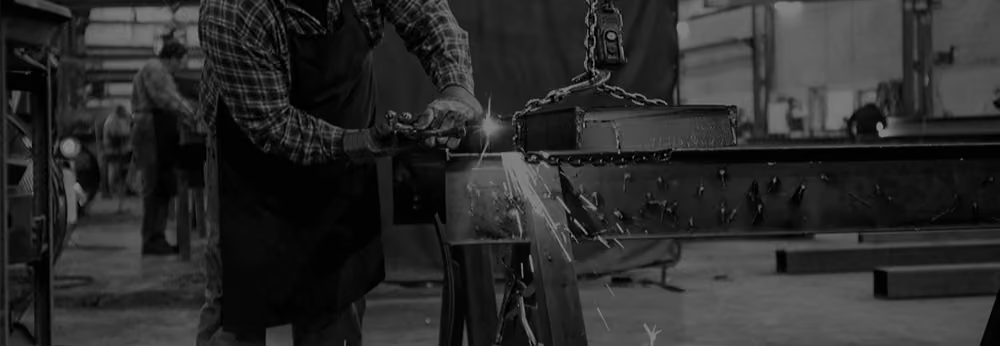


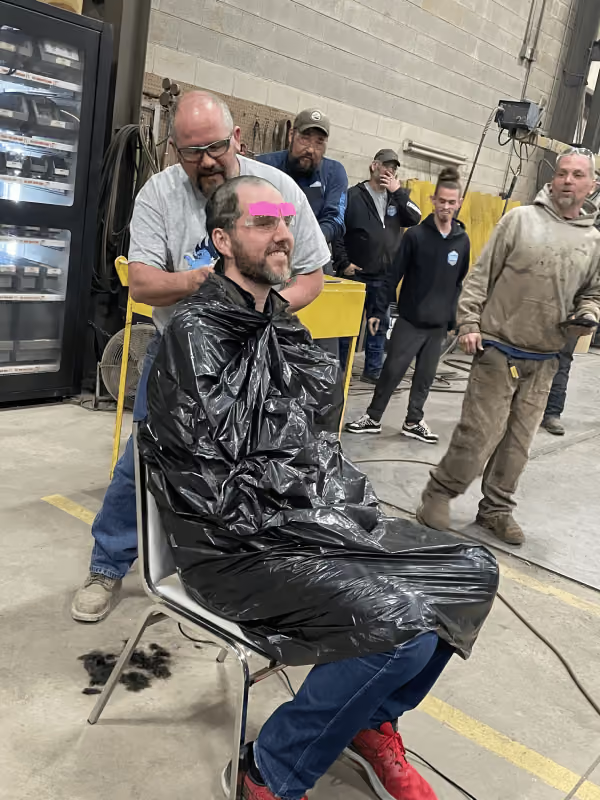























































%20-%20thumbnail.avif)




%20-%20thumbnail.avif)

%20-%20thumbnail.avif)

.avif)




%20-%20thumbnail.avif)