Host: Many acquisition entrepreneurs don't even attempt to buy a SaaS business and for two big reasons. The primary reason is that they are perceived, not incorrectly, as too expensive. SaaS businesses are characterized by an enviable trifecta strong tailwinds. Software is eating the world. Recurring revenue in gross margins in the 70s, 80s, even 90s. It costs a relatively small percentage of revenue paid by a client to service that client. And there are a couple other characteristics to love that aren't intrinsic to SaaS, but true in many cases, like today's story, they are virtual businesses that can be run from anywhere and the entire world is your talent pool. So even though software developers are expensive, they are plentiful. So for all these reasons, SaaS are coveted businesses to own and multiples are high, sometimes eye wateringly so. And that makes them risky, not to mention unfinanceable with an SBA loan. But not always. Again, like today's story. Okay, and the second reason that many entrepreneurs don't attempt to buy a SaaS business? They aren't technical. So they worry about buying a business whose very product is lines of code. Fair enough, but today's guest, Andrew Swiler was undeterred by all of the above. Andrew found a SaaS business doing 650,000 SDE, acquired it with an SBA loan, and all while living in Barcelona. Now, as you'll hear, it's not actually a slam dunk. Andrew explains the nuances of SSAs and how these businesses do have their weaknesses as well as their strengths. Please enjoy this fascinating deal story and education in SAS with Andrew Swiler, owner of Lantaria. Welcome to Acquiring Minds, a podcast about buying businesses. My name is Will Smith. Acquiring an existing business is an awesome opportunity for many entrepreneurs and on this podcast I talk to the people who do it. I want to share an update on the Acquisition Lab. As you know, the Lab is a highly vetted cohort based accelerator and community for people serious about buying a business. After going through the Lab's month long intensive, you have ongoing access to almost daily Q and A sessions with advisors, regular live deal reviews with Walker Deibel, author of Buy, Then Build, Potential Deal, team introductions and a very active Slack group with other searchers on the path. Well, the update is that the Lab recently passed 60 businesses acquired and for well over $100 million in aggregate transaction value. Also, all members now enjoy lifetime access to the Lab because when you buy a business it's often just the first of many and the Lab wants to support you in every deal, not just Your first. Lastly, check out my recent interview with Shane Ursum, episode 105. Shane acquired a business with over $1 million in EBITDA in just six months. And he attributes a lot of his deal success to what he learned in the lab. Check out acquisitionlab.com or email the lab's director, Chelsea Wood. Chelseythenbuild.com Andrew Swiler, welcome to Acquiring Minds.
[3:33] Guest: Thanks Will. Thanks for having me. It's great to be here.
Host: Andrew, you were a searcher who bought a SAS business, which deserves congratulations because a lot of people would love to acquire a SaaS business but can't get their hands on one. Also, you did it with an SBA loan, the generous terms that an SBA loan affords to Americans buying businesses. So even better than buying a SaaS business is buying a SAS business with an SBA loan. And lastly, you did it from Barcelona. So you are an American but live in Spain with your wife and kids. So all of that is pretty impressive. Andrew. Now I know that there is a lot more hair on this story than that, but still a great scorecard I would say. And now we are going to get into the hair, the details, how you put all this together, Andrew. So please start us off with some background on you.
Guest: So first of all, anyone that's watching this on YouTube will see that there was hair on the deal. But. But there's not hair on my head. So I did. It was the deal wasn't when I lost my hair. I lost my hair about 10 years before that. So don't worry. Getting an SBA loan and acquiring a business doesn't make you go bald. It's a genetic thing. So anyone that's out there thinking that it's gonna cost hair loss, don't worry. So yeah, I started my journey. So I mean, I started in private equity 15 years ago in 2006 after college, started in private equity, worked for a company called Hillco Global. We basically did mostly retail acquisitions in distressed retail acquisitions. So I mean, my claim to fame was, you know, we did a lot of work with Starbucks when Starbucks was in restructuring mode during the great financial crisis. Also we acquired like Polaroid during their bankruptcy. So we did a lot of sort of deals in distressed. I did that for about four or five years and at one point I just was super burned out. I was living in Chicago. The winter was getting driving me crazy. Even like grew up in Minneapolis. But winter was driving me crazy. I was just depressed. I had a buddy of mine that had just moved to Spain and I was sitting there with him the day before he left, and I was like, hmm, like, that's interesting. That's this. I'm interested in doing something like this. And the months went by, months went by. I ended up living in LA for a month. And I just decided, like, I gotta make a change. Like, whatever I'm doing right now isn't working for me. And so I ended up breaking up with my girlfriend at the time, and then went into my boss's office and told him I was gonna go move to Europe and write. And he was like, I'm not even gonna try and convince you to stay with us, because what you just told me means you're out the door. Like, you're gone. And so I packed up, and In May of 2010, I moved out of Chicago. Ended up traveling throughout Europe for about five months. And on an island in Croatia, I was doing a kayaking trip, pulled up on this beach with the kayak and met my wife, who was sitting next to me on the beach. Ended up striking up a conversation, talking to her on the beach. And then we ended up traveling for about a month together through Bosnia and Croatia, staying in, like, hostels, in little houses. This was right when Airbnb started. So we were like the first people using Airbnb. And after that, I convinced her to move with me to the US To San Francisco. I said, like, I'm not going back into private equity. I'm going to go into startups. I experienced, like, Airbnb and, like, all this tech stuff and new apps and Instagram had come out, and it was like, all right, let's move to San Francisco for the Gold Rush and moved out to San Francisco, and all I knew was finance. So I went out there and just became, like, what is now called a fractional cfo. At the time was just a guy that did spreadsheets and prepared our Series A decks. So I did that for people and sort of, like, prepared their books and prepared their numbers and got them ready to go out and pitch. And then I would go with them. Like, I would go to Sequoia. We would go to, like, Sandhill Road and sit in the room with them and be like, their CFO in the meeting. And I was only like, 27. I don't know why they thought I was a professional guy.
[7:45] Host: Well, at 27, you were like, the oldest person in the room, Andrew.
Guest: Yeah, I was pretty close. It was like 24 year old, 25 year old, and I was the oldest guy. So then after about two years, my Wife just said to me, she was like, I hate it here. I hate San Francisco. I want to go back to Barcelona. She didn't like the weather. She didn't like the people. She's not in tech, she's an artist. So she's like, all you guys talk about is tech and it's stupid. She's like, I'm not interested in it, and I don't really like the culture here, man.
Host: Interjection. Such a sad commentary on San Francisco because San Francisco historically has been the city that attracts the art, maybe the artist, including LA and New York, but, you know, a hub for artists or at least kind of bohemian types. And so it's. Yeah, to actually hear an artist be like, this place is the least artistic place I've ever been. It's pretty sad.
Guest: Yeah, it was. It was not. I mean, we had some friends who were artists. Like, some. She had made friends with some people there, but it's not like New York. It's not like la. I mean, night and day from. From any of those places. So she said to me, I'm moving back. I said, okay. I, you know, kind of weighed my options, didn't know what I was going to do, went hemmed and hawed a little bit, and then decided, well, we got to get married if we're going to move back to Spain. So we got married in San Francisco, moved back a week later. I didn't know what to do. I didn't really speak the language. And my wife started this company, started an eyewear company. At the time, I tried to start some e commerce companies. They all failed. My wife started an eyewear company and like, six months in, she was like, we need money to make these glasses. And I was like, well, I know how to help find money. So I sat down with her and her partner and we made, like, the business plan and we, like. I started like a PR movement. We got on. On the news and we got the company in like, all the big newspapers. And all of a sudden, like, the CEO of this important company in Spain calls us and just said, like, hey, I'm interested in your product. I'd like to invest. And gave us money to start the product. And we raised, I think we raised like 30k, like, nothing, and ended up getting the product built. It was like a patent. It was glasses that were interchangeable so you could go into the store and customize your glasses inside of our stores. We ended up making our own retail stores and then spinning those off into franchises. People would come to Barcelona and come to our stores, and they were interested in the product, and they're like, can I bring this to Dubai? Like, sure. And they're like, can I open a store in Dubai? We'd say, sure. So we made, like, a master franchise agreement, started franchising on our business. It was in Mexico, Italy, Dubai, Abu Dhabi. I forget where else we were in somewhere in Southeast Asia. And it was. It was an interesting experience. My wife, after a few years, she. We had two kids during that period of time, and then she had some health issues. And in 2019, right before the pandemic, we actually sold the company. Not for a lot of money, but it was enough that gave me a chance to sit down, think, what's the next step? What am I going to do? And I knew about search funds. I had actually gone to a search fund conference here in 2016 in ESE in Spain. ESA is like, the most important place for search funds here in Spain or in Europe. So went to the search Fund conference in 2016. I was like, wow, this is awesome. You can skip all the really crappy parts of entrepreneurship and just jump into the parts that are interesting. Sign me up. And it always kind of in the back of my mind. But I knew, like, in Spain, I wasn't going to acquire, like, a local Spanish company. Strangely enough, in Spain, the multiples for, like, service businesses are the same as in the US financing's, like, 10 times harder, the market's 100 times smaller. And so you're in a situation where, like, why am I going to buy this? Like, that? This? You know, I went back and forth. I'm like, I'm not going to buy this. I even tried to talk my brother into buying a dumpster company in the US In Minneapolis, where he was living, and that he would be, like, the operator and I would be the finance guy. And he's. My brother's a chef. And he was like, are you insane? Like, what are you talking about? Like, I'm buying a dumpster company. How did you do this? Like, what do people. How do people buy things? And so you do kind of get this feeling like, oh, this is a weird, small niche society, like, where, you know, you look up to, like, these guys that have bought other things or, like, private equity firms or something else. But, like, in reality, it's a very small subset of people that are in this business.
[12:10] Host: Exactly.
Guest: So I knew living in Spain, really the only lucrative thing I could find was E commerce or software. And I had already done CFO sort of work for software. I'd Obviously done E Commerce as well. I just was turned off by E Commerce. I think it's a very hard business. I think I did see a couple cool businesses I'd mentioned to you, a LEGO minifigure business that I did like. But in the end SaaS was really the only thing that, that really piqued my interest. The sales building up enterprise sales, building up this infrastructure.
Host: You said e Commerce and SaaS seemed like the most kind of too lucrative industries. But I also assume they were the only kind of virtual remote style industries or, or segments that also would allow you the lifestyle or allow you to continue operating them while in Barcelona because you weren't going to buy a brick and mortar or traditional business in Spain and you weren't going to do that in the US either because your, your brother had said no thank you. So you, it needed to be a kind of a virtual business. And I get. But, but what about a, you know, cloud bookkeeping business or you know, there are a lot of types of service businesses that you can run remotely. Why not any of those?
Guest: So I actually a couple, about a year and a half ago I was trying to spin up the fractional CFO business again in the US so I was talking to some fractional CFOs that were sort of doing it on their own. It was talking about like coming together and putting together a team, putting together a sales team and doing that. And almost starting from zero, they all had a book of business but like almost merging a few individuals together. We discussed that. I think for me the service business thing is, I think it's interesting. I think from an acquisitions perspective it's really hard to make the numbers work sometimes. I think a lot of times you end up, I mean the great thing about SaaS is that if you do it right, you can have this multiple expansion that with service business it's really hard to get. Like you might buy service business at 1 or 2x revenue, but you're not going to exit it for 5x revenue unless you've done something absolutely incredible with it. So for me that was something that if I was going to dive into it, I didn't want to do it that way. And I also knew I had to put debt on one of these businesses. I knew it had to be very cash flowing, have a strong history behind it in order to just get enough skin in the game for me to make it interesting. Because otherwise, you know, you get into some of these search types of economics and you know, somebody might have 20%, they might have 15%. You know, they, they obviously get more. But I wanted to make sure that I was above 50% inside of our deal. And I knew the best way to do that was, you know, demonstrate a past of, of knowledge, but also being able to put debt on, on the business. So it had to be a business that's, that's cash flowing the SBA would, would accept. And that's hard to find in software.
Host: Sure. Well, so that's a perfect segue. But before I ask you about that, I want to hear more about why you don't like E commerce. Because we saw an explosion of interest in E commerce during the pandemic because everyone started working from home and became entrepreneurs and didn't want to, you know, rethought their lives. But also E commerce was also booming. So there was this great, this great pull of for this great appetite for E commerce businesses. Now that's come back kind of down to earth, but there's still on paper at least a lot to like about E commerce, Namely that you can have a business doing millions of dollars a year that you're running from your laptop. Disabuse people of that, of that vision.
[15:37] Guest: I think, I mean, there are FBA businesses that I think you can sort of run that way. I have a couple of good friends that are running. They have, you know, the typical setup. Bunch of people in the Philippines running their whole business and they're playing golf all day. It's fantastic. They're. I'm super happy for them. I, I wish I had gotten into that business in 2015 or 2014 because that was the moment to do it. I think right now it's very hard. It's very saturated. It's super cutthroat. You're fighting with Chinese people all the time. And the moment to sell was sort of when I was looking too, because there was all these FBA aggregators that are out there looking. And a lot of guys I knew ended up selling out at that moment. But also the multiples were going through the roof. So it was like, you know, what do we. And you knew that it felt like a bubble of, you know, these. A bunch of capital was pulling in. Same thing with non FBA businesses. But I had run an E commerce company for, and just a physical goods company for five years, six years. I had seen from 2014 where we were, where it was just sort of wild west, like throw some Facebook ads out there, make some Instagram posts, and some of them might hit or you get, you know, a famous person to talk about you and you get it out there. The industry professionalized and optimized super quickly. So like by 2020, 2022 it was whoever's the best operator, whoever had the best chops and whoever had the best team. And I saw that, like I saw my evolution in E commerce and I knew like I'd been out of the game for a year and I was like, I don't want to get back into it because I know where this is going. It's just whoever, whoever has the best operations or whoever has the contacts with, you know, a creator or a famous person or something like that or, or you just got into a really, really strong niche early on and you've gotten positioning from SEO. It's super hard to take a business that you acquire that's an E commerce business right now and in today's environment and grow it into something bigger. Unless you have some sort of special sauce that you know, like hey, I'm going to buy this because I know Kim Kardashian or I know X, Y and Z person and they're going to help me get it off the ground. And I know people that have done that, did really well during the pandemic and right now they've cut a lot of their businesses, just got kneecapped.
Host: Really.
Guest: Yeah.
Host: You already know that business owners are making amazing use of virtual assistants, often based in the Philippines. And while virtual assistants are helpful, virtual professionals are transformative. More Staffing is a boutique agency that hires a players in the Philippines not for simple tasks but for deep competency work. Think operators, supply chain managers, controllers. More Staffing de risks your engagement with a 12 month guarantee to you and they provide coaching for six months to their talent. When an engagement begins, that means your hire is coached in the background, no additional cost to you, so that your working relationship flourishes and is as successful as it can be. Global staffing is increasingly the norm and building the muscle within your business to take advantage of it will be crucial in the years ahead. Speak with More Staffing about the pool of capable, affordable managers they can connect you with. Check out Morenow Co. That's Morenow Co.
[19:02] Guest: E Commerce.
Host: E Commerce. Okay, well that was exactly what I wanted to hear. Thank you for that explanation. No, it sounds. I still find my own kind of personal attraction traction to E Commerce. Surface every now and then and think let me buy an E commerce business. And then I hear from an E commerce operator like you or somebody who knows a lot of e commerce operators and I'm reminded why I should not of Course, there are people who will buy e commerce businesses and it will go well. So this isn't. Let's not generalize too broadly, but buyer beware. All right, so the question that I wanted to, going back to SaaS now, the question I wanted to ask you about SaaS is, so there's lots to love, why don't you actually enumerate for us the reasons to love SaaS? We kind of glanced off it. Address that directly and then I'll ask my question.
Guest: So, I mean, one of the best things about SaaS is if you can grow it and you can show growth and that growth isn't petering out, your enterprise value goes up enormously, very quickly. So today, one of our investors, Inar, is the guys from tinyseed. He tweeted out a graph that shows MRR growth and enterprise value. I can share with you afterwards the link.
Host: Yeah.
Guest: And it shows like, as the graph goes like this, the enterprise value is actually above, above the graph. And as the graph for MRI goes like this, the enterprise value collapses like this. So what is there to love? It's if it's growing, if you can figure out how to grow it, there's huge opportunity on the exit of selling one of these businesses. So if you can come into one of these businesses and it's flat and you buy it when the enterprise value's down and you can get it to go like this, and the enterprise value jumps very quickly because growth in SaaS is something that people value a lot because they see that as every piece of growth has not a lot of marginal cost. So the value immediately goes up because the product is already made. It's not like a physical good in the case of most SaaS businesses. I mean, there are SaaS businesses that require a lot of service to actually deliver the product. So that's number one of what there is to love. Number two, from my perspective is like you mentioned, the remote workforce I love not just the fact that I can live wherever I want, I love the fact that I can hire people from wherever and you can find fantastic people you can leverage. And it's not, it's just that they're cheap. I mean, we have guys in Ukraine that make as much as a US Software developer. So that, you know, there's a misnomer that, that this is cheap labor and it really isn't. You're getting, you know, there's only X amount of engineers in the world and you're going to pay good money for the good ones, but you're able to, you know, you're able. I go on LinkedIn and I post jobs. Like I'll do this thing where I post if we need a position, I'll post every day in a different country or in a different city around the world and just collect resumes for free. Because LinkedIn lets you post one job post for free at any given time. So if you post every day, usually you'll hit the max 50, 54 if it's like an interesting job post. So I'll get 50 candidates a day in different cities you can weed out of those 50 you might find five that most people just apply to things and don't even look at what the job is. But you'll find five like really good people and you'll find them in India, Ukraine, Germany, Portugal, Mexico. And all of a sudden you have this huge pool of talent that you can look to rather than saying like, hey, I'm in Denver and I got to hire, you know, the best guy in Denver. And you get 50 guys in Denver, but you know, you're not getting to choose from this enormous pool of talent that have experience. And a lot of these people now have worked for international companies and they've worked for, you know, startups or large corporations. And frankly, I mean today I was meeting with a guy that's here in Spain, that's from Brazil. He's a product manager and he's amazing. He's amazing. And he's probably, I'd venture to guess we haven't agreed to anything yet, but I'd venture to guess he's 30% of what somebody in San Francisco would be paid, maybe less than that. And English is perfect. His experiences with a super fast growing startup from Berlin and it's hard to find that if you're just stuck geographically. So for me those are like the two key things that I love about SaaS. The other thing is, you know, it's, it's grown, it's matured a lot with like, like with E commerce, which brings its good and bad. But there's, there are playbooks that you can run, but those playbooks are ev, they're always evolving. And for me, what's interesting is always trying to like get ahead, like see what people are doing in outbound marketing, what people are doing in inbound marketing. What can we do better? What can we tweak? Because you're not selling like what drove me crazy selling glasses was like, you're selling like just to consumers. Like they're, they just see a cool picture and they're like, oh, I want to buy that. Like buy, buy, buy. Where with B2B you have to be telling a story, you have to be explaining to people, you have to be educating the consumer, you have to be showing your knowledge about, like in our example, hr. So we're always building knowledge about HR and explaining it to people and telling people like what we know just to build a relationship with them. And that relationship's long term and it just, I don't know, it's that long term, like B2B enterprise. Like you're actually trying to do something together rather than just transactional like, hey, give me the money, buy some glasses, move on.
[24:25] Host: Interesting. That's kind of the consultative, what you call consultative sales when it's, specifically when it's applied to sales. Now I know you're also talking about content marketing and kind of, I don't know if consultative marketing is a thing, but same kind of, same idea where you're trying to really be, to educate your customer and in educating them, kind of hoping and expecting that they'll then turn to you when they need the thing or when they're ready to, ready to buy.
Guest: Yeah.
Host: And that's interesting that you actually like that, Andrew. I mean, I guess it's certainly, I can see the appeal of that, but I think probably more people would just prefer, you know, transactional, quicker sale and doing it more often. And also, and also a lot of people just prefer consumer marketing. Now again, I, I don't, I don't actually think that's me, but you know, your glasses company, you could talk to people, you know, at a cocktail party. Like there's a, there's a universal appeal to it. So it's kind of quote, I put this in quotes, more interesting to people because, you know, it's more accessible to them. Whereas this is super niche, super B2B, super only going to be interesting to people who care or know about HR and software and hr, which is, you know, one millionth of the people who wear glasses. But I guess it's, that's just interesting. I never thought about SAS that way or B2B. SAS specifically.
Guest: Yeah, yeah, it definitely takes sort of a specific, you know, way of thinking about things or enjoyment to do that. But I mean I hung out with like famous soccer players. We had like models, we had all this stuff. We were, our glasses were in movies. But I never felt like comfortable in those situations. Now I like talk to HR people and yeah, I like them. They're interesting people. I'm learning as much as they're Teaching me because I didn't know anything about hr. So I've never worked in a big company, I've never done anything with hr. And I just talked to our clients and just found out why do they use this? What is important about this? What do they do all day? And it's interesting.
Host: That's great. That's great that you had that you were willing to reach out to customers and kind of ask, I guess you got your clients on the phone after you bought the business. But we're jumping ahead, so let's return to that. One other thing I want to ask about SaaS is were you not scared off by something I kind of said at the top or implied at the top, which is they're very expensive from a multiples, multiple perspectives. So a lot of people want SaaS but can't get it because, you know, you need dry powder or you need some kind of financing where you can really pay a premium for a business. The idea of paying 3x on SDE like we're used to with, you know, a traditional business with an SBA loan, we're told doesn't happen in sas. Now you did make it happen. We're going to get into that. But even before you kind of went after sas, did that not just scare you off before you started?
[27:16] Guest: Yes and no. I, so I looked at, I mean, I would say between SaaS, E Commerce and everything else, I probably looked at, I don't know, over 2,000 deals in just looking at sims, talking to brokers, looking at a lot of things. And that made it. So when I did find Lanteria, I knew it was an outlier, like from pricing perspective, from a valuation perspective, from an opportunity perspective. So all those sort of at bats of taking those swings and seeing it, it could have scared me off. Like I looked at some, there were some great companies we looked at that, you know, they wanted. I don't even know what they ended up selling for because they were just, they weren't priced, but I assume they were, they sold for 10x ARR in, in that time period. Maybe they would sell for seven or six now. But yeah, it, it was definitely daunting.
Host: And were you also expecting to be able to, or to have to get an SBA loan to buy whatever business you set your heart on?
Guest: That was my original thesis. I knew that if I was going to have, like I said at the beginning, if I was going to have enough skin in the game and enough equity in this business, it had to be something that we could put debt on. I knew that from the, from the top.
Host: Yeah. And so again, part of the reason that people can't get their hands on SaaS businesses is just because they're so expensive. But even, even so, you just don't want to pay a huge premium for a business. But even if you're kind of willing to, often it's an UN finance. I mean, the bank is going to say this, you know, this thing doesn't underwrite. So it's kind of like even if you're willing to, to go after that SaaS business, you're, you know, your lending partners are not. That also was not something that scared you off.
Guest: It. I think I was just too dumb or naive to actually think through that part. I didn't really talk to that many lenders before we actually found the deal. So my thesis was, and I have another, another friend of mine that, that acquired a SaaS company. His thesis was he went to the market, to investors and started talking to them like years before. So he was doing the deal on his own. He started talking to investors years before and started sending them emails, updates to lenders, to investors, and he'd send them every month, like his update about his funnel that he was doing for his search. And I was like, why are you doing that? I'm like, just find a really good business and the whole thing will kind of fall into place. Which I, I've tweeted about before was a big mistake on my part. I got lucky then that, that I just was super aggressive afterwards and had a good deal and moved as fast as I could. But it does make a lot of sense to keep people in the loop and build up that investor network while you're doing this. But from a lender perspective, I didn't even. I talked to a few lenders. I talked to like the people from Live Oak bank and they were like, we don't really do SaaS businesses.
[30:03] Host: Right.
Guest: And once I found the business, actually it was Xavier Helgeson who sure.
Host: He Enduring Ventures.
Guest: Yeah, Yeah. I. He reached out to me or I tweeted about something and he like sent me a dm. We ended up talking on the phone for a while. He put me in contact with a few different lenders that he knew. One of these guys just was crazy enough. He was like, you know, send us the, Send us the information. And fortunately for us, what the previous owners had done was basically optimize 100% for their own profitability for years. So they underpaid their employees, they underpaid for marketing, they Basically didn't try and grow the business, but at the same time they were building up a cushion of cash underneath them every single year. And so the bank looked at this and was like, wow, look at this business. These guys are taking home like 750k a year on this business is doing like less than 2 million top line. They're like, this is crazy. So we were able to sort of show them these numbers and they were like, oh, you guys have tons of room to maneuver. Which we did. I mean, the profitability was there and it did give us a lot of cushion afterwards to make, you know, all the mistakes that we've sort of made over the first year because there was a solid base inside the business.
Host: Fascinating. Okay, well, we're going to hear all about Lantaria and what it is and why these guys were running it the way they were. But before we do that, let's just hear a little bit more about your search 2000 Sims or listings that you looked at all SaaS businesses or some version of online businesses, Digital businesses?
Guest: No, no, it was all over the place. Like I said, I was looking at dumpster businesses in, in Minneapolis. I was looking at, at SaaS businesses, I would say. I mean, I was focused more on digital businesses. Sometimes if like a traditional business kind of came across my desk, I would take a look. But very few of those, it was mostly digital businesses. I mean, if you look on the, you know, acquire.comflippa all those, those, I don't really consider those as sims that I reviewed. Those are just a lot of crappy businesses that just put their PNLs up there and, you know, you kind of figure out what's. Who are scammers and who's not. I looked a lot on Axial Axial. It's in pretty good deal flow during the, during the pandemic with SaaS companies. And what I would do is just, I would look at the sim, but then I would get on the phone with the broker. I mean, I was one of those typical jerks that would, that would, you know, take up the broker's time that they always complain about. Like these searchers that waste their time. But tire kickers.
Host: You have Andrew.
Guest: Yeah, the tire kickers. Yeah, the tire kickers. I was kicking the tires, but I knew like, you know, I was kicking the tires in business. I knew I wasn't going to buy. Just to kind of understand like what was the level of. What was the level you could push back on these companies. Sometimes people are listing things that 8x revenue or they Weren't listing up for anything. You just kind of feel out like what is the pricing here? What is their motivation? And just test out like the questions that you could ask and the discovery that you could do. So when it actually came time to find. Because the key to most of this is there's a bunch of deals that are on the market that'll be there in 12 months because they're not really looking to sell unless somebody hits their number. But what you want to find is the businesses that are ready to sell, that are priced to sell and that want to move fast. And that's when you're going to need to be able to like have mentally say, hey, wait a second, this is outside of what's usually there. And I need to know exactly what I need to ask because I'm gonna have to move really fast in this business because otherwise somebody else is gonna call and they're gonna rip this out from underneath somebody that's probably more well funded than me. So when you don't have the funding, you kind of have to be smarter and faster in some way. And so you gotta kick the tires and just figure out what's the motivations. Yeah, yeah. It was all about reps and Andrew,
[33:43] Host: do you remember from those conversations or that kind of self learning, tire kicking phase, any learnings? I mean, I understand you're just kind of like building a framework, kind of a loose framework in your mind and understanding where the kind of like the push and pull is. But were, were there any hard takeaways that you recall that you could share?
Guest: I'm going to try and think about this for a second because I, I actually was thinking about this today. One of the things I was thinking about is how funny it is that you spend almost two years building up like a muscle for something that once you're done with that activity of searching or acquiring, then you don't use that muscle again for a long time. So like today I was trying to think of things and I was like, I don't even remember. Like it's like you block it out of your memory because all of a sudden like a whole wave of new information comes in about how to run a business, about how to manage the business, how to grow a business that you weren't thinking about it. And I had even done it before and I almost blocked it out for those two years too. It was like, no, I'm going to buy a business and you forget about all the things that come with it because you're thinking about also this like Grass is greener on the other side. Like, oh, this new business is going to be fantastic. It's not going to have all the other crap that I was dealing with in my other business. And of course it will, and probably 10 times worse. But I mean, for me, the biggest takeaway in entrepreneurship in general too, is just curiosity. Like, you have to be the one number one thing, like in being an entrepreneur searching, acquiring, or operating business is you have to constantly be curious, because otherwise you're going to run out of passion or excitement for something. Unless you find, like, the passion of now. Like, I just like talking to HR people and kind of hearing the random things they do all day, or like sitting in Facebook groups and be like, what are these people talking about all day? And because if you don't have this curiosity, it's like you're in a run. You're like, well, okay, I acquired a SaaS business and now, okay, we're making money. You know, we're doing like the levers of sales and things. But, like, if you're not curious about, like, why are people using this? Why do people do that? Why do people do this? You'll kind of lose that. So for the interesting thing about acquiring a business is you get to look at hundreds of business models and companies and industries. And if you're not doing it out of, like, the curiosity, you're just doing it looking at the numbers. Like, what's the bottom line? What's the ebitda? What's the multiple here? What's the motivation seller? You're not going to keep yourself motivated through that whole process. You just have to be interested. Like, wow, look at this dumpster business. How does this work? Where do they park the dumpster? What does the real estate look like? It's all about interest in industries and in business models. Otherwise you kind of run out of room to push through some of the difficult moments if you're not curious.
[36:23] Host: That's so well put, Andrew and I. I think it helped just crystallize for me why I like doing this podcast so much, because I get to peer into all of these different little random businesses and industries. And I, I just, I love business. And so this is just kind of a way for me to just be ever curious. And you'll hear podcasters say that it's like one of the great things about podcasting is you can just be. As a host is just like, you can just be curious and ask questions all day. But if you really like business, you know, hosting, acquiring minds is a. Is hard to beat for sure.
Guest: Our marketing manager, because we do a little podcast where we invite. Part of our lead generation right now is we're inviting HR people that are potential leads, but instead of trying to get them on a demo, I'm just having them come talk to me for 15 minutes, and I ask them questions about their life, about hr. And she's like, these are really boring. I don't think we should be posting these. And I'm like, really? I was like, I thought that was really interesting. I really like to. She's like. She's like, no, it was really boring. She's like, you just had that lady talk about her life. And I was like, oh, I thought it was interesting. She was like. Like, last week, I talked to this woman that was a 911 operator, and then she went into HR, and I was like, wow. And I was like, tell me the stories about the 911 operator. Like, why? Yeah, why'd you and our marketing look at marriage?
Host: Like, why?
Guest: You really want me to post this? I'm like, why not? It was interesting.
Host: That's great. And by the way, does podcasting as lead gen work? This is a technique that I've heard about a lot.
Guest: So in B2B SaaS, actually, specifically, I don't know if it works as a sales closing tactic. It works like crazy for actually getting people to answer emails. Like, we had to stop the. We. We only ran the campaign for a week, and I had to stop our SDR because I don't. I said, I don't have enough time to do all these interviews in the next two months. So I said, you gotta stop. So we've limited this now. So what we're doing is we'll reach out to people, but we only reach out to people that are active on LinkedIn. So we'll narrow this down to just our leads, like the people that are specifically in our lead, in our lead funnel. And, you know, maybe they didn't answer our book a demo type of thing, but we'll look and see. Are they active on LinkedIn? What do they talk about? What do they like? And then we'll reach out. We'll say, this post they talked about. We'd like to expand on this post. And have you come on the podcast. And the response rate is, like. At least from this small campaign, the response rate was like, 30%. I want to say positive response, which is, like, absolutely insane. And a cold email right now is dead. It's, like, almost impossible to get cold email leads. And this has blown up so, yeah, we're gonna.
Host: And the lifetime value of a new customer justifies this customer acquisition cost of your time to do a podcast, produce a podcast, et cetera.
[39:06] Guest: That I haven't dove deep enough into the. Yeah, that's tbd. I mean, we're just looking for anything to sort of generate, get the lead gen going and getting it to work. So for me, I view this as twofold. One, we talk to people that we know are our target market. We 100% know this person could buy our software. Then we get them on the podcast, then they share it to their LinkedIn audience, which is usually other HR people that they know. So at some point, I think indirectly, this should work in some way where I'm taking 15, 20 minutes of my time two or three times a week and talking to these people that I think if we do it well and we find the right people that share a lot on LinkedIn, we should get some ROI here. Well, good question.
Host: If you can do a. If you can truly do an episode in 20 minutes, man, I need to take notes because my mind, mine are multiples of that. I recognize.
Guest: No, I do 20 different. We do 20 minutes and I've, I've been on other people's that do. I was on a guy that was, it was 15 minutes. He like entered the room. He was actually an HR guy too. At 15 minutes we were in and out and, and done. Like, he, he's like, we're gonna talk about this. I'm gonna ask you three questions, you're gonna answer them. And that's the show. And he just, he. His focus is just like giving people like really quick hit HR tips and that's it. So, you know, there's different types of podcasts for everyone.
Host: Cool. Well, Andrew, let's get back to the search. So you've looked, you looked at hundreds and hundreds. You were kind of educating yourself on how to strike quickly. When that right deal did come along, finally it did. How did you find Lantaria?
Guest: So Lanteria actually came about the guy, the seller posted it on Search Funder at one point. It was one of those things on Search Funder that nobody. So that, you know, like the founders of Search Funder always like at people or they mention people to get their, you know, get the post up. This one just slipped through the cracks and they didn't notice it. And it didn't get posted as a deal, didn't get upvoted or anything, and just was there. And I was like, this is interesting. And I looked at the, the. The ebitda. I looked at everything. I was like, wow, this is an interesting business. Reached out to the guy, talked to him. At first he wanted, like, I want to say, 3x revenue, probably. I didn't even get into the numbers. I just was kind of poking around, asking him, and he alluded to, like, kind of around 3x they were looking at. I was like, no, no, thanks, but, you know, let me know if you guys can't find anyone. Hung around the hoop. Kind of kept following up with him from time to time. And about six months passed. So this was in 20. The end of 2021. Six months passed. It was 2022, mid-2022. They were starting to get closer to actually wanting to sell. They didn't really have that many people interested. And I said, okay, well, you know, we'll take a look. You know, the numbers had been flat. And I said, no, we're, you know, still not interested. End of 2022 rolls around, the Korea, the. The Ukrainian wars becoming a thing. They're starting to have questions from clients asking, what's going to happen? What's your plan? Your emergency plan? Employees are starting to worry. Everyone's starting to get a little bit concerned. Now they're motivated. Now they're really motivated. And they knew we were. I mean, I'm sure they were talking to a few other people, but we were one of the few that had been actively checking in on them and seeing what was going on. And Ukrainian war starts or was sort of on the horizon. I said to him, we will buy this for 1x revenue right now. I'll get the deal done. I had no money to actually close the deal. And he said, okay, signed an LOI. I told him we'd close in 60 days. I went out and started. I lived in front of this big park, and I would walk up and down the park every day, like 10 kilometers, talking to. Talking to investors, dialing for dollars, getting people on the phone. And the investors that finally invested, we talked to them for like 15 minutes each. Like, they understood the economics, they understood the market, and they said, go ahead, send me the. Send me the due diligence you've got. And we're. We're in, in principle. So we closed most of the capital. We closed about like 700k pretty quickly. We still needed a little bit more. And then the SBA was the next phase, because the SBA wouldn't even talk to us until we had the equity capital. So then we went up to the sba. One group just kind of led us along for a few weeks. Didn't work out. Xavier connected me with these two guys, Ben and John, who at the time were at Dogwood State bank. Now they work at another bank. They got the deal through in like three weeks from first meeting to closing to like starting closing in three weeks. I don't know how they did it because I was in Barcelona. The sellers were in Ukraine. The company was a US based llc. I have no assets in the United States. Zero other than other than an ira. And they basically just said we see this as an airball. We're not going to get anything back on this if you screw this up. But we believe in you and we think the business has a lot of room to screw up. So you can screw up a lot and we probably won't lose our money. And the investors said the same thing. They're like, this doesn't have the upside of the deals we typically invest in, but it also doesn't have the downside. Like if you screw this up you, you know you really made some big mistakes.
[44:39] Host: So Andrew, were they saying that they think that the downside was so protected because of the healthy balance sheet of that was you referred to earlier or just because they thought the fundamentals of the business were so strong.
Guest: The business had a long history of profitability going back for, I mean six, seven years basically of being highly profitable, having decent top line revenue, having good recurring revenue that didn't churn. So they saw that as churn was very low and continues to be very low. And they saw that as an opportunity. I mean the biggest pushbacks were the product basically needed to be rebuilt at some point in the future. Um, this was a product that, It's a legacy SaaS product, needed a lot of work. So that was really the biggest pushback. And then a lot of people push back on the fact that we haven't gotten into this, but it's a, it's Microsoft focused. So this is for Microsoft users. And a lot of people didn't get that. They were like Microsoft, like who wants to be in the Microsoft ecosystem? But turns out in due diligence. I talked to several people. Steve Ressler actually put me in touch with a guy that had acquired a business in the Microsoft space and he was like, it's crazy. He's like, Microsoft will help you, they will push for you. If they know you exist, they will bring you deals. Like he had doubled his revenue just from Microsoft's business developers bringing him deals. So I found out that it was a crazy, it had doubled. Microsoft's user base had doubled in 2020 alone. So it was like, whoa, hang on, there's a big opportunity here. And we kept talking to people like Microsoft, like, ugh, we don't want to deal with that. And it became pretty clear to us, like this was a really interesting deal at a really interesting multiple. And you know, especially at the time, I mean, you know, now you could probably negotiate some of these SaaS businesses down, but at the time, I mean, everything was going for at least 3x revenue. So it was, it was a huge outlier, like I said.
[46:29] Host: And when you say it is for the Microsoft ecosystem, what does that mean?
Guest: So, I mean, two part we, we do have on premise customers. Almost half of our customers are still using on premise servers. We do move them into cloud pretty regularly. So we're on, we use all Microsoft infrastructure. So Azure is like, everything's in Azure databases, Azure servers. So if you're a Microsoft user and you're using Teams, OneDrive, Viva, all these different products, our product integrates very well with those and is like built to sort of integrate with them. And especially with SharePoint where it's built on. So, you know, if you're inputting all your employee data into our system, it's easily going into all the other Microsoft tools that you're using and easily sort of sharing that. So you only need one source of truth, like inside of our product and it'll share to all the other Microsoft places we're using. So all the documentation, all the contracts, all the employee pay stubs, all the employee information, predictive index, all that stuff lives inside of ours and can easily be found in other parts of Microsoft. And also ours sucks things out of Microsoft too. We have Microsoft Viva that sits inside of our dashboard. So it's a great sort of hub for HR. And you don't need to leave SharePoint. So like you're kind of used to being inside of SharePoint and our product sits inside of sort of that ecosystem. So it's a unique, weird niche.
Host: And why did everybody turn their nose up at Microsoft if in fact Microsoft is this really healthy, growing ecosystem? Is it just because it's seen as it has been and people are kind of ignorant to the actual growth that still exists in the Microsoft ecosystem?
[48:07] Guest: Yeah, it's viewed as boring. I mean, there is always platform risk in anything. I mean, they looked at as like, well, what if Microsoft raises prices? What if they do this, what if they do that? I mean, there are certain things around that when you're sort of focused on one specific niche and we will take a hit like in our, in any exit. Like, people will say, like, if this was just a cloud based solution, could go anywhere. Which that's sort of where we're going, is focusing on Microsoft users, but being a cloud based solution that anyone can use. But, you know, if we sort of stuck with this, it would take a hit in the multiple. But I think the infrastructure in the ecosystem is healthy enough and worth it to sort of make that investment and to focus on Microsoft.
Host: Fascinating. And going back to how you kind of waited around and kind of kept them warm or kept raising your hand to let them know you were out there. Sorry, you said it was a 3x multiple initially on Search funder, and then eventually it came down to 1x is what you acquired it as at.
Guest: Yeah, they had, we never got into specific numbers in the first calls, but they alluded to something around three, like, you know, minimum that they would look at would be, you know, around 3x. And as we waited around, it got down to 1x. And then we went even further. When the war started, you know, we were still negotiating things around deferred revenue. So Lanteria, all the contracts are annual. So when we bought the company, there was all this deferred revenue. Like, you know, whatever, if somebody's contract renewed on March 1, you know, we would have to wait a whole year to collect that money. And so we had to educate the owners on this because they were just booked everything as revenue. It was like, well, this money's in my bank account. It's revenue. We had to, you know, educate them on what deferred revenue was and how to actually account for that. And then we ended up reducing the price even more because we said all this deferred revenue, we're not like, we're not paying for it, we're discounting it off the deal due to the risk of the Ukrainian war and that some of this revenue might not exist next year. And they ended up accepting that and deferring some of it through payments later. Like we said. Okay, we came to an agreement where some of the deferred revenue was taken off the deal and, and some of it was just moved into year two where we would pay them through the company, like as a consulting fee because the SBA doesn't allow. Doesn't allow. So that there, there's the seller notes that people always talk about, but the sellers are way down on the capital stack and they can't get paid out until, until the SBA is paid out. Which a lot of owners don't like. But what our lender let us do is do a consulting contract with them posterior like so we could do a consulting contract with them a year later or two years later and pay them out via consulting contract, which you know, obviously isn't as interesting for them from a tax perspective. But since they were living in Ukraine and the Ukrainian tax like 5%, they didn't really care getting paid out that way.
[51:00] Host: And just to educate people on deferred revenue, to make sure we're clear, imagine, you know, one of your customers pays you a thousand dollars for an annual contract. They pay you on December 1st, so it goes all the way through to the next December 1st, that thousand dollars. But really, and they sell to you on January 1st. So really they have serviced that thousand dollars for only one month. And you're going to have to service the remaining 11 months of that contract before you see another more income from them. $1,000 renewal for the next year. And so the sellers shouldn't be able to keep that 11 months worth of the thousand dollar payment that should go to you.
Guest: It's, I mean it's, technically it's a liability on a, on a balance sheet. So the way I explain it to other people that, you know, talk about referred deferred revenue, I think the easiest way to explain it is imagine you go to a bank and they give you a loan for a thousand dollars on January 1st and you got to pay that loan back on December 31st. That loan sits on your balance sheet as a, as you know, whatever hasn't been paid back on that loan sits in your balance sheet is a liability because the bank gave you that money that you have to give to the bank. In this case, it's the client that's giving you the money up front and you have to pay them back via services throughout the year. And those services, you know, dwindle down that amount of money that they sort of, that you owe to them over that period of time. So I just say just instead of thinking of the bank, think of the customer as your lender for that whole year. And yes, you don't have to pay them back via cash, but you have to pay them back via services.
Host: And once you explain this to the sellers, they got it.
Guest: They didn't get it until the war started. And then we told them this, you got to take this one or leave it. We're not going to dance around this one anymore. Because they were kind of dancing around this for a while. And we said once the War started, we're like, no deferred revenues off the deal.
Host: And the role of this tragedy, the war sounds like they, they weren't necessarily hopefully affected like their families personally, but it was more. It just created a lot of uncertainty in their business. And as you said, their own employees and customers were kind of getting concerned about, about what this could mean for the business. So it just kind of was a natural point for them to want to get out of it. But this wasn't like a vulture situation where, you know, there was some tragedy that everybody was able to kind of like take advantage of?
Guest: No, I mean, we, we had been talking to them for a while. The war, like I said, really the war just spurred them to be more motivated. They did have clients that were, that were concerned. And then for us, when the war actually started, you know, we had been negotiating this deferred revenue for a while and we just said like, you know, guys, we've been dancing around this issue for a while. We're taking on a lot of risk now, you know, your whole team. Because what, remember like when the war started, like these guys left the country. So they got out and their families got out. They live in Canada now. But a lot of the employees at the time, we didn't know. Are the employees still there? Are they not still there? Are they leaving? Some of them were going to leave, then they didn't leave. So, you know, the risk was varying from day to day of, you know, who was leaving and who wasn't. Because there are some employees that did leave. If all the employees had left, the risk would have been totally off the table and we wouldn't have been able to negotiate this. But a lot of the key employees were still in Ukraine. So we said to them, like, the risk just went up and so the price has to be impacted by that. And what we've been debating this deferred revenue for a while. This is what's coming off the tail. Like this is for us sort of a red line inside the negotiation. But they got out and they're doing fine. And frankly, all of our employees are pretty good too.
[54:42] Host: Great. Well, that's great to hear. And, and your lender and your investors, did they also, I mean, they talked about how this didn't seem like it was. There was little downside here or pretty good downside protection because the business had been historically enduringly profitable, really healthy balance sheet. But to lend money into a business that's now in a war torn country might change the calculus a little bit.
Guest: Did it? The bank the investors. We had one investor that wanted to get on the phone and find out more. So one of my partners, they're in India, they have an outsourced product development agency. So we were able to tell the bank and tell the investor, like, hey, we've got teams in India, we have the ability to hire what, you know, that was half true. We did have teams there. Other half that wasn't true is we did not have teams that were built specifically for the technology stack that Lantairo is built on. But we were pretty confident that worst case scenario in this was if this would just set us back three to six months in development time from anything else. It would just be we just got to get new people up to speed and hire them quickly. So we alleviated their concerns with some of that. But frankly, in retrospect, there was more risk than we probably, than we probably let on and that we probably understood.
Host: Although on the flip side, there's also that, that factor that you called out at the beginning, what you like about SAS is that, you know, kind of the world is your, your labor pool. So you are likely at some point, even if it takes some months and the business gets a little bruised or you kind of get into a pinch, you're going to be able to find people to do this somewhere in some country at some point.
Guest: Yeah, it just would have taken time to get them up to speed. I mean, there's a lot of tribal knowledge, a lot of we have people that worked for the company for eight to 10 years. So, you know, you've worked somewhere that long and it wasn't a super well documented product. So we went about almost a year without having like a real cto. Now we have a CTO in Indianapolis that joined the team. If he had joined the team at the beginning, we would have really mitigated this risk. And, you know, he really understands the product now. Within a few months he was up to speed and said like, hey, if anyone leaves, I can get new employees up to speed quickly. But we definitely went for almost a year where we didn't have anyone that could actually step in and really document the product and really train new people. If the three developers we had in Ukraine just disappeared, we would have had difficulty for about six months getting anyone up to speed, I think.
[57:21] Host: And what about this factor, Andrew, of the fact that you're not technical? I mean, you are comfortable in digital businesses and digital business models, but not understanding, not being a coder yourself or at all technical. How do you feel about that? And what would you tell other people out there who might be intimidated by buying a SaaS company because they're not technical.
Guest: You have to find somebody. You got to find your other half that is technical. I think you can get far enough. So we did. So like I said, I had the guys in India that worked with me. They did the technical due diligence. So they brought in a consultant in India that went through the whole technical product, worked with the team, understood the product before we bought it. So we were comfortable with sort of how the tech stack was built and documented. So I would say you can get external services that give you a report and can make you comfortable with the acquisition part. But I think personally, one of the biggest mistakes we made was not bringing on from day one a really strong cto. And it wasn't necessarily a mistake. It was just a lack of funding, a lack of having the right people. We actually did have a guy that started with us, and he ended up sort of quitting, like, three different times. He just kept flaking out. And finally we were like, okay, you gotta go. But I think you gotta find, like, a really solid person now. Now we have him. Like, Chris is a fantastic guy, super committed. We've given him equity in the project, but if we had had him from day one, it would have made a huge difference. And I would not recommend anyone to do this without having at least someone next to you that is technical. If you're getting into sort of a bigger product that's like Lanteria, I mean, there are simpler SaaS products that you can step into. Maybe they're doing 20K MRR and it really just needs marketing and sales muscle to get it to the next level. The product is good enough, but there's a lot of landmines that could explode in your face if. If you go in that direction without having sort of a really technical person next to you.
Host: And what would you say to just having that technical person next to you? Just be somebody who's already employed by the business? Does that. Check the box.
Guest: Are you.
Host: Are you suggesting that, you know, you need to partner with somebody who's your fellow acquirer and your partner in this project kind of as an outsider?
Guest: It doesn't have to be a fellow acquirer. It could. It could be somebody that's employed or somebody that you hire to join?
Host: Right?
Guest: I would say if it's an employee that's with the business, that's ideal. But you got to make sure that they are, you know, gonna stick around ready to step into that type of Role like we actually, we approached when we acquired the company, forgot about this. We approached the cto. The CTO that was outgoing said, you should have this guy become the cto. He's our best developer. So we approached him the first week and we said, you know, Sergey says that you're the best guy here, you're a fantastic developer, that you should step up and be cto. And he said, no, I don't like managing people, but I will step up in the midterm for you, but I want double the salary from what I'm getting paid right now. And it was like literally the first week that we were there and I was like, oh my God, like what, what did we just step into opening this door? Because if we had never said anything to him, he probably would have asked for a raise, but never at this level. And it kind of opened up Pandora's box and put us in a very adversarial relationship with him for a long time. He's still with us, but it took until we kind of hired a technical person to actually build up a better relationship with him. But I think you got to make sure that the person has the right mentality and is sort of thinking about things, right? Because otherwise you could, it could bite you that you kind of have someone that's like, oh, this guy really needs me, I'm going to put the screws to him right now.
[1:01:12] Host: I want to hear a little bit more about the terms of the deal, the structure of the deal. So just going back again, you see it on Search Funder 3X. Just for the uninitiated, remind us how SaaS businesses are sold. It's, it's a, it's a multiple of ARR. Annual recurring revenue. It's not a multiple of steel and 3x. 3x you consider too high because I, I recall now this is a few years ago, SaaS businesses being sold for even more eye watering multiples of revenue, not a profit. So 3x doesn't strike me as a lot for SaaS. For SaaS. But it was, I guess you're saying
Guest: it was because it wasn't growing. I mean it was a business that first of all anterior has a heavy part of service revenue. So we probably have 30% of our revenues through services implementation, customization, things like that, which is always a little bit scary for a SaaS buyer. So I think that scared off a lot of people. I actually personally think it's, it's, I think it's actually a sign of you're going to lock in Customers very well because they need something customized or need something, you know, specifically implemented and you're going to get them locked in. Which you've seen from like Salesforce. Salesforce needs certain customization. They lock people in forever.
Host: Yeah.
Guest: So I actually viewed it as a positive where other buyers probably looked at this like, oh man, look at all this non recurring revenue. The other part of this was like I said, it was basically flat for three or four years. Profitability continued to go up, they continue to grow a little bit. But you know, 3 to 5% a year where you know, most of these SaaS businesses you're seeing are growing 30 to 50% a year at that level because they're going, you know, 200k, 400k, 600k, 1.2 million. A lot of these SaaS businesses that are even bootstrapped are growing very fast because they can expand, you know, globally super fast. I'm not saying everyone because it's not easy to grow at that clip, but usually the ones that are out there for sale are growing at that speed and they're looking for 7 to 10 x ARR in those cases. And frankly they're basically what you're buying is that projection that that's going to continue, that there's an unlimited or long term growth plan here where you're going to go 1.2 million, 2.46 million. All of a sudden you're going to make these big jumps and you're going to grow into that multiple. I would be interested to see how often that actually plays out in certain SaaS acquisitions. I mean, I know there's the big companies and the big acquisitions and the big P firms that do fantastic. I'm saying in this lower market there's a lot of companies that find really good product market fit for a specific subsector or a specific niche and they can't hit those next levels outside of that niche or they had a really great offer. I looked at deals where you'd be looking at the revenue. You say, wow, this is amazing, this growth. And what you noticed was that their sales team was actually just running these crazy promotions to lock people in. And then they were churning the next year and they would run the same promotion again and churn again the next year and then run the same promotion. But they would continue to grow because they would lock in new revenue, but always at a very low, very low margin. And you'll see that a lot in SaaS businesses because it's all about just the growth because that's where the Enterprise value is. So you see a lot of weird things that pop up in these smaller lower market deals where companies like Lantaria that have been around for a long time, has a long history. You saw sort of what they were doing, you saw the profitability, you saw the company people were locked in for a long time. And it, you know, it, it takes a hit on the multiple for the seller. And we saw it like, we just knew like somebody that doesn't see growth, people are going to automatically discount that they're not going to buy this because it's not growing. And so we knew there was a smaller pool of buyers than a typical SaaS business.
[1:05:04] Host: You know, it's interesting Andrew, because actually the quality of your revenue was higher than the, than these growthier SaaS businesses where, where they're basically sort of buying revenue, revenue that's not going to stick around. Very, very interesting. And, and so map for us when you, when it was, you got it down to 1x revenue, what that actually was in multiples that we understand of sde. So what, what. Because I assume you had to do that for your sba, for your lenders anyway. So, so what, what did that look like? So we can all speak the same language.
Guest: I think the SD that they calculated, keep in mind the SD was, I mean there was the ebitda. There was what the owners were kind of paying themselves, which wasn't super clear because they were paying themselves like overseas through like another llc. So the, the bank had to do some strange math to figure this out. But I believe they calculated that the year before we bought it. So I think it was the audited financials that we had for the business were from 2020 when we bought it. The 2021 ones were not audited, but they calculated more or less like 550k. So it was about, it was under 3x SD that we bought the company for.
[1:06:13] Host: Just keeps getting better, Andrew. That's remarkable.
Guest: And also we vaporized that SD by reinvesting into the company. But that's another operational question.
Host: Yeah, we're going to get to that too. But, but Andrew, you know, was it just really kind of foresight and savvy on their part that they, that they had that a US based entity? Because I feel like a lot of non US based software businesses, e commerce businesses, website businesses, don't bother setting up, you know, don't have a U.S. entity. They have an entity wherever and then so. And that immediately disqualifies it from an SBA loan. Happily for you, they have this US entity.
Guest: So most of the business, most of the clients, most of are US based. So early on this company started as like a consulting firm, like a Microsoft SharePoint consulting firm. So they were doing like offshore consulting work for US based companies. So they set up an LLC from day one in the US and were were selling into the US So for them it was sort of table stakes to be a US based company. Like people weren't going to pay Ukrainian company. So they, you know, fortunately the US is a very easy country to set up an llc, run it especially online now. And they had an LLC since 2012 I think is when they set up their US based LLC. So we had a long history in the US great.
Host: And the Lanteria product as such, when
Guest: was its inception, how old was started in 2012. Also 2012 product as it is now is sort of like 2018 is like when the current product sort of came into being. Before that it was a, they were selling it as a very traditional perpetual SaaS license business, perpetual software license business. So they had a pretty bare bones product, pretty cheap. In fact, a lot of the customer interviews I did at the beginning when we took over, it was like, so what do you like about Lanteri? And they're like, it was really cheap when we bought it in 2014 and now we pay you almost nothing. And so we're fantastically happy with this amazing product that continues to update. So which is great news when you're the new owner. Like there's no revenue coming from this customer, but they had a lot of perpetual licenses. They did a good job at the time of like having just a bare bones product. It was cheap, it was easy to get new clients because they were selling this just like really cheap product. And then 2018 they saw like they started moving to SaaS. They upped their game, the product became more robust, they expanded into like lms, expanded into more, more modules and, and raised the price significantly at that point. They obviously took a hit on amount of customers coming in because they were going from these crazy perpetual license deals into recurring SaaS deals. But in 2018 that's sort of where they came in. And so that's where you know, we were able to see, you know, four years of history in the SaaS business and they took a big hit at the beginning of the pandemic. But 2020 for them actually worked out pretty well because they brought on a pretty big customer. We still have a very large bank that works with us and the bank does a lot of customization work. So they're constantly customizing our product, adapting it to their needs. So they brought in a lot of revenue that was sort of one off revenue in 2020 from that. But we've been able to continue that relationship with the bank and continue to bring in that revenue. And even more like this year, we've brought in more revenue than they did in 2020 just from this one client, which has basically helped us bootstrap the business and continue to be able to reinvest. Because, I mean, we can get into this later, but I'd say the biggest mistake that we made, the number one mistake that I made in this business, was we raised enough capital to close the deal. We didn't have a lot of time. So, you know, we did what we could do. But my mistake was, okay, we closed the business, we're fine, we've got enough capital, let's build a plan, let's build up some bonafides, go, and then we'll go out to the market at the end of 2022 and raise sort of the rest of the money we need, sort of like a growth round, so to speak. And obviously the market totally tanked, collapsed,
[1:10:30] Host: and
Guest: rates went through the roof. So, I mean, our SBA loan went from 12k a month at the beginning to now it's 16k a month, which it's a hit. It's probably a developer that we can't hire because we're paying the bank those interest rates. But the bigger hit was just on the fact that we couldn't go out and raise the half million to a million dollars that we really need now to do that. And so what we've had to do is just find ways to claw cash out of, out of customers through doing more work for them, doing customizations, doing things that don't scale, but at least fill the coffers to be able to invest into new people and sales.
Host: Well, in some ways there's a pattern where an agency, a tech agency, will eventually create a product from, from kind of something that their customers are asking for over and over and over. And they're doing custom work over and over and over. And then they say to themselves, oh, there's a, there's a product here, there's a SaaS product here, let's build it once and then, and then we have a product. Yeah, it sounds like that's this case, but, but now you're kind of having to take a little bit of a, go back to the custom work thing, kind of, kind of the reverse of this, where you have the SaaS product, but you need the capital to, to reinvest into it to, I guess, redo, rebuild it. And so now you're going kind of back to agency custom consulting work, whatever you want to call it, project work, to, to. To kind of fund the project anew. Yeah, kind of an interesting.
[1:12:04] Guest: We've. We. I mean, even beyond that. So one of the things from a cultural perspective is because this company was built with that fundamentals like the previous owners did. Everything thinking of how much money can we make off of this? How much are we billing the customer? You know, everything was billable hours. So we came in here and we were thinking, like, we're going to step into a SaaS business. And like Chris, even when he stepped in almost a year later, he was like, what's with these? What's with the billable hours? Discuss why is everyone talking about billable hours here? And I'm like, listen, I had to explain to him sort of the structure of what we were doing from a revenue perspective. I said, this business was started as a consulting company and it kind of stayed that way. Even as it moved into product, they still thought about, how do we bill the customer? How much is the customer to pay for this? So like, implementation hours, it was like, oh, we went over on implementation hours, doesn't matter. Bill the customer instead of saying like, hey, how do we cut down the implementation hours on this so we can get more customers? So there's all these like weird dynamics that you would never see in a regular SaaS business that we've sort of had to pull out, and we're still pulling out the wires there that are difficult. And I would say people that do spin up SaaS products from agencies have to be careful that they don't embed that into their culture, that thought process.
Host: On the other hand, in some ways, in this kind of growth equity raise pinch that you're in, it's serving you well because it's a natural. Now it's natural to go back to doing kind of consulting work to, to. To quickly generate revenue.
Guest: Yeah, it definitely derails some of the things that we want to do because you'd love to have your developers just working on the next version of the product, improving the things. So it definitely rails us. It derails my sleep more than probably anything. But that's, you know, that's, that's the next phase. I mean, that's what I'm focused on mostly right now is, is figuring out dial in for dollars again, getting well.
Host: Well, I want To, I want to close with that in just a second, Andrew, to kind of hear what your plan is, what your vision is. But I, my listeners are not going to be happy if we don't just, I want to make sure we got terms of the deal and kind of the numbers laid out cleanly. So what did the ultimate deal look like? What did you pay for the business? What percentage of it was your capital? Investor capital, SBA capital? Break it all down to the extent that you can, please.
Guest: Yeah, so I'll, yeah, I'll break it all down. So we ended up paying 1.6 million for the business. It was doing 1.6 million in revenue. Now it's doing about 2. We'll probably do 2.2 this year. The breakdown was about 600k. 650k was investor capital. I didn't put in very, I mean, personally, I probably put in 75 into the business. A lot of my, I mean a lot of his. I pay myself a lot less now on a CEO salary. You know, I, I basically did all the due diligence. I didn't charge. We didn't do any fees for, you know, closing. We didn't do any fees for anything. The rest was all the SBA. So what was the SBA? So the SBA gave us 100k in working capital. So I think the SBA was overall, because of the fees of the SBA was about 1.2 million that we got a little under 1.2 million, if I'm recalling correctly. And then we have a deal with the owners that next year we'll pay them $100,000 in consulting fees over the year. So monthly throughout the year if we hit certain milestones, which, I mean, from a revenue perspective, it seems like we're in a hit because what we've done this year, so that I believe was, I'm trying to think what else would be an interesting point from there.
[1:15:57] Host: No, that's great, Andrew. So basically the sba, kind of the traditional. I did some, some quick math here. About 75%.
Guest: Yeah.
Host: And, and the investors in you, a small piece, you was the remaining 25%. So this, so this, this was also. Because I thought it might, we might hear from you like, yes, it was an SBA loan, but only, you know, 50%. But no, this was a, this was kind of a traditional searcher, first time searcher acquisition of mostly funded by the sba. That's great.
Guest: Yeah, they did push at the beginning. They did want us to put more. And in the middle of the closing, we Got them to give us more capital for. For. Because we just said, like, we're, we're going to need more capital to get this deal going. And the banker was like, whatever. He's like, you're. He's like, we're not at the limits of the threshold. And, you know, nobody's close to more than 15% in the capital stack. So they felt comfortable that, you know, there was a good spread of capital out, so they gave us a little bit more working capital.
Host: And to be clear, that consulting agreement that you have with them, where if you guys hit certain revenue, a certain revenue number, then you engage them as consultants for 100 grand for one year, paid out monthly over the year, that is, you know, what SBA lenders will talk about as kind of the side consulting agreement. It's effectively an earn out, but the SBA doesn't permit earnouts, so they're packaged in these kind of interesting ways. Fair.
Guest: Yes, it was definitely a side agreement. Like they wanted it to be in the asset purchase agreement. And the SBA was like, somebody told it, one of the attorneys was like, you guys can go sign this. It's not enforceable. They're like, if you want to break this deal, go ahead. But they said this is just a gentleman's agreement, basically.
Host: Okay, okay.
Guest: A gentleman's agreement on paper that had no relationship to the SBA deal, but, yeah, gentleman's agreement nonetheless.
Host: Yeah. But just to be clear that I'm understanding it correctly, because it kind of essentially does function as an earn out in your mind, as the buyer, you're like, if we hit certain performance in the business, certain growth, then I'll compensate you more. Seller after the fact.
[1:18:09] Guest: Yeah. Cool. Yep.
Host: Thank you for that. And just the. Before, we just move on to your plans here and close out. Andrew. So to paint the picture for everybody, the SaaS business comes out, it's on search funder. It seems overpriced. It doesn't get much interest. But you circle the hoop. You, you engage with them and then you circle the hoop, keep raising your hand, and that price comes down to earth and then, you know, kind of hits your strike price and a deal happens that's do. Do you think? And a little bit more context. So, like, a lot that will happen a lot in SaaS businesses where they come out overpriced and like, nobody bites and then it kind of like withers or whatever. Do you think that there's a playbook or a technique that people can draw from your experience where you, if you're interested in buying a SaaS business and you see the many listings where the SaaS where the price is way overlisted, that you should kind of return to the seller, put them in your CRM, you know, reach back out to them in three months and six months and see if that price comes, comes down to earth as it did in your case. Or were you just. Was the Lanteria story just totally fluky and there's not really, there's not really a playbook that one could write here.
Guest: I think it's a little bit fluky, but I think every, I think everyone that closes one of these deals or gets anything done in general is usually kind of an out. It's not something that's like, hey, this was right in the middle of the bell curve on acquire.com and I bought it and everything went well. It's. Something strange has to happen for any of these deals to get done. Unless you've already done some of these weird deals and you have a track record and you have capital and you can just move fast. Like that's, you know, that's the pitch that works well on acquire.com or on any of these is we can move fast. We have committed capital, 30 day due diligence or 45 day due diligence. But if you can't offer that, you got to find some weird stuff and be willing to deal with. I mean, I tweeted about this the other day, like, you're either buying a growing business or you're buying a turnaround. And you got to know what you're buying when you buy it. Because some people are great at like, hey, I'm an account executive or I'm an enterprise account executive at fast growing Startup X and I want to buy a company because I know the playbook of how to grow SaaS startups. But if you buy a company like Lanteria that you basically have to like crank it to get it going again, you're moonshot, like super fast. I'm going to hire SDRs and build out this system isn't going to work with this type of company. You got to be willing to get down and get dirty with a turnaround or pay a premium. Buy a company like that, run your playbook and grow it and grow into that revenue multiple. But you got to be clear what you're going to get into and what you want to get into and what your talent is at the beginning.
[1:21:05] Host: It's interesting, Andrew, to hear you characterize, I assume you're characterizing Lanteri as is in the turnaround bucket. Which kind of, you know, belies my characterization at the beginning of your story here that, you know, you got this amazing SaaS business with an SBA loan. And I acknowledge that it was gonna, that it's a little bit hairy. But to hear you call it a straight up turnaround, you know, that that suggests a lot more risk there and a lot more, a lot more hair than I was implying. And also, but it also doesn't actually sound like your investors or your lenders thought of as it as a straight turnaround. It seems like it's kind of a sleepy business. But not one that's in freefall.
Guest: No, not in free fall. I, I consider in SaaS, I mean,
Host: if you're not growing, you're. You're basically turn around.
Guest: Basically. Like in SaaS, a turnaround is either like a real turnaround would be like someone that dumped a bunch of VC money into something and the VC money's dried up and we're to buy this company, you know, instead of it going into bankruptcy, we're going to buy it a huge discount because the VCs basically just want to dump it and write it off. That would be a real turnaround. But in those cases, like, you just step in and you say, like, hey, all that VC money is gone. So the hundred people that are working here, we just need 15 of you to actually run this business. And that's what we're do. I view either that's a turnaround in SaaS, or if you're not growing, you're turning around because something's got to change. If you're not growing, it's usually not like a magic dust gets sprinkled on it and you just start growing the next day. You got to do some, you got to fire a lot of people, roll heads, make some tough decisions and push pretty hard. And if you're going to pay the premium, you're going to get a good business that's growing and you just got to, you know, you got to hit that next crank and hit that next, hit that next level and push it up. And that's, you know, it's just two types of businesses and different strategy, different playbooks, different people to, to run those.
Host: Well, it sounds like in your case, in the quote turnaround that is Lantaria, it's not conserving costs, it's actually investing a lot into the business. So you've made it clear that basically there's tech debt quite a bit. I mean, the product needs to be rewritten. At some point, I think you'll do that gradually, not all in one fell swoop. What. So as kind of a closing topic here, what is your game plan?
Guest: So there's two game plans. One is Lanteria needs to be sort of rebuilt. So what we're doing is module by module, we're adding new modules, building them in a more modern tech stack and, you know, joining them onto the current product. And then we'll keep rolling out, you know, current modules. We have updated versions inside of new tech stack over the Next, I'd say 24 months. Will sort of have a new product that's fully launched in 24 months. We have been out there, we were looking for capital at the beginning of the year, like I said, kind of put that on hold as we focused on bootstrapping, so to speak. And I went out and did the rounds. I mean, I've been talking to a lot of HR people. I've gotten the word out there that we acquired this HR company and that we're like, this is what I'm doing now. I'm in HR, I'm acquiring HR SaaS companies. And planting that flag has all of a sudden attracted a lot of companies that want to sell that are they can't raise that Series A, they can't raise the Series B, they couldn't raise their seed round or, you know, for whatever reason, the markets just kind of turned on them. But they have good businesses. So I'm getting a lot of good inbound of interesting deals all of a sudden. And Lanteria on its own, raising capital is very difficult. So what I've kind of pivoted to is let's go bigger, find, raise 10 million in capital and go acquire a couple more businesses that could be complimentary to Lanteria. Could be just they run on their own. The way I view this is hr. If you're building HR content, you're building a content flywheel. You're building up a database of VPs, of HR, HR managers that's all shareable across various HR software companies. And then there's obviously the HR back office, the finance back office that we can build out. So that's where I've pivoted my vision to. Because what I saw from talking to investors is they're like, well, this is just too small for us, but if you need a $5 million check or a $10 million check, come talk to us. And it was like, well, this business is too small right now to do that. But I've got some really interesting Businesses that have reached out to me. What if we kind of either. The only thing that hasn't crystallized here is is this like a holding company type of thing or is it a fund? But that depends on the LPs. I mean, we're talking to some LPs that don't want to put money into a fund, talking to some LPs that do want to put money into a fund and sort of depends on who we're able to close first. Uh, I'm frankly, I don't care if it's a fund or not. I don't want to collect fees. Uh, I'm all about building the businesses, growing them, selling them or keeping them, whatever we end up doing. So for me, it doesn't matter the structure because I'm not going to be collecting management fees on any of these. So that's sort of where we're at right now. And part of that funding, you know, I'll, I'll put our shares of Lanteria into that fund or into that holding company and part of that funding will go into, you know, growing Lanteri as well as part of that portfolio of two or three companies.
[1:26:30] Host: And so the idea would be, let's say whatever the structure is, and I'm going to want to return to that in a second, the, whatever the structure Is, you have three or four or five HR SaaS businesses. And unlike a H Vac business, H vac roll up, where you're going to integrate them maybe, I mean, I guess if they're in different parts of the country, you don't integrate them. But you know, in kind of a services business, oftentimes there is an attempt to, to integrate. If they're, if they're basically serving the same, the same market, you, you integrate them into a larger entity. In this case, they would remain, they would remain distinct entities. And so you don't necessarily get, you're not building a single, under a single brand or a single piece of software. But the economies of scale, of course, in the back, kind of back office economies of scale and also your customer list. So, you know, once you have some kind of touch point with a VP of hr, you know, at this company they're using Lanteria, but when they go to another company, maybe they'll want, they'll, you know, they won't be on the Microsoft stack and they'll use. Yep, they'll be, there'll be a prospect for one of your other pieces of software that still basically feels serves the function sort of thing.
[1:27:45] Guest: Yep. Yeah. Serves the function or even serves a complementary function. I mean there's, there, there's a lot of things. I mean even if you just think of like a normal software company where you do a lot of channel partnerships across software companies, you know, you have, this is a complimentary product to us. They, they do like one company we've talked to does AI coaching for you know, for companies so like the managers can run their one on ones. It's kind of like fireflies where like an AI sort of sits in the meetings, takes notes, gives you tips on like how to improve, improve the performance. That's something that you know, we could resell or they could resell anterior if you were just channel partners like working together, saying like hey, you should talk to Lanteria. It's an interesting product. Now think of it as like you're just owning them both and sort of cross selling. If you, because you're taught you're, if you're a good account executive, you're talking to these people, finding out what they need, what they're doing, you say ah, we don't have that but we could, you know, bring in this piece of software that is part of, you know, our family of companies and give you a great deal on it. And you could use that to complement, you know, what you need and is
Host: there, are there funds or holding companies or collections of companies, SaaS, companies that are following this playbook. Of course I don't, not the constellations, not these giant software roll ups but something like what you're talking about where there's kind of light, complimentary between the various software packages that are being held there.
Guest: I, I did talk to one other group that's focused on HR software for this. There's a few that are focused on accounting types of softwares. Most of the ones that I've seen though are, it's just decentralized. It's, you know, doesn't, it's just software for a lot of people. I mean software is software. It's. They, they always say it's like chicken. It's like 80% is the same thing. I personally think that having sort of that knowledge base in one specific industry gives you, takes you from 80% to like 95% because you, you can cross sell in that. So I don't know. I, like I said I'm, I'm always just a curious person and, and like dove into this HR space and from diving into it all of a sudden this sort of came back as like a payout was people want to, they see you as a legitimate buyer because you, you know the space and you can go to people and say, hey, we're building up an ecosystem here with content. And you know, I'm in like Facebook HR groups, so people sort of know who I am now. And you can use that to leverage into, you know, growing a customer list.
[1:30:14] Host: Well, it's funny to see this play out in SaaS because certainly it's a pattern that plays out in buying a blue collar business in a local market where, you know, you buy, you buy the H vac business and then the other owners who are also nearing retirement hear about you and say, hey, you know, why don't we talk about you buying my business as well sort of thing. Yeah, yeah, yeah, Andrew, we're really pushing time here, but there are a couple of things I got to ask you about just because I think this will be helpful for me and probably for others in the audience. When you talked about or you said I'm open to a fund or a holding company, I'm kind of agnostic about the structure. Can you give us like 120 seconds on what, what the pros and cons are there, how you even think about that? Educate us a little bit, please.
Guest: So, all right, we'll start with holding company. Pros would be it's more tax efficient in theory. You're able to reinvest that money into the business on a much longer term at a much more tax efficient way than with a fund because the fund has to legally has to return money to the investors. So that's one of the pros of the Holdco. The Holdco also has operational efficiencies inside of the business. So if you're running the the fund, all those like efficiencies and management type of stuff kind of goes into the management company where if you're running the Holdco, that's all something that could live inside the same C corp or the same llc and you can share those relatively easily. You know, there's a whole host of other efficiencies that go with hold coast that we won't go into. I can share some links and send it to whoever wants to read them. The biggest con on hold coast is how do you value them when the investors come in? Like, how do you build up these valuations? Like the Enduring venture guys, I don't know how difficult it's been for them, but they've done several rounds and you got to value your shares in each one of those rounds and you're raising new capital, fresh powder it gets complicated where as a fund, each fund is sort of closed. It's its own entity, it's its own thing. The investors invested into fund one, now they're investing in fund two and it's all sort of closed off. It's hard to value the Holdco and it's hard to convince people to invest in Holdco because the fund structure is way more prominent. So if you go to a family office and you try and pitch this to them, they're like we just invest in funds, we don't want to do this. So like I said, I've talked to some investors that actually don't invest in funds because they're like very contrarian in that way. So if they want to do that then I'm totally open to it. I think the Holdco for me is much more interesting. Gives way more incentive and way more skin in the game for like the, the GP so to speak in, in that structure because they're all owning it together rather than, you know, use collecting fees and collecting the carry on the back end on the fund structure. Biggest pro is that it's way more prevalent, way easier to raise capital. You don't need to educate people on what that is. Valuation, it's way easier structure fee deal structures way easier. You say 2 and 20 or. One thing I've been pitching to people is if we do hit certain MOIC, certain return on capital to people, if you hit 30% or if you hit 3x we'll take out 30%. If you hit 4x we want 40%. If we hit 5x around 5, 50%. So you can structure it in a way that's a little bit simpler. Like I said, the most attractive thing for funds is the fee structure for people. You know, the more it's under management the more fees you're collecting, which for me is not what I'm looking to do. I'm still obviously a novice in this space and am presenting myself in that way of saying hey I'm it's step one, but this is sort of step two and I don't think I should be paid, you know, a fee for management because I don't think I'm at that level yet. So those are the pros and cons.
[1:34:13] Host: Andrew, is it also fair to say that if with a fund there's going to be the expectation of a life cycle of the fund and a return of that capital at a certain date, whereas with a holding, Holdco holding company it's a little bit more open ended, Permanent, permanent equity ish so, so that's, that's, and that's a pretty, pretty key distinction. One is there's a ticking clock. The other is there's probably always a little bit of a ticking clock because most investors are eventually going to want to, want to get their capital back, but it doesn't tick quite as loudly.
Guest: Yeah. And it's, it is more capital efficient from a tax perspective. The HoldCo type of thing, I mean where the SaaS part starts to bump into it is like if you talk to like Michael Gurdley, like he, he has a holding company of SaaS of software companies, but his theory is to hold them forever. Like his thing is like we're going to hold these software companies. I, I could see like if you find the right companies, the right businesses, but I think those are really hard to find in software unless you have like a really good funnel and a really good structure and really good capital. I mean, even Constellations, like they're doing a very good job of acquiring companies very cheap, but their volume is insane and they're going after very specific types of companies that oftentimes don't have a long life cycle in front of them. They're kind of being phased out, so to speak. But Constellation is getting them so cheap they're able to siphon a ton of cash into their holding company. But where they kind of bump into each other and where the fund does make a little bit of sense is that you are kind of working on a shorter time frame. Like you're buying these companies and maybe it's a five year hold, maybe it's a six year old, maybe it's a seven year hold. But the money a lot of times in these SaaS businesses is made in the buy and in the sell. Like what multiple you come in, what multiple are you going out in? And you know, what's the timeline that goes in? And a lot of times that timeline is, you know, three to six years. So the fund could make more sense
[1:36:07] Host: then specifically for SaaS, because SaaS products by their nature kind of have 3, 5, 7 year kind of lifespans or generations.
Guest: Yeah, and you're, you're reinventing. I mean in a SaaS company in six years you're reinventing yourself. I mean you're.
Host: Yeah, exactly.
Guest: Doing something basically new where if you're an H Vac company, I mean, you can probably keep offering the same services in six or seven years and be fine.
Host: And that's actually, that's a, that's a great point that we should highlight because that's one of the ways that SaaS is, despite its there being a lot of appeal to it because it is technology and it moves fast, it's not actually enduringly profitable in kind of the traditional definition because you got to be. It's. I mean, technology, software moves quickly, so it doesn't just what you build doesn't endure. It needs to be reinvented. So. So it's actually kind of violates the enduring, enduringly profitable principle, even though it's very attractive in many other ways.
Guest: It's sand. I mean, it's. The day you're holding it, the sand is dripping through your hands and you're trying to figure out how to put more sand to keep it going. But the sand is very profitable as very good margins. So, yeah, that's what makes it attractive.
Host: That was an education. Thank you for that, Andrew. That was great. Okay, we are at time, but is there anything that we didn't get to that you wanted to. Wanted to say, wanted to share learnings otherwise?
Guest: No, I think I. Like I said, always be curious. Raise more capital than you think you need would be sort of like the two takeaways and invest in whatever I end up. Whatever I end up building.
Host: How can people reach you, Andrew? Let's. Let's plug you here directly.
Guest: So on Twitter, I'm swyler. A on LinkedIn, I'm Andrew Swyler and you can find us at Lanteria L A N T E R-I-A dot com. Yeah, that would be sort of the three ways to find me. DM me. I'm always around.
Host: That'll all be in the notes. Andrew, thanks for giving me so much of your time. Thanks for the education on how to think about funds and hold cos. With respect to SaaS, SaaS Overall, this was a very rich and educational episode. Really appreciate it.
Guest: Thanks, Will. It was great to be here. It's awesome talking to you, Sam.


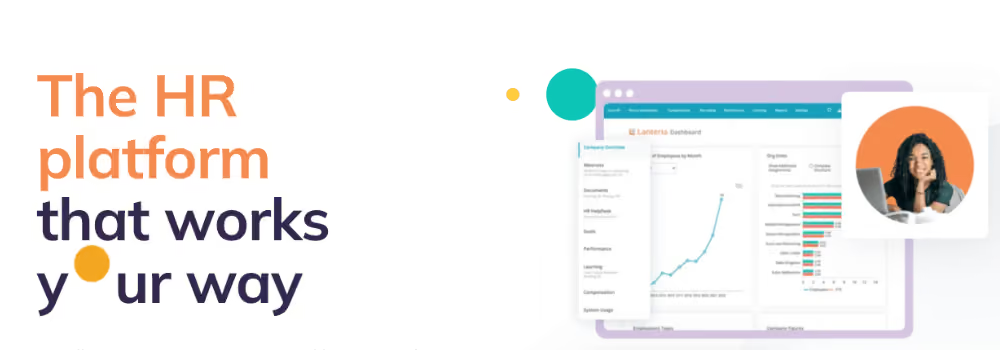






















































%20-%20thumbnail.avif)





%20-%20thumbnail.avif)


%20-%20thumbnail.avif)

.avif)




%20-%20thumbnail.avif)