Host: Ryan Sullivan launched a new career in his late 40s. The self described risk averse entrepreneur is acquiring small legacy manufacturing businesses across the US and it's going well. His first acquisition was a hundred year old electrical component manufacturer in Wichita, Kansas doing about $700,000 in adjusted EBITDA. He bought it alongside a partner who took a little apartment in Wichita and flew back and forth during the transition. Two years later they've bought three more businesses, have another under loi, and have expanded to five partners. We spend a lot of time on Ryan's model here, which has some key elements. He raises money from investors to buy these businesses, but he does it deal by dealing with, not as a fund. His investors get returns from the acquired business's cash flows as opposed to the more traditional PE model where liquidity occurs when they then exit those businesses themselves. He's a long term holder of these businesses. Decades is the plan. He uses SBA loans and personal guarantees for each acquisition, which is why his group has expanded to five partners. But despite those loans and PGSOR better said because of he's conservative with debt. The debt equity ratios and the acquisitions are low. They're structured such that an acquired business's revenues could decline by half and the deal would still survive. This interview pulls back the curtain on a serial acquirer that's not quite a holdco, not traditional private equity and not a rollup. I appreciate this because it feels like Ryan and his partners didn't just copy the existing models out there. Instead, they worked from first principles to arrive at a model that aligns incentives and generates compelling economics even while being conservative with respect to debt and risk. Enjoy this interview with Ryan Sullivan, managing director of NorthPark Group. Announcements next Thursday, August 29th. Attorneys James David Williams and Bill Barlow, whose entire practice is devoted to business acquisition, return for legal office hours, a webinar this month's topic is the main legal diligence issues that arise during a transaction. There are over 10 very specific issues that James, David and Bill see time and again when working with entrepreneurs buying businesses, and they're going to walk us through how to handle those issues. As always, there will be ample time to answer all legal questions related to buying a business, not just those related to legal diligence. So come get any legal question you have about your deal or your target or your search answered by James, David and Bill next Thursday, August 29, noon Eastern. Link to register for the webinar is right at the top of this episode's show. Notes. Welcome to Acquiring Minds, a podcast about buying businesses. My name is Will Smith. Acquiring an existing business is an awesome opportunity for many entrepreneurs and on this podcast I talk to the people who do it. What do the following Acquiring Minds guests all have in common? Doug Johns, Morley Desai, Tim Erickson, Chirag Shah, Shane Ursam. They all went through the Acquisition Lab, the accelerator in community for people serious about buying a business. But they represent just a sliver of the Lab's success stories. The number of deals across the Lab's cohorts now stands at over 120, with over $300 million in aggregate transaction value. The Acquisition Lab was founded by Walker Deibel, author of Buy Then Build, the book that introduced so many of you to the very idea of buying a business. The Lab offers a month long, intensive, almost daily Q and A sessions with advisors, live deal reviews with Walker, deal team introductions, and an active community of serious searchers. Check out acquisitionlab.com or link in the notes or email the Lab's co founder, Chelsea wood. Chelsea buy, then build.com Ryan Sullivan, welcome to Acquiring Minds.
[4:44] Guest: Thanks. Thanks for having me.
Host: Will Ryan, you are buying manufacturing businesses here in the US you are working with investors to do so, but you haven't raised a fund. So this is deal by dealing with Correct. You're leveraging SBA loans and personal guarantees and operating partners to assemble this portfolio. So there's a lot to your model and we're going to get in the weeds. But first we're going to hear your story, how you got here and the story of a couple of those acquisitions.
Guest: Sure.
Host: So start us off please with some background on you. Ryan.
Guest: Yeah, sure. So I guess as I tell everybody, I was born an engineer, went to school for engineering, spent my whole career in manufacturing businesses, lots of different industries, nuclear power plants for the Navy, telecoms, building products, industrial products. But the common theme for my whole career was basically manufacturing businesses, got into buying businesses when I took a role running a portfolio company that started out as a, as a public company, had about five companies in it. I was there for about four years and we did great. We acquired six small US based manufacturing businesses, divested one that the company had held for a long time, was very successful there, and then decided to kind of spin out of there and keep the strategy going, but this time kind of do it for myself and my friends and my network instead of doing it for somebody else. So we formed North Park Group in December of 2021 and since then we've acquired four businesses and we should close on our fifth here the first week of August. So So far, so good over the last two plus years.
[6:30] Host: Beautiful, Ryan, thanks. A couple follow ups. So you were working for a larger business that you helped take private, and that business was something of a holding company or it just did acquisition. It was a holding company.
Guest: Yeah, it was a holding company, majority owned by a family. They had owned it for 60, 70 years and hadn't done much with the portfolio. Brought me in to kind of bring the portfolio back to life. And that's kind of what kicked off the acquisition strategy at that point. So up until that point, they hadn't really bought many businesses.
Host: And just give us a sense of the size of that either. The portfolio and also the acquisitions that you did, you called them small, but maybe small for them is different than small for us. So give us a sense of scale here.
Guest: Yeah, it was about 150 million in revenue when I joined. And the acquisitions are very similar to the ones I was doing now. Typically between 500,000, 2 million of EBITDA. So kind of lower, lower middle market. So very similar strategy. When I joined the portfolio, it was not in the best financial health. So we had to go find acquisitions that we could put cash into and get kind of an immediate return. So we weren't in a position where we could pay high multiples or wait four to five years to get a good return on our cash. We were, the portfolio was in a position where it needed to get a good cash return right away. So that's kind of what led me to the strategy of buying, you know, I don't know what the right term is. Lower, lower middle market businesses, you know, 500,000, 2 million of EBITDA, you can typically buy those pretty well, but a lot of them are kind of too large for a lot of solo operators to buy. So that strategy worked very well for that holding company. And that's kind of the strategy we deploy now inside of North Park Group.
Host: Well, listeners who are many of them solo searchers and business buyers are going to disagree with your comment that those are, those are too big, too big for an individual to buy. Also, your characterization of needing to, you know, make investments, buy businesses that generated a return quickly. Well, that's, you know, that's the criterion we all have. We'd all like to invest our capital and start seeing, start seeing it throw off cash as quickly as possible. So you'll, you'll have to tell us what you learned and how you found those and how you found them now for yourself.
Guest: Perfect.
[9:02] Host: Okay, great. And then talk a little bit about
Guest: the
Host: personal, emotional intellectual decision to do this for yourself, was it just. Yeah. Tell us, tell us what you can there.
Guest: I got to give the credit to one of our partners, Greg Topol. He's the one that kind of talked me into it. I mean, I had, I had enough net worth that I thought I could go out and buy kind of one to two good sized companies. Right. So I was looking to put 2 to 3 million dollars to work in acquiring companies as far as an equity position. So that plus, plus debt, I figured I could buy a good sized company. I'm a big believer in diversification, so I'd rather buy six to 10 companies and be diversified in my private company portfolio instead of putting all my funds into one business. And Greg was really the one that kind of convinced me that we could go out and actually bring in partners and investors so that our capital then could, could go further and acquiring more businesses. So Greg's really the one that convinced me to do that and to kind of hang our own shingle and do the own strategy. It is very different. I spent my whole career in corporate America. You get a paycheck every two weeks and maybe you get an annual bonus, maybe you have stock options, you know, but it's very different when you go out on your own. You hang your own shingle. And even with outside investors, most of those investors are people from my personal network, people I know, you know, friends, family, college buddies, people from my professional network. So taking that investor money is a lot more personal than, say, investors in a public company. You know, you're going to see these people at Thanksgiving and Christmas and every time you go home. So you probably lose a lot more sleep when you take private money than when you take public money.
Host: Sure.
Guest: True.
Host: Especially, yeah. When it's friends and family. Of course. Ryan, what will become clear to the listeners and I already know about you, is interesting. You're, you're, you know, you're a good example of how entrepreneurs have the reputation for being, you know, swashbuckling risk takers. But, but in fact, good entrepreneurs are often risk mitigators. And so here you are doing this entrepreneurial thing, but you're actually doing it quite conservatively. And we're going to, as I said, we'll get into the model and how, how you, you know, your debt ratios, etc. How you're doing this conservatively and you're really attentive to risk and mitigating it. So while you're doing something entrepreneurial and maybe you have some sleepless nights, you're also Very, very tuned attuned to, to managing risk.
Guest: Very, very risk averse. Yeah, most people would know me and know my personality. I'm an engineer. Right. Lot of calculations, you do a lot of math. But we take a very conservative approach. But a conservative approach that gives us also very good returns, especially for the risk profile that we plan.
[12:07] Host: Yeah, exactly. Well, that's what you want, right? Low risk and nice returns.
Guest: Yep.
Host: And also, Ryan, I mean, just, you should just take a little bit of credit too, in terms of how your own risk appetite. You did choose to do this, whereas most people at this stage in their career would not have stepped out at all. So you're maybe, you're maybe not as risk averse as you, as you tell yourself, by the way, I heard the number 2 to 3 million of your own balance sheet wealth that you were prepared to go out, buy and buy a company with. So given that you're risk averse, I assume that wasn't your entire net worth. So your net worth is just, and this is always important for context as people hear these stories and imagine themselves in the shoes of the. Or trying to do what the guest has done. Your net worth was pretty good at this point, probably significantly above 2 or 3 million when you started doing this.
Guest: Yeah, I was not putting to work 90% of my net worth. I was putting together, putting to work a good chunk of it. But obviously again, I'm a little risk, risk averse. So I would not want to put 90% of it to work, especially not in what to me was a new strategy, even though we'd been doing it for, for five or six years. You know, at this point, I've participated In acquiring over 20 companies just under different investment portfolios. So it's, we have a good track record. But yeah, I was still only putting to work, you know, less than 50% of my net worth.
Host: And just to repeat and get clear on what you said your initial thought was, was that you would go out as essentially a sole individual business buyer and buy a single, maybe two businesses with 2 or 3 million bucks. That would get you a 8 or $10 million business. But this partner of yours who's now in the group with you, say his name again, please.
Guest: Yeah, Greg Topol.
Host: Greg said to you, let's accelerate this or compact or amplify this with other people's money and do a diversified strategy. So less risk, bigger numbers also sounds good. Thank you, Greg.
Guest: It does sound good. Thank you, Greg. And Greg had fundraised before. I mean, the hard part about getting Investors is understanding the structure and really just having the faith that someone's willing to give you money for what you believe in and your approach to something. I suffer from imposter syndrome and a ton of self doubt and self loathing like, like most people, I think, in life. And so the idea that investors and people in my network are going to give me money because they believed in me was just something I could not wrap my head around even with, you know, a very good career and a very good track record. And, you know, at this point, we've put to work, I think, about 14 million in equity across the four businesses. So we've taken, you know, a good bit of investor money combined with the money from, you know, North Park Group Partners. So it's, it's a significant amount of funds at this point. And it still kind of makes me shake my head that people have believed in us that much.
[15:23] Host: What did Greg say to convince you that this, this isn't weird? People do this? People raise money?
Guest: Yeah, he had actually raised money for a startup which, you know, again, as an engineer and a very conservative person, the idea of investing money in a, in a, in a company that doesn't have a product yet and doesn't have a revenue source yet, like, you know, I know, I understand people do it all the time and I have a lot of friends that do VC work all the time. I, I understand the model. It's just not something I would never, never do. And he raised, you know, five to $10 million for a startup. And I was like, well, if you could raise money for a startup, we could probably raise money for a good business that's been around for 80 years and has always made money. Right. I mean, if people are willing to put money into something that doesn't even exist yet, they should be willing to invest in a company that's made it 80 years and through all the ups and downs and always generated money. And it seemed very logical and it worked out. Our first one had about 1.8 million of equity in the deal and we raised it in, you know, about 30 days.
Host: Well, not only are the targets, do the targets feel more sound than just investing into a concept Silicon Valley style? Also the sponsor, namely you as a guy with a track record and doing exactly this. So you could point to. Point to a track record.
Guest: Yeah, I mean, we buy businesses that, you know, we're all operators and I think that's, you know, you know, when you look at private equity funds or you look at a lot of the larger players in Private equity. I mean we are business operators. Everyone inside of North Park Group has spent their whole career in manufacturing businesses, you know, doing, doing real work. And, and so, you know, I think that gives us a lot of credibility and that gives us our track record. But we also stay in our lane. We buy companies that are very similar to the ones that we've all participated in for the last 20 or 30 years, which I guess means I'm, I'm dating myself. But you know, they, they all end up looking, feeling and tasting very, very similar even though they're making very different products for very different industries and very different customers. I never buy a business where I don't feel like I could run every machine and make the parts if I had to. And so again, that's part of me being kind of risk averse. I often joke and say at this point I'm too old to learn new things, so I just stick at what I apparently am good at.
Host: Well, that, that has echoes of Vista. The private equity group had the famous line. Software businesses all taste like chicken, right? So they, they may be doing different things but fundamentally have the same characteristics. You said basically the same about manufacturing and you also said 20, 30 years, Ryan. So tell people how old you were when you started on this path. On the path to do your own, step out on your own.
[18:14] Guest: Oh yeah, well, we formed it in December of 2021. So a little over two years ago. I'm 50 now. I turned 51 in August, so I was probably 48, 49.
Host: A peo run by a searcher for searchers. If you're running a company with less than 100 employees in providing health insurance, you could secure better benefit plans at a 15 to 30% discount through a professional employer organization or PEO. Aspen HR run by search fund veteran Mark Sinatra understands the needs of search operators and could be a great solution for you to receive HR compliance and diligence support, a powerful HR tech platform and Fortune 500 caliber benefits, all for a fraction of the cost. Check out aspenhr.com or contact Mark directly@markspenhr.com so take us back to the story. Then you decide to do this. You have a conversation with Greg about that causes your strategy to shift a little bit. You're going to raise money and buy a portfolio of businesses over time as opposed to buying a single business. Getting there in there as owner, operator. Carry on. What's it look like as you actually set about to do so?
Guest: Yeah, I mean, I guess we were lucky Gregory had actually been working as our Buy side broker when I was at my previous portfolio. So we understood how to go look for companies and find companies and negotiate deals. I mean at that point we had done, you know, 10 deals, say. So we weren't starting from, you know, a blank piece of paper. We got our first one under LOI pretty quick, which was Electron, based in Wichita, Kansas. We closed that one on May 1st of 2022. So it really only took us five or six months to get the first one closed after we actually form North Park Group.
Host: Great. Called Electron.
Guest: Yeah, Electron. They make terminal blocks, terminal boards, so electrical components that are going into H vac and appliances, things like that.
Host: Okay, well tell us more. Tell us, tell us why you liked Electron numbers about electron, age, etc.
Guest: Yep.
Host: Let's get into the story of this, this first acquisition. Yeah.
Guest: And all of them end up kind of looking and feeling the same. You know, Electron's a great company, been around for basically 100 years making different products over those hundred years. Was owned by two sellers who had previously been employees who had bought it out from the previous owner, which again was private, had reached retirement age, didn't have family in the business, were looking to transition their business but wanted to do it in a way that was good for employees, maintain the legacy. They wanted to sell to somebody who was going to keep the business there, not roll it up into a larger corporation or a larger strategic entity. They didn't really want to sell it to somebody who was going to turn around and try to sell it again in five years. Right. So that kind of rules out private equity. It rules out selling to strategics. And that's, that's where we play. We like US based manufacturing, we like, you know, small to mid sized companies. We like the 100 year legacy. And so we got, they had a sell side broker. We got introduced, you know, went through the work and eventually got it under loi. We typically buy the business and the real estate. We tend to view the real estate as a good investment. If you're going to own a business for 20 years, you might as well own the real estate as well. But also it's a big, it's an emotional thing I think in buying the real estate. When you tell employees that you've bought the real estate, employees know that you're there to stay. They know you're not going to move the business. They know that you're really planning on owning, owning the business for a long time. It also helps the sellers. The sellers then get a full liquidity event. They didn't really want to be. You know, they're going into retirement. They didn't really want to be landlords for the next 15 years and try to have to figure out what to do with the property in 15 years. So they liked a full clean exit. And at this point we've bought buildings for all four of the businesses that we have in the portfolio. So great business. You know, I was in Wichita, Kansas, so Greg and I traveled a lot. Greg spent almost a year down in Wichita, Kansas, flying back and forth to Chicago. He rented a nice little two bedroom apartment. We had two mattresses on the ground, no real furniture on the apartments, some folding tables to eat at. It was very much kind of bootstrap. I mean, these are small businesses. It was maybe 500,000 in EBITDA when we bought it. You know, you can't spend a lot of money flying down and staying in hotels with a $500,000 EBITDA business. So we bootstrapped it and it was, you know, it was, it was a good solid business that always made money and it lived through all the downturns, you know, 911 housing market crash Covid. It survived all of those. And we jokingly tell everybody our strategy in year one is just don't mess it up. You're taking over what has historically been a good business. It's a profitable cash generating business. It's been around for 100 years. We're not the smartest people in the room. Don't, don't get itchy and mess it up in year one. Just go in and learn. Learn from the people that have been running the business for 20 or 30 years. Learn the industry, learn the manufacturing and then you can start to make changes. And that model is basically what we play out kind of over and over. And Electron has been very successful. It's probably 700,000 in EBITDA now with a full new management team in place. You know, that's a lot more capable than probably the historical resources inside the business. It's growing, it's improved its margins, it's improved its manufacturing efficiency. And you know, if you envision a, a business that maybe has been under loved for 20 years, you know, we go in and we're painting walls and painting machines and stripping machines down and rebuilding them and trying to take a business that maybe looks like it's in year 2000 and bring it up to 2020 at least with elbow grease and love and care. You know, we bought Neverleak in Mississippi and the weekend after we bought it, you know, we went in and, you know, scrubbed all the bathrooms that honestly looked like they hadn't been cleaned in a while. And our wives painted the break rooms and printed, painted the restrooms and painted the entryway. And when employees walked in on, you know, the Monday after we bought the business, they're like, you know, whoa, this place looks better. You know, and, and we do that because we love that.
[25:21] Host: Ryan, let me, let me stop you. I mean, I want to get into that, but I have a bunch of follow up questions just to your Electron deal. Who was the founding partners? Five of you or you and Greg?
Guest: Greg and I were the founding partners. Greg ran Electron, I ran Phoenix. The second one that we bought in August of 2022. At this point, we've hired somebody to run the Electron business and he's now a partner inside of North Park Group. And then as we acquire businesses, we tend to bring in partners. It's kind of your typical operating partner model. It's, you know, somebody who's looking to acquire a business, maybe take a personal guarantee, is looking to run a manufacturing business and we partner with them because obviously as we scale, I can't and Greg can't day to day run four or five businesses. We need more partners to do it.
Host: But, and I want to get, I want to spend some time on that model, Ryan. So, so can we just put a pin in, in the operating partner? Because that's going to be very interesting to people.
Guest: Sure.
Host: I just want to make sure we leave some of that kind of the technical workings of the, of what you're doing to the end or to the second half. Just a point about real estate that also of course gives you better amortization schedules generally. So yeah, it makes the loans less, less heavy.
Guest: Yeah, We've typically done five or four loans, so seven on the business and 504. We haven't blended them. And so on the real estate, we're doing 25 year amortization. I know some people have blended them. We just haven't done that yet with our banking partners. So we typically have a 10 year 7 line on the business and a 504 for the real estate.
Host: Okay. In any reason that you haven't planted them?
[27:02] Guest: No, just free cash flows where we thought we could get the interest rates better over the long term. And since we're going to own the business for 20 years, I like the idea of always having debtor leverage on the business for a longer term. So if we blended them and pulled that in, in theory, it would just speed up the time at which we'd have to kind of recap or put a new debt structure in place to maintain some sort of leverage in the business.
Host: Okay. All right. Well, just to be clear for what I said about to the audit just now for the audience, if you don't blend the real estate and business acquisition together, then the eMory, they're two separate loans, as you said, a 504 and a 7A. And so it actually doesn't help your business loan payments.
Guest: So scratch that.
Host: If you're not doing a blending approach. The preferred. So you're a kind of a preferred seller or you worry, excuse me, a preferred buyer from the seller's perspective, the sellers at Electron and you said a lot of things that are going to be familiar to listeners that they didn't want to sell to a strategic. They didn't want to sell to a larger corporation. They didn't want to sell to traditional private equity who's going to turn the business around in five or seven years. They wanted to keep it basic, keep things the same, keep it local, keep it there legacy protected. So, so these are things that this audience will understand and know well. And in fact it's often a value their own listeners value proposition as they go into the market trying to buy a business. They're typically going to be that sort of buyer. And so a lot of, a lot of sellers that you hear about on acquiring minds were looking for such a buyer. But there's a little bit of survivorship bias. I'm talking to the very people who fit that profile. And so therefore they buy the businesses where sellers wanted such a person. But because you have a bit of a bigger aperture there because you, you came from the, you know, your previous life doing this as well. Is it hard to find such sellers that want exactly that or do most sellers want that or how can you give us a sense of a better sense of how sellers of legacy businesses like this think in the aggregate? Because, because if you listen to acquiring minds, you might think, oh, they all just want buyers like, you know, like you Ryan, or like, like my listeners. When in fact the reality is probably that most sellers are perfectly happy to sell to the big, the highest bidder, meaning, you know, a strategic or private equity. So respond to that, please.
Guest: Yeah, I think a good way of looking at it is the, the ratios. Right. I think the, the thing that a lot of people don't understand is how many companies you have to look at and talk to to get to that one that actually closes and, and works well. Right. And you know, our normal Ratio is probably looking at a hundred companies to get to kind of one loi. So just by definition, there's a lot of companies we don't want to buy and we don't want to partner with. And the companies I acquire, I acquire because there's a relationship with the sellers and we view the world in a similar way. I mean, buying a business is hard, it's emotional, it's risky, it's stressful for the sellers, it's stressful for the buyers. There's a lot of drama. And you're with these people for a year or two whether you like it or not, to getting to loi and then loi plus transition, you have to like each other. You have to be able to have conflict and get through that. So I'm too old to do business with people I don't like and who don't view the world kind of the way I do. And so we just walk away from those deals. You know, they're not bad companies, they're just not a good partner for us. So there's definitely a lot of people out there that just want to sell for the highest number. There's nothing wrong with that. There's a lot of people out there who, you know, have very different goals in transitioning their business. Some people want to transition and stay in. Right? I mean that's kind of your typical private equity model. I want to sell, take some chips off the table, but I want to keep 20% ownership. And we're typically buying from people who want to go into retirement and want a full clean exit. So all those models are out there and all those models are good models, they're just different. There's nothing right or wrong with any of them. And so we gravitate towards those buyers where we're kind of aligned in how we view U S manufacturing and what we'd like to do with the company for the next 10 to 20 years.
[31:27] Host: Okay, and then let's talk size. So half a million bucks in earnings is not a lot. We would consider that small and we would consider that below the, you know, the, you know, quote unquote ideal threshold of earnings for it. For a self funded searcher, call it 800 and above the. And I won't listeners, regular listeners will, will know all about that. So how did you think about size and why were you comfortable with something so small? I. Is it because your own balance sheet, you could kind of live off savings for a while, you and Greg, or because you had a bigger vision? So this was just going to be one among many or what?
Guest: Yeah, I guess a few things. I mean, not all $500,000 EBITDA businesses are the same. Right. So we typically look for businesses that have more than 30 people in them. So we're looking for a certain organizational scale that means that the sellers are not doing 80% of the work that de risks it for us. We typically are looking for where we can buy the real estate that de risks it for us. We're looking for a business that has always been cash positive. So we don't really do distressed assets or turnaround arounds. And even through Covid, we're looking for people that, that generated free cash flow. And then our structure and the purchase is pretty conservative. We're not, you know, doing a 1090 SBA loan. We're way closer to 50, 50 debt to equity. And therefore that risk you have at a $500,000 business, you know, where the, the dollars are small and the percentages are big type of thing we did, we just de risk that. By the way, our cap table, basically by the structure that we, the way we structure deals. And so we tend to find, you know, as long as we like the business and we like the industry and there's no customer concentration and the organization's got enough scale and we understand the assets and the manufacturing, you know, there's as much opportunity, if not more at a $500,000 business. And sometimes there is at a $2 million business. You know, we're typically looking for a business that, you know, it looks like it's aged by 20 years. And that just tells us that there's a lot that we can bring to the table to help bring that business back to life or re energize it. And that often is where we kind of generate our returns. It's a lot of blocking and tackling, but it enables us to feel comfortable at that dollar value.
[33:54] Host: Well, $500,000 in earnings, you know, that just, that doesn't go very far if you're going to be reinvesting into the business and you've got a bunch of partners and LPs.
Guest: Yeah. And it's important to say, typically for us, it's $500,000 of EBITDA, not seller discretionary earnings. So there's, there's a big, there's a big difference there. Right. I mean, a lot of, a lot of, you know, search for individual buyers are looking at sd, which is often very, very different than ebitda, with a market rate for the operator running the business included in that Right. So that really takes on an SDE perspective. Our 500 is probably closer to 700 from an SDE perspective. So that is important. You gotta, you gotta make sure. And then there's enough organization there that, you know, there's enough sgna spend that there's some real capability in the organization, you know, so the revenue amount or the money inside the organization that you have to reallocate or reapply is important to us when we look at a deal. Of course, that being said, we bought Neverleak and it has 10 employees, so there's, there's an exception to every filter that we use for our businesses. So. And Never League is a fantastic, fantastic little company. So.
Host: Well, of course we've heard criteria around having a management layer or not or having an operator or not, but I'm not sure I've heard criteria in terms of the number of people at the organization and the 30 people are above. And I know that that's probably just a very approximate proxy for management or, you know, for processes and so on.
Guest: Even operators on the floor. Right. I've looked at businesses where the owner is the one doing machine setups and then somebody else is operating the machine and you're like, well, well, okay, that's, that's, that's, that's an owner that's really down in the weeds. Right. They're not just kind of running the books and doing sales. If you're doing machine setups as an, as an owner, that's a very different organization than if they have somebody else that's doing machine setups. That's not, that's not the owner. Right. So that, that 30 person thing covers an awful lot of the institutional knowledge. And you know, a lot of these businesses don't have policies and procedures and work instructions. Right. So it's, you're looking for where's all the knowledge in the organization sit? And I tend to think when you get over 30 people, there's a lot more knowledge in the organization than just with the seller. And so that de risks it for us because the seller is going into retirement. I mean, yeah, they might stay with us for six months or a year and they might try to teach us everything. But you can't teach 20 years or 30 years and six to 12 months. Right. And so the more people in the organization, the more true knowledge there is in the organization and not just in the seller.
[36:43] Host: Yeah, yeah, it's well, well put. Great, great point. And then in terms of your strategy, when you buy, you don't screw it up for a year. But it sounds like you are more than willing to very quickly make literal cosmetic changes, painting the walls and such. So what's your line there between the changes you'll make painting walls and the changes you won't make for a year, which is probably, you know, processes, etc. What's the, is there a bright red line there? Because that, that's kind of the art of the transition, what to change.
Guest: And when it is, I mean, it's, it's definitely not a bright red line. It's more of like shades of gray. You know, we, we, we love to bring confidence and comfort to employees when we buy a business, right. So we put in a retention bonus for two years for all employees that stick with us for two years after an acquisition. That's a way of acknowledging to employees, hey, it's, it's scary when you're. The business you work in and maybe have worked in for 10 or 20 years gets sold to someone new. Right? Like, that's just as scary for employees as it is for a seller. We try to do a lot of things to, to bring comfort to those employees and have that transition be good for them, not just be good for the sellers. Right. So sprucing up the facility, you know, throwing a party on the day that we close, painting the walls. I mean, all that stuff is assigned to employees that, hey, wait a minute, maybe this transition is actually good for me as, as much as it is good for the sellers. This is great. They get to transition and go into retirement. They've worked a long time. They've. They provided this business that's provided food and, and, you know, shelter to, from my family that I've, you know, I've worked in this business for 10 to 15 years. They're happy for the sellers, but they also want to know that it's going to be good for them. It's not going to be bad for them. So we do a lot to try to make sure that employees realize that we want this to be good for them because employers are what makes companies good, makes companies great. That's what's enabled these companies to be around for 100 years. So that's why we do a lot of that stuff. And there's, there's no hard red line. I mean, we've bought a business and taken price increases the next week because we had to. There's other businesses where we don't touch price for a year until we really feel like we understand the market and understand competitors. You know, there's, there's always some stuff in business that you just go, hey, we've, we've got to do this. But because we're planning on owning a business for 20 or 30 years, because we've taken a very low risk approach to our capital structure or how we fund deals, we can be patient. So it's the true definition of kind of patient capital. It's a good business. Don't mess it up. If, if we have paid a fair, good multiple or, you know, dollar amount for a business and we're buying, say a $500,000 EBITDA business, what we need to be successful in year one is for it to be a $500,000 EBITDA business. We don't need, need it to be a million or million and a half in the first year to generate a good return so we can take our time and that enables us to make better decisions when we make a decision. I think we've reinvested capital into Electron. We've bought a new machine for them. We've done a lot of TLC maintenance in the equipment, we've hired new people, We've, you know, promoted people. Right. We've done all those things in the first year of a business. We just try to do it with, with softer gloves. And a lot of other groups out there that are acquiring businesses.
[40:22] Host: Well, just one little detail there where you said, you know, because we're patient with our capital, we don't need it to be get to a million dollars or a million and a half dollars in earnings in the first year. Actually, according to your model, which we'll get to. You don't really need it to get to, for, for your numbers to pencil and for you to deliver to the return that you are offering to your investors. You don't need to get for it to double earnings or triple earnings ever. As long as it's kind of keeping up with gdp, the returns will be there. So keep teasing. I keep teasing. The model of North Park. We're gonna, and we're gonna get there. Not yet. Okay. And so, so great. Anything more to say about Electron before we move to your second acquisition?
Guest: No, it's great. Phoenix Electric was our second acquisition, based in Chicago, Illinois. Again, two brothers that had taken it over from their father were ready to retire, had a few offers from a strategic. They were probably going to move the business. Didn't really want to do that. I had actually talked to them two or three years earlier when I was at a different portfolio. And so when they finally decided to sell the business, they Called me back. So sometimes finding these businesses is a very long burn cycle. You talk, you talk to somebody this year and they might call you back in, in three years and say, hey, now I'm interested in selling. You know, so great brothers really cared about what happened to the business and the people afterwards. We weren't able to buy the real estate right away on that one. It was manufacturing business located right next to Wrigley Field, which is maybe not the best place for a small manufacturing business, but. Cool, very cool. Yeah, nice to walk to a game and all that kind of stuff. But the, the best use for the real estate was obviously, you know, retail and condos and stuff like that. And the family, the, the brothers did own the real estate. And I'm like, well, this manufacturing business doesn't support the purchase price of that real estate. So we knew when we bought that business we'd have to move it. We've now bought a building in Chicago, move the business and retained 100% of the employees in that move, which is exceeded my wildest dreams. I mean, I think even if you move a business two miles, lots of times you risk losing somebody. Sure, we moved about six miles and you know, we had mapped all the employees. We put a lot of work into giving us the best chance of retaining all the employees. But 100 of them came over in the move, which was, which was fantastic. Now we own the real estate, gave us a little bit more space, much newer, fresher building, brand new break rooms and all that kind of good stuff. So we again, we got that kind of lift for the employees. Very similar business, higher EBITDA. We bought it, it was probably 1.7 million in EBITDA. 30 ish employees, very high profit margins, you know, both gross profit and EBITDA margins. But again, kind of look like a business that operated in year 2000. Lots of paper, lots of, you know, manual processes. And so we've been doing the work to freshen up that business and you know, get it SEO and marketing and some outreach instead of just waiting for the phone to ring. And that business has been going well, but both of the businesses that we have run like 20 annualized returns for investors. So so far so good in, you know, two years.
[43:55] Host: Yeah, just on the paper, a lot of paper moving around in digitizing a business like that, that for the employees, while that is the low hanging fruit and that is the pattern that you see over and over and over again in our world world that for employees is a major change when you.
Guest: Very scary, very, very scary Right.
Host: So I imagine swapping out the paper and in the cloud is something you do delicately.
Guest: Oh, very, very delicately. And a lot of it on the shop floor. We haven't changed yet. Right. So like we bought the business, you couldn't get into the ERP unless you were on site. Right. So now we can get into the ERP remotely, but the process out on the shop floor is exactly the same. They're still working with Travelers and paper and stuff like that. So we've enabled our management and oversight of the business and our ability to participate in the business maybe without being on site during the day. And we've improved a lot of the accounting procedures, we've improved purchasing things that impacted a lot less of the employees. And we haven't done some of the other stuff that's a lot scarier on the shop floor until we get the infrastructure. Right. And you know, we've owned that business since August of 2022. So we're coming up on two years. And you know, then again, and I think we've retained, you know, all the employees over those two years as well, which is fantastic.
[45:24] Host: Okay, so those are the first two acquisitions. At this point. You are at call it 2.2, 2.3 in EBITDA. So we've got true, true EBITDA. And I don't think you said what the revenue of these businesses is. So what, what is aggregate revenue at this point in the story or for each of them?
Guest: Oh, for Electron, when we bought it was probably about 8 million in revenue. And Phoenix Electric, when we, we bought it was 5 million in revenue. So pretty small, but high, high profit margin on Phoenix.
Host: Wow. Phoenix just keeps looking better and better. 1.7. A lot more. A lot more EBITDA, same number of people and a lot less revenue. So very profitable.
Guest: Yeah, very, very profitable. Less opportunity, right? I mean, did you tell us what it does?
Host: Sorry, did I miss that?
Guest: No, sorry, I didn't. Phoenix. Phoenix Electric makes brush holders that go inside of DC Motors to hold the carbon brushes inside a DC motor. So very, very niche manufacturing. They're probably the only manufacturer in the United States that makes them for, for DC Motors. So high market share, very niche product, kind of low production, runs a lot of custom runs. Each, each one of these holders is customized for a particular type of motor from a motor manufacturer. But, but less opportunity in a business like that. When, if you walk through Phoenix Electric, you wouldn't say, oh geez, I can double this business. Whereas when you walk through Electron, you'd say, oh, I could Double this business in revenue, or I could double this business in profitability. So Phoenix is a bit different from that perspective. Still a great business, great people, a great purchase, but a little bit of a different model when you look at it.
Host: And, and, and why did it have less growth potential? Because it's already, it already dominated its market.
Guest: It's. And, yeah, very high market share. And then when you have that very high ebitda, you think, well, there's are. They're already driving an awful lot of efficiency. There's not a lot of waste inside of that business. So it's just a different model. The brothers that owned it did a very, very good job running it. Alex, who is a general manager, president, he was there. It was actually his first job when he came to the United States when he was 18, was at Phoenix Electric. And he now runs the business for us. So he's been there for, for a long time. I won't date Alex, I guess, but, you know, they've done a very good job running that business. And so it's just a diff. Different little bit of a different model.
Host: Okay, so Electron, Phoenix, by the way, nice brands. I like that. I like these, these names.
[48:04] Guest: Yeah.
Host: So take us quickly through just the other two and because I want to turn now to how you're, how you're structuring all of this.
Guest: It was interesting, right? We closed Electron in May of 22. We closed Phoenix August 1st of 22. It seems like we're rolling, everything's great. And then basically we went a year plus not winning any deals. I was bidding on a lot of stuff. I was looking hard, you know, and so we kind of came out of the gate and bought two companies back to back. And I was like, yeah, this is great. And then we hit the, you know, the trough and, you know, all the doubt set in. And I said, oh, geez, now we're just going to end up with two small companies. And what have I gotten ourselves into? Once you buy them, you can't really get out like, oh, you know. So there was a lot of stress maybe towards the end of 2023 when we hadn't bought another business in, in over a year. And the thing I just kept telling myself, I kept telling investors was there's nothing more important than buying well, like, like, you know, it's not about buying. It's not about just winning a deal. It's about buying a good company and the right company or the right fit and the right people. And I lost a good bit of bids, probably by, you know, fifty thousand dollars, hundred thousand dollars, two hundred thousand dollars. I mean, not a lot in purchase price when you're determining winning or losing. And, you know, my. My wife Nicole, actually was the one that probably helped me the most keep my head on my shoulders, just saying, like, just relax. It'll come. And then In November of 2023, in one week, we signed two. Lois, back to back. And so then I had the opposite problem. I was like, what did I just do? Now I got to close two businesses in 30 days. And that's a whole different level of stress, especially going into the holidays. Now you're trying to do diligence over the holidays. And two businesses. And so we closed Dickey Manufacturing, which is located in St. Charles, Illinois, in March of 2024. They make security seals that go on shipping containers, food transportation, U.S. post, postal service. And we bought Neverleak, which is a company in Mississippi, right across the border from Memphis, in April of 2024. So 30 days apart. And with both of those, we bought the business and the real estate.
Host: What's NeverLeak do?
Guest: NeverLeak makes flashings that go over pipe penetrations on roofs. So if you look up at your house and you got a sloped roof and you got pipes coming up, they make the flashing that goes over that pipe to make sure that it doesn't leak into your house.
Host: Okay. Flashing is the name.
Guest: Flashings. Yep, yep.
Host: Flashings.
Guest: Flashings.
Host: Never heard that word in my life. Thank you. Okay, and what rough size of these businesses? You've already told us that Never Leak was a small one. But could you give us numbers on both?
Guest: Sure. Dicky is. Oh, geez, you're testing me. 6 million? Yeah, 6 million in sales. About 500,000 in EBITDA. So again, on the the small side, Neverleak is probably 8 million in sales and closer to a million and a half in EBITDA. And Neverleak only has 10 employees. So there's. There's an exception to every filter you use in searching for a business. Great little business, you know, both of them, again, were owned by people for 30 years that worked in the business, either had pretty purchased the business from the previous sellers or neverleaks case had taken over from her, her father and were looking to go into retirement and transition the business and wanted to do so where the employees were, you know, probably at the forefront of their minds in that transition.
[51:49] Host: So to that point, not strategics, not people who are any group, private equity group or corporate that's going to move or do what they can to start cost cutting, etc.
Guest: Yeah.
Host: Okay.
Guest: And you know, I think the thing that helps us a lot is, you know, I've, I've run manufacturing businesses a lot. I've spent a lot of time running machines and working with our hourly operators and, and when you sit down with a seller who has understands what it's like to run a small business for 20 years and then you talk to them and they understand that you understand what it's actually going to take to run that small business that helps us a lot when we're buying.
Host: And what is it going to take? What do they see in you? Yeah, you can bullet point your resume, but is there more for the people who are listening who don't have that experience and are going to need to compensate some way for not having it?
Guest: Yeah, I think it's, it's a level of credibility that they trust that I understand what I'm getting into, which also means that they trust that the transaction will close. I mean, so we've, we've closed every loi we've ever signed and we've never retraded on an loi. And I, I tell people that all the time. We do a lot of work before loi, probably a lot more than other people do before an loi. But it, I view, you know, all the negotiations done when you sign the loi, it's just about doing the work to close the transaction. And so our close rate on Lois is 100%. We don't retrade, we do what we say we're going to do. And, and that brings people a lot of confidence. There's a lot of sellers out there that have had broken transactions or somebody said they wanted to buy it and then they for some reason couldn't buy it. Right. And it's, that's scary and we bring an awful lot of credibility both that we know we're getting into. They trust that we'll be able to take care of the business for the next 10 or 20 years because we've done it before and we understand small businesses, it's very different. I mean even if you've worked in corporate America, you know, in a 10,000 person company, it's very different spending your Life in a 30 person company day in, day out. And so they understand that we understand that difference and that we'll do what it takes to make sure we take care of the company for decades.
[54:01] Host: Well, certainly as you build out your portfolio, that credibility only gets stronger. You can point to all these other businesses where you've Done it. You said that you have missed out on a number of deals and missed just by 50 or $100,000. So are you bumping up against, I mean, how competitive is it to buy these businesses? Because they sound like really good businesses and you know, this audience is going to have felt that it's really hard to find a good business and yet you seem to be finding them.
Guest: It is, it is very, very hard. I think a lot of the partners in North Park Group, you know, Will, who's running Dickey Manufacturing, fantastic operator, long history in private equity, did his own search for two years looking for companies to buy and couldn't find one and joined North Park Group. Because we've got a model and a track record and a history of being able to find good deals and get them closed. It is extremely hard. I mean, most of the people I talk to that say they want to go buy a business, I think very few of them actually get it done. You know, it's, it's, it's hard because
Host: they can't find the target or I guess all the reasons they can't find the target or if they do find the target, they can't get determinants they
Guest: can't find or, or it's just scary or you know, just exhaustion from looking. I mean, if you have to look and talk to a hundred companies and you have a day job and you know, you're trying to do it in nights and weekends, I mean, it, it's hard. I mean, the only reason I think we got off so well in North Park Group is because that's what Greg and I were doing 100% of the time from December 2021 on. Like that was what we were doing. You know, obviously we both have, you know, board positions and other things we do in our professional career. But like that was what we were trying to do. We weren't doing a day job for eight hours a day and then looking for companies on nights and weekends. It is a tremendous, tremendous amount of work. I mean, it's like when people say you're looking for a job, looking for a job as a full time job, well, looking for a company to buy is two full time jobs. It's, it's a lot. And you got to kiss a lot of frogs. You're going to meet a lot of companies, you're going to take a lot of trips and be like, that was a horrible trip. There's no way I'm buying that. You know, that's, that was a waste and it's expensive and it's, it, it's hard to get going. I mean we're at the point now where we've got enough scale. It makes it a bit easier, but it's definitely not easy to find these companies. You know, there was definitely competition in buying them. A lot of times we're not the high bid. So that, that credibility we bring and our model for what we're going to do with the company going forward forward. You know, we've actually won deals where we were actually not the high bid from a dollar perspective. We were just a better buyer
Host: or
Guest: a more confident buyer type of thing. And, and all that factors into our ability to, to, to do a purchase.
[57:07] Host: Well, the other thing I'll point out Ryan, just about your first purchase. So as much money as you spend time, as you spent and two full time people searching you and Greg together, the business you bought electron. Not to, not to speak ill of it, but for a lot of picky searchers out there, they probably wouldn't have done it. Why? 500 of earnings. Okay, call it 700 of earnings adjusted EBITDA which hopefully most self funded searchers would jump at that. But some people might say, well it's not a million, I'm looking for a million. It's not 900, I'm looking for 900. You were prepared to.
Guest: And it was in Wichita and we lived in Chicago and yeah, yeah, you,
Host: it meant that you were, it was remote. So, so you said Greg was you know, living out of a cell, essentially
Guest: a very small, I've seen prisons that look nicer.
Host: Yeah, so, so what you were willing to do too is, and frankly you guys are later in your career so you, you might expect you guys to be like, well I'm not, I'm not going to kind of lower myself to maybe if I were 25. But, but you were willing to. So I just, I just emphasize that because you know, I do think that there's a bit of a, of a pattern here where searchers can be too picky and to get in that first deal. Yes, yes. Search and ETA is all about not having to bootstrap something from absolute zero and you know, getting into a moving ship that has revenue, that has employees, et cetera, et cetera, et cetera, all the positives. But you should still treat this like a scrappy adventure and be willing to, to, you know, to that, especially that first one really go, you know, self sacrifice.
Guest: It is one of those things. I mean I could make more money going and doing something else in life. Right. I Mean, I could make more money going back into corporate America. So we do this because we actually love it, because we like it, because the, the idea that this, you know, 70 person business down in Wichita, Kansas is flourishing and doing well and that we've kept it alive in Wichita and in the United States manufacturing, I mean that, that makes me sleep good at night. I mean there's a lot to what we're doing other than just trying to make money. You know, the, the place looks better, it feels better. People are excited. They, they have confidence now that they can continue to work for that company for another 10 years. They're not worried about the sellers aging out and what's going to happen to the business. I mean there's, there's a lot of families and souls that, that work in our companies and yeah, that, that means a lot to what we're doing. And if it's all about, you know, how much money you're making and the nice hotel room you're staying in, then this is probably not the, probably not the way to go.
[1:00:04] Host: Yeah. Yep. Let's now kind of, that's a kind of perfect segue into what you're building at a higher level really is and really what it looks like in indeed the, the returns and the money that it could, that it could be generating for you and your investors. So how to, how to attack this? Maybe, maybe the. We've already started touching on the operating partner model. So maybe let's hear more about that and then we'll, we'll continue to see where that takes us. But there's a lot, there's kind of a lot of detail here. So let's say, yeah, let's say you, one of your operating partner deals. What does it look like? Or unless. Did you have a better way to approach?
Guest: Yeah, I'll just start with where Greg and I started. Right. So.
Host: Okay, great.
Guest: We want to buy the first company wanted to use SBA loans. SBA loans are great. Longer amortization and you can pay distributions while the loans outstanding. That's the big thing you can't do with most commercial debt, but you can do with SBA loans. And that was important to our investors. So our model to investors was give us money. Yes. It's kind of like a private equity deal. You own a portion of a small company. Investors get an 8% preferred return. So we structure our deals just like a traditional private equity deal. The difference is that we told investors, hey, we'll give you money back during the hold period. And the SBA loans enabled us to do that. And the 10 year amortization reduces the debt service on a business. And then we took a very conservative approach, which means we're close to 50% debt, 50% equity, even when you include the buildings, which means on the business debt we're probably down closer to 30% business debt, 70% equity, and the buildings are, you know, 85% debt. And so the deals overall are pretty close to 50, 50. And we did that because then that's very conservative from a debt servicing perspective. We model our businesses under the idea that if they go backwards 40 or 50%, we can still cover our debt service. So yes, we're taking a personal guarantee, but it's a very low risk personal guarantee. You have the building asset, you have the assets in the business, and then we've only put enough debt on it so that the business can still cover its debt service even if it goes backwards by 40 or 50%. And I do that because I've just lived through too many downturns in business that have nothing to do with whether you're running a good business or a bad business. I was in building products during the housing market crash. I mean, poof, 60% of the market gone overnight, right? So anyone who bought a business in 2019 and used a ton of debt and Covid hit, you know, depending on what industry they were in, they were either okay or they were devastated, right. So, so things like that happen. So we take a very conservative approach and our investors like that. We like that as the people taking personal guarantees. But it also leaves a lot of free cash flow. We can reinvest into the business. We can give money back to members. It gives us optionality in business. So I did the first personal guarantee. Greg actually went and ran it. And that's because he needed a daily paycheck. So he unfortunately had to fly to Wichita all the time on Phoenix Electric. Greg took the personal guarantee and then I ran the business. And then we kind of get into this model that says, well, to buy another one we need someone else to take a picture personal guarantee. And so that's where we started partnering with people. And the people we partner with are largely people that I've worked with for, you know, five, 10, 15 years. So a good example is never leak. Scott Martin, who we worked together for four years in a different portfolio. We're very familiar with each other. Scott's a fantastic manufacturing operator. Been running manufacturing businesses his whole career. Wanted to go out and buy a business. We searched, found one. Scott's great because he's very, very mobile. I think he's lived in 50 different cities over the course of his career. He, him and his wife get an itch every three years. They want to move. So he's like, yep, I'll go to Memphis, no problem. Found a business, bought a business for him. He did the personal guarantee. And then since I believe in diversification and I believe in everyone in the portfolio being partners, even though they're all their own separate legal entities with different investor bases, I write them all into the structure of all the companies. So we all share in the management fee of all companies, we all share in the carry of all companies. And that kind of truly makes us all partners in North Park Group. So Scott, while he's running neverleak is just as incentivized to help electron as he is to, to help Never Leak. We, we operate as one big happy family and that de risks all these companies. Because the hard part about running a small company is you're a person on an island. Well, now we're not. Now we're, you know, five or six little islands together. And we can phone a friend, you can call somebody who's probably dealt with the problem that you're dealing with that day. If you haven't. If we just need a resource, you need coverage, we have somebody to call. And so as we add more companies to the portfolio, it actually de risks all of our companies or, you know, look at it another way, helps us accelerate the entire portfolio because now we've got more shared resources that we can put to work in these small companies. It's, you know, a 30 person company. There's not, there's not a lot of people to tap to go run a project. But now across, you know, our four companies and with the fifth one that we'll acquire in August, you know, we're pushing 200 plus employees. So now if we want to do a project in a business, there's a lot of, lot of technical expertise and history and knowledge that we can tap into. A lot more so than your typical small business.
[1:05:42] Host: Fantastic. Going back to, let's use Scott as an example. So he has a piece of North Park Group, so he shares in the carry there. The management fee. You haven't said about the management fee, but before that, but obviously he took the personal guarantee in Never League, so he's got a much bigger piece or piece of the carry of that business. You must have more than 25%. Well, maybe not. The SBA is going to require somebody to have personal guarantee even if everybody's under 20%. That's right.
[1:06:11] Guest: But in most of our deals, everyone's under 20%, so we're just taking the personal guarantee with no one having more than 20% of the equity. Okay.
Host: Yeah.
Guest: And Scott's an investor and never league. I think he. He also invested in Dickey, so they obviously invest when we buy other companies, so he's an equity holder. And then we structure our deals like private equity deals. So we charge a 10% of unadjusted EBITDA management fee, and that again gets split between the partners. We charge a 25% carry. So once investors get their 8% preferred return and their initial equity in the deal back, we get into the carry. Scott, when he took the personal guarantee, gets the, you know, a big chunk of that 25% carry, but he also gets carrying each of the other businesses, so he's diversified. And so, you know, at this point, we've got five partners, three that haven't take. Haven't taken personal guarantees yet. I guess six partners, three of us haven't taken personal guarantees, three of us that have. So we have, you know, more SBA debt that we could go take because these people want to find a business that they want to run themselves. They're just operating inside of our portfolio today. And, and it's a. It's a interesting, unique, good structure, you know, And Scott has control because that's what the SBA requires for Never Leak. He's got control. He runs Never Leak, but we share the financials across the portfolio so that we all work together.
Host: Well, so you have now brought in operating partners that don't yet operate any business or, Or. Or not personal g. Or are not in one of your businesses yet. So they're. They're on the bench.
Guest: Yeah. Will runs Dickey Manufacturing. He's running it day to day. He has not taken a personal guarantee yet, but he is a partner in North Park Group. And he invested in Dickey. He invested in neverleak. We just haven't found an acquisition yet that he could take the personal guarantee on.
Host: Okay. And then when you do. So he's kind of waiting in the wings. In the meantime, he's running Dickey.
Guest: Correct.
Host: But then he'll go. When you find an appropriate business for him, he'll go in and. And that'll be really. He'll take the personal guarantee and that'll really be his baby.
Guest: That's right.
Host: And when you say that your partners invest in the businesses, you mean they invest personal capital as well into the acquisitions? Correct. As well, as having percentages of the carry and the percentages of north park groups carry. Man, there's a lot of lines on the spreadsheet for each of the, for each of the partners. It is where cash comes from. From the.
Guest: You know, the biggest criticism I always get is, you know, it's a, it's a lot of work for small deals. And I tell people it's a lot of work for big percentages. Right? I mean, you take a $500,000 EBITDA business to 750, it's great on a percentage return perspective. But yes, it is smaller dollars than if you did a $3 million company that you took the, you know, four and a half. Right, or something like that. But, you know, so we play in smaller dollars but big percentages and, you know, everyone has different capital that they can invest in the businesses. But most of them had, you know, like Will looked for two years to buy a company. So he had a certain amount of capital. He wanted to put the work. And he was just looking for that one company to buy himself. And then when Will and I got introduced, he said, well, wait a minute. Yeah, I'd kind of rather take that capital I had set aside to invest in that one business and put it in four or five. That sounds like a better investment investment model than putting it all into one. And, and so that's why he was attracted to North Park Group, because he was just taking that same capital pile that he was going to put to work in his own business and investing it with, you know, almost similar better returns than if he would have gone out and bought his own company. The only thing he doesn't get is he doesn't have 100 control of that one company because he's investing in four, where somebody else is going to have control. Control. But that, that's basically what most of the partners are doing. They were all out looking to buy a company. We've just found a way to increase the success rate by getting together and doing it as partners.
[1:10:18] Host: Well, but, Ryan, there is also a, an emotional shift that they all have to make to participate where they're not going to be, you know, the one man show the owner, the, the strict owner of their own business. It's now a more of a collective thing. Even if, you know, they kind of do have their thief. That sounds negative, but, you know, they're, they're, they're fief in the business that they took the PG on. How do you, how do they make that leap from, okay, I'm not going to be a sole business owner out there on my own. I'm going to be part of this.
Guest: Yeah, yeah.
Host: What's that progression been like in their own minds?
Guest: I mean, so far, like all of us were coming from corporate America into this. Right. So I don't have a partner that say, ran their own business for 20 years and then came over and joined North Park Group. I think that'd be a hard transition if you go from. Yeah, I'm 100% owner. You know, I run my own shop now. I'm going to join this partnership. I think it's tough when you come from, you know, participating in corporations where you're an employee and then you come over into this model of partnership. I think it's a much easier transition and honestly it's less scary. Like going from corporate America to, you know, it's me, myself and I, and I own 100 of this thing and it's, you know, 80% of my family's net worth in this one company. That's a really scary transition. I think that's why a lot of people don't find that company to buy. It's. It's a lot easier to come over into a partnership. You know, Scott's running a 10 person company across the border in Mississippi and Memphis. And you know, he's run, you know, thousand person organizations and 100 person organizations. I talked to him on the phone and he's like, you know, I'm really glad I have you to talk to. Like, like doing that on his own in Mississippi with just him and 10 other employees on an island, I think he'd be just as successful. Scott is a fantastic operator, but emotionally that is way, way harder that now. He can call me, he can phone a friend if he wants to go on vacation. I'll go to Mississippi for a week and watch the business. Right. I mean, there's a lot of lifestyle aspects that come from this partnership and we all got into the small businesses for the lifestyle aspects. We want to have control. We don't want to have to report to like a board or an investment committee. We want to do our own thing and make our own decisions. But, you know, no one wants to be a solo person on an island. It's always better to do that as part of a team, in our opinion.
[1:12:45] Host: Yeah, no, it's very, it's, it's kind of a sweet spot. So let's get back into kind of numbers a little bit.
Guest: Sure.
Host: You mentioned how much equity the, the debt to equity ratios here are very low. So sometimes kind of 50, 50, 40, 60. And of course, yes, that makes an investment safer with way, way less heavy loan payments.
Guest: Yep.
Host: But of course, but you know, you, for every kind of any, any deal you structure, the more risk, the more reward there will be in. Traditional private equity is known for taking a lot of debt. Now traditional private equity doesn't do 1090. That's something that we crazy searchers do.
Guest: Yep.
Host: Traditional private. But traditional private equity, I believe, as I understand, will leverage more than you are doing. And so with more leverage, you get better returns. So how are you? It's, but it seems like you're having your cake and eat it and eating it too, in that you've got very comfortable debt to equity ratios. So not a lot of debt and yet still generating good returns. Low risk, high return. That's what we all want and doesn't exist. We're told, we're told by financial principles. How have you, how are you doing it? Or am I overstating? Am I overstating your returns, maybe?
Guest: No, no, no, I think it's, I think the returns are correct. I mean, we've, we've got about, across four companies, we have about 20 million in debt and 14 million in equity. So we're a little bit below 50, 50 even equity to debt, which is very, very conservative. You're right. We could get more percentage returns on our equity portion if we took, you know, even, you know, more debt than we do. But we're, we're just conservative. We, we buy well. Right. So we're typically buying in a 4x EBITDA kind of multiple with, with good terms in a business that we believe that we can accelerate and can perform well. We model it very conservatively, 3% growth rate over eight years. And we make sure we can cover our debt service and there's a lot of free cash flow. So it just means that we have to find a business in which that model works and that not every company we look at would get that kind of return even if you were buying it at 3x. Not all companies are that stable. I think it goes back to how hard the search is to find those right pairings and those right relationships and the right company. We've just been very patient in, in making sure that we, we find them and that we don't overextend. Right. So I talked about losing deals by a hundred or $200,000. Well, you know, if that was a $500,000 EBITDA business, you're talking about, you know, a half turn or a Quarter turn on your multiple and you're talking about a good chunk more of debt or more of equity that's in the deal. Yeah, I mean the way, and the way we look at returns, again, I'm, I'm relatively simple in a lot of things. I tell our investors, if we bought a business for X and we sell it in 10 years for X, how much money did we make? The money we made was basically the cash that we generated during those, that 10 year period and the, and the debt that we reduced. I don't play the game of I buy for X. Don't worry, I'm going to sell it for 2x or 3x. We just literally when I say we're generating 20% annualized returns, that's how we're doing the math. If I bought a business for $5 million, I assume I'm going to sell it for $5 million. My, my annual returns is cash generated, cash on the balance sheet, cash return to members and debt reduction. That's it. So our real returns are well north of 20%. If we have also grown EBITDA and if we believe we could sell the business and if the real estate, I mean we've got, you know, $10 million of the real estate in the portfolio, if that's appreciated. You know, our real returns are well north of that. Again, that's just me taking a very conservative approach to. I'm in a lot of private equity deals and they send me reports that show me my mark to market. I'm like, yeah, but there's no money in my bank account. So until it's in my bank account, I don't count it as a return. And that's how we treat it to investors. And that's partly because that's how I wanted to put my capital to work. And so those are the investors I brought along that viewed it the same way.
[1:17:07] Host: Ryan, this is fascinating and there's a lot there. So first thing I want to ask you about is traditionally in private equity, which, which you kind of just touched on the LPs, the investors get their money back at a liquidity event. So all that return is, is sometime in the future, back back weighted, whatever, it's at the, you know, five, seven years when that, when that acquisition is then re exited by the private equity group. Which is of course why going back to our sellers, why sellers expect private equity groups to buy and then sell again in five, seven, eight, nine years and, and even search deals like when I've run webinars and when we were Structuring mind's capital. Our fund. The, the, it really looks like the economics of this are kind of that, that you're going to see your return at an exit, at a liquidity event at the exit. And so that's why you hear private equity groups talk about what the multiple arbitrage will be, even though you try to be conservative in your, in your estimates there, but that there's going to be some sort of multiple arbitrage or some sort of growth. So, and it's almost to the point where private equity groups will argue, private equity will argue that you really can't make the numbers work if you're just paying out dividends in the meantime. And that's where the return comes from. The return doesn't come from that, but somehow you're making that work. Where. And as you pointed out to me in the, as you said to me on the, on the pre call, it's almost more like real estate deals where you, the rent that's coming out of a real estate deal is going back to the investors in real time or year by year, so they don't have to wait. So, so what have you figured out here where your LPs, your investors can see cash on an, on a kind of gradual basis and not at the end. And please address the fact that you don't even need to see growth in the business for this still to generate 20% returns. Right. You need to see growth along with GDP. But you know, no, you don't need to exceed the growth of the economy to see these really, really healthy 20% returns for your LPs.
[1:19:13] Guest: Yeah, like I said, some of it goes straight to purchase price. We buy low capital intensity businesses. So businesses that don't require a lot of recapital investment to continue to fuel the business, we're able to do a lot of it with elbow grease and hard work. We're not buying 20,000, you know, $200,000, $800,000 machines to continue to maintain the business. So very low maintenance capex in the business. So if we do capex projects, it's truly for revenue growth, returns growth, it's not to keep a business running, you know, and that's because we're buying a business that's been making the same parts for 60 years with the same equipment. And a lot of this equipment, some of it is, you know, world war equipment, but that equipment will run for another hundred years if you just take care of it. I mean this equipment will last forever. Right. So low capital intensity businesses where we're not forced to put a lot of money back into the business to continue to keep it running. That's maintenance capex, but that's also networking capital. We typically buy businesses where we think we can control networking capital very, very well. So you might have inventory, the ar, the apartment, the amount of cash tied up in the business. When you do that, we get a very high ratio of cash generated from a business relative to Ebitda. So there's a lot of businesses out there that'll say oh, we're a $2 million EBITDA business. But when you look at the free cash flow coming off the business, I mean it could be 300, $400,000. Right. I mean we're typically getting close to an 80% or more free cash flow relative to EBITDA coming off of a business pre debt service. Right. But just there's a lot of free cash flow coming off these businesses are almost like service businesses. People tend to look at as like high cash generating businesses but we're doing it with manufacturing assets and manufacturing parts but they are high cash generating businesses.
[1:21:09] Host: So, so it sounds like the way you're, to distill what I'm hearing, it sounds like the way you're able to make this pencil is you buy well your criteria and you're buying small. So it's not super, you're not competing. The businesses you're buying are not being bid up and in your discipline. So in cases where you've lost deals, it's because you wouldn't, you wouldn't budge. I, I as I understand so you buy, you, you're a low, you're not low ball but you're a conservative offer, you stick to that, you're disciplined, you buy smaller. So even though you have competition in your deals, probably not nearly as much competition as if you were are buying businesses, you know that all private equity would be looking at you and you buy and of course, needless to say your competitive edge and that you all have this incredible operating experience. So you know these businesses, you can go and make improvements and then low capex which is not typically associated with manufacturing. So you're finding that Venn diagram of manufacturing and low capex which is means that, so you're paying for all of this with a search. The search is painful. Why? Year goes by, you don't, a year may go by, you don't find anything. But if you can find a low capex manufacturing business, it can be, it can throw off a lot of cash.
Guest: Yeah, one of our partners, basically, I Missed it. No, you're completely correct. And one of our partners called it the Moneyball approach to buying businesses. Right. We're not necessarily looking for home runs. We just want to get on base. If you just get on base every single time you get singles and doubles and singles and doubles, you get. You get a great return. And so it is kind of the Moneyball approach. We're just sticking our lane, and we look for the companies that fit. And, yeah, we probably are not going to buy one of these businesses for $5 million that we maybe sell for $100 million. Right. There's not the grand slam home runs in here, but we can get, you know, outsized, good returns, especially relative to the risk profile, both personally and the risk profile for our investors. Right. So one thing people always ask me is, how do you convince somebody to take a personal guarantee? Personal guarantees are scary. And I say, well, personal guarantees are only scary in a scary deal. If it's not a scary deal. If it's a deal that you believe 120% in and you see very little risk in the deal, then the personal guarantee is not scary. And so part of why we've been so successful bringing partners in is because of the structure of our deals, because they go, this company can go backwards 50% before I even get into any trouble with debt service, and then I get to cut my salary, and then I get to do all the other things that entrepreneurs do to keep the lights on. Like, well, that's not going to happen. Like, that's right. And that's because we found the right company under the right structure with the right partners. And it. It's watching all that come together, which, by the way, like, this is all fig it till we make it. And we just kind of tripped into all this strategy. Like, this was not, like, we sat down and said, this is how it's going to work. Like, we just have kind of been making it up as we go along. But watching it all come together has been kind of beautiful. I mean, it. To watch how excited our investors are, how happy they are with the returns, about how happy they are with what we're doing with the companies and the people in our companies, to how excited partners are to come in and. And somebody like Will, who looked for two years and was frustrated and wanted to kind of get out of corporate America and wanted to find his own business, and then to get introduced to him and see the excitement in the portfolio of, like, hey, we can keep doing this. We've done it four times. We can do this 14 more times is really exciting to see all that come together and actually work for, like, everybody involved. It works for sellers, it works for employees, it works for investors, it works for partners. It just is turned into a good model. And yes, there's models out there that will get higher returns and make more money or, you know, but this one works for us. And I think that's the key is we found the model that works well for us. And, you know, if there was a bit of advice I was going to give to everybody is find a model that works for you, doesn't have to be mine, doesn't have to be somebody else's. Find the one that fits with what you really want to do and what's important to you. And that's what we found under North Park Group.
[1:25:18] Host: Well, the other thing about it is even if you're offering slightly lower returns, you know, call it 20%, they, if you can sustain those and deliver those year after year after year, Those returns over 20 years are pretty good. Phenomenal. Phenomenal. So I'd rather have 20% over 20 years than some enormous percent once. And then I got to figure out how to redeploy all that capital. And, you know, so it's kind of, you know, this is classic, kind of Buffett long term kind of compounding stuff.
Guest: All of our investors say, hey, if you're north of 15%, for love of God, don't sell a company. Because all I got to do is figure out how to, like, where to put that money. And the likelihood that I put that money where I get 15% a year, every single year is low. Right? Yeah, they're like, if, if it's running, just keep running. And selling's expensive, buying's expensive, and it's not good for employees, and it tends not to be great for investors. So if you can own one good business for 20 years, your returns over 20 years are going to be way better than buying and selling four times over those 20 years. Because there's transaction expenses are a lot. And so if you get the right model and you bought well and you have structure and you believe in the company and you actually believe you can run it for 10 to 20 years, the returns over that period will be far superior than buying and selling, you know, and you can recap, you can redo the debt, you can, you can do all that stuff still.
Host: Yeah.
Guest: You don't have to sell to somebody else to do it.
Host: Well, I just want to highlight what you've now said a couple times that 50 a 40 to 50% decline in a business. So your business, at a business that you can acquire can have, I mean, can have collapse basically. And the numbers still work. You're still going to make those SBA loan payments. That's, that's a lot of room to get comfortable.
[1:27:12] Guest: Investors wouldn't love the returns. I wouldn't love the returns, anything like that. But the business will be solvent, the business will be stable, we'll be able to support the employees. And most times that happens to a company. It's the housing market crisis, which then comes back. It's Covid, which then comes back. These are not things that happen for 10 year periods. These are things that happen for one or two year periods. And we don't want to be in a position where, you know, we're tripping bank covenants or we got to take out an additional line to keep a business afloat. We want to make payroll every year with our eyes closed and make our, make our debt payments every year with our eyes closed and then figure out how to have it be a great company for 20 years.
Host: Well, again, the 20 year, the value of a 20 year time horizon too is that you are, you frankly, you need that to be able to survive some of these cycles and some of these black swan events. Because with a traditional private equity where that time horizon is five to 10 years, that might just be one economic cycle. And you find yourself, intentionally or not, basically timing the market, the macroeconomic market or the industry's market, and that that's a harder game to play. Twenty years that the, the vagaries of the, of the economic climate smooth out. But you need a really long time horizon for that. And speaking of 20 years, you've told us that you're 50. So you, you basically to realize this vision, you're working till you're 70, you're. Call it now. Call it now. Did you tell your wife? Did you tell Nicole?
Guest: Does she know that? Yeah. No. Well, probably not. I mean, the nice thing is that's the other nice thing about partners, right, is that this portfolio is not 100% me. It's not 90% me. The companies that were bought are not 100% me. There's five partners in it now. I mean, Scott's older than I am and Will's younger than I am. If we, if we have the right partnership structure, there's no reason in theory, we couldn't hold all these companies for 100 years, years and let the partnership ship, take care of it. Right? So yeah, we're, we we think long term and, but by no stretch of the imagination is the success of this portfolio all me. I mean, there's, there, there are guys in businesses every day doing a lot of hard work. You know, Will, Caleb, Scott, Greg, you know, Robert, who is our finance guy. I mean, these are the guys that are really getting the results out of the businesses. And I'm helping. So, yeah, I could do this for another 20 years. They don't need me for another 20 years. And, you know, that I think is also the strength. And I think employees also see that it's not. You know, what if Ryan gets hit by a bus? No, employees are gonna be fine. These companies will keep going. There's enough partners now and there's enough scale. These companies are bigger than any one of us, which is great.
Host: Well, perfect segue to my final in the weeds and final, final question. We're over and we both got a hop. But it's important. You're, you're, you're buying these deal by deal. You're raising money deal by deal. So you. So to be clear, if it hasn't been clear yet to the audience, this is not a fund. This is deal by deal. So again, more like real estate. A real estate kind of how a real estate developer or investor might raise money project by project. So say more about why you've done that and pros and cons, if you would, as a last. As we close out here.
[1:30:31] Guest: Sure. I mean, I don't understand funds hugely. I've never operated in that, in that market. So some of it's just stick with what I know. We like the low overhead. Our investors like being able to get in or get out, depending on how many deals we're doing now. That said, we have about 40 investors that basically follow us from deal to deal. So we are funded, right. When we go out and look for a deal, we say, hey, we're fully funded. Like, we didn't raise a fund, but we have enough investors that are going to be in every single deal they've committed that we're not a fundless sponsor. We're not just a search fund. We don't have to figure out where to get the money afterwards. But, you know, we have investors that sometimes will flex up in a deal or sometimes they'll flex down, just depending what's going on in their, their own life situation. And, and that's nice. And, and you know, we will probably continue to grow our investor base. We'll continue to add investors, especially as we start to do more and more Deals. Not everyone can do. You know, our minimum is 50,000. You know, a lot of people can do 50,000 twice a year. People maybe don't want to do 50,000 six times a year. Right. So we'll end up getting more investors. But I tell everybody I want our investors diversified just like we are. I don't really want an investor in one deal. I want an investor in a lot of north park deals. And that way they're diversified like we're diversified. And we all view business and manufacturing kind of the same way.
Host: One of the benefits of doing it deal by deal is that you don't have to deploy capital, right?
Guest: Yeah, I mean, yeah, we don't take money until we close basically.
Host: Exactly. But so you had said your, your, you had some uncomfortable nights that year where you weren't finding anything and it was like, oh gee, now I bought these two businesses, I'm stuck with, is it just going to be these two? Why would that have been such a terrible outcome? Because it's not like you'd raised a bunch of money you needed to deploy.
Guest: Well, that, that, that's true, I guess. You know, when you look at our, our personal income from the portfolio. Right. We wanted to get EBITDA to a certain amount, to get the management fee to a certain amount. You know, being in a business and running it every day is different than having a portfolio of companies. So part of it's how I like to work and how I like to spend my time. I'm honestly not the best operator to run a 30 person company day in, day out for eight years. That's probably not like the best fit for me. And I know that about myself. And so that's probably where some of that fear was coming from. But you know, I think just staying disciplined. And you're right, we didn't have money burning a hole in our pocket. We didn't have to put it to work. So I just tell, I tell everybody, like we just want to buy a company and know that it's going to be a base hit, doesn't have to be a home run, but we're not going to strike out like it's always going to be okay. And you know, if okay is 20% annualized returns, then everyone always gives me a hard time that that's way better than okay. But that's what I view as okay and solid. And that again, it's just worked for everybody inside the portfolio, which is kind of beautiful to watch.
[1:33:39] Host: Well, it's a, it's a really interesting and, and Compelling model here, Ryan. North Park Group. So I would. There's probably going to be people listening who may be frustrated in their search or for whatever reason they, they may not, they may not want to buy business right now. That was quite a, quite a kind of pitch for how you explained Scott's, how Scott got involved with you guys. I'm sure there are people listening that can relate to that, so you might get some inbound on that front. How do you like people to reach out to you, Ryan?
Guest: Yeah, email or LinkedIn or through our NorthParkGroup.com website is, is fine. I, I take a lot of meetings. I talk to a lot of people that are searching companies. I guess it's like, you know, paying it back or paying it forward. There's a lot of people that took time talking to Greg and I when, when we were starting this off. So I'm always willing to try to help. That's one thing I really like about this kind of industry of acquiring businesses is everyone's really willing to share and talk and talk about their model. And some of our investors run their own portfolios where they're out buying manufacturing companies. Like, we don't view them as competitors. We view them as kind of part of the family. And we sit down and I look at their models and they look at our models and, you know, there's Michael Fox is one of our investors out of Ohio. He runs his own portfolio where he's buying companies and, you know, he thinks our model is great and I think his model is great. Right. And so like, we, we literally trade notes and, you know, and he's a bit more of your typical model. He's doing more leverage and it's just, you know, him and a few partners and not outside investors. And, you know, there's, there's no right and wrong with it. But I love that he's invested in us and he shares information with us. We share information with him and even deals. I'm like, hey, I don't like this for North Parker. Maybe you like it because it's in Ohio or vice versa. And I like that about the industry. The industry is very open. And so, you know, Will and a lot of people that are joining the portfolio, I get introduced to as somebody who is looking to buy a company and heard about what we're doing and wanted to talk about it. And we talk about it and maybe they want a partner, maybe they don't. You know, it's all okay,
Host: great. Well, yes, it is very collaborative and we, and we hear people say that over and over. And it's really nice, that aspect of the culture on its face, but also because the more of a reputation the industry, that more of that reputation that exists for the industry, the more it sort of self perpetuates. You know, people come into the industry and behave accordingly. Yes. So it's great. All right, I'll let you go. Ryan. Fascinating. Thanks for coming on, being so transparent, sharing with us about North Park Group. I think it's really going to be very intriguing to people. So really enjoyed it.
[1:36:25] Guest: Excellent. Thanks for the time, Will. I appreciate it.


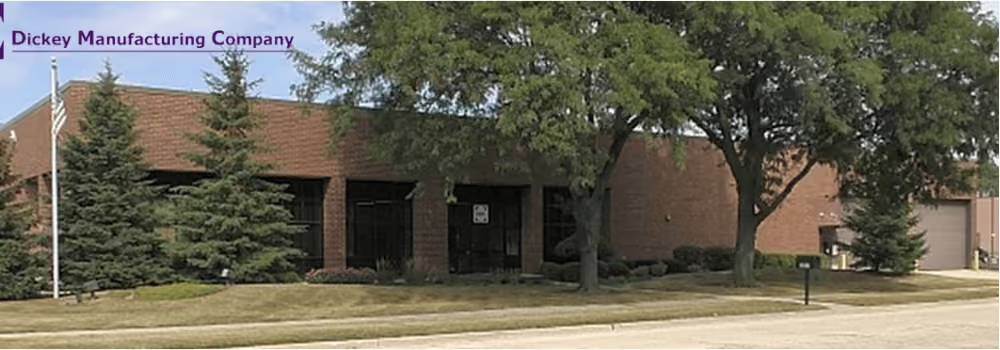




























































%20-%20thumbnail.avif)





%20-%20thumbnail.avif)

%20-%20thumbnail.avif)

.avif)




%20-%20thumbnail.avif)