Read MoreStories



This has been the most trying six months of my life, and it's not even close.
There were moments where I thought that I had ruined my life.
I met Chris Edwards on Twitter.
He had published a thread reflecting on his first six months as the owner of a small business he'd acquired.
It was grim.
The gist of his thread was basically, hey, you've heard small business acquisition is hard. You have no idea.
But as you'll hear in this interview — and what to me is really the takeaway of Chris's story — it's already getting better.
He can see the light at the end of the tunnel, and assuming things do continue to get better, this will have been a life-changing move for Chris, both financially and in terms of personal growth.
It's pretty powerful.
By the way, there are a lot of parallels between Chris's story and Mike Botkin's.
Mike Botkin was one of the first Acquiring Minds interviews, so check that one out as well.
Mike characterized his first three months as the new owner of a landscaping company as getting punched in the face every day.
Chris prefers to call it a bloody knife fight, so choose your imagery of violence from either of those two.
Anyway, both of these individuals bet on themselves, both hunkered down, and I predict both will not only be successful with their acquisitions, but will go on to do more.
Here's today's interview with Chris Edwards.

Chris Edwards grew up in Colorado, specifically in the Front Range area outside of Boulder. He comes from a family with strong entrepreneurial roots—his father was a serial entrepreneur, and his mother more recently ran her own business for about 14 years before selling it. Chris studied business in college and began his career at Zayo Group, a telecom asset roll-up backed by major private equity firms. There, he worked in finance and FP&A, conducting deal due diligence, supporting product teams, and handling investor relations after the company went public. This role exposed him to acquisitions, debt markets, and equity markets, sparking his early interest in how roll-ups and acquisitions create value.
Chris later moved into consulting, working first at Slalom Consulting and then at Deloitte Consulting, where he led large-scale Salesforce.com implementation projects. Despite professional success, he grew disillusioned with the corporate consulting track after observing the stress and personal sacrifices made by senior partners. During the COVID-19 pandemic, he reevaluated his career path, drawing on his family's entrepreneurial history and his own long-held desire to break away from corporate life, which ultimately led him to explore small business acquisition as an alternative to building a startup from scratch.
Be a shock absorber, not a shock amplifier. Don't meet people's emotions tit for tat, because it's a very emotional time for everyone involved.
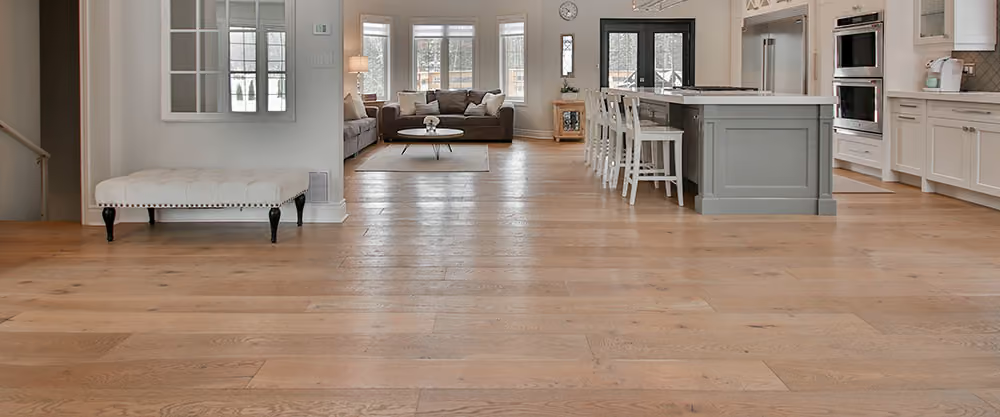
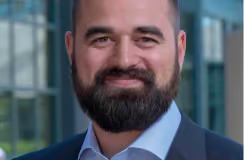
Chris Edwards' first 6 months as new owner has been a “bloody knife fight.” But things are looking up, with the business projected to profit $750k this year.
Themes from Chris’s interview:
Reach Chris at:
Official episode page & full show notes at AcquiringMinds.co:
Host: Foreign.
Host: Welcome to Acquiring Minds, a podcast about buying businesses. My name is Will Smith. Acquiring an existing business is an awesome opportunity for many entrepreneurs and on this podcast I talk to the people who do it. I met Chris Edwards on Twitter. He had published a thread reflecting on his first six months as the owner of a small business he'd acquired. It was grim. The gist of his thread was basically, hey, you've heard small business acquisition is hard. You have no idea. But as you'll hear in this interview, and what to me is really the takeaway of Chris's story, it's already getting better. He can see the light at the end of the tunnel and assuming things can do continue to get better, this will have been a life changing move for Chris, both financially and in terms of personal growth. It's pretty powerful. By the way, there are a lot of parallels between Chris's story and Mike Botkin's. Mike Botkin was one of the first Acquiring Minds interviews, so check that one out as well. Mike characterized his first three months as the new owner of a landscaping company as getting punched in the face every day. Chris prefers to call it a bloody knife fight, so choose your imagery of violence from either of those two. Anyway, both of these individuals bet on themselves, both hunker down, and I predict both will not only be successful with their acquisitions, but will go on to do more. Here's today's interview with Chris Edwards. Chris Edwards, thank you for joining me today on Acquiring Mines.
Host: Thank you, will appreciate you having me.
Guest: You are seven months into the acquisition of a flooring business, retail and installation services based in Steamboat Springs, Colorado, and I have been reading some of your tweets which have talked about, let's say, the interesting process this has been. The transition. Bloody knife fight, I think was one of the ways that you characterized it. But when we talked last week, it seemed like you were starting to feel some optimism around all of this. You can correct me if I'm wrong about that, but this interview will be just great for people who are themselves thinking about buying a small business. Because here you are in the trenches six, seven months into this and you're feeling it every day. And it seems like, yeah, you're right, kind of at a moment where things have been really hard, but you can also see how things might turn good. But I'm putting words in your mouth, you'll tell me all that. Why don't we just start with two minutes on your professional background? And so, yeah, give us the Chris Edwards bio real quick and then take us up to your decision to wanna buy a business. Not this particular business, but just wanting to buy a business in general. How did you arrive there?
[3:12] Host: Yeah, absolutely. So a little bit about me personally. I grew up in Colorado. I grew up in the Front Range of Colorado outside of Boulder. Come from a family of small business owners, a serial entrepreneur and my mom was also more recently an entrepreneur. She actually recently sold her business of about 14 years. So I grew up in Colorado, studied business in college. After college I joined a company called Zayo Group which, which was a roll up of telecom assets across the country backed by big private equity hitters. I was a part of their finance and FP&A team. So I did due diligence on deals, I did FP and A for our product teams. I did investor relations for a while once we went public. So I did a kind of a full suite of finance things for that company and saw how roll up plays and acquisitions can create value for investors. Got exposure to debt markets and equity markets through that experience and really was the first foray into what can be done with business acquisitions. After that I was in the consulting world. I did a stop at Slalom Consulting and then most recently Deloitte Consulting. During that time I did salesforce.com implementation projects. So led large scale enterprise type of implementations of salesforce.com and then how I got into this SMB world was, you know, I think I was like a lot of people. I was taking a hard look at my life during COVID You know, I had been traveling all around the country. Obviously it wasn't during COVID but was, you know, stuck in my house doing work that I felt wasn't going to be in my long term interest if I stuck around too long in the corporate world. Decided that I wanted to find a way to break out of the corporate structure and get into a more entrepreneurial track. Stumbled across the SMB Twitter world and really started to research what a small business acquisition might look like and really investing my time and energies into thinking about entrepreneurship through acquisition. So I decided to quit my job about a year ago to search for a small business to acquire. After giving it a lot of thought, the self funded search, I was in a position where I didn't have to raise equity. Had a little bit of Runway where I can look for small businesses. I looked at businesses from basically Arizona, New Mexico, up through Idaho, Montana. So pretty much everything in the Rocky Mountain region and wanted to stay in Colorado if possible. I was living in Denver at the time. I found this flooring business and got it under LOI fairly quickly for a number of different reasons. It was appealing to me, which I'm sure we can get into. But that's kind of the quick and dirty story of how I got into this world. Great.
[6:27] Guest: I want to pick just a couple of those things. So had you had entrepreneurial ambitions before COVID either buying a business or starting your own?
Host: Yeah, I have always fantasized about being an entrepreneur. As I mentioned, coming from a family of entrepreneurs, it was kind of in my blood. I kind of felt like I wasn't. I would have regretted staying in the corporate hierarchy for too much longer.
Guest: Why?
Host: Because I just felt like if I played out my current track 10, 15, 20 years from now, I looked around at the partners that I was looking at that I was working for. I looked at what a senior, you know, consultant track looks like, and I felt like it was. It would have been a mistake for me to stay in that sort of comfort zone and follow the track of the partners that. That I had been working with. They worked, you know, they worked constantly. They were stressed out, a lot of divorce, lot of.
Guest: So owning an SMB is not stressful?
Host: No, no, I'm definitely not saying that. But you're doing it for yourself. You're doing it for yourself. I saw a graphic that I tweeted out at the beginning of my search that I felt was actually pretty accurate, was looking at a graph. On the x axis was time and the Y axis was level of stress. And as you become a more senior consultant and you become a partner, your stress level actually goes up over time. For an SMB owner, the stress level starts very, very high, but goes down after a while. So over 20 years, you see them kind of intersect and change the level of stress over time. And that resonated with me. I felt like that was true. And as I'm starting to get more settled into the SMB, I feel like that's probably going to be a pretty accurate portrayal of how things are going or would have gone if I stayed in consulting.
Guest: You didn't want to be on the partner track. You have an entrepreneur gene. And then why buy something rather than build? And had you considered building from scratch or was it never really on your radar to do that?
[9:01] Host: Honestly, like I said, I kind of have a fantasize about, you know, the rocket ship startup life. My fiance actually is currently working for a startup and has worked for a number of startups. And for me personally, I watched my dad go through creating startups from scratch, and it was extremely difficult not Only to make it successful, but the amount of stress that I put on my mom, my family. I think one of the reasons why I was attracted to the corporate track in the beginning was that it provided stability that wasn't afforded my dad during his career choices. It was very rocky ultimately. Never really had a major home run. He had a couple decent small exits, but nothing that he could comfortably retire on. So watching my dad go through that was probably shaded my aversion to doing a startup from scratch. So once I stumbled onto the SMB landscape and really started researching about the possibilities that are out there, the lower multiples, the opportunity to finance it with SBA debt, things of that nature, it just made a ton of sense to me, you know, for all those same reasons I'm sure many of your guests have articulated. You know, you can buy something that has momentum, that has traction, that clearly has product market fit, that wouldn't require you to go through the insanely hard, you know, one to five years that it takes to get a startup off the ground. You know, bypassing that very difficult stage was really appealing to me. And, you know, the opportunity to have something that's cash flowing day one and not put a ton of my own capital at risk of going to zero was something that really appealed to me.
Guest: Let's go back to your search. So you had started to say that you were looking in the Rocky Mountain geography, so those four or five states there, from north to south. And what were some of your other criteria? Walk us through your search if you could.
Host: My search was basically geographically and financially focused. Those are my main two filters. I was basically industry agnostic. So I looked at a wide variety of different deals that were on the market. From Arizona, New Mexico, through Montana, Idaho. I basically focused on brokered searching. That's where I spent most of my time was looking at broker deals. I. My strategy was to focus on that first. And if, for whatever reason, a deal didn't manifest, I would then go to a proprietary search model. For me, like I said, I was preferring. I was hopeful that I could stay in Colorado. So I found this deal. The reason why I felt like this particular deal made sense to me was I have done flooring personally myself. I feel like I understand it to some degree. It was a. It was a deal in a business that I felt like I could understand and get up to speed on fairly quickly. Didn't require any special certifications, didn't require any special training that I felt like was out of my. Out of my, you know, realm of possibility. So it was something that made sense to me, again, geographically, financially, not met my filters.
[12:45] Guest: What were those financial criteria that you had?
Host: So I kind of subscribed to the Harvard Business School model, which they recommend, looking at businesses between 750 to $2 million of EBITDA. I went on a little bit on the lower side of that. I did about 750 to 1.5 million were the deals that I was looking at. And again, the other filter being geography, I wanted to stay in the Rocky Mountain region, so that's where I focused. Yep.
Guest: Okay, great. And when you said you were looking at broker deals, does that mean that you were just reaching out to brokers and saying, hey, put me on your list, send me your deals?
Host: Essentially, Pretty much, yeah. I networked with any and all brokers that I could get in contact with in that region. My first month or two was really focused on networking with anyone and everyone I could talk to. Brokers, accountants, lawyers, anyone in the space that could help me get some deal flow going.
Guest: Okay, great. So what is the name of the business? Is it AFW Flooring?
Host: The name of the business is Affordable Flooring Warehouse.
Guest: Affordable Flooring Warehouse. Okay, so Affordable Flooring Warehouse. You found it. Of all of this deal flow that you were able to gin up, where did this particular deal come from and what were the economics of this business?
Host: So I found this deal through transworld, which is a pretty big brokerage out here in the Western states. The deal was advertised as basically 750,800k of EBITDA and about 3.5 to $3.7 million of revenue over the last couple months or last couple of years. The reason why I give a range like that is just because you have to make some assumptions with COVID and all of that. So there's a pretty big wrinkle there with COVID as you might imagine.
Guest: Sure. Okay. And what was the. You saw this business. Flooring was something you felt comfortable with. You'd actually even done a little bit of it yourself. And this is actually in Colorado, your home state. So of all the states you looked at, this was really the ideal. Are you from close to Steamboat Springs?
[15:20] Host: No, I grew up just outside of Boulder, which is on the Front Range of Colorado, kind of near Denver. Steamboat Springs is in northwest Colorado, so it's a fairly isolated mountain town. It's not on the i70 corridor, which is where Breckenridge, Keystone, Vail, those major resorts are. So it's a little bit off the beaten path A little bit, which is actually one of the Reasons why I thought it was a compelling deal was that it had sort of a geographic moat. Steamboat Springs is a. Is a pretty small town, but it is an affluent town and it's growing very quickly. There's a lot of construction that's happening right now. A lot of people are moving here and just in the mountains in general because they want to have a, you know, a getaway home. They want to escape the city. Covid has created a mass exodus to. For people to want to have a mountain home. The real estate market here is absolutely on fire for me. The opportunity to live in an amazing mountain town that most people were not going to. People who had looked at this deal were not willing to move to Steamboat. I was. And that, I think, is what made it a good fit for not only me, but the seller as well, is that I'm someone who's from Colorado. I'm in this unique spot where I'm looking at small businesses to acquire. And the fact that this was on the market and I was willing to move here made me a pretty attractive buyer for the seller.
Guest: And how competitive was it? How many other offers did you beat out or interested buyers did you beat out?
Host: This deal had been on the market for probably about nine months by the time I came around. There was a number of people who had. Who had put in Lois, but it didn't work out for whatever reason, mostly because it was a deal that required someone to come in and operate versus having. There wasn't an established GM in place. So that turned most people off because they weren't willing to move to a Steamboat either. They wanted to stay in Denver or wherever else they're from. The prospect of packing up and moving to Steamboat was too much for everyone else.
Guest: That's interesting because on SMB Twitter, a lot of what I see, I feel like most of the stories that I'm hearing from people are people who are operators.
Host: They acquire a business to operate it.
Guest: I hear less about people who just want to acquire businesses that already have operators, unless it's a private equity play. But apparently those buyers do exist. People who just want to have the means to buy a business and keep an operator in there. Any thoughts on why? I just feel like that's not the flavor of SMB.
[18:16] Host: Twitter? Yeah, I can only speak to what the previous seller told me, but yeah, there was a couple of private equity people that had looked at the business and had talked to them fairly extensively. A couple other people put in Lois. That again, just didn't work out because they didn't want to move here. But yeah, I think for these types of businesses that are in the lower middle market, the lower end of the lower middle market, you have to roll up your sleeves and you have to get dirty, get your hands dirty and you have to be willing to put in a little bit of elbow grease to make these things work. Just installing a GM or another operator to take over usually is not going to work just because these businesses are very much relationship driven. You have key players, key employees that you need to keep happy and going. Just playing golf all day isn't going to be conducive to the long term success of these smaller businesses.
Guest: On the other hand, you do at some point expect that you would be able to put in a gm. You're in no rush to do it. But when you look at the trajectory of your own career, I expect you would do that.
Host: Yeah, yeah, definitely. And you know, I'm starting to think more and more about that. That's probably going to be a couple of years out, I would say. But you can see how once you start installing better systems, better processes, building a stronger team, better training, that you can eventually step away and install a gm. So we're not there. That's going to take a little while for us to get there. But I'm more than happy to be kind of in the weeds day to day.
Guest: And was this a situation kind of the stereotype where this business didn't have systems and what wasn't very tech forward and was taking orders by a fax machine? Not literally, but sort of figuratively. Was that, was that what was going on here?
Host: 100%. 100%. I mean, you know, the seller that I bought it from is an old school guy. He, you know, he's retired now. He basically, you know, and I say this very lovingly and he would agree with this characterization. He's kind of an idiot savant. He's just like, he's, he's insanely smart. Like he just remembers everything. He remembers everything. He, he can flip through 40 papers and remember all the numbers that are in there, but he has like, he has these social skills that are just at times completely unbearable. So again, it must have been fun to negotiate with. Oh, exactly. Yeah, it was a beautiful thing. But he would agree with that assessment. I'm not saying anything that I wouldn't say to his face, but he, because
[21:23] Guest: this is going on Twitter,
Host: I promise he's not on Twitter. But I say all that to say that there were no processes, it was all just paper based. The Amount of paper that he would print out and mow through on a daily basis was astounding. And it was, it was really intimidating for me to walk into this, this business where papers are flying around, everything is in everyone's head. There's no real systemized way to, you know, track and track an order track what's happening with that order track what's happening with an install. It was all just happening in paper. And so, yeah, I say, again, I say a lot to say you're. Your characterization of having no processes is exactly what I walked into.
Guest: Well, I want to get into this in just a minute because this is the bloody knife fight part. But before we do, I want to hear the terms of the deal. So it was doing. Sorry, you said about 750, 800 EBITDA on about 3 to 3 point something. 4ish million.
Host: Is that what it was? Yeah, it's basically about, call it for round numbers, I would say 750k on about $3.5 million of revenue.
Guest: Okay, and so what were you able
Host: to acquire it for and what were
Guest: the terms of that and how did you finance it?
Host: I acquired it for 1.7 million
Guest: and
Host: I financed it with 10% equity, 10% seller note and 80% SBA debt.
Guest: So 10%. So you brought 170 of your own cash and then the seller, idiot savant, has 170 as a note and then the remaining 80% from the SBA. So that's a pretty big. Is 10% the minimum that you can do on an SBA loan?
Host: Yeah.
Guest: So it's pretty big. Highly leveraged.
Host: Is they highly leveraged? Yes.
Guest: Okay, and did you choose to do that? Was that a strategic decision or it was just the nature of this deal and you were prepared to do that and so that's why you did it.
Host: I came to the perspective that if I'm going to go and do this deal and have the conviction to do it, I might as well lever up and do it. I could have put more equity down. I decided against that for a number of different reasons, personal. But I decided that I was going to be aggressive with financing it. And I felt comfortable with the business financials, with the trajectory and my forecast of the business, if I felt like things were going, if I felt like I executed at a fairly high level. And so I decided if I'm buying this thing for around two and a half times, that was a pretty sizable margin of safety for me to feel comfortable with that aggressive of financing and
[24:35] Guest: that margin of safety. So if the business, for example, revenues were to dip what percent would you still be comfortable?
Host: I mean, basically the business could drop 40% and we'd still be able to cover our debt obligations. Right now we're sitting at about 3, more than 3 discount or sorry, debt service cover ratio. So that's a pretty healthy margin of safety for me to feel comfortable with levering up that much. At least that's how I felt at the time.
Guest: Okay, let's pivot into that.
Host: So you.
Guest: These first six months have been difficult. This transition has been difficult. Why?
Host: I mean, these. So I would start off by saying the transition has gone about as smooth as you can possibly hope. Realistically speaking, the seller gave me a three month transition period where he trained me up. He actually came back last month when I was getting married and covered for me while my wife and I went on a honeymoon. This is all negotiated as part of the deal. I think the way that the transition has gone has gone about as smooth as you could hope. With that said, these things are extremely difficult. It's very difficult to. To get everyone on board, to get people to feel, to buy into your vision of the business, to get people to buy into continuing to work hard for you. More than anything, it's just an emotionally difficult time. For me, part of the difficulty was going from a very, very comfortable corporate environment where I never really. I was working hard, but I wasn't overly stressed at any given time. I was successful in my previous career. So going from that very comfortable environment to one where I really put my financial future on the line to make this thing happen. It's an immense amount of pressure to make the transition work. The team has been great. I've got a great management team in place. We have three managers that are doing a great job. One of the managers is the seller's son and another manager is the seller's son's wife. So coming into this family business and basically taking over for his dad is a very tricky emotional situation. So navigating those highly emotional waters is a taxing experience. So on paper, the transition was smooth, but the amount of internal turmoil that I went through to make this work, to get people to continue to work for me and invest in the business, what. Which is extremely emotionally taxing.
[27:59] Guest: So on you or on them? On you. I know, but on them as well.
Host: No, yeah, yeah, on everybody. On everybody. You know, one of the reasons what made it so emotional is the previous seller had. The previous owner, I should say had health problems and was basically, you know, there were moments where he was almost, you know, gonna die on the job. He was so stressed out and he just had all these health problems. And that was really taxing on his son, his son's wife, all the rest of the employees. So it was a stressful environment that I walked into. And having the seller transition out, the emotions involved there. The new guy coming in, who is he? Can we trust him? Is he going to take care of us? Does he have our back? Is this someone I want to work for? You know, you have to prove yourself and really buy and get their trust during that transition period. Because if they were to leave, I would have been screwed. I mean, there's no doubt about it. Like I, they, they are the ones that made the business run for the first six months that I've been here. That's changing a little bit now that I'm more comfortable and can drive things to conclusion more. But, you know, if they were to have left, I would have been in a very, very difficult position and having that debt hanging over your head. I basically put my entire net worth on this business. And if they were to not work out, I would have been in a very precarious situation.
Guest: These issues with employees, the trust and et cetera, everything that you just described, did you anticipate that?
Host: Yeah. Yeah. It was definitely something that I thought long and hard about prior to closing the deal. It was one. There's a couple of times where I almost walked away from the deal just because I thought that the employee situation was going to be a little bit too hairy to navigate. Ultimately, I got to a point in a place where I felt like the seller was creating the right incentive structures for them to stay in place. We negotiated a bonus for the key employees to stay that the seller was going to pay for for the first year. And just kind of everything that I had heard from the seller and just given the profile of the key employees, I felt like there was a pretty high likelihood that I can convince them to stay, at least for the first year. Which is really what you need them for in order to not go bankrupt, is you need to have that first year Runway so that you can get up and running. And then whatever happens there, I can handle it. I just needed someone. I needed them the first year for sure. And I felt like we came to a deal and a resolution that convinced me that they would stay. And so far they have stayed.
[31:00] Guest: Yeah. So now you're seven months into this 12 month period where you had kind of foreseen absolutely meeting every, all hands on deck and nobody Leaving. Do you feel like this prediction is playing out that at 12 months you'll be more comfortable if people take off?
Host: Yeah, I mean, there's one employee right now that if he were to leave would be a major challenge for the business. The other two, we could handle it. But yeah, no, I, I'm now at a point where I feel like no matter what happens, we can figure it out. One in particular would be extremely difficult, as I said. But I'm at a point now where I'm comfortable with how we operate. We've made a lot of improvements and enhancements to the business that give me confidence that we can navigate some choppy waters.
Guest: Great. Good for you. I mean, it sounds like what you wanted to do. It's really. It sounds like you diligence this intelligently, Chris. I mean, you had a lot of experience already in acquisition, at least at the corporate level. It sounds like you were asking all the right questions, you were concerned about the right things. And yet on Twitter you still only gave yourself a B minus, A B minus on your effectiveness or capability in executing this transition. What did you do wrong? Why don't you deserve an A?
Host: You know, I guess I'm a hard grader. So, you know, I would say that I, you know, just. There's just a lot of growing that I had to go through in order to get to where I'm at right now. I made mistakes, you know, just with the way I handled some interactions with employees. I would say I jumped the gun on making some process changes a little bit too quickly and my change management with the existing employees was lacking at times. For instance, we installed notion to replace a lot of the paper based processes that were happening in the business. And I think I underestimated how difficult that would be from a change management perspective, especially with the existing employees, employees getting them to buy into this new system, like getting them to believe that this is the right way to go. They've been doing this for five years. Who am I to come in here and make this sweeping change that impacts all of their day to day operations? So I underestimated how hard the change management aspect would be for making process improvements. And at times I think I was probably a little bit insensitive to that. So I think that that stands out to me. A couple of, I would say decisions that we made with suppliers and what we would stock and not stock in our warehouse could have been better. So I wouldn't say anything was, was a total disaster for sure. But there are things that next time around I'LL definitely do better at. So I think a B minus is probably a little bit on the harsher side of things. But I have high expectations for myself.
[34:29] Guest: When I hear you say that there was just some resistance to these changes. It actually goes against what my reflex would be, which is when we were talking about the fax machines and
Host: as
Guest: a symbol of the kind of outdated processes or lack of processes of the business, I would have thought that people within the business would also have seen how inefficient things were and they would actually be chomping at the bit for new blood to come in and make things run better. And I guess my reflex is only that because I sometimes hear that you'll hear a buyer will come in and interview all the employees and say, what can we improve in this business? And the employees are overflowing with ideas and really eager for new, a new leader to come in and listen to and implement their ideas. Is that the case here? Or did you just implement that incorrectly? Or a little of both or what?
Host: I mean, there definitely were some people that were very enthusiastic about the changes and offered up a lot of ideas on ways that we can make the business better. So I don't want to give the characterization that everyone was reticent to the change, but there were some that I would say are not as sophisticated with technology as people like you and me might be. And. That's just a result of them doing this paper based process for years and years and never really being exposed to the different alternatives that are out there. So it was a little bit of a, I would say not only just a technology resistance, but also kind of like an ego resistance. Right. Like I've been doing it this way for five years. Who's this young hotshot who thinks that they can tell me how to do my job? So that's more than anything, I'd say it's not just the technology, it's also the change management and being sensitive to the way that people have done things in the past and respecting what they've done. To build a respectable business, you have to be. At least in my case, I had to be a little bit more cognizant of how my ideas of change landed with some people. Some people were more receptive to it than others. And you have to play it on a case by case basis.
[37:00] Guest: Well, but can we be more specific? What would you Advise, Chris of 6 months ago? Because you do have to put into place these changes and I hear you saying that you need to be more sensitive on the Change management front to people who might be more stuck in their ways or their pride or they're less adaptable to new technology or what have you. So how would you. Can you be very specific about how you would have done it differently? What does be more sensitive mean? Just go slower or what?
Host: Yeah, I would say go slower and design the new processes in tandem in conjunction with your. With your existing employees. So bring them along a little bit more. Make them feel like they're a part of the process of building these systems a little bit more. You know, there's a couple instances where I kind of get. I kind of got ahead of myself. I designed what I thought was really cool process notion or whatever the case may be, and then I bring it to them. I'm like, hey, what do you guys think? I'm all excited about it. And they're like, whoa, whoa, whoa, whoa, whoa. What about this? What about that? What about this? So what I would have given myself feedback on is make sure that they feel like they're brought along as part of the process.
Guest: You said you already have improved some processes. As rocky as that was, you've improved some stuff. Are there any financial manifestations of this yet? Like has revenue gone up or expenses come down? Have you improved the P and L yet or is that still being baked?
Host: I would say on the margin, we've made some improvements. We're growing, so we're up year over year. Revenue? Well, you kind of have to throw out last year with COVID but we're up from both last year and 2019. So we're growing by how much from 2019? We're up about 5%. Call it over the same time period from when I acquired it to now, we're up about 25% from last year. Just because they were shut down for about a month last year, five weeks or so. The P and L, I would say, margin wise, we're pretty healthy. We're kind of on that 23 to 25% EBITDA margin range, which I'm happy with right now. I have brought in some overseas resources to help me with the business. So some assistants that are doing a great job for us and have really added a ton of value for our more rote processes at a pretty cost effective rate. But I would say there's still a lot of changes that we're making that won't be fully reflected in the P and L thus far, But I'm hopeful we'll show progress in the next, let's say, nine to 12 months.
[40:05] Guest: Well, that Seems, I think then my takeaway from our conversation last week that you, you seem more optimistic than the infamous bloody knife fight tweet is right. So it's kind of interesting. Let me ask you a question that I've asked a few other guests. The SMB acquisition is a hot topic. People talk about it a lot on Twitter. People fantasize about it. Then very wise people who have done it a lot like the Brent Beshores of the world and others come back and say, this is so hard.
Host: So, so, so hard.
Guest: Don't think that it's on a spreadsheet. It looks great, but the reality is these are people problems. And people problems don't have fidgeting with Excel solutions. And yet this is coming from Brent Beshore, who's one of the most successful people in this space. And here you are. Two or three months ago, you may have felt like you were drowning, and yet now you're even smiling a little bit. I don't want to put the cart before the horse. You're not out of the woods yet, but seem more optimistic. And six months of pain is a long time, but it's not that, that long in the course of one's career. So where do you fall on this kind of, this, for lack of a better word, debate as a path for people, SMB acquisition?
Host: I mean, I think that I would agree with the characterization of Brent. It is extremely difficult. This has been the most trying six months of my life and it's not even close.
Guest: Wow.
Host: So on paper, yeah, the opportunity is extremely compelling. You can buy a small business from 2 to 5 times earnings lever up and the equity returns can look very attractive. There's no doubt about it. The opportunity is there. On paper. The real world ability to go execute is all that matters. And for me, I had moments of serious doubt whether I could do it. As I mentioned in Twitter, there were moments where I thought that I had ruined my life. And I was like, I had a great thing going in consulting. I was doing well. What did I do this for? This is madness. And now that I'm settled into it, and again, like you said, I'm not out of the woods yet. I'm not ready to declare victory. You're never going to declare victory. And I still have my moments of very, of high stress, including this morning. But I see the pathway to success and I see that this could be a very good long term decision. When I go home and I talk to my wife about how things are going now compared to four months ago, it's night and day, I feel much more comfortable. I feel like I can make substantial improvements to the business. I feel like I'm not sitting on the edge of oblivion anymore. That's. That's a huge step forward for me. So you're talking to someone who's still very early in the game. But I feel like. And going back to that graph that I talked about, I feel like that stress level is on its way down a little bit, and I'm very early in the X axis of time. But I. I think that this ultimately will be a good decision for me personally. How it plays out for anyone else, not from. Not really my place to give advice, because, again, I'm so early in the game here. But I would say the opportunity is out there. There's no doubt about it. But be prepared for very, very difficult process in order to make it successful.
[44:21] Guest: And the thing is, you were prepared like you expected it. And it was still really, really scary, even.
Host: I mean, maybe I bought the wrong business. I don't know. But, you know, there's certainly different ways to go about it. For me, one of the other things that made it very difficult at times was I did not. I don't have a partner. I mean, I have a wife who was incredible during this process. There's no way I could have done it without her. But I didn't have equity partners. I didn't have an operating partner. It was just me. So on paper, in terms of the returns for my balance sheet, that's the reason why I decided to go at it alone. But it made it a very lonely few months. There's a lot of different ways to skin this cat. I may have gone about it in a little bit more of a difficult way than some other people might have, but.
[45:22] Guest: You mean by going solo or was there something else that you did that invited difficulty?
Host: By going solo? Yeah, by going solo. And again, I'm sure that there are much easier businesses to operate out there. So there's a. Maybe there's a survivorship bias here. But again, I would say there's opportunities out there, but it's very hard.
Guest: And I think the best litmus test of all is the future for the business. Do you think that you would acquire a similar business or an adjacent business once things settle down at Affordable Flooring Warehouse?
Host: Yeah. Yeah, I think so.
Guest: There you go. Well, that tells me more than anything else you've said.
Host: Yeah, no, I mean, like I said, the opportunity on paper is there. There's no doubt about it. I hope to someday have A couple other deals under my belt. Do I want to be the next Brent? Be sure. I don't know. He's a lot smarter than I am, so probably not, but we'll see.
Guest: Cool. Is there anything. I mean, we've talked about a lot of advice and challenges and stuff, but is there anything else I haven't asked you that you would advise to people out there looking to buy a business? Let me lead you into a couple answers. Would you say have a partner? I guess that depends on. Do you want to split the. The return or not? Would you say have a partner? Would you say lever up aggressively? Would you say. I know these are all very personal, so maybe it's hard to say, but is there any generalizable advice that you would give to somebody who is where
Host: you were a year ago? Oh, man.
Guest: Maybe look for businesses in location. Like if you can really gain advantage by being willing to move somewhere that other buyers wouldn't be.
Host: Yeah. I mean, it's so hard to say. My deal was unique in the sense that it met my geographic filters, met my financial filters. I mean, there's nothing that I could say about how I did my deal that I would patently recommend to everyone. I would say the thing that was most important for me during this transition was to be a shock absorber and not a shock amplifier. You're going to be hit in the face. You're going to be. You're going to have conversations and moments with customers or employees or suppliers that are very challenging. And the best thing that helped me ride this kind of tumultuous last six months was to be someone who took the temperature of the room down and take the emotions down a little bit. And like I said, be a shock absorber and not a shock amplifier. Don't meet people's emotions tit for tat, because it's a very emotional time for everyone that's involved. It's emotional for the seller, it's emotional for the existing employees. It can be emotional for the suppliers even, and the customers. So it's a rocky, rocky time. And the more that you can turn the temperature down, the better. And I would say that was probably one skill that I would give myself maybe a little bit of a higher than a B minus on. That made a world of difference.
[48:55] Guest: Very well put. So develop a meditation practice before you buy a business.
Host: I would actually recommend that. I've been a meditator for five years now, and I would say that without it, there's no way I could have. I could have gotten this deal done and survived the last six months.
Guest: Very good. How can people reach you?
Host: Chris, feel free to shoot me an email if you have anything that I can help you out with. It's ChrisAnitasEquity.com S A N I T A S Equity.com you can also follow me or DM me on Twitter. My Twitter handle is oaf T H Edwards. Great.
Guest: And what's the URL of Affordable Flooring Warehouse?
Host: It's Steamboat Floor Deals.com Steamboat Floor Deals.com Yep. Great.
Guest: Chris. This was a great conversation. Thank you very much.
Host: Awesome.
Guest: Thank you.
Host: Appreciate it. Sam.

































































%20-%20thumbnail.avif)





%20-%20thumbnail.avif)

%20-%20thumbnail.avif)

.avif)




%20-%20thumbnail.avif)