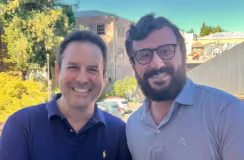
Host: A small vending machine hustle opened Connor Perez eyes to the power of entrepreneurship. It was just a taste, just a few hundred extra bucks a month, but it sort of broke my brain, says Connor. It made me realize that I don't need permission to go out and create and capture value. There's no gatekeeper determining whether or not you can go out and make a living. You can just go make things happen and make things happen. He then did Conor closed on a commercial printing business just a few months ago. Also listen for how he approached the process of buying a business. One thing we don't talk much about on the pod is how daunting this is. Just learning the mechanics of doing a deal. There is so much to learn, but one foot in front of the other, always continuing to take action, however small, can get you there and faster than you expect. As in Conor's case, here he is Connor Pera, owner of the Print Authority. Welcome to Acquiring Minds, a podcast about buying businesses. My name is Will Smith. Acquiring an existing business is an awesome opportunity for many entrepreneurs and on this podcast I talk to the people who do it. Listeners of Acquiring Minds know that for almost any business you acquire, its success comes down to the people and how you develop and manage them as their new leader. Thing is, in addition to management, there is also a lot of process and bureaucratic work when it comes to your new employees. Payroll, compliance, HR technology, hiring to name but a few. These processes are crucial to get right, but at the same time distract from where you want to be putting your energy in leadership. So Aspen HR is an HR firm and PEO that takes this work off your plate and handles it with the care it demands. Aspen is owned and run by Mark Sinatra, himself a successful former searcher. So Aspen's own leadership understands the HR challenges that searchers have. Post acquisition, the firm is offering Acquiring Minds listeners a complimentary pre acquisition HR and PEO review for your target business. Check out aspenhr.com or contact Mark directly@markspenhr.com Connor Pera welcome to Acquiring Minds.
Guest: Thanks for having me. Will. I gotta say it's cool to be on the podcast that I've spent the better part of the last two or three years listening to on my commutes and runs and other activities. So it's it's cool to be on.
Host: Awesome man, awesome. Thank you for saying that. Well, you've earned it. You recently closed on the Print Authority, which is a printing business in the Nashville area, and I saw the story that you had written about the article that you'd written covering your story of this acquisition. You posted it on Twitter and on Search Funder. We'll link to that in the notes. And so I wanted to have you come on and share that story with the listeners. You really have kind of thought it through and laid it out and you have some of the mistakes that you made in there, which of course we always learn most from our mistakes. So really excited to dive in. Start us off as always, Connor, with some background on you, please.
[3:35] Guest: Yeah, sure, yeah. So I came into the whole search fund ETA ecosystem through a very, I would say cliche and traditional means of discovering the ETA model. In business school I went to Kellogg for B school, which has a pretty, pretty sizable and well known sort of program for eta. And there's actually a class on ETA at Kellogg. And so I took that class, was super interested and fascinated by the model and the whole idea. But coming out of business school, I, for a variety of reasons, just think, for the most part, I wasn't quite ready to take the plunge, but was definitely, definitely enthused by the idea of owning and operating a small business. I also started a vending machine business on the side. And that was the, I think one of the bigger catalysts to deciding that that entrepreneurship was for me, it sort of like broke my brain in a weird way and made me realize that like, I don't need permission to go out and create and capture value and like there's no gatekeeper determining like whether or not you can go out and make a living. Like you can just go make things happen. And the vending business is very, very, very small. So I'm not making a living on that. Just the idea that the path was out there was sort of the sort of nudge that I needed.
Host: What did this vending machine business look like? Just give us some quick bullet points.
Guest: Yeah. So it's right now two machines at one location at an apartment complex in Nashville and in the process of securing a second location where I'll be installing another machine. But the first location has turned out to be be pretty, pretty good. I've had months where I've done 1200 and in gross sales and my margins are 55, 60%. So definitely not supporting the family on that kind of money. But as long as I continue to have capacity and bandwidth to scale and reinvest cash flow into expansion, I think there's an opportunity for it to be a nice little, you know, stable source of moderate cash flow as well as just something that I can, you know, test and learn various Things on the business that I'm currently operating that I spend, you know, 99% of my focus and energy on, as well as just my, I guess, entrepreneurial curiosity about if I do this, then what happens type of thing. So it's a way for me to, I guess, satisfy that. That urge as well.
[6:56] Host: Did you consider buying a. Buying a vending business when you got serious about search? Because vending routes are one you commonly see on biz by sell.
Guest: Yeah, I mean I definitely would have been. Would have been open to it. And I have talked to other searchers who are interested in vending with the caveat that, you know, I'm a really, really t. Tiny operator. But I can tell you a little bit about this industry. But I will say. And we'll. I'm sure we'll get into my, the business that I'm. That I'm currently operating. I will say vending, like printing is an industry where the competition is high and it's sort of that like red ocean versus blue ocean dynamic. And actually operating in the world of vending made me realize that I'm comfortable with a little bit more of a red ocean type of dynamic because I know that the demand is so evergreen. Even though there's a lot of competition and it's not easy, there will always be product market fit. So. So anyway, so it definitely gave me a lens through which to look at deals and look at opportunities. I would have been open to a vending business. I just didn't come across something that was compelling when I was searching that I would have been interested in, in putting all my time and energy into. But definitely something I'm was and still am open to the idea of. I'm obviously I know enough to be dangerous about how to operate in the industry, but. But yeah, I didn't really focus on it.
Host: Okay, so you, but it did make your brain explode and you so carry on with your kind of motivations around what. Yeah, what finally said, let's get serious about search.
Guest: Yeah. Yeah. So, yeah, so that, that was a big thing. And then I think just, you know, the, the. The sort of trajectory I felt I was on in my corporate career. I think I was in a world where I'm around a lot of other post MBAs who are ambitious, driven, intelligent, in many cases much better at brand marketing than I was. So I kind of felt like I see this path that I'm on and the sort of process of getting ahead is, is a long and windy road that is, that requires a lot of subtle, you Know, political maneuvering. So I kind of started to feel like there was this push pull dynamic of do I want to be playing this game long term? And then perhaps like the biggest one was my wife and I found out that we were expecting last year, so we had a baby girl in October of 2022.
[10:06] Host: Nice.
Guest: And when that happened, then I really started to feel the, not necessarily pressure, but feel the pull to, you know, if I'm going to go do something entrepreneurial and risky, then I better start making moves now because again, there's sort of like this twofold dynamic with the trajectory I was on a. Like, as our daughter gets older, you know, we may have more children in the mix, she'll have more expenses and I'll have more responsibilities. So just the, from a time and energy and financial point of view, it's like going to make less and less sense to go do the, the ETA thing. And then the other piece of it is the long. I felt like the longer I stay in corporate America, the harder it's going to be to leave because I'll be, you know, continue to, you know, hopefully I thought, you know, I would continue to get, you know, promoted and, and move up and, and, you know, be making a nice, nicer salary and you know, you get, you get, I think, used to that lifestyle, which is a, you know, it's an, it's a great lifestyle. So I, I felt like if I don't start making moves now, it's only going to get harder and harder, so I should, I should start making moves. So I, you know, I did what I think a lot of people do and when they're thinking about this more seriously is I just kind of started tapping my network and talking to people who I knew who had searched, who had bought businesses, who had, you know, been involved in the, in the ecosystem. And I actually met a guy here in middle Tennessee who's also a Kellogg alum, who was nice enough to sit down with me, owns a truck bed manufacturing business. And I kind of told him a little bit about my story and kind of what I was looking to do, which was search kind of part time. I'm like asking for permission and, and this guy's a former Marine and just very matter of fact, kind of no nonsense. And he had done a geographic search while working a corporate job and had young children at home. And he was like, what are you waiting for, man? Go make it happen. And so I just kind of started making, setting goals each week to accomplish, you know, one to two things and, and Trying to knock those out when I had had time and availability. And so, you know, things just kind of snowballed and here we are.
[13:00] Host: You know, it's, it's the, the learning you're pregnant thing is always tricky because on the one hand it's like it makes you realize that life is only going to get busier and more complex for the next 18 years. But on the other it's like, wow, this enormous thing is going to happen that sucks up all of my available energy and time. And so is now the right time to, you know, buy a second baby in the form of a business? Two babies at once. But it's kind of like it's at the same time. It's kind of like you're in a corner because, because it's only going to get trickier probably. Especially if you're planning on having more kids or whatever. I guess, I guess the logic could be if you're just gonna have one child and you wait five years until your first kid goes to kindergarten and they just don't need you as much, you can, you know, pause your life for professional life for that long and then you'll have some more time on your hands. But that's a long time and most people probably don't want to do that. So anyway. All right, Connor, so, so you, but so you make the decision to do part a part time search. Let's talk about that a little bit. Because the, some of the kind of conventional wisdom some of which people have heard on this podcast argued for strenuously is that you must do a full time search because it's so hard. Finding a business, a good business is hard. Then closing a deal is hard and there's going to be three dead deals. And all of the stuff that you hear, which is all true means that, you know, you increase your chances hugely by treating this, giving it as much energy as you can in treating it like a job. How did you, I think been listening to this or other stuff so you'd kind of, you would come across that wisdom. How did you reconcile that in your own mind?
Guest: Yeah, I mean, I think all sort of boils down to knowing oneself and kind of what. And I would argue this was one of, if not the only advantage I had in my search was that I'm, I try to be as, as self reflective and self aware as, as possible and kind of knowing what I'm good at and what I'm, what I'm not. And I just knew that kind of the way that I'm wired And the way that I've been able to accomplish other things in life has been very much of like an incremental approach and like just do a little bit every day or just do a little bit every week and don't necessarily like stress about having to have it all figured out all at once.
[15:45] Host: I think that's great advice. I mean, that's it. It's not advice that I necessarily take to, to my detriment, but it's advice that I've kind of read. Whenever there's some kind of mammoth goal that you, you want to accomplish in front of you, it can be overwhelming. And so the best approach is just one foot in front of the other. What can you accomplish this week, however small it might feel? You know, everything, all those small actions add up into accomplishing the goal. And yeah, I mean it seems to work. It worked for you. Not only worked for you, worked for you, worked for you in a very counterintuitive way because you ended up buying very, very quickly.
Guest: Yeah, yeah, yeah. I'll caveat again with like, I think the nature of this search that you're conducting and what you're trying to accomplish very much like dictates the approach you should take. Sure. So if you're you know, raising a traditional fund and you have investors, I'm not recommending going out and getting a 9 to 5 on top of that. But I just think it's like a matter of knowing yourself and kind of being really clear about what you're trying to achieve and therefore backing into kind of the method through which you're trying to achieve it and being eyes wide open about the trade offs that you may be making.
Host: August Felker is a two time successful searcher. First with a traditional search fund. The second time around he did a self funded search. Today August runs Oberly Risk Strategies, an insurance firm with a dedicated practice group for searchers and acquisition entrepreneurs like you. If you've got a business under loi, Oberle will provide complimentary due diligence on that business's insurance and benefits program. A great no risk way to get to know August and team. They love helping searchers. They've worked with hundreds. Oberly is a specialty insurance brokerage for searchers by a former searcher. Check out oberly-risk.com O B E R L E D risk.com link in the show notes. How does your part time search, what shape does it take as you kind of officially start?
[18:00] Guest: Yeah, so it takes the shape of early mornings and weekends mostly. I'm again like, like kind of know about myself that past 7pm my brain doesn't really work too well for any activities that are intellectual. So I kind of again like leaned into what, what I felt like my, my sort of style was so very much that and, and then just kind of like networking was, was sort of number one and just communicating to people that this is what I want to accomplish, this is what I'm looking for. Who should I talk to? Do you have any recommendations for me? And, and then just kind of taking recommendations and applying them and then going back and then just iterating from there. So it was definitely, and I guess for a more like practical application of how that went for me was I from a deal flow standpoint looked into both brokered and proprietary, tried to get like a proprietary engine up and running through hiring someone on upwork to scrub various data sources and kind of find the owners, the people I was looking for. And then also while concurrently pursuing brokered. But I found brokered to be just much more effective channel for me I think because I was severely time constrained and I just found that proprietary just took a long time to pull together those lists to then filter through the list to then find and identify the person to contact and likely like you're going to reach out and not make contact, which I didn't even actually get to in, in, in the proprietary stage. So I just kind of was like, okay, proprietary is taking too long. I'm going to focus on brokered pretty much exclusively.
Host: You turn your attention to brokered and are just communicating with brokers at this point. How do you eventually find, how do you ultimately find the print authority?
Guest: Yeah, so I think just serendipitously a broker that I was having agreed to sit down with me to press me on my ability to close a deal and what I was looking for. But for whatever reason he seemed at least open enough to like take a meeting with me and, and sit down. And so I had, I had met with him and yeah, it just kind of gave him the pitch on what I was hoping to accomplish, like what, you know, what I was looking for. He spent most of the time grilling me on who the heck are you? I mean anyone who's a searcher will know kind of like the pushback that you get from brokers. And as someone who's never ran or bought a small business before and it's understandable but I think for whatever reason I was able to convince him that I was serious about doing what needed to be done to, to make it happen. And he's like, you know, I do actually have something that may be of interest to you and I'd like you to consider it. I can send you some information. And it turned out to be the deal that I ultimately closed.
[22:00] Host: Give us the bullet points of the print authority, Connor.
Guest: Yeah, so it is a 32 plus year old commercial printing business here in Brentwood, Tennessee which is right outside Nashville. And I think that in and of itself was very impressive to me in general, like the durability of a 32 year old business that has been profitable for three decades through multiple recessions. And Covid to me that's in the
Host: advent of the Internet.
Guest: Yes. And that's like a super reliable Lindy ish business. For those familiar with the Lindy effect,
Host: for those who are not. Tell us what the Lindy effect is, Connor.
Guest: Yeah, so I'm definitely not a mathematician or qualified to speak, speak in detail about the Lindy effect, but essentially what it is is that for non perishable things, the longer it has been around, the longer it is likely to continue to be around. So it applies to pieces of technology ideas and I would argue businesses and industries. And so I felt good about the Lindy nature of the industry and the business. And it was a business that had done a lot in the advent of the Internet as you mentioned, to sort of adjust and pivot its model to tailor to that changing dynamic. And so a lot of what we do today is sort of what we, what we specialize in is what's called web to print. So we work with a lot of small to medium sized national, multi location businesses and franchises and our relationship is with the franchisor or the corporate office and we are sort of the recommended provider for, for their franchisees. In many cases, day to day printing needs to continue to operate their business. So what I really, really like about that model is that you're hooking into a multi location national business where you become a recommended vendor for franchisees. And so we do a lot of, you know, quite a bit of shipping as well. So I, I felt really and continue to feel really bullish on that model in, in the industry as a whole because it's a compelling proposition to the franchise in that we provide consistency, reliability, branding and cost savings. And then for us it's good because we kind of hook in to the franchise entity and we get this sort of compounding effect of both multi location as well as if it's a high growth franchise. There is a lot of team members who have been in the Industry and with the business again for decade plus decades in some cases who have forgotten more than I'll ever know about print and web to print. And so I felt as the new potential new owner of such a business I would benefit greatly from having that expertise around me provided I could keep it. And I also thought that that spoke volumes about the culture and the business that had been built that there are a lot of people who have been with the business for a long time. So those were really like the high level like bullet points that got me excited. I think the other big thing was the value I felt like I could add. So I mentioned the business has done a really good job over the years of reinventing itself for the digital age. So our website is pretty, pretty well optimized for search. There's an SEO strategy which is I think, you know, rare in the world of commercial printing. And however, and there's, there's customers that we've had for again decades in, in some cases however there I felt like there was opportunity in both the digital marketing side of the, the business as well as just in terms of old school outbound selling and getting a sales process and engine up and running which has been kind of like two of my biggest focus areas since, since operating. So, so yeah, so I felt like man like sales and marketing, like the business would benefit from that. Like I can provide that I think, I mean certainly better than I can provide any sort of like technical solution.
[27:31] Host: For example, give us some sense of size of the business, whatever you can share employee number and then any financial metrics around it.
Guest: Yeah, yeah. So we're on Track to do about 2 million in revenue with pretty good EBITDA margins in the 10 to 15% range. And we have 12 full time employees and three part time employees on the team.
Host: Awesome. I want to dwell a little bit on. Well, let's before we just leave printing in your decision that you were fine with printing even though it's kind of the classic example of an industry that has been disrupted by technology. So, so one reason to that that critique can be neutralized is because of the Lindy effect. Maybe in 100 years people aren't printing anything anymore. But it's, it's, if it's declining, it's declining very slowly and probably any of the big decline that it was going to see because of technology is already in the past. So at this point probably the rate of decline, if it is still declining is probably much slower. So that, but what else about the printing industry? Maybe tell us what you Print, like give us an example of one of your customer franchise or customers. What are you, what are these franchisees printing? Where is the business these days?
Guest: Yeah, so we, again, I thought a really shrewd sort of approach. We work with, you know, we work with a handful of small to medium sized restaurant actually, and we work with some home services businesses. Those are some of our biggest, biggest clients, just off the top of my head. But you know, we do everything from marketing materials and business cards and brochures for them to a lot of what we do, particularly for our restaurant customers, is a lot of back of the house printed materials, which again I thought really sort of wise and shrewd approach to not focus entirely on the marketing and branding print because, and as a former brand marketer, I can attest to this, that oftentimes those sort of jobs require a lot of very specific print detail. And marketers are very particular about color and shape and ratio and logo. And again, as a marketer, I can attest to, you know, how much we push our vendors on branding and ensuring uniformity and compliance with the sort of specifications that we're trying to, trying to hit. So when you're focusing on printed materials that tend to not have branding so front and center and so consumer facing, you're oftentimes talking about jobs that are, you know, relatively simpler both operationally and from a customer standpoint to execute on and deliver really well. So, so we do a lot of that sort of back of the house stuff that, you know, the average consumer doesn't necessarily see when they go into a restaurant or some of it, they, they would, but, but that a lot of the staff use in, in sort of the back of the house and the kitchen and stuff. And then like I said, for, for a lot of other clients, we do, we do a little bit of everything and you know, we've even, you know, gotten into promotional products and apparel and wide format over the years as well. But, but I would say the wheelhouse tends to be booklets, brochures, books, you know, all that, all that kind of stuff, sort of traditional print.
[31:35] Host: Okay, great, thank you for that. And then you mentioned again this, this, this channel effectively of franchisors which have franchisees presumably all over the country. What, to what extent is, is this a local business serving the greater Nashville metropolitan market?
Guest: Yeah, you know, I think about this often because one of my sort of thesis going into my search was that, and I talked about it in terms of how I started thinking about entrepreneurship is that I'm super bullish on the region. And I think that just sort of like a belief that I have come to develop as someone who's looked at small businesses. I think that there's like the valuation of those businesses. The multiple is consistent no matter whether it's in a growth market versus a non growth growth market. And to me like there's a, there's a sort of valuation, there's a, there's a fundamental mispricing of an asset that is situated in a growth market versus an asset that is situated in a non growth market. And so part of my belief was that businesses in this region are going to outperform like businesses in non growth regions simply by dent of economic expansion of the region. And so we do not necessarily, not, not as much as other printers in the region have sort of that regional play if you will. So I'm constantly kind of thinking about that. But we definitely over index and we do a lot of local work and we definitely over index in Nashville and even among multi location businesses they're over indexed in the Southeast. And so in general like it's you know, from a shipping standpoint it's you know, more cost effective for us to be shipping in, in one day range versus you know, two and three business day range. So the west coast and particularly like the Pacific Northwest becomes more complicated. We do have business out there but. But again yeah, so we not as much as other commercial printers or regional businesses are. We sort of is our customer base here in the region specifically. But we still strongly over index in the Nashville market. But yeah, it's interesting. I'm kind of, you know the investment thesis that I had going into my search, particularly as it relates to regional small businesses, I think it still largely holds true. But I've, I've kind of, you know, I've bought a business where it's not necessarily like the growth strategy, not central to the growth strategy anyway.
[34:27] Host: Connor, one of the things I found very interesting in our pre call was about how you recognized that this business, the operations of this business was going to be heavily about managing people and how that could be perceived as a, as a weakness because it as everyone knows people are, are messy and so on. But that, that was actually. I won't, I don't want to speak for you. So but that, that was actually a draw. Can you, do you recall that? Articulate that please?
Guest: Yeah, yeah. And I've heard sort of people talk about it to varying degrees on, on your podcast and in other spaces and for search that you know there's I think Kind of again, depending on what your tendency and what your preference is and what your goals are. Some searchers have a tendency to go after businesses that are people light. And some searchers like, want to, want to lead teams and want to be, you know, in the throes of managing people. And I am definitely in that ladder camp. And I think, I actually think that there's not. And I'm just starting to scratch the surface on some of this stuff, but I think there's like not enough discussion among the SMB acquisition community about what a cool and awesome opportunity it is to be able to impact people who oftentimes, you know, in sort of the circles that searchers run in versus the circles that, you know, people who work in small business run in. Like there, there's, you know, oftentimes not much overlap in other areas of life. And these are, oftentimes business is where you have like this phenomenal opportunity to impact people in a really positive way that you may not have had the opportunity to impact otherwise. And I actually was sort of drawn to the small business world in many ways. During business school even I sort of heard this point articulated around, I think it was a searcher who had acquired a business. But just talking about how in the world of sort of post MBA careers and the people that you manage in those organizations and in those functions, like for the most part, and I would argue for 100% of the time, those people are going to be just fine. You don't need to manage those people. In fact, by managing them, you're actually probably impeding their growth. So I kind of was like, I was always thinking about that too, like in my sort of corporate role as well, the people you're managing, it's kind of like the other side of the coin of, like I said, this sort of competition, for lack of a better term, the, the colleagues that you're with, like those people that, you know, you manage and you know, in those post MBA roles, they don't, they don't need to be managed. Like, they, they're super ambitious, they're going to find opportunities, they're going to have a lot of success. And it's all kind of like, no thanks to you. I mean, you, you know, you always have an opportunity to make, make people's lives better. But I guess I just think like the opportunity in small business is so, it's so cool and it's like one of the most energizing things about now when I get up in the morning and go to work, kind of the Way that I think about it is like, yeah, people's stuff is hard, people's stuff is messy. But also, like, I think fundamentally, like, I'd be lying if I said the, you know, potential economic outcomes weren't, you know, a draw, as with all searchers. But at the end of the day, like, I don't know, to me, like, business without people is, like, not fun and not interesting. And so, like, the opportunity to make an impact on people is. Is, like, what it's all about for me, I think, at the end of the day. And I just think that's like a really, really awesome opportunity that we get as searchers. That, again, I don't think is, like, discussed enough because it's a really cool appeal and I think we should sell it more. But I don't know.
[39:37] Host: Well, thank you for that, Connor. And you probably know from listening that you're not. You're not alone in that. Although it seems like what I guess does differentiate you is that you perceived that opportunity going into this. What I. What I have heard from a number of guests is they didn't. But once they got in to the seat as owner, they. They then learned how gratifying having an impact on their employees has been. And that. That's been. That's been among the most gratifying, if not the most gratifying part of the journey. And it kind of caught them unawares. They really didn't expect that. And I also want to. That. That was. That was awesome, Connor. It's. It's adjacent, but not exactly to the where what I was also driving at, which is, for lack of a better word, you could call the fact that this was that, you know, this business was going to be people and management intense as a, quote, weakness of the business, at least from a certain perspective. You know, I guess. I guess in. In theory and sort of from an academic perspective, the perfect business has no people and just spits off money. It's just a magic box that just prints money, right? So the more moving pieces and people, the worse. So quote, unquote, weakness. But you were drawn to that aspect of it. And so when thinking about a business, when. When you're a searcher thinking about what kind of business to buy and looking for business buyer to fit, think about not just what you're drawn to and the strengths of a weakness, but what problems you want to solve, what problems you. You wouldn't hate that. That you actually might even enjoy or enjoy more than the next guy or gal solving.
Guest: Yeah, yeah, yeah. And I. I Yeah, I actually, and kind of when I was going through the process of, you know, looking at businesses and I was talking to my, my dad about it a bit and he's, he spent his career in corporate America and he's, he's got really like, well obviously he's my dad, but I think he's got great business instincts and so you know, I bounce a lot of ideas off of him and, and he, I forget exactly what I was driving at or talking about, but just talking about, you know, this kind of the issues of this, this business that I'm looking at or. Yeah, it's got this issue or whatever. And he was like, well every business has issues. You just got to decide what issues you're comfortable dealing with and you're excited and invigorated about versus the issues that you're like I don't want to spend any time on that. So for me, yeah, it's like the issue of man, they've got a lot of manufacturing machinery that needs to be updated and retooled and that's like a huge value creation lever and you know, potentially an acquisition target for a searcher. Like that's not a value creation lever that I'm like excited about tackling.
[42:41] Host: Yeah.
Guest: So yeah, for me like the people heavy is like, yeah, it's a, you know, it's a double edged sword but actually like, you know, the issues of, you know, people being an issue, if you can, you know, kind of call it that. Yeah, I'm, I'm invigorated by the challenge of, of dealing with those, you know, people challenges. So, so yeah, again I think it kind of goes to buyer, business fit and knowing that there's no such thing as a perfect business. Every business has issues like what issues are you able to tolerate and what issues are you like? I really don't want to spend the next 10, 15 years of my life like plugging away at this issue because it's a big commitment.
Host: Yeah, yeah, yeah. And I, and I wonder if a way to, to be systematic about this or just a little, a little framework is when, when evaluating a business what a buyer might do is, you know, list out the cons or weaknesses of that business. And if you're comparing a number of opportunities, just compare the cons of these different opportunities and, and stack rank them and which, which of those businesses has the cons that are most appealing and, and rather than because it'll jump out at you probably that certain businesses have cons that are just intolerable to you and there's your answer. And so anyway, very interesting. Connor, let's return to the deal. A couple questions quickly on the deal. So one thing that I learned in our pre call is that you did not do an SBA loan, you did a conventional loan. What should the audience understand about that opportunity versus because we all just default to thinking, oh, sba.
Guest: Yeah, and I definitely defaulted to that mindset as well. And I've had people reaching out of like, oh, hey, how'd you avoid a personal guarantee? And the answer is, I didn't. It's just not a loan through the SBA program. It's conventional bank debt from, from a regional bank that does acquisition financing, but which, you know, not every regional bank does. But, but some do, but it is, it is personally guaranteed. So I don't want to give people the impression that I got away from that one. But, but I would say that, you know, quite simply, it, it boils down to again, sort of this theme of like leaning on the advice of people who know more about getting deals done than I do. And I had a good friend and a couple other people who I know know a lot about small business M and A and kind of the world of searching and acquiring. And they sort of steered me away from sba if, you know, if it's not needed. Um, and they said if you can get, if you can close a deal without using the SBA program, then that would be my recommendation. So I pursued that route and was successful. So I just never really went the SBA route.
[45:53] Host: And why did they say it's if you can, if you can get it, go non sba. What, what, what were the benefits of doing a conventional versus sba?
Guest: I think, yeah, so there's, there's trade offs. Right. So I have a shorter AM than, than 10 years. So on an absolute basis, debt service is higher, but lower rate and more flexibility, I would say are the biggest benefits that I found. And I think particularly now in a rising rate environment, I don't know for sure, but I think there's SBA loans that are certainly well within the double digit interest rates, and you may be looking at like 11%, which, you know, I think starts to get like, pretty untenable depending on the target and the multiple that you're, that you're paying. So, you know, there's that and then there's, there's also just the flexibility and the ability to refinance. I know that you can do it through the sba, I believe, anyway, so I don't want to steal Any thunder from SBA experts who are probably, you know, can correct what I'm, that I'm inaccurately characterizing the program. But I do know that depending on the lender you use there can be like prepayment penalties and stuff like that. So. And, and I think at the end of the day too it's like it's a government backed program which is great because you know, it, it helps support first time acquirers who maybe won't be able to get a loan from a bank to finance a deal. And then I will say too like it required more the LTV was, was lower than an SBA loan which I've heard it, you know, 90 though I think that too like not necessarily in all cases will the SBA lend it 90% of the transaction value. But, but yeah, I think just depending on the lender like you can have a lot of issues with flexibility in terms of if you do want to refi or if you do want to, you know, I don't know, recap the business or like whatever. I, I guess I just feel like the advice was given to me because it's more flexible and it's from an, purely from a rate perspective. Cheaper, cheaper debt.
[48:11] Host: So what? And, and so then what's the catch? That sounds great. The catch is that you have to bring more equity to the table and that the amortization schedule is going to be shorter so the monthly debt payments are going to be significantly higher. What, what is your amortization? Five years? Seven years?
Guest: Yeah, five. Five years. So yeah, five years tighter. Yeah. Then, then you would see. Yeah.
Host: So, so is the math on that that it's effectively twice what roughly. But effectively your monthly debt payment twice what it would be if it were a 10 year amortization schedule? Is that how debt math works?
Guest: Well, I mean not really because the, if it's compounding monthly at a higher rate, then it's not quite double. But yeah, I mean you're in the ballpark right of 5 versus 10 year. But, but a note that Amber, that that com. That compounds interest every month for 10 years is going to compound more interest. So you'll be paying more interest so if on a higher cost of capital basis. So, but yeah, I mean it's probably. I, I don't know and I'm not, you know, a finance expert at all. But, but yeah, I mean it, it probably it's you know, not quite double but, but in that neighborhood 1.7 just
Host: for, just for kind of back of the envelope and the, so what can you share what your equity injection was, at least in terms of percentage. How much did you have to bring in?
Guest: So it ended up having to be 30, which was. Or 30% was financed outside of the, the loan. So. Okay, so yeah, so it's a combination of, of structure through equity injection and other elements of the deal.
Host: Yeah, so, so that's, that's the other thing though is that while you are, have a much shorter amortization schedule, so you're paying the loan back over five instead of 10 years. It's a smaller print, it's smaller principle because it's, you're bringing more equity. So it's 70% of, of the enterprise value versus 90 in an SBA loan sometimes and your interest rate is less than SBA. So. So I guess. So I guess really the quote catch would be. Or the downside would be just whether or not you can access 30% equity, 1, whether or not a buyer can actually get that equity and bring that to the table either from their own balance sheet or from investors. And, and did you find this recall I rec. Remind me how you found the bank. I mean, if somebody wants to explore this, do they just. Do they just start calling their local, local regional banks or look for banks?
Guest: Pick up the phone, man. Just pick up the phone.
[51:02] Host: All right, all right.
Guest: Yeah, no, that's what I did. I. Well, I had again, had some recommendations of some banks to look into that were hyper regional. And yeah, just kind of gave him a call and said, hey, here's who I am, here's what I've got. Do you got? Well, first I was like, do you guys do acquisition financing? And if they did, then I would say, hey, here's a little bit about, you know, who I am and what I've got, what I'm. What I'm working on. Would you be willing to take a look? But yeah, just, just, just reached out.
Host: Connor, I want to. So you've done this deal and you have now been operating for. Sorry, when did you close?
Guest: So we closed in the like, beginning of May. Ish timing.
Host: Okay, so two months. I just want to dwell a little bit on the fact that you do have an MBA from, you know, a great program, Kellogg. And in fact, you took the ETA class. Because I'll occasionally get emails from people who like, don't have that pedigree and are somewhat discouraged by hearing my. The quantity of guests on Acquiring Minds that did come from a fancy business school. How much of your MBA experience and specifically that ETA class, how much did it help this process so far?
Guest: Well, I would.
Host: Other than wet your appetite? Other than open your eyes, the actual, the actual knowledge gained?
Guest: Yeah. No, I mean, I think in terms of like putting a deal together, like it was pretty invaluable. And I would say that both the class, but also the like network and the amount of people I sort of have at arm's length who can, you know, I can jump on the phone with and can help me through like a deal structure or whatever the case may be. And then, and then I would say I spent quite a bit of time in business school taking finance courses. And even though I was, you know, going into marketing, I felt like just having a cross discipline sort of education and I just found finance classes interesting. So I definitely feel like I got some reps like doing some modeling in Excel that I otherwise would not have been able to. I mean it's all the kind of stuff that, you know, if you're savvy, you can like, you know, find these courses online and like figure out how to do LBO modeling and all that kind of stuff in Excel. But, and my model was very rudimentary. But, but yeah, I would say that the combination of like the focus on taking a lot of finance courses in conjunction with just the knowledge from the class and the network of like how to put a deal together and close it. Yeah was pretty, pretty big, big help. But again, I don't think, like, I don't think out of reach for someone without access to that. But I mean, admittedly I would say it's, you know, it's probably more work to do the research and talk to the people. But in general, like people are super willing to connect with, you know, people who are interested in pursuing search and former searchers. And I've never encountered like a situation where someone reached out and wanted to connect and like it was discovered that they didn't go to like a fancy business school. So therefore like I'm not going to talk to them or help them. I, I don't, you know, I don't think that's a thing. But, but you know, definitely it doesn't hurt to know a lot of people who have done search and have put a lot of deals together. Definitely it helps.
[55:00] Host: Great. I want to ask, in your article you talk about some of the mistakes you made. Let's dwell on those. So among them was the working capital retrade. So at the end, at the toward closing, what happened?
Guest: Yeah, so I just, I think fundamentally like what happened was I just didn't account for working capital early enough in the deal. So I ended up in a position where I needed to bring more to the table than I would have anticipated. But I didn't account. I mean, it was one of those like, shame on, shame on me type of scenarios because it was like. And I guess the downside of like my sort of willingness to fire off an LOI was like, I didn't,
Host: I
Guest: just didn't account for working capital adjustments early enough on. And by the time it became something that was a point that I wanted to contend, it was just like at that point gonna start to erode some of the other things that made the deal so smooth around, like just relationship with seller and trust that I just felt like, yeah, I mean, I could try to push here, but like, it's. It's a huge risk because, you know, I may not get what I'm driving at. And then. But even more importantly, even if I do, like, is it going to erode the. It's likely going to erode this sort of like, trust and commitment that, that has been something the deal has had going for it so well throughout the process. So. So yeah, I think, you know, if I were to do another deal, I would definitely be super upfront about working capital and the adjustments I expect.
[57:01] Host: And the, the premise to your answer there was because you were so willing to send allies. That was actually, that was also a theme of your article. Elaborate on that. What do you mean by that?
Guest: Yeah, and it's not like, like I said, I kind of found one that I really liked early on. So it's not like I was sending Lois to every company every other week type of thing, but I was quick on the trigger. I was. I. And again, I've heard kind of some guests on your podcast who've. We've had a lot of success with this approach of just like. And I think it's important in search, I think it's important in life. It's just like, look like, make a decision and like, and, and go with it. And like, I think that there's a lot of times too that searchers are, you know, deep into their model or deep into diligence and they're looking for some piece of information about the business that they can find in diligence or in their financial model that is going to tell them whether or not it's a good idea to submit an offer or close a deal. And that information, like, you are looking in the wrong place. Like, it's not there. It's not in the model, it's not in the diligence of the business, like, it's ultimately like it's way, it's way down in the gut and like, you gotta like, know whether or not it's there and if it is, like, in my opinion, there's a huge benefit to action and like move and don't wait and just take action and then go from there. And the other thing is, I think it then becomes easier to kind of move on because you see something, you spend the time with it, but you don't like overanalyze it. You just kind of go with, with, with what you're thinking on it and then let it fly. And if it doesn't work, it doesn't work, then move on.
Host: Elliot Holland of Guardian Due Diligence likes to say, quote, send the damn loi. Just bias toward action. And an LOI is not a purchase agreement.
Guest: So it's not. Yeah, and I think that's something I mentioned too, like before, it's like you're not, it's not binding, like you're not signing an apa. So you know. Yeah, just an hour.
Host: One of the other mistakes that you called out, I'm not sure this is in your article is from our pre call, but during the transition and your, the hours that you were in the business and how you're negotiating time at home. So talk to us about that.
Guest: Yeah, yeah, so. So the baby, baby came, baby came, she arrived. And it's funny, when I, when I started looking for, when I started this, this whole journey, obviously talked to my wife about it and she was, you know, and still is, I think, somewhat hesitant but ultimately like supportive and all in which again, I think, you know, I could do a whole nother podcast about, you know, the importance of partnership with your spouse and search and all that kind of stuff too. But, but she, she did press me on my commitment to, to be at home with our daughter until we could sort out our childcare situation, which was further out than the close of the, what ended up being the close of the business. But at the time I had just started like looking at small businesses and I was like, that's an easy commitment. It's going to take me forever to like find something like, yeah, of course, you know, I'll do, you know, my, my part at home and, and, and I did, but I, it was a commitment that I made. I ultimately felt like my commitment to my wife won the day. But there was a period of transition where I owned the business, but I wasn't there operating full time. And so I would be as involved as I could. But I. This seller was still operating, which, again, seller relationship was like, everything for me and my situation. But I do think it created questions among the team of what my strategy was, like, what my level of commitment to the business was. And fair or not, that is a. If it's a perception people have, it's valid. And like, I think one of the things that I'm learning very quickly is, is that, like, there's no way to externalize any of the consequences of your decisions when you own a small business. Like, and if you are not comfortable living in a world where your decisions can be interpreted in seven different ways and all those interpretations are valid and they can be thrown back in your face, not that this happened to me at all. I think it was more of just like a perception thing and just a challenge that I probably made a, you know, potentially made a bigger deal out of it than people had. But I don't want to, you know, put. Put words and thoughts in anyone's mind. But. But I think it. It brings up this broader point of, like, if you're not comfortable with your actions being interpreted and, you know, 17 different ways and being, you know, used against you sounds so nefarious, but used for what the interpretation of those actions is, then, like, you know, you're probably, like, in the wrong seat because ultimately, like, you're accountable for what happens in your business, fair or not. And so I. I think I netted out on a good footing with everyone and with the decision that I made. And ultimately, like, it was purely, like, a decision driven by commitment to my wife and daughter above all else, above any expansion of EBITDA or multiple arbitrage. Like, that's just like, I just came to that conclusion and I said, let the chips kind of fall where they may from there, and I'll deal with the consequences if they are various and negative. But ultimately, I think it was more than anything what I'm finding and hope to continue to be the case is that, you know, it's. It's a big. You know, it's a big change for people, and people are, you know, this isn't a new insight in the search world, and I think the transition overall was handled well. But, you know, it's. It's big and scary, and it's. It's a lot. And again, kind of goes into two thoughts that I hold in my head today, too, about, like, making changes. It's like, do you want to make changes or, like, don't rock the boat? Like, Some things you have to change and. But knowing that like just you being there and not making any changes to the business, like is a change. So like you got to. I don't know, you know, it's a lot of, A lot of thinking. But. But yeah, I think, you know, would I have been better served to just operate from day one? Maybe, but. But I ultimately made the decision I made and I'm moving forward. And again, I don't think that, you know, there's been any material negative impact. Just probably more trust that I need to continue to earn and that's, that's going to happen over a long, long period of time.
[1:05:33] Host: So Connor, last question. So you talked to us about the. When you got too close and, and started feeling cold feet, for lack of a better phrase. Just because it's probably a universal feeling, but it's actually not one that I have asked about very much, if at all.
Guest: Yeah, I had to check in with some people in the search community of whether or not the anxiety I was feeling was normal. And everyone assured me that it was totally normal and that it would be weird if I wasn't anxious. But yeah, I mean, I think once week of close arrived and you know, I came to the realization, like I said throughout this whole process has been like me taking action, listening to recommendations, taking action, tweaking and iterating the process from there and kind of checking in with people and then being like, here, go do these four things and. And then I would go do those four things and then they'd be like, now go do this. And I would go do that and. And then it's like, okay, like the week of, it's like this is happening like, and then it kind of just like hit me like a ton of bricks. I remember like I was actually had just finished a haircut and I like started feel like I remember this feeling so vividly. Like I just, when it started happening, like I just started feeling so anxious and I was like, what's going on? Like, you know, I haven't felt this anxious in quite a while and I realized it was just like my body's response to like this impending like massive change. But I think from between like having the baby a few months prior, all the life changes that we're like thinking through, and my wife and I starting a family, like, it was just like I was taken aback by how much it affected me because those other ones were, yeah, they were like a big deal, but I don't remember the visceral like physical reaction that I had the way that I do with the closing, but I think it was just the stakes of the decision I was making and that, like, okay, this is it. Like, this is. I'm putting it all on the line, and I think I'm confident this is the right thing to do. But it's still, like, hard to do. Like, I remember feeling that week, like, a few times, like, man, I just want to, like, curl in a ball and like, disappear for like, the next week or so and then come back and, you know, just go back to my comfortable life.
[1:08:16] Host: Connor, you had a fetal position moment before you even closed. Yeah, exactly.
Guest: But it was one of those, again, like, sort of going back to the theme of, like, growth and a muscle. Like, it was one of those where I was like, this is hesitation that is related to the momentous life change and all the, you know, variables that it entails. It's not. It's not a feeling of like, I'm doing the wrong thing. So it was more of just like, stand in and stand up and, like, you know, face the. Face the fear and go through with it. And. And then after I went through with it, it was like, well, I can't dwell on it now. It's over.
Host: Yeah. Yeah.
[1:09:00] Guest: So. So now here we are. And, you know, as an operator too, like, I think one of the things that I've noticed already is just how engaged I am with the work. And I. I think a lot of that has to do with the stakes. The stakes are high and it feels that way and. And that makes it exciting.
Host: So great note to end on, Connor. If people want to reach out to you, how do you prefer they do that?
Guest: Yeah. So you can. You can find me on Twitter on our PERA, or you can just hit me up on LinkedIn and you can email me at connor, the print authority dot com.
Host: Connor, thank you very much for sharing all this with us. Congratulations on the two enormous changes in your life. Baby number one and baby number two. And. And we'll. We'll have to see how baby number two, the print authority, has gone a year or so from now. So thanks a lot.
Guest: Thanks. Will. Sa.


































































%20-%20thumbnail.avif)





%20-%20thumbnail.avif)


%20-%20thumbnail.avif)

.avif)




%20-%20thumbnail.avif)