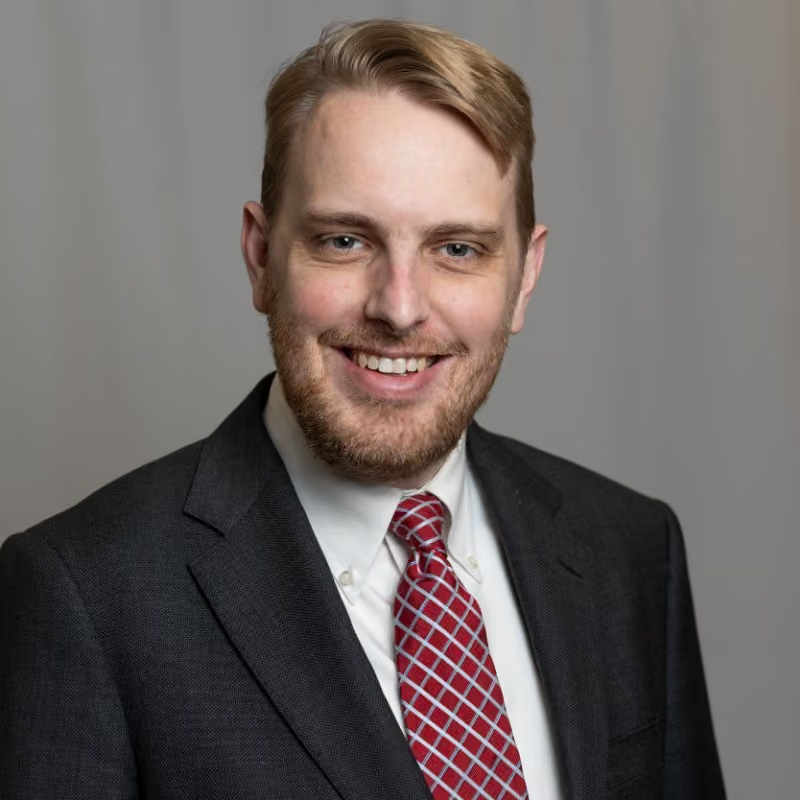
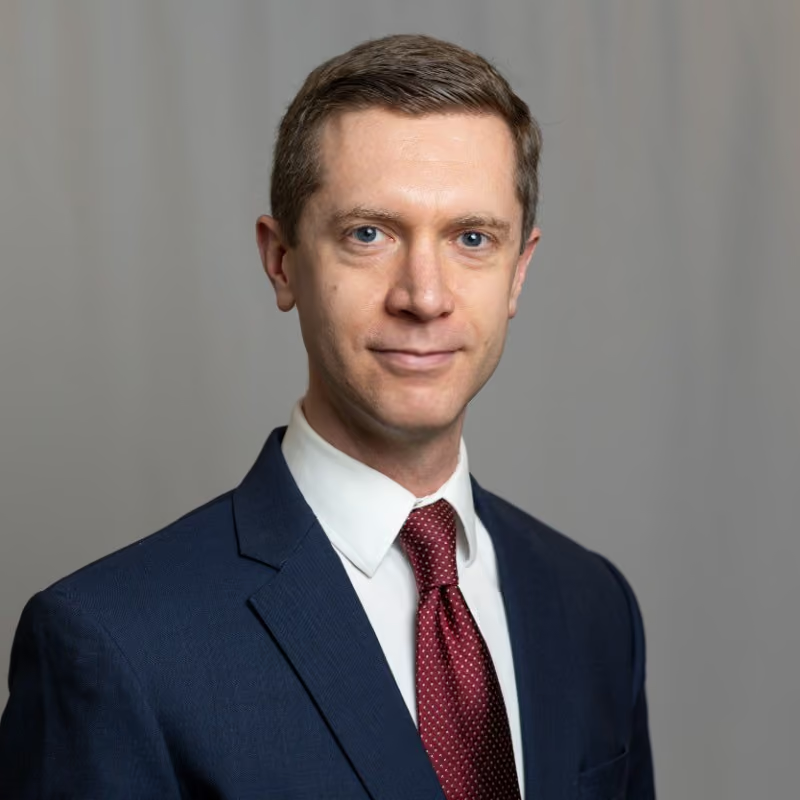
Host: We are getting this week's story of buying a business from multiple perspectives. Today we'll hear how Don goerley acquired a 45 year old business and on Thursday you'll hear from the seller, Peter Wild and the deal facilitator Carlos Laconi. Boston Tree Preservation the subject of this pair of interviews helps homeowners tend to the health of their trees and plants. A veterinarian but for your trees Don Goerly, today's guest talks about what he likes so much about the business, where the potential is and how he approaches leading an organization whose founder, Peter Wilde, the seller, was regarded as an industry pioneer. We also get into the mechanics of Don's search which was constrained to the Boston area. Valuable perspective here for those who don't want to have to move to buy a business, which I suspect is most of you. Also listen for how Don arranged his interns. He took what is a well known playbook of having interns for your search and refined it to ensure that all the interns got as much value as possible from the experience of working for him. Even if you're not planning on using interns, Don's breakdown will show you how an experienced manager brings structure and value and scale to a team. It's so fun and interesting to hear from both the buyer and seller of a business that sold. So make sure you tune in on Thursday as well for part two of this story with the seller. Here is Don Gourley, the buyer and now owner of Boston Tree Preservation. Welcome to Acquiring Minds, a podcast about buying businesses. My name is Will Smith. Acquiring an existing business is an awesome opportunity for many entrepreneurs and on this podcast I talk to the people who do it. I want to share an update on the Acquisition Lab. As you know, the Lab is a highly vetted cohort based accelerator and community for people serious about buying a business. After going through the Lab's month long intensive, you have ongoing access to almost daily Q and A sessions with advisors, regular live deal reviews with Walker Deibel, author of Buy, Then Build Potential Deal, team introductions and a very active Slack group with other searchers on the path. Well, the update is that the Lab recently passed 60 businesses acquired and for well over $100 million in aggregate transaction value. Also, all members now enjoy lifetime access to the Lab because when you buy a business it's often just the first of many and the Lab wants to support you in every deal, not just your first. Lastly, check out my recent interview with Shane Ursum, episode 105. Shane acquired a business with over $1 million in EBITDA in just six months. And he attributes a lot of his deal success to what he learned in the lab. Check out acquisitionlab.com or email the lab's director, Chelsea Wood. Chelseieveenbuild.com Don Gorley, welcome to Acquiring Minds.
[3:12] Guest: Hey Will, thanks for having me.
Host: Don, you acquired a business called Boston Tree Preservation. It is a business with a lot to like as a searcher and I know that because I've already interviewed the seller, Peter Wild. So for this acquisition, we're getting your perspective as a buyer, but we will also in part two, have the perspective of the seller. So it's kind of different and fun to get the full view here. But for our conversation here for the next little bit, we're just going to get your piece done. How about some quick background on you to start, please.
Guest: I'll try to take you guys up to where I started my search. So I was born and raised in Massachusetts, went to Northeastern to study civil engineering and joined the Army's Reserve Officer Training Corps, got my degree in commission, went into active service for the Army. About 10 of my 12 years of active service were spent assigned to units in Europe and from there we did our three years in Iraq and Afghanistan over about three different deployments. At some point had, you know, two, two beautiful young boys growing up and wanted to see them a little bit more and decided that I was going to make a shift off active duty and come back and use the post 911 GI bill and get an education. So I left active duty, joined the Massachusetts Army National Guard, which I would always joke with people, was a little bit like putting on a Nicorette patch. When you give up smoking, you still get to serve, but it's on a part time basis. I went to Babson College and got my two year mba. And then I had a friend who was over at the Kennedy School of Government at Harvard getting a mid career master's and he had told me about it sounded great and I kind of missed that element of public service that at least at that point in business school I didn't see in my future. So I put an application, got in, went over there for about a year and found myself really first time back in civilian life as an adult in the epicenter of the political and cultural wars going on at the time and said this is a little bit intense for me. I think private sector business is where I want to be. So coming out of there I was interviewing for jobs in commercial real estate, local in Boston, but unfortunately my Late father had come down with cancer and was helping to care for him and towards the end of his life, sort of truncated the professional search. I just had a few companies I was interested in, mostly focused on taking care of my old man. And a few months after graduation, unfortunately he passed. Same day that he passed, I had three job offers come in for commercial real estate positions and turned them all down. You know, a lot of things happening on the same day. I think realized that it really wasn't what I wanted to do, but it was, I wanted to make sure I had a job. My father's passing kind of crystallized things. Took a, took a little time to regroup for a few weeks. Happened to meet someone who was a search fund accelerator, successful acquirer and CEO at a Boston Chamber of Commerce mixer. And he told me all about how some baby boomers, some investors and freshly minted MBA come together to do a deal. And I said, that's for me. I always felt that the problem some military officers had, at least I had in a job search, coming off active duty, as you walk into a room with a guy interviewing you, he's got all four people working for you and he says, tell me about some time you led. And you're like, if I answer this question honestly, I'm not going to get the job. So I think a lot of us come out with, you know, this much general management leadership experience, but this much specific functional knowledge and what it is that you did in the service, unless you were a dentist or something like that, and you're going to get hired and recruited for the lower of those two things, by and large. And when I, when I met this, this young guy who's a CEO working in industrial park outside Woburn nearby where I knew the area well, I'm like, what is a, a young good looking South American man, HBS grad electrical engineer and working with a bunch of plumbers in this industrial park outside Woburn. And he told me his story and, and that was it. So, kind of wished I'd been paying a little bit more attention in business school and heard about ETA or search. But in that second I knew what I wanted to do. I took a little bit of time to get organized to do it and then launched my search.
[7:30] Host: And so Don, it sounds like what really attracted you to it was the opportunity at leadership, not necessarily that you were always bound to be an entrepreneur or something like that. It was really, it was really, yeah, the closest thing to, to in civilian life, kind of having the leadership that you had in Military service, outside the military.
Guest: Nobody was going to give me a unit to lead. I was going to have to take it.
Host: It's concise. And Don, you just have to, we have to circle back on when you said the interviewer asking you tell me about a time that you led and if you were actually truthful, you wouldn't have gotten the job. Elaborate.
Guest: Well, I always. You get recruiters that will come to schools and they're going to be the executive vice president of some organization and they're there looking for people in talent. You show up at these social mixers to meet these people. Deliberately you meet them, they want to get you as part of the organization. But they're, to use a military analogy, they're like a four star general and they can, they have a lot of power but they're not the guy who's going to hire you. So they punch you down to the three star general who then got a mission from his boss to find you a job. He punches down to the two star general and it keeps going until you get to the guy who actually has a job for you. And that's where they want you for your leadership management experience. But they keep punting you down until they find something that fits your background, which is you don't have any. And exactly what they do outside of your education and your degrees and find yourself down at a place where you're not going to be hired for your management leadership ability. You're going to be hired for your potential and your ability to grow functional knowledge. And I can't blame them. You know, running a business now, training people is hard to do and I wouldn't want to take on somebody who one I'd have to invest a lot of effort to train. And then when I do it, his background is his lead organizations 10 times larger than the one I'm leading right now. I'd basically be hiring and creating my own competition. There's no incentive structure for their.
[9:28] Host: Gotcha. Gotcha. Great. Excellent. Okay. So you are exposed to this idea of search somebody who successfully done it locally there you say this is for you. You kind of start organizing yourself and tell us a little bit, a little bit about the search itself.
Guest: Well, once I got into it, I did all the stuff that a lot of new guys do. I hit a conference, I get the red book. I could download the big old PDF file from Stanford. I start cracking into it and I start talking to some people. Came across Jim Sharp, he gave me a little bit of his time, very generous. Said what a lot of the advice we all give out to guys is go talk to 20 searchers. So I did all these things and realized one of the first decisions I'd have to make is geographic search or nationwide search. I was fortunate I had the ability to self fund and did not want to pick my children up who are starting to get rooted now after a few years into life. Because part of the things I was hoping for them to experience with me outside of active duty was to stay in one community for a period of time and not pick up and move. So it seemed a little counterintuitive to then pick up and move them. Although I would say in my own experience now there is always a business big enough that you will pick your family up and move them for or at least nearly always a business big enough. And so I probably should have considered that at the time, but my whole family was back this way and I wanted to stay if I could. So I had to decide when I'm going to roll the dice and fish in a smaller pond and hope that I'm a good fisher.
Host: So geographically constrained and self funded, you had the that sort of good fortune or luxury to self fund? Did you have a sense of what your Runway would be? How long were you giving yourself?
Guest: I. I looked around and said 50 million elves fans can't be wrong. And if everyone says 24 months is about what to do, I said can I do 24 months? And the answer was yes, and can I put a little reserve aside in case it doesn't work out? And I said yep. So I said that that was the deal. I had had my main parachute for 24 months and I was going to pull the reserve if it didn't work at that point, which sometimes I, when I talk to guys about, I say there's two ways to look at it. I would say you have a plan A and a plan B and a plan C for your search, but you want to have a plan Z for when things don't go well. But you want to write that plan Z down. You want to make sure it's a really good plan and then you want to wrap it up and put it away and don't look at it because you have to pretend like it doesn't exist. I mean, mentally, I think you're either there 110% or you're not there at all. I think it's too hard to do if you're not committed.
[12:09] Host: Yep. Okay. Well, in terms of how hard it is to do, tell us what your search started looking like as you started, embarked on these 24 months.
Guest: Well, the first thing I did is I spent a little bit of time organizing. So I switched branches from being a corps of engineer officers in the reserve component to a cyber warfare officer. And even if you're a part time soldier, when you change your specialty, you need to go for some retraining. And so I did that. And that bridged me a little bit of time outside of formal training and duty assignments to mentally prepare for the search and to educate myself. And the first thing I realized is I really should have taken that class back at Babson, which is all about buying a small business. Somewhat of a joke, but somewhat true. I thought it was all for the wealthy South American guys who dad owned a bank. I figured that was the class designed for them. There's a little bit of a tradition with that at Babson and. But that was just me not knowing what's going on. So I went back to the professor and I said, professor, I really should have taken your class. I'm sorry, I didn't. Do you mind if I sit in the back? And he was very generous. He said, yep, you can sit in the back. He said, don't raise your hand if any of the paying students are raising their hand, but if none of them are raising your hand, you can raise your hand because you know I'm going to get bored if no one raises their hand. So he let me do that, and that was sort of me catching up for having not taken that class. I got a good baseline and then, like I said, I decided on a geographic search. So then the, the next question you always hear from guys is, do you do a lot of interns that you don't spend a lot of time on, or do you get one or two interns that you really take care of? And I thought about that and I decided that that's not the right way to go. I had tried searching a little bit while I was in the class on my own, sort of like a dry run, knowing that it wasn't going to formally start looking until after the class was finished. I picked zip codes that I had no desire to acquire in and looked at businesses to sort of get over the fear of making a mistake where you do want to acquire. So that was sort of my, my training range, so to speak, and got some reps under my belt, did some I.O.I, some Lois screwed up a lot, made a lot of mistakes with brokers on the phone. Try to learn from them, forget the embarrassment, remember the lessons and regroup and move forward.
Host: What were some of the mistakes that you were making in those early conversations?
Guest: Two weeks to get an IOI out of my inbox or out of my outbox and over to them. Later in my search, I held myself to a standard of 24 hours to deliver an IOI from having something equivalent to a sim. You know, being from Boston and being a old Celtics fan. We got Red hour back here, and there's a plaque in the Boston Garden saying, if you don't shoot, you can't score. And one thing I realized, one of my earlier mistakes is just being too slow, and it communicates the wrong thing. For one, it conveys rookie ship. Of course, I was a rookie, but it really conveys it to a broker. When someone's slow on an ioi, that just gives them a bad sign. And one was not understanding brokers enough. You know, realizing that I might scan through 300 deals and only get serious about maybe 20, and then, you know, push forward 10 in the whole funnel. Brokers like that, too. They've got tons of deals, and they have deals. They don't think Those are the five or six that are going to yield the collective 10% commissions that's going to sustain their lifestyle that year. You know, they probably have this many out there, and these are the ones they think are going to be their real goals to close that year. Well, if you're out here on this other one, they're gonna. They're not gonna get interested in it unless it's a higher multiple, thus a higher commission. So I realized it's not just working with the seller. It's the broker gets to put their foot in the scale on which deals move forward, because when that deal moves forward, it drags them along with it and out of their portfolio of potential deals. Maybe the one you're interested in is not on the top of their list of what they want to see get to close in that year, because they can't do them all. And there's nothing wrong with that. That's just the way the industry is set up. That's their motivation. But I would be blind to that sometimes. And I would see a broker who's insisting on something being at what I think is a ridiculously high multiple. And I'm sitting there thinking, like, I've only been doing this for a few months, but you must be, like, two days old as a broker. That's obviously not the case. They are probably pretty good at valuing things. They work for big firms that have professionals with decades of experience There's a reason why they're marketing this thing at a higher price. They're not that excited about it closing, but if they can find somebody to pay 7x, they'll get excited. So there's a little bit of naivete there. I also had one guy tell people about this too much, but he tried to sell me a dead man's business. It took a little while to figure out that the guy was not alive. It was. It took multiple attempts to try to find this guy. It was very much like Weekend at Bernie's. And the broker was actually trying to sell business on behalf of a state or surviving family member, but was not. He was not saying the guy was alive, but he was not able to get me to meet him. But that was a different situation. And I always kind of laugh at that because I'd see experienced searchers and they always seemed very direct and to the point. You know, they look a guy right between the eyes. Like, why do you want to sell your business? Like, you almost seem hostile and kind of like they've been jilted at the altar 10 times before. And, you know, they just. They're no BS at this point. And so I remember the same broker reached out to me again. I said, okay, first thing, I want to see some proof of life on this guy before I'm going to look at your. Your sim. Anyway, that was one of my rookie mistakes going in. Maybe not the best lesson, but perhaps a humorous one. And then after I had shaken the rust off, I turned my focus back to the geographies that I really wanted to search in. And then the question now became is how do you eat this elephant? I knew that to be successful in 24 months, I would have to dredge the bottoms of what's available much better than if I was looking nationally where I can quickly look. On the surface, I couldn't leave an eligible business unfound in the zip codes that I was searching in. So I had to become the sort of worst cold caller ever. Every businessman's nightmare. Because if you own a business and you're registered in the state of Massachusetts, I am calling you somehow, some way. But I realized I couldn't do it myself. I tried to. I tried to do it mechanically. And I came back to that question of what do you do with your interns? So you could think of my search as broken up in the middle by Covid, because there's longer than normal with. With COVID in the middle. So there's the intern, heavy pre Covid search, and the absence of interns post Covid search. And that's because I had to canvas pretty much everything east of Worcester and Hartford in New England and I had mechanical lists. But I realized the problem would be that once I get to know an industry so I can recognize a good business from a bad business in that industry, I'll exhaust the total count of industries or excuse me, businesses in that industry pretty quickly and then I'm gonna have to get smarter another industry. And I said I can't do that. I've got to have a group of people getting smart on the next industry while I'm working the current one. And then they can distill down the research to me so I can quickly move ahead. Because my fear was not being able to separate the wheat from the chaff and recognize a good business that's benchmarked against, you know, the average business in the industry. I might think something's great because it was great in another industry, but it's horrible. So what I ended up doing, and this is something I key point I wanted to get across here is that the old dichotomy of get one or two interns and invest a lot of time in or get a bunch and don't invest any, I think that makes sense for most searchers. But there's two groups of people that that doesn't make sense for second time around. CEOs and military officers or people with equivalent experience somewhere else in life you're probably not going to have. That's perhaps your August Felker, a second time CEO going out on a self funded search. Obviously you're down the learning curve there a little bit. You've probably plan and organize and led teams to do these things and you can do it again. The military spends a lot of money on the people that it recruits to teach us how to do these things. And to not do that would have been searching with one hand tied behind my back. Especially as a geographic searcher who had to dredge the pond very deeply and move fast to find something in 24 months.
[21:10] Host: August Felker is a two time successful searcher. First with a traditional search fund. The second time around he did a self funded search. Today August runs Oberle Risk Strategies, an insurance firm with a dedicated practice group for searchers and acquisition entrepreneurs like you. If you've got a business under loi, Oberle will provide complimentary due diligence on that business's insurance and benefits program. A great no risk way to get to know August and team. They love helping searchers They've worked with hundreds. Oberle is a specialty insurance brokerage for searchers. By a former searcher, check out oberle-risk.com O B E R L E- risk.com link in the show notes
Guest: the question becomes is how do you manage a lot of interns? How do you manage double digit interns and why would interns come to you in a double digit scenario where their individual time with you is going to be diffuse among the other interns?
Host: Right?
Guest: So there's probably three or four things about that. Two of them perhaps unique to me, but the rest valuable to everybody else. The first is not all your interns need to be undergrads. Undergrads want experience. I went to Northeastern as a co op school. You rotate around to a lot of different co op jobs over a five year period. You have a pretty good idea if you pick the right major before you graduate. So I didn't want to bring an intern in and have them do the same thing for four months or six months. I also couldn't invest a lot of time in training them. So what I did is I'd organize them into teams and I'd have a graduate student intern lead the team. What don't graduate students get to do? Graduate students often don't get to lead anybody. So if you take into account that had plenty of experience training and assessing leadership, it shouldn't be too hard to organize three like minded MBAs who are also interested in buying a business someday themselves as interns and teach them how to lead these teams. They already knew the first or second year of business. They're already interested in search. They just needed a little bit of coaching on how to manage a team if they didn't have that experience already. So I had grad students managing the interns who are undergraduates and we would rotate them around. The grad students would stay fixed on the same responsibilities for me and they looked at different time horizons, businesses under consideration, IOI or loi. Businesses that we were actively doing outbound proprietary outreach to. And then the next industry around the corner, the grad students stay fixed on timeline horizon. The undergraduates rotated around and what that did is that gave both groups of people something they normally can't get out of an internal. Grads got to lead. Undergraduates got variety to see, hey, do I like doing industry research? Do I like financial modeling? Do I like digging in to the accounting of a business? And that worked pretty well because as each group moved around there's one person, the graduate student who's already Experienced and can train up the new group of people. So I solved the problem of me having to constantly be a full time trainer of interns and built a system that can sustain itself. People like it when you go back to career services and you, I would say, get a 10 slide deck and go pitch the career services of the universities that you want to pull interns from. Go talk to a professor who teaches a related class that your interns need to have and say, here's the opportunity. If you think this sounds good for your students, perhaps you could direct me towards some students who would be a good fit. Just like I think the first part of your search is searching for your search team. You search for your accountant, you search for your Q of E provider, you search for your attorney, your interns and your investors. And I think that's a good one to do while you're kind of just working on a broker focus search perhaps in an area where you don't want to require, where you can make all your embarrassing mistakes and poor modeling decisions without too many eyes on you. At least I did. It was easier for me. I felt better about making my mistakes. And then I got to keep them a secret until I am here talking to you.
[25:13] Host: Um, Don, Don, let me stop you for a second. The interns, now a lot of people are listening to this, are going to have searched or be searching and not use interns at all. Interns are very much kind of coming out of an MBA program and this very formal search process covered in the classes, covered by the book, interns are a key part of it. But outside of that context, people don't, you know, reflexively put together an intern team. Could you have imagined doing your search without interns?
Guest: Yes, but I would have focused it mostly on a brokered basic search. I don't think that would be too different than what a lot of guys have done. The other one would have been blasted emails going out. But I think what I would have done is generate a lot of inflow that I couldn't have managed. So I wanted to make sure that I had the people organized to have balance between the flow of opportunities in and my ability to manage them. I made that mistake when I got started. I get a bunch of deals, but I only had time or experience to focus on one and the other one's just withered on the vine. Having made that mistake, went back and said, well, why did happen? And I realized I had already learned how to do these things in the service, but I had not applied those lessons in civilian Context. And that's why I'd made the mistake.
Host: Okay, so tell us how the so you build the system in your first phase of search when you have a larger team of interns. But then phase two of your search post Covid you, you had no interns or you dropped to two interns.
Guest: What did that look like I had? As the expression goes, sometimes you might find after your proprietary search has run its first wave, you might circle the hoop, as a lot of us say, and deals or brokers that you'd built relationships with will come back to you. And I had felt that enough of that had happened also during the search. Being a reservist and the state guard, we were activated almost 100%, so spent a long time on active duty. I had a deal collapse two weeks before the pandemic started because its supply chain was in China. We had an agreement on a $6 million price. When the pandemic started creeping, they wanted six and a half and I wanted five and a half. And that was million dollars between us was enough daylight to kill the deal. Probably not a bad thing that it did. But then right after that a lot of us were called to active service. So my concern was when I restarted my search is the pandemic was somewhat unknown. I did not know if I would be recalled back to active service again in my search. And I didn't want to build a big team that I would abandon. And so I leaned on the fact that I had done a real good pass and had really good files over who are the brokers who are getting the kind of deals I'm looking for, what towns tend to have the highest return on proprietary search, what channels and, and that worked out and I was able to go back and lean on that again. But of course, as we get down to a Boston tree preservation, something as simple as when the day is over and you're scanning some of the low hanging fruit that gets posted here or posted there, sometimes you come across something that turns out to be great. But I, I would say though that I had built a system on both ends that would have led to a result. But sometimes serendipity is a part of that system.
[28:39] Host: Well, I like the expression increasing the surface area of luck. So just kind of maybe a numbers game is another way of putting it, but the more you put out there more the more likely you are to to make contact with what looks like serendipity, but is actually just increased your odds of good fortune hitting. Okay, so, and so when you say circle the hoop Just to be absolutely clear that does that mean that folks, these brokers that you had developed relationships with a year, two years prior, before COVID hit, were coming back to you or were you outreaching to them? Oh, they were coming back to you.
Guest: There's a little bit of both, is a reach out and they know what I'm looking for. One thing I learned early on, but I had made the mistake before, is to be crystal, crystal clear about what you're looking for. And every time a broker brings me something, reply to them and say I'm interested or I'm not and I'm not. Because here's my criteria again and here's where this one doesn't meet one of the ones that I can't live without. And to really try to be a partner with the brokers, I know there's all this opinion on the blogs about pro broker, not pro broker. I'd say don't hate the player, hate the game. You know, these are people trying to, with their incentive system and their motivation and they're looking for people who can get them the commission for a good business, earn their reputation with somebody who's not just a tire kicker, as we all know. So I tried to support the people that I was asking to ultimately support me, which is the brokers that would bring me some deals on top of going back to old proprietary targets and reaching out to them, particularly people who after a pandemic may be looking for an exit.
[30:21] Host: Okay, well that was a great breakdown of the anatomy of your two phase search. But as we know then, so, so Boston Tree preservation comes across your desk,
Guest: how it comes across of all things under the deal section under the search funder website. And it's funny, I had a couple of deals like this where the offering pops up and it looks interesting and it's nearby. So I'm a geographic searcher and something that was just one town over is going to catch my attention. I took a look at it and I was like, hey, I think I know the guy who posted this. I think he was my classmate at Babson. And as it was, I reached out to him and we got on the phone and he told me about it and it all sounded fantastic, but in a teasing way. We all know Carlos is a smooth talker, silver tongue devil, but, but, but a good guy. And, and so we, we talked for a little bit about the business. I was definitely interested. Everything sounded right and the table of contents and of course it was close. Now close could be thought of for a couple reasons. Close yeah, sure. Makes your life easier. Your everyone usually finds their job and then picks where they live so they can have a manageable commute and lifestyle. But I was doing it the other way. I knew where I lived I might have to move, but I didn't want to if I didn't have to. But this was, you know, 15 minutes away. But I had other deals that were at various stages of the process which were an hour and a half commute away that I was doing with one partner or another because of the time distance factors and the size of the company. And the one thing I realized is if you want to be putting in more than 40 hours a week and you ought to be an hour and a half commute each way is going to really crimp your style.
Host: Yeah.
Guest: So, you know, then you really get down to the scenario of, you know, do you put your house up and move and do everything that that entails for the job? And, you know, if the business isn't big enough, the juice is probably not worth the squeeze. This was a fantastic business, and I was happy I found it, but still had other mechanisms in place and had other active deals that I was looking at. But this immediately, even though it was smaller than all the other deals, became my priority.
Host: Well, given it's right next door to you, so proximity is beautiful. What else did you like about it? Tell us about the business.
Guest: Well, the best part about it is we weren't selling meth, I wasn't running a collections agency, and we weren't doing anything bad. It's organic healthcare that focuses on preserving your landscape, particularly your trees. So if there's one thing I would look forward in, a business is a business that you feel like a good guy when you come home at the end of the day. And this one appealed to me quite a bit. It was also very niche. I was a little confused in the beginning. I'm like, wait, are you a landscaping company? It's like, no, no, no, we're not a landscaping company. We don't cut grass. Okay, okay, I get it. All right, You're a tree company. You cut trees. No, no, no, we don't cut trees. Okay, you don't cut grass, you don't cut trees. What do you do? And it's like, well, we're kind of like a veterinarian for trees that makes nothing but house calls and doesn't have a veterinarian's office. So that's pretty much exactly what the business is like. And I said, that's a business, and it's like oh yeah, it's a good business. And Carlos walked me down through the numbers. I'm like, that is a good business.
[33:48] Host: What about it? What made it a good business? The margins.
Guest: It's a three legged stool of things that make me happy. The financials are all there, but operationally it's very interesting. There are, there are challenges to grow the business, but they're solvable challenges. The value proposition, what they actually do, helping people preserve the quality and health of their landscape for their own enjoyment. Anybody who likes the great outdoors could find some satisfaction in that. And the other side of it is there is this new and growing E commerce side to the business digital marketing side. That was just getting started and to me that was great because the operational side lets the sort of the military officer and the engineer in me bring himself to bear, you know, maybe a little bit of who I am long before I finished high school. Likes the, likes the tree health care and organic plant health care side of it. And then you know, the financial and E commerce side with an MBA education really gives you something to work with. You feel like you can take all those classes that you learned and you can actually take those tools and put them to use and it's a nice balance between the three. So it wasn't a medical device company where I'm like, I would wreck this place. This is, this is not for me and no one should sell to me. But this one I saw and I said yep, I can throw all myself at it and be successful. And, and the margins were good. You know, when, when roughly a third of the sales drops to the bottom line, you've got something to work with is a little bit smaller than the average sort of HBS book would say. Is your EBITDA range not too much smaller, but a little bit smaller. But you know, that's the template for that is a 15% EBITDA margin business. So when you're more than double that, you can go a little lower on revenue, especially when you have a positive cash conversion cycle as much of this industry does. A lot of landscapers take, you know, seasonal deposits. We're not landscapers, but we take upfront payments at a, at a discount to the customer. And we normally have 6% of our operating cash needs within the first three or four months of the year. So in that sense we actually have a six figure cash float for about half the year. That is an opportunity to grow. So yeah, basically small businesses are small for a reason. There's a great reason why this one was at the size it was at and if this thing does not grow, there is nobody to blame but myself.
[36:27] Host: And sorry, did I miss what the reason was that it was that it was small. And, and make sure you tell people a little bit of the history or at least how old it was because it's, it's a decades old business.
Guest: This business was founded in the year that I was born. So definitely more than four, four decades. And it had been around for a long time. It had done all sorts of tree work, everything. But the seller, as I think he'll get covered in his interview, was a serial entrepreneur and had invented a fantastic new way to inject treatments and medication into trees when they need it. And just putting it into the soil on the leaves will not be sufficient. And that has grown into a fantastic company. It's known around the industry, it's the industry standard for injecting trees. And I won't try to steal his thunder. It's a, it's a fantastic story. This was not his greatest business success, it was his first business success and a fantastic legacy. But he was an established businessman through other activities. So in that sense it was a side dish later in life, not the main meat on the plate. And so it didn't receive the majority of his time. The other one is he made two big investments in the company. One's material to what we're talking about here. One is he invested a lot in the vehicle fleet once he decided to sell. The second is that he put in a lot of modern software systems on what had largely been a business run on map books and custom made Microsoft access Software. And imagine 20 years ago, this industry. But he brought it up into the 21st century. But that's tough, that's tough to do and integrate all that stuff. That's tough for a big company. And we have some heavy software in this company that has a lot of capability in it. And what it needed is somebody who would treat this as the main dish on the plate and will dive in and basically be frustrated until you make it all work. And so that's my first six months of ownership is that I just have the luxury of focus. I'm not a GM trying to sell the business on behalf of the owner. I'm not the owner who has a diverse life and a family that he wants to spend time with. After many business successes, this is my main professional focus. And so the, the, my different horizon and objectives that allow me to focus my time is what brings the power to synchronize what's Already there so that it can be as successful as the seller knew it could be when he started the ball rolling.
[39:13] Host: And we're going to get into that a little bit more. But to, to be clear, so this 40ish year old business, did you say roughly what the revenue is? Can you.
Guest: Yeah, it's between 2 and 5 million.
Host: Okay, so it's a service business about 40ish years old, 40 plus doing between 2 and 5 million. And on the one hand you say to yourself, why hasn't it grown? And you just explained why. Because Peter Weil, the founder, was devoting his full attention to yet another business that he'd started. On the other hand you say to yourself, not only does that mean that with 110% of my attention I can probably grow this, but the fact that the business had kind of carried on and continued to operate in not died. In fact, I think as I understand it, it had continued to grow if kind of only incrementally says, says a
Guest: lot about the quality of the business
Host: that even without the founder's full attention, it continues to, you know, carry on.
Guest: Yeah, he was lucky that he had a great strategy and picked a great niche and he had great people. The employees are incredibly knowledgeable. They're the same level of dedication to their trade that I'm used to seeing back in the service and I know exists in many other industries. And it's refreshing and familiar to work with them every day. They're true professionals and they have the same amount of care for trees that if you take your pet into a veterinarian's office that they have for the pets they care for. And that's nice to see because you don't have to clean up after the tree as much and it doesn't eat nearly as much, but we do feed it quite a bit. They're great people. So the obstacle that kept it from going forward was making that digital jump is that the profitability of the business comes from a very high gross margin and a relatively light overhead. In industries like ours, many grow by investing heavily in the middle management ranks. We were middle management light and so we had a couple ways we could try to grow. You could add a bunch of back office people and that would increase your capacity to take in more revenue. But the software was designed to take the place of excessive middle management that would really just be moving a lot of information around and managing data, but wouldn't be a high level knowledge work. Said software can do this better and people will be happier with their jobs focusing on the stuff that only they can do the best. So Peter was right to install the software that would allow operations to scale where we'd be adding direct labor, but wouldn't have to add a ton of overhead to do it. It's just. It's a little bit tricky. We brought in Salesforce software, which, you know is not an industry standard for what we do. It's extremely capable, but it's like a blank canvas. It can be whatever you want it to be. That's why they're so big and they sell everywhere. But you have to customize it. It's like a white canvas. And so for a small company to work with an integrator to basically custom configure some very capable but. But not cheap to integrate software has been a challenge. He invested heavily in it and move the ball forward very far. What.
[42:35] Host: But Don, let me understand. So he invested before the sale to you in this software or. Because what you're talking about in the present tense as if this is your project.
Guest: I picked the ball up. I'd say 50, 60 integrated.
Host: Okay.
Guest: But it has to be 90 integrated. You have to tighten down the screws to 90 before you can step on the gas. I could walk in and take a hundred thousand dollars and put it right into marketing, hire a decent agency and make a lot of mistakes in marketing because it really hadn't been too much before. And I could get customers coming in the door, but our ability to handle it wouldn't be there. We were perfectly set to grow at that slow, steady rate. But to take full advantage of the company's potential, we had to figure out a way to increase the amount of customer interaction, the throughput in a way that would stay organized for the employees in the field. And if you. You tried to say double revenue. Nice problem to have. But even trying to grow at 20% initially would make day to day very hectic. And you wouldn't want to have a Hector veterinarian's office either. It's not good for the cats and dogs and it wouldn't be good for the trees. So everything was set up. It just takes a little bit of focus to sit there and be in the business every day and look at everything systematically. And when you make a change in one area, you have to have in mind where everything else is going to change. So that's essentially the. The first six months in the job was trying to answer all these questions. The great news is the answer is it's completely doable and we're working on
Host: it right now, well, and so is this a case. I asked this actually to Peter and Carlos. We hear in Search that digital transformation is, you know, kind of one of the obvious playbooks, if not the most obvious playbook. Find a fax machine business. Out with the fax machine, in with Salesforce. But at the same time, you'll have kind of. I've heard just as many stories of kind of detracting from that playbook where it's like, you know, if we have some internal SaaS instead of, you know, the paper we're pushing around, yeah, we'll get some incremental efficiency there. But that's really not the bottleneck in this business. But it sounds like actually, happily, in the case of Boston Tree Preservation, it really was that this really was a fax machine. I know it's not actually a fax machine. There was software there, but it was old software, custom software. This was a business that needed that. That a digital overhaul was exactly what it needed.
[45:12] Guest: You're. You're right. And, but the, the caution you raised is also true that customers love us almost as much as they love their trees. And we're a high touch company. You know, someone comes out to talk to us while we're there, we'll sit around, we're going to talk for 15, 20 minutes. A lot of these customers the employees have known for decade, and we're not going to be sitting there going, we're looking at the watch, hey, you know, number of service points per hour is dropping below benchmark. I got to leave. We don't do that. And so as we've been looking at this for the last six months, one of the key discussions back at the office, how to maintain the standard of customer care that Peter put in while we eliminate things that aren't adding value to us or to the customer. And I think one of your other podcast guests that you had on a while ago goes so far as to sit down at the table with the customers and talk about what they're going to be doing for their landscape. And they're designed extremely high touch for those clients, and we're trying to maintain that standard. The key to the software helping, and I think where we avoid this problem that you raised, is that we're not just adapting the software to our processes. We are in some. What I'm trying to bring to the company is adapting the process in light of the capability of the software that we're using. So originally, back when the first aircraft carrier was built, it was designed to be a reconnaissance force for the battleships to get those planes flying far away from the battleships, find the enemy, bring the battleships in. But people quickly realized that the carrier could do a lot more. And now the Navy works on a carrier centric model where the battleships protect the carrier and the carrier with the aircraft is what fights the battles. So we've spent the last six months really looking at what the software that we have can do and trying to redesign and improve our value proposition to customers in light of the capabilities of the software systems that we are integrating. That's the difference where we start with what the customer needs first and we work back through the human and the software processes to deliver a result. And that level of integration is what helps us avoid that trade off.
Host: Okay, excellent, Don. So in speaking with Peter, you, you for more than five minutes, get him to get in, getting him talking about the tree business and the history of this business. You realize real quick his passion for trees and that he's really a pioneer in this space. We got that whole story in my, in my interview with him, which which people will hear will air. Will air after this conversation. And so tell us how you felt about that. So being an outsider to an industry and buying into that industry and then quickly learning that industry is a common theme in our world of search. But now that I've interfaced with a seller, a founder, kind of a visionary, really, Peter Wilde strikes me as, it seems like that might have been even more intimidating in his case because he's not just a tree guy, he's a guy who actually moved his industry forward. How did you feel about that, filling those shoes?
[48:36] Guest: Frankly, I think in the beginning of the process, it's definitely something you're like, okay, can I do this? And I say to myself, well, first off, it's not medical devices, so it's trees. And there's books on this. And this industry has been around for more than four decades, you know, centuries. And many people learn it all the time, and so can I. But most importantly is when Peter leaves the company, who knows how to do this before I figure it out. And they had a deep bench. Now, I didn't get a chance to meet the employees before the, before the closing and I met them afterwards. But having spent a lot of time with Carlos and Peter, I was able to understand their operating model and I understood that, you know, Peter was involved in the company. But there are definitely a lot of high touch customer interactions that were going on with the existing experience employee base. So I knew that the cash flows are seeing was just amongst just as much a function of the skills of the existing employees as purely Peter, because Peter had trained them well. Yeah, in fact he talked me through some of the things that he was doing sort of behind the scenes and a lead up to a transaction to make sure that, you know, people really were able to operate without him fully engaged. But as I'd say to the guys when I got there, I said, I can't replace Peter wild. He's got 40 years of doing this. I'm not going to try to replace him. I'm going to try to be myself and come in and take what he's built and try to carry it forward. So my strategy isn't going to be based on me having his knowledge. That would be a horrible strategy. It will take me, you know, years to develop functionally sufficient knowledge to fill his shoes. But the team has that experience collectively and that's what you get taught as a military officer or first time CEO is how to get the most out of the people that are there and create an environment where the team works really well. You know, I'd say that one of the first things they drum into you as a young cadet is that there is no such thing as bad units, only bad officers. And there are no such thing as bad companies, only bad CEOs. So when I looked around, all the talent needed was right there. I just had to lead the people to get the same job done in a slightly different way. And we've gone through the first year of that where some of the high touch, high knowledge demand have fallen on a couple employees a little bit heavier. I've tried to lighten their burdens in other areas. And then we have a deliberate plan going into what we call kind of winter camp as when things freeze, we don't do as much of our work and we're going to start to cross train people. And we have a new operating model coming out into the spring. They'll take advantage of what I've talked about before. Enhanced program for our customers to give her high value that open the doors to more growth. Combined with a software backed operating model that allow us to grow without increasing overhead. But it's a people centric business because ultimately at the end of the day it's this business is no better than the technicians that I train, recruit and motivate to put in the field that help people protect the tree that they planted with their grandmother 80 years ago.
[51:47] Host: And to reminds me of a question I wanted to ask. So because it is niche tree health, it's kind of A niche within a niche of landscaping, if you will. Is that why the margins are so, so strong, these 33% gross margins? Because. Because you're, you know, maybe you're offering a really specialized service.
Guest: Yes, we're much more high touch. So the typical way that and a pruning company might get into this is they're going to come by and cut something that's dead off of a tree or they might prune it to help it grow properly. And when you put a big wound on a tree, just like you and I might need a. After a bad cut, might need a shot of penicillin, the tree needs some support to heal. So that's the acquisition model. Something's wrong with my tree. Come cut something off my tree. Come provide plant health care to help the tree recover. That's reactive. We do it the other way around where we're trying to keep the tree in good health and to prevent the limbs from dying in the first place. So we're the ounce of prevention as opposed to the pound of cure. And customers feel it in their wallets. They're much better off spending money with us. So if you're trying to think about how a customer looks at us, we're like the decision to put solar panels on your house. It's a little bit more money up front. And so we appeal to customers who can front, load the cash, but eventually it breaks even and they start to save money because our approach costs less in the end and we do it without harmful pesticides and herbicides.
Host: As I understood from my conversation with Peter and Carlos, it's been a very residential focus business. And Carlos, I think was trying to, to. To kind of steer the business into more residential, excuse me, into. Into some commercial business. What are your thoughts on. On that and the potential there?
Guest: I think they're both right. Peter had a strong emphasis on residential. That had been the block and tackle bread and butter that had built this business over the years. People who own trees love them a lot more than people who are simply stewards of trees. And they will pay a higher margin for them. You would simply probably pay more for a tree in your yard than you would for one in the town common. So that dynamic exists. However, Carlos is right. Commercial work can be very profitable. We've served the Boston Public Garden and the Boston Commons in the past. We've served some university campuses and we try to deliver a high degree of value there. In fact, they're very important to me as an example of what we can do on a large scale. However, the thing I have to remember is the profit that comes from that is not going to necessarily be repeat or recurring revenue. That profit is then on a line item reinvested back in the growth of the residential sector. Now the good news is the product is the same, but when it comes down to installing capacity, I'm not taking out truck loans for commercial work, but I will take out truck loans for residential work because that is recurring revenue and repeat revenue over the long term.
[54:50] Host: So why is the commercial, the commercial work not repeat or recurring?
Guest: Somebody comes in, somebody leaves, you have a different guy. People have different opinions about green or organic.
Host: Yeah.
Guest: And what you really need is a, it's a, it's a philosophy. Just like houses perhaps wouldn't install solar panels if they're selling every two or three years. So, you know, it really comes down to an individual customer's desire. People do business with us for a lot of reasons, because we enhance the value of their property, because they don't want their kids and dogs rolling around and stuff that there's no test out there saying it's good for them. Or they might do it on a simple value. You know, the people who shop at Whole Foods, even though it's a little too expensive for them. But what we try to do is, although, you know, some of the chemicals out there that are used in agriculture, people have opinions on this, but I would say that they're, you know, the Midwest of America has, it's sometimes nearly fed the world and certainly the nation. And there is a good cause to make sure that we could generate whatever we needed to. But in our home landscapes there's never been a need to use herbicides and pesticides. It's never been necessary. We can always do it better and in the long run, cheaper, organically. So. And there's no risk to, to pets and dogs. When you see that little flag in the yard saying stay off for three days, that's based on laboratory tests of 150 pound man. Not a pregnant woman, not a small child, not an elderly person. And so there the debate is out there in the industry and in the government about whether it should be banned or not. Some municipalities such as Portland, Maine have many Cape Cod, Massachusetts towns have tried to or successfully ban pesticides and herbicides. I try to sidestep the issue. I'm not into forcing people to do anything, but they simply don't have to. It's unnecessary in the long run, it's cheaper. So that's the value proposition we try to put to people to Just like the name that Peter gave the company, help people preserve their landscapes for the long run.
[57:00] Host: Don, let me ask you just since we're on this topic. So you had said, you know, this, this business has a lot of the characteristics that we, we as searchers really like, maybe it was a little bit, a little bit smaller than, than ideal, but that also represented opportunity for you to come in and grow. But one of the things that I'm feeling like might not be ideal as a searcher is the value prop is awesome. I find it a really neat business. That said, it feels discretionary. And I think you, you basically acknowledged as much by saying you target probably more, you know, higher income neighborhoods, people with a little bit of disposable income to, to spend on their trees. So this is a discretionary spend and in a recession, are people going to stop, you know, being proactive about the health of their trees? Is this one going to be going to be one of the first line items cut from a family's budget? So all to say, do you know how this business has performed through recessions?
Guest: Yeah, it's done quite well. The customers in this business value their trees and if they run into a tough time, they might take a year off, but then they come back. We have occasionally lost a customer to a competitor and it's usually for something like the sake of simplicity. In other words, their tree company comes in and they cut something and they say, who does your plant healthcare? And they say so and so and they say, well, we could do this and that for you and it's going to be cheaper and you only have to talk to one person, not two people. So you see that in the industry and that's something we're looking at going forward. But in terms of discretionary, I'll put it this way, there's a lot of beech trees in eastern Massachusetts. There's disease that will kill all of them in seven to nine years once they get infected. When your tree gets this, you simply have a decision to make. If you do nothing, you will be paying 3 to $5,000 to have this tree taken away in, you know, half a decade. Or you can spend some money with us and we can try to help preserve it until an industry cure is found, which is what's being worked on. It's discretionary, like spending money on your route is discretionary, but you're just kicking the can down the road. And something I found very interesting when I was doing due diligence and I think this goes to the importance of it is that According to the U.S. real Estate Appraisers Organization, 15 to 20% of the value of your home when you sell it is based on your landscape. I think the simple analogy to see this is think of two traditional Cape Cod style houses, small modest homes. One has a beautiful landscape, you've seen one. One is just grass to the fence. And you've seen that too. Would you pay 15 to 20% more? Does it sell for 15 to 20% more? It absolutely does. So, you know, people want to live in nice places. I think the pandemic drove that home. People spent more time at their home and wanted to look nice. In fact, this business saw a bump during that time.
Host: On the topic again of the value prop. So I'm just kind of trying to think about the fact that I haven't heard of this type of business before. Maybe you hadn't either before you came across, before Carlos came across your radar. Is it in terms of just kind of demand for the core service for this core value prop? Are there Boston Tree Preservation, like businesses in other cities, Is this something where, you know, they're all over the place and I just haven't noticed them, or is it something where, where you guys are still one of the of a small handful of businesses that specialize in tree health across the entire country?
[1:00:30] Guest: Actually, that was the number one due diligence question that I had. And I can tell you that having searched around on the eastern seaboard of the US I have found not enough to need my second hand. What you will find is a lot of people will do plant health care. Some people will do organic. Most of them bundle this together with some other offering either landscape services or pruning of trees. But we know a little bit about these industries. There are exceptions. You've interviewed some on your, your show. But landscaping, of course is. You got a truck, you got a lawnmower, you're now a landscaper. It's hard to get high margins in landscaping. You need a excellent management to get higher margins in landscaping. If all you do is landscaping as opposed to like hardscape installs in tree cutting. There's also competition there too. It's high cap instead of low margins. You have high margins, but you have high capital expenditures. You have these very expensive million dollar machines and expensive insurance programs because guys climb trees with chainsaws and that costs money to insure against. And we have neither of those two things. But Boston Tree Preservation, as I'm sure Peter has told you, will tell you, somehow came out by accident. He was focused on a very big business that was growing rapidly. And there was the pruning side of Boston Tree preservation had not had its fleet refreshed over the years. And what happens is they all more or less expire at roughly the same time. And so when you're at a certain age, you look at this thing, I presume he looks at his fleet and says, how much money does it take to recapitalize my fleet and how many years will it take me to get payback on that investment in Capex? And the answer was he was better off shutting down that revenue line and redoubling all effort into only plant healthcare, which had already gone organic at that point. And he had a large and established customer base. So I would say that Boston Tree preservation, although it doesn't sound right, is sort of an anomaly if you think about it. How many guys who own a pruning company that also does organic plant health care also happen to be visionary serial entrepreneurs that start, you know, patented technology, tree injection businesses that get outside investment and scale and consume most of their professional time? I could also not use my second hand to count those guys. So, you know, it was some. And then it's in the town next to me. So you can see why I was doing cheetah flips when I came across the business. And Peter's a great guy. He has. He's a smooth talker, salesman. He cares a lot about the customers, and he has forgotten more about trees than most people are going to ever know. But that is a little bit about why they're niche. And so the answer is, I hate to use the word about my own business, but Boston tree preservation in its industry is a mutation. Now, is it a Darwinian dominant mutation? Is this the way of the future? Well, I think it is. My vision for the company is that it becomes like your primary care manager. You see the guys who cut your trees and the guys who cut your grass, they're the outsourced specialists that need to be a part of the hmo. But you don't go to them until you come through Boston Tree Preservation. And this is, we're responding demand from our customers who said, who can do our landscaping. So it does not erode what we're spending on the work you're doing. You know, you can trim hedges the right way and you can trim the wrong way. When people prune trees, are they doing it a way that supports our organic approach and the customer's philosophy for their own landscape, or is it working against it? So we have received more Requests for referrals from our customers than we can even field. That's a great opportunity right there. That's the opportunity to become the primary care manager for someone's landscape. To offer that simplicity of how I lost a couple customers to other people in the past. But they only have one belly button to push to take care of them and to provide that higher touch that a couple other your guests have done. Where when we're really doing a lot more for that customer, we then use software to help us double down on that relationship, that eyeball to eyeball relationship with our customers.
[1:04:51] Host: Don, I'm probably getting a little bit ahead of where you are in the business, but the word franchise or the idea of franchising was floated in my conversation with Peter and Carlos. Is that something where you could see a way of expanding this and bringing this model 40 years in the making to other markets faster?
Guest: It is. It's a practical growth model for somebody like myself in mid-40s. I have designs to grow out this into Eastern Massachusetts and New England organically under one set of ownership. I've got a great team and I think we're going to become the place where plant healthcare professionals want to come. I have about half a dozen fantastic professionals. My competitors have about one guy each and there's nowhere for them to move up. But as we're growing, we're going to create a career path for people who have got into this and allow them to come over and really truly become professionals. It to grow it and to get a little bit further. The model Peter built is definitely scalable. Once I can sort out the software integration and develop a growth model where a return on ad spend can be correlated to a growth plan, then I think you will grow out to the limit of your geographic area and then the next geographic area is going to be an hour away or two hours away. And franchising would become probably a likely growth model with us providing a lot of centralized support. I think that's a better model than some of our competitors right now who are side dish competitors. The way they compete with us is a non core offering on their part. They have these Star Trek Borg like acquisition machines and they're in, you know, 26 states growing out fast and they're solving the problem of high capital expenditures and expensive insurance for what is a dangerous profession. But what they're not providing is the level of care that we provide. So growth by acquisition risks customer care. The way to standardize the quality as we grow would be a franchise model. And I think Peter and Carlos are correct in that. But, but to be successful for my reasons for buying the company, I, I think I can be successful from in, I'd say growing out probably to about 5 to 10 million in revenue because some of my larger goals are related to helping guys like myself. You know, remember the first guy I met was from the search fund accelerator. So that was my first experience and I always thought it would be a great thing if there was a search fund accelerator for military veterans. Not because we don't like other people, but we have a common baseline of language that speeds the learning. Competitive strategy is competitive strategy. And when you're learning about the tactics to compete in the business world at business school, your mind goes back to what you'd already learned in the military. And ultimately the principles are the same, the context is different, or as one of my favorite authors said, the war remains the same, only the field has changed. So that's one of my long term goals, is to grow this business to the point that I can become like the people who helped me. And then a franchise model would be congruent with that sort of a growth model where I could build a team to help that happen.
[1:08:31] Host: So you would actually, the franchisees might be, you might make it particularly hospitable to, to military, to vets coming in, being your franchisees sort of thing.
Guest: It's fairly well known for a lot of guys coming out of the service that there are a lot of military veterans are encouraged to be franchisees because we're very good at managing established systems. If you think about this, very few of us raided our own company, created our own battalion, created our own platoon or squadron or wing for the other services. We moved into one that was in existence and tried to make it better while it was under our stewardship and then hopefully hand it off to somebody else in a good way. And I think that bailiwick is there. We're not necessarily, at least I'm not necessarily the guy who will start it from scratch. And I give all, a guy like Peter and I give all the credit in the world to him who did it. If you think about us as searchers, we all start from scratch, a small private equity firm, but we're following a model. We read about it in a book. I think franchising would be a good way. Not necessarily at veterans, but it wouldn't be a bad place to go look for people who had the skill set, but not exclusively, not at all. But I do want to try to help guys who are like me, officers Coming out, getting an mba, this much general management leadership experience, this much specific functional knowledge, and try to show them that one of the best ways is to go someplace where your general management experience has a high return. And that's in the small business world. And if they're looking for a reason to do it, you know, we all know that the New York Stock Exchange is very important, and when it goes down just a little bit, the whole nation shakes. But as you know and your guests have talked about, you know, the small businesses make up 44% of the U.S. economy. They're the link to the middle class. If it was to go down as much as the stock market has at some time, there'd be worse than a recession because there'd be jobs lost, not just equity lost. So I can think there's not too much that I would like to do after a professional military career than to help hold up a small amount of the small and medium businesses in America for the next generation. People love to talk about how after World War II, a lot of vets started businesses, and that's very true. And the economy is growing based on combustion engine and later the microchip. And there's other technologies that were causing massive growth. Maybe we're in a little bit of a lag time now where, you know, the microchip has run its course for us and we're waiting for the next big thing to come around. And if that's the case, then focusing on the businesses that are existing right now and preserving them as the baby boomers move into retirement might be one of the best things you can do and is not incongruent with what a lot of us raised our right hand and signed up to do is, you know, to protect the, protect the country and what we were allowed to grow up in for the next generation. So I'll start with trees and we'll see what else I can preserve.
[1:11:34] Host: I love the broad philosophical view you're bringing to this, Don. I want to take it from that kind of 30,000 foot view down to the nitty gritty of the deal. I'm also, I'm also rewinding a little bit. We should have gotten to this earlier, but I got excited to talk about the business. There were a couple features of how you got the transaction actually done and across the finish line that you called out as notable. And I really agree. So let's get to those and I'll set the stage. Peter and Carlos together had talked to a couple of other prospective buyers before you, and none of those buyers could get the deal done. And there was, there seemed to be a common reason why.
[1:12:14] Guest: What was that? Well, one of it is, is that bringing Carlos in as the GM was a great move. One thing that would have been helpful if Peter had known that he wanted to sell the business in this manner, say three years ago, you know, the luxury of time would have been to streamline the finances of the company because as he was creating multiple companies, it was all privately held. All these different businesses that he was growing, creating, they were all his, it was his money and his choices and he would, he was moving quick and being agile. So when he needed money, he'd pull it from one business here, pull it from one business there. That's great. As a visionary serial entrepreneur, when you're trying to do due diligence on a company to recast its earnings, that could be challenging to say the least, you know, and we all know the answer to that. The answer is a quality of earnings report. That's simple. Call Elliot, boom, you're done. But if usually you'd want to have a term sheet as a self funded searcher before you're going to front the, you know, 8 to $16,000 or 5 to $10,000 for Q of E. And what had happened is the guys before couldn't get past the SBA lender term sheet, which normally isn't a hard thing to do. So it's kind of hard to have that talk with investors and to go shell out four figures as a self funded searcher on phase two of a search after a pandemic if you can't even get the term sheet. So what we decided to do is we said, well, here's the deal. The problem is risk. You're representing the business as being this good. I believe you, but that's because we've been talking and I have a relationship. I don't know if the bank's going to believe you and, and we won't be able to get the deal done without the bank. So we need a Q of A. But I'm not entirely certain that I can invest this money and it's going to lead to the term sheet. So because I don't know what the result is, they had the advantage of asymmetry of precise knowledge about the business. And I said, well, if you front the money for the Q of E, I will promise to repay you if I acquire for that part of your deal expenses. And so we did that. Now of course the question becomes, well, hey, who's. Now it really matters who's doing the Q of E because at least the first check he's getting is not going to be from me. So we went to the lender and said, who would you trust? Who have you worked with in the past? Who do you consider to be a neutral party? And, and we got a name and, and we went to them. And then that way, although I wasn't writing the check, I knew that the person doing the Q of E had a long standing professional relationship with his bank. And what really mattered was quality. You know, they had to do a good job and be accurate. So that worked out. That was also a huge confidence builder on for me from Peter as if he's willing to front a four figure check to stand behind his word on how good this business is, then I truly believe that this just, it's going to be there when it comes out at the end. My risk was mitigated other than my time risk. And it worked out. But it did two things that it reduced the deal cost risk to me as a self funded searcher on something I couldn't get a term sheet for. And it was a huge signal of seriousness and honesty from Peter which we were at the beginning stages of our relationship. And so that to me was the decisive moment in this deal. When he said yes I do that I knew we were going to get it done and we did get the term sheet.
[1:15:53] Host: And do you think that that is kind of a technique that can be generalized to buyers to say to a seller, pay for the Q of E and explain kind of the logic of kind of splitting risks together? I'll reimburse you for this if the deal closes. Or, or is it, was it was this just so particular to kind of the, the rapport, the early rapport you developed with Peter and the idiosyncrasies of this deal that you, you wouldn't necessarily generalize it?
Guest: I think you can generalize some of it. I'd add a twist if anyone asked for my advice on this one. Again, I would say you could probably split the cost of the QE as is conventionally known to do EBITDA verification first, do working capital second. So you're only fronting half of the cost of the Q of V to get the term sheet and that would have been a viable course of action. But one of the major concerns we had was, you know, the capital expenditures. You say trees and people think million dollar trucks. We have Ford F450s medium duty trucks, relatively new, low capex. They don't do a lot of miles. Everything's really close. So that gave me confidence that it would work. But I would advise somebody to try to get to EBITDA first, which I think is enough to get the term sheet. But I think that's a, that's a way to do it. I mean, if a seller agrees to it, this is sometimes a way too for a seller to say. And I think this depended because Peter probably had a good first impression of me and wanted to do the deal. You think about what it allows the seller to do. Well, now I get a Q of E in hand. I definitely know what my business is worth, and now I can go into market and auction for a higher price. But if you'd already found somebody that he wanted to preserve his legacy, then he wouldn't necessarily be motivated to do so. So, you know, it's not a silver bullet, but it was definitely a way to overcome an obstacle and keep hope alive to get to the finish line. And it worked in this situation.
Host: Don, is there anything that we haven't touched on that you wanted to make
Guest: sure was talked about? Yeah, there's a. There's an old saying that. Strategy without tactics is the long road to victory. And tactics without strategy is just the noise before defeat. I think in search, you gotta get ready before you get started. And you really got to know almost do a postmortem before you finish. And you say, if I get to the end of my 24 month Runway, I am out of cash, and I'm about to polish up my resume to use my reserve parachute of cash to survive until I can go interview for a job, you know, downtown or wherever. And you got to turn around to everybody you've been talking to saying, oh, I'm going to buy a business, I'm doing this, and tell them, nope, I didn't do it. What is the criteria of a business that if it, you know, the search fairy popped out of the sky and said, this business is available to buy, press this button and it's yours. What is that criteria? And would that criteria still be good for all those same people that you care about in your life and your bigger goals? I think you have to be crystal clear about it. And I would say that you need to be so good at it that you are almost willing to turn over the sourcing up to the phase of an IOI out to one of your best interns. You don't even look at anything that somebody else with no emotion involved has used your clearly and concisely written criteria and has done an objective screening for you, because I think if you don't do that, then you fall into the sometimes like the oneitis I did in the beginning. This deal's great. This is fantastic. You know, this is better than all the other ones. I'm gonna pursue this one. And you're not trying to find the best deal out there, because there will always be a deal that looks slightly better than the one you're looking at or the belief that you might find it. You need a criteria. You, you know, you're basically trying to breach the upper class or into a. A role in society that you do not currently exist in. And your job is to get a foothold and then work from there. So you need to have a clear criteria on what you're looking for, and you need to acquire the first thing you can that meets that criteria. The only time you get a chance to make a decision is if you've got two businesses at the similar stage of due diligence moving into closing, and you can only morally and honestly push forward with one, or you can only afford the deal cost to push forward with one. And at that point, you find a buddy that you try to pass that deal off to and you go forward on the one. But that's the point where you're trying to optimize. And I think to do that, you really have to have a clear philosophy about what you want, where you want to be in life, what your role is. And I would say to just, you know, wrap up the solo here about it. You got to know what good you want to do in the world, and what criteria of a business is going to enable you to do that. It's nice to think about the heart, the cars and the house and all that, but what good do you need to do in the world that you deserve that car, you deserve that house? You know, how have you taken care of your employees and your customers and your investors so that that is a. A prudent, fairly won reward for your efforts. And you got to go forward 100% if you're. You got to make sure that your family's on board, take them to a conference, make sure people know what you're doing, because it doesn't sound like a real job, but at the end of the day, just to wrap it up, you got to look in the mirror and you got to forget about having anybody else's encouragement, anyone's affirmation and anyone's support. Whatever you need, you need to be able to give to yourself. And if you get more than that that's great. But anything less, you don't deserve to be in charge of the company. You don't deserve to sit in the big chair and make the big decisions, because the people working for you need you to be that person. So you got to become that person first. It's either 110% or you're not there at all. I think being crystal clear about what you're looking for and why you want to do it will allow you to do that.
[1:22:21] Host: Well, Don, I see why you're a guy who likes to be in positions of leadership. That was a stirring and motivating soliloquy. How can people get in touch with you, Don, if they have questions, how do you prefer?
Guest: Probably the easiest thing is I've kept up the email address and the website for my search engine. So just to separate tree preservation from everything else, it's dontbarricocapital.com or, as all my friends says, the email address that is way too long. It's Mount Barico Capital. Any veterans of the 173rd Airborne in Vicenza, Italy, will know about it. It's a big hill that we'd run up almost every morning. There's eight ways to get to the top, and all of them are hard. So I thought it was an apt name for search.
Host: Indeed.
Guest: And I appreciate you giving me the time.
Host: I really appreciate your time, Don. This was a great conversation. Great to hear the other side of the. The other half of this story. After talking to Peter and Carlos this morning, I think people really like the. The entire frame. So thank you very much, sir. Congratulations on. On your successful search.
Guest: All right, thank you.




















%20-%20thumbnail.avif)

%20-%20thumbnail.avif)

%20-%20thumbnail.avif)
.avif)

%20-%20thumbnail.avif)