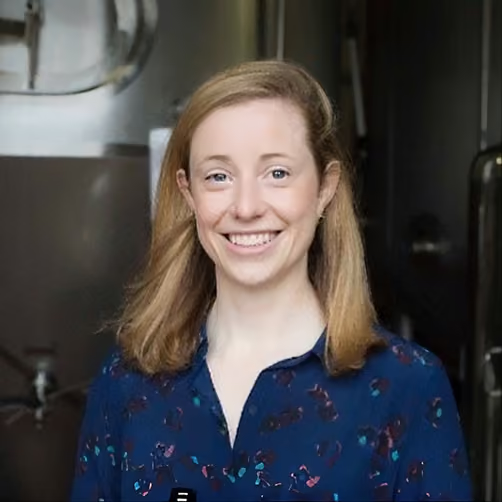
Host: Today's guest has built a business with a size and scale rare in our world. Jenna Wigham, along with her brother, bought a home care business in the fall of 2020. It was big for a search business. 60ish million of revenue, 10 million of EBITDA. Well, just over five years later, revenue at Abound Health is projected to exceed 350 million in 2026 and 75 million EBITDA. We hear from Jenna how they've accomplished that. We spend time on the business of home care, which is a popular target among searchers. Jenna speaks candidly about what makes these businesses so difficult and so difficult to scale. Much of Abound's growth has been inorganic. They've acquired 14 home care businesses during their ownership and their seller had done seven before that. So while the headline numbers and tailwinds may draw you to this category, tread carefully. There are countless tiny home care agencies across the US that stay tiny precisely because growing is so hard. Also, don't overlook the purpose of this service, which is to provide care and aid to the vulnerable. You can make a deeply positive impact by running one of these businesses. Well, that mission drew Jenna to the industry and it helps get her through the difficult days. Conversely, running one of these businesses badly can cause real damage to individuals, families and communities. So if you like the category, treat it with the gravity it deserves. Okay? Please enjoy the candor and journey of Jenna Wigham, president of Abound Health. Today, Thursday, we're hosting a webinar with a great twist on an old theme. Buying a business and hiring an operator to run it is a topic as old as buying businesses itself. But today's webinar will explore the topic from the operator's perspective. Chelsea Wood of Acquisition Lab will sit down with Ted Bronstein. Ted runs operations for acquisition entrepreneur Tim Erickson. Tim is a former Acquiring Minds guest who bought an office equipment rentals business. Chelsea will bring her own perspective, having been brought in by Walker Deibel to build and run Acquisition Lab. So together, Chelsea and Ted will explore what helped build trust early between owner and operator, where expectations aligned and where they didn't, what worked well in practice and what didn't the biggest challenges they faced running the businesses day to day and lessons learned about communication, about decision making, about accountability. This will be a candid behind the scenes look at what it really takes to make the owner operator relationship work. The webinar is the operator's perspective running a business for an owner. And it is today, Thursday, April 9th at noon Eastern. Link to register is right at the top of this episode's show Notes or or on the Acquiring Minds homepage. Acquiringminds Co. Welcome to Acquiring Minds, a podcast about buying businesses. My name is Will Smith. Acquiring an existing business is an awesome opportunity for many entrepreneurs and on this podcast I talk to the people who do it. If you ask owners in the ETA and search community which insurance broker provides highest quality work, great outcomes and has a practice dedicated to searchers and acquisition entrepreneurs, one name comes up again and again. Oberle Oberle Risk Strategies has worked with hundreds of searchers over nearly a decade and is in fact led by a two time successful searcher who August Felker, which makes Oberle a specialty insurance brokerage for searchers by a former searcher and if you've got a business under Loi, Oberle will provide complimentary due diligence on that business's insurance and benefits program. An easy, no risk way to get to know August and the team at Oberle to take advantage. Check out oberle-risk.com that's O B E R L E- risk.com, link in the notes Jenna Wigham welcome to Acquiring Minds. Thanks for having me Jenna, you are running a home care business with your brother. The size of your business Abound Health is staggering by search standards. As I re listened to our pre call I literally sounded dumbfounded as we talked and I was trying to digest your numbers. But of course as listeners know there is much much more to these businesses than the numbers which can oversimplify the messiness, the complexity underneath and in your case in particular can distract from the value to society of the service itself which as we'll hear is a big part of this. So let's get into it. Jenna, some background on you please to begin.
[5:48] Guest: Yeah, happy to do that. Rewinding to the beginning of my career, I started out investment banking in actually in the healthcare sector in 2008 which was probably the worst time to enter financial services and learned a lot about doing work for work sake. Just given a lot of deals weren't happening in 2008-2010 but really enjoyed the work with the healthcare companies but hated the advisory part of it. Really wanted to do something where I was actually in the operations instead of trying to tell someone what to do with the operations. And so five years into that I decided to go get my MBA and in 2013 I went to Sloan with the goal of immersing myself in operational learning so that I could leave business school and do something. Actually my goal was to do something with tangible product where they were physically making something. I thought, there's no better way to be in operations than like to see a product being made, marketed and sold. And in 2015, when I graduated from Sloan, I went to work at Anheuser Busch, the beer company, which was a fun product to. To work on and was really fortunate enough that there they were allowing young and Post MBAs to take on kind of any scope or role that you were interested in. And so for me, coming from a financial background, had the opportunity to do marketing and sales and operations. And in my last two years there, got to run a craft brewery that they had purchased and we're leaving as a standalone entity. And as a result, I had full P and L responsibility for this small business within a very, very large international company. And it was awesome. Day to day. I was managing the team, we were building a new brewery, we were running a restaurant. Many of the small decisions were mine, but was what wasn't mine was the strategy of the overall business. And I hated that someone would tell me what I then had to go sell to my team on the ground. And. And that was kind of where I paused and thought, like, I really want to do something on my own. And my younger brother, who had graduated from Sloan two years after me, was in a similar kind of phase of his career. He was at Wayfair when they were becoming a bigger company. And so he had joined there when it was much smaller and loved the innovative spirit, but felt like that was being stifled given the size and scale they were getting to. And so we had both learned about search funds in business school, but had not pursued it at the time. And in 2018, we both decided to leave our jobs, meet Anheuser Busch, him Wayfair, and launch our traditional search fund. And we together. Together. Yeah, as partners.
[8:35] Host: Let me just ask about your taste in what you like to do. So not unheard of, but a little bit rarer for somebody to be drawn to operations. It seems like maybe many people want to graduate out of operations and, and work on rather than in.
Guest: Right.
Host: I consider operations kind of working in business. It sounds like you like both operations and you want it to be working strategy. But just curious, what, what draws you to actually running a restaurant and running a brewery, which for a lot of people might sound like too much and they want to be moving chess pieces around instead.
[9:11] Guest: Yeah. Interestingly, when I was in investment banking, I was working on some proprietary deals and we had bought an insur. And they put me on this project. I think it was maybe like 25 years old to redesign the sales commission program for the sales team. And so I, like, flew out to Iowa where this sales team was, and I sat with them and I was learning from them and like rolling up my sleeves. And I just, I loved that. I loved, like, being part of something with a team, hitting a goal together, designing how you were going to determine what success looks like, and then creating the building blocks to that goal. Um, and I actually think it ties back to. I was an athlete in college and in high school, and I just, I love the team dynamics of doing something collectively and like training and preparing for something. And for me, operations often feels like that. Like you're moving something forward together and trying to figure out what are the components of the team that can enable that success. And I think for me, that was kind of like the driving. The driving force behind that. Of course. Do I want to be in the weeds? No. But I love moving projects forward with our team and then thinking about how that aligns to our broader strategy as a company.
Host: Great. And why was Search an answer to your prayers that might be a little strong and answered the answer to what you wanted to do?
Guest: The story really is Dennis and I, my brother, decided before we picked Search that we were going to do something innovative together. And we looked at a lot of different things. The original business idea was we were going to create a craft butter company. I. I had just been in Paris with my husb, saw like the essence of butter there. And in 2016, 17, like that didn't exist in the US and coming from the beer space, saw how craft products could really take off. Anyways, we went down this whole path. We visited all these farms and came to the conclusion that the unit economics of butter really suck unless you have like, specific milk subsidies. And so that went to the. That went to the wayside. And instead we. We picked up Search. I just remember talking to him about what are our options? And he had done. He had built a company from scratch in business school that served senior living communities. And he just was kind of tired of the product market fit part of the innovative spectrum, and really thought we could be most successful taking on something that already existed.
Host: Yeah. And to underline the fact that while you were running the craft brewery in under ambev, you loved that P and L experience. I mean, you were effectively running a small business and it felt like a fit. Except you also wanted to be able to make strategic decisions which buying a business would. Would enable you to do great.
[12:00] Guest: Exactly.
Host: Okay, so we'll skip over a lot of the mechanics of the search. We have a lot to get to today. I think the interesting element of that whole process, that whole chapter, is the fact that you got two businesses under loi, I guess talk to us about the one that you didn't end up buying.
Guest: Yeah, sure. That company is called FSI and we met the seller in late 2019. And the company itself provides maintenance software for healthcare systems. So. So think about it as you're the maintenance operator in a very large healthcare system. This software tells you when and how your different pieces of equipment need maintenance and it routes people to fix that effectively. It was a true SaaS. It is a true SaaS business with a very small service component. And we can talk about a Bound at the time, but when Dennis and I looked at the 2 business opportunities to kind of figure out where 1, we could add most value and 2, which P and L was best equipped to absorb, both of us, Abound made the most sense for us and it definitely had more of that mission component to it than FSI did at the time. And so we made a tough decision because, you know, Abound had not closed yet, but to pass the FSI opportunity off to another searcher after LOI phase. And so Zach, who ended up running the business, took over kind of getting that deal closed. And he's been there for, I think almost 16 years at this point.
Host: And that's doing well.
Guest: Yeah, it's doing very well. They've had a, an equity re. A recap process that finished almost a year ago.
Host: And so to just underline something you said there. The earnings needed to be at a certain level to support both you and your brother and the SAS business. Earnings were then, I, I guess obviously lower than the, the precursor to Abound, the, the home care business you were looking at, Correct?
Guest: That's right.
Host: Let's do hear about the business that you did. The other one you had under LOI that became the platform, if you will.
Guest: So about the origin of A Bound is actually the origin of two different companies that came together in 2015. So the first was a software company built in 2000, the very early 2000s. It was a. It is an EHR before EHR has really existed that served the behavioral health community. Started by like a true software entrepreneur. And the second company at the time was called the Small Miracle. And it was a home care agency founded by a mom and a dad who had a son with severe autism, based in Raleigh, North Carolina. And they couldn't find an agency that was providing high quality care to rob and so they started the company also in the early 2000s. The software company became the software that a small miracle used. And so the two had kind of an analogous path for 15 years. And then in 2015, that mom and dad, Janet decided that she didn't want to run the business anymore. It had gone to a size that she felt like was beyond her skill, ability. And so she and the software company CEO Lewis, decided to merge the businesses. And Lewis, who founded the software company, was an accountant by background, and he just was so frustrated that the business owners were not implementing the software he wanted them to, meaning, like they were true mom and pops. They would implement the software, but not design the process around it to really gain its efficiency. And so he bought a small miracle. The two companies came together. He took a small miracle from negative 1 or 0% profit margin up to 10% in the first nine months. So huge success. He basically proved the business case for his own software and went on to do seven more acquisitions of his software customers. So the two companies are now one, and they're a North Carolina statewide provider agency empowered by this software company. And in 2019, he and the team decided it was ready for its new home in terms of ownership. And we had reached out to them on a cold email, actually, Dennis, my brother, did. And he. He responded the actual.
[16:23] Host: Let me. Let me pause you there, Jenna. So. So these two businesses were built in parallel, completely in parallel. Like they're unrelated. And the software business founded by this accountant was an ehr, electronic health records business, and. But powerful. But his customers weren't implementing it correctly. So almost as a use case, he bought a home care agency from a small miracle or. Or the owner of a small miracle. He bought a small miracle almost as a use case. He probably didn't get it. I mean, he probably bought it for a, you know, did what it was an unprofitable or barely profitable business. So it probably wasn't, you know, that expensive for him. And in nine months, sort of because of the value of his software. The value. The value proposition of the software made it profitable. Move the needle to 10. 10 points of net profit. Okay, interesting. And then proceeded to acquire more and basically got into the agency game, still using his own software as an engine. But at this point, he's probably thinking about his business more as an agency business. Okay, okay. And then, you guys, he gets a cold email from your brother, right? Okay, great. Well, go on.
Guest: So, you know, the cold email is like, hey, the same cold email. Every searcher sentence, hey, I'm really looking to buy one great business and run one great business. And he's like, I love that you're
Host: making fun of your own cold email.
Guest: Yeah. And his response is, can you afford a hundred million dollars or something? Which is out preposterous. Of course we can't. And Dennis proceeds to respond, yes, we can. So, yeah, sure. That's how the relationship started. And one of the fun facts about our search fund is it's not that fun. But on our website we had our dogs, which are two golden retrievers that are brothers and you know, they had like stupid titles like office manager and financial analyst. You know, you're in a search like you have no, you're not talking to anyone else, you come up with crazy ideas. And so they're on the website and Lewis, the CEO responds because he looked at the website and he's like, like, I really like golden retrievers.
[18:40] Host: And so you never know, you just never know what it's going to be.
Guest: And so they get on a call and then it turns out that Lewis had hired an investment bank. And so he was very serious about selling the business and he was about to launch a process, but he'd be willing to entertain a one off conversation. And that's how it started. And we ended up evading a formal process for him. And nine, I think nine months later, we closed the transaction.
Host: Ah, but he already had hired a banker. It just hadn't. He hadn't, it hadn't been taken to market just yet.
Guest: Right.
Host: Running payroll, paying your bills, closing your books and producing financials. These are critical tasks every business owner must do or oversee. But spending time on them distracts you from the leadership in growth work you want to do. So let system 6 do it for you. Owned and led by a former Searcher, Chris Williams, System 6 is a leading outsourced finance team for hundreds of SMBs, including over 50 searcher acquired businesses. Chris, Tim and the System 6 team understand firsthand the challenges, the opportunities of jumping into a business as its new owner. So whether you own your business already or have one under LOI, talk to System 6 about how they can give you time back and improve your financial operations. Mention acquiring minds and they'll provide a free review of your books and financial ops. A $500 value. Check out system6.com, link in the show notes or email helloystem6.com and can you give us the bullet points of the business, give us a sense of size and where he had the audacity to ask for $100 million, I don't know, maybe you paid $100 million. But point, point for the audience too is that this was a, it's very large today, but it also was a big business for searchers to buy it from the start.
Guest: Right. So at the time when we had encountered him, the business was they had just done a large acquisition. So it was roughly 55 to 60 million of revenue, most of it being the service business, but it still had this external software component to it which was much smaller. And pro forma for that deal, it was roughly 10 million of EBITDA. So I think he did 10 times 10, $100 million. That's what my business is worth.
[21:21] Host: Which frankly it's pretty aggressive. But not totally crazy.
Guest: Not totally crazy.
Host: Not totally. There's a world where, you know, a well funded private equity rollup pays that.
Guest: Correct? No, yeah, at that time, definitely.
Host: And, and, and as we'll hear this, EBITDA is very high quality revenue. This conversation, just as an aside is going to be. We're going to be hopping between sounding extremely mercenary and missionary because we're going to talk about all the usual features of how we assess businesses quality of revenue and, and just the hard dollars and cents. But it's. This is about a business of taking care of people, of adults who can't take care of themselves. So it is also. There is a profound mission here. Okay, so can you. And so how other than the revenue and ebitda, what other stats about the business? Employees or contractors or footprint, etc.
Guest: Yeah. So the service part of the business, which again at this point is now most of it is statewide North Carolina only. The software business, which is again much smaller, is I think sold in 12 states, maybe 70 customers outside of a small miracle. Abound it. We had, were served, we call it serving. We were serving roughly 12 to 1300 individuals with intellectual or developmental disabilities and employed roughly 1500 to 1800 caregivers and employees at the time in. And this, I think it's interesting to point out, the deal came to us in late 2019, but we were negotiating the deal in Covid, so obviously March 2020 happens. You're in a healthcare business. We got a pause. Fortunately, the business performed well through that period and we ended up closing in October of 2020. So in the heat of COVID And
Host: is there anything more to say about that? Just about doing a deal during COVID
Guest: I think that as I reflect on that time, just when you're a new CEO or president, you obviously really want to immerse yourself with the people and the business, you. We couldn't do that in Covid. And so I think we had to get very creative about how we got to know people and how we showed our faces, I guess, virtually and pivoted the whole business. We were deemed an essential business like most healthcare companies were. And so our employees could continue to work, but certainly not without fear. And just managing that as a new CEO and president was, you know, certainly an interesting twist to starting your leadership.
[24:13] Host: And what exactly now does the business do? Give us a. Give us a picture of sort of the motion of the business.
Guest: Yeah. So the business today is in four states with the service business, which is now 99% of our revenue. We provide three different service lines. So, of course, the core of the business still is serving adults with intellectual and developmental disabilities. And the second business line, which we entered in 2024, is serving pediatric patients. So children who have complex medical needs that will likely age into an IDD diagnosis. And so these are kids, often that are getting discharged from a hospital and need in home nursing care. So strictly nursing care for the kids. And then the third business line, which we entered in 2026, so very recently, is personal care, which is sending a caregiver to work with typically elderly people, people that don't necessarily have an IDD diagnosis. And so the theme for us is obviously home care, providing care in the home across those three business units and four different states. And then we still have the on target software business, which I think is in 11 states still and now has over 100 customers.
Host: Well, as we'll hear that while it doesn't represent a lot of revenue to the business, it represents deal flow, and it's. It's been a key lever. Right. We'll get there. The.
Guest: The.
Host: We. I. I said home care. You said home care, but it sounds like it's also home health care. There's. There are actual nurses, at least in your pediatric and the pediatric division. On the IDD division, are they nurses?
Guest: Very rarely. Typically it's unskilled caregivers.
Host: Unskilled caregivers. And so you are. Pairing patients with caregivers who will go to the patient's house on a daily basis for eight hours a day. Of course, it depends. But give us kind of the average, a sense of what this looks like to be a caregiver and what you're doing as the service.
Guest: Exactly right. So each individual, whether they're an adult with idd, a kid with medical needs, or an adult that needs personal care, has a care plan that the insurance company writes for them and that dictates how many hours of care and what type of care they need on a weekly basis. On average, our clients are getting somewhere between five and six hours a day. The majority of the care is around assistance with activities of daily living and socialization in the community. With the exception of some of these medically complex kids, their care will look more clinical in nature. And so the nurses are in the home. Monitoring could be as severe as event they're administering medication. But we're all delivering care against an individual's care plan which is specific to their own diagnosis and their own needs. And so our caregivers and nurses are trained at the individual level to deliver again, whatever that specificity is to that individual. But it can be very different depending on the acuity of the patient. You know, we have some folks with down syndrome where the caregiver is taking them out into the community, they're going to the ymca, they're, you know, going grocery shopping together, or it could be someone that's total care, they're in a wheelchair. And so our caregiver is, you know, feeding them, et cetera. And so it's, it's a very wide gamut tailored to the individual.
[27:53] Host: Your payer is Medicaid across the board,
Guest: it's 95% Medicaid for all.
Host: And what does that, what does that mean? I mean people will know what Medicaid is broadly, but what are the implications of that?
Guest: I mean, it's always worth double clicking, especially I think in today's environment. The Medicaid that funds our population is different than the Medicaid many people think of, which is available for low income individuals to have health care. This is medication, Medicaid rather that's carved out for people with long term needs as it relates to the IDD population. This funding originated as funding for institutions. So if you like can conjure in your mind in the 1960s these very large congregate settings where we would house people with developmental disabilities, like very inhumane, very costly and very not habilitative, meaning these people go into these institutions and you would like never see them again. And so in the 90s there was a landmark Supreme Court ruling that said people can choose where they want to live, you can't force them to live in an institution. And so the state started closing these large facilities and making that funding available into what's called the Medicaid waiver program. And it's permanent funding that exists so that these individuals can get care for their lifetime in the Setting that they choose that's on the IDD side. On the pediatric side, it's typically Medicaid for children, which is again a subset of Medicaid. And these are kids that without this would have to be in a hospital. And so it's typically very cost effective for the states to provide the in home care versus long term hospital stays.
Host: And on that final point, that's one of the big tailwinds in this whole very broad category of home care and home health care. People often first think about the aging population, but a quick follow on to that is a recognition, I guess or whatever the, by the health establishment that having people receive care in their homes is way, way more efficient, cost effective for everybody than in hospitals. So there's this other kind of generational shift going on from hospital care to home care, correct?
[30:15] Guest: Yeah. So it's cost effectiveness and better outcomes for the patient, typically.
Host: And better outcomes. The other thing about Medicaid is that you're a price taker. Right. Explain what that means.
Guest: Yeah, so we're almost strictly fee for service, meaning that the states and the, we call them MCOs, managed care organizations set the rate for the services we provide. There are few exceptions where we can negotiate one off contracts just depending on the specificity, specificity of the needs. But typically we're a rate taker so we don't influence price.
Host: And this is probably considered a risk. Right. This is a, this is an, a weakness if you will, when considering a business.
Guest: Correct. I think that was certainly one of the top issues when we were doing this transaction, especially in the search space is you can't take price for yourself.
Host: What other issues did you see with the business? Let's now return to the actual. The first acquisition.
Guest: So, so I'll put Medicaid and price taker in one bucket. The second big bucket was, is this really a recurring revenue business which you know better than anyone? Like that's the tenant of search businesses. And what we found, and I think what excited us about the opportunity was once an individual gets an IDD waiver slot, so they've received the funding, they have it through the rest of their life. And so if you're their agency, you have the ability to serve them from that point until, until they die. And so if you think about like in the, and again we're a mission driven company but for the sake of business fundamentals like the lifetime value of a customer is, is fairly high if you do the service well. Whereas like in traditional healthcare, you're talking about acute or episodic relationships. This is very different from that.
Host: And so that sounds like strength, not a weakness.
Guest: Correct. So what, what we were uncovering was this looks more like a recurring revenue model than you might think a traditional healthcare business model would look like.
Host: The fact that there was the, that it was kind of a software business or had this software component, that complexity, I guess was that a, a flag or a non issue or what?
Guest: At the time I think that our investor group and us probably thought it was maybe a wash, but it's proven to be like the competitive advantage that we never knew we could have. And we can talk about that. But it's provided a lot of financial benefit M and a opportunity and just ability to be agile in the Medicaid space, which is very challenging because you're subject to so many regulations and having the ability to tailor your software to those as needed has been extremely beneficial to our operations.
[33:12] Host: Whereas other folks in the space can't customize their own software.
Guest: They get on an enhancement list from their vendor and maybe three years later they're getting something fixed.
Host: Yeah, yeah, great. Well, we are going to return to that. So the acquisition price, can you share what you acquired this $10 million EBITDA business for?
Guest: Yeah, I, and I'm not saying this flippantly, I genuinely don't remember the spec, but it's. It was under nine times, it was like 80 something. It ended up being 80 something million or 8.8 times. And there was an earn out on top of that that was related to growth.
Host: And how significant was the earnout?
Guest: The Earnout was another 15 million.
Host: Okay. Ah, so he gets to his hundred million.
Guest: He does.
Host: Well, he wasn't crazy after all. Because you guys, I assume did grow into that earnout.
Guest: He. Yeah, he got all of it or the team got all of it. Yeah.
Host: Okay. Can't hurt to ask. There's your lesson now. Okay, so you paid 85, 88 million for the business with an additional 15 potential earn out. So call it $100 million price. You were signing up for very large for a search acquisition. What did that look like from the investor's perspective? Were people on board for this? This is probably even for search investors, a pretty unusual case.
Guest: Yeah, I think especially in 2019, there weren't as many search investors with larger funds willing to write larger checks. We were fortunate that Housatonic Partners was in our search fund and that was sort of by design. Just in the event we did find a larger deal. They have a private equity fund and that fund will look at search opportunities and evaluate whether it's a fit. And luckily it was a fit for them. And they took 51% of the equity check and then we were able to round out the rest with our search group. So people stepped up and wrote bigger checks than I think they may have normally with a search deal. But it was certainly tough to navigate at that time because when you're doing a search deal, you never know where you're going to land with the equity until almost the end. And we didn't really have a, a great backup to who Satanic. So if they went through diligence and decided, you know, this is not a fit for us, I think it would have been very challenging for us to get the deal done in the search with the search community.
Host: And what you're saying now is related to the 51% because what is the significance of the fact that they were, they, they took a majority of the, of the equity. That's unusual.
[36:02] Guest: Yeah. Not something we intended to have as our outcome. I think when you do search, you do it because, again, you want to control. That was the cards we were dealt to get the deal done. And as a result, Housatonic, who is still, you know, our majority shareholder, has four of the seven board seats. And so technically, if anything came down to a vote, they have the voting majority. We've been very fortunate with them as a partner that it's. There's never been, not one single instance where there's been misalignment from the board and them or Dennis and myself and them and where we've, you know, had to force it to a vote. So we've been very lucky having a majority partner that doesn't necessarily act like that.
Host: But to be clear. So this is a, this is a question of control of governance. And with four of seven seats, they can. They ultimately have veto or the power to basically dictate terms if you aren't in the future in alignment on some big, big strategic decision.
Guest: That's right.
Host: And so from your. And so that's risk for you guys or, or risk or, you know, not, not how you might want to structure things if you're trying to optimize for autonomy, which most entrepreneurs are also. So that's we're talking about here is investor concentration. Also, as you said a minute ago, if they kicked out or decided they didn't like the deal, they leave a really big hole to then have to fill, which you might not be able to fill. So there's kind of risk pre and post deal to you guys. The searchers was what it was and happily it's worked out. But that and, but again, to underline it's. That's pretty unusual. Generally in a traditional search fund there isn't so much investor concentration. It's more evenly distributed across the participating investors, right?
Guest: That's right. We tried to seek out diligence opportunities where there were searchers who were in this same situation. So we can understand what it was like to be operating in a paradigm with a majority investor. I think at the time There were like two others CEOs running a business. So probably less rare now. But certainly at the time a lot of entrepreneurs were not choosing that path.
Host: And a big part of it too was the fact that, I mean, part of the reason why you needed to make this concession, if you will, was because it was such a big business. Right. And you were just that that's, you know, you're going to need a bigger check and, or a bigger, more capital to raise, which means that effectively that gives investors a little bit more leverage in the negotiation with you.
Guest: Correct. Okay.
Host: So you closed in Covid, as you said. You said October 2020. So we're now five and a half years in. Yes.
Guest: Yep.
Host: And the business today is what in revenue in ebitda?
Guest: It's roughly. So we just did a very large acquisition that closed in January. So pro forma for that were roughly 350 to 375 of revenue and 75 million of EBITDA.
[39:07] Host: Wow. Are you familiar with any other search businesses that got to numbers like that? 75 million of EBITDA?
Guest: I mean certainly ones have grown to that after multiple like Assurian and other ones like that got bigger through stages. I'm not sure about on the first hold period.
Host: It just to. Not to put too fine a point on it, but let's say $75 million of EBITDA in this category, high quality revenue trades for. What would you say could trade for if you sold it today?
Guest: It's a great question that I'm sure our whole investor group would love an answer to. We, we're in an interesting dynamic because of the federal administration and just rhetoric around Medicaid has created a little bit of noise in the, in the market. But I mean the multiples could be anywhere from 8 to 12x depending on who the buyer is and where which part of our business they see value in.
Host: So big Beautiful Bill has some people in Medicaid land a little concerned. Correct. So that's probably depressing multiples a little bit from where they would have been Prior to that I hear you say 8 to 12, but you bought it for 8 and a half or 8.8.
Guest: Well, I don't think a bound is, I'm more talking general industry multiples. And to just double click on that, there is a continuum of the IDD care model where it's a group home model like you're owning facilities running 247 cares. Those kinds of businesses would trade closer to eight home care models. Again, preference for investors to be in the home given the tailwinds we talked about could be, you know, depending on the service you're delivering in the home. 10 to 14 times like hospice businesses trade very high. Home hospice businesses, specifically personal care for elderly trades high because of the tailwinds of just demographics. And so it's a, it's a mix depending on the model of delivery and the demographic you're serving. But I think for our home care model maybe 10 to 12 would be a more narrow range.
Host: 10 to 12. And that still strikes me as conservative, Jenna, not not knowing the industry too much. But $75 million of EBITDA feels like in again, in a space where they're a handful of very obvious tailwinds that everyone knows about, where there is a lot of private equity institutional capital coming into the space. From my 30, 000 foot view, I would guess that the multiples would be quite a bit higher than 10 or 12. So you're being conservative.
Guest: I'm being very conservative.
Host: Okay, appropriate, appropriate. But let's, let's assume to your conservatism 12x. Okay, 12 times 75. For those of you counting at home, that's $900 million. Let's just round up, shall we to get to an even number. That could be a billion dollar exit today. Today. So like I said, I was dumbfounded at these numbers. Now we're not going to, we're not going to get grotesque about such a big number, but it sure, I mean it just says something about the scale of what you've built if nothing else.
[42:27] Guest: No, yeah, I think it definitely puts the scope of what we do into perspective.
Host: You know. Enzo Technologies as one of the leading IT managed service providers serving the search community, led by Nick Akers, an acquiring minds guest who bought the 35 year old business. The team at Inzo regularly works with searchers and their acquisitions. And one feature of acquired businesses that Enzo is seeing over and over is the need to implement cybersecurity promptly during the transition. So many acquired small businesses either have glaring vulnerabilities, lack security best practices, or both. That step one to de risk the deal you just closed should be addressing these issues. INSO is your full service IT MSP for post close stability. They assess your target surface, the biggest risks in plain English and give you a day one through 30 plan to cut exposure, prevent downtime and even find cost takeouts like bloated telecom bills. Check out enzotechnologies.com I N Z O or email Nick directly at nicknzotechnologies.com let's hear about the actual number of people and interactions for a business of this size. What does that look like on a daily basis? How many caregivers are their patients?
Guest: Yeah, so we are roughly 7,000 employees, mostly employees, a few contractors and we serve 6,500. 6,000 patients or clients in their home.
Host: Well, we're going to return to the realities of that. That's just, that's an enormous scale. Let's turn now to how you've, how you've grown so much. Jenna. So please, please tell us. I remember there were kind of three prongs to this.
Guest: Yeah. So the, a big driver of our growth has been M and A. Basically taking the strategy that the former owner had developed and fueling that with more gasoline, using a pipeline of software customers as M and A targets, which is I think a very unique thing to our business model. And then developing a building out a BD team effectively that's looking for the right businesses for us. And we quickly realized that we needed to diversify the business geographically because Medicaid in one state is Medicaid in one state. And when you're in multiple states, you really diversified the stroke of the pen risk, which is what everyone is scared of with Medicaid and Medicare as your rates get chopped in half. So we quickly moved to Pennsylvania, which was a very large TAM for the IDD space. Followed on with New Jersey and then most recently Michigan. And so M and A geographic growth has been a big fuel of our growth engine. The second thing is expanding business lines. I mentioned earlier, we started with just ID'd care. Now we offer pediatric nursing care and personal care for the elderly. So further diversifying kind of our payer mix within a state has been another piece of our growth path. And then the third is organic growth, being a really good partner to our referral sources, building a big enough brand in each of our states, standing for high quality, being very good at matching caregivers with patients based on the need of both sides of that supply and demand equation. So it's been M and A geographic service line and then driving organic growth in our, in our current markets.
[46:21] Host: And if you had to attribute the revenue growth. So reminder to everybody, you started at 60 50, call it 60, 5560 and are now at 3 53, 75. So that's, that's a 6x6 to 7x growth in revenue. How would you attribute that between M and A and organic growth?
Guest: Yeah, so it's probably 75% of that is M&A. And then 25 to 30% of that. Excuse me, is organic growth.
Host: Wow. Okay, so those acquisitions. Yeah. Obviously 75% of your growth has been, has been in those acquisitions. And yeah, you're so this, so two, two things here. You're, you're being very acquisitive in your choosing states strategically. You did a market study, right. To, to identify the states where you should go.
Guest: Yeah.
Host: And, and, and, and the decision on the state was based on presumably just sort of demand tailwinds and then the vagaries of the Medicaid regulation within that state and kind of whatever was, you know, optimal. Whatever was the most optimal of that combination of those things.
Guest: Right.
Host: And it ended up being what it was. What did you say? Pennsylvania, Michigan, New Jersey. New Jersey, Yeah. Great. And so you go into these states and look at your sought your customers on the software side. You already have relationships and you can I guess also see all kinds of intel on these businesses because you're at least volume of patience if nothing else. And you reach out to them directly and say can we have a conversation?
[48:13] Guest: Yeah. So the, the model is that, and once we've identified it, a state is of interest based on that market study, we go put our sales force from the software company there first. So they're selling in, they're understanding what the software scope needs to be. You know, we have to set up electronic billing and payroll and just all the things that need to function properly to run a business there. So they go do that, they go start selling in and then we follow on with the service acquisition. Sometimes it's a software SC customer, sometimes it's not. In the case where they've been a software customer for a long time. Like a deal, we did a tuck in we did in North Carolina a few years back. We were able to integrate the business in less than 30 days. You know, we had all of the data readily available. Like we knew immediately what to do with the business. And that's the power of buying a software company to your, a customer, to your point, like you know, everything. And so we've done a mix of Both
Host: and sorry, why did you. Why was your first move into a state to try to sell software into that state?
Guest: One get the, the process kinks out. The. Not to get into the specifics, but like to be able to bill Medicaid in a state, you have to set up an integration. It can take time. And so when our software company is there first, they're basically laying the groundwork for the service company to function operationally. Um, the other thing we like to do is get the company to implement the software before we go under LOI with them. The change management, moving EHRs, or in many cases moving from paper, which is wild. To think that some of these businesses are still run on paper to an EHR is. Is vast. It's a big change hill. And if we could put that on the former owner of the business so that when we come in we don't have to actually deal with that piece of it, the software in place. That's a huge benefit to our. For our ability to like hit the ground running and layer on organic growth versus being mired down by a software implementation.
Host: But it is your software company that's doing that implementation. It's just kind of siloed over on the side on the software side. Right.
Guest: Okay.
Host: Okay. Wow, what a model.
Guest: Yeah.
Host: This guy, your accountant who founded the software business, really hit upon something pretty powerful.
Guest: Yeah, he's on our board today still, so it's been fun to have beyond this journey with him.
Host: Okay, great. Jenna. Now the other thing that we had talked about in the pre call is the culture in that that actually has also been important for you. Convince us because a lot. Because, because a lot of companies say that private equity will say that building a good culture. But you seemed, you seemed to really adamant that it's different in this case.
[51:02] Guest: Let me convince you. Well, it starts with we're here to. To serve people that have special needs. And that at the end of the day is all of our jobs at this company. Whether you're processing payroll or you're a caregiver in the field, we're here to help people. And we were fortunate enough to inherit a business from the founder who truly lived by their core values. And I can say this, like at any company I had worked at previously, the core values were like painted on a wall somewhere. But in no way were you like naming them or living them in behaviors. At a bound. We have a formal daily huddle process that all of the teams are doing every day for 15 minutes. And as part of that, there is space at the end where every person goes around and says a core value, and they shout out what an example of someone living a core value is, whether it's a teammate, a caregiver in the field, the client's family, whatever, it could be anything. But when you do that every single day of your job, you're like, really living the way that your core values are described. And it's been so amazing for us to all feel connected to the mission by. By doing that. The other thing is all of our leadership team, our caregivers themselves. So when Dennis and I joined the company in 2020, we signed up to be direct support professionals, which is the job title of a caregiver. I worked with one of our clients who had cerebral palsy, and I was out in the community with her once a week, twice a week sometimes. And so it's critical for our culture that people roll up their sleeves and they do the work. Like I'm taking her to the bathroom, like I'm doing the work that I'm expecting the rest of our workforce to do every day. And I think when you do that, you create a culture where there's no job small enough or hard enough for anyone here, because at the end of the day, no job is as. Is as hard as living with special needs. And our job is to help them. And so I think showing our team that we're willing to do the work was critical on day one.
Host: This business is, as I understand it, challenging because it attracts both people who. Who are feel in their hearts drawn to this mission of helping people. And that's the good. The bad is that it's low wage work.
Guest: Yeah.
Host: So it also attracts people who aren't skilled to do something else. So the former category, those people are probably just great to manage. I mean, they're people who are drawn. Drawn to this work and others less so. What's that like?
Guest: It's been hard. One thing to point out about our workforce, which is interesting, is I think it's 25 or 30% of our caregivers are family members now, which is great because for the most part, when it's a family member, the connection to the individual is so great that the wage is almost irrelevant for them. And so that's obviously a nice employee to have on top of the. The group you mentioned, which is people who are doing this because they want to give back. And we've really been able to figure out how to go find that person. But that third bucket, which is, you know, Joe off The street, who's 24 years old, has no experience taking care of people, needs money is what keeps me up at night. Like, we have a very stringent hiring process, so we're, you know, running background checks, fingerprinting, in some cases drug testing so you can feel good in the moment you hire them, that they don't have any prior record. But does that mean two months from now something bad isn't going to happen? No. And so we have a very strong supervision program in place, which is not required of us in many of the states that we operate in. But we're sending someone into the home to monitor how that caregiver is working with that client or patient. But we don't.
[55:00] Host: You mean every now and then, 10% of the time or something?
Guest: Right. So, well, 30, 30 days to 45 days, depending on what the model of care is. But you're right, like the other 29 or 44 days, no one is watching what's happening. We don't have cameras in the homes. Many of our clients live with their parents. And so there is another check on the care that's happening, but that doesn't mean there's no risk. And so we do everything we can to train and equip our caregivers and our families to be, to be doing the work properly. But your point, and your point is, right, there's no, there's, there's no way to completely eliminate that risk.
Host: After we had our pre call, Jenna coincidentally, completely got drinks with a couple friends, both of whom had these home care horror stories where one friend's mother fell, needed care at a broker, hip, I think, needed care at home. And the caregiver stole from her, like logged into her bank account, Zell sent money out via Zell, total disaster. And then the other friend's father, end of life, they found out later, maybe a year later, somehow through the grapevine, that the caregiver had, as the story goes, murdered his wife. It's almost unbelievable. And so the three of us are talking about this and of course both of my friends are just utterly horrified at the agencies. They blame the agencies and their indignation, as you can imagine, rises to the point, point of just of that being angry at the entire model. You know, this home care, this, these home care agencies shouldn't exist. Etc. So we had this conversation and they were, you know, their point was, you know, the background checks, you know, the home care agencies are taking too much profit. The background checks should be more, there should be deeper, fuller background checks or they should be hiring better people in other Words, paying more. You know we kind of went through all of the, the ways that they felt that the home care agency was just profiteering and that frankly this, this shouldn't even be a private market. I know I'm putting you on the spot. What do I say to them? Why, why isn't it as easy as saying just spend invent to the home care agencies, the, the industry at large spend more on background checks and pay people better.
[57:43] Guest: Well let's start with that. Like it shouldn't be a private industry. I'm not going to go into like whether free markets should operate in this space. But there isn't. There is in New York State only allows non profits to participate in this type of care. So you can't be a pr. We couldn't operate in New York State. If you look at the outcomes and the abuse and the neglect that happens in New York State, it's no less than anywhere else. And I, so I just don't buy the argument that if you're not taking profit you're going to be able to prevent situations from happening. So like that aside, it's on the agency to do everything in their power to determine if this caregiver is suitable to go into a home and take care of someone. Like regardless, the profits aside, it's on me every day to make sure that these 6,500 patients are of ours are not being subject to abuse, neglect, theft, whatever it might be. And so we never trade profits for a smaller background check or any upfront work that we could have done to prevent a murderer from being in someone's home. I mean I'm assuming that agency didn't do a background check properly. But your second point is if you pay people more money, will they be better caregivers? Like I, I'm not sure I'm buying that argument either. You know, we're still capped at a fee for service rate. So it's not like we're attracting individuals that are going to be making 50 or $75 an hour. Like we're within a realm of low wage work. We're just talking about where within it we're falling at this point and we argue here and we've proven it versus when benchmarking against competitors is we use our software so we can be very efficient and as a result of that we reinvest the money back into caregiver wages, we provide health care benefits, all of those things 401k match for all of our caregivers. So as a company we're not choosing to cut wages of our caregivers in exchange for delivering profits to a private equity fund. I just want to be very clear about that. You will do everything in your power to make sure that the 6,500 patients and caregivers are being taken care of properly. But some won't be. That's just the matter of delivering care at home. And I would also say that it's what you do with what when something goes wrong and how you change your company for the better that matters. You know, here at Abound we're running incident reports every day where we're hearing, you know, this caregiver did this to a patient or a client. We have a full team dedicated to figuring out whether that happened or not than a team that's dedicated to making a recommendation based on the findings of that so we can continuously get better. The alternative setting of care. You know, you're talking about these bad home care agencies. The alternative setting of care for your friends, family members is in a rehab center, in a nursing home with them, presumably. But when you're talking about facility based care, you're not talking about higher quality or better outcomes. You're just talking about now an institutional setting where you're hiring low wage workers to deliver this care and hoping that they also don't do the same things. So I guess my, my point is to say just because you're delivering the care in the home doesn't mean you're automatically subjecting patients and clients to a worse situation. These things happen in nursing homes and hospitals all of the time too. It's what you do with when they happen. I think that matters. But this is what keeps me up at night.
[1:01:21] Host: Like yeah, and let's just turn. Go back to the wages for a second because I, I used to ask this and I feel like I should, I need to start re asking it because hiring people is so challenging in many search businesses. Yeah. Why is taking a few points extra, a few points less of EBITDA and putting that into wage higher wages not the answer. And, and the answer to this problem. And the answer always came back, I guess what you just said. So I just want to make sure I heard it correctly that like another dollar or two or three or four an hour, it just doesn't. It, it's, it's almost. You need to think about it in terms of strata as opposed to kind of inching. Inching. Pay up a few dol. It's just unless you, unless you pay people into a different strata. So you're recruiting from sort of a different level of skill or level of background, which then breaks the business model completely. It really isn't about a few dollars one way or the other of hourly wage.
Guest: That's exactly right. And it's also about finding the person who wants to do this work. They're not looking at it as strictly a wage conversation with you. They're looking at as, yes, I need to make a living wage, but also I want to help people. And we've done a lot of work to figure out, like, what the Persona of that individual is. Because, you know, someone can go work at Target and make the same amount of money that they may work, may get it abound. I don't want the person that wants to work at Target. Right. I want the person that wants to go home every night feeling good because they helped our client have great care in their home so they don't have to be in an institution.
[1:03:13] Host: So back to your day to day and what keeps you up at night. Yeah, you're having 6,000 interactions a day is this. And. And you. And so the division of responsibilities here between you and your brother are he's CEO, so more external facing, your president, so more internal facing. So these 6,000 interactions are really your purview.
Guest: Please remind him of that if you ever talk to him.
Host: How are, how's that going for you?
Guest: It's been a journey. In the beginning, I made it a point to learn about every single thing that was going wrong with those at the time. You know, 1500 interactions and making it my mission to help improve that. Obviously that's not scalable. And as we've grown, as any leader would say, it's about hiring and developing the right people to be able to do that. And so you're trusting that the work is happening and that the issues that are actually making their way to me are fewer, more severe, but fewer. And I'm very proud. I think probably the thing I'm most proud of is the team we have here at Abound and how much they care about the work they do. And so I feel very good most days about those 6,000 interactions because I know the team behind them knows what they're doing and is doing it because they care. And you can't. When someone wants to do this work and they care so deeply about it, there's nothing that matches that level of commitment to their job. You know, especially coming from financial services and the beer industry. Like, yeah, you love your work, but this is like a different passion set. And so my day to day has evolved from you know, knowing what's going on in, in detail to how do I support my teams that need to know what's going on. And that's been an evolution for, of my leadership style. I'm a very hands on person. So it's been, there's been friction internally for me, like do I really need to get involved in that and how do I figure out at an enterprise level what's happening in the home so I, I can feel good about the care we're delivering.
Host: I mean at 6,000 people in the field a day, you are beyond a small business at this point. And so you as president are probably pretty well outside the operations at this point. The operations that we refer to at the top that you enjoy.
Guest: I get pulled in, I'm pulled in right now when we do large acquisitions and there's like integration scoping that needs to happen. But yes, for the large part, some of that I am pulled out of and it's like, it's tough because I love that. And you know, I was reflecting when we joined Abound, I got to know all of our administrative staff. I think it was like 125 at the time, so non caregiver population. And I, you know, made a point to know like one thing that was going on in their life, like whether they had a kid or a sick parent, whatever. And now it's like I can't keep up. There's so many people I don't know and it's like it kind of hurts me on the inside.
[1:06:24] Host: So you don't, you don't enjoy being that almost purely strategic, sometimes operational, but almost purely strategic at this point?
Guest: No, it's a different thing.
Host: Yeah. I think many entrepreneurs assume that the bigger their business grows, the better. And then I guess they find out that managing a business of different sizes feels very different. The motion of it, their, their, their own talent or skill for that size of business. Right. So this is a traditional search fund. You have investors as we talked about. In fact, you have a big majority investor. They're going to be looking to have their capital return to them and then some. What, what do you think the exit looks like for this business? I mean you've already grown it so much you could exit tomorrow. When is the, when is the natural point?
Guest: I think in the medium term it's coming, you know, not tomorrow. Let's say 18 to 18 months to two years is probably the horizon we're looking at in terms of thinking about what's next. We love running the business and so the Right. Home. For it is critical. I think that something that is important to me and I know is important to Dennis, is that whoever continues the mission cares deeply about it so that we don't end up in this situation where we're sending thieves and murderers into the homes of our patients. And so I think it's finding the right balance of, like, who the right buyer is and what they care about that's gonna be important for us and for. For Housatonic. I know they care too.
Host: I was gonna ask. I mean, it's. As much capital is coming into this space as there is, it just dilutes the mission orientation of a lot of these businesses. So I. I feel like it. It's going to be hard to find that private equity group that's going to care like you guys care.
Guest: You know, I've been, like, doing a lot of reflection lately. And, you know, Housatonic, to their credit, the number one thing they ask us in every board meeting is patient safety compliance. Patient stories. Like, there's never been a conversation about, are you sure we should be investing that money into XYZ related to client care? And so to your point, like, finding someone who can continue with that sentiment, I think will be a balance.
[1:09:03] Host: Are you guys waiting also to kind of see how this Medicaid risk shakes out? Okay, so that's a big question mark looming over the kind of. Mm.
Guest: Right. I think the midterm elections will be interesting just to see, like, the sentiment of the country and where we're headed, but we feel good about the stability of our funding. We just need to make sure the rhetoric kind of dies down a bit.
Host: And the balance sheet. You had said to me in the pre call that, in fact, all these acquisitions have been done with debt in cash.
Guest: Correct.
Host: And. And so say to the audience why that's significant and a great position to be in. What's the alternative? First of all, how else might you have done these acquisitions?
Guest: You could raise additional equity search, which.
Host: Which dilutes your ownership.
Guest: Sorry, dilutes our ownership. Very expensive, as searchers know, in the context of capital and capital allocation and just a process that we wanted to avoid. And because we are a Medicaid business, we generate very healthy cash flow, meaning we'll bill Medicaid one week and almost get paid the next week, which is a great silver lining. Unlike traditional healthcare companies, where you're billing a commercial payer, as you know, when you go to the doctor, like, for the doctor, actually get your money, like, can take a long time for us, that's not the case. And so because of the cash flow generation and our low leverage and our ability to pay down debt, we've been able to fund equity acquisitions through our own balance sheet without additional equity.
Host: So using cash so incredible cash cycle that you have, you deliver service, you get paid the next week and debt as well. So you have debt, you've taken additional debt. So your debt on the, on the overall business now is, is what
Guest: I'm just summing it up because we just did this acquisition, maybe 150 million, no probably 200 at this point and then some seller debt. We make most of our sellers roll into a seller note. We are on our third debt facility almost since doing the acquisition. Obviously like a debt partner that funds a 10 million EBITDA deal versus a 75 is different. And so we have, we have a new debt structure in place that's been very helpful for us with ability to delay draw term loan for acquisitions.
Host: And so your overall debt is something shy of 3x EBIT.
Guest: Oh yeah. Yeah.
Host: So it's a, it's a not over levered in at all low leverage for especially for a business of this size.
Guest: And I think that's been critical to us too because God forbid there was ever a rate cut or some external event to the business. Imagine having to trade off like cutting caregiver wages versus paying down your debt. Like we're, we would never want to get this business into that situation.
Host: We're getting toward the end here. Jenna, I want to spend some time on even more on the industry but if you would kind of hear you reflect on getting into this industry for searchers, maybe self funded searchers buying smaller businesses. This is a, a big industry or category that we hear a lot about. So I want to come back to that. But anything to say about running a business with your brother, Anything to say about that? For the siblings listening who might could be considering searching together, it's been a lot of fun.
[1:12:27] Guest: I'll say that we've had less than a handful of true disagreements as it relates to the business disagreements in our personal life all the time. But as it relates to work, it's been really rewarding for both of us. You probably when you talk to family members who search and run businesses together like the theme of having this level of trust and transparency especially through tough times has been hugely beneficial. Especially like for me dealing with the day to day operations, the type of stuff that crosses my plate on any given day can be very wild. And having a partner who I can speak candidly about these situations with. Has been very helpful, and I think a big part of why we've been able to get to this size. And so besides the fact that he doesn't worry about the 6,000 interactions as much as I do, it's been. It's been a great partnership.
Host: That's great. And. And anything more to say about the fact that Housatonic is the majority investor and how that's played out, has it not? We talked about it kind of what, you know, what. What the. How you weighed that going into this business, but now, six years later, has it felt a certain way?
Guest: You know, honestly, and I'm. I'm very. I'm very transparent person. We've been very lucky. I think there are times where we maybe wished we had a more traditional search board with people that were used to coaching young entrepreneurs. That's like a typical search board ethos. Maybe we missed out on a little bit of that in the beginning, just because the private equity dynamic is a little bit different. But at this point in the hold period, I think the board has been more effective than ever, I'd say. And they, like I said, have been very supportive of the mission. And I genuinely don't think we've ever had any disagreement over where and how to invest in the business broadly. And so, you know, as a leader, that's kind of all you can ask for.
Host: Yeah, well, I guess for the audience, it's one of those where, you know, if it works out having a majority investor, then it works out and it's great. It's just the situations where it doesn't. So it's very case by case.
Guest: Yeah. And the other thing I'd add is, like, Housatonic has been in the search community forever, like one of the original investor groups. That's helpful. They care deeply about their reputation in the search space. I think it might have been more risky to bring on a large investor who doesn't have that level of connection. But, yeah, I think with any investor, you got to diligence other people they've invested in and see what the perspective of a CEO working with them is.
[1:15:16] Host: Yeah. And actually that last point is a. Is a great one, which I'll just tie to what we've seen in the independent sponsor world, the Mind's Capital podcast, the other podcast that I co host with my partner, Nicholas James. We have heard from independent sponsors who are raising money that they. That you should really target investors, capital providers who are committed to the independent sponsor space, because there can be a lot of capital providers I guess in any, in any category, in any asset class that kind of come in and aren't maybe that committed or they're new and they care less about their reputation. And so they. Reputation serves to kind of keep everybody on best behavior. And so if somebody doesn't care about their reputation because they're new or they're not really committed to the space, they may not, they may not behave. Behave themselves, they may not act in good faith, whatever. However we define behavior, if somebody is really, in the case of, in this case, embedded, enmeshed in the independent sponsor space, they're going to care. They're. They're going to know that they're, that every interaction they have with an independent sponsor is going to travel and they have been in the space for a long time and they plan to be in the space for a long time. And so they really value that, that they leave good interactions in their wake. So it's a good, I think it's a, it's a handy proxy for entrepreneurs to think about no matter what space they're in.
Guest: I agree.
Host: Yeah. Jenna, I heard you say wild things come across your desk. Let, let's. So I'm, I'm now pivoting to just kind of an abstract conversation about the industry and, and, and for searchers to think about. But give us an example or two of what's a, What's a wild thing in, in this world.
Guest: The first week I joined, so October of 2020, I had asked that I be looped in on all compliance incidents which, like I mentioned earlier, like incidents happen all the time. One, as a learning mechanism and two, just so I could be able to make decisions more effectively. The, the first week I get a message on my teams. You know, there's been a client incident in Greensboro, which is in North Carolina. Here's a photo of what happened. We're going to run an incident. I open the photo. It's a caregiver of ours in a car with the client next to him. And the caregiver is sleeping with their pants down, naked. Yeah, I'm like, what the f. Wildly unequipped to deal with that in the moment.
Host: God.
Guest: The client's brother found them in the driveway and obviously reported the incident to us. Of course, we immediately fire the caregiver, report him to the healthcare registry. He can never work in the industry again. But that gives you a flavor of, like, the types of things that, oh, my God, can happen.
[1:18:13] Host: I mean, I feel like probably a lot of these wild episodes border on the criminal. I mean, Some are just, are explicitly criminal, obviously theft and abuse. But some of this stuff is, I mean that sounds like you could make an argument even.
Guest: Oh yeah, yeah. Okay. I think that your point, I heard
Host: it sounded like the implications were, oh, he can't work in the industry again. But it seems like the, there should, the punishment should be more severe than that.
Guest: You'd be surprised. I mean we, we report, we're mandatory reporters and so you report many things to police or adult protective services. You'd be surprised at the things they don't pick up, they don't care about. But yes, criminal, borderline for sure.
Host: Okay, Jenna, let, let's. So as I said, there are a lot of examples of home care agencies, home health care, all the different flavors, businesses being acquired or being looked at by searchers. I've interviewed a lot of people who have bought this type of business and I, and you know, I, so, so much of this conversation, this last segment here will be like, well, it depends and what, what type of, what type of home care or home health care business are we talking about? I mean there's, I mean as we heard you say earlier, that even the state that you choose, that you chose to enter the markets that you chose, the geographic markets you chose to enter, you know, some were worse, some were better. So, so there's just, it's going to be very hard to make generalizations, but if you can put yourself in a searcher's shoes, even preferably like an SBA searcher's shoes, somebody who's taking a personal guarantee and buying a business with half a million dollars of earnings, maybe a million, maybe even more than a million dollars of earnings, but still way smaller than your business. Do you feel like broadly this space is a good one for searchers to look at? If you can generalize so broadly, I
Guest: think the number one thing to keep in mind is it's a highly people intensive business. You're at any size, but certainly as you scale it, you need bodies to do this work. And so you have to be comfortable and prepared for that to be a big part of what you're dealing with are people issues, the man exposing himself in the car or any kind of HR issue, like the, the scale of the number of employees you're going to have versus the revenue is going to be high. And so if dealing with people is not for you, this is not the space to be in. And it's not just your employees like the dynamics of the families too. Right. So the, the son and daughter of the elderly person and their issues that they're bringing to the table or the parents of someone with IDD who abused their client and that's why they have idd. Like there's a whole dynamic of people things in this space that you need to be prepared to be a big part of your day to day, especially at the smaller end where you don't have the people in place to help. The flip side of that is as you're thinking it was, we're like seeing AI and all the potential for AI to disrupt industries like the care still is a people business. So there's a huge opportunity to use AI on the administrative side of our business, which is very exciting as you think about compliance and process. Like there's no more ripe industry than ours to make more efficient, but you still have to hire people. And so it's not going away. AI isn't going to completely eliminate our industry. And so that's in today's investment environment where AI is like probably on the top five questions. This space is pretty insulated and so that's an exciting thing for people businesses. The third thing I'd say is like scale is hard. Like we've obviously grown a lot through acquisition, but it's a one in one out business. Like it's not like a SaaS business where you're scaling like this, like this is, it's a, it's a grind to grow and so there are tailwinds. We talked about the demographics so there's opportunity. But it's not a completely scalable business in the way some other search spaces are.
[1:22:19] Host: And say more about that because I my sense is that the demand is the. Is easy, so is it the supply and let me step back before you answer that question. You said to me in the pre call that at core this is a staffing business. You are pairing supply with demand, caregivers with patients. Okay, the patient side, the demand side seems well solved. Or that that's not the bottleneck, it's the supply side. Right. And say more there.
Guest: Especially in the elderly spaces, which I think most people associate with traditional home care, there's more demand than supply. The supply of low wage workers has never rebounded post Covid that it was before. And especially in the healthcare space has been very challenging. So it's one thing you have to get a caregiver in the door. But imagine trying to retain them at a low wage for a long period of time, which is what a family wants. If they like their caregiver, they want that same caregiver to come and take care of their parent or their son or their daughter. Like the turnover of low wage work is not compatible with providing great high quality care. And so you're constantly recruiting not only new caregivers to work with new referrals, but every year in the personal care, 50% of caregivers are turning over and ours is 25%. We're much better than the industry. But like even 25% that's just to replace is the amount of people I have to hire thousands of people just to replace people and then more so that it's a critical part of the business is finding staff.
Host: And why is there so much turnover? I can answer my own question. It's hard work and it's low wage work. But, but for the, that turnover I assume is, is mostly the people who are just looking for a paycheck and kind of taking whatever job. The people who are called to this stay in it and don't, don't, don't churn.
[1:24:15] Guest: It's mostly that. It's also, you know, there are people that care but also want upward mobility and a way to make more money. You know, there's a cap on how much a caregiver is going to make in terms of if you think about as a career, like there's a ceiling to it where there are some people that want to go and do something where there's more of a potential progression. So it's a mix of people that don't like the work and those people quit pretty quickly. We have a high turnover rate in the first 30 days. Like they get into the home and they're like, oh gosh, this is not for me. Then there's just low wage churn is, is high in any low wage job. These people tend to switch jobs more frequently. And then the third component is lack of upward mobility.
Host: The. So scaling, scaling is difficult, as you just said. Therefore somebody buying a business in this, in this world, even a pretty small business, if they want to scale, probably needs to be thinking acquisitions, correct? You, you, you, you believe I'm kind of putting, putting that out there. You agree?
Guest: I agree.
Host: And acquisitions in this space, you guys had this Trojan horse, as you put it this in with this, with the software, you could really be selective in who you reached out to. You already had these very warm relationships because they were using your software. You already had an acquisition motion because even when you guys bought the business, the previous owner, the seller had done, what did you say, like seven acquisitions on his own. So you had all of this all of this kind of tribal knowledge and momentum. A lot of searchers who buy a single, you know, million dollar ebitda, million dollar SDE home care business with an SBA loan won't have any of that. But, but, but you still would orient them in that direction because that's really the only way that they're going to get any scale.
Guest: It's that or find some competitive advantage with your referral partner that matters to them. That unique to either them or to your business, which there's not that many silver bullets there on the acquisition side. You know, if I drive down the road here, I see like 10 shingles of home care, home health agencies. Like there are a lot of tiny companies in this space. You know, we were already at a scale where we weren't looking for, you know, sub 1 million revenue businesses, but there are tons of them in the home health space. To your point, you gotta flex and build the muscle to do integrations. You will fail by the integration. Integrating these businesses is so challenging. And we were lucky, to your point, that we inherited the skill set and the tribal knowledge of doing that. We've obviously really continued to develop that skill. But learning how to do integrations, doing a very small acquisition as your first one and getting your hands like in every part of it and coming up with a playbook is going to be critical to success and retaining those clients and patients through an integration, which is always a risk that you drop a ball and the family goes and finds another agency. And so you bought something that ended up being nothing.
[1:27:26] Host: Anything else, Jenna, about the category overall that we didn't talk to talk about that you want to say or about your story?
Guest: Overall, I think it's been, you know, the experience of a lifetime. It's been so rewarding to be able to serve this population and to wake up knowing that what you do in this day will impact someone's life. It's not without challenges, but I think when I really reflect back on the past almost six years, like it's through those challenging times where like I've learned the most about myself myself. And so I'm a huge proponent of running a search fund business and this space in general.
Host: What have you learned about yourself
Guest: that you can handle more than you think you can handle and that you can constantly evolve who you are as a leader. Great.
Host: Jenna Wiggum, thank you so much for doing this and being so transparent. Not just about the numbers, which we love, but about the realities of this business and the challenges and just the entire story. Fascinating. And of course very impressive what you and your brother have been able to build. We'll probably be seeing news out of you guys in the next couple of years, so I'll be watching for that. But thanks for joining us on Acquiring Minds. Really appreciate it.
Guest: Thank you.
Host: Hope you enjoyed that interview. Don't forget, forget to subscribe to the Acquiring Minds newsletter. We send an email for every episode with an introduction to the interview, a link to the video version on YouTube, and soon, key takeaways, numbers and more essentials from the interview. For those of you who don't have time to listen or watch it, subscribe at acquiringminds Co. You'll also find all our webinars there on the the website, both those we have coming up, and recordings of past webinars. At this point, There are over 30 webinar recordings, a wealth of information on all the technical nitty gritty of buying a business. Acquiringminds Co.






















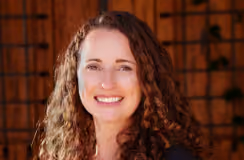





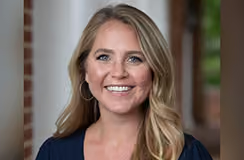

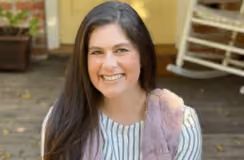




%20-%20thumbnail.avif)



%20-%20thumbnail.avif)


%20-%20thumbnail.avif)
.avif)




%20-%20thumbnail.avif)