Host: Welcome to Acquiring Minds, a podcast about buying businesses. My name is Will Smith. Acquiring an existing business is an awesome opportunity for many entrepreneurs. And on this podcast I talk to the people who do it. In this episode, I talked to Justin Harris. Justin's story is so cool. He was looking at deals, dozens and dozens of deals throughout late 2019 into the pandemic and finally found one that was a great fit. And then surprisingly, that led to a second acquisition. Shortly thereafter, he took ownership of these businesses and in very short order really ratcheted up revenue. And he's kind of only getting started. So very inspirational about how an outsider can come in with energy, get a great deal on an existing business with existing clients, with an existing product and just take it to the next level. Really cool stuff. Here's Justin Harris. Justin Harris, thank you for joining me today. You've acquired two companies, Candle companies, E Commerce Candle companies, Walter and Rosie and Stack. Walter and Rosie and Stack. And you have really ambitious goals for those companies. So that's really what we're here to talk about today. But you also are a proponent of the infinite banking concept or ibc. And I think a lot of our audience may not be super familiar, so I want to make sure we touch on that as well and really understand how that is relevant to people who want to acquire a company. So those are the broad strokes. But let's start quickly at the beginning. Why don't you give our audience a quick background on yourself as it pertains to what led you to ultimately buy these businesses.
Guest: Yeah, thanks Will man. Excited to be here. Yeah, good question. So had previously been a partner in two companies. One was a recruiting firm, the other a leadership software as a service company. And I was a minority partner in both those, ran operations for those and for seven or eight years, I mean, we took it from the both of those from the basement just to growth, you know, and about three years ago exited those, those two, sold my, my shares of those two companies as a minority partner and said, hey, I want to go kick the tires and try my own thing. So ended up starting a small business consulting company that I was doing essentially the same thing, taking smaller businesses that wanted to grow but maybe didn't have the systems in place or they didn't have the finances for a full time coo and was doing that fractionally and after a couple of years of that basically said, wow, I want to do that same thing but with my own portfolio of companies. Right. And so that's really when the business buying process started. And that's really what kind of got me on the journey to acquisition. Because originally I just thought, hey, I'm probably just going to start from scratch with the company, but really quickly realized that just the momentum that you can gain and the speed to me, to which you could grow something was going to be much faster if I just hopped into the acquisition game.
[3:20] Host: So even though obviously when you acquire a company, there's going to be a lot of friction there, you're going to have to go in and figure stuff out, especially if you're not even an insider to that industry. Even with all of that obvious friction, you calculated that it's less than starting in the basement all over again, as you put it.
Guest: Oh, yeah, absolutely. I mean, just when you're stepping into cash flow, even if it's smaller amounts of cash flow, it just makes a big difference. Because to me, whenever and again we can, I know we'll get into this a little bit more, but when I was thinking about what they had already done was identify the avatar and you know, in terms of who the customer is and had already established that that avatar was going to buy the product. So at that point it's just kind of looking at all the variables around that and going, okay, well can we grow it? You know, what are they not taking advantage of?
Host: Which was your expertise.
Guest: Oh, yeah, absolutely. So to me, the fact that they had already created a solid product that people wanted, they already identified a group of people that wanted to buy it, I mean, that's so much of the startup world. And to me that's the hard part, you know, so to know that I was going to pick up something that was already past that stage.
Host: Yep.
Guest: You know, I got, I got excited about that.
Host: Yeah, great. Cool. Well, tell us then about the search process and how you ultimately identified this company. I remember when we spoke before that it was a long process. So talk us through that. How did it begin? Tell us the beginning, middle and end of that. Cause I know, it was so long.
Guest: Yeah, yeah. So my initial search, because prior to starting the two companies that we did, I was a vice president of operations for a really large service based company. So I was thinking originally about service based stuff and I was looking at those primarily. But that evolved fairly quickly into service, but then into E commerce, even though I hadn't done E commerce before, because I just saw the ability to scale it quickly. The ability to grab multiple and bundle them together and have kind of a similar, you know, an operational system and to set up operations that could run one or two brands or 15 brands. Right. From an E commerce standpoint, if you did it right. So once I kind of realized that that was possible, I started shifting gears a little bit more towards E commerce. And I mean, honestly, I just looked at deals. So like my eyes were just bleeding, you know, I mean, it wasn't easy. That part of it to me was, was very arduous. It was looking at tons of P&LS, talking to tons of owners, looking at tons of different products and niches and really thinking through what are some of the criteria that I really think are the most valuable and where do I really feel like I could bring the most value to what we were looking at.
[6:03] Host: So when you say you were talking to owners and looking at P&LS, so let's dive into that a little bit. Were you working with business brokers? Were you just looking at listing sites online? Were you creating your own deal flow? All of the above. Talk us through that.
Guest: Yeah, all the above. Because I had done obviously some consulting in the past that helped with some of just conversations from a deal flow standpoint. But I did, I mean, I didn't want to leave anything off the table. So I was talking to brokers, I looked at lots of sites, everything from the empire flippers to website closers, to quiet like to a lot of the big ones out there that handle that. And then again, lots of good relationships with just brokers in the area.
Host: In the E commerce area or in your geographic area?
Guest: In my geographic area as well. And honestly, that's how I ended up with the first one, you know, with the first brand that ended up purchasing. Again, I've been doing a national thing. I mean, I've been looking everywhere, but it ended up coming through just a relationship here in town with a broker and that.
Host: But that wasn't one of your criteria. That was just a happy, happy accident.
Guest: That was just a happy accident. That's right. That's right. That relationship was. Yep.
Host: Okay. And so the search process, well, how long would you say it took from beginning to end?
Guest: It, let's see, I was probably looking for about nine months before we ended up landing on something. I mean, I say nine months. I mean, I would lightly for probably six months even before that. But it was probably nine months of hey, let's get pretty serious with this. And during that period did make offers on a couple of others that did not work out for various reasons, getting into due diligence or they just accept offers or they had multiples on the table and went with something else. So Obviously it's all those things are factors into it that made it take the amount of time that it did.
Host: How do you deal with the psychology of you're in whatever month, 7, 8, maybe this isn't your situation. Maybe for you and for others, certainly there's no income during that search process. So how do you deal with the psychology of the months are ticking by? You're not finding anything, not making it happen. Do you just set a hard stop? It's like I'm going to give myself 12 months to do this. Kind of your own personal Runway. How do you approach that?
Guest: Yeah, that's a great question. Probably depends on the situation. You know, because of the exit from my previous companies, that helped and because I have been doing some consulting that helped. But what I did do was I did give myself a deadline by the end of 2020.
Host: Okay. Would have been 12 months in total, which is about.
Guest: Yeah, around. Well, we actually acquired the first Walter Rosie in July. So I had six more months. And then. And then the second company was a couple of months later, you know, right before Q4. So. But yeah, I basically said, if I can't figure this out by the end of the year, I'm either going to really ramp back up consulting or I'm just going to go back and, you know, hop in with. With another company. And so I was like. But I did want to give it a solid year of, let's get after this. Let's see if we can find something that's really going to work. And if not, you know, again, I might could have had a little more Runway than that. But I just said at that point I would have given it a good old college try. Right? Yep, Yep, that's it.
[9:13] Host: And were you using your own money or did you have partners here?
Guest: Well, great question. The first one, partners. Second one was a seller finance scenario. So I did not have to have partners, although I did just for that one, just to accelerate growth, I did just bring on some partners for it.
Host: Okay. Okay. All right. I want to get into the details a little bit of each acquisition. So maybe just circle back around on that and just going back to. Just before we move off the search. So about. Well, you were going to give yourself about 12 months, but looking at all these different companies, how many deals would you say you looked at? And I don't mean just like looking at a listing online that you disqualify in 30 seconds. I mean like to the point where you looked at financials. How many. How many companies did you look at? Financials for.
Guest: That's great. I've got. I've got Google Drive folders full of those. Let's see. Seriously, looking at financials, I don't know, it was probably. It was 40 or 50, you know, getting to that point of more, and obviously the light looking, hundreds, you know, but serious looking, probably 40 or 50. Yeah.
Host: Yeah. Okay. So what were your target criteria? You've talked about how you shifted from services focus to an E commerce focus. Geography wasn't important. I assume you wanted us based, but geography wasn't important. Although happily, it ended up being in your hometown. But tell us what the other. What some of the criteria were, and if you can put numbers behind it, that'd be great as well.
Guest: Yeah, that's great. I was pretty flexible from a number standpoint, and part of that really depended on was it going to be SBA eligible. Obviously, if it was, I mean, I'm not crazy about obviously working through SBA process. It's just a lot to work with. But, you know, last year they had just. The terms were phenomenal, you know. Yeah, that's right. I mean, that you couldn't do much better. So I just thought, you know, if they're gonna. They're gonna pay for the first six months of your loan, if you get an SBA loan, all those types of things. So I just said, I'm gonna leverage that if I can. Which obviously opened up the range, the price range that. That I could look at. So I was generally looking at $250,000 deals up to, I mean, honestly, 3 or 4 million. Big range. Yeah, it is a big range, but I would put all those in a small business category. I mean, and for me, personally, I understand that's the stages of growth in those areas, what type of team it takes to run those and then to push past that. And so for me, I mean, especially say 3 million and under, I really get that. Like, I really, you know, from a sweet spot standpoint in terms of understanding what it takes to run one of those and then push it to the next level, I felt comfortable. So for me, that was a little bit of why in that range. But, you know, ultimately what we ended up landing on, the SBA didn't like it because they had declined from 18 to 19. So we ended up doing just a little micro loan from the sba. But, you know, I got a couple other guys together and we just went in and bought it.
[12:11] Host: So this for the first Candle acquisition, Candle company acquisition had declined 2018 to 2019. That's right. Okay, all right, now that scares off the sba. Why doesn't it scare off you?
Guest: Well, because there were legitimate reasons. Like I said, because it was a local deal, I got to go sit down with the owners face to face. And basically, you know, Walter and Rosie obviously is the first acquisition. That Kendall company, The couple who started it, they just love Disney. The wife is a travel agent. And so, I mean, they just bleed the stuff and basically had young kids And I think mid 17, you know, ended up having a couple of kids. And so 18, they were still kind of blowing and going. But then coming into 19, they basically just said, hey, this is too much. The husband had a full time job. She's a travel agent. She's like, I just can't give it more time. So we're just going to back off some. We're going to take, take our foot off the gas a little bit. So for me, I got really excited about that because I thought, well, we can get it for cheaper. But I know, I know at a minimum what it could do from looking at 18 to 19. And then I just thought, yeah, you know, here's what she had done really well, which got me excited.
Host: But before you do, let's tell the audience what now exactly what Walter and Rosie is.
Guest: Yeah, yeah.
Host: Elaborate more on. So it's candles, but what's their niche?
Guest: Yeah, yeah. So the niche is we do Disney inspired stuff.
Host: Disney inspired stuff.
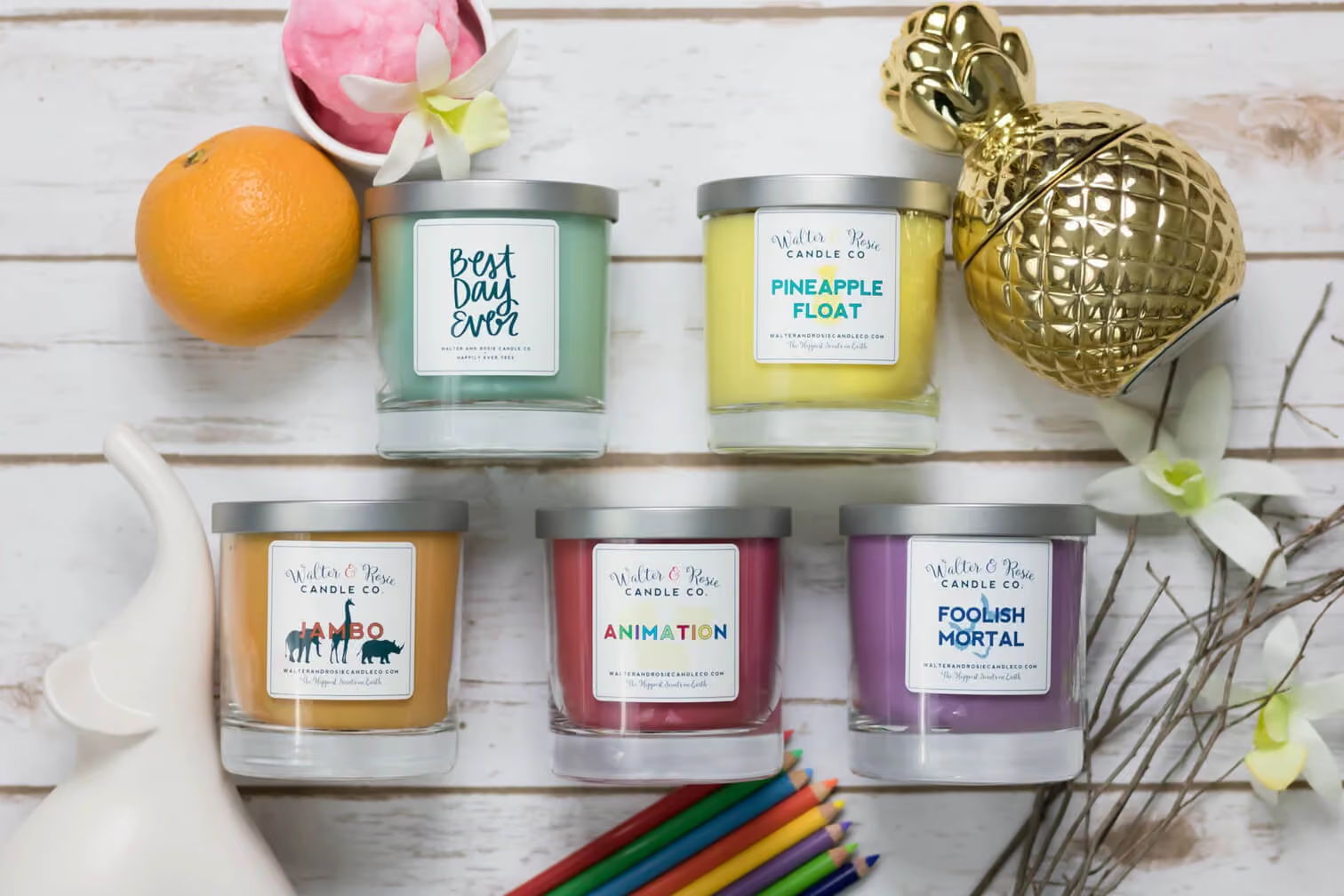
Guest: Disney inspired stuff. So it's candles, wax melts, room sprays, detergents, air fresheners. Those are the kind of the five big things right now.
Host: That all sounds kind of fragrance oriented.
Guest: All fragrance oriented. That's right. And again, all Disney themed. We don't have a licensing agreement with Disney and so we don't obviously use any trademarks or we don't. I mean, it's okay to say, you know, something's Disney inspired, but, you know, obviously we're very careful with anything that's trademark related or any of that with Disney. But the fun part about that is she had already developed over 100 fragrance types that you could. And names and things related to candles that obviously could, could be any of those products. Right. So, you know, when we have a beach club candle that smells like, literally smells like the beach club resort, if you walk into, you know, you walk into at Disney, I mean, people, you know, they love those smells, they love to remember those types of things. And so you like that candle, you spray the room spray, you put the wax melt on, you wash your clothes. And the detergent, it's all going to take you back to that happy spot, right? Yeah. And that's really the heartbeat of the brand. It's, hey, we want to take people back to those memories. We want them to think about the happy things in life and remind them of those experiences that they've had. So obviously it's a great niche. I mean, there are folks out there that are just, I mean, they love Disney to death. We love Disney. There are people that love it way more than we do.
Host: So were your kids excited that you were buying this Disney themed.
[15:01] Guest: Oh, they were so excited. I mean, so excited. You know, my son, anytime we do like Marvel inspired stuff, we've got lots of those. He loves that. My girls, they, yeah. So it's fun. It's a lot of fun.
Host: That's cool. So Walter and Rosie was actually a side hustle for this couple. The guy, the husband had a full time job and she was a travel agent full time, I guess. Wow. Okay. And she was selling. It was E commerce for her as well, right? That's right.
Guest: Yeah. Yeah. They originally started on Etsy and had moved over to Shopify, I think maybe Etsy for a year, year and a half and then they'd moved to shop, you know, built a Shopify store in 2016.
Host: Okay.
Guest: So for four or five years, you know, had just been on, had been doing that and again, what they've done really well, really two things. One had just, she had developed some really great products. The names, because she was a travel agent at Disney. So much just inside information around fragrances that are used in different parts of the parks and those types of things. So she had done that, you know, fantastically well. And she had also done a really, really good job from an organic social media standpoint. I mean, right now on Instagram, I think we've got 41,000 followers for Walter and Rosie and you know, 90% of those she cultivated just they're doing a great job of organically on there. So for me, I saw, you know, when I saw those two things, I saw number one, just a fantastic organic presence already on social and I saw a lot of great products. I thought, okay, we've got some opportunity here. Because what they hadn't done, Shopify was the only sales outlet. So not on Amazon. Not, you know, when I think about Amazon or Walmart.com or just the different channels that you could utilize. Even back on Etsy, it's a, you know, you could be on Shopify. Shopify and on Etsy.
Host: Exactly. Yeah.
Guest: Those things weren't taken Advantage of. And then the second thing is she had never done paid traffic. So, I mean, think there was no SEO optimization for the site, that there had been no, you know, never any Instagram or Facebook ads run for the business. And this is like the perfect thing for Facebook and Instagram ads, right?
Host: Yeah, exactly.
Guest: So I looked at that and thought, we can crush this. And then the other thing I thought was, at the time, they had developed two laundry detergents. You know, I said, we do. We do laundry detergent. Two types. And from my perspective, obviously, the candle businesses is really big. But what I know is that the laundry detergent business, especially the specialty laundry detergent business, has tons of room for growth. I mean, it's just. It's big and getting bigger. And so I saw that and I was like, man, these are fantastic, you know, and people don't do this. Most candle companies, you know, they do candles, maybe they do room sprays. But this, this is an entity in and of itself that could just be huge, you know, and they'd figured it out, right? They'd already done the hard part, right,
Host: to figure that out.
Guest: So we just launched, I mean, we lost three new detergents, you know, two or three weeks ago. So I'm like, I'm so excited about growing that side of the business now.
[18:07] Host: For somebody who doesn't know anything about fragrance, I would think that coming up with a fragrance, particularly when you're trying to emulate one, you know, that exists at Disney or whatever, you're trying to emulate another fragrance, that. That would take, like, real expertise, chemical engineering level expertise. I assume this woman didn't have that. How does a layperson come up with this? Or is this not as complex as
Guest: I think it's not? The beauty of it is, you know, Disney is going to get there. They're going to get their fragrance from somewhere, right? So they're buying it from a manufacturer to pumping it through the air vents or whatever they're doing.
Host: So it already exists.
Guest: It already exists out there. Now you have to figure out what that is. And so, again, some of the relationships that she had, she was able to do that.
Host: Oh, wow.
Guest: Especially with some of the core sense. But then some of the others, you're matching as best you can or it may be inspired by something. And she just did a great job. I mean, we're developed. We've developed new ones this year and are kind of learning and growing with it. But she just did a great job of thinking, what does this, you know, if you make up a Hulk inspired smash candle. What should that smell like? Yeah, you know, like, she just. And she was really good at it. So again, so she, she's like, what
Host: should a Hulk inspired candle smash candle look smell like or fragrance smell like? And then she'll go to, I don't know, the Alibaba of fragrances. And there's a menu where you can go through and just try all these different.
Guest: Yeah, yeah, that's right. There's, there's, there's a local place here that she would go to and do samples. Thankfully, there is a fragrance supplier here in town, you know, here. But then there's four or five larger players throughout the country that you can. I mean, you get tons of samples, and it's kind of crazy, you know, and you're trying to match what you think matches well with that particular theme. And what will people like? Right.
Host: Interesting.
Guest: And try to make it fun. And so because the whole thing's a brand for every single candle that you do or fragrance. It's, it's a, it's a branding experience. I mean, it's a whole thing. You know, it's smell, it's, it's. What does this look like? What color should it be? You know, what's the label going to be and what's the name going to be? You're trying to put all that together to create something kind of unique in that.
Host: Yeah. Yeah. Fascinating.
Guest: Yeah. Okay.
Host: So you make me want to buy this business. It sounds like you really, you really stumbled upon something great. And did you find. You said that she was local. Does that mean that a local business broker that you were working with found brought her to you, or was this just through your network, through the grapevine?
Guest: Yeah, it was, it was a local. Yep. I talked to this guy about a couple others, and honestly, he knew I was like, hey, I'm serious. So I really want to acquire something and I don't want to wait around. And so probably every week, either I was calling him or he was calling me, and I was, you know, with my little network of folks, either through email or through phone calls or whatever. I was just trying to get updates. And so he would call me and say, hey, I got this, or, hey, I got this, or, hey, I'm about to list this. It's not even on the market yet. Do you think he'd be interested? To me was super helpful because he would call me before he even listed something and say, hey, what do you think?
[21:16] Host: That's just what. Of course, seems to be always the case that the Best deals never even hit the market. So he was kind of shopping us around to his contacts like you. And if he didn't get any bites, he would have put it on an Empire Flippers. My question is why didn't the Empire Flippers or whichever E commerce listing selling site get ahold of her first? And it's, I just answered my own question. Is that basically how it goes?
Guest: Yep, that's right. And you know what's interesting is that in both of the cases that I had dealt with the owners, they didn't, they don't know Empire Flippers exists. No clue. You know what, those types of, they were just really focused on trying to sell some candles and trying to sell, you know, and take care of kids and work full time jobs. Like, you know, thinking at a little different level about how they would exit or any of that. That really wasn't on their mind, which is a good thing for me, you know, not to say like, oh well, they weren't sophisticated sellers in that sense. It was just, they weren't worried about that. They weren't trying to shop it to 10 different places. They, they had a good relationship with this guy and as a broker and they're like, well, I guess that's how you do this.
Host: Yeah, sure, sure. Fascinating. Okay, can you now tell us some, some of the deal terms? I mean, what you can tell us revenue she was doing and then what you bought her for and financing.
Guest: Yeah, so 18 did about $280,000 in revenue. And again, you know, if you're talking about this is purely organic traffic and social traffic. So I thought that was phenomenal and gave me a lot upset. And. But then in 19 again, they backed off tremendously. You know, they were basically only open on the weekends even even though it was an E commerce store. They were kind of the store you could only buy something on weekends. And some months she wasn't even open all the week. So the revenue dropped to maybe in 19 to like maybe $120,000. And I think, gosh, only netted 40ish off that, you know, 35 or 40 off that, whereas the year before it was 80 to 100. So the margins are pretty decent. But again, that's where I was like, this is great. And having a good conversation with the broker, understanding what 18 was of what 19 was and why we blended a little bit of those financials together and ended up settling on 160,000 to buy it. So it wasn't a large acquisition, but it was basically 4x4 times the 19 number. Yep. You know, and roughly 2 of the. Of the 18 number.
Host: Sure. Yeah.
Guest: From a, you know, ste standpoint, so nothing crazy there. And I thought it was pretty reasonable, but they were. And they were excited about it. They were like, hey, we understand where we are and what 2019 was, and if you'll kind of work with us on a little bit of it in between. Because what I was comfortable with. Three to three and a half.
[24:08] Host: Yep.
Guest: And so I thought, you know, if we blended the two years, that was about where we would land there, and I was okay with that. I wasn't going to try to, you know, be a bulldog with that.
Host: Sure, sure. And how old was the business at 2018? Was that the first year?
Guest: No, no, no, 20. They started on Etsy in 2015, and then 16, 17, 18. Like I said, they saw growth. You know, obviously the kids came into play, and then.
Host: Yeah, gotcha. Okay. Okay. So it was 160 and then go into a little bit of the. You didn't need SBA for that. This was the one where you took a little bit of a micro loan, but was mostly your own money. That's right.
Guest: Yeah. Yeah. Most of our money. I mean, anytime we can leverage, we could have done it all with our own, but anytime we can leverage, you know, some other debt, we will. So we took a $50,000 SBA micro loan and same thing there. The terms are great. They paid for that for the first six months, obviously, with the COVID scenario. So that was nice. So that's, you know, 5% of the business the SBA paid for, roughly. And then the rest of it, myself and another partner we ended up doing. You know, we talked about this earlier, just a little bit of IBC for that. So we used our own money and, you know, and purchased the rest of it.
Host: So, okay, now for if you said it netted 40 in 2019. And so. So I guess 80ish 2018, the net.
Guest: Yeah, that's right. Yep. 80ish 2018. Yep.
Host: So if you want to reinvest into the business, probably a lot of that net, you know, what Justin is bringing to this is a lot of his ideas and energy, and so he's going to take that cash flow and put it back into the business. How is Justin himself getting paid in the meantime, or is this basically sweat equity For a while?
Guest: At the end of last year, I think we distributed maybe 15 or 20 grand at the end of 20. But, yeah, the rest of it, we just said, hey, we're myself or, you know, the partner other Partner in it between some of the other things we were doing, we were okay income wise. And so we just said, hey, let's distribute a small part. Everything else, let's just put back in.
Host: Yep.
Guest: What we were able to do though, is we acquired it in July, I think, maybe July, I can't remember. July 8th was the closing date of last year. And like I said, in 19, they did 100. Yeah, right. At 120,000. And so we were able to basically double that in the six months that we had it. So we said, hey, let's can we rock this thing and get a couple hundred thousand in revenue from July to December? You know, and we were able to do that, which is great. And that's just. We just barely got into Amazon and we weren't even able to do fba. That was just kind of fulfilled by merchant stuff that we had to do. We just, you know, so it was just through. We grew the email list. We tried to take advantage of it. We started running some social, you know, some paid ads, optimized the website a little bit. Still got a lot of work to do, but we did that. And again, just barely for November, December, got some sales moving on Amazon. So I'm excited about, you know, this year and seeing where we can go.
[27:08] Host: So you turned on a little bit of social ads the last two months of those six, you finally got on Amazon, but not even fba, you started using the list, her email list.
Guest: That's right.
Host: And then you did a little bit of website optimization and that essentially what doubled what the revenue was on track to otherwise do is that. What's the math?
Guest: That's right. Yeah, yeah, yeah. So we did 200 grand in six months, whereas, you know, they'd done, you know, 100. A little over 100 all of 19 the year before. Yeah, but. Yeah, that's right. So.
Host: And you must. I mean, with an acquisition like this, where you're just putting all the money back in and not taking any of it out, you're really not looking at this as an investor per se. Have you really think you can really grow this? Every dollar in is going to be worth it a lot more in your view. So talk to me about. Well, we're getting a little bit tight on time. I want to make sure we talk about that second acquisition. So let's do that. And then I want to hear about your vision for what these two companies now look like in your hands. So tell me about the second acquisition.
Guest: So the second acquisition, again, just good Providence there, the manufacturer. So the guy who's actually helping manufacture our candles.
Host: The Walter and Rosie. The first acquisition.
Guest: The first acquisition, that's right.
Host: She was working with a local candle manufacturer.
Guest: That's correct.
Host: And so now you have this relationship.
Guest: We've got that relationship. We're talking. He says, hey, I've got another lady that I'm making candles for that she may want to sell. Would you be interested? And my answer was absolutely, you know, and then he told me what the brand was and you know, we had two of those candles sitting in our living room. Right. So we knew it was a good product.
Host: Customers already of this company.
Guest: Yeah, we were customers already. Yeah. So that the brand is Stack, it's a luxury brand. And so the candles are more expensive. Just that, you know, it's a little higher end brand from a, you know, from a product standpoint. But I thought it would be great in really similar scenario a few years ago. It was moving and shaking. Her primary avenue was retail. You can imagine what's happened to retail in 2020. Yeah, it was just crushed. Not, not only that, but, well, two things. One, she had some health issues. And then two, just, you know, Covid the whole thing. She basically said, told the manufacturer, hey, will you just kind of run with this right now? Like, I can't, you know, from a family and health standpoint and a couple of other scenarios, she's like, I really can't mess with this. So he was like, he didn't really want to run with it. You know, he wanted to just make candles for everybody. And so I, like, again, I knew the brand. I knew what a quality product it was. I knew kind of the same thing as similar to the other in that she was very limited in online, the online presence. And so I was like, all those things added up to. Yeah, let's, let's, let's do it. You know.
[30:02] Host: And so when you say she was selling through retail, she was selling through kind of like local. And you're, you're in Birmingham, Alabama. Yeah, that's right. She was selling through sort of gift shops in the, in the. Yeah.
Guest: Local boutique. A lot of. Yeah. Boutiques. And really she had moved into the Southeast that, you know, kind of in the. At its higher point maybe three or four years ago. What was in, I mean, you know, Mississippi, just the Southeast. She was probably in, you know, 30 or 40 stores.
Host: Wow. Okay.
Guest: Yeah.
Host: So you had all of that distribution already and then you could just turn on E Commerce was the idea.
Guest: That's correct.
Host: That's great. And so what was. Tell Me some of the numbers of her business and then how the. What the acquisition looked like.
Guest: Yeah, so she had done real similar to the other one. I mean, actually a little bit more so three or four years ago. Probably been in the $300,000 range of revenue. So again, not, not massive. But that's just her kind of hustling, you know, and getting into the retail stores.
Host: 300,000 in revenue. Ish. And what did her, what did her, her margin look like?
Guest: Pretty similar. 30ish percent ish, you know, on that.
Host: Okay.
Guest: Which if you're selling those, again, when you, when you're selling those retail, obviously you're wholesaling them to them. Now if we're selling those on the website, the margin goes up.
Host: Yeah.
Guest: Because these are luxury candles. So I was really excited about that. But again last year she ran into a scenario where the bottom had fallen out because she wasn't doing anything. The retailers weren't buying anything.
Host: Yeah.
Guest: So you're talking like 30 or $40,000 in revenue, you know, is where it went down to. That's what it went down to.
Host: Because Nobody was buying 300 to 30,000.
Guest: Yeah, that's right. Nobody was buying anything. And that was a combination of people weren't buying plus her, the health issues, you know.
Host: Yeah.
Guest: So those two things together. Yeah, so yeah, we were, I was able to just to come in and say, hey, I want to do two things. I want to do just a seller finance deal off. So basically she gets 10% of gross revenue for a period of time. And then. And also some other things she's going to help. She is going to help kind of with some retail stuff. So we've got some other incentives in there from just a pay standpoint. But yeah, I mean, compared to what it was a steal of a deal, you know, to kind of step into some of that. So I'm excited about that. So I didn't, we obviously didn't have to get any financing for that. I did just bring on a couple of partners for that. And that's mainly just to say, hey, what do we need to do now to shove some capital into this thing to get inventory in? We need to get some stuff from overseas in just from a packaging standpoint, more of that and really ramp as quickly as we can this year to be ready kind of for Q3, Q4. So yeah, so I'm excited about that.
Host: And so just to drill down a little bit on the deal terms or the main point that you just touched on seller finance. So you promised her, given her 10% of gross up to, I assume a certain, there's a up until what number.
Guest: So the seller finance portion is going to go to 20,000.
[33:00] Host: Okay.
Guest: But then she's also, again, she's got some other, we've got some other things in there that she gets to, she's going to get to do that are going to be a little bit different in terms of her access to product and how much of that we're going to give her over the, I mean, honestly, as long as we own the brand. But then also some, some pay incentives around retail distribution because that was kind of her sweet spot and she's really excited about, she's feeling good again, really excited about getting back into that. So you know, some of that's variable so that's going to be there. But what's, what was set in stone was, hey, we're going to give you up to 20,000 for this and, and then with these other variable things that are going to be, should be fairly valuable to her if, if things work out.
Host: So. Okay. Okay, great. Really interesting. Okay, now we just have about five more minutes. I want to. You had touched on IBC and I took us in another direction. Why don't you tell me, tell me how it works now. Infinite banking concept.
Guest: The infinite banking concept. So the core of it is you initially put your money into a whole life insurance policy.
Host: Okay.
Guest: So that's going to do a couple things. Number one, you're going to earn a small amount of interest on that. Typically you're looking at 4 to 5%. So most people think, well, that's a terrible investment vehicle. And you're right. If you're using that as the end game, it's not good. But if you think of it as a supercharged bank account where you can become your own bank, then all of a sudden it changes.
Host: Okay.
Guest: Because what you can do is you say, let's say I put, you know, we put 50 or $60,000 into a whole life policy then so that two things happen there. Number one, you get cash that's, there's cash value there that's going to grow, you know, at 4 or 5% over time. The second thing is obviously you're going to have life insurance, you know, paid for because of that, which is nice. But then what we do with the infinite banking concept is we borrow against that policy. So we essentially become our own bank. We want to do what banks do. We put our money in and they borrow against that to go do loans. Right. It's the same thing Conceptually, we take those dollars, we borrow against those dollars, and now I put that money into another asset. So now I've taken the same dollar and I've leveraged it to do two things to grow in two places for me, because the policy isn't going to stop compounding because I haven't taken money out of it, I've borrowed against it.
Host: Okay, so let's say you put 60 in. How much can you borrow? And you. Can you then borrow 120?
Guest: No, if you put 60 and you could borrow 60 out, right. I mean, you can borrow up to whatever the cash value is. Although, again, so much of that depends on how long it's been in there. So there's a. There's a big incentive. I mean, I've started policies on my kids because I want them, when they're 50 or 30 or 20 or 25 or whatever, to be able to do the same thing. Not just to buy, hopefully, businesses one day, but to buy their own cars, to buy their own. I want them to be their own bank to do all those things and help them kind of just think differently about that. So, yeah, so now I've got two assets that are growing because, again, because I borrowed against the policy. If I had taken that money out of a savings account, it's gone. Right. It's only going to be growing in one space. But now my goal is how can I leverage a dollar to use it multiple times? That's where infinite banking came in. And it's been fantastic. I'm so excited. I want to do it over and over and over again.
[36:17] Host: So this 60 grand continues to generate 4 or 5%, but you've now withdrawn or not with. Excuse me, you certainly haven't withdrawn. You've borrowed against the six, let's say all 60 to invest in your business, but you're still getting 4 or 5% on 60 grand.
Guest: That's correct. And now part of that depends on
Host: how long it's been.
Guest: How long it's been. But then also the type of insurance company, there's one, there are companies that are called direct and then some that are indirect recognition. So anyway, there's some, there's some obvious, some minutiae there that somebody has to pay attention to, but conceptually, yes, that's right.
Host: Okay.
Guest: Now you are going to pay some interest back to yourself, which is really interesting on that loan because they're going to require you to. The insurance company is going to require you to. So there's some, there's some interesting, obviously, nuances to all of it. But at the core of it it's how can, as an entrepreneur how can I build multiple assets with the same dollar? And for me Infinite banking was just a great no brainer to do that. And it gave me a lot more control. By having money in an asset like that, a vehicle like that, I actually have access to it. So it doesn't go into, you know, 401k prison. Right. For the rest of its life. I mean to me that's, I'm glad I have no control over that. So now I've got control. I can pick the path that I want that I feel like is going to be the best use of that and again leverage it multiple ways.
Host: Okay, okay, well I have a lot more questions on that. It is counterintuitive so maybe we'll have a separate conversation at some point about. I just. But I want to close with your ambitions for these two businesses, for Statcandle and for Walter and Rosie. What do you see doing with them revenue wise in the next, let's say three to five years.
Guest: Yeah, great question. So the goal was to at least make them 10 times 10x their worth in 3 years. So you know, for Walter and Rosie that means we would take it from 160,000. You know we bought it for 160. So would it be worth 1.6 million in three years? I think we can do that. I mean this year we should probably do. I mean we're tracking towards about a half a million in revenue this year. And guys, there's so many other things we need to do from a product standpoint. I mean there's just so much we need to do to that can continue to grow that. Yeah, stack 10x would be. We can't do that. I mean I would love for it to be in the, you know, one to one and a half million dollar worth range within three years as well. Three or four years as well. So yeah, if we do that I would be ecstatic. And you know, like I said, I think this year, I think the goal this year by the end of the year would be for Walter and Rosie to build a million dollar run rate.
Host: Right.
Guest: So ultimately lend it about a half a million in revenue, be on a million dollar run rate. And the goal for Stack by the end of the year is to be on a $300,000 run rate, you know, to kind of get it back to where it was and hopefully Walter Rosey, because we got it earlier, it had a lot more momentum. I think we can get it moving faster if stack if we can get it back to where it was. And then obviously I hope in 22 I think we could double that revenue pretty easily. Take it from 300 to that 5 to $600,000 range.
[39:23] Host: Phenomenal. That's phenomenal. So just to distill this, you acquire one business for the 160 and then just 24 stack. So that's 180, but you didn't have to put it all up front. And then you think you can get these businesses to 10x their revenue in 3 years for $180,000 initial investment. Just crudely. Yes, it's pretty. And you're coming into these businesses with product market fit with the manufacturer in place, with social presence with all of this stuff that all that really hard work just getting, you know, starting from absolute scratch. So the businesses already have momentum in customers and you're just kind of adding fuel in your own expertise. It's really, really powerful.
Guest: That's right. That's right.
Host: Cool. Well, I want to leave it there. Justin, I thank you for your time. Thanks for being transparent about the numbers. I could have kept going. I had a lot of follow up questions as I said, ibc, but also other stuff. So maybe we'll have you back on again. But for now thanks very much for coming on.
Guest: Thank you. Will have a great day.
Host: You
Guest: Sam.




















































%20-%20thumbnail.avif)




%20-%20thumbnail.avif)

%20-%20thumbnail.avif)

.avif)




%20-%20thumbnail.avif)