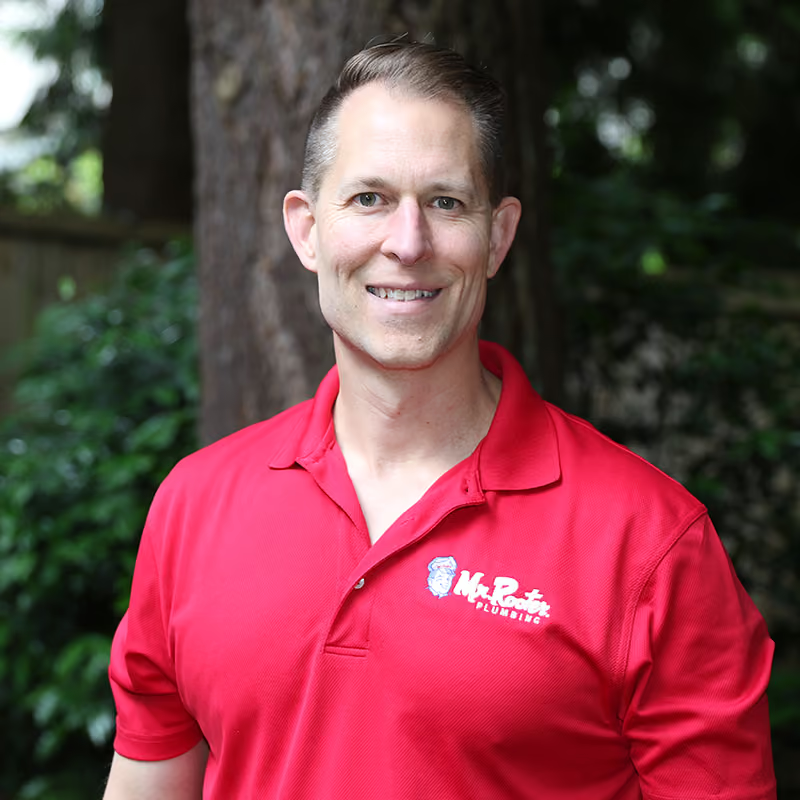
Host: Most acquisition entrepreneurs I talk to start searching for a business to buy and are not open to buying an existing franchise business. But I've also heard from a number of you that as your search progressed, you eventually did open your minds to franchises and in doing so availed yourselves of many enticing opportunities. Today's guest, Doug Johns is a great example. Doug started his search looking for a business doing between 750,000 and 2 million in EBITDA. Sizable for a searcher and naturally he was thrilled when he saw a great one until realizing it was a franchise. Well, flash forward. Doug and his wife overcame their reservations and today own one of the top selling Mr. Rooter businesses in the country. It does nearly 2 million in EBITDA. With 50 employees. It is a big, healthy, mature business. Just what so many of us would love to buy. So if you've been curious about buying an existing franchise business, actually especially if you have not been curious about it or open to it, this interview will help. Doug Johns was where you are, but softened his position when the right opportunity came along and has been rewarded handsomely. Enjoy. Welcome to Acquiring Minds, a podcast about buying businesses. My name is Will Smith. Acquiring an existing business is an awesome opportunity for many entrepreneurs and on this podcast I talk to the people who do it. August Felker is a two time successful searcher, first with a traditional search fund. The second time around he did a self funded search. Today August runs Oberle Risk Strategies, an insurance firm with a dedicated practice group for searchers and acquisition entrepreneurs like you. If you've got a business under loi, Oberle will provide complimentary due diligence on that business's insurance and benefits program. A great no risk way to get to know August and team. They love helping searchers. They've worked with hundreds. Oberle is a specialty insurance brokerage for searchers by a former searcher. Check out oberle-risk.com O B E R L E- risk.com, link in the show notes Doug Johns thank you for joining me today on Acquiring Minds.
Guest: Glad to be here. I can't believe I'm actually speaking to you and not just listening to you while I drive down the freeway.
Host: Doug, last year you acquired a plumbing business that is actually a Mr. Rooter franchise. You're the first acquiring minds guest to have bought a business that's a franchise, but it's actually a request I get a lot from for just such a guest. So we're definitely going to spend some time on this question of buying a franchise versus buying an independent business. But that and much more. There's a lot to your story. Start us off with a little personal history. Doug, you had originally expected to get into the family business of flying planes. So tell us about that and we'll go from there.
[3:18] Guest: Sure. The family business. Hadn't ever thought of it that way, but I suppose that's the case. I grew up as a military kid and that goes way back. Both my granddads were in the Army Air Corps in World War II. My dad's dad flew missions on D day combat missions in Vietnam. He had a 30 year Air Force aviation career. He commissioned my dad who aviation career, he flew in Vietnam, he was in Desert Storm, he was in Bosnia and my dad commissioned me. I, I went to the Air Force Academy. If you had seen a picture of me at age 2, I wore a little flight suit with my name on it. You know, when I was in fourth grade, before the Top Gun movie, I used to ride my bike along the side of the flight line next to the jets like Tom Cruise before he knew that was the cool thing to do. So that was the path and went to the Air Force Academy. But in my second year there, we went through aviation physicals and they found out that I had a failing mitral valve which later I had a heart surgery on. It's all good. And so that changed. You can't be a, you can't pull GS if your heart valve doesn't work. Great. So I was disqualified from flying. And that just rocked my world. That's all I had wanted to do growing up, be an Air Force pilot. But they slid me into a position as an aircraft maintenance officer. And that unbeknownst to young 22 year old me, was highly relevant to running a plumbing company today. So I graduated, was a lieutenant, my first job. I had 100 munitions technicians and then later working on F15s with mechanics and just got to have some experience of leading teams of technical people without having the ability or even the legal ability to turn that wrench myself because I wasn't licensed. So that was a great early career step. My world was a quiet place though. This was the 90s and I could see that that wasn't going to be a long term career path for me. And my wife and I decided to start our family and jump into the civilian world. And I got on board with a company that specialized in placing junior officers in Fortune 500 companies. This was in 99 and 2000 that I was interviewing. Every MBA in the world was going to whatever.com to be a vice president because it was the first tech bubble that hadn't burst yet. And so there were some cool openings. And with those folks, I landed a job as a brand manager at the Campbell Soup Company.
Host: And I had so not a.com?
Guest: the ante.com exactly. Yeah, it was not cool at the time, but man, was it cool for me. I had no idea what an MBA was even at the time. And now I was with all these people who had them and rode in a taxi cab for the first time my first week in Philadelphia at that company. And they poured training into me and process and some great business experiences, big budgets. I got to do fun things like look after the Chunky Soup business and make TV ads with NFL players and their moms. And it was a great experience. Ultimately, my wife and I chose that job because we wanted the best possible job and we'd live anywhere and then figure out how to get where we wanted to be. And after a while had moved along in the career enough that I could more call my shot and was able to move to Washington State, where I've got a lot of family on the west coast and Pacific Northwest and made a jump over to a company called Precorporate, made fitness equipment and was with them for 13 years on their executive team in a bunch of different sales and marketing and customer service and roles. And then that. I thought that was going to be my career stop. I loved that company. My dream to maybe get the shot to be the president there instead of just a member of the executive team. And that was actually lined up on paper. But you can never bank on what's on paper with hr. We went through an acquisition and it's a long story, but the short version is during the pandemic, we sold our company to Peloton, the exercise bike manufacturer. And during that process, my wife and I came to the conclusion that if the selling company was not one whose business model we could buy into that we didn't want to go with it and what would we do? And we had daydreamed before about what if we ran our own company? But we just got serious and I typed into Google, how do you buy a company?
[8:08] Host: How to buy a business?
Guest: Sure. Boom.
Host: And let me guess. Biz Buy Sell came up those guys with the best SEO in the world.
Guest: I started reading Biz Buy Sell and I got the same books that everybody has read. Harvard Business Review and Walker's Buy, then Build Book. And two weeks after that, I joined Walker's acquisition Lab and my wife committed to go back to school and get her accounting certificate at community college. And we were all in and. Great. The last bit on that story is the day that the acquisition closed I resigned and we took a few weeks but then went full time search.
Host: Cool. Well, I am going, I'm going to, I'm going to dig back into a couple of other details from your history there. You and I had a pre call and I got a lot more color and there were some interesting things that I think are going to be relevant to your later story of the acquisition. First is there when Precor was the name of the company that you were at for 13 years and you were sort of in line to be the president CEO and there was before it was sold to Peloton, it was sold to a Chinese sort of holding company. Correct. And so you spent a lot of time in China and kind of seeing Chinese work culture. Is that a fair assessment?
[9:35] Guest: That's fair. For several years I was responsible for our Asian and European businesses and spent time in China and particularly after that acquisition, which was a short one, but our parent company got acquired by a bid to buy all the shares. I won't call it a hostile takeover, but it was unannounced. I found myself working for a Chinese holding company and the chairman of that company is a member of the Chinese National People's Congress and the head of the Chinese Olympic Committee. So pretty high ranking fellow.
Host: Yeah. And one of the wealthiest men in China, which obviously means one of the wealthiest men in the world. Very interesting. Well, people might guess where, where how that becomes a theme later in terms of the types of, type of business you chose to buy and we'll get there. The other detail that I thought was so interesting on our pre call was how you just alluded to it how you and your wife like not being full believers in the, the business model of the acquiring company, namely Peloton. You, you didn't want to, you didn't want to stay at the company for that reason. Obviously we all know now Pelo having quite a bit of trouble. But around this time 2020, you know, Peloton kind of peaks with COVID I mean, you know, it was one of those, it was one of the, it was kind of like the, the picture of a, of a company benefiting from COVID What did you, why did you see the writing on the wall before the rest of, you know, consumer dom and the markets did?
Guest: Yeah, I wish I had that kind of insight into every investment because then I wouldn't need to own a company. But in this particular situation, you're right. The day that our acquisition, the acquisition of Precor was announced to the market is the day that Peloton stock hit its peak. And I don't know where it trades today, but in the last couple of weeks it was, you know, 95% below that peak. What I saw, number one, I admire, by the way, the product that the Peloton folks built and the brand. I think there's some incredible things that happen and it is a fine, fine product. The problem was, and any investor could have seen this before the peak of COVID they had over a billion dollars in outside equity invested to build that company up, but had not yet made profit. So it was completely propped up by exuberant investors. And then layer on top of that, anyone who's been around consumer products knows that if you have a company that has a single product, that has a narrow audience, it goes up and it comes down in fitness. That's the Bowflex, it's the thigh Master Peloton is better than that. But it's a predictable pattern. And I wasn't going to tie my fortunes to that. But it hurt, I tell you, because I had been at that company, Precor for 13 years. It's a company of just under a thousand people. I knew hundreds of them by name. I loved our mission, the quality of the products. We made 90% of our products in the United States. It was just a great environment and I would have happily ended my career there. But once that was not going to be the case, we said, well, what are our options? And bam. Here I am running a 50 person plumbing company. Who knew? But I'm so happy to be on this path.
[13:16] Host: Yeah. Okay, well, let's get more into how you chose this path. So we know you sat down one night and said how to buy a business and put that into Google. But why? And you and your wife before had kind of entertained this fantasy of being business owners. But why not the start from scratch path? Why buy an existing business?
Guest: Two things. One, I don't think I have that skill set. If you look at my past, I've been in very large organizations. Even Precor is still a thousand people. I'm better at running and optimizing and leading and inspiring. I'm not the scrappy start from scratch kind of guy myself. And then second was just even
Host: the
Guest: good fortune that my wife and I are five decades in, we've accumulated some assets over that time. There's no reason to start from scratch. When we have the opportunity to get something that's a going concern and magnify our lifestyle instead of stepping back to eating ramen.
Host: Yeah, yeah. And certainly that's one of the classic reasons to buy an existing business. Had you already figured that out, that that value of buying existing business before, say, cracking Walker's book open, you know,
Guest: conceptually, I appreciated that. That would be an excellent way to go, but I had no idea how to do it. And, you know, until I started reading his book and the Harvard book, it's something embarrassing. I mean, I eventually went back. I have an MBA from the Wharton Business School. Campbell Soup Company sent me there on their dimensions through the executive program. I'm forever grateful. But I still had no concept that you could do an LBO as an individual. Basically, I just did not know it until I cracked those books open that I could leverage something like that. So I thought we were going to have to buy a much smaller business, and thankfully, we've got a substantial one.
[15:20] Host: Oh, so before you learned about the. Let's call it the personal LBO model, as championed by the Buy then Build model, you thought you'd buy a business, but you thought that the two of you would basically buy a business unleveraged, buy the whole thing in cash. That was kind of what you. Before you knew much about it.
Guest: That's kind of what you imagine, I imagine. So I was thinking, oh, you know, there's a couple hundred thousand dollars in SDE is probably what we can swing, but thank you, sba.
Host: Yeah, man. Weren't you pleasantly surprised like the rest of us? I mean, we all kind of have this light bulb, mom, it seems.
Guest: And I'm so glad that this is taught now in business schools. You know, when I went through Wharton 2004, 2005, we did not have a single discussion about small businesses. It was all about being an investment banker or a CEO of a packaged goods firm or whatever. So I'm glad that curriculum is changing for folks.
Host: Yeah, for sure.
Guest: For sure.
Host: And you also just said, and I like to give this for context, your age. So you're about to be 50. You're 50.
Guest: I am a couple months from 50, and my wife has already crossed.
Host: So you decide that this is going to be your path, that you're going to buy a business. You educate yourself by reading the two books, doing some googling, and then where do you find yourself? Tell us about, like, what you imagined buying in terms of what your financial picture looks like and what you imagine that allows you to buy. And what sorts of businesses you were going to look at? Kind of all the parameters.
Guest: Sure. So we went through. I almost wish Georgina could be sitting here with me because she was part of this whole journey to include her big sacrifice of going, even though she has a master's degree in engineering, going back to community college to. So she could get QuickBooks certified, which has been powerful in the business as I'm good at finance, but I had never cracked open accounting. Right.
Host: So anyway, interesting how those two things are actually quite different skill sets.
Guest: Indeed. So we, we followed the model of defining our criteria tightly, you know, getting that down on paper, sharing that with brokers. So our criteria. Can't quote it word for word anymore, but we said first we had a geographic limitation for us that was the Pacific Northwest. I didn't want to get too far from family in the part of the country we love. And we had definition of the business, which was the SB one offline. So there's no way that I wanted to compete in SaaS or website World or even E commerce. I don't have those skills. And I wanted to narrow my competitive set to people who were of similar size and local to me and not get beat by some wizard in Ohio who just started a website or by the Chinese. And I say that with all respect. I just, you know, I've seen up close and personal the power of international businesses when it comes to online and apps and imported products. And so he said it has to be offline and then said it has to be a product or service business. And we had a size criteria and it was pretty wide. We defined that as 750,000 to 2 million EBITDA. I figured the 2 million was a stretch. It was going to require a pretty lean multiple, but that was the layer we put. And I also had in the back of the head that if we got that big, I would consider investors. But the overriding drive was to fund it ourselves. I just preferred not to have. Since I could buy something, I preferred not to have other people to answer to. Maybe I'm a bit selfish, but
[19:20] Host: sure. No, believe me. I think a lot of people listening, including myself, understand that. Now a $2 million EBITDA business is, as you said, quite sizable for a loan acquisition entrepreneur at that. At that level, you're competing with a lot of interested parties, namely private equity. So, you know, $2 million EBITDA business and it's going to command a higher multiple probably. So let's call it, you know, 4x. So that could be. That could have been an 8 million. If you found such a business, that might have been an $8 million acquisition. So 5 million of that comes from the SBA, assuming that's how you're going. And then the rest would have come from you and your wife and maybe, as you said, investors, if you couldn't swing the balance. Wouldn't it be great to have experts at your back when buying a business? People to help you polish up your pitch and processes as you go to market as a searcher, then help you evaluate opportunities once you get some deal flow? Such experts exist buy side advisors, but they'll cost you to the tune of tens of thousands, even hundreds of thousands of dollars. But another option exists, the acquisition lab. The lab is a do it with you buy side advisory service, not do it for you. Founded by Walker Deibel, author of Buy Then Build, the Lab represents Walker's vision for what is most needed to make a searcher successful and available at an accessible price. It's cohort based and you will come out the other side of your cohort prepared to go to market as a savvy searcher with a tight message and process. So brokers take you seriously. Pre approved for a loan and with an entire community at your disposal to help you along the journey to buying a business. To learn More, check out acquisitionlab.com, link in the show notes.
[21:15] Guest: That was the plan and the deal we ultimately did. It was structured with big SBA package, you know, us putting in more than a million dollars and the seller carrying
Host: a note in the note. Of course. Yeah, failed to mention the note. Okay, so tell us a little bit about the search. So these are your criteria and are you, who are you talking to? Are you talking to local brokers? What does that look like?
Guest: Yeah, so I started out talking, trying to reach local. Well, I guess I started out like I think most people do, which is spending way too much time scrolling through Bizbysil and the seven other websites that all have the exact same listings but slightly different URLs. And I eventually got fun. I eventually got to a point where I got to stop doing this. I just got to set my searches with the parameters and have it alert me, which is ultimately what we got to. But then once that was in place, it was the broker outreach and I had some assistance from a couple of bankers that I talked to in my local area who we put together, my wife and I, each a two page sheet that had our well defined criteria at the top, bullet points about us, some of our skill sets, basically the Business buyer resume. And I used those to get attention. It was. In retrospect, this is a silly statement, but it was harder than I imagined. I thought, well, of course I'm going to call up and they're going to say, great, let me help you. And that was not the case. Even with a substantial corporate background and the ability to say, I can bring a million dollars to the table, I still had to call three times. Some, you know, to get an answer from brokers once.
Host: And why, why do you suspect that that is? That was
Guest: one is they've got a lot of people calling them. I think they're looking for persistence. If, if you're legit, you're going to call me a second or third time. And if I put myself in the broker's seat, particularly somebody who's got legit businesses, you know, and we lived in Seattle at the time. We still do. We live in Seattle and Portland combined. There's a lot of people with corporate backgrounds and a million dollars in Seattle. I mean, there's probably a thousand people at Microsoft that meet that criteria, right?
Host: Yeah.
Guest: And so like, okay, great, call me second time, call me a third time, and let's see if you're real. And by the way, I'm busy as a broker trying to get the three or four deals a year done that I'm going to do. And I'm dealing with an active project list over here, not just Wookie Loos, but did break in and ended up building a reasonable network of brokers in the Pacific Northwest. I learned over time that I had one particular broker who I made an offer on a business we didn't win. Purportedly we came in second. After that, he started showing me more listings that I hadn't seen before. So I think there is a couple of steps of legitimacy that have to happen.
[24:34] Host: It's interesting to hear you say that they're unresponsive by design, just as they're as their own filtering mechanism, like intentionally. I can totally see that. I've always thought that brokers have a reputation for being unresponsive just because they're bombarded or they don't take you seriously. And maybe we're kind of saying the same thing in different ways, but it's almost like it's interesting that a broker might sit there and see people coming in and say, I'll respond to any of you people, but you just have to show me that you're persistent. So email me a second or third time and then we'll talk.
Guest: Interesting concept hypothesis on My side.
Host: Yeah, yeah, yeah.
Guest: The other, I will tell you that I started having more success with brokers when I changed the way I referred to myself. And this is, I started out saying I'm a searcher and of course I was on searchfunder.com and I think there's cool resources there. I love searchers. But I realized after a few broker conversations that some brokers have a negative attitude towards search funders in that, okay, this deal is going to be tough to pull together. There's going to be other investors involved. This person may be 26 years old. What experience do they have? How are they going to relate to my buyer? Because of being the age and the experience that I am, I was able to bring a different story and I started referring to myself as an independent investor in my emails and in my profile document. And after that I had conversations with at least two or three brokers who said that was the right way to go for me. I mean I met that criteria. If I was my 27 year old self, I couldn't have done it.
Host: That's so interesting. I did these. Did these two or three folks actually say to you that, I mean, did you just kind of infer or have you heard from brokers that searchers have maybe not the best brand in brokers minds?
Guest: I had multiple significant listing brokers in the Oregon and Washington area tell me about their concern of young unqualified searchers. So if I was a 27 year old searcher that wouldn't stop me. But I would certainly go into these conversations knowing that there may be some bias that I need to overcome and
[27:00] Host: how can I do that, man, that is so valuable. Listen up everybody. You 27 and 28 year old searchers out there. So the moniker that you started using for yourself was independent investor. And yes, that does sound so much more dignified. I would, I would much prefer if I'm selling a business to talk to an independent investor versus a searcher.
Guest: Great.
Host: Okay, so. So tell us about the. Well, how many opportunities did you look at? Like how was your deal flow given that you were, you know, you were looking for larger businesses, there are fewer of those high quality businesses. You were geographically constrained. Like you're, you're putting some pretty tight parameters in there. So what a deal flow look like.
Guest: I should have pulled the numbers up for you because I still have them, but I didn't. So in my business career I've spent a fair amount of time leading sales and marketing teams to include B2B sales with pipeline measurements. So I went completely into that mode. I set up thank you HubSpot for your free CRM if you have 3 users or less. So I set up a full HubSpot deal flow and funneled things into the top and moved them through stages. Just like I was running sales team in my old role. The number of opportunities, it was not that huge. It was somewhere around 100 that entered. I'm sure I looked at many, many hundreds of garbage things, but there was about 100 that truly entered the top of my filter. We ended up meeting with six or seven sellers. To some level or another. We bid on two businesses. The first business that we bid on was the first seller that I met with. I probably could have won that business if I was deeper in the process, but I just didn't quite have my act together yet. And then we won the second one that we bid on and I'm so glad I could not be happier for the outcome.
Host: And what was the first business?
Guest: So I bought a residential plumbing business, but the first business was also in water. And keep in mind my wife has a master's degree in civil engineering and this first business did sewer line and water line repair and replacement, but it was almost all municipal and it's a great company. It was about a 10 minute drive from our house. Retiring owner, wonderful man, really enjoyed him. And the angle on that business maybe wouldn't be a great business for a lot of searchers, but the angle for us was they're doing all this government work. My wife is a legitimate master screen holding civil engineer. She could be the owner and president and we would have qualified for woman owned business status going through these government contracts and, and I felt comfortable, you know, leading an organization like that. So we went for that one. We didn't, we didn't win. There was someone else with a, with a higher bid, but wonderful seller and learned so much. So I do advocate, you know, get out there and make a bid, be willing to follow through. But we learned a lot during that. Almost one scenario that then translated.
[30:21] Host: Mm. And so then you find this opportunity. So tell us about the business that you did buy and how it came across your desk.
Guest: Sure. So just at the point that I was saying, okay, I may need to do the proprietary outreach and I forgot which database, but I purchased some records from one of the databases of businesses and was preparing my campaign. I had an alert pop up from bizbuycel. It was a bit opaque as many of them are, but said it was a residential plumbing company and the size was super Attractive to me. And so I, I jumped on the BIS by sell listing. I learned from the broker that I was the first one through the door later and got the sim and we went from there. We'll get into the details. But you know, all this prep, all this work and it ended up being an online listing.
Host: So what did you find when you got the sim back?
Guest: So the sim came through. And what was scale Business just I suppose for the audience. Let me look here. The numbers that I had at the time were through the first half of 2021. I don't have those on this page. But for the full year, 2021, $9 million in sales and $1.8 million in EBITDA. All right, so the numbers were smaller than that for the 12 months ending the mid-2021. But you know, on a similar scale. So this was right at the top of our range. It's just under 50 employees, residential service, plumbing. So that means there's three elements. There's going in and replacing or repairing sewer pipe or water lines between the house and the street. And then there's plumbing of all of its various forms and then there's drain cleaning. So somebody's got a backed up sewer line or backed up toilet. Those are the three lines of business. Business had been around for 25 years. The current owner had had it for two decades. His goal and his wife, their joint owners was to retire by age 70. And he's knocking on that door and the SIM revealed all this. And the SIM shared that there were some managers who'd been with the company 18 and 16 years that were at the top of the pyramid. And then the financials. When I read the financial summary and saw that the owner add backs were de minimis. I mean we're talking low, maybe 15 grand or something. That was a beautiful thing to see because I had seen so many ridiculous owner add backs and so just super clean financials and this beautiful story in Portland, Oregon and Vancouver, Washington. But it said this is a Mr. Ruger franchise. And admittedly that's when, oh no, I'm on this path to be my own man. I'm going to get involved in a franchise. I'm going to go back to the corporate world. It gave me a lot of pause. Obviously we'll talk about, I went through the deal and I'm happy with it, but at the time I just was disappointed.
[33:46] Host: And before we get into that, because that is such a, this can be so, so meaningful to people. Let's you had we talked a little bit about like how you're trying to experience how you, how you didn't want like a digital business because you had seen how China competed. You didn't want to be. I don't think you've said this yet, but you're also concerned about Amazon. Amazon, you know, and that's kind of a common refrain. I don't want to be China and I don't want to be Amazon and the business that I buy. And so home services, check both of those boxes. But there are other businesses as well that could check those boxes. But you liked home services specifically. Why? What other reasons did you like home services specifically? Other than, you know, the moat against China and Amazon.
Guest: Sure. Thanks for asking about home services. I glossed over that. But we did start looking for electric H Vac, plumbing home services in general. As we reviewed businesses, I got excited about this category and so I suppose some of the reasons for that ones you mentioned also fragmentation. Not only is there not a major player, the industry is so, so tiny. This is from the IBIS world report. But plumbing and h vac. There's 100,000 plumbing and h Vac companies in the United States of America doing this from memory. Go and search funder and pull up the report. But 50% of those have fewer than five employees and I think it's only 5% have more than 20 employees. So as a 50 employee company, we're somewhere in the top 2 or 3% in the nation in size. But that's still a small company and I love that from a competitive set because I don't have to be better than everybody. I only have to run a company that's maybe better than the bottom third of an industry and we're going to be fine. And if it's that diverse, I can probably be better than the bottom third. Other elements about the other elements about the home service space that attracted me as an individual was the opportunity for leadership. And so that goes respect to my personal drive and what talked about the aircraft maintenance career. I was a 22 year old with a hundred team members that I was responsible for along with Chief Master Sergeant Philip Kennedy who made it all work employees. And for me in home services you can have a bigger company, you can have important. I just, I love to walk around, scratch, you know, people on the back and say good job and get up in front of the team and hand out new iPhones. Right. Which we did this morning. Finally we got off dumb phones. So, you know, for me having a team, I could not sit at my desk even if I was making $2 million a year. I could not sit at my desk and just look at a website. It would kill me.
[36:35] Host: So you really, you know a lot of. A lot of people, Doug. Kind of the people aspect is actually an unattractive component of small business ownership. It's like, yeah, manage, you know, people are people and unpredictable and unreliable and as we all know, hiring is next to impossible these days, etc. Etc. Etc. But pretty interesting then that you, you're actually really drawn to that as opposed to just kind of sucking it up. It's is actually, it's actually a plus. You don't want to be just you and a website, even if that website's highly profitable. Like you really want to be face to face with a lot of people and helping them grow and managing them.
Guest: Yeah, I love that side of it. And it has all come true in the year that we've owned this business. Beyond the team, I would say if a searcher desires to be deeply ingrained with customers, home service is perfect. Any day that I want to, I can clear my calendar and jump in the passenger seat of one of my vans and ride along. And now I'm in front of that customer in the moment, just hearing what it's like seeing the customer face to face. That's something that I experienced to some degree as a sales leader in my corporate career to go right along with a salesperson. But it wasn't the same as actually going into a home and watching your team member try and solve a problem and seeing what that customer says and responds. The data collection, it's awesome if a person likes that kind of interaction. And lastly, I didn't discover this about home services until after I became the owner. But the best home services businesses are more sophisticated with better data systems than almost any other businesses I think out there, including Fortune 500 companies.
Host: Elaborate.
Guest: So there are multiple CRM systems which serve the home services. We use one called Service Titan. They're the market leader. I think they have about 50% share now. I've gone to their national conference. I've gotten pretty tight with them. To put it in perspective, they only have 10,000 customers. There's 100,000 plumbing and H vac companies and they serve other industries. But with this system or an equivalent. Let me just walk you quickly through the consumer flow. So the consumer goes on Google's plumber near me. Well, of course I've got my ad in there. We're placing different phone numbers in each ad that we're generating. So when that person Then calls into our shop on that number. It goes to the main desk, that number is captured. So I have attribution of how many phone calls happen because of the Google Ad. Then it flows in to is that call converted into an appointment or not? Then it flows to is the job sold or not? And even if it's not, what was quoted? What were the parts on it? What was the price? Who was the technician? Then it flows through the job to what was the satisfaction score. We send out both a net promoter score and request for a Google review. All that ties back to the job and then it's in their total record of what their lifetime value to us is. I never, despite being on salesforce.com and, and I was pretty deep into that. I spoke at their convention twice. And on marketing automation in a big company you don't get that total integration. All my stuff's in one data set. And we can tweak price, we can tweak our script and see the results. These little businesses are so sophisticated.
[40:25] Host: But to be clear, it's these, in the home services businesses, the best performers that have it so dialed in. But the vast majority are still not like that. So you saw an opportunity like you saw that there was a model there for an incredible kind of marketing attribution marketing funnel that you knew existed. But it was kind of the best of both worlds where you knew it existed. There was a model for this but actually few players have that level of sophistication to do it. So you could, you know there was, there was kind of proof of concept but still like green field for you to like out compete the, the 90% who are actually not doing this.
Guest: That's accurate. And I do believe that any home services company with 10 or more employees could do this. Well, you don't have to be 50 like we are and also even a 50 person company, I mean this was a very well run company when we bought it. But not all of the features of that system were being taken advantage of. And anyone who's gone to a salesforce.com or an SAP implementation knows that owning the software and getting the business value out of the software are two different things. Right?
Host: Yeah, yeah.
Guest: So tons and tons of upside. I think home services will continue to see consolidation to a smaller number of bigger players over the next 20 years. Any of my decent competitors in town use the same system. Right. But the 50% of competitors that are 5 or fewer employees, some of these guys are still using carton paper on a credit card machine.
[42:09] Host: Well Doug, that raises the question of so much of the acquisition, entrepreneurship of a traditional business, so much of the kind of playbook or the perception of opportunity there is adding a system like this to an old fashioned business that's still using, you know, triplicate. But the business that you acquired already, it sounds like they hadn't, you know, fully optimized their use of service Titan, but that they had done a lot and so that low hanging fruit was not there in your case to be plucked. So how did you think about the why? Why did like what? Like levers did you imagine pulling for this business which was already pretty robustly run.
Guest: And that when I went to a national franchise convention I had some of the other long serving franchisees effectively asked me the same question is this business is in the top handful of the national network in size. And I had some folks come up and say how do you expect to grow that? Like they basically said you're a sucker. You just paid the most anyone's ever paid to buy one of these franchises. And how are you going to grow it? I was not concerned. And that's proving out. So every business has got multiple levers to pull for us. Geographic expansion. I'll call it sales coverage was my number one lever. So we have a defined territory. It includes 2.6 million people, three counties in Oregon and two counties in Washington that straddle the river, Columbia river between the two states. And my predecessor ran an awesome business. He never opened a branch in the northern part of the territory. And we have done that. We paying $1,800 a month in rent for another shop that's about 35 minute drive north of this one. We've got inventory there and a place for techs to meet. And just by opening that shop we were able to hire more technicians who didn't want to drive 45 minutes from their home to go to the office. And now we've got more technicians to cover that space. So our penetration in those parts of our territory is going up.
Host: And Doug, did you see that before you acquired the business? Did you recognize that as one of the opportunities when you were going through the transaction?
Guest: Yes, that was definitely part of the thesis going in. And I suppose that comes back to my go to market and commercial background of doing sales coverage models around the world. It's just now I can decide it and do it.
Host: Yeah, yeah.
Guest: There's no board to present to.
Host: Yeah, yeah. Being the boss, being the owner. Was there something else? I think I interrupted you.
Guest: I think most businesses have also a decision to make around product line expansion. And that's true even in a service business. And I. An example of that in the plumbing world is there are some companies that are repairing sewer lines between the house and the street with cure in place. Piping pipeliners. You run something through there and then run a UV light through and cure a pipe so you don't have to excavate. This technology has been around for 40 years, but nonetheless it does. It's not that widely used in residential work in our country. It's very highly used in Western Europe. And that's just one small example. I think every industry has got product line expansion or technology plays to make.
[45:49] Host: And when these folks at the, at the franchise convention said you just, you know, you bought something for a pre. You just bought this big business for a premium and you were not intimidated by this assessment from people who supposedly know there are, you know, They've already owned Mr. Reuter franchises for longer than you. Was it. Yeah. Why. Why did that not give you concern? Because you. Because of the two growth levers that you just mentioned to us that you. That you knew you're going to pull, or was it just some other kind of core confidence that you had? I mean, because that would be intimidating to me if I, if I heard from my other people in the franchise network that I just got that I just, you know, paid too much. I would just assume they were smarter than me and believe them.
Guest: Maybe I'm foolish and arrogant. So I do believe in the ability to grow the model. Plus they had never seen inside it. Right. I mean, these are just people looking from a distance. And in the franchise world, you've got a wide distribution curve. So there's some people that are running a business that's $400,000 a year. Top line, $400,000. This one's 9 million. And that person in a small town may be looking up the hill and going, a $9 million business that's inconceivably large to me, how could you possibly grow it? So I think that's a component. And I say this very gently because I've enjoyed meeting some of the really small business owners. We have different backgrounds. Most of them have come up out of the trade. They can do things that I could never do and I respect them, but we're looking at things a little bit differently. And then lastly, we always talk about buy, then build. But if you can buy a business that's big enough that it meets your financial needs and makes you excited to come to work and serve people and do Something meaningful in life, but who cares if it ever grows? So that was another, like, this is a big freaking business and we're, you know, we're making six figures a year and that's plenty of money. I don't, we're not changing our lifestyle. Like if we just kept it the same size. The feeling of being independent, taking care of others, doing something meaningful, that's enough. I don't, I don't need to be Warren Buffett.
[48:12] Host: I love, I love that point. Doug, I'm so glad you said that. On the point about, you know, some of these folks that you talk to, you know, maybe came up in the trade and you didn't. Now that's, that's something that is I certainly consider intimidating and I know others do too. A concept of buying a, let's say a plumbing business and not knowing the first thing about plumbing you had. We, as we already know, you had some experience in managing kind of mechanical tradespeople. Your very first job was managing 100 such people. And you weren't even legally allowed to touch the wrenches that they were using, let alone knowing anything about it. So, so maybe it's just like, well, you know, you, you kind of have, you've, you've been through that once already and we're comfortable with it. But, but maybe not. Talk me through that and, and, and also tell me how it's gone now that you've been in the seat.
Guest: Sure. Well, I'll start with. I don't think I would. My chances of being successful as an owner of an eight person plumbing company would be dramatically lower than what I believe my opportunities are to be successful and charge of a 50 person plumbing company. And the reason is this company is already big enough that the owner doesn't need to be in the truck or making technical decisions. And I think earlier in this call, I mildly jokingly said my success as a lieutenant in the Air Force with those hundreds of people was tied to my chief master sergeant. And my first one was Phil Kennedy. But there were multiple over time, and these were people who had come up in the trade of fixing jets or all the other technical things we did. And they were the ones that handled that tough part. And I was having other responsibilities, you know, looking after folks. And that's the same with this company. I'm not going to use their names since they're current employees. I don't know if they want to be on the, on the recording, but they're wonderful people. And my operations director has been here 18 years. He knows Everything there is about how water comes into and out of your house. And I've owned this business for just short of a year. I have not tried to, nor will I answer a signal technical question. We've got business operations director as well. He's been here 16 years, who handles payroll and all the technical things that make in the team work, the IT side, the HR side. And so my role is to come in and on top of leading people and just making a great place to work and keeping the culture alive is making decisions about growth and saying, yes, I am willing to inject $75,000 of cash right now out of the company's reserves to create a stock and stock a warehouse and pay some rent in Vancouver to expand the business. An employee can't do that. That's what the owner has to do. So this business was big enough that those roles were separated already. And that gave me the confidence to roll in. On top of I do enjoy working with my hands. That background plus a lot of automotive work. I like these kind of people and so I felt comfortable coming to the environment, but also I guess had the personal confidence to know I don't have to know how to turn the wrench. My plumber doesn't want me to be the plumbing expert. They want me to create a great working environment and make sure they've got a stocked truck and that they've got great HR benefits and that we have a company picnic and I actually care to talk to their kids. Right.
[52:00] Host: That's great. Well, also, all the other things that you just said about the management layer that you have people running hr, running operations, etcetera, just as people, as listeners to acquiring minds already know. Like, this is why a larger business is so much more attractive. I mean, you've just got many, many systems in place and your job is to think about outgrowing the business, maybe refining some of those systems, maybe putting new systems in place, but you just have the breathing room from day one and not to mention the cash flow to, to kind of make those big strategic decisions and quickly. It's pretty, pretty exciting. Okay, let's circle back to this big question of how you got comfortable acquiring a franchise, which at, you know, initially, as so many, like so many of my listeners, you did not want to buy.
Guest: So yes, I initially had that pause and some of it was legitimate and it was okay. Now I'm going to be part of an organization. How healthy is this organization? My franchisor is a company called Neighborly. They own more than 25 home services brands and have rolled up a number of those over the last decade. But I really needed to dive into the direction of that company, its investors, its financial health. I'm going to attach my life savings and my future. How do I feel about that organization? So that was an important step. And I just went after that like an investor evaluating do I want to invest in neighborly? And that came up pretty quickly. Yes. For me, the second piece was how involved and how will the franchisor be and how constrained Am I going to have the shackles of the franchisor on me? I think that's a legitimate concern. There was also a little bit of hubris in it. I didn't initially think about what benefits the franchisor might bring, but most searchers and independent investors probably have a bit of that. I can do this, right? I'm the man. I'm going to get this done. Otherwise we wouldn't be trying. And as I dug into it and I asked for permission to speak to other franchisors, which I later learned is not hard because they're all listed in the franchise disclosure document. But I went and talked to multiple franchisors and how much interaction do you have? And I became comfortable with that. And then it ultimately came down to, all right, I would rather not. At the time, I thought I'd rather not be a franchisee, but I can own a 50 person, $9 million business with great margins and pay a little bit of royalty and have some constraints, or I can keep searching and I can land a $400,000 business and never have the work life or the financial returns. How important is it to me to consider myself independent and just logically landed there.
[55:25] Host: Great. That's very convincing. That's very convincing. And also, as I recall from our pre call, you saw that it was a franchise. You saw everything checked out. You saw that it was a franchise and you were initially disappointed, but it was just too good. And you just kind of kept following, kept kind of going down, researching this, this business as we all do when, when we're, when we're learning about a new opportunity and everything just kept everything about it. Just kept checking out, kept checking out, kept checking out until eventually, like the only thing that you were left with to complain about was, was the fact that it was a franchise. And it was at that point, I guess you just went through this logical thought process that you just explained.
Guest: We did. And I'll add a little bit of post close. How am I feeling about it? Yeah. What I didn't appreciate Going through the acquisition part was the immense benefit of the peer group within the franchise, at least in my situation. So if you're with a good one, there's 215 Mr. Rooter owners around the nation. Everyone's financials load up into a central system. And so there's, I don't see them individually, but there's benchmarking. I have, you know, developed relationships with some of the other large owners. I can call them up and ask them questions about how they run their business. We can compare what are we doing for hiring and there's no competitive threat that the value of that I had not thought about or appreciated.
[57:00] Host: Yeah, that's great. I also, I'm gonna, I hope I don't misspeak here because I'm quite ignorant about the world of franchising, but it feels like there's maybe more acquisition opportunity. I, I feel like, I just often hear about people who buy one franchise and, and then another territory and another territory in another territory. And like the path to, to expansion via acquisition seems kind of more, there's less friction to it because everybody knows kind of how everybody else's business works. And the moment, you know, somebody wants to retire, you know, they've got the, you know, 10 other people in, in the franchise network that they can call and say, hey, I'm looking to retire and get out of my territory. Do you want my business? No. And then call the, call the next guy or gal. And you as the buyer, similarly like you, you just like if you're, if the neighboring territory came up for sale for you, I imagine you would see that as an opportunity that you could act on really quickly and really comfortably. Yeah. So anyway, just talk me through any thoughts about kind of future acquisition opportunities of other territories.
Guest: I do think that happens commonly in the franchise world. And I have someone else who went through acquisition lab with me that I've become friends with who's buying into a non plumbing franchise and even at the time of his acquisition, he's rolling up a couple of other territories simultaneously to create a bigger zone. So I do think those things happen for us. You know, time will tell. We've already got a big territory. It would be a couple of years before we could handle, I think the geographic reach. That certainly does add some complexities. But suffice it to say, I know my geographic neighbors and if they ever sold, I'm sure I'd be one of their first calls. You might say, then why didn't this territory sell to another franchisee? And I believe the Answer to that is it was just too big at 1.8 EBITDA level. It was just too much. And there were private equity bidders and that surprised me. But I have, you know, there are if not private equity family office types that get into franchising as well. I knew about that in my previous career because I had hotels as a customer segment for our fitness going business and met a lot of big time franchisees who have franchised hotels. And these are large family offices that, that have those around the country but might also tack on other types. It's QSR or anything else. So I don't know why I didn't think about that in advance. But when we were going through the purchase process, we did come up against some more institutional investors.
Host: And I think you've already said it, but say it again for us. You're the number three Mr. Rooter franchise in terms of revenue in the whole network.
[1:00:09] Guest: It's a tight pack. So somewhere between three and five given the, you know. But right in there. Yeah, great.
Host: Well let's, let's close out Doug with a little bit more on the numbers to the extent that you can share them on the deal. So it was 1.8 EBITDA as you said, you know, kind of starting to bump up against your limit of $2,000,000 EBITDA which is great because the bigger the better. And then. So how did. And you used robs as well. So I want to hear about that. So can talk us through, can you talk us through the deal and a really kind of the numbers to the extent that you can.
Guest: Sure. So the deal structure ended up being. So I would love to tell you what the multiple was. The reality is I don't remember and I was so excited about multiples early in my search. When we actually got down to doing the deal, I stopped caring because it was do I have enough cash? Will the bank give me the rest? Can we get this deal done? Whether the multiple was a half a point higher or half a point lower didn't matter. It was going to be a major lifestyle change with frankly more income than I had ever seen even in my corporate life in the great bonus years. So it's just, it's funny, it was a very academic concept that at this point, like, well, was it between four and five? Yes. And we made it work because we had enough cash to bring to keep the debt service coverage ratio correct.
Host: That's such a great point. You're not the first guest to have said that buyers find themselves obsessing about the Multiples when they're kind of a little greener. But once they've done an acquisition and once they're into their own acquisition and maybe reflecting back on it, they often can't even remember, remember what it was. Just not, you know, a few, A few, you know, tenths of a point, one direction or the other. As you just said. Like in the grand scheme, this opportunity is so full that that's kind of a niggling detail.
Guest: It is. I think the number that's more important is the debt service coverage rate or ratio. I mean, you can overpay for a business, but if you've got enough cash, you're going to be able to make it work.
Host: Right.
Guest: And if you leverage too much, you might be at risk. So our structure, I think the seller note was 15% and then our cash injection and then the big SBA number, I'll comment on three of those components. So in terms of getting the SBA backing, I would certainly advocate to any of the listeners, just go straight to the top couple well known SBA banks that are in the searcher community don't waste time anywhere else. I've talked to multiples of them. They know what they're doing, they're smart, they're generous, they can get these things done. We actually attempted to finance the business with a large national bank where the seller had been doing his banking for 20 years and where we do our operational banking today with the same banker, they wouldn't touch it. They capped us out at $2 million of SBA and it was a waste of two weeks to get to some bureaucrat somewhere deep in a cubicle who just does not understand this personal LBO model. Ultimately, we did talk to a couple of the big players and one of them that I loved working with decided not to back us because the trajectory of the EBITDA was too steep for their taste. Over the last couple of years, the seller had not only added some technicians, but had done some very intelligent pricing work and raised his margins. As a result, the EBITDA was going up at a pretty steep clip. I had to become super comfortable with that myself. That was a big part of the due diligence, was understanding these pricing models, even getting access to the prototype P and LS of some of the other franchisees to validate that the gross margin of this business was in line with the others, which it was. He should have raised his prices years ago. He's said that now as well. But it was too much for one of the banks. But one of the Other major banks made it go. So the second part of it was our cash injection. And yes, we used the robs rollover for business startup approach. We could have swung it ourselves but I didn't want to take every penny that we had in the world and put it into this. I wanted to maintain some liquidity and with a couple of decades of work had pretty significant 401. We structured it and disclaimer I'm not a lawyer, go do your own research. But the piece of guidance I got that has proven very powerful was we used the robs structure for less than 50% of our cash injection.
[1:05:15] Host: Okay.
Guest: The reason for this is because it was our desire and still is to buy back the shares from the robs. And if anyone doesn't know what robs is, the short version is the 401. In this case, my 401 becomes an investor in the business, buys shares of the business. So I personally do not own any of this business. My wife owns 51% and my 401 owns $49,000. That lets us take the money out of the 401 for the down payment. But the downside of that is when you do a shareholder dividend, 49% of that dividend goes into the 401. It's untouchable until you retire amongst some other things. So it's our desire to buy those shares back from the 401. It's a noun. When the business gets valued by an independent valuator, the value of the shares in a privately held business are reduced for it's got a discount for lack of control. If it's less than 50% of shares, you just imagine yourself as an independent investor. Would you put in 49% of a company's value but not be able to guide the direction of the company? Right, right. And so then the buyback price ends up being lower because of that we're in a position now that we're going to buy those shares back here at the end of the year and we'll exit the ROP structure. But it gave us as a family comfort that we had liquidity. On a bit complicated side, if there was, who knows what happened in our lives but it was worth it for us.
[1:06:55] Host: Now. But wait so to buy. So your robs, excuse me, your 401k currently owns 49% of the business and you are going to acquire that 49% of the business out of the robs so that you hold it and you get to enjoy then you and your wife get to enjoy 100% of the dividends.
Guest: Correct. The corporation, we've been retaining earnings in stockpiling cash since day one. The corporation will use its cash to buy the shares back from the 401. Those shares will then be retired and then we as a family will be 100% owners. And at that point we're out of the robs structure. There's, you know, there's a lot more to it. Everyone needs to read the books, talk to advisors. But it was a good structure for us. For other people it could allow them to have access to more cash than they would if they didn't use the structure. But there are, there are drawbacks to it. One other element. Oh, you might have a follow on.
Host: Yeah. Just on the robs. So the piece here of you buying back or the, or the, or the corporation that you've acquired buying back the 49% out of your 401k, is that common for a rob structure? I don't think I had heard that second step. Is that how everybody does it or is that a quirk of your deal?
Guest: It's infrequently referenced, but any of the major robs providers have information somewhat deep on their websites about it. My own, and this is conjecture admittedly, but I think most rob structures are used by someone who's opening a single subway sandwich shop and they pull 120 grand out of their 401 and that's all they've got. And they might even have 90% of the business ownership by the 401. Right. I don't know how frequently a 1.8 million EBITDA business is bought with a robs structure. So I know we're an edge case.
[1:09:02] Host: Okay. Okay. And can you share who you worked with to do the whole robs?
Guest: So I'm not going to share because I am not that pleased with them. Okay. I don't want to, I don't want to run that out. But there's multiple significant providers that are easily searchable and I am thankful this one helped me get the deal done. But the service hasn't been amazing.
Host: Okay. And just for. So what you've learned the hard way by using this particular provider, is there something that you can share with the audience that they should be careful of or is it just kind of quality of service attention, your attention to you.
Guest: I'd say, you know, if you're doing a. I would consider looking, make sure that your provider is going to have a person who's dedicated to support you and you're not going to be calling into a phone bank or emailing to a generic email address when you've just put in over a million dollars of your money into a business. Yeah, great.
Host: No, I'm glad I asked. That's a great point.
Guest: Last thing I want to add about the whole deal structure was just a reminder. Beyond the purchase price, there's additional cash needs for working capital, and I think that often gets forgotten. We pushed an additional quarter million dollars in cash into the business on day one just to be solvent and able to buy parts and be covered for the first payroll. And that needs to be in any acquirer's model is what's the true cash outflow, not just the acquisition price. Yeah. Yeah, great.
Host: Doug, a couple more questions, just on the loan and how you said one of the big banks in our space, in the search space, wouldn't finance this acquisition because actually the business was growing too quickly or it had shown too much growth over the last three years. So just explain briefly, like, how the numbers work there because. Yeah, how can it sounds counterintuitive. How can strong growth be a negative?
Guest: In this case, the risk tolerance was based upon a weighted average debt service coverage ratio. And so the years two and three years back being somewhat lower, the weighted average cash flow led to a debt service coverage ratio that was not within this bank's liking. And they were amazing. And I would do another deal with them if I had an opportunity. So that's how it worked out. And I get the risk. Right. You're just looking at appeal. And this thing seems to be hockey sticking. Well, what's going on here? What nefarious techniques have been used to pump this thing up for sale? I mean, in my big company world, I've looked at acquisitions and seen some real garbage from small companies that are trying to get acquired by big companies.
Host: So I get the risk, especially one like yours, like the business that you bought that's 25 years old. So why just in these last three years, is there all of a sudden growth? Oh, by the way. Right when the. You know, just before, when the seller's trying to sell.
[1:12:12] Guest: Absolutely. And. And that was the number one thing I keyed in on my due diligence. And I have to be thankful to the seller who has become a friend. And I'm speaking to him every week or two still. He's been a nice coach and he's happy for us. I could not ask for a better scenario here. And he was super open, showed me everything, explained everything. And ultimately it's like, okay, do I believe this guy? Do I believe these numbers? Well, he's got $15,000 in seller ad backs. He's not. There's nowhere I can find in here that it looks like this is a person who's trying to pull the wool over my eyes. And I had seen enough sims that were trash that, that gave me confidence and then the benchmarking versus other businesses. But yeah, there is some risk there. I mean, anyone who buys the business the night before you go sign the papers, you're going to be staying up all night saying, am I really doing this?
Host: Yeah.
Guest: Fast forward a year. In this case. I don't want to say lucky because I do believe we were logical about it. I look back and nothing has come up that was untrue from the seller's presentation. And there have been a few opportunities that I had not previously recognized. I just, I could not be more thankful and more pleased with the way this happened.
Host: That's, that's so cool, Doug. Congratulations. And just to be clear, so when you, when you say that there were very few add backs, you're using that as kind of a barometer of the. What word can I use that doesn't feel too charged? The business ethics of the owner and
Guest: seller, in my view. Yes. And when I looked at one sim where. What is this? And it turns out that it's the owner's high performance boat that may or may not have a logo on the side if he's or she. You're putting that through the business. I mean, there's two flags for me there. One is the behavior. And two is not even smart enough to have stopped that three years ago when they were preparing, you know, starting to get into the position to sell. So there's two red flags on this person. Maybe I have a super high standard. We don't run anything through this business that's not legit. But we're handling that from that way from day one. I just think it's the right way to operate. And I do believe that it will also be. It'll pay off at some point in the distant future when we sell, if we've got super clean books.
Host: Yeah. And to drill back in, I'm jumping around a little bit, but to drill back into the two lenders that you worked with, the one that you really liked working with, but they just couldn't, they couldn't do the deal because your debt service coverage ratio didn't meet their number. So for the audience, the way, I think you'll correct me, the way it works is the banks kind of have their kind of debt service coverage ratio number. It might sound something like 1.15, 1.25, 1.50. And your when they, you know, they run the numbers of financing your deal, it needs to be above that number to meet their threshold. So in your case was it simply a matter of bank A had a lower debt service coverage ratio than bank B and so therefore they could, they could tolerate your deal where the other was it was it as. It was kind of as, as, as arithmetic. Is that the decision?
[1:15:46] Guest: Mostly and some. So on the arithmetic side, the bank that we end up going with didn't use as many years of history in their weighting. So that favored us. They also did have a lower threshold for debt service coverage ratio. I think they're being a little more aggressive. Then the piece I didn't mention is the bank we went with had
Host: more
Guest: of a focus and enthusiasm for this vertical and that's totally fair. I think banks, you know, the first bank would have done this deal with different numbers. But I do think banks often have some segments that they really like and that played into our factor and my yeah it was a good experience with both of them and I'm not going to name them but they're both very well known that all the searchers see. And I said just, just stick with those big instit you can download. I don't remember exactly how to get to it anymore but on the SBA website you can download a report that shows the volume and value of SBA loans issued by banks in the United States every quarter and just get that list rank, order it in Excel, look at the top 10 and stay there.
Host: Yeah, yeah, it's a good tip. Lastly Doug, we talked about how you're rebranding your personal rebranding from searcher to individual investor, independent investor. Excuse me. And because to kind of appear more favorable in the eyes of brokers. But do you think that a 27 year old relatively compared to you, an experienced searcher who might be listening to this, could they be doing your job today? Could they be comfortable buying the business that you acquired and managing it and growing it well? Or are you really relying on your, you know, your 20, 30 odd years of experience on a day to day basis?
Guest: There's somebody out there who could do it. Me at age 27, I would have thought I could do it, but I'm glad I'm doing it now instead. Me at age 27, I guess I was leaving the Air Force as a captain in the Air Force at that point. Had teams up to 300 people and done some pretty significant things. So I felt really confident in my leadership of people but I had no clue at all about anything financial. And that was just my package at the time. But there's some incredible people in the search community that have got great education, been at great companies. I wouldn't sell them short. Everyone's got to know their self, what they're interested in and what their skill set is. The one piece though that the age did bring an advantage is most of my, most of my employees are younger than I am and those 20s and 30s technicians and oh, all right, he's a real grown up, must have done something like he's a business owner and it's unfair but it's just the way it is. I would have had a harder time if I was even 30 and got up in front of that group. And now the quote, grizzled 40 year olds, who's this kid? But I had that same challenge when I was in the Air Force leading hundreds of people in my 20s. So I mean the people who are thinking about this are so smart, they're so driven, they're so capable. Just go after it and do it with some humility. Find yourself a senior manager to be the gray hair and go for it.
[1:19:16] Host: Cool. I want to end it there, but I have one more question that I just remembered because this was so important from our pre call.
Guest: Your
Host: it was competitive. There was another offer that you were competing with to get this business and maybe a stronger offer, at least financially. And yet you got it. Tell us that story.
Guest: And we didn't learn all this story until afterward. The broker was outstanding and showed a lot of discretion. Didn't create any stalking horses and that kind of thing. But the scenario as it later unfolded is that there were some small PE or family office players interested and there was one in particular who had an offer on the table that I believe was as much as a half million dollars higher than ours. And ultimately the sellers chose us. And the way they've explained it is that they felt more comfortable handing over their team and their last 20 years of work to my wife and I, who were a closer fit. You know, they believed that we were going to take care of their people and run the business in a way similar to what they had and they believed in our ability to do that. Whereas this investment group was going to bring in an unproven leader. They're from the east coast. This business is in Portland and going to have to relocate. We just had the more compelling story. And I'm forever grateful that the sellers said, yeah, we could make a couple hundred grand more after taxes. But we've been doing this thing for a couple of decades. It's more important for us to have the business and the people continue. You hear that story a lot of times in the books, but we lived it, and I'm thankful for it.
[1:21:09] Host: You do hear that story, but I think it's. It should never get old because, yeah, your seller basically chose you guys and $500,000 less than. Because the vision that he saw in you was so much stronger. That was worth $500,000 to him. So it's nice to also kind of be able to put a number behind a story like this.
Guest: And one of the. I'll use the word tactic that sounds more manipulative than I intend, but one of the physical elements of that was we drove down here and met with the sellers face to face, even though there had been the opportunity for a video call. And it's, you know, 200 miles from our house in Seattle to Portland. And this was in 21, when everything was still locked down. And. But we came down and the. It's my understanding we're the only suitors who actually came and physically sat. And one of the first meetings is supposed to be an hour, and it probably went four because we're together, we're engaged. And I think if that had been a zoom call, it probably would have ended.
Host: Yeah. Yeah. That's great, Doug. Congratulations on a really great acquisition and on, you know, this new, new path in your career. It's already been a really successful career and you're going to have a whole other chapter. You have a whole other chapter to look forward to. Really, really a fun conversation. How can people get in touch with you? What's the best way? If they have questions or whatever.
Guest: Yeah, I do love to talk to searchers. I've got a long commute between Seattle and Portland, and I often fill that with phone calls while I drive. So I'm pretty findable on LinkedIn. It's LinkedIn Doug Johns, because I got my account back in the year 2000, so that's one way. And I don't mind sharing my email either, so put that in the show notes. But it's Doug Johns. J O h n s@coufli.com C-O-U-F-F l e y.com that's the name of our actual legal entity.
Host: Your independent investor.
Guest: That's right. Happy to talk to people in the search process, particularly if they're interested in boots on the ground businesses like this.
Host: Great, great offer. Take, take, take Doug up on that, folks. Doug Johns, thank you very much, sir. What a pleasure.
Guest: I've enjoyed it. Thank you, Will, and appreciate your podcast. I listen to every episode. I love it.
Host: Thank you very much,
[1:24:00] Guest: Sam.























































%20-%20thumbnail.avif)





%20-%20thumbnail.avif)

%20-%20thumbnail.avif)

.avif)




%20-%20thumbnail.avif)