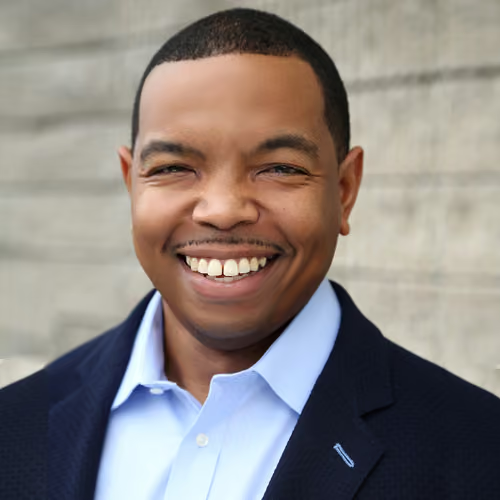
Host: Elliot Holland is the founder of Guardian Due Diligence, a firm that specializes in quality of earnings reports and due diligence for acquisitions in the lower middle market. So just the sort of acquisitions that are featured here on Acquiring Minds week after week. In this shorter episode, Elliot and I discuss a particular pair of risks that show up commonly in small business acquisition and how you, the buyer, can address those risks. By the way, let me know if you like this shorter format and I'll do more like it. Enjoy my conversation with Elliot Holland. Welcome to Acquiring Minds, a podcast about buying businesses. My name is Will Smith. Acquiring an existing business is an awesome opportunity for many entrepreneurs and on this podcast I talk to the people who do it. Acquiring Minds is going to be recording live on Wednesday, April 13th. The episode will be something of a debate about the merits of two models of search, self funded search on one side and traditional search funds on the other. I'll have two guests, each a proponent of one of the models Greg Geronimus acquired, grew and exited a business with a traditional search fund model and now invests in searchers himself using the same model. Robert Graham acquired and now leads his business as a self funded searcher and also now invests in searchers himself using the same model. Both of these individuals are articulate and strong proponents of their respective approaches to search, so it is going to be a high quality debate. My goal for you, the listener, is that you come away with a stronger sense of the pros and cons of each model, self funded employees, traditional search funds and have a much clearer sense for which would suit your own search. Again, it's Wednesday, April 13, 10am Pacific 1pm Eastern over Zoom. The link to register is right at the top of Today's show notes. April 13th see you there. Register in the show notes Elliot Holland thank you for joining me today on Acquiring Minds.
Guest: Thank you for being having me here. I'm looking to have some fun.
Host: Elliot, you are the founder of Guardian Due Diligence and longtime Acquiring Minds listeners will remember you from an earlier episode. So you were on in the fall or late summer of last year. Then we had the chance to meet just a few weeks ago in Orlando at SM Bash. So that was fun to break bread and have some beers. I wanted to have you back on because you are putting out content around risks that you so as a diligence firm in the lower middle market you are working with searchers and looking at deals of searchers very characteristically similar to those that Acquiring Minds guests and listeners are doing and you see the same sorts of risks come up over and over again. And we hear about those risks and they come up, those themes come up in the acquiring minds interviews. And there's two risks in particular that you and I have talked about that I thought warranted some special attention from you. And so I'm going to just say what those are real quick and then hand the mic over to you for you to define them in more detail and then how you at Guardian mitigate those risks for your clients. So we can really learn, some folks in the audience can really learn how to do some of this stuff on their own. So the two risks are industry risk, which kind of speaks for itself, but essentially you are looking at acquiring a business. Everything about that business looks good, the business internally. But of course, what about the external factors? Is the industry that it's in about to tank, or are there there's some other variable that's about to change things negatively in that industry? First. Second, the seller risk. So the will the sellers often are leaving the business, if not immediately, imminently, shortly after you take the helm. And what risk does that pose? How can the business be extricated safely from the seller? So with those two things defined, Elliot, why don't you start with the first one, the industry risk. Define it with a little bit more color than I just gave it. And then, and then let's get into some tactics about how you at Guardian help your clients mitigate that industry risk.
[4:29] Guest: Sure. And the reason this is so important to anchor it is that these are risks that you can get a clean quality of earnings and a great asset purchase agreement and great financing. And if you don't check these things, your deal could still go very poorly. And so the reason we're covering it is because these are a bit more nuanced types of things. So on the industry side, what you're trying to figure out is, is the industry growing, shrinking, changing anything of that nature? And you're particularly trying to be careful around a seller who's been in business 10, 20, 30 years, who's telling you it's because he had a heart attack or something. But it could be because he sees the industry going terribly poorly, or he's not prepared for the new new normal in an industry and selling it to you for you could take that fall. You know, people talk about catching a falling knife, but let me tell you an example, because I think that's always easier. I recently put out an article about buying into a dying industry, and it was about a deal I tried to get done in 2016 in Arkansas. And the deal ended up blowing up. But when I got a chance to talk to the seller, he told me that he was selling because he thought a certain president was going to win and that was going to sort of completely torpedo his business because some regulation was going to come in and the business was going to go down the tubes. And so he was selling to get out of that risk. And one of the reasons why that deal didn't go through is a different president won and he didn't feel that way and he kept the business. But it taught me a lesson around, you know, that wasn't the three reasons he told me when I had dinner with him, his wife and his four kids. Right. So you gotta be careful. And I'll give some other examples. So let's talk about somebody who is buying something that looks like a peloton or some sort of home gym situation. And I'm using these recent examples because I think it'll click in people's head easier. Those businesses will have done amazingly well during the pandemic and now you see that they're having issues already. And so if you're buying a business like that, your strict quality of earnings, right, Just that what's the trailing twelve month EBITDA will come back fine, but you're not buying trailing twelve, you're buying future five, future ten, future forever. So that's why industry becomes important. Even things like Facebook marketing agencies. Right now, you guys are seeing Facebook stock go down. Apple cut down on what they allow them to do. So if you're buying a marketing agency today that's heavily focused on helping people with their Facebook ads, you have to realize that that's going to shift as a mix of most marketing companies going forward. So these are the kind of things you have to think about.
[7:14] Host: What is so difficult about mitigating this risk, it seems to me, is that it's a classic case of you don't know what you don't know, so you don't even know the questions to ask often since you're a newcomer to the industry. So anyway, tell me what, how you know Guardian, how you approach this for your, for your clients at Guardian.
Guest: So we, we tend to be a bit more holistic in how we think about diligence. So our work doesn't stop at the quality of earnings. We try to help people think if the business is worth what they're paying for it. And on my website we say we stop people from buying a bad business. So we look at things like how you get the information on a shoestring budget. So I'm going to go like shade tree mechanic on you guys. So one of the ways to do this is look at LinkedIn, look at Twitter, find somebody who's in the industry, send them a message. It should not start with I know you're busy but I delete all of those in my inbox. It should start with I'm buying a business in your industry and will usually benefit from 15 minutes of your time to not sync my family with the million dollar personal guarantee. You do 10 of those, you're going to get some folks to talk to you and they're in the industry, they know it back and forth and so you'll get some solid information. Another way to try to get this cheaply, find the closest public comparable. So if you're buying into H Vac or plumbing, you know Google, what's the biggest plumbing or H Vac company in the nation? Hopefully if they're public, you can go to their investors page. Don't look at their annual report, don't look at their quarterly reports. You want to go to their investor presentations. When they go speak to Goldman Sachs, bank of America about what the business is doing to try to cultivate new investors. What they put together is a 30 page report on what the industry is doing, what they're doing to take advantage their financials. And so you get all of the gain that the public company paid for free on their website.
[9:11] Host: Actually on that point, Elliot, there are of course companies that produce industry reports, IBIS or EBIS World. I believe I'm pronouncing that correctly on searchfunder.com if you're a member of Search Funder, they have a partnership with that organization and another industry reports organization. You have access to these for free. And I've peeked at a couple of them and they seem like they're pretty hefty 20 page documents. What's your opinion on those?
Guest: So they're a good place to start. So my mind is the way you look at these nuanced issues, the same way I look at diligence. So I want to triangulate data. So as a buyer on the cheap looking to get smart, you have to triangulate data. So go to EBIS World. I think it gives you the drivers of value in those industries. I think it does a good job of sort of laying the foundational lay of the land for what's going on. But I think those reports can be dated, they can be a bit simpler than the real sort of challenges in the industry are. And so really, in the past, when I've used those, I've used them to circle the drivers of value in that industry and then go dig further in. How do you, how do those things manifest in the business I'm looking to buy? And then how are those things? How can I do more research on those things to get to the answer? So I think that's a valuable tool to add to your mix. You know, at the end of the day, when you're making huge decisions, you want to be listening to more than just, you know, one or two sort of points of data.
Host: And when you say drivers of value, can you, can you give me a concrete example?
Guest: Yeah. So, for instance, in H Vac, one of the big drivers of value is recurring revenue. I mean, recurring revenue is the big deal everywhere, right? And so a lot of H Vac companies have way more new construction work than maintenance work. And so if you want to increase the value in H Vac, you want to purposefully seek out more maintenance business because that's valued at a way higher multiple. So if you were able to read EBIS World and to find that out, now all of a sudden you're looking at your company, the broker is giving you some mix of new construction versus maintenance. Now you understand why that's important. And now you can dig further into the financials or the operating metrics to see exactly how much residential stuff you have.
Host: To me, it seems most attractive to really just talk to people in the industry, like you said, so reaching out to them cold and saying with appropriate message, just getting straight to the point, I'm about to spend a million bucks on a business in your industry. You know, please give me 15 minutes of your time. That seems like really effective. Are there any, you know, any risks to that?
Guest: Sometimes, Well, a couple of risks.
[12:02] Host: So
Guest: when you're speaking to a person, you always have to understand what their bias may be. So say you get a person that's done poorly operate in their business, they may tell you the industry stinks, but that's not accurate data because it stinks for them. So you got to be careful about people who may have a negative opinion because they're operating poorly or have stepped away from the business and the thing is just dwindling. The other risk, and I would put that in air quotes, is the advice that people will give you when they've been in something 20 years can sometimes be deeper than the level that it's actually actionable for you. So for instance, when I was looking at the Same company in Arkansas, Durable Medical Equipment. So wheelchairs and stuff like that for folks in their home taking care of themselves. I called the guy in pa, part of a family office and asked him the same thing. Got on the phone and he's like, hey, you know, our whole strategy around buying durable medical equipment companies is buying them in poor areas because they people don't service that area. You get better payer mix and you can just really, really expand your services and blow up and you won't have the same competition you'll have in more affluent areas. That's great information. Well, the business I was buying was where it was at. There was no way to move it. And so now that I knew that, that's great, but it didn't necessarily help me make a decision in the company that I was buying at that time. So that's one example of sort of what you get from folks can be a bit deeper level than what you can sort of actionably go do something.
Host: Well, and going back to the first example of, you know, if you talk to somebody who's just poorly operated their business and they're frankly unhappy with the industry, you can still, you know, identify what have been so, you know, ask that person what is so challenging about their business. So maybe they did things wrong, but at least you can know what like a potential weakness to look out for yourself might be.
Guest: Sure, I think that's absolutely correct. And then I'll tell anyone and I tell all my clients, you have to be thoughtful about the stuff that people won't tell you. You know, so like in that same scenario, the person that may be having a bad business, you ask them sort of what's the challenge about it? The stuff that they say, they're not going to say, hey, I'm a lazy bum and I live in the Bahamas and I turn it over to my general manager and he's terrible. You know. So again, the reason you triangulate data is because you want to be looking at the mission critical points of your decision from multiple angles.
Host: And when reaching out to the existing owners, do you ever find that there is. They don't want to help somebody that could be in their own industry for competitive reasons or as long as you're not in their geography, they'll be, you know, they're fine if, if they're in Florida and you're looking at buying a business in Seattle, they're not going to, they'll be fine to talk to you.
Guest: So that's the elephant in the room. So, you know, my email strategy or LinkedIn strategy at the time was to that direct message, hey, putting a million dollars up in the business, in your industry, 15 minutes would change my life, you know, and then if I didn't get a return, the second message is, the business I'm looking at is in Washington. You're in Florida. I don't think we compete. So address it directly. Again, this will be a numbers game. And so you just want to take risk away from the seller because he's not going to want to talk to you about a business in Florida if he's running one there. But, you know, for a regional business, you know, with trucks going places, you know, he's not opening up Washington anytime soon.
[15:33] Host: Great. Eliot, let's. Let's go into risk number two. So can this business operate without the seller owner, sometimes referred to? I guess this is a version of or maybe is directly key man risk. So define this for us and then let's get into some tactics to mitigate it.
Guest: Sure. And this is one of my more favorite ones, because it's difficult, it's nuanced. Even Will and I had a conversation about kind of what is it? And then, so people use key man risk, which I think is part of it. But like key man risk in my deal experience is more about if you're working with a seller that's mission critical to the business and they're going to stay on for some period, getting a life insurance policy so that if they pass, you get to pay off your debt and also realizing if you can sort of identify people that work at the company that are a big risk if they're not there. But the reality for my clients is that it's not so much do the deal or not do the deal. Most times it's often is this person in the business. Halftime, no time, full time, full time and a half. Right. And so how do I define sort of can you run the business without the seller? To me, what that is, is if the seller got hit by a bus as soon as he signed the purchase agreement, could you run the company? And the reason that's so important is because you may have a contracting agreement with the seller for 6 months at 150k a year. But if you just gave the guy 2 million bucks, the likelihood they're going to do hard work for $150,000 is pretty low. So in a mechanical way, you're likely to get shorted on that. So then how do you sort of understand if you can run the business without the seller? And a lot of that is answering is the seller in the business every single day making key decisions. And so a part of diligence is kicking the tires on that question, making sure you listen to what the broker and the seller are telling you, but you should go find out yourself.
Host: And how do we do that? How do we go find out ourselves? Especially because this is notoriously an area that's fudgeable. And if it doesn't look good, if the business is somehow more fragile because of the relationships of the seller or the amount of time the seller's in the business, it's easy and common for them to obfuscate that as much as possible so they know that it makes their business less valuable, and they're going to do what they can to hide that from you. So how do you. How do you penetrate their tricks?
[18:14] Guest: Yeah. So this is where you got to get off your laptop, put down your cell phone, and go do some review. So real work. Yeah, yeah, yeah. You're gonna get your hands dirty. Put on some boots. Right? So let me tell you a story. So I was working with a client recently who was buying a company that did some work with content online. And the sellers had founded the business, and their marketing message was heavily about their genesis story. But they said in the confidential information memorandum that they hadn't worked in the business, they had stepped away, given it to the general manager, and that was that. And so as I'm dealing with my client, I'm telling them, that's cute, but how do you know? And so what we did is we got the client access to their operating system and how the business flow, like coming in. Leads go to, you know, the customers, customers get service, service continues. And so he was able to look into the systems and processes and like, think about, like an asana or any sort of project management software. So you got the sellers at the top, and so you can see what they're doing in that operating software. So over, you know, eight weeks, he was looking at that stuff. So that's how he got familiar. Some of you folks are doing more industrial businesses. So I'm working with a client now that's buying a rental company, and once again, husband and wife own it. And husband says he's completely out, Wife is half out, but we can never get him on a call between nine and five. So I encourage my clients to do something that most people don't want to do. And so I'm going to, like, emphatically push people to consider it. If you spend a day with the sellers, you'll you'll know who's calling them, how many emails do they have to check, what decisions do they not feel comfortable of their people making all those kind of things? Now, it's hard to schedule a full day meeting with a seller. Sometimes the broker's not going to want it. But I think the way you do it is you schedule a breakfast and ask them if they can sort of not have plans after that because you want to kind of do a ride around and then just try to keep it going. Right. That's a great way to check in more industrial businesses, you know, if the husband has to drop his wife off immediately after breakfast. You answered your question.
Host: Great. Now, what about a case where, so what we're talking about right now is how much is the owner actually working in the business? What about a case where, like the sales relationships, the key relationships or vendor relationships are just all personal relationships of the seller. And so, you know, you just need to be sure that you're going to inherit as many of those, the handoff of those is going to be as seamless as possible, and you're, and you're going to retain as many of those as possible. How do you uncover how personal these relationships are?
[21:23] Guest: Sure, I mean, there's four or five ways, but I'll tell you the most, sort of direct. And this is one again where the broker is not going to want you to do it. So you're going to have to stand your ground. But what you want to know is who manages the sales relationships? Is it the owner? Is it the head of sales? No matter what they tell you, you want to sit with both of those people to understand the whole process from sort of lead to, you know, warm lead to proposal, to, you know, follow up, to close the business. And you want to see it happen because you want to see, is it the head of sales that's managing it, or is it always sort of the client calling the owner to check on something? Even after the salesperson sends things? Right, Is the salesperson acting autonomously or is the owner sort of always over their shoulder doing things? And so the sales relationships, this is another one where you got to get away from the computer, put the cell phone down, you need to go sit with whoever owns the sales relationships. And so when you ask the question, who owns it? And then you say, hey, I want to sit with them, you've kind of put them in a pickle because if that person runs sales, they know sales is the most important thing because you can't have profit without sales. Hey, I Want to talk to that person and sit with them. It's going to be tough for them to have a compelling reason why you shouldn't. I'm not saying that it's easy folks. I'm just saying, you know, you're putting a million dollars up. You need to push for what is going to help you feel comfortable.
Host: I want to share with you a recent example of something related. So Brandon Adams was an episode a few weeks ago bought an ice delivery business. And so getting ice from point A to point B on delivery trucks is the service the business offers and everything checked out about the business. Brandon private equity background did serious thorough financial due dilig uh and day one of his ownership he finds out that the owner seller was running the business from the cab of one of the trucks. So he was one of the basically full time delivery people and for the business to continue going, Brandon himself was going to have to get in the truck and, and do the same. Not the end of the world. Brandon's a scrappy guy. He's not shy away from doing real work. There's that real work thing again. But still would have liked, you know, by his own admission would have liked to have known this in advance. And you know, we talk about on the episode like what could he have asked the seller to really get at whether or not this fact that the seller was spending all day in the cab of the truck doing ice brokering basically from the cab of the truck. And he really, he's like, you know, if the seller wants to obfuscate this, it's going to be really hard around that. Do you see in that particular case something that could have helped him get closer to the truth in advance?
[24:19] Guest: I'm smiling only because I love this work. So I'm not smiling as any kind of got you situation. People who know me know I'm not that way. You got to put the computer and the laptop down. And I mentioned it earlier, not knowing it would come up again Will, but there's certain things nobody's going to tell you. Like the broker's not going to tell you. The guy sits in the truck all day, the seller's not going to tell you. So if they're not going to tell you then you know, de facto there's no question you can ask to get it.
Host: Exactly.
Guest: But then that doesn't mean you can't get it. So I'm amazed at how many of my clients don't sit with their sellers for a day. But oh, we're busy. Oh, the seller's Busy. Oh, Covid. Oh. But million dollar personal guarantee. Go sit with the seller for a day. Right. You'll learn so much. And if you can't schedule a day with the seller, that gives you your answer. You know another trick I saw on Twitter that I actually agree with? You can pose as a customer and go through their funnel and see if you engage with the seller. I think that's brilliant. So again, like, laptop down, phone down, like, go do some work. You know, these are scrappy industrial businesses. You need to go, you know, take this shirt off, go put on a T shirt and some jeans and then go do some work.
Host: Anything. We didn't get to on either of these two risks, Elliot?
Guest: No, I think this is very helpful. I think these are two of the most nuanced challenges that the buyers have that I don't think get addressed enough. And I think we've done a great job of giving folks tools and letting them know if they have trouble, please come seek us out because we can help you with that.
Host: Cool. And how can they do that? Give it. Give us whatever. URL or whatever would be the best way to get in touch with you and guardian.
Guest: Sure. Guardiandudiligence.com and on the website you can download a sample report. My contact information, phone and email are there. I'm also on LinkedIn, I'm on Search Funder and I'm on SMB, Twitter, Elliot E Holland and Elliot's E L L I O T. So you can find find me in all those places and would love to speak to you. You can even schedule time with me on my website.
Host: Very good, Elliot. Thanks for coming back on.
Guest: Hey, thanks for having me, Will. I really enjoyed.





































































%20-%20thumbnail.avif)






%20-%20thumbnail.avif)



%20-%20thumbnail.avif)

.avif)




%20-%20thumbnail.avif)