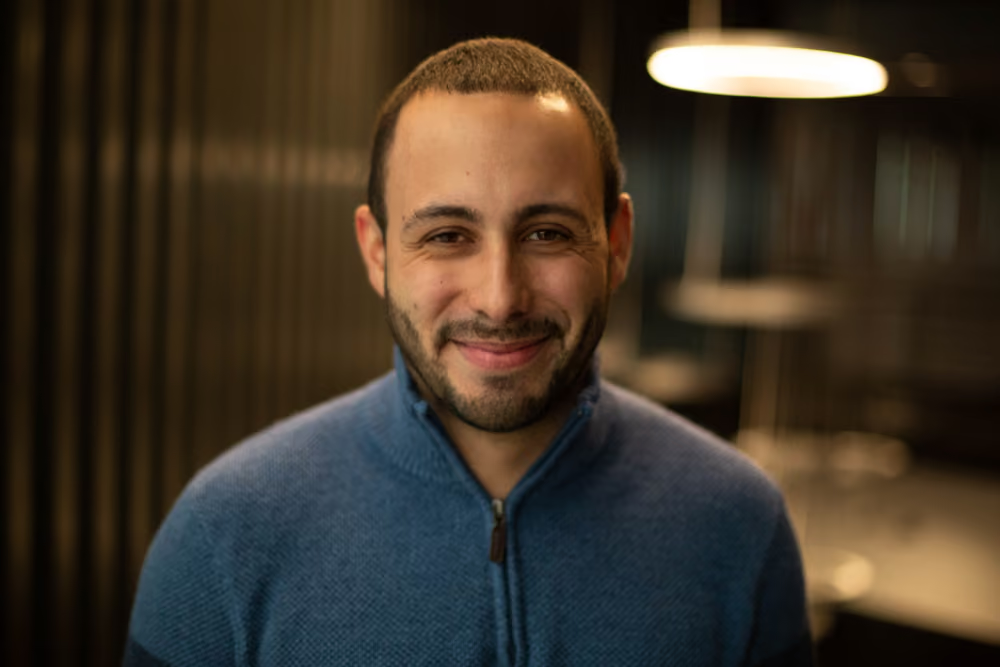
Host: I've talked to acquisition entrepreneurs who've acquired e commerce businesses and SaaS businesses and affiliate or content businesses, but I haven't yet talked to someone who bought a business with the other big digital business model, lead generation or Lead gen. Well, today's guest Jaime Arias did Jaime bought Patients4U, a family of websites that generates leads for certain dental procedures. If you're at all interested in digital businesses, this interview is an opportunity to learn about lead gen. Often overshadowed by EE Commerce and SaaS, but an important industry in its own right. Some of the topics Jaime and I cover the opportunity to buy Quote old Internet businesses the three types of sellers you find on Flippa the rank and rent model for local lead gen what are you really buying with a lead gen business? SEO vs PPC for lead gen Getting comfortable with Google algorithm Risk using biz Buy Sell to buy digital businesses How Jaime is growing Patience for your and oldie but Goodie Choosing Self Funded search over a Traditional Search Fund Enjoy this conversation with Jaime arias, owner of Patience4U. Welcome to Acquiring Minds, a podcast about buying businesses. My name is Will Smith. Acquiring an existing business is an awesome opportunity for many entrepreneurs and on this podcast I talk to the people who do it. August Felker is a two time successful searcher, first with a traditional search fund. The second time around he did a self funded search. Today August runs Oberle Risk Strategies, an insurance firm with a dedicated practice group for searchers and acquisition entrepreneurs like you. If you've got a business under loi, Oberle will provide complimentary due diligence on that business's insurance and benefits program. A great no risk way to get to know August and team. They love helping searchers. They've worked with hundreds. Oberle is a specialty insurance brokerage for searchers by a former searcher. Check out oberly-risk.com O B E R L E- risk.com link in the show notes Jaime Arias welcome to Acquiring Minds.
Guest: Great to be here Will.
Host: Jaime, you acquired a lead gen business business that generates and sells leads for a very particular local service in various geographic markets around the us. A really interesting model. I've dabbled in Lead gen so I know something about it. But you've got deep expertise in this space. So in addition to hearing your story today, we are going to learn a lot about online Legion. Start us off Jaime, with your background and what led you to want to go out and buy a business.
[3:03] Guest: Sure thing Will. So first of all, I'm Puerto Rican born and raised, currently living in Puerto Rico but I went to school here all the way through undergrad, studied mechanical engineering and then after I graduated from college I moved to the states, moved to Alabama and, and worked at a nuclear power plant there as a mechanical engineer for a number of years, over five years. But pretty quickly after I got there, even though I enjoyed the work, I realized I wanted to do something different with my life because I saw the path that was kind of laid forward before me and it would lead me to be working in nuclear power plants which are usually in the middle of nowhere across the United States. And that didn't really appeal to me. And so I found out after I got working there about the whole concept of full time MBAs. I wasn't really even aware of that. Going back to school to get an MBA was really a thing I knew about people doing part time MBAs and stuff, but not really full time MBAs. And so I got educated on the whole concept and started applying to business schools. I was fortunate enough to get into Harvard Business School and so I went there in 2016. During my time at Harvard Business School, I found out about this whole world of entrepreneurship through acquisition search funds and all of its variations and really became intrigued and fascinated with the concept. Just didn't have the guts to do it right out of the gate when I graduated business school. And so when I graduated business school, I moved back to Puerto Rico, not really having a clear professional plan because some family stuff pulled me back to the island before I was kind of had it in my plans. And then as I looked around for a few things to do on the island, still wasn't ready to do the search fund thing. I ran across a company called Red Ventures that is actually headed by a Puerto Rican CEO and their headquarters are in South Carolina. He actually wanted to get reconnected with the island in some way, shape or form. And so he was hiring, call it initial cohort of Puerto Rican professionals to go to their South Carolina campus, learn the trade, learn the business up there to with the intent to really come back and start a Puerto Rico office of Red Ventures. And then during my time at Red Ventures, I didn't even knew what Red Ventures did when I found out about them when I joined them, but came to find out they are well number one, they really just could totally transform during the time I was there. And I'm sure they kept transforming. The one cost about them is that they're constantly changing but. But right now they're a big name in online publishing, they own a number of large digital brands, give us some examples. Yeah, CNET Healthline, who's another the points guy, creditcards.com, bankrate.com, and so they have a bunch of these and they keep acquiring them and they develop an expertise in SEO is really organic. Organic traffic is really their primary bread and butter. And most of them make money at least when I was there, through the Legion business model. So basically just Legion at scale in just selling leads, financial services and the variety of verticals there. And nowadays they do a lot more, but that was their bread and butter when I was there. Uh, but anyways, I, I did that for.
[7:02] Host: And what, what year, what years were you there, Jaime? What years were those?
Guest: Yeah, that was in 2018. Yeah, 2018 and 2019. And then I left at the, in December of 2019 on my own just because I realized that I really wanted to do the search fund thing. I wanted to do this on my own. Didn't want to do it with a, another company until I moved back to Puerto Rico to do the search in Puerto Rico because nobody was doing it in at the time and nobody had done it for a long time here. Okay, great.
Host: That's an awesome background. Let me follow up with a few questions. First of all, I have to needle you about the fact that you didn't know that full time MBAs existed and then you find yourself at Harvard Business School. I'm sure I'm not the first person to have pointed that out, but I mean, that's pretty remarkable. Sounds like the same thing happened with Red Ventures. You didn't know what it was, but you find yourself there and it ended up setting you on a really prosperous path. So yeah, just calling that out.
Guest: Just calling that out. Yeah. Well, you never know. I mean, sometimes opportunities, the best opportunities, sometimes in life, you aren't aware of them. Right. And it just takes a matter of somebody making you aware and then recognizing them.
Host: Well, and that's a perfect segue to my second question. Kind of the opposite happened with search. You learned about it in a very academic way. I mean, you were at HBS learning about search, but then you postponed it for a number of years to get, I guess, some more professional experience, some confidence maybe that you were going to then go out and do it. So that one you learned about and knew about for years before you really decided to embark on that path yourself, which we're going to get to in a second. What else did I want to ask you? Just, just to set the stage with, with lead gen flow jumping a little bit, jumping around here A little bit, but with Red Ventures. So let's say let's like take one of their credit card sites, like just walk us through, people will know. So you don't need to get into too much detail, but just walk us through how having this deep expertise in SEO is a lead gen model that leads to making money. How do you, what does that look like? What are they actually doing and how are they actually monetizing what they do?
[9:24] Guest: Yeah. So let's say for example, the points guy, which is a big credit card site on the Internet. If you search best credit card for rewards or best credit card for business, you're very likely to find this site, the points guy, along some of the other sites that Red Ventures own in the top of the search results. And so by virtue of that being good at SEO, they get millions of visitors a month. And then the that article, you know, best five credit cards for rewards is going to list five credit cards. And more than likely those five credit cards are going to have an affiliate link that if you click on them and you apply for the credit card and you get approved, Rev Ventures gets paid a bounty and you add that up and it ends up being millions of dollars.
Host: Yeah. And there, and there are credit card applications is kind of the best example because credit card companies pay so much per lead because a new, a new credit card customer is very valuable. So one way to think about lead gen is like the service that the consumer is looking for, how valuable it is, and in spaces where that is of high value, then you're going to see a lot of lead gen activity there because there's just. There's more money there. Exactly. Great. And so when you left Red Ventures to go do something on your own to do basically to do a search, you decided you were going to do a search. Did you decide, did you think that you wanted to buy a Legion site or something digital or were you open to anything? What were the parameters of your search?
Guest: Yeah, no, I actually was not going to buy Allegiance site because for a number of reasons. Number one, I had a non compete with Rev Ventures that lasted a year. And so I was kind of very nervous about that. I didn't want to get into a competing space, particularly the space which I knew, which was financial services, because that was a space that I worked in during my time at Rent Ventures. I was afraid of anything coming up there. And so I decided to just go completely different and do just a local business search in Puerto Rico for a number of reasons. Number one, because nobody had done it For a while in Puerto Rico. I mean, nowadays we see Puerto Rico on the news all the time and there's all kinds of business press about it. But back in 2019, all the press around Puerto Rico was still very negative and everybody was still very bearish on the island itself. Um, and so I, I thought that there was a lot of opportunity there. I still think there's a bunch of opportunity here. And I probably would have kept on that path had Covid not happened. And the lockdowns ensued, which brought about a whole bunch of uncertainty into the whole business climate. I mean, it's hard to kind of put ourselves back in those shoes back in March of 2020. But you know, nobody really knew that this was like the start of another depression or you know, this was going to be like a two week thing or there was a whole bunch of uncertainty around what was going to happen. And then it also killed my funnel because I was doing a lot of networking, coffee shots, and over here we had pretty strict lockdowns for a very long time, which affected all that. And so during that time I started looking, I started saying, well, it kind of, you know, I'm kind of not doing anything here. Let me start looking at some online businesses at least to keep my funnel going and do some stuff. And as I got more into it, eventually started getting close to the year after I had left Red Ventures. So I figured, well, non compete is a moot point at this point anyways. And then I just started going deeper into it.
[13:19] Host: Okay, and when you say that nobody had done a search in Puerto Rico for a while, I assume you're talking about kind of from like the big name business schools, kind of an official, kind of an official capital S search tradition, maybe a traditional search fund or something because you know, there's a lot of people buying businesses always under the radar, you know. But I assume you're talking about kind of one of these kind of well publicized known within the academics, the search, academic academia, one of those types of searches.
Guest: Yeah, you're exactly right. And I think that's sometimes a misnomer that we searchers get into that. If nobody that's kind of in this inner circle of searching as a name brand then doesn't get counted in any of these statistics and such. But yeah, actually, and after I've kind of been in the community here for a while, I've actually run across people that even people from kind of name brand business school. I ran across a Mexican guy that bought a distributor here a couple years ago, but he wasn't in any of the networks or anything. So just nobody knew about him.
Host: Yeah. Yeah, totally. Okay. And so tell me about the type of search you were doing self funded. You and I on the pre call talked a little bit about, you know, you kind of chose self funded because of your training at Harvard Business School, which is kind of heavily lean self funded. Talk to me about your decision to go self funded versus Traditional doing a traditional search fund. Wouldn't it be great to have experts at your back when buying a business? People to help you polish up your pitch and processes as you go to market as a searcher, then help you evaluate opportunities once you get some deal flow? Such experts exist buy side advisors, but they'll cost you to the tune of tens of thousands, even hundreds of thousands of dollars. But another option exists, the Acquisition lab. The lab is a do it with you buy side advisory service, not do it for you. Founded by Walker Deibel, author of Buy Then Build, the Lab represents Walker's vision for what is most needed to make a searcher successful and available at an accessible price. It's cohort based and you will come out the other side of your cohort prepared to go to market as a savvy searcher with a tight message and process so brokers take you seriously, pre approved for a loan and with an entire community at your disposal to help you along the journey to buying a business. To learn more, check out acquisitionlab.com link in the show notes.
[15:53] Guest: Sure. So I decided to do a self funded search primarily being heavily influenced by Rick and Royce who teach the Harvard Business School course on entrepreneurship through acquisition and I really just was just very intrigued by the concept. I think also I'm naturally somewhat risk averse when it comes to these businesses and I think this self funded model lends itself a little bit more to somewhat risk averse because it generally the businesses that self funded searchers are going after are lower growth, more stable and the model is more about paying down debt and keeping things steady, some growth on top, kind of for gravy, but not really these kind of high growth almost VC esque roll ups and things that the funded searchers get into. So that was one of the things that drove me there in the first place. Number two was control and autonomy and I know some funded searchers that actually feel like they have a good degree of autonomy and I actually am good friends with a fund that invests mostly in funded searchers here on the island. And so I interact with funded searchers and the funded search ecosystem a good amount. But I just decided that for my personal reasons, I prefer to do it for the autonomy. Also because I was focused on Puerto Rico, I thought that maybe there were opportunities that were very small for a funded search. And so that's why I ended up going self funded.
Host: Well, I was going to say about the traditional search fund are notoriously supposed to be, at least in theory, geographically agnostic or at least the regions in which you look are supposed to be quite broad, supposed to be willing to move somewhere if somebody's looking just in Puerto Rico and they've got a thesis around Puerto Rico that's the opposite of geographic agnosticism. So yeah, I guess so. I frankly I'm surprised to hear that there is this kind of funded ecosystem. There are the criteria of these investors. Not that you have to be willing, you as a Puerto Rican searcher have to be willing to move anywhere there. It's for Puerto Rican searchers for and buying Puerto Rican companies. Is that what it is? Just curious.
[18:28] Guest: Well, they invest mostly in searchers, not really in Puerto Rico. I mean, the thing is, but these two guys, Jose Estela and Pochito, as they're known, they did a traditional search fund in Puerto Rico back in the late 90s, so one of the first traditional search funds outside of the continental United States to come out of the Stanford model and all that. They actually searched for three years and didn't find. They found a target but they wanted too much. And then they, they built up a competitor to them from the ground up and exited in like three years. Incredible success story. And then they went into the cell phone tower business, which is what they're doing now in Brazil and a bunch of other countries. But then through the capital that they've gained through the years and through their, their network, they use that to invest in searchers. A lot of them Latin American based, that just come to them because they know of them from the ecosystem.
Host: Interesting. Really cool. I hadn't heard about them. And then going back to Rick and Royce in your time at hbs, so they're pretty. And by the way, for the audience that doesn't know, Rick and Royce are also not only the professors who teach this course at Harvard, but they're also the authors of one of the two most famous books on search that so many of my guests have read. The first is Buy Then Build by Walker Deibel. And the second is Rick and Royce's book. It's kind of an orangish red color. I don't even remember the name. It's terribly Titled frankly, what's the name here?
Guest: HBR Guide to Buying a Small Business.
Host: HBR Guide to Buying a Small Business. There you go. So you were in these guys classroom. So they're pretty vocal about not doing traditional search. I'm interested.
Guest: Yeah, I mean they are at the beginning. They're not. They kind of present all the cards on the table and they, they say that there's a fit for everybody. But if you were to ask them, they say hey, it's kind of hard to argue with the economics of the self funded. They lean heavily towards that even though they actually have funded searchers come on as guests. They've had a number of funded searchers come out of the class that have been success cases and all that too.
Host: Great. Okay, so you're doing, you've started doing a self funded search in Puerto Rico. Covid hits. So your funnel kind of dries up because you can't do the in person meeting and greeting. So you're do you were doing a proprietary search then I, I assume. Well you're probably every. Everything available to you, including proprietary. You were reaching out cold to, to folks and were people receptive?
[21:18] Guest: Yes, yes. I found that people are generally receptive and I found that to be the case in Puerto Rico as well. I mean it ends up being a question of how with all this cold outreach, it's a question of how much you customize it. How much. What's the point of diminishing returns in terms of the customization but if you customize something enough, you're bound to get a 50 to 70% response rate. It's just how much time is it going to take you to you know, find the right email and you know, craft a whole, you know, dig around through the person's LinkedIn for two hours and you know, to find relevant stuff to say.
Host: No, that's well put that, that is the calculation. How much time can you. How much the cost benefit of personalization.
Guest: Yeah, exactly, exactly. And I mean it's a thing I deal within sales today. We do cold outreach dentists and stuff now. But yeah, I forgot where I was going with this.
Host: Just how the proprietary outreach was going. But you answered it. So your kind of funnel starts drying up. It's Covid tons of uncertainty you're getting toward the end of your non compete with Red Ventures, you know, digital, presumably you like digital so you turn your attention to digital. How so what marketplaces are you looking at?
Guest: Yeah. So before actually going full steam on the digital search when I was still kind of halfway Puerto Rico Halfway Digital. I bought a couple of small sites on Flippa and I got burned on a couple of them. I bought a total of three, I got burned on two of them and then one of them actually turned out to be a really good buy. And so I just became excited about the whole space, understood kind of, I felt like I understood where some of the pitfalls were when I was buying the other ones. And so that built up a little bit of confidence in me to say, hey, let's go out and look at this space more seriously. And I came through. I realized a couple really interesting things. Number one is nowadays the Internet has been around for almost 30 years.
Host: Commercialized.
Guest: Yeah, yeah, exactly. And so for at least, and let's say that for the first 10 years nobody was really making much money on the Internet except maybe online casinos and you know, some select stuff. But for the, for the last 20 years at least, you know, the Internet, a lot of people have been making money on the Internet and what's amazing to me is that some of these money making sites and businesses are still around in pretty much their original form than they were 10 or 15 years ago. And you would think that that is not the case because you never run across them when you search or you know, you don't run across them in your day to day life. But they do exist. I know because I bought two of them now, you know, I bought one very small one on Flippa and then I bought a bigger one as my main business. And so I think there's actually still a lot of opportunity on a lesser scale. Not on a lesser scale, but on a more compressed timeline than what exists in the offline world of these mom and pop businesses that haven't been modernized and all that. Believe it or not, there are still websites that are mobile friendly, don't have easy payment options. There's all kinds of stuff that is still optimizable on online businesses. So that is a little bit of a tangent there, but yep, no, it's
[25:08] Host: a really interesting point and it actually another interview that I recently recorded but haven't aired yet, somebody acquired an E commerce business and you'd think that if an entrepreneur started an E commerce business, you know, it happened in the last few years, you know, as most e commerce businesses you know, have started in the last few years and that somebody who's savvy enough to start an E commerce business in the last few years is also probably savvy enough to like do all the things to optimize that E commerce business. But no, they were. In this particular case, the entrepreneur happened to be really good at product but they hadn't done XYZ ABC thing to market the business and to do kind of just low hanging fruit, best practice sort of E commerce stuff. So my guest was able to acquire this business that was still, you know, again, a pretty, a pretty, a young business, but by savvy entrepreneurs, but they just weren't marketers and he could, you know, put in place some of these best practices in a short amount of time and just skyrocket revenue. And it's just. Yeah, it's just interesting to me too. I think we're saying the same thing where you'd think that website owners are. Website owners and founders have, because they've built digital businesses. There's, they're savvy across all of all aspects of digital optimization, but they're not. There's often big gaping parts of their business that they've overlooked or haven't had time or whatever that you as the acquisition entrepreneur can improve upon if you buy the business. Is that what you were saying?
Guest: Yeah, yeah, for sure. Especially because a lot of These online businesses are 1 Manchos 2 Max 3 yeah, you know, there may be some VA support and you know, some contractor support, but at most there's main. Maybe you know, the biggest businesses have like three key people that are actually thinking about all the strategy and all that stuff and you know, there's only so much that you can have expertise on and even do.
[27:14] Host: Yeah, yeah. Jaime, can you tell us about these two, the three businesses you acquired on Flippa and in particular the two ones that you got burned on. What is getting burned mean?
Guest: Yeah, I mean I bought the first one was an insurance site. I really liked insurance because I, well I already, I actually I have a part time business in PR in Puerto Rico selling insurance. Plus in my time at Reventures, I dealt a lot with insurance. And insurance is consistently one of the categories that has like the highest PPC cost on Google because the leads are worth so much. And so insurance lead gen sites, when run properly and optimize efficiently, can generate a lot of money. And so this site I was looking at, it was a site that was getting supposedly some organic traffic from Google and it was monetizing through display ads. And I thought, well, this is exactly what I was looking for. I'm gonna get this. It's already getting traffic. I'm just gonna take these display ads out and I'm gonna put insurance affiliate links and immediately revenue is gonna triple and so, and when I got it like traffic was still, you know, I got some traffic for a couple months and then it went to zero. And I never made any, a single penny out of that site because all the traffic was fake. But it was, it was spoofed at a, at a more advanced level than I was looking for in my cursory overview. Because they were. Go ahead. Yeah, it wasn't, they were spoofing us cities. It wasn't, you know, this obvious, oh, there's you know, 10,000 hits coming from Pakistan. You know, it looked like US organic traffic coming from different cities but when you looked at it closely, all the sessions were exactly the same length. It was coming in at the same time every hour. And really it was obvious once you looked at, didn't match up with any of what you could find on the third party tools as ahrefs. If the site's supposed to be getting a lot of organic traffic, you should be able to externally validate it in some way, shape or form.
Host: So what you find in businesses like these maybe or small, small content businesses or affiliate or whatever business is being sold on Flippa is that in fact it's a, it's a complete bad actor selling the business that they're, that they're actually generating fake traffic. Basically they're frauds fraudulently gen like showing traffic that is as you said, spoofed or phony or whatever. So like you're dealing with legit fraudsters.
[30:05] Guest: Exactly. Yes. There's, there's mostly there's three kinds of people on Flippa, three kinds of sellers on Flippa. There's these actual legit back actors, actual fraudsters. And you will see that, you'll reply, you report to Flippa. And to be fair, I know Flippa has done a lot of changes to their management and all that over the years. So I haven't checked on it lately. But it's not easy. You know, some of these are like repeat sellers and you know, they keep scamming people, they use different names and so it's, it's not, you know, they're prevalent on the platform. The, the number twos. The other kind of people are say they're not bad actors but they are professional flippers. And so it, it you, you may not find the great value, you know, you're not going to find the value buys because just, just with like house flipping, you know, if you buy a house from a flipper, you know it's already had all the quick wins taken out of it.
Host: Yeah.
Guest: And then number three which is where I really think the value is. There's actual real people selling their side projects, which kind of micro acquire has become famous for nowadays. But there's people selling their side projects there. And that was. I ran across one of them, you know, had this site. This guy had built a course for certified nursing assistants in Florida back in 2008, and he had kept the site up forever, and it was still making him a couple hundred bucks every month. And he just said, I just want to get rid of it. I don't check this report email. I get PayPal disputes because I never reply to anybody. I just want to. I just want to be done with it. And so I acquired it and, you know, it was making like 300 bucks a month when I got it. And nowadays, you know, it's consistently making me 1500. I've been thinking about selling it, but I'm just keeping it for now.
Host: Cool. And how much does a site like that cost?
Guest: So that one I got for $3,600.
Host: So 1. So that's 1x. Basically it was making that one is 1x revenue. Yeah, yeah.
Guest: It ended up being. We agreed on 18x. Well, we were doing a monthly multiplier by 1.5. Basically yearly revenue.
Host: Yeah. Cool. And so to take it from 300 to 500. Excuse me, $1,500 a month. Did you just do. Can you give us a minute on that?
Guest: Yeah, yeah. So it did a couple things. Number one is I just raised the price by like 30% and nobody dropped off. Number two, I did SEO. I added a whole bunch of Spanish stuff. And number three, I built an email funnel. And I kind of. Everything was paywalled. And I just unlocked some of that content, put it in, and made it into a freemium thing where you get the first few lessons for free with an email opt in. And then you've got an email sequence that converts people over time.
[33:12] Host: Cool. Really cool. And then give us a minute on the other website that was a fail.
Guest: Yeah. So I bought a Serbian dating site.
Host: Serbian dating site.
Guest: I love it.
Host: Yeah.
Guest: Yeah. That was the most. Certainly the most eccentric one that I. That I bought. And what I learned there is that there is no good way to verify traffic from social media. And basically you can go into ga. You can go into Google Analytics and see that it. You know that you're getting Facebook traffic, but you don't know where in Facebook that traffic's coming from. And so unless you get access to the actual Facebook pages and can see the outbound traffic going from Inside Facebook, you don't know. And so what happened to me is I bought that site and then the owner, what I suspect was happening, I can never verify for sure, but he had a bunch of different Facebook pages and he had other dating sites that depending on which one he was trying to push, he would push traffic from those Facebook groups. And so once he sold it, he stopped pushing traffic from some of those Facebook groups. So I still kept the Facebook groups that were tied to the dating side, but those weren't really generating the traffic.
Host: So it was another instance of like traffic just kind of collapsed after a few months or less.
Guest: Yeah, yeah. And that one didn't go to zero. That one still, I mean, I still own it actually, and it makes, you know, it still makes some money every month, but. Yeah.
Host: So with the, the nursing training site, you got a little bit of confidence and you said, and kind of got excited and you said, let me maybe take a bigger swing, right?
Guest: Yes, that's correct.
Host: So tell us how you found patients for you.
Guest: Yeah, yeah. So I, I started doing my proprietary search and the brokerage search and initially I got really excited about membership sites because that was what this online nursing site was using to lock the content. And so I went on a site called Built with and I built a list of all the websites on the Internet that were using any of the main WordPress membership plugin. And I started emailing every person on that list and came across some really interesting sites. One of them, I remember was a golf stats business. They. They just had this preparatory. This, it was this one guy who sold statistics actually to the PGA and everybody, because he was just like the number one golf stats guy. And they had this subscription service and they were looking to sell, but they were, they were looking for some big exit which, which didn't really make sense. But anyways, there was a whole bunch of these really interesting businesses that I came across through this proprietary search. But in the meantime, I also set up all my alerts with all the brokers and on Biz Buy Sell and one day on Biz Buy Sell, on the Biz Buy Sell email, I noticed this dental lead gen business for sale. And that just really caught my eyes because I always knew that dental was a high money niche. I liked lead gen in general. And I just said, well, it's worth knowing a little bit more about this. And then the fact, as I learned more, I really liked it more. Number one, it was, it had been around since 2008, you know, which, what I found with business is, you know, when in doubt, go old. That always seems to work. And they had recurring revenue. You know, the average client had been with them for seven years. You know, no customer concentration and yeah, everything. It kind of ticked all the boxes. And so I decided to move forward with it and that's where I'm today.
[37:21] Host: And what was your budget? Well, size of business were you looking for?
Guest: Yeah, so it went down slowly over time, basically as I was doing as I started my search eventually to when I closed it. So initially I was looking for businesses in puerto Rico from 750,000 EBITDA to 1 million EBITDA after I transitioned to
Host: this kind of self funded sweet spot.
Guest: Exactly, yeah. And you know, kind of off the record, I was really willing to go down to 500,000 EBITDA because the economy is just smaller and the businesses are smaller here. But then as I moved over to online, I said, well, you know, if I can find a business that I can do, if I can find a deal that I can do on my own with SBA and I don't have to bring investors in, then I would be willing to just go all the way down to 200,000. So I was really looking for a wide range, anywhere from 200,000 cash flow to a million dollars in EBITDA. When I was looking for the online businesses, this agency in particular came in at 150,000, which was below where I was looking to go. But I liked everything about the business and I decided to pull the trigger on it anyways.
Host: Now, when you went from 750 million range or kind of 500 to a million range, and, and then you said, okay, well if I don't bring in investors, I'll let myself go down to 200. You know, I assume when you were at the, the 750 to a million kind of self funded sweet spot, it was because of all of the things that we always hear you want. There needs to be enough meat on the bone to be able to, you know, really invest in the business. That's the big thing. And a larger business like that with EBITDA like that is going to be a less risky investment than a business doing a third or a quarter of that EBITDA is going to be more fragile. How did you, when you decided to kind of lower your EBITDA bar, how did you rationalize that to yourself? Yes, you wouldn't have to get investors, but still all of those factors would go away. You'd be buying a riskier business and you'd have less to reinvest. So how did you, how did you rationalize that?
[39:41] Guest: Yeah, the only reason I could get comfortable with it is because it was a space that I knew and I felt good about. If I didn't have the expertise and kind of prerequisite knowledge, I wouldn't have done it in that space. So because I felt good about knowing the space and knowing the risks and the in and outs, I felt that I could operate it, a relatively simple business model with low overhead and still make it work. You know, in hindsight, I probably would have gone bigger. I maybe would have like stuck around a little bit more and waited for a bigger business. But you know, at the end I think it was still a good, still goodbye.
Host: And when you say in hindsight, are you, is that because you're finding that it's a little bit. The capital that you'd like to be able to reinvest in the business isn't quite there?
Guest: Yeah, yeah. I think basically if you buy a business that kind of barely covers your lifestyle, you have like one or two choices to grow it. Like you can cut back on your lifestyle. And if you buy, you know, a business that you know, kind of barely covers your lifestyle and you're kind of, you don't have a whole room to cut there or you need to find something else to add to the business. I mean, well, it's always like, you know, you know the question, but it's, it's, you are kind of on survival. You are, you are stepping, it's almost like you're stepping, you know, entrepreneurs through acquisition is all about, you know, catching the running train. When you buy smaller, you're still catching a running train, but you're, you're catching it like it's barely getting, barely catching on a little steam. And so, you know, you still, the, there's a little bit of grind there.
Host: Yep, yep, yep. So tell us more about patients 4u. So it was doing 150k in cash flow and you've referred to it as a legion business, but also an agency. Explain exactly to us what it is, what the model is.
[42:03] Guest: Yes. So patience4u is really a lead gen agency. Call it. So our clients are independent dental offices that have anywhere from one to four locations. And they pay us on either a monthly basis or per results basis for providing them with patients or patient leads. And we specialize only really in the emergency dental niche. And so client comes to us, they say, hey, we want 20 new patients a month. And we say, hey, that's going to cost this much. And then we generate leads for them through Google Ads, local SEO, and our own websites.
Host: Okay. And can you. So when a consumer searches for a dental procedure that they need, like an urgent dental care, can you give me an example of what one of those might be?
Guest: Yeah, let's say, for example, like you, I mean, you just, you were skating and you, you fell down and, you know, a tooth fell out or you chipped a tooth and you need to get, you can go to the er, but they're only going to give you some antibiotics and some pain medication. They're not really going to fix your tooth. And so you would search for, you know, emergency dental or something along those lines. And you would find one of our clients ads wherever you're searching, and when you call, you would be connected to their phone number.
Host: Okay. And so you guys. But what you bought and what you own now are the websites that are kind of in between. So the consumer with the chip tooth searches, they see a, the website of a dental office, a local dental office, they click. And now they're on this website and it's got a phone number and they call the phone number and it's. And it's actually you guys. And then you direct them. You, you, I assume maybe you collect some information, kind of qualify them as a lead, and then you direct them to the actual true dentist office, your client, and the lead transit. And then, and then they go to that dentist and have the work done. And so you've prearranged with this dental office to, to send them a certain flow every month, a certain quantity of leads every month according to a process like this. Great. And so what you really bought here, the asset that you really bought here was were these websites that were kind of well positioned in SEO since, you know, because they have age. They're, you know, probably many of them go back to 2008. Talk me through what, what the, what the real value of what you acquired was.
[45:00] Guest: Yeah, so the value was in two things. Number one, it was the websites. I mean, we have over 200 websites from existing clients and previous clients all across the U.S. you know, with some really old domains that can rank well across a whole bunch of different cities. And number two, the book of clients, really, because you can, anybody can make money in Legion, but where the real money is at the end is if you can go directly to the retail lead buyer, which in this case are the dental offices, Then in that case, you don't, you don't have to go through an intermediary lead broker and take a little bit of margin There. So those two things are where the real value was.
Host: So you're saying that in other digital online legion businesses say I own such a business, the leads that come into my website, I can either sell directly to the business that's going to use and convert those leads for their own book of business, or to yet another lead broker, yet another intermediary who themselves has relationships with the end buyer of the lead. So there can be various degrees of separation between you and the business who's actually the lead is actually meant for. And in your case, and patience for you, this business had direct relationships with the end buyer of the lead. And that's valuable and rare.
Guest: Yes, that's correct. That. Yep.
Host: Cool. And so, and the reason it's a recurring revenue business is because you have these contracts with dental offices around these markets in the US that are monthly, on a monthly basis. And it's like they pay you whatever, $1,000 a month, let's say. I don't know, I don't know what your pricing is for X number of leads a month, month in, month out, you bill them $1,000 and it recurs. You have a contract of some kind.
Guest: Yes, that's correct.
Host: Really, really interesting. Okay. And so I'm curious for like. So for a business that's doing $150,000 of SDE, how much revenue is it doing? How are margins in an online legion business like this?
Guest: Yeah, so when I bought it, it was really doing like 225, 230 of revenue.
Host: Highly profitable.
Guest: Yeah, yeah, extremely. So nowadays we're doing a little bit north of 300 in revenue and margins have compressed because we're doing a lot more as we get newer clients. We've added a few clients over the past few months and with newer clients we can't get organic traffic as fast. And so we have to run more Google Ads, which are just lower margin in general. But yeah, that's, we're kind of probably around there.
Host: And so the sources of leads that you deliver to your clients are either SEO. So people are, you know, your websites, these, these 200 websites that you have are ranking organically for certain search terms or you're actually paying for the traffic, meaning you're paying Google, Google Ads. You're you know, typical pay per click kind of campaigns for certain terms. And that's more expensive obviously cause you're paying per click. But there's still enough arbitrage there to capture leads that way and then turn them around to your clients to make a profit. But you see Margin compression in doing that. But it's more reliable, presumably.
[48:38] Guest: Yes, yes. And that's actually why, you know, these clients are so hard to find. Number one is you need to find a dental office that's, you know, willing to do this, is hungry for new patients and such. But also because we are on a pay for performance model, we are highly dependent on their conversion process. So yeah, the office has to have an efficient process for getting those leads in the door. And so over the years we found that many offices are not a fit. And so the ones that are, we really value those relationships and we try to grow them.
Host: That seems like an opportunity for your business to grow is to expand up the value chain and offer these dental offices that are your clients, you know, more parts of the funnel, like to manage more parts of the funnel for them. Is that an opportunity for you?
Guest: Yeah, yeah, yeah. And we've been finding that, you know, over time we keep getting referrals and, you know, there's a certain part of one state that we've got like, you know, five offices within a five mile radius there. And we tell everybody, hey, you know, we're happy to work with you, but we're also working with these other four guys, you know, where we could actually, yeah, do a little bit of better lead matching and just, you know, own a little bit more of that customer funnel. Because, you know, another, another golden rule of the Internet is, you know, whoever has that customer relationship and has that customer attention is really who has, you know, captures a lot of the value in that, you know, in that interaction.
Host: So if, if you're able to, like, in one market, you've got, I, I. So I think the model is that generally. Let me back up. Can you explain, explain Rank and Rent.
Guest: Yes.
Host: Can you explain that to us?
Guest: Yeah, yes. Rank and Rent is a business model where generally you have a whole bunch of small sites that rank well for hyperlocal terms or to say differently, they rank well for a small geographic area, say a small city or something like that. And the idea is you get the site ranking in the first place. You get it generating traffic and generating leads, and then you offer those leads to a local business that needs those leads. And one of the classic examples, I mean really Rev Ventures and some of the bigger guys do this just really in a mega site way. But HomeAdvisor is a site that does rank and ran, basically, but with a mega site and people, the way they compete with those kinds of sites is they just build these hyper local sites. And yeah, the, the idea Is you're renting the digital real estate that you've built, which is this tiny site, to the local business owner, and then your job is to keep ranking it, and then his job is to keep printing it and paying you for the site.
[51:55] Host: Right. So, okay, so it's like you have. You have a website that ranks organically in Google. When I put in, you know, tooth repair, Tallahassee. And so you've ranked. That's the ranking part. And then you go to a local dentist's office in Tallahassee and say, look, I've got this great. This website that ranks for this term. I will rent. I will rent you on a monthly basis. We'll have a contract where any leads that flow through this site will go to your business. And so the cool thing from your perspective of this model is, you know, if you work with one Tallahassee office, and for whatever reason, that relationship ends or they no longer want to continue. There are, you know, 15 other dental offices in Tallahassee that you can then approach as. As backups. Right, Exactly.
Guest: Or also the other thing that happens too, is if, you know, if a client gets behind on paying them on paying, you can. You can turn off the phone and, you know, there's all kinds of. You have a lot more control versus just a general SEO. Oh, we're already ranking. We don't need you anymore. Bye.
Host: Yeah. Now, the question that I always ask anybody who's acquired a website, particularly one that relies on SEO so heavily, is how did you get comfortable with so much platform risk or Google algorithm risk?
Guest: Yeah. On this one in particular, the way I got comfortable with it is it was already doing a mix of Google Ads, PPC, and SEO. And so the way I got comfortable is I underwrote. Well, what if, you know, all, you know, we take a massive algorithm hit and we just have to run it all on ppc, and it compressed the margins, but it would still work. And so that's basically how I got comfortable with it.
Host: Wow. So if. If the SEO went away or at least dropped significantly, the business still pencils and with your loan and everything still doing. We're just doing. Paying for traffic.
Guest: Yeah, yeah, yeah. It services the debt at that point, you know, it doesn't. I'm not really even taking much home, but, you know, it's still. It still services the debt.
[54:07] Host: Yeah, yeah, yeah. You don't have to worry about that personal guarantee. You're still at least exactly safe there. Okay. Speaking of the loan, I don't think I asked you, Jaime, but What did you acquire the business for? And tell me the structure of the deal, if you would.
Guest: Yeah, so I got it. It was listed for 500. I got it for a little bit below that. And the structure ended up being 10% down, 15% seller node and then the remainder and an SBA loan.
Host: Great. Okay, so you brought. So it was basically about $50,000 or $445,000. Ish down. Yeah, in the, in the rest call
Guest: it 55, 65 with the, you know, legal fees and closing costs and all that.
Host: Great. Okay. And you tell me about just Biz by Sell. We all know the audience will be very familiar with Biz by Sell, of course, but buying a Digital Business on BizBuyCel, you don't hear as much. You usually hear flippa or microacquire as you had, as you, as you mentioned earlier. So. But bizbuycel I guess does have some volume of digital businesses. Did you see, was this a total fluke or is there like, did you see other interesting digital business opportunities on bizbuysell from time to time?
Guest: Yeah, I saw a lot of opportunities on BizBuySell. I communicated with a lot of brokers there. Basically all of the brokers list the businesses that they're selling on bis by Sell as a lead generation for them. So it's a marketing channel for the brokers. So it's a really good way to find out about niche brokers which in the online space are kind of popping up more and more all the time. So that's how I came across it. I found a lot of interesting. I mean there's like all kinds of crazy stuff in there. I mean there's like outright scams or like people selling actual, not even businesses, just like business opportunities. But there are very legitimate businesses and I found that the best way to use it is really to find out about niche brokers that you wouldn't otherwise have been aware of or aren't captured. You know, sometimes these are new brokers that just got one listing or something like that.
Host: Yeah, yeah, yeah. I've noticed like, like the big names in digital business brokerage are quiet light fe international empire flippers for smaller, typically smaller businesses. But on Biz by Sell, for example, I've noticed like website closers a lot. So they're obviously website closers, which is a decent sized digital brokerage are just syndicating all their deal on Biz by Sell. They're a slightly lesser name than the other guys. And so but for example, I have not seen Quiet Light put their stuff on, on, on this Bicel. Interesting. Okay. And did you do your own diligence? Were you, were you expert enough in SEO and this whole space to do your own diligence or did you also work with like a Centurica or somebody?
[57:10] Guest: I did work with Centurica particularly because I wasn't super scaled at ppc. I still am not. I outsource that stuff today. And I also wasn't very savvy on local SEO, which is a whole nother beast from, you know, traditional organic SEO. And so I did, I did contact with Centurica and they helped me out a good amount.
Host: And is Centurica cost effective for a tiny site like your Serbian dating site or your insurance site or. No. Is it like, you know, you need to be doing a more sizable transaction for, for it to make sense?
Guest: Yeah, I didn't really even inquire, but basically I'm sure the answer is going to be no. Those sites, you know, even, even spending, once you get into the sub 10k, you know, even spending a couple, you know, $500 or something is really going to mess up or you know, can it can, it can influence your, your thing and, and they won't be able to give you that much anyways for at those lower price points all you're really getting is a lot of these automated reports and such, which you're better off probably just spending that money on, you know, getting the tools like the Ahrefs and such and doing the dirty work yourself.
Host: Yep. Going back to the growth that you've, that you've seen since acquisition Jaime, and, and you said it's primarily been through increasing your PPC spend. Google Ads. Is that something where the growth that you've seen now you've hit the ceiling or could you continue to dump more money in Google Ads and continue to push, push your top line number higher and higher?
Guest: Yeah, we still have a little bit of ways to run there. So we still have more expansion with our current clients available. We just, it's not always so cut and dry because the thing that I've also found that makes it hard to tune that is that we don't exactly know. Basically we charge, as I mentioned a couple times, charge for performance and so we rely on the dentist to tell us at the end of the month how many people showed up.
Host: Yeah.
Guest: And so that is actually really affects the feedback loop of the whole Google Ads optimization and actually realizing even how profitable we are or not on a particular client because we spend all this money and Then we got to wait, see what the return on that was, and then make the optimizations for that. So that feedback loop is what slows down the growth on that a little bit. But yeah, we still have some growth there. But we're also exploring other niches within the dental space. A lot of our clients have always asked us for dental implant and this whole cosmetic patient and we just haven't been. Super excited about it because it's a lot more competitive and a lot of different dynamics. But our clients keep asking for it. So we're trying to make it work and we think there's a big market in there.
[1:00:25] Host: Okay. What's interesting is when you bought the business and you're doing a rank and rent strategy where you have all these websites that are a decade old and they're ranking really well in organic and that is really kind of this moat that you have. But if you start relying on Google Ads, then it really does become kind of a lead arbitrage thing where you generate, you generate the lead and then you sell it at a profit to the business, to the dental office. So on the one hand, like, yeah, there's a lot of the margin compression, which we've already talked about, but on the other hand, like, it expands dramatically. You can just turn on a new market, like you could just go into Tallahassee or go into Sacramento or whatever. Because if you're no longer relying on some 10 year old site that's been ranking, you know, that's ranked in that market to generate your leads, you can just flip a switch and turn on Google Ads. So, and what you just said, you can also expand not just geographically but in the types of terms you're trying to capture leads for. So dental and plants as an example. So that seems cool. Like all of a sudden it seems like the ceiling of your possible expansion has just gone way up. On the other hand, like when you're in the Google Ads game, it would just seem to me that it's, and you have acknowledged that it's competitive, but that it's highly competitive because so many local service businesses, and this will be really relevant to a lot of listeners, so many local service businesses, you know, are getting all of their leads from Google Ads and there are marketing agencies that have been for years, you know, doing PPC campaigns for the local, you know, the local plumbers and the local dentists and the local xyz. It seems like it would be late to be getting into this, into the Google Ads game for local services, whatever that local service might Be can you any reactions to everything I just said?
Guest: Yeah, I mean I think the thing about PPC is that it can also be highly market dependent. So there could be some markets where it's just impossible to make it work because, because the competitors are just paying so much and your client isn't, you know, their lead is they can't pay that much because it's not worth that much for them. And so if it's not worth that much for them then there's not even any margin for you to cut off there to get. To get.
Host: Exactly.
Guest: And so that does happen in some markets and so every market's different and I think where we, we don't see Google Ads as the only, as the only source. So we have also this rank and rent. Right. And so when we land new client, we see Google Ads, we're also willing to take a loss on the first couple months to get the client some leads. In the meantime we're always building the organic presence even as you know, as soon as we land a new client with the intention over time, you know, we're going to move over more to organic and get healthier margins over time.
[1:03:40] Host: So
Guest: yeah, I think, I think with Google Ads there's, there's difficult things definitely the agencies that I've seen you know, be, be successful at ppc they certainly they, you know, they focus on one specific niche or, or something but, but there are, there are markets where it's going to be difficult but you know there's still opportunities in other places.
Host: And so the game is kind of finding geographic markets and, or kind of service markets like dental implants versus whatever tooth replacement that might still have some margin left because they're not, they're not yet it hasn't all been competed away.
Guest: Yeah, yeah, yeah. And I mean there's people, everybody's spending millions of dollars on Google PPC every day. So you know there's still, even if it has gotten more expensive or such over time, you know it's still profitable for, for many people otherwise they would cut spend. Right. And so you know, and every day there, there's people who are not, who weren't spending that they're actually spending, you know, getting on the platform and all that. So yeah there, there are certainly opportunities I would say I think you know, with these, with all these agencies the real, what I found actually would differentiates the agencies that grow from those that don't isn't really even in their service delivery. It's more in their sales process and actually getting those local Businesses in the pipeline and signing contracts, getting those lead buyers, actually.
Host: Oh, interesting. So the problem is not that it's too competitive to get these leads. The problem is just getting that. That local dentist on the phone and explaining to him the value proposition and converting him and then making sure that his funnel is. Is tight enough that it actually, like, you know, he does something, he works the lead that you deliver to him appropriately and so on. Really interesting.
Guest: 100%. Yes. Yes. That's basically like, that's my main problem, like, is just getting new dentist in the pipeline and, you know, signing them.
Host: Hmm. Food for thought chewing on that. Jaime. So you said earlier that, like, in retrospect, you know, you did $150,000 of SDE is a little low. Maybe in retrospect, you would have gone higher. Any other things about this acquisition that you've learned that you would do differently for the audience out there who might be looking to buy a digital business or a content or lead gen business?
[1:06:17] Guest: Yeah, I think. Well, the things that I would probably repeat is I would really. I would really like to find another really old business like this one, because I think there's just something that, you know, another searcher that I talked to, I remember he, when he was going through the process at the beginning, he would ask a lot of questions and then he would say, well, you know, people have been buying for this business for so long. You know, the same people have been buying. They're. They're doing something right. I don't know exactly what it is, but they're doing something right and we'll figure it out. I think that's something that I will look for when I buy another business. Maybe it's not going to be 13 years old, but it'll be. I think I'll go five years plus if I'm looking at another online acquisition. In terms of other things that I would have done differently, aside from the size is. I'm trying to think of.
Host: Do you still like Legion as a. As an entire category?
Guest: I. I like Legion, yeah.
Host: What do you like so much about Legion?
Guest: Well, I like Legion. That Legion ends is very. How do I explain it? The thing I really like about Legion is it provides a high value per visitor of traffic and you can focus on what's really driving the value, which is generating the traffic. And you don't really have to worry about the product or the service delivery. And so it's almost like having an E Commerce that you have already got, you know, outsourced all the supply chain and all that and then you just got to worry about the funnel. That's basically what lead gen is to me.
Host: And said another way, like, you got to love marketing. It is, it is a pure marketing business. That's all you're really doing is marketing and converting a lead. So if you don't like marketing, marketing is not your thing. I mean, you probably wouldn't even be entertaining Legion business anyway. But let's just be explicit about it. Don't. Because this is a market business is what it is.
Guest: That's correct, yes.
Host: Okay. Okay. Yeah. And your point about age? You know, I always kind of use the term Internet years, like five years in Internet years is, is the equivalent of whatever X number of more years and offline years. And one of the big reasons for that, particularly in a rank and rent kind of SEO business like, like yours, is it has withstood the Google algorithm for this long. Google's tweaking its algorithm. Google used to update its algorithm in these kind of big updates. And then as I understand it, over the years, it's kind of tweaking the algorithm all the time at this point, it's kind of constantly tweaking the algorithm. And so if a Website domain is 12, 13 years old or 14 years old and still generating traffic through organic search, it has withstood all of these algorithms changes over time. And that just tells you that Google thinks that there's, that there's value to the site. And it's nothing is for sure. You, you still, you know, you're still kind of operating at the behest of the Google algorithm. So there could be a change that could just, you know, that could just decimate your traffic. But that's less and less likely the more and more age there is to the business, to the website, to the domain.
[1:10:02] Guest: Yeah, that's correct. And the other thing, that was also another thing I liked about Patience4U is, you know, the people that are paying us are the actual dental offices. So if there is some kind of catastrophic Google event like it won't immediately result in a decline in revenue. You know, it will result in a decline and results in performance for the clients and it will result in some decline of revenue because some of them are directly tied to performance. But we have the opportunity to make up the results to the clients, you know, if we can figure out how to, you know, get back from the Google penalty or whatever. But you know, there is a little bit of buffer there or we can talk to the clients and we can explain, hey, you know, we, you know, sites aren't ranking as well. So we're going to do this other service and such.
Host: Yeah, right. And so that's a great point. So that's kind of to contrast your business with, with, you know, like an affiliate business that's just selling. That's, that's sending people to e commerce sites. Like, there's no. If, if your traffic collapses tomorrow, then those links that we're generating affiliate kick, you know, affiliate payments to you will just evaporate. Whereas in your case, you, you really, and that's kind of how you really are an agency. You have direct relationships like your, your, your clients are basically like, just deliver us leads. We don't really care how. So if something with the Google algorithm that hurt you happened tomorrow, you still have these relationships. They're still going to keep paying you so long as you can figure out some other way to send them clients. So, yeah, there's, there's a little bit more buffer there than like a pure affiliate business, for example. Yeah, great. Well, Jaime, if somebody, a listener out there is looking at sites like these or opportunities like these, can they reach out to you directly?
Guest: Yeah, yeah, for sure. You can find me on LinkedIn or you can go to hidemaareus.com I have all my stuff there too. Oh, great, great.
[1:12:00] Host: I don't think I'd seen that. I'll put your LinkedIn and your personal website link in the show notes and. Really cool. This is really interesting to me, Jaime. Thanks for being so transparent about it. Sharing everything you know about Legion and eager to see what you do with patience.
Guest: 4U thanks for having me, Walter.






































































%20-%20thumbnail.avif)





%20-%20thumbnail.avif)



%20-%20thumbnail.avif)

.avif)




%20-%20thumbnail.avif)