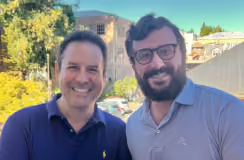
Host: Welcome to Acquiring Minds, a podcast about buying businesses. My name is Will Smith. Acquiring an existing business is an awesome opportunity for many entrepreneurs and on this podcast I talk to the people who do it. Jason Budd acquired a 45 year old software company last year right as Covid hit. He was a self funded searcher who had worked in corporate for years, but he saw the moment in his career when it felt right to take a leap and work for himself. You'll hear me get excited when he talks about someone influential in his life sending him a podcast about buying businesses and how listening to that podcast really opened his eyes and sort of set him on the path. No, it wasn't Acquiring Minds, that was before this pod existed. But still, hopefully Acquiring Minds will serve the same purpose in somebody else's life. Anyway, that anecdote and the rest of the story with Jason Budd. Jason Budd, thank you for joining me today on Acquiring Minds.
Guest: Thank you for having me.
Host: Will, you're the president of Meta Systems, which is a 45 year old software company, which 45 years old is a good lifespan for any company, particularly in Software. Not many 45 year old software companies around, but you yourself are more recent to the company you acquire. Acquired it in March of last year Covid March 2020. So I imagine there's a lot to say there. But before we get into that story of your acquisition of Metasystems, give us two minutes on you and what led you to want to go out there and find a business to buy.
Guest: Great. Well first of all, thanks Will for having me on. Really looking forward to our interview and our session today. So you know, my background is I have an engineering background ever since I was in high school, really started doing engineering related activ. And you know, and with that was a lot of process engineering, had a career in, you know, process control, a lot of manufacturing, company work, design, that sort of thing. But really ever since, ever since really my college days, I've had, you know, quite a bit of entrepreneurial sort of spirit and mindedness. You know, you ask my wife, I've always been working on some sort of project and incidentally a lot of those were software related projects. And over the course of time, no matter where I found myself, whether it was in college, working at the student union related offices, I was finding some way to do something different, build some tool that would help. Over the course of my career, no matter where I was working, whether it was on the production floor or in the engineering office or in management, I was saying how can we improve the way we're doing things especially via software. And so over the course of that, I've always been one that thinks, you know, creatively enjoys doing the what ifs, what about this? And just challenging the way the world works, challenging the way, you know, we do things. And as you can see, you know, in any sort of environment or organization, depending on the organization, that might work well, that might not work so well. But I found in my case that it worked really well, and it helped me to see a lot of different areas. And so as I progressed throughout my career and learn more about the corporate world, learn more about business, I came across an opportunity that said, this is a good time. If I'm going to go build something, let's go build something of my own. And so that sort of turned into. Once that light clicked, I had some influencers in my life that helped point me at directions. Hey, have you really thought about buying a business? That was the moment, sort of that it clicked and I was all in.
[3:50] Host: So you had kind of a moment in your career where you felt like it was a natural point to go out there and scratch that entrepreneurial itch. But why was it buy something rather than build something from scratch?
Guest: Yeah, good question. So building things are very hard. And being somebody that's got a family, three young kids, it's hard enough to build something as it is and make it successful. It's even harder when you've got a busy life. And so if you can find something that's stable, that's been around the block a time or two, and that's got to be 45 years. At 45 years, and it's got a good cash flow, then the risk is much lower and the reward could be a lot higher, at least sooner. And so, as I mentioned a little bit, I had toyed around with different things and just takes a lot of time to market it, to provide it. And it's not always just about building a product, but it's finding the customer and having a compelling time to introduce it to them. And so that's a big challenge. And so finding an existing business that was prime to go on to the next chapter was the perfect scenario for me.
Host: Did you realize, did you know that, like, about being able to finance with an SBA loan, the acquisition of a small business? I mean, did you have people in your network who had acquired a business? Because all those things that you just said certainly sound good, but if you were like me, I didn't realize. I just thought acquiring a business was something that only an Already rich person could do. I didn't, you know, know all about the SBA financing, but of course I've. I've now learned how is it even on your radar to think that you could go out and buy six, seven figure business?
Guest: Yeah. So I had somebody that I had worked with in the past, and, you know, he was very influential for me in my career, and he was the person that said, hey, you know, have you considered doing this? He pointed me to a podcast, I can't remember the name of which it was, but it was it about the process of business buying. And it was very much aligned with search funds and that sort of approach, which is not the approach I ended up taking, but you know, that it was that person and who had a lot of respect for still do, who won. You pointed to me to that podcast that started the journey in terms of thinking about it, but also the fact that that person had confidence in me as well, that I could do it sort of was just helped the alignment of the stars, if you will, to really take that plunge.
[6:25] Host: Well, I'm very pleased to hear that. It was listening to a single podcast episode. I feel like you teed me up perfectly for this comment.
Guest: No problem.
Host: It was a single podcast episode that opened your eyes because obviously acquiring minds, like every single one of these interviews that I have should serve as an inspiration to people who are very, very early in their awareness about business buying, just like you were at that time. So that's great to hear that. That it can be so influential. So you, okay, so you make this decision that you want to buy a business with the advice and the kind of nudging of this influential person in your life, listening to the podcast, going down the rabbit hole, what comes next? What is your search like? What does your search look like?
Guest: Yeah, so the search was literally just, hey, I grew up in the technology world. I said, let's go to the Internet and, you know, businesses for sale, see what that happens. The podcast did point me to a book which talked about the business buying and financing process. Like I said, it was very much aligned with the search fund process, but that focused more on the due diligence and acquisition process. Not so much the finding it, but went to the Internet, found with that ultimately found a business buying brokerage in an organization who promotes essentially business buying. Right. Because he himself, who started this and is leading this, is himself a business broker. So it's in his interest to promote business buying, of course, but also just educating people. And so he would host networking events, business buying breakfast that brought together brokers, bankers as well as attorneys who specialized in that space. And so just a function of that networking and getting connected with online brokerage websites. That's really how I started to refine the companies that were available. And sometimes it was they might know of a company, you get to know them a little bit and they'd express the willingness to even say, hey, if I come across something, I'll let you know. That might align with your skill set.
Host: So you were looking at online brokerages, probably all the usual suspects that we've named on here many times, but you were also doing something local. You were going to these breakfasts hosted by a local business broker who brought together people. Sounds like you brought together service providers in the, in the ecosystem. Not so much buyers themselves or sellers even.
Guest: Yeah, so no, it was very much intended. The intended audience of the seminar was people interested in business buying. And the key presenters, if you will, would be these service providers that would, that would talk through the process, you know, like, like I said, the lenders might be SBA lender for example, and things like that.
[9:14] Host: And where was it? Where are you based or where did this process happen?
Guest: Yeah, so that was happening in the Columbus, Ohio metro area.
Host: Okay, great. So, okay, so you're putting yourself out there, you're networking locally, you're on these business brokerage websites. So how do you happen upon Meta Systems?
Guest: Yeah, so it was through one of those business brokerage website that I had seen it and it was, it was actually really interesting how it all unfolded. I had looked at several different companies. What I was targeting was around. I said, okay, I have an engineering degree experience in manufacturing. Over the course of my career, as I told you, I was doing a lot with software and business intelligence and building systems and tools to help them. I was also involved in a lot of erp. For a time I was the ERP product owner for the company I was working for. The company I was working for got acquired and I was involved in integration of companies and that included ERP integrations, things like that. So I was doing a lot of work at the time in this space. And so when I came across it, that felt like a very natural fit. And my affinity for software, it sort of really spoke out to me as well. I wasn't limiting my search to that though. As I mentioned, it was something in the manufacturing space. I looked at machine shops, I looked at other places that did light industrial manufacturing or assembly. By the time I said Meta Systems would be my number one, I had maybe seven to 10 businesses that I was working on, getting the financials for the initial packages for review and refining it that way to meet those initial high level qualifications.
Host: So ERP manufacturing, this was kind of like you wanted to be touching this in some way, but the business itself that you acquired might be software touching it might actually be a manufacturer. You were looking at all that.
Guest: That's true.
Host: What was your, what can you tell us what your financial criteria was or any, any of the kind of the, yeah, the, the quantitative metrics of your acquisition?
Guest: Absolutely. I mean, of course it had to be something that would support a loan. Right. Because I knew I'd have as well as something that, you know, knowing that I was going to be ending up in the SBA space by that, that point, you know, I had to know that I could support it from my down payment, you know, sort of faculties that I had available to me. So that sort of limited it probably in the, you know, one to $3 million range in terms of price.
Host: Okay, and so you did go the SBA loan route.
Guest: That's right, yep.
Host: And actually this would be a good time. So what does Metasystems do exactly?
[12:00] Guest: Yeah, so Metasystems, we are an ERP software provider and what we do is ERP, for those who don't really know, is software that typically manufacturers might run their business on. So it's the full integration between not just manufacturing orders, parts, bills of materials, planning, purchasing, but also integrating that into the financial system. So it's highly embedded so you can do your payroll based off of it. It's really the full suite of managing your business. And we have a focus on highly engineered solutions. There are some products that are more aligned to retail operations, some that are more aligned to distribution. Ours is very much focused on sort of engineered to order, configured to order, made to order, sort of companies that have maybe a very complex or deep build material and a lot of shop for emphasis in their environment. And so that's the gist of what an ERP software is.
Host: Yeah. I mean, so is the reason that it's been able to survive as long as it has is because it's so custom to this niche. Because I would imagine in this ERP world that there would be kind of like in the CRM world there would be some real dominant players. Although actually in the CRM world there's Salesforce and then there are some big players, but there's a very long tail of smaller providers as well. So maybe it's, maybe it is kind of like that.
Guest: Well, absolutely. And as you know, Being in this sort of business, small business world as well is that it is, you know, you hear this saying a lot, that small business is the backbone of America. And it's true. And it's really, really hard to appreciate just how true that is. And so once you, once you open your eyes to the world of small business and acquisitions, you realize there are so many of these companies that do exist and that do exchange hands and sometimes the sellers are ill equipped because they haven't had a good sort of exit strategy over time. But I bring that up just to say that in the software world, for every company out there, they need some software that they're running their business on. It could be a lightweight accounting tool, it could be a strictly more operations oriented. And so I think this is a product that has evolved over decades, started off on very legacy database systems and has imported and brought forward over time. With that we've been able to preserve these really powerful features that some modern SaaS oriented systems just don't have. It has depth and breadth over a 45 year built solution. And so that, that appeals to the companies that have very wide needs. And if I'm, if I'm very lightweight manufacturer and I'm just trying to track inventory, that's great. But if I really am trying to do a deep cost accounting, inventory management, perpetual inventory with very solid month end controls for auditing purposes, then we have all those, those features that you're going to, you're going to need.
[15:12] Host: As I hear you talk about this, you're using a lot of manufacturing phrasing and vocabulary that I'm unfamiliar with. So it does seem like one of the interesting questions in small business acquisition is always how much the prospective acquirer needs to really understand the inner workings of the business they're acquiring. They'll eventually need to understand if they acquire that business. Of course they'll need to learn those inner workings. But how much do they need to know before they even acquire? Could I have acquired Meta Systems not knowing really frankly anything about manufacturing? Or was this, did it really take, Was Jason Budd really the sort of person that needed to buy this business?
Guest: That's a good question. I think I'll answer it in two different ways. The first being depending what your financing situation looks like. Because as part of the process, if you're going to go out and find a lender, the lender's got to get comfortable not with the financials, but they want to get comfortable with the fact that, that you are now running this business. Maybe if it's got a very tenured and long standing management team. They would be more open to a hands off. Right. But for a company that's small like ours, that is you know, not as, you know, more shallow management structure. Right, yeah. They're going to be looking for as part of the lending process and their due diligence, you know, are you, are you sort of qualified? They have confidence that you can do it and then of course, from the other side of it, but you will, knowing nothing, come in and do this. Setting the financing aside from my take coming into this, you would have a very hard time keeping it going in the right direction without much experience in manufacturing at all. Because a lot of what we do is really partner with our clients. And to your earlier question about how has it survived this long is because we really don't. We're not a commoditized approach to software. We don't say here's our product off the shelf, you buy it, click the install, here's the lots of documentation on exactly how it works. Go click it and good luck. We take very much approach of. We have a core aspect of our solution, the accounting, the work order management, the cost controls, the manufacturing elements. Right. And then where we typically find the most diversity in people's business is, is not so much in the manufacturing. Sure, they have their own processes and trade secrets of them building the thing. But at the end of the day, the fact that I've got a bill material and I'm tracking material and labor and service costs and overhead, things like that, you know, that's all true. And so, you know, typically, no matter what variety there is in their manufacturing process, you know, we can make that work in our tool. Where we see even more variety though, is the fact that, you know, I've got these different companies, like I mentioned, configured to order, et cetera, where the most diversity and complexity is often in the sales, the sales cycle. Because I've got a models and options approach where you can get this, but here's all the options you can get. And how does that go into, to link not only into building a sales price, but ultimately translating into a work order that I have to ultimately build. And so we tend to focus on clients that, you know, need a little bit of customization on the front end side of it. And then we just partner with them to make it really efficient. So a lot of systems, and not to belabor this point, but a lot of systems do everything just kind of okay. We try to do the very special needs of our, of Our clients do what they need to do that makes them stand out from their competition, do that really well.
[18:57] Host: So. So there's just a lot of upfront custom work that you do, Is that what I'm hearing?
Guest: Maybe. It just kind of depends. Now being the fact that we are 45 years into this, we have lots of features and so sometimes we have conversations with clients that say, well, what does it do? And you know, we chuckle a little bit and say we could, you name it, we can probably do it. But tell us more about what you're trying to do and we'll help you get it done in the right way. And so we do a lot of configuration. We spend time, a lot of time up front trying to understand the business and we like to say we try to get to know the businesses as if we work there.
Host: That just sounds like a lot of work, but it sounds like a great investment because you're probably on the other side of the sales process, so embedded in your clients workflows and in their businesses that your retention is probably something to envy.
Guest: Absolutely. You know, like you said, we want to partner with them really well. And then, you know, companies needs change a lot and so we like to keep close contact, you know, working with them regularly because as they have attrition, turnover in their workforce and their, their needs change or you know, things like 2020 and 2021 hit, they need to be dynamic in the way they respond to the market. There's the work harder, there's the work smarter approaches. And companies realize that software is here to stay. And if we can have something that helps us be more process based and less people based, that's a win win.
Host: Going back to the acquisition itself. So what was your due diligence like? How did you get comfortable that Metasystems was a healthy company that you wanted to pull the trigger on?
Guest: Sure, yeah. So a couple things with that. I had a really good couple of different partners in that one. Of course the lenders are going to help you and that's some sense. They're going to get comfortable for their own reasons. But then also you think about, at the end of the day, they're looking out for their interests. You have the broker who is representing the seller, of course, so they're going to say lots of things and warrant it in a certain way, not going to try to come out right and deceive you. But then really something that was interesting is the only person that really is on your side exclusively as part of the process is your attorney who's helping you with it. And that's an important thing to realize because the lenders want to get the deal done, the brokers want to get the deal done, the sellers want to get the deal done. And most of the time you do. But the only person who's maybe on your side exclusively is your attorney. So in my case he was actually a former cfo and so we had a lot of experience. He did a lot, he does a lot of different acquisitions. That's a decent part of where he likes to put some emphasis with his clients. And so he had done a time or two, so he was able to help me in that regard. But you know, at the end of the day, it's getting familiar with the employees. You want to talk to them as much as you can. Some sellers are going to be more comfortable with that than others and the timing. But maybe you don't speak with them directly, but you know, you can get know a lot. Hey, do you have resumes from them? Can I see that? How long they've been with you? Give me a salary history, any sort of hr, you know, information that you have just to tell you the story of what your team. Because especially in the small business world, you know, your people are your business. That really is true. You can have our hard assets, intangibles, in my case, you know, with a software company, a lot more intangibles than tangibles. So the people are a huge core of it because as I said, you know, our go to market strategy is to work with our clients and that that implies people. And so, you know, having a good confidence that you have retention there, that those people are satisfied and that you have the means by which to continue growing that as you acquire it is important. So I think that's one side which is the people side. Huge for small companies financially, of course you get the records. People don't tend to misrepresent a lot to the irs. And so you want to get the actual filings and corporates, the documents and just bank statements, hey, give me the checking account for the last three years. Is the money actually coming in? Can you see that? Things like that, that just sort of marry up and proof out financially. And then I had done a lot in, like I said, the business intelligence space. I had done a lot of reporting in my background, both for sales and all kinds of costs financial. So I had built financial statements and reports in my past from scratch. And so I had a decent sort of background coming in to be able to understand financial statements and dig into the details on it.
[23:54] Host: What about the product itself? So this, as we keep saying, it's an older company, older piece of software. How did you get comfortable that it wasn't going to become obsolete or there wasn't a 50 million like some startup, some SaaS startup funded with $50 million in VC? Who is coming after your lunch? Yeah, talk to me about your comfort with IT and or just technical debt. Are you worried you're going to have to rebuild the system or how did you convince yourself that you weren't? Or just talk me through that stuff?
[24:30] Guest: Oh no, and you know, that's a good question because obviously like I said, that's one of the key assets that there is, is the software. So I scheduled some demos and so very, very key people got to be aware of it. Like I said, I was very intimately familiar with ERP systems and so as part of that demoing and reviewing the product, I could ask some good questions, the best of my ability and understand the architecture. So I was able to talk even I had some IT leadership roles in the past. So I knew the full stack. How does it work from the behind the scenes, from the software point of view and was able to view it now, I'll be honest with you, when I first saw it, I go, wow, it's not modern at all. I mean the interface, we call it the lipstick on the pig problem. It's very well featured, a lot of great options, it does a lot of good things. And experienced manufacturers, people, the more experienced they are and know truly what they need, the less that's critical for them. But it is a dated sort of platform that most of our clients are on today. That being said, coming into it, you said technical debt, how are you going to move forward? One of the things I launched within 3, 4 months was as I was meeting some of our top clients and ones who would be, we thought would be interested, we met with them and we said, hey, we're going to work on a project to pivot from this current platform into a web based platform. And so we said, hey, instead of doing the cycle where we go off and develop it and then we approach you about upgrading, let's partner together so you can drive product direction. You can help us do it. And so we had clients sign up to do that. And so we're a year into kind of a two and a half year process to migrate it from sort of a legacy thick client based solution onto a web based solution. It's going really well.
Host: Nice. And before the acquisition, did you budget for that? I mean, it sounds like you're rebuilding the product from the ground up.
Guest: Yeah. So you do as much as you can in terms of forecasting and then you get creative as you come in. So absolutely, I knew that a web push would have to be a critical element of it. Partnering with some of our customers was something that was a great asset to both us and them to be able to help drive that effort.
Host: How long had meticystems been on the market for sale?
[27:00] Guest: It had been on the sale for, I think it was tried to be sold, I think back in 2012, if I recall, and then. But I don't think it was on the market for that entire time. I think it came off the market for a period of time and then was, I think, I think listed for maybe six months to a year by the time that I had sort of come around. I had mentioned earlier, and so it was very ironic though, actually I mentioned that business buying breakfast. That was that. And two of the presenters there, like I said, were an attorney and a lender with one of the SBA lenders in the area. And it turns out that later on when I found the Meta Systems listing and had kind of reached out and I think somehow had connected with the president of the Business Buying Brokers association in town, he says, hey, wait a minute. It turns out that both the lender and the attorney had worked with a previous basically potential buyer. And so they were very familiar with the business, both from a financing point of view and in terms of the seller from a selling point of view. And so that turned out to work out really well. It was very ironic, but very favorable. And it sort of probably jump started the process a little bit. There was an initial comfort and the lender himself, he was at a different bank than he was at the time when he dealt with it the previous time. So that created a little bit of complexity, but otherwise there was a lot of familiarity and it aided the process tremendously.
Host: I feel like going into that negotiation you had a lot of wind at your back. I mean, it had been on the market for some time. I mean, it had been on and off the market. And for a software company to not sell really quickly, software is obviously a hot commodity these days. Software businesses probably meant that it wasn't super competitive. You were probably the only offer. You find this lender and attorney who already knew the deal. You knew that there had been a buyer who a deal that had fallen through. So it feels like you could really, you were negotiating from a position of strength.
Guest: I really do Feel like that was the case. Of course, every broker wants to suggest there's dozens of buyers lining up, waiting, but that's their job. Right? But you're right, all those signals pointed that this was a good deal. But I also knew that this was something that was a strong, solid business. I did appreciate being familiar with this space, that there was a lot of work ahead and that was okay. To me that meant there was a lot of upside because I had a seller at the time who was at retirement age and was planning on sort of moving on with their chapter and the next chapter in his life. And so this was just a good opportunity to say, hey, how am I going to take the reins on this and take it forward, really, if you will, the next generation of Meta Systems. And there were also some key employees. One key employee who was within a year and a half of retirement at the time. And of course going into that, say that's a little intimidating. But having gotten to know this gentleman, he's been a tremendous partner. It's a year and a half later, so he is semi retired, but working on us on apartheid basis, helping the transition. He loved the work, he loved the product, loved the clients, and he's been a really good partner in this transition.
[30:42] Host: Did you uncover as part of your due diligence that there was this key man risk, that the second in command or the main tech guy was a year and a half out from retirement?
Guest: Absolutely, yeah.
Host: So, okay. Okay. So you planned from that from the day one.
Guest: Absolutely. Getting, you know, getting a good understanding of the employee makeup. As I mentioned earlier, that that was a part of the due diligence process.
Host: Yeah.
Guest: And getting comfortable with that. And like I said, it's somebody in your shoes that didn't have any maybe software, you know, experience or ERP experience. You know, that's what made to your point about the tailwinds and is that I was in a position where I had done manufacturing, I'd done erp, I'd done a lot of peripheral systems integrated with those tools that I think from a comfort level I could come in where many other buyers may not have been comfortable taking on the reins for
Host: something where it was the retiring owner, the seller, were they the founder?
Guest: No. Metasystems has changed hands a couple of times. One of them happened and very abruptly it was a pretty, pretty tough time, I think just with health issues and things like that. But, but otherwise there had been a lot of stability. You know, I still have employees that have been here over 30 years, over 20 years. And so there's just a lot of tenure and longevity. And so, you know, it's been great working with all these individuals who have the history, have the knowledge and have the passion for this kind of work because it can be grueling sometimes. But every day is a different day and a new challenge. And having lots of clients to work with is a good thing.
Host: Well, it gives you some further assurance. The 45 years is a really strong signal, but the fact that it's already gone through an ownership transition, that the business had already gone through an ownership transition before, or more than one, tells you that it had survived a transition, which some businesses don't. So that's another strong signal.
Guest: Yeah, not just that, but endured recessions and things like that. It had gone through several different cycles.
Host: Jason, we talked about you really diligencing the team, the employees, the technical debt. Were there any other risks that you were particularly wary of during your due diligence that you were concerned about as you sign on the dotted line, or were those the big ones?
[33:15] Guest: Those are certainly the big ones. And there's only, for example, so much technical debt that you can assess going into it because it's proprietary, things like that. But those were the key things, is understanding the team. And the other thing, when you had asked about what are the criteria, for example, for looking for a business, yeah, you want something strong. And also knowing that ERP systems that take a long time, they take months, sometimes years, depending on the complexity of the business, to one, both get on board and to really get where you need, it could be as we do it, sometimes as little as two, three months. But my point with that is simply that this is something to invest in. And with my potential clients, I'm not creating a retail transaction. We're working on a relationship that's going to span, you know, a decade or more. And so, you know, looking at the clientele and saying, you know, our customers had, you know, last eight, in some cases, you know, 10, 20 years, that gave a lot of assurance that, you know, change might happen, but change can't happen all at once, you know, with that, with all of our clients.
Host: Yeah. And so now that you, once you acquire the business, were there any challenges that. That materialized that you hadn't foreseen? Or were they basically. Were they the things that you'd worried about? You knew that one of the key personnel was going to be retiring in a year and a half. Covid. What about the COVID effect? Tell us, what were the first six months like? Talk to me about that.
Guest: The first Six months really were. They were somewhat quiet at first. A lot of learning, digging in, learning the customer base, the COVID effect. I think right up until the point of transition. It was the middle of March 2020, right before the world started considering a lot of restrictions and things like that. So from that point of view, I think it was the weekend of close. I was having a conversation with my lender and he said I hadn't really heard anything. But for the first time today in one of our company calls, the CEO mentioned hey, we, if this thing continues, this might affect some of our lending decisions. And so, you know, that said, hey, let's get this thing done. We had originally had a January 1st close date that got postponed for various reasons. But at the end of the day we made it happen in March. And then really as it progressed into that, I think in some ways, you know, it created some demand from our clients, not so much, you know, new clients, you know, that's. Companies have plenty of things to worry about in the 2020 year that we had rather than trying to maybe onboard a lot of ERP software. Right. Because that's just adding a lot of, you know, a lot of decision points, a lot of an investment. But it did create other demands like hey, we have to, you know, there's supply chain impact that happened. How do I manage that? You know, with software maybe I needed some sort of COVID check in screen or something like that as part of the timekeeping system. So there were some opportunities created as a result of that. But all in all things stayed strong. And because a lot of our clients are infrastructure engineered, configured to order, it was either because they were infrastructure transportation and so that wasn't really affected or disrupted or two, we've got some trailer manufacturers that are more, that are less on the infrastructure side and more on farming and things like that. So that also helped some resilience in that space. But we also have clients that make sort of sports and leisure and you may have seen some of the stories those industries were booming, had all kinds of backlog associated with them and some of my clients still have months and months for the backlog in those spaces. So it was very interesting, interesting dynamic and mix, but overall it was really not that disruptive from our point of view.
[37:27] Host: Well, it sounds like it was good that you just hurried up and got the deal done. Because do you know then if your lender's bank stopped lending for a time,
Guest: I think lending in general was affected. You had PPP and things like that that were happening that banks were trying to coordinate. So the banks that worked in the SBA space were very busy. And so whether or not it was lending decisions because of risk, I know that restaurant spaces and things like that were certainly restaurants are always challenging from an acquisition and longevity point of view, but particularly last year, that was the case. So I think it was probably a function one of just, yeah, there's a lot going on. But also they had so many other. All their existing clients or previous clients all of a sudden had needs. And so that probably just shift to where some of the resources went.
Host: Sure. Can you tell us anything about the numbers of what you acquired the business for, what the multiple was, what the margins were on the business, any of that stuff?
Guest: Yeah. So ultimately acquired the business. Like I said, I was targeting one to three range. So the final price was in that range. Ended up doing an 80% SBA loan and then 10% seller financing and 10% financing on my side. And so the cash flow supported that from the business point of view and margins in the net margins, 20, 30% range.
[39:10] Host: And did you pretty much immediately, were you able to replace the salary that you had when you were gainfully employed, traditionally employed, right after you became owner of Meta Systems, your own salary?
Guest: It was not quite exactly where it was before, and that was due to a couple reasons. One, you got this nice new loan. You got to pay back. But two, as we mentioned, with some of the personnel, I knew that I had to start a transition process immediately for the one individual that was looking to retire in the short term. And so I had to take some of that cash flow that maybe otherwise could have gone to me to work on hiring not just one, but really two replacements to focus one on the business requirements, Business analyst point of view. On the flip side, more of a technical development resource. And so in the interim, that tied up cash flow a little bit, but
Host: so you pretty much quickly hired two people or within a few months hired two additional people, two more people on payroll after acquisition. So, yeah, that would put a ding in your cash flow for sure.
Guest: Absolutely. Yep.
Host: Well, Jason, now that you're on the other side of an acquisition, how do you feel about the concept in general? Like talking to yourself of two years ago, before you started on this path, what would you say?
Guest: I'd say it's, you know, I've been asked several times, you know, hey, if you. If you could do it all over again, would you choose to? My answer has always been absolutely, yes. I've. It's. It's been a lot of work the due diligence process, trying to make the thing close, that can be really nerve wracking at times because you never know. There's so many aspects that you don't know what could happen. Something can happen in the business, the lending institution, you really just don't know. And then coming into it, a lot of hard work, but a lot of great people, a lot of great clients. I've enjoyed every minute of it. But has it been super easy? No. But that's part of why I went into it because I said, hey, if I'm going to help rebuild something, I'd rather it be something of my own than something of someone else's.
Host: Yeah. Is there any advice that you might have for the Jason of two years ago or anybody else out there looking to buy a business or if this is the first time this episode has been forwarded to somebody by somebody else who thinks that they should buy a business, what would you tell that person?
Guest: I would say really keep your options open and I tried really hard to do this. But when you do see a business that you say, man, this is really intriguing, it aligns well with my skill set. It's hard, but you never know what, where it might fall apart. Any number of reasons, as I just mentioned, could happen. So even, even when you are getting closer and closer to a finish line, you know, keep the process, you know, going the process of other deals.
[42:17] Host: Keep your own pipeline.
Guest: Yeah, absolutely. You know, keep the pipeline coming because you just don't know what could happen. Also just, you know, even framing the relationship like I had mentioned, hey, know that the attorney is the only person really not on your side. Everyone wants to be able to happen, but aligning, you know, what, what their, you know, end zones are. Right. Is a really fundamental part of it. And you know, learning to use maybe sooner, sooner rather than later. One thing about, especially in the small business space, most sellers are first time sellers, most buyers are first time buyers. And so that can be intimidating for you. But it also creates a little bit of rapport. I think if you acknowledge it early on, maybe with the people that you're looking to acquire the business from, because, you know, they, you know, they're new to this process just like you are. And if you can, you know, kind of indulge that together, I think it helps sort of frame the relationship a little bit. Obviously you're still, you're still after your own interests, but, but to know that you're both sort of in the spot for the first time, I think is productive. And then Also, with that being said, depending on who you have helping you, you might be going it alone for most of due diligence. Like I said, I had a partner in it. But there's only so much that that person can do and so it still mostly falls on you. So learning when to escalate, I think there were times where we probably could have had our attorneys, you know, sitting down. That would have been worth the investment to have them sitting down maybe earlier in the process because, you know, the documents get floated, you know, back and forth. And sometimes I think everyone finds themselves waiting on somebody and sometimes keeping track of who's waiting on who is the biggest challenge. Right. So learning to use the levers at the right time, I think the broker can be a really good lever. Right. Just like real estate people say, at the end of the day, does the purchase price matter to the broker? Yeah, a little bit. But they've got a pipeline full of deals they're working to close. So obviously $100,000 difference in price means a whole lot more to the seller than it means to the broker. It means something to the broker, but it means a lot more to the seller. And so learning that perspective and being able to pull levers with that. And so sometimes there were hurdles I ran to with the seller, maybe just a function of the fact that he, like most of them, was a first time seller. Right. And so when you, when you run into something that you kind of, you deem to be a process problem, that's when you got to start maybe talking to the broker and saying, hey, I think there's a breakdown here, or getting your attorney talking to theirs, or your attorney talking to the broker, your lender talking to their broker, just really trying to keep those communication channels open because sometimes it's just a misunderstanding on what's required.
[45:29] Host: It sounds like what you're saying is that you should really maybe not announce this to everybody involved, all the stakeholders, but to yourself. See yourself as the project manager of this deal. And when things drag or when you suspect there might be ambiguity, whose turn it is or the ball and is whose court is the ball in, you just default to yourself to be like, I'm going to keep this thing moving forward. I'm not assuming that somebody, that there's some referee out there doing it, it's on me to keep this deal moving forward.
Guest: Absolutely. I think that's a great takeaway is just at the end of the day, the seller wants to make it happen. But depending on, like you said, where the deal's been at how long it's been on the market. It might just be that the seller is fatigued in the process. The employees, depending on how involved they are with pulling financial data, or everyone could just be a little bit of burnout. So you're the new one in the process. And yeah, if you want to make it happen, sometimes you have to keep it going. So I think that's a great way to frame it.
Host: Cool. Jason, if other would be buyers out there want to get a hold of you, what would be the best way?
Guest: I think, you know, we've got access with metasystems.com we've got a LinkedIn page. I've got a personal LinkedIn page that they could find me on and that would be a good way to reach out.
Host: All right, I'll link to that. Show notes for sure. Jason, this has been great. Thank you very much for sharing and congratulations on your acquisition.
Guest: Thank you so much, Will. I've had a great time in this session and hopefully we can talk again sometime.
Host: I look forward to it.
Guest: Sam.

















































%20-%20thumbnail.avif)




%20-%20thumbnail.avif)

%20-%20thumbnail.avif)

.avif)




%20-%20thumbnail.avif)