Host: Today's guest didn't have to buy business. In fact, he didn't have to continue working at all. In their mid-50s, Matt Pol and his wife exited a small business they'd started for enough money to retire early. But instead of doing that, they got back into the game of entrepreneurship, this time as business buyers. And what they ultimately bought was a welding business. Welding is a trade you haven't heard much about on acquiring mines, and today is going to be an education. The business Matt and his wife dawn bought was a grand total of four people, the two owners who would leave after the transaction plus two additional welders. So really, the business that would transfer was just two welders in a market where welders are hard to find and without Matt and Dawn knowing anything about welding themselves, this was risky to say the least. But it's gone well. Against those odds, they quadrupled revenues in the first 2ish years, though so far 2024 is a bit softer. Listen for what I consider a few reasons for their success. First, using a well defined framework to grow the business. Second, Matt and Dawn's partnership. They'd built a small business together before and have a good division of responsibilities. And third, call it the X factor. You'll hear how much Matt has enjoyed this journey into welding. Easier to be successful at something that intrigues and interests you. Meanwhile, you'll hear how dawn doesn't shy away from being among the welders on the shop floor where the sparks fly. Enjoy this story of Matt and Don, a couple who chose buying and growing a small welding business over retirement and have been rewarded for doing so. Announcements don't forget that tomorrow is our latest webinar, this one with attorneys James David Williams and Bill Barlow, whose entire practice is devoted to small business acquisitions. James, David and Bill are going to walk us through the do's and don'ts of your loi. They'll focus on how Lois can stand out both for good and bad reasons. So what you can do to get a competitive edge with your LOI and avoid the common pitfalls. And we're going to leave ample time for questions. Any questions not just those related to Lois. So treat this like office hours. Come get any legal question you have about your deal or your search answered by James, David and Bill and learn from the questions of others. It's tomorrow, Tuesday, June 11th at noon Eastern. Link to Register is right at the top of the show notes where it says Register for the webinar. Tomorrow, Tuesday, June 11th noon Eastern. Link to Register at the top of the notes. Also Smith List the job board for operators and leaders of small businesses that we launched recently has more amazing opportunities. Posted an operator to run a small industrial distribution company with 10 employees, an operator to run the operations and own the P and l of a 30 person sign manufacturing business, a GM to run a 30 person glass fabrication business and an operationally focused CFO for an H vac and plumbing platform doing 50 million in annual revenue. And the right CFO candidate here could evolve into CEO. So if instead of buying a business right now, you want the opportunity to run one, check out these opportunities and others@smithlist.com link in the notes okay, on to today's episode. Welcome to Acquiring Minds, a podcast about buying businesses. My name is Will Smith. Acquiring an existing business is an awesome opportunity for many entrepreneurs and on this podcast I talk to the people who do it. August Felker is a two time successful searcher, first with a traditional search fund. The second time around he did a self funded search. Today, August runs Oberly Risk Strategies, an insurance firm with a dedicated practice group for searchers and acquisition entrepreneurs like you. If you've got a business under Loi Oberle, will provide complimentary due diligence on that business's insurance and benefits program. A great no risk way to get to know August and team. They love helping searchers. They've worked with hundreds. Oberly is a specialty insurance brokerage for searchers by a former searcher. Check out oberly-risk.com O B E R L E- risk.com link in the show Notes Matt Paul welcome to Acquiring Minds.
[5:06] Guest: Thanks Will for having me.
Host: Matt, you spent the first chapter of your career as an employee, then pivoted to 0 to 1. Entrepreneurship. You then pivoted to what else? Buying businesses, namely a two employee welding business. Sounds risky, was risky, but you and your wife dawn have really made something from it. Let's get into it. Start us off Matt please, with some background on you.
Guest: Thanks Will again for having me on here and excited to share our story. Hopefully it'll be valuable to other entrepreneurs. Grew up in Iowa, moved out to Colorado to finish up my schooling at the University of Denver. My academic background is in statistics and information systems, so I'm kind of a data geek at heart. And then career wise, started off with the Federal Reserve bank here in Denver, moved to Arthur Anderson for a number of years and then over to a company called Corporate Express, which at that Time was a $4 billion office products company. That was really kind of shaking up the industry and it eventually got bought out by Staples. So I, I kind of was in that quasi governmental area, you know, really high end consulting and then corporate environment. And that took me to my mid-30s.
[6:37] Host: And what happened then?
Guest: Well, I think like many entrepreneurs, I just had this itch, right. It was like, you know, in the corporate environment, you're, you're just a piece of the machine and didn't really feel like I could control my own success. I think a little bit comes from my, my upbringing. My parents had their own business growing up and they had a successful business for a number of years, 20, 20 plus years. But during the 80s, well, yeah, kind of in the 80s, they, they lost their business. They had to close the business. So that was pretty traumatic. I was just going into high school and, you know, this lifestyle I had grown up with and, you know, where I saw my parents busy and going to work every day, they employed several members of our family, you know, my aunts and uncles and grandpa. And just to see them lose that, I don't know that as a high schooler I really understood the significance of it. But you know, my dad really never recovered from that. He was in his early 50s at that time. So anyway, I had that itch to own my own business and having been in the corporate environment for a few years, I just felt like I needed to let the market decide what my value was. And so hung out my shingle. My wife and I have been business partners from the beginning. We have two really complimentary skill sets and kind of ways of seeing things. And so we had four small children and said, you know, my wife was like, okay, you're finally making a lot of a good, good salary. Why are we doing this? And it's like, I'm sorry, honey, we just, I gotta go do something. And I think it's not uncommon. Kind of in that 30s, early 30s period of time for kind of get that itch to say, can I do it better? Can I do it my own way? Can I make a difference in the world? And so that's what we did.
Host: Matt, you felt that itch, but at the same time you just finished saying how traumatic watching your parents or how traumatic it was for your parents to lose their business.
[9:06] Guest: Yeah.
Host: So how do you think that, that, that played in? Did you. You were drawn, you had the itch, but at the same time, were you maybe more scared than somebody who hadn't seen his parents go through a business failure?
Guest: Well, I think the, the reality of potential failure was there from the very beginning. You know, although I didn't spend a lot of mental energy on that, worrying about it. You know, I, I had seen that and I, I guess in some ways I felt I had good skills. If I had to go back to the corporate environment, that would be the worst case. For some reason my dad couldn't transition out of entrepreneurship back into that. And I'm not to say, you know, I, we've all heard the saying, you know, business owners make the worst employees. I'm sure I wouldn't have been a great employee then, but I knew that that was always a fallback if I had to do that. So yeah, yeah, I think there was that reality that was, you know, based on my personal experience, but it didn't shape really my mentality. I didn't see myself as my dad. It was just an experience of my father.
Host: Okay, Matt. Well, where of course we're heading is when you decide to buy businesses. So we're not going to spend too much time on the businesses that you started, but give us the abbreviated version of that chapter.
Guest: Yeah, so the business was in the area of legal, legal services. We manage class action lawsuits, so we're a class action administrator and our clients were attorneys, both plaintiff defense attorneys who worked on class action lawsuits. So complex litigation, big companies typically, you know, being sued and there's this data oriented and kind of administrative process that kind of goes into that. So we had that business for 15 years. First 12 years were kind of a lifestyle business. And then around year 12 we had the business valued. It was not the valuation we wanted. And so we had this important decision. Do we just keep on running a business that's a good lifestyle business, you know, is paying for our kids as college and all that kind of stuff. But, or we could change our, our approach and say let's, let's do it differently so that it has value. And so we decided, hey, we're going to be in this, we figured another 10 years, let's least make something that would have value when we want to exit. And so we, we stumbled upon this growth methodology. We applied that methodology three years into that 10 year plan. We sold the business for 10 times what it had been valued in year 12. And so kind of, kind of coming out of that experience, it was like, wow, this was pretty incredible. We, you know, that's, I ended up acquiring all the IP of that growth system, several decades of research of small mid sized businesses and, and turn that into what's called the Rewild group. And that's, that's kind of the One of my main focuses today so is take the methodology, making it able for other consultants to apply it, other business owners to apply it, you know, kind of in a self directed manner as well. And so that was kind of.
[12:45] Host: Let me jump in here with a question. The class action administration business, when you considered selling it and then got evaluation and then saw how low and disappointing that was. Yeah, we hear about that phenomenon a lot with sellers. They think their business is worth X, but really market terms are, yeah, sure, what, what was the difference there? How much of a difference was it? And how, how were you valuing the business? Why were you so off based on what had you come up with your own unrealistic valuation?
Guest: Yeah, and I think it's, I, I suspect my wife and I, dawn and I are, are pretty typical in that we, we build a business based on the things we like to do, the things we're good at and the things we had experience in. And to be transparent, we really weren't thinking about what is this business valued at. So when we got the valuation it was less of a. Oh, we went through our calculations, it should be X. And you go through your calculation and it's Y and there's a big gap. It was more of like the broker came back and said, okay, it's worth this. And we're like, wow, 12 years, all that effort, all that sacrifice and that's all it's worth. So it wasn't A versus B, X versus Y. It was just wow, that's lower than I would have hoped it to be.
Host: Yeah.
Guest: And I think one of the key realizations is that we weren't building, we weren't running the business to, to really focus on the transferable value of the, of the business. We were just focusing on it. You know, did we enjoy it, did it challenge us to use our skill set? And so it's really a real mind shift of saying, oh well, we should take this into consideration. We need to change our up think our thinking so that it is valuable at some point in the future. So I think that that kind of
Host: describes where we were and we'll return probably over the course of this conversation to rewild this framework that you've built another zero to one business around. So I don't want to, I don't want to digress too much into with the whole framework right now, but could you give us the 62nd version of the levers you pulled to in three years increase the value of the business by tenfold?
[15:15] Guest: Yeah. So first of all, let me Guess
Host: you guys, you stepped out of the business, you guys were, you're basically glorified consultants and you fixed that problem.
Guest: Yeah. So I would say the key thing is we didn't understand the rules of growth and that's really what the methodology helped us with, to understand that there are different stages in each stage, there are rules you need to follow. And so basically I was focused on the wrong things. I wasn't, I was being more of the specialist as opposed to really being the leader. And so. But part of that required us to grow the business. We had to have more revenue and that required a more focus on profit instead of process. I'm a process minded person and so I put a lot of energy in process and that took away from my energy. Focus on bringing in revenue seems, seems obvious now, but that was one of the things that held us back and that took really intentional effort. So it was really creating a system where we could systematically, and not depend on me, bring in more revenue. That was a big thing, creating really a, what we called a, a lead generation machine. And so we did a lot of stuff on the air in the area of business development. As that occurred and more revenue came in, we hired better people, the right people. I spent more time coaching them as opposed to doing the work so that they could do the work. And so we went from like nine people up to 30, know, 35 people in three years. So we tripled in revenue and more than tripled our, our profitability, our profit, I should say. And, you know, just understood, well, you got to manage margins, you know, if you want to improve profitability, you have to understand what gross margins are. So those are some of the things. Just a big part of it was establishing core and brand values to understand who we are in the marketplace so we could attract the right customers, we could attract the right people. So there was a number of things, but really the key part was understanding that there are different stages of growth. So when we moved to stage one, to stage two, I knew what that stage two looked like and how I had to adapt to that stage. Then we got to stage three again, where my focus needed to change, where I need to spend energy, how I needed to see the organization changed again. So it just became a roadmap that I just literally followed really by blind face. And it worked. And so at the end, the value of the business increased exponentially because it was less dependent on us as owners. We had a team that was really doing the work and we had built a business development engine that really was Driving growth. You know, by expanding the number of customers and projects, we are winning.
[18:11] Host: Yeah, well, it's fascinating, Matt. I mean, you're, you're talking now to an audience that will understand this intuitively because they are the buyers of these businesses. And so listeners are looking at listing after listing, business for sale after business for sale and disqualifying those that don't feel like there's any transferable, transferable value. But so many business owners suffer the realization, the, the very disappointing realization that you did that in fact, there isn't a lot of inherent value in the business. And so you see that all over the marketplace. Businesses for sale. What do the following Acquiring Minds guests all have in common? Doug Johns, Moore, Morley Desai, Tim Erickson, Chirag Shah, Shane Ursam. They all went through the Acquisition Lab, the accelerator in community for people serious about buying a business. But they represent just a sliver of the Lab's success stories. The number of deals across the Lab's cohorts now stands at over 120, with over $300 million in aggregate transaction value. The Acquisition Lab was founded by Walker Deibel, author of Buy then Build, the book that introduced so many of you to the very idea of buying a business. The Lab offers a month long, intensive, almost daily Q and A sessions with advisors, live deal reviews with Walker, deal team introductions, and an active community of serious searchers. Check out acquisitionlab.com Walker link in the notes or email the Lab's co founder, Chelsea Wood. Chelsea buy, then build.com just before we close out. What was revenue when you sold it?
Guest: I think we're closing in on 4 million.
Host: Okay. And so you grow the business tenfold, or excuse me, you grow the valuation, the enterprise value tenfold. And you do exit. Is it, I assume it was a meaningful exit, but maybe not so much that you retire?
Guest: No, we could have retired. I retired for about two months and was driving dawn nuts, cleaning the grout on the floor, doing all these things that really didn't need to be done. And I'm just a productive person. It's part of my DNA, so I had to be productive. And so it's like, okay, I'm going to start a consulting business. I started to do that a little bit, then was approached by the inventor of this methodology, ended up acquiring that IP and that became Rewild Group. So that was kind of the, kind of the first step back into owning a business. About six months later, I would say I was actively, you know, near full time pursuing a new opportunity again, as you call the Zero to one kind of thing, you know, startup. A startup business.
[21:14] Host: Yeah. And that was the methodology that you had applied into your own business. You bought the IP and built a consulting practice and methodology practice around that from scratch to grow. You're still the owner of that, you're still growing that. You still have big aspirations for that.
Guest: Right.
Host: But meanwhile, buy, then build. The book enters your life. So now let's, let's get into the meat here.
Guest: Okay, well, just a little background. My wife and I, dawn and I
Host: are,
Guest: we've used walking as kind of our stress reliever ever since we got married. And so we walk a lot, we listen to a lot of audiobooks during that, those walks and we just stumbled on a book, Buy, then build. And we were walking one day and it was like, wow, this is, this seems a lot different than starting from scratch. Why didn't we do this?
Host: What the heck have we been doing?
Guest: Why are we doing this? It's so, so hard getting traction in the market with a new idea. And so, you know that that's where the first thought of well, maybe we buy a business this next time. And you know, Don was still kind of enjoying semi retirement and, and, and yet she had a passion. She wanted to see if she could replicate what she had done at the other business. You know, was it just a one off? Were we just lucky or could we do it again? And she's always, dawn spent a lot of her career in hospitality industry and you know, blue collar kind of work and you know, just has a passion for those that work hard and you know, maybe they didn't go to college but you know, that, that shit doesn't really define who they are, their value they bring to the marketplace. So we had talked about, well, you know, if we looked at a business, what would we want? And we talked about the trades and you know, we're trying to find something that was like essential business because we had been gone through Covid and it's like, okay, what kind of a business wouldn't be shut down? And you know, you have Anime Automation and Amazon, you know, disrupting markets, you know, something that could survive that. So that's where we kind of headed into the trades. And then we said, well, we don't want to do the retail consumer kind of trades, we want more of the commercial industrial. And we just started kind of slicing different things. And by the way, during this time, dawn actually got her, her license to be a business broker and went through a sale of a business. But she didn't really like Being on that side of it, not being the, the broker and. But it gave her really good insight into, you know, the process. So she, she just, she's a big real estate person too, so she loves that kind of acquisition and, and then selling assets. And so she just was always looking for a business. And then we just kind of. So the book kind of got us into the mindset. Don's passion about this kind of industry kind of fueled us as a couple. And then I was like thinking strategically, okay, what kind of business would we want? And I had thrown out, you know, kind of a fabrication, metal fabrication kind of sounded cool. So it just turned out dawn was on a bunch of lists that, you know, she'd get businesses, you get information, we'd look at them. And serendipitously, I didn't say that right. But our, our, our son, he had been coming out of the cannabis industry where he had really grown a lot of technical skills in what. What's called a. What is it? A mip, Marijuana infused product. So he was running labs, a lot of science and chemistry and everything involved, which is kind of some of his passion. But there was no money in the industry. And so he was like, hey, I need to make a switch. And so we were kind of looking at businesses with that in mind as well. And he had always worked with metal. That was kind of a hobby of his, you know, blacksmithing and welding and stuff like that. That had been kind of a hobby for him.
[25:55] Host: And so the idea was maybe that he becomes operator of a business you buy.
Guest: Yeah, that's. That was really the idea. And so, and, And Matt, how old
Host: are you all at this point, you and Don, roughly.
Guest: We're in our mid-50s.
Host: Okay. At this point in the. Sorry. At this point in the story.
Guest: In the story. And this is a couple years ago, so we're. Yeah, we're later 50s.
Host: Great.
Guest: Not 60 yet. So great.
Host: And you're based where?
Guest: In Denver.
Host: In Denver.
Guest: Okay, yeah.
Host: Okay, great. Just wanted that context for folks. Please carry on. So, so sorry. Profile parameters of the. Of the search was kind of blue collar. Be nice if it had real estate attached to scratch that itch of Dawn's.
Guest: Right.
Host: Something that maybe your. Your son could become GM of or work in.
Guest: Those were some of the key criteria. We. I was looking for a business that was generating a million dollars for us that seemed to be okay. It's a legit business, you know, and healthy margins.
[27:02] Host: Million dollars in revenue.
Guest: In revenue, yeah. Million in revenue. And so we, you know, we're not patient people and we're not. We subscribe to the shoot, fire or.
Host: Yeah.
Guest: Ready, aim. Ready. Fire. Aim. Right. So we, we are quick to pull the trigger. It's just worked for us throughout our lives and so we just ran on, you know, stumbled across, across this business that was being presented by a business broker. Looked at it, you know, looked at the financials, met the owners and it was really the first serious conversation we had. And the things we liked about it were it was a welding business, had been around for a number of years. They had you know, some repeating clients although a lot of his project based and so there's not a lot of repeat business but good reputation, had a couple good employees that were solid welders. It was just clean business. You could tell that they were. The books were honest and fair and, and you know there wasn't shenanigans going on so. And there was real estate. So we had, they owned the real estate which like you said scratched Dawn's itch and you know a well run business they, they weren't doing quite a million dollars on most years but close to that.
Host: Well Matt, you've, you've already surfaced one. What would have been one of the key concerns, the project based nature of it. Although we can get over that if there's enough history in the business. We, we just say it is what it is and, and move on. But two employees, two tech. So the owners plus two employees. Yeah, that one admittedly for me would have been hard to get over.
Guest: Yeah.
Host: How. How did you.
Guest: Well, one of the things that Don and I've had a good track record with is, is building teams. So she's great with people and managing them. I'm good with strategy and kind of the structure that's needed. I think one thing we underestimated was the impact of not being a specialist. We've always been when things get busy, when there's a time crunch to get stuff out, we can come to the table with our skill set and make things happen.
Host: Yeah.
Guest: And you can, you can do the work.
Host: When the business can do the service is actually being delivered. You can be deliverers of the service as well.
Guest: Exactly. We're both very productive people in doing the work, but neither of us are welders. Neither of us have even tried to weld. So. So that, that I believe.
[30:06] Host: Matt, you said on the pre call that you really weren't sure what welding was at the time and it's possible that I don't either. So. So educate us now. What is welding exactly I, I know it has something to do with metal, but I couldn't tell you what a melding a welding business actually does. Please.
Guest: Well, our business is a commercial industrial welding company and we focus on pipe welding. We do all kinds of welding, but pipe welding is, is really our core, what we call our core revenue group. And so it's basically the fitting of pipe that's used in typically transportation of liquids or gases that it's metal and you are using. There's basically three welding techniques. Mig, tig and stick. And they're different technologies that are used based on the, the application the metal, what you're trying to get out of it. And in particular, our group tends to do a lot of tig pipe welding, which is really the hardest welding, the most difficult welding. So we're kind of the high end welding shop in town. And. Yeah, we had no idea. I mean, welding as you might think, it's, it's the, the melting, it's a process of, of melting metal materials that go into and form a joint, if you would, a connecting point for metal members, whether that's a pipe or flat kind of surfaces in a structural application so that the weld in fact becomes stronger. Because if it's done right, it'll actually be stronger than the material outside of it. And one of the tests of a weld is called a bend. A weld, A bend test. So you weld something, you bend it and you see where it breaks. And if the weld's done right, it actually breaks in the original material before it breaks the weld.
Host: So this is like when you break a bone where you broke it, it grows back stronger than it's.
Guest: Exactly. That's a good analogy there. So that's the one.
Host: So, Matt, basically welding is connecting two pieces of metal together, be it pipes or be it panels or be it whatever, you're connecting metal together and there may be a joint between them or maybe always is. And you're connecting metal together to basically create a larger or longer metal structure.
Guest: Yeah, exactly. And, and that's our tagline for the business is building strong connections. And, and that's really what we're about both obviously in the physical work we do, but with our relationships with our clients and with our general other contractors that we work with, we're really about building strong connections. And so that's kind of our, that's our tagline.
[33:17] Host: And so Matt, from your customers, your clients, they'll send you inputs, let's say pieces of pipe and your output is an assembled pipe.
Guest: Yeah. It, it's very customized. So that's one of the natures of it. And one of the things we like about it, it is custom work. We try to standardize or at least get the semi custom on as much as we can. But the nature of our work is often, here's a drawing. Now make this happen. And that could be in our shop. It can be in the field sometimes. Most of it I would say is new piping that's going in to connect a piece of equipment, for example. And a simple example is high school is installing new, new chiller systems. So on a big commercial building like a school, you don't have individual air conditioners, you know, in the windows or little units like up on the top, like an apartment complex. You have a big, big cooling system that can cool the entire building. And that's usually called like a chiller is one type of technology. Well, it runs a lot of water through the cooling system. And so in order to do that you have to connect pumps and the chiller units and the air units, you know, all have to be connected somehow through a mechanical system. And so we, we work underneath a mechanical contractor that's putting in all the equipment and then we do all the custom piping that is done maybe in our shop to get started, but then has to be finished at the site in the field with mobile welding equipment.
Host: Great, that's a great example. And the work being done by welder looks like flames and sparks and, and he's got a mask covering his face with the little, the little kind of window through it where he sees through his eyes that that's a welder. I'm sorry, so ignorant. That's a welder.
Guest: Yeah, that's a welder. And welders are very unique people. I mean they are literally, you know, one of the common T shirts is, I'm. No, I know I'm on fire. Just let me finish welding. It's, I mean you get birds almost every day. It seems like they wear flame resistant clothing. And all welders have, you look at it, you think, well you, you kind of dress like a slob. But it's, it's their, their shirts are all full of holes because they're catching on fire and you know, and that type of thing. And they do a lot of grinding and there's a lot of math involved, especially with pipe because you've got pipe runs that have different elevation gains and angles and all this kind of stuff. So they use a lot of, a lot of math. There's a Lot of shop math that they use. So you have to have a pretty good analytical mind to do the welding. But then it's really a craft, especially tig welding. There's really an art, art sense to it. And, and they've, I've been, they've been trying to teach me how to do some welding, so I've been playing around here the last few months and, and it's, it's, it's hard. I mean, it's very hard. It's not like just connecting wires like an electrician. It, it's just very. Because, I mean, we're sometimes dealing with pipe that's, you know, 4, 6, 8, 12, 16 inches in diameter. And you can spend four hours, eight hours just on one pipe because you have to put in the root, which is the first one that has to go through in what they call complete joint penetration. It gets into the pipe and then you have to fill it up. And if the pipes, you know, schedule 40 pipe, it's, you know, a decent thickness and you have to basically just do multiple passes around there. So you could be a, a welder working on just one weld. What you see as one weld for eight hours and it's just, you know, whether it's stick or tig, each of them have their different, you know, sticks. Messier takes more of an artistic mig is it tends to be the simplest and goes a little bit faster. But yeah, they're grinding stuff. It's, it's, it's awesome. As a guy, you go in there, there's sparks flying everywhere. It's pretty fun stuff. So that's cool.
[37:56] Host: And it sounds therefore too like it's a pretty highly skilled trade. As trades go. It's, it's pretty highly, highly skilled.
Guest: Yeah. I, I, my analogy, I'm not sure if this works for everybody, but I was a wrestler in high school. I grew up in Iowa, big wrestling state. And wrestlers were always this weird bunch. Right. I mean, you got the football players, you get the basketball players, they get all the cheerleaders. You know, we just show up and we, we, we, we tumble in with another guy. Right. So kind of weird. But, but wrestlers really. I think wrestling is kind of the most intense sport you can be in because it's, it's, you have to control your weight. It's 24 hours a day. It's, you're on the mat for, you know, several periods and it just seems like short period, but you are going so intensely for that period of time. Yep. I say welders are kind of like the wrestlers of the trades. They are kind of a unique breed, and it is a very unique skill set, and it takes years to be really good at it. You. There's a lot of people that say they're welders, but I've come to realize that there's only a small subset of that that are really, truly good welders.
[39:16] Host: And Matt is this. I feel like I've. I've heard the phrase pipe fitters as kind of an old school, you know, an old school profession or trade that.
Guest: Yeah.
Host: And maybe I'm wrong about old school. Maybe it's still a thing. But I, for some reason, I associate it with. With the past. Is that just another. Is that just another phrase for welder? A pipefitter is a welder.
Guest: Well, I would say pipe fitter in our language is a role. It's not a position. And so if you're a welding technician, for us, that's a title, a position. Pipe fitting is a role that you have. So, okay, it's one. Welding welder is a role that you have. So it's part of the welding is kind of the. The last step you have to fit the pipe. So it's the measuring is the beveling is preparing the pipe to be welded, and then you get to weld. Now, in some industries like oil and gas, you may have enough of the pipe fitting work that you have people that specialize. That is their title pipe fitter. And they're just doing the pipe fitting. And then somebody, a welder just does the welding. That's all they do is welding all day long. They don't have to worry about the fitting. Somebody takes care of that for them. In our welding technician position, that's. That's a role is the pipe fitting or the fitting, the, you know, prepping and getting whatever. If it's a pipe or more of a flat or structural kind of a steel member, getting it ready to be welded.
Host: I want to return to kind of the industry. Industry dynamics. The opportunity you saw here, these two employees, scary. And now that I know more about welding, or at least what it is and how highly skilled it is, sounds even more scary because probably hard to find. You just finished. Your words were something to the effect of a lot of people say they're welders, but few actually are. So just seems like it'd be hard to hire for. So we'll return to that in just a second. But before we get too far from the plot, some terms of the deal, please. You said it was doing Nearly a million in revenue. What else can you tell us quantitatively about the business and the deal?
Guest: Yeah, so the business was, I would say between 800 to 1.1 million the last few years in a revenue st side of things. They were SDE sellers. Discretionary earnings were my recollection, 300,000 to 400,000. So they, they were having a. It's nicely profitable.
[42:08] Host: Yeah.
Guest: And the building, I can't remember, I think it's around 6,000 square feet of an industrial space. You know, lots of welding equipment and stuff like that. I wouldn't say inventory per se, just more of a, you know, some material that could be used potentially. But basically you had trucks with machines, you had welding machines in, in the shop. So that was kind of the, the assets involved.
Host: The two sellers. It was a couple. And how active were they in the business and what were they doing?
Guest: Yeah, so the, the husband, it's a husband and wife team. The husband was a master welder, had welded all of his career and had been on his own for 20 plus years. The wife had worked in industry, I should say in the trade industries and office kind of roles, administrative roles, and had joined the. Her husband's business at some point. I think they had been in that space maybe five to seven years. And she basically was a part time administrative role, doing books primarily. Okay.
Host: If he was doing some of the welding, how did you see repl? Well, sorry, I'm getting ahead of myself a little bit. Back to the numbers. What can you tell us what the terms of the deal were? So it was about a three or four hundred thousand dollars ste business, two employees and, and two owner operators that were going to be exiting the business. What did your deal look like?
Guest: Yeah, so again we're, we're quick to pull a trigger. So we, we liked the business. It was the best business we had seen, at least on paper after looking for a year or two. And the, we basically offered them what they were asking, which was around $2 million with the building being about 1.1 of that and the business being 900,000 essentially. So basically 3, 3, 3 times a 3x on, on their, on their SDE plus the building, which we felt was undervalued at the time. So we really. Well, I think that's how it worked kind of in the deal. We, we saw the building probably being worth more than, than what we paid for it.
Host: And what about the business? Because I might say the opposite about the business.
Guest: Yes, yes, we thought we overpaid for the business, but there was a Couple things that were important to us. First, the owner wanted to get out right away and he agreed to stay on for three months operating the business with us. So we got that concession and again, we just felt it was a clean business. You know, it wasn't like we were going to get into it and there was just a rat's nest of stuff that we were going to have to figure out. So that was worth something to us and just to be able to do it and get it going. Close on the deal quickly. There was some really attractive things from SBA at that point in time, which kind of were incentives to us. Like they waived the entire SBA fee and they paid for like the first three, three months of payments. They, they paid for us. So there, I mean, at the end of the day, between that savings, it was, it was also a 10% down loan and they treated it as a full real estate. Well, we got real estate terms, so it was a 25 year term. And at that point it was a really attractive interest rate as well. So with the savings that we got from the loan, off the loan closing costs, it almost covered most of our down payment, you know, a 10% down payment. So we felt like. But for the terms of the loan or when we took into account the terms alone, we basically didn't put anything down on the business. So that was also attractive and kind of incentivized us to move forward quickly on.
[46:20] Host: Yeah, well, let me just highlight a few things there. I mean, certainly now you're really thrilled with the deal that you got because you've grown. The business you got was a floating interest rate. So I assume it wasn't fixed. Yeah, so, okay, so yeah, we're fixed.
Guest: That was the downside. Who would have known, right? Yeah, yeah, yeah.
Host: But this thing about the 25 years, let's just, let's just make sure people are clear on that. If you buy a business, this is SBA terms here. If you buy a business that has real estate attached, you buy them as a single package in the real estate value represents more, half or more of the entire package. Then the terms of the SBA loan are 25 years. The loan is amortized over 25 years. So as a recent guest put it, it's almost like you're mortgaging the business. You're getting a very long term loan like you would on a house, but for a business and, and its associated real estate. So that makes it very much, much more appealing loan because the amortization schedule spread out, your monthly loan payments are so much less. So that's great. Good for you. And Don gets her real estate. It's.
Guest: Don gets her real estate and the other, you know, everyone who's done an SBA knows that one of the downsides is the, I'm not sure what they call it, but the SBA fee, the guarantee fee or whatever it is, the loan insurance. But you know, it's a big number. You know, it can be 50,000, 20,000, 100,000, you know, depending on the size of the loan, but it's, it's a big number. So to have that done without a charge was, was a big, you know, that was a lot of cash that we didn't have to come out of pocket. So, yeah, it was a very attractive loan.
[48:09] Host: And what percentage generally is that fee?
Guest: You know, I don't, I don't recall. It could, it's kind of like, you know, when you're paying points on a loan, it's kind of like that. I don't know if it's a 1% of a loan, but it's probably in that range. Yeah.
Host: Okay, so now back to this, the strategy here and the vision for buying this business.
Guest: Right.
Host: The. You don't know anything about welding. There's two employees. You later learn as you learn about welding, just how much of a craft this is and just how small the universe of true welders really, really is. So how are you thinking about this extreme key employee risk?
Guest: Yeah, so, you know, we obviously spent a good amount of time talking to the two employees and you know, just getting their buy in for the vision. And it was a big change for them. You know, instead of being having a welder as a boss, you have, you know, dawn as a boss or me as a boss. Really how we set up the business, this was really Dawn's business. She's the CEO and she's running the business. I'm, I'm there to kind of support her really using the, our growth methodology. But on a day to day, the idea going into it was that this was Don's business. She's going to run it. And so we kind of head into it that way. You know, it's, it comes pretty quickly. It's like, oh, what a we, we can't help in this. We can't do the welding. So, so Don's real focus was I need to build a better team. We need to get more people. We only have two people. We, that's not sufficient. We got to bring in some more people in case these guys don't stay On So that was kind of the first focus is bringing on more people, the challenges. You know.
Host: Sorry to interrupt, but you had also said, I think that building teams was a strength that you, you guys had. So, so that was always going to be part of the program here was, was building the team.
Guest: Exactly, exactly. So part of it is establishing our values as an organization, making sure that people are a good fit for that, those values. And, and again, Don, Don's very good at overseeing and managing and coaching and growing a team. So really from the get go, we started hiring. We didn't have the revenue just yet, but, but we had some projects on the horizon. So it's like, okay, we've done this before in our businesses where at the end we see people really as revenue generating units.
Host: Is that what you told the welders?
Guest: Not, not in those terms. Basically what we say is, hey, you guys are the ones that bring in the revenue. We want more of you, not less of you. We don't see you just as an expense, we see you as potential revenue. So we want to have a good team that can, can bring in revenue. And so started hiring people, you know, some swings, some misses, some hits, you know, get on the base on a few of them. And you know, our attitude was, let's hire quick, fire quick. And that's what we were doing. And so we had a few good projects to kind of get us out of the gate and stretch our legs and things like that. And again, the, the former owner, the master welder was there for the first 90 days and we wanted to try to get as many people in place so that he could interview them, test them, that kind of a thing. So that's kind of what we did. At the end of the 90 days. We felt decent, you know, a little worried, but pretty decent. And, and then we just kind of go through that first year. We had a decent first year. Yeah, I shouldn't say decent. We had a really solid year. We were at like 1 1/2 million our first full year. So we bought the business in September. Kind of the 90 day transition got us through to the end of the year. So kind of January of the following year we were kind of on our own. So that first year we went from, I think they had 900,000, we went to 1.5 million in that, that first full year.
[52:23] Host: That's fantastic. And this is. Yeah, I mean, for a business that you guys don't know much, much or anything about, very small, very fragile. And by the way, I don't think we Told the audience the exact time. So this is September 2021. So a year and a half into Covid when you buy. And, and so you're talking about taking it from 900, a run rate of 900 to 1.5 from call it September 21st to September 22nd. Right. And. And so the back to the rev revenue generating units. So to get to 1.5 you had how many hires at the end of that year or excuse me, how many employees in total?
Guest: Yeah, we went. It was a bit of a churn that first year trying to figure out who's a good welder, who says they're a good welder and who actually is a good wel. Welder. And that 1.5 was really, just to be precise, that was really January, December. We kind of count that those first three months is just the training wheels. Yeah. So really January December of 22 was one and a half million. And I think we, we had highs and lows during that and a big driver of the revenue. We got a special project that was just a beast. And at times we had 20 welders working on this project. It was in our shop. We had people just walking on top of each other, welding on top of each other. We had welders working 16 hour days. It was a crazy, crazy, crazy project. But it's the kind of thing that I know that the old owner wouldn't have even considered. And yet it's the kind of thing that dawn especially, she's very risk prone. She's willing to take risks. And so she pulled the trigger on it and oversaw it. And it was, in many ways it was a nightmare project. But she was able to collect by the end of the year a good, a good amount on that project. I can't remember what it was, but it really drove our year. And it was very highs and lows and craziness for that summer. But that was really what drove it. So we, like I said, we had up to 20 employees during that time, up from two when we bought the business. So totally different. And, and yet coming out of that, we knew that there was a lot of people we had brought on for that project. We just needed people to do work. And so coming out of it it was like, okay, let's clean out what, what's not a good fit for the long term. And that became kind of our staffing model was let's use these projects to bring in people. Prove the nice thing about welding is it's very hard to hide incompetence. And it's very difficult not to recognize talent. I mean, it's so dramatic and the proof's in the pudding. If you're a good welder, you can weld well, you can weld nicely. Your wells look good, they pass testing and it's, it's black and white. But you don't know that until somebody welds. But you do know it after they do. And so we, we realized that this is going to be part of our staffing model, that as we staff up for projects, we're going to have to bring on a number of people and coming out of those projects, we'll try to wean out, you know, those that are not a good fit, not good talent and keep those as kind of an ongoing team. And that's really what we did coming out of that big project. We ended up, I can't remember with six, six or seven welders in a welding manager, operations manager coming out of that. And we were really excited about that because we finally had somebody that felt, you know, this gentleman, he probably a 20, 25 year welder, welded on basically everything. So kind of this master welder that we could rely on. That could really offset the lack of specialized skills that Don and I had. And so Don's really running the business operationally, the team. My job is really on business development, bringing in work that's kind of my focus in the business proposals, estimating, all that kind of stuff, coming up with models and spreadsheets to figure out how we, you know, control margins and price things outright, generate leads from a marketing standpoint. So great.
[57:10] Host: Well, Matt, let me jump in with a bunch of questions and follow ups here. First of all, to Don, just, I'll just say it plainly. To get into a blue collar environment for a lot of my guests who come from white collar land is already a cultural mismatch and could be intimidating if there are, you know, tough guys who, who brag about all their burn scars.
Guest: Okay.
Host: And, and, and so therefore, frankly, it'd probably be even more intimidating to be a woman in such an environment. Forgive me, female listeners, but I, I suspect that everybody agrees with what I'm saying, whether or not they like to admit it. So anything to say about that? About dawn getting in there and kicking butt in a room full of welders?
Guest: Yeah, so she, she's. Dawn has a spine of steel, so that kind of stuff doesn't bother her. You know, just, just a little bit about her background. She, she was born in Korea. She's, she was adopted when she was in fifth grade to a family in the U.S. she's known a lot of adversity in her time and so she's, like I said, she's, she's unflappable, but still, but you're, you're very much right that, you know, she, she definitely is out of, out of her, out of her comfort zone in this environment. You know, and in a couple ways, you know, first of all, she doesn't know. She's used to being a specialist like she was, she was the kitchen manager in a restaurant, right. So she knows she's the best cook. Right. She knows how to do it because she's the best at it. Here she's now running, overseeing people. She doesn't know what's good and what's not good just intuitively because she doesn't have that experience. So she's having to really get up this learning curve on, on understanding that. So I would say that would be, that was even more of the challenges just from the technical side of things. And then you know, to be in front of a client and they say, wow, you own a welding business, do you weld? No, I don't weld. And that part was kind of a bit of a challenge just to say I'm an entrepreneur, I own businesses, I run businesses. It just, I happen to acquire a welding business. And she had to find her footing there to be comfortable in that conversation. And that took a little bit. And I'd say sometimes she still feels a little bit awkward not being that specialist just because she's such a person of competence. That's where her competence comes from. And she feels like there's this gap here that she's never going to be able to close. So we've worked through that and you know, our roles have kind of developed especially over this past year, a little bit different to where we're really.
[1:00:05] Host: That, that disconnect she feels between the competence she wants to have and, and be able to present to a client but doesn't. Do you think that that's all in her head or has it indeed been a ding when you've been pitching jobs and, and the client, the prospect, the prospect realizes that you guys, you guys as owners aren't welders. Hasn't, has that in fact ever. Have you ever lost jobs because of that or nobody cares?
Guest: No, I think there's a little bit of both. It's definitely in her head primarily. But you know, we, we had some oil and gas clients that had been long term clients of the prior owner and you know, it's pretty clear that they didn't, they didn't feel comfortable with dawn leading the organization. You know, that's not, I don't think it's necessarily female. I don't know what it is, but it's just that they just didn't feel comfortable with her experience or whatever. And yeah, I think we lost some clients there. I think there's more respect given to her. More, more like, oh, wow, that's cool. That takes a lot of courage to do that. I think that's been more of the reaction. Yeah. And yeah, as we've strengthened our welding team, you know, we are going out to those opportunities with members of our team. So the idea of the technical expertise, we've now found ways to, you know, it's a. Not rocket science, you know, just bring the expert with you. And that, that resolves the, the concerns about, oh, you don't know how to weld, but you're a business owner, but you brought your best welder. I, I can be comfortable that they're, you're not going to do the welding they are. So that's, that's where what I'll look to as far as from the technical expertise.
Host: Yeah. Well, Matt, if we, if we do a follow up episode in a year or so, I'll, I'll twist your arm or twist Dawn's arm to come on with you. I feel like she should really be, be sitting here alongside you. Yeah, I'm sure she's got stories, a couple of the, couple thoughts and, and questions on the, the kind of the, the labor and how you built your team.
Guest: So. Right.
Host: The first of all, have you retained those two original employees?
Guest: That's a great question. The answer is no. They turned out not to be all that good of welders at the end of the day. Yeah. Okay, so we have much better welders today. I mean, night and day from where we started, which is really disappointing. You know, these, these, these gentlemen, you know, had been welders for 10, 15 years and I don't know, it could have been just working for us that was the issue. But the talent or the application of the talent at least wasn't there in a consistent manner. And so yeah, we've, we had, we lost them in the, I would say they were with us about a year before we, we replaced them. Mm.
[1:03:13] Host: And this model. So basically the entire organization is turned over at this point. Everybody is. You guys, you and Don are now the veterans. I mean, you're the ones who've been there the longest which probably. Probably makes you feel a little bit more comfortable in terms of seniority as opposed to. Right?
Guest: Yeah. Yeah.
Host: The. This model of big job, bring on a lot of people and then kind of pick the ones that are the best to retain on a permanent basis. When you have the big swell of people that you're kind of. You're paying and. But you're also trialing. Are they W2 at that point? Are they on contract?
Guest: We. We've done it both ways. You know, whether that's, you know, there are some staffing agencies that focus on the trades that we worked with to bring in temporary workers as a 1099 or through that. That staffing agency. So we've used that model. We've done some direct 1099s who are really independent contractors. They're. They're what they call rig welders. They have their own welding truck and they just go around wherever the work is. So those are kind of 1099s. And then you have your W2s. For us, in this particular area, welding, again, because of it specialized, we found that the trade staffing folks, they do better with carpenters and, you know, laborers and electricians and stuff like that. It's really a struggle on the welding side. So we've kind of set that aside as really a major source of staffing. We've gone through enough people that we now have a network of folks that have worked with us and that are willing to come back and work with us or refer other people to us. So that's really where we get our staff, our temporary staff now and again, it's kind of unique. It's not like I'm hiring for an office worker to do general tasks. It's can you weld? And so when we're hiring, it becomes very clear within a few days, sometimes within a few hours, that the person can. Is going to work out. So we have the higher fast, fire fast kind of mentality, and we bring most people on as W2s. At this point, we just want them to be part of the team. We feel like we have more control over them and. And that type of thing. Our. Our vision is that as we do work throughout the state, that we may do 1099s, you know, these rig welders, where they're representing us, but they are their own independent consultant kind of arrangement to handle work that's too far away for us to get to. But in the Denver kind of the Front Range, which goes kind of from Fort Collins down to Colorado Springs, that's kind of where the bulk of the Colorado population is. We handle that out of our Denver office with our employees.
[1:06:15] Host: Okay, well, what I was wondering about was, was a model that a recent guest whose episode aired just last week, Reed Tileston, he bought a. An industrial kind of pumping business and he arrived on a hiring model where he what he called kind of tempt to hire. So he'd bring on temps that. But with the idea that if they. That they could and would be hired properly. So they'd be. So he'd get the labor that he needed but not actually make them W2s until they sort of earned it over a number of months. So. So it's great. Everybody wins. Everyone gets to kind of try each other out, including this prospective employee. And he doesn't have to actually properly hire somebody until he's sure they're a good fit. But also in the meantime, as he's evaluating if this person is a good fit, he's actually getting the labor plugging the labor hole that he's also that he needs. So doesn't sound like maybe that's exactly what you're doing, but can you react to that?
Guest: Yeah, so I, I think we have somewhat of a parallel. We've got a 90 day trial period for all employees employees. And so, you know, we bring in people at a lower rate. You know, they don't get all the benefits, but they are W2s from the start. And we just found that one of. One of our principles is quality is the elimination of variance. So wherever we can find a way to reduce variance, we find that that improves quality. And for us on the hiring process, bringing in people in the same payroll process, we don't have to pay them differently and stuff like that. It goes into our QuickBooks better, all that stuff if we do it one way as opposed to multiple ways, it just makes the business simpler. So. So we've decided bring people on as W2s. They don't get all the benefits until they've been here for 90 days. That gives a trial, like you said, both ways, but it doesn't create a whole new way that we're paying people. So that's kind of where we landed is maybe a little bit of a hybrid of what the other company was
Host: doing and then two other things. I just want to call out first that you just finished saying that you kind of have a network now. A number of recent guests who bought trades businesses talked about their new ownership, bringing new energy to the organization, cultural improvements generally. New owner comes in, wants to make Things better for everybody. And how quickly word travels around because in these trades, all of the, the trades, people talk to each other like, like most of the world. It's a small world. So the Colorado welders kind of all know each other sort of thing. And so they're these new owners and they're doing good things and growing their business and treating people well and paying competitively, et cetera, et cetera, et cetera. That word will travel fast, creating a pipeline of actually people who are coming to you to work for you, rather than you having to scramble to figure out where your next hire is going to come from. I have, I projected a little bit here based on these, these other anecdotes. But is that, is that kind of the same effect here?
[1:09:35] Guest: Yeah, I think we're getting there. I don't think we're quite, you know, have a pipeline of welders, you know, stand outside our door per se, but we've got a network now where it's like, okay, this person worked for us a year ago, and then they took a job down in Texas and now they're rolling off of that job. It's, it's a very transient workforce. They go to where the work is. And so, you know, you might have somebody you'd like to bring back, but they're out in Tennessee right now, so they can't. But then they'll be back in Colorado later this year and if you have a project, they want to work for you. So the dynamics are there. I don't think we have quite the, you know, quite the pipeline yet, but it seems to be that we can achieve that and we're partially there already. So we just feel that that's a big part of, part of how we can staff effectively with good people.
Host: Yeah, well, if there's a nomadic element to this industry, it might be a little harder in your case if they're all bouncing around the country all the time following work. Last thing I wanted to say is this, this thing you said a couple times where it, it's very clear, very quickly if somebody's a good welder or not, that, you know, they just, their work product just screams, did they do it well? Did they not? And a couple again of recent guests, Stephen Quinlan and Paul Westheart, who, who I interviewed last week or the week before, they'll air just before this episode, talked about how in blue collar businesses or trades businesses, one of the, the great things as an owner of these businesses is that the inputs can be measured, so are very quantifiable Comparing this to say white collar land, say you're you know, consultant and you've got a team of three other consultants and you are all working on a project together. You know, how much, how productively each individual consultant is working on a day to day basis. Very hard to understand and, and measure. Whereas in blue collar land, from industry to industry, it seems, or in trades land, you can really. It's, it's very easy to measure in your case. It's, you know, how qu. You know, how many pieces were welded and the quality of those, of those weldings. Would somebody who's, somebody who's got now trades, a lot of trades experience but also comes from kind of white collar land. Would you agree with that assessment of the differences between the two environments?
[1:12:05] Guest: Yeah, it's, it's quite stark. It's quite stark. The difference there, and I think that's what draws a lot of people to the trades is because they can see what they do with their hands every day. And so that's the kind of people that are drawn. But it's very easy for our welding team now when we bring somebody on within a half a day, everybody on the team knows, you know, is this guy a welder or not? And so it, that it really is. I don't know. It's, it's a really nice characteristic because you're right. I've worked in white collar and it's just really hard to, to capture and to quantify a person's effectiveness. But, but it's, it's in the trades, I think in general welding definitely. Maybe even specifically. It's, it's very clear one way or another.
Host: Yeah, well, it might be a slightly different phenomenon in welding than, than what I've heard from my previous guest where it sound, where it's this aspect of welding specifically that sounds like it's almost. There's an artistry or craft would be the word to it. And so people are being assessed on their craftsmanship and that's very evident. But I, but I, I was also talking about how kind of measurable the inputs and outputs are in, in, in the trades versus versus white collar, which is slightly different if related.
Guest: Yeah, you're right. You're right. It's both the individual performance as well as what's the amount of work that somebody's done. Right. If you got 10 welds done versus two, you know. Yeah, that's so quantifiable as opposed to. Well, I thought of three good ideas instead of seven good ideas. Exactly, exactly.
Host: Exactly.
Guest: Okay.
Host: One of the things that you'd said to me in the pre call is how much you've enjoyed being involved in this business. And in fact, we're surprised by that. Tell us more about that, please.
Guest: Well, again, I mentioned that this was really meant to be Don's business, and it is continues to be, but my role was going to be fairly minor. Just kind of consulting with her and just the nature of things, nature of the business, it just has helped for me. It's been beneficial for me to be more involved in it, to support Don and support certain functions within the business. Yeah, I, I didn't know that I would enjoy this industry as much as I've done. I mean, I've been in business, you know, all my career. And, you know, just to have something really brand new that you have to learn, it doesn't really happen that often anymore. And it's. It's like taking up a new sport. You know, I've. I've played most of the sports. Right. So it's not like you get a new sport. Right. Very often. It's kind of like that. It's like, okay, welding. I don't know anything about it. And just the learning curve, while challenging, has also been really rewarding and just to the people in the industry. And we've had this conversation, you know, the trades, blue collar, it's just a different kind of a person. And I'd say pluses and minuses. Like, dawn has felt like her white collar team. She was able to mold more and coach more. And it could be gender kind of differences as well. You know, primarily a female group versus a primarily male group. The tradesmen on our team, even though they're bought into the company and are passionate about it, you know, at the end of the day, they're providing for a family. You know, they. They're about, I need to work so I can make money, so I can pay bills. I mean, that's, that's really the primary motivator. And so it's like, if I can work 12 hours a day, 16 hours a day, I will do that. And at White Collar, it's like, well, can you work an extra hour here or there? You know, I've got my kids thing or whatever, and these guys are just like, you got welding for me. I'm here, you know, seven days a week, I'm here. It's just. It's just the, the dedication to the work, which I think is motivated by the pay and the responsibilities for, you know, providing for a family. It's just a Different dynamic. And it, I like it. I really like it. It's just, I'm a hard worker. I appreciate when people are willing to work hard and put passion into and care about what they do. That's the other thing. They care about what they do. It's not like, you know, I don't really want to do that kind of welding. It's like, and I shouldn't say all of them, but the people that have stayed, they just have such a good attitude. They're willing to do anything. I mean, they, they're out in the heat of, of the summer and the cold or the winter, literally 12 hours a day, 14 hours a day. And they just show up every day, you know, six in the morning, they go, they want to start at six so they can be done by three. And it's just a different, I don't know, Persona. It's a different mindset and I've really enjoyed the people part of it. Just the learning of a new area that I, I don't really know much about. But, and, and it's also been rewarding for me to apply this, this growth methodology to a brand new business and see it work. And, you know, it doesn't solve everything, but, you know, it still provide us a really strong roadmap and helped us get things in place to make our, our business scalable and I think much, much more valuable. We didn't kind of get into our second year, full year of ownership, but we went from one and a half million that first full year. Last year we were at 3.8, so we doubled in year two. And so now this year we're starting off kind of soft. I think a lot of the trades are doing that. You know, there's, you might not see it across the board, but in the commercial industrial space, there's, there's some softness in the economy, which is a part we've never really been had to deal with in other businesses as well. But anyway, so that's kind of where I rambled there a little bit.
[1:18:37] Host: Not at all. So you, you said you, so you doubled. No, you, you got, you basically at the end of last year, 2023, you said you got to about 3.8 million from a starting place of, call it, the last calendar year had been about 900. So you've basically quadrupled the business. Maybe it'll dip some this year.
Guest: Right.
Host: But for easy math, let's say we quadrupled it in 2ish years.
Guest: Right, right.
Host: That's pretty exciting.
Guest: That's really exciting. Okay, just so we're clear, it's super exciting. It's. Well, and then you have to keep on doing it. Right. That's the challenge with a project based business is you start at zero basically at the beginning of every year.
Host: Yeah.
Guest: And you know, we're learning, you know, we got really busy as the numbers imply last year so we weren't doing as much business development and pray, trying to get more work in because we had no bandwidth. And, and then you learn the lesson, oh, when you're busy, that's the time you have to be selling. Right. Those, those truisms kind of come back and you're reminded of them.
Host: Well, there's this framework that you should be following there, Matt. No, we're going to get to that here in a second. But at 3.8 million, what does SDE or EBITDA look like excluding your loan payments for the business and the real estate?
Guest: It was a good year. We were almost at a million dollars in EBITDA, so about 30, 35% net income.
Host: Wow. And so those margins have maintained even as you've grown, which is often not what happens.
Guest: No, exactly, We've, and those are some lessons from our past businesses that we've. I believe in working, I want to work with every client, but I want to make money. And so, you know, we're, we're selective. You know, if, if we can't make money on a project, well, we'll pass it up. We're not just going to be busy and not make money. So we're a bit selective and we're just fortunate. We, we got some big projects this past year that the clients saw the value that we brought and, and we're willing to pay what we wanted to get paid.
[1:21:03] Host: So to be crystal clear, in your previous life with the class action business, you took any, you know, you took a lot more business than you should, even projects that weren't very profitable. So this goes back to your kind of learning what gross margins need to be and always protecting that gross margin. And now you'll say no to jobs where that gross margin isn't protected and therefore you maintain margins by doing so.
Guest: Right, right. We've, we from the very beginning put in good reporting so we know, we know margin for every one of our projects from the get go and you know, can manage based on that and learn from our pricing and estimating almost
Host: a million bucks in EBITDA and off of a loan that was, those loan payments are pretty low for what is now a four million dollar business because it was only a $900,000 business before. And as we talked about, you got a 25 year amortization on your loan. So even with the, the increased interest rates, it's probably not that big a deal. Not that big an expense for you in the grand scheme at this point. Yeah. So a lot of that million bucks is dropping, truly dropping to the bottom line is where I'm going to.
Guest: Yeah, yeah. We made the choice to pay down the loan pretty aggressively just because it went from five and a half to ten and a half in a year from an interest rate. But yeah, that was a choice. Right. We didn't have to do that. But we don't like debt. We use debt, but, you know, we don't like paying a lot in interest. That's kind of a rule of thumb for us. So we were a little bit pretty aggressive on trying to bring that loan down. So in part, we want to be in a place where worst case, we sell the real estate and we're whole. And for us, that's just kind of a financial, kind of a mental stress management technique. So that's kind of a, kind of our philosophy.
Host: You had said, you had said to me, Matt, on the call, that you actually, you guys didn't take any money out of the business for yourselves in the early days, right? Salary.
Guest: Yeah, yeah, that, that was the first, I would say, about the first year. Don started getting the salaries in 22. Yeah, 22. When we. Yeah. And then she was able to start paying my, my company basically a consulting fee later in that year. And we had a good year last year. So we both were. She was taking salary, I was getting my company paid as kind of a consulting fee.
Host: Great. And we are going to hear about rewild here in just a sec. We're about to, we're starting to wrap up here. But one other thing I want to double click on, Matt, is, you know that you make it seem like it's gone great and, and you've talked about some kind of challenges, but nothing debilitating. No fetal position moments, as we call them on the pod. Am I wrong? How difficult or easy has this been?
[1:24:21] Guest: No, I would say there's definitely been some very stressful times kind of mid year through 22. We had brought on a bigger team. We had some projects that got delayed and you know, we were looking at probably doing some layoffs kind of mid year. And that's when this opportunity came. That was risky. And so getting through that risky project was very stressful. We were working with an Indian firm on a repair job and very tight timelines, lots of pressure. At some point they stopped paying us for six months. You know, we were, we were a half a million dollars in, in receivables from that one client.
Host: Wow.
Guest: And, you know, it was, it was very stressful. Had to threaten litigation and go through all that. But at the end of the day, those are the kinds of things that dawn is very good at. And stress that, you know, it's stressful for her, but she's, she's not debilitated by it. And so we got paid and that turned out to be, wow, it was actually a good year. So those types of things. And even this year, you know, we had a great year last year, but there was a lot of change. We, the gentleman that we had put in that operations manager role came in on a Monday and said, hey, I'm leaving. And it's like, what? I, yeah, I'm, I'm, I'm going to the airport an hour and you know, I'm going to go work on a nuclear plant down in Texas. And it's like, okay, you know, any conversation about this, oh, no, I'm gone. And so there was, we had people who we brought on that we thought were good welders that weren't, and we had projects that go sideways, we'd have to go back and fix them. Didn't make any money on those. So all that stuff's buried underneath of those really solid top line numbers. So I would just say every business you own, whether you start from scratch or you acquire it, has significant challenges. And I like what Robert Kiyosaki says that it's not really your intelligence that is going to determine if you're successful as a business is your ability to handle the stress. It's that emotional strength to get you through the hard times. Because that's really what differentiates in my mind. You know, somebody that can sustain that and work through that, even, just even taking that first step to buy the business, you have to have that fortitude and then you have to have that perseverance to get through those hard times. And you know, a big part of what dawn and I, we've been married for 35 years. Nothing's worth risking our marriage over. Nothing. And you know, these businesses aren't, aren't. We'll walk away from this business if it hurts our marriage. But there's times where it's, it adds tremendous stress and you have to work through that and know that this isn't, this isn't the Marriage, you know, it's, this is the business and let's get through that. And so, so there's. Yeah, there's been tremendous stress. Every business has that stress. No matter if you have a growth model or not, there's still that stress. It doesn't eliminate that.
[1:27:55] Host: Thank you. Matt, you had just talked about starting from scratch. You just finished saying that all businesses have stress, be it zero to one or, or buying a business. Now that you've done both, reflect a little bit on zero to one versus entrepreneurship through acquisition. Some of the, you know, you're preaching to the choir here, so the listeners will be very familiar, but indulge me anyway.
Guest: Yeah, so I would say the biggest, biggest thing in my mind is the idea that buying a business, that you're buying a business that the market has already acknowledged that there's a demand for. Right. So you're not trained to see if the market wants this, they already want it. So your job is just to make it better than what everybody else is doing. And if you bring talents and skills that aren't in that existing business, I think it's much easier. Don and I look back and say, oh, did we overpay for the business? I think financially probably did, but the real estate makes up for, I think the bulk of that. But I still, the way I tell Don is we could not have started from scratch a welding business and in two years be at 3.8 million. There's just, I, I don't see a story how we could have done that.
Host: Yeah.
Guest: And so there's this forward momentum that comes with buying a business that already exists. So I think it's much easier. We've ramped this business up much quicker. The fact that we had businesses that we started from scratch I think actually played to our strength as well. We could see the lessons that took us 15 years to learn in one business. We've been able to apply those lessons here in the first two years. So I think that shows that that's a potential, that that's a possibility of the benefit of buying and then building as opposed to starting from scratch. That's kind of my perspective.
[1:30:03] Host: Great perspective. And there was more perspective. I wanted to draw you out on that. You said to me in the pre call, we, as you just did, focus on the momentum, the existing clients, the demonstrated market demand for what the business is producing or selling. All good things. But you pointed out, which, no, none of my, I don't think my guests ever had, although it's always kind of implied, but never directly when you buy an existing business, you can't control cost. You're, you're, you're, yes, you're getting into a, a business that's operating. Yay. But a business that's operating also has expenses that are coming in, you know, hot. So, so controlling your costs. Talk to us about the difference there.
Guest: Yeah, it's very, that's a very different thing in part because when you get, acquire the business, you don't know which of those expenses that are already going. Right. You didn't, you didn't sign the contracts, you didn't make any decisions. You know, the money's going out from day one. You've got a team that, you know, salary has to be met. It's not like you're adding one person here. Oh, should we maybe add another person next month? You know, and you're kind of growing as the revenue allows it. You are full bore, you know, drinking from the fire hose of expenses from day one.
Host: Yeah.
Guest: And so that's a real big thing for me. What, what's helped us is we had, we had additional capital available that we could, you know, stem the tide to get the revenue going and, and catch it up, you know, later. But
Host: is that to say you put more money into the business? Yeah, yeah.
Guest: We basically put, put a line. A line just, you know, during some of the slow times and we've, we've gotten that paid back. You know, it's basically a cash flow. It's really a cash flow issue. Right. It's, it's like the money's going out. Revenue might not be especially right. As you close on a business, the sellers typically are, get all the receivables. You know, it depends on the deal. But oftentimes they, they own the receivables. So from a cash flow, those first, that first quarter to six months, you may be running at a deficit from a cash flow because there was work completed, the money coming in is, goes to the seller instead of to you. But you are starting the payroll day one, and it might be 60 to 90 days before you start to collect on the new work that you're doing. So I think especially in those first 90 days, six months, you just have to be aware that you're likely going to be negative on cash flow for a while. And you know, you, that may be part of the SBA loan, that you have some working capital, but it, it's, it's a difficult transition. You know, you, I would say that's really the, the biggest financial challenge is that first three to Six months.
Host: Yeah. Well, working capital and how easy it is to, to underestimate and to mismanage is certainly a theme of the podcast. We actually did a webinar recently with Sam Rosati in the space talking about how to think about that in your deal. But it is something that, it is a pitfall that unhappily many people fall into. They just underestimate what that's going to. The money going out is going to look like and feel like particularly during the transition. Plus a lot of people just managing cash flow, I count myself here is a skill and, and, and if you have a, if you've never done it a, or if you've only done it in really simple businesses, it is, there's a learning curve to it when you get into a bigger business where lots of money and inputs and outputs are moving around at all times.
[1:33:55] Guest: Yep. Yep.
Host: Matt, let's close with. I want to now give you an opportunity to talk about rewilding and I'll contextualize it with. Just remind people what it is. This is the ip, the methodology that you guys used for your class action business to really ramp things up in a short amount of time and grow the value of that business. Ten times you bought the intellectual property into kind of a consulting methodology group practice business. That is another zero to one that you've got going on in parallel with the welding business. And, and it sounds like the welding business is a client. You had said that the welding business pays the way that actually the way that Matt is getting paid by the welding business is via Rewild Group. So, so, so, so Rewild Group is, is a, is a vendor for the welding business. And you had told me that you really wanted a part of this exercise of buying the welding business too was to prove to yourself in a second instance that this methodology really works.
Guest: Yeah. So you set that up accurately. You know, a lot of times consulting is a bit of an intellectual exercise, you know, a lot of theory, a lot of principles. And what I wanted to do is say okay, if I believe in this methodology, why wouldn't I use it? Why wouldn't I use to financially benefit myself from it? And so that was really a big part of my motivation with, with the welding business was let's use it to, as a showcase you, let's showcase the methodology using this business. And so, you know, I think the numbers kind of show that it's working and, but it's not just the numbers. Obviously numbers have a big impact on, on valuation. But what we've been able to do is really create a lot of structures within the business using the methodology that, you know, most small businesses don't have. And our people tell us about this, right? They, they, they really appreciate what we talk about, about the business. They're learning how the business works, how it's profitable. They understand business better today. And most of them have only been with us a year, you know, year and a half, but they just, they're part of the business as opposed to just an employee. And I would say that's another thing that's, that's common in the trades. A lot of them feel like they are just, you know, they're just. Whatever they do, they're just a welder and everybody just sees them as a welder and they're no different than any other welder kind of a thing. So there's a little bit of commoditization, I think, from their perspective. But we've been able to make them part of the team. And the methodology gives us things like a simple one is like a one to one process where we, we're not always good at this, but where every supervisor meets with their employees every couple months and just has a conversation about what's working, what's not working, you know, ideas for the company. And it. Instead of just doing the work, we're actually having conversations with them as a person and they feel part of the team and their ideas we actually listen to. We've had dozens of improvements to the organization just come out of those conversations. So that's just one little snippet, one little slice of things that we have that most businesses of our size don't. Most businesses in the trades don't have it, you know, yeah, large general contractors, they're more sophisticated. But know a small welding business doesn't have this kind of structure. We have strategy in place. We know what our revenue groups are, we know what our customer segments are. All this comes from our business model. And we have titles and positions and roles so people know that they're a welding technician or a senior welding technician or a welding supervisor. All that structure is there. All these things come out and provide really kind of stability for the organization, allow it to grow and expand quickly without going down a lot of dead ends. Because we have a roadmap to kind of keep us going down the right path. So I would say it's been, it's been rewarding in that part as well. You know, we talked about just learning the business in the industry, but just seeing that the methodology actually does work. On day to day, it's a little bit different because I'm not sure, just consulting, I'm kind of a member of the team. But you know, at the end of the day, I, I look at what I didn't know the first 12 years of my, my first business, the, the class action business. And it was just so much. I mean, I went to business school, I'm pretty smart, but there was so much I didn't see, I didn't understand. And it's not the running of the business, it's not the doing of the business. It's. It's kind of the working on the business stuff that I just was missing. And this gave me a framework to work on the business instead of just saying, oh, you need to work on the business. Okay, that sounds great. This is how you work on the business. And so we're working on the business as we're working in the business. And with those two hand in hand, we're able to be comfortable that if we go from four people to 10 people, down to eight, up to 15, we're fine with that. We can handle all that because we know what stage we're in, we know the rules for that stage and that really guides how we run the business. So.
[1:39:36] Host: And Matt, contrast the rewild methodology with something like an EOS or some other very well known framework that people might pluck off the shelf.
Guest: Yeah, I think EOS is a good reference point. There's some similarities there. I would say a big difference is our methodology is focused on what stage you're in. So it writes right, sizes the methodology to where the business is, because that's a stage one business. Stage three business are two totally different businesses. Even if they're in the same industry or if they're in different industries and have the same revenue, they can, they're, they're totally different businesses. Because your stage of growth is based on the number of employees that you have in your organization. Because it's the number of people that drive complexity. And, and it's really the complexity of the organization that drives the rules of that organization. The way I say it is, if you, if you build a one story building, you don't have to have as much structure there. If you build a seven story building, you have to have much more. So a stage one business and a stage seven business need different things. And our methodology helps you understand that. As you're adding one more story to that building, adding more complexity, what you need to adjust.
Host: Fantastic. Matt, this has been fascinating. I love the Education on welding. I'm completely intrigued by, by the industry. Is there anything that we didn't get to, that you wanted to, to say about your experience, your business?
Guest: No, I, you know, I think at the end of the day, like we said, you know, acquiring versus startup, you know, I believe in the Thomas Soul. He's an economist. He says there's no, there's no solutions or there's no perfect solutions. There's only trade offs. There are trade offs here, right? You know.
Host: Yep.
Guest: Starting your own acquiring. There are trade offs there. I've done both. If I were to do it again, I would acquire as opposed to start, but I've done both and I have businesses in both and you know, hopefully we'll see success in both. And either way, business ownership is hard. Don't, don't let anybody tell you anything other than that. But what it does for you is it will force you to grow as a person. And if you're willing to grow and you're not willing and you're willing to have that fortitude, I think it's the most important experience you can have in your life outside of your family. And so I just encourage folks, you know, that are kicking tires and stuff like that. You know, I don't know if. Ready, aim, fire, no fire. I get it all. Pull the trigger. You know, sit on the sidelines. You're not gonna, whatever you, whatever order you do that, it go ahead and pull the trigger. You know, obviously find a good business but, you know, you can look at hundreds of businesses and never do anything about it. You're not an entrepreneur until you actually pull the trigger.
[1:42:44] Host: Great note to end on Matt Paul, if people want to reach out with questions. What do you like email? LinkedIn?
Guest: Yeah, probably for me the best way is email or going to the website. So rewildgroup.com and my email is m pole@rewild group and it's just re r e wild rewildgroup.com so there's contacts for me on, on the website, but mpolewildgroup.com great.
Host: And we'll have that in the show notes so people can just tap or click. Thank you very much for coming on and sharing. Congratulations to you and Dawn. Tell her we all say hello and that we're impressed with what she's doing over there. The welding shop.
Guest: I'll do that. And we'll try to twist some arms and get her on the show next time, please.
Host: That'd be great. Thank you.
Guest: Okay, well. Okay.


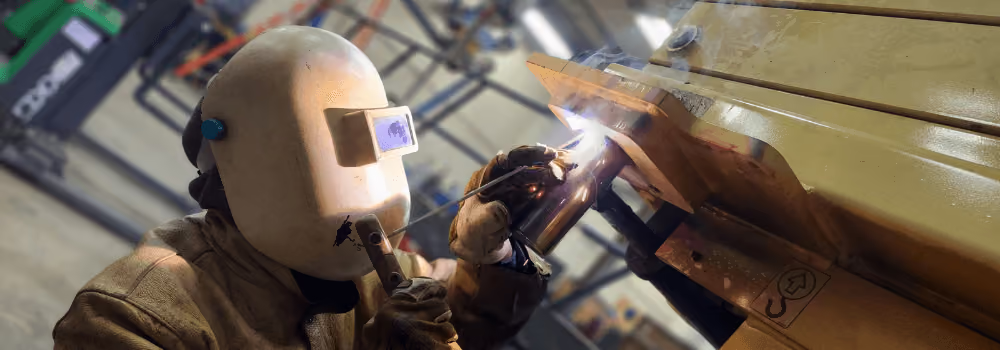






































%20-%20thumbnail.avif)


%20-%20thumbnail.avif)

%20-%20thumbnail.avif)

.avif)



%20-%20thumbnail.avif)