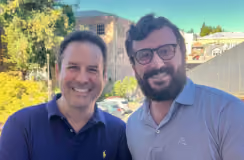
Host: Foreign. Welcome to Acquiring Minds, a podcast about buying businesses. My name is Will Smith. Acquiring an existing business is an awesome opportunity for many entrepreneurs. And on this podcast I talk to the people who do it. Harvard Business School ran their annual ETA conference last weekend, December 5th. This is one of the leading conferences for acquisition entrepreneurship in the world. And my guest today is an organizer of it. Michael Ledecky is one of the co presidents of the ETA Club at hbs and he came on for a quick episode to share some of the takeaways from this year's conference. Here he is, Michael Ledecky. Michael Ledecky, thank you for joining me this Friday afternoon on Acquiring Minds. You are a hbs, a Harvard Business School student. You're actually in the throes of midterms, so thank you very much for carving out some time to talk to me today. You're also one of the co presidents of the Entrepreneurship through Acquisition club at hbs, the ETA Club. And in that capacity you are one of the key planners of the annual conference that the ETA club puts on. HBS's ETA conference. It's one of the biggest, if not the biggest acquisition entrepreneurship conferences in the world probably. And so. And it just happened, it happened last weekend. There's a few events, but the main event is all day Sunday. It's panel after panel after panel. Amazing speakers, lots of recognizable names. And so I wanted to have you on and just have you share some of your and your colleagues and other attendees, observations, thoughts, takeaways from the this event which happened five days ago. So before we get into that, Michael, just give me, give me a minute on yourself. Yeah. And what interests you? What got you interested in eta such that you're one of the co presidents of the club at Harvard.
Guest: Thanks for the intro, Will. We're excited about how the conference went this year. We love the engagement from the panelists, the moderators and the attendees. It was fun to see some people on the. In the happy hour before the event and then online for our main event. Yeah. As far as my interest in eta, I started learning about ETA around the time I got into HBS in March 2020, beginning of the pandemic. Didn't have much to do. Curled up in a corner read how to how to Buy a Small Business by Richard Yudkoff and by Royce Yudkoff and Rick Ruback who teach at HBS. This one. And that's the one HBR's guide to buying a Small Business. So that got me started thinking about it. Love the idea of having real Ownership in a company from a young age, being able to be at that intersection of operating and investing and capital allocation at such a early point in my career and chance to own and build enduring businesses. And I think it kind of connected with my family story as well. My grandpa owned and operated an industrial manufacturing company in the Czech Republic and my uncle started his career buying family owned office supply businesses and turning it into a large publicly traded company called US Office Products in the 1990s.
[3:34] Host: And you had an internship at Pacific Lake, which is a big name in the search fund world. Tell us just a bit about Pacific Lake for people who aren't familiar with brand.
Guest: For sure, Pacific Lake is one of the larger institutional search fund investors in the space. They typically take up 20 to 30% of cap table for a search fund for a searcher and that searcher would typically take on 10 to 15 other investors. And Pacific Lake is interested in vertical software and healthcare companies. They're interested in enduring businesses and have great leadership. With Coley Andrews and Jim Southern at the head of the partnership, Kevin Oxendine is also a general partner. And Chris Hendrickson, it could go down the line. A bunch of great crew at Pacific Lake. Very collaborative, which is not surprising. This is a very collaborative ecosystem. But top class at Pacific Lake.
Host: And tell us a little bit, Michael, about the ETA club at hbs. So I'm just so curious how many people are in it for one thing.
Guest: Yeah, we have about 150 members. And I feel like we get a little bit of a bump in the second year as students start taking the Financial Management of Small Firms class taught by Rick and Morris. And people become more familiar with the space. But I feel like we've been growing each year and there is always more and more energy on campus when it comes to eta.
Host: That class that you just referred to. So is that. Is there no like strictly like acquisition, entrepreneurship or search fund class? Is that kind of the closest thing to a class at HBS around buying a small business?
Guest: No, I feel like I'm giving Jason Pananos and Jay Davis short shrift here too because they actually just created a field course around ETA focused on operating search acquired businesses in the second semester. And Rick and Royce also have a field course that's very much focused on the tactics around searching, but they use that gateway financial management of small firms to get folks acquainted with the model. And I think every year you'll see people at HBS take that course and go down the search path after that.
[6:13] Host: Great, Michael. So why don't you Take us through some of these observations. What's your first takeaway from Friday's conference?
Guest: Think first takeaway would be focused on finding a good business in a great industry. And that's a direct quote from Pacific Lake GP Kevin Oxendine. He was on our industry thesis think tank with Tiffany Clay Augustine, Alex Gelman, Neil Jacobs and Scott Alderman. And I think every investor on that panel spoke about the importance of recurring revenue and sticky customers. Pacific Lake applies their four plus one model to invest from four plus one model. Four plus one model. Yes. So that, that involves looking at, look at the industries tam look at market growth. Typically want to see market growing at 2 times GDP so like 6, 6%. To what extent is the service that company is offering penetrated within the market? So think about software replacing paper based services and kind of the adoption curve that that industry is seeing right now.
Host: So you want low penetration, you want
Guest: low penetration and on top of that you want something that's highly critical. So looking at criticality, something that is needed for that company to operate, for that customer to operate. And then the plus one is business model. Pacific Lake is very comfortable with software deals and more generally recurring revenue or reoccurring revenue is what investors look at. One of the interesting things that came out of that panel with those great investors was Tiffany asked the investors, if you were making your PPM today, which three industries would you select?
Host: Yeah, what were some of the industries that people cited?
Guest: Yeah, I think Neil Jacobs gave the three. Gave three pretty interesting ones. First one was elder care. Second one was insurance technology and the third one was med spas, elder care,
Host: insurance technology and med spas. Okay. Elder care speaks for itself. The other two are a little less known to me. Insurance technology is enabling insurance providers, I assume with SaaS products, cloud products. I assume that seems very niche.
Guest: That's right.
Host: But again, I don't know anything about the industry. And then, and then med spas, like what, what does that, what does that mean exactly.
Guest: So med spas provide services like Botox and skin therapies and spa like services, but they can have a medical or invasive component to them. I think in general search fund investors are interested in medical practice consolidations or acquisitions that involve a service that does not need to be provided by a physician. Specifically in the med spa space, I think Neil sees some strong tailwinds. The sector itself is growing by double digits right now in the US you're seeing young people really take to med spas. I think the first average age of the first botox treatment. Neil didn't say this, but I looked it up before and I think it's in the 20s. So you're getting these customers pretty young and then they're, they're typically rescheduling or they're scheduling new appointments at, at the site. So it's, it's not recurring revenue, but it's very, very reoccurring, sticky revenue with customers.
[10:06] Host: I didn't realize that people in the 20s were getting Botox.
Guest: I'm not. You don't have to worry about me, Will. Yeah, I'm happy with my wrinkles as a 27 year old, but I think. Yeah. He also cited mostly cash pay. That's another attractive element of it. Great. Unit economics in private equity has been slower to focus in the space. So private equity is not there yet, but it could be there eventually.
Host: And so for a searcher, that's good because private equity often represents the exit for the searcher. So the searchers get there first, build up a company, maybe do multiple acquisitions and then private equity, if private equity is kind of late to that industry, there you are having bought a business or two or three, grown a business or two or three, and private equity is now looking to acquire in that space and you're perfectly positioned. Is that the chronology?
Guest: That's right. And that's a dream sequence for a lot of search fund investors. I think search fund investors are also coming around to the idea that maybe they're selling these companies too early and there could be opportunities to recapitalize in other ways and promote and structure deals to promote longer term holds. But I think a typical model you see out there is buy the company, build and grow it for five to seven years and build it to a scale in which it is attractive to a private equity acquirer. One area that we were able to highlight this conference, which I think is a very important one, is the importance of mental health in search. So we actually had a panel with some searchers to discuss their experience searching and operating and how that intersected with their mental health. I think Steve DeVitkos had some particularly profound things to say on the topic.
[12:07] Host: And I know Acquiring Minds.
Guest: Guess he's an Acquiring Minds guest. Remind me what he said about Steve.
Host: Steve could not have been more emphatic and unapologetic about how much he hated, I mean his word, hated searching. The process of searching, once he found his business and got into being CEO, it was, it was challenging but fulfilling and great outcome. So all was well there. But I mean, it was to the point where the episode with Steve David Coast. I called from search misery to CEO. I mean, it was a really a miserable process for him and it was very, I mean, because it was very lonely. You're getting no feedback. Uh, you don't, you know, until you actually have acquired the business, you don't, you know, it could go always, you know, you could end with nothing. Very binary outcome. So it is incredibly nerve wracking, as he said, particularly for somebody like him who had been academically inclined, had a very kind of prestigious resume and had always had lots of signals of feedback throughout his career. And then all of a sudden he felt like he was floating. Another direct quote. Anyway, so I can imagine he would have been a great panelist for this,
Guest: for this talk for sure. You know, there's so much rejection that goes into the search. The feedback loops are so long and you need to find ways to balance yourself and to make yourself happy and do things that make yourself happy as you're searching. Paul Thompson was another searcher on the panel. He has a great summary of his search on Jim Sharp's blog called the Search Fund Manifesto.
Host: Manifesto.
Guest: On Paul's Search Fund Manifesto. Yep. And he highlights some of the things he did. He would go to volunteer with children who had cerebral palsy. And he would also kind of pressure test whatever he was looking at by looking at other jobs and asking himself, would I be happier taking this job as opposed to being the CEO of a company. And I think that put things in perspective for him. But he's a character. He runs a great insurance agency business and still owns it after more than a decade in it. And then another one of our panelists, a more challenging story. He entered Chapter 11 bankruptcy after acquiring a company in a three year search. It took him three years to acquire the company. But I really appreciated him just kind of opening up, telling that story and still having an incredibly positive attitude and continuing to operate the business. And I think he's going to have great success.
[15:11] Host: Yeah. So two years is kind of what people schedule for a traditional search and two years at the outside. So you want it to be less than two years. So imagine taking three years to find the company and then in short order facing bankruptcy within this company that's taken you so long to identify and acquire. I mean, that must have been just brutal. So awesome that he's pulled it out still in the business. What's the next takeaway from the conference?
Guest: We had the chance to highlight some really awesome women in search and I think what we're seeing is that more and more Women are searching. According to Jim Sharp, 23% of searchers are women now. So we obviously have a long way to go to get to 50 50. But we had an awesome keynote speaker who's I think an amazing example to all searchers. Her name's Ty Lee.
Host: Ty Lee. Okay, what's Ty Lee's story?
Guest: Ty Lee acquired a small IT business in 1989 with her husband for about a million dollars. And she is still operating that company. It's now called SHI International and it's one of the largest IT software resellers and service providers in the country. It's a $10 billion business and she's the wealthiest, well, fifth wealthiest self made woman in America. I was going to say wealthiest Korean American woman in America. I'm pretty sure, yeah. First Korean American graduate of Harvard Business School. So big, big win for HBS there. But she, she spoke to us at the end of the conference and really appreciated getting her take on how she grew and held this business and the power of compounding and holding onto a business that long and not selling. It takes some gumption to retained that much of a business that's growing that quickly. But we asked her why she hasn't sold and she said what else would I do with my time? She loves the operating part. She's a consummate operator but she is amazing example of hard work and determination and acquisition, entrepreneurship. Acquisition, entrepreneurship. Very much American dream. Acquisition, entrepreneurship. I think we talk a lot about assuring and other outsized outcomes on the traditional search fund investing side. But this is another example kind of hidden in plain sight. That is not one that a lot of searchers think about or have heard about.
[18:20] Host: Yeah, I hadn't heard of Ty Lee, but I'm on a Wikipedia page here and it's an amazing story. And to acquire a million dollar business in 1989, I mean she obviously appreciated the value of acquisition entrepreneurship but it probably didn't even have a name back then and searching or search funds probably weren't a thing. So insightful on her part to go that path, I guess. I mean I don't know her story but I imagine in 1989 things were very different. So that's super cool. And she owns it to this day and it looks like her. According to Wikipedia, she's become a billionaire through all of this. So prospective searchers take note.
Guest: She's doing all right for herself and still working hard in the business. I think she now has a little bit more perspective too on trying to find balance. She talked a lot about Prioritizing her personal health as well. And I think that kind of connected to the mental health panel in a good way. But she also had a plan too, which is cool. She thinks of her life in tenure plans and she planned to buy a business when she turned 30 and she very much constructed her education and her first jobs out of school as a way to prepare herself for entrepreneurship. So I thought it was cool. The power of long term planning and the power of long term perspective, and that's another thing I think that's kind of underappreciated in this space. I think a lot of folks think about the short term, what will my life look like in five to seven years once I sell this company. But she's built something that's compounded over multiple decades into something pretty incredible.
Host: I would have loved to see that talk. I don't think any of this was any of the conference was recorded. Am I, am I right, Michael?
Guest: That's right. We. There were a couple of presenters who asked to record it for their own private use so you could maybe reach out to them directly. But we did not. We did not.
Host: So I have to email Tylee the billionaire and ask her.
Guest: I don't know. We didn't record Ty's session at all, unfortunately. I think Jim Sharp recorded some of his sessions. But we're hoping that next year, by the way, will be in person. So I'm hoping that people will get to experience it on campus next year. Although it's been great these last two years in terms of being able to cast a little bit of a wider net on the online platform. So thankful for that.
[21:00] Host: Quick aside on that point, actually. So just to give people a sense, there was some Friday afternoon panels, a small handful, and then there was the all day Sunday event. But then there was also an in person happy hour. Right. Was that, what is that Friday night or Saturday night?
Guest: That was Saturday night. It was just in Harvard Square and it was amazing to see people from across the community, many of whom I never met, people that flew in just for the happy hour and the opportunity to meet with people and sidebar conversations around the event as well.
Host: But we, I think that's a testament to an event where, where the event is online. It's a zoom virtual event. And yet you still have dozens of people who fly in just for the, the happy hour attached to the zoom of it.
Guest: I think it's, you know, I think this is a community that really enjoys meeting each other and collaborating. And we just somehow lucked into having the flagship event in the space and we want to keep it that way. But it's, it's, it's been great.
Host: How many people were at this happy hour?
Guest: We had about 150.
Host: 150 people? Yeah. Happy hour?
Guest: Yeah, yeah.
Host: And a lot of you rented out
Guest: the entire basement of the bar. So we had the entire floor to ourselves.
Host: And what percentage, I mean if you, you know, roughly if you had to say were local versus people who flew in.
Guest: I was trying to guesstimate that. I think I told you 50, 50 in the pre chat. Maybe 60, 60 to 70 were local if I had to guess. But strong presence from outside the Boston
Host: area or back to the conference content. What's your next takeaway?
Guest: My next takeaway would be that there are just many ways to win. We're seeing a lot of capital flowing into the space. Obviously searchers can raise a traditional fund in a week or less and they can be very thoughtful about choosing the right investors who are aligned with them. And searchers now have the chance to consider other non traditional models like holding companies. Long Term Capital Saw examples like Trish Higgins from Chenmark who has a permanent equity play in home services, the home services space. Seeing Andrew Saltoon, an exited searcher. He's investing in a combination of franchise brands now and vertical software. Just seeing so many ways to win in terms of self funded deals, traditional accelerators. We had some interesting panelists on the accelerator side from SFA and Broadtree. So it's interesting. Just so much going on in terms of new people coming into the space. You're seeing MBAs from outside Harvard and Stanford getting very involved, which is fantastic. MBA programs are devoting more resources to the space. Business school students are more educated about what searching is and how to do it and what options are available to them.
[24:32] Host: Michael, just speaking of kind of diversity of options and how that's ever expanding, just one thing I want to ask you directly since you're at hbs, I think I understand. But so between HBS and Stanford, GSB Graduate School of Business. GSB is the school. Stanford is the school where the traditional search fund is really kind of taught. And many people coming out of Stanford MBAs do a traditional search versus Harvard where it's. There's traditional but there's also self funded. And that's a little bit of a philosophical tension, if you will, between the two schools. Or am I overplaying it? Do I have this right? Talk to me about, elaborate on that for me.
Guest: Yeah, I think have it generally right. I think Stanford is very heavily on the traditional side, it's unusual to see a self funded searcher coming out of the gsb, but there are plenty of exceptions. You interviewed Chris Williams the other day and he did a self funded search after graduating gsb. I think it boils down to kind of the way search is taught at the two schools. Stanford kind of claims Irv Grousbeck as the founder of the traditional search. I think he taught at both HBS and Stanford, but he really developed the traditional search model at Stanford, invested behind Pacific Lake's Jim Southern as one of his first search investments. So I think that model is also just very intertwined with the startup culture of Silicon Valley and comfort around software deals and the necessity to have that committed capital in order to do those types of software deals. And then on the HBS side I think you see, I think it's kind of 5050 at this point. But Rick and Royce are a bit more comfortable with self funded deals or deals that fit the profile of a self funded search. They also invest in traditional deals or they have a vehicle in which they are the sole investor in a few searchers that they select each year.
Host: Self funded, not traditional.
[27:03] Guest: I don't want to speak out of turn on to what their terms are. I think in some cases they might fund the searcher as they go finding the company, but the terms look a little bit different in terms of the carry and the eight and a third, eight and a third, eight and a third model. I'm not sure they go toward that, but I think they. Yeah, you see Jim Sharp is very much in the. He also teaches and is an entrepreneur in residence at HBS and he's very much on the self funded side and waves the flag for that. But he invests in traditional searches. But I think there's a trade off between alignment between one side you have on the traditional side. You think about the alignment between investors and searchers and searcher might feel pressured to sell in five to seven years depending on the portfolio return. A self funded searcher on the other hand could have less pressure and hold a company for the longer term. Different models and different ways of going about the search.
Host: Right. Well, and when you say that there's multiple ways to win, it just seems that that's appropriate for Harvard for HBS's ETA conference to hear kind of this. There's more of a rainbow of options. If Stanford kind of is more committed to the traditional search, which is a little bit more of or maybe a lot more rigid of a model.
Guest: Yeah, we were pretty intentional about Finding people that represented all the different types of search and put them in conversation with each other. And there are some interesting things that came out of those conversations.
Host: All right, so I think you had one more point, Michael, or one more takeaway from the conference. So what was that?
Guest: I think just generally speaking, there's a lot of optimism around opportunities for searchers, but there's also uncertainty. Jim Sharp gave a great presentation on the myths of search. And in it he kind of discussed his expectations for 2021 versus reality. And what he found was a lot of searchers, a lot of sellers were waiting to sell because they hadn't fully rebounded from COVID and to see more of a recovery before selling. And that could lead to a bulge of opportunities in 2022 and 2023. But it's kind of unpredictable at this point. I think it depends a lot on the recovery and other factors driving sellers. But I think his prediction is that we'll see a lot of interesting deals come to market in 22 and 23.
[30:11] Host: And just so people know, Jim Tharp, I mean, Jim Sharp, sorry, he's at hbs, but he's also known beyond the grounds of Harvard for his blog. Right.
Guest: He has a fantastic blog. He was the plugged up blog. The, the. The Jim. Jim SteinSharp.com I think is the blog, the OG Acquisition Entrepreneurship Blog. You're. You're giving him a little bit of competition now, Will. You should have him on. It would be great to have. Yeah, conversation. But he's prolific. Prolific in the content that he puts out and the things that he does for the HBS community. I mean, between Rick and Royce and Ham, I think he's inspired. They've inspired tens, dozens and dozens of searchers who would not have otherwise gone out to acquire a company. So, yeah, we owe him a great dad in terms of what he does to moderate panels and connect with investors and searchers and provide us with examples and thoughts on search.
Host: As I recall, his blog is less on the frequency and more on the depth. So long form, thoughtful essays really around acquisition entrepreneurship. Am I right about that?
Guest: That's right. He goes deep into the weeds on acquiring and also operating. He's very much an operator. He saw great success with his company and as many, has seen many searchers and has guided many searchers through their operating experiences. So a lot of wisdom in that blog. Highly recommend. I guess we've probably mentioned it a few times over the course of this podcast, but a lot of great content.
Host: So for next year, tell people a little Bit just about what to expect from the conference. I guess you're hoping for it to be in person next year. You're hoping but don't know yet?
Guest: We're hoping, yeah, we'll be. Yeah. We're at the mercy of Harvard and HBS on bringing guests to campus. HBS has been starting to bring guests to campus, but it's been under limited circumstances. We didn't want to risk bringing 650 people on campus which is the second most that we had to last year. We had about 800 signups last year in the thick of the pandemic. So I think probably people had other things to do than sit on a video conference last weekend. But we were happy with our numbers. Who knows what the numbers will look like in person. I think last time we had it in person we brought about somewhere between 300 and 400 people on campus.
[33:10] Host: Okay.
Guest: But yeah, we're seeing. It seems like we're drawing from a increasingly larger pool on the conference and it's been exciting to.
Host: And would you say that that's a goal? So I don't necessarily need to be somebody who is a business school grad myself to get value from, from attending the, the conference. So if I'm kind of a, an independent searcher, you know, from, from wherever. Yeah, this is, this is something that I should feel like.
Guest: You're welcome. Yeah, we, we're excited about mid career searchers again. Jim Sharp is, is also very much on the mid career searcher trainees promoted that as an aspect of searching and I think I really enjoyed talking to some of the mid career searchers that just showed up at our happy hour. There was one guy who was in the military actually and is now searching locally and we must have chatted for 20 minutes and it was one of the more inspirational conversations that I had at that conference. So yeah, I appreciated the time I got to spend with him and some of the other self funded searchers who bring in a very different perspective than the MBAs.
Host: Well, it sounds like it's a really a great cross section of people who come. So assuming it's in person next year I'll be in that crowd. Michael, thanks a lot for coming in on short notice and doing this. This is great. Since I couldn't come to the conference myself and probably many of my listeners didn't weren't there or weren't attending virtually, they'll get a lot of benefit from this. So thanks for taking a break from midterms midterms and hopping on Zoom with me. This is awesome.
Guest: We'll get a much better overview of what happened if you actually go to the conference next year. But thanks. Thanks for this opportunity to talk with you, Will. It's been so much fun consuming your content and seeing you grow, acquiring minds.
Host: Appreciate it. Thanks, Michael. Till next time.
Guest: Thanks. Welcome.




























































%20-%20thumbnail.avif)





%20-%20thumbnail.avif)


%20-%20thumbnail.avif)

.avif)




%20-%20thumbnail.avif)