Host: $150,000 in SDE. Would you even look twice at such a business? Scott Walton and his partner did and they bought it, and another at around the same time that was doing 250,000 in SDE. So the combined SDE of both acquisitions is below the threshold that many searchers would even consider. And yet Scott doubled the businesses in 2023 in and is gunning to double them again this year, which would mean $10 million in revenue and well over $1 million of profit going into 2025. And much more of that profit will go directly to Scott as owner versus servicing debt had they bought a $1 million SDE business right out of the gate. One of the benefits of buying small is that you pay far less for the initial acquisition, meaning far less debt service, Meaning if you can grow into the desired $1 million of profit and beyond, you keep a lot more of that profit a lot sooner. Today's interview with Scott is how you might do just that. Some topics today Hiring a president so you can step out of the business Scott was very much in the business at first. Today his time is mostly devoted to strategic projects, improving culture and introducing KPIs at a blue collar business. How they solved hiring by creating a full pipeline of blue collar talent how they finance these deals without the SBA there in Canada. How Scott gets very personal with sellers to arrive at a successful negotiation and migrating from tech to the trades. A dense and fascinating episode today. Please enjoy. Here's Scott Walton, co owner of Matrix Mechanical. Welcome to Acquiring Minds, a podcast about buying businesses. My name is Will Smith. Acquiring an existing business is an awesome opportunity for many entrepreneurs and on this podcast I talk to the people who do it. Most business buyers acquire their target company using an asset purchase, which means that you've got a brand new legal entity that needs to be ready on day one to properly employ your new team. Payroll HR documents, tax accounts, workers comp benefit plans like medical and 401k. You need to make sure all of that is transferred or set up on day one. Aspen HR understands this challenge and the delicate timing that searchers have to juggle. Led by a successful former searcher, Mark Sinatra, Aspen HR can assist searchers to ensure a seamless transition for the employees. If you are structuring an asset purchase, contact Aspen HR for a free consultation. They'll walk you through their proprietary checklist for asset purchases that assesses your readiness for HR payroll and benefits. Check out aspenhr.com or contact Mark directly at markspenhr.com Scott Walton welcome to acquiring minds.
[3:26] Guest: Thank you for having me.
Host: Scott, you bought two businesses, quite small businesses, but you doubled the revenue of the portfolio and are aiming to double it again this year, 2024. So hopefully going into 2025, you have a $10 million revenue business that will serve as a platform for further growth in acquisitions, I assume.
Guest: Yes.
Host: Let's hear how you're doing it. Start us off, Scott, with some background on you, please.
Guest: Sure. Great. So I live in Saint John, New Brunswick. It's an eastern province in Canada that borders with Maine. Was born and raised here, lived throughout North America growing up and ended back here for university once I finished school. It was 0809. Not a lot of people were hiring, so I ended up starting a material science company. We raised about 7 million in angel investment, venture capital and other types of funding. We had trouble scaling the technology, so we ended up winding that down about three or four years into it. After that, I did some consulting for some other tech companies, helping them raise money, do commercialization, planning, et cetera, and. And then eventually co founded a digital twin company with three other people. And we grew that. Also raised some VC funding for it as well, and then ended up with eight figure exit to our largest customer, which was a mix of cash and stock. And everyone was happy with how that went. We sold to one of the fastest growing companies in the world. So Juul Labs, who does the vape hardware. So we sold to them because there was a lot of value in us being able to simulate their device before they actually built them. So we sped up their product development process quite significantly. Yeah.
Host: And the exit for you guys, eight figures sounds like a lot. You said it was in stock. So is this life changing? Are you. Can you retire? I mean, I mean, tell me the number if you can and if you can't give give us at least a directional sense of how this changed your network.
Guest: Sure, yeah. I mean all the founders, like we, we became millionaires. So for all of us it was definitely life changing. I would say it wasn't the pinnacle exit we were all hoping for, and it would have been had the company not gone through some regulatory hurdles that impacted their. Their share price. But it definitely changed all of our lives in a very positive way. So very grateful for that.
[6:09] Host: Well, congratulations. Thank you. I know where my questions are going to be heading. How did we get into plumbing from here? But keep going. Maybe you'll answer for me.
Guest: Sure. So I'm a big believer in learning from others and I've been part of business owner groups and Entrepreneur forums for the past 14 years. And in one of the forums one of my forum mates and I had always talked about doing business together and we after our exit and we were doing our earn out, we just had more conversations about that vision and what that would look like and then we said okay, let's start looking at if, if there's some businesses out there for sale, let's start searching properly and, and see if we can buy one. And so we were able to find two small trades companies here in St. John that we were for sale privately. And we went through that process, we purchased them and then we put them together and launched a new singular brand.
Host: Okay, well you just skipped to about 45 minutes into our interview here Scott, so I'm slowing you down. I missed the part where you decide to buy a business. What was the, the exposure to this? I think it was E.O. you told me in the pre call. What was the pitch? Why did it resonate with you especially somebody who basically had pretty good success in tech and exit and it sounds like your whole career had been in tech. So what did this friend, colleague of yours say that was so convincing about buying small businesses?
Guest: I think we both recognize a few things. One, startups are very difficult and it takes many years before you can even start to become profitable or even generate revenue in some cases. The second is that we're just coming out of COVID and it really changed our perspective on what a critical business was because there was a big jump in SaaS user base but then there was a big drop after Covid and then there's a lot of other businesses that just didn't survive or barely survived. But the one that stuck out to us was the trades and we figured if we're going to start anywhere, we might as well pick a recession virus proof type business to, to go with and, and something that's going to be around for a very long time and get our feet wet there and then see where it takes us. And then the third piece is, is really just recognizing the, the silver wave of retirees coming and, and that the next generation, it seems less apt to kind of take the reins of, of those businesses. They, they seem a bit more risk averse and so you know that coupled with the Walker die kind of buy then build philosophy, it just resonated with both of us.
Host: Great. Okay. All right, so how does your, what is your search so sorry, first of all, are you partnering with this person or is this was just the person who introduced you to the idea and you ran with yourself.
[9:11] Guest: We're 5050 partners.
Host: So this person Neo, who exposed you to the concept then became your partner. You're 5050 with.
Guest: Yes.
Host: Great. Okay, so tell me what your search, your, in this partner's search looked like when she decided to set out.
Guest: Yeah, we really went through a lot of connectors. So owners of finance brokerages, mortgage brokerages, insurance brokerages. We talked to owners of accounting firms, law firms, people that would do business valuations and fundraising for businesses, basically anyone that was connected to owners of companies. We really found a lot of good leads through wealth managers because they're typically touching base with business owners every quarter to get a pulse on like where's your head at when it comes to succession? Is there any major changes coming in your life? And so they usually have a heads up on when someone is eventually going to sell
Host: and that person will share that information with you. I would assume that wealth managers would be tightly guarded with those contacts.
Guest: The way I like to approach it is first you need to sell them on yourself because they're again like they're not going to risk their credibility with their clients over some Yahoo that wants to buy business but isn't actually ready to. So you need to sell them on what your vision is, what you're looking for. Define what the criteria is and you need to paint that picture a little bit and just say, look like if you're comfortable, if you think any of your clients fit this criteria, if you don't mind, have a conversation with them and then if they're open to it, we'd love to sit down and just have a coffee and get to know them.
Host: Yeah, yeah. And I guess also there is a, an incentive for the wealth manager because if their client then has an exit to you, there's that much more wealth to manage the. And so you. That bore fruit.
Guest: Yep, yep.
Host: Is that where you found the two businesses?
Guest: Yes. Yep.
Host: Ah, okay. Yeah. Well, can you, can you, you just kind of told us in the abstract what it could look like. But tell us the ex conversation with a wealth manager that then led to conversations with these owners.
Guest: Yeah, we, we've done this, we've done this a few times. So essentially I would sit down and say look, here's our background. You know, we both have experience with exits and, and he had bought businesses before, so he had some experience there. And we'd say, you know, we're really interested in the trades. As an example we want to look at, to start off, companies that are between 100 and 500000 in EBITDA ideally companies that have a solid team and an ability to grow. And so then we'd say some of the things that we want to shy away from is any company that may have a, a customer concentration risk. So if they have like one major client that's 50% of revenue or it's a super low margin type of trade. So general construction as an example, we, we said we're not really interested in those. We're more interested in companies that either have a strong value add in the market because of the team that they have or some angle or have the potential to, to adopt that.
[12:29] Host: But. So you found a wealth manager. This wealth manager heard you out and then what, circled back around and said I got somebody. Or immediately in that first conversation with them said I got somebody.
Guest: So in any of these conversations it's almost always, let me take this away for a week and kind of think about it. There is the odd time where someone will say oh yeah, I got someone for you right away. There's also certain wealth managers at some banks they have a weekly deal meeting every Friday. So they sit down and they say, okay, we've got these clients, they're putting their hands up to sell. Who do we think could be good suitors to purchase them or how can we help them out? So yeah, that's why we like to just talk to everyone because sometimes they have private deal things like that.
Host: Interesting. I mean you'll hear talk to local accountants, talk to local attorneys. Ben Rizzo and I had a conversation about that a few episodes ago and it really worked for him. I, I'm not sure that I've heard, I may have heard it once or once before to talk to wealth managers. But yeah, that seems, it seems like another great service provider, local service provider. To, to get in with local. I said, so were these all local service providers? Were you, what was your geographic criteria?
Guest: Yeah, they're all local service providers. The, the challenge I find with lawyers or accountants is they're, they're very utilitarian when it comes to them. So they're only coming to them when they're looking to execute something. It's not like they're going to sit down and say, at least I haven't found that, that, that they're going to go to them very early in the, in the personal mindset like of I'm thinking about selling. Whereas with the wealth managers they seem to, to, to be a little bit. And I think it's the wealth managers, they do a good job of just asking those deeper Questions like what are you thinking? Coming up, any changes happening in your life that I need to be aware of and we need to start planning
Host: for so that's a great point. That's a great point. Yeah. Attorneys and, and accountants serve sort of tactical needs, whereas the wealth manager is kind of the strategic supposed to be supposedly they're, they would say their value prop is as kind of a strategic confidant. Great insight there. What do the following Acquiring Minds guests all have in common? Doug Johns, Mo Morley Desai, Tim Erickson, Chirag Shah, Shane Ursam. They all went through the Acquisition Lab, the accelerator in community for people serious about buying a business. But they represent just a sliver of the lab's success stories. The number of deals across the lab's cohorts now stands at over 120 with over $300 million in aggregate transaction value. The Acquisition Lab was founded by Walker Deibel, author of Buy Then Build, the book that introduced so many of you to the very idea of buying a business. The lab offers a month long, intensive, almost daily Q and A sessions with advisors, live deal reviews with Walker, deal team introductions and an active community of serious searchers. Check out acquisitionlab.com link in the notes or email the lab's co founder, Chelsea Wood. Chelsea buy then build.com now 100 to 500 in EBITDA. Ultimately that is the range where you bought but that, but you know, my guess, when they buy that small, it's often because that's, you know, they kind of, it's all they could find or a deal, they stumbled upon a deal that they liked despite the fact that it had really low EBITDAR sde. But they rarely go out looking for something that low 100 to 500. So what was your thinking there?
[16:19] Guest: Again like we just, we wanted to kind of dip our toe in the water a little bit and, and go with something. Again like I, I view those transactions as very risky personally. If one person leaves, that can potentially be like 10% of your, of your business in some cases.
Host: So try, try 33% of your business. I mean a business that small, yeah,
Guest: but yeah, so yeah, so I, I, I don't advocate it for everyone but for us we knew that the trades was a relatively safe space. We, we'd done some asking around about the brands and we knew that a lot of the other trades had a lot of respect for these two brands in particular. So and I, and I had a best friend who worked for one of them early in his career. So we, we had some like confidence in in each of those on the, on the brand side. But we certainly knew that there would be risks stepping into those.
Host: Right. Well, but you're now talking about the business that you found, which we're going to hear about in just a second. But I'm, I'm just curious that even before you saw this particular business, you were willing to buy a business of a hundred thousand of sde?
Guest: Yeah.
Host: And that's basically because you were willing, you were willing to absorb that risk because basically you're new at this. You're, you're trying this, your personal balance sheet. Basically you can tolerate more risk than maybe a lot of my listeners probably. So was, was that it? Like a business with $100,000 of SD is. That's so small? That's almost, that's almost like the next. I mean. Yeah. Like from one year to the next there be. There might be no profit.
Guest: Right. Yeah. I think the other aspect was our general vision. We saw an opportunity very early on to develop a one stop shop for mechanical services. So we would, we knew we'd be purchasing multiple brands and that there'd be some scale there. So that gave us comfort as well.
[18:15] Host: Okay. Okay. So you grow out of it. The idea was that you, you know, this would just, just a tow, a toehold that you'd quickly grow out of, which in fact you have done.
Guest: Okay.
Host: All right, Scott, so let's hear about more about these acquisitions then you keep referring to them collectively. Were they the same owner? Did they just come in rapid succession or what?
Guest: Different owners, but the process overlapped. So one was a company called Easy Gas, it was a heating server, it is a heating services business. It was a small team, like four or five people, classic owner operator business. And then the other one, very similar but a little bit bigger. It's called George Freeze Plumbing. And it was about eight to 10 people depending on the, the time of the year. And yeah, they're Both founded about 30 years ago here in St. John.
Host: Both 30 year old companies. Great. What is heating services exactly?
Guest: So it would be working on boilers, furnaces, air handler units, like any type of heating equipment other than oil. They don't deal with oil, but natural
Host: gas, propane, and that doesn't. But different from H Vac?
Guest: Yes. Yeah.
Host: And, and why would they just be clear here about the niche? Why don't you compete with H Vac providers?
Guest: We eventually built an H Vac team just last year, but you need refrigeration techs on staff to be able to do that. And, and they had tried in the past to recruit some, but they. They weren't successful, so they just didn't have anyone on staff that could work with refrigeration.
Host: And by refrigeration, you mean air conditioning.
Guest: Yeah.
Host: And please forgive the obnoxious American Canada is cold joke, but is the IDE idea that in Canada you can get away with just the H of H vac business like you? I mean, I assume H vac businesses evolve the way they did because they to. To be seasonal. So you got business in the winter and you got business in the summer. But maybe Canada's cold enough, you can just provide the H of H Vac and get away with it. Is that.
Guest: Yeah, it's not Florida here, so we definitely have more pronounced seasons, but it is. H Vac has taken off a lot in the past five years because of federal mandates around energy efficiency and sustainability. So because these. The heat pumps now can go down to minus 30 degrees, a lot of people are starting to displace a lot of their main heating equipment with heat pumps.
Host: So acquisition number one was the heating services business. Tell us the, if you would, the revenue, the ste. And then let's get into the deal. So what was the revenue?
Guest: Sure. So revenue on average was a million dollars. The SDE was 150,000 and the purchase price was 450,000.
[21:09] Host: Great. Okay. 150. There you go. Just above your threshold there. So 450. So a 3x multiple. I would think that you might be able to drive a little bit lower price for such a small business.
Guest: Yes. Yeah. Knowing what we know now and negotiating more deals. Yes.
Host: Because 150,000 of SDE. I'm sorry to hammer on this, Scott, but it's just. It's so counter to what we're taught on this podcast. And I'm good. So then we'll. We'll really talk about buying small in the abstract here in a little bit. But it, you know, it. That's so small that it's almost like that owner might have just shut the business down when he was time to retire sort of thing. Yeah, you're nodding. So. So in retrospect, you feel like you could have. You could have driven a much harder bargain.
Guest: Yeah, like knowing what I know now and. But I mean, now I understand how to recruit in the space, how to attract top talent. I would go out and just build a team and start a new brand. However, like, back then, it would have been very difficult to build that team not knowing what I know now.
Host: Yeah.
Guest: So it wouldn't have Been as straightforward as, I'll just put up some job ads for some gas technicians and we're off to the races. It's a pretty competitive market here, so.
Host: Well, and you had said that you were also buying goodwill or reputation and this business had that. So that's something that takes years to build and is hard to quantify, but valuable.
Guest: Yeah. And one other angle that they had in the market is that they're the only certified gas technician service provider for the utility in our city. So all their service calls come to us first. So that's certainly an advantage that we really liked.
Host: That's a great channel that you got a great relationship. Okay. And what did the term, what does terms of a deal like this look like? I want to spend some time here because no SBA in Canada, so always interesting to hear how people do it without the sba.
Guest: Yeah. So we did half bank financing and half vendor take back or seller financing as you might call it. Yeah. And we did a five year amortization on both with a 10% down payment and 2 and a half percent interest
Host: on the seller note, vendor take back, everyone. As Scott said, that's Canadian for seller note, seller financing. The 50% bank. 50% seller, yeah. Wow. So the whole thing was financed, but then what was the 10% down?
Guest: It just came off of that total. So sorry, I should have said 90% of it was financed. 50. 50 between the bank and the seller. Yeah.
Host: Right. So 45. Yeah, yeah, 45 bank, 45. Seller, 10. You guys, that's great. Is that common in Canada? I actually, I should say I just aired my episode yesterday with Andrew Storter in Calgary who bought, who bought a furniture manufacturing business. And we also spent time on the terms of his deal where, how, where and how he raised capital and financing and he got great terms from Canadian banks, a number of them. It wasn't, he didn't just get lucky with a single bank. So, and I, and I basically say like, I'm wondering if the SBA for us Americans is as advantageous as we think or if in fact it's, it's maybe disadvantageous because we're not thinking open. We're not, we don't have as kind of the, as open minded an approach to this and really we should just be approaching banks without an sba, without assuming we're going to do the SBA and see what we can get. Because it sure seems like in Canada where search, you know, young guys and gals going out and buying blue collar businesses is probably less mature than Here, I would assume it's an assumption. And yet still, you're, you're getting great terms and receptivity from the banks. So what do you, what do you say?
[25:14] Guest: I mean, the, the first point goes back to what I was saying earlier. Like, you need to sell everyone, so you got to sell the connectors, you got to sell the seller, you got to sell the banks. So for us, we developed very strong relationships with the banks, as many as we could, the finance brokers. And anytime we have a deal that we're looking at, we go to all them. Even though there's one that is the clear winner in, in every single situation, we, we still go to all them because we don't know, you know, which bank likes this vertical, this size of deal. Like, they all shift their interest levels in different sectors and different sizes pretty frequently, especially after Covid, with everything going crazy with interest rates and inflation. So we found at the tail end of COVID banks became very aggressive to get money out because they're having a hard time getting lending out, at least in this area. So we found them great to work with. The first deal, the heating services deal, that's the only time we've ever not been offered 100% financing. And we, we, we negotiated three deals after these two. We walked from them, but we had discussion papers from the banks for 100% financing and all those cases as well. So I think it's a mix of, like, you got, you kind of got to paint the vision for where you want to go with this, that you can actually, you know, add value to this business and grow it. And, and that it's a, it's a safe bet for them.
Host: Sure. Well, actually, okay, so here I am talking about what, what great terms these are, and then you proceed to say that, in fact, they were the worst terms that you got across across the other deals that you've done or almost did. And you also kind of just neutralize the thing that I was going to follow up by saying, which is same with the same thing with Andrew Storter's deal, which is a lot of seller financing, which is, which is effectively kind of equity from their perspective. So if you got 50 or 45% seller financing, that's going to give a lot of comfort to banks. And, and, and so, so I don't mean to act like it's. That's very different than down here where we can just bring 10. The SBA enables us to just bring 10, 10 equity in a deal here. There's a lot more because of these big seller notes. Same with thing in Andrew's case there was I think a 35 seller note. That's what I was going to say. However, you just proceeded to tell me that in fact there weren't seller notes in these, in these other deals that you negotiated and you still got incredible offers by the banks.
[27:44] Guest: It wasn't that there wasn't seller notes, it was that I had the option for no seller note. So I should distinguish between what is a good deal and isn't a good deal. Like a good deal to me is I have the option to do the full thing in cash to the seller so I can drive the purchase price down, meaning and ideally the full amount in cash, not my cash, but the bank's cash. Like the best deal to me is where all the terms are on the seller, where it's a seller finance deal or even there's profit share built in there. Like all the risk is, is tied to them. Because typically I can get much better terms that way. So I just want to distinguish between those two.
Host: You could get much better terms from your lender, from the seller. Risk is on the cell from the seller.
Guest: Yep. Yeah. Like I can always structure their, their. Like if, if we're doing seller financing, I can typically get much better terms with the seller than I could with the bank in terms of the interest rate, interest only periods, amortization, clawbacks, things like that.
Host: Ah, that. I guess that's counterintuitive I think because if you can get a seller to agree to a lot of seller financing at all, again American perspective, if you can get them to agree to a lot of seller financing at all, it seems like they'd be then hesitant to give you even more, even better terms or lower interest rate or whatever it might be because they've already given a lot which is seller financing piece.
Guest: Yeah, it's all about how you frame it in the beginning, I find. Typically I'll sit down with the seller and the first thing I'll ask everyone is, do you have a structure in mind? Like have you contemplated how you want to do this? Because if they've already got something in their head that evaluator said or a broker said, you should do this and don't accept anything else. Well, it's going to be very hard to move them off that number or that structure. So I like to start there and then the second step is, is really just feeling out like where are their sensitivities, what do they actually care about? So I'll usually ask very early as soon as I feel like I have trust with them, I'll say, what do you want to do with this money? And it usually catches them off guard, but I'm like, no, like, okay, we close the deal, I'm cutting you a check for 450 grand. Like, what are you doing tomorrow? Like, are you vacationing? Are you buying a couple snowmobiles? Are you buying a house? Like what's going on here? And, and then I'll like, based on what they say, I'll start to kind of feel out where the sensitivities are around purchase price and the structure. Because if they tell me, well, I'm gonna take this and stick 90% of it into, you know, an indice fund or whatever and I'm just gonna set it and forget it. And you know, my wife and I are gonna travel maybe one more trip a year. Then it's like I can probably push them to give them more over time than up front versus if someone's like, well, I need to get out of debt because I, I put shareholder notes or I lent money into the company to float the operations. It's like, okay, they have a serious cash need and, and that's probably the bar I need to meet in terms of cash down on that business. So I like to figure out the sensitivities of all the levers very early in the process and then develop a little bit of a sandbox that helps me understand like if I'm going after seller financing, like I'm probably only going to get to this percentage of the deal and the same thing with cash and whatnot. And then the, the last piece is I'll usually offer more money for, for seller financing or profit share than I will for cash down at day one. So I'll give them a higher multiple.
[31:30] Host: Okay, well, and there, that addresses my confusion of a minute ago where I said I'm surprised you can get, usually if you get seller, a lot of seller financing, you have to give them better terms and in fact you, in some ways you, you do give them better terms if, if you hire basically higher price.
Guest: Yeah.
Host: Tell us the little, that example of one of your sellers who wanted to start a non profit.
Guest: Yeah, sure. So we had discussions with a company last year that he wanted a, an oversized valuation in, in our minds. But you know, he put a lot of work into the business and, and, and he did evaluation with his accountant and it worked out to be maybe six or seven times ebitda. And to us that was a very large valuation for, for the other Aspects of the business, like they, they had some challenges there. So we asked him, you know, what do you want to do with the money? And he said, well, I really want to start up this nonprofit. That's where my heart is. I want to bring people into the country and train them a new skill set. And that's what I really want to do. And so we said, okay, you want this oversized purchase price, we can do that. And we think we can do that in a way that gets you the full value you're looking for, but not necessarily in cash rate down on the day of close. So we said, you know, how about you consider taking a corporate sponsorship from us? And because we've done these tech startups before, we know all the people at the economic development agencies, we can help you leverage every dollar for three or four more dollars. And you know, all that put together, we can get you to the level of, well, we can get you even beyond the purchase price that you're looking for. So it was a way for him to access more money in a way more tax efficient manner and for us to improve the income statement and drive down our taxes because the corporate sponsorship would be on the expense line. So that was just a really good example of it probably would have been a deadlock with nine out of 10 buyers out there because it's like, oh, they're out to lunch. They want this six, seven times ebitda. It doesn't make sense. They might try around with a couple different levers and then walk away. But it was a case where you really had to approach it from a very creative angle to. Yeah, yeah.
[33:58] Host: Well, Scott, I, I really applaud that. That is, that is quite, that is some creative deal making there, I will say. So did that happen?
Guest: No, not yet. We're just, we're sort of monitoring the company and, and because we, we need some financial aspects of it to improve a bit. But. Okay, we're staying in touch.
Host: Okay. Okay. Because it's one of those where it's, if I'm, if I'm that per, you know, it's one of those sounds good in theory, but thanks. I just like to have the cash. You know what I mean?
Guest: Yeah.
Host: So, but you know, the other observation here I want to make, Scott, is that you've, you've talked earlier, you've kind of glanced off the fact that selling is a big part of what you do. You're, you're not a, you're not your, your conventional sales guy. Big, outspoken, gregarious. But I hear it in Your strategy, you, you're cultivating relationships. You're selling people on the vision, be it the lenders, be it the wealth managers or be it the sellers. And what you just described, where you try to get the seller to explain exactly what they, what they really want, what, you know, what's what, what do they want, what's behind the number that they're giving you, what do they actually want? And then, oh, I have a solution for what you want that's, you know, classic, you know, more, more sophisticated but classic sales techniques there. So you're a killer, Scott.
Guest: Thank you. Yeah, I mean, part of it, the other underlying tone is we, my partner and I have this vision where like in the example of these trades businesses, we want to impact the team's lives in a very profound way. We want to help them do things that they didn't think were possible. We want to help them build equity and wealth over time. And, and for us, like, business is all people. It's all personal. And so we, that goes a long way in the discussions with sellers because it's a very personal thing in their life. Like 90 some. I don't know what the stats are, but it's probably 95 of people selling their business have only ever, are only ever doing it once. And it's their only business that they started and ran for, for their life. And so it's a very major event in, in the grand scheme of things. So, yeah, we, we really empathize with that and, and we try and treat the process so that it factors that into it. And that's why, you know, we try and make it as, as human to human as possible throughout the discussions.
[36:25] Host: Yeah, that's great, Scott. It's another good point because that's, that's that personal ness of this is something that a lot of searchers need to be taught or reminded of because it's, it's too easy to come in talk in multiples and talking about the business as an asset sort of thing. And then we, and then of course we hear, no, this is extremely personal for the seller. But, but in fact, still a lot of searchers I think, kind of like, oh, okay, yeah, I have to do this, this. I have to remind myself that it's personal. Basically. You guys just lean into that. You embrace that wholeheartedly, that this is, you make it almost personal for yourselves as well. So it's not this, it's not this thing that you kind of try to dance around you, you fully. Yeah.
Guest: Oh, yeah.
Host: Leaning into it, I guess would be
Guest: the way to put it, yeah, it's, it's, it's central to, to our approach because I think most sellers would take a 10 or 20% haircut if they, if they were guaranteed that their team would be taken care of. So for a lot of these owners, it's very important that the team, you know, their legacy isn't just burned down overnight and that it continues.
Host: So, so just to round out the, the deal on acquisition number one, how much did you ultimately have to bring to the table? How much of your cash?
Guest: 45,000.
Host: 45,000, right. So that's the 10% of the four, the 450.
Guest: Great.
Host: Okay. Now acquisition number two, George Freeze Plumbing. What? Let's go through the Numbers. Revenue and SDE first, please.
Guest: Sure. Revenue was in just north of 2 million and the SDE was on paper 350, but realistically was more like 250. So we were basing our valuation off 350.
Host: And so what was the valuation? What did you pay for it?
Guest: 1.3.
Host: 1.3. So 350. So that's over a 3X. What is that? 3 2ish?
Guest: 3point. Yeah, it's in the threes. Yeah.
Host: Yeah. Okay. And now this business, do you, you know, I'm not. Now I'm anchored to your first business, which was so small. I'm like, oh, this is a much bigger business. But no, 2, 250, 000 of SDE is still very, very, very small. Yeah. Do you also reflect back on it that like knowing now what you know, if you knew then what you knew now, if you knew how to do then what you know how to do now, would you, would this also have been a build from scratch rather than buy opportunity?
Guest: No, I, I think this one, the, the equity it had in the market was the brand. Like it was small company, but it's the biggest plumbing team in, in the city, Believe it or not. We're a small population, but I think in that deal, you know, redoing things, I probably would have went for some seller financing. Just for a de risking perspective, like we, we try and factor that into almost every deal that we look at now. Unless there's a significant purchase price reduction by going all cash. Okay, but that one, we did 100% bank financing with a 15% holdback for two years. So 15 of the transaction went into an escrow, meaning if some old lawsuit popped up or air, certain air wasn't collectible, inventory was aged out, then that could be deducted from that portion. It's always Easier to not give cash out than go chase it back from the seller. Exactly. And then eight year amortization.
[40:09] Host: And so then how much cash did you bring to that deal?
Guest: So that one. Another thing I learned, or we learned through the process, was the beauty of networking capital. So there was an adjustment at close of 200,000. So my partner and I each put in 100,000. And correcting that, from that point on, we would only ever do a close with a normalized level of working capital, which we calculate during the due diligence.
Host: Okay, let's. That was something that was a big part of the story or big one of your big learnings and I wanted to spend some time on it. So let's do that now. So what did you, what did you get wrong? And then how. Give me more detail on what you just said. What did you get wrong, first of all?
Guest: So we calculated the average networking capital, which is your current assets, minus your current liabilities. So we wrote, we calculated that and then we wrote it into the loi, but we, we specified what the number was as opposed to saying let's calculate it in more real time and, and look like, dive deeper into this year because there's big swings when it comes to networking capital. And so at close, they had a big jump in receivables which drove up their networking capital, which gets added to the purchase price. So in that case, to prevent that in the future, I would negotiate a normalized level of working capital. So what we do now is we'll sign an LOI, we'll get access to their QuickBooks, and we'll have our accountant estimate what the normalized level of working capital is so that we have a very small probability of there being an adjustment at close. And then the second thing that you can do is have the banks say that they'll finance that portion so that there's not a, a cash call at close.
[42:07] Host: Interesting, your own language kind of bit you on this, on this second deal where you guys had the networking capital.
Guest: No, it was just standard. Like it's standard. Yeah, it's pretty, it's standard to either write the number in or to the LOI or say we'll close with a nil level of working capital. So zero. So anything above zero, adding the purchase price below subtracts from it.
Host: And so that cost you. That was basically a $200,000. Yeah, mistake, for lack of a better word. Learning, let's say.
Guest: Yes. Yeah, learning.
Host: Okay. And the. So was that the only kind of working capital lesson you had? That kind of how to treat it during diligence. What, in other words, once you got into these businesses, did you find that working capital was, was sufficient or did you suffer some working capital asphyxiation at any, at any point?
Guest: I, I would say, you know, other things we learned once we got into these and one general thing is, is you have people leave. You fire people because they don't fit with your culture. So there's natural attrition that happens there. So your revenue can drop. You have customers that leave and you know, it's like, oh, the owner left, like I only ever dealt with him. So that can happen. So there's natural dips that happen. It didn't really happen in either case for us, but I've certainly seen it happen with, with other friends of mine that have purchased businesses so that risk is there. The second thing in terms of cash needs is, is big projects. So when you do a major like plumbing project, there's a really big holdback like 10, 15% of every invoice that goes out. So you, on a $1.5 million project, you could accumulate a 150,000 or $200,000 cash shortfall in that period. So if that's not factored into your projections, then you're going to be surprised that cash flow isn't going according to plan. So that one, like we learned, fortunately, we had a fractional CFO that we'd like to work with and he came in and sort of helped us with projections based on major projects.
Host: And on the, on that cash collection thing that you just explained, dynamic that you just explained with projects, your, your client is holding back 100, 150,000 of the 1.5 million.
Guest: Yeah.
Host: So that you guys perform and do everything that you're supposed to do, right? Yeah, yeah. That 110% of the project value, I mean that's, that could be, you know, that's half your profit right there. It's 10% of the 50% of the profit.
Guest: Exactly.
Host: You mentioned your CFO. That was also something you'd said to me in the, in the pre call. I don't think you said it earlier about part of your selling process to, when going around and talking to banks, you demonstrate that you have, you have real financial heft on your team in the form of the cfo. Say more about that.
[45:13] Guest: Yeah, yeah. Fractional CFO goes a long ways. Like it's hard to afford a full time controller or CFO at a company that's of this size. And so we access a fractional one. He Has a ton of clients in the trade space. So he's got domain expertise. He understands job costing and work in progress calculations very well. So that brought a lot of confidence to the banks. And then the other aspect is my partner, he's incredible in sales. He built a lead gen company and sold it. Myself I always led sales and marketing for the companies that I had and so we brought them the confidence that we'd be able to, to really drive up revenue by, by bringing more leads and, and, and contracts to the business. So yeah, we, those types of experience shares and, and, and anything to do with like back office access definitely gives them confidence too.
Host: I don't think I got from you whether what the split is between commercial and residential and project and service. Can you break those down for us on both businesses?
Guest: Sure. So it was very similar in terms of commercial versus res split. So it was about 80, 20 in both businesses. The project versus service for the heating services company was about 20% project and 80% service. And then on the plumbing company it was about an even split between projects and service.
Host: Great. So, so 80% commercial. So mostly these are commercial businesses. And then, and then happily on the heating, 80% service, then on the, on the plumbing one actually fit fully 50% half and half between service and project.
Guest: Yes.
Host: Okay. And so yes to your point that your, your partner had legion experience. That's probably more important in a home services bit. Pure home services. If you're going residential, I mean that, that's the name of the game these days in home services is basically how good you are at driving leads from Google. Yeah. But probably it's probably still quite relevant in commercial as well.
Guest: Oh, big time. Yeah. And we wanted to grow residential side as well. Residential is great from a cashless perspective. Like they're expected to pay either as soon as the job is done or within 7 days commercial. What we learned from an AR perspective can be very challenging because you're dealing with a lot of, you know, they might own a McDonald's or KFC or a dry cleaner and they don't have access to a credit card so they can't give you that before the booking. Which is what we do in residential. We won't roll a truck unless we have a credit card. So AR is more challenging in commercial, especially small commercial. And that goes back to your cash constraint question earlier. That's another thing we learned once we got into it.
[48:17] Host: Interesting. So at this point do you consider residential revenue higher quality than commercial revenue?
Guest: It's higher quality in certain ways. It's you know, you can again collect. Yeah, you can collect faster, but then on the commercial side there's more opportunity for, for growth within each account. So there's pros and cons.
Host: Okay, well let's hear then about you. You know, you, you guys actually this, you feel almost like the cliche kind of, you know, buying 30 year old businesses from retiring boomers who probably maybe weren't so tech forward. So digital marketing forward, here you guys come. You know, you're obviously tech startup experience, successful experience. Your partner built a lead gen, built and sold a lead gen business. I mean you guys are gonna, you know, gonna just crank that digital marketing dial. So is that what happened? Tell us what happens.
Guest: Yeah, the first dial we cranked and that's my, my partner's other major skill set. Major, major skill set is people. And in operations he's, he's incredible at understanding people, understanding culture, understanding values. And so the first nine months of this experience was all people. Because the only thing we heard was there's no issue with demand. Our phones ring all the time. Classic example. We don't market, but the phones ring all the time. We need people, we can't get people. Okay, let's solve that problem. So we spent about nine months just figuring out like, how are people paid in line with market, what are their benefits, what are the best people in North America doing from a comp perspective and benefits perspective, what are our values, what is our culture? What does that look like? And we spent a lot of time on that and thinking about variable comp and layering that in. And so around the nine month mark is when it comes to really started to tick in the beginning, like day one it was, we're like, oh, we can just offer a referral bonus and people refer employees and we'll hire a bunch of people. And no one took us up on that. And we said, you know, it's a, I think it was 500 bucks or a thousand bucks. And we said, if you bring someone, we'll give you some money and if they stay for six months, we'll give you some more money. No luck. At the end of the nine months, people completely forgot about that bonus. But they were bringing us leads every week. And we started hiring a new plumber, a new gas tech every couple weeks or once a month. And we were able to like now we're able to very predictably hire when we need to. But that really set the foundation for everything else. No one knew why they did what they did in their roles. They were just doing what they were told to do. And so we had to, you know, implement eos and a lot of basic functions of planning and management.
[51:15] Host: Wait, so it was implementing eos and kind of tightening up operations that had. That was the culture change. That was the culture change. The culture improvement.
Guest: No, I mean that was part of it. Like, yeah, empowering everyone and just like explaining why you do what you do to people and like the text, like, why do you park this way when you pull up to a customer? Why do you go through these steps of service? A lot of them, they just weren't used to being explained like how it actually ties back to benefit them. And the same thing with the estimator and the service manager, et cetera. So that was one part of it. But the big foundation setting was really just everything to do with the people. So how we comp them, how we motivate them, how we plan with them, all that stuff. And then like during that nine months in parallel is when we're implementing eos as well.
Host: But so I'm clear, people started recruit, referring employees to the business after nine months. Totally disinterested in your, in your financial incentive, the bonus incentive. They were just doing it organically, if you will, because you just made it a better place to work. They just became enthusiastic about the company.
Guest: Exactly. They, you know, and it was genuine. You could tell just the way that they would refer people and the applicant would come in and, and they'd say, yeah, like, you know, Joe said this and that and, and like said it's one of the best companies he's ever worked for. And so those types of things started to percolate. And then we'd hear it like at the supplier's desk. It's like the hair salon of the trades industry. Like everyone complains and, and you know, airs out their dirty laundry at the supplier desk. And then we started to get feedback from the suppliers that it's like ge, you know what, whatever you guys are doing, it's working because your team is super pumped and positive at our counters. When the other contractors like, it's, it's more negative.
Host: And did you ever encounter any friction like, like initially, did you encounter friction A couple of tech bros coming into this blue collar, buying this blue collar business and trying to change stuff.
Guest: Seriously, we, we expected that, like we, we expected resistance around everything. And, and we told the team, we're like, look like we're gonna make every single person extremely uncomfortable for a while. Like it's probably gonna take you a year, maybe a year. And A half to. For everything that we're doing, to kind of for you to believe what we're saying. And so we said to the team in every all hands, every Tuesday morning, don't, like, you don't have to believe what we're telling you right now. Just watch what we do. And we just said that over and over and over. And. And we just had to make sure, like, if we were promising something, we had to do it. And so we said to the team, like, hold us accountable. Like, if we tell you we're rolling out benefits in three weeks and we don't do it, like, knock on our door, like, harass us, like, whatever you need to do, but you need to hold us accountable for what we're saying we're doing. But it took time.
[54:21] Host: I want to double click on explaining, like, to the techs why they do what they do. Give us an exact concrete example, like the part what you said, like, they should park in this direction, not that direction. Walk me through that. Because this, you know, white collar, blue collar divide is. Is a theme of the podcast constantly, right? And so. So I feel like there was a moment of connection here that you made, and maybe I don't get it. So. So what did they not understand that you did that you had to explain? So walk us through it, please.
Guest: So customer experience is obvious to a lot of people why it's important what it does to a business, but for a technician, it, you know, the. The connection's not always there. And so I'm a big fan of Tommy Mello. I don't know if you'd listen to him, but he's a. A1 garage doors phenomenal podcast. And, and he's just kind of leading the industry. He's a big inspiration around this. But stepping into the home, you know, the. The technician will approach it and, and we'll say to them, you know, knock on the door. And this is taken from Tommy, but he says, knock on the door. Like, friends and family knock. They don't ring the doorbell. Strangers ring doorbells. So little nuances like that. But we're like, you know, step into the home. Confirm what you're there to do. Ask them if there's anything else you want them to do while you're there that day. Do the work. Show them that you did the work. Walk them through it. Ask them if they have any other questions or they don't understand what was done. And then, you know, treat it like they're your grandmother. Like, is there anything else I can do? Like, can I Move a box that's too high up on a shelf. Can I fix some other random things, screw in a light bulb, change the light bulb, whatever. And, and then at the very end it's about asking is there anything. We have this line that's like, is there anything I, I didn't do today that could have given me a five star review? And that's really to give them one more opportunity. It was like, well, you know, you didn't quite explain this this way. And so why does that matter? The text? It's like, well if you treat customers like that and consistently like that, they're going to give us a five star review. They're going to call your name out personally. We're going to give you, we pay everyone 25 bucks for every five star review. So you're going to get a bit more money for you and your family. That's going to lead to more repeat business, which means we're going to be able to invest again in more training, newer trucks, newer tools for you. We'll be able to raise our compensation because we'll have more of the market share in the market. So we kind of tie it all back to them in, in one way or another. But there's, there's usually some level of impact there for them no matter what the, the action is. Because at the end of the day we're trying to drive a better, like we want, we want a really strong business so that we have better margins so that we can pay our people as much as possible.
[57:18] Host: Phenomenal, Scott, that was great. What was the podcast that you liked?
Guest: A1 so it's the home services expert podcast.
Host: Gentleman's name.
Guest: Tommy Mello.
Host: Tommy Mello. And Tommy Mello is a big deal in home services businesses, not just garage doors. And he's, yeah, he, he grew best practices like this. He's sharing.
Guest: Yeah, he grew from 0 to 100 million in revenue. He just had a massive investment from a private equity group and he invites all the best of the best onto his podcast to kind of talk about various aspects of business.
Host: But yeah, and home services specifically. Yeah, should know this person. Turning back to your marketing prowess and Legion, how did, how did that play out?
Guest: That one? So we, we spent a lot of time trying to understand what was needed in this space. And, and so we, we started with all the low hanging fruit. Like what can we do there? So one, we need a new brand like George Freeze Plumbing. It was a, a night on a horse. Like people, some people thought we made saddles like it's very confusing. So we launched and we waited to launch new BR brand but we launched Matrix Mechanical. And I'm a big fan of the movie the Matrix. But the, the, the theme of the movie really tied back to our vision which was questioning reality. And so reality in the trade space, a lot of cases is people retire broke with broken bodies and, and we wanted to change that. Like that's reality for a lot of people. But we don't think like we think there's a better situation than that. And so that's really where the Matrix name came about.
Host: That's cool.
Guest: And then, and the same thing with the customer, like reality is I call the plumbers, I can't access them. So is there a better reality? But anyway, so established the brand, some of the messaging around that and then just started basics like, okay, if we're going to be a new brand in the market, we got to get consistent branding. So uniforms, we started with truck wraps and then heavy into Google. So Google, lsa, gmb, ppc, all that like any type of advertising that we could do through Google and then a lot of internal stuff as well. So customer campaigns, reminders, things like that. And then in the home or in the business, things. So that's the steps of service that is adopting like our service management tool, service Titan to make the experience easier for the customers. So we kind of hit it from those three angles.
Host: So this is all the kind of, this is layering the kind of in the most. The best practice modern stuff. Nothing not to take away from, from the work that you're. You guys are doing. But nothing ingenious necessarily. Just kind of best practices in 2024 for home services. Fair to say.
[1:00:18] Guest: Yeah, exactly. Like we'll get there too. You know, there's tools now that it's an app on the text phone that'll record their conversation, like the actual customer experience and then it'll make suggestions as to how they should tweak their messaging to drive higher sales and upsells and whatnot. So we'll get there. But it's again, it's all about foundation building. So starting with making sure we know for every dollar spent on wraps, uniforms, ppc, et cetera, like what is our ROI for each of those things?
Host: Well, but you know the old, the old line about marketing, I don't, you know, I know, I know I waste half of it. I know I waste half my advertising spend. I just don't know which half beauty about PPC is. You can track that all the way through wraps on the Other hand, how are you, how are you measuring the ROI of reps? Some of this branding stuff is kind of squishy.
Guest: Some of them are estimated for sure. Service Titan does a really good job at AT lead Attribution. So yeah, it automatically generates random phone numbers. Like if you go on our website, you'll get a new number each time. And that's because it's kind of attributing that to just like that instance of a, of a session. So yeah, there's certain ones we just have to thumb in the air.
Host: Exactly. Great. And okay, so Scott, you, what year did you buy these?
Guest: What, just under two years ago? Yeah.
Host: Okay, so we're, so it was what, summer 2022, late spring 2022?
Guest: Yeah. Like winter 2022?
Host: Yeah, winter 2022. So your revenue collectively when you bought them was about two and a half million?
Guest: Yeah, yeah. And then, and the first bit like it, it was more like stabilization. And then that's when we like around the six month mark. Ish is when we started to ramp. Yeah.
Host: Okay. And so what did the end of year one look like? Understanding that you really only started applying growth techniques six months in.
Guest: Yeah, like, like six months in, which would have been like fall ish of 2022. Everything was kind of going as is. And then from that point on for the next year is when we doubled our revenue and EBITDA.
Host: So maybe by the end of kind of 18 months of ownership, you doubled revenue from two and a half to five.
Guest: Correct.
Host: And did your EBITDA double commensurately or did it better or worse than that? Okay, so now you're up to 800, 800 in EBITDA?
[1:03:03] Guest: Yeah, yeah.
Host: By last fall, fall 2023.
Guest: Yeah.
Host: Okay. And you are, how realistic do you think it is that, do you think it is that you get to 10 million by the end of 2024 in
Guest: I, I, I think it's, it's definitely a aspirational target. Like it's, it's going to be tough to hit that. But our new, so we, we brought in a president about six months ago and he comes from the world of, his background is in business development, in medical, gas sales and then in plumbing as well. And, and he had a big focus on contracts, like big projects. So I think him and the team will, they'll land a lot of growth through that. He's already driven our estimate funnel through the roof and, and that's all going according to plan. And then on the service side, I think we'll see some pretty Significant growth there too, just through what we're doing on the customer experience side. So.
Host: And you haven't found that you dislike project. You're actually perfectly happy to lean into project. Sounds like that's where your president is spending his time, project revenue.
Guest: Yeah, I don't think I would have said that early on, but now knowing what we know about like the full pro, we actually got to experience a full project cycle for a 95 unit building for an entire plumbing system. And so now that we get what the cash needs are and how to time everything and how to invoice properly and make sure you're always overbuild, not underbuilt, and know how to track and execute and find efficiencies now we're a lot more comfortable with projects, but we think that it's healthy to have a mix of service and projects from a cash flow standpoint.
Host: So this doubling, have we hit on why and how you did it? Have we have we basically answered the question. You, you solve the culture, you fix the culture. You and in, in so doing fixed recruiting. So you had, you were, had more people were willing to work for you than you knew what to do with. You also then improved your marketing so you, you grew demand as well. And so those are the two sides of a home service or of a services business.
Guest: And go ahead and some on pricing too. So we, we definitely looked at our markups and our hourly rates. We had to, we had to modernize those. They're, they're a little bit dated. And, and so that helped with some of the, that drove some of the growth as well. And then again, just implementing like the EO EOS process in the L10 meetings, like that just really lifted up every person on the office side. Like now they're thinking more about like what's my quarterly rock, like how do I contribute more to sales? And, and they're thinking about like why their role mattered and how to get the group to the goal.
[1:06:00] Host: One thing, Scott, you said in the pre call that I don't think you've said here is that you're actually. You shifted your Google spend from consumer to recruiting. Talk about that.
Guest: Yes. Yeah. So one thing that happened during COVID and has continued to happen since is that because of the housing, the cost of living across Canada, people living in Toronto, Calgary, Ottawa, Montreal, Vancouver, it's crazy expensive to live there. And the quality of life dropped significantly for those people during COVID And so what we saw in our province is a massive migration of people from other provinces and so we actually, because again, like the phone never stopped ringing in the beginning, we allocated Google, like traditional marketing spend to spending money on advertising our recruitment positions or our open job ads. And then we started getting half of our applicants were from other cities in Canada of people saying, like, hey, I'm a plumber from Vancouver. I'm moving to St. John in two months. Like, I'm just wondering if you've got an open position. We found some amazing people from across Canada.
Host: So you were marketing open positions in far flung cities.
Guest: Yep.
Host: So you'd mark, you'd have an ad running in Vancouver for plumbing openings on the other side of the country. And by the way, that's, that's east to west there is further than it is even is from Virginia to California. I mean that's a, that's the continent gets even wider as you go north.
Guest: Yep, it's, it's a far ways away. I mean we had applicants from like Nunavut, which is way, way up north. But yeah, we, we basically set the geography for our Google Ads to focus on those bigger cities.
Host: Wow, that's, that's incredible. And so those were high quality. I mean, people were willing to move. They were. I guess they were probably only if they were thinking about wanting to move to St. John. It's St. John or St. John's Forgive St. John. St. John. Okay, but isn't St. John's is a
Guest: city though, in Newfoundland? Different province, but yes.
Host: Okay, so Saint John's Saint John's is Newfoundland and Saint. And you're a Saint John province.
Guest: Saint John in New Brunswick. New Brunswick's the province.
Host: Ah, so they're saying. But they're both major cities.
Guest: Yeah, yeah. Luggage gets lost often.
Host: Okay. Okay. So I'm not so embarrassed by my lack of geographical knowledge here, although still slightly embarrassed. Scott. So, so these were folks that were probably planning to move to St. John anyway?
Guest: Some of them, yeah. Like I'd say most of them. Probably two out of every three I had already had plans to move here. And then the other third were like kind of feeling it out. Yeah, but it's, I wonder if that's
Host: a technique that, that is just really specific to your case. I guess one question would be, was St. John a particularly hot destination for people fleeing the big cities?
[1:09:02] Guest: It was one of them, I think that people have moved out to like we call ourselves like a secondary market. Like, I think people did this all across Canada, but we like us particularly, it's a great size city, 100,000 people. It's right on the Ocean. There's lots of stuff to do here. So the housing prices are reasonable. So yeah, a lot of, a lot of good aspects of it.
Host: So just a little bit more on kind of the trajectory here. You. So one thing to remind people is that you were plowing all the ste back into the businesses. So you've done very well, which is amazing. But a lot of listeners aren't going to have the luxury of such a full of their own personal balance sheet that they can not take money out of the business. So just, it just deserves being called out. Do you want to say anything more on that?
Guest: Yeah, I mean, we, I, I would say one of us could have stepped in and taken a salary and instead we, we built up our back office with that and, and reinvested in some of these initiatives in the business. So I think you would have sacrificed maybe some of the growth, but I think you would have been able to live with a reasonable salary running this new venture.
Host: Okay. And here would be the spot too, where we, where we reevaluate buying so small. So we've already touched on it a lot. We've already talked like, now you're an expert in your industry, so you could probably spin up the size of. You said you could probably spin up the size of business that you bought relatively quickly, build it versus buy it. But talk to my listeners who are wanting to buy a business and were like you three years ago, don't know the industry necessarily that they're going to buy into. How do you think about buying super small now?
Guest: Very risky. Yeah. I mean, like, yeah, the number of challenges we had in the first year, unbelievable that we, we got through it. It's just.
Host: Again, give us some examples, Scott. I haven't, I haven't asked. I guess because those are important details. Again, give us an example or two.
Guest: It's, it's back to. Yeah, okay, so, so one thing during due diligence for one of the businesses, we said, is everyone happy with their, their comp? It's like, yep. We talked to all them individually. Everyone's happy day. After close, half the team wanted a raise and said they've been promised a raise for a while. So like right off the hop there, boom, everyone's salaries go up. Then it's like, okay, this one key person that you absolutely can't lose and the business will fall apart if he loses. Three weeks in. Both Wayne and I are traveling. He's climbing base camp in Everest. I'm somewhere in the States. And it's like, oh, this person said they're going to quit. And I'm like, oh man. And we don't know like anything about this space yet. And if we can actually recruit and replace them, but then we outgrew that like by six or nine months. It's like if someone says, if someone's threatening to quit, like, show them where the door is and thank them for their time and service. And if we can be a reference, but like we're not going to be hostage to anyone anymore. But in the beginning, like, you're highly, highly sensitive to that and you are afraid, legitimately afraid of losing like a key person or two. So all that to say, I like looking back and knowing what I know now. I think the hesitation for a lot of people is like one, financially they don't think they can afford a bigger transaction. And I think that's false. It's in our experience again, it goes back to being able to sell yourself to the bank and, and really represent a vision that you think is attainable. So I, I think that's a bit of a, of a myth. And then the second piece is just like I was saying, around cash flow, customer revenue risk, like you lose one major account, like one or two significant key players in the business. Your dispatcher, like you're, it's going to be a really rough road. So yeah, we had some big pain points along the way, but it again, I, I learn a lot more from the struggles than, than things that go swimmingly well. So.
[1:13:26] Host: Yeah, well. And I think the, your balance sheet. Sorry to probably make you feel uncomfortable. I keep talking about your net worth, but your, your net worth here is also, you just have a higher risk tolerance because if a listener buys a really small business and it doesn't go well, then they could lose everything. So, so the key person threatening to quit could mean the business collapses. Could mean their whole, their whole financial. They're basically financially ruined. You guys could probably absorb. Be terrible, but you could probably absorb that better than somebody who is, is really doesn't have a lot of money, basically.
Guest: Yeah, I think like, I mean most of the money from our exit, like I put back into real estate. So I definitely had, I definitely had assets to access. Like it's not overnight or anything, but I definitely had some security there. Now you're in these transactions like you're guaranteed up the wazoo cross guarantees and all that for, for every penny. So you know, you're, you're still between the two of you, you're just under 2 million of personally guaranteed money plus any line of credit that the company has access to and credit cards and supplier credits. So it's still, we treat it very seriously and it's, it's very nerve wracking regardless of, of what you have as other collateral. Like to lose a couple million bucks is, is. Yeah, that's certainly scary for.
[1:15:05] Host: Yeah.
Guest: At least for us.
Host: Yeah. The other thing about buying small, of course is that you're working in the business, not on the business longer. But you guys talk to us about that, that evolution because you, you said you've hired a president every time I've talked to you or I guess just this is, this time in our pre call you've been at home so you're obviously, you know, not at the shop. So you're working on the business now.
Guest: Yep.
Host: Talk to us about that, that evolution and how you thought about it and how you approached it and what you might. Yeah, et cetera.
Guest: Yeah, that was, that was probably another learning for us. I think we knew we had to roll up our sleeves and get involved in the business in the beginning, but I think we underestimated the extent of that. So it was a lot of heavy lifting in the beginning. Just like again, you have certain assumptions about industries and you think like, oh, we implement a variable bonus program, everyone's just going to work three more billable hours a day, we're going to grow our revenue by 15 or 20% and then everyone's happy. But it's like tradespeople, they're not used to variable programs. They think you're selling them snake oil and it's like some weird thing like you, they think that you're taking something from them by giving this new thing. And so just all those little subtleties and nuances about even how to communicate things to people because they're used to the dollar, like the dollar per hour, that's all they care about. So again, like I, I think we had certain assumptions coming into this that we needed to really learn about, like how this space operates versus the tech world. So it, it probably took us more hands on than, than we expected in the beginning. But as we implemented that EOS process and people started to get into rhythm, they, they understood what their defined role was, what their KPIs were. Then it was started shifting to more on the business and then eventually we brought on the president and that, yeah, made life a lot easier.
Host: And so how are you spending your days now?
Guest: We're down at the office one or two days a week. And then the way my partner and I like to get involved, because we're involved in some other projects as well, is we like to work on strategic projects. So we say we obviously have to keep the president accountable and make sure that he's keeping the office accountable. But we also say to him like, you got to keep us accountable. Like again, I have a great background in marketing, like use me on a strategic project and so I'm driving that one and I got to be accountable to him. So the accountability goes all different ways. So. Yeah, so, yeah. So weekly check in plus strategic projects.
Host: And are these strategic projects, do they consume a lot of your time? I guess what I'm getting at, and maybe this is the, also the time to ask you about the grand plan here for that, you know, five, ten year plan. What are you building here? Have you basically bought a small business that's, that doesn't consume all your time and is generating nice cash flow for you or are you gunning for this to get as big as possible as quick as possible? 100 million is your BHAG, et cetera, sort of picture. What, what, what's the plan?
[1:18:26] Guest: Yeah, we, the plan is to become a hundred million dollar revenue company that's multi trade, multi city. We think there's a really good opportunity to build a one stop shop that treats people really well that they can rely and depend on. And so that is the bhag for us. And then we have the one, two, three year plan that gets us to that plan eventually in, I think it's nine years out. Nine or ten years.
Host: Nine years.
Guest: Yeah. Yeah. So back to your question. It comes in waves. It's kind of like, okay, we work on these strategic projects and then the team needs to execute and we kind of like it's, it's kind of coasting for a bit and then it's like, okay, we need to step in. There's a couple key priorities. I think right now it's still, there's always a strategic project each quarter. So we're, we're still heavy lifting on a couple aspects of the business because we're just not quite at that scale to have like a, a full marketing agency or CMO kind of run that aspect of the business. We're not big enough to have a COO run all operations, so we're leaning in kind of helping the, the team there.
Host: You're kind of learning the blue collar kind of how, basically how to communicate with blue collar folks. This sounds so elitist, but it is a different culture. As I said, it's a big theme of the podcast. So was a big learning for you. Do you feel like you could now is that kind of like a skill that you could apply to bolt ons to other trades businesses?
Guest: Yeah, definitely. And again, there's the, there's the trade nomenclature in general and then there's the nomenclature that's specific to that certain area. So I, I think at the end of the day, like you need to earn people's respect and, and, and whatever we said, I, I don't know, maybe that resonated with them, maybe it didn't, but I think it was more so what we did and, and demonstrated to them, you know, like we'll probably be met with resistance and if we go buy another trades business, like I would expect to see the exact same thing. But what we like to do with people, if, if they are like hesitant or you know, there's like, ah, are they really telling the truth? We just say don't talk to us, go talk to the team. Like go talk to our plumbers or gas techs or H vac people. Like, they will tell you whether they like it or not. And you know, they got, I mean, yeah, they might worry that they're sugarcoating it, but they'll, they'll usually open up and just say this is how it is.
[1:21:10] Host: And Scott, what about learning the industry? So just the trade itself, Plumbing and heating services also, obviously big theme of the podcast. Very technical. How much of that stuff did you guys, first of all, how did you feel about not knowing anything about it? And once you got in there, how much have you felt like you needed to learn for your own comfort and then also for a sense of credibility among your team?
Guest: I'm, I don't know, like, I grew up, my father was a cabinet maker and, and my partner's father was a carpenter. And I think just growing up, like my dad had me involved in a lot of, you know, whether he's fixing the tractor, building a, a ramp or this or that. Like he, he taught me a lot of different skill sets around that and the same with my partner. So we're, we're not like complete idiots. Like totally when, when it comes to talking about trades. But I don't think we took it any further than where we were at in terms of knowledge. Like again, because we're so hyper focused on people. Like I don't need to know where to source the best pipe. Like our people can do that. I don't need to know the particulars of a, of a plumbing design, a plumbing stack. Like our people can do that. So we're. One of my big core values is, is just being in uncomfortable territory and not knowing what's going on or what the answers are. Like, I, I really love those types of environments in those situations. So I, I crave for that stuff to, to not have the answers, to be learning about a new space and how it operates. So we're both very comfortable there.
Host: Why do you like that environment? Because it means you're learning and you want to always be learning. So it's basically kind of sort of a, the appetite for learning is what underpins that kind of desire to be in a situation where you don't now, WTF is going on?
Guest: Yeah, and I like, one of, one of our approaches is again, like, we're not. There's, we don't think there's much new information. It's just new to us. So we'll usually go to the industry titans and we'll ring them up and, and talk to someone who's gone from 0 to 50 million revenue and say, how do you do it? And so those conversations are very rewarding. We just put together an advisory board that we'll be starting up sessions for soon. And we just really enjoy people sharing those experiences and kind of talking through their challenges and in their pathway.
Host: So it sounds like you'd be an advocate of other tech bros, other people from tech land doing this. It sounds like this path has been not only financially rewarding, but also personally rewarding. You're stimulated, you're learning a ton. Yeah. Talk to your, your former colleagues in techland.
[1:24:03] Guest: Yeah, it's, it's a real business. Like, it's not that tech companies aren't real businesses, but like, you just get to understand people in your city on a totally different level. Like people going through emergencies with floods, they have no heat. A business that can't open because a gas pipe is corroded. Like you, we, we work with, I think it's like 5,000 different customers, five or six thousand. And you get to understand the life cycles of buildings being built and new projects. And so it just gives you a different pulse on everything happening around you and a different appreciation for how things work. And so that part has been incredibly rewarding. But it pulls you in to the day to day of understanding how business works where it's like, okay, like we're letting our AR creep up, like that's cash flow for payroll and we have payroll coming up and government remittances and this and that. And so it's just a, it's a real Hardcore business. And I think that that part's super fun.
Host: Scott, I need to ask you one thing before I let you go that I'm out of order here. This should have come much earlier, but it's too important to let slip. And that is how you, in your deal making, how you've come to think about Lois and your philosophy now is that you're super detailed in your. Lois, talk to us about that evolution. Why, why what your philosophy is now and why it became that.
Guest: So it goes back to the personal connection. You can take two paths to get to an Loi. You go super fast and get your exclusivity. You do a long close or you take your time, you get to an Loi and you're very confident you're going to close with that structure. So we like to take the ladder where we'll sit down with someone again we ask them like what, what structure do you have in mind? If you do have one, then I like to slow down that process a bit and really like check in with them to make sure we're on the right page. So I prefer to do things directly with the seller, ideally only us in the room, like no other accountants, valuators, brokers, whatever, and, and just have that human to human connection and, and talk through. Okay, let's go through normalizations like this is how I see it, how do you see it and talk through it and then agree that okay, this is the normalized level of EBITDA and we're on the same page. Then valuation, here's how I, you know, look at your business. Here's the pros, here's the cons on all the different aspects of it. Do you feel any differently? We go through that. Okay, for this industry, the valuation range is 4 to 6. I think you're like 4.2, 4.3. Where do you think we agree on that? Then I say okay, for this. I start to tease out like, you know, back to the structure thing. What, what are you sensitive to? Like is it cash? Like less cash now, more over time. Are certain things off the table like profit share or earn out, like what can I play with here? And then I, I like to sit down and, and give them offers not. Or options, not ultimatums. So I, I'll typically come to the table with a couple different structures, not just one. And, and we'll talk through the pros and cons, but I like to have a sheet open in front of them like I'm not hiding anything. And we can tweak things in real Time and where I found that's been powerful is like a lot of people don't understand what seller financing is or what profit share earnouts are. And so because I've already normalized everything and I've talked through a little bit of the forecast and where that can go now I can play around with the numbers and I can say well you know, if I give you a 10 profit share it's going to do this. And they see their number like go way up and they're like oh well maybe I will look at profit share. So I, I kind of use that three step process as opposed to there's, I see a lot of people make the mistake of they, they dream up the structure that they think is fair with some egregious purchase price. They, they email it over to the person' and then they get offended and it blows up the deal. Whereas if someone's going to disagree with you in, in that loi, it's on well, it's in four areas. It's one of the three that I mentioned or it's in one of the terms that I, I put in that loi. So I just like to make sure we're super clear and align on, on the those three elements. And then I usually present the additional terms in the loi and, and again sit down with them, go through it, make sure they understand it. A lot of times like again it goes back to assumption making. People just have certain assumptions. Like in one deal the guy thought seller financing was basically profit share. Like we could decide whether or not we gave it to him. It's like no, it's a, it's an actual debt instrument that is tied to the business and that we're liable for and there's. Yeah, so, so yeah, so that, that's probably the, the biggest one is, is, is just stepping through those. And then the other piece I touched on earlier which is I don't get too fussed up about the, the purchase price. Like some people hyper focus on that and I'm, it's like okay, like I, I'd rather we both walk away from this very happy and, and the seller is usually quite focused on the purchase price but I want the terms and so I really like to focus because we can get creative in, in deal structuring. I like to spend most of my time there so I want to make sure they're like it's not out to lunch the purchase price. But I'm okay paying a premium for a really good business if I can
[1:29:41] Host: structure it right Scott, what you said, the three elements of your, of your walking the seller through your loi, and then kind of the fourth basket, the kind of fourth element, kind of the catch. All minor items. Outline those for us, just in brief again.
Guest: Yeah. The first one is normalization. So that's making sure that, you know, we agree on the normalized level of SDE or ebitda. The second one is the valuation multiple. So what is the, you know, the multiple of that EBITDA that's going to get us the purchase price. And the third is, is the structure. And then the fourth would be the, the key terms that go into the loi.
[1:30:19] Host: Excellent. That was great. Great education. Thank you.
Guest: Yeah. And don't. I guess one other tip is. Yeah, just try not to emotionally get attached to the deal. We've walked from deals like one week before close, couple weeks before close. Set your parameters, like your walkway parameters early, like before you even start negotiating. And, and just try and keep emotions out of it. Like, deal making is very sexy and exciting and euphoric and there's, you know, you get visions in your head. You're like, oh, we're going to buy it, we're going to do this and it's going to grow. And, and so just be sure to really keep it objective and make sure you're not sacrificing something for an emotion.
Host: This, this very topic just came up with my, my guest, Christy Laux last week, my interview with her and Christy bought a business with her husband, Canadian business, actually. She's American. That was complicated, but they did it. And, and she talks about the they that they have the kind of classic stereotypical. He's rational, objective and objective. She's more emotional and gets excited. But she made what was a really good point I thought about. There is value to getting excited into getting and having some emotional element to the deal because deals can be so hard that it might take a little extra oomph to make it happen if you're just. Especially because there's so many reasons. I mean, the reasons that a deal should and can die are so many more than the reasons the deal consummates.
Guest: Yeah.
Host: So. So it's kind of like an X factor that can push you over the finish line. And I thought that was a really good point. That probably, probably 99 deals out of 100, if you're just strictly rational, should die. And you know, that's too many. Yeah. Any reaction to that?
Guest: They take a lot of energy, A lot of energy because they, they can stop all of a sudden. You can get discouraged. Then they can pick back up again in six months randomly the seller again because it's personal. They could have an emotional change and say I'm gonna run with this. I'm gonna, you know, they can completely change overnight. And so time is again, we like to go slow but we always recognize time is, is against us for sure.
Host: But yeah funny, my interview yesterday with Chandra Rao who who actually built similar to you partnered number of acquisitions in blue collar services, utilities and in electrical actually now at 12 million. So very, so just a little bit ahead of where you're going to be at the end of this year. Anyway was within a week of closing when, when I interviewed him yesterday and or a week ago he was, he was supposed to be closing basically like this week and because the, the business he was buying was seasonal and here we are in March, you know, starting to see that spring and summer revenue come in. The seller, it was just the greed got the better of the seller was just like I don't want to sell anymore. Here come all this money's coming in. So nothing else changed? No terms of the deal change, no new information. It was just a change in mood in season and seller walks at the, at the 11th hour. Very frustrating.
[1:33:43] Guest: Yeah, it's, it's tough. It's. I'm trying to focus more on the, the major risks like the top two or three risks of, of the acquisition and, and asking myself like if that risk pans out to be twice as bad as I think, then can I live with that? Like can the business survive? And that's been an interesting test. Sometimes like, you know, if I think if, if reasonably like three or four people are going to leave, but six to eight leave, like what does that do to the situation? I just had one random tip that popped in my head.
Host: Yeah.
Guest: If, if a seller. So sometimes we'll have a seller say yeah, my accountant said it's the company's worth this and it's some crazy valuation. We'll say okay, can you in your account and go get financing for that and we'll, we'll take a look at it. And that sometimes will help with the, the kind of expectation setting because if they go chat with the bank and the bank's like ah, actually you know, this is like this is how we would finance it. Like this is what we could do for you. That, that helps kind of level the, the discussion field a little bit and
Host: Sorry, what do you mean that they would go get financing? Like they just have a hypothetical conversation with a lender that's like if somebody wants to buy me, would you, would you finance my business, this, give the financing to my buyer at this level?
Guest: Yeah, yeah, yeah. It's a good reality check tool.
Host: Yeah. That is a good, a good tip. Great, Scott.
Guest: Awesome.
Host: Scott, if, if people want to reach out to you, what do you how do you prefer they do that?
Guest: Yeah, they can email me at Scott WaltonatrixMechanical CA.
Host: Scott Walton, thanks for your sharing your story with us and so many of these tips and tricks that you've learned along the way. You've really learned a lot this last couple of years and are a really good teacher of it. So we really appreciate your time.
Guest: Thank you. Never stop learning. Thanks for having me.
Host: Thanks, Scott.
Guest: Sam.


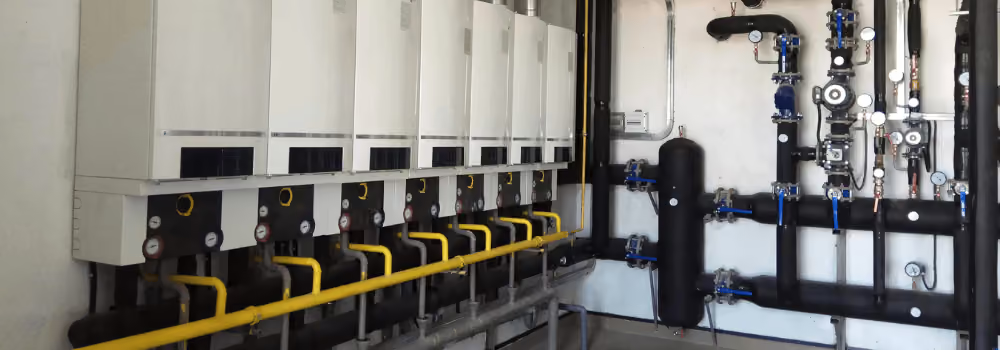



































































%20-%20thumbnail.avif)





%20-%20thumbnail.avif)



%20-%20thumbnail.avif)

.avif)




%20-%20thumbnail.avif)