Host: Are you like I was that you don't think an art gallery could be a good business? Well, prepare to be corrected. When Sean Moore discovered acquisition through entrepreneurship, it was love at first sight. He pivoted hard out of his corporate path to buy a 33 year old art gallery in Denver. And this is a serious business. It does over $4 million a year in revenue and over 1 million in Steven. Those are solid numbers for any Acquiring Minds guest, let alone an art gallery of all things. And the icing is this is a passion business. Sean is a collector of art himself and he says at one point about his life, today, I'm surrounding myself in beautiful art every day. By the way, Sean wasn't looking for a passion business. He'd looked at a generator rental business, a multifamily renovation business. But he got lucky, saw the gallery, this beacon of light, as he calls it, and ran after it. And boy, am I excited for him. Shawn was very transparent in this episode. Thank you, Sean. We go deep on the twists, turns and terms of his acquisition. So for those of you who like studying the anatomy of a deal, this one is for you. We also talk about the gallery business itself, how it makes money, how it leverages the Internet and its physical location, growth levers, what the strategy is. I loved learning about it. What a neat business. Okay, please enjoy this conversation with Sean Moore, owner of Fascination Street Fine Art. Welcome to Acquiring Minds, a podcast about buying businesses. My name is Will Smith. Acquiring an existing business is an awesome opportunity for many entrepreneurs and on this podcast I talk to the people who do it. You already know that business owners are making amazing use of virtual assistants, often based in the Philippines. And while virtual assistants are helpful, virtual professionals are transformative. More Staffing is a boutique agency that hires a players in the Philippines not for simple tasks, but for deep competency work. Think operators, supply chain managers, controllers. Moor Staffing de risks your engagement with a 12 month guarantee to you and they provide coaching for six months to their talent. When an engagement begins, that means your hire is coached in the background, no additional cost to you, so that your working relationship flourishes and is as successful as it can be. Global staffing is increasingly the norm and building the muscle within your business to take advantage of it will be crucial in the years ahead. Speak with Moor Staffing about the pool of capable affordable managers they can connect you with. Check out Morenow Co. That's Morenow Co. Sean Moore. Welcome to Acquiring Minds.
[3:08] Guest: Thanks Will. Very happy to be here. Honored to be here, Sean.
Host: This is going to be Such a fun conversation. You bought an art gallery gallery. It is a top performing gallery in the country. It's a 33 year old business. It's a sizable business. We'll get into the numbers later. And you are an art enthusiast yourself with your own collection. So this aligns with a personal interest and passion. So we're going to hear all about this fascinating acquisition and of course learn about the business of art galleries and whether your cool story here is kind of a one off or whether listeners should approach owners of galleries in their cities about selling. But let's start with a little background on you first, please. Sean, if you'd go ahead.
Guest: Absolutely, yeah. I'm originally from the Minneapolis area and my family moved to Jacksonville, Florida when I was about 7 where I lived there till I was about 18. I went to Southern Methodist University in Dallas, Texas where I double majored in finance and Management Information Systems. Out of school I got a job at Ernst and Young management consulting in 1998. It was a great job. Right out of school I started traveling a lot every week to different cities where I would have projects for 3, 6, 8, 9 months at a time. And one of these projects was a nine or ten month stint in the Netherlands and it was based out of the Hague, but I would be living in Amsterdam. So this was a life changing event for a 24 year old to go to Europe and you know, be on an expense account and you know, and
Host: this was before pot was legal in the U.S. by the way, everyone.
Guest: So let's remember, yeah, Amsterdam was a
Host: Mecca for a certain something back in
Guest: the decade and a half before, you know, Denver or before Colorado paved the way, you know, here in the US So I was also traveling across Europe and got to visit, you know, up to 12 countries during that stint. So I kind of like lived in this hotel. But I would check out on the weekends and check back in, you know, on Sunday night and you know, amazing. Take the train down to, you know, Den Haag, you know, on Monday morning. That was my life. It was great. I was, you know, taking the train to and from work and sometimes I'd stay in the Hague and stayed at a hotel around on the North Sea. It was great. You know, it really, it started my love of travel. You know, I think I had been to Norway and France and Italy before that. But after this it was a marriage. It became my number one passion really in life and coupling that with my love of world history and literature and learning languages, very humanities focused interests. It started to draw a connection Briefly to my business choice here, which is I started to collect art everywhere I went. So I started buying, you know, paintings, watercolors, sculptures. It started in Holland and France and Czech Republic and Spain, and, you know, eventually over the years, you know, all across Asia and South America as well. But art became my kind of number two passion in life because everywhere I'd go, I'd come back with something that I would put up on my wall that would remind me of that, you know, cityscape, that pastoral setting, that religious icon, or, you know, whatever historical figure, you know, that I picked up. And over the years, my house became a museum of all my travels. So that's.
[6:44] Host: Sean, since. Since you told me that on our pre call, I've been kicking myself for not having done the same. I've had the good fortune to be a lot of. Visit a lot of places, and I've, you know, picked up a piece or two along the way. But. But I. I love the idea of just like, you know, that's going to be the thing that you do on every trip is, is find something beautiful and bring it home with you as a keepsake as. As something to decorate your space. It's. It's a great. It's a great idea and kind of building a collection over the long term that each. Each item of which has kind of personal resonance and recalls a memory.
Guest: Yeah, it's great. And, you know, I've got a friend who used to collect shot glasses everywhere you went. I'm not going to say who he is, but he is going to be on your podcast at some point and. And, you know, he'd watch me collect these paintings and he got the bug, you know, he got into it and he started collecting paintings. And now his home is very much decorated with, you know, masks from Africa when we went to the World cup down there, and, you know, paintings from all over the world. And it's caught on with a lot of my friends and even my mom, who I also travel with. So it's a great pastime and great passion.
Host: Really. Cool. Okay, so where do you find yourself professionally in the years leading up to where you now are?
Guest: Yeah, so I finished up the gig with Ernst and Young after the Amsterdam project. So I got recruited and took a new role as an executive account leader for a tech services company called ServiceSource here in Denver. They're a global company that provided recurring revenue management services for big tech. And I manage the executive relationships and global delivery teams for some of our biggest clients like Microsoft and Adobe and Avaya Broadcom, Mitel and handful of others think if you're Microsoft, you've got your biggest customers and you're going to really have a close relationship with them. But then you've got your long tail or your SMB, small medium businesses, and you can't get to all of them. So they would hire companies like ours to engage with them at that level. And our job was to bring in that large amount of recurring revenue where if you look at one client, it might not be much, but if you look at all those SMB clients, it was a lot of revenue. So it was nothing to sneeze at and they didn't want to lose it. And we were really good at doing that. And then the last job that I had was I was recruited to another role where it was a very enticing opportunity, a great compensation package to be, you know, the VP of Solutions at a, at a larger, like $4 billion tech outsourcing company that was looking to expand their footprint in the tech industry. Customer success, recurring revenue and sales services type of work that I was doing previously. So I started getting a little frustrated after about a year, and maybe, you know, in that last year of employment there, leading up to January or I guess April of this year, I started looking for other opportunities. And I'd message my friend, the same guy who collects the shot classes, say, hey, when are we going to get out of this rat race? What are we going to do? And this is also my best friend from college, where when we were 20 years old, 21 years old, right after we graduated, we'd sit up all night in our apartment in Dallas, Texas, and sit outside of our balcony and sit there and try to talk about what companies we'd start up and how we could be CEOs someday and how are we going to get that done. But we were both just too green, I think, to really make anything like that happen. And we had to learn our lessons along the way. And I truly do believe that my career prepared me for the, the exercise that I just went through with the acquisition. So. I sent that text to him. He came back and said, yeah, I know, I've been thinking about it. And then that's probably towards the end of last year. And then right after New Year's 2023, in the beginning of January this year, he called me and said. And he just started talking really fast and he was really excited to tell me about all this reading that he had been doing over his Christmas break. And, you know, he started talking about this book that he read called Buy, then Build. He told me about SBA loans and how you can get a loan for up to $5 million, you know, but you have to have, you know, some collateral and blah, blah, blah. And then he told me about the Acquiring Minds podcast, how he listened to maybe like 20 hours of it so far over his time at Christmas when he probably should have been hanging out with his family, but I think he was, you know, really getting into. And he also told me about the Biz Buy Sell marketplace. And then finally, the thing that clinched it for me was when he told me about the Robs transaction, which is the rollover for business startups acronym robs. This is when it all clicked for me. This is when everything changed. And he shared how you can use the funds from a retirement account to fund a startup business or to acquire a business or acquire the assets of a new business. And as soon as I heard this, I jumped in with 100 questions. And because over the last 25 years of my corporate career, I did a great job of tucking money away into my retirement accounts, but I was only modestly liquid in terms of money that I could put down to make an investment. And so for me, it was like the partying of the seas, where it was a creation of a path to a new future. And all these light bulbs were going off for me, and I felt like, this is my moment. The clouds were parting, the light was shining. Because what seemed so harrowing before, the idea of building a startup having low income for a couple years, and you're having to fund an acquisition with modest liquidity, that was starting to be no longer a problem. There was not an obstacle anymore. So I quickly told him to stop talking because it was all quite confusing. But I said, look, immediately send me the name of the book Buy, then Build by Walker Deibel. Send me your contact's name at this Rob's transaction company, which for him was Guidant. And his contact was a guy named Josh Level, who was awesome, by the way. And he was a fountain of information for me. And I'd recommend listeners if you're exploring, you know, to go this path, you know, reach out, find Josh Level, you know, at Guidant, and tell him I sent you. And finally I said, what's the link to that podcast? And so he sent me the link to your podcast, Acquiring Minds, which, you know, I told you this in our pre call will. Like, I can't thank you enough. You know, you've created a community here. And this podcast did so much for me. And I really think you're doing your listeners a huge service. So thank you.
[14:04] Host: That's awesome, Sean, thank you for saying that, man.
Guest: I appreciate that so much. Yeah, of course. And I couldn't hang up the phone fast enough. Once his text messages started coming through, I was like, okay, gotta go, gotta go. I literally said like, I'm gonna call you in two weeks. And so we hung up. I dove right into the book. You know, I started listening to the podcast, I did my research on the Robs transaction. I started, you know, trying to understand, you know, what the whole business broker market was all about. Because you know, Walker Deibel really focuses on that in his book, you know, you know, building relationships to get, you know, upstream deal flow. And, and you know, I started looking at Biz by Sell. But it was funny like these, these things happen in phases, right? Because as you're preparing you kind of need to arm yourself with information and the first time you get on Biz by Sell is almost like nerve wracking because you're like, okay, you know, I don't even know what I'm doing here. You know, I don't know what I'm looking for. But I was perusing and eventually filtered down some items and saw okay, okay. Within Denver, there's a ton of businesses available because I didn't want to move. That wasn't an option for me. I've got a wife and a five year old and a three year old and so moving was not an option.
[15:24] Host: August Felker is a two time successful searcher. First with a traditional search fund. The second time around he did a self funded search. Today August runs Oberle Risk Strategies, an insurance firm with a dedicated practice group for searchers and acquisition entrepreneurs like you. If you've got a business under loi, Oberly will provide complimentary due diligence on that business's insurance and benefits program. A great no risk way to get to know August and team. They love helping searchers. They've worked with hundreds. Oberle is a specialty insurance brokerage for searchers. By a former searcher. Check out oberle-risk.com O B E R L E- risk.com link in the show notes. So was Biz by Sell also kind of a revelation? Because a lot of people have an aha moment where they actually go on and they can see literally businesses within a 10 mile radius of where they live that are for sale. That the idea that there's a marketplace for businesses you can go buy. I love this. By Sell to this day was, was that Eye opening for you?
Guest: Absolutely. You know, and I'd heard of the concept of buying a business before probably about nine years prior. And you know, because I knew a guy that went out and bought like a janitorial services company and and to me it just didn't sound very sexy. Like why would I want to buy some business that's for sale that's probably not going to be successful? It's, you know, for sale for a reason. I don't know anything, you know, about how to do that. And you know, I, I think I just wasn't ready at the time from a, you know, business maturity standpoint. But, but yeah, when I looked at it this time I was thinking, you know, I didn't do say I hadn't finished the book yet and I hadn't listened to Acquiring Minds, you know, the hundreds of hours that I've listened to since.
Host: And
Guest: so I, you know, it was, it was fascinating. Right. And you know, so I got vaguely familiar with it but really I continued my education, I finished the book, I think I got the audiobook, I listened to it twice and it was the best step by step guide for how to prepare you for that journey. And I mentioned before there's a lot of focus in that book on building upstream deal flow and reaching out to brokers. And, and I remember after looking at Biz by Sell, the first thing that really caught my eye was this multi site art gallery in Denver, Colorado. And I was like, I couldn't even believe it. I thought for sure it was going to be one of these small galleries in this part of town that I didn't want to operate a business in because there's an area like that. And I did the, you know, request more information and learned that it was in Cherry Creek, which is, you know, a really upscale business and entertainment district, you know, in the center of Denver, just like seven minutes from downtown. They've got hotels, restaurants, bars, salons, galleries, you know, all sorts of, you know, shops and super high end growing significantly. You know, it's always been sort of the high end part of Denver but now like more hotels, apartment complexes and condos are going in the area. So it's just skyrocketing right now. So I couldn't believe it was right in the heart of, of Cherry Creek, right at, you know, third in Detroit. And so. Go ahead, Sean.
[19:01] Host: Let me, let me jump in real quick. The actually before we get into the story of your buying the, the gallery. Sure. A little bit more on kind of as you approached it. So a number of my guests have used Robs. But I'm interested that for you it was like such a big unlock because basically you were looking at your financial picture and you weren't super liquid, so you didn't have a lot of cash. And in your own mind you were like, well, I'm going to need this cash to buy a business. I'm going to need cash to buy a business. Even if I can finance it in some way, I probably need more cash than I have. But then your Rob's was pretty healthy and so that was the difference for you. Because I feel like a lot of people who've been on, I may be wrong about this, but they decided they'd buy a business and then they learn about this thing, Robs, which is great. Oh, I can Tap My, my 401k as well. But for you, it's like you wouldn't have proceeded if you didn't learn about the existence of Rob so that you could access your 401k. Do I have that right?
Guest: Pretty much. I mean, that, that was the difference maker for me.
Host: Okay. Okay, great. And also, I just want to try to tease out what the difference in your mentality was today versus whatever it was nine years ago when you heard about somebody buying a janitorial business. And at the time it just was totally unappealing. And as I think, as you put it, like, you weren't ready and like now you were ready to hear something like that because, you know, everybody who is listening to acquiring Minds like, gets it. But there's still a lot of people out there who don't get it. And it's like, you know, why buy one of these old businesses? And it's just interesting. It's kind of binary. It's like it either. It either really lands with you and you're like, yes, like, you know, you and he who shall remain nameless, your buddy. It just, it just like, it was just like, it was, it was an immediate, like an epiphany and so exciting. And yet nine years before, and this is probably the case for many, many people still, like, it didn't land on you at all. It was like, ugh, what do you think changed in you?
[21:05] Guest: You know, I, I've said to so many people, God, I wish I had done this 10 years prior, you know, because I've listened a lot of your listeners, I think are, you know, you got some maybe in your late 20s, but a lot of them are landing in their 30s. Right. And, and yeah, and I have lots of jealousy, you know, When I, when I hear them talking about what they've done because I think, God, you know, I could have done this 10 years ago had I known about the Robs transaction. But timing is everything, right? And I was in the point of my career where I thought I was going to grow up and be a chief ex officer of a tech company or a tech startup. Right. And so that was my dream. Right. We all have our dreams of having some kind of financial windfall or exit or business success. And mine was to eventually find the right company, the right product or solution that I really loved and believed in and help scale that into a global company. And so I think I was a bit blinded by that and blinded by the career climbing and the rat race. And once you're in that, it's hard to pull your head out of the sand and look around and see what's out there. So I think when I heard about the Robs transaction, it made it real for me because I realized I've saved enough money I could easily qualify to buy a lot of these companies that I'm looking at. Whereas before I didn't necessarily have that qualification or know that I was qualified because I didn't know about the Robs transaction. So I think part of it was my identification of the opportunity that I had that I could do it. And also just being a little bit more seasoned in business and writing contracts and selling and doing everything that you do as you get into those upper echelons of the corporate world. So my friend, you know, Jan and I, we talk about it all the time how, you know, our, our careers have prepared us for this point because a lot of the buying process, the acquisition process really wasn't that hard for us. It's stressful. You know, there's a lot of work you have to do, there's late nights and, you know, your deal's falling apart, you know, three or four times throughout the process. And. But it wasn't hard. It wasn't anything that I hadn't like necessarily, you know, been able to do in terms of mind share before. So it.
Host: And why was that, Sean? Because you guys both had kind of had sales experience and sales at a pretty high level where you're, you know, you're signing contracts worth tens, maybe hundreds of thousands of dollars. So like you're used to kind of high stakes deals sort of thing.
Guest: Yeah, like did deals for millions of dollars and, you know, leading teams, you know, across the country and across the world and selling to, you know, seasoned executives and the C suite and, you know, managing, you know, critical operations or, you know, risk management areas for big companies. So it's like you're, you're running parts of a business, right? You're running parts of a business. And as you move your career around, you get to experience another piece of scope that you maybe hadn't done before. And so it all starts to fit together. And you know, personally, I look at myself, you know, in my, in my late 40s, being a bit late to the game. You know, maybe I'm just a late bloomer, you know, here when I hear some of your, you know, 30 somethings on here. But, you know, it was the right timing for me. And that's what I guess I wanted to come back to, which is, you know, I tell people all the time I wish I had done this, but it really was the right timing for me. And it was an awakening and, and it just became obvious, painfully obvious. I actually started telling. I had my, my in laws in town for Christmas. I started telling them when they were still here. I think they left like around January 10th, you know, around January 5th. Guys, I'm going to buy a business. You know, and this was, you know, four days after my conversation with my friend. And, you know, and I just started kind of rattling off the, the, you know, some of the basic stuff that I knew. And, and you know, I said, I, this is what I'm going to do. And, and I also told that to my wife and she was like, what are you talking about? She's like, okay, so you've been like, you know, drinking all throughout the, the Christmas holiday, and now you want to buy a business. Okay, honey, we need to talk.
[25:36] Host: You know, but you've been talking to Jan again.
Guest: Yeah, yeah, exactly. You've been talking to your, your good buddy again.
Host: Well, Sean, you know, on this point about wishing you'd started earlier, um, I'll, I'll spare you the. We shouldn't compare ourselves because we all do, including me. But I, but, but like, let's just indulge in, in, in comparing ourselves and in the reality that our egos exist. Look, man, you, you, you bought a $5 million business. Okay? So, so, okay, so you're not 32, you're, whatever, 46, 48. But you still. I mean, how many people can say they bought a 5 billion, 5 million dollar business themselves and put that together and made that happen and now own this business? And you've got a lot of years left in your career and you've learned this incredible skill of how to Buy a business. It's such a valuable skill that you could very realistically do it again and again and again. So. And, and let's also not forget that the very point of ETA is that it's something of a shortcut. This is a 33 year old business that you get to roll in.
Guest: Exactly.
Host: And be owner of. So. So in some ways you, you know, you, you, you're way ahead. So I just say all that to put things in perspective. No.
Guest: Thanks for the pep talk. I, I'll call you every day. Doggone it. People like me.
Host: Yeah, that's right. Just call me Stuart. Smaller.
Guest: Right.
[27:00] Host: Okay, well, let's get back to the plot here. Okay. The other last question I wanted to ask before you carry on about your search as it, to the extent that it was kind of a search was did you, it sounds like you were just kind of browsing Biz by Sell when you encountered the business that you now own? Was there any kind of other thesis that you had or what were like, how well defined were your criteria? Let me put it that way. Yeah. You've already told us that you weren't going to move, so it had to be near Denver or in Denver.
Guest: Yeah. So, you know, the first time I got on Biz by Sell, yeah. I still didn't really know what I was doing. I didn't have a thesis, I didn't have criteria or scope yet. And at that point it was still a bit intimidating to me because I didn't know what I was looking for. But I was just kind of browsing around and just looking at types of business, you know, in my geography. And, you know, I will say it wasn't like super enticing because, you know, there's a lot of stuff on there and.
Host: Yeah.
Guest: You know, but, but after I got through the book, after I reached out to, you know, eventually, you know, a dozen, you know, SBA lenders and then finally got up the guts to call, you know, my first broker who had a deal, I had the art gallery deal on, on Biz by Sell. You know, then I started filling in the blanks, right. Because each call was an education. You know, each call I brought, you know, the accumulation of the last call with somebody else. And I was filling in the blanks and I was literally taking notes, you know, in like onenote and just, you know, writing down everything that, you know, I was learning that was like net new from previous conversations. And so I started building this, you know, mass of knowledge. Right. And, you know, by the 12th call with an SBA lender. I got to the point where I could predict what they were going to say, and so I would be able to volunteer the information before they'd have to ask. And I already knew what the risk spots in my deal were, and so I'd highlight them before they'd even be able to ask them. So it builds confidence. You have to have the tenacity to keep doing it and to keep filling in the blanks and the curiosity and the guts. Right. Those first few calls, like you, I came out of the gate saying, hey, look, I'm a novice here. You know, I. I need to use this as a learning opportunity. So I appreciate in advance, you know, this conversation and all the, you know, your willingness to kind of help me out here. And. And some of those early people that I spoke to, like Josh Level at Guidant and, you know, some of the lenders that I spoke to, I feel like I made friends with them because they've become advisors, and I actually still keep in touch with them because I've got friends now, you know, that I'm, you know, kind of bringing along up. Up the rears with the, you know, the eta. So I'm, you know, making references and, you know, I'm going out and meeting people that I met along the way, you know, for lunch and. And, you know, it's great. You know, it's really great. There's. There's a lot of community in here, as, you know, you know, across biz by sell and search, funder and. And acquiring minds.
[30:22] Host: Great, Sean. Okay, so let's. Let's get into the gallery. Now that you tell us the listing, what you saw, what you liked. You've already said that it was in this great part of Denver that you knew was really. That you were bullish about. And also, let's give it a name. What is the gallery called?
Guest: It's Fascination Street Fine Art.
Host: What a great name. Fascination Street. So what else do you like about Fascination street when you see the listing?
Guest: It's named after a Cure song, by the way. The. The founder really loved the Cure, so he named it after Fascination Street.
Host: Well, I was actually good reminder because when I googled it earlier today, I. That's what comes up. And I was like, oh, this has to be more than a coincidence.
Guest: Yeah, yeah, yeah, yeah. So, okay, so Fascination street is. Is a business that's been around for 33 years in the Cherry Creek neighborhood. It was. It was founded by my seller 33 years ago. You know, at first, he was an art dealer, and at first he was just into like collectibles and animation and so we, you know, hung out a, you know, a shingle, got an office somewhere in Denver and you know, eventually this kind of morphed into not just animation and collectibles, but fine art. You know, he felt like. I think his first fine art acquisition from an artist is an artist named Thomas Arvid, who does this amazing photo realistic wine art. And you know, so it's paintings of like high end wine bottles and glasses and from different perspectives and it's incredible. And this was where my seller made his first purchase and that was his first foray into fine art and I think he saw the potential on that. So that's really where 95% of his business started growing around. And he got in the space that we're in maybe 15, 16 years ago, it's at the corner of East 3rd Avenue in Detroit in Cherry Creek and Cherry Creek North. He bought these three parcels in the same building on the same floor and connected them in the back. So he blew out the walls in the back, connected them and so now it's one, you know, gallery with, you know, three parcels. So it makes it a really nice, you know, walk through, right, because they're like two really large gallery sections on, on the, on the both ends and then in the middle there's a frame shop which is something that, you know, one of his more recent add ons and probably two or three years ago. So, so we've got a fully functioning frame shop. We've got, you know, know, a really large gallery, about 6,000 square feet of space. And you know, it, it's a, it's a nice journey, you know, from one end to the other to see all the different art that's in there. And we've got about, we probably represent 30 to 40 artists today. They are all nationally acclaimed artists. They're, they are contemporary artists. So all of them are alive today. So we don't have any, any masters don't have. It might have a couple pieces of modern art, but it's really focused on contemporary artists. And the business model is such that, or the qualification is that these artists need to be represented in other high end fine art galleries. And that's the qualification. And so we'll look at them, we'll see who's representing them. And obviously we need to curate based on taste and theme and then we'll add them to the collection if they're not already represented in Denver or Colorado. Because in the art business there's a lot of exclusivity with galleries. So you might have a up and coming artist who latches on to a high end gallery in New York City and they want exclusive representation, which means that artist cannot go in another gallery. But most of them can be represented, you know, and you know, by, you know, 200 square mile, you know, geography or something. So I could have an artist that's represented by another gallery in Aspen or Vail by a different gallery.
[34:36] Host: But it does give you basically geographic exclusivity in the local market.
Guest: Yeah, you've got to have it. There are at least like four or five other galleries in Cherry Creek and, and there's no crossover and that's by design.
Host: And so does that mean that those other four or five galleries you're very competitive with like you, you guys really kind of duke it out because I assume, you know, there's only so many artists in the world that are kind of experience pull through demand by collectors. And so you guys are really fighting to be the exclusive local dealer effectively, or distributor or whatever, I guess, or gallery for those artists. So it probably makes it a less than collegial experience with your, your fellow gallery owners.
Guest: That's not how I view it actually. And the one thing that I've learned in my journey is that there are many different echelons of the art industry. You, you know, you've got your, you know, Heritage House, Sotheby's, you know, auctions, you know, in London, New York City, Hong Kong, and then there's probably a couple tiers below that of really high end art dealing. And they're trading and Picassos and Miro's and Salvador Dali and a lot of Renoir in Masters. Right. And they're auctioning them. 50 million here, 100 million there. And that's a totally different space. Right. And then so every gallery has kind of a unique curation and they create an identity for themselves. So I would say to some degree, yes, there's some healthy competition with the galleries in my neighborhood. But I literally was in one of them yesterday while I was waiting to get a coffee two weeks ago, I went in one of the other ones to just go in and introduce myself and try to get to know some of the staff and learn a thing or two from them and invite them out to lunch and they invited me to one of their events that weekend. So it's very collegial. If there were a gallery that I competed with, it probably wouldn't be like that. But I would say the galleries I compete with, where we have a lot of Overlap in artists. Those are spread out across the country. Those galleries are in key west and Fort Lauderdale and Las Vegas and Laguna beach and LA. And there are maybe half dozen to 10, you know, galleries across the country that, you know, we compete for deals. But another surprising thing about the gallery business is, you know, it's not fully dependent on walk in traffic. Right? I, I am blessed by the fact that I have a space in like the best neighborhood of Denver and I get quality walk in traffic and, and people have spending money to, you know, to buy art and they have the interest. But we've structured the business in such a way that a lot of the business is online and a lot of the business is done through advertising who you have and making sure that you're able to capture those leads before other galleries do. So I think there are other galleries that know about Fascination street and they feel like they are a competitor because we are hustling to get those leads.
[37:56] Host: That's fascinating. So, so a lot of the kind of the businesses is Internet based because one of my big questions about the business is like what does the Internet do to a business like this? Or what did it do years ago and, and what does it mean today? And I, so I want to, I want to do a deep dive into more of the how the business works in a minute, but I want to catch the plot up to, to you as owner. Can you give us some, some numbers that you saw there in the listing, like give us a sense of, of size of business.
Guest: It was a 4.2 million revenue business last year and that had a, you know, net net income of about 584k. But there was roughly another, you know, 500k of add backs and you know, owners salaries and owner owner benefits, you know, SDE. So really the SDE was around 1.1 million. And at the end of the day we did evaluation of 5.3 million, which included 1.4 million of inventory. And so when I look at the multiple, will I look at the multiple the calculation for me, because inventory in the art gallery business is so much more significant than if you're buying a janitorial services home services company, right? You need some working capital, you need some inventory. But really the inventory is the lifeblood of the gallery business and also makes it a little bit more risky and interesting when I'm having these conversations with banks trying to get a loan, because you don't see a lot of art galleries come across and all these banks saw that as a nuance. Some were kind of interested in it. And others just sort of said, yeah, this is so out of our typical basket of deals that we're not sure. So back to my calculation, I kind of looked at it like the valuation at 5.3 million. I subtracted 1.4 million of inventory, and I got to a $3.9 million business without the inventory. So when you look at SDE of 1.2 million, let's say the multiple is around 3.25x. And that's how I see it. And that looked like a good multiple for me. A little bit of a premium when you consider the inventory. But again, the inventory is different with the art gallery business.
[40:33] Host: Okay, well, Sean, I mean, the thing that jumps out at me is that an art gallery owner can take home a million dollars a year. Like, we just don't think of these as businesses that could do that. Well, when I think of. But, you know, I'm ignorant of it, so, you know, what do I know? But. But I think of an art gallery business as a passion business, you know, as, you know, somebody who's. Who's maybe an artist themselves, you know, maybe kind of adjacent to kind of a bed and breakfast or restaurant or, you know, something that somebody founds in retirement or because they're passionate. Your seller may well have been somebody like that, but never one that has a lot of financial potential. Indeed, many of them just struggle to survive, if they survive at all. So this gallery is doing basically, when you. When you add back everything over a million dollars in SDE just blows my mind. Did it blow your mind? Did you have the same kind of intuition about the wrong intuition about these businesses?
Guest: Yeah, I mean, I think initially you do think it's a sleepy business. And, and honestly, when I tell my. My friends and, you know, some of my family members, I'm going to buy an art gallery, you know, everyone's shocked because I think they have in their mind, you know, this paradigm of an art gallery that is a sleepy business with, you know, a single person, you know, sitting behind a desk that may or may not get up and talk to you when you come in.
[42:07] Host: Exactly.
Guest: And. And you just look around, they say, oh, you know, are you looking to fill a space on your wall? And, you know, however that goes, and.
Host: And always empty, like there's nobody else in there. Always sitting behind that desk.
Guest: Yeah, yeah. And. But. But that's not this business. You know, this business is, you know, with the 6,000 square feet, you know, we have a lot of inventory, and we. We proudly show as much of that Inventory as possible. But we also have an upstairs, I have an upstairs office which is like an apartment. And that apartment is all art storage. So we have hundreds of paintings, you know, that are in storage. And so we're constantly rotating the inventory and re hanging the gallery. You know, at least, at least once a month we have an art exhibition. An artist comes in and does a show for a couple days, usually on a Friday night for three hours, and then a Saturday afternoon for three or four hours. And, and they come and you know, they meet the collectors, they do dedications on the back of the painting, or they'll sign things, take pictures. And it really, you know, helps connect, you know, the people and the, and the collectors, you know, with the art itself because the artists can tell them the stories. And, and you know, ultimately that is the job of, of, of, of us as a, as a sales team to connect people with the art. Right. You can come in and you can view something, but if you don't really understand the technique or the background or all the obstacles that the artist overcame to get to this point, it doesn't mean as much. And then when you're able to personalize it with something that they see when they're on vacation here in Denver and it's a memory for them or it reminds them of their dog that they had 10 years ago, whatever it is, you've got to connect people to the art. And you know, kind of getting back to your question, though, you know, the business is built in such a way that it's about generating leads online and driving people to the website. And when they come to the website, what we, what we want them to do is peruse the art. And they're usually coming because they've googled an artist. And that's why it's important for us to have a famous artist. So they're googling an artist that they're looking for and that they're interested in. And we do a good job of making sure that we're coming up in one of those, like, top three or four options for them to click on. And once they do, they come to the website, they look at the art. And most artists in this space in commercial fine art do not want prices published on the website. So they need to click, inquire for price, send their email, send their phone number, and then that generates an incoming lead, it generates an auto response to the recipient, and then it generates an incoming lead to my team. And I have four sales consultants at the gallery that are dedicated to, you know, responding to These leads and also to responding to walk in traffic. But I'd say that's a lot.
[45:13] Host: That's a, that's a big sales team. I mean, how many leads a day are you getting that you need four people to service them?
Guest: Well, it's not for every day. Right. You know, we have a schedule rotation. Right. But ideally we've got at least two sales consultants in there every day. Right. And the way the gallery is structured is I have two gallery directors and I also call them sales consultants because they're responsible for selling. But they have a gallery director, assistant gallery director, and then I have one full time sales consultant. I have another resource who's kind of a hybrid role where she's a sales consultant, the frame shop manager and also what we call gallery assistant. And then I have two gallery assistants. And the gallery assistants, their role is really focused on receiving incoming inventory, making sure that we're updating our systems, our website, our inventory software, and packing and shipping items. And they're also my marketing team at this point. So that was one of my newest hires. I looked for a gallery assistant that was willing to roll their sleeves up and do all of the hard work of rehanging the gallery and doing inventory, packing and shipping. But also I was looking for social media excellence and video content creation because I think one of the big growth areas that I have in the business, you know, number one, if you go to the website, which is Fascination S-T-A-R-T.com for Fascination Street Art. If you go there, the website is from 2004. Right. It is a good symbol of early 2000s websites, which for me was good and bad coming into the deal. Because if the revenue is what it is and the profit margin is what it is today, and I'm able to modernize that website, make it so much more aesthetically pleasing and functional, you know, I've got a big, you know, growth opportunity ahead of me. So that's something that we've been working on. And you know, back to social media, you know, the team had previously done a really good job of, you know, uploading photos on, you know, Instagram or Facebook and the website, you know, that we have of the art, you know, to promote it. But we weren't doing anything that was like sticky, you know, nothing in the kind of short form video where you. That you see in TikTok or Instagram Reels. And so now we're starting to experiment. We put out our first TikTok a couple weeks ago. We're very proud of that, I think we've got four or five of those. And that may or may not be, you know, the ultimate consumer that I'm going after. But part of the marketing approach is really getting the brand out there, the name, the familiarity, both locally and nationally. So that's just one of the tools. But we're also going to be updating the website significantly as we get into 2024.
[48:19] Host: So Sean, it was $4.2 million a year in sales. Right, that's what I was. Right. So that divided by 12 is what, $350,000 a month, something like that.
Guest: Exactly.
Host: So $350,000 a month in art, I mean. So can I ask what your median sale price is for a piece? Just give us a perspective. I guess what I'm looking for, of course, is how many units are you selling per week?
Guest: That's a good question. I think the last I looked we had sold, you know, up to maybe 180, 190 pieces so far this month. Right. So one thing that we also do well with, I think is offer lower priced items that are affordable for people that are walking in the gallery and you know, maybe they're not ready to buy an $8,000 original canvas or they're not able to buy a $102,000, you know, bronze life size sculpture of an elephant. I say life size, it's not really life size, but that's what we call it because it's really large, you know, that weighs, you know, 350 pounds. And so, you know, we have, you know, small sculptures and we have, you know, prints and we have, you know, hanging sculptures and pieces that can range between, you know, $200 to $1,000. And we do really well with that. So I'd say our average sale price is probably between 2 to 3,000 dol. But you know, we do go all the way up to, you know, our largest piece that we, we sold recently was $102,000. It was, it was that elephant. So.
Host: Wow. And, and so what percentage of that revenue is coming from online basically? And you're not E commerce, let's be clear, because it's, I mean it's, it's kind of E commerce. So you get a lead online, but then it sounds like it's a very kind of human. Like your sales consultants probably have a conversation and obviously the higher, the higher price the item is, the more likely there is to be a conversation. You don't have prices listed online, so there needs to be some kind of interaction. So, so does that Take place mostly over email or over calls or depends or what?
Guest: Yeah, it does depend, but I would say it's kind of a hybrid process between digital and human intervention. And frankly, I'd love to increase the digital percentage of that pie chart, but that's going to take time. And the original way of doing business in the art gallery is somebody walks in, likes a piece, you negotiate, and then you arrange for handover or shipping. So for us, it's creating the digital footprint and awareness out there that we have the pieces that people are interested in, bringing them to the website, and then when they reach out to us via the website, that's when the human intervention begins and that process begins. And it takes place depending on the buyer. Right. It takes place over email, takes place over the phone, and sometimes there's a little negotiation there. Some galleries don't discount and some do, we do discount, but we try to hold those discounts to 10%. Right. And, but it also depends on, on the artist. And it, it depends on the margin, you know, for the artist, you know, that we're buying from or from the publisher that we buy from. So publishers are, are like, think of them as like a, you know, an agency that represents multiple artists. And, and we get certain buying terms from the publishers and from the artists. So some are better than others. So that'll, that'll drive what we're willing to discount.
[52:19] Host: So on the pie chart of where your revenue comes from, like what, 80, 90% of that is online leads,
Guest: you know, I'd say it's probably closer to like 70, 75.
Host: Okay. Yeah. Okay. Okay. Well, it's just you just trying to understand like, to what extent this is a brick and mortar business. You do a lot, it sounds like, to, as you said, to kind of establish the local community, a connection between the artist and the local community. So you have these events monthly at least, where, where the artist is actually coming in and doing an exhibition. You've got this great space in a great neighborhood in Denver. You've done a frame shop now, which maybe. Let's hear a little bit about that. But all of this feels like a brick and mortar business that's trying to bring people in. And you know, that's not, doesn't have to be mutually, mutually exclusive that it's only brick and mortar or only E commerce. But it's interesting because a lot of the effort, it seems, is bringing people in, and yet, well over a majority of the revenue is. Is E commerce. It's not a critique. I'm literally just trying to understand the business. I find it so interesting. We should probably get back to your story and start with all the academic questions about how the innards of the business works. But as I said, I'm very interested. Tell us why, tell us why the seller did the frame shop inside. And did you think that that, do you think that that was a good strategic move? I guess you got to say yes because you got employees who work in it.
Guest: Yeah, no, I'll say yes, but I, I believe in my answer. Look, you know, last year I think the frame shop did around 130, something, thousand dollars. And this year we're already up, you know, 50% from last year, same time last year. So it was a great idea. Yeah, yeah, it's burgeoning. Right. Because when you sell art, you know, if it's a, if it's a painting, a print, people are going to need to frame that. Right. So why not exactly be the one stop shop for that, right? Unless it's already pre framed, which sometimes we get those. But so yeah, it's actually one of the major growth levers that, that I have right now. That and you know, increasing, you know, the, the digital experience with a new website and branding with social media. So yeah, the frame shop's been great. We've got, you know, the frame shop manager who is, you know, the hybrid role. She, she does a few things and then we have, we had a lead framer and two framers also up there. So we have basically, you know, four people running the, the frame shop operation. I had, I had to let one of the FR last week. So we've got a lead framer and a framer kind of doing all of the bulk of the hard work, you know, putting together the frames, you know, stretching the canvas, you know, putting it, you know, together in a gallery wrapped frame and then, and then framing it to the customer's specifications.
[55:21] Host: Well, as I hear you talk about that, it strikes me, you know, frame shops of course are their own type of business and many frame shops are just frame shops. Yeah, they, sure they have a few pieces of art on the walls that you can buy, but that's not where the vast majority of the revenue is coming from. But it seems like this, this hybrid where you have a frame shop within a high end gallery is a great combination because you know, it's kind of like the whole is more than the sum of the parts. Like they really, both sides of the business complement each other beautifully. So that's, that's really, that's great. And are you And I assume you are selling framing to people who are not just buying art from you. Get people off. Off the street or whatever.
Guest: Absolutely. And that's. That's on my to do list right now too, is to really begin, you know, marketing that business, you know, independently. Right. We've actually branded it separately. We call it Denver Custom Frames. But, you know, it. It. When you come into the gallery, people often ask like, oh, is this frame shop separate? You know, because you could walk right into it through, you know, one of the corridors. But. But we are. We are going to put a big push into branding it separately. Come here to get your. Your photography framed, your. Your pieces framed, your collections of, you know, things that you want, you know, you know, put into a, you know, like a big box frame or something. You know, like, I saw like a bunch of Michael Jordan rings, you know, come in the other day with a Michael Jordan Nike, Nike Air, you know, shoe. And so people bring in all sorts of stuff, and we're trying to make a big push for that. And I think what we're. What we're lucky about, and this was no accident, was that there was a frame shop in the building years ago, and my seller basically capitalized on, you know, when. When they closed their shop down, he opened one up and, you know, kind of piggybacked on some of the clientele that might have known there was a frame shop there. Right. So it was clever. My seller was quite clever in how he thought to expand the business, and he did a great job over 30 years.
[57:39] Host: Well, speaking of the seller, let's get back to the deal itself. So thank you for your transparency and sharing all the numbers you used your raw give us kind of. What did the terms of the deal look like? Because I know there were hiccups, to say the least.
Guest: Yeah, Yeah. I, you know, before getting to that, I actually, I want to just tell you about, like, leading up to, you know, the first loi. Like, one of the cool things that I did with, you know, my friend Jan that I. That I mentioned was once I got caught up on, you know, the book and, you know, acquiring minds and biz by selling, you know, I. I started, you know, we started talking every day, right? We started, like, exchanging notes every day talking. And so he. He was kind of ahead of me, right. And I. But I was coming up right behind him. But he was also kind of right behind another one of his friends, you know, a guy that he had worked with, you know, at. At a bank previously. And. And that guy was ahead of Of Jan, his name is Dan. And, and he joined a, an accelerator called Acquirer, which I'm sure you're familiar with, an incubator for eta. And, and so the three of us started a pod, right? We got on a text chain together and we just started sharing information left and right. And I have to say, like, this was one of the most instrumental, like, you know, parts of the journey that was so helpful, you know, because we had each other. If one of us didn't know the answer, we just text into our group and we'd have like, answers and ideas and, you know, different strategies, you know, coming back right away. And I know a lot of people are doing that through, you know, Search Funder and other communities, but, you know, this little intimate group was so helpful and, and we even, we even like, we were sharing like SBA lender contacts and we all use the same attorney, a guy named Jeff Bachman at Aegislaw, who was incredible, by the way. I highly recommend him. He did for, for all of us. He did a flat rate through the process of 20k from LOI to close. And you know, based, based on, on my research and talking to some other attorneys, that was a really good deal because a lot of attorneys were quoting a certain percentage of, of the deal price. And you know, I was looking at, you know, 30 to 40,000 potentially, you know, had I gone with another attorney and you know, his rates may have changed, you know, since the 20k flat rate, but he was smart, uber focused on limiting my risk. And you need an attorney that really does a great job of like, you know, breaking down all of the contract, you know, lengthy contract legal clauses and understandable notes so you can make educated decisions about how you're going to manage your risk in the deal. So.
[1:00:38] Host: And do you think that having this pod with Dan and Jan because you guys knew each other and that, that it was kind of intimate was more valuable than say, just asking questions on Search Funder and Twitter? I think you've already answered that, but expand please.
Guest: Yeah, 100%. Like, I actually didn't know Dan. We both knew Jan, so Jan was the connector. But, but yeah, it was personal, it was intimate, it was timely. Right. I could put a question into our text group and there was a commitment to answer. We were all supporting each other, so it wasn't putting it out into the ether and hoping that someone would come back with a good response in a couple days. It was same day responses. We also used it as a venting room, you know, a crying towel. Right. Because A lot of us went through, you know, many times during our deal where the SBA lender backed out or, you know, something really critical threatened the deal and, and we could vent and, you know, try to help each other, but more importantly, help each other, like come up with negotiation strategies to, to get out of those issues. Right. And to come up with something net new. And Dan had great ideas. He had such a treasure trove from, you know, his incubator that, you know, he was giving us, like, templates and, you know, our attorney and, you know, but. But Jan and I also had, you know, many more years of business experience too, that we could offer, you know, throughout the process and, and it was. I would highly recommend reaching out, trying to find people that are, you know, on the ETA path and, you know, if, if you can even time where you are on your timeline as well. We were so lucky. I think Dan closed his deal, let's say at the end of April. I closed my deal June 1, and then I think Jan closed his mid July. So there were six weeks before me and six weeks after me. So we were all just going through the same, same stuff in many ways.
Host: Well, you know, I would just want to emphasize, because one of the things that my guests say over and over and over about what makes the search hard is the emotional toll and that it's A, extremely lonely. You're doing this weird thing often your family doesn't get it, your friends don't get it, your old business colleagues don't get it, and then A, the loneliness, B, the roller coaster, the inevitable disappointments of broken deals, etc. So between loneliness and disappointment and severe ups and downs, it's, if you can, you know, to kind of make this a little clinical, like, those are kind of the problems of search. Those are some of the key problems of search. And if you can kind of alleviate or even eliminate those problems in a peer group, particularly, as you said, with people who are kind of going through, if you can line up the timing, amazing. You're really, I guess, kind of making the search much more bearable.
[1:03:57] Guest: 100%. 100%. And the process is, like you said, it is lonely. And not everybody understands what you're trying to do. And I mentioned, I told you my friends, I'm. I'm buying an art gallery, and I get a mix of responses. You know, some people would say, oh my God, that's so awesome. You know, you're. You're following your passion and, you know, they were just supportive. I think from an emotional standpoint, you Know, but I, I told, I told my dad and he was like, you know, you've got, you know, bigger cajones than I do. You know, good luck with that. You know, it's like so not super encouraging. And, and then you tell others and they come back and they say, oh, okay, well, I never pictured that for you, but okay, good. You know, and they, and I think they think that it's like a big sleepy business. And, and so it's a mix of responses. It is lonely and you know, but, but I will say, like, you oscillate during that process almost every day from moments of panic, you know, to, because of the like, financial risk that you're taking on. You know, I'm, I'm liquidating a large part of my retirement account. And my logic was that, you know, this, this money that I've been saving for 25 years is going to maybe grow at 7% per year for, you know, each year, if I'm lucky, you know, for the next like 20 years until I retire. And, and that's great. Maybe it grows 40 to 50%, 1.4 or whatever it is in 20 years. But that's not game changing. And I am much more aspirational than that in terms of what I'd like as I get older. And I've got young kids now and I want to be able to give them experiences. And so I wanted to be able to put that money to use. Right. So there's a huge risk, but I want to use that retirement money now. And when I learned that there are no IRS penalties, there's no tax that you pay on it, I mean, you. Basically, the way it works is. We didn't talk about this, but the way it works is, you know, you go to a company like Guidant, who I went through, and you pay a, you know, typically $5,000 fee. And what they do is they set up a C Corp for you by IRS regulations, it has to be a C Corp. And there are some considerations with that because if you look up double taxation with C Corp, you can learn that the corporation pays taxes as well as the employees. But there are ways to manage it. But they create a C Corp. They also create a 401 plan for your C Corp. And the way it works is that you roll the money over from your IRA or your 401k into this 401k plan that they set up and it's usually with, I think Seattle bank. And that money is then sitting in that 401k plan. And from there you work with a Guidant to do all the documentation and they create stock certificates so they actually issue stock for your company. And anything that you're rolling over then becomes part, like owned technically by the 401k plan of your C corp. And then once that's all done, you monetize that by basically transferring it and wiring it into your business checking account. And at that point it becomes liquid. But it's highly governed what you do with that money. You can't go out and buy a marijuana store. You can't go out and just do a whole bunch of things with Airbnb. You can't acquire properties that maybe you would eventually use for Airbnb. But there are rules and you have to know what they are to avoid any kind of down, down the road complications with irs. Then what Guidant does is, you know, there's obviously a lot of compliance that comes with that. So they do an annual, you know, compliance, compliance filing for you. So you're paying them, you know, throughout the year to, you know, to, to get that service. But it's, you know, it, it was the way to make everything possible for me. And, you know, but getting back to like, you know, the, the loneliness and the risk and everything, like you go through this process and you have the ups and downs and the loneliness and, and the moments of risk panic, I think is, is balanced by this horizon of opportunity, you know, this looking at these financial figures and you say to yourself, if I can keep this business rolling in the way that I see it performing in the last 12 months or 24 months, then, and I've done my pro forma, my business plan to be, you know, conservative enough and maybe even account for some downside as I'm, you know, trying to take over the business and dealing with, you know, employees coming and going. You've got to be honest with yourself about, you know, the conservative numbers or liberal numbers that you build. But it's invigorating, right? The opportunity there is like invigorating. And every day that you're paying your, your loan to your bank or to your seller, you are acquiring more equity in that business, right? So whatever the term, you're paying yourself in a way. Paying yourself. Exactly. So with a lot of interest, unfortunately, and especially in this environment. But you're paying yourself. And at the end of that 10 year term, that's your $5 million of equity when you close out those loans, right? Assuming you do it in 10 or maybe you do it in less, but that's your equity and Then everything in theory becomes gravy in terms of your net income or your sde. So you counterbalance between these highs and these lows. And one day you're literally thinking, am I going to run my retirement and my future into the ground? What am I doing? What the hell is this risk? And. And it's funny because you go through this process of M and A, right, the acquisition process, and you have to learn that. Thank you to Walker Diabell. Thank you to you and others out there in the HBR study, which is the second bible of how to do this. But you kind of think you're a total stud as you're getting through this process. And by the time you get to the closing table, you know, your family's patting you on the back and people are buying you a bottle of champagne. You sign the papers and you think you are a Goliath. You know, you are a titan of business and industry, right? And. And, you know, it's the peak of everything. And then you wake up the next morning and you think, what the hell did I just do? You know, now I've got this huge loan payment, I have this huge rent payment. I have 10 souls that work for me that I need to make sure I'm taking care of and promoting, and I've got to grow this business. And you don't sleep for a week at least. I've talked to Jan and myself. I was waking up at 3, 4 in the morning and just not able to go back to sleep for at least 10 days after buying the business and going into that operate mode, you know, you do feel for a little while like, you know, if I'm being honest, like a little bit of imposter syndrome, you know, and. Like a deer in headlights, right? Because you're just trying to take on the business. You're trying to transfer accounts from the seller to yourself. You're spending more time on customer service calls with vendors and with providers and merchant services accounts and, you know, and phone companies and cable companies than you ever wanted to. But that goes away. And then you start to get into the rhythm of the business and you slowly start learning how to run that business. And I think for me, one of the big takeaways is making sure that you really trust your seller and that you establish a rapport with him or her during that buying process. Do not do this all through the broker. At some point, you know, when you get into the deal, you've got to insist with the seller's broker that you are meeting that seller. And that you're, you know, going to that person's place of business after hours, you know, to avoid, you know, discovery from the employees. You know, somehow you're meeting them and getting to know that person, learning about the business, asking, you know, questions during the due diligence process. And you've gotta have a good relationship because I think establishing that for me has been just so uber critical for me over the last four months. So I, I took it over June 1st. I'm almost four months into the business and my seller and I, you know, we've, we've transformed our relationship, you know, from him constantly telling me what needs to be done to, you know, a friendship and a trust. And he sees that I'm putting in the work and he sees that I'm learning and he sees that I know what I'm doing. And, you know, he's going to be a consultant of mine for at least, you know, six months. And we may do, you know, a phone call contract for the second six months. But, you know, without that trust between each other, you know, I think it's a much scarier road.
[1:13:36] Host: Trust also helps getting the deal done because the deals. There's a newsletter I subscribe to, guesswork Investing, and he talks about coming from private equity into small business acquisition land. He was a searcher. He bought a business. And how in both private equity and down here in small business acquisition land, it's not. He refers to the cliche time kills all deals. And he's like, it's worse than that. Deals want to die. They are looking for a reason to die. They are, they are trains careening down a track that at any moment are just going to jump the track. And your job is to take this unwieldy beast and just do everything you can to keep it on, keep it on the track. And so, so as we all know, you know, deals die three times before they get across the finish line and so on. And the more trust you have with your seller, the better, the more likely are you, the more likely you are to survive, survive that process. What did that look like between you and your seller? Because I know that there were some fits and starts.
Guest: Yeah. So, you know, I'll get into the building trust first and then get into the deal dying a few times. So on the topic of trust, the way that it worked for me and my seller initially was that when I put in my loi the same on the same day, his broker told me. And I thought this was a ruse, by the way. I thought this was like A selling negotiation tactic. He told me that another offer had just come in in the day before, and this is after this business had been on the market for five to six months. So I thought, oh, this is like kind of convenient timing. This is probably not real. But I had to take it at face value, right? So, so that impacted, you know, the monetary value of my offer and everything. But ultimately it came down to us doing a meet the owner event. So the other buyer candidate met the owner and I met the owner and we came, you know, to the gallery separately after hours to meet with him and just, you know, talk about who we were and what we wanted to do with the business, learn a little bit more about the business. And you know, another thing like that I felt like I went out on a limb a little bit, but I gave him like my, you know, 60 second, like, heartfelt speech about why I was doing this and, you know, what my goals were, what I wanted to accomplish, you know, that it was, you know, ultimately for the benefit of my wife and my two children and for, you know, them to spend more time with their daddy, you know, as, as they get older. So, you know, I could take over the business, really work hard for several years and, and slowly begin to take myself out of the business that when I, you know, tweak it and get it where I want to. And, and the seller since shared with me that the other buyer candidate was significantly more well capitalized than I was. There would be a lot more money down. But it was the vibe that he got, it was the familiarity with the family story and mine was authentic. I'm not suggesting to be inauthentic, but he connected with that and you know, he turned down another buyer. That could have been an easier transaction, you know, because we had our bumps along the way and a lot of it was related to my financing. So that, I mean, that's my advice for, you know, searchers out there, is to, you know, really find a way to connect with your seller and insist with, you know, the seller's broker that, that you have the opportunity to, to meet with the seller and not just do all the negotiation through attorneys and through the broker. Like he and I had lots of one on one conversations at the end of the deal where, you know, things were looking sour at certain points. And he and I had lots of one on one conversations where he and I came up with clever ideas to solve a problem, right? And credit to the seller. He came up with a lot of those. And, and so did I. And you know, but and by the time we established this relationship that was, you know, open, he was more than willing to, you know, acquiesce to some of my asks, you know, that he probably wouldn't have earlier in the process because he's a tough negotiator. And it was not an easy negotiation or process. But I think towards the end, you know, we both wanted the deal for each other
[1:18:10] Host: and. Do you want to. Can you share the terms of the deal?
Guest: Yeah. So, yeah. So originally the LOI was purchase price of 4.9 million. That included $1 million of inventory. It was going to be about 4.4 million of cash at closing between me and an SBA lender. I offered $10,000 of earnest money in good faith just to show that I was willing to stick into the deal. I asked for a 10% seller note of about 490k and offered, I think, a generous 7.5% interest rate on that seller note just to sweeten the deal. 7.5 was generous at the time. You know, interest rates have gone up since. But at the time I learned that, you know, other seller notes were, you know, offering, you know, 1 to 1.5 points less than what I offered, that kind of came back to bite me because that rate kept going up. So I wish I had anchored at a, at a lower rate, but, you know, and I asked for obviously exclusivity to ensure that the seller wasn't any entertaining any other deals and, you know, taking it off biz by sell, which I think is pretty standard. And he came back and asked for a $150,000 earnest money deposit, which everyone, you know, all attorneys and, you know, and I think his broker maybe too, everyone was a little surprised by that. But he really wanted to get me stuck into the deal. And it was interesting because he wanted to really show that sign of good faith. But that created a lot of downstream issues because our negotiations subsequent to that really was more around, am I going to lose this earnest money if the deal falls apart? So it was all about what date we were setting where the earnest money goes hard and it's no longer accessible to me, despite what happens with the, the deal. And we probably spinned our wheels for a long, long time with attorneys and attorneys fees on, on his side. I had a flat rate just trying to navigate this. Right. So we eventually settled on like a $100,000 earnest money deposit and we figured out how to make it work. And, you know, ultimately he, you know, he bent on some of the, on the terms related to it, but and then I had an SBA lender, you know, after interviewing, you know, 12, I found one that was. That was solid, and they were going to give me a prime plus 1.5% variable, you know, interest rate, which was pretty good, considering that I think the standard offer from SBA lenders is about prime plus 2.5. That's kind of like, you know, top shelf, bottom shelf, whatever you want to call it, that's the standard offer that they're making. And if you can cut that down to 1.5, then you're doing okay. There were some other flat rates that were available out there in the eights, but a little harder to get. And my SBA lender at some point during the deal said, you know what? You've got too much blue sky or air ball in your deal, where I just didn't have enough collateral to satisfy the loan, and that's even taking into account a life insurance policy that they were requiring me to take out. So they came back and said, we need to increase the seller note from 490k to about 1 million. So he's in for 20%. And this didn't sit well with the seller because we thought that the deal was starting to shape up. So the seller started to get fairly frustrated with the SBA lender at this point, but he asked for a few things and eventually bent to the 20%. So we agreed on a $1 million seller note, and then he came back and asked for a higher percentage interest on that increased value that he'd be loaning, which the logic follows. So we agreed on an 8% interest instead of 7.5. And, you know, and then towards the end, we got to a point where we. We needed to change the deal up a little bit. And, and. And the SBA lender started to show him the, you know, maybe three or four days before closing, showed him the. The fine print on how the seller note would be subordinated to the SBA loan. And, you know, it basically read, you know, this is all standard language from the sba. So, you know, anybody that's going into this, you need to be aware that this could be a. A gotcha with the seller. But basically, it says that, you know, his seller note, if I stopped paying it, but I was paying the SBA loan, he would have no recourse. Right? And I think my seller's, like, fear was that, you know, after seven years, he would have no legal recourse, and if I were still paying my SBA loan and that I, you know, I could Just stiff him ultimately. And, you know, that's really not how things, you know, work. But, but that was his fear. And so he killed the deal. At the 11th hour, he killed the deal. I was actually out to dinner with two of my friends celebrating that I was about to sign closing, you know, in a day or two, and I got a text from him, and he said, you know, we've got an emergency. This deal is dead. So I left the dinner, I'm outside calling him, asking him, and, and, you know, and he was upset, but he wasn't upset at me.
[1:24:01] Host: At least he reached out to you.
Guest: Yeah, because a lot of, A lot
Host: of people, a lot of sellers, when they want to kill the deal, they. They ghost you.
Guest: Yeah, yeah. You know, and his attorney hadn't done an SBA deal as well. He had a very, like, qualified, experienced attorney who was very good, but I think he was more experienced doing, like, private equity size deals and, you know, never dealing with sba. It was his first SBA one, and he even advised his client, don't, don't do this deal. I can't recommend if you stop doing this deal, you know, I, I can't represent you. And so, you know, so they were kind of, you know, two peas in a pod at that point. And, and so he said, look, I, I need the, I'm going out of town right now. I need the weekend to think about it. And, you know, I, I, I still want to do the deal, but I just don't know how we're going to get it done. So that left me with two days of absolute, abject, you know, disappointment and brokenheartedness and, you know, but he came back on my shoulder.
Host: Of your pod.
Guest: Yeah, Texting.
Host: Using that pod.
Guest: Texting. My podcast, you know. You know, you know, and I got those same texts from those guys when they went through it, too. But he came back the next week, you know, a little refreshed, had some time to think on it, and he basically came back and he offered me, like, two options. You know, one was a 100% seller carry 100% seller note, not 100% of the 5.3, but 100% of whatever loan that I needed to get there. And he said, or, and this could be an interesting option, I am willing to be your partner for two years, and you can buy in equity, and I'll be your partner, and we can work together. And then over the course of two years, we can part ways and we'll have a loan and maybe you'll have an SBA loan, or maybe it'll be a seller note at that point, but you can continue to, to buy up your equity. And, you know, I thought, honestly, I was like, really impressed that, that he came up with those ideas and that he offered that. And I was, I was honored that he was willing to work with me as a business partner in that kind of a relationship. And I told him as much. And. But I knew immediately when he offered the business partnership that that was not what I wanted to do because my, you know, you got to come into this knowing what your goals are. Right. And what your desired outcome is, is. And my goals were to be my own boss and to, you know, have my own business and to be, you know, responsible for everything in the business, to learn it inside out and not to buy a new job. Right. I know that's something a lot of people talk about is, you know, trying to avoid buying a new job. And so, you know, I politely declined the partnership offer, but I, you know, and I was a little intimidated by doing, you know, the seller carry for, you know, the balance of everything for the loan, but because I would be so intrinsically tied to him because he is, you know, now he's my landlord, he's my bank, and he's my consultant. Right. So we are very, you know, our success is now mutually intertwined, which is good, but it's a very tightly wound relationship. Right. So, so I took them up on it and we got the deal dusted off. We kind of had to go back to the attorneys and, and say, all right, we've got a, you know, fairly decent restructure of the deal here. You know, all other things notwithstanding, we just need to change, you know, some of these, you know, loan sections in the deal. And I had to go out and get different types of INS insurances and pledge him some security interest in the business if I were to ever, you know, fail on, you know, paying the loan. And so, you know, he definitely wrapped it pretty tightly around me in terms of, you know, my commitment to make him whole in the event that something didn't work out. But we figured it out, right? And at the end of the day, the final deal structure was a total loan of 5.31 million. And at this point, the inventory went from 1 million to 1.4 million. Because during my process, they told me that there's actually more inventory. There was actually another 600k of inventory. But I said that I couldn't take all that on. So we whittled it down to 400k and I had to decide on some pieces and some artists that I didn't want to bring in. But I had a seller note of 3.91 million at 9% interest starting on June 1st. And then for that extra 400k, he gave me a little bit of extra time to kind of swallow that pill. So we set up a second seller note of 400k at 9% interest that would start on October 1st. So I'm a few days away from doing that second note. And then I did a self funded equity injection of $1 million and that included, you know, my $100,000 earnest payment. And I had to get, you know, an insurance policy and pledge, you know, security in the business if, if, if some of that didn't work out.
[1:29:26] Host: So you had around a million dollars in your 401k?
Guest: I did, I had, I had a little bit more than that. But yeah, that was a large bulk of it.
Host: And so this really, I think you said earlier, but this is going really
Guest: all in, all in, 100% in.
Host: And what does your dad say now, now that you're on the other side of the transaction?
Guest: I think he's, he's still, you know, waiting for the shoe to drop, I guess, you know, one way or another. But, but you know, ultimately I am happy beyond belief and it is everything that I had hoped it was going to be. I, and what is that?
[1:30:03] Host: And what is that, Sean? What, what is makes it makes you so happy?
Guest: You know, I, I, I, I went from, you know, jobs where you have significant daily work stress and you have, you know, when you work in a big corporation, you have a highly matrixed organization typically, and you may have a manager who is called your boss, but you really are accountable to dozens and dozens of people. Right. And you don't always control the amount of work that is being asked of you. Right. You know, we're all, you know, very reactive and you don't control the funnel of business, especially in sales. So that was a lot of daily stress that I was doing for other people and it was really a grind. And for me, as I've gotten older and maybe more set in my ways, or maybe just more confident or maybe just more stubborn, you know, I just, I started to reject that completely. And so this, this new premise of really me being the boss, me driving the tempo, everything that I'm doing is for my family, it's for our future success. You know, there's a lot more motivation there, there's a lot more willingness to, you know, roll your sleeves up and get into it. And you know, like we talked about earlier, you know, every payment that you're making is, you know, you're really paying yourself in equity. So it was a no brainer for me. And, and while I will say that there is a larger kind of overhanging umbrella of burden, you know, financial risk out there, it, it's manageable because I did the due diligence on the business and the business is performing as, as I expected. You know, it's, it's not, it's not like breaking any records right now, but it's, it's doing what I need it to do. And, and we are having fun with it. The team and I have really bonded and created a strong relationship. I've got really smart people in the gallery and I learn from them every day. You know, which coming from corporate business world, coming to a gallery, I think I thought that, oh, I'm going to be able to teach them everything. And you know, but they are teaching me everything. And, and, and I'm loving the process of learning. I'm also loving the business that I bought because it's a passion business as well as a successful one, so.
Host: Well, let me ask you about that, Sean, because I recall you saying that you'd seen when in your kind of biz by sell browsing, more practical businesses, maybe more sound businesses, more of the type of businesses that a searcher would traditionally go after and the conventional wisdom led you there, but then you're kind of your heart, for, for lack of a better way to put it, kind of raised its hand and was like, you know, if I'm going to leave corporate, safe corporate, where I'm clearly having a lot of success and there's a, there's a, there's a path laid out for me and I could continue having success. You know, I want to do it for something that lights me up, not just for more drudgery. Even if I get to be my own boss in that drudgery. Elaborate on that.
[1:33:14] Guest: Yeah, you know, I'm surrounding myself in beautiful art every day in the workplace. And, and the art is my business. And you know, part of the fun now is that I get to curate the art, I get to develop the relationships with the artists. And that, that is like so fulfilling for me. And, and, and I've also taken it upon myself to really study the art industry. And along with that comes some really great things. Right. So I've booked a ticket to go to the Miami Art Week, right where Art Basel Fair is going to be among a dozen Other fairs. It's a five day thing and I can't wait to go just parachute in there and learn about this other aspect of the art industry. Right. Because I told you there are some echelons to the business and some of that is probably out of my reach in terms of the expense of the pieces that they're going to be showing and some of them are installations. But I'm rounding out my knowledge and I booked another trip to go to the European Fine Art Fair in Maastricht, Netherlands in March next year, where I really want to get into the European art community and understand what they're doing. Because right now most of our artists are North America based. And if I'm able to expand internationally and curate some interest in that, I think that'll be fun. So it's a journey for me and it's a labor of love in terms of learning about something that I've always been interested in and never been able to really devote the time that I wanted to it.
Host: So, Sean, it's so fortunate that you not only found a business that is a labor of love, but it's also a really strong business because as we've already talked about, often those things cannot fall in the same bucket. But here is a passion business that is also a really good business. It seems like a business that would require passion. Like it seems like your customers, your employees are going to require your interest in art in a way that maybe somebody buying an H VAC business, the crews don't necessarily expect you to be an HV H VAC technician or an H VAC expert. Now, kind of earning credibility with those crews is part of the process. It is something you need to do, but they're, they're not going to expect you to develop actual functional knowledge so that you can go out alongside them in the cruise. So some learning is definitely expected to earn credibility with your team and kind of a blue collar business, but not all the way in. And in this, you probably got to go all the way in. They probably, they probably wouldn't appreciate in an art gallery business an arm's length kind of owner. Am I right about that? And then also curious, could you have seen yourself buying a blue collar, a more kind of practical business? What would that have looked like for Sean? Was that ever in the cards?
[1:36:05] Guest: Yeah. So I, look, I. To answer your first question, I think, you know, could anybody step in and buy an art gallery business with or without the passion? Sure. But are you going to be credible as the, as the owner and the the person that's driving the business,
Host: if
Guest: you don't have the passion for it? Probably not. But I think that there's a parallel with that to any business to some degree. Like, you need to establish the credibility with your crews or your teams or your sellers. And the difference for me is having the passion for it just makes it so palatable. And not just palatable, but makes it just so invigorating every day. Yeah, that is such a difference maker. Right. So. And that, that actually led to my ultimate decision because I was heavily weighing a few other companies. Some of these companies were like construction, generator rental company. One was a multifamily dwelling renovation company, another was a home construction company. And these were all kind of like in my, you know, scope criteria that I was. I had narrowed down on Biz by Sell. And I, I really thought about it and I, I looked at a lot of these and at the end of the day, it came, you know, it. And I know so many people go out there and they buy a business that they're not passionate about and, and maybe it's hard to be passionate about an H vac business or hard to be passionate about a generator rental company, but are you passionate about building your family's future then? Absolutely. If it's a sound business, then you go in there, you figure out how to run it, and, and if you can step away and let the teams run it that you've highly trained over a few years, then I think that's a great recipe. I just happened to get lucky with seeing this beacon of light out there at Biz by Sell the first time I looked. And it was just something. It just kept pulling me, pulling me, pulling me. And ultimately I considered, I think, the differences of managing some of the labor teams in the services business and all the HR that might be involved in that, and, you know, some of the. Some of the transient nature of some of the employees. I weighed that and I thought, you know, I actually don't want to deal with that as much. I'd rather be dealing with people that love art, that are interested in it and that can teach me about it. And then I can just go skyrocket into this place that I love.
Host: I think that's a perfect place to leave it. Sean, if people want to get in touch with you, how do they. How should they reach out?
Guest: Yeah, you can email me at seanascinationst.com or you can go to our website at fascination S T-A-R-T.com and we've got our phone number up there, and you can. You can call into the gallery anytime.
[1:39:01] Host: Congratulations, Sean, on not only buying a business, which everybody who sits in your seat there deserves to hear, but also in finding this. This passion business. It's. It's such an interesting business. We could have spent another hour with me asking you about the ins and outs of. Of the gallery business, so maybe another time. But really interesting and really cool that it's. It just lights you up so much. So thanks for coming on, sir.
Guest: Yeah, thanks a lot, Will. I loved coming on here and love getting to. To know you in the process, too.
Host: Thanks, John. Sam.


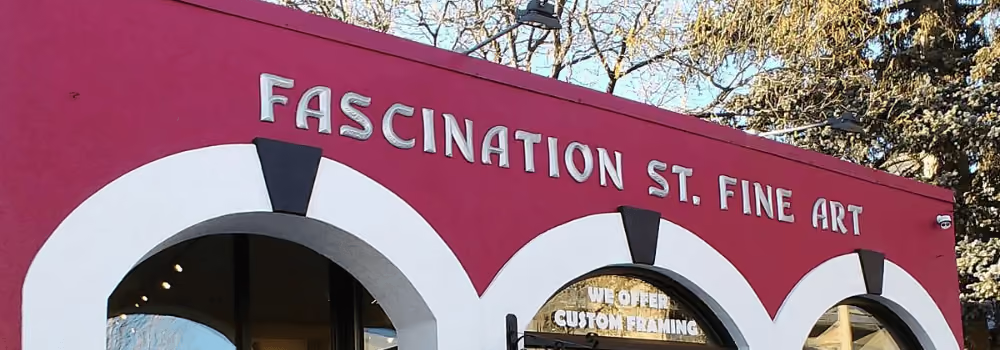































































%20-%20thumbnail.avif)





%20-%20thumbnail.avif)



%20-%20thumbnail.avif)

.avif)




%20-%20thumbnail.avif)