Host: Regular listeners of Acquiring Minds know that entrepreneurship through acquisition and franchises play well together. There have been a number of interviews where an entrepreneur started with a single unit or small collection of units, then programmatically acquired a sizable portfolio. Today's interview is a sterling example of the strategy. Jack Foster and Jake McLaughlin developed a thesis around franchising, then automotive within that, then auto repair specifically, and finally the Meineke brand in particular. Jack and Jake raised $2.8 million from friends and family, expecting that would get them to 10 Meineke locations. Instead, that single equity injection has taken them to 25 Meinekeys and in only two and a half years. The combination of cash flows from their acquisitions, sale leasebacks and debt, both seller and sba, has allowed them to keep buying without diluting their ownership further. Suffice it to say, Jack and Jake's plan is working. In addition to the structure of their acquisitions, we learn how they've been building. Listen for the segment on culture change on variable compensation plans and their appreciation for the special magic of their Chief Operating Officer. Joe Please enjoy this deep dive into building a portfolio in a legacy franchise and doing it quickly with Jake McLaughlin and Jack Foster for the past decade or more, one of the best ways to achieve operational leverage for business owners was offshore talent. More recently, you can't say operational leverage without AI appearing in the same sentence. So the question on many owners minds is how do offshore talent and AI play together in your small business? What is the right balance between the two? Which tasks and responsibilities remain better for offshore talent and which are AI better suited to? Well, Greg Carey of Moore Staffing has been at the forefront of helping business owners gain operational leverage, first with offshore talent and now with AI as well. So Greg understands how these two powerful levers complement each other in small businesses and how you, as current or hopeful business owner, should approach it. Tomorrow, Tuesday, Greg is hosting a webinar on this very topic, Offshore Talent versus AI for Business Buyers and Owners. It is Tomorrow, Tuesday, Tuesday, March 31st noon Eastern. Link to register is right at the top of this episode's show notes or on the Acquiring Minds homepage acquiringminds Co. Then Thursday we have a webinar on technology due diligence. When it comes to buying a business, technology due diligence often gets way less attention than it deserves. That gap is frequently what costs new owners the most in their first year of ownership. Well, Thursday, Josh Hedone of Preferred Data will host a webinar walking through what a technology assessment actually uncovers in an SMB acquisition and why the findings so often change the conversation around price terms, timing. Josh is a former searcher himself, having acquired preferred data, so he understands this issue from both sides. Among many topics Josh will cover why technology is the most overlooked step in SMB due diligence, how to inventory exactly what you're buying before you sign and what a quality of technology report a QOT reveals, and how to use it. The webinar is Quality of Technology Report Protecting youg Acquisition and it is this Thursday, April 2, noon Eastern. Link to register is right at the top of this episode's show notes or on the Acquiring Minds homepage. Acquiringminds Co. Welcome to Acquiring Minds, a podcast about buying businesses. My name is Will Smith. Acquiring an existing business is an awesome opportunity for many entrepreneurs, and on this podcast I talk to the people who do it. Running payroll, paying your bills, closing your books and producing financials. These are critical tasks every business owner must do or oversee, but spending time on them distracts you from the leadership in growth work you want to do. So let system 6 do it for you. Owned and led by a former Searcher, Chris Williams, System 6 is a leading outsourced finance team for hundreds of SMBs, including over 50 searcher acquired businesses. Chris, Tim and the System 6 team understand firsthand the challenges, the opportunities of jumping into a business as its new owner. So whether you own your business already or have one under LOI, talk to System 6 about how they can give you time back and improve your financial operations. Mention Acquiring Minds and they'll provide a free review of your books and Financial Ops, a $500 value. Check out system6.com link in the show notes or email helloystem6.com Jack Foster Jake McLaughlin welcome to acquiring Minds.
[5:59] Guest 2: Thanks for having us.
[6:00] Guest 3: Well, thanks well. Excited to be here, Jake, Jack, the
Host: two of you are pursuing a venture that I have talked about quite a bit as a model, but haven't interviewed many entrepreneurs actually doing it. And that is buying consolidating units in a legacy franchise brand. And in your case, it's Meineke. You have moved fast. It's going better than you expected. I think. Fair to say we're going to unpack it all. Let's start with some quick background on you both. Please Jack, if you'd go first.
Guest 2: Yeah, I will. Thanks for having us. My name is Jack Foster. I grew up in New York City, lived in Morocco for a few years, but New York is home. Went to Penn for college, did a finance degree in Wharton but also an Arabic one. Couple years of investment banking afterwards at Goldman Sachs and then KKR on the private equity team. Jake and I are childhood buddies. I'll let him introduce himself as well. But we partnered up a couple of years ago. Got really excited about the Meineke brand and doing a roll up within that franchise and looking forward to telling you all a little bit more about what we've been up to.
Guest 3: Perfect. Thanks, Jack. I grew up outside of Boston, Chestnut Hill. I was fortunate to get recruited to play hockey at Amherst College. Graduated in 2018 and then moved to Chicago. Joined Baird's consumer investment banking team, spent two years there and then pivoted to Prospect Hill Growth Partners just outside of Boston, formerly JW Childs. That's where I got exposure to franchising and wanted to do something more entrepreneurial. Jack and I had similar ambitions and we started to put our heads together.
Host: Excellent. Thank you. Okay, about that. Putting your heads together, why then you were both kind of off to promising starts in your career. What, what do you think the catalyst was? And then why this? So first why, why now and then why this?
Guest 2: Yeah, you know, I, I think we were both happy with what we were doing. And I don't want to speak for Jake, he, he should share his side, but I think as I looked around the people I was working for and with, I was more excited about what I was reading about in terms of SNB and roll ups and things of that nature and pursuing that path as opposed to a more traditional background in large private equity. It's a. Today, you know, we're some hybrid between investor and operator, but we do get involved in our business. In the beginning. We moved for six months to North Carolina and were in our stores every single day. I was, and I still am, more excited about investing, not just allocating. And I felt like the job I was in was much more of an allocation role than an investing role. So that's why I was, was wanting to take the plunge. We can talk about how we ended up getting really excited about Meineke, but. But Jake, do you want to share your why as well?
[9:12] Guest 3: Yeah. I think when I graduated, I realized that I detested the concept of grinding for someone else's benefit. Really wanted to put myself in a situation where the time invested, the relationship between time invested and earnings potential was more symmetrical. And the reality of banking and private equity is until you reach a certain level, your earnings potential is really capped. There might be a range of bonus amounts, whatever, but your earnings potential is capped. And I kind of wanted to take, take that cap away, bet on myself. So that's what really triggered it for
Host: me, Jack, when you say you saw yourself as more of an investor and not an allocator. I heard you make that distinction in our pre call as well. Capital allocation versus investing. Just tease that out for us a little bit. What do you mean by that difference?
Guest 2: Yeah, so Jake and I have done 15 acquisitions over the last two years as we've built their Meineke platform. We've also done a handful of sale leasebacks, which is to say a big part of how we spend our time is looking for acquisitions, looking for deals, executing on those deals. We spent a lot of time building out the network of folks that we need to help us do acquisitions successfully. But we're also operating these businesses once we've completed a transaction. I really enjoy that process. I like that we are doing a lot of small deals. I think that's a little bit of a competitive advantage in a world where a lot of firms, you know, want 5 million of EBITDA in a service category as a for instance, you know, we're willing to start really, really small and bet on ourselves to, to work through our acquisition pipeline. I think that's been, you know, one of the handful of really rewarding pieces about this journey. As I think about my former experience in traditional private equity and friends who are still there, you know, you may be doing one acquisition, one, one portfolio company acquisition over two years. You may be spending most of those two or three years when you're an associate diligencing industries, working on investor materials, turning PowerPoint pages, things that are, frankly, not investing. Those tasks are all good and important for a larger scale firm. But as you think about the later stages of your career, I think you want to be as good as you possibly can at either doing acquisitions or optimizing businesses post acquisition. And I feel like the roles that Jake and I are in today is much more levered towards that relative to working at a traditional private equity firm. And I think that is the difference between allocating and investing. Jake and I aren't just buying businesses and hoping that the management team in place can do a good job with those businesses. We're buying businesses and then betting on ourselves and our team. Our team is critically important. We've got 10 folks with decades of auto repair experience. Jake and I can only do an oil change with supervision, but we are betting on that group and ourselves being able to operate it. That is being an investor, not being an allocator. I think it's a really important distinction.
[12:40] Host: So to be clear, it sounded like a combination of Investor is more active versus passive, operational versus not. And it sounds like the cadence at which you're making decisions is higher. You guys are putting. Putting capital to work on a multiple times a year. And then, of course, making a lot of decisions in the business about how to direct resources versus somebody in big PE who might only make actually, you know, be involved in a single transaction every other year sort of thing.
Guest 2: Yeah, exactly. And I think that has made us significantly better at our transactions, as I think about it. And we talk about this all the time. You know, the things we focus on for our 16th Meineke acquisition are different than they did when we were getting started. I think we've improved our process. It's made it easier for the sellers or our counterparties that we're working with. It's made it more efficient as we think about deal expenses, which are larger as a percentage of a smaller transaction and important to be really thoughtful with how we're spending that money. And it's also made us realize, here are the pieces of information we need to make a good bet, or here are the pieces of information that if we see we should pass on because we have the benefit of going a mile deep, an inch wide. I think it's made our M and A engine work a lot better.
Guest 3: Right.
Host: Well, we're going to get into that in a lot more detail. Let's return to the plot now. So you got excited about this opportunity in Meineke. So actually, why don't we start broader. Why franchising and then why Meineke specifically?
Guest 3: Yeah. So I mentioned this in the introduction, but got some exposure to the franchising universe while I was at Prospect Till we had an orange theory platform, a crunch platform. We invested in sweat house in Dogtopia as well. So I knew about franchising broadly. It seemed like a good model. Jack and I were not operators. We thought we could benefit from some of the infrastructure and kind of de risk some of the operations side of the equation by going that route. So I think we started with franchising and then grew more passionate about the automotive side of things.
[15:07] Guest 2: The only thing I'd add, and I agree with, with what Jake said, franchising is, is new to me. I had been aware as like a consumer as to what a franchise is, but I had no experience investing or operating a franchise business. But I really like the idea of paying a royalty for product market fit. And I think in a legacy franchise, Meiniki has been around since the early 70s. There are still 800 locations. We're really fond of the brand, like anything, you know, there are certain weaknesses, but we really do like Meineke. But I think of our royalty as you are paying for a concept that has been proven to work in a lot of different markets by a lot of different operators. I think that's valuable. It's ultimately our business. Any franchisor cares about sales. The business owner cares about profitability. There are sometimes tensions between those two things. Right. But in brick and mortar, you know, having, having the flag to fly I think is helpful. As we think about finding good technicians and retaining and acquiring good customers, I think that's a big piece of what franchising offers us as well as a closed loop network in which we can do a lot of M and A. That's another big piece of this.
Host: Well, that's what I was going to ask, because I didn't hear you mention it, is the idea of a baked in CRM of acquisition targets. You get into a system and then you've got, in your case, you know, you buy a unit, you've got 799 other targets. You have their contact information, all this information about everyone, and you can start reaching out. Yeah, Jack, interesting to hear you characterize that fee being going to product market fit. That's not usually how franchisors characterize it. That's not, I think, how franchisees see it. Usually the, the argument the trade is you're getting support services, the SOPs, the whole, you know, the, the, the back office, the marketing, the br, you know, the. Especially if it's a national brand. And, and of course that is another reason you talked a little bit about tension. That's another reason why there can be tension. Franchisees, especially as they get more advanced or more sophisticated, often feel that that fee is, they're not getting a lot of value back for that fee. And so maybe that's what you're saying is that you're kind of. That the ongoing. Because you guys now are very sophisticated operators. Probably, I don't want to flatter you, but probably the most or among the most sophisticated operators in the entire Meineke universe, how much value are you really getting for those fees in the traditional sense these days?
Guest 2: A ton of value. And I say, I say what I said because I think if you want to be a happy franchisee, right, over the long period of time, sometimes you get more directly from your fee, sometimes you get less. But, but we are always at peace with it because at a minimum, we are paying for product market fit and a logo. In reality, we're getting a Ton more. We get a lot of operations support. We've got weekly calls with folks from the franchisor. They really help our team hear some of the things Jake and I try and point out, but from a different lens, which I think is often more impactful. We do a lot of national marketing comes from Meinike, albeit through a different fee. A weekly ad fund fee, not the royalty. But I think it's unfair to say we don't get a lot of support from them. At the end of the day, it is our business and we are responsible for making sure the bills get paid and there's something left over after those bills get paid. But I think our royalty does. Does support a lot of things that are critical. It was just to say, at a minimum, you are getting product market fit.
[19:00] Guest 3: Yeah. I would also say that people are inherently distrustful of auto repair facilities. So there is a lot of value to the brand. I think people naturally trust brands that they recognize. So there's a lot that comes from that brand recognition, too. Engendering trust in this category in particular,
Host: in this category that suffers from a trust deficit in the market.
Guest 2: Yeah, yeah. And one other piece that that's worth mentioning because we're doing mostly acquisitions, not development, and we're in three different markets. We're in the Carolinas, Wisconsin and southern New England. Like Meineke has a service offering. It's pretty broad, right. We're not really doing, or we're not doing bodywork, we're not doing a ton of heavy engine or transmission repair, but we do kind of everything in between. But because we're in a franchise and because the service offering is relatively consistent post acquisition, the issues we're facing in Appleton, Wisconsin, or Marlboro, Massachusetts, or Rock Hill, South Carolina, they tend to be pretty similar, if not the same. The people are different. There's some weather impacts, there's some cultural differences, but by and large, we are finding a similar set of challenges which enables our team to react to them in a way that's. That's impactful because we're not starting fresh in every single market that we're in.
Host: The team at Aspen HR recently published a short white paper targeted at searchers Entitled A New CEO's Guide to Human Resources. It lays out the key items you should be thinking about as you transition into CEO and owner of the business you bought. The link to download that is in the show notes, Aspen HR is a professional employer organization, or PEO, which provides HR compliance, flawless payroll, robust HR technology, and Fortune 500 caliber benefits, all for A fraction of the cost compared to using multiple vendors. Reach out to Aspen HR for your complimentary HR diligence checklist and benchmarking analysis. Go to aspenhr.com or contact Jenny Theere directly at jenny aspenhr.com well, and we had talked about, so we talked about the characteristics of a legacy franchise brand or franchising in general, where you have the, the CRM of future targets, where you have a lot of fragmentation in certain brands like in Meineke. But all, all of that is kind of with the, the assumption that what we're doing here is programmatic acquisition. It's a, it's a system where you can systematically buy and buy quickly. You can move quickly because you can find targets quickly. And then as you were just saying, Jack, on the other side of the acquisition, the integration and the problems, you, there starts to be real muscle memory there. Not saying there's no integration, that can probably be a little bit oversold, but there's less integration than when you're integrating two independent businesses. I think that's a very fair generalization. And we're gonna, all these themes are gonna recur throughout this conversation. So we'll put a pin in them and return to them. Why Meineke? Other than that brand, that great decades old brand.
[22:42] Guest 3: Yeah, we really value that they had a national footprint that at the time that we entered the brand they had over 700 locations. So we knew that there would be acquisition targets. It was super. It was hyper fragmented relative to a lot of other brands. There's some great brands, but also great brands with really powerful franchisees. They're well capitalized. Meineke didn't really have that dynamic. The largest franchisee had 25 locations at the time. He was a long term holder, growing strategically, adding one location a year, call it. So there was no one really executing the model that we were hoping to pursue. All that to say is we thought we'd have a competitive edge in the M and A arena and we knew there would be a frothy M and A environment because it was a mature brand comprised of older operators. So those were some of the attractive qualities. And then the unit economics were strong as well. A million of EBITDA or sorry, a million of revenue and 20% store level EBITDA margins. So those were some of the characteristics that I liked about Meineke.
Guest 2: Yeah. And, and Will, I would just add you. Even before we got to Meineke, you know, I think the initial determination for us was we should do something within auto services and we should do a franchise. Jake had Some franchising experience. I've got some family in automotive. Not so much in repair, more so on the supplier side, but just been around it. Knew a little bit more about that than some of the other categories like H VAC or qsr, et cetera. So we started wanting to do an auto franchise. We looked at the different categories of auto services and the way we thought about them is you've got quick lube, you've got repair, you've got collision car wash and then what I'll call like non discretionary or discretionary things that are like performance. We spent no time at that. It wasn't interesting. Collision has a lot of really sophisticated operators in it, you know, because it's a really high quality business, it's attracted a lot of smart money.
[25:00] Host: We liked quick lube.
Guest 2: Unit economics were good, but we had some concerns about what would an exit look like in quick lube. Given fears around electric vehicle penetration and, and things of that nature. We thought car wash was over penetrated. Just way too much competition, very capital intensive, hard to move quickly and develop sites for, for all those reasons. And so repair felt like it was a little bit in an earlier inning then collision and then car wash. And there were some good case studies. We had seen people enter a collision brand or have an independent collision brand and do really well. We thought something similar would be true within repair. So I'd say that was kind of step two. Step one being auto franchise, step two being repair. And then it was a function of figuring out the right angle or the right brand to enter. And mein was that right brand? For some of the reasons that Jake
Host: mentioned, the electronic vehicle threat looming on the horizon, it would be the obvious, obvious potential headwind to this business. Maybe it doesn't affect you guys for 10 years, but when you go to sell the business, as you pointed out there, Jack, about looking at the quick L businesses, maybe the economics are great today, but what will, how will buyers 10 years hence see the opportunity? Why isn't that a factor in your business in Meineke as well?
Guest 2: So it's a factor. I think it's more of a headline factor than something actually impacting our PNLs today or in the medium term future. What I'd say is our business is maybe 8 to 10% of sales come from oil change. 0% of profit comes from oil change. It's truly an opportunity for our team to inspect the vehicle, figure out if there's any preventative or safety maintenance issues that we can address. So I think that's one piece of it. Right. We are not a quick lube center where, you know, four of every five vehicles that are coming into our quick lube center are coming for an oil change. It is a very, very different model. I think that's one piece of it. The second piece of it, you know Meineke's work on vehicles that no longer have a dealership warranty. Right. So think a car that's at least three years old. We're typically working on cars that are like 4 to 8 years old. And I say that because the car park today is just a couple percentage ev. They are. It is growing. It is growing mostly in specific markets. Right. Often on the coast. We are intentionally not in those markets. But even if you assume we've got the infrastructure as a nation to actually charge those vehicles both in the house and as part of road trips or for commercial trips, a small percentage of vehicles in the car park are electric. Today, the car in America is on the road for about 12 years. That's gone up every year. It will just take a really, really long period of time unless that changes. Unless cars all of a sudden are getting replaced. That two years or three years, which seems like a large bet to make on the American consumer. But that's a big piece of why we think it will take a longer period of time for EVs to penetrate the car park in a substantial way. But we also acknowledge that it's happening. We've got a couple of locations that are Meineke EV centers. We've got technicians who have gone to a university in Utah for a course. They've been trained on how to safely perform repairs on electric vehicles. There's electrical concerns that you need to be really trained on how to do Meinecke as a brand. And I think they've done a really nice job as being the first national brand to invest in an initiative like that. We're not yet seeing a significant percentage of our sales in those EV centers coming from EVs. But it's a great thing to do to make sure that these businesses continue to. To be successful over the very long term.
[29:10] Guest 3: Yeah. I would also say a national brand like Meineke is going to be well positioned to pivot when EVs comprise a higher percentage of the car park relative to, you know, your local mom and pop independence that may lack the resources to invest in training and the equipment needs that EVs demand.
Host: Yep. Guys, one thing that's interesting about your you is that you don't really conform to any of the labels we see in this world, you're not really searchers. You don't. I self identify that way. You're not really independent sponsors either. Or at least you don't identify that way. Fast forwarding to the end of the story. You've now raised a fund, so I guess technically you're in, you know, blind pool, private equity guys. But as you set out on this project, it was, you'd kind of defied categorization. That's fun because so often we, you know, we talk about, we have these labels which, you know, I, on this podcast perpetuate. It just, it's, it's a nice shorthand to understand somebody's model. But then we're, you know, we'll often say people have been buying businesses forever. Despite ETA's popularity today. It's really nothing new. And you guys in some ways feel kind of old school to me. And then in that you were like, let's go buy, let's figure out a thesis, go buy some mines and, and, and we'll just figure out what the, that model looks like based on, you know, first principles sort of thing. We'll, we'll, we'll do it from first principles. First of all, did I characterize how you guys see yourselves correctly?
[30:47] Guest 2: Okay, great. Yes.
Host: So with that, I and I, we are going to hear how you structured this in just a sec. But first, how do you think about, how do you see yourselves?
Guest 3: I'll take this one. I think that mentality kind of traces back to our feelings towards maybe our superiors. In prior roles. I had a lot of respect for my superiors, people far more intelligent than I am, hardworking, a lot of traits that, you know, I want to emulate someday. But I didn't envy the lives that they'd built. In some ways not as involved in family life that, that type of stuff. So I think like, my mentality stems from that. Those interactions that I had in the past and wanting to build something different for myself where I could hopefully make a good living now and then be more involved in my family's life further down the road. I also think a lot of private equity firms, and especially the senior folks, are less involved in the trenches. They're in there sitting in their ivory towers. We're a little bit more gritty, willing to roll up our sleeves. And I think that piece of the equation kind of lends itself more to like non traditional private equity investors.
Guest 2: Yeah, and I, I think one really important. I agree with Jake, but I think one thing that has been true since we started and was an initial guiding Principle is we want to operate these businesses that we're owning, but we're very humble and we admit that we are not auto repair experts. Right. We take a first principles approach to business and we've been around other businesses, but we need to have really, really good people who actually have the industry experience and the ability to do what I'll call cultural translation. Right. To take what we're seeing at a strategic level and make sure it gets deployed accurately at the store level. In the case of our Meineke business, we've got an incredible team today. Joe is our CEO. He's been with us since before we acquired the first three Meinekes. He's a master mechanic. He had been a regional manager for another similar brand. We can talk, talk about him. But I think we knew coming into this that we were going to be operationally involved, but we weren't going to be the quote unquote operator. We had to have somebody who had experience because we wanted to move quickly and be successful. And acquisitions don't matter unless you can grow them organically. And we have thanks to this team. And I think that's, that's part of why we struggle to, to label ourselves with some of the labels that, that you mentioned. They're all good and everyone's approach is different and they all work in different circumstances. But I think given what we wanted to do and the time frame we wanted to do it in, we needed to have really good operators.
[33:51] Host: So now let's do open the hood here of how you structured this so you decide you want to acquire Meinekeys. How do you raise the capital to embark on that project? How do you structure that project?
Guest 2: Yeah, so we raised a relatively small amount of capital. We thought it would be enough to get to 10 Meineke locations. And we said if we can get to 10, there's something to this and we'll figure out what's next. It has been enough to get us to where we are today. And we could talk about the bridge. We don't have a lot of debt, but the business cash flows really nicely. We've reinvested cash from the business into acquisitions. We've sold a couple pieces of real estate that's helped fund our, our growth as well. But we invested or we, we raised a small friends and family round, went to some folks from our prior professional networks. We're fortunate that we had folks like that in our circles. We capitalized the holding company. The capital was, was committed and callable, but it wasn't called, you know, up front it was called deal by deal and only for meine acquisitions. Everyone invested on, on the same terms. It was as vanilla as vanilla gets. Jake and I put everything we had into it as well. Folks knew we, we were totally committed. We had made a bet on this and, and on ourselves. So I don't know if there's any other structured points you'd mentioned, Jake. Well, I'll.
Host: Let me follow up here. I got more questions on it. But the amount that you raised, can you share that?
Guest 2: Yeah, it was like 2.8 million of equity.
Host: And that's including your own contribution or just from your. Okay, so you raised 208. 2.8 million from friends and family in your own contributions in equity to go out and buy 10 Meinekeys. And in fact, you've gotten with that first and only capital infusion or equity infusion to how many?
[36:05] Guest 2: 25 today.
Host: 25. And how long?
Guest 2: Two years. Incredible.
Guest 3: Two and a half now, but time flies.
Host: Incredible, guys.
Guest 2: Yeah.
Host: And when you raised. So you didn't raise all of the. As you said you didn't raise and sit on the money as dry powder. You got it committed and then only it made those capital calls when, when necessary. Did you have any minis under LOI when you raised or was it still kind of a hope and a prayer sort of moment in the story?
Guest 2: Well, it still feels today sometimes like it's a hope and a prayer day. But. But I'd say at that point we had the first three. We did a three unit acquisition in Asheville, North Carolina. We had those under loi. We were working towards a transaction close. We were simultaneously, and I think this is important, we were building out a pipeline. Three mining keys was a good start, but it wasn't going to be enough to keep everybody happy for very long. So I think when we closed on those three, we had seven more locations in our pipeline. We own all seven of those today. But that was really our first 10. It was five in North Carolina. It was another five in Wisconsin. We can chat about why we went to Wisconsin, but I'm thrilled we did. It was a great move for our business and it's opened up a lot of growth factors. But we knew that when we acquired these first three, more were coming. I think we bought the first three on September 1st of 23. Number four was maybe December of 23. And so there was a couple months to figure out, can we work successfully with Joe? Do we like working together? Do we like the Meineke model? Like all of those types of things that I don't think, you know, until you're really in it. And the three of us were living in Astral at that point. We were going to the stores every day. We got really comfortable doing what we were doing.
Guest 3: Yeah. And I would also say we fully equitized that first acquisition.
Host: What does that mean?
Guest 3: We paid with cash, didn't take on any leverage. We wanted to kind of remove any potential stressors until we got comfortable with the health of the business. At which point we took a retroactive loan from a local bank, small retroactive loan, but we wanted to feel comfortable in the state of the operations, make sure that things were growing. It was all new to us, so we didn't really want that pressure from a lender.
Host: Jake, say more about that. Because for people familiar with private equity and finance, buying a business fully equitized 100% in cash with the idea that you'll later put debt on it to kind of unders. To kind of understand from inside what the optimal amount of debt is or capital structure is maybe obvious. But for many searchers listening, they, they just automatically assume you get the loan to buy the business. And so, you know, the loan looks like a 90 or 80% SBA loan. So just talk more about just how you thought about that and that sequencing all cash and then later putting debt on.
[39:38] Guest 3: Yeah, I mean, I, I think I summarized our mentality towards whether or not we knew we had the capital to go out and execute and close the deal. We didn't really know much about what we were getting into first time operators. As Jack highlighted Joe, this was a new relationship. We didn't know how things were going to go. There was just a lot of uncertainty and a lot of pressures, kind of.
Guest 2: And the one. Well, what is it?
Host: Let me, let me maybe ask differently. So what does it look like then when you do get a loan on the business, you're inside, you understand the business, you like the model, then you.
Guest 3: How.
Host: What is the dollar amount and how do you decide it and so on.
Guest 2: Well, let me interject if, if I can, because I think there's a really important nuance here. The 90% LTV SBA loan, I'll call it, just to generalize. Yeah, I think that works really well if you're a searcher and you're trying to buy a company. Right. And your value creation plan is I'm going to own this for five or 10 or 15 years and we're going to compound organically. Right. And maybe I'll do some acquisitions down the road, but that's Not a core piece of my core growth strategy.
Guest 3: Right.
Guest 2: In addition to what Jake is saying is that we wanted to be really comfortable with the cash flow profile of Meinekes before taking on debt. Right. That's one piece of it. But the second piece is, you know, if you do that, if you do what we did and you start with a 90% SBA loan, you may run out of Runway really, really quickly because you want to do a lot of deals. And so that's a key piece of, of what may be distinguish our capital approach, capital structure approach to what I'll call the like quintessential searcher. We've done 15 deals in two years. Wouldn't have been possible if we had started with that traditional SBA loan.
Host: Well, and it's a good point because the 90% again generalizing LTV SBA style acquisition, that amount of leverage was we, there's a little chicken in the egg there. Sometimes we think about it as just a, you know, a great way to get a higher return, just leverage like crazy. But in fact, for a lot of people, they do it that way simply because they don't have access to equity to do it in any other way. So it's like, you know, the more our mortgages in the US are often 20% deposits. And in this know that's because that's all the, you know, a person can afford. They just don't have the balance sheet. So if you are in a position where you, where you can raise money or, or have a balance sheet or just generate dollars for equity in some other way, then you're probably not going to leverage something 90%. That's just in any, in any context, considered extremely risky and unusual.
[42:34] Guest 2: Yeah, and I, I think so. I think that's all true. The other piece of it is having a little bit more equity. Being able to over equitize or in some cases fully equitize allows you to be really creative and do deals that maybe a bank wouldn't approve of.
Host: Yeah.
Guest 2: And it's not to say we've done anything that I'd characterize as overly risky, but I can think of 13 unit acquisition in particular where it was in one of the markets. It's one that we were operating in. We knew the situation in extremely close detail. We had some employees who had worked for this other owner. There were reasons why the stores were not performing the way that we thought they would be with the right operator in place. That was not an acquisition that I think an SBA lender would have Financed, we did the deal. The stores have been a home run, they're in major markets in the Carolinas and, and they've really fit nicely within our portfolio. So being able to selectively just fully equitize acquisitions like that has been a great way to grow our portfolio and our platform.
Host: If you ask owners in the ETA and search community which insurance broker provides highest quality work, great outcomes and has a practice dedicated to searchers and acquisition entrepreneurs, one name comes up again and again. Oberle. Oberle Risk Strategies has worked with hundreds of searchers over nearly a decade and is in fact led by a two time successful searcher, August Felker. Which makes Oberle a specialty insurance brokerage for searchers by a former searcher. And if you've got a business under Loi, Oberle will provide complimentary due diligence on that business's insurance and benefits program. Program an easy, no risk way to get to know August and the team at Oberle. To take advantage. Check out oberly-risk.com that's o b e r l e-risk.com link in the notes. Going back to the question of a couple minutes ago, when you do put debt on a business that you now own and you fully equitized going in, how do you decide what that looks like? And be specific, what did it look like in your case with this local community bank?
[45:01] Guest 3: Yeah, it was a $500,000 loan. The TV for that initial purchase was 1.2 million and we really just used that capital for future acquisitions.
Host: So you paid 1.2 million in cash for the first three acquisitions and then after getting inside, liking the model, et cetera, getting to understand the businesses, things are working out well with Joe. Then you put half a million dollars of debt on the business to, to free up that capital to go make more acquisitions and return to the balance sheet or working capital.
Guest 2: And I'd say today, you know, we're, we're incredibly low leverage, like a little over one times debt to ebitda and we think that's healthy. But you know, we're fortunate to be at a stage where debt we're incurring today is related to the real estate and it's not business debt. So one thing we like to do, like a lot of folks, is buy the real estate under our businesses. That takes two forms that can just be the real estate under an existing Meineke or we'll buy a piece of property where there's an independent auto repair center, call it Jack's Garage and we'll convert it into a Meineke. There's a whole host of reasons why we think it's compelling to own the real estate. Sometimes we do it for a shorter period of time, sometimes we take more of a secular bet on the dirt and hold it longer term. But the debt today is really related to the real estate, which allows it to be typically lower cost, longer amortization period, and it doesn't have some of the working capital constraints that a lot of business debt might have. So we can unpack any or all or none of that, but that's how we've thought about debt at this stage.
Guest 3: Okay, great.
Host: We'll, we'll return to that, time permitting. So I just want to go back to the initial structure here. So you raised the 2.8 million thinking that that would get you to 10 units or aiming to get to 10 units with that. And then what were you telling your investors you would do at that? Sell that 10 pack and return capital or maybe go out and raise more to do more. Or, or, or what? Or you didn't know. It was just kind of.
Guest 2: We, we had a model with an exit and you know, different cases weren't
Guest 3: beholden, but we weren't beholden to a timeline.
Guest 2: Yeah, flexible capital there, there's no like you've got to sell in year two or year five or pay us a, or anything like that. It was not a blind pool in the sense of the capital was tied towards a very specific strategy. Right. Acquiring Meineke car care locations or independent garages to be converted into a mein. But it was quote unquote, a blind pool in the sense of Jake and I. And we're really grateful for folks to trust us with this, but we would be the ones that would make the decision as to what was right for the business. Whether that's a recap, whether that's a sale or a longer term hold. We've tried to do right by those folks by figuring out how to keep buying stores without putting in more debt or more equity. So I think folks are happy, they've come on the ride and we're really grateful for it. But there was no time pressure or structural pressure to get to 10 and flip out or do something along those lines.
[48:33] Host: And then it was a carry structure. Your own, your own interest in the project and can you share what the carry was? Was it kind of traditional 2030 style?
Guest 3: There it starts, there's a stepping function and eventually on the high end of the threshold steps up to 30% above a four times return MOIC split between
Host: the two of you, obviously.
Guest 3: Yes.
Guest 2: Yeah.
Host: For the US sponsors. Great guys. Thank you for sharing that. Fascinating. Okay, well, the way you and I think, Jack, you were just touching on this, the way that you've acquired all these Mina keys. It. It varies from deal to deal, does it not? I mean, you, you just said you can be creative. We're probably not going to have time to go through each and every one. Although it'd be nice to, to get to hear some of them. But let's do spend some time on acquisition number one. Although since you bought it all in cash, maybe, maybe there's not much to say. Pretty simple. You said it was 1.2 million total enterprise value. It was a three pack. It was three locations in Asheville, North Carolina. So I guess that that really is the deal there. Talk to us about the, the qualitative piece of this going down there, living there, working with Joe. Tell. Tell the story.
Guest 2: Yeah, so. So Joe's a really special guy. He's allowed. He's like the type of guy you hear when you walk into a room before you see him. And I say that because he relates to our people in a way that builds them up and motivates them. He also relates to us in a way that builds us up and motivates us. But Joe and Jake and I moved down to Asheville, North Carolina late August of, of 23. We rented a small house. I think everyone thought we were a little bit crazy. Who are these three guys from. From the north, living in Asheville and operating a couple of garages. I'm really grateful we had those six months just because I'd say our relationship amongst the three of us got a lot stronger by having that type of experience. I think there is a higher level of trust from Jake and I to Joe and from Joe to Jake and me than you might otherwise accomplish. Just because when it's Sunday morning and you've been in the garage for six days and you're finally taking a break, you have deeper conversations. And so that was really impactful. Jake and I didn't have experience operating garages and, and we still don't really operate them, but we learned a lot of the questions to ask just by virtue of being there every single day. We're no longer able to do that. We've got 25 stores, we're in six states. It's just not feasible at this point in time. Although we get to every garage about every six weeks today. But I think we both look really fondly on, on that period of time for, for the Learnings and the cultural integration, if you will.
[51:37] Guest 3: Yeah. I would say that people recognized, and we recognized pretty early on that Joe had an unparalleled automotive brain. And everyone was well aware that Jack and I had no experience in automotive. So for me and Jack, I think it was imperative that we conveyed to the employees, one, that we care deeply about the business, but two, we care deeply about them. No one likes to work for a jerk, especially an absentee jerk that has no experience in the industry. So for us, I think connecting with them on a personal level and hopefully motivating them to want to work hard and deliver good results and that type of stuff, that was really important.
Host: And what were you guys doing for those six months, you two specifically given that you weren't doing the operations, but you were. Sounds like in the garages all day,
Guest 2: every day, whatever we could truly. Right. Setting up accounts, cleaning, getting to know the guys, asking questions, getting to know our vendors.
Guest 3: Yeah, I painted an office.
Guest 2: Yeah.
Guest 3: I mean, yeah, there was a lot of administrative work, but we also spent a lot of time building out the pipeline. I think my greatest fear, and I'm sure Jack's aligned in this, was getting stuck at three.
Guest 2: Yeah. That.
Guest 3: That was the biggest risk from my perspective.
Host: Ah, interesting.
Guest 3: Like, so building out the pipeline is how we probably spent the majority of our time. But a lot of the administrative stuff, which wasn't fun, comprised a lot of our. Our time, too.
Guest 2: And Will, one thing we were doing then and. And we're still doing today, and I think it's really helped our sourcing engineers is we just show up. Right. Like, we'll call other owners. And it's. It's easier now because folks know us. We go to all the Meineke events. We're pretty engaged in the Meineke community, kind of broadly so, but particularly then we would just call someone and say, hey, we're going to be in the area on Tuesday. Can we stop by and ask you a few questions? And we would drive from Asheville to wherever that was, and we would spend time with them. The immediate thing that that did is a We. We got to know them and we learned, you know, what our best practices. If you take a guy who's had one Meineke for 40 years and he's got the best Meineke in North Carolina, there's going to be items that. That we can learn from him. Yeah. And I'd say the second piece is, you know, over time, a lot of those folks have called us and said, you know, I do think it's my time to, to go on to the next chapter. I'm ready to sell my business before I speak with anyone else. Are you interested? We were fortunate to get a lot of those calls today in the three markets that we're in. And I think that's just been a function of being decent guys and showing up. And that took a lot of time, particularly in those first six months.
[54:40] Guest 3: Yeah, the last thing that we didn't mention is really just injecting life into the business and this is been consistent across all our acquisitions. Sellers are not necessarily unsophisticated, but a lot of them are fatigued. They've been operating these businesses for decades and they're solving for something different. You know, we come in, there's a higher standard level of accountability. We also just convey that we care. But layering in KPIs and objectives and goal setting and really showing that, you know, we're going to support people's professional growth too. That's a big piece of what Jack and I think bring to the table post acquisition, beyond the deal execution side of things, which I think we're pretty good at.
Host: Yeah, well that is happily a common pattern I think in entrepreneurship through acquisition eta, where the buyers are an infusion of energy, new energy and, and that can be its own powerful lever in a lot of these cases. You mentioned that one of the key risks here was that you wouldn't get beyond three, that you're. There would be no deal flow. You also mentioned that one of the appealing characteristics of the minor key system was that there was a lot of fragmentation. So on paper there looks like there should be a lot of. It looks like there should be a lot of deal flow or targets. So, so why, why did you think that there could be a risk there? And I guess related question is why had, why did it remain such a fragmented system? Why hadn't there been consolidators? Wasn't that its own yellow flag?
Guest 3: We believed in ourselves and we thought that we could build a sizable portfolio. But you never know. These deals take time. You know, the transaction in Wisconsin, the five pack, we had been building a relationship with that seller for call it, you know, nine months. So sometimes, you know, I guess the time kind of breeds a feeling of doubt.
Guest 2: And I'd say fragmentation is really important if you want to try and execute on a roll up or a consolidation. But actionability is just as important. Right. Like we could to pick on another space like H Vac is a great category and a lot of people have been really successful in that. But as you talk with folks today, you know, multiples, as I understand, have gone up a ton for, for smaller, for smaller acquisitions. And so, you know, maybe that's still a really fragmented space, but the actionability is much harder unless you're willing to pay very, very high multiple, which makes it less compelling just from a dollars and cents perspective. And so I think the fear, my fear, I won't speak for Jake, but my fear wasn't that there wasn't a lot of deals to do because there was so much fragmentation. But it was can we juggle seller emotions? For most of our counterparties, this is their largest financial transaction or one of a small number of large ones. We take that really, really seriously. We're very forthcoming. We don't retrade on deal terms things of that nature. But that can just layer in a level of emotions on the part of the seller that can be a little bit of a roadblock to getting deals done. We also wanted to make sure we did the right deals. We looked at a bunch of different acquisitions that frankly in retrospect made no sense. They were either not in a good market or they were in a market where maybe you could have two or three, but you couldn't have 10. And you couldn't have enough density to support the operations folks that you need in a profitable manner. So I think that was another piece of it. And then the other part of your question was around the yellow flag within Meineke. I think that's totally fair. And it really goes back to certain legacy characteristics of the brand. Sam Meineke, who founded the brand for the first, I don't know, 40 years, if you will, from like the 70s through the early, you know, early to mid 2000s. He wanted the brand to be a place where you could take a successful mechanic, put him and his wife, or wife and husband, whatever it may be, into business. They would become first time business owners in a lot of cases. Over time maybe they would scale to two or three stores. One, one part of one of the spouses might do the payroll and the bookkeeping. The other might almost be the floating manager. Like that is a spec that we have seen a lot and we've purchased stores like that quite a few times. And so I think there wasn't necessarily something like quantitatively or economic as to why Meineke hadn't experienced consolidation. It's not like the model is not profitable or something along those lines. I think it was more just, you know, it's not going to get consolidated until someone is willing to do a lot of Small acquisitions. We've averaged one and a half garages per acquisition. I forget the exact fact, but I don't think we've bought more than one garage in a deal in like a year. Jake, you might recall. But the point is, Will, like June.
[1:00:12] Guest 3: June.
Guest 2: We are doing a lot of small deals to have a integrated platform that down the road a larger buyer would find a compelling asset that didn't really exist within Meineke two and a half years ago.
Guest 3: Yeah.
Host: Great. Guys. Let's return now to hearing about some of these other acquisitions. And let's start with. You had just mentioned Jack, like that you started refining the criteria for what you were looking for. Market size was one of them. I think you want to be in markets where there can be at least 10 to have density. I think I heard you say so. So just give us some bullet points on. On your criteria as it evolved.
Guest 2: Sure. So. So when we started, we thought we would just be in the Carolinas at the time. I want to say there were 52 Meineake's in North Carolina, maybe another dozen in South Carolina. So we thought there was a lot of growth via acquisition to do. We signed a small development agreement with Meineke, committing to develop a certain number of sites over the next five years. And we thought that would be the growth. Right. Maybe 2/3 acquisition of existing, 1/3 development of new sites. We've pursued both of those paths in the Carolinas, and it continues to be a market where we're adding locations. Six or so months into this, a really unique opportunity in Wisconsin came to our attention. It was a five unit acquisition by Rooftop. It's the biggest one we've done. We liked it for a couple of reasons. 1, 5 felt like enough to support a strong regional manager. From the beginning, we thought there was a lot of ways you could grow in Wisconsin. These five, four of them were in Madison, one was in Appleton, but you could go into Milwaukee, you could go to Chicago, you could go towards Green Bay. We've done all of that. We've got nine locations in Wisconsin today. But we also got really excited about the regional manager that was running these stores. We bought it from a husband, wife, duo. They were very active in the business. They did a great job. Probably one of the best, if not the best, small franchisees within Meiniki at the time. The regional manager who is supporting them still works with us. He does a lot, not just in his market, but in the Carolinas and Massachusetts as well.
Guest 3: So I think we.
Guest 2: We like the geography, we like the size, we like the Operational support. Support. And the only other thing I'd say is, you know, Jake mentioned the unit economics on a typical Meineke. These were maybe 30% better than the typical unit economics of a Meineke at acquisition. They've grown a ton. Madison, Wisconsin is the second best market for Meineke nationwide. And the first market has 10 stores as compared to Madison's four. So we just felt like there was a lot of special things happening in Madison. And I think two years into it, that has proven to be the case.
[1:03:27] Guest 3: Yeah. I'd also say that we've pursued shops that are, we'll call it B plus or better. And I would define that as generating $750,000 in sales or more, ideally higher. But what we look for in some of those lower performing top line shops is higher car count. One of the biggest learnings for us today has been it's a lot more difficult to grow car count than it is to grow ticket size. And if you steep below that $750,000 threshold, it's probably not just operator. There could be something fundamental about the location. Maybe it's lower traffic demographics that aren't a fit. Um, so you look for, you look
Host: for a strong intrinsic demand, that the demand side of the equation is solved and so that you can come in and work on operations.
Guest 2: Because if, if you think of sales as vehicles per week times ticket size, which is what it is, Right. Driving car count is a marketing exercise. Making sure you've got the right ticket size is process that is more controllable. It's more intrinsic to our people and our process than to other things. Our team can grow car count. They've done it successfully in a number of stores. But the shops where we've seen the most organic growth and in some cases think, you know, like very high double digits or even triple digits. Same store sales growth. Those are very, very high car count. Stores with very low ticket size, where our team is able to slow down the cars a little bit, maybe 10 or 15%, not 50%. But we're starting to see ticket size, you know, increase three or four times relative to what it was. It's not that we're taking advantage of customers or anything nefarious. It's a function of a customer comes in for a state inspection or an oil change, and our team is taking the time to look at the vehicle. We've got a couple pieces of software that we use. Every car gets a digital vehicle inspection that does three things. It tells the customer, here's what's great about your vehicle. Right. It's like, almost like a stoplight. Green, yellow, red. Here's what's great. The yellow is. Here's what you think we think you need to do in 90 days. You don't need brakes today, but you will based on where your pads are. And then the red is here are critical safety issues that we think you need to deal with today because your vehicle is not safe. And here are pictures and videos and notations showing you the customer who's maybe not an automotive expert, why you need these items. Changing and implementing this process. A right. It generates a lot more customer trust because we're showing the customer why they need certain things that they need. We're also telling them, here are things you don't need. Do not spend money on this. And then that middle category is in some ways the most impactful because it helps to sell work for three or four months down the road. This can be a seasonal business. We have experienced a lot less seasonality. And the winter is typically the slower time of the year. We've experienced a lot less seasonality because our team is maniacal about doing these digital vehicle inspections. It's just critical to keeping your base full and your customers happy.
[1:06:53] Guest 3: And I think with Jack. Jack just described is important to reemphasize. We're not taking a ton of price. Our ticket size is not growing because we're just increasing parts and in labor costs. In fact, our labor rate is well below our market averages in well below the Meineke average. We've actually been encouraged to. To increase it and we've been reluctant to do so. So it's really. It is really process driven. Yeah. And just as an antidote, I was in one of our other shops last week and I went in for an oil change. This is my, my dad's car that I was driving our Massachusetts market. And the brake pads had fully eroded. So I ended up leaving with a, a larger ticket that I anticipated going into the shop and in. Our technician had big smile on his face.
Guest 2: Be clear, Jake's pads were fully metal. There was no pad whatsoever. So it was a good example of, of our team's process working and keeping cars safe on the road.
Host: Well, what I'm and what I'm detecting here, but between the, between the lines, guys, is that private equity? I know you don't identify, but you know, the, the guys in your shops might or may, maybe not. I don't want to, I don't want to presume, but buyers of businesses, private equity has the reputation for coming in and Raising prices, which you haven't done, but upselling the customer. Right? So as consumers, we all have this experience. We go to our dentist and all of a sudden there's like five things the dentist is trying to sell to me. And it's like, okay, I guess private equity bought this dentist six months ago, sort of. And it sounds like you guys are trying to thread the needle there that you're doing, you want to, you got, obviously you need to maximize, optimize these businesses, but you're not trying to do it in a heavy handed, mercenary way, but in a, in a way that actually adds value to the customer.
Guest 2: And Joe speaks about this really, really eloquently, way better than I can. But, but what he tells our team is we should be performing preventative maintenance on vehicles as if it was your mom's car. Right. We're not selling something that a customer doesn't need. I've heard him and I've heard our regional managers, you know, unsell a job when mistakes have been made, when we've had a process failure and you know, our team's not perfect, we're not perfect. We've certainly made mistakes, but the goal is how can we keep cars safely on the road? Because just in the way when you go to a dentist, maybe you go in for a teeth cleaning and you don't know that you have a cavity. Oftentimes our customers, they're coming in for a state inspection or in the case of Jake, like he came in for an oil change, he had no idea that he didn't have brake pads.
[1:09:35] Host: Right.
Guest 2: That is a vehicle should not leave our shop with no pads on their brakes. That is a really scary thought. And I think that is the needle that we have to thread. There's no other way that this works.
Host: Well, I want to spend some more time on how you've improved these businesses and, and optimize them and so on. That's going to be another segment. And so I'm just watching the clock, guys. We still got a ways to go, so I'm gonna ask, I'm gonna start moving us quickly. But this is just a very rich conversation. So let's, let's keep going. It's just fantastic. Let's hear quickly. Can you just rattle off all your acquisitions? So you did the three in Asheville, then you did five in Wisconsin, that's eight.
Guest 2: We did three in Asheville. And I may, I may forget if you used to jump in Jake, but we did three in Asheville, then we did two more single unit acquisitions. In North Carolina for five. We did another five in Wisconsin which got us to 10. Then we bought a three pack in the Carolinas for 13. Subsequently did two conversions, one in Wisconsin, one in the Carolinas. That got us to 15. Everything else since then has been a single unit acquisition.
Guest 3: We entered Massachusetts beginning of 2025 with a single unit acquisition and Lowell did a single unit acquisition in Kill Devil Hills, North Carolina. Oh wow. Yep. And that was one of those lower performing sales but really high ticket count examples.
Host: And are these. So are the. So that was, that was great guys. We don't need to go through the next nine or eight or nine. That were the individuals in the last year. You said last year, single ones. Are you reaching out to these folks or they are. You must have a reputation now within the system as, as active buyers. So you're probably getting inbound. Probably both, I guess.
Guest 2: Yeah. No, we're really fortunate. We were rookie Franchisee of the Year our first year. We were Franchisee of the Year this past year. Joe is Operator of the Year. It's the only individual award that Meineke gives. It was a really nice reflection of his efforts and his skill. So I do think folks know us, I think we've tried to be really efficient with our diligence processes. So we've hopefully garnered a reputation for, you know, we do what we say we're going to do type behavior. So we are getting calls in our markets but we also spend a lot of time trying to source other deals.
[1:12:13] Guest 3: Yeah, I'd say we invest. We, we, we're very intentional. We invested a lot of time building rapport with one, the franchisor and then to the franchisees. So yes, franchisees have approached us and because we've invested so much time into our relationship with the franchisor, they are also reaching out to us about deals that are coming to market and to Jack's point about building reputation in these deal processes. I think a lot of sellers care about the transaction itself, obviously what they're going to get paid, not retrading. But they also a lot of them do care about their employees too. And it's been a priority of ours to retain everyone post acquisition, which we have done. Some people end up leaving. Maybe it's not a fit our ownership style, but we give everyone a fair chance and I think that carries weight too with, with the sellers and who are invested in their, their employees.
Host: So as you continue to acquire more are. Do you think about the, do you have goals related to how many units you're acquiring or how much revenue or ebitda.
Guest 2: You're acqu.
Host: Acquiring. I'm just, I'm just, you know, as you think about this, 12, 24 months from now, do you want to have a certain number of units, certain size in terms of aggregate revenue? How do you think about that?
Guest 3: Yeah, I think we have a, an overall goal to get to somewhere between 25 to 30 locations north of 30 million in sales, north of, you know, 6 to 7 million. Store level EBITDA, north of 5 million. Corporate EBITDA. I wouldn't say that we've ever broken it down into like quarters. How many transactions we need to do each quarter. We've gone through waves of acquisitions where we've knocked a bunch out, pause, taken time to integrate, feel comfortable with the state of affairs. And then Jack and I will have a meeting, look at the list of franchisees and compile a list of targets that we want to start reaching out to. And then there will be another wave of acquisitions and then a cooling off period. That's kind of how it's gone.
Guest 2: Yeah, that's a really good point. You know, we like doing acquisitions, but, but we've got to get our teams buy in on the integration front. And by doing, by having seasons of acquisitions and seasons of integrations, I think it makes it more manageable for our team. As a for instance, we didn't add any stores in February. Our team has gone really deep on some of the operational aspects because there haven't been, you know, new, new unit distractions, I'll call them. March is going to be a really busy month. We've got a bunch of things coming online. And so we've said to the team, and we keep them really in the loop of our pipeline. Let's make sure we feel really good about the state of affairs and hiring and things of that nature by like the second week of March because come the back half of March, we're going to be scattered, we're going to be flying around a lot, making sure that we're integrating new units. And there's got to be a balance because rooftops without growth don't, doesn't really matter. But rooftops where you're growing sales and profit and process and all of those things, that's what we all want at the end of the day.
[1:15:31] Guest 3: Yeah.
Host: And Jake, the 25 to 30 units number at 30 million of 30 million of revenue. So a million dollars a store. 5 million of of store level EBITDA. Sorry, did you say. Yeah, no. 5 million.
Guest 3: Corporate.
Host: Corporate. 7 of 7.
Guest 3: Yeah.
Host: You're already at the 25 units, right?
Guest 3: Yeah, we have two that will be closing. So yeah, yeah, we're basically at 25 now. I think we, we have a few more in the pipeline that are near term that we'd like to knock out. And then I think the priority is really going to be standardization of operations process. We have taken those cooling off periods, but they have been brief. We've moved very fast and I think historically we've been committed to process, but we also have muscled our way through some things. So I think kind of committing ourselves to memorializing templates and stuff like that to build, you know, a foundation for a scalable asset beyond where we currently are today will become the priority once we hit our, our rooftop threshold.
Host: And how are you deciding on that 25 to 30 unit goal given that you've moved so much faster than you thought you would? It's. You're at 25 units after two and a half years, about to be hopefully 27 units. You know, why not go at this hard for another two years and get to 40 and 50 units?
Guest 2: So, you know, Meineke, like a lot of other systems, really likes growing franchisees, but there's a point at which they don't want a franchisee to have more than a certain number of stores because that franchisee can become overly powerful or exert too much influence relative to the broader universe of franchisees within that brand. So I think the question for us has been, you know, is 25 to 30 units the right point in time to consider the broader universe of what else is out there, or should we keep our head down and go towards a hundred units? It's a conversation we have all the time. I think we may be leaning more towards considering an exit, Tom, at that lower threshold as opposed to going heads down and continuing to grow. I think we could. There continues to be a great pipeline. We've been buying stores in North Carolina for two and a half years and we're still finding new stores that we want to buy with sellers who want to sell. We're adding a location just outside of Charlotte, middle of March, so there's still a ton more to do. You know, we're thinking about some other things. We raised some capital at the end of last year and so given where we are in our stages of career, which is pretty early at this point. I'm 30, Jake's 31. I think there's some desire to allocate some time towards some other things.
[1:18:41] Guest 3: Yeah, we'd like to print a win return capital to Our investors be able to dedicate time to some other things and also give the next buyer an opportunity to grow three or four times without bumping into that concentration limit that that franchisors have.
Host: Well, thank you for taking the words right out of my mouth because I was going to say to our earlier discussion of the potential headwinds of the transition to electronic vehicles, you always, when entering into an acquisition project, need to think about if you're sale oriented at some point, which most are, who the potential buyer is or what, what the, what the potential for them is, why are they going to see what you've built and what you've bought and built as appealing? And so you have to leave some meat on the bone as it goes for that future buyer. And so it is interesting to hear that, you know, it makes sense that in a franchise context, even if you don't get to the ceiling of potential stores that the franchisor wants to see concentrated in a single pair of hands or with a single group, that you need to kind of limit, you know, kind of throttle your own success here. Because you guys, I mean, just getting better at this, as every month you could probably only, you could probably actually accelerate what is already a very quick speed. So you got to kind of throttle your activity to ensure that there's some meat on the bone for your potential buyer.
Guest 3: Yeah.
Host: And then you got to ask yourself, is that buyer going to worry, well, how much growth can we enjoy? Because when we go to sell and say we have 100, 100 meine keys, who's going to want to buy when we've already reached the cap that the, the franchiser kind of allows. Point is that there is, it's, it's this risk and franchise context that franchisors exert control. They're, they're a big variable. And then in some ways you could argue that there's an inherent ceiling in franchise contexts that don't exist in independent business contexts. Your thoughts on all that?
Guest 2: I think that's, that's all true. I think, you know, when you are buying a franchise, it needs to be thought about as a transaction with three parties. It's not, not a bilateral, it's a trilateral situation. Seller, buyer and franchisor. We have spent a ton of time investing in our relationship with the corporate team at Meinike. They've been really, really good to us. You know, we told them we were going to scale and be the biggest franchisee. And they didn't totally laugh at us. They laughed at us a little bit. But they've been really supportive along the way, bringing us deals when someone's maybe looking to sell that's not on our radar, helping us refine our marketing strategy, improving our process with. With the operations coaches. We've really, really invested in that relationship. I think if you want to enter and be successful in a franchise, you have to do that, because at the end of the day, like a lot of franchisors, they've got, you know, they've got a consent to a transaction. They could always exercise a right of first refusal. You tend to know if a franchisor wants to be in the business of operating locations or not. But. But they very much. You are very reliant on them, thinking you're. You're good operators and you are competent. And so we both spend a ton of time meeting with the senior folks at, at Meineke Corporate telling them what we're up to. They know our acquisition pipeline. They know our goals. You know, we've gotten some. Some good feedback this year. Our car count was up in 2025. That's a little atypical in the industry. Folks saw sales grow this year, but it was a little bit more ticket size than car count. You know, cars are newer, they're coming in for larger jobs, but they're coming in a little bit less frequently. And so I think Beinecke trusts that our team can handle the. The stores that we're buying. We've not acquired locations recklessly. We've tried to be strategic with geography and with taking B or better locations, not just doing turnarounds. But your. Your point is true. Like, they have a ton of power. We've just got to be good stewards of the Meineke brand within our locations.
[1:23:19] Host: Great. So want to ask you to give us a sampling of some of the structures that you've used or ways that you've bought these subsequent acquisitions, because there's been a lot of variety there. I'll let you lead. Give us some examples of your how you bought, structured, subsequent acquisitions, please.
Guest 3: Yeah. So we've taken on SBA debt for a number of our transactions. We've built a great relationship with Live Oak bank, one of, if not the biggest SBA lenders in the country. I think we got connected with them early on, prior to Meineke.
Host: Is that Lisa Forest?
[1:24:02] Guest 3: Yes. We've interacted with her. Brian Babcock as well. We have a great relationship with Brian, so we've used them to fund a number of our transactions.
Host: And Jake. So. So, like, how so? And that's like a 90% LTV like a self funded searcher might use or something like that.
Guest 3: Yeah, I forget what Wisconsin was not 100% loan of value. It may have been closer to nine.
Guest 2: That one was 90. So we've, we've had a handful of loans with them. A bunch of them have been paid off. One or two is still outstanding. The Wisconsin acquisition Jake mentioned was, was business only, no real estate. We've also, and I think we were talking about the real estate debt earlier, we've used them in a handful of occasions to buy, buy a property and business. And then in some cases we've, we've sold the property, done a sale leaseback, signed a really long term lease. So we've got site control and pay off that debt. We have typically found that when we do these sale leasebacks, the proceeds of selling the real estate is greater, in some cases significantly greater than the debt that we had to put on the real estate. And any net proceeds go into buying more Meineke locations. That's been one way. We've been really disciplined with debt and with equity.
Host: But let me, let me pause you really quick there, Jack. So, so to be clear, what I, if I just heard you correctly, in certain sale leaseback situations, you essentially get the business for not only for free, but actually capital is returned to you because you buy the business and then you do a sale leaseback, which frees up the capital from the underlying real estate, which might be more than what you bought the whole thing for. Do I hear that correctly?
Guest 2: Yeah, every situation is different and there's a lot of time and energy and these transactions are typically challenging to structure. But. But yeah, we've had some situations where that is the case. Right.
Host: Well, that's compelling. And then on the SBA, so you're using 7A loans. So how do you decide, like why is it sometimes SBA loan? Why not? What were the cases where you decided to do a 7A loan for an acquisition, for example?
Guest 2: I think that product can be really attractive when there is real estate because of the terms of the loan that you can get when the value of the real estate is greater than the business. And in the case of a single mein location, the real estate's always going to be more valuable. So that can be a huge benefit. We've got a relationship with, with a family office that has also financed some of our real estate purchases. There's pros and cons to using either traditional SBA debt or this family office. And I would say at a high level, the SBA tends To be a little bit lower cost, but much less flexible. This family office is a little bit more expensive, but they're very flexible. And in cases where speed and certainty to close are a priority for our seller or for us, sometimes avoiding the SBA route makes sense. That's how I've thought about it.
[1:27:26] Guest 3: Yeah.
Host: As you have an opportunity, you get it under loi. And so you, you then sit together and say, what's the most. The, the best structure to buy this deal? So you just kind of deal by deal are intelligently figuring out the best way to structure the offer, essentially.
Guest 2: Yeah. I mean, and there's two components to that. One is what matters to the seller. Purchase price is obviously important, but, you know, do they want to have a seller note? Because that's tax efficient. And sometimes our sellers like doing that. That can allow us to move really quickly. We can talk about one of those transactions if interesting. But yeah, we typically have a conversation and figure out, you know, is it going to be balance sheet cash, Is it equity, is it debt? If it's debt, what type of debt? But we've definitely tried to take each one as its own thing. There's no one size fits all approach to these, and that's been a really important part of what we can bring to the business.
Host: And when you say cash or equity or debt, what's the difference in this context between cash and equity? What does it mean to buy?
Guest 2: Cash is cash from operations, earnings that the business generates to go out and buy more stores. I forget the statistic, but I want to say like eight or nine of our locations have come just from balance sheet cash. That is, the business's cash flow is being reinvested into acquiring other businesses.
Guest 3: Plus sale lease.
Guest 2: Plus sale leaseback proceeds. When we say cash, not equity, we mean either cash from operations or net proceeds from a sale leaseback.
Host: Gotcha. Gotcha. And when you refer to equity, it's. It's whatever still remains from that 2.8 that you raised at the outset.
Guest 2: Exactly. Yeah.
Host: And how much does remain?
Guest 2: Not a lot. Okay.
Guest 3: Yeah, no, we, we've called all the capital that, that we raised at this, at this stage. But thankfully, the businesses are higher margin cash flowing and low levish in low leverage. So that's what you want.
Host: That sounds like an amazing. That's incredible that you can buy some of these with, with just the cash flow from the operations of previous acquisitions. I mean, what a, what a flywheel that that becomes. Jack, you mentioned the, the seller notes and how that structure can be kind of interesting. Before we leave this segment on structure, do do share with us. What, what say more about that.
[1:30:04] Guest 3: So we've only used seller notes in one instance, Wilkesboro, North Carolina. And I think the issue we've really run into is, I mean, it all depends what the sellers want. But a lot of them just value cash up front. They want to take their cash run. This seller in particular, he also has another business, we're next door neighbors. It's a part of the driven family of brands. So he is not retiring. And I think in this case he values just the incremental cash flow that he would get from the seller note. So the way we structured it was 50% cash upfront, 50% seller note. It was a three year term, three year ammo and 4% interest.
Guest 2: And I think to Jake's point, we've only done it once so far. Couple of our acquisitions, well, two that we're adding next month also have a seller note in them. I think what we're seeing is a, what Jake mentions about if folks are looking to retire or not plays a big role and if they're open to a seller note or not. But I think equally as important is our reputation within the brand. I think we're increasingly viewed as, you know, larger Meineke franchisees who are really credible guys. And I think that increases seller appetite to take on a seller note because ultimately they're underwriting if we're going to be a credit worthy, successful, you know, borrower. And it's easier to have those conversations when you've got 25 successful meinekes in most cases at this point, we've purchased stores from people that are friends of the next group of people that we're purchasing stores from. And so when that group is of people can say, yeah, Jack and Jake have paid us back and they've done what they've said they're they're doing. I think that increases, you know, seller appetite for seller notes a lot as well.
Host: So do you think at this point that one of your core value adds to this whole operation is this is all of your M and A, essentially the, the two of you specifically.
Guest 2: For sure, for sure. But I think one caveat is, you know, we've talked about Joe a little bit. Joe is in the loop on all of our M and A activities. He is touring sites with us when they become, you know, all but final. I'd say he's got a veto right on any acquisition we want to do. And so I'm not sure if our M and A approach is Unique. But I think one benefit is it's not just M and A in a vacuum, it's M and A meeting, operating operations. We had a deal that was supposed to close a couple months ago. We were literally at the closing table and Joe identified he was doing a walkthrough. He identified some capex items that hadn't been disclosed that were material in nature and we have not moved forward on that transaction. So I just think it goes back to like our side of the business and the operations side of the business. Have to, have to really respect and trust each other. When Joe calls and says guys, we can't do this, like we're not going to do this and we didn't in that case. And that's been really critical to the long term success.
[1:33:25] Guest 3: Yeah. I would also say, you know, we're analytical beings, we're financial beings, like we're data driven. So we've professionalized the business by layering in that type of analysis and, and KPIs and templates and that type of stuff that put some numbers behind the people. And so I think that's been instrumental in driving our people towards higher objectives in goal setting. And then we just, we come from a business background, not an automotive background, but we see things as they are without any bias from having been in an industry for 15 years, which Joe maybe carries at times. And we'll be able to think through and problem solve a little bit differently because of that.
Host: Yeah.
Guest 3: And then Joe thinks through the viability and implementation piece of it. But there's a lot of times we have conversations, he's like, oh, I hadn't really thought about that. And it's not his fault, but he's so in the weeds a lot of times that I think Jack and I take a first principles approach or observing the big, the business from a higher vantage point at times. And so I, I think we bring that value too.
Host: Yeah, yeah. Joe sounds like he's really structural to this whole enterprise. Has it just worked out that way or did you set out to find a Joe and how did you find Joe? Joe himself.
Guest 2: Yeah, we, we definitely set out to find someone like Joe. It couldn't have gone any better. Joe's a really special guy in a lot of different ways. It's a funny story how we found him. We had interviewed a bunch of different folks. We wanted to enter Meinecke with an operator and I think we had a pretty specific spec in mind. We wanted someone who had the automotive knowledge, but we also wanted somebody and who had done Multi unit repair before. Not just multi unit, quick lube or collision. Like, truly had the industry experience, but we also wanted someone who was just a tornado of energy and was going to be able to lead our people. This is a really leadership intensive business, and our people are great, but they often require different approaches to get policies in place or. Or things ironed out that way. So we met Joe through the doctor that I go to. I was going for, like a checkup. And it's only funny because it's a doctor in midtown Manhattan, wears like a white coat and a fancy suit. And she was asking me what I was up to. And I said, jake and I are a few months away from pulling the trigger on this thing. And she says, well, you've got to meet my nephew. I didn't necessarily think Dr. Jones's nephew was. Was going to be Joe, but a few days later, I got him on the phone and we spoke. My recollection is we spoke for like, three hours. I'm chatty. Joe's pretty chatty, too. And I remember texting Jake, and I was like, this is our guy. I ended the conversation with Joe, and I said, hey, Jake and I are going to the Carolinas tomorrow to tour a few sites. Do you want to come? And he just said yes. And we booked him a plane ticket. We didn't even really tell him what the itinerary was. I remember picking him up at the airport, that app the next afternoon. And he had a lot going on in his world at that point, but he dropped everything. He jumped on it. And that was just a sign of what. What was to come. We've been doing this literally every day since, like, there was no pause. Joe kind of jumped in, and I'm so grateful for him. I don't think this would have worked without him. I'm sure there's other good operators. Joe's the best operator in Meineke, and we've been really fortunate to build out a team around him. There's eight folks that support him. Most of them are in market. Joe's number two, Alex, our director of operations alongside Joe, oversees all three of them. But everyone else is living in their market and touring their stores on a weekly or. Or daily basis. But it. But it all starts with. With him.
[1:37:49] Guest 3: Yeah.
Host: And does he live in New York?
Guest 2: He does.
Host: And you guys live in Midtown or any. You're in Midtown now. You live in New York.
Guest 2: I live in Manhattan. Joe lives a little north of the city.
Guest 3: Great. And just to expound on that too, I think, like, energy was one piece. But we were realistic too. And we realized like, this individual is probably going to be a youthful guy, someone that's younger with a higher risk tolerance. Jack and I didn't have a track record. We were starting with three locations. I mean, at the time we met Joe, we had zero locations. But those, those were under loi and to persuade someone to leave a stable career for, you know, this, this plan that Jack and I had had mapped out took someone with, you know, that was maybe younger and willing to take a risk. And Joe's a few years older than us. And we got really, really fortunate.
Host: Well, it's, I, I, my mental image of him was as a kind of a grizzled old, you know, vet, not industry vet, veteran. So I guess that was completely wrong. It sounds like he's a mid-30s, young and hungry guy. Well, he's mid-30s, but if you heard
[1:39:01] Guest 2: his voice, you might think he's a liar. Little bit older than that. Joe's a master mechanic. We've got like 200 mechanics on our team today. He is literally the best at fixing cars of all of them. It's insane. He doesn't even work on cars anymore. He's doing a lot of other things, but he's an incredible mechanic. He's worked at dealerships, he's worked at independent brands. He was a regional manager for one of the big tire brands in Massachusetts. So he's had by, by like days and years. His career is, is maybe 15 years, not 50, but he's been able to, he's been able to fit a lot into those, those 15 years. He, he doesn't sleep a lot. He loves, he loves work. He loves family too. But, but he's just a hard charging guy and he's the battlefield general that you want running your organization for.
Host: Amazing, amazing, great guys. Okay, let's hear about the variable compensation structure that you put in. This was a big needle mover. We heard you say earlier that the franchisor actually leans on you guys sometimes to increase your labor, what you're paying your folks. But you did this compensation structure very much by design to align incentives, not to just save money on labor. Talk us through it.
Guest 3: Yeah. So just one point of clarity. They encourage us to increase our labor rate, which we charge to customers. So it's not what we pay our employees. But as far as compensation structures, you know, we, we demand a lot of our employees. We set objectives, we think they're realistic objectives. But we want to reward our employees for strong performance and the way to do that is by introducing incentive based compensation where we all benefit from strong performance. So everyone, techs and managers and service writers included, are on incentive based pay plans. It takes a different form whether you're front of house or back of house. But managers either get a base salary or a percentage of sales. And then technicians get a base salary. Or on the production side, if they produce, you know, above a certain threshold of hours, labor hours, then they'll get paid the compensation rate. So yeah, I mean that.
Host: And this is unusual in the Meineke system.
Guest 2: I think we're, I think we're more aggressive with what we're willing to share with our team if they do a great job. We're certainly not the first people to pay mechanics on production. But what's powerful about that, if you're a great mechanic, right, and you can bill 60 hours, but you're working 40. And we have people on our team who consistently bill 60 in 40, 40 maybe. If historically under a prior owner, they would be paid on clock. Their compensation today is 50% more than it was before our ownership. That's really powerful. It allows guys to save money. It allows them to invest in their family in ways that, that maybe wasn't always true before. And it also attracts, I think this variable compensation plan is, is important and it's impactful because it attracts the type of mechanic who says, yes, like I can bill more hours than I'm clocking because I'm a competent mechanic who's an expert at what I do. And we want to share that with people. That is a big part of what Jake has built.
[1:42:54] Guest 3: Yeah. Uncapped earning potential is really what it comes down to and rewarding people for, for working hard in producing.
Guest 2: And then front of house, right? Folks get a percentage of sales that is uncapped. Another structure which we don't use, but I've seen a lot of times before, is like if you get to a certain sales threshold, you get a fixed dollar bonus, right? So maybe if you did $18,000 in sales, you get $100 bonus and 25,000, you get a $200 bonus. That, that's fine, but you're not really sharing dollar for dollar in the growth of the business, right? And so because our folks at the front of the counter are getting a percentage of sales, and because the folks at the back of the house are getting a percentage of what they produce, everyone is incentivized to build the shop in the same way we are and in the same way our corporate team is as well.
Guest 3: And I may not have articulated that well. But our paid plans truly are simplistic. We have seen commission based plans which are very intricate. There's a step function, there's all these different variables that factor in whether you actually get paid your commission. We're intentionally simplistic. It's important that our employees understand how they are being paid so the incentive works. So that's another piece.
Guest 2: Yeah, it's the greater of A or B. Either your clock or your production, whatever is higher. There's nothing else that goes into it because folks then know, like employees are tracking. Okay, I did nine hours today. I did seven. Like people get to Friday and they know what their paycheck's gonna look like. And that's really important. Right.
Host: And so this change has had downstream effects on the culture, positive effects on the culture, and which of course has then improved these businesses.
Guest 3: Fair.
Host: Is that how the connecting the dots, how it works? You had said that one of the things where integration still needs to occur in a franchise context is in the culture. So there's less systems integration than and brand integration and all of that stuff than in integrating to. In indie independent businesses. So one of the great benefits of franchising, but the cultures can be different from unit to unit or pack to pack. So just to close this out here, guys, I could keep you for another
[1:45:25] Guest 3: hour, but we're already over.
Host: So this will be the last question. Talk to us about building culture, cultural integration. What can you say?
Guest 2: So I'll start and jump in. It is easier today with 25 shops when we're buying a location to bring our culture from the core 25 to the. The new location. Right. I think we've got a way of doing things. Our regional managers are on the front lines making sure that our culture is followed. And I think that has made it a little bit easier. All of our stores are going to feel a little bit different. Right. There's different people in them. We acknowledge that certain things. We've got one shop in North Carolina on the beach. Like it's a different vibe there in, in the summer than it might be at a shop in Wisconsin in the winter as a furnace.
Host: This must be the Kill Devil Hills one.
Guest 2: This is the Kill Devil Hills one. We've got some sand in the, in the waiting room. It's that close to the beach. But, but I think, you know, culture is, is what Joe is a master at. He has worked every single job in these stores from entry level technician to senior technician to front of house as well. And I say that because he's an owner in the business. He's Jake and my partner. But he also understands directly certain challenges our team is having. And I would say all of our corporate folks have that experience. They've all either been technicians or front of house people. And so we are not some corporate behemoth who says, you need to fix 40 cars this week or else. Like, we have goals and we hold our people accountable. But we understand that, you know, the last month we've had challenging weather in North Carolina that's made it more difficult to hit our sales goals. And we get that. We understand that people are people, right? And, you know, there's going to be issues in our workforce at home, and we try and minimize the impact that it has in the store. But we're very accommodating when something is brought to our attention and communicated. And I think that it's important to Jake and me to have a supportive culture. I worked at a couple of big organizations and I felt like big organizations, this is a generalization, but it was my experience that you can either be performance focused or have a great positive culture. And those two things are mutually exclusive. We've tried to do both, and I think it's possible. We push our people really hard. They work really, really hard. But we also. We flew them to New York City around the holidays for a corporate retreat. None of them had ever been here. We had a blast showing them the city and having some good meals. We try and build the environment we wanted while also being focused on performance. I think that combination is a little bit atypical. It makes my day a lot more fun, and I think our team finds that it's a much more engaging workplace. So I've rambled a little bit, but I feel really strongly about that. You should add, I mean, I would
[1:48:42] Guest 3: say that the reason we're able to push our employees so hard is that we've demonstrated that we care about these people on a human level. They're not just another cog in a machine. We ask about their personal lives. Like, we show that we care. That way, if we ever have to be hard on them, it's not personal. It's strictly business. And that's what really our interactions with people that sit above the store level. Jack and I are well aware that the quickest way to lose people is to go into a shop and reprimand someone. We're not in the trenches every single day. We didn't grow up in the industry. That is just a very quick recipe to lose people. We've observed it so anytime we observe something on the automotive front, our ops people are our mouthpiece for that.
Guest 2: And we ask them, we'll say, hey, you know, we were in a shop last week and the bathroom was inexcusably dirty. I was incredibly frustrated because you've got to have a clean bathroom and there's a part of us that wanted to kick and scream. But what wasn't the right approach, we communicated it that afternoon to the regional manager. The pictures of the bathroom look improved. It's now satisfactory. To Jake's point, it wouldn't have accomplished anything for us to make a whole scene. There's a better way that it could be handled. In the case of that store, you know, the manager had had his, his first child like three days before slip through the cracks. Right. We're not going to ruin someone's week over something like that. I really hope the bathroom is clean the next time we visit that shop. But I'm really confident because our team is great and they're high integrity and they want to be good that it's going to be really clean the next time we visit.
Guest 3: And at the end of the day this has to be enjoyable for everyone. Yeah, that's what we care about most is creating that type of environment. So it's business focused. But we have smiles on our face. We'll, we'll joke around with the guys. It's not, you know, this rigorous, like super intense environment where people are, you know, gripping, like clenching their hands and they're nervous to jump on a call with us. Everyone is very comfortable and I think enjoys coming to work. So that's important.
[1:51:13] Host: Great, good, good point to end on, guys. As I said, there's more to talk about. I mean you, you have a lot going on actually that the mein success has led to which we're not going to have time to talk about. You glanced off the fact that you've actually raised a fund now to support new and other projects. So I'll just wet the, the audience's appetite with that, but gotta let you go. Any points that we didn't get. Really wanted to say. Are we good?
Guest 3: I don't think so. We appreciate you hosting us. Have really enjoyed talking about our mein journey. We're excited for the next stage of, of our careers and deploying the capital that we've raised and are, are getting close on our next thesis which we're really excited about.
Host: In towing, in towing, in franchises. Are there towing, Are there towing franchises?
Guest 2: Not to my knowledge. No. But we're, we think there's a really similar thesis to be done with within vehicle towing. Not non discretionary, very fragmented space. A lot of the operational challenges or opportunities that we've seen in repair we think are really similar to the towing space. And we've been lucky to meet two folks to partner with that are operators in the style of Joe Deep industry experience, really focused on culture and want to repeat what we've been able to build in Meineke. And so Meineke business is going to continue to grow, but we're pretty close on a couple of towing assets and we're spending a lot of time in that space at the moment.
Host: How fun. Guys, I love towing. Not because I have some grand thesis about it, I just think it's cool.
Guest 2: The trucks are very cool.
Guest 3: That's a unique take on it. Most people have a negative experience with towing, but well, right, of course I
Host: don't like to be the consumer of it.
Guest 3: Yeah.
Host: Great. Jack Foster, Jake McLaughlin, thank you gentlemen very much for sharing so transparently and going over time with us. The audience is just going to really appreciate that. So thank you guys. Thanks. Hope you enjoyed that interview. Don't forget to subscribe to the Acquiring Minds newsletter. We send an email for every episode with an introduction to the interview, a link to the video version on YouTube, and soon key takeaways, numbers and more essentials from the interview. For those of you who don't have time to listen or watch it, subscribe at acquiringminds Co. You'll also find all our webinars there on the website, both those we have coming up and recordings of past webinars. At this point There are over 30 webinar recordings, a wealth of information on all the technical nitty gritty of buying a business. Acquiringminds Co.





















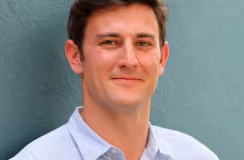
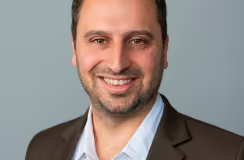








%20-%20thumbnail.avif)


%20-%20thumbnail.avif)
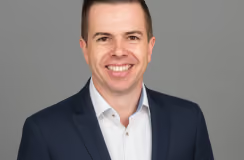

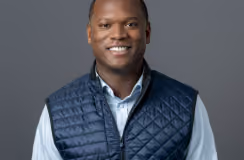
%20-%20thumbnail.avif)

.avif)
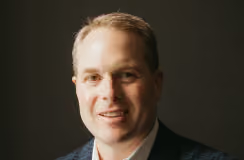


%20-%20thumbnail.avif)