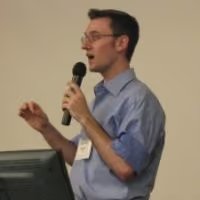
Host: Today's guest started buying businesses about 10 years ago. And today the portfolio that Andrew Blesenko has acquired generates 60 million of aggregate revenue and 12 of EBITDA. But Andrew started small. His first business was a building exterior cleaning company doing less than a million dollars in revenue, about $250,000 of SDE. He bought that one as a side investment while keeping his day job. Flash forward and in late 2024 he closed on a $19 million manufacturing business plus $22 million in associated real estate. So you can see the trajectory here now. Though the size of the businesses Andrew acquires has changed dramatically, one thing has remained constant, his dependence on operators to make his acquisitions go. Andrew's playbook has always been to pair operators with businesses, which is nothing new really. Private equity does the same. But Andrew didn't start as an independent sponsor doing deals in the style of pe. He started as an acquisition entrepreneur like you. And though the conventional wisdom and even what we preach here on Acquiring Minds says that you should not expect to just install operators for your first acquisition, rather you should expect to be the operator. Andrew was installing operators from day one. It has worked well for him and we unpack it. Here he is, Andrew Blazenko of Eterna Equity. Welcome to Acquiring Minds, a podcast about buying businesses. My name is Will Smith. Acquiring an existing business is an awesome opportunity for many entrepreneurs and on this podcast I talk to the people who do it. Buying a small business sounds simple. Find a company, due diligence, get a loan close. In reality, you wear every hat just to get the deal done. And then the moment you close, you have to throw those deal making skills out the window and learn how to operate. You shouldn't have to rebuild this infrastructure from scratch and you definitely shouldn't do it alone. That's why Walker Deibel created Acquisition Lab, which started as an accelerator, has expanded into a complete ecosystem for acquisition entrepreneurs. Over six years, the lab's 1200 members have acquired over a billion dollars in businesses. The Lab puts everything under one roof. An active community, deal reviews, post close services, and a dedicated fund helping experienced operators buy larger businesses. If you're serious about buying a business, come see why Lab members have a 40% success rate. Learn more in the show notes or at acquisitionlab.com/acquiring minds Andrew Blesenko, welcome to Acquiring Minds.
[3:24] Guest: Thank you for having me. Will appreciate it.
Host: Andrew, you have made a second career for yourself in buying businesses. Today you would probably identify as an independent sponsor, but you don't come from a traditional private equity background. So I tend to see you as an acquisition entrepreneur who's now years into his journey. I may be splitting hairs there, but the point is that you have stairstepped your way from your first very small acquisition into larger and larger acquisitions. And in a way that I think many in the audience could model. Now, we're not going to have time to get into all of those acquisitions. Andrew, there are a lot of stories that you could share. We're going to focus on two or kind of two and a half. But let's begin with the end. Let's begin with where you are today. What does your portfolio of businesses look like? What do you own, bullet points, aggregate revenue, etc. If you would.
Guest: Perfect. And I appreciate your characterization because I see myself the way that you do. I'm a business buyer, not a private equity type guy. Today, my portfolio, I've made six acquisitions as we'll discuss. I started small, so total revenue of 60 million, total EBITDA of 12.4. And then within two of those acquisitions, we also bought the real estate and the rent from those real estate is 2.3. So kind of a total of say, 15 million EBITDAR, which is an important term for if you own the real estate too.
Host: Right, Great. And what are the real estate holdings worth?
Guest: The real estate holdings, good question. The east coast ones are probably in the $30 million range. And I've got one on the complete opposite coast, the west coast on Vancouver island, and that one is north of 4 million.
Host: And you are based where?
Guest: In Vancouver.
Host: In Vancouver. And you are how old?
Guest: I am. Good question. 39 now. So, okay, that's a question that gets harder and harder as you advance in age. You have to kind of think back, but yeah.
Host: Or are you in denial because the next one is the big four zero. And so you're trying to forget how old you are. I've been there. Well, that's very impressive. Obviously, Andrew, it's why you're here and why we're eager to hear from you. Let's now hear what your background was kind of the first chapter of your. Of your career before you got into buying businesses. Please.
[6:19] Guest: Yeah, I'll start from the beginning. I graduated Simon Fraser University, where my dad actually worked as a finance professor, if the name Blazenko is familiar to anyone in Canada. So I graduated 2009 in the aftermath of the financial crisis, and you know, a lot of my friends went into the CA CPA route. Others went commercial banking because investment banking, there wasn't a lot of opportunities. But I met someone At Deloitte Corporate finance of all places. When Deloitte was on campus and this individual was, you know, down to earth, he talked about how he got to meet with business owners on his regular day to day job. CEOs, CFOs. And the important piece is that he helps people in the most important business activity that they'll do in their careers and supports them through that process. And you know, that in contrast to investment bankers who, you know, I think as you described, they're a bit posh, they're a bit unapproachable, you know, not somebody that I would ever aspire to be personally. And, and so this, this more down to earth guy spoke to me and post university I only look for jobs in corporate finance. You know, I, I found out pretty quickly that you know, the Deloittes and the KPMGS and mid market M and A firms typically hire people with experience. I was just out of university so I just, I, I got a job with a small business broker for the first year of my, yeah, I actually got that job before I even graduated university. And I, I basically did one valuation per week. These are small businesses, kind of say under 5 million, but most were under a million. So like coffee shops, small, you know, metal fabrication shops, you know, real Main
Host: street stuff as we would call it here.
Guest: Exactly. So I, I got a lot of exposure to, to that, that side of the business, but it was, I was dealing directly with the business owners and the decision makers and stuff like that. So that was exciting. It wasn't a lot of pay so I couldn't stay there for too long. But it was a great first stepping stone as you said in the intro. So I'll quickly progress because I know we have a lot to cover. I then went to work at a public company in corporate development or M and A. This was in the education space. That's going to be important for later. And while I was working at this education company, I, I was approached by business brokers who wanted my services as a, as a valuator. So I, I was doing my cfa, I started to do my cbv, which is kind of a valuator designation here in Canada for private companies. And then I started off the side of my desk evaluation firm and was doing not as many as I was previously doing, but maybe one valuation per month. And these were all people who had approached me and what I did from there was, I was like, okay, let's drum this business up. And so I approached some M and A firms seeing if they needed valuation Assistance. And one of the firms I approached was Sequoia M and A. And I met with the partners there. They were like, screw sending you work, let's just hire you and you know, we'll build you up to become a partner in a couple years. So that sounded like a great proposition to me. They were already doing sizable sell side M and A engagements. They were my style. Like they were entrepreneurial, you know, not high flying kind of investment bankers and very approachable. So joined that firm quickly, made partner and yeah, you know, was exposed to, in my opinion, some of the best business owners in the business at Sequoia. I. You know, as you're working with someone, you typically takes a year to get a business from the first time they send you financials up until the closing date and then you get to have a couple of beers with them after it's all said and done. And you know, they're exhausted but
[11:28] Host: rich.
Guest: But rich and satisfied and happy. You know, and you know, there's some, some people who get rich and buy fancy cars or fancy houses and they're never happy. This is, this is the one time where I've seen pure joy, pure happiness and I wanted a piece of it for myself. So I started buying businesses off the side of my desk.
Host: Great. Andrew. Well, one of the things that does jump out is that while I said you don't come from a traditional private equity background and you don't or investment banking, you do come from a business brokera background and you have a lot of experience in doing valuations and valuing businesses. So you do come from, you do have that really core ingredient as part of your resume. So just need to highlight that. Okay, so let's quickly hear I said we're going to do two and a half of your acquisitions. The half one is going to be this first business. We'll just give it a minute.
[12:32] Guest: But
Host: I think the key point to the story is kind of it's your origin story, how and why you decided to start doing business acquisition off the quote side of your desk, as you put it. And then what you learned from this first little dalliance with business buying. So why did you get into buying businesses yourself as opposed to just being a vendor, a service provider in the ecosystem?
Guest: Yeah, good question. And you know the thing that draws me is, is the fantastic returns that I was seeing, buyers that, that I was dealing with were, were gearing to make. You know, I did all the financial modeling for, for the sellers and you could forecast what a, what a buyer would return. I was in the business of selling. I wanted something like what my parents had on the side, which is they're investing in real estate. They'd buy a home, they'd make it into, they tear it down, make it into a triplex and live comfortably off of those rents in addition to their regular jobs. My mom was an accountant, my dad was a professor.
Host: So did you envision doing this as a side thing only at least initially.
Guest: Initially, so I could figure out the finance piece, the valuation piece, the structure piece. What I needed was somebody willing to quit their jobs and go run these businesses. And so a friend that I studied the CFA and CBV with happened to also be looking for, for businesses. And so while we were studying together, we shared our notes and in his case he did what we call now the proprietary outreach method where you know, he is actually the CFO of private business that he wanted. A part time CFO of a private business that he wanted to acquire while working full time at a commercial bank. And you know, his intention of doing this part time CFO gig was he would be the first in line to buy the business and he knew that the owners wanted to sell. You know, I was telling him my method is always, you need, you need options in this game. If you've got one prospect that you're looking to buy, you're unlikely to transact because business owners have their own idea of who they want to go with. And, and, and that's what resulted is, is they did want to sell. Eventually him and I put in a bid and you know, we, they went with somebody who they thought was a better fit. So that hurt a little bit. But you know, again, I was probably looking at six or seven and we had six or seven opportunities to, to put an offer in on. I think we put three offers, got one. It was called Knightsbridge Property Services. So they did window cleaning, gutter cleaning, pressure washing, all for low rise apartments and townhouse complexes and things like that around Vancouver Lower Mainland. We bought it for a great price.
[16:09] Host: What were the bullet points on that business, Andrew?
Guest: The bullet point, we bought it for 800,000. Um, it was probably doing 250,000 in EBITDA. Friend was going to run it. Revenue is about 800,000. So really good margins. And yeah, just needed somebody to go run it. And yeah, so, so on paper looked great.
Host: And so it was a, an exterior. You said exterior building cleaning and maintenance, sort of.
Guest: That's right.
Host: Great. Okay, so we're not going to spend much time on this.
Guest: But
Host: ultimately the business was it was difficult. That was one. And so I want to hear why in this. And it was also quite small. So just kind of fast forward to the very end of your relationship with that business and what some of the key lessons were from this first experience. Yeah, and then we'll spend more time on proafe.
Guest: What I learned here was, you know, anyone that's blue collar, that can, that has $500 to, to get a pressure washer and a ladder can compete with you. You know, bids come. Even though the SIM was very adamant about the repeat customer base, and that was true, they did keep coming back. But all it takes is for a, you know, an aggressive entrepreneur to come in, submit a bid completely lower than yours, and they'll win the business. And if you're not building that business like the previous owner was, the business is declining. Right. And you know, the other issue I was learning about that business, you know, a year or two in, was that you needed really good operator business fit. And that's a really hard thing to pin down. And I can get into how we knew that that was that we had a really good fit within the next business we'll buy. But how, you know, it's, it's not going well is two factors. One, if employees start to leave and you know, if, if bad apples start to leave, then you know, that's not a bad thing. You can replace them with eight A type players. But if some of your best performers start to leave, you know, the culture is not the greatest and as you replace them, they're not as effective and then customer quality starts to diminish. So you know, that, that did happen to us after a couple of years. We maintained the revenue and the revenue did grow, but the EBITDA rate stayed about the same because again, the people that you're replacing these high performers with are just not as, not as effective in their jobs. So that's a quick lesson. But you know, the first two businesses that we bought had that kind of, we didn't have the right operator to business fit. The third business really did. And that's where that one was called prosafe First Aid Training.
[19:42] Host: You know, Enzo Technologies as one of the leading IT managed service providers serving the search community, led by Nick Akers, an acquiring minds guest who bought the 35 year old business. The team at Enzo regularly works with searchers and their acquisitions. And one feature of acquired businesses that Enzo is seeing over and over is the need to implement cybersecurity promptly during the transition. So many acquired small businesses either have glaring Vulnerabilities lack security, best practices or both. That step one to de risk the deal you just closed should be addressing these issues. INSO is your full service IT MSP for post close stability. They assess your target surface, the biggest risks in plain English and give you a day one through 30 plan to cut exposure, prevent downtime and even find cost takeouts like bloated telecom bills. Check out enzotechnologies.com I N Z O or email Nick directly at nicknzotechnologies.com Great. Well, let's spend a little bit more getting in the weeds on Prosafe. This is a business that you're still in for now and it's already been a fantastic run, even if you held it indefinitely. So, and it's a much, you've grown it a lot. It's a much larger business today than when it was when you bought it. Seems like a great business. Let's hear about it. What is prosafe?
[21:26] Guest: Yeah, Prosafe is a first aid training school.
Host: First aid training, first aid training.
Guest: So they deliver first aid training, which is kind of CPR training. It's required for a lot of jobs like if you're a teacher, a nurse. If, if you work in a warehouse or a construction site, you need a first aid ticket. We also do work safe training, fall protection, enclosed spaces again within certain fields in construction or, or you know, working in a manufacturing or warehouse. You need these tickets and you need them updated every couple of years. And, and so yeah, you know, fantastic little business. When we bought it, it had two campuses. We were the second buyers of this business. So it was founded by an individual, purchased by a lady and within two, three years she wanted to sell it and sold it to us. The main driver for growth here, you'd expect it to be, you know, finding new students is, is, is a good driver for growth. But the, the bottleneck driver for growth, I would say is finding really good instructors. But the great thing about owning a training institute is that, you know, you take your top student, your top two students, you approach them after class, hey, you really excelled here. You're, you're, you're natural. Have you ever thought of teaching? And you know, does that, does that
Host: work as well as it sounds?
Guest: It does, yeah. Yeah, that's great. That's how we get some of our, our best instructors. And then the best instructors help you reach out to even more students and you get better referrals that way. And yeah, so if you deliver funny. Hey, well, if you deliver a great service, great product, people naturally Come back that easy, huh?
Host: Andrew, how big was that business?
Guest: Yeah, we bought it for 950,000 and it had 310,000 in EBITDA at the
Host: time with so still a small business, a pretty small business and frankly smaller than in self funded search land. The conventional wisdom would recommend especially Canadian
[24:09] Guest: dollars, which is basically supposed to you guys, right?
Host: And at this point were you still doing your day job?
Guest: At this point? I was still doing my day job, yeah. Okay.
Host: And the operator that was going to run this was who.
Guest: Yeah, so that's what I'm talking about. I think it was a fantastic business. The exact right timing and I had a friend and colleague who was the exact right fit to take on the CEO role in this, in this, in this company. So you'll recall that my second job out of university was CIBT Education Group, a publicly listed education business. We had a number of campuses within, you know, Sprotchaw and kgic, two of the education businesses that we owned. And one of the youngest and brightest campus directors who was running one of the biggest campuses within that network was in his late 20s. You know, a lot of middle age staff were reporting up to him and they were happy to do so. So that indicated to me this guy was, his name is Colin. He, he's a, and an exceptional leader. Someone who's not necessarily the, the loudest person in the room, but he's got a quiet confidence about him and can rally the troops around him. And so someone like that is not only a great leader but also a great leader in the education space. And I knew that he'd be the right fit to, to run prosafe.
Host: And if you hadn't found him, would you have done the acquisition? Are you basically only doing an acquisition if you, if you feel like you have a good operator or will you proceed and then hope to backfill that? How do you think about that sequencing that?
Guest: In this case, everything happened really, really fast for Pro Save. So now we do a bit of both. In my opinion, finding a really good business is more difficult than finding a really good operator. There's, there's a lot of fantastic people that I've found and they'd all be great at running certain businesses. And so we're looking for both though. We, a lot of our efforts are spent, you know, looking through 500 teasers and 125 or 130 Sims per year. And then out of those we usually find one that we actually acquire within operators. You know, there's, we do our, the, the opposite Thing which is, you know, we're constantly looking for them and, and then if we find someone who's really great, we will search for a business within the industries that they have experience.
[27:36] Host: Ah, interesting. Really?
Guest: Yeah. Okay, so there's kind of a.
Host: So you'll find an operator that you like and try to find a business for sale to meet this operator. That's very interesting.
Guest: Yeah. So you can think of it like one. One is proprietary search, so find a really good operator. Now we go search for a business and contact business owners directly within the field that they know and love. And the other one is a brokerage search. So you know, we still get lots of teasers and things from M and A firms and investment banks and, and then yeah, once we find one that we really like, we've got an executive in residence program and we allow them because they've signed NDAs with us, we allow them to review each of our dozen opportunities that we're currently looking at. And then two or three of them will raise their hand. And raising your hand, they've all signed contractor agreements with us. So raising your hand means I'm willing to review this with you. And if it fits all of what I like, I would leave my current job and come run this business. And then what we do is we pay them for their time as they, as they diligence the opportunity because their diligence is critical for the success of the deal. Right.
Host: And back to proafe. So. Or actually and, and maybe today the, your operator and proave Colin, or what did you call them? Your executive in residence.
Guest: Executive in residence.
Host: Yeah. Yeah. What do you, how do you structure their ownership, if any?
Guest: Yeah, usually they, they're seasoned executives and so they're making a lot of money currently and so it would be optimal for them to put a quote, unquote, meaningful amount in invested. So meaningful amount is, is different from every, for everybody. You know, if they're draining their savings account and, and it amounts to 50,000 or 100,000, as long as that's meaningful for them, that that's okay with us. We just don't want a situation where you know, someone has a multi million dollar stock portfolio and has invested a hundred thousand dollars with us and, and then they're offered a job for $700,000 per year and they leave us. Right. There's no. There's for them. Yeah.
[30:33] Host: And so the amount of money that they bring to the transaction then that's just, that's just gives them their pro rata share of the equity that's right.
Guest: And then. Sorry, you're saying compensation. So there's.
Host: Well, actually ownership and I'm curious. Yeah. Because I assume compensation wise they make kind of a market rate for whatever their salary would be. Kind of a market salary. No.
Guest: Yeah, market salary, but not necessarily the same as what they were making before. You know, if they're coming from $100 million business and they're making half a million dollar salary plus bonus. So they could be making up upwards of a million dollars a year and you're buying a million dollar business or you know, a business that earns 2 or 3 million in EBITDA, you can't pay them that, but you can justify it with the, the equity piece. And so, you know, in addition to salary and bonus, which might not be upwards of what I just mentioned, we, we cut them in on some of the carried interest and you know, it tends to be different for, for different individuals. We've kind of standardized it now. But you know, in the past while we were playing with the model, there was certain individuals that were making more or less or whatever and now we're, now we're about, now we're standard.
Host: Well, in the Colin case, back to Prosafe, the business doing $310,000 of SDE there, there and now he was younger but still showed a lot of promise that he probably was not getting market, market rate to come run the business. So you probably had to buttress his earnings with a significant share in Prosafe.
Guest: That's a good, I mean in Colin's case, I think he was earning at about the same rate or more within this acquisition because, because he was young, because of his age, you know. Yeah, when you're 50, 60 years old, your constant pay raises get to a certain level. You know, maybe his, his pay hadn't caught up to him. Although, you know, I can't be certain because I, I don't know what he was making before but I know that he's, he's at a fair level and Colin was our kind of, our first case. What I did with Colin was what I thought was fair at the time and I didn't, this was 2020. There was, I don't. Was your show around in 2020. There was no comparables for, for what we were doing. We were still charging a carried interest and at a slightly lower level than what I'm charging now. But what I thought was fair for Colin was that he shouldn't have to pay any carried interest given he is running the business. He's building it and so that was, that was the justification for. And we structured it as a bonus. But my understanding and I didn't. The legal work was done five, six years ago. But that bonus he's able to claim capital gains on and earn it as part of a corporation I believe.
[34:10] Host: And so what has the trajectory of the business been?
Guest: 950 was what we bought it for. Revenue was about 1 above a million 1.2 or so great.
Host: And then that was 2020.
Guest: That was 2020. And out of the 950700 came from RBC, a bank up in biggest bank here in Canada. And we put down 250,000. There was no vendor note, no earn out, no rollover equity. It was pure cash from bank plus our cash.
Host: And what does the business look like today?
Guest: Yeah, Today we are 1.5 million in EBITDA and about 7 or 8 million in revenue. You know I give all credit to, to Colin again he's the type of leader that, that people respect and, and one case in point of that is there was an individual during our diligence that he was a critical person and he told us that he was going to retire in the next two years and he was developing all the curriculum again very important person to the business. And when you hear that you're like okay, well once we acquire the business, you know he, he might only last a year. But the environment Colin, you know built within this business was such a positive one and something that, that people wanted to be around that this guy's stuck around even today, six years later.
Host: And so Andrew, on a returns basis this business today does a million and a half of ebitda. If you were to sell it conservatively, what do you think the enterprise value might be?
[36:04] Guest: I'll preface this by saying we are not planning to sell but we have received offers. And those offers, you know, without negotiation result in a 45 times multiple on invested capital and close to 100% return on invested capital. So if we wanted to sell we'd be making a very good return.
Host: 100% IRR per year.
Guest: Yeah, yeah.
Host: Per year. 45. So you're 250 of equity that you put in to acquire it. The proceeds could be 40 times that is $10 million.
Guest: 40 times that is 10 million. So yeah, offers came in a little bit north of that. But again we've got a growth plan.
Host: Not looking to sell. Not looking to sell.
Guest: We've got a growth plan. There's a couple more acquisitions that, that we've got lined up. And so you know Acquirers are really looking for a growth story and
Host: you
Guest: need a little bit of meat on the bone. And what we've been able to do with acquisitions is, you know, you buy an acquisition of a school that might be doing only, you know, half a million in revenue and 100,000 or so in Ebitda and then you put in our systems where, you know, we've got fantastic instructors who can go into those schools from around the city. You know, we can load them up with lots of students, we've got lots of recurring sources of how we find students and you know, send them to the new schools that we've acquired and therefore within a couple of years we can build those schools from a hundred thousand in EBITDA to 2, 300,000. So two or three times and then their kind of run rate growth from there. So with this kind of flywheel model, yeah, it attracts the right investors to purchase us and in the future. And so if we can continue to demonstrate the growth, I'm sure that they'll
Host: see that running payroll, paying your bills, closing your books and producing financials, these are critical tasks every business owner must do or oversee. But spending time on them distracts you from the leadership in growth work you want to do. So let system 6 do it for you. Owned and led by a former Searcher, Chris Williams, System 6 is a leading outsourced finance team for hundreds of SMBs, including over 50 searcher acquired businesses. Chris, Tim and the System 6 team understand firsthand the challenges, the opportunities of jumping into a business as its new owner. So whether you own your business already or have one under LOI, talk to System 6 about how they can give you time back and improve your financial operations. Mention acquiring minds and they'll provide a free review of your books and financial ops, a $500 value. Check out system6.com link in the show notes or email helloystem6. The meat on the bone point is, is one we hear about. When you are growing your business, you want to be able to make an argument to prospective buyers of your business that there's still a lot of growth to be had. So you don't strategically want to grow to the business's ceiling. You want to, you want to sell when they're still that your buyer can can see their own growth path ahead. Let's hear now about Trufoam. Andrew. So we're jumping ahead a couple of years. Few years in your story, the CPR business was a million dollars of revenue. Truphone is a much bigger business and I think it's telling it because it shows the trajectory, your progress, your increasing sophistication and capacity as a buyer. Tell us the bullet points on Trufoam, please. What does it do first and then the size of the business?
[40:44] Guest: Yeah, happy to. Yeah. Trufoam is the size where that I was used to from my days at Sequoia. You know, we, we would, I would look at these businesses all the time and, and help the business owners sell them. And, and so, you know, again, I'm very familiar with, with bigger businesses. And so this was a natural fit. Trufoam produces expanded polystyrene, which is an insulation product. Half of the business produces this expanded polystyrene for fish boxes and lobster boxes. You might see that in, like, restaurants. As the fish comes in, it comes in. This looks like a Styrofoam box, but it's actually probably expanded polystyrene. But it's also half of the business. So 50% of the revenue is in insulation for buildings. It provides a very good R rated value for insulation. And so, yeah, there's two facets to that business. What we bought was 32 million in revenue, 8 million in EBITDAR. We segmented it at the time. 6 million business EBITDA and 2 million rental. Rental income. There's four facilities, but nine properties. And so some of those facilities include multiple properties adjacent or maybe a couple of doors down. And each facility is basically a steam plant. So, you know, you produce steam, goes up these pipes and the pipes filter throughout the rest of the building into this machinery. And you take these polystyrene beads, tiny little beads, you put them into your mold. You fill that mold with steam, it expands into the, into the mold. And then you shape it and cut it from there. Or perhaps the mold is already shaped, but you can slice it up using hot wires from there. That's as. And then you ship and package and ship the product. One thing I'll mention about Trufoam, which really excited us and kind of caught some buyers off guard. You know, when you hear of quote, unquote, plastics business, some people who initially rejected Trufoam were saying, hey, this could be shipped from China. Like, you know, why, why is manufacturing still done in Canada? And the reason for that is within a 500 kilometer radius of your facility. If you're delivering a product 500 kilometers, it costs as much to ship the product as it costs to manufacturer, including labor, product cost, overhead, and all of that stuff. And so absolutely cannot ship it from China. That would be way too much in shipping costs. These are really big, bulky products, and moreover, you can't even ship it from the nearest province.
[44:09] Host: So is there one of these in every state? In every province?
Guest: Exactly, yes. And there's two competitors within Atlantic Canada. So we're in three provinces within Atlantic Canada. Nova Scotia, Newfoundland, and New Brunswick. And we've got one competitor. So, you know, can't get any better economic moes than that.
Host: And what was the purchase price on the business?
Guest: So we bought the property as well. The business we bought for 19 million. The property we bought for 22 million. One important factor is how this business was introduced, and we spoke a little bit about this. But since prosafe, I understood very clearly how important a really good operator is for a business. And I talked about those two avenues for how we now approach business acquisitions. I put out a feeler to my network for anybody who's a fantastic operator, I would love to meet with them because at the time I was finding a lot of businesses that, that. That the owner wanted to retire. And, you know, I wasn't willing to leave my job. And my business partner, current business partner, is running a business and doesn't want to leave that job either. So a wealth manager that I knew really well introduced me to Josh Plamondon. And Josh ran a business here in British Columbia that does the exact same thing as Trufone. And he didn't have any equity within that business. And so first I was talking to him. We hit it off right away. He wanted equity within a business and wanted to make an acquisition. I showed him my pipeline of opportunities. He said, hey, I'll do you one better. I know of true foam that is right in my wheelhouse. Let's buy that together. And so that's how that's how that whole thing started.
[46:23] Host: Andrew, how do you react to people, including this podcast that says business buyers should be very cautious about buying a business and just putting in an operator at this point, You've done it and you are the basically an independent sponsor model. So the independent sponsor model does. Does mean that you buy a big enough business that it supports an operator. You're not going to go be the owner operator, but you've done this every time and you've thought clearly very deeply about finding operators. But I just wonder how you, how you respond to many stories on this podcast. Most stories on this podcast where the business buyer is the operator, you've avoided that model the entire time. And in fact, the way you're doing it is how most people would like to do it.
Guest: The way I think of it, and a lot of investors don't agree with me on this, but the way I think of it is my expertise is in evaluating businesses, understanding, you know, the economic moat and the growth prospects and, you know, getting the deal done. I come from a very Warren Buffett school of thought and, and in, you know, evaluating businesses. But I can't pretend to be somebody who, who can go in and run the business effectively. What I like to do is find somebody who's already doing something very similar, but that's the bare minimum. In addition to that, they have to have a desire. To have ownership and desires too weak of a word. It's almost like an obsession towards, towards ownership. And we saw that clearly in, in Josh and in Colin and yeah, you know, you gotta gel really well with this individual.
[48:38] Host: Would you advocate for like a first time business buyer who's gonna buy a smaller business that they, that they do that, follow this model? Because most places, including probably here, we would say don't, don't think that you can do that. You should go in and run the business yourself.
Guest: Yeah.
Host: At least for a few years.
Guest: And a lot of opera, a lot of investors believe that to be true too.
Host: So you disagree with that?
Guest: I'd advocate for. I had a different start. You know, a lot of the first couple of businesses kind of under a million dollars in purchase price. I learned my lesson with my own capital before going out to investors. And the other factor is I'm a very trusting person. So for the average individual, I would say trusting your life savings in the hands of somebody you met three to six months ago could be challenging. And you know, I, I'm trusting, but I also have confidence in the ability if, if this individual were to leave and were to find a job somewhere else. And, and I have a trust in the, my ability to, to find someone new. And I think that trust comes from, you know, I've got really good networks, really good people I can draw in and help me solve problems. And yeah, we've done it before where we trusted the wrong individual and then quickly found somebody to replace her. And yeah, worked out really well.
Host: Um, okay, Andrew, let's just, before we close the Trufoam story, hear about the realities of raising money for an acquisition that was too big to take down yourself or friends and family. You were going to have to go out and get real, real LP money. What did that, what did that look like?
Guest: Please, I'll say first, just to back up, I guess it was a $42 million purchase price or sources and uses including professional fees for true foam. We're able to get 22 million of that in a mortgage which is 100% loan to value on a 25 year mortgage on the real estate and then a $12 million loan at a very good interest rate. Currently it's at 4 and a 4 and a half percent and a 10 year amortization which gives us, you know, a lot of leeway. But that leaves us about eight kind of eight and a half million of equity to raise. And you know, raising a million dollars in equity has some challenges but is, is potentially pretty straightforward raising eight and a half million. And your first raise presented some challenges especially because no offense to, to your podcast, but I was listening to a lot of US buyers having said things like, you know, if you've got the right business, the right operator, the right valuation, finding investors is easy. And yeah, and, and that, that is probably true in, in the U.S. although I, I can't confirm it because I, I'm a Canadian investor and, and Canadian, I buy Canadian businesses. But you know, we had a fantastic valuation. The ideal leader in our opinion, a fan, great business with lots of room and you know, a lot, you know, within our networks we, we knew a lot of high net worth individuals. Especially given my prior role. I was selling businesses between 10 and 300 million in value and we had a lot of success doing that. So you know, anybody who's selling their business for 80 million has a lot of money to invest and knows the, the results of could be fantastic within those investments. So long story short, raising money was challenge. You know, we were, we went out to our, our friends and acquaintances and people who have had a lot of success in business. Number one we, we had success within people we've actually worked with and are close friends. So that was, that got us 70% of the way there. And then later on in the process we approached a, a group called Sage Capital. They're very, very, they're very good here in, in Canada. They're, they're kind of pioneers in this search fund and, and independent sponsor space.
[54:08] Host: You had reached out to a lot of American investors and they said no because they didn't, they couldn't or didn't want to the extra lift or the extra diligence involved in doing a cross border transaction. Right. Which is key for Canadians and other non US folks to hear.
Guest: Yeah, so you know, I would say our first shot across the bow was people we knew and you know, eventually within two or three months which sounds like, you know, not a lot of time, but it was a lot of time when you're talking about a deal. Post loi we got there and then because it was slow with within people that we knew, we, you know, thank you to you. You gave me a list of investors who invest actively in search funds and independent sponsors. A lot of them were from the US and you know, I downloaded other lists of people who invest in this space. But time and time again, you know, these investors who are from the US they have more than enough opportunity within US businesses. Why would they want the extra complication of investing in a Canadian business nowadays? You know, you do have, you do have investors who are more interested in or have raised a fund that allows for it. And so you know, we're seeing a little bit of that now. Post Trufoam this is more speaking on Terrigen now. Now we do have a US investor but True foam is all Canadian and yeah, that was, that was more difficult than, than I originally thought.
Host: Well we, you, you sent us the deal at Mines Capital and in our first fund we were just like you describe, only looking at US deals. Part of that, most of that really was, was just the extra lift in doing, in doing cross border transactions and the diligence and the extra legal and, and so on. And so there's just as American capital providers, you're spoiled because our domestic market is so large. You're really looking to filter all of your inbound deal flow. And a deal being in another country is just easy to put in the, as Buffett calls it, to too hard pile. So it just kind of, and, and you know, may, and we probably missed a lot of good opportunities like Truphone because of that. But it's just a reflex, a default. I will say that for flat. For our second fund for Flagship two, we now are investing in Canadian deals, but just Canadian deals. And it's not like we've gone international because every additional country that you add adds friction, adds legal and adds complication. So it's just, it's, I wanted people to hear that. Not just Canadian listeners, but anybody who's from a smaller. Really anybody outside the U.S. because the U.S. is the exception, not the rule. The vast capital pools that exist in the US really make it a much, much easier environment to raise money in. And most other countries, that's just not going to be the reality.
[57:29] Guest: Yeah. So for us, for example, what I saw from the US is there's people who actively invest in the space, they're familiar with search funds and independent sponsors and, and know the standards within the industry. For us, we kind of had to convince a lot of high net worth, you know, real estate investors or business owners that hey, this is, this is your returns after fees and, but you know, for a lot of them this was their first investment in a structure like this. So you know, as you know that that takes a little bit more convincing than somebody who has done five deals in the same, the same structure and is evaluating this as you know, in addition to five others. Right.
Host: Two more questions for you, Andrew. The first is I assume you have contact with people who are aspiring searchers, business buyers aspiring to do what you do. Maybe not, but to the extent that you do or, or what would address them if you did, what would you tell them? How does somebody who doesn't have all the M and A experience that you, you did as a service provider beforehand and any sort of big career advice to provide somebody who wants to do what you're doing.
Guest: Yeah, and I've provided this advice before and apologies because I forget how the quote goes, but it was Alex Hormozy. He says something like do so much work that it would be unreasonable that you're not successful. And how that applies to buying businesses is a lot of people I talk to, they're looking for the ideal business, you know, I, I ideal valuation and, and all this stuff and you just won't get enough reps. If, if you do that, you have to, you have to get in the reps you need those reps in because you know, you're learning something. Every, every time you do an eoi, every time you do an loi and you're getting feedback from the seller or the business broker or who, whomever. Right. Eventually after certain amount of reps you're going to get something that, that you like and then you know, if you have optionality, it'll be something that, that you can decide whether you want to go forward with or not.
[1:00:14] Host: And finally, Andrew, on the, or at the risk of overselling this path and how buying businesses can just be this incredible career and lifestyle, do share with us what your A day in the Life of Andrew Blasenko looks like today because it's pretty sweet.
Guest: I'll, I'll caveat that will because a lot more people prefer to run a business. I would say they prefer to be the CEO. And so I, I've decided that that's not my skill set and that's not what I want to do. And so my, my job is very similar to, although much Much, much smaller scale. But I like the analogy of, of Warren Buffett or Monish Pabrai, where I'm Mohnish Pabrai says it best. He's, he's a gentleman of leisure. And then twice per year he makes a big decision and that provides enough income for the rest of the year. So my day to day, because I'm not running any of these businesses, if you're running a business, you're working 80 hours a week. But you love that. That's why you've made the decision to do it for me. I wake up early, I get to go play tennis at Vancouver Lawn and Tennis down the street from me or I go work out and, and then I grab a coffee upstairs and, and maybe a protein shake and I read Sims. I have management calls. Learn business and you know, a lot of time for quiet contemplation. If you look at my schedule today, I've got this meeting and then nothing
Host: else scheduled and today is a busy day for you.
Guest: And then, you know, tomorrow, just looking at my schedule, there's you know, another meeting and then Friday, I've got nothing. So you know, my schedule is, is tightly controlled and that way I've got downtime to think things through and you know, do what I love doing and what that allows for. And this is the part that, that I like the best is, you know, if I want a tennis lesson middle of the day, I can schedule that if I want to. And I've done. I played yesterday at you know, 2 2pm with a, with a friend and then we had a coffee afterwards and yeah, you know, if I, as long as I'm hitting those metrics that I mentioned, you know, eois every couple of weeks, I'm happy with the amount of performance that I do and I support business owners for whom I've bought their business. But you know, Eterna is built in a unique way. I'm the only, the one with MP8 advisor or investment banking type experience. My two partners, Michael Tuan and Josh Plavandon, both have experience building 60, $80 million revenue businesses. And so you know, they're the ones who can really support some of our portfolio companies in terms of the, you know, day to day, how do we hire the right sales guy, you know, how do we combine these two operations to, to make things more efficient and things like that. So I rely on my business partners and focus on what I love doing, which, which gives me the ultimate life. Agreed.
[1:04:09] Host: It's a pretty, a pretty, it's a pretty picture. You paint, Andrew and I congratulate you on building this and not even by the ripe old age of 40. So you've probably got a couple of decades more to keep enjoying it and keep building. I think it'll be an inspiration to people. We'll link to Eterna, we'll link to True Foam and Prosafe, and we'll link to your LinkedIn in the show notes.
Guest: Amazing.
Host: Hey, thank you for coming on Acquiring Minds.
Guest: Thank you for everything that you do. You know, a lot of, a lot of what I've done is, is because of some of the interviews I've heard and, and you know, it's encouraging to hear so many people having success and, and that's, that's the reason I keep going or, you know, have started down interesting paths. So keep doing what you're doing. I love it.
Host: That's great to hear. I appreciate you saying that. Thanks, Andrew.
Guest: Thanks. Will appreciate it.
Host: Hope you enjoyed that interview. Don't forget to subscribe to the Acquiring Minds newsletter. We send an email for every episode with an introduction to the interview, a link to the video version on YouTube and soon key takeaways, numbers and more essentials from the interview. For those of you who don't have time to listen or watch it, subscribe at Acquiring Minds Co. You'll also find all our webinars there on the website, both those we have coming up and recordings of past webinars. At this point, There are over 30 webinar recordings, a wealth of information on all the technical nitty gritty of buying a business. Acquiringminds Co.

























%20-%20thumbnail.avif)



%20-%20thumbnail.avif)

%20-%20thumbnail.avif)
.avif)



%20-%20thumbnail.avif)





.avif)