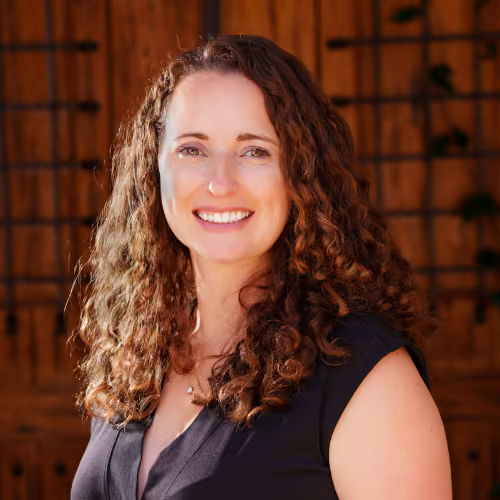
Host: Residential construction is not the typical target for a business buyer. Building additions, remodeling homes, ADUs. This is high ticket project based work for consumers. Well, today's guest, Alicia Powers, knew all that. But there was a lot that de risked Price Builders, the residential construction business in San Diego that she bought last July 2025. For one thing, Alicia knew and loved construction. She'd worked in it for years. For another, Alicia had experience driving leads and generating demand in the home remodeling market. In that very geography, Alicia knew the business and its owner and superintendent. She and her husband had hired the firm to build an ADU on not one but two of their properties. So she'd worked with them twice as a customer and seen firsthand the quality of service and product. Then there was structure. Alicia hung around the hoop after a first failed round of negotiations with her seller. But then months later, when negotiations restarted, Alicia was able to structure deal terms to mitigate her risk. Listen for that segment. And finally, what this business also had going for it was Alicia's interest in it. She was just drawn to it, excited by it. That X factor doesn't show up in the spreadsheet, but it can make all the difference. Here is Alicia Powers, owner of Price Builders. Most searchers know that a Q of E can kill a deal, but in many cases, a deal should have died long before the searcher spent thousands on due diligence. The signs were there. They just didn't know what to look for. Well, this Thursday, Andrew Hippert and Daniel Duran from Acquisition Lab Capital are hosting a webinar to teach you the early soft signals that experienced acquirers catch before ever spending a dime on due diligence. Things like dubious seller motivation, recent growth in the years leading up to a sale, excessive add backs. These aren't accounting problems, they are judgment calls. And the pattern recognition to make them well is what separates searchers who protect their time in capital from those who learn the hard way. Andrew and Daniel have reviewed hundreds of SMB deals and are going to share their hard won judgment with you. The webinar is this Thursday, May 14th noon Eastern. Link to register is right at the top of this episode's show notes or on the Acquiring Minds homepage. Acquiringminds co. Also a heads up. A lot of you have asked over the years whether there is a way to search the Acquiring Minds back catalog by industry or acquisition model or geography. And there hasn't been. But soon, and finally there will be. We're about to launch a searchable, filterable archive of every Acquiring Minds episode. Watch out for it next week. We hope it will be a very valuable resource to get your arms around over 400 case studies of entrepreneurs buying businesses. We're calling it the ETA Database. Keep your eyes peeled. Welcome to Acquiring Minds, a podcast about buying businesses. My name is Will Smith. Acquiring an existing business is an awesome opportunity for many entrepreneurs and on this podcast I talk to the people who do it. Running payroll, paying your bills, closing your books and producing financials. These are critical tasks every business owner must do or oversee. But spending time on them distracts you from the leadership and in growth work you want to do. So let system 6 do it for you. Owned and led by a former Searcher, Chris Williams, System 6 is a leading outsourced finance team for hundreds of SMBs, including over 50 searcher acquired businesses. Chris, Tim and the System 6 team understand firsthand the challenges, the opportunities of jumping into a business as its new owner. So whether you own your business already or have one under LOI, talk to System 6 about how they can give you time back and improve your financial operations. Mention Acquiring Minds and they'll provide a free review of your books and financial ops, a $500 value. Check out system6.com, link in the show notes or email helloystem6.com Alicia Powers, welcome to Acquiring Minds.
[5:16] Guest: Thank you.
Host: Alicia. You bought a design build general contractor gc, which is not a common business to acquire among searchers. So we are eager to hear all about your decision to do so, your experience doing so. Let's start off with some background on you first, please. Alicia.
Guest: Absolutely. And thank you so much for having me. I'm a big fan.
Host: Thank you.
Guest: I started off my career in the Air Force, so I went to the Air Force Academy in Colorado and then commissioned as an officer and started doing air traffic control and airport management and ended up running some airfield construction projects, doing Runway resurfacing, taxiway building, some having to do with building a tower. And that's how I got my first taste of construction and interaction with the trades and interacting with professionals. At the same time I was managing air traffic control facilities and so working with controllers that were really professionals and 99% of them were older than me and also developed a real passion for leading people and for learning how to lead people that had a lot more expertise than me and typically a lot more life experience as well. So I played on that a little bit. I went to Afghanistan, I ran more airfield construction projects there. When I came back, I decided to get out and I went and Joined an elevator company in Boston, and I was with the elevator company. So I switched to commercial construction for about seven years. Spent time in Boston running all the elevators at mit, which was a super cool experience. And really got my hands on and pants dirty, I guess you would say, with elevator grease and all kinds of other stuff. And then got the chance to go work overseas at the global headquarters in Switzerland. So saw the company from a completely different angle there. Got to experience corporate governance and global management. It was a large company, about $12 billion in revenue at that time. And then when I came back, I moved to San Diego sight unseen. It was during COVID My husband and I thought San Diego sounded like a great place, so took over the role as the general manager for the elevator business here for a couple years, and then switched over to residential construction, running a shower remodeling company business. And that was really interesting. I learned commercial construction, residential construction are completely different. The, the experience of managing them and working in them, the customers, how you sell, what you sell, the codes, it's all completely different. But I really liked my experience growing in, in residential construction and sitting with people, you know, at their kitchen table, typically, and talking to them at that time about their showers is very intimate space in their home. And going into people's homes and seeing how they live and then also providing the value of changing their shower in a relatively small project can have a huge impact on people's. On people's lives. And. And it's a huge. And it's a very tangible impact. So I started to really enjoy that. Through that process, I got my general contractor's license, which was a pretty big feat for me to go through all of the testing and everything. And then as I was, you know, kind of feeling like I wanted to do something more entrepreneurial, was looking at a couple different options. My husband and I, in the background, had been doing some real estate investing and worked with a general contractor to build an adu, an accessory dwelling unit, as it's known in California. It's like a small apartment or like a granny flat, depending on how you organize it at our house in San Diego. And then when we moved to the suburbs, we did it again with the same general contractor because we had a good experience and we rent those out now, but it was basically like building a little house. And I started developing a relationship with that gc.
[9:24] Host: Alicia, let me pause you right there. I want to underline a couple things from your background. First of all, going all the way back to the top, working in air field Was the word construction? Yeah, taxi way. Was that the other word? Construction? And how much you liked that in working with people who were the actual construction folks, the tradesmen and women, people who knew their stuff were years older than you that I, I mean you glanced off it today. But I remember from our pre call being an environment that you really enjoyed. Yes, good, good to underline because of course this is where we circle back to. All right, then the other thing is that when you went to Switzerland to work in corporate for the elevator company, it's one of the world's big elevator companies named Schindler. Schindler. You were the, what was it? The executive.
Guest: Executive assistant to the chairman of the board.
Host: Executive assistant to the chairman of the board of a multi billion dollar global elevator giant. So you also got to see the world from the corporate lens. And I mean you can't go buy a business and you know, and a multi billion dollar business like that. So maybe it's a moot point or question, but did that not that kind of white collar environment not draw you? Because that's not the type of business that you bought. It's you. It seems like you were pulled back to the actual getting your hands and pants dirty. As you said, work.
Guest: Yes. Boots also. I think, I think I enjoyed both. I mean, there's certainly an appeal to working in the ivory tower and flying around and doing global business and being a global business person and all of that is very exciting. But at the end of the day, you were making a lot of assumptions and pushing a lot of paper around. And even my experience, having spent three years with the elevator technicians, working very closely with them in Boston was very useful when I was in Switzerland because most of the people that I was talking to didn't even know how an elevator worked. You know, they had worked at this corporate level. And actually I started a Elevators 101 teaching program when I was in Switzerland just to teach my colleagues who were like the attorneys and that kind of stuff, like literally how an elevator works. And I loved being able to draw that connection and also being able to speak to like the reality is on the ground, like this is how work gets done in the world. You know, this is how this wrench is turned and this is how this rope is wound. And that was just very compelling to me. It was compelling to be able to speak to it and also to be the person who could draw, draw a through line for people between the oil and the grease and how work gets done all the way to the corporate strategy because there's not that many people that can walk in both places.
[12:37] Host: Yeah. Yeah, great. And you, as we're about to hear, you didn't do a search in the sense that you went out looking for businesses, so. Spoiler. But I do wonder. Elevator servicing. I've had a guest on who was very successful in an elevator servicing acquisition and ultimate exit, ultimately, an exit. Was that something that you considered or. Or not?
Guest: Not at all. And the reason was because I got really, really tired of the service business. And why.
Host: What should searchers know about the elevator servicing world?
Guest: Well, I don't think this is true for everybody, but at least for the big four elevator companies, you're bidding typically in the service world. So recurring service revenue, all that stuff, everything looks really good. But you have a fixed contract, right. With your customer, and that price, monthly price, typically includes all the repairs and all the maintenance on their elevators, with some exceptions for obsolescence and things like that. What I found as the person who was supposed to be executing these contracts, is that our labor rates kept going up. The cost of doing business kept going up. The prices that customers were paying per month stayed about the same. And so there was an intrinsic push there, which meant that I had to reduce how much service I was providing to people. And we would come up with, like, fancy ways to say it, like remote monitoring, things like that. But really what we were doing is reducing how much actual service was being provided to our customers. And there was so the. The. I felt that the incentive of the company and the incentive of the customers were misaligned because we were constantly reducing the level of service, but telling them that it was the same amount of service. And also, the people who were owning the elevators, typically, they didn't want to pay more anyway. And so. And they were sending things out to bid. And so it was a constant. The experience was constantly being yelled at on the phone by customers who were upset, and they were rightfully upset, and there wasn't much I could do about it. And so unless you really do start over and you really do put together, like, a very good case about why elevator maintenance costs more, or you change the billing philosophy so that you're paid, paid either on, like, an uptime as a measure of uptime, like how long, you know, how much is my elevator down, and then therefore, I'm paid directly based on that kind of metric, or you change all of the billing to time and material, I don't see how you really align the incentives and the outcomes appropriately in order to not end up in that situation. Again, and I think there's so much private equity interest in that, in that area that the multiples get out of control really quickly, which puts even more. Even more pressure on. On trying to squeeze costs out of the business.
[15:32] Host: So Ben Rizzo was my guest, this is now going back a couple of years at least, who bought the elevator servicing business in Pittsburgh. And he bought a small business. And I remember him saying that the way he was able to steal market share was because so many building owners, property managers, are unhappy with the big guys. The biggest, the probably your former employer and the other big three who have their own servicing packages, but then also these little independent shops can service them. And so he was. He bought one of those and was able to provide better service just by. With a, you know, a lot of passion and leadership and enabled. And probably he's under bidding as well, and was able to. Was able to, I guess, gain market share quickly enough and then. And then exited the business. So. And.
Guest: And there are people out there disrupting. One of my former mentors is. Is coming up with an independent elevator service company, and they're doing very, very well. The other side of that was that when I was in Switzerland, I was very close to, you know, Mr. Schindler, and I was. I was very deep in that company, and I didn't feel right starting a business and competing with them.
Host: Okay, Alicia, back to you and your husband have built. Paid a contractor to build not one, but two ADUs, as you said, which are just standalone small structures in the backyard. What did you say? Granny flat or whatever. Man cave or a she shed or casita.
Guest: And she shed is a little, little less. These. These have typically, like, full kitchens. You know, it's a one apartment, basically.
Host: Yeah, yeah, yeah.
Guest: Depending on the size.
Host: Exactly. And can be a rentable unit, which is, I guess, what you were doing. You can actually have a tenant. Okay. So you then start talking to the owner, the general contractor who built those for you. About what?
Guest: Well, I asked him, you know, came to know that he didn't really have a succession plan in place. He was pushing his seventh decade and probably would be looking at retiring sometime in the future. And so I talked to him about what his plan was going to be, and then I actually just called him and approached him one day asking him if he'd be interested in me acquiring his business. And he said yes.
[18:03] Host: And why were you interested in acquiring business?
Guest: Well, I, in the background, had been interested in entrepreneurship and was kind of looking into this ETA and search world, but I couldn't really figure out exactly what area I wanted to do it in. As a licensed gc, I kind of had maybe a walk in into a home services business that would make sense to a lot of folks. But I really was interested in the mentorship that comes with taking over a company of this scale and taking over something that was somebody's life's work. Uh, and I knew that he was looking for somebody that he could mentor, that he could hand over his, you know, 33, 32 year old baby at the time. He could hand this company over to somebody and have somebody take it into the future. He was looking for that, I was looking for that. And a lot of the search models that I saw, they didn't, they didn't include a structure or a handover like that. And I also wanted a lot of, a lot of training and that all kind of checked out. And because I was a customer of the company, I trusted them, I trusted him. And that trust goes a long way.
Host: And you had known about entrepreneurship through acquisition, you knew this was a thing people did, right?
Guest: Kind of, yeah. I, well, when I first met my husband in, in Boston on one of our first dates, we were talking about what people do after business school and he brought up this, that people go on search. And I thought it was just about the craziest thing I'd ever heard. There's no way people pay people to look for businesses. And I wrote it off at that time that was way before we went to Europe and came back. But it was in the back of my head that was possible. People do buy businesses. And then when we moved to San Diego, there were a couple folks here that were, were pretty good friends that had done it, had, you know, paved the pathway and were willing to talk to me about it. And so that's, that's how I got a little bit more momentum there.
Host: Buying a small business sounds simple. Find a company, due diligence, get a loan close. In reality, you wear every hat just to get the deal done. And then the moment you close, you have to throw those deal making skills out the window and learn how to operate. You shouldn't have to rebuild this infrastructure from scratch and you definitely shouldn't do it alone. That's why Walker Deibel created Acquisition Lab, which started as an accelerator, has expanded into a complete ecosystem for acquisition entrepreneurs. Over six years, the lab's 1,200 members have acquired over a billion dollars in businesses. The lab puts everything under one roof. An active community, deal reviews, post close services and a dedicated fund helping experienced Operators buy larger businesses. If you're serious about buying a business, come see why lab members have a 40% success rate. Learn more in the show notes or at acquisitionlab.com/acquiring minds.
[21:24] Guest: And then I was working for the shower remodeling business at the time, so kind of in the background considering eta. And I've been running the shower remodeling business for about two and a half years. Grow it grew it pretty significantly. But I had the classic my boss scheduled meeting with me for the following morning. And I logged onto the meeting and it was HR on the team's call. And turned out they had decided to eliminate my entire geographic location. And so I was being laid off. I was seven months pregnant at the time. And I had to also lay off my entire, my entire team that I had built, which at the time was about 30 people. And so that was really the catalyst that propelled me into, you know, saying I'm never, I never want to work for somebody else again. And I never want to build a brand or build a company for somebody else again. And sorry to go ahead.
Host: No, please, no, no.
Guest: After that is when I started to take ETA really seriously.
Host: Yeah. And let me just say, since you're not Alicia, that that shower remodeling business, I feel like is an understatement of what you were doing. If I may, you Kohler, the giant home fixtures, giant brand. I mean, I know, I know Kohler, Kohler toilets. I think I just bought a new Kohler toilet seat actually on Amazon. They were standing up a, a shower remodeling business that in, in your. They're based in San Diego. Right. And so this was ground zero. And they were doing their first experiment there, and you were among the leaders or the leader of that effort. And so this was like a, you know, a very large company doing a new venture, trying to break into a new industry. And you were instrumental in that. Ultimately, the numbers didn't get where they needed them to get to continue the effort, but it was, it was a big deal. It wasn't just a random kitchen remodeling thing. This was like a corporate effort to, to start a whole new division within a giant company.
Guest: It was, and that was part of what attracted me to it because I thought, you know, I was interested, interested in entrepreneurship way since before that time. But when Kohler called me and said, you know, we want to start a new line of business, San Diego was the third location. They had other, two other locations. And it's a, it's a field based business it's trades, it's, you know, fleet, it's safety, it's all the stuff that you've done. But we want to do it in residential construction, shower remodeling, it's, it was basically a startup. And so they recruited me to be employee number one in San Diego and then take it and grow it from, from the ground up. And so that is what I did. Yeah, over the, over about two and two and a half years. And Kohler has a shower product, shower wall systems product basically that they've been selling for quite some time in the range of 10 to 20 years with distributors across the country. And so and those distributors are major dealers, distributors, depending on how you, how you look at it, they call them dealers are major targets for acquisition. There's a couple of private equity roll up groups that have been super, super active in the space. And that was part of why Kohler potentially, in trying to figure out how to do it in house, so that these private equity groups didn't just go and purchase every single one of their dealers. And then the, the power dynamic in the relationship flips entirely. And so they had this model from their dealers that they had worked with, so they knew how to, in theory, knew how to do marketing and lead generation and installation and all those things. That was all in theory. And then when you put that together and actually you're installing actual showers in the state of California, the city of San Diego, that was all what I was tasked with working out. Like you said, we grew pretty significantly. And so we were installing somewhere between 25 and 35 showers a month. And so somewhere between maybe 600 and $800,000 a month of revenue at our peak. But we never made it across the line of profitability for a couple of different reasons. And so that was certainly what part of what played into Kohler's decision to, to shut it down. Not just my location, but actually eventually the other two, the other one of the other locations was shut down prior to mine. And then the other one, the one that was remaining, they actually just sold to private equity themselves.
[25:56] Host: And you were employee number one and you'd hired about 30 people. And so when they told you that they were going to shut down the vision, shut down the division, you were also the one to then let go all of those people that you'd hired. So painful. And, and it gives you, I mean, I think you had a number of reasons why you would want to go be an entrepreneur or buy a business, but that sure is a, another additional big why to Motivate you as you, as you said, absolutely. Agency, right?
Guest: Yes.
Host: Never letting that happen again. Okay, so you, what do you find when you talk to this owner, this general contractor whose business you might want to buy? And he's looking for a successor.
Guest: He had talked to a couple brokers, he'd gotten a couple maybe sort of estimates, but hadn't signed any documents with anybody which ended up working out in my favor. But pretty immediately he, you know, he had, I had worked together for about four years over the course of these projects that we did. So he knew me. He, he felt like he trusted me as well. And so he pretty immediately was, was really receptive to the idea. So I put together an loi. I used kind of a template between various books and people who were very nice to share theirs with me put it together pretty standard terms. I put in there, an asset sale, I put, you know, pretty standard, like networking capital, all those sorts of things, and sent it to him. It was a very slow process. From the initial time that I sent the LOI to the day we actually closed was about 15 months. And so there were some, it was a long time. And eventually we figured out he sent back a lot of revisions. Some of them made sense to me, some of them didn't. And over the course of about the first eight months or so, we finally ended up in a meeting in his attorney's office and the deal fell through based on some terms that he kind of wouldn't budge on. And what I.
[28:03] Host: Is there anything to learn from that, from what he wouldn't budge on?
Guest: I think the things that he wouldn't budge on were the work in progress for the business. And so if you're a searcher or you're in this ETA world, you think your coach or we understand that the value of the business is the value of its, its EBITDA or SDE or, you know, but the value of the business is this ongoing business, right? Like if you're. This is certainly one of the weaknesses that is very obvious in this business is that it's a project based company. And so we have projects going on and they may or may not appear next year. And you're. It's a constant sales pipeline effort. And one of the things that he wouldn't budge on was that the work in progress that he had, he wanted to keep it for himself. Both the revenue, but also the expenses. And it took me quite a long time to understand that that was because he felt like he had made a promise to those customers that he would be the one to, to execute that work. And I pushed back against it and I tried to talk around it and I tried different ways and methods and means. And at the end of the day, it was a moral thing for him. And so once I understood that, I had to find a way to, to work with it.
Host: And so he was, he was intransigent on this point, that he wanted works in progress, which is an unusual. Outside the norm.
Guest: Yes.
Host: But on the other hand, not for the wrong reason. The way he sees it, without knowing all of this fancy acquisition terminology and thinking it was like, let me just finish the projects that I started. Let me just deliver the service to the people that have hired me, that I would set it, I would, that I said I would do no big deal. Seems pretty clean.
Guest: Yeah, that's right. That's exactly how he looked at it. And then his idea about that was that we would have two bank accounts. He would have his bank account and I would have my bank account. And then when I started, my bank account starts. Starts there.
Host: And why is that a problem?
[30:02] Guest: Well, it's a problem because if you're paying for a company, you're buying a company based on a multiple of sde. If that SDE doesn't exist, then what are you buying? And there's a couple of things you are buying that are reasonable to. To value in this case. One is the, is the brand name. You know, the company has been in business now for 33 years, so there's some establishment of the brand name in the area. One is subcontractor relationships. So we have some sub, sub. Subs that we've been working with for 30 years. And those are, those are really valuable. And we have about 30 to 40 given subs that we work with at any given time. And establishing that, like if I was, I did evaluate as an alternative starting my own gc, which would have been cheaper obviously. But establishing all of those relationships, trusting relationships with your subs, where you get preferential payment terms, you get preferential bid terms. There's a lot of value in that. There's also value in keeping the license number. Our license number is like a very. What you would consider a very low number for people that pay attention versus giving it to me or like starting a new one, you would get a very high level license number that indicates you lack experience in the construction world. And then.
Host: And sorry, who, who would, who would be savvy to that?
Guest: Well, there is a theory that people, customers, some customers, I would say maybe a proportion, smaller proportion of Customers do pay attention to this and also suppliers and other creditors of some kind do pay attention to it. In addition to eventually, if we talk about the future, if I branch out into different types of construction, say we start a small commercial construction arm, those things do become important.
Host: Great, carry on.
Guest: So those are some of the things I think that you're buying, but those things aren't. And the other thing is like with the. I was very interested also in this documentable past performance because if I register the company as a service disabled veteran owned small business and then start going after commercial or government contracts, somehow past performance, 30 years of past performance is extraordinarily valuable for me. I have to have most, most government sort of things. You have to have a minimum of five years. And so that changes the calculus about how you might look at starting your own company versus acquiring one, if that's one of your goals. Which it was for me eventually. So if you roll and also insurances, that kind of stuff is also, we get preferential treatment on our workers comp. For example, because we have such a long history. All of that, you roll that up together, that still doesn't equal like the purchase price. Right. That equals some amount of goodwill or however you want to value it if there's no sde. So that was kind of how I was thinking about it and that's why it fell through because we didn't. He didn't also didn't want to renegotiate the purchase price and was really stuck on this particular term. And until I found ways to make other or propose other compromises in the deal structure, it wasn't, it wasn't working. It didn't math out for me.
[33:21] Host: Great. That was really, that was a really good breakdown of, of where the value is. And by the way, listening to a lot of where the value is suggests strongly that you are going to have to do a stock sale because a lot of that history, that licensing, the, the, the insurance and so on, all of that is tied to the entity. So you were going to need to keep that entity. Right? Okay. And so the works in progress. If he didn't get he, if he didn't hand those over as well, then there was just going to be, you were going to be starting from zero because those projects are, are the service and, and so they're, they're profitable work. And that profit should, you would hope be flowing to you from day one. And it wouldn't be if he kept it all. All right, so he's inflexible on that you guys say thanks, but no thanks to each other and go your separate ways for a while at least, right?
Guest: Yeah. And then at that time, that's when I started really diving into the ETA world. So I was looking in, doing what people do, looking at biz by sell and talking to some brokers and evaluating some franchises that I might have been interested in getting pretty far. I got pretty far down the line on the franchise path before deciding that was really wasn't what I wanted to do either. And then also looking at starting something myself and kind of evaluating what the pros and cons to that were. And then during that time, I was. I was doing all that, had a baby, had our second baby. And so, you know, there was a lot going on at home, too. And eventually I got, like, my physical general contractor's license, which I was really proud of. And I texted him a picture, the seller, and he. He texted me back. So this is months later he texted me back, and he said, hey, I, you know, I've been thinking about it, and why don't you come by my office and we can talk? And when he did, so I did schedule a meeting with him, and he gave me a new proposal, basically. Go ahead.
Host: Well, I was just gonna say that taking that photo was a savvy move. You make it sound so innocent, but I suspect it elicited the exact reaction you were hoping for.
Guest: I think so. I think it proved that I'm a serious person, and I have went out and earned this serious credential.
Host: Well, and Alicia, why did you go out and get that credential? Because you thought that your future would be in construction one way or the other, or was it actually because you still had your heart set on this particular business?
Guest: I think it's probably a combination of both. And also a piece deep down in me that says, if I can do it, I want to do it. And because it was hard. And so that's part of why. And I knew it made me, you know, if. Even if I wanted to go back to the corporate world, if I wanted to go back to some sort of corporation doing construction, it makes me more valuable to have my own license.
[36:12] Host: Why, real quick, as an aside, this dalliance with franchising, why did you decide against it ultimately?
Guest: Yeah, the franchising, I. There were two of them that I looked really closely at. One was like a garage renovation. And so they would come in and do cabinets and lighting and an epoxy floor, and you would have, like, a garage makeover, basically. And I thought that was kind of cool because, you know, it's very touch and feel and people see their garage all the time, every day.
Host: Yeah.
Guest: And then another one was like pull outs in your kitchen cabinets where you can like pull things out and like see spice drawers and stuff. And I thought that was really cool because we had those installed and now they like change my life every single morning when I'm not as stressed out because I reach my spices. Like, that's cool. But the. There were a couple of things. One was the total addressable market. Like, if you're looking at kitchen cabinet pullouts, you know, the average price was like 2,000 to $4,000. Right. Like the people who are buying into that franchise are buying in. They're like retirees, you know, or people who are just kind of buying a job or like a steady career or whatever. And like that's not. I wasn't really able to calculate what the address, total addressable market was for kitchen shelf pullouts. But it's not very big and it's not as big as I needed it to be. And I also talked to someone else who did start a franchise out in another area of the country. Did like a Mr. Handyman, I think. And he talked to me a year in and he said, if you know about lead generation and you know about marketing and you know how to run a crew, there's absolutely no reason that you should start a franchise. You're just going to be paying part of your EBITDA for the rest of your life. And so I took that to heart and it didn't seem like the right thing to me.
Host: And he was saying that about all kind of all home services style franchising, that so much of it is in the leads that they deliver to you.
Guest: Yeah. And it's very interesting because when you actually look at these franchises, they don't deliver that much lead generation to you. And they certainly there's, you know, they do some. So like the, the shelving one, they would deliver leads to you for national home builders and you, you know, they would put you in touch with like the, the regional manager for whatever two mark homes or something. And you were supposed to, from my understanding, sell like for their new development of 400 homes. You would sell whatever your pullouts were. But that was like the lead. They were not doing like Google search, Bing Search, meta third party lead generation, you know, certainly not events. You had to do all your own events. That's like weekends gone because you're doing event marketing. All of those things that I learned at Kohler, which I had no idea about before I got into the Kohler business, that your lead generation, your portfolio of lead generation has to be super diverse and you have to be constant. I mean it's a full time job. And from what I understand from interviewing, you know, multiple franchisees in my area and also the ones the companies recommended and you know, they were not. Lead generation was the biggest area they were suffering in and the franchisors were not providing like lead generation anywhere near what you would need to see in order for it to, to be kind of a plug in business. Thank you.
[39:39] Host: Okay, so back to the response by your future seller. He says, I've, I've had some time to think. You now have your GC license. Let's talk. And what does he say to you?
Guest: He lays out some new terms. And, and one of the terms was that we would delay the down payment. We were all, we were already, we were always considering a structure where we were going to have some amount of down payment. Like one fifth of the deal was down payment and then 4/5 was seller note. And so there was never a bank involved which gave us a lot of latitude for how to structure everything. So we're going to keep that same structure. But he proposed delaying the down payment until I would have basically a little bit more time to, to build up the business in order to. Obviously I was still going to have to contribute my own money toward the down payment, but the delay would help with the networking capital. And then also we reduced the, we, we extended the start date of the seller note. So basically I didn't have to start paying the seller note until 18 months after the close date of the business, which also helps with generating, getting that business flow generating in order to develop SDE to pay off the note. And then the third major thing was that we eliminated the consulting fee that he had originally put into the. His response to the letter of intent. And so we agreed on like a certain period, pretty significantly, like an 18 month period during which he would be working with me, but unpaid by me. He would still take the payment from all his work in progress, which we did agree that we would do the two accounts. He would keep all the work in progress, all of the expenses related to that work in progress. I would start a new account under the same company and that's how we would manage it. But he continues to work with me and I'm not paying him a consulting fee. We basically rolled it into the value of the business.
Host: Okay, very interesting. So ultimately he never did capitulate on the works in progress piece. He's still got it. He's still got his works in progress. But what, what you did do or what he came back with and what you guys agreed to is a structure where the fact that you were frankly weren't going to have any cash flow for a while. Any, any cash coming in was going to be, was going to be alleviated by the fact that you didn't even have to bring your own cash, put in your own 20% for what did you say, two months, four months.
[42:14] Guest: We ended up splitting it into two payments, but some of it was on the day of closing smaller portion and then the rest of it was after six months.
Host: Okay, so didn't even have to put in your 20% fully until after six months. And then the seller note didn't even kick in. So it was on standby as we say, until, for 18 months.
Guest: 18 months.
Host: 18 months. And then you were going to effectively get his, his full time counsel consulting for, for free for 18 months. His mentorship is teaching you how to do the business. Now when we say for free, do you think that that was that the purchase price went up to accommodate that or was it really the same? So it really was, it really kind of was a, a value add. I mean, I don't know how you want to, how you want to quantify it, but, but it feels like he really would be working for the business for, for, for, for you to teach you to do this business for kind of nothing for 18 months. And that is huge. I mean, if you, if you look at his fair market salary times 18 months, that would probably be 200ish more.
Guest: At least.
Host: At least. And he's the perfect person to teach you. So he's not just some gc. He's the, he's the guy who built this business and he's going to be teaching you how to do it now. So the, the deal. So he. So great. I mean this is a real, a case of where he really, really sweetened the deal a lot. But he was also being a stickler about this other thing that was making it weird. So, so he needed to, he needed to do that now. Now all that we just said about this, that it's great that he's going to be mentoring you for 18 months. Of course, in this world that can go well, that can go terribly. And sometimes, you know, we all think as buyers that we get into the business and we want to hold on to that seller as tightly as we can for as long as we can, because we got to download their brains and learn everything we can from them, et cetera, et cetera, et cetera. And then sometimes it finds out. Well, we find out. Well, actually, too many cooks in the kitchen. I want to make changes, and they're resistant. We're stepping on each other's toes, et cetera. The business isn't as complicated as I thought. I figured it out after three weeks. I don't need the seller round anymore. I'd like to just, you know, exit them stage. Right. So anyway, how did you. Did you consider the risk of not wanting him to be lingering in the business for 18 full months, which is a long time?
Guest: Yeah, to some extent. For sure. I knew that the way that they were doing business, you know, this is a legacy company, right. Like, there's a lot of paper involved. You could only pay by check. I knew that the way that they were doing business was very traditional and very undigital and, you know, didn't really suit a millennial, that's for sure. And so I knew there would be some element of that. But I valued his expertise and mentorship so much that I think really overruled it. And I also. There's just. There's no way around it. There was a lot of trust involved. I think there was a lot of. He had a lot of trust in me, and I. I trusted that he would, you know, do what he said he was going to do. And so.
[45:27] Host: Yeah.
Guest: Yeah.
Host: Well. And by the way, I didn't mean to imply that sometimes seller buyer relationship can go off the rails, not because there was an integrity issue, but just because the dynamic changes a lot when you buy their business and it becomes yours and it's no longer theirs, but they're still kicking around. So I was just touching on that point. But at this point, you guys know each other for some number of years. He's done two projects for you as you. You as his customer. Then you've had this first round of negotiations. Then it's now eight months later, you've gotten your GC license. So at this point, you guys have known each other for a while.
Guest: It has been a while. Yeah. And maybe. Maybe trust. There was obviously a lot of trust involved, but maybe how I would phrase it is there was also a lot of faith on my point, on my part, you know, that this would be the right way to go forward and that he would know how to enter me in the best way, and also that he would know how to let things go. And also that, you know, customers would resonate with me instead of, you know, he's completely different profile than I am and that we could hand people over back and forth. You know, there was a lot of faith involved in that that I don't necessarily think that you can't write off how scary it felt at the time. I guess putting that faith there. Yeah.
Host: Looking to secure an SBA loan to buy a business Meet Pioneer Capital Advisory your go to partner for sophisticated buyers who want deals closed quickly and on the best possible terms. The Pioneer team has closed more than 100 SBA loans, averaging timelines well below industry standards. Founder and owner Matthias Smith and COO Valerie Stash bring over two decades of SBA lending experience. Matthias and Valerie have built a team that meticulously works your deal from underwriting to close. You'll have a full bench working on your behalf, sales associates who streamline onboarding, M and a financial analysts who craft investor grade lender decks and an operations team that manages every step of the closing process with institutional level rigor. Pioneer is not a single person but your true deal team. Visit pioneer cap.com or click the link in the notes. One thing that we haven't, I haven't asked is how big this business is. So that, that will also inform how you feel about him. Kind of riding along with you for the first 18 months. How big was it if you would, in terms of, in terms of revenue and SDE and employees, et cetera, projects per year, size of projects. Give us all those bullet points if you would.
[48:14] Guest: Yeah, so because it is a project based business, I wanted to look at, you know, more than just the last year like the preceding year of P and L. So somewhere the business over the preceding like three years was somewhere between $1.6 and $2 million revenue and typically running at about like 10 to 13% SDE. So the SDE in the immediate year preceding was 250,000 with construction. Bit cyclical business but typically one to two or three crews in house crews and so we do perform some trades in house and we have a superintendent in house as well who, who manages the jobs pretty significantly, not entirely. Also a very, very valuable employee. Super valuable to the, to the business. So that's kind of the general shape. And then the purchase price that we agreed on was 750,000 which was a 3x multiple of that most recent years SDE.
Host: So and as GCs go, residential GCs go, they're probably all quite small businesses. Would you say this is typical smaller? What would you say?
Guest: Yeah, this is probably, I would Say probably right about like the median size for a residential gc, there's a lot of people out there that are either doing the work themselves or did do the work themselves and are kind of more at the couple projects a year mark, you know, maybe hitting low million, low 1 million area. And then there are a couple quite a bit bigger players in the market who have their own design staff, have their own, you know, are truly doing a lot of marketing funnel work that are making them, you know, a little bit a higher millions either, you know, getting above 5, up to 10 generally for a residential GC, you're not going to get a ton much larger than that, especially if you're, if you're local to just one market.
Host: Okay, so, but so again, the employees for in his case was him a superintendent and then Cruz was there no other.
Guest: Yeah, one admin and one admin part
Host: time and one admin. Okay, okay. And so we've already talked about him and, and the risks, frankly there. What about the superintendent? This is a small business. This is a very small meaning a lot of key person risk. How did you think about that if you were, you know, the superintendent and
Guest: how key they are and. Well, the seller was pretty open also that the superintendent was probably planning to retire at some point in the next couple years and may leave when he left, when the seller left the business. And so that's something that we were open with from the beginning and talking about what we need to do to plan for a succession of the superintendent to kind of download also his knowledge and mentor somebody and train somebody so that we could move, continue moving forward. So I did have that element in mind. I also knew that that superintendent was very, very, he'd been with the company since it started in 1993 and was very, very loyal to the seller. And so I had, I did trust that he would stay on as long, at least as long as the seller was around. And I also knew the superintendent from him, you know, having been at my own home for quite some time. So we had a relationship as well. You know, I feel like he, he respected me. I certainly respected him. And so that, that helped kind of pave the way for that.
[51:52] Host: So let's talk for just a sec about the earnings. So 250,000 of earnings. That's. That's not a lot. That a lot. And a lot of that is going to be eaten up by the seller note which you have deferred, you have on standby. So that's good. That's true. By the way, what were the terms of the seller note, other than the
Guest: standby 4% for five years, that was another concession.
Host: Concession. Well, the, the five years is standard except when compared to an SBA, which is 10. And that, that's pretty amazing amortization. So it's not as good as the 10, but that 4% sure is good. So, so anyway that, so that's great. The. But your 250, when, when that note come starts coming due, that's going to eat into that. How did you think about basically your own take home and kind of what's the family financial picture look like? San Diego is an expensive market, high cost of living area. How did you think through your own take home?
Guest: Yeah, I think the seller note does eat into it. The rent also eats into it. So one thing I didn't mention is that he also owns the building that the office is in. And so that was part of our, part of our deal that I would sign a lease for this, for this space for two years. So between that and the seller note, it does eat up a good amount of the existing sde. And that was the SDE on the work in progress that I didn't even have. So yeah, there's a lot of assumptions baked in there that I can grow the business and build the business in order to be able to afford those things. I think I'm looking at, I'm bullish on my ability to grow and run the business based on my experience and what I've done in the past. I also, you know, am looking at San Diego, Southern California as a market. There is always and will always be a housing density challenge here that we, you know, there are more people that want to live here, especially in San Diego. There are more people that want to live here than can afford to live here. There are more people than there are housing units. And so the business that this GC is in, what we really specialize in is additions. Because of the nature of our property taxes here. Our property taxes are fixed at sale. And so the, the taxes, the homes are never reassessed, which means that people have an incentive not to move for a couple reasons. One is because the real estate's really expensive. And so if you have your house at your interest rate, whatever it is, you're incentivized not to move because the basis for your property taxes all the way back from when you bought it, if it was 10 or 15 years ago, it's never reassessed. And so all of those kind of macroeconomic factors, in addition to like higher interest rates for general home buying, push people more into remodeling in general and specifically push people toward additions because they can stay in the same house, not have it reassessed. So but build more space for their family typically and stay in the same school districts that they are in, which in California, where there's a huge swing between like the good schools and the bad schools in different, less performing schools, I guess you could say, in different areas, a lot of times the people that we're working with, they're younger families who have school age kids who need more space to grow, want to stay in their same house in their same school district, but can't afford a bigger house in the same district that they're in. And so that pushes you toward, toward additions and remodeling. And so I was looking at those macroeconomic factors and thinking, you know, if I can build in some digitization, some efficiency, some certainly more lead generation and marketing than was occurring at that point, and ride some of the macroeconomic factors, I think most of which are still valid, I could grow it beyond the size that it was already and therefore have the SD to afford those things and maybe eventually a salary.
[55:52] Host: Okay, great, Alicia. So that's kind of a thesis, if you will, or the hopeful tailwinds for this business. What about the actual, you know, dollars and cents that we're going to come out of it or we're not going to come out of it for the family, for your income in the, in the near term?
Guest: Yeah, I think, you know, this is a family investment certainly. And I'm obligating my families to a significant portion of debt should this go poorly. I should note also one of the concessions I negotiated was a 50% personal guarantee instead of 100% personal guarantee on the seller note. Oh, good. Which, which helped with the family family calculus. If things did go very, very poorly, we felt like we could probably manage that. But for a good portion of our marriage, I was, had kind of the stable corporate job and my husband was kind of dancing around in startups and doing some small business things. And we made a large family decision, I guess to do a switch and that it would be my turn to do the entrepreneurship and the small business and that it would be his turn to take a more secure corporate job with the healthcare and all that stuff. And so we switched. And I'm so thankful to have his support through all of this. He's not involved in the company or in the construction in any way, but supporting, supporting the family. You know, I don't think I can go without a salary indefinitely. But for. For the meantime, that's how we've managed it.
[57:28] Host: So he has a corporate job and you are not taking any salary. So is that. Did I get that right? So all. Any. Any and all earnings coming out of the business, in fact, you're reinvesting back into the business.
Guest: That's right.
Host: Okay. Any thoughts on. On that approach? Given that for a lot of people, the reason. One of the big reasons to do ETA is because you can have immediate salary, even if modest. This. This, you know, it's. It's interesting, Alicia, your story, because there's. In some ways there appears to be a lot of risk just because It's a small GC. And GCs are harder businesses to get financed. They're more challenging businesses. We haven't even gotten to working capital and the project nature of this. So we will address that directly. But in other ways, you have this, a lot of structure in your deal, which mitigates the risk. You just added to that. The 50% seller note, only your husband has a. What I will assume is a pretty full salary from his corporate job. So. So you don't. There's not an immediate need for income. I'm. I'm sure, you know, you guys want to have some money coming out of the business as quickly as possible. And when I, you know, when we consider your background, I mean, boy, you are really well suited to this. Not only all the construction, your own passion, the, and, and then the fact that you've also done all of the, the digital marketing through your experience at Kohler. You know how to generate leads in residential remodeling, residential construction. So you're actually kind of the unicorn fit for this business. And you, and you, you knew the business itself. You, you know, you, you, you'd been a customer. So it's interesting. I'm just, I don't know, it's some of those very. A lot of de risking and otherwise seemingly risky business.
Guest: Yeah. Yeah, I think you summarize that very well. And I think you, you also captured why I just couldn't let this go. You know, I just. In all those 15 months that I waited, from the first LOI or the first phone call, it just, it felt like this was the right one that I wanted to do because of all of those factors that you mentioned. And finding ways to de risk to try to balance out the risk, I think was critical to getting the deal done. But I just did not find myself very excited about garage renovations when I had something that had this much Going for it on the other side.
Host: Well then that is probably going to be your answer to my next question which is what about all of the project based nature of it, the working capital challenges of this, the seasonality and cyclicality of construction. And if I may, I mean it just feels like this is a great case of what we unimaginatively call the X factor, which is there is a lot you can look at a deal very objectively, but you need to also bring in the protagonists, entrepreneurs, your interest and passion and just something for the business. The X factor, because that is a huge needle mover. If you're just drawn to this and you're. And it's the prospect of getting out of bed every day to work on this business excites you, that is worth that more than compensates for all the supposed weaknesses in this business. But anyway, do address those supposed weaknesses, please.
[1:00:53] Guest: Yeah, I think you're right about that. And I've heard some of your guests say before that you know, when they're looking at businesses, if you can buy something that you wake up excited to do, then when you're having to do all of the stuff and address all these weaknesses and go through all the slog of owning a small business, you'll still be excited to do it. And it changes. I think it changes not only the course and the experience of your life in a better way, but also it allows me to relate to, to my customers, my suppliers, my subs in a better way. Because I actually do really care about, about what I'm doing and I get really, really hyped up on like the, you know, what we're planning and what we're doing. But it is project based business. I, in my, like if you go back and pull up my original pro forma from when I was trying to look at this deal and make it all work, I was way too optimistic in how fast the sales cycle was. I thought people would be making decisions on their $200,000 projects in two months and that every two months maybe we'd find a sign, another project. And that just, it hasn't been true. And you know, the longer projects, they have a much longer sales cycle than I had anticipated. You know, six months, eight months. We have some that are, you know, going on two years. They've been talking about and working on permitting and working on design. And there's just, there's a very, very long point until you get actually a first check for a construction project. And even in the projects that, you know, you do sell, it's still like another month, two months, three months sometimes before you start and you get that first check because of some of the regulations around construction payment schedules and things, especially in California, really limits your ability to take really any money upfront for, for this work. So that does present a really significant networking capital challenge. And so I've, you know, we've had to contribute our own money to fund networking capital and to fund, you know, the other expenses of the operation, the increased marketing, the revamp of the website, all of those sorts of things. You know, I'm funding, hopefully I can pay myself back at some point when we, when we start some of the bigger projects that we're working on. But those, those weaknesses in, you know, a small general contractor, they're all, they're all very real and they feel a lot more real on this side of it. But even though it's taken longer than I thought, I still am very optimistic about, about what we're working on. And what also tends to happen in construction is that you have peaks and valleys and if things go really, really slow for a while, probably everybody's all going to sign their construction contract at the same time. And then I'm gonna, you know, my hair is going to be on fire and we're going to be going crazy. That's just how it works in construction. And so I, I'm confident that we'll, we'll get there.
[1:03:51] Host: That was great. Alicia, a couple of follow up questions. So, so on the infusion of cash that you've, that you've made for operations and marketing that pro you may, it sounds like you treated it as a loan to the business that can be paid back. But just to be extra conservative here, let's assume that it's just additional working capital that's going to live in the business indefinitely, I. E. It's effective additional purchase price, is it not? If you look at it that way, yeah. And, and can we ask how much that is, how much more you put in?
Guest: Yeah, it's somewhere in the range of 20 ish thousand.
Host: Okay. Okay. So it didn't really materially change the, the purchase price actually. Yeah. And then this point about a sales cycle is so, so your seller wanted to keep the works in progress as we keep talking about, but hopefully he had some pipeline. So you weren't starting from scratch with no pipeline, was he?
Guest: I think there was less pipeline than I had hoped.
Host: Okay.
Guest: Yeah. I think, you know what's interesting about this business that I didn't really appreciate before getting into it is that you have to really put some work in for your pipeline. I mean, you're really. We got leads coming in and, you know, you talk to them and you, you weed them out and kind of identify the ones you're interested in, but the ones that you connect with. Like you're working like for this pipeline and following up and managing it and shepherding it through the design process and the permitting. And we have some structures in place where we're, you know, we, we don't design things for free. We are a design build contractor. Right. So we, we love to take projects from like the idea in your head all the way through the whole design process. Engineering, permitting, construction, like, that's really what we like to do and what we're very good at. And so we don't do design for free. Right? Like, we don't do permitting for free. There is revenue coming in in those portions of the sales cycle, but it's like, it's not like revenue to pay your bills necessarily until you get to the actual construction. And so I had hoped, I guess, or before getting into the business or really understanding it more, I had hoped that there would be a more significant pipeline of like, jobs that were a little bit kind of more ready to go. And that didn't end up being the case. I think he had not done any marketing for the prior, like three to four years. And so everything was referral only. Referral and repeat customers only. And that can only take you so far if you're, if you're trying to, to grow a company. We have had gotten a good number of referral customers come into the pipeline since, since I have been the owner, but it hasn't been like there weren't like a bunch of projects that were kind of stacked up in the pipeline like I had hoped.
[1:06:46] Host: Okay, because, because you do hope that part of the reason that, of the value of buying an existing business is that there will be some natural inbound in, in, in this case, just the referrals that they would just kind of, that they would just materialize after 30 years in business. And there has been a little bit of that, but maybe not as much as you thought or none that were kind of shovel ready or approaching shovel ready. Sort of.
Guest: None that were, yeah, I would say shovel ready. None that were shovel ready. But also the, this type of business, I mean, we're, we're talking like our, our ticket prices for the jobs that we're working on are typically somewhere in the range between like 200 and 700,000. And so, you know, you don't need very many referrals to walk in the door to get, you know, they have a very high percent closing. They go through our design process. They always come to it. You know, they very rarely come to us with plans and stuff already, so that. That's a better position for us to be in. And so it's not like I have, you know, leads flowing out of my ears or I need this many leads, but those, those individual referrals, when they do come to me and they come, you know, they come to the seller and he. We seamlessly have found, you know, we work together now every day. And so we are able to really manage how they're coming to us so that we can take advantage of them and provide them great service right away. And so those are. Even though, I guess the numbers. What I'm trying to say is that the numbers aren't very high for, like, the number of referrals, but the value is very high, very high.
Host: Right. And so, and so speaking of pipeline, like, you just need a small handful really of projects a year to at least maintain the business where it was. I mean, if, if the business is 1, 6 to 2 million a year and these projects range from 2 to $700,000, three to four projects kind of get you there, depending on, you know, if the average project is called half a million bucks. I want to start wrapping us up here, Alicia. So given first, let's just hear. Just put a pin in the, the GC type business. And then I want to kind of step back and big picture this. But so for GC business, for people listening who might consider buying a construction business or kind of a residential remodeling addition sort of business, we've heard, you know, how we. We know how important works in progress is. We know now how important it is to think about pipeline, things like that. Any, Any other tips that for. For people who might be interested in this type of business or, or, you know, hey, don't, don't do it. How about this, Alicia? Like, you have all. You have this passion, you have this great experience for it, both in construction and on lead generation. Like, if you didn't have that, maybe would. Would this not be something that you'd advise somebody else to do?
[1:09:47] Guest: I don't think so. I think everybody brings their own. You know, there's a lot of people in construction that will tell you that you shouldn't, you shouldn't buy a construction business unless you actually were in the field. You know, were you a carpenter? Were you a framer? Were you something. And there's a whole bunch of people walking around owning construction businesses right now who would, would tell me that I have no business owning a GC because I wasn't in the field or I wasn't with the tools as they typically say. And I don't think that's right. But I do think that they, I do think that they bring certainly a different skill set and a different, a different way of being able to look at things and validate the quality of what's going on and challenge their subcontractors that I have to learn. And so I think I wouldn't, I certainly wouldn't say that like lead generation like we were talking about. I just, you just don't need the volume of leads that you might need in something like a shower business or a solar business or any of those, like a flooring business, any of those kind of quick turn home services businesses. And so I think, I think that can be learned. I think a lot of this GC work can be learned. So I wouldn't necessarily, necessarily tell people to be afraid of that. I would tell people that they should pay really a lot of attention to the P and L and how consistent it is and how be aware of like traditional construction margins. And if there's something going on that's like super high, super low and maybe the seller doesn't want to stick around, you know, you should get that, that should get your spidey senses tingling about construction because you know, there's kind of typical margins that a GC is able to hit. And maybe if you make, do things more efficiently or digitally or whatever, you could improve those. But if something looks too good to be true, this is probably true of all businesses, but especially in construction, you know, where construction has been famously resilient and resistant to most efficiency, most types of efficiency. I would, I would definitely give that, give that a second look. And I think, and the other thing is if, if, if you're not good at sales or you don't want to do sales, I would not, I would not come into this business because at the end of the day, like you have to, you have to sell yourself. You're going to have a multi year relationship with any customer. You have to sell yourself, you have to sell the company, you have to sell the project, you have to sell all the time, constantly from the very first visit. And if you don't, if you don't want to do that or you're not good at it, you're like gonna waste your time and Your money, I think. So that's, that's the one thing I think I would really call out.
[1:12:29] Host: Those are great tips. Thank you. Okay, Alicia, what, so what, what's the vision here? If, or if, if there is one, maybe it was just to become an entrepreneur, but if there's something more or five, after five, ten years, what you, you know, what you, what you dream about, what would that be?
Guest: Yeah, I think definitely become an entrepreneur to, you know, prove everything out the business model, to get very, very good at what we do really well and to grow that to the extent that we can. And then you know, a couple years down the line when we have a really fully thriving residential additions business to potentially branch into a commercial, a small light commercial construction or some federal contracts like I mentioned, or potentially maybe if I wanted to dip my toe into the service recurring revenue business, something like a property management or property repair could be all really interesting options. Whether I would hire someone to, to start something like that for me, I think could be a really good option or look to acquire something maybe. But that first, at least in the, in the near term, probably three to five years, really, really digging in and getting, getting very good at what we do now and, and finding ways to pull myself a little bit more out of the business as well.
Host: But it sounds like on that point of working on, not in the business that you're, it's a goal but, but you're not rushing to that. You recognize that for some number of years here it's going to be you very much in the business. You've got to learn it. As you just said, sales is going to be a big part of this. You're the face of this business, the client facing face for a while.
Guest: Yeah, absolutely. Both by desire and by necessity. Right. Like based on the cash flow that we went through, you know, I. Unless we grow really significantly quite quickly, you know, there's no, there's no place for a manager or an operator of some kind on the P and L. So it needs to be me until I can build that, build that up.
Host: You had said in our pre call that you want to set an example for your sons. What did you mean?
Guest: I have two little boys, a four year old and a one year old. The baby that I had during this whole process. And I think that going out and doing something as unlikely as serving in the military and doing all these things and then buying a construction business as a woman is something that I hope they can look back one day and be kind of amazed that their mom did that all while trying to be a present and focused and joyful mother to them physically and mentally and emotionally. And trying to do that all at the same time is very hard. But I think in the future, if my boys look back and they say my mom was a badass and she ran this construction company and she didn't just run it, but she bought it and then she grew it, and that just, it's very, it's very motivating to me to think about my kids in the future knowing that women can do amazing things and also that people can do things that would have been very unlikely if you had met them, you know, 10 or 15 years ago and that they can do those things too. And then they don't need to be constrained by typical paths or typical assumptions about who they are and what they can do. You great.
[1:16:07] Host: An inspirational message for us all. So we'll, we'll end there. Alicia Powers, Congratulations on, on all the, the, the entire unlikely path, I guess, of your career, but with this as, as the capstone. Congratulations on the acquisition and thank you for, for sharing with us. Thanks for coming on Acquiring Minds.
Guest: It's been a pleasure. Thank you.
Host: Hope you enjoyed that interview. Don't forget, forget to subscribe to the Acquiring Minds newsletter. We send an email for every episode with an introduction to the interview, a link to the video version on YouTube, and soon, key takeaways, numbers and more essentials from the interview. For those of you who don't have time to listen or watch it, subscribe at acquiringminds.co. you'll also find all our webinars there on the on the website, both those we have coming up and recordings of past webinars. At this point, There are over 30 webinar recordings, a wealth of information on all the technical nitty gritty of buying a business. Acquiringminds copy.




































































%20-%20thumbnail.avif)





%20-%20thumbnail.avif)


%20-%20thumbnail.avif)

.avif)




%20-%20thumbnail.avif)