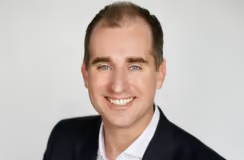
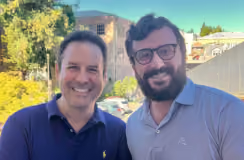
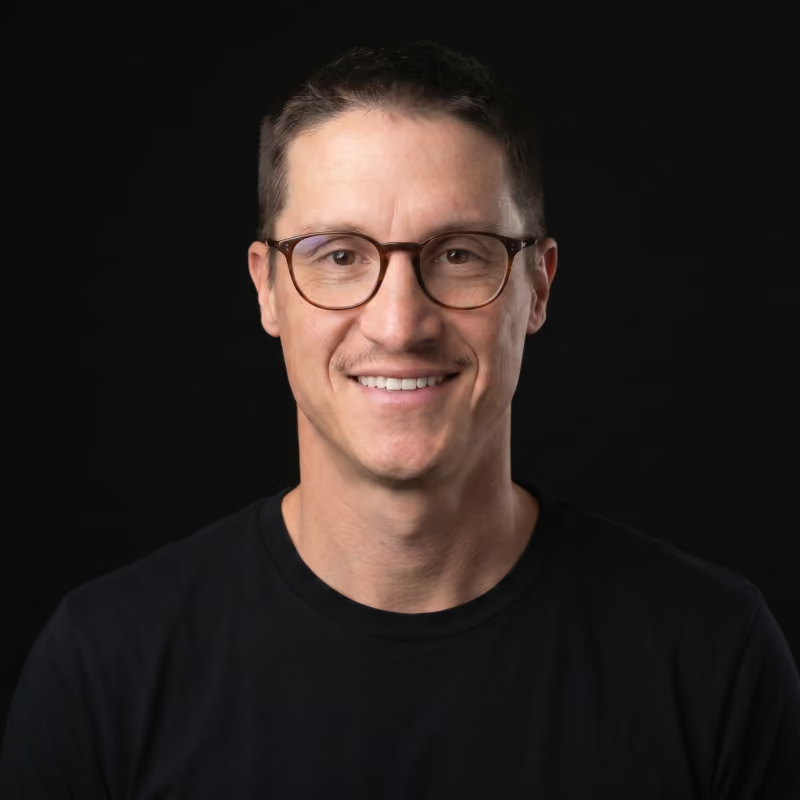
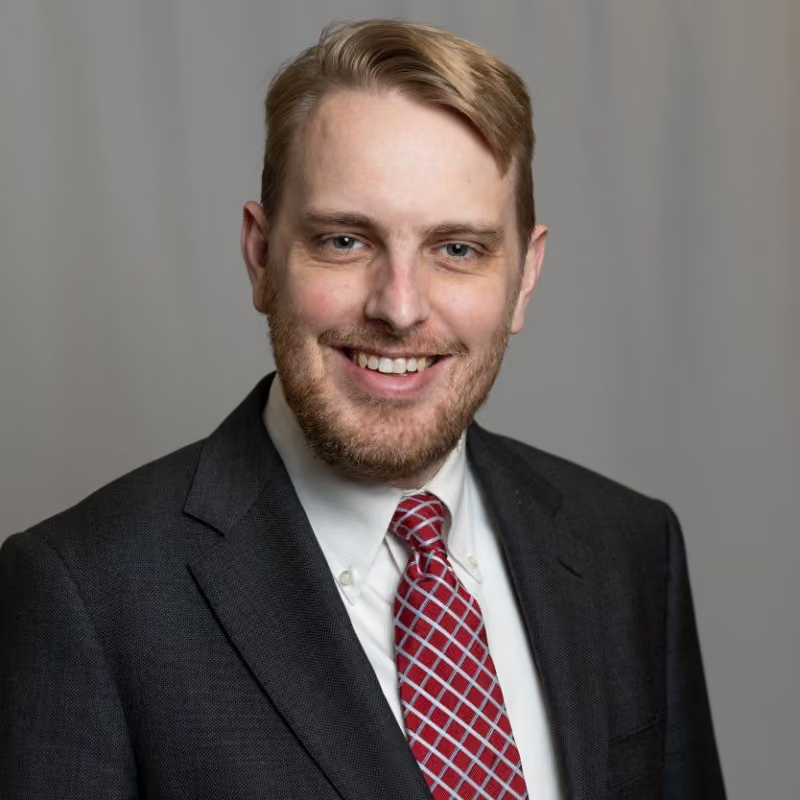
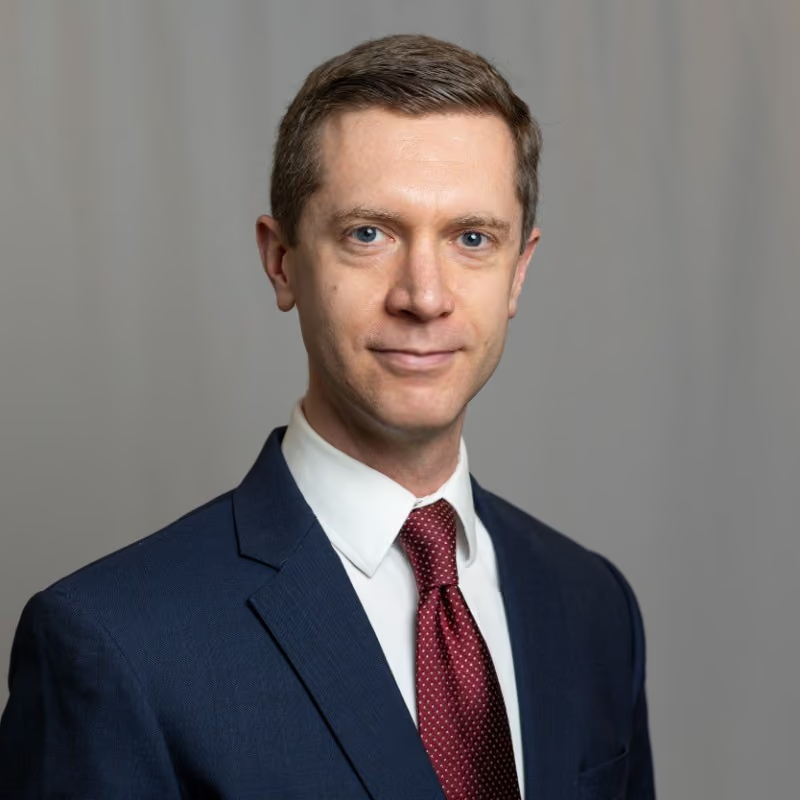
Host: Today's interview is the story of a searcher who launched the first search fund in a small country and over the last six years has built a category leader Nicolas Luli and his two partners raised capital from US investors to buy a business in Peru. They found and acquired their target in 2020 during the depths of COVID The business had a million dollars of EBITDA and offered a variety of services including physical document or as the industry calls it, records management. Peru imposed very strict rules during COVID which crushed Nick's business. That million dollars of earnings dropped to zero in his and his partner's first year of ownership. But not only did they save the business, they've since grown it into a powerhouse in the Andean region where with $10 million of EBITDA and the future looks brighter still. Today Nick lives outside Boston, his base from which he works on the business. But listen for how he worked in the business on the ground in Lima for the first five years. It was a very difficult and operationally intense half decade of living and breathing the business every day. Many of the standout stories on acquiring minds share this pattern. The entrepreneur works in the business for years, learning operating, becoming an expert, earning the right to only then work on the business. Recent examples include Jared Pearce who grew his little half a million dollar SDE H Vac business to over 6 million in EBITDA before exiting to private equity for high eight figures. Isaac Zimmerman has grown his plumbing business Jay Blanton from 6 to 25 million in revenue in three years by embracing founder mode. And of course Steve Carroll who bought a mechanical contractor that he operated himself painfully for the first year. Today Kelso Industries does over a billion in revenue. Nicolas, Jared, Isaac, Steve, all examples of entrepreneurs who did not shy away from being the operator themselves. Now don't get me wrong, it is important to see a path to working on your business. You will hit a ceiling if you can't graduate from in to on. But often years of working in the business are required or said better reward it. The credibility, the battle scars, the expertise that you build over years of operations become the foundation from which you eventually grow your business to new heights. You'll notice that the format of today's interview is a bit different, including the presence of my co host and partner in Mind's Capital, Nicholas James. This is a cross post from the Mind's Capital podcast. If you haven't checked out MCP yet, the interviews over there focus on the independent sponsor model of business buying. We publish weekly interviews with sponsors and other successful players in that ecosystem. Check it out. Minds Capital Podcast okay, here is Nicolas Luli, launcher of the first search fund in Peru and builder of Poli Sistemas webinars. This coming Tuesday, the team at due diligence firm LCS will teach advanced deal mechanics. You'll learn where purchase price really moves and why networking capital and net debt are often where buyers unintentionally overpay. You'll hear two case studies, one on accounts payable, the other on project based revenue, and you'll learn about inventory and how to normalize it and how to define debt correctly for your target's valuation. These are advanced but crucial topics taught by Max Lummis and Travis Sadler of lcs, a team that does dozens of Q of Es for searchers and independent sponsors every year. The webinar is Advanced Deal Mechanics and it is this coming Tuesday, April 28th noon Eastern. Link to register is right at the top of this episode's show notes or on the Acquiring Minds homepage. Acquiring Minds co. Welcome to Acquiring Minds, a podcast about buying businesses. My name is Will Smith. Acquiring an existing business is an awesome opportunity for many entrepreneurs and on this podcast I talk to the people who do it. You know Enzo Technologies as one of the leading IT managed service providers serving the search community. Led by Nick Akers, an Acquiring Minds guest who bought the 35 year old business. The team at Enzo regularly works with searchers and their acquisitions and one feature of acquired businesses that ENSO is seeing over and over is the need to implement cybersecurity promptly during the transition. So many acquired small businesses either have glaring vulnerabilities, lack security best practices or both. That step one to de risk the deal you just closed should be addressing these issues. INSO is your full service IT MSP for post close stability. They assess your target, surface the biggest risks in plain English and give you a day 1 through 30 plan to cut exposure, prevent downtime and even find cost takeouts like bloated telecom bills. Check out enzotechnologies.com I N Z O or email Nick directly at nicknzotechnologies.com Nicolas Luli started his private equity career as an LP in the search fund space. Nick and his two partners later became the first search fund in Peru and acquired a $1 million EBITDA Records Management business in that country just before COVID Peru was hit particularly hard by Covid. The government implemented draconian laws that shut down business and Nick's business fell into the red. It has since recovered and then some and today the business is growing fast and is a leader in the Andean market.
[7:11] Guest 2: Thank you so much, Will Nichols, for having me. Very excited to be here.
Host: So Nick, you started as essentially a searcher. Today you oversee the business in Peru from your home outside Boston. You're just down there some. But really it's more of a independent sponsor structure in the way of your oversight and management. Tell us about that journey from more searcher operator to kind of more of an independent sponsor model, at least the way you manage.
Guest 2: Sure, happy to dig into that a little bit. And we still manage the business day to day, just to clarify. So I have two partners. We launched the first search fund in Peru, Kolka capital, launched in April 2019. We acquired Policistemas in December 2020. Now I moved to Peru. I was there for five years, had three kids there, certainly spent some time on the ground. And those initial years were building years. They were brutally difficult. We bought a business that at the time only had 20% of sales record storage. That 20% stayed very solid. But when the government killed the economy, a lot of the other things the company did that we knew longer term we wouldn't want. Management, print services, data capture, reselling of hardware, things like that, they basically went to zero overnight. So we had to unfortunately lay off about 200 or 350 employees. Shut down, call it three of the five business lines. Really redesign the business around storage. Exclusively recurring revenue. So that was very much kind of every day in the office, 12 plus hours a day with my two partners building. And it was the organic phase. So we went from a million bucks in EBITDA to basically zero the next year. And then bet everything on record storage and trying to win these big step function contracts that would take us to basically back to par, you know, where we thought we'd get. And we ended up doing much better than that. Got to 5 million, then 6. And it was only. I only moved back to the US in the context of a recap that we did in December 2023. So once the company had gone from 1 to 0 to 5 to 6, we did a recap and that was all organic. And the next phase became inorganic growth. And I was on the road already three out of every four weeks per month, pretty much looking at deals all over the region. Talking to my wife, sort of realized, you know what if I'm already going to be gone so much to these other countries, some of which require me to fly to the US to then fly back to say Honduras or something like that, might as well be based In Boston, work in Relay's office here in the Prudential Center. They're on our board. They're one of our lead investors. And like you were saying at the beginning, that's where I kind of cut my teeth in this industry. Started working with Sandro back in early 2017. Opportunity of a lifetime opportunity. So that was a little bit of the journey. And as you, as you alluded to, I do live in the Boston area probably nine months out of the year. Summers we spend, American summers we spend in Lima, which are Lima winters, and still continue to travel probably three out of every four weeks.
[9:56] Host: Great. So this was a case of being very much in the business for those early years, especially since you were affecting a turnaround or whatever we want to call that saving the business. And now there's a little bit more distance, but only after years of rebuilding. Now you, you plowed through those numbers, but let's hear them more slowly.
Guest 2: Sure, sure.
Host: One million of EBITDA when you acquired to zero to then five.
Guest 2: Yeah.
Host: A year later. So was that, that, that's, that sure smells like customer concentration. Was there like one or two contracts?
Guest 2: Exactly, exactly. So when I, when I'm talking, I'm talking run rate. So in our industry, just, you know, for clarity's sake, everyone talks in run rate because you win a large contract, it could take you a year to move all of those boxes into your record center and, and everything's recurring multi year. You basically don't lose customers. There's no churn. So the way people talk about their financials is basically run rate. So we went from 1, 20, 20 0, 20 21, 5, 2022. And that 5 was, some of it was. Of course, you know, the government realized the disaster that they'd done with COVID They lifted some of that, that kind of boost some of the imaging, BPO type revenue, but it was fundamentally winning four big contracts. And this is an industry where you've got your biggest customers and they represent an outsized share of the market. So we won the largest pension fund in Peru. We won a very large bank in Bolivia. That was a greenfield effort. We won the Ministry of Education in Peru and then another large private company in Peru. So we won a bunch of big contracts. Honestly, it was not something we had thought would happen. You know, we hoped to win one or two of them to sort of get back to at least a couple million. And we, we won all of them, which then created another problem. Because this is a spend money to make money business. You've got to Rack out record centers, hire the guys to move them, get the insurance on the trucks, pay for the gasoline. There's a million things you got to do and you're getting paid per box per month. But that's kind of a steady eternal, which is nice, but still forward cash flows at Yeah T equals 0 money out the door. And at that time you still didn't have financing. So that kind of brought up. I'm happy to get into it a bit, but host of other challenges on how you would pay for that growth.
[12:02] Host: Well, I think we should spend some time on this. This is quite a case study. There's a lot for us to cover today, but since we're in this story, let's continue. And one other thing just on on it that I want to make sure I understand. So 20% of the business was records management. Going into Covid, your plan was always in fact that you would grow that line of revenue. So. So really the COVID thing, as painful as I it sounds like it was, was really an acceleration of the plan you already had.
Guest 2: Yeah.
Host: To get rid of all those other service lines in double and triple down on records management.
Guest 2: Yeah, absolutely. Look, I mean nobody wants to pass through that. It's inordinately risky. The company possibly could have not survived. We made a lot of big bets, went through a lot of one way doors and in the end it did work out. The positive thing was we had to tighten every screw. You know, we had to basically make sure this thing worked like a submarine. Nothing could be lost, nothing could be leaked. We had no space. So assuming you do survive, well, all of a sudden you've got this Mach machine that kind of passed through a crucible and that's how organically went from one to six in the first three years. And it catalyzed. At that point the inorganic phase, which we're currently in, went from 6 to 10. And that's where we are now today. 25 in sales and 10 in EBITDA. We've bought six businesses in the last couple years. We've got two more that we'll buy in the next three months. And we're now sort of this well oiled machine that took three years of blood, sweat and tears to build at the organic stage.
Host: And so talk more about how did you put it sealing it down like a, like a submarine. This was culture. In other words, operational discipline, culture change. Right, Yep. Say, say more about all that.
Guest 2: Sure. So you know, very specifically, first thing we went in there and realized was, you know, hey, Covid wasn't a great time in this company's history. One of the worst sales years in the modern time. And the sales team received the same compensation in 2020 as they did in 2019, which was the best previous year in the history of the company. So clearly something is wrong. You know, when sales goes down by 70% and the sales team makes the same amount of money. So we, we went in there and basically said, okay, performance based incentives down to the guy that supervises nine other guys ripping staples out of documents all day. And we kind of created this ownership culture. Look, the company's not a family, company's a sports team. We exist to win games in our market. Winning games is taking boxes from Iron Mountain and putting them on our record center, in our record center, on our racking. How do you do that? Great customer service, speed, a million different things, but basically you go to each guy and you own this, this is your business. Now that guy owns, for example, the little business of ripping staples out of documents all day. And he's got nine guys that work for him. These are his targets. And look, if you can get it done with eight guys, if you can get more documents done, if you can get it done faster, better, you get paid. And it created this culture down to that guy. And now we have over a thousand employees. You know, we took it from 350 to 150 and now we've got 1200. So we've hired a thousand people basically in this business. And we've had now had the luxury of essentially forming, you know, 85, 90% of employees are people we or have hired, or people we have hired have hired, you know what I mean? So they've kind of got that DNA of everything's performance based. You eat what you kill. And that's super different from how most these businesses work in the region. It attracts a certain type of person. So there are people that can't handle that, don't like that. Well, they leave, they quit, they do something else, and that's fine, it doesn't have to be for everyone. But that's how we look at our business. And we're managing other people's money. So we have a fiduciary obligation there and we're excited about it. And the people that are still here are excited about it.
[15:32] Host: Sports team, not a family. Is that an original I've never heard of?
Guest 2: No, not at all. Nothing is original that we do. We have zero creativity. I mean absolutely no creativity. So I mean, look, everything is sort of copied from. So that That's a Netflix thing. So you can find some podcasts from probably decades ago or whatever. You know, Reed Hastings or one of these guys. They, I, I don't know if they pioneered it even, probably came from somebody before them. But yeah, we, we are big into. Look, we don't know how to do anything very well, but there are other people who've done things well and we can at least sort of tropicalize what they've done. And where we can do well is effort because you control 100% of that. So we bought a business that's very hustle based. It's very simple. You know, I have a son who's six years old. He probably couldn't run the business today, but I would say in the next two years you could probably manage it. Right. I mean it's just sort of like adding and subtracting. It's not rocket science, but it's a lot of hustle. It's a lot of showing up, push, push, push. And that really aligns with kind of the strengths that the three of us have.
Host: Well, just to underline this great, this great line sports team, not a family. I mean what, what I particularly like about it is, is because so often in, in businesses being acquired from founders, there is a sense of family at the business. And so you're, you buyer are very likely to disrupt that culture. So how can you position it in a way that we still have camaraderie? Because so often if, you know, it's just like, it's just like no more family here. All corporate.
Guest 2: Opposite of that, zero corporate. From our point of view, we're very happy to promote people that are young or don't have the fancy degree or whatever. The thing is to run something if we think that they're good and we'll give them the opportunity and if they perform great, they get paid, they do the next thing, they rise. Or if they don't, well, they don't. And that's kind of the end of that. So we were forced to basically remove a significant most of the employees at the beginning just in order to remain solvent. So you kind of are from the get go, you're kind of prioritizing because obviously when you do that, you want to keep your best guys. You kind of reduce that at the beginning. And we went in there and it was sort of first separating the family culture out kind of completely, just removing that where it was four kids working the business, a lot of conflict within the brothers and sisters fiefdoms, all of that type of Stuff typically you see in family business where guys are getting promoted based on. Because they're friends with the other brother or whatever. The thing is zero business sense in some of these decisions. So we ripped all of that out. And the, the first thing we did was, hey, this company only has a cto, basically a chief revenue officer, head of sales type guy, and a coo. So three C level people. No, you got to have department for legal, department for hr, department for continuous improvement, and none of it adding bureaucracy. But you, you've basically got to be able to delegate. You know, you, you've got to be able to create layers of middle management that. Create those little business silos that someone can own and be excited about it, want to move the ball down the field. So that, that's sort of the way we thought about at the beginning.
[18:22] Host: Well, this also sounds like. What's the cliche? Don't, don't let any crisis go to waste.
Guest 2: Absolutely. Yeah. No, yeah.
Host: Well. And just, I don't mean to linger too long on this, but the operational efficiency. So it sounds like you guys just kind of audited the entire.
Guest 2: Yep.
Host: All the processes in the business and, and then found kind of micro KPIs for almost every single role and then incentivized all those roles tied to those micro KPIs.
Guest 2: Yeah.
Host: Sort of thing.
Guest 2: Yeah. Daily colonoscopy. I mean, we went in there and it was sort of like, look, I want to know everything. I want to know why this pallet isn't 3 inches to the right. You know, and that in our line of work, that's not that complicated to do. You know, you can spend a week in the record center, you can figure out a lot of operational stuff. You can spend some time with the different guys, figure out, okay, who actually knows, who doesn't know. And, you know, you build from there. So it was very, very involved at the beginning. It was a lot of time in the facilities on site, because you have to build before we started any of the M and A. You know, we didn't buy any companies for the first three years. We had to build the machine. We had to, so that we could work on the business. We went from working in the business to working on the business, and that really wasn't possible. You know, today we've got a country manager in Peru, a country manager in Ecuador, country manager in Bolivia. As we get into other countries, there'll be a country manager there and they're reporting to us. So we're still kind of the CEOs of the whole thing. But at least you've got many CEOs in each place. But that takes years. It takes years of forming those people who have the experience, have the confidence, all of that. In the beginning, it was extremely operational.
Host: Yeah. Your other two partners, are they also from. Do they have roots in the area? Oh, yeah, absolutely.
Guest 2: So my other two partners, full Peruvian born, bred there, went to undergrad there. They Both did their MBAs in the US my background's. My dad's from Peru, my Mom's from the U.S. yeah, I grew up in the U.S. and then moved back to Peru for this project. Also went to school in the U.S.
Host: and so today, after all of this initial pain, now growth, you are, you are the leading record management business in the Andian region, which includes Bolivia, Peru, Ecuador, even up into Colombia. Some, I think.
Guest 2: Correct. Yeah. So after Iron Mountain, Iron Mountain is the biggest player in the world. Billions in sales, public list in New York, you can, you can look up their information. We would be the largest, and we would be the largest independently owned, if you will. And we are the largest in Ecuador and Bolivia, some of the smaller countries where Iron Mountain is not present at all. We actually are the number one player.
Host: And so then also buyer of choice or at least.
Guest 2: Absolutely, yeah.
Host: I mean, are you going up against Iron Mountain or. No, because they're too small. Who you're buying is too small.
Guest 2: Yeah. So realistically, one of the things we love about this industry is we buy subscale businesses that are inherently local. So there's a physical component to this business. You can't have the boxes out of country. Usually there's legal or regulatory reasons for that. And then your biggest customers, financial services, need to consult those boxes with some frequency. So they can't be that far away. So this creates kind of a hyperlocal effect where all of these guys are subscale because they're X market within Ecuador or X market within Bolivia. So you don't have kind of regional, global players, very few of those. So subscale, I can pay a lower price. And we're there. We have capital. We bought six of these things, me and my two partners. We, we've been in private equity. It's been our career. That's the one thing we do know how to do is buying and selling companies. It's not like we knew anything about storing records or running a business or any of those things. So we are the buyer of choice for them because they're so much smaller for an. Access for an Iron Mountain for, for a company like vrc, based out of Memphis. You know, they're, they're too big to look at some of these. It doesn't move the needle. You know, you got to kind of put in the same amount almost of legal accounting, the resources internally. It really doesn't make sense for them to be buying a million EBITDA or 500k or even 100k. We're willing to buy whatever, you know, we've bought. Businesses do a couple hundred thousand dollars in sales or have 10,000 boxes, you know, price is good, we'll get it done. We have people that do that. We'll move the boxes and you move to the next thing. For those big guys, they're just not, it's not like it's wrong. It doesn't make sense really for them to be doing those deals.
[22:22] Guest 3: Iron Mountain is the global behemoth in your industry. How likely is it that you will exit to them one day?
Guest 2: Yeah, well, I'm not sure if their CFO is tuned into this podcast, but our valuation expectations would be quite high if he is. Yeah, I mean, look, it's possible. I mean, we're a financial owner. Very subtle. Yeah, exactly. Say, put it all on the table. Yeah, look, Iron Mound's the biggest. You know, they're buildings of sales. Then you've got access, then you've got vrc, you've got Oasis in Europe. You know, you've got a few of these businesses that are good size. There's not tons, there's not dozens of these very large record businesses. It would be logical for one of them to one day, especially as we get bigger and bigger, you know, we're 10 and EBITDA now. We have a very clear path to getting to 25 in the next few years. That gets increasingly juicy for one of, for one of them, right? Because with one bullet they can all of a sudden take a leadership role in a bunch of countries that have 5 10% organic growth rates that haven't been seen in the US for 30 years.
Host: Buying a small business sounds simple. Find a company, due diligence, get a loan, close. In reality, you wear every hat just to get the deal done. And then the moment you close, you have to throw those deal making skills out the window and learn how to operate. You shouldn't have to rebuild this infrastructure from scratch and you definitely shouldn't do it alone. That's why Walker Deibel created Acquisition Lab, which started as an accelerator, has expanded into a complete ecosystem for acquisition entrepreneurs. Over six years, the lab's 1,200 members have acquired over a billion dollars in businesses. The Lab puts everything under one roof. An active community, deal reviews, post close services and a dedicated fund helping experienced operators buy larger businesses. If you're serious about buying a business, come see why Lab members have a 40% success rate. Learn more in the show notes or@accentlab.com acquiringminds
[24:38] Guest 3: and so when your exit route potentially is so well defined because for most businesses it isn't right, you probably will exit to some generalist PE firm. But for you guys at least there's a very strong path and reasonable likelihood that one of the biggest strategics will acquire you one day because they want to expand their footprint in your particular geography. So how does that drive your day to day decision making? Now as you're building the business, do you have an eye towards them and what kind of try to be a, what's the expression, hand in glove for them down the line? Is that how you're building the business as well?
Guest 2: Yeah. So the way we look at it, there's three types of buyers. And when we bought this business coming from private equity, we kind of, you see the writing on the wall where a lot of private equity failures in our region have arisen from being unable to sell or it wasn't quite the right business for the right buyer. So we identified from the get go, hey, this is a very M and A driven industry. You've got a handful of strategic buyers with a demonstrated interest and experience of paying reasonable prices, good prices in some cases for top tier assets, great check. So you have a path there. This would also be a very attractive business for sort of what we would call record information management adjacent buyers. You have companies like Indra, Inetum, kind of, you know, they're broader IT services players, they do very large sort of digitalization or data center, different things like that. And they are kind of selling stuff to the same customers. And the storage unit economics fit into their existing business model. So you have kind of a set of buyers there as well. And then frankly you have a set of buyers that would look at this more as a dividend, as a bond. So they would be like kind of larger family offices, very different. So right now this business, it's everything we're all in, every dollar we generate back in the business, back for growth, full speed ahead. Now let's say you're a family office, you look at this as a bond and there are a number of these guys that exist, whether it's Latin America or elsewhere. They're looking for very stable, long Term cash flow, highly recurring. You could do that for a very long time with this business. You kind of have three types of buyers there. And we don't optimize for anyone because, you know, we're not necessarily selling now. Everything is always for sale, right at the, at the right price. Right. You guys sell the Mind's Capital podcast to, I don't know, Blackstone or something. And, and, and that, that works out for everyone. Now we're, we're not that different, but we kind of run the business every day as if we were going to own it forever. And I think that's kind of the sign of a great business where if I own it forever, fine, no problem with that. So it's sort of everything. The question is what's best for the business? Not what's best to be able to sell to such and such type of buyer in a couple years because like I said, there's three typ buyers wouldn't necessarily be best for everyone. It's, it's just that kind of core question. What's best for the business? Return on changeable capital. What's the highest return on changeable capital for this additional dollar? That's how we measure it.
[27:22] Host: And Nick, going back to that third group of potential buyers and, and looking for a kind of a dividend play in you guys that goes to the point that this, this business actually has very much sort of real estate dynamics. Right. You're essentially building space that you're then renting out in the form of storing boxes. So, so in some ways it's, it's, it's akin to a real estate business.
Guest 3: Yes.
Guest 2: I mean, that's not, you know, one of the reasons perhaps that Iron Mountain decided to actually list as a reit. So, yeah, you know, yeah, you have real estate economics. You can think of it as we are renting space on our racks to our customers. Right. And they pay us a fee per month. That's sort of like their rent and their utilities are basically what do they consume? You know, they consume, for example, scan me this, send me that, that type of stuff. So it's not very different from a, from a real estate business in that sense. The capital requirements are also pretty low. So depending on what I mean, real estate's an enormous category. So you can look at some real estate businesses that are enormously capital intensive, like data centers. You can look at others that are, that are not. But we're sort of one of those where really, once you rack out a record center, that's expensive. Sure. Maybe you Spend half a million bucks in a place like Peru to rack out 300,000 positions. You know, build your facility, do the whole nine yards. But then you're kind of done. You fill it up with boxes that steel racking, 26cm of solid concrete floor. I mean, you don't really do anything. I mean, you'll have to, you know, it's basic stuff you'll do to maintain it, but de minimis, kind of what you call maintenance capex de minimis in the industry. So that's very attractive where you can just kind of over time, as you fill it up, you know, the 200,000th box is pure free cash flow. You don't need to hire any more guys to manage your record center. Maybe it's you hire three guys to manage an empty one and 20 to manage a full one. There's no difference from 200,000, 250,000. And you know, it all just kind of drops the bottom line, which is similar to really any storage business.
Host: Yeah.
Guest 3: Hey, to play devil's advocate a little bit on a previous point there about not actually building a business that is bespoke for a certain buyer, I think you it out eloquently and I think there's a strategic rationale in either direction. But what you're saying is we're building the best possible business we can. We're opportunistic, perhaps with regards to the things that come our way. And we're trying to build a business that we are happy with as forever shareholders. However, every public company in the world always has to build with regards to a narrative.
[30:00] Host: Right.
Guest 3: And the narrative is, you know, how do we maximize the stock price? And when you talk to a banker, they will give you a range. You know, I don't know what it is in your industry, but let's say 25 million of EBITDA if you get there, I have to imagine it's going to be well into the double digits and they will say something like, oh, your business will be 12 to 16x, but within that range. If you have been more random in your selection of priorities versus very specific about, yep, we ultimately want 16 DX from Iron Mountain. It can affect your decisions. And so wouldn't it be your duty to maximize shareholder value to have an eye towards that?
Guest 2: Yeah, absolutely. And I like the 16x multiple. Just in case, again, the CFO of Iron Mountain is listening to the phone call.
Guest 3: I'm going to personally find his email address and send this episode to him.
Guest 2: Just like link it to him. No, I know Barry We've talked to him a few times. Very nice guy. He's done a tremendous job at Iron Mountain. But look, I think that's absolutely right. However, all types of buyers want to see certain characteristics that we also want to see in the business. So for one thing, we're creating a lot of value every time we buy a business because we pay, call it 4 to 6 times EBITDA for these businesses. We buy them with leverage and we know we're worth materially more than that. You know, even if you were to say conservatively, hey, I think your business is worth eight to 10 times. Well, right off the bat, you create a ton of value every time you do a deal. And we're in the deal making stage. I mean, not to say that we're not growing organically. We are growing organically. Whether it's 5, 10, 15, kind of depends on the market, the service, whatever. But there is an enormous amount of focus right now as an organization on the M and A side. So everyone's going to want that because everyone wants scale, everyone wants diversification. So it could be by country. Absolutely. You don't want to depend on a specific currency, a specific market, politics, whatever. Everyone wants diversification, client base. So to your point, at the very beginning of the call on client concentration. Yeah. Overnight we had four customers represented, basically everything. That's not necessarily great. Not the case anymore. Because now we have thousands of customers after having done six acquisitions and gone into Ecuador and kind of Greenfield and Bolivia where now nobody's more than say 12% of sales. And as we keep going to more countries, that's a fundamentally attractive thing. So a lot of the things that are just good for the business are kind of good for anyone. Now you could make the case, hey, you look at an iron mountain, big into data centers. Could we buy a small data center? Could we go that route? Sure. But that might not be something that someone else wants. And then you've got two different profiles. You have a very high capex type business, very stable, reoccurring, might trade at a high multiple. And then something that has a much lower maintenance capex requirement probably trades at a lower multiple. So it becomes a little bit, you know, we say in Spanish, rice with mango, arroco, mango, which in Asia is actually a normal thing to eat, but at least for us is it's not. So it's sort of like, okay, these are two things that you're just kind of smashing together that don't go together. So, you know, we try to be cognizant of that I would say and just sort of focus on, stick to our knitting a little bit. Sort of like, okay, this is what we know how to do and there's a lot of it. It'd be one thing if, you know, we're having this conversation a couple years from now. We've bought everything, so we're 25 plus. There's nothing left to buy of scale in the region. Then it's sort of okay. We're going to have to start assuming you don't choose to sell. We're going to have to start making some big strategic decisions. Are we going to go into a new market entirely? Africa, Asia, us? Are we going to get into something like data centers or something like software? So you could do two opposite things there and you could look at some of the big players and they've done one or more or both. So I think it's sort of like for now for us, focus on what is fundamentally the best for the business that aligns with everyone.
[33:28] Host: I'm just reminded of a pattern that we often see in private equity broadly where a buyer is looking at a target and is often interested in just one of the types of revenue that the target offers. So classically, Nicholas, you know this well, classically you'll see this in home services where they where a buyer might completely discount the new construction revenue and only care about the service and maintenance revenue. And so all this work that you've done building a side of your business that is the mango and not the rice, you don't even get credit for.
Guest 2: Yeah, it makes sense. We've adopted the one stop shop approach that's been our, one of our biggest differentiators versus an iron mountain. They're kind of a pure storage player in our region. And what that means is the biggest customers are financial services. 50 to 60% of sales perhaps, maybe it's more. And they don't want to deal with eight vendors. They want to deal with someone who knows how they work, knows what the ERP is, knows what the CRM is, knows how they generate records, where they need them, when they need them. They want to go to the Four Seasons, you know, they don't want to deal with all of these different people that are constantly getting onboarded. You know, new vendor comes in, guy gets fired, doesn't know it. So we come in and say, look, it has to do with records. We do it, we do all of it. So that sort of cradle the grave from the generation of the physical record to its eventual destruction and shredding Whether it needs to be scanned, stored, moved, that really creates a link, a really powerful bond between the two thirds of business that today that's storage and then the one third that's sort of like bpo, imaging services, software, the rest of it. And sure, you could have buyers. So some of those big strategics might say, you know what, I love your storage revenue, I don't love your services much, or vice versa. Some of them are actually much bigger into the software stuff and not as big into the storage. In our case, it's almost inextricably linked and you can't really separate these things. And as part of our value proposition and it's worked so sort of like, okay, you can't really say, oh yeah, I don't want that. You couldn't separate it. And you'd be very foolish to do so because you can look at, well look, because this guy really wanted the bpo, I could renew his storage at a higher price or whatever the thing is. So that's in a way how we think about that.
Guest 3: Another decision point that you reflected on here was how when you acquired a business initially in 2020, you shedded some revenue lines. Now in my experience, buying small businesses, every dollar of revenue or every sol of revenue in a Peruvian case is super precious. And so how is that process around making the decision to actually remove revenue?
Guest 2: Yeah, I absolutely agree with you. In our case, the decision was made kind of involuntarily. The government effectively removed all of our revenue that wasn't storage by killing the economy. So closed borders, martial law, curfews at night, actually closed all what they deemed non essential businesses. And in their infinite wisdom of which businesses are essential and not, you know, very bright guys in Lima working in politics. So we were thankfully an essential business because we store records that the banks, which were also essential businesses, the clinics, the insurance companies, all these things that kind of have to exist in any society. We store the records, they have to consult those records to service the customer. So we were allowed to open, but management services, reselling of hardware, data capture, all that stuff went to zero immediately. So it's not like we deliberately decided to, hey, we're going to shed 70% of sales overnight. That didn't happen. No, we shed it, but we didn't actually make the decision. We just kind of had to live with that. And then we realized, okay, this is where we are, we've got to play to our strengths. What's the only thing that we can really bet on to get us back to par is Storage. So, yeah, I agree with you because there's no way we would have done that. It would have been crazy for us to have done that, taken that path and kind of a stable scenario.
[37:01] Host: Nick, let's pivot away from the incredible story here. What is the name of the. Of the business again?
Guest 2: We operate in Peru and Bolivia under a brand called Polisistemas. And then we operate in Ecuador under a brand called File Storage.
Host: I guess certain markets are happy to have an English brand and others, I
Guest 2: mean, really, I mean, long story short, we bought a business called File Storage in Ecuador and they're the biggest player and people know it. And yeah, you might as well just leave the name for a bit. We greenfielded in Bolivia, so if you're going to do a greenfield, it's sort of easiest to do it out of the company that you already have in Peru. So we kept the polycystemos brand. We'll see what we do as we get bigger. Maybe we do some global rebrand. I'll have to ask some sort of open claw AI thing to tell me the best name for all these countries, but maybe I'll have to ask you guys. Great.
Host: Well, let's hear a little bit. Rewinding now about your time at Relay. You said Relay is an investor. You are also an intern there. And now Relay is a. An intern or employee. Sorry.
Guest 2: I was the first employee. I started out. Yeah. Sandra hired me in early. This would have been Feb 2017. And we kind of. It was just me and the two partners. So it was this incredible apprenticeship experience. Learned so much from Sandra. He's a brilliant investor, very patient guy. Taught me a lot of different things in the industry. You know, we hired our first investment professionals. We raised the First Institutional Fund. Fund 2, 80 million, which has done quite well. They actually ended up investing in us with that fund. And then they've invested out of, you know, subsequent funds and all of that and what we've done. So, yeah, I was there for. Basically the idea was I'd go and work for Sandra at the beginning. And from at that time it was clear, hey, look, I want to go back to Peru. I want to do this for a search fund there. And if things go well, me working for you, then you'll. You'll back us and help us, you know, raise the money and garner the support, which is exactly what happened.
Host: And was he essentially investing in you, not. Not being familiar with the Peruvian market, I assume?
Guest 2: Yeah, I think to some degree that would be fair to say. I mean, you'd have to ask him, perhaps have Sandra on the next Mines Capital podcast and say why in the world would you have done this? And, and he, he'll give you a better answer.
Host: Well, you now are, let, let's talk about kind of your involvement in search broadly. So continued connections with Relay as, as I think you said you're working out of their offices occasionally when you're in, in, in Massachusetts.
[39:17] Guest 2: Yep.
Host: You also are trying to kind of seed the, an ecosystem in, in the Andean region. You were the first search fund in Peru. So talk to us a little bit about your kind of your vision there and your efforts in search in South America.
Guest 2: Yeah, so one of the things we realized during this process, you know, you're getting a lot of emails every day. You're getting WhatsApp messages, LinkedIn messages from all the other people that want to do search funds, especially in Latin America. It's a very close knit community and we basically always take the calls. It's very much a pay it forward culture. We did the same thing when we were launching, you know, email everybody and everybody gets back to you. It's an amazing culture in the search space. I think quite a bit different from at least my experience for private equity, whether it's derivatives or hedge funds is definitely not as collaborative as this community. And it's a wonderful thing. So we take those calls. And then in 2023, in that recap, we actually did sell some shares. So we took out a little bit of money, me and my two partners and we decided, you know what, we're already taking these calls, these guys, why don't we start investing in them very small checks. We might invest $10,000 between the three of us in a search fund. You know, there's a couple thousand dollars each and as it turns out, we've backed about one third in Europe, 1/3 US, 1/3 LATAM not. There's no sort of mandate or rules around that. That's just sort of the way it's turned out. And that's been wonderful because some of them have actually gone on to buy great companies. We, we've bought a couple, we've participated in a couple awesome opportunities in Spain, Brazil, Italy, the US they're all very small checks. But it's fun on one hand to kind of stimulate intellectual muscle that you don't use as an operator when you're operating. You're in the trenches. You're very, very focused on record management in our case and this M and A thesis and whatever you have to do, raising debt, raising equity is very tied to that. You don't have the luxury, sort of like almost academic luxury of look at this interesting deal in this H Vac sector or this ERP software, whatever the thing is. And that also makes you better. You see things that are almost like a liberal arts sort of sort of framework to it's looking at different deals all over the world. So that's been fun. I mean some people play golf or do other things. We just do ebitda. We don't really do other things. And this sort of looking at even down other places I think makes us better operators of our business.
Host: We just do ebitda.
Guest 2: Yeah, I mean I think that's a very good way to encapsulate. You could have my partners on here and say the same thing, probably in Spanish.
Guest 3: That's nice.
Host: And then. But what about your particular interest in your region or in the Indian region, doing there?
Guest 2: Yeah, absolutely. So one of the other things we realized, you know, and in region there's really not a lot of private equity, lower middle market. Especially when I say private equity, I mean lower middle market. Obviously big funds. You know, HIG bought Ranza, big logistics company based in Peru. Sure. You know that those are deals getting done in the hundreds of millions or more. I'm talking about companies like ours. You know, you buy a million dollar EBITDA business, 3 million, 10 million. Anything in that range is very little. So you know, we are very much tied up full time job running this business. But we also, I mean we chopped a lot of wood during the search. We signed five. Lois. We generated a list of hundreds of companies that really couldn't sell because there's not a lot of buyers for a lot of some of them did sell, but most of them didn't. So sort of like, hey, if we ever found someone that wanted to do the next search fund in Peru, we could kind of partner with them, pass on all this kind of institutional knowledge that we've gained from having done this, the relationships with the intermediaries and the credibility. So a big thing. It sounds kind of silly to say this to an American audience, but when we bought six companies in this region last couple years and most other people bought zero, even though it's all focused on the record business, all of a sudden sellers sort of say oh yeah Colca, that's a real buyer. They exist in the league tables of Peru, which is nothing. We're there in these markets so we can kind of pass that on. And we did that with Coca Capital too. There was another searcher who wanted to a search fund but wanted a sort of partnership to it. Doing it alone is very difficult. That's a whole separate conversation. I would never do it. Massive props to the people that do it and some of them are very successful. I could it just do. Just could never do it myself. And this guy partnered with us under our brand. We helped him raise the money. He launched in 2014, bought a company in 2025 data center actually small microscopic compared to American data centers but a very nice cloud hosting business primarily and that's gone quite well and he's been running it about a year now. So we invest. One of us is on the board. He has an investor group of his own. It's his own search fund. Right. So we're not more than that really but we do invest, we help them raise the money. He's got probably half overlap ish, maybe a little less with our original investor group. Some of the people wanted to re up and. And that company's done very well. It's called Canvia in Peru if you want to look. It's a larger business, 80, 90 million in sales. It's publicly listed so you can look up its financials in the stock exchange. And we then did the same thing earlier last year. So after he bought first guy that worked for us ended up working at Relay for a couple years kind of taking the same path. Relay by the way has produced a number of successful searchers who have gone on to acquire businesses. It's been a great sort of apprenticeship for various people. And he launched I want to say in the fall of last year and he's got a great software company under LOI right now. Very interesting business. 3 million EBITDA. And it would be something similar where we invest. He's got the name and we kind of go from there.
[44:27] Host: Nick. The difference between language and culture or, or the not difference. So you know, if you're a Spanish speaker, do you. And you want to do a search fund in your. Wherever you're from or your parents were from, is it generally that you go back to that particular country? Example, you know in, in the NBA kind of circles, there are a lot of Mexicans, many that I've met, many of them from Monterey. It seems to be the theater city. And so. So would somebody like that almost if they're going to, if they're going to do a search outside of the US go back to Mexico or is there an opportunity for Latinos from different countries, south Central Americans from different countries to kind of cross pollinate or Is that not really what people want to do?
[45:15] Guest 2: Sure, sure, sure. Now look, that doesn't really happen, long story short. And it doesn't really happen because these all are kind of smaller places. They tend to be more insular. The decision makers sort of know who you are, why you're there, like where your father went to high school to some degree. So you know, if you're from Peru, you're going to do your surge in Peru. Now the exception I would say to that is sometimes you have people from, from a smaller country that maybe they move to a bigger country like a Mexico or Brazil at some point or they work there, they've got some relationships and they say, you know what, this is a bigger, bigger market, more companies, I'll do it there. And I, I already have my relationships and I'll try it. Or even the U.S. so you've seen that as well. But you wouldn't see a Mexican guy doing a search in Peru. It really wouldn't make sense. And then you have the language thing with Brazil. So you would never see, I mean, I shouldn't say never, but to my knowledge at least, you know, you wouldn't see anyone going from, you know, Mexico and in region, Central America. Do a search in Brazil. I mean you're not gonna be very successful there without sort of native Portuguese and you know, a lot of roots in the place. Similarly, they don't come to our countries because Brazil is enormous. I mean Brazil is the size of all the other countries put together in our industry and many others.
Host: The team at Pioneer Capital Advisory has started offering peripassu debt for SBA business buyers. That means they can help unlock up to $3 million of conventional debt on top of the $5 million limit of SBA 7A loans. So Pioneer can structure larger, more complex acquisitions. Listen to our story with Anika John from one of their clients who did just that. Buying a $10 million business as a first time self funded searcher. The Pioneer team has closed more than 100 SBA loans averaging timelines well below industry standards. Founder and owner Matthias Smith and COO Valerie Stash bring over two decades of SBA lending experience. Matthias and Valerie have a full bench of analysts and associates who work your deals with them. A true deal team. Not just a single point of contact. Visit pioneercap.com or click the link in the notes.
Guest 3: Do you have a sense of which countries are easier versus harder to be a searcher or business buyer in?
Guest 2: Well, in PERU we have a 2 of 2 100% track record. So I Would have to say it's probably the best with. With very, very, very limited data we have available. Look, I think it's kind of more mixed in the other countries and there's not enough of a sample size. So you've had Kit call it two in the doctor and they've bought companies and maybe there's more, but like I'm not. There's not enough. The numbers in the smaller company countries are very small. Chile, another small, very small number. Colombia, small number, and then a bunch. Ecuador, Bolivia. No search funds ever have been launched. Most in Central America, really only Guatemala and he bought a company and there was a second guy that didn't buy a company. But you know, most of the countries, Panama, Costa Rica, Nicaragua, El Salvador, Honduras, Belize. No one's ever launched a business, sorry, a search fund. So I think early days, I think what you are seeing now is the volume of searches in Brazil is vastly greater than all the other countries put together. And that's kind of in line with the opportunity set in Brazil. It's a much larger country you've got there, unlike all the other countries, a large institutional investor group. So you have investors like Spectra here, Kviv, Kanoa, Bird Capital that just launched kind of larger institutional investors that are really focused on Brazil backing searchers there. There have been two of these conferences I've actually spoken at in Sao Paulo over the last two years. So they're kind of growing the Brazilian ecosystem quite a bit. And one of the interesting things that happens when the risk free rate goes to 25% is real assets are cheaper. Right. So you're looking at interesting businesses you can buy at four times EBITDA just because of how high rates are.
[49:13] Guest 3: Do you find that the set of challenges that meet you in Peru or Guatemala or Dominican Republic are more or less the same then? So these are immature private equity markets. Pretty small pools of available businesses to buy. You have to hustle for capital racing hard to do big deals. So you probably start with pretty small deals by US standards. But you have a first mover advantage if you're successful and you can quickly build a brand and reputation if you succeed. As you said, you're a notable buyer in Peru already now. So do you find that those dynamics are quite similar across Latin America with the exception of Brazil?
Guest 2: I think it's right, yes.
Guest 3: And how would you contrast that to people who are starting out in the United States?
Guest 2: Man, Very different. Very different. So look, the US you've got probably hundreds of searchers looking at any one time in the U.S. you've got every type of searcher too. You've got the traditional guys, the accelerators, the self funded searchers, the kind of like search fund Holdco things. You've got lots of independent sponsors too, who are probably listening to this podcast and wondering why you had a search fund guy on here instead of an independent sponsor. In the US You've just got so much going on as far as who are the buyers, but then you've also got the largest community of small businesses in the world by a huge margin. So it's just a very different place. The US is also, it's almost hard to see this, you know, coming. If you're born in the U.S. you grew up in the U.S. you know, this is the main thing you focus on, but it is the most transactional place on earth. It is a remarkable place where you can pick up the phone, call somebody and say, hey, I know nothing about you, I live 3,000 miles away, I'd like to buy your business. And then the other guy, instead of hanging up, would say something like how much? And you can actually do that. That isn't how anywhere else works. So it's an interesting place, very well suited for private equity and this sort of micro private equity that we call in search. But yeah, it's super different.
[51:04] Guest 3: Different. But how about difficulty? Where is it harder? Is it harder to be a first timer abroad or a first timer in the United States?
Guest 2: Yeah, well, first timer, the first timers in the US launched in the 80s, right. So like 80s and 90s of search funds. So I think it's in a, in a certain sense harder today to be the, like if you were to say, hey, I'm gonna be the first guy in Honduras to do a search fund, I would think that is materially harder than being the next searcher in, in the U.S. unless you are from say one of the families that controls a lot of the economy or has a lot of good relationships there. And it's almost like everything is sort of lined up in your favor where you have a higher probability of buying something. So if you're just like a regular guy, you go to a good mba, it's just harder in these markets because there's fewer companies to buy. But with the right relationships, I think it actually can be easier than just being the next guy in the US So sort of depends on who, who the searcher, who the, the entrepreneur is.
Host: Nick, one thing we hear often is, and we've already heard it from you, is that the, the pools of available capital, the capital Providers in smaller markets are, is very thin. So why is the playbook not kind of what you did where you raise US based capital to acquire in the local economy? Because then you have your cake and eat it too.
Guest 2: Yeah, it's a good question. So we in our business, we look for mostly US capital because as ironic as it is, most of our local guys are. You got two kind of categories. Let's take a step back. The local families, a lot of money tend to be very levered to certain industries already in the country. So they want to diversify. They want to invest in KKR's 12th fund for European infrastructure. Right. Like they don't want sort of more exposure to whatever the local thing is. And then there isn't this enormous high net worth category in most these countries. Very different than the U.S. the U.S. you've got lots of kind of random millionaires that want to take 50k, 100k, 250k punts on whatever it is. And you just have to be that whatever it is. And it's sort of easier to raise money from Americans of a higher risk tolerance than anyone on earth for this type of thing. They are more willing to invest in a place that they cannot pronounce. They do not know where it is or honestly anything about it. If they think that the guy who's raising the money kind of speaks articulately about the opportunity. Okay, let's go and move on to the next thing. That just isn't how very, very different DNA in, in how this type of stuff works.
Host: But it does seem like you or the other. We've talked to a bunch of the other independent sponsors in in search fund entrepreneurs. You mentioned Guatemala. I assume you're talking about Ramiro and Juan.
Guest 2: Yeah, of course, yeah, yeah. One was the first and so followed. Yep.
Host: Yes. And so those guys and just others that we've talked to talk about trying to raise local capital. Yeah. So there must be some good reason for that. Just because that's who they know they're working their network sort of thing.
Guest 2: Yeah, yeah, yeah. I mean they, they've done an awesome job and they're also currently lenders of ours as well. So yeah, they, they were equity investors. They sold in the recap. They're, they lend to us now. So great relationship with them. It's a little different. They put together this amazing firm where it's. You've got some of the most important, most relevant families investors, players in Guatemal them. So that's awesome. If you can achieve that. Wonderful. And they don't have to deal with, you know, whatever complexity there might be with the U.S. i had my start at relay, so I had already. It was just easier to raise money here than there. And we, me and my two partners, we don't have the sort of relationships, pedigree, whatever in Peru where we can go out and get the 10 families that most matter to be in our deal maybe one day, but now we don't. So if that's our state of the world, you're better off raising majority of US capital. And then, you know, a bunch of things go into that where structuring. You're going to be set up more for us sort of tax efficiency and the rest of it, rather than having, okay, I've got an equal number from seven countries. That becomes really difficult. How do you structure around. Around that? EU could be different than us, LATAM could be different than eu. So you're kind of better off. Okay, who am I going to optimize for? In our case, it's mostly U.S. investors. And that's true across Coca Two, Coca Three, probably whatever we would end up doing, I think majority US capital. US Capital also is by far the largest. So not that we're raising a ton of capital, but it is sort of easier in the sense that there's just a lot more there. You know, it's just a much bigger pool, if you're fishing for that.
[55:20] Guest 3: You mentioned your recap in 2023. I took away from it that you did it in order to enable the next phase of growth, which has been M and A led. Can you tell us a little bit more about the recap and which investors or how did the investors decide whether to roll or stay? And what kind of outcomes have you seen so far?
Guest 2: Yeah, so we did a recap in 2023. The company went from like I said, 1 to 0 to 6 in EBITDA. And there were some guys that said, you know what, it's been a great week in the casino. I'd like to go home. You know, this has been great and that's enough. Now there were other guys that said, you know what, let's double down. We've made a bunch of money, but there's a lot more money to make if we can put money to work in M and A. And that was the mind that we had, me and my two partners, because we're there, we see the target. And we'd spent three years plus the year plus of trying to buy this company, mapping out the targets, building the relationship with the sellers. We Saw the opportunity and we realized if we sold the thing now, we'd just be leaving too much money on the table. And we actually did run a process. We got bids from different buyers, kind of usual suspects. So we were able to use that, go to the board, go to the investment, say, hey, this is the price. Who's buying, who's selling? And less than 20% chose to sell. Everyone else chose to roll and. Or put more money in. We also brought in some new guys and we've said, we also, like I said, we sold some shares a little bit in that round. Have to, you know, buy a house and all that.
Guest 3: And then how was that received by the investors that you took some chips off the table?
Guest 2: Yeah, perhaps unlike traditional private equity, in the search space, that's almost encouraged if the business grows a lot, because by taking a little bit of air out of the balloon, you cease to have as much pressure to then immediately sell the next day and the next day and the next day. So if you're, if you're raising money and your idea is, I'm going to conduct an M and a campaign for two to five years and really build this thing. You don't want to have that pressure every day where it's like, look, I need to buy a house because now I have four kids and I started with one kid or whatever the math of that is. And you don't have it. You just don't have liquidity. And then that could incentivize you to sell the business or operate in a certain way. So, no, that was fine. I mean, it's not like we sold a ton. If we had said, hey, we're selling everything and we'd like more money, that would not have gone over very well. So, no, that was very supported and there was a lot of precedent for that type of thing, specifically in the search space space. So perhaps not the case for a typical independent sponsor or whatever you would else would see in private equity.
[57:33] Guest 3: No, I actually think error out of the balloon. That's a great analogy there. And I believe it might be something we will see more of in the independent sponsor space as well. I think the reason it hasn't happened yet is, well, first of all, you don't have a lot of deals that have that continuation. Right. That you have a recap with. Effectively the same group. If you have a recap, it's going to be a majority recap and you just roll some portion of your equity. But I have seen, and in fact, even on our, of our strategic vendors is They're a lender who. For more seasoned independent sponsors. If you have a portfolio of, say, three companies and you have real carry built up across the three, they will provide you a loan against those assets as a gp. So that. That lowers the pressure to your point to exit if you're still growing fast. And so I think as the industry matures, we will see more liquidity and just more maturity around instruments like that. And it has the same dynamics as you say, that it's actually positive for those who are investing for growth.
Guest 2: Yep, yep, exactly.
Host: So I think you see this in venture land as well, where young entrepreneurs are encouraged to take some money off the table just to relieve the pressure, lest it cloud their judgment or make them too eager to exit completely.
Guest 2: Yeah. And frankly, the price was such that I think the investors were happy to buy some of those shares.
Guest 3: And how did you set the price? That was my next question.
Guest 2: So we ran. We ran a process. So we ran a process. We got a bunch of bids from third parties and then we went to the board. The board looked at the offers, the pros and cons, and essentially selected a price that was on the lower end of the range, you know, which made sense, right, because it's secondary, minority, such and such, and that was it. So you could say, do I want to put money in, do I want to put money out, do I want to roll? Which is to say, do nothing. And that was what everyone did. We raised a bunch of equity, went out and bought six businesses in the last two years and actually just completed earlier this month, another kind of committed capital raise recap, if you will, to fund future acquisition. And that's.
Guest 3: How big have these rounds been done? How much have you raised?
Guest 2: Yeah. So, I mean, without getting into too much detail on each one, we've raised close to 50 million in equity in committed capital. We've not deployed that, but in total across the original raise. The recap. The recap we just did. So it's a lot of firepower so far. And frankly, there are now some investors in the group that are quite large that if we wanted to do something much bigger and try to buy other players, larger ones, whether it's the us, Europe or something else, we would be positioned to do that. Not saying we will, but it's a nice spot to be. We're in committed capital, we would be commensurate with any other reasonable buyer in this industry. And then if we wanted to go a lot bigger, we could, or we still have the flexibility to sell it. You know, if we get a good offer and that's what people want to do. So it's a good, it's a good spot to be. There was no secondary in this round. We didn't want to sell any with where the business is today and with the opportunities that are kind of on our plate. So kind of kept things simple.
[1:00:28] Guest 3: And how has the journey been if you can share? For the investors who've been there since the beginning, you had a recap. So what did that look like? And now that you had another recap earlier this month, how are they sitting
Guest 2: without kind of revealing anything that's confidential with the returns? I can say the guys that sold, they essentially are carry. So traditionally in search funds, your carries in the money fully in the money at a 35% dollarized IRR. So that's what we do and that's what most searchers do. So. And they were well in the money in the guys that sold after those three euros, you can kind of back into that materially higher than that IRR with the ones that sold at that time. And same goes now, there was no secondary. So it's sort of paper return paper money. But again, in the round that we just did, at the price that was set, again, well over a 35% dollarized IRR five years into it.
Guest 3: Wow, that's breathtaking. Congrats.
Guest 2: Thanks. So far it's all on paper, but we're thrilled. I mean, we're honestly super excited about the opportunity ahead of us. And who knows, maybe we'll be on the next one.
Guest 3: And so you started your career, or at least earlier in your career, you were at Relay Investments, as we've discussed with Sandromino, who's a big profile in the traditional search fund community. He supported me, in fact, when I was about to quit my corporate job way back in the day. The returns you're talking about here are 35% IRR. How common are they within the search land? And what have you seen having been on that side of the table as well?
Guest 2: Totally. So that's something that's very much in question today. And the conventional wisdom of the Stanford study and the ESSE study that gets published every couple years, there's sort of a thought that it's more common than you would think. Now, recently, Yale AJ Wasserstein, who's one of my investors as well, published a piece saying, hey, this is actually extremely uncommon. And the way you're cutting this, and I don't want to kind of get into the details of why you should just read what his piece was, which is quite thorough, and then you should read the rebuttals and the studies and if you want to look into that. But that's a great question, and it's one that is very much in dispute by people who have a lot more information than we do. I mean, from our seat, I would say in Latin America there have not been many that have produced that since the first one, whatever that would have been 2010, maybe the first searchers in Latin America as far as delivered a cash on cash return that would correspond to that, probably a handful, just because there haven't been that many exits. And most of the Latin searchers have launched, say in the last five years versus the last 15. You know, it's been very much sort of a J curve a little bit where at the beginning you have, you know, funds here and there, Mexico, Dr. Colombia, whatever. And then, you know, today lots of funds launching Brazil especially. But they're young, they're younger in their holds. So you don't have as many exits. But. No, I mean, I don't think it's common in our region. No.
[1:03:18] Host: AJ's report sure made a splash.
Guest 2: It did.
Host: We're hearing about it all the time.
Guest 2: Yep.
Host: Well, we should also say that of course, AJ is in your deal. He. He made his own money in records management. I don't know when, the 90s maybe,
Guest 2: I don't remember, but he was an immensely successful operator. He's a brilliant, brilliant CEO, did an amazing job with that business. It's a very sort of incestuous community in the record management space. Because, you know, that's a deal where his Atonic was one of his investors, they're one of our investors. Investors. You've got a lot of the same guys, you know, Tom Bird, ken Saxon, were CEOs of first American Records Management way back in the day. They're also sort of investors in or affiliated with sometimes these other deals. So it's great. We have sort of the RIM mafia, if you will, of these highly successful, highly competent operators. You know, guys who run these businesses. They've sold them, they've made a lot of money for their investors, or they've invested in them. Sandro, with Will Thorndike, they bought Oasis. They've kind of formed Oasis in Europe. This would have been, I don't know, ten years more ago. And then they sold it to Montegu, a German private equity fund, after building what is basically the largest record business in Europe after Iron Mountain. So a lot of our investors are familiar with the space, which Kind of also made the whole thing easier because they're like, okay, if I've done it a few times and it's made money in the us it's made money in Europe, okay, maybe I'll try it here, where it's. It's basically the same economics and it's just a different place. Yeah.
Host: Actually, this is an important point, Nick, that you have so many seasoned, experienced operators in this industry all around you. So did. How much value have they added in terms of going all the way back, for example, to when you went through that operational crucible of. Of tightening up the submarine and all of that? Were you leaning on them and their expertise, or were you.
Guest 2: You.
Host: They were in the background and you guys were just kind of figuring it out?
Guest 2: No, they've all added a tremendous amount of value in different ways, I think. I mean, there's two. It's a bit of a dichotomy. Obviously, the operator is the man in the arena. Right. So you were the one getting knocked down. Blood, sweat and tears. Have no idea if the thing's going to work or why you moved to Peru, or, you know, a number of other questions that sort of might be arising under those circumstances. At the same time, the decision the board and the investors made actually just let us run was kind of a significant decision, because if you looked it on paper, it's sort of like, wow, the world's on fire. This is a disaster. I don't know, you could liquidate it. You could kind of cut your losses. You could do a million things. And I think a lot of the culture there is look in search. No, we know these guys. They're going to do their best. They're going to put everything. They're going to leave it all in the field. And if it works, it works. It doesn't work. It doesn't work. At least I know, you know, I'm getting good mileage out of. Out of these guys. And that was what they did. And that was a big part of why we were able to have that success, because we had enough of a leash where we. We, you know, we did what needed to be done, and we. We did it fast and we did it aggressively, and that was the only way to do it, really. So that was kind of that stage. We learned we leaned heavily on those that are operational experience. So I talked a lot with AJ at the beginning and other CEOs, sort of like, hey, this is how this is set up. How do I do this? Why does this happen? And then, of course, you figured out. Like I said, this is not a rocket science industry. So 90 days, 120 days, one year, once you're kind of in it, and then the businesses, you know, you write the ship. Okay, you don't have those same operational questions anymore. In our case, a lot of our investor support has been around capital. So equity debt restructuring, we've done multiple refinancings on the debt side, that's really important. That's a big lever for growth, is sort of the financial engineering of this. It was very simple. It's not complicated. But you still need it. You still need the equity, you still need the debt. Bringing the right people in, getting a board together that understands the thesis. And it's sort of like, oh, yeah, these three guys who have never operated a record business, they're gonna go out and buy six businesses in two years and nothing's gonna happen as far as, you know, risks or whatnot. It's a very straightforward, very M and a driven industry. So getting people understand that, getting people to buy in, that's been key for us. I think we'll leave it there.
[1:07:14] Host: What a fantastic interview, Nick. Really, really interesting. Nick Luly, thanks for joining us on the Mind's Capital podcast.
Guest 2: No, thank you so much. This has been wonderful. Appreciate it, guys.
Host: You thank. Hope you enjoyed that interview. Don't forget to subscribe to the Acquiring Minds newsletter. We send an email for every episode with an introduction to the interview, a link to the video version on YouTube, and soon, key takeaways, numbers and more essentials from the interview. For those of you who don't have time to listen or watch it, subscribe at Acquiring Minds code. You'll also find all our webinars there on the website. Both those we have coming up and recordings of past webinars. At this point, There are over 30 webinar recordings, a wealth of information on all the technical nitty gritty of buying a business. Acquiringminds copy.





























%20-%20thumbnail.avif)



%20-%20thumbnail.avif)

%20-%20thumbnail.avif)
.avif)

%20-%20thumbnail.avif)