[00:00:00 - 00:05:45]
Host: I've been reading a book recommended by Nicholas, my partner in Mind's Capital. It's called the Compounders From Small Acquisitions to Giant Shareholder Returns. As one of the blurbs says about the book, it's a blueprint for turning small acquisitions into generational wealth. Well, today's guests have set out to build a compounder themselves in the H Vac space.
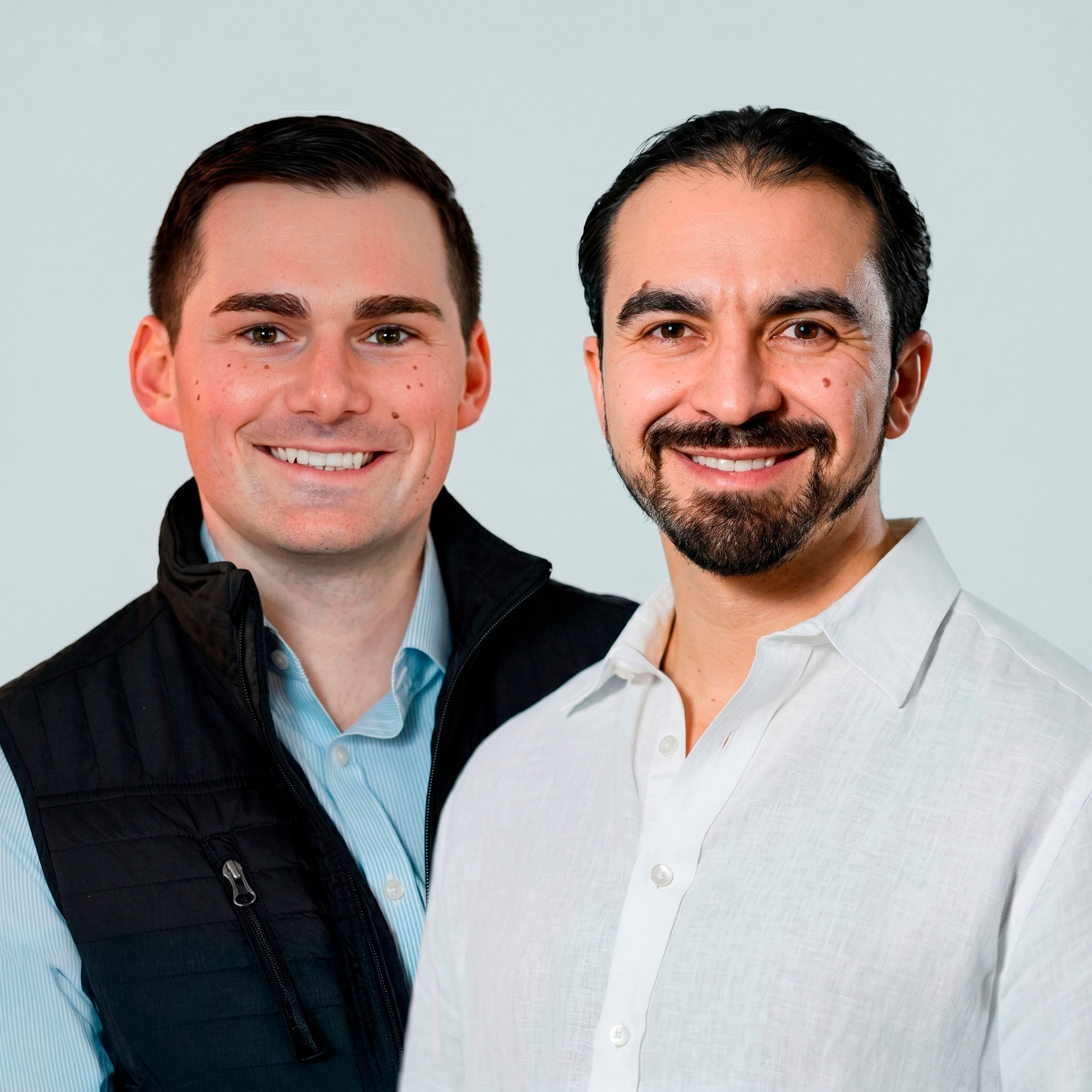
Greg Shapiro and Zach Cooper Vostola are two of the three founding partners of Hickory, which today sits at 80 million top line with 300 people and 200 vehicles. We hear the story of their first acquisition in Manhattan of all places, and how their vision has evolved in the eight years since. Today, they see themselves as the anti PE home for trades businesses in a world where PE is gobbling up the trades. So this is the origin story of the compounder business that Greg, Zach and the team at Hickory aim to in a business that I know many of you too would love to build.
Here are Greg Shapiro and Zach Cooper Vistola, co founders of Hickory. Today Thursday, Franzi CEO Alex Smarczniak will host a webinar on the intersection of ETA and franchising. Alex will discuss the pros and cons of buying an independent business versus Franchise resales as well as franchise resales versus De novo franchising. We don't want to be dogmatic on acquiring minds.
There are also great opportunities in starting franchise businesses, of course. Alex will also bring two franchise resale listings to do deal teardowns, unpacking how to evaluate the strengths and weaknesses of these opportunities from category to franchise system to price to deal terms. He'll also share a number of case studies on empire builders, that is Entrepreneurs who have built very large holdings through the acquisition of existing franchise businesses. The webinar is franchising for the ETA buyer resales, roll ups and real deals and it is today, Thursday, June 4th at noon Eastern.
Link to register is right at the top of this episode's show notes or or on the Acquiring Minds homepage. Acquiringminds Co. Some good news out of the SBA last week. You may have heard recently that anyone who so much has invested in an SBA deal that went into default was denied access to any future SBA financing for themselves.
Meaning, for example, if you wrote a $5,000 check into your buddy's H. VAC acquisition 10 years ago in and he defaulted, you would never be able to access SBA financing again. There are reasons of bureaucratic process that this policy came into effect too long to explain here, but happily this has been reversed if you invested into a defaulted SBA deal but were non controlling, non guarantor and held less than 20% ownership, you can continue to access SBA financing. Which is good news and actually just a reset to how things were in 2025, but certainly a welcome reset.
Separately on the SBA, you may have seen that the SBA loan limit has expanded to $10 million for entrepreneurs combining 7A and 504 loans. There is nuance here and last week SBA loan broker extraordinaire Heather Anderson shared presented an Acquiring Minds webinar explaining that nuance and the new possibilities. You can find a recording of it on our website Acquiring Minds co under webinars. Welcome to Acquiring Minds, a podcast about buying businesses.
My name is Will Smith. Acquiring an existing business is an awesome opportunity for many entrepreneurs and on this podcast I talk to the people who do it. You know Enzo Technologies as one of the leading IT managed service providers serving the search community, led by Nick Akers, an Acquiring Minds guest who bought the 35 year old business. The team at Enzo regularly works with searchers and their acquisitions and one feature of acquired businesses that Enzo is seeing over and over is the need to implement cybersecurity promptly during the transition.
So many acquired small businesses either have glaring vulnerabilities, lack security best practices, or both. That step one to de risk the deal you just closed should be addressing these issues. INSO is your full service IT MSP for post close stability. They assess your target, surface the biggest risks in plain English and give you a day one through 30 plan to cut exposure, prevent downtime and even find cost takeouts like bloated telecom bills.
Check out enzotechnologies.com I N Z O or email Nick directly at nicknzotechnologies.com Greg Shapiro Zach Cooper Vistola welcome to Acquiring Minds.
[00:05:46 - 00:05:47]
Guest A: Thank you. Great to be here.
[00:05:47 - 00:05:50]
Guest B: Yeah, thanks Greg.
[00:05:50 - 00:06:07]
Host: Zach, you guys are building Hickory, a rollup of H Vac businesses, but with some key differences over the typical private equity playbook. Let's get right into it. Greg, how about some background on you first? Please.
Then Zach, we'll go to you.
[00:06:08 - 00:06:58]
Guest A: Sure. So I grew up originally outside of Boston, went to undergrad at George Washington University in D.C. where I was studying computer science and Econ. While I was there I also learned Mandarin and moved to Taiwan and then Beijing for a while during some gaps in undergrad and in the years after that and then I started some businesses out there and during college, but afterwards got back to the software engineering side.
Worked for a while at a company providing Technology for political campaigns and nonprofits. Worked a little bit in the econ world again doing helping with the research group there, and then after 2016 or so, got into what became Hickory.
[00:06:59 - 00:07:01]
Host: Great, thank you, Zach.
[00:07:02 - 00:07:36]
Guest B: Yeah, I grew up in a town outside of New York City, in the suburbs, in Queens, went to school in Boston, and while I was there lived in Spain for a bit and always had somewhat of an entrepreneurial background, really interested in financial markets and public companies. And while I was in Boston, I met John Holzappel. He had posted something about small businesses and, you know, software around them. And so I thought that was interesting and sent him a message and met him in 2015 and.
Yeah, great.
[00:07:36 - 00:07:39]
Host: And so John is the third partner in Hickory.
[00:07:39 - 00:07:40]
Guest A: That's right.
[00:07:40 - 00:07:41]
Guest B: Who's.
[00:07:41 - 00:07:53]
Host: Whose name will probably reappear over the course of our conversation. Okay, so. So now if we could get into the origin story then of, of Hickory, the two of you and John, what did that look like?
[00:07:54 - 00:09:01]
Guest A: Yeah, so I'd say some of the earliest origins were when at this time we were all living in Boston. John had someone who I had worked with on some of those businesses in China a few years before. He had gone a different route and was looking at a career in private equity. And we'd be having a lot of late night discussions while I was working on technology for political campaigns and fundraising, thinking about finding the right voters to talk to.
And he was looking at what these private equity groups would want to do in terms of finding business owners to talk to and running a process to acquire companies. And we collectively kind of thought this really doesn't make sense. And if we could bring just 10% of the technology and the data forward approaches that exist in, in these other realms to the idea of finding great small businesses, we could do way better than what that baseline would look like.
[00:09:02 - 00:09:11]
Host: And so, Greg, you mean specifically bringing tech to deal sourcing? Specifically finding businesses to buy?
[00:09:12 - 00:10:25]
Guest A: Specifically finding businesses to buy at the smaller sizes of the market. And keep in mind, this was a number of years ago. So. So a lot of the trends that became popular more recently were different then there were.
The expectation was that for anyone who was thinking about buying a business below, let's say 2 million of EBITDA, you were either working a lot with brokers or you were kind of in go to country clubs and do very, very old school networking in order to, to meet these business owners and establish a relationship with them. And there wasn't a lot of publicly available information about any of these companies. People were kind of not on the radar. So we thought that we could take a much better approach to finding great companies to partner with.
And the idea was then once we did that we would point the same kind of high volume and data forward approach to finding investors and also to. To helping modernize the companies, find customers and grow revenue.
[00:10:27 - 00:10:33]
Host: So, so tech enabling small businesses, it was pretty innovative at the time. You, you felt. Or, or it just not being done,
[00:10:34 - 00:11:44]
Guest A: you know, it was, it was not being done at the time and, and people were really against it, you know, now and, and we sit in this position now, right, where we get 20 emails a day from anyone from actual, from large private equity groups to a person in a dorm room who decides that they're going to spam email a lot of company owners. No one was doing that then. And in a lot of ways I think we were doing it a lot better than most people are doing it now. And this is something that we, we thought of it as a software play potentially in the early days.
And is this something where we try to build the software, where we try to sell the data? Is this a platform where people go to look at businesses? And what we eventually decided was that we could use this a lot better ourselves and both control the process more and control the outcomes more and more and potentially do really well for ourselves by, by being the people who actually got in and owned the business and using this to help fuel that.
[00:11:45 - 00:11:55]
Host: Sorry, if you owned the business, you could do that. That became the goal rather than building some piece of tech that you sold to private equity shops.
[00:11:56 - 00:13:02]
Guest A: Exactly. The question was, do we want to be building tech that we sell to private equity shops or do we want to be trying to find leads and then, and then flip those over for a finder's fee or, or provide a product for, for very small groups who are trying to buy maybe one business at a time. And what we thought was that at the end of the day there's, there's a huge amount of value that comes from owning a business and running it well. And we thought that we could, we could approach that world, but because we would have a better process for finding and acquiring businesses, that we could build something really big without having to raise a large fund or be backed by a large fund and maybe something we can get into later.
But for us, that was key for us being able to think long term, not be tied up in a. And the, you know, five year need to exit and get money back to investors mindset.
[00:13:03 - 00:13:13]
Host: And John was working in private equity at the time, so he did understand the idea of buying businesses, but you two were not. That was not your world. Or do I have the chronology wrong?
[00:13:14 - 00:14:19]
Guest A: That was not my world. And, and John had some background in, in VC and then was. Was beginning a career in private equity for a group that was, was intending to have a more alternative approach, but, but really not as alternative as what we thought made sense. And that's right.
My, my background at that point was more in software engineering and managing engineering teams, though I had started to get more and more interested as a number of different people who I knew John was, John was definitely one of them. I knew some people who were. Who had shifted into the search world and into other, other forms of. Not necessarily what we would think of as large cap private equity or traditional private equity, but, but I had sort of gotten the bug from knowing some people who were approaching this mindset of buying a traditional business and growing that rather than trying to start something that would go from zero to one.
[00:14:19 - 00:14:43]
Host: Okay, okay, all right, interesting. So you approach it as kind of zero to one entrepreneurs with this tech vision. And then as you iterate on the idea, you land on let's and, and kind of have heard about search and John has his private equity exposure. Let's buy a business and all of this leverage that we can gain from tech, we will pour into the sourcing such a business and then owning that business.
[00:14:45 - 00:15:07]
Guest A: That's right. And our, and our ambition was always to do it at scale. And we thought of this first one as being partially a proof of concept and partially for us to hone what it was that we needed to be building and what were the systems that we needed to think about putting in place so that we could bring Those to numbers 2, 3, 4 and onward.
[00:15:07 - 00:15:08]
Host: Yeah. Yep.
[00:15:08 - 00:15:09]
Guest A: Great.
[00:15:09 - 00:15:11]
Host: And Zach, when do you enter the picture?
[00:15:12 - 00:15:51]
Guest B: Yeah, so I had joined in 2015 as this was all starting to get off the ground. Mostly my background was more in traditional finance, more financial analysis, things like that. But when I met John, he had sort of told me about this idea of addressing this market of small companies that were somewhat overlooked and somewhat not attracting the talent pool that it really deserved. I thought it seemed like a really incredible opportunity.
And so I said let's, I'm in. Let's do it. And joined. It would have been October of 2015 around that time.
[00:15:53 - 00:16:10]
Host: And so you were the kind of the finance. So the way this is shaking out is that Zach, you're the finance guy, Greg, you're the tech guy, and John is the, the, the generalist with some private equity Experience, investor experience guy, something like that.
[00:16:10 - 00:16:48]
Guest A: And we've, we've traded hats a lot of times over the years. But, you know, Zach also wound up building the first version of a lot of the data collection tools and analysis that we would do. So we, I'd say we came together with a mindset about how this should work. And in a, in a different type of setup, Zach would have been the person, you know, building models one by one for a few companies that came from brokers.
And he was certainly able to do that as well, but was also able to build things that would help take this to a scale that would be a really different level.
[00:16:49 - 00:17:19]
Guest B: And we were collecting data from dozens of sources and reaching out to companies that we felt would be a good fit for what we were looking for and the approach that we were taking. So companies with great bones, strong financials, but operating on a more antiquated system basis. So really something that was in need of modernization and you know, but still had the strong processes and fundamentals to build a great company around and deploy our sort of strategy into great.
[00:17:20 - 00:17:34]
Host: Well, we're going to want to hear about the first acquisition. We don't have time to hear about them all, but we'll spend time on the first one before we get there. Let's hear what Hickory is today. So take us to the end of the story so we, we know where, where all of this is building toward.
[00:17:35 - 00:19:02]
Guest A: Sure. Well, hopefully far from the end of the story, but we are expecting to reach 125 million in revenue by the end of this year, including some of the partnerships that are in the works now. We have, and that'll look like something like 500 employees. We're around 300 employees right now.
We have 13 locations and 14 acquisitions that we've done. We're slimming down some of those locations as we speak. So that's changing a little bit. And we've really come full circle to the original vision where we've been able to build out a really significant in house technology team with some really heavy hitters who've been very successful in the technology space, some of whom have, I had worked with before, some of whom have exited technology companies on their own in kind of the traditional SaaS world.
And so now we're really trying to reinvest in the business for a long term vision by building out a lot more technology to enable our employees to be great at their jobs and help us manage the group at scale. And meanwhile we're building out the operating playbook to make sure that we can be the best residential H Vac company out there.
[00:19:03 - 00:19:12]
Host: Very impressive numbers. Okay, back now to the first acquisition. That didn't happen until 20. You said 2018.
[00:19:13 - 00:19:15]
Guest B: Did I hear you say correct?
[00:19:15 - 00:19:19]
Host: Yeah, so. But when the three of you decide to partner on this, it's 2016.
[00:19:19 - 00:19:22]
Guest B: Between 2015 and 2016. Yeah, 15, 16.
[00:19:22 - 00:19:25]
Host: So it took two years to find the first acquisition or more.
[00:19:26 - 00:20:02]
Guest A: There's some time, a lot of that time was building, building the product that we were thinking about commercializing as a software company and then eventually getting to that point of saying, let's really run this process. In 2017 we had, we had the first company and maybe Zach can tell more of the details on it. We had Stanley Ruth under LOI in 2017. That closing delayed a few times, as can often be the case.
And March of 2018 was when we actually walked in and introduced ourselves to all the employees at the business.
[00:20:04 - 00:21:26]
Host: Buying a small business sounds simple. Find a company, due diligence, get a loan close. In reality, you wear every hat just to get the deal done. And then the moment you close, you have to throw those deal making skills out the window and learn how to operate.
You shouldn't have to rebuild this infrastructure from scratch and you definitely shouldn't do it alone. That's why Walker Deibel created Acquisition Lab, which started as an accelerator, has expanded into a complete ecosystem for acquisition entrepreneurs. Over six years, the lab's 1,200 members have acquired over a billion dollars in businesses. The lab puts everything under one roof.
An active community, deal reviews, post close services, and a dedicated fund helping experienced operators buy larger businesses. If you're serious about buying a business, come see why Lab members have a free 40% success rate. Learn more in the show notes or@accentlab.com acquiringminds Great. Well, before we hear about Stanley Roof, how are you going to structure this?
What did that look like?
[00:21:26 - 00:22:15]
Guest B: Yeah, so for Stanley Ruth, it was a bit of traditional debt, some equity that we raised from a small pool of people and a seller note that was held by the owners, who were two brothers, fourth generation owners in their early 70s at the time. And so we were able to build a structure around that and they were very, they worked with us. I think the diligence took a little bit longer than our current sort of process only because at the time we were really bootstrapping the entire business. We were doing a lot of the things that we could do that we would typically maybe hand off to like an accounting firm or even our attorneys on our own to try to reduce the costs of operating that process or running that process.
And so, yeah, the structure was, that was pretty much it.
[00:22:15 - 00:22:24]
Host: Okay, so you, the first one you bootstrapped, you didn't raise money from investors until later. That's actually what I was driving at. But you hadn't, you did not raise money for the first acquisition.
[00:22:25 - 00:22:28]
Guest A: We did, we did raise some. We were able to, we were able
[00:22:28 - 00:22:33]
Host: to, but it was just for that acquisition. It wasn't for the grand plan yet.
[00:22:34 - 00:24:00]
Guest A: Exactly. We had, we had raised a little bit of money. We had raised some money from people who looked more like software angel investors around this broader idea and, and the long term vision. And they were generally people who had, who had something that looked more like an angel investor background that you would find in software.
But most of the people who, who saw and liked what we were doing had some tie into either running physical businesses or experience in large roll ups so that they kind of understood where this could be valuable. And then it wasn't until we had the pending acquisition that we went out and raised more money to close that deal so that we could approach a partially different set of investors with a very straightforward story of this is the return that you're going to get from the money that you put into this business. And we were able to raise on, on very good terms in that way because we weren't, you know, we weren't, we weren't starting from something like traditional fund economics. We were starting from what is a really great return that you can get on the money that you put in on this deal.
And, and we're not going to force you to commit to putting future money in. You can always decide deal by deal whether you want to be in or in or out.
[00:24:01 - 00:24:26]
Host: Okay, so you had some quote unquote, angel money, angel investment to build the software platform from softwarey people, but kind of who also understood rollups. And then, so you were living on that, kind of building on that. And then when you found Stanley Ruth, you raised yet more with this, with this actual deal in hand and a model built around this single deal, this single acquisition.
[00:24:27 - 00:24:47]
Guest A: Exactly. We raised a little bit under a million dollars of equity for that first deal. And we tried to raise it from people who we knew could come in for a lot more and would be interested in coming in for a lot more. If we could show the success and show the merits of each deal as we, as it came up and give
[00:24:47 - 00:24:49]
Host: us a sense of the size of Stanley Ruth.
[00:24:49 - 00:24:50]
Guest A: Yeah, yeah.
[00:24:50 - 00:25:40]
Guest B: So Stanley Ruth at the time was about four and a half million in revenue, about 20 to 30 some odd employees and about 1.2 million in EBITDA. I think for us what was really attractive about the business was that it was a primarily recurring and repeating customer base. They were servicing or still are high end, you know, high net worth individuals in Manhattan. So, so they had a large contract pool.
They had a lot of customers that had been around for you know, 30, 40 some odd years because the business was a hundred plus year old company operating in the, you know, in the Manhattan market. So if we didn't have customers that had been with us for, you know, 40 years, their families may have been using us for 40 years. And they were maybe the second or third generation to own a home that was being serviced by Stanley roof technicians. Wow.
It was, yeah, it was a really,
[00:25:40 - 00:25:51]
Host: what a neat business. We never hear about targets in Manhattan. We never, I never meet New York searchers, let alone that the target actually be in Manhattan. Amazing.
[00:25:52 - 00:26:35]
Guest B: And Manhattan comes with its own challenges. I'd say, you know, we were fortunate that that was the first location that we landed because the issues that you run across in any business operating setting is amplified by New York City. Whether it's the amount of parking tickets we receive every year or dealing with pre war buildings management companies and building supers, or the insurance landscape which we know for New York City there's regulatory, the environment there is quite challenging and it makes procuring things like a general liability policy really difficult. And so we know in New York the, the cost for insurance is 10x, you know, companies that we own outside of the New York State area.
[00:26:36 - 00:26:45]
Host: Okay, so Stanley Ruth, it was doing a little over a million in earnings. What did you buy the business for?
[00:26:47 - 00:27:23]
Guest A: Sure. So we, we paid four and a half million for it. But part of what allowed us to be very capital efficient on the deal was that with part of that as a seller note and then some of the other deal mechanics. In that case, the cash that we needed at close was somewhere between two and three times the EBITDA of the business.
So that did allow us to be very capital efficient and give a really great return for our investors who were putting equity in without having to give up a lot of the company to them.
[00:27:23 - 00:27:26]
Host: And was there other than seller note, was there outside debt?
[00:27:27 - 00:27:37]
Guest A: There was. So we had, we had traditional debt from a non SBA bank and then we had the seller note and then the equity.
[00:27:38 - 00:27:49]
Host: How could you get traditional debt on such a small business? I mean that's usually where an SBA loan, you know, plugs A hole, otherwise a hole in the market.
[00:27:50 - 00:28:56]
Guest A: So this was relatively early days for them. In this case, we worked with a regional bank from New England that we had some connections to because they were interested in lending into this space. And so we were able to work with them. They had ambitions to grow, grow a lot larger and put together this nationwide lending portfolio of small business acquisitions making up a big part of it.
And so they were not mainly an SBA lender. And we were able to do this with traditional debt. It did definitely make it harder in some ways because of the extra covenants that we had in the early days. But we thought that we wanted this to get really big and we didn't necessarily want to go sba, which I think is a really great option for buying one business and maybe growing some, but not something that would scale to our ambitions.
[00:28:57 - 00:29:02]
Host: And explain that why is the SBA capped on how you can scale to larger ambitions?
[00:29:03 - 00:29:48]
Guest A: So I should caveat that I may be a little out of date on this because, because of the fact that we didn't do a SBA debt and that things probably changed over the years. But at the time there was a, I believe a $5 million cap per guarantor. So at the time, if, let's say, you know, if a couple of us were guarantors, then maybe that would go to 10 million. And it was a little unclear even depending on the bank, whether you could even add those guarantees.
So it basically gave you a $5 million cap on the senior debt that you could raise, which we knew that we would max out pretty quickly as we continue to grow.
[00:29:49 - 00:30:46]
Host: Okay, so when you're thinking about a roll up project and you're going to be acquiring a lot of businesses and the aggregate, the way to think about it would be the aggregate value of, of all of the, the enterprise values of all of these targets that we're going to buy over the next number of years is whatever it is, some big number, 100 million, 200 million. Right. And so to, to think about, and so, you know, 30 or 40 or 50 or 60% of, of that is going to be leverage that we use. And so that's, say you're targeting $100 million of acquisitions, that's call it 40 to 60 million.
That's way more than what the $5 million SBA loan is limit. Is. Is that the way that you thought about it?
[00:30:46 - 00:31:19]
Guest A: That's exactly right. And just as your math, I think is generally right, you know, we would hit that limit way before we got to, you know, $100 million of. Of purchases. So we.
We probably would have hit that limit within and in our minds, within a year or two. You know, it did take us a little bit longer to. To grow at that. That pace in the first couple years that we expected.
But. But we. We still had that vision and wanted to make sure that we were committing to the vision that we had.
[00:31:21 - 00:31:25]
Host: And I was throwing out that number. 100 million for easy math.
[00:31:26 - 00:31:26]
Guest A: Yeah.
[00:31:26 - 00:31:36]
Host: Is it something where the three of you sat down and we. And said, we want to acquire this much of enterprise value in this industry or this much of EBITDA in this industry?
[00:31:36 - 00:31:37]
Guest B: Did.
[00:31:37 - 00:31:43]
Host: Did you kind of have a number that you worked back from, or was there some other way that you approached it, get into the weeds a little bit there?
[00:31:44 - 00:33:16]
Guest A: Yeah. You know, I think it's funny because we. We've elevated our ambitions several times throughout the process, so we didn't necessarily think in terms of enterprise value, but we thought starting out that we would buy 10 companies that were around the Stanley Ruth type of profile, and maybe that'd be a little more, a little bit less, depending on whether some of them were larger or smaller. But in the early days, we thought, if we can do 10 of these, manage them well, develop them, digitize them, which, of course, we thought, you know, digitizing them and managing them, that would be super easy.
Obviously, there's a lot of challenges there. And we. We thought that was crazy ambitious. And, you know, even before we bought Stanley Ruth people, we.
We went through a program called capital innovators in St. Louis where we had some great mentors, and they encouraged us to shoot larger, and we said, okay, well, we'll double it from that. And we still thought that was really crazy. We're at the size now that is equal to or larger than what we had targeted as that big crazy dream back then.
And so what's happened along the way is we've said, you know what? There's a lot of Runway to still go here. So. So we've kind of raised that.
That picture a few times. Picture a few times, for sure.
[00:33:17 - 00:33:31]
Host: And your mentors at Capital Innovators, what did they see that you all didn't and therefore encouraged you to raise your ambitions just the size of the market they perceived to be bigger than you guys understood it to be or what?
[00:33:32 - 00:34:30]
Guest A: You know, I think we had. We had a lot of good experience, but part of what they had that we didn't was just having seen these groups and companies get really big before. And so I think they believed in us. Maybe in a way that we were still getting comfortable shooting that high.
So one of, one of our mentors there who, who became one of our lead investors was someone who was involved in a, in a cable roll up, you know, cable group that, that eventually reached $9.8 billion of revenue, if I'm remembering it correctly. And that started with, with a strong team that was in a room that had no revenue. And so I think that they saw that this was something that can be done and they, they knew that it was real people who do these things. Not, yeah, not imaginary rock star people.
So I guess that's the best that I can guess for it.
[00:34:31 - 00:35:07]
Host: Yeah. Well, I love that you guys are rollup entrepreneurs that don't come from private equity. Right. I mean, I guess John does a little bit, but really you were not.
Because so many people who do a roll up or basically go out on their own from private equity or it's a private equity group, it's just, you know, been around forever and does these things. But I love that you are kind of coming at this from a different from as outsiders and figuring it out and being coached along that. I think that could be encouraging to people. You don't fit the typical profile.
Or am I wrong?
[00:35:07 - 00:36:12]
Guest A: I think you're right. And to be honest, we don't even, and we understand why people apply it. We don't love the term roll up because to me, and it's not necessarily what you mean, but to me that makes me think about someone who says, well, I'm gonna buy 10 companies, I'm gonna not really do much to change them or integrate them. I'm gonna flip the whole basket to someone else who says, great, thanks for doing the work of finding those 10 companies for me so I can write one check instead of 10.
And that's kind of the whole play. And for us, we always wanted to really build a great business. And I think that is maybe partly because we came from that alternative mindset when we tried to take some of the education from private equity and other areas. But we, we really wanted to build something that could, that could be great, compound and grow and, and kind of trust that, that we would do well for ourselves as long as that's happening.
[00:36:13 - 00:38:05]
Host: Yeah, well, I take the point. I, I, I may, you may continue to hear me use the word rollup, I may even use it in the subject line of this episode. But I, I understand why you chafe a little bit at the term and why you don't see yourselves as a roll up. I'm just using it because it's a, a lazy label that people immediately understand.
But there. But we are in agreement that what you guys are building does not fit the typical profile of what one thinks when you say roll up. So thank you for clarifying. If you ask owners in the ETA and search community which insurance broker provides highest quality work, great outcomes and has a practice dedicated to searchers and acquisition entrepreneurs, one name comes up again and again.
Oberle. Oberle Risk Strategies has worked with hundreds of searchers over nearly a decade and is in fact led by a two time successful searcher, August Felker which makes Oberly a specialty insurance brokerage for searchers by a former searcher. And if you've got a business under Loi Oberle will provide complimentary due diligence on that business's insurance and benefits program. An easy no risk way to get to know August and the team at Oberle to take advantage.
Check out oberle-risk.com that's o b e r l e-risk.com link in the notes. So Stanley Ruth, you buy the business, you, you think it's going to be easy to put in tech, run the business, go buy more. Tell us about the realities of this first acquisition once you're now the owners.
[00:38:06 - 00:40:09]
Guest A: Sure. You know I, I think one major reality was that and, and this is the, this is easy to say and know but digitizing a business is really about changing the things that people do every day. And so that was hard. There was also just a huge role that the former owner played and we didn't realize quite how large that role was because there were two brothers we had met mostly with the other brother.
And it turned out that the brother that we weren't meeting with was basically running the business for 12 to 14 hours a day, every day. And so there was a lot of, there's a lot of dependency on that owner. So you know, not only was he handwriting his proposals and instructions for most of the technicians every day, but he was also making a lot of the decisions. And so I think one of the things that we learned to just pick one challenge was that it, it's a big cultural shift to get to where, where you, you can grow and empower leaders throughout the business so that all of those decisions don't have to come back to one person who's, who is deep in the business every day, another one depending on how much time we want to spend on it.
But specifically because we bought a business that was serving in Manhattan in these co op apartment buildings with Mostly largely senior citizen customers. When Covid hit in 2020, which was not that long after we came into the business, that was a huge disruption for us and it was very formative for us. We really figured out what we were doing and gelled with the team that we had here. But that at that time we were still entirely a New York City business.
And so we had an almost 13 week period where we were basically completely shut down from operations. And so working through that and then the recovery and reopening from that, that was, that was a year that we were just operating every day for sure.
[00:40:09 - 00:40:51]
Host: Yeah, yeah. And you're three guys doing this. You bought a size of business that a lot of searchers, individual searchers might buy and pay themselves 150 grand, maybe if they live in Manhattan, 200 grand, maybe they pay themselves that. So are, how are you, how are you affording your lifestyles?
And on this point of your respective personal finances, you guys, as I recall, also didn't really have any money going into this. You, you were, you know, not, you didn't have a lot of your own personal balance sheet to bring to this project. Just, just to set, set, set the context for people.
[00:40:51 - 00:41:59]
Guest A: You know, we had a little bit, not a lot of, you know, and, and we were each in slightly different places. But you know, I would say for me personally, I had had a few years of working as a software engineer and, and making, you know, reasonable money doing that and, and, and living very frugally because that was just what I was used to doing still. And so that provided a little bit of cushion. But, but generally we, we ran quite lean for, for a good while in order to make sure that we weren't overly taxing the business.
So you know, it was a combination of some savings and taking small salaries from the business. We used to joke about, you know, sort of where we sat in the ranking of highly paid employees. And we were, we were pretty far from the top for a long time. And actually I think still none of the three of us is the highest paid employee at the company.
That would probably be, you know, couple of, of commission based sales reps. And, and that was definitely important. It was definitely part of the, the challenge. Great.
[00:42:00 - 00:42:20]
Host: Well, I'm sure we could spend an entire episode just on those years of Stanley Ruth. But take us to how that first acquisition, I guess you probably wait till you get to the other side of COVID before you make a second acquisition. When does the second acquisition and kind of the multiple acquisition period begin?
[00:42:21 - 00:43:48]
Guest B: So there was actually a second Acquisition. You know, after we'd been running this business from 2018-19, we felt like we were finally getting a handle on things. Learning how to be, you know, efficient operators, dealing with the, you know, issues that come with operating outside of Manhattan. We acquired a small competitor, more of like a bolt on acquisition, in 2020, specifically February of 2020.
So timing was slightly off for us given the context that New York City, a month later, shut down. And, you know, there were a lot of different things that were happening at the time, but one thing that was unanimous was that building management companies did not want to permit H vac technicians or anyone into their buildings from a contractor standpoint. And so that was, you know, Manhattan Air Conditioning. A longtime competitor, Stanley ruth.
And then 2022 was our first large acquisition where by then we had organically grown the business and began to expand outside of New York City and entered the Westchester market. And overnight the business doubled. And it was a tremendous shift. We went from servicing and operating a business that was New York City based.
The service radius was under 20 miles to now we have a New York City business and a Westchester company that is covering, you know, 100 mile radius with employees all over southern Westchester, Putnam county and the surrounding areas.
[00:43:50 - 00:44:04]
Host: And before you made that Westchester acquisition, you had Stanley Ruth in the bolt on the competitor and you'd grown those businesses. What did the business look like then, revenue wise?
[00:44:05 - 00:44:12]
Guest B: The business was about, at that point, you know, just north of 10 million in revenue and probably about 60 employees.
[00:44:13 - 00:44:13]
Guest A: Right.
[00:44:13 - 00:44:21]
Host: And so at that point, you, it must have felt like it was working. You were four years in, you'd survived. Covid.
[00:44:22 - 00:44:23]
Guest A: Mm.
[00:44:23 - 00:44:33]
Host: And, and what about the, the, the original thesis of putting in tech and, and enabling the businesses that way, did that also come to fruition?
[00:44:35 - 00:45:28]
Guest A: We were still trying to get there, but we had certainly, it certainly felt farther at that time from where we started out, where we were developing, we were developing some custom software. We were, we thought that we had come up with a lot of really unique processes to run our business, which was somewhat true. Though I think we later became open to the idea that we didn't have to invent everything in house. But at that time we were more piecing together some of the different CRMs and tools that we could buy off the shelf and building some of the glue to help it run a little bit better.
It certainly wasn't until a couple years later that we were able to, were able to really, what we felt like, invest a lot more in, in building the technology that we could scale out
[00:45:29 - 00:45:53]
Host: and why did it prove to be so much harder than you thought? Why was it taking years when, when it really was one of the first levers you thought you'd pull? It was my impression. And where I'm going with this is, is, is for other searchers out there who think they're going to run this playbook of know out with the fax machine in with the CRM.
Why? It's easier said than done.
[00:45:54 - 00:46:53]
Guest A: Yeah, well, you know, I mean, certainly we, we had gotten the CRM in. We had, we did get the fax machine out, which was a real fax machine. We had gotten the typewriters out, which were real typewriters. And so we were running the business digitally.
You know, it was hard because you're really, you're often trying to create a process that you can then digitize if that process doesn't really exist to begin with because you have an owner who's doing a lot of the selling and his pricing algorithm lives in his head and has a lot to do with his instincts and his memory of what he did in this building nine years ago. Then you're going to have a lot of work to do to figure out what is the right system that you can then do. The relatively easier part, but still hard, of mapping that into a Service Titan, into SOPs, into technology that you build yourself if that's the route that you want to go.
[00:46:55 - 00:47:12]
Host: So it's not the tech itself. It's the understanding and building processes and downloading from the brain of the owner or management all of that institutional knowledge that you just have to extract before you can start doing anything with tech to it.
[00:47:13 - 00:48:11]
Guest A: For sure. It's, it's getting that knowledge and then it's, it's working with people, right? So it's identifying who are the right people to, to take these processes over, make decisions. You know, I think even today we find that, that the best tech, that when it's not in the right hands, it's not going to have the impact that it would have if you have the right person who's, who understands the right priorities for what they need to do in a day.
And now they have a tool that helps them do that better, but they're still the ones driving it. You know, that was something that I think we had to develop in some cases, reorganize, recruit in some really great people into the business. So we were really, I think, building that team that could run the business and run all the individual departments at each business, working with us at the same time as we were trying to put those tools in their hands.
[00:48:11 - 00:48:32]
Host: Yeah. This also sounds like around the inflection point that you told me about on the pre call of your recognition that you were working to in the business, the three of you were working to in the business. And for this business to really take flight, you needed to be working, working on the business. When was that inflection point?
Was that in this era?
[00:48:33 - 00:51:01]
Guest A: I'd say a big part of it was in this era, all of these things. There were, I'd say, multiple big inflection points. We always knew we wanted to be working on the business, not in the business, but we needed the leadership that we could hand it off to. I think that when we moved from having a couple of small acquisitions, but we were still running everything out of one building in New York City to where now we have two major locations, I think that alone forced us to operate differently because we weren't in the building every day for someone to ask us a question or for us to be managing things.
And part of what we loved about that business that we bought in 2022 was that they had a strong management team. There was a seller who was, who was a little bit younger and still interested in, in continuing to work in the business in a more direct sales and engineering role. And there were some longtime employees who were, who were not owners of the business before we got there, but who we, you know, we, the, the seller and us believed that they could play a really large role in continuing on the leadership of this business. And so even though I think we still had a lot to learn about how to set up and coach and work in these management structures, it was a big inflection point there.
And then I would say the next big inflection point came around 2023, 2024. And we had been trying to hire some really great people into the business in leadership positions. We didn't quite get any of those hires to land and work out and come in full time. Around 2024 is when we started to get a couple of pretty senior really great leaders to see enough of the vision that we saw that they would come in and hitch their wagon to our train.
And really, I think that was a huge inflection point for us because now, now there were not just employees in the businesses, but other leaders who could take on really huge initiatives in major areas. And I think that's when we, when we started to do that so that we could step out, work more on and a little more specialized, that's when things started to really take off.
[00:51:02 - 00:51:38]
Host: Oh, okay. Well, and that's pretty recent. I mean, that's just two years ago, 2024, when, when you really work on, start working on and versus in. And it's also when you went and raised outside capital for a larger vision.
To date, you'd been doing deal by deal. So that westchester, your, your third acquisition or your kind of second material one, you did the Bolton and then westchester, you raised money to buy that one on a deal by deal basis just for that one business, correct?
[00:51:39 - 00:52:07]
Guest A: That's correct. So we were, we were still going back to those same four investors who had backed us for Stanley Ruth, and we would use some combination of either just cash flow from operating for the, the smaller ones or going back to those same foreign investors and offering that opportunity for them to reinvest. And that was what we did up until really last year when we did a larger, a larger external fundraise for the first time.
[00:52:08 - 00:52:17]
Host: And so how many actual acquisitions did you execute with this deal by deal model before you went and raised the big slug?
[00:52:19 - 00:53:01]
Guest A: Zach, you might know the number better than me, but it's probably something like eight. So we did eight. We did quite a few. And some of those were sizable businesses that had one or more locations.
Some of those were very small opportunistic that really just came out of, you know, our, our relationships and knowing what was going on in the city. And so, so some of those, we didn't need external money. And some of them, we would, we would go to those investors, present the opportunity, raise some more traditional debt again just for that, for that one next phase. And that got, that got us all the way up to September of last year.
[00:53:03 - 00:53:19]
Host: And was there a strategic reason you were raising deal by deal as opposed to doing one big raise to not have to raise again, which you did ultimately do. But was there a reason that you went call it eight acquisitions in before you decided to do that?
[00:53:19 - 00:53:47]
Guest A: Yeah, you know, we, we wanted to make sure that we could keep control of the vision. And, and part of that meant not taking more money than we needed, so not having too much dilution, not having a major burden of saying we need to go spend this money and then get it back to a set of investors on a hard timeline. And so that was something that was very important to us.
[00:53:49 - 00:54:37]
Guest B: And the other thing from the prior year in 2020, we had realized that finding a seller who didn't want to just walk away from the business and wanted to work and grow with us was a good model. It took us a couple of years to figure that out. And then last year we were able to really put that into motion by finding people we had worked with, operators we thought were capable and saying, why don't we buy a piece of your business? We can help and grow together as a team.
You're capable at operating and we are quite good at deploying systems and facilitating growth. And that was something that allowed us to also maintain capital efficiency because we weren't buying 100% of these businesses, we were buying them, you know, portions of them, allowing the owners to retain significant equity and grow with us and you know, share on that upside.
[00:54:40 - 00:57:01]
Host: You know, guys, there are two patterns here that remind me of Kelso Industries. Steve Carroll Kelso Industries is now a billion dollars above a billion dollars in revenue and it is a roll up, consolidation, whatever, whatever we want to call it, of commercial H vacs so kind of MEPs the, so it. And they started in 2020. So a lot of revenue has been acquired in a short amount of time.
But Steve's story, and I promise you'll see the relevance here is that he bought, he thought he would just do an SBA loan, self funded kind of search and buy buy business and be the owner operator for the duration. Didn't work out that way. His first acquisition was a, was an mep, a commercial H Vac business in Arizona. And he operated it painfully for a while, for over a year I think was very in the business, not on the business, but the two.
But, but he, he now reflects on the that year or so as being extremely valuable because he learned how the business worked and he had credibility in all his conversations with investors and sellers, future sellers and his, and his whole team and his now and future employees. I mean he's, you know, he's, he's, he's been in the trenches and just understands how these businesses work. You guys. Feels like a similar pattern there.
Second pattern I would say is that his big inflection point where they really accelerated was what you just said there Zach, that instead of like to buy more businesses, he wasn't going to be able to scale himself. He wasn't probably even going to be able to hire operators to put in those target businesses. Instead it became a partner with the existing seller who's going to roll a lot and continue to run their own business essentially. And so, so and, and so narrowing the universe of targets to those sellers that wanted to stay on and continue with the, with the, with the, with Kelso in his case or Hickory in yours.
So do are those Would you say that those are apt parallels?
[00:57:03 - 00:58:04]
Guest B: Yeah, I would say it's, you know, I've not heard of him, but it. It does feel very familiar. And, you know, I. There is a base level of financial diligence that has to happen with any transaction.
And I don't want this to be received as saying, don't do your diligence. But what's been a nice benefit of our pivot here is that we're really underwriting people. And when we meet a company owner, and a lot of them are proprietary, we don't typically deal with brokers. They're people that we've met, you know, along the way, we say, do we want to work with this person?
And if we decide that we want to work with them, we find a way to. To make that happen. And again, the numbers, they obviously need to make sense, and, you know, we need to do a level of commercial diligence, but we're really oranging towards getting the right people in the seats on our bus and trying to realize a larger vision together. And I think, you know, we make it expressly clear across all of our organizations that, you know, what is our, you know, where do we want to go?
What is our mentality? What are our values, and, you know, what are our expectations? And so it's allowed us to really grow and begin to realize this vision.
[00:58:04 - 00:58:12]
Host: What can you share? Kind of what a typical structure is for one of your acquisitions and. And what the seller there would roll into hickory.
[00:58:13 - 00:59:10]
Guest B: Yeah, so we, you know, I think it looks a lot like that initial Stanley Ruth acquisition just to go back to that, with the exception of, you know, there's a rollover portion where they would essentially, you know, it's still an asset purchase. They roll their ownership into a. A new entity that we own together. And then there's some terms and agreements around what a potential exit would look like if they wanted to walk away or wanted to realize an exit.
I think for us, we're a young team, and we've got this vision to build an enduring company that goes decades beyond what we initially set out to do. But we also realize that not everybody wants to be doing this in 20 years from now. And so I think it's something that we set up to allow people to gracefully exit if they decide to. We've been fortunate that we have not had to deal with that.
And the partners that we have right now are, you know, fully engaged and in great position with us.
[00:59:10 - 00:59:10]
Host: And.
[00:59:10 - 00:59:15]
Guest B: But yeah, so we try to pre negotiate everything up front so that we don't have some kind of issue in the future.
[00:59:16 - 00:59:30]
Host: But you do want to see them have a commitment for some number of years. That was the whole point that you just said. So you don't want them deciding that they're not, you know, after two or three years they're, they're done. You want it to be five and seven years at least would imagine.
[00:59:30 - 01:01:17]
Guest A: Yeah. And that's one thing where, and I, I don't know a lot about Kelso Industries either. I'll look them up later. I'm interested.
I know there are, there are some groups that I am aware of and I've heard stories on the other side from sellers where they, you know, they had some rollover equity. But you know, maybe it's a seller who, who due to age or whatever reasons, their, their plan from the beginning is to get out in two or three years and the buyer is promising to them, hey, don't worry, you're going to get this check today, but you'll get another bigger check in two, three years. And the seller says, okay, I'll, you know, I'll, I'll tough it out for a couple of years. And in some cases it, it now becomes a friction point because those groups didn't, they might not have hit their target.
And they're trying to, they're trying to convince people to squeeze out longer than they wanted to. So for us, it's gotta be a values match culturally. And then if we think of it like a case study with what's been really successful for a partnership with us with one company in New York City, it looks more like a group that we've, in this case, we had gotten to know. They had gotten to know us.
They saw what we were doing over a couple of years and they wanted to be part of something larger and get the benefits of some of the investments that we could make. But these were owner operators who, who saw a very long Runway for themselves. Either way, we are not, you know, we're, we're able to be flexible on structure, but we're not necessarily trying to get someone to, to quote, unquote, roll equity. If what they really want is to be out in a year, you know, that's, it's not really what we're doing, what we're seeking.
[01:01:18 - 01:01:35]
Host: Okay, guys. Well, a key theme of what you're building we haven't even hit on, although we've been hinting at it, which is the long termism. It's in the name hickory. I guess hickory are trees that live a Long time.
I don't know. My trees live a long time.
[01:01:35 - 01:01:59]
Guest A: They're very resilient. You know, they'll survive forest fires. And part of what we liked when we were thinking about names is a hickory is both the name of, of one tree as well as what you call a, a group of hickory trees. So a group of hickories is also a hickory.
So for us, that speaks to kind of the unity among, among, you know, many leaders and partners within our broader group.
[01:02:01 - 01:02:03]
Host: Oh, that is clever. I love that.
[01:02:03 - 01:02:07]
Guest A: But yeah, certainly deep roots long term. For sure.
[01:02:07 - 01:03:15]
Host: The long term ISM itself is a little bit of the, of a little bit of, you know, violates that's a little bit strong, but violates the PE model, which we all know to be, you know, five and seven years. But there are other aspects I think here that, that are also not that violate the PE model. In fact, you kind of anchor against what traditional PE does. And so this was an evolution.
Right, you start. And so let's, let's hit on this directly now because this is central to what you're building looking forward. When you first bought Stanley Ruth, as we discussed different time, private equity hadn't been, it wasn't yet so hyperactive in this space because Amazon was going to come in and disrupt home services. So no one wanted to touch it.
Right. Well, the world changed dramatically in five years. And by 2022 and 3H vac is white hot in, in, in PE. And so you start bumping up against it as you, as you talk to owners.
Right. And are and are kind of expanding your own geographic footprint into, into neighboring markets. What do you see?
[01:03:16 - 01:05:37]
Guest A: Yeah, so, you know, we, we started out thinking we're doing something different than what PE would do. And, and we have our niche and they have their niche somewhere else and in other industries. And it was really 2022, 2023 that we started to see more firsthand what it looked like when some of the national PE aggregators were buying businesses in our market. And we'd often see a huge exodus of the top employees.
We'd see them spend, from our perspective, just a tremendous amount on marketing. You know, people would get, get 10, 20, 30 flyers, sometimes a week in these homes in Westchester and, and hearing from technicians who would come over to us. You know, they would, they really would be driven to basically get these customers in the door, get a technician in the home, sell everything that they could that day, and then, you know, kind of start that process over again with a new set of customers the next month or the next year. And it became something that shifted for us from, hey, we want to do something different to, we're kind of offended that they're even in our market and going after the same customers or same employees and often being disingenuous to employees.
Where we would. We would see job ads that would say, we're going to pay you X dollars an hour asterisk. And the asterisk was that's what you could make on full commission as opposed to what you're getting paid as a wage or maybe a wage plus a commission if you. If you hit some.
Some bonus goals or do some sales. So it became something where we really said, we want to be the anti PE group. You know, we kind of want to be the apex predators of our space. And we think that we can do that by really building the culture from the ground up and making sure that we really are the best residential H Vac company out there.
So that both customers and employees would see that and have a really clear choice of what to make
[01:05:38 - 01:06:34]
Guest B: and to put a chronological sort of approach or take a chronological approach. What we're seeing was companies selling to consolidators, employees fleeing, which then, you know, led to some multiples inflating across the board because they were starting to buy businesses. And then now we're in the stage where we're starting to see a tremendous amount of turmoil, friction, and financial stress where businesses are starting to fail. Now, you know, there are large hyperscalers out there that are, you know, that are quite large, but these small micro groups that go out, raise, you know, $50 million, are going to buy up a bunch of H Vac companies.
You know, we are starting to see bankruptcies and a lot of strain in those companies where, you know, they were overpaying, they were underwriting the multiple, the EBITDA incorrectly, or just frankly, you know, weren't capable operators. And so we've seen several of these groups start to change, show signs of either going under or closing or whatever it may be.
[01:06:35 - 01:06:40]
Host: And do you feel like a shakeout is coming from all of that hyperactive H Vac consolidation activity?
[01:06:40 - 01:07:03]
Guest B: We saw a pretty large one last year. And so I think that we are still, you know, at the beginning of this and that, you know, people are not disciplined, you know, selling their business to a large, faceless buyer. You have to realize that that's who you're. You're selling it to, and that if they've got thousands of businesses, you know, to cut your brand or your business, that you've created is really.
Yeah. There's no second thought to it.
[01:07:04 - 01:09:00]
Guest A: Yeah. And we've, we've seen, you know, certainly there are some of the larger ones that were headlines in the last year in terms of, of these roll up groups failing, going into bankruptcy and, and at a more local scale. We've started to see some of the shift where some of the, some of the opportunities that we're looking at now where before we were and typically on average we still are dealing with someone who is a long time owner. We've started to get opportunities coming to us where we would be acquiring from the acquirer.
Where someone bought this business. They've failed for a number of reasons and now it's really a turnaround opportunity where it's less about what we're going to pay in cash, which might be close to nothing and more the fact that we can bring an ability to operate and move fast and make some decisions on what we want to take on that I think someone who was doing this for the first time or someone who's trying to do this from an ivory tower somewhere far away, they wouldn't be able to touch those. So it's definitely a shakeout that we see starting to happen and I think it's going to be a big part of our growth and opportunity over the next few years. You know, certainly I think, I think some groups are stronger than others.
So, so I don't think that, I don't think that all of these groups are failing, but I think a lot of the largest ones have a lot of problems, especially in, at least from what we've seen in our region. You know, I don't know there, it might be that there's a playbook that works really well in the Southwest or Southeast where I think they were operating for a long time. I can't really say. But from what we've seen in our market, it's definitely been a big opportunity for us.
[01:09:02 - 01:09:23]
Host: Great. And so as you observed what was going on in PE and kind of could position yourself as. Not that this was also where your idea of a long term really a decade's going to build a, a company for decades here that vision crystallized. How did those two play together?
And then let's, let's really hear the vision of in here in 2026.
[01:09:23 - 01:10:32]
Guest A: Sure. Yeah. So you know, we, we saw this as something that we were committed to for a long time from the beginning. We weren't sure how long.
I think we've really, we've learned as, as we go despite all of the, the entrance in the market. It's still just a huge opportunity in front of the, in front of us and I think, and we have an amazing team now with a lot of great leaders. So part of the, that vision for us was saying okay, we want to, we do want to reinvest. We, we think we can aim for more scale and, and more leadership in the industry.
So that brought us to want to, to prepare to raise some more outside money. But we, we were selective about that with a partnership last year with a group that had a 30 year long term hold fund. And so we were able to work with this investment group which also was introduced to us by one of our initial investors in Stanley Ruth and the other acquisitions. And we felt that that was a way for us to.
[01:10:32 - 01:10:34]
Host: Can you do some name dropping here, Greg?
[01:10:35 - 01:12:41]
Guest A: Sure, yeah. I think they'd be okay with that. So one of our early investors and someone who we read a lot of his books and thought leadership was Will Thorndike, someone who has a lot of experience in this space. And he talks all the time about sort of wanting founders or leadership teams to keep going and thinking about how to keep going and keep compounding value over time.
And he was, I, I believe one of the significant LPs in Pacific Lake Partners Fund. In this case we are working with their long term hold fund number two. So this was a fund that they raised specifically to be able to invest in these long term compounding growth businesses. They had a 30 year time horizon and they were in I believe year two when we took the investment from them.
So we knew that there was still the vast majority of that 30 year Runway to be able to work with them and have them thinking on the same kind of long term growth and investment path that we were. And that lets us be more ambitious while also keeping true to our values, which for us mean thinking about investing in the business and in the people and building something really long term that I think it's, it's very real for us in terms of what we want to build. And it's, and it is certainly a message that we can bring to a potential partner so that we're, we're filtering to the right types of other business owners for us, which is someone who cares who they work with if it's a partnership, cares who they sell to if it's a sale. And you know, we can really offer that alternative to someone who's thinking about exiting their business where you don't have to exit to a large PE fund or, or even exit to someone who will themselves probably exit to a large PE fund in a couple of years.
[01:12:43 - 01:12:57]
Host: And so Greg, was your affinity for this long term positioning or this, this long term ism just to be attractive to sellers? Why, why this model? Why not just build for another five years and then exit?
[01:12:58 - 01:15:55]
Guest A: Well, you know, I think there's, there, there, there are a few reasons, right? I mean I, I care a lot about the people who I work with every day. And I think that's true for Zach and I think it's true for everyone else here. And so part of it is that the, a lot of the reward of what we're doing comes from, comes from building these teams and building this group and building this culture.
And it's hard to want to hand that to someone else. And if we were to have a big exit and I were to have a bunch of funds all of a sudden sitting in a bank account, frankly I don't think I would have a better place to invest that than in, in what we're doing right now. So you know, I think it really is win win. You know, we're, we're trying to think of how to have a lifestyle in this business where we're not just grinding it out in an unsustainable way from a personal perspective for a few years.
And that, that was definitely a shift. You know, that's something that, from just a life standpoint and a, and a family building standpoint, we kind of had to say, okay, how do we, how do we reorient how we're spending our time to make sure that we can do this for a long time. But you know, I think it is a, it's a really exciting thing to be building for sure. One of the companies that I worked at for a long time in my previous career, they sold to a, a basically private equity buyer.
A little bit after I, I left and started co founded Hickory and generally I kept in great touch with a lot of folks at that company. They, they actually had on average a pretty good experience with the first buyer. But then that was a group that had a timeline. They, they merged in some other companies, grew it, sold it to another buyer and generally everyone's experience with that second buyer was terrible.
It's worked out well where now actually a lot of the, a lot of the top engineers who I worked with in the past are working with us now because they've gotten to a point where they were on their own, they were ready to do their next thing. But it was very instructive for me because it makes us think about, you know, if we would sell to someone, we're not really selling to them for the next 30 years. And so it's not, it's not will they take care of our employees for the long term, it's will they take care of our employees? But if they sell to someone else who we would have absolutely no control over, then what does that look like for them?
So, you know, I think it just has, it's been instructive for us thinking about who we partner with and thinking kind of not just what is the next step, but what is the next next step.
[01:15:56 - 01:16:51]
Host: The point about lifestyle and making your professional lives compatible with a lifestyle that you want is what I was hearing there, that if you're doing a traditional roll up where there is the, you know, the speed of deployment of the capital and the speed of, of then exiting the whole project really matters versus something where it's a longer term, that that just gives you kind of breathing room and that which translates to a more manageable, you know, you're running a marathon, not a sprint sort of thing. And that then bleeds into your personal lives and makes this whole career, or at least this whole acquisition path, I should say, of the two flavors, you know, where you're rolling up in a traditional style versus when you're building something over the long term as you guys more sustainable, more measured.
[01:16:52 - 01:18:30]
Guest A: Yeah, you know, I'd say for me personally, you know, and I think this is true for any kind of startup or really intense thing that you're trying to achieve. You, you might have a period where you sacrifice a lot and I think we all certainly did that. And I know for me personally, you know, sometimes that was skipping some, some friends, overseas weddings or skipping family events and really just working a lot. And for me that was something that at some point I had to say, it's one thing to make those sacrifices for a couple of years, but if you're making those sacrifices for 5, 10, 15 years, then what is the point?
And I don't know if it was the shift from, you know, I'd say it's the shift from roll up to long term in the sense that we all said. And it was something that I'd say, Zach and John and I really had a lot of conversations about was can we keep doing this for a much longer time and what does it need to look like in order to do that? And so for me it's, you know, I have a daughter now and you know, so even before she was born, but, but kind of making the time for that kind of making the time for, for certain family events that, you know, I, you know, I, I had a. On the more personal side, my mother passed away when she was 63 and I was relatively young and, you know, you kind of.
Sorry. I'll take a sec.
[01:18:32 - 01:18:33]
Host: Yeah, take a sec, man.
[01:18:35 - 01:18:44]
Guest A: You know, you realize that you don't, you never really know what chances you're going to get. And so you just, you just have to decide to make time for certain things.
[01:18:45 - 01:18:51]
Host: Zach, what about you in this decision to go enduring rather than sprinting?
[01:18:51 - 01:21:08]
Guest B: Yeah, I, I think for me it was, you know, we went in a, we were in a period where things were moving so quickly leading up to the acquisition of Stanley Ruth. And then it just felt like we hit the brakes for a minute to try, digest and go through this. Like, I've heard of a lot of people describing like their acquisitions as, you know, there's a period of digestion where you're learning and just absorbing what is going on around you. But there were these points where we thought, can we continue to do this?
We were mimicking and we had become students of the business, which meant showing up at 5 in the morning and setting schedules. And I think a lot of our approach to systematizing and deploying systems like CRM or, or a voice over IP system that could transcribe voicemails and be distributed out to the organization, a lot of those systems were rooted in the fact that we felt that what we were doing was not scalable. And we did, around 2019, sit down and I remember we sat in an office and said, we got to really figure out how to get this to the next level. And for me, I think that shift to say we're going to try to find ways to scale this so that we're not on the ground doing sales.
And I think it's an experience that's, you know, not very unique, that you buy a business and you immediately begin doing everything. So that pivot from we're going to go from working in the business to finding ways to work on the business, not 100%, but what are the steps and things that we needed to do? And setting that road, that roadmap is really important. And I think for me, a really exciting moment when we said we're going to take this and scale it and grow beyond what we initially thought.
And from a lifestyle standpoint, yeah, it was very challenging, you know, not being able to go on certain vacations or, you know, saying, you know, hey, I got to be up early, so I'M going to bed very early and so we can't go to dinner with these people. And, you know, I think it's unfortunate that we've really hired and brought in very capable managers and elevated a lot of people within our organization so that we can delegate and not only just, you know, hand problems to, and say, hey, this is an issue to someone and solve it, but also trust that they're making the right decision and give them, you know, sort of the tools and the resources to execute and do that on their own without feeling like they need to come to one of the three of us and ask for permission.
[01:21:10 - 01:21:57]
Host: Yeah, guys, I gotta let you go. There was so much to this and I feel like so much more to say. I think this is a model that will really resonate with people. So let's just close out with one last question for the business buyers listening.
Maybe they've already bought a single business or maybe they haven't yet even bought their first and they want to build something like what you guys are building. Maybe not so huge, but something longer term. Yeah, something long term. And, you know, they're believers in compounding and, and building something over decades and, and that also has a culture of reinvesting in its people, et cetera.
Any advice?
[01:21:57 - 01:23:22]
Guest B: Doing a proper diligence is so important, and that's beyond equality of earnings. It's, you know, identifying key people, risks licensing that a business may hold, or financial misrepresentations that may exist out there. Because we've been fortunate that we've been very disciplined and had the mentality of saying we're going to do our diligence and feel comfortable walking away from a deal, failing to do that and doing a bad deal. There's no shortage of brokers and people representing million dollar EBITDA businesses that are really, you know, a quarter or half of that, you know, falling for that trap and failing to identify real risks and then stepping into a business and immediately having the financial strain of, you know, hey, I overpaid for this company and now I have debt service or whatever it may be that will really hamstring you.
So for, for us, you know, it's being willing to walk. For me, it's being willing to walk away. But also, you know, it's not a competition. If someone is bidding more than you or you're at the table and there's another buyer, you don't have to beat them if you feel like you're overpaying or overextending.
Because we have seen real instances where you know, those situations get pretty ugly, especially if you have a personal guarantee or you've, you know, sort of burnt the bridges, the boats, and you have no way to go back. So do your diligence and make sure you're buying, you know, what you think you're buying.
[01:23:23 - 01:24:10]
Guest A: For me, I would say define your values early on. You know, for us, that. That was literally defining a set of five company values and putting them on the wall and then trying to teach and share and infuse that into everything that we did. I think that was something that we were doing implicitly early on but didn't start doing explicitly until a couple of years ago.
And I think that was huge for our business. And, you know, and. And it makes a lot of hard decisions, easy decisions, when you build that muscle of running everything through the lens of what are your values and what are you, you know, what are you aiming to accomplish with the people you're partnering with?
[01:24:10 - 01:24:32]
Host: Greg Shapiro, Zach Cooper, Vistola. I wish I could keep you longer to hear more about Hickory, but, um, I'm so glad your team reached out to do this interview. I hadn't heard about you, and I think what you're building is important and impressive and will really inspire this audience. So thanks for coming on, thanks for sharing and congratulations with what you built so far.
[01:24:32 - 01:24:34]
Guest A: Thank you. Thank you so much. It's a pleasure.
[01:24:35 - 01:25:22]
Host: Hope you enjoyed that interview. Don't forget to subscribe to the Acquiring Minds newsletter. We send an email for every episode episode with an introduction to the interview, a link to the video version on YouTube, and soon, key takeaways, numbers and more essentials from the interview. For those of you who don't have time to listen or watch it, subscribe at acquiringminds.co.
you'll also find all our webinars there on the website, both those we have coming up and recordings of past webinars. At this point, There are over 30 webinar recordings, a wealth of information on all the technical nitty gritty of buying a business. Acquiringminds copy.

































%20-%20thumbnail.avif)



%20-%20thumbnail.avif)

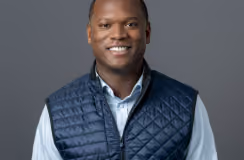
%20-%20thumbnail.avif)
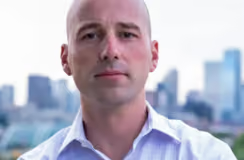
.avif)
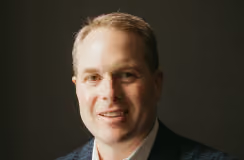



%20-%20thumbnail.avif)