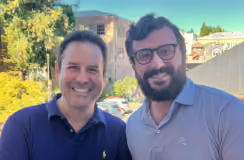
[00:00:00 - 00:04:06]
Host: Today's story shows you how to buy a business without the benefit of the sba. Justice Ludig is a South African national and he didn't yet have his US Green card when he was buying the two trades businesses in Texas that he planned to consolidate into one. So he couldn't use SBA debt for these acquisitions, which at 1.5 million of pro forma earnings was otherwise in the sweet spot for an SBA loan. So we unpack how justice got the deal done with seller rollover, seller notes, investor equity and a convertible note.
That last instrument is not common in our world. Listen for what it means and why it clinched the transaction. Also listen for Justice's thoughts on the first two years of his ETA journey when he worked as CEO of a trades business that he intended to acquire. Working with an owner seller to first run the business with the understanding that you'll later acquire it is an appealing model for many reasons.
I've had offline conversations about it and you've heard flavors of it on Acquiring Minds. But a lot of stars need to align for that model to play out in reality the way it looks on paper. In Justice's case, he did not end up buying that business and and his reflections here are valuable. Okay, here he is Justice Ludig, owner of Copeland Home Services Webinars Today, Thursday, SBA loan broker Heather Anderson will host a webinar on the new $10 million limit for SBA loans.
You may have seen that eligible borrowers may now combine SBA 7A and 504 loans from for up to $10 million in SBA backed financing, doubling the previous cumulative limit. Heather will lead a webinar on these newly expanded lending limits and what those changes mean for you. If anything, that is today, Thursday, May 28th noon Eastern. Link to register is right at the top of this episode's show notes or on the Acquiring Minds homepage.
Acquiringminds Co. Welcome to Acquiring Minds, a podcast about buying businesses. My name is Will Smith. Acquiring an existing business is an awesome opportunity for many entrepreneurs and on this podcast I talk to the people who do it.
Buying a small business sounds simple. Find a company due diligence. Get a loan close. In reality, you wear every hat just to get the deal done and then the moment you close you have to throw those deal making skills out the window and learn how to operate.
You shouldn't have to rebuild this infrastructure from scratch and you definitely shouldn't do it alone. That's why Walker Deibel created Acquisition Lab. What started as an accelerator has expanded into a complete ecosystem for acquisition entrepreneurs. Over six years, the lab's 1200 members have acquired over a billion dollars in businesses.
The Lab puts everything under one roof. An active community, deal reviews, post close services and a dedicated fund helping experienced operators buy larger businesses. If you're serious about buying a business, come see why Lab members have a 40% success rate. Learn more in the show notes or@accentlab.com acquiringminds Justice Ludig, welcome to Acquiring Minds.
[00:04:06 - 00:04:09]
Guest A: Hey Will, great to be here. Thanks for having me.
[00:04:10 - 00:04:31]
Host: Justice, you are seven, almost eight months into ownership of an H VAC and plumbing business. Surprise, surprise. There have been surprises, many unique features to your story. Justyce, let's get right into it.
Start us off with some background on you, please.
[00:04:31 - 00:06:47]
Guest A: Yeah. Cool. So you know, as you can hear, I'm not from around these parts. Originally from South Africa born and raised, spent the majority of my life down there.
Actually grew up on a on a ranch down in South Africa and then eventually went through the process did my undergrad in South Africa and you know, for various reasons mostly due to opportunities in South Africa to some degree and more more in the US Made the made the move over to the US Spent some time in New York initially came over to do my MBA in New York and then worked in banking for a couple of years at JP Morgan and then eventually transitioned over to their venture capital team and and the last kind of 10 years have spent that time moving from their venture capital team into private equity and then more recently joined a venture capital firm out in San Francisco and had a good run there. Had the excitement of investing in some really cool at the center of technology tech tech companies. And you know, I think having having the more blue collar kind of background I was always very interested in entrepreneurship and owning my own company whether that was through you know, an acquisition or or through starting something. And you know that that whole process led me to where I am today.
But a big part of that was the lack of hands on operating experience that that I was kind of yearning for in in venture capital and you know, know, somewhat disillusioned with with the venture capital bubble that you know, everyone kind of tells you it's, it's the dream and the be all and end all and where you want to be and you know, very quickly realized that it wasn't for me. And you know, through through that whole process kind of led me to a point where you know, the gloves off and you know, let's go out and find something and was lucky enough to to get in touch with a mutual friend who put me in touch with, with their friend who was towards the end of their career on their, on their H VAC plumbing business. And so, you know, on a whim, a lot of thinking behind it. But you know, it may seem like on a whim, quit my job in San Francisco and moved down to Texas.
[00:06:47 - 00:06:56]
Host: You said that you have a blue collar background. What did you mean? In South Africa you grew up in a blue collar family. What, what did you mean there?
[00:06:56 - 00:07:01]
Guest A: Yeah, we were, I mean, ranchers and Ranchers. Yeah. Yeah.
[00:07:01 - 00:07:09]
Host: So despite the fact that you went into vc, you actually had a, an affinity for that sort of life?
[00:07:11 - 00:07:35]
Guest A: Yeah, look, starting out, it was what I was told not to do. The blue collar, you know, trajectory. But the more I, more time I spent in VC and realizing I'd got into it for the wrong reasons, the more I, I wanted to, to be involved with a hands on business that I could see, touch and feel. And the people I think was a big component of that too.
[00:07:36 - 00:07:37]
Host: Say more.
[00:07:38 - 00:09:32]
Guest A: Look, I mean I'm not an engineer by background, so with the AI boom happening and going around, you're really investing in the nuts and bolts of that now the consumer side I could understand, but you're really investing into know how differentiated the, the tech is under the hood and you know, there, there I had, I had no feeling that my skill set was able to get me ahead. And as much as I thought that VC was a people game, yes, it is. But those relationships take many years to, to develop and so I just felt I didn't have a real edge in looking through the next 20 years in that. And you know, having grown up on a ranch, you learn how to problem solve very quickly, which you don't really think there is value in that early on.
But thinking back now, you know, your cattle are missing. You know, you can't just put that into Claude and figure out where they are. You got to figure out a very detailed operational plan of, you know, they're in these camps. We've got to start from this direction, rule out possibilities.
It's very hands on, kind of process driven thinking and also hands on, you know, no different to putting in a new process with a dispatching system that you are troubleshooting. Well, what's going on with you know, this technician that is potentially driving too far, this customer that is out of our service area? You know, it's kind of process of elimination and a lot of that is just hands on thinking through things you can see, look and feel. And again Big part of that is you can go and look for the cattle.
Again, you can't put in AI you got to motivate your team to go and look for the cattle. And so those core, core pieces that I grew up with, I realized were a strength of mine and I just wasn't able to use them as much in my former career.
[00:09:32 - 00:09:54]
Host: The other thing I recall you mentioning from our pre call is that you were, you were exposed at, in South Africa to American, I think, but maybe from many different countries. Small business entrepreneurs who were clients and customers. You offered safari tours, correct?
[00:09:54 - 00:09:55]
Guest A: Yeah, yeah.
[00:09:55 - 00:10:22]
Host: And so there's, there's actually a pattern here of people on acquiring minds, maybe being in a very white collar environment or in your case, a ranch in South Africa, but thinking that entrepreneurship looks like Mark Zuckerberg or Elon Musk or something. And then, then there's this moment where they're exposed to small business owners, small business entrepreneurs, and it can be a bit of a light bulb. So tell us about your light bulb moment there.
[00:10:23 - 00:12:06]
Guest A: Yeah, so I think the origin story there is, you know, we, we, we ranched cattle and sheep and eventually moved into the safari business. And by virtue of that, you know, know, most of our clientele came from the U.S. and you know, I had heard about America, thought about it and you know, didn't really take it seriously. Fast forward 20 years from growing up in that environment, I ended up being in the US And I would still go back to the ranch.
And you know, I followed this path where I thought that that was the, that was the dream, right? White collar banking, venture capital, private equity. And the reason for that was what was drilled into me at a young age was get an education and get a real job that doesn't depend on the weather for grain and fe, because he can't control that. And going back to the ranch, I would, you know, now in my adult period would meet some of these, these clients that would come over and we would kind of compare notes, sit around the fire and they'd hear my story of following, you know, kind of what society deems as successful, whether you're on Wall street or Silicon Valley.
And I would look at their notes and you know, they'd be H Vac owners, construction, you know, property owners and property plumbers. And you know, obviously not the sexy jobs that your parents tell you to do out of college or, or out of high school. And I would look at their lifestyles, I'd look at their happiness, and I would just think to myself, I'm missing something Here, you know, they had a lot more passion for life, they had a lot more purpose. And yet it, I was taught to think that that was something that you avoid.
Those are the unsexy jobs, Those are the, the, the jobs that you do when you have no other option. And that was a big reckoning for me of thinking, well, have I missed the beat on what success looks like or have I been chasing a dream that wasn't actually mine? You know,
[00:12:09 - 00:12:18]
Host: and so then your parents who encouraged you to go get an office job to escape the vagaries of ranch life or blue collar life, were they wrong?
[00:12:19 - 00:12:59]
Guest A: Look, I think they were doing the best they could and you know, one always wants to, to set your kids up for success and something better than themselves. You know, I think they were right in setting me up in that direction because they bought me optionality. Right. I think the trajectory that I followed, I had to find out for myself what I wanted to do, but I still had the optionality to stay where I was and then go back to the roots.
So call it if I wanted to. And so no, I mean, you know, and, and they've just been a great support and it's so, it's, yeah, really thankful for them for, for setting me up on that, on that journey.
[00:13:00 - 00:14:40]
Host: If you ask owners in the ETA and search community which insurance broker provides highest quality work, great outcomes and has a practice dedicated to searchers and acquisition entrepreneurs, one name comes up again and again. Oberle. Oberle Risk Strategies has worked with hundreds of searchers over nearly a decade and is in fact led by a two time successful searcher, August Felker. Which makes Oberle a specialty insurance brokerage for searchers by a former searcher.
And if you've got a business under loi, Oberle will provide complimentary due diligence on that business's insurance and benefits program. An easy no risk way to get to know August and the team at Oberle to take advantage. Check out oberly-risk.com that's O B E R L E- risk.com link in the notes. Okay, so you're in VC for a number of years.
You're feeling like it's going to be very hard to make a dent in this world. It turns out to be a people business. As AI takes flight, it turns out to be. Or it's going into a phase where engineering chops are maybe more important than they were for the last 10 years when it was like, you know, social media apps and the underlying tech was a little bit less important than it is going forward, you're reawakened to things that you can see, touch and feel as you described it.
So pick us up from there, please. How did you get from San Francisco to Texas?
[00:14:40 - 00:16:14]
Guest A: That was the relationship that came through the Safari Network. I came down to Dallas, actually, for a safari convention with my, with my dad. And through his relationships, you know, I, I was at the point about six months before I jumped ship from vc, where, you know, I was pitching my idea of a service business. You know, it wasn't necessarily H Vac or plumbing, but I wanted to be in, in the service business.
And, you know, the writing was on the wall. AI was booming. Everyone wants to go and work in either tech or Wall street or consulting. You know, the services trades for the person of my profile.
Call it, you know, well educated finance. That was still a big leap, especially in cities that were somewhat overlooked. Now, I know Dallas doesn't seem overlooked, but for the guy or girl sitting in New York, it's a big move. And so, you know, through this relationship, he put me on to the company, Stows Independent Services.
And so the owner and I did a handshake deal where I would come in as CEO and run the business, while at the same time putting a deal together to buy him out over time. And that, and that process was about two years, in hindsight, the best learning experience that could ever happen. The difficulty there was, well, how do I figure out the visa situation, which we can also talk about later. But I was at that point still on an H1B work visa, which makes doing a search or ETA very, very challenging because your, your visa and work status is tied to an employer and you're not really a free agent.
That, that gives you autonomy to do that.
[00:16:14 - 00:16:30]
Host: Yeah, well, and I want to spend some time there, justice, because this will be very relevant to certain listeners. But give us a little bit more on this, this agreement with the owner of stos that you would work in the business as. Did you say COO or CEO?
[00:16:30 - 00:16:32]
Guest A: CEO, yeah, CEO.
[00:16:34 - 00:17:12]
Host: Run, learn the business and then over time acquire it from him. It's funny, that model is, is one that just came up in conversation earlier this week. And it, it seems like a great model because everybody de Risks each other. It's gradual.
The transition is gradual. Maybe you're not a good case because the, the, the visa green card situation was this other factor. But overall, elaborate on that model and to the, the extent to which listeners might try to work out similar agreements with owners.
[00:17:12 - 00:19:41]
Guest A: Yeah, no, that's. And, and, and you Know, I mean in, in my case it was somewhat unique. But you, you think about it from the seller's standpoint. Right?
And, and as you as you mentioned de risking themselves is a, is a massive one when it comes to legacy. They they often feel like and Sturz was is a 40 year old business. The and the kind of the context there in that point in time the owner was, was, was outside of the business. He lived about two hours away from the business and he had put some of his, his family in place to help run it.
And so his real need was he needed an operator and needs needed someone that he could trust. And over time, you know that was, that was the goal. So that was the, the real, the real kind of impetus to the relationship starting. We both had, had had kind of a symbiotic you know, need on what we wanted.
I wanted to run a business and he needed me. And you know, the issue there is you, you go into these relationships thinking it will work out. I think the biggest challenge in these relationships working out is, is the, the lack of control that one has when you don't do that deal up front. And so you really need a very special seller owner to give over the reins without those, without the buyer having any legal recourse or structural, you know, agreement in place beforehand.
It's kind of just a handshake deal. And so that was challenging over the, over the two years and partly why why it wasn't successful. But I've spoken to a lot of searchers. Well how do you even come across those deals?
And it's really difficult because you got to earn the trust to even think about that idea of letting someone else who you don't know run the business if you don't put an agreement in upfront. And I would caution these deals as well because the biggest downside is for the searcher or the buyer because the owner has some guardrails in the sense that if the business starts declining or hopefully they have enough context or insight into that if it starts declining they can pull the plug. So the power dynamics are not really well balanced from that standpoint, which makes it really difficult. However, in my case thinking back it was the greatest thing because it gave me Runway to learn the business, learn the trades, make mistakes in a relatively risk free environment.
[00:19:43 - 00:20:52]
Host: Well and, and I would say that that is a, is a great bear case of this path. A lot of people listening will say yeah, even if I it doesn't end up working out with this owner seller that I become the successor, the buyer of their business. I will have gotten two years running a small business and so I will have gained all of that experience which will be valuable for me as an operator. Will be valuable for me going out back into the market, looking for another business and communicating with and sellers and, and, and selling myself as a viable operator of their buyer of their business.
So there's def. And you're being paid all the while, right? I mean this is a job. So, so it, it seems, I mean it seems like the sort of thing, the sort of job a searcher would take, period.
Let alone with the, with the, the potential prize at the end of the road that they get to buy. So with all that said and all of that kind of understood at the outset, it is a model that if you can get it, you would advocate it. If, if somebody listening can get an opportunity like that, they should go for it.
[00:20:52 - 00:22:03]
Guest A: Yeah, I mean, no, no doubt. You know, and it's easy for you and I to talk now and, and kind of looking back, Hindsight is obviously 2020. Right. And it, and it sounds great.
I think our generation is, is somewhat misguided and, and I'm, I'm part of that camp and how quickly we want things done. And so I think the advice to, to anyone doing that is I would over index or I would anticipate it not working out with that specific deal, but act like it will work out and put your, you know, your whole life, your blood, sweat and tears into that. However, you know, it's very, it's, it's very, it's, it's emotional roller coaster. Right.
You get plugged into that business, you learn the people, you build consensus, you become a leader. All the while, while that deal may not, may not work out and I think the big if there is, it won't necessarily lead to a new deal if that does not work. Yes, of course, you know, logically speaking, and you applying the right framework first principles, it gives you the experience, it gives you the relationships in the industry, it buys credibility and it gives you operating chops.
[00:22:03 - 00:22:03]
Host: Right?
[00:22:03 - 00:23:29]
Guest A: So sure, 100% get that. I would just go into it with a mindset of hey, this could not work out. And in the downside case that it doesn't work out, I am still much better placed than I was two years ago had I not gone through the experience. But you know, I think everyone is, it goes into that deal thinking this is the only deal I'm going to do or this is the deal that will happen.
And oftentimes there can be some unmet expectations. So I think keeping your expectations low is probably the biggest thing there. And look, I would say it takes a very emotionally mature person to deal with that, because in most cases, you're dealing with an owner seller who is not yet at the point where they do want to sell. Right.
So you're in this constant arm wrestle of proving value to them, while at the same time, and I think most likely looking the other way for some of the decisions that you would want to execute on which you don't for at the risk of sacrificing the relationship. Right. So, you know, the guy who's been there for 20 years, or the. Or the woman who's been there for 20 years, who you know is very close to the owner and they are doing a subpar job, you might not let them go in order to ensure that the relationship with that owner stays in place.
Right. So, yeah, it's. It's a very muddy, muddied area to. To navigate.
[00:23:29 - 00:23:57]
Host: Right. Yeah, yeah. No, that's all makes a lot of sense. It is very well put.
Okay, great. And just in case the audience missed it, so you upped yourself from San Francisco to go down to Dallas to run this business. This was a big, hard pivot in your career. Did you get.
Were your VC pals scratching their head or were they like. Or were they like, oh, you're one of these go buy a plumbing business guys for that I hear about on Twitter.
[00:23:57 - 00:24:08]
Guest A: Yeah, no, I mean, this was right before that Wall Street Journal article came talking about the H Vac millionaires. And so that was. That was ironic. So I had people in both camps.
[00:24:09 - 00:24:09]
Host: What's.
[00:24:10 - 00:25:17]
Guest A: I think for my career trajectory, I, at that point in time, told my friends, as I was kind of thinking through these decisions, and I told my friends, I remember distinctly saying, whatever I do next, I hope that you tell me that I'm crazy. Because if you told me that I'm crazy, it means that I'm not following the traditional path of stay in vc, either jump to a tech company or, you know, make partner at a VC firm or whatever that may be. And those words came to bite me back when I made the decision. And my friends did tell me I'm crazy.
And, you know, you're on this great track and you've got a great background. You know, you've kind of done all the hard work to get into vc, and now, you know, the world is your oyster. And so I had to really live and eat my words on that point. And that's where it gets scary.
Right because the key question everyone asks you, and then, you know, taking a step back now you kind of look at people who do follow the proven track and there's nothing wrong with that, but you know, your risk tolerance is lower there. And, and then you kind of, you know, realize that, well, you know, you gotta be a bit crazy to follow down, down this path. And I, I have to eat those words.
[00:25:19 - 00:26:02]
Host: Isn't it funny to that these people in, in vc, in tech in San Francisco, which is supposed to be the picture of entrepreneur now I know they're not the entrepreneurs, they're the VCs. But still, even in that environment that there's where, where risk taking is so celebrated, or at least people claim to celebrate it, that that risk, risk aversion is, is all over the place. And of course it really was a big risk justice because you could, you could find that you just hated it. I mean, yeah, and then it'd be much hard, it'd be really hard to break up, break back into hard, if not impossible kind of.
Well, I don't know if impossible, but quite hard to break back into where you were.
[00:26:02 - 00:26:19]
Guest A: Yeah, no, no, definitely. And you know, the, the narrative that you tell people when leaving the industry, you obviously start justifying your decisions and then, you know, if it doesn't work out in a six months to a year from now, you're going back to those same people and saying, well, you know, I got that. Ignore what I said before.
[00:26:19 - 00:26:25]
Host: Exactly, exactly. Okay, so after these two years, pick us up in the story.
[00:26:26 - 00:29:07]
Guest A: Cool. So the Stos deal didn't end up happening. The business was somewhat exposed to multifamily and in that environment, with rates increasing post Covid, that made that period pretty difficult and some headwinds. And so there were various reasons including valuation and so on, that that caused that deal to die.
And at that point, when that wasn't on the table, I think the seller and I both looked at each other and said, well, let's part ways. And so took a step back from that. That was April. It was the day of my birthday in 2025.
All time low. And this is kind of where my point around tempering your expectations going into this, when you do go and work in a business to try and acquire it over time, temper those expectations. Because April 8th hit my birthday and my dream of everything that I have left in San Francisco for acquiring this business was a failure. And sure enough, you and I can sit in hindsight now and you know, talk about the experience.
Great. But in that moment, you rock you're rock bottom. And I obviously mean that with respect because rock bottom means very different things to various people. But, you know, the dream didn't work out.
I'm a failure. Where do I go and find a new business now? Right? And, you know, you speak to enough searches, and you know how difficult it is to find a new business.
To check all the boxes, the investors that I had been warming up for the transaction, I had to go back to two and say, hey, well, this deal didn't work out. And without the right mindset, all of that is a failure. Going back to investors saying this didn't work out in the one perspective is you have now burnt goodwill because they are now questioning your judgment because you told them this deal could happen. It didn't happen.
So all of that is negative. Obviously, in hindsight, investors aren't as binary. They see it as a positive. You learn something and you pick up those experiences and you take it to the next one.
And so I had luckily built a relatively good network with searchers and people in the industry, especially in the trades. And obviously that's by virtue of spending those two years. You start to get to know people, and you also have the opportunity to meet business owners without the guise of acquiring them. And so I picked up those relationships and through a searcher who had not been able to close a deal with Copeland at the same time, his deal fell apart with Copeland.
And so him and I reconnected over coffee, and he said, well, my deal died. And I said, well, at this point, I've got nothing going on. Would you mind if I had a look? And so that kind of kicked off the Copeland process.
[00:29:08 - 00:29:11]
Host: And why didn't. If the deal didn't work for him, why might it have worked for you?
[00:29:13 - 00:30:13]
Guest A: And I guess, you know, you look back and when you don't have many options, you're willing to turn over every stone. And so logically, it shouldn't have worked for me. And logically, I should have trusted him. He'd been searching for two years.
He'd seen deals, and so I should have trusted his judgment, which I did. But at that point, you know, I've got nothing else going on. Let me have a look. Obviously, I'm busy looking at other companies as well.
And so it was kind of a Hail Mary, thankfully. You know, he said, good. He said, go for it. And, you know, I'll forever be thankful for that.
And so the deal structure there is, you know, he was looking at Copeland, and there was another company, First American Plumbing, that he was looking at as well, but would be later down the line. It was a smaller company. And the reason why it didn't work out for them is they, they couldn't agree on valuation. And, you know, some details came out in the QV at that valuation.
And, you know, I thought, well, let's, let's have a, let's have a second go and see if the, the seller would be happy with a different number or a different deal structure.
[00:30:15 - 00:30:41]
Host: And so, and you said there that. So Copeland is the now the primary subject of our story, the business you're now talking about and for the audience, STO's was the business that you were at before, where you were two years and maybe working toward acquiring it from the owner, but back to Copeland and then. So Copeland was the main business, but there was also potentially another plumbing business, First American. Did you say?
[00:30:41 - 00:30:41]
Guest A: Correct?
[00:30:41 - 00:30:52]
Host: Yeah, yeah, that. So that they would have, they would have been acquired as a pair and merged sort of thing as the initial acquisition or as the platform acquisition, correct?
[00:30:52 - 00:31:44]
Guest A: Yes. And, and the deal morphed somewhat because I got involved with, with the process at the tail end of the previous searcher where their process ended. And at that point in time, we had literally a week before that deal died, we had high Level discuss the structure where I would come in and we would buy the smaller plumbing company, he would buy Copeland, and we'd later merge them together down the road. And so Copeland deal dies.
I'm speaking to First American and at that point, First American, Copeland, are working together and sharing deals. You know, H Vac Plumbing, they are complementary. And so when the deal died, I then engaged with both of the sellers. So First American and, and Copeland and we, and we then kicked that process off and then that, you know, the idea was over to, to, to structure the deal where we combine them into one entity.
[00:31:44 - 00:32:00]
Host: Let's pause there and just hear now as a sidebar about your legal status as a South African. You are not, or at this point in the story, you don't have a green card, so you're working under a visa. What does all of that look like?
[00:32:02 - 00:34:00]
Guest A: Yeah, it's a, it's a challenging one. And, and, and one that is, you know, this is already a stressful process right now. You add on your, your legal working status, and as an mba, you hear a lot about search funds. And obviously that's a massive recruiting tool for that.
The difficulty there is for an international to do a search fund or an eta. You know, you have a work authorization typically, which is an H1B visa. Which is a visa class that is structured for highly skilled workers and that is often, or not often, it is mandated to be tied to an employer. So employer sponsors you and you can work for them through that.
So the question is how do you acquire a business when you're not employed by anyone? And that's really the difficulty in trying to do an acquisition as an, as an international. And, and how do you navigate that? Right.
And so what, what was, and again maybe you know, putting more, putting more positive color on the experience for Stos was that doing that model, you actually are sponsored by the employer to do that. Now that's another wrinkle is, you know, it's a tough pitch to that employer because sponsoring you takes a product, takes about 10 grand. And it's a process to go through. You know, and that, that for them is, is also, is also a hard one to swallow as a small business.
Right. And most of these small businesses, I've never heard of these visa processes. You know, they, they, they just, it's not part of their wheelhouse. And you know, the difficulty there was then, well, how do I acquire Copeland with, with this, this burden of my head with, with Stows and you know, the way around that, that eventually I structured it was with the Stow's owner.
We came to an agreement where I would still do consulting work for them and they would continue to sponsor my visa. That then allowed me the time really to be able to go ahead and work on the Copeland transaction for about four months.
[00:34:01 - 00:34:48]
Host: Okay, great. Let me unpack a couple things there. First of all, when you. So to be clear, as the audience knows, if you're doing a full time search, that means that you're not working a job and you're just spending all day searching and you're not employed.
And so as an international, you can't do that. You're basically not, not allowed to do that. At least not for any extended period of time. So one question right there, justice is, is the obvious solution to this, although you're, it's, you know, you're kind of being forced to it where Americans can choose to do a part time search.
So that is a thing too. Where searchers keep their jobs and then they search on and weekends. Is that bas, is that not the kind of the first and most obvious way to address this?
[00:34:49 - 00:36:07]
Guest A: Yes, that, that, that's the ideal situation. Bearing in mind you're they limited geographically. Right. And you know, oftentimes the best deals come in the places.
It's by virtue of supply and demand where if you go to the places where the most concentrated searches are not, they are all in New York and San Francisco and probably Austin and the larger cities, Dallas and the outskirts of Dallas are still somewhat overlooked. Now I'm sure people will have counterarguments to that, but the density of Dallas searches versus New York, San Francisco is totally different. And so the part time model is great, but having been in the stow seat for two years, I can't remember how many calls I received from searchers. I don't know where they got the number or the details calling me.
And I was obviously empathetic to their situation because I had been there. But you know, whomever else runs their company, they're not going to spend any time, you know, speaking to them. And so trying to do that over the phone is really difficult. Which is obviously the easiest way of doing part time is sending emails and trying different strategies to get someone's attention.
Going through brokers and so on, you know, you can obviously still get a deal done. It's just very difficult.
[00:36:08 - 00:36:49]
Host: Okay. And so the way you solved it was you had this relationship, this. You've been the CEO at STOWS for two years and so. And they had been sponsoring you.
You're sponsoring your Visa. And they agreed to continue to. Because you continued to work for them, but not on a full time basis. And so that freed up your time to then pursue Copeland's, which was itself.
Even though you had a deal in hand, it was going to. As people know, it's can be all consuming to get a deal done even when you got the deal in hand. Okay, all right. Okay, great.
Anything else to say to the international audience on your. That they can learn from your situation or is that. Have we covered it?
[00:36:49 - 00:37:49]
Guest A: Look, I think I would have done this a lot sooner had someone mapped out the path for me, but I've never spoken to anyone who had done that in my situation. People either had green cards or a lot of my friends in banking have subsequently gone through the same process, but only after getting their green cards. And that was kind of the checkbox. But no one that I knew of had ever done this on an H1B visa.
And so I think the big takeaway there is, and it's a first principle of just seeing someone else do it and seeing that there is a path towards that and knowing that there is a way of structuring that to make it work for you. Now there's obviously a lot of big ifs along the way, but having the structure in place as well as Just the path of knowing that it can happen. I think that's a massive takeaway. And had someone told me that five years ago, I would have done this a lot sooner, I think.
[00:37:50 - 00:38:18]
Host: Yeah. And, and really, to distill this justice, it comes down to what a lot of people who are international in the US Confront. Maybe they're not searching to buy a business, but they're pursuing some project or doing something that isn't necessarily the job that they have. And so it's how to get the visa coverage right while being here.
[00:38:18 - 00:38:18]
Guest A: Right.
[00:38:19 - 00:38:31]
Host: That's the puzzle generalized that you're solving. And in your case, you had this relationship with a small business that you'd run for two years, and so happily, they were willing to continue to sponsor you.
[00:38:31 - 00:39:30]
Guest A: Okay, all right. Because I think the other angle of that as well is you're also trying to make sure you live right. And so sure, you could go part time and you could figure out a sponsorship, just make sure you have enough savings for that. I think the other element of that as well is that with the recent SBA laws that have changed that now prohibit green card holders to apply for SBA loans, I think that's a big hurdle that luckily I didn't have to face and I didn't go down that path.
But typically that was a path that people followed when they had received their green cards or were on H1B visas. The difficulty there is, if you're on an H1B visa, you were not eligible for NSPA. Learn you were waiting for a green card. Now that green cards off the table as well, you know, the, the, the big piece there is that what I came to find out is that there's a ton of capital chasing small deals which still allows you to do an acquisition while the SBA is not on the table anymore.
[00:39:31 - 00:42:03]
Host: And, and that is the other big takeaway that international and non international people are going to get from your story, how you structured, how you structured your deal. Now, that point that you just said is the one that I was going to scream to the audience, unfortunately, if, if, if you weren't following about the green card, that what justice has said, there was a recent rule change to the SBA where even green card holders now don't have access to the SBA loan product. And it's really quite devastating and surprising. But, so, yeah, so if you are anything short of a citizen at this point, the SBA loan for now is all but off the table.
So a lot of actually your story is sadly not going to be applicable to international people because the winds have changed even further in just the last six and nine months. So listen listener, listen especially closely then to how the structure of justice, how justice did this and financed it. Because without access to SBA capital, this is how one way it can be done the team at Aspen HR recently published a short white paper targeted at searchers Entitled A New CEO's Guide to Human Resources. It lays out the key items you should be thinking about as you transition into CEO and owner of the business you bought.
The link to download that is in the show notes Aspen HR is a professional employer organization or peo, which provides HR compliance, flawless payroll, robust HR technology and Fortune 500 caliber benefits, all for a fraction of the cost compared to using multiple vendors. Reach out to Aspen HR for your complimentary HR diligence checklist and benchmarking analysis. Go to aspenhr.com or contact Jenny Thier directly at jennypenhr.com okay, let's get back to it then. So Copeland's why don't you tell us about the business, give us kind of the bullet point, size, history, employees, etc.
[00:42:03 - 00:44:54]
Guest A: Yeah, so First American is about seven years old, formed in 2017. First American is the plumbing business and Copeland had been around for about three years at that point and pro forma total business was around 8 million in revenue, 1.5 million EBITDA and just under 30 employees. And the businesses have just been scaling rapidly over the last few years I think. Obviously DFW is a very competitive market, especially when it comes to H vac and the team had just figured it out and they'd found a nice niche for themselves in Dallas and we're on an upward trajectory.
And so having been through the STOS process, that definitely helped me with my diligence and being able to at least have a side by side of detail of in depth operations that I could kind of compare to. Right. And so yeah, the business was a high growth business, solid margins, solid team. It didn't have the full team in place obviously and there was a ton of potential to get there.
I think what created the interest from all three parties, myself and First American and Copeland was that they had reached a point where they needed to scale even further, go broader within dfw. And that's where my experience and skill set came in, as well as access to capital. And that really kicked off the beginning of the great relationship and we spent about four months in diligence and doing one deal on its own is hard enough, but then structuring two together and then ensuring that everyone's on the same page and terms are, are met with everyone. That was, that was definitely something that in hindsight I probably, you know, definitely bit off too much that I could chew.
But it took a good four and a half months to get over the line. From the day I started fundraising, I think the, you know, as with anything, someone, someone told me that don't worry about the capital, the capital will come. I didn't believe them. And then the first six weeks was putting together the initial deck, putting together the diligence materials and then going out to market.
And I had a few investors lined up from the STOS deal, but we had never gotten to the point where they had to fund any cash. And so you've been dragging people along and then the rubber meets the road and you wonder will they actually fund and will the capital be there or have they just been stringing you along? And some people fell to the wayside. But I think, you know, the big thing that, that stood out to me was obviously it was, they were both good assets.
And when you have that dialed in and you have the trust of, of your network and people to back you, the capital flows. And, and we were oversubscribed by, by the end of it.
[00:44:54 - 00:45:05]
Host: Oh, fantastic. Great. Well, I want to hear about the structure as we, as we said. But just going back to the business, you said 8 million in one and a half of EBITDA.
That was just Copeland's.
[00:45:05 - 00:45:10]
Guest A: That was pro forma. So, so Copeland and, and First American together. Yeah.
[00:45:10 - 00:45:16]
Host: God. Okay, thank you. And, and, but Copeland was the larger of the two businesses.
[00:45:16 - 00:45:16]
Guest A: Correct.
[00:45:17 - 00:45:33]
Host: Great. And it was only a three year old business. So they. Okay.
And did you see risk in that, that, you know, quick, quick growth, but also quick, quick decline potentially. I mean it is H Vac, so it's like an enduring, an enduring business, but still.
[00:45:35 - 00:46:01]
Guest A: Yeah. And look, I think if I hadn't had the STO's experience, you know, a 40 year old business, which from, you know, 10,000 Foot View is the ideal acquisition target. Right. The downside of that is you're also picking up 40 years of bad habits.
And I think if I hadn't gone through that experience, I would have seen the three year old company because I know a lot of people don't even look at companies, you know, under five or 10 years.
[00:46:01 - 00:46:02]
Host: Yeah.
[00:46:03 - 00:46:28]
Guest A: And so I think that opened my eyes right, to well, let's treat this like a startup. Let's see what good is. Our good can come out of, you know, what has already been built as opposed to the brand name. Now look, you also make some trade offs.
You do go into it up front knowing that your marketing spend might be slightly higher than, than, you know, a, an older business. But it definitely kind of took the blinders off in looking at the, at the track record.
[00:46:29 - 00:46:34]
Host: Okay, so pro forma, one and a half million of ebitda. What was the, what was the purchase price?
[00:46:34 - 00:46:40]
Guest A: And then we end up doing the deal at a 5.5x EBITDA. So yeah, just, just over 8 million.
[00:46:43 - 00:46:50]
Host: Great. And talk to us about how you structured all of that, please. With no, no spa. Yeah.
[00:46:50 - 00:50:22]
Guest A: So, okay, so, you know, the, the big hurdle there was, I think, knowing what I knew then coming out of Stows. I wanted partners with me and I wanted operating partners. I wanted people that I could, you know, go to the, go to the promised land with, you know, so, so, so kind of, you know, how do you, how do you solve all of that? Luckily, the, the two sellers were both or are both still relatively young.
They had had a ton of gas in the tank left and they, we all were aligned on the vision. And so we, we rolled equity for both of them. Probably larger than you see in a typical deal pro forma, they roll about 30%. And so, you know, that's, that's a big one too because you're now locked in.
You know, you're married to, to two people that you've only known for four months. You know, what does that look like? And then, you know, you, you, you then go over to the equity side and then, well, how are we going to fill this bucket? And the deal is kind of locked in and you've sent out an LOI based on initial diligence and you've sent out your deck to your investors and you go through the awkward phase of the delta between your initial LOI and findings and diligence.
But from a seller's perspective, who's never been through this before, the LOI is the price. Why would that differ? Right. Why would anything in diligence come up and tell me that my business is suddenly worth less when you told me it's worth, worth this much?
Sure, the legals provide you all of the caveats and recourse to be able to retrade? However, it's not seen that way. That was a tricky path going through diligence. And at the same time you're waiting for something bad to happen.
You're also hoping for nothing bad to happen. But at the same time, you've got to be prudent with that and so thankfully there wasn't a big retrade in between those two. And so we're filling up the equity bucket, sent out the deck to the investors and everyone that I've been speaking to, we found an early anchor investor who was willing to put up the majority of the equity. And they really then got the snowball going.
And eventually anyway, funnily enough, the majority of the investors are all South African Americans who've been here for 20 years plus. And so once that key investor came in and they're a very credible person who'd been in private equity and operations in New York and him and I had a 10 year plus relationship and so a lot of credibility came through that relationship with him, that helped anchor the rest of the investors too. But then we hit a sticking point because there's no sba. And so to make the deal dynamics work for dilution as well as ensuring that the sellers are able to roll at the right valuation, obviously the best instrument to get across that is with debt.
And so SBA is now off the table. I hadn't received my green card at that point and, and you know, no, no seller is going to sign for that SBA debt as well as the fact that you can't have an equity holder who's not a green card holder. And so dealt with those dynamics. So, you know, scour the earth for justice.
[00:50:22 - 00:50:29]
Host: Let me pause you when you said the best thing to solve for that is debt. Say, say that line again and what did you mean?
[00:50:29 - 00:50:30]
Guest A: Right, right.
[00:50:30 - 00:50:33]
Host: So for the. Not for the non financial listener.
[00:50:33 - 00:54:27]
Guest A: Yes, no, definitely. And so you're constantly finding the dynamics between, in a seller rollover, you're finding the dynamics. On the one hand there are very incentivized by cash, on the other hand they're very incentivized by their equity ownership in their rollover because they've bought into this vision of you're going to get a second bite of the apple and the second bite is going to be much larger than the upfront bite, you know, if everything goes according to plan. And so, you know, you have two misaligned expectations or incentives from the same person.
And they already know what their cash upfront is. And so now you're solving for their equity. And the binary decision there is the more equity you put in the business, the lower their role becomes their equity rollover. And so the easiest way of solving for that is using debt and putting that on the balance sheet because that's non dilutive to the, to the equity holders.
And so you Know, and, and you know, the difficulty there is also explaining that to, to the sellers who are, who are not financial or don't have financial backgrounds, you know, that's a whole challenge in itself. But I guess that's a, that's a conversation for another day. But. So the question of how do you raise debt spas off the table?
So you scour the earth for any lender out there. The business did not own the property or any real tangible assets except for vehicles. Underwriters or banks or lenders don't really like that as underwriting collateral. And so how do you finance a deal without, you know, significant, significant tangible assets as collateral is a really challenging piece because the SBA really helps you when it comes to that front.
And that's kind of the design by the sba. And look, I guess with the SBA becoming more stringent, I imagine that there'll be more credit funds entering the market and more regional banks becoming more entrepreneurial. But the landscape on the regional banks, well, kind of take a step back. Where do you get debt from banks, credit funds, and then obviously individuals who are willing to lend or family offices.
But that's not as big a market at the scale of our deal. So at a 1.5 million EBITDA deal, that's right in the strike zone for sba. When you speak to regional banks, they are very traditional and not as sophisticated to underwrite cash flow deals. And so the deal that we did, because there's no big asset like a building or a property or land to underwrite to no hard asset.
When you underwrite those businesses, you're underwriting based on the cash flow of the business or the EBITDA of the business. And traditional regional banks really dislike those type of deals. There's too much risk for them. So scour the earth for them.
Eventually got to a point where that was a no go. No one was willing to underwrite that. And then you go to the larger banks, traditional banks, bulge racket banks, the deal's way too small for them. So you're kind of stuck at a road to nowhere there.
Then you open up the box of the credit funds or family offices. The difficulty there is that they are obviously pricing in that risk that the regional banks did not want to take on. And that comes in the form of, you know, typically a depending on what the rates are doing, but a low teen cash interest rate, and on top of that, a pick interest, which means that it accumulates. You don't pay cash on that.
And then in addition to that Warrants. And so warrants are directly dilutive to everyone on the cap table. And so now you get to this.
[00:54:28 - 00:54:37]
Host: A warrant for the audience is a right to a small piece of equity. Right. Anything further?
[00:54:37 - 00:55:18]
Guest A: Yeah, a righteous small piece of equity. And, and you know, you, you then price that in to the debt and it turns out to be, you know, a very expensive instrument, you know, in the high teens, mid to high teens, especially at our deal size. And the other thing is they're, there are very, very few credit funds that are in the space at that size. And so you know, you start moving up the, up the chain of deal size.
You know, you move into the, the larger big credit funds who do deals all day, but not at the size. Right. The, the, the risk reward is just not worth it for them.
[00:55:19 - 00:56:39]
Host: And so, and just to jump in with something you said there about the value of the SBA is that yes, it fills, it fills a big gap in the market where these are just too small for most other credit debt instruments on the market. But also so many of these SBA style businesses that we buy are very asset light as you said, or so called air balls. They're just cash flow deals. And that's, you know, I assume at larger sizes that cash flow deals also happen.
EBITDA based deals are, happen all day long but it's just that much more risky when the business is small. You're buying. So, so there are kind of layers to why these deals down here are so unattractive to professor to professional lenders. And so the SBA patches all, all manner of holes down here.
So it'll be, it'll be really interesting to see as these, as these rules have tightened and may keep tightening if the market is what kind of solutions the market's going to offer up if any to very small airball size deals that we're also familiar with carry on
[00:56:39 - 00:59:57]
Guest A: highly, highly seasonal business. No seasonal, no real recurring revenue. Sure you've got maintenance and memberships in place, but bulk of your, bulk of your revenue is, is seasonal and, and non recurring. And you know, and I get it from an underwriter standpoint, you could lose your pants on that.
And you know, it is what it is, but it puts you as a, as a potential acquirer in a very difficult position because you've, you've used all your resources out there to look for the traditional pockets of cash and you then kind of left with this really expensive piece of paper from a credit fund as well as looking at family offices and I kind of bulk bulk them into the same, into the same category because their business models when it comes to their debt arms or credit funds, very similar and it serves a purpose. And luckily we didn't end up having to use that. But at one point we were very close to doing that. And so you kind of go back to your investors, they throw up at that because of the warrants and the expensive paper.
And that kind of opens up the conversation. Well, if you don't like that, what about, you know, writing a note to us? You know, what about lending us some debt? And so that kind of kicked off that conversation.
As I went back to the investors, the initial deal that I sold to them of saying this is going to be our structure, you know, I delivered on my structure in that I found debt. However, it wasn't at the right terms. So you know, in, in hindsight that worked out well because that opened up the conversation to investors where you're telling them the alternative is this high teen piece of paper. What about coming in for debt and you've already set the bonus benchmark of, call it 15%.
What about coming in at 12%? 12% is a great return on any investment when you look at, especially from a debt lens. Obviously the difficulty there and the heartburn from investors is that they've now overexposed themselves both on the equity and the debt side. And there are two ways of looking at that as well.
So anyway, we went to investors and I was actually speaking to someone who had been on your podcast before and he advised me on the convertible note structure. And I'd seen convertible notes in action before, especially in vc. Didn't really know it was something I would use in this transaction. And so we plugged the remaining piece of debt with a convertible note from existing investors as well as the seller note from the original sellers that originally from the sellers.
And look, I think oftentimes what I found in hindsight is that business owners that roll equity are used to a certain lifestyle and oftentimes the seller note is frowned upon because they aren't getting their cash out up front. However, if you kind of tearing them down back to a traditional base salary plus bonus that is market related, that cash salary to them is often a lot lower than what they were pulling out before the seller note and paying that back over time, that kind of bridges the gap on the cash flow for them.
[00:59:57 - 01:00:27]
Host: Yeah, so this is something that I'll hear from time to time that one way of, of framing the seller notice, maybe more palatable for more appealing to the seller is that it's going to give them an income stream and they're probably used to high income from their years of ownership and this is a way to get that. So it's not all bad having the enterprise value delivered piecemeal over the years.
[01:00:28 - 01:00:28]
Guest A: Right.
[01:00:29 - 01:01:24]
Host: Let's just, let me just repeat some of this back for the audience's sake. Justice that this is a great takedown. Thank you so much for the transparency. The.
So you're having trouble filling the debt piece of the deal. And so what you do is you go back to the investor, your equity investors, and you say, why don't you guys put in lend me money. So for the debt piece that I can't fill, it'll be a different instrument to your equity and it'll be 12% versus what I'm getting out on the market at 15% and why. And, and, and, and so you ended up actually iterating on that to get to the convertible note.
We'll double click on that in a second. But why were they willing to do 12% if you're telling them that the market people who do this, do this professionally say the price should be 15. Why were they willing to sell debt to you for market?
[01:01:24 - 01:02:10]
Guest A: Look, I think, I think some of it comes down to pragmatism and, and knowing that they, they have the downside protection of, you know, being on the board and, and having certain, you know, legal rights that somewhat de. Risk their investment, you know, but a lot of it came down to just, you know, pragmatism of, you know, if you are an equity investor, you should be thinking like I am. Yes, why would I go, why would I go out to the market and you know, put put an onerous, onerous clip on, on the business and so it kind of forces you to speak from both sides of your mouth and then, you know, it's a, it's a risk adjusted kind of call at that point.
[01:02:11 - 01:02:35]
Host: A risk adjusted. Yeah, a risk adjusted call. Gotcha. Great.
And then, and then. So it was Nicholas James, right, the previous guest in Acquiring Minds, who's not only a previous guest but now my in Mines Capital. So work with him very closely. Who proposed to you the convertible note?
So define a convertible note and explain why it was the ultimate solution here.
[01:02:35 - 01:04:01]
Guest A: Right. So the convertible note works like a debt piece. However, if that debt is not repaid within a certain period of time, the outstanding balance of that converts into equity at a preordained price. The convertible note solves two problems there where obviously this is all based on the precedent that you Hope the business does well in that they could have the cash flow to repay that debt.
Now, if that does not happen, the investor has the downside protection of being able to convert that into equity. And oftentimes, you know, however you structure that, there's, there's an option or a mandate to follow one or the other direction. But it was a softer blur than doing a pure debt instrument from the company's perspective, because if that was callable when that got called in a year from now or three years, whatever the term is, and you don't have that cash or you haven't had the growth to refinance that debt out, it kind of gives the company a kind of a get out of jail free card. Well, not free because you get diluted by the equity when that does convert, but it at least buys you time and avoids having to get into a cash crunch.
[01:04:02 - 01:05:27]
Host: Great. Okay. So for the term of the convertible note, let's call it, it can be a year, three years, it's debt. And with the idea that you're hopefully going to grow into being able to pay that debt off.
Yeah. And in the case where the business, upon your ownership and the business over that term, one year, three years, doesn't, can't pay down the loan, the convertible note, and, or can't refinance it out or whatever, then it converts to equity. Yeah. So it doesn't, it doesn't suffocate you, your cash position, because it could just converts to equity.
Now all the equity holders, you, your investors, your sellers who have rolled now, equity get diluted so they have less equity on the other side of that. But it does, it's not fatal to the business or otherwise extremely damaging to the business to have an unpaid liability. Okay, all right. So it's a, it's, it's an intermediate step.
Okay. Okay, great. And, and you feel like this is something that should be common in search deals or was it only in this sort of edge case of yours? This isn't probably going to be that applicable to that many people sort of thing.
Well, because, because you do hear about it a lot in, in VC land. Why is it so much more common in VC land?
[01:05:28 - 01:06:52]
Guest A: Look, I think, I think in VC land, the, the equity is the golden goose there. Right. You want to ride the wave. And so oftentimes, at least in, in tight cap tables, a convertible note is a way of getting some action and getting into the, into the, into the action there.
Kind of a Trojan horse. And, and you know, obviously it's, it's oftentimes for, for vc given equity is such a, such a big one and that's even a more of an able than, than our businesses, especially in the early innings. It also is as you said, an intermediary solution. And so I guess it often has its place there.
But just given the deals that are getting done in the trades now, I expect this to happen more and more especially as VC starts to claw its way into the trades. It seems like as well. I think the other piece to not overlook is you know, when you obviously you know, you gotta, you have to be able to convince investors to want to write that paper. But on the other side of it now, you know, when looking at what your other options are as a either a seller note if that's not amenable, or now that if SBA were off the table for you, you know, looking at that vis a vis a credit fund, a convertible note is almost a no brainer.
[01:06:52 - 01:07:00]
Host: And so justice, to your piece of this. After all of this structure, how much equity or ownership of this business did you get?
[01:07:01 - 01:07:17]
Guest A: Yeah, no, that's a good question. And the way we structured it and I think, you know, if you follow this model, it looks and feels very similar to a search fund model, a traditional search fund model. And so with that my ownership was in line with the traditional search fund model.
[01:07:18 - 01:07:54]
Host: Okay, great. Which listeners will know is call it 25 to. Well, it is 25 to 30%. So you're saying that your own is something like that in that range.
Great, very helpful Justice. Thanks for walking us through this. Okay, so anything more to say about the transaction or can we hear about what it's what it. Okay, so you have been.
You closed in September 2025. Here we are, last day of April. So as I said, eight or nine months in. What.
What can you tell us about your ownership so far? How's it going? What. What are the highlights?
[01:07:55 - 01:11:01]
Guest A: Yeah, look, I think biggest learning from, from the previous experience with STOS is, is the, the culture and the lifeblood of the business is the most important. And as much as the media search fund world, you know, whatever you want to call it makes it out to be of this, you know, this young gun coming in and turning a business around and creating explosive growth and coming up with the smartest business school ideas and structuring and entering new markets and improving margins. Yes, that's all great. The biggest thing I learned is to focus on the servant leadership component of it.
And I know it's a cliche word, I wish I could find a better word for that. But the, the trades are notorious for not respecting white collar and earning your, earning your respect over time without having to. To really call in the structural lines that have been drawn. I think that was probably the biggest learning.
And so getting people on your side without having to tell them they have to be on your side. In simple terms, that's probably be the biggest learning. And it's been amazing and incredible to see the buy in from the team over time when you've more focused on. And this is so difficult to do because at the same time you have investor updates to send out.
You've got investors expecting the world from you because you've sold this deal with up and to the right and you then don't budget much time into relationship development and get building consensus as opposed to, to building profitability. And that for the first four months was really tricky because we had a lot of cleanup to do. But you can't mandate that. You got to get buy in.
And so I think the biggest win out of all of that, outside of the growth and the profitability and all that good stuff, is seeing that plan pay off and over time building consensus. The difficulty there is as well, we bought this business in the shoulder season, right? September through March are slow months for H Vac, which was the majority of the business. And there were some tough moments during the last six, six to eight months where you are not sure where your core volume is going to come from and you're trying to scale the business at the same time while not losing people.
And that was really challenging. And I would say through February, there were a lot more tough moments than easy ones in turning the ship around. And we were already on a good growth rate. But you hit that slump and you start questioning, well, did we make the right decision?
And investors are starting to ask questions. And then suddenly the summer hits and luckily for us, the heat came early in Texas. And so, you know, the last two months, I think we, we're really finding our stride.
[01:11:02 - 01:11:10]
Host: Great. And this getting buy in sounds like leadership to me. What, what is your style? How did you get buy in?
[01:11:11 - 01:12:25]
Guest A: Look, I, I think the, the first, the first piece is not. Not announcing yourself with a title. You know, just announcing yourself as, as someone who's there to help and grow and make, make people's lives better. I think we can so easily get stuck in this title world of and swim lanes from White Collar, where we almost need that as kind of an impetus or an introduction to be able to lead as opposed to just getting the work done and Getting into addicts with your technicians and spending time in the field.
And you know, one of my investors, he's built a great business in Arizona, was that, you know, his, his, he had a similar profile to me and he said the magic happens when you leave your desk. And you know, we feel, I mean, at least my background, my profile, we feel most comfortable analyzing a spreadsheet, building a deck and, you know, making a decision off of that data. And then, you know, marching orders continue from there as opposed to spending the time to meet people, to get to know them, and then from there slowly Trojan horsing in ideas. I mean, that's, that's probably the biggest learning.
[01:12:27 - 01:12:39]
Host: And going back to your youth on the ranch, do you feel like you're leaning on whatever, whatever you learned then or imbibed then as a kid?
[01:12:39 - 01:13:39]
Guest A: Yes and no. You think, you know, those worlds are very similar, but you know, then you get 10, 10, 15 years in white collar, you start losing that. But the biggest piece there is the relationship component. The relationship component is, is the lifeblood of the business.
And something as simple as, you know, spending two hours in the morning when your first instinct is to analyze the numbers from the past week or the past day, or look at close rates or look at average tickets, spending time just building relationship, that goes a long way. And I think, you know, the, the trades are very similar to a ranch where a lot of the time you are out there having fun and joking and playing while doing the work, which I think we've lost in white collar where, you know, it's dead quiet, you can hear a pin drop and
[01:13:41 - 01:13:41]
Host: if
[01:13:41 - 01:14:03]
Guest A: there's loud and I guess, I mean, startups are obviously different to this, but traditional corporate is, if there's any noise or any chaos, no work is being done. And so marrying those two worlds where, yes, you can have fun and it can look chaotic, but the trains are still running on time.
[01:14:03 - 01:14:07]
Host: Talk to us about buying two businesses at once. So what's that been like?
[01:14:08 - 01:15:01]
Guest A: Thankfully, the two sellers had a good relationship and I didn't have the stress of getting their buy in with each other as well. So that was, that was a big help. But you know, then you're focusing on three different identities as opposed to two. And look, I think having three people might, might often be better than two in in terms of getting, getting buy in or making tough decisions.
It's not a stalemate every time. So, you know, that, that was helpful. And then, you know, culturally it was, it was actually, you know, incredible how the two teams gelled well together. And, you know, we, we had a lot of consensus on the vision where we were going.
And the team's done really well in terms of, you know, playing the ball and not the man and, and focusing on the job that needs to be done. And look, there's nothing greater than building culture, than winning.
[01:15:02 - 01:15:08]
Host: Yeah. And are, but are you going to two different offices or two different businesses?
[01:15:08 - 01:15:15]
Guest A: No. So we're under the same roof, in the same, same logo, same brand, same office. Yeah.
[01:15:16 - 01:15:19]
Host: So the plumbing business was brought under the Copeland brand, Correct?
[01:15:19 - 01:15:19]
Guest A: Correct.
[01:15:20 - 01:15:22]
Host: And the office was consolidated.
[01:15:22 - 01:15:24]
Guest A: Correct? Yeah. Oh, okay.
[01:15:25 - 01:15:50]
Host: And what about pairing H VAC with plumbing? Yeah, you said they're complementary, which we all understand that's intuitive and we hear about it. And of course, the third trade, big trade, is electrical, so we know that these play well together. But now that you're in it and doing that, are you seeing anything about that strategy that makes extra sense or makes less sense than it would seem from the outside?
[01:15:51 - 01:15:57]
Guest A: Look, I, I think the, the biggest benefit of the, of, of that is you've already paid for the lead on either trade.
[01:15:58 - 01:15:59]
Host: Yeah.
[01:15:59 - 01:16:52]
Guest A: And so flipping them, you know, theoretically sounds like a great idea, but there, the difficulty becomes in, in. In people. Right. You know, John needs to be thinking of Mary on the plumbing side when he's selling an H VAC job to, to make sure that she's top of mind to call her to come over and, and look at the, you know, the water heater.
And so we focused heavily on building culture where, you know, we've, we've done a ton of company events. We just had our offside retreat with all of the managers in there from all departments to, to make sure that they're gelling because, you know, as much as you can mandate it, if, you know, if John and Mary don't get along, they're not going to be cross selling. And that's been the biggest, biggest piece there is. You know, not mandating.
Well, not mandating it, but rather getting the consensus brought in through organic relationship building.
[01:16:52 - 01:17:00]
Host: And it sounds like in terms of a transition period, you're, you're out of that or at the end of. Toward the end of that.
[01:17:00 - 01:17:02]
Guest A: Yes, I, I think so.
[01:17:02 - 01:17:12]
Host: That's a pretty fast transition, I would say justice. Six months or ish for two businesses. I mean, that's, that's in a pretty good business. You said 30 people in total?
[01:17:12 - 01:17:23]
Guest A: Yeah, we're currently at 35 people and actively growing. We've just, we added three more trucks last week and, and, you know, long, long Made live.
[01:17:25 - 01:17:47]
Host: And what is your take on the trades, especially H Vac in the wake of so much private equity activity in the space? What's the opportunity for searchers? Are multiples too inflated? You know, how does being an individual searcher sponsor in this world.
[01:17:48 - 01:18:32]
Guest A: Yeah, what does it mean? That's a good question. I mean, you know, Blackstone recently entered the market and, and you know, having the largest, I think this is exactly what we say is having having the world's largest asset manager be your employer is you know, paradoxically the, the biggest off putting reason to anyone who entered the trades. And so that's been a really good hiring tool for us where you know, we're still, you know, locally owned.
Yes. You know we do have investment but we still still very family owned. You know, there's still still a large majority of the ownership of families and, and that's actually been a great tool for us for, for hiring.
[01:18:34 - 01:18:35]
Host: You think it may, it matters.
[01:18:35 - 01:18:35]
Guest A: Yeah.
[01:18:35 - 01:18:39]
Host: To technicians one, they know, they know the difference
[01:18:41 - 01:19:25]
Guest A: 1,000% and, and it's, it's, it becomes the DNA right when, when you can't, when you can't see, feel, you know, speak to the owners anymore and you know there's, there's, there's some, you know, giant on the back end pulling the strings. Someone put it to me as you know, I didn't come into the trades to work for Wall street and, and I thought that was well put and that's a lot of the, of the mindset, right, where you know, traditionally any new investment in the tech world is a good thing because it means stock options and growth and all of that good stuff. It's the worst thing for the trades, at least from the employees perspective.
[01:19:26 - 01:19:54]
Host: You mentioned up and to the right showing investors, your investors up and to the right and you know, being the doing investor relations while also having time to go out into the field etc. But on that point about investor returns and growth, what is the, what is the vision here? Justice. Are you, are you building something for the very long term?
Are you just trying to taking it year by year? What is it?
[01:19:54 - 01:20:41]
Guest A: Yeah, so none of our investors are funds or institutions and so there's no mandate of three to five year return horizon. The big piece there is building value and building optionality and with value comes optionality. And so we've said, oh we were at our off site last week and the 10 year target is to be the largest home services business in dfw and that's our goal and we're all bought in for that and with that comes optionality of where it takes us. So we're trying to be very open minded with that and are keeping our heads down and focusing on our core competencies.
[01:20:41 - 01:20:50]
Host: And how do you reflect back now on your decision to leave Venture? I guess if your investors and employees are going to listen to this interview, there's only one right answer.
[01:20:51 - 01:20:53]
Guest A: I would do it again in a heartbeat.
[01:20:53 - 01:20:55]
Host: Okay, there you go. There's the right answer.
[01:20:55 - 01:20:56]
Guest A: Good.
[01:20:56 - 01:21:00]
Host: Anything else, justice, that we didn't get to that you wanted to share with the audience?
[01:21:00 - 01:21:29]
Guest A: No, I think it's, it's just such a privilege to, to be able to do this day in, day out. Such a privilege obviously to be, be on, on the podcast with you. But yeah, it's all about people, man. As, as much as we can.
We can get disillusioned by tracking our careers and thinking that, you know, it's, it's, it's about the, the goals or the, or the result or the. Whatever it may look like for you. Yeah, it's all about the people. I think, I think as long as we remember that, I think, I think we'll be okay.
[01:21:29 - 01:22:14]
Host: Yeah, it's such a, it, it's, it's such a good point. It's one that we hear a lot and it's, it's just bears repeating because I think it's one that unless you, it's, it's just something you gotta experience to really internalize. So because including yours truly, you know, first thing I go to is the numbers and so always good to be reminded again and again about the story behind the story, which is of course the people, especially in small businesses, lower middle market. So great point to end on.
Justice Ludig will provide a link to your LinkedIn in the notes and we thank you for coming on Acquiring Minds. Great.
[01:22:14 - 01:22:16]
Guest A: Thanks Will. Thanks for having me. Take care.
[01:22:17 - 01:23:04]
Host: Hope you enjoyed that interview. Don't forget to subscribe to the Acquiring Minds newsletter. We send an email for every episode with an introduction to the interview, a link to the video version on YouTube and soon key takeaways, numbers and more essentials from the interview. For those of you who don't have time to listen or watch it, subscribe at Acquiring Minds Co.
You'll also find all our webinars there on the website, both those we have coming up and recordings of past webinars. At this point, There are over 30 webinar recordings, a wealth of information on all the technical nitty gritty of buying a business acquiringminds copy.


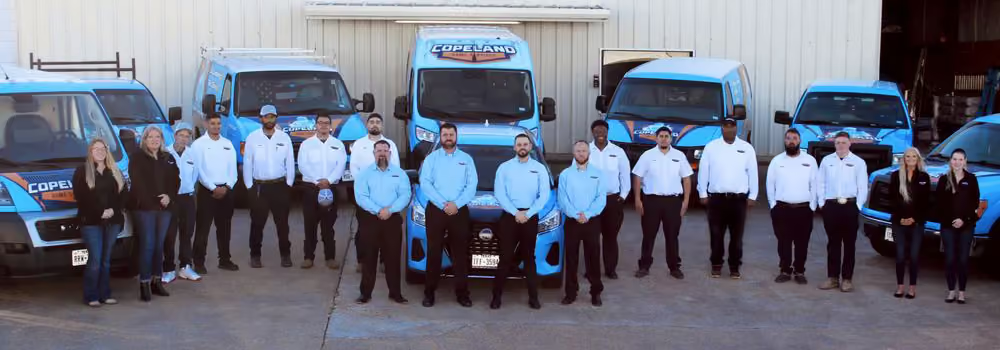




























































%20-%20thumbnail.avif)





%20-%20thumbnail.avif)


%20-%20thumbnail.avif)

.avif)




%20-%20thumbnail.avif)