[00:00:00 - 00:04:27]
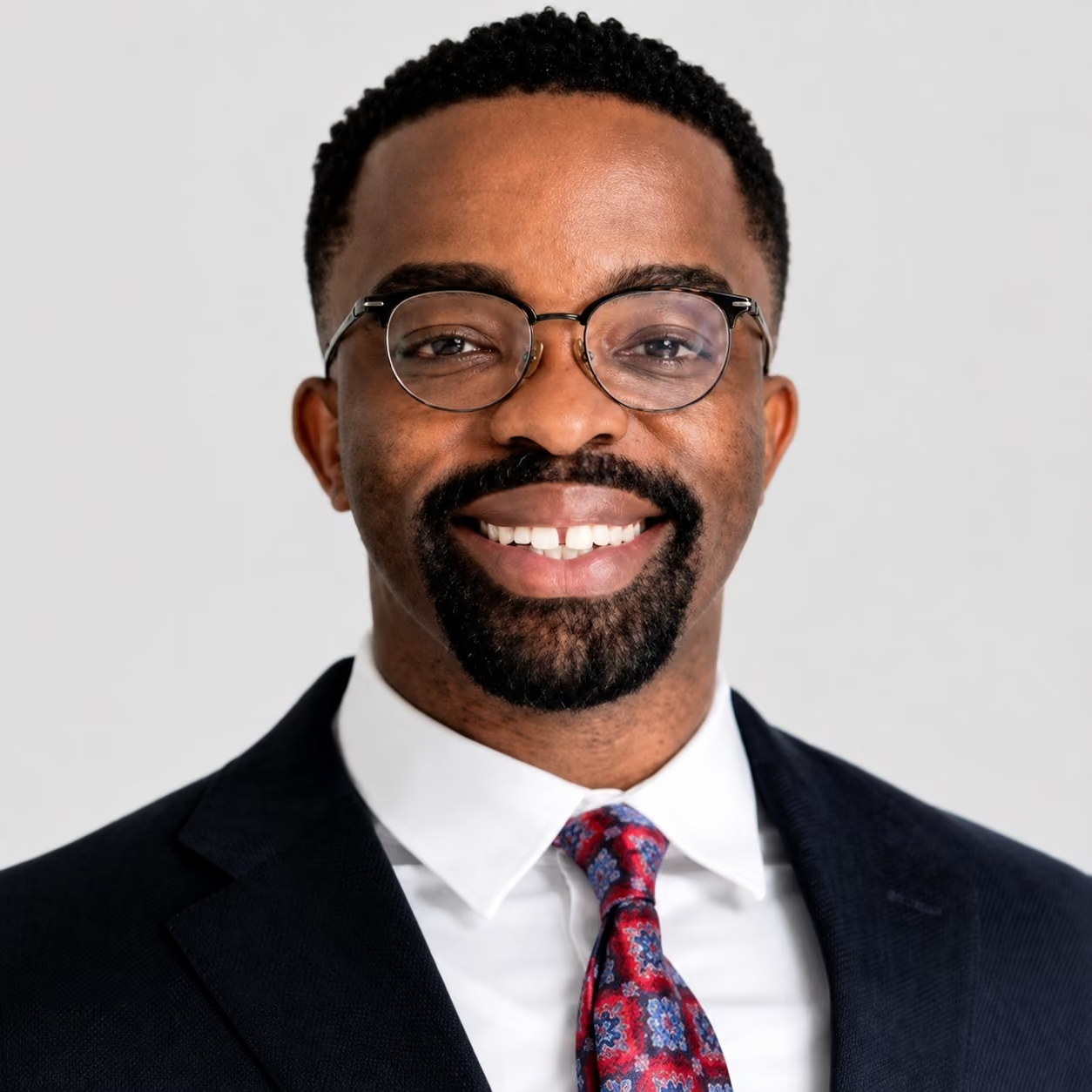
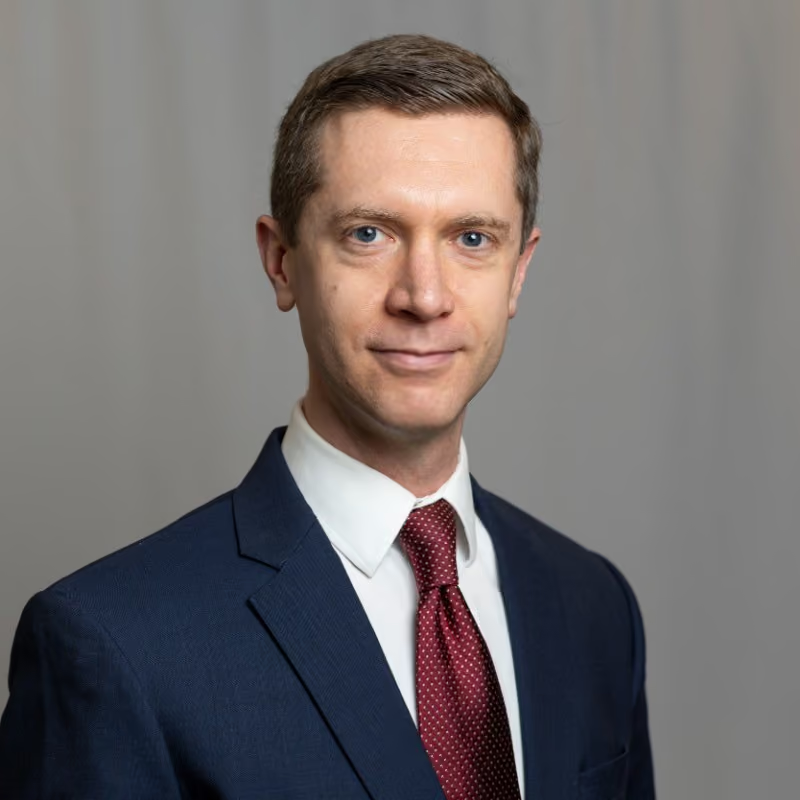
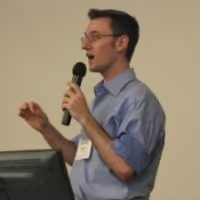
Host: Today's guest spent his career studying healthcare from the outside, first in managed care operations, then as an investment banker doing healthcare M and A. Then he pivoted, bought a business and got a crash course in the one thing the spreadsheets never fully prepared him for Working capital. What Else? Chibuna Chimezi is a Nigerian immigrant who grew up in Jersey City where his parents worked blue collar jobs for 25 years, raising the family.
After a Duke MBA in a stretch in healthcare investment banking, Chibuna went the self funded SBA route, deliberately buying a smaller company so he could hold 89% of the equity rather than the roughly 25% a traditional search fund would have left him. The business is Veterans Room, a behavioral health provider serving veterans. Chibuna acquired it in August 2025 for 1.6 million. In his first week of ownership, a congressional fight froze all telehealth claims.
So for nearly two months, Chibuna kept delivering services with no revenue coming in at all. A live demonstration of why he'd been so deliberate about post acquisition liquidity. Listen for that. Also listen for how he came to think about working capital not as money, but as a tool the business needs to run like gas in a car you've just bought.
Here is Chibuna Chimezi, owner of Veterans Room Pop Quiz what's the most common reason that acquisitions fail after close? Regular listeners could probably guess working capital specifically running out of working capital in year one well, in a webinar this Thursday, Andrew Hippert and Daniel Duran of Acquisition Lab will walk through how to make sure your acquisition has the cash it needs from day one. Among the topics you'll learn this the five ways to fund working capital at close how to estimate what your business will actually need in year one. A live walkthrough of the financial model the Lab uses with members to size the working capital requirement before signing common misses in first time buyer estimates and how to spot an undercapitalized deal before you sign the webinar is Learn to avoid the number one reason acquisitions fail and it is this Thursday, August 13, noon Eastern.
Link to register is right at the top of this episode's show notes or on the Acquiring Minds homepage. Acquiringminds Co. Welcome to Acquiring Minds, a podcast about buying buying businesses. My name is Will Smith.
Acquiring an existing business is an awesome opportunity for many entrepreneurs and on this podcast I talk to the people who do it. If you ask owners in the ETA and search community which insurance broker provides highest quality work, great outcomes and has a practice dedicated to searchers and acquisition entrepreneurs. One name comes up again and again. Oberle.
Oberle Risk Strategies has worked with hundreds of searchers over nearly a decade and is in fact led by a two time successful searcher, August Felker, which makes Oberle a specialty insurance brokerage for searchers by a former searcher. And if you've got a business under loi, Oberle will provide complimentary due diligence on that business's insurance and benefits program. An easy no risk way to get to know August and the team at Oberle to take advantage. Check out oberly-risk.com that's o b e r l e-risk.com link in the notes Chibuna Chabenzi welcome to Acquiring Minds.
[00:04:27 - 00:04:28]
Guest A: Thank you for having me.
[00:04:28 - 00:04:49]
Host: Chibuna. When this episode airs, you will be almost exactly one year into your ownership of Veterans Room, a behavioral health business serving veterans and their families. So many details that I want to address in your story. Let's hop right in.
Start us off with some background on you, please.
[00:04:49 - 00:09:05]
Guest A: Chibuna yeah, great to have. Great to be on the podcast with you Will, and happy to, you know, share some value with the audience. A bit about me I I like to start and say the most important thing is that I'm a father first father of two boys who are the wind beneath my sails as they say. But you know, aside from that, I am an entrepreneur background.
I'm originally from Nigeria, so I'm an immigrant here, one of six. My family and I came to the States in 1995 where we grew up in Jersey City. My father and my mother and my father really the inspiration behind my recent acquisition and journey into entrepreneurship was an entrepreneur himself. He sold goods such as textile and that was the resource that we were able to leverage to coming to the state.
So I grew up in Jersey City and I subsequently went to school in the south, went to a small school that has gotten a lot of notoriety now, Jacksonville State University. I went there where I studied political science and had all the aspirations of venturing into a career in government and law where I interned for Congressman in that area and fast Forward graduated in 2007 and moved back home like most people do and moved right into the financial crisis of 0809 and you know, really that's where and I'm sure we'll talk about this, but that's really the genesis of my interest in healthcare was sort of what was going on during that subsequently thereafter I decided to try my hand at a master's program and I went to Rutgers and got my master's in public administration again focusing on healthcare and public effectiveness within organizations. And spent some time in Trenton working for Governor Christie at the Office of Management and Budgeting. And through that foray of exploring public service, I realized that there was a shift happening around that time and that shift was a lot of private equity and a lot of banks really changing the landscape of healthcare by way of acquisition.
There was a flurry of acquisition, as you can imagine, post that financial crisis. And that's really where I got interested to wanting to see the other side of the fence. But before I got there, I spent significant amount of time within the managed care organization. So I've worked at Aetna, I've worked at Horizon, I've worked at various other plans, one recently acquired by Molina called Affinity Health Plan and cut my teeth, as you would say, around healthcare managed care operations.
And with all of that said, I subsequently ended up at Duke University in pursuit of my mba, looking to get to that other side of the fence as it pertains to healthcare. And I focused on healthcare and finance and you know, by, by will and grit and you know, the luck of, of the universe. Ended up as an investment banker at MTS Health Partners and focusing on life sciences and, and healthcare services, M and A and you know, really is that's where I, I hit the ground running in terms of learning what value creation looks like from capital markets perspective, understanding governance as it relates to operating a business with the intent of scaling and exiting and also just understanding the financial jargon. Right.
And really metrics that underscore value, underscore sound operations and underscores to an extent really psychological safety within your employees or partners or contractors. So in that experience I really felt like I had the confidence and the desire at that point to own my own ceiling. Right.
[00:09:05 - 00:09:37]
Host: Chibuna, just let me double click on this whole background. So there's a obvious through line of healthcare or almost like healthcare systems interest because you were never actually a medical professional of any kind, nor does it sound like you were ever on that path. Didn't go to medical school, weren't going to go to medical school. So interesting your interest in healthcare without actually, but never being somebody who was drawn to being a practitioner.
[00:09:37 - 00:11:32]
Guest A: Most African parents, as, as many, maybe even immigrant listeners that you have, our parents either nudges towards the, the medical field or law field or any of those. So. So you're almost in my mom's kitchen when I was making this decision. No, you know, just be a doctor.
Exactly. Please no, you know, well, coming from Nigeria and you know, Nigeria specifically, over 180 million, I think close to 200 million people have the largest labor force when you consider ages between 25 to 30. And for me, it's twofold. I wanted to, I believe fundamentally that healthcare access to good and quality healthcare is paramount to anyone actualizing whatever potential that they believe that they have.
And for me, initially, the thought was, how do I understand health care operations enough to go back and make a significant change back home and create that public private sector partnership that underpins our health care system here in the United States? The government pays a premium to the insurance companies and they develop a risk product that you and I and public employees acquire to ensure that we have access to the care that we need. So that was really the genesis initially. And then looking back during the financial crisis, one thing we can say is that we're a melting pot of many different ethnicities and socioeconomic classes.
But the one thing that I found that unified everyone and the term at the time were these Cadillac plants was healthcare. It didn't matter if you were orange, green, blue or black healthcare. And access to healthcare was something that we all could find unification around. So it's.
It. It doubled down on the importance of healthcare to me, and I thought best to go into the system that operates it.
[00:11:34 - 00:12:40]
Host: Well, it's refreshing to meet somebody who leans into our healthcare system and, and tries to figure it out with enthusiasm because most of us, when we interact with the healthcare system, we throw our hands up or we cry or we punch a wall in frustration at the, at the impenetrable Byzantine nature of. Seems like you almost have a. Maybe enthusiasm is too strong a word, but an interest in how all of the, how all the intricate pieces of it work. So anyway, a different take.
Take on it than. Than my own, at least being an immigrant parents, it sounds like your parents were kind of the stereotypical wanting you to do something with your career that was a conservative approach to your career. Doctor, lawyer. But at the same time, your dad was an entrepreneur in Nigeria and that.
That life enabled you or that professional choice of his enabled you guys to come over. So. So just square that circle for us.
[00:12:40 - 00:12:40]
Guest A: Your.
[00:12:40 - 00:12:45]
Host: Your parents are supportive of you as an entrepreneur or no, they still wish you'd just gotten an M.D.
[00:12:45 - 00:15:57]
Guest A: no. You know, it's funny. Only now have they kind of appreciate the operator life. But I can tell you prior to that, and it took me connecting, connecting them back to their own beginnings in terms of, you know, taking a bet on themselves.
Particularly my, my father. So just to circle out, my dad, he, he was an apprentice very early on, culturally. He, he left his house at 6 and was an apprentice for, for. For a family for, you know, call it 18 years after.
For 18 years straight. And once he finished, they essentially handed him a check. And that check was enough for him to buy material and open up a storefront. And that's where he started.
He started selling textiles in the northern part of Nigeria, which is where I grew up. Now if you know anything about that region, you know, north is mostly Muslims and I'm, I'm from, you know, I'm an Igbo man, so I'm Christian in that sense. So just kind of sharing space in a diverse place was, was tough. But my d.
Kind of in his business and what he taught me was just as I've kind of gone back and circled back with his story is the importance of, you know, connecting with people, connecting people to the value that they provide, whether they're a customer or whether they're a person who just punches this key all day. It's getting them to see the value add that they give to whatever outcome they expect. So my dad started that way and was able to earn enough to bring his hair during a period when you only came to the United States by way of lottery. And when the lottery hit, you had to be ready.
So father of five at the time they had my last sibling here, had to be ready. So the lottery hit for all of us and whatever was needed to be done in terms of economics and expenses, you had to be ready. And it wasn't a cheap, cheap experience. So he sold everything to get us here.
But when we got here, and I think to your point, it was just do the things that are assured. So go be a doctor, go become a lawyer, and go become an investment banker, which they didn't know anything about until, you know, they saw how much I made and, but then they said, why would you leave that? But I think now that they understand, especially at veterans Room, given the value that we're creating for, for veterans and, and the partners that we work with and the providers. And I tell my operating story.
It's a humanizing connection because my mom's a teacher, she's soon retiring. And my dad, you know, came here to clean trains. You know, I'll be frank. He cleaned the NJ Transit train, the double deckers, for the 25 plus years since, since we came.
He retired during COVID like many, many of our parents did. But they were, they were, you know, really blue collar workers. So now when I tell some of the stories of, of, you know, the help that we're creating and then the families that we're, that we're helping kind of rewrite their lives, they connect to that and no longer just think about my son was this and my son is that. And then that's their pride and joy because of the work that it took to get here.
But they get it now.
[00:15:59 - 00:17:31]
Host: Running payroll, paying your bills, closing your books, and producing financials. These are critical tasks every business owner must do or oversee. But spending time on them distracts you from the leadership in growth work you want to do. So let system 6 do it for you.
Owned and led by a former Searcher, Chris Williams, System 6 is a leading outsourced finance team for hundreds of SMBs, including over 50 searcher acquired businesses. Chris, Tim and the System 6 team understand firsthand the challenges, the opportunities of jumping into a business as its new owner. So whether you own your business already or have one under LOI, talk to System 6 about how they can give you time back and improve your financial operations. Mention acquiring minds and they'll provide a free review of your books and financial ops, a $500 value.
Check out system6.com, link in the show notes or email helloystem6.com returning to the plot now, your decision to go do entrepreneurship through acquisition to buy a business. Tell us more about that decision and tell us to how your relationship to risk evolved being exposed to American people and their families.
[00:17:31 - 00:18:40]
Guest A: So the journey to his eta, you know, I'll always say started at Duke where I was fortunate, wanted to get my MBA and take a class by David Robinson and it was entrepreneurship through acquisition. But prior to that I would say just being an immigrant. Risk was always something that was presented in a very scary way. You didn't take risk.
But I will say being exposed to my classmates in business school and really understanding risk in a more optimal way. So it helped me reframe and really challenge the way that risk was presented to me growing up and studying finance and realizing there are ways to optimize risk. Right? And risk is necessary to achieve outcomes and especially big outcomes, right.
We often say got to bet big to win even bigger. But you know, that loses kind of that sense of optimal, optimal kind of, you know, structure and risk. So business school helped me kind of challenge my understanding of risk and that was the beginning.
[00:18:40 - 00:18:57]
Host: And then also we should say just speak directly to new majority capital. Your, your investor. Some folks will be familiar with what new Majority Capital is, tell us what it is and particularly for the people in the audience who are listening for whom the program exists.
[00:18:57 - 00:21:07]
Guest A: So New Majority Capital is an impact, impact driven investor and particularly around supporting business acquisition for, for various groups of people, whether it's minorities or whether it's first time buyers in all walks of life. So that's their mission and I think it's a worthwhile mission in that they provide a community of support and that community of support where it was very helpful for myself. While someone can say, oh, you're a banker, you might know all of these things. No.
New Majority Capital pivotal in me flattening the learning curve of sba. And that's what they're there for. They help flatten that learning curve by way of classes that they present. So it's about a 10 week program.
Immerse in a kind of intense program that you go through to understand just the fundamentals around sba. And you're also in a community of like minded people with various backgrounds. So you get a lot of opportunity to learn from different walks of life and different perspectives. And even more importantly, you get downstream connections that would take you a while if you're not a sponsored searcher or if you don't have a lot of capital.
And it's also a free program. So that's where my quality of earning support came from. That's where, you know, the partners in SMB law that I worked with through the acquisition, it came from a new, a New Majority alumni who leveraged SMB, Eric and his team. And they were great.
Eric happens to be a Duke alum as well. So you know, New Majority Capital played a very huge pivotal role led by Havel and Chris and Allegra and the rest of those team. They were instrumental for me in creating that kind of soft ground to flatten the learning curve of sba. Because there are a lot of intricacies, especially as administration changes and the rules and regulations change.
They back their searchers by way of investment and for me there was alignment in my vision and where they were looking to go, how they deployed capital. And that's how we, we, we formed a partnership in, in investing in veterans.
[00:21:07 - 00:21:18]
Host: So, so they are a, an education program, a community, an ecosystem and then also a source of capital. And in fact they ended up being your sole investor.
[00:21:18 - 00:21:27]
Guest A: They, they ended up being my sole investor by way of, of that choice. Because of all that, as you said, they, they provided for me. Yes.
[00:21:27 - 00:21:29]
Host: Let's hear about the business itself.
[00:21:30 - 00:23:39]
Guest A: So the business veterans room, it's A behavioral health platform. And it's a platform in that we're looking to expand in terms of the value and the services that we provide to veterans. So currently we are a mental health provider and we serve exclusively veterans. We position ourselves in the way of helping veterans understand that we are unique to you.
And most of our providers are veterans either by way of service or affiliation, whether it's a spouse, a brother, a son, or have worked exclusively or really intensively with veterans. And in the case of associates that are newly minted in their way of becoming a therapist or a full time clinical provider, they have an active interest. So there's an alignment journey that we, that we undertake before we bring on a provider. So that said, we are mental health provider and we service exclusively veterans as part of the tricare community care network.
So it's called ccn. By, by way of understanding, tricare, Tri west and Humana Military are the two providers of healthcare benefits third party administrators for veterans. So in essence, those are your two revenue doors as it relates to being a provider exclusively to veterans at Veterans Room. So I believe by the end of this year will be well over 55 providers serving well over a thousand veterans.
And we've been, you know, at acquisition we were at 700. So we've grown and we're growing and as a result of that, we're constantly changing systems, changing optimizing our systems to help us work better. But we provide mental health support to exclusively veterans and their families and we say that we understand the journey that got them there and we just want to provide that pathway to healing for them to reclaim the life that they want in the way that they want it.
[00:23:39 - 00:23:51]
Host: Great. We're going to get into the business much more. Give us the bullet points on the, on the numbers around the business when you found it and then let's hear how you structured your deal to acquire it, please.
[00:23:51 - 00:24:57]
Guest A: We were able to kind of shortcut a lot of the negotiations and we just married on what value they were looking to get. And in that, in that sense, it was about four times their EBITDA at the time. And the business itself was priced at 1.6 million. 1.6 million was what we acquired the business for.
And the way that the deal was structured, it was a combination of SBA and New Majority Capital being an investor. So New Majority own a certain percentage of the business, I can say, because I talked about equity and it's important. So New majority capital owns 11% of the business business and I, and I think my subsidiary own 89% of the business. And there's also a seller finance component as well that, that was structured into that and yeah, and then my own personal funds to support working capital as well as you know, just the, the whole acquisition process.
[00:24:58 - 00:25:12]
Host: Okay, Chibuna. So it was the purchase price was 1.6. The total project cost was a little bit more. Tell us what the total project cost was please again and then break down the sources and uses.
[00:25:12 - 00:26:46]
Guest A: So 1.6 pure acquisition purchase price, total project cost was a shade under 2 million. So roughly around 1.8, 1.9 of total project cost. And you know, in terms of just the funding, right. It was, it was the SBA percentage loan to value percentage that they often kind of benchmark their, their investment in.
And then there was new majority's capital that, which garnered them 11% of, of ownership and then my capital and, and also there was seller financing roughly about 400,000. So that kind of helped put the project to, to on its way right to fruition. And you know, well I, I also want to point out that you know, post acquisition liquidity was, was really vital for me. So there was a part of that project cost was also $159,000 from our SBA lender as working capital.
As I've mentioned, working capital was a trade off that happy to talk about that I made and one that you know, if given an opportunity I would do differently. But there was that and then you know, some, some additional liquid liquidity, personal liquidity that, that I had that I you know, certainly knew that. Again, post acquisition liquidity is, is the number one thing that any small business buyer, especially self funded, worries about, thinks about, tries to solve for and we were fortunate to be able to solve for that with the lender and also in my own case, some personal capital.
[00:26:46 - 00:27:48]
Host: And so let's linger on this post acquisition liquidity point for a minute. Of course that's fancy lender speak for just keeping some of your own cash so you're not draining your own bank account to do this acquisition just in case. And of course lenders like to see it. We'll push you on it.
It's often something that buyers, first time buyers at least overlook or don't think about, especially the ones who are risk on. You know, just want to buy as much business as they can with as much leverage as they can. So but you were prudent and we're going to hear why you were, why that was so important in just a sec. But your point is that you, while it didn't show up as part of the official project cost.
You made a point and I guess it sounds like your lenders, the other stakeholders also leaned on you to have a pretty significant chunk of cash on the side, personal on the side, just in case.
[00:27:49 - 00:28:27]
Guest A: Yeah, yeah. Okay. And I think that was part of the, the business valuation. All right.
And thinking about you know this is, this is a business that leans heavily on, on government, government payments, right. Government subsidized business. So anything can happen. So it's important that, that you're able to have some, your lenders investors are taking are underwriting much of their, their, their bet on one you being able to operate the business and having some post liquidity that will support the business and support yourself support you and support me in the case of buying veterans room.
[00:28:27 - 00:28:55]
Host: Great, very helpful. And just one last question on the structure here. Seller note of 400,000 that ends up being about 20, 25%. 20 25%, right.
That was a pretty good. It's more than the typical 10% that we often hear. 20% is a lot of seller note which you like like to see in terms of seller skin in the game. Was that also high because of risk that you perceived in the business?
[00:28:55 - 00:30:12]
Guest A: Yeah, it was high. And even then just the, the, the mechanics around that we were again goes back to what are you solving for? We were able to agree on interest, interest only, you know, payments. Right.
So again just having that buy in but, but then that sets us up for a balloon payment in year five. Right. And when that, when that term so you know, it's what you're solving for and in this case interest only, you know, very much appreciate being able to meet at the table in that way with the seller because they understood hey, this is the nature of the business. And you know, let's try to be as minimal in terms of you know, cash flow on the business in of terms for repaying a seller note knowing that there's an SBA component right.
To also a debt expense that you have to pay at the allotted amount. So that was great. And again goes back to what I said earlier. You solve for certain things and you make those trade offs and you see where you land.
And we had a good relationship that we were able to agree on interest only. And I'm able to make that, let's say a year's worth of interest up front. Right. And just kind of mess around with cash flow as you see fit.
Given the nature of the business.
[00:30:15 - 00:31:58]
Host: Buying a small business sounds simple. Find a company due diligence, get a loan Close. In reality, you wear every hat just to get the deal done. And then the moment you close, you have to throw those dealmaking skills out the window and learn how to operate.
You shouldn't have to rebuild this infrastructure from scratch, and you definitely shouldn't do it alone. That's why Walker Deibel created Acquisition Lab, which started as an accelerator, has expanded into a complete ecosystem for acquisition entrepreneurs. Over six years, the lab's 1200 members have acquired over $1 billion in businesses. The lab puts everything under one roof.
An active community, deal reviews, post close services, and a dedicated fund helping experienced operators buy larger businesses. If you're serious about buying a business, come see why Lab members have a 40% success rate. Learn more in the show notes or at acquisitionlab.com/affiring minds. Okay, you close at the end of 20, at the end of August 2025.
So here we are in early July 2026. So as I said, you're approaching your anniversary, your first anniversary. So talk to us a little bit more now about the working capital, what you did do, what you did structure with the seller and then we'll play out the plot and what happened and what you might do.
[00:31:58 - 00:33:41]
Guest A: Yeah, so what I in the trade off series of trade offs, I was able to structure a $15,000 working capital with the seller and they made that available immediately. So we funny story, we closed officially, paperwork signed Aug. 31 and but it wasn't fully funded because of the subsequent Labor Day weekend. So the seller maintained ownership until the third.
So all the services rendered between the first and the third went to them. It was really mechanical. We split everything that was date of services on the third, we split that in half. So that's kind of where it went.
And these are trade offs that you make, I think it's fair to say. So the seller, I think they made out pretty well in terms of just overall value that they retained. So I had $15,000 in working capital and whatever services that were rendered from September 4th onward to own as a new business owner. And further, working capital was pulled in from our SBA lender in Truliant and Shem and his team were great.
So they were able to provide us with roughly $159,000. And then I also had personal liquidity that was available to also support what we needed to do with the business. And that was the nature of the working capital and that was what we had to get us going.
[00:33:41 - 00:34:29]
Host: And so Chibuna, this is a so on day one of your ownership, you're going to be delivering services to your veteran clients or their families. And but any revenue that's coming in, any accounts receivable is going to come in for services already rendered under previous ownership. So you're just passing those payments and checks along back to your seller. So you are not going to see any income, any revenue that you can work with until service is rendered on your day one of ownership and beyond.
And so what does the working capital cycle look like in the business? If you deliver service today, when do you get paid for that service? In an ideal condition, not when things go haywire as they did, which we haven't even heard.
[00:34:29 - 00:35:53]
Guest A: Yeah, so there's not a straightforward answer to that because it all depends on, on the quality of that provider. In our case, we are a really good quality provider with our insurance partner and Triwest. So I will say that we have very quick turnaround times as it relates to when we send out a claim and how quickly we're paid. So for those purposes we've ran a smooth and quality driven operation where let's say within five to seven days we're able to get, you know, kind of our claim service.
So in that sense, you know, adjudication process, standard adjudication process for claims is 30 days, right? It's 30 days from the day of service, from the day that the claim is submitted. So again, you have providers who vary on that spectrum of how soon that they're paid. I'll again, I'll just summarize to say, you know, we're fortunate to kind of be on the front end of that 30 days.
So, so I was able to start seeing revenue relatively quickly from September 4th onward. And it's also a function of how many referrals and how many services that you're providing that day and really how much availability you have within your provider. So all those kind of micro factors affect how quickly you're able to start seeing some, some revenue.
[00:35:55 - 00:37:21]
Host: Well, to, to get in the weeds here because working capital is technical and hard to understand and so important effectively. So you get in on day one of your business and you're not going to see any revenue, any of the revenue for services rendered for best case scenario, a week because you guys have that great payer, but they're not your only payer. So you have all these other payers and it's going to take longer. So whatever the average collection day is, call it two weeks, I don't know, I'm pulling it.
Let's say it's two weeks total average of all your revenue that Two weeks is of expenses and is basically working capital that you need. And really that the business, it's not a car with any gas in it if you don't have that those two weeks to cover expenses. So the effective price of the business should have included the work, working capital necessary to get you through those two weeks. So, so just to, for people to, just to reinforce this point that working capital is, is a, is don't think of it as money or value of the business.
Think of it as just another tool of the business that the business needs. Like a, like a, you know, a fleet. Business needs its vehicles sort of thing. And so if you show up day one and you're light on vehicles, then it's not a complete business.
Am I characterizing your situation?
[00:37:21 - 00:37:27]
Guest A: Well, you said it perfectly. I, I say another way is when you go buy a new car, it has to have gas in it.
[00:37:28 - 00:37:54]
Host: Yeah, yeah, exactly. Okay. But happily you did the, you had the line of credit. Yeah, true lion.
Right. And you had your, your prudent about your post acquisition liquidity. So you were able to plug the holes. What would you do differently?
Reflecting back now, how should it, in quotes, how should it have been structured?
[00:37:54 - 00:39:10]
Guest A: You know what I would do differently was anchor more on the working capital. So I advise listeners and those that are searching, as you said, you can't buy a fleet without a fleet of cars there. So you need to be creative. Right.
But be anchored on ensuring that you have enough working capital. I don't care what the business is, I don't care what the future says about the business. You need enough working capital in day one. So that's what I would do differently.
I would have been a lot more strident about calculating working capital and as drawn out as legalese can be. And I think in my case there was a little bit of that effect. Start talking about working capital as early as you can and ensure that you have enough working capital to, to, to operate the business and be flexible in structuring how working capital is provided because there are many ways and help the seller remind them that you know, working capital is necessary and there are different ways to structure it. So what I would have done differently is I would have taken my own advice now and structured working capital to make sure I had enough to start the, to start running the business with.
[00:39:12 - 00:39:52]
Host: So essentially you would have just kind of gone direct with the seller and tried to educate them earlier on in the conversation about the concept and that you were going to need some of this, some working capital in the business for Your day one and yeah, and, and basically just negotiated in and, and explain and over explain the concept to them because it is a, it is a, an abstract concept. And, and as, and of course also what we constantly hear is that the psychology of sellers is that if that cash is sitting in the bank account, they've already earned it. It's theirs. Thank you very much.
[00:39:52 - 00:40:11]
Guest A: Yeah, I think, I think you said it well. It's education and you, you have to, it's an educative experience that you as, as a prudent buyer is also doing. So you're not just buying, you're educating and sometimes you have to get as pedantic as possible and, and by being a, a kindergarten teacher and do it over and over and over and over again.
[00:40:11 - 00:41:31]
Host: Yeah. Okay, Chibuna. We're, we're. I'm just watching the clock and I.
And there's a lot to say about your, your past year of being an owner and so I want to make sure we have time for that. One of the. Look from the outside looking in one of the risks of this business or indeed any business that that's relying on basically insurance payments is that payer risk that there could be a, there's pen. So called pen stroke risk.
There could be a legisl. A legislation change that affects things or even if it's not related to that, there could, I guess the insurance provider, private insurance provider also could represent risk. As people might tell, I'm already kind of over my head on the point. But the point is, you know, there aren't.
There's. There's concentration in where the revenue comes from in this whole really universe of types of businesses. Yours is no exception. We've already heard you say there were I guess two payers.
Is that right? The two TPAs. But then you have, I heard you say also there was another layer where you have multiple providers. I wasn't following.
So anyway, quickly distill that for us or explain that to us and then, and am I right in saying that this business seems to have concentration risk?
[00:41:31 - 00:43:20]
Guest A: Yes. I'll start backwards. Concentration risk in terms of. The concentration risk is tied to what we are anchored on.
So we are exclusively supporting veterans. So most veterans, whether they are active or retired, receive their insurance benefit depending on the state that they live in. They either they receive insurance through Tri west or Humana Military. So in essence you take the hundred million veterans that we have that are either active or retired, they receive insurance benefits from these two companies, right.
Humana Military and Tri west tricare. So in our case, we are a provider in network provider within Tri west and TriCare. So we're an in network provider. So we're not in network with Humana.
So in essence there is that concentration risk of revenue. Right? There is that and there's also the concentration risk in the provider world, we call it. We're a specialty provider in that we're exclusive to veterans.
Now veterans could also be currently working and employed at acquiring mines. And so we're now able to service them by way of whatever insurance provider that you have. So there is that slice of the pie that's available. But the ballpark of our clients are either within TriWest, TriCare or Humana Military.
So you just have two concentrated revenue sources. And as we're not a provider on the human man and military side as of yet, we just have one.
[00:43:20 - 00:43:22]
Host: And so what is the risk?
[00:43:22 - 00:44:25]
Guest A: The risk is anything can happen. You know, the business way of saying it is, is, is revenue diversification. You don't have it. Right.
So anything can happen. Whether it's a claims issue, whether it's a cyber attack issue, or in our case it's a legislative issue where now there is a provision in the early current administration's kind of jostling across the aisle. There was a particular line in a bill that there were consternation over and as a result of that, all telehealth claims were suspended. So in our case, it's really what you said, the stroke of a pen.
And, and we had that affect us for about a little bit over two, close to two months. Right. Where we had, we were still offering services, but there were no claims coming in and there were no claims. And, and obviously you still need to keep the lights on.
Right. And, and provide assurance.
[00:44:25 - 00:44:36]
Host: So for two months because of congressional wrangling, for two months there was effectively your payer spigot turned off completely.
[00:44:36 - 00:44:40]
Guest A: Yeah, there was no revenue, there was nothing. Nothing coming in. Yeah.
[00:44:42 - 00:44:44]
Host: So. And, and that was in your first two months of ownership?
[00:44:44 - 00:44:48]
Guest A: My first week back to that post.
[00:44:48 - 00:44:49]
Host: Post acquisition liquidity.
[00:44:51 - 00:44:53]
Guest A: Yeah, that was so.
[00:44:53 - 00:45:05]
Host: So was that as brutal as it sounds? I mean, or, or were you confident that as uncomfortable as it was, it was the revenue was going to eventually be paid?
[00:45:05 - 00:45:39]
Guest A: The beauty of the American system is once we figure it out, revenues will get paid. And that goes the same for the labor shortage that happened with the TSA workers back pay was issued. So in our case, once it was all figured out, then you might kind of say to yourself that my favorite moving trade in place is where he Said, Mortimer, we're back. So we came.
Came back. We came back with a lot of back pay once everything. Everything was squared away.
[00:45:40 - 00:45:45]
Host: That's at the end, right? When they're. When they're have been. They're now homeless themselves.
[00:45:46 - 00:45:59]
Guest A: It's actually coming to America. He's like, mortimer, we're back. So that's kind of how. How I felt what my.
With my COO when we started receiving checks, it's like, teresa, we're back. You know, so it was great. It was great. Yeah.
[00:45:59 - 00:46:09]
Host: Okay. All right. So it. So it didn't feel necessarily existential.
It just felt like a terrible working capital burden. And you didn't know how. That. You didn't know how long.
[00:46:09 - 00:46:15]
Guest A: I think that's the ex. That's the piece that you're uncomfortable with, right? Because you have no idea. It's out of your control.
[00:46:15 - 00:46:22]
Host: What else Shibuna can you tell us about your ownership? What are. What are some of the key themes, key learnings from this first year?
[00:46:23 - 00:46:40]
Guest A: One of the many key learnings, I would say, is I. I talked about it earlier, which was kind of decision making, you know, coming in, right? You. You.
One thing I've learned is you. You can't come in and. And change everything immediately, right? So.
So maybe there was a little bit of new.
[00:46:40 - 00:46:41]
Host: New.
[00:46:41 - 00:48:52]
Guest A: New toy. Let me kind of leave my imprint. You know, business school teaches you as soon as you become a C. CEO, you just restructure, right?
Restructure your way to. To confidence and. And comfortability. But in.
In my case, it was really looking and understanding what was important to people. It was, you know, my leadership style, maybe. Let me back up. My leadership style is empowerment, transparency, and accountability.
And for me to be able to do those things, I need to understand that those who I'm partnered with take what I call radical ownership. And that term radical ownership, I got from, you know, when I was at duke, we had General Stan McChrystal come and teach a class, and he. In his book Radical Inclusion, he talks about radical ownership as a necessary element for that frontline soldier to be able to see front north, south, east, west, everything that's coming to them. So that way he feels better of empowering them.
So that's my style. And that said, buying a smaller business, it's a family kind of almost a kind of familial kind of structure. So when you come in making many, many changes, it can upset the apple cart a bit. Right?
And in our case, I just have to be cognizant of that one. That's one of the early things I learned is think about the changes that you're making and quantify the impact and say the one with the most meaningful impact, that it's a necessary change. That's what we'll tackle first. Rather than, I don't like the phones, I don't like this, I don't like that.
I want to change everything. So for me, that was the first thing was what do I want to change that would have a sizable impact. But that wasn't the way that I approached it to be fully transparent. It was, hey, I want to change this, I want to change that.
And then as you go, you kind of get feedback, right? And included in that leadership style is feedback. As you give feedback, which is a privilege to get, you have to kind of iterate. So that's one thing I learned.
Make the changes that drive the most meaningful impact, but spend the time figuring out, quantifying that impact to the outcome that you're looking for before you decide to make the change.
[00:48:53 - 00:48:53]
Host: Change.
[00:48:53 - 00:51:33]
Guest A: The other thing that I've learned in operating is that you can't become the bottleneck, right? So you buy the job for the purposes of, of learning the job. But in buying the job, you're now in front of things that in my case, I've never had decision making priority. I've never made decisions for marketing, I've never made decisions for it.
I've never made decisions for procurement, I've never made decisions for hr. But now as a small business owner, you know, you are that you're all of those things and it's great to learn from that, from that paradigm. However, you run the risk. I, I believe you can run the risk of, you know, becoming the bottleneck when everything has to flow through you, right?
So that's the other thing I've learned. So you do it, you buy the job for a period of time, right? So I bought the job for a period of time. And then you, you learn enough that you're able to now go out to empower those that you are asking to now take the mantle.
And, and, and now you can focus on growing the business and ensuring psychological safety from a different position. That's the other thing that I've learned. And lastly is always keep in mind what are you solving for? And so I asked myself on my whiteboard there, it's what are we solving for today?
And in order to get there, through my business coach, we work on carving out that, what she calls CEO Week, CEO time. Where you reflect right for me is Fridays between 10 and 10am and 12am, 12pm I'm reflecting on what the week was. You know, it's almost like this Venn diagram of what's in my control, what's outside of my control, and where do they converge, what am I focused on? Right.
And that's where, that's where I try to, I anchor myself on. So those are the three things that I've learned and sprinkled in there are, are, you know, if I'm Frank fires that you have to put out. You know, I think in our lead up, I mentioned to you we, we had, we had a payroll issue where, where it wasn't due to lack of funds. Rather it was a mechanic technical issue where, you know, people, funds were reversed.
And I'm being very transparent. And imagine doing that while also, you know, navigating your own life's personal challenges. Right. So, and now you, now you have people who are, who are, you know, looking at you.
So as a leader, you have to step in front of that. So there's, there are those things too, right? There, there are aspects of people, you know, where you have to make decisions that, that, that require you to, to, you know, separate from, from, from people. Right.
So there's all of those things.
[00:51:33 - 00:51:53]
Host: And, and, and so Chibuna, how comfortable would you say you are now, now as an owner, as a leader, but as a person who before making this move in buying a business, hadn't been in leadership positions like this, had, had been sort of more of an analyst. Right.
[00:51:53 - 00:51:53]
Guest A: Fair.
[00:51:53 - 00:52:01]
Host: Fair to say if I had to generalize your entire career trajectory. Sort of a kind of analyst, analytical type position.
[00:52:01 - 00:53:24]
Guest A: Yeah, I'm, I'm, I'm very comfortable now. And I think the comfortability stems from the fact that I've accepted that you can't be an analyst in leadership anymore. You can't just read the books. Right.
You have to actually do and apply your own flavor to all that you've read and all that you're experiencing. So my comfort level is more intrinsic than it is to say, hey, will I know what to do the next time Legalese or our partners in Washington do something. But I'm prepared, I'm prepared to kind of see what's around the corner. So, so part of what anchors me is, and I think Ray Diallo said this a while back in one of his books, is if you just focus on creating value, it makes operating a lot easier and it makes operating a lot more authentic.
And value has economic value, so we don't focus on the economic value of what we're building, but we focus on a value that we're creating and from there everything is kind of driven and the ability to iterate as things are happening is what I've learned. So that's where the comfort comes from, is fully accepting you're in charge and you can't wait to get it from a book to do it.
[00:53:25 - 00:53:58]
Host: And focusing on creating value and not necessarily in a financial sense. The idea is that if you create value, non financial value, the financial value will, will follow. But, but put the human value or service value ahead of, of just the spreadsheet value. What about the fact, Chibuna, that this is a for profit business?
This is a business in a world where a lot of your clients are served by nonprofits?
[00:53:59 - 00:57:46]
Guest A: Yeah, it's a great question. So I think that's what also sets us apart in that, you know, I think there's great value in both. I'll start with the nonprofit. You know, from a nonprofit perspective, a lot of the value there is, you know, call it altruistic on its face, but I think nonprofits are able to be strong advocators for the mission that they're providing and they're solving for by way of, of getting partnerships.
Right. So they're funded through foundations and things of that nature. So they're, they're strong advocates, you know, from the, from the, you know, for profit side. Right.
You know, we are also strong advocates and we're strong advocates for outcomes. Right. Because most of the value we, we derive economically have to be proven out in the outcomes that, that, that we are, you know, kind of anchoring ourselves and achieving. So we have to say that these are the assessments that we're doing and these are the outcomes that these veterans are seeing.
And we have to kind of stand in front of that. We have to stand in front of being an advocate for veterans in a different way. So that's truly understanding the barriers that they face in understanding their service and now getting to the lives that they want to live as a civilian. So, you know, I've been in a position now to truly understand how difficult it is to make that transition into civilian life.
And our veterans population, I'd say they're a venerable population in that they've given the ultimate sacrifice. So from a for profit perspective, I believe that we're able to see that and advocate for that in terms of these are the outcomes that we believe that we're achieving. And now I can also go back and I'll be quite frank and say, hey, The VA has these opportunities for improvement in order to help veterans see and live the lives that they want. Legislatively, there are these opportunities for improvements in order to truly make the changes that we're looking for.
I don't know if you can see that in a nonprofit perspective. However, both models are very much providing great value to a population that's very deserving. What I've learned, and I think all operators of businesses, whether small or large, particularly smaller, the enterprise value, in my opinion, comes from how seamless and how scalable your operation and your processes are. So that could be as simple as how quickly do you go from intake to appointment?
How quickly do you go from claim submission to payment? But how quickly do you go from service rendered to claim created and claim out the door? How quickly do you manage, in our case, request for services? And that, that is, that's a tedious process.
How quickly in our case do you provide the VA with the feedback? So those are all systems that require you to create in a very optimal way. And I think that's where the enterprise value comes from. Less from, hey, we, we went from a thousand to five to ten thousand referrals, you know, a year, that's great.
But if those systems are not optimal and scalable, you're going to quickly go back to 5,000 because you're not going to be able to handle them. So the systems of getting interviewing providers and bringing them in the door, that's where your enterprise value comes from. So if there's one thing to focus on is how do we make these things as iterative and as seamless as possible?
[00:57:46 - 00:57:52]
Host: And is there in your own business opportunities that you see for AI in particular for that stuff?
[00:57:52 - 00:58:27]
Guest A: To your point about AI, yeah, absolutely. But I will say this as, as a company that serves veterans, we will never use AI to do intake. So you will always talk to a live person. There will never be an AI bot to guide you through anything as it relates to veterans room.
It will always be a human. It will always be someone who is there to be empathetic, compassionate, and also steward in the right, right way, your needs. But on the back end, we certainly think about different ways that AI can support us in the name of efficiency and scalability.
[00:58:28 - 00:58:53]
Host: Let's not forget what this business, your business is doing at the end of the day, providing behavioral health services to veterans. And so there can be a lot of terrible situations or people in terrible psychological states. By nature of the business. How has have you encountered any of that, had to deal with any of that directly what's it like to work in such an environment?
[00:58:53 - 01:00:17]
Guest A: It's one of the things that, you know, it's challenging it. In my case, it's reaffirmed why we are doing and why we're exclusive to veterans. You know, as soon as I, I came on, you know, we had an experience. We had an experience where, you know, there, there was, you know, let's not mince words about it.
Suicide is a high. It has, it's a highly occurring thing in our veteran population. You know, homicide ideations is also that and, and all branches of kind of challenging psychological and mental conditions. I had an experience very early on, very early on.
It was a very, very, it was a very tough one. But that said, you know, it made me understand our, our providers. Right. So our clinicians, how valuable they are, how important it is that we have an alignment in figuring out who do we hire to, to, to work with the veterans.
So it's a tough thing. It's a tough thing to deal with. But for me, it anchors on what we're creating. So, for example, I answer our calls after hours.
I'm not part of our intake team, but answering those calls had brought me closer to understanding a lot of the plight that veterans are calling in with and looking for, looking for support.
[01:00:17 - 01:00:18]
Host: This is a hotline.
[01:00:18 - 01:03:20]
Guest A: No, it's, it's just our, that's our number. It's our, it's our, it's our office number. And you know, after hours, I forward the calls to my phone. Right.
And that's part of buying that job. Certainly don't, won't do that forever, but I forward the calls to my phone and I'm able to answer the calls. And I get calls. We get calls 12am we get calls 6am we get calls 4am by somebody in distress.
Whether it's in distress or whether they're looking to, you know, they were finally comfortable enough to call, to reschedule. But the calls in distress, you know, we have our clinicians who are, who do a masterful job of providing support. So those distress calls have often landed directly in the clinician's kind of purview. And then I'm by extension invited into that, whether it's our clinical lead or our operating officer saying, you know, hey, I just want to give you a heads up.
This is what we're currently facing and these are the things that we're doing and what is your suggestion and if it's needed. Right. Because most of it is clinical and supportive. And, you know, I've learned about the supportive systems that are available in different states when it comes to a mental health crisis that may not, not require you to call a police officer so you can get the proper resources there.
I've learned of some of the challenges maritally that, that you know, that are kind of in front of a lot of these issues from, from a veteran's perspective. I've learned psychologically what's in front of them, whether it be past experiences and, and one thing that we've, I've learned personally is a lot of veterans are unaware of how to identify the symptoms of what they're feeling, such that they're able to call out for help. So now we work on ways to help them identify symptoms. So maybe I can identify.
I'm having a bad day for these reasons. Maybe I should go for a run. Maybe I should call my therapist. You know, veterans that is not in, you know, you can't assume that that such is the case, right?
Because, you know, I haven't been in the battlefield. I haven't had, had 10 tours as, as a sniper, right, where it's hard, hard, hard, and then you stop, right? And then you go back hard, hard, hard. You know, I haven't done that.
So maybe I have more mental white space to be able to identify certain things. So there are those, there are those, right? There's the story, the acquisition story and kind of the, the operating story, but there's the human story. And the human story is really that story salt of the earth experience that I privilege to have every day in all the partners that we work with.
And also it's part of the story that makes it that we're going to be exclusive to veterans and we will create that value and extend that to other social determinants of care to support veterans through Veterans Room.
[01:03:21 - 01:03:51]
Host: On this human point, point Shibona, last question. You were an investment banker in and healthcare services and now you're really at the front lines of a healthcare organization directly delivering care to even in quite acute situations. How do you reflect on that breadth of perspective that you now have?
[01:03:51 - 01:05:08]
Guest A: I believe that my life's work to this point in terms of journey, even starting as far back as being an immigrant, has informed my understanding of where we're going as a company, where I'm going as a leader and what I. And most importantly, how I'm operating now in being able to iterate, iterate constantly iterate as things are happening. And you know, there's a, I'll leave you with this. There's an, there's a ebol, I think I mentioned my father never spoke to us in simple English.
It was always proverbs and parables. So there's a translative saying that says, basically translates into, you know, your hand can bend too far to the right, can bend too far to the left, right. So you just have to find that even keness to operate. So it translates, it translates into that.
And as a leader, you know, that's also why I like military leaders, because there's practical elements in their experience and also sports leaders. So I lean towards that understanding of leadership. And I believe that all of my work's experiences up till now has kind of informed where I am today, where we're going as a company and what's the arena that we're playing and who are the spectators watching and what are they watching for? For?
[01:05:10 - 01:05:50]
Host: Speaking of spectators, you talked about your father's influence on you. You opened by saying that you're a father. You talked about how now you know, you, you are very aware of your own children looking at you the way you did at your father. How do you, do you feel like they're even old enough?
I know they're very young. Even old enough to. Your three year old certainly isn't. But is your six year old enough to perceive what you're doing or that there's been a change or is too early, too young in their lives for them to, for this path that you've taken to have an influence?
[01:05:50 - 01:06:59]
Guest A: No, I, I, you know, I think any parent out there knows that kids have an in, they just learn, right? So you just, they learn everything that, that you put in front of them. I'll say that I knew that he's old enough to see and be impacted in a way that fits where he's at in his life now. When my son recently made a Father's Day card by basically filling out the word father and putting what he thought was there and for his A, it was always working, right?
So in that sense. And his R was really smart, right? So in that, that sense, I feel like he's getting some of what I'm putting down in the way that he could. And lastly, I was fortunate to be on a panel at Columbia Business School.
And I took him and my father with me. I was invited by the professor and when we left, he said to me, he said, dad, I really didn't understand everything you were saying, but there were some things that I understood because you've said it before. And I saw, said, okay, he's getting, he's getting what he needs to get right now.
[01:06:59 - 01:07:14]
Host: Yeah, yeah, yeah, sure. Great. Great note to end on and also I should say Chibuna, you and I both will be at your alma mater a Fuqua for the Southeastern ETA Conference in September.
[01:07:14 - 01:07:15]
Guest A: October. September.
[01:07:15 - 01:07:16]
Host: September.
[01:07:16 - 01:07:39]
Guest A: Yes. And yeah, September. Yes. It's a, it's a, it's a great conference to be at for, for searchers, investors and likes of yourself who are in this space providing value.
It's a great conference for those interested in the space and for those just curious about it. You know, you get a chance to talk to Will and I in September in beautiful Durham, North Carolina and it
[01:07:39 - 01:07:54]
Host: rotates through Georgetown, uva, Darden, and this year it's Duke Fuqua's turn. And so if people have heard me talk about being at Georgetown or uva, it's for the same conference. It's just this year hosted by Dan Duke.
[01:07:54 - 01:07:54]
Guest A: Great.
[01:07:55 - 01:07:58]
Host: Well see you there Chuna and thank you for joining us on Acquiring.
[01:07:58 - 01:08:13]
Guest A: Thank you for having me and thank you for the value that you provide. I've been on the listening end of many of your many of your guests and happy to be able to have shared some some value to to you and, and to myself and to the listeners. So thank you for having me and thank you for letting me tell a story of veterans.
[01:08:14 - 01:09:03]
Host: Thanks for saying it. Thanks J. Hope you enjoyed that interview. Don't forget to subscribe to the Acquiring Minds newsletter.
We send an email for every episode with an introduction to the interview, a link to the video version on YouTube, and soon key takeaways, numbers and more essentials from the interview. For those of you who don't have time to listen or watch it, subscribe at Acquiring Minds Co. You'll also find all our webinars there on the website, both those we have coming up and recordings of past webinars. At this point There are over 30 webinar recordings, a wealth of information on all the technical nitty gritty of buying a business acquiringminds copy.
























%20-%20thumbnail.avif)


%20-%20thumbnail.avif)

%20-%20thumbnail.avif)
.avif)


%20-%20thumbnail.avif)