Read MoreStories



I believe I hold the title for world's worst angel investor.
Let me tell you something about running a successful business. The biggest factor was luck and timing.
Today's story is about a turnaround in progress.
Mike Brown has acquired a struggling e-commerce business.
It did $8 million last year during COVID, so it's a sizable operation.
But the previous owners overreached and found the business imploding under debt.
Mike stepped up and bought it a few months ago.
He's in the thick of it right now, and in my conversation with him, he's super transparent about the whole thing.
His numbers, his scrappiness, his sense of panic at times.
It is a very real struggle.
Another thing to call out:
I love how Mike talks about his path to acquisition entrepreneurship, to acquiring a business.
He talks about being acquisition-curious, which probably many of you are, and it's why you're listening to this podcast.
All in all, a fascinating conversation with Mike Brown.
Here he is.

Mike Brown began his career flying jets for the Navy, which he describes as a great way to spend his 20s. After leaving the Navy in 2011, he moved back to his hometown of Midland, Texas, drawn by opportunities in the oil business. A mentor offered him a position at his company, telling him it was the best time in history to be in the oil business. Brown worked there for a couple of years before starting his own company, Palmaris Energy, in 2013 with a friend from his Navy days, Jay Consolvi. The company thrived during an exciting period in the Permian Basin, and Brown sold it in 2019.
Following the sale, Brown went through a period of reflection about his next steps, eventually transitioning into coaching other entrepreneurs full-time, helping them grow from seven to eight figures in revenue. He had also been angel investing since 2014, though he jokingly claims the title of "world's worst angel investor." During this period, he became increasingly curious about acquisition entrepreneurship, partly influenced by taking Walker Deibel's "Buy Then Build" course, which deepened his interest in acquiring rather than starting a business from scratch.
Jay and I always used to say that we would buy call options on ourselves. If we can control the outcome, that's an investment I want to make.
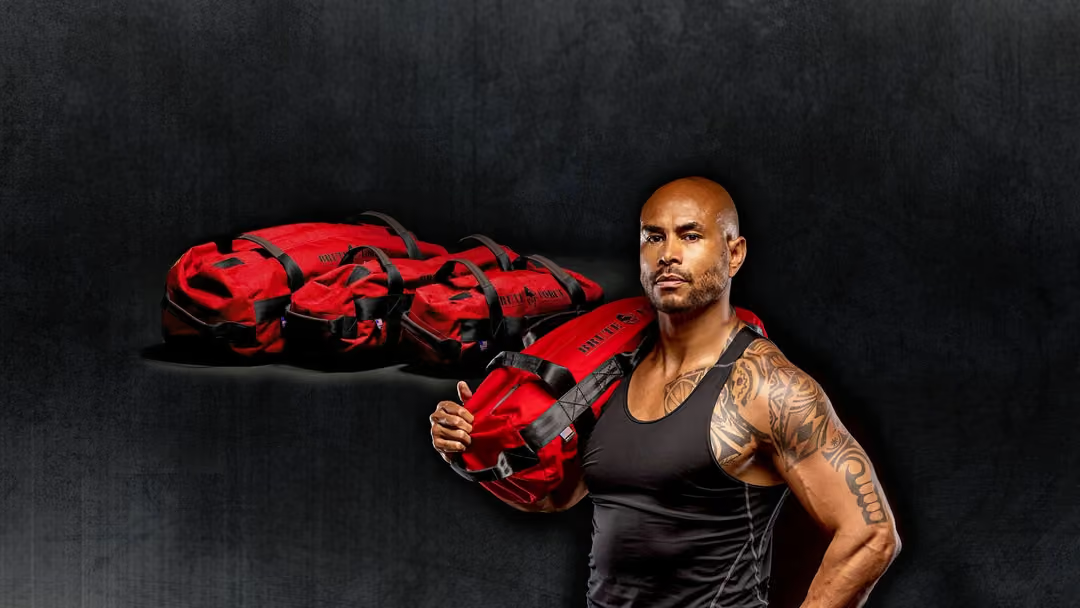
Brute Force thrived during COVID, but 2021 hit hard. Sales plunged 60% in one month. Mike Brown bought it to fix it.
Themes from Mike’s interview:
Reach Mike at:
Official episode page & full show notes at AcquiringMinds.co:
Host: Welcome to Acquiring Minds, a podcast about buying businesses. My name is Will Smith. Acquiring an existing business is an awesome opportunity for many entrepreneurs. And on this podcast, I talk to the people who do it. Today's story is about a turnaround in progress. Mike Brown has acquired a struggling e commerce business. It did $8 million last year during COVID so it's a sizable operation. But the previous owners overreached and found the business imploding under debt. Mike stepped up and bought it a few months ago. He's in the thick of it right now, and in my conversation with him, he's super transparent about the whole thing. His numbers, his scrappiness, his sense of panic at times. It is a very real struggle. Another thing to call out. I love how Mike talks about his path to acquisition, entrepreneurship, to acquiring a business. He talks about being acquisition curious, which probably many of you are, and it's why you're listening to this podcast. All in all, a fascinating conversation with Mike Brown. Here he is. Mike Brown, thank you for joining me today on Acquiring Minds.
Guest: Hey, thanks for having me. Glad to be here.
Host: You have recently acquired an e commerce business called Brute Force. It is a seller of sandbags, essentially heavy canvas bags filled with sand for intense working out.
Guest: That's it.
Host: This is a distressed acquisition, so this isn't some big success story we're going to talk about. You are in the trenches as we speak. You've only owned the business for a few months and. And you're going to tell us about how it's going. So I think people are really going to benefit from this because, you know, we get sick of the success stories. We want to hear people who are actually in the mud right now.
Guest: Well, that is me. So if that's what your listeners are hoping for, I'm happy to provide.
Host: Awesome. Well, before we get into to Brute Force, why don't you give us three minutes on your professional history leading up to this acquisition.
Guest: Yeah, so I started flying jets for the Navy. It was my original career. Great way to spend your 20s. But I always knew I wanted to be an entrepreneur. So I got out of the Navy in 2011 and moved back to my hometown, Midland, Texas, which is no place you want to be except for if you want to be in the oil business. And I got an opportunity from a mentor of mine growing up to work for his company, and he told me it was the best time in the history of the oil business to be in the oil business. And I went to work for him for a couple years and then started my own company in 2013. And fortunately he was right. It was the best time in the history of the oil business to be in the oil business. And started my company, Palmaris Energy, with a buddy I flew with from the Navy, Jay Consolvi. And we had a great run for, for a few years and kind of as Jay likes to say, rising tide lifts all boats. It was a really exciting time in the Permian Basin. And then sold that company in 2019 and kind of went through a what does it all mean what do I want to be when I grow up Type thing. I think as many post exit entrepreneurs have experienced and started coaching other entrepreneurs full time. I'd also been angel investing since 2014 and I know it's a competitive title, but I believe I hold the title for world's worst angel investor and wanted to kind of hone my skills and get better at due diligence and better at deal selection and took a course from Walker Deibel called Buy then Build and got really curious about acquisition entrepreneurship kind of during that, that window.
[4:18] Host: So you use that course. You didn't know much about acquisition. You knew Walker personally or I guess you know him now and you just dip your toe in the water by doing that course.
Guest: Yeah. So you know, again, kind of during my what does it all mean Thing there was a few things that I kind of thought about. One, I didn't want to start from scratch again. Or at least I didn't want to build the whole thing by myself. Because. Because building a company is really difficult. And I think that probably the hardest thing in the world is finding a real product market fit. I think that that's probably the toughest part about starting. And then I think it doesn't matter. Well, people, I think go one of two routes. Either if they're post exit like I was, they spend all their money on things that they don't need to spend it on trying to launch something that they ultimately don't know will be successful. So the risk profile is incredibly high or they jump back into the grind of bootstrapping and doing everything themselves. And that's also something that I didn't really want that time. So I didn't want to go the route of starting something new. And I also had really exhausted myself trying to think what that is. One of the things that happens when you exit a successful business is everyone comes to you and goes, what's next? And I'm like, what's, what's next? Oh shit. Like I just, I just knocked it out of the park and Now I got to think of something else that's going to be bigger and better. And you know, it was a lot of pressure.
Host: Yeah, that's, that's really interesting. I mean, because my first reflex is to say, I'm surprised you didn't want to go. I mean, you had your first time out of the gate. You had what by all accounts was a really big success.
[6:05] Guest: So.
Host: But it sounds like you kind of came out of that a little bit more. Not risk averse, but less confident that you could do it again. Whereas I would have guessed you'd be more confident. Hey, I did it once, I'll do it bigger the second time around.
Guest: Totally. And I think that there is a tendency for some people to think they have that Midas touch and that they think they're smarter than they really are. Let me tell you something about running a successful business. The biggest factor was luck and timing. It's by virtue of where I grew up. I happened to have this mentor that was in the business. Our timing was impeccable. Entering the oil and gas business in 2011 was an incredible opportunity. And then thirdly, I made good decisions with that massive opportunity in front of me. So I have to credit luck and timing way in front of anything I did myself. And not to sell myself short, there's a lot of other people that had that luck and timing that didn't make what I made out of it. So it's not like I'm just completely throwing it all to the wind and am down on myself. But I think you have to take those things into account and be realistic and realize, hey, there's a big factor here that is out of my control. And uh, and you know, I, I spent even, even before my exit, I started thinking about what was next and I, and I started really thinking about what, you know, what kind of things I wanted to do and went down a lot of rabbit holes. Kind of thinking about starting a company and talked myself out of it every time. You know, just was, was able to poke those holes because I think one, I had the, you know, I knew how hard it is. You know, I think a lot of times, first time entrepreneurs just push through anything because they have this unbridled enthusiasm thinking that they're going to be successful and that's really great. And I think once you're older and wiser, more experienced, you're like, no, this probably isn't worth pushing through. This is like, maybe this is just a bad idea.
Host: And so all these rabbit holes that you went down, were they novel? Ideas creations of yours?
Guest: Yeah, yeah. First it was starting individual companies. Then I went way down the rabbit hole of raising a fund and going kind of the startup studio route and then even more kind of into a private equity route. And I think it's important to say that I really consider myself an investor first and foremost before an entrepreneur. My first company was an investment firm essentially and I was CEO, but I was really chief investment officer. I was the one putting the deals in spreadsheets, looking at the risk analysis and making the ultimate call on, on what we were going to buy and how we were going to sell it and structuring our portfolio. So I took that approach to business is I would look everything as a risk reward profile and I would look how to yield asymmetric returns, basically. And starting a company is a really tough way to yield asymmetric returns. By asymmetric, I mean downside protected with really high upside potential. I think starting a company is a 5050 upside versus downside. Right. I think that there's a really great chance you're going to lose all your money. And that wasn't something I was interested in.
[9:34] Host: Okay, okay. So you considered doing your own things, you considered startup studio, you considered kind of doing your own private equity fund and you arrived at.
Guest: I arrived at coaching. So I, because of my angel investing experience, I was already mentoring a bunch of companies and I really enjoyed that side of it and had kind of gone through my own personal development process and so started coaching as kind of a full time gig. Other founders looking to grow from seven to eight figures and was really loving it. But during that time I was really acquisition curious. You know, I'd gone through Walker's course, which I found tremendously valuable and Acquisition curious. Yeah.
Host: Okay. So you became interested in acquiring a single company, so versus a private equity model where you're maybe acquiring a handful of companies and looking to probably flip them or improve them and sell them in three, five, seven, nine years. You became interested in acquiring a company and to be then its operator.
Guest: Yeah. And the reason for that is I had built this portfolio of angel and private equity investments and just found myself kind of perpetually frustrated that I wasn't in the driver's seat. I spent a bunch of money on investments that I didn't control and I had made my money by betting on myself. Jay and I always used to like to say that we would always buy call options on ourselves. Right. If we can control the outcome, that's an investment I want to make. And I kind of got away from that mentality and ultimately jury's out on a lot of those companies, but lost a lot of money in that process and so decided that like, hey, I'm going to double down on myself again. And I at that point was, yeah, just kind of really missing that CEO chair and got kind of excited about what it would be like to run a company again.
Host: Okay. Even though running a company, I mean, you said you consider yourself first and foremost an investor. If you acquired an E commerce company, for example, what you'd be doing day to day would not be as investment minded as your earlier business. It would be operational. And so it would be a slightly different skillset. But you felt good about that.
[12:05] Guest: Yeah. So in my coaching, one of the things I actually really worked with founders or CEOs on is developing that investor mindset and actually bringing that as the CEO. So my first step, and we're fast forwarding now, but my first step is to hire a good operator because that's not actually my favorite skill set. Interacting with employees and day to day and kind of setting up operational tempo, that's not my favorite thing. What I like to do is be in this seat thinking about what ideas are going to yield those asymmetric returns a year from now and how can we start executing on those. What's going to grow this company 4 or 5x, even 10x. And that's where I should be concentrating my time as the CEO. My job is to buy my employees enough time to execute that vision.
Host: Okay. So when you say you put an operator in, you would be CEO, you'd be setting strategic vision, but the operator would be handling the day to day.
Guest: Yeah, absolutely.
Host: Okay. And so you like acquisition or you are acquisition Curious because it scratched your entrepreneurial itch. You're betting on yourself. You're the one, your destiny is your own, but you're still being an entrepreneur, except it's with something that you haven't created. So the product market fit is already there, it's already market proven and your job is to grow it.
Guest: Yeah, absolutely. And I think the last piece that we haven't touched on yet is the amount of leverage that's available for acquisition. I can take a very small piece of my net worth and either go out and get an SBA loan or raise some money from my network to spread the risk a little bit, but end up having a significant controlling stake in a company without putting a huge amount of my own capital on the line, which at this point in my career, after having a success, capital preservation is more important. Than accumulation.
Host: When you were looking at company or when you were considering companies and looking at deals, what kind of size companies were you looking at? Or enterprise value?
Guest: Yeah. So really, 2 to 5 million, I think, is kind of the sweet spot for a few reasons. One, I think that anything smaller
Host: may
Guest: be too niche to scale, or maybe they haven't figured out what scale looks like yet. And so I think there's particular growing pains as you kind of hit that one to $2 million mark that I kind of did not want to tackle. Again, that's too startupy. And then above 5 million, you start competing with the big boys. Right. And multiples get higher and competition gets higher. And so I felt like for me and my size, that 2 to 5 million was really kind of the sweet spot for an acquisition based on kind of past the 1 to 2 million hurdles, but not big enough to start attracting real private equity. It's just too small for a PV shop.
[15:17] Host: When we say 2 to 5 million, we mean enterprise value, not SDE or EBITDA.
Guest: No. Yeah. Acquisition price, like total acquisition price. Right, right.
Host: So if you were going to acquire a company like that, were you anticipating putting 10 or 20%? What was the leverage? What did your leverage profile look like?
Guest: Yeah, the way I was thinking about it was to go the SBA route and put 10% down and be able to finance that over 10 years and have cash flow from day one. So that was really the goal. That is not what ultimately happened based on the distressed nature of the company that I ultimately acquired. But that was what I was thinking was, hey, I can take a really relatively small percentage of my net worth, put it on here, lever up via SBA and just start. And if you're growing successfully, you can really outpace that SBA debt pretty quickly.
Host: So you were a business coach. That was what you were doing as you were considering also what your next entrepreneurial move would be. So tell us how you learned about brute force.
Guest: Yeah. So the previous owners came on as clients in December of 2020, and, you know, quickly it became apparent that they were in a pretty tough situation that required more attention than my hour a week was going to be able to give them. So, you know, brute force, as you said, makes fitness equipment, home gym equipment, and that was a great place to be in 2020. You know, based on lockdowns, quarantines, everybody and their brother was searching for kettlebells and barbells and sandbags are actually a really amazing piece of equipment because it kind of does it all. It's One piece of equipment that replaces kettlebells, barbells, dumbbells, and you can do a whole bunch of movements with it. Makes a ton of sense for limited space garage gyms. And so just had a tremendous growth through Covid and presented a unique set of challenges for the previous owners. Any company that grows from 3 to 8 million basically triples overnight is going to face a ton of challenges. And in the midst of a pandemic with supply chain issues, and they fought off a lawsuit from a previous owner, I mean, they just had a ton of challenges that put them in a very precarious situation kind of post holiday 2020. And that's where I stepped in.
[18:01] Host: So they did $3 million in sales in 2019, and they saw this tremendous Covid bump. So 2020 looked like it was around $8 million. So as you said, more than tripling. And then so now we're in January 2021 about six months ago, and they have a lawsuit situation going on. They have debt and the business is completely distressed. Even though. Or perhaps because of they had this explosive growth during COVID Totally.
Guest: I mean, a few things happened and there was always. And I think it's really tough in E Commerce. Right? I mean, E commerce is a tough business. You've got to have a profitable customer acquisition funnel and your cogs have got to be low enough where you can go out, whether it's via Facebook or one of these other avenues, and acquire customers profitably. I think most E commerce companies are always living on this edge of customer acquisition versus cogs. They had been on a cycle of borrowing and basically robbing Peter to pay Paul and. And taking on more and more debt as they grew. And that had actually started prior to Covid. So this was not a new situation for them. It was just a higher stake situation. And unfortunately, they failed to anticipate the slowdown post Covid. Right. With their manufacturer and marketers, some other vendors, they kind of just went full speed ahead and were producing at the same rate that they were at the peak of the holiday season. And all of a sudden revenue started dropping and they got flipped upside down pretty fast. So they were already in debt. And then that just kind of sunk them. And that's right when I stepped in and basically came to him and said, hey guys, this is either a bankruptcy or I will make an offer and buy this company basically for the debt. And so that's what I did.
Host: And why did you think that you were positioned to save the company or jury's still out. But why did you take this bet on yourself.
Guest: Yeah, I mean, a few reasons. So 1A, I love the product personally. And I think that was I, during my military time, I was super into CrossFit and this brand really has a CrossFit, military, police, fire feel. So I really fell in love with. And by the way, one thing that the previous owners did right was they built a loyal, raving fan base of Fitness, Functional Fitness, CrossFit, Police, Military, Fire audience. So they built that audience that loves the product. So that was the first thing that was like, okay, check, that's something that I like here. And for me, that kind of felt like coming home to my people. I know that audience, I know that person. And you are that person. I am that person. Right. And that felt really good. And I thought that was probably kind of a rare find to find a company that kind of resonated with me personally so much. And then as far as what needed to happen in order to save the company was kind of that investor mindset. And that's kind of what I talked about is I view myself as more an investor than an entrepreneur. What this company needed wasn't like a brilliant product guy or a great marketer. What this company needed was somebody who was very financially disciplined to come in and cut costs and flip the balance sheet and manage cash flows and fight off lawsuits and creditors. And that is a skill set that I hadn't done all of those things before. But I know how to be disciplined with financials. That felt like a unique fit. So even though I hadn't run an E commerce company before, I was comfortable building a 13 week cash flow and ruthlessly managing expenses. And ultimately we came in and I looked at everything that needed to happen and we had to make a lot of cuts and it was painful. I think one of the cool things though is that I think that's really, really tough for a founder to do. Right? This is their baby. It's been working really, really well. Until it wasn't. And I think that second set of eyes, that dispassionate position that I get to come in, I didn't build this thing right. So I'm not married to any of these concepts or ideas or unfortunately people that have been here. And so I can look at it with a clean slate and just go, here's what needs to happen in order for this thing to work.
[23:07] Host: You know, one of the kind of detractor points against buying a business is that people will say, well, if there's all this opportunity in a business that's for sale. Why didn't the existing owner do it? Like if it were so easy or if there was all this low hanging fruit, why didn't the existing owner do it? And you just answered that sometimes they're just too close to the business. They have too much emotional investment in whatever it is, the product, the processes, the whatever that they just can't. And I understand that and an outsider can. And so sometimes it's a what you bring. It's not that the things to do are that difficult. It's that the psychological, the mindset has to be different to actually execute those improvements.
Guest: Totally. And in this case, the other thing I really liked about it was, you know, the website was in sore need of an update. It was a very outdated Shopify theme. So they had a really great email list that hadn't been effectively marketed to. They had a big social media presence that definitely could use some optimization and their Facebook ads. So the other thing is my fiance happens to own a digital marketing agency. So I kind of had an ace up my sleeve. Even though I didn't have the skillset necessarily for E commerce, I happen to know somebody that does and share a bed with that person. So having her expert eyes look at everything and go, hey, there's a lot of opportunity for optimization here. And I was blissfully naive. I thought that if I just came in and fixed the website, spun up the email marketing and put some shiny new Facebook ads out there, we'd start going to the moon. And turns out it's a hell of a lot harder than that.
[24:53] Host: Is it? Because for the listeners, I think a lot of people do think there's this pretty obvious playbook. Do they have an email list they're not marketing to? Boom, there's value. Is their website out of date? Boom, there's value. Does their Facebook marketing suck? Boom. So you just. Those three things that doesn't turn it around by itself to educate us a little bit more on why not.
Guest: Yeah, look, theory still says that it should have. I came in in February as interim CEO and we actually had really stable cash flows. February, March, April, May, all just right, kind of where I expected. And that gave me the confidence to close on the business and go, hey, this is my baseline. This is exactly where I think we can grow from. Basically we were at break even. Based on all my projections, cash flows, expenses. It was like, okay, we're going to start from breakeven and then we're going to implement all of these things and we should start to see that growth. And then in June almost literally on the day that I closed Facebook, which was our primary acquisition channel, implemented iOS 14.5, which for the non e commerce people out there is why you have to now go and opt in to tracking. And it's this war between Apple and Facebook. And really the casualty of that war is small business because that is the backbone of really who advertises on Facebook and what people don't really realize about this war on privacy or Apple's saying, hey, we're going to take care of you, we're going to kick these privacy invaders to the curb. It's not really your privacy, it's actually just your preferences. I think what we're finding is if you go back to the early 2000s when you're browsing the Internet, you get blasted with Viagra ads because. Because all the Internet knows is that you're an IP address. What's really nice about this specific targeting is you get advertised stuff that you're interested in. Like I get CrossFit equipment and mountain bikes and snowboards and all the stuff that I really like. And I actually think those ads are really cool. And basically Facebook is removing that opportunity. It's not like they're following you around like looking at your own preferences. They're basically just putting you in a big fragment algorithm and going, hey, this person who behaves like this is more likely to buy this product. Let's show them stuff they like. So because I'm a marketer or I have a marketer's perspective, I actually view it as a positive. But when a big scary pop up comes on your phone and goes, hey, do you want Facebook to track you? You're gonna be like, no, I don't want that. And so it really started muddying the algorithm. And across the industry, across any kind of direct to consumer e commerce company, we saw Facebook ads start to tank. So our June revenue was 40% of our May revenue and went from break even to upside down again really quickly. And I mean it was panic mode.
[28:00] Host: Is this what everybody in E commerce is seeing now if they're relying on Facebook ads?
Guest: Yeah.
Host: A 60% haircut?
Guest: Yeah. I mean it just depends on how reliant they are and what their other channels. And every company's got a different mix of where they go and acquire customers. But if Facebook is your primary acquisition channel, there's a good chance you're hurting right now. It was really a full panic mode. I was like, oh my God, did I just go out, raise money from some of my best friends, put myself on the hook with the bank and close on this company and now it's going to tank. I mean, there was some really sleepless nights there. But good news, what that really made us do was get even leaner and scrappier. And I worked, and especially my fiance worked a lot of 14 and 16 hour days trying to figure it out. And we stabilized revenue and started back toward a path to recovery in July. And things are looking okay now. But I don't know how many listeners are familiar with Jocko Willink, but it was almost like kind of his good speech.
Host: I know who he is, but tell
Guest: me what the good speech is. So basically what he says is, hey, if you're experiencing adversity, good. That gives you an opportunity to go out and push yourself and get better. And so just for example, we knew the website needed to be updated. Well, I got a few bids. The person I was going to go with was going to be between 50 and 80k to rebuild it and take three to six months. And when revenue started tanking, we were like, oh shit, what are we going to do? We need a better website right now. So Claire and I battle for a weekend and spent 36 hours rebuilding a website and launched it on a Sunday night for free.
[30:00] Host: You dropped out just for microsecond there. You pounded Adderall all weekend and did the website redesign yourself. Totally.
Guest: And it's not something that we ever would have done. You know, I would have never trusted myself to do that if I had the money in the bank to go out and acquire an expensive agency to redo it. Right. And there's a whole bunch of things like that, you know, SEO. I mean, there's a bunch of SEO agencies out there, and I'm not trying to throw anybody under the bus, but they have a bunch of really expensive and complicated processes and they can tell you what keywords to write blogs on and how you know and do it all for you. And you know they're going to charge you 20 grand. Well, I didn't have 20 grand. Right. And I needed things to start happening now. So Claire educated herself on Ahrefs and got really smart on SEO and handed me a list of keyword rich blog titles and said, go write these. So now as a CEO, I'm spending a Saturday writing a blog article. But, you know, these are the kind of things that a scrappy startup would have to do. And we just had to get really lean and scrappy again. And it was actually a really great exercise for us because I saved myself a whole bunch of money and I could outsource all those things and I'm sure those, those experts would all do a great job. But if you got to save a company and if you don't have the cash flow to go do it, like sometimes it's worth learning it and going to do it yourself.
Host: Well, also, yeah, I mean, that's amazing. And it's a lot of the expenses that you just cited would have been ongoing expenses. So you didn't. They're not just one savings, they're ongoing savings that drop to the bottom line from here on out. Huge savings over time. That's really cool. Just because you're experiencing this tumultuous moment with the Facebook in E commerce. What are people doing? Is everybody across E commerce again, if they rely on Facebook and Instagram ads just totally scrambling and pounding Adderall and writing blog posts themselves? I mean, is this going to transform the industry or is this just a really rough quarter and then everyone will
Guest: figure it out, man. I think it's a little bit of both. I mean, I think one of the unfortunate side effects is those that already have a lead are going to, I mean, you know, people with money make the rules. Right. So the bigger your e commerce direct to consumer company is, a, the longer you can afford to deficit spend while your competitors are going out of business and B, the bigger you are, hopefully the more returning customers and organic channels that you've built over time that helps you so you're not so reliant on Facebook as an acquisition channel. So the smaller you are, the more it hurts probably the earlier you are in your business cycle, the more it hurts probably. Which is super unfortunate for those founders. I've linked up with a few other founders and I mean there's a couple of them that the conversation ended with them almost in tears. Like, I've been running this company for five years and I don't know what I'm going to do. We're losing money every month. I mean, it's really serious and it's a really unfortunate thing. So yeah, I mean, I think everybody will be forced to adapt. And by the way, with iOS 15 coming out next month, Apple is trying to kill email as well, which is typically 20 to 30% of a good e commerce company's revenue. This is not just going to be a Facebook issue. There is an ongoing war against privacy, but really war against small business that is going to continue to, I think, make the next foreseeable future pretty challenging for E commerce companies. Yeah, I mean, if people aren't getting scrappy and preserving cash and cutting expenses and really battening down the hatches and getting ready to go to war, there's going to be some casualties out there.
[34:01] Host: Do you happen to know if this is affecting the market for e commerce businesses? Because the first quarter or two quarters of this year, e commerce businesses were the hotness and I feel like they still are on Microstrategy and Quiet Light and Empire Flippers. It's like a lot of e commerce companies for sale at what appear to be growing multiples. They're ever more expensive. How to reconcile that with this Facebook thing?
Guest: Yeah, I mean a. I think acquisitions are always kind of a lagging
Host: indicator.
Guest: Indicator, right. Because even if I'm acquiring, even if I'm looking at a listing on Quiet Light right now, I'm looking at their first quarter's earnings, I'm not really looking at their second quarter earnings. This all happened in June. So if a potential acquirer is super plugged into E commerce and already has a portfolio, they might know that there's some rocky waters ahead. But just depending on your insider information or how close people are to those companies, they may or may not have that knowledge. So, yeah, I mean, is now a really great time to be selling an e commerce company? Probably. But at the same time, again, e commerce means so many different things to so many different people. There are e commerce companies built solely on an organic acquisition strategy. Those will, I'm sure, continue to be strong and actually, maybe actually the values and multiples for those increase significantly. I would expect to see some softening of the market for companies that primarily rely on Facebook as an acquisition channel. But like Amazon, Amazon still going strong. So if you got a strong Amazon presence or a purely FBA type company, I'm sure those continue to crush, if not go for even a higher multiple. Because the Shopify Facebook route is getting worse.
[36:08] Host: Yeah, well, I imagine this whole thing is going to be not unlike Covid was for Main street businesses. It's like if you survived Covid, if a mainstream business survived Covid, you've demonstrated what a robust business you have that you are. And the same thing is kind of happening. Shakeout is happening now with e commerce businesses.
Guest: Yeah, absolutely. I think that's right. And I will say that even in our own business, we've seen Facebook's not stupid. They hire the best and the brightest. And they're not just going to sit back and let Apple kill their business. They're rapidly working on solutions. We've seen our ad performance start to get better in the last few weeks. I'm sure they are very hard at work trying to come up with solutions and figure this whole thing out. And it also depends on how good your Facebook media buyer is. I mean, we've tested out a ton of different strategies and iterated and found some. And again, this is this forced iteration. Oh, your Facebook ads tank. Good. Now you've got to go out and find some new strategies that maybe are going to work.
Host: Thank you, Jocko.
Guest: Yeah, exactly. We've had to go do that. And our Facebook ads are better than they were on June 1st. Time will tell how everybody adapts, but it's certainly probably been painful for a lot of people.
Host: Well, this also just points out why the asset that you acquired, brute force. Those assets that you described first, like the brand loyalty, the product enthusiasm, the community passion, the email list, always that much more valuable because those are things that don't have to aren't just like spot buys on Facebook. Those are a committed customer base.
Guest: Yeah. And I will absolutely say that email saved this company through the Facebook downturn, if that's what you want to call it. We were just standing up our new email company or our email program. We use an amazing agency called Long Play. I got to give them a shout out because they've been just absolutely amazing. Longplay, Jess Chan and her team have really just done an incredible job and we were getting amazing feedback from our email list about like, hey, we really like what you guys have done here. Really. Not just trying to sell, sell, sell. Really putting out content that our customers really like and really use and is really valuable to them has really helped bolster the company.
Host: Excellent. Great. Just to wrap up, circling back to just acquisition entrepreneurship generally, did you look at any offline businesses or did you want to do something digital? And I asked because, well, because I know the audience is interested in all manner of businesses, but also because your previous big success was in a decidedly not digital space. So what are any thoughts on that?
[39:25] Guest: Yeah, once again, where I started, in fact, I'm pretty sure I told Walker on day one of the cohort was I want to buy unsexy local businesses like car washes and storage units and stuff like that. I think there's amazing opportunities there. My thought was if there was a car wash or storage unit or anything else that had never used paid search or paid social that we could grow the company that way and looked at a few of them and I still think those are amazing assets. And I think there's a ton of opportunity taking unsexy businesses and kind of just dipping the toe in digital with paid search and paid social as an acquisition channel for those businesses. Everything that I found a. You have to be more local for that, right? The beautiful thing about E commerce is I can be located anywhere. This happened to be a local business, which was really cool, but didn't have to be. So I went and we looked at some car washes and some storage. The multiples on those are pretty high. The risk is pretty low. Those things typically churn like clockwork, but I couldn't find one that fit my threshold for purchasing. They all just wanted too high of multiples at that point. And again, I think that there's a ton of opportunity there and finding the right deal is super important, but I didn't find anything that I liked.
Host: Well, Mike, before I let you go, I want to just plug your podcast, episode 31 of my first million, where it's an interview with you and your whole story of your previous success. That is such a great story and a great interview. I just want people to. And we didn't talk much about your history. We just talked about that you had this success, but what it was exactly. Essentially you acquired land and little parcels to sell larger parcels to energy companies. Crudely, there was a little bit more to it than that, I suspect. But anyway, I encourage people to go check that out. Episode 31 of My First Million to hear Mike's previous life and awesome story. But thank you for doing this, sir. This was a really great conversation. And yeah, let's have you back on in the not too distant future to hear how it's going.
Guest: Yeah, I'd love to. Yeah, we really covered a lot here. That was a lot of fun. And yeah, I mean, it's, you know, for anybody that's acquisition curious like I was, I really think it's a great avenue A to leverage capital B to bet on yourself. I highly recommend it. And I've got to plug Walker Deibel and his book, Buy Them, Build and his courses. Just a really great primer for what you can expect. And so thanks, Walker, for helping me get here.
[42:34] Host: And do you know if his recent, like the latest iteration of his course is the same as what you took? I assume it's evolving every. Because it's a pretty young course.
Guest: Yeah, I mean, I was in it a year plus, but yeah, they're evolving all the time. I've been screaming at him to charge more for a long time because I think that he should be charging about three times what he is for the value that he's putting out. So it's getting better all the time. And yeah, so it's very solid and
Host: it's like a live kind of cohort based course.
Guest: Yeah, yeah, totally. And half the value comes from the other people looking at businesses. They have a deal forum where you go on and go, hey, kind of rip me apart here. And here's what I'm looking at. And all of the other people that are searching for businesses kind of look at your deal. That's super valuable. Right? You just get a ton of perspective. So, you know, if for anything, that's a great reason.
Host: And I'll just say you said it offline, but I didn't bring you back to say it before. But I think one of the other things that people can do to learn is you just got to look at a lot of deals. So get on biz, buy, sell or whatever platform of choice and just request sims and Prospecti for all these for sale businesses and just look at them dozens, because that, that's really, you're going to learn quickly and you really probably want to do that before you pull the trigger on something. So recommended. Cool. Mike, thank you for your time. This was awesome.
Guest: All right, thanks. Will.




































































%20-%20thumbnail.avif)





%20-%20thumbnail.avif)



%20-%20thumbnail.avif)

.avif)




%20-%20thumbnail.avif)