[00:00:00 - 00:05:30]
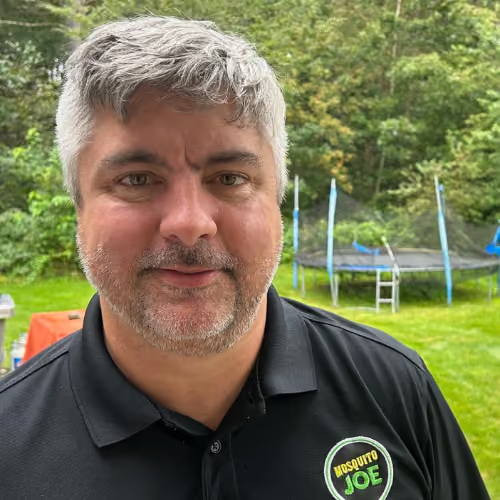
Host: Three years ago. Today's guest was six months into owning a very small business, a Mosquito Joe franchise territory, doing under $700,000 in revenue. Today he's over 3 million. Neil Finneran returns to the show to tell us how that happened.
The short answer? Organic growth got him from 700 to about 1.2 million. But the real inflection point was acquiring his neighboring territory, a business bigger than his own. Listen for how that deal came together.
Neil had been planting seeds with neighboring owners from day one and how little money he had to put down a benefit of buying within the same franchise system. Also listen for Neil's candid reflections on buying small. Generally don't he says now. The episode immediately before this one was with Jesse Sundquist, who also bought a Mosquito Joe territory and at around the same time and at a similar size and had a very different outcome.
Neil and Jesse know each other and compared notes for years. So why did one business grow while the other stalled? Listen for that discussion. Welcome back to Neil Finneran, owner of five Mosquito Joe territories across Massachusetts and New Hampshire.
The top line is the first number you see on any deal and it's the easiest one to take at face value. But how a business generates records and sustains its revenue is where the real story lives in a webinar today, Thursday, Derek Pitts and Chris Williamson of diligence firm Cane Crossing with return for their second Acquiring Minds webinar, this one a deep dive into revenue and what you should understand about it before closing. Among the topics you'll learn how to conduct thorough revenue diligence, the differences between cash and accrual accounting and why they matter, industry specific nuances that can shape your analysis, how to evaluate the customer base and identify potential risks and your questions. There will be time for live Q and A with Derek and Chris at the end.
The webinar is the revenue deep dive, what every searcher should understand before closing. And it is today, Thursday, August 20, noon Eastern. Link to register is right at the top of this episode's show Notes or on the Acquiring Minds homepage. Acquiringminds Co.
Then on Tuesday, we're hosting a legal webinar with attorneys Bill Barlow and James David Williams, this time on the licensing and regulatory issues that you need to think through before buying a business in a regulated industry. An added layer of complexity, yes, but for buyers who understand the requirements, also an opportunity. Bill and James David will cover how to identify the licenses and permits a business needs to operate, whether licenses are held by the company or by individual employees, and whether they can be transferred. What happens when the seller or a key employee holds a license?
The business depends on how licensing requirements can influence whether you structure the deal as an asset or stock sale, and how to determine whether you're the right buyer for a regulated business. The webinar is Licenses and Regulatory Issues When Buying a Business and it is this coming Tuesday, August 25th, noon Eastern. Link to register is right at the top of this episode's show notes or on the Acquiring Minds homepage. AcquiringMinds co.
Welcome to Acquiring Minds, a podcast about buying businesses. My name is Will Smith. Acquiring an existing business is an awesome opportunity for many entrepreneurs and on this podcast I talk to the people who do it Looking to secure an SBA loan to buy a business? Meet Pioneer Capital Advisory your go to partner for sophisticated buyers who want deals closed quickly and on the best possible terms.
The Pioneer team has closed more than 100 SBA loans, averaging timelines well below industry standards. Founder and owner Matthias Smith and COO Valerie Stash bring over two decades of SBA lending experience. Matthias and Valerie have built a team that meticulously works your deal from underwriting to close. You'll have a full bench working on your behalf, sales associates who streamline onboarding M&A financial analysts who craft investor grade lender decks and an operations team that manages every step of the closing process with institutional level rigor.
Pioneer is not a single person, but your true deal team. Visit pioneercap.com or click the link in the notes Neil Finneran, welcome back to Acquiring Minds.
[00:05:30 - 00:05:31]
Guest A: Thank you. Good to be back Neil.
[00:05:31 - 00:06:07]
Host: You were on the show three years ago, 2023 at the time. You were six months in to acquiring a Mosquito Joe territory. So this is franchise ETA. It was a very small business under 700 in revenue.
Today you're over 3. 3 million in revenue. So that sure seems positive. We're going to hear how things have gone over these last three years, but start us off Neil, with a quick refresher on your backstory and how it was that you came to acquire a Mosquito Joe territory in the first place.
[00:06:08 - 00:07:00]
Guest A: I wasn't dead set on acquiring a company, you know, I had, you know, read about that. But you know my my prior life mostly in finance, investment management and then I was kind of at a crossroads know in that mid-40s time where it gets a little trickier. I happen to be in the flow of both franchises and businesses for sale. Kind of like more as a hobby as oh that's pretty interesting that ETA stuff.
And then this pesk small pest control Franchise was for sale in the. In a location that was a fairly easy commute from my house. So I dug into it more. I dug into it.
I liked the economics of it. It was clearly a very small purchase. Tough to appreciate the pain of buying small until you actually do it. But you know, I pulled the trigger over three years ago and here we are.
[00:07:00 - 00:07:28]
Host: Your background before that was in finance. So you took a significant step down in terms of income, annual income, you. But you also had some reserves. I mean, you had savings from a career in finance.
Just to that piece is important because you didn't pay yourself for a while. We're going to get there. Where did we leave you at the end of our interview? Where were you?
Where were you? October 2023, do you recall?
[00:07:28 - 00:08:04]
Guest A: The plan was probably to get to something like this, but I was in the thick of it and was growing a little bit. It was very small, really. Not a lot to pay yourself if you have any. A little, even a little bit of debt, especially at the rates kind of back then and now.
So it was a grind. It was a grind that I was hoping I would get to a place kind of like this. And so in hindsight it worked out. But it's certainly, you know, during the path that never feels like.
Not like I've made it, but definitely made progress from that point. So it's kind of going along with what I would hoped.
[00:08:05 - 00:09:02]
Host: Yeah. Well, as we're going to hear, you've actually had a whole lot of success and you're one of the bigger players in the whole franchise network. Now. We're going to get there.
But just to refresh your memory from when we talked last time. Yeah. You were in the thick of it. You.
I think you characterized it as the occasional 3am staring at the ceiling moments. You know, you know, what. What the. What the f did I do?
Not all the time. I mean, you weren't panicked to get up, but there were definitely moments learning to manage crews. You had said in that interview that like, if I got a crew of five guys, there's a 50 chance that one of them will just be a no show every day sort of thing. So it was the grind.
Okay. So that kind of sets the stage. And then just so we know where we're going, take us up to where you are right now. What are the kind of the headline numbers, size, employees, territories, etc.
Yeah.
[00:09:02 - 00:09:56]
Guest A: So right now I have. That original purchase I made was the Mosquito Joe. And it's Mosquito Joe in. In Massachuset is called Mosquito Jovan Rapidity.
That was the original purchase had about, I don't know, I started with 900 customers and, you know, 700,000 ish of revenue. I'm up to probably, you know, 4,100 customers now after acquiring, after growing that, that branch in Massachusetts, but also acquiring the Mosquito Joe of Southern New Hampshire earlier this year. So, you know, probably over 4,000 customers over, should end up over 3 million in revenue, still growing. So I grew both the, you know, organically a little bit and had a big purchase and that combined entity should grow year over year versus last year.
[00:09:57 - 00:10:18]
Host: So let's pick apart the growth. You said both organic and inorganic. The inorganic piece here really vaults you up. So we're going to hear about that after.
But, but talk to me about the organic growth because you were, you were growing yourself out of the kind of purgatory, weren't you? Organically, I was it, yeah, it was.
[00:10:18 - 00:11:17]
Guest A: I mean, yes, I was growing organically and probably would have continued, but it's a, you know, you get older, it's a grind and it didn't have patience. But I was growing chunky. But I think that original purchase, which was below 700,000 revenue, it should probably do 1.1 to 1.2. That entity that I originally purchased in 2023, that was doing about less than 700, it should be over 1500 customers and 1.1 to 1.2 revenue this year.
It's pretty easy to forecast these businesses so that have grown. I mean, it has like up 5%, up 20%, up 10%. It's a little bit chunky, but definitely growing. Kind of do the, all the marketing stuff, take chances here and there.
And yeah, I've been able to grow that probably, you know, in a fairly okay environment. You know, the macro is just okay. So it's been, yeah, it's been good.
[00:11:18 - 00:11:20]
Host: And what do you mean chunky that you keep saying?
[00:11:20 - 00:11:51]
Guest A: Like it hasn't. It's not like it's up like 15 every year and it's like clockwork. It's like, oh, I'm up a lot this year. Oh, I'm not as up as much as I thought the next year.
I don't quite know why. I mean, I definitely try different things in marketing. It's not a smooth, smooth line like you'd like to see like a chart or you know, like a, you know, those old school public companies that always beat their numbers by 2% every year. But it has grown.
It just doesn't feel like it's, you know, it's a given, but it has grown. It's just chunky. As far as the rate of growth.
[00:11:52 - 00:12:11]
Host: Yeah. And then like your day to day in managing it, how did that evolve or did it evolve in. In terms of the managing your crews and I mean. And you were also out.
Yeah. Sometimes doing. Spraying yourself to fill in the gaps. How did, how or did that evolve and if so how?
[00:12:12 - 00:13:27]
Guest A: Oh yeah, that's like it's been, it's so much better to be bigger as far as that in these businesses. You know, that first year, you know, one day you're doing like, you know, your QuickBooks to the next second you have to run out to change a flat tire. You have do all the hiring. You have to deal with every customer that complains.
You know, I had some help in the office, but not much. And now I have a crew of, you know, three to four full time office people and some ops managers. So my daytoday, the, you know, I still deal, I'm still very much in the business. But all that day to day stuff like answering every customer's complaint or dealing with every issue or every flat tire or someone calls out, I was, I was probably overly militant on never rescheduling customers.
So I would jump in a truck. Probably, probably short sighted. But now I don't really have to deal with nearly any of that stuff. And it really, I love as far as lifestyle, it's so much better than it was.
So in a lot of ways bigger is easier even though it's more risk. I think a lot of ways for as far as working in the business day to day, if you can get bigger, it's just so much easier as far as, you know, the day to day stuff.
[00:13:28 - 00:13:53]
Host: Yeah, well, buying small, we're gonna, we're gonna, I'm gonna ask direct directly about that in a minute. But just to understand the like how you, you know, were working so in the business and just like you know, going out to customers, houses yourself. Did that only end once you made this big acquisition or, or had you already grown yourself out of that just organically. But before this big acquisition, I think
[00:13:53 - 00:15:07]
Guest A: I kind of grew out of it a little bit each year. A little more each year. First year there's only you know, five or six guys and I think I a little more comfortable and a little better managing business and people each year. So the first year I think I probably hired bad but also trained.
So like a lot of the, when I talked to you the first time, a lot of the issues I had with attendance were Both hiring and then being a good manager, really a lot of it. You know, all this stuff, it always feels like it flows up to me where it should. Like any problem I had is usually it was my fault, either allowing it to happen or not training the guys. So definitely implemented stuff over the years to fix a lot of the issues I created.
So like, for example, I used to just pay a little bit of bonus with the guys at year end and then I really tied some of the stuff I tied to outcomes I want. So I tell. Tell the guys. Listen, for every week you have, you show up every day on time, you get a small percent of the week's production.
You do that's paid at the end of the year for the week. You. If you miss that Tuesday that you don't get that whole week just as a little and that like solved like, you know, 80% of that stuff.
[00:15:08 - 00:15:27]
Host: Really. You. You were actually talking about putting that very plan into. Into practice when we talked last time.
So I was going to ask about it. That's amazing how well it worked. Did you come up with that or is this a case of you're. You're talking to all the other Mosquito Joe owners around the country and people are swapping what works?
[00:15:28 - 00:16:10]
Guest A: Yeah, no, I came up with that one. Yeah. Even before the AI would probably have told me to do that now, but that was. That was all me.
Oh, y. There's a lot of guys. Yeah, exactly. I probably would have asked AI now not had to use my brain.
But there's a lot of guys throughout. Like in pest control, they kind of do, you know, a don't do all production pay and. Or do. There's hourly.
So it's a little bit of a hybrid, you know, to pay a little bit of production. You know, I float the idea of just paying on production or incentive, which some companies do. And the guys I floated with the guys who I like the other. The better more season guys were so afraid of it that I didn't want to go fully there, but I wanted a little bit of, you know, carrot and stick.
[00:16:11 - 00:16:24]
Host: I see. Okay. And. And by production you mean paid.
Exactly. Proportional to how much work they actually. How much they're actually spraying, as opposed to hourly. Okay, okay.
[00:16:24 - 00:16:24]
Guest A: Right.
[00:16:25 - 00:17:00]
Host: All right. Well, so Neil, now on the point of buying too small, $700,000 in revenue is very small. By all the kind of rules of thumb that we have in the space. We've just heard, you know, color on your experience and it sure felt.
Seems uncomfortable. On the other hand, certainly like some of you having to learn the business, even down to doing spraying yourself some of your success today you could probably tie to being so in the business or, or, or not.
[00:17:01 - 00:18:03]
Guest A: Absolutely, yeah, 100%. You can call through any BS you kind of, you know, you know stuff, how long stuff should take, you know what situations arise especially very repetitive business like this. So having been have done the work, it's helpful, very helpful. And plus you get a little more street credibility with the guys.
Even though the guys in the new shop, the new office, they don't, don't know I did that. At least I can tell them oh yeah, you know, I did whatever number of services. So it helps knowing the business, knowing how it works, knowing the situations. So it just, it's huge and not, not necessarily you have to buy small to do that.
I was kind of forced into it. But even if you buy big, I would, I clearly recommend if you can try to get in the weeds a little bit at the beginning to understand especially if you have a business that has some, a lot of frontline technicians or if you're in manufacturing, to get in the weeds a little bit, you know.
[00:18:03 - 00:19:33]
Host: Enzo Technologies as one of the leading IT managed service providers serving the search community led by Nick Akers, an acquiring minds guest who bought the 35 year old business. The team at Enzo regularly works with searchers and their acquisitions. And one feature of acquired businesses that Enzo is seeing over and over is the need to implement cybersecurity promptly during the transition. So many acquired small businesses either have glaring vulnerabilities, lack security best practices or both.
That step one to de risk the deal you just closed should be addressing these issues. INSO is your full service IT MSP for post close stability. They assess your target, surface the biggest risks in plain English and give you a day one through 30 plan to cut exposure, prevent downtime and even find cost takeouts like bloated telecom bills. Check out enzotechnologies.com I N Z O or email Nick directly at nick@enzotechnologies.com about the size of business that you bought.
You you were forced into getting in the weeds as you just said. But yeah, would you, how do you reflect on buying that small? I mean what would you tell somebody who, who's saying neil, I'm looking at buying a $700,000 revenue business?
[00:19:33 - 00:19:34]
Guest A: Yeah.
[00:19:34 - 00:19:42]
Host: Would you, would you scare them off it or would you say you know this can work. It's you know, it know what you're signing up for, but it can, I mean, you know, how do you reflect
[00:19:42 - 00:21:03]
Guest A: Such a good question. I don't know this right answer. I, I, I mean I listened to your, your, some of your podcasts and I see you guys make both arguments. And I can make both arguments.
If it was just 700,000 and I didn't think it was a potential to be more, I would say run as far as ways you just there's no value. Don't maybe if you get it for zero. But I would say yes, generally buying too small is a risk. I think in my case, I knew what I was buying.
The business I was buying was doing that. I knew surrounding businesses were doing about twice as much. So I thought there was some organic growth embedded in the territory they own. So it's a franchise, you have territories.
So I knew there was some, a little bit of upside there. One, two, There's a problem with buying small, right? Totally. But it also costs less money.
So I felt like if I bought big first and I screwed it up, that's a big financial risk to me. If I bought a business for a few hundred thousand, it would really suck. If it went bad, I'd probably figure it out and it would suck. But if I got it wrong, it was manageable.
So there's some buying small there that is good. I think in my case, I bought in the franchise thing specifically. If you can buy in a franchise where you have the chance to,
[00:21:05 - 00:21:05]
Host: as
[00:21:05 - 00:21:58]
Guest A: I say now, I think the buzzword is like kind of plant your flag in a system that you kind of believe in and then acquire neighboring, which works really well. And I think the four wall franchises, I think that is really a good way to make money because, you know, the integration I felt like, I'm sure the employees here didn't love it, but not too bad systems and processes. So it depends. I think you're just buying small.
I would, it really has to have a lot of like sizzle or something behind it to make it worth it because it is brutal. So I, I would say generally don't buy small. Bigger is better and in a lot of ways safer. But in this case, you could kind of see the, the forest through the trees.
So I felt like it. There's, there's situations where it works out. If you're thoughtful.
[00:21:59 - 00:23:37]
Host: You mentioned the plant your flag strategy. I think, I think Connor Gross, who does the franchising webinars with us, I think he coined the term and the idea is to get into the system and I from him get into a franchise system. And I think technically his plant your flag is like even be willing to do de novo, not ETA startups. Being willing to start a location or territory.
Yeah. With the idea that once you're in the system, then, then you can acquire. So you don't necessarily. If you can't acquire your way in, maybe you start de novo and then acquire.
But, but, but, but also I think fundamentally it's about the idea of getting in a franchise system and then being able to acquire and how much efficiency there is. There is in the acquisition path and how interesting and compelling that is. That's what's behind all of this. But, but, but I will say, Neil, like your big inflection point here was this acquisition.
And you can't plan an acquisition like that. In fact, as I'd like you to tell the story, that acquisition almost didn't happen. It didn't happen the first time and then it did. So I guess the question would be, before we hear the story of the acquisition, if that acquisition hadn't happened and you were, you know, at 1.2, 1.3, 1.4 of revenue in the one territory that you acquired, you'd grown it organically there.
Would you. Were you still pretty psyched about the outcome or, or no, you're. This all comes down to the fact that you made this acquisition happen.
[00:23:38 - 00:24:07]
Guest A: I would not as have been out as psyched about the outcome if this acquisition did not happen. Yeah, yeah. But I think it wouldn't have, wouldn't have been horrible situation. It probably would have been fine, but not like, you know, not great.
I know, you know, it's hard to know the alternatives. Is sometimes you hear like, oh, let's go back to my 400,000 year job in finance. So I don't know, like for me, I didn't know if that exists either. Like sometimes people just say that like on Twitter.
[00:24:08 - 00:24:09]
Host: Right.
[00:24:10 - 00:24:16]
Guest A: So for me it would have been okay. I would have figured it out. But you know, the acquisition was definitely what I was hoping for and it worked out.
[00:24:17 - 00:24:36]
Host: Yeah. Okay, well, you, when we talked last, you, you did have that kind of. You hadn't heard the plant your flag phrase yet, but you had the, you had the, essentially the sense that you acquire. So how did that play out?
Tell us about the. This, this acquisition that you did of your neighboring territory. Whole story, please.
[00:24:37 - 00:26:05]
Guest A: So it's good. Yeah. So in franchises, it's, it's definitely a community and a network of people who, they do conferences, they complain on Facebook, you know, together. And it's always, you know, definitely a lot of networking.
So it good to be like, you know, a Good girl or guy who is social and talk to people. So, you know, right. Almost right off the bat, you know, I knew my neighboring owners and owners all around. You know, when I definitely, when I was doing the due diligence, I probably talked to 10 to 20 owners and I planted that seed.
Hey, if ever. If you're ever thinking about it, ever thinking about it. So I mean, I still get calls like yesterday about ones that are close, but so that's really planted the seed in a lot of the neighboring owners. And then you hear back, you know.
You know, usually hear back. The business gets like hard in like June, July, August. Usually people call and say, oh man, I hate this business. I want to get out of it.
These customers are so annoying. So usually get some calls. And then like September, when this gets easier, they go, you know, I change my mind. But I plan to the seeds all around.
And they. If the person likes you, I think they can, you can keep kind of their employees happy and keep the business going. They tend to want to sell in the network because it's the ease of the transition and the high certainty of the close. So, you know, it worked out eventually.
[00:26:06 - 00:26:12]
Host: So you were just signaling the whole time, you know, think of me when it's time to sell or if you ever want to sell.
[00:26:12 - 00:26:13]
Guest A: Yep.
[00:26:13 - 00:26:24]
Host: And eventually you're bound to get. Somebody calls you. And in fact, it's been much more than somebody. You get some number of calls.
And then this one that actually closed and tell us about this, this big one. This one that closed.
[00:26:25 - 00:27:29]
Guest A: Yeah. So the one that closed is Mosquito Joe, Southern New Hampshire. It was owned by, I think it was. Might have been the first Mosquito Joe in New England.
So they have a long history, which is wild. So it's north up in New Hampshire, Southern New Hampshire. So I don't know how old they are. You know, their business, they started maybe 2016, but husband and wife team.
The husband was actually a banker high up at a major bank. So his wife was definitely involved in business. He was too. So, you know, they were doing fine, they're doing well.
I think they're at the point of their lives, let's say 55, 60, where they wanted to. At least she wanted to tap the brakes a little bit and relax and they built a great business. So a couple years ago they came up, reached out to me after I reached out to them and said they wanted to sell. They, like I said, I think they said it in the middle of the summer when she.
When they're probably stressed out and then by the time the fall came, things changed. Then this past fall, or actually things change.
[00:27:29 - 00:27:35]
Host: Meaning she said, never mind, I'm, I, I don't want to sell anymore. So you had a first conversation more
[00:27:35 - 00:28:20]
Guest A: so him, he's like, why the hell would I sell? This is a great business. Oh, you know, and I was like, yeah, I get it. All right, well, things change.
Give me a call. I totally get it. That's a good business. And then I think a year later he had them travel more, go to New York City more.
So he was even less involved. So I'm talking about last summer. They reached out again. I said, yeah, let's talk.
And we kind of, you know, already kind of indicated what price is fair. And in the fall we just, you know, took a while to close like everything, SBA debt and all that. But we closed earlier this year, so we kind of worked on it. We started the process last summer.
Didn't really do much until the fall when business slows down a bit and we closed it earlier this year.
[00:28:20 - 00:28:24]
Host: And can you give some numbers around that business and how you structured the deal?
[00:28:25 - 00:29:10]
Guest A: Yeah, I think, yeah, there they had probably have 25, I think 2,500 ish customers, you know, around to 2 million in revenue and 38% more owner earning margins. So as a fair small business purchase multiple, you know, roughly three times, it seems fair of earning, you know, those sellers earnings mostly a lot of SBA debt, not 100%, but maybe it was like 70, 80. And then the seller note it was structured interest only for a little bit. And then, yeah, that was it.
I didn't really put much down,
[00:29:12 - 00:29:16]
Host: you know, and that's because I didn't need
[00:29:16 - 00:29:36]
Guest A: to and I'd rather have the liquidity. You know, you can do it later. I feel like I can make that choice later. And I feel like you can handle it.
Debt service, fine. It was pretty well covered in debt service. It's pretty good cash flow business. Not a lot of capex.
So. Yeah, so that's where we ended up.
[00:29:36 - 00:30:01]
Host: No, I'm, I, I mean, I think it's, it's great. The, I mean, obviously if you're, if your debt service is comfortable, the. But the point is that the sba, because it's in the same franchise system, this is an instance of the SBA allowing you not to have to put any equity in if you're buying in the same Nick's code, obviously a franchise, two territories in the same franchise system is going to be the same naics Good.
[00:30:01 - 00:30:42]
Guest A: Yeah, they would have financed more they would have financed 100%. They loved the deal. It seemed like the SBA people loved it. They would have financed more.
Yeah, no, it's good. I mean, I think they're comfortable. I think they're. I've heard multiples higher that where they finance more.
So I think, you know, I think it worked out. I know some pest control multiples outside of franchise. I know I do Mosquito Joe, which is lower multiple. It's franchised.
I think that just trades at a lower multiple. And it's mosquito tick, which is come to some labor, you know, seasonal challenges, but geez, I think I hear pest control companies selling for two to three times revenue.
[00:30:42 - 00:30:51]
Host: There's that much of a multiple difference between being an independent pest control business, trading for multiples of revenue versus being in a franchise. That's a pretty big difference.
[00:30:51 - 00:31:17]
Guest A: I think there is a big difference. I mean, I just know what I see on Twitter. Yeah. Maybe some of the big guys scoop up regional guys for a high multiple.
2 to 3 times revenue might be super high, but definitely, I think a good pest control company trains high. Like, high multiples. I think if you ask Twitter, you'd see some high. High multiples.
Yeah.
[00:31:18 - 00:31:36]
Host: Okay. Okay. But, Neil, so to be clear, this southern southern New Hampshire territory, Mosquito Joe was a bigger business than your own, so you. You were the smaller of the two and took it down.
Yeah, not. Not that much of a difference, but notable, maybe.
[00:31:36 - 00:31:36]
Guest A: Yep.
[00:31:36 - 00:31:47]
Host: And. And so the integration has been fine. You mentioned that your. Your existing team might not have liked it so much, but all things considered, pretty smooth.
What can you say about more of
[00:31:47 - 00:32:34]
Guest A: the team I acquired? I mean, just, they were great. I. I took over their office.
So I. And mine. I had a very lean office for my operation where I had some offshore person or two helping. What?
The Mosquito Joe of Southern New Hampshire was bigger and had a much more established office. So I absorbed their office and took their office staff. And eventually letting my offshore person go just was too complicated. So I got a really good.
A really good team here that I inherited. They actually did a really good job already. So I was very lucky. So not only did I buy, you know, some more, you know, a bigger business with more customers, I inherited and bought a really good office team.
[00:32:34 - 00:32:38]
Host: This business also came with Christmas lights, right?
[00:32:38 - 00:32:38]
Guest A: Yeah.
[00:32:38 - 00:32:54]
Host: Talk to us about Christmas lights. Why it exists in a pest control business. What it looks like I almost had to reschedule on you this conversation, but we couldn't do it next week because you're going to actually be at a Christmas Light hanging conference.
[00:32:54 - 00:33:12]
Guest A: Yeah, exactly. Seriously, I don't know much. I mean, I know we have this business now and I know we have 100 and something customers. It really exists.
I think the. And you'll see a lot of pest control companies or landscapers do these businesses. This business as more as a labor retention tool.
[00:33:14 - 00:33:15]
Host: Labor retention.
[00:33:15 - 00:33:16]
Guest A: So instead of.
[00:33:16 - 00:33:24]
Host: Instead of laying people off in the. Or letting them go for the off season when there's no work. Yeah, you keep them around and keep them busy with Christmas lights.
[00:33:24 - 00:34:01]
Guest A: Yeah. You get them to like mid December and you get them to January to take the lights down. So you're bridging maybe a month or two, hopefully for most of your staff. Funny enough, like, the New Hampshire licensing process for pest control technicians is really hard.
So it's really hard to hire and get licensed people in New Hampshire. So if you can keep them, it's great. And I think that's why they started the Christmas lights business. So.
Yeah, I really. I'm going. I gotta learn a lot about. Does keep at least half the staff or more of the technician staff employed up until.
[00:34:01 - 00:34:03]
Host: Is it actually a profit center? It. It.
[00:34:03 - 00:35:05]
Guest A: It's probably a few hundred thousand in revenue. Let's call it. I don't know, Maybe they did 300, 000 in revenue. Maybe it does 50 to 100 in profit.
Ish. So in my head, if it can keep staff and not cost money, I feel like it's a win. Yeah, I think, I think the guys like doing it because, you know, pest control is a very individualistic thing for the all. You know, I have 25 trucks out.
They come in, they get their stuff and they all go out on their own. And this kind of brings like crews of three to four together, working together. So they kind of like that. But it's really number one employee retention tool.
So my goal that is to hopefully, you know, make maybe a little bit of money, keep the guys employed and do it safely is probably the three priorities. But beyond that, I don't know. You won't see me up on a roof. So I don't know.
I don't know much about it besides that. I'm working on learning next week. Yeah, I'm going to a conference.
[00:35:08 - 00:35:18]
Host: Great. Okay. I be. I'd be curious at that conference if there are any businesses that are only Christmas lights business or if they're basically all businesses that do something else in the.
In the summer season.
[00:35:19 - 00:35:36]
Guest A: Yeah, no, they might be all lights. Some people like get into the permanent lighting. You might see some people get into More if you get into more commercial stuff, I guess can be more year round like shopping centers and, and banks and stuff you can get into, I guess more of a full year thing.
[00:35:36 - 00:36:23]
Host: Great. Okay. So I heard you say, you know, when you were thinking about the counterfactual of if you'd never bought this business and you'd still be sitting in your $400,000 a year finance job. Of course you have no idea if that job would still be around or what would have happened in that version of events.
But I heard the number 400. So that's a great full finance salary or annual income. And I don't know if that even includes bonuses all to ask you what, what you're able to take home now if you can share that, people will remember I said at the top of the interview that in the early days of this, for I don't know for how long, tell us you didn't take anything out of the business for you are reinvesting everything. So how has that changed?
[00:36:23 - 00:37:31]
Guest A: Yeah. First year or so. Well, as a finance guy had a lot of money in the market and the market just keeps going up, I guess. So that kind of, you know, I think my portfolio probably stayed the same, but I just lived off the, the gains for a couple of years.
But that changed. I, you know, my sense is I should. With all that stuff, you throw it together, I should be around 800,000 profit. Even assuming some margin degradation due to increased marketing and trying to grow the business in the top line.
And then the debt service, I think it's a little bit over 300. Probably 340. 340 including principal pay down. So I don't know.
I think. Yeah. So it should be say 400 to 500 should be. It ish.
Which is, you know, fine, that's more than enough for me, I think, you know, if I make 300 plus, I'm okay. Ish. You know, I don't live a lavish lifestyle. I live in New Hampshire.
So yeah, that's where it should end up with, you know, room to grow the business, I think.
[00:37:31 - 00:37:34]
Host: And are you. Is that what you're paying yourself or that's what you could.
[00:37:35 - 00:37:52]
Guest A: That's what I think it's gonna. I'm not, I don't, I take a small salary right now, so I don't even know what I mean. I pay myself. That's what I'm thinking will end up being as far as what the business makes is left over for me at the end of the year after debt service pre tax.
[00:37:52 - 00:38:07]
Host: Yeah. But it sounds like you're still. You're still in a. Basically will pay yourself some token salary under market or under what you could and just continue to keep the cash in the business.
Reinvest or just have it kind of
[00:38:07 - 00:38:09]
Guest A: distributed as needed, I guess. Yeah.
[00:38:09 - 00:38:16]
Host: Well great. So you have. But in theory, if you were to take those earnings out, you have replaced your finance salary.
[00:38:17 - 00:38:26]
Guest A: Yeah, about. I mean finance later I was in a hedge fund. So it was like, you know, it'd be. It was not no average.
It was good or okay.
[00:38:27 - 00:38:28]
Host: Yeah. Okay.
[00:38:28 - 00:38:46]
Guest A: Theoretically if I can. Which you know, in that finance is certainly an investment management world. It's so lumpy and doesn't feel as recurring as a business you own especially in the. This pest control.
It's a fairly, you know, tight. I mean things can go down but it's fairly reoccurring. Ish.
[00:38:47 - 00:38:50]
Host: But yeah, which is why it sells for the multiples that it does.
[00:38:50 - 00:38:59]
Guest A: Right. Yeah. Basically I feel like I'm replacing it. I mean it's taken a while, you know, I mean years.
But yeah, I feel like I'm getting there.
[00:38:59 - 00:39:01]
Host: A few more segments for you here.
[00:39:01 - 00:39:02]
Guest A: Yeah.
[00:39:02 - 00:39:18]
Host: Talk to me a little bit about being the one of the biggest guys in. In Mosquito Joe or where are you. Where do you think you are with respect to the rest of the franchise network? And.
And do you see yourself continuing to grow more but by acquiring other territories?
[00:39:18 - 00:39:18]
Guest A: What's.
[00:39:18 - 00:39:24]
Host: What's the. Yeah. What's the future look like in terms of your. Your size with respect to Mosquito Joe?
[00:39:24 - 00:40:04]
Guest A: Yeah. So Mosquito Joe is. It's part of neighborly as far as franchise brands. Mosquito Joe, there's not a lot of like huge private equity a lot of times in private equity in or big big franchisees in these networks.
Mosquito Joe is certainly still on the smaller end. So I'm probably top 1, 2, 3 on customers depending on the week. We get leaderboards every. Every week revenue.
I'll probably end up I would think top five probably top 1, 2, 3 in new customer growth this year. So yeah, right near the top of. I don't know how many owners there are. 180, 200 something.
I forget. So yeah. Right at the top view.
[00:40:04 - 00:40:19]
Host: Well that seems like an accomplishment. Is this a case where the franchise or is not super excited about somebody becoming a franchisee becoming too big? Is that why there aren't bigger fish or what?
[00:40:19 - 00:40:26]
Guest A: I think that's probably. I. I don't know. I think that has been the case.
I think. I think.
[00:40:26 - 00:40:32]
Host: And will that affect you? I mean are you hitting? Are you going to bump up against the ceiling that they impose on you, do you think?
[00:40:33 - 00:41:32]
Guest A: I think if you play the. I hope I don't have to listen to this, but I think if you play the game right and they kind of like you, I think. I don't think it'll be a problem, but there is a. Yeah, certainly a bias to.
I think some people have. I think there's an assumption that the people who have the one or two territories, you know, I have five, they work really hard in one or two and as you get too diluted, you're not as focused and it's better off with a smaller, scrappier guy. I think there has been that. I think I've been made the argument, listen, if I'm buying an existing territory, the debt and spending money, I'm not.
It's not like I'm scooping up territories just to hold them. I mean putting real money and I'm going to grow it and yeah, better with me than somebody new. I think that will probably be. Be true.
There's not like a hard and fast rule and within neighborly on those other brands where guys, you know, do 40 million in sales, you know, and across multiple states. So I don't think neighborly has a rule against it.
[00:41:32 - 00:41:35]
Host: I heard you say five terror. Did I hear you? Did I hear.
[00:41:35 - 00:41:41]
Guest A: Yeah, two branches. But like if territory is like a group of. I don't have any. Some sort of household count or something.
[00:41:41 - 00:41:42]
Host: Okay.
[00:41:42 - 00:41:49]
Guest A: So yeah, it's a total of five territories, two different office branches or brands, two different, like gotcha, you know. Google profiles
[00:41:51 - 00:44:37]
Host: longtime acquiring mind sponsor Aspen. HR is now part of Engage Peo. Engage helps acquisition entrepreneurs. Business buyers like you take care of their new employees and build trust from day one.
Whether it's an asset or stock purchase, Engage provides a turnkey solution for payroll and taxes, hr, admin and technology, employee benefits, retirement plans, workers comp, and more. They're also always a phone call away so you can receive HR guidance from licensed employment attorneys promptly as those inevitable people issues come up. With Engage managing your people infrastructure, you as new owner of your business can focus on building relationships, operating the business and driving growth. To learn more, contact Jenny thier directly at jtheir j t h e a r@engagepeo.com or click the link in the notes so the audience will have heard before this.
The. The episode immediately prior to this one will have been Jesse. Jesse Sundquist, whom you know. Yeah, Jesse bought a mosquito Joe territory in North Jersey or the Trenton area of New Jersey about the same time.
And actually a slightly bigger business than yours. Yours is approaching 700. His was more in the 900,000 revenue range. And so right around the same time, roughly the same size business, same franchise network.
Both of you ETA guys, you know, searchers actually were you. You had been kind of following eta, but this business kind of found you. Jesse was a real searcher. He'd been at his search for well over a year and his outcome has been not yours.
In fact, when, when we really unpack what his outcome is, it's not what he set out to do, as he put it, but it's actually pretty great outcome. He's got the business, he's got a great GM in his business and the business is throwing off cash. And he's now or earlier this year took a, took a job at A, at W2 at a startup that's done really well. He's done really well with it.
So it all worked out for Jesse overall. But this particular project, the Mosquito Joe project, he's probably disappointed with, even though it's not like a horror story or anything approaching that. So it's. So obviously the, the, the differing outcomes here is interesting.
And, and you had been talking with Jesse over the years. You guys were kind of in touch during your respective. What's your take on the differing outcomes?
[00:44:37 - 00:46:16]
Guest A: I, I think him and I came in the same spot. I think he's very bright. I think I could be where he was and he could be where I was. I think he actually tried to buy a neighboring territory.
It just didn't work out. I don't know if the price or whatever. So like, I don't think our stories are much different. It's just like the set of circumstances and whether I got lucky or he got lucky.
I had one for sale, you know, it was able to close on it. He could, he was close to doing the same thing and it just didn't work out. It's hard to get a buyer and seller to agree. It's a process.
Sellers have expectations like I need, you know, this amount of money post tax or whatever. Expectations that might not align with what the buyer thinks is a fair price for the business. So I think, I don't know, like, I think it's just two very similar situations. Probably similar mindset that we talk, I mean, we, I talk to him less now because he's less in the business, but I mean, must have talked, I'm not sure weekly, but every other week free years.
So I don't, I think it's just different set of circumstances. And I think he's been able to spin it and make it work given the same circumstances. But I think he is him. And I always talk, we're both doing like, you know, a million.
They're like, this is too small. This is either you gotta get big or you can't get stuck in this purgatory forever. Somehow you gotta break out of this. You got to like for this business, I know different business have different margins, but for this business, I've always said you got to get to like at least a couple million of revenue to make it.
Like I say, I'm not, say, viable, but worthwhile for where we were in our lives.
[00:46:18 - 00:47:59]
Host: Well, I take your point. And, and it's, it's the one I was kind of trying to make earlier, that part of you can't engineer acquisitions. There's a bit of a luck factor or a chance factor when a neighboring territory is willing to sell. And if the timing is right for you, then you were a beneficiary of that in a big way, as you have been.
And, and so, and so some of that, yeah, chalk it up to good fortune. However, and that didn't happen to Jesse, so he didn't get that. It didn't break that way for him. However, one of the things that Jesse and I also talk about is that he really struggled to just, just the organic growth of his business was a real struggle for him.
He couldn't crack that nut. And you were growing your business organically. Your big win was this acquisition. But as we've said, you grew your business organically from 700 to 121 3.
So you were well on your way, just doing it the old fashioned way. Old fashioned way of organic growth. And, and Jesse to date doesn't really know why he couldn't grow his business. He surmised that it was because his business was an hour away from where he lived.
So he wasn't in there all the time a lot. And, and so he thought that maybe there was a leadership, lack of leadership or visibility of the boss sort of thing. But then since he's put in his gm, who is there every day, grow that hasn't like ignited growth. So unclear that that was the difference.
You have been in your business, so it would suggest that maybe that it's that. But anyway, so what do you think about that? Do you think that's a big feature like that you're in there?
[00:48:01 - 00:50:03]
Guest A: I mean, I guess being in there definitely helps. I'm not sure I have an answer for the growth. I mean I definitely spend a lot of time as a finance guy in the numbers and I'm not a good marketing or social media. I'm just really bad at all that stuff.
But I definitely, and I'm sure Jesse is too just hyper focused on cost to acquire customer. What's the cost of this strategy versus that strategy versus like postcards and cold emails and all this marketing stuff they, they sell you. So I'm super hyper focused on acquiring customers as low as I can or getting impressions for cheap as far as marketing and acquiring customers low. I'm sure he was too.
But that's probably what I spend I think about a lot is getting customers is like the number one thing I think about most of the time. And all the technicians have to be good. All that stuff has to be a given. Ask for reviews, you know, all that has to be a given.
But as far as where my mind share is how to get more leads and more customers and close higher at a higher percentage. I'm sure he is there. So I don't know what the secret sauce is sometimes. You know, I've had years where I've grown 10% and then this year I'm growing pretty good.
A couple years ago grew a lot. I don't know what the difference is year to year. I really don't. Sometimes it's weather, sometimes it's, you know, I, you know, I don't even know.
But definitely in the weeds and hyper focused on marketing. And I do try like sometimes the marketing people, Mosquito Joe, if they have some new test case for some hairbrained idea, I'm usually the guy they call who you know, may or may not waste money on ideas. So I'm definitely willing to spend a little bit in that space too. But I really don't know.
Yeah, on the growth side, I wish I knew it was. I wish I knew the. What the magic formula is to. For that growth.
[00:50:04 - 00:51:19]
Host: It's so, it's so funny for frustrating, I should say about business in general when things grow, when they don't. And there's a lot of mystery to it. Here we have two smart guys bringing their own experiences in the exact same system, similar size starting point, same time frame. Both of you thinking hard about this.
And it's just, and it's kind of mysterious why your territory could grow and his and his didn't. And it's not like he's in a, there's a population problem. He's in a very populous area. Just, you know, Trenton, New Jersey are right outside.
So it ain't that. It's not. And it's not that the a weather thing. I mean because there's other territories he knows in, in New Jersey and they're doing fine or have grown.
So anyway, sometimes I guess it remains mysterious. One of the things that we had talked about the other day, Neil, is how the business has gotten more competitive. Customer acquisition costs have gone up and that's bad, at least superficially it would seem that's bad. Some ways it's actually good for you.
So just talk us through that a little bit.
[00:51:20 - 00:54:00]
Guest A: Yeah, I mean I think it's getting more. And it's harder and harder to get customers. I think, you know, I would say the cost to acquire a customer just using marketing spend, how many customers you acquire. I would say a few years ago, like Covid times, like the people I bought it from and a lot of that system we're probably getting customers for, you know, I don't know, 100 bucks, 150 bucks.
When you take into account how much you'd spend on Google, what a pay per click or other ads and how many customers you close, I think that's, you know, it's gone up a lot. I think it's more and more expensive just, you know, buying leads. So I think Covid was probably a head fake for a lot of people when they got into this business. And it's been hard and, and I, and I, and like I think I told you we talked off the air before.
It's. It's definitely. It sucks because you. It's harder to get a customer so that, you know, lifetime value versus cost of a customer.
That gap may have. It's not as wide as it was or not as a big as a multiple. But there's also some, you know, maybe I'm just glass half full in some ways. There's some.
Adds a little bit of a moat in the fact that it's very hard to start up. I know, I know it's easy, easy for people to. I was reading on today on Twitter, screw that. I'm not paying this business.
I'll just start it on my own. But and I was probably in when I signed up for Mosquito Joey. I still did the training class as if I was a new franchisee and I, I think almost all those guys are no longer in business because the amount of capital and time it takes to ramp up is hard right now given the competitiveness. Whether it's competition in Google or competition, whether it's the economy and or Competition from other competitors, players.
It's harder and in some ways it stinks but in other ways it adds a little bit of a moat and it's good to be big and have cash flow, to pay a little more and have cash flow, you know, to, to get out of the truck and to hire techs and to spend marketing and to focus on higher level things. Whereas you're starting fresh right now. Unless you're some sort of maybe a guru social media person. Although I don't know who really wants to watch videos on pest control people.
Maybe they have some special sauce. It's hard to just. Yeah. Just start up and grow.
You see a lot of businesses. I see a lot of mosquito control companies going into business past couple years.
[00:54:00 - 00:54:07]
Host: Wow. But. And that's probably because the barriers to entry. There's licensing in mosquitoes.
[00:54:07 - 00:54:08]
Guest A: Yeah, it's just enough.
[00:54:08 - 00:54:19]
Host: But the barriers to entries are pretty low. So yeah, people are going out of business because it's getting more competitive, I imagine. Right. Not, not because the demand is still there.
In other words, it's more of an oversupply problem.
[00:54:19 - 00:54:37]
Guest A: Yeah, I think so. Oversupply and I think just like advert marketing is get got. It just gets. Yeah, the oversupply of competition is where it drove off.
The marketing cost actually hurt. Yeah. It makes it harder to get going. But yeah, I think the demand is still there.
I think the bugs keep coming back.
[00:54:37 - 00:54:38]
Host: Two more questions for you.
[00:54:40 - 00:54:41]
Guest A: You.
[00:54:43 - 00:54:54]
Host: How do you reflect on the, on the whole journey so far? And, and I guess ETA broadly for you know, for the listener used to listen to the occasional Quiet Minds episode. What do you think about the, the entire space?
[00:54:56 - 00:55:45]
Guest A: Yeah, I mean, I think, I mean the, the space. I talked to people who have been looking for years. So I, I mean God bless the people who, who are, you know, listening to this. Just frustrated.
I didn't experience that long search process. So as far as the ETA space, I totally hear that's hard to get deals done. It's hard. You know a lot of competition on multiples are high but as far as the actual.
If you get into the right situation, it's. It's awesome to not work for somebody else. Although you don't work less and you're probably stressed more and you. There's like a low level.
There's a low level stress where you never. Brain never shuts off. So people ask how many hours I work. I'm like the part of my brain always kind of working.
[00:55:46 - 00:55:46]
Host: Yeah.
[00:55:46 - 00:56:28]
Guest A: At least you're in control of it. And you know, I Can, you know, tomorrow I could take my kid to a basketball tournament, and I'm just gonna do it, you know, that's cool. It's hard to do that in normal, you know, W2 work and having control of the outcomes and. And make decisions.
I think all that's great. Certainly not without its risk. Like, if I could just work at a fancy hedge fund and look at interesting puzzles to solve, that's a great life too. That just kind of went away.
But, you know, if you can. If you can nail it, it's not without risk. I think it's awesome to. To acquire an existing business and make it work.
[00:56:29 - 00:56:48]
Host: And are you in your own project here? Are you slowing down? Have you kind of. Have you reached a plateau?
Are you trying to acquire more? Are you just. Are you just reactive? If opportunities come up, you'll look at them, but you're not trying to programmatically build an empire or what?
[00:56:49 - 00:58:19]
Guest A: Not programmatically right now. Still, like, feel like this is still fresh, this last one. I think if. If there's territories around me and there are a few that I can absorb and not add to my two offices, like these one off territories, I would fold that in.
Absolutely. And I'll probably try to be a little bit aggressive doing that. Although, like, you need a dance partner, so I have no sense that it's possible. Do I have dreams of, like, owning, like, you know, up and down the eastern.
Eastern seaboard? Not really. Like, that'd be a lot of work and risk. And it's not.
I don't think it's. As these service companies, I feel like. I don't think they're. Although the integration wasn't bad, and I have two offices, and I haven't been to my other office in Massachusetts.
Like, I haven't been there in a month. And it's fine. I feel like recreating it. States stayed away or places I can't travel to.
I feel like that would be hard to maintain the same quality if I'm too far. But I think if I'd be happy if I can just grow these organically and maybe fold in neighboring, you know, onesie twosies, neighbor ones where I can fold in and just add trucks and not, you know, too much infrastructure, adding cost by customers and trucks or. But, you know, basically by customers.
[00:58:20 - 00:58:25]
Host: Mm. So you're. And so your criteria is kind of within driving distance.
[00:58:25 - 00:58:26]
Guest A: Yep.
[00:58:26 - 00:58:32]
Host: Yeah. And do you have a revenue or earnings target?
[00:58:34 - 00:58:36]
Guest A: No. No.
[00:58:36 - 00:58:46]
Host: Do you have a revenue. What you feel like you could get to? I mean, do you think Well I guess no brainer. 5 million is no brainer stretch sort
[00:58:46 - 00:59:29]
Guest A: of for my existing business. I feel like 5 million is probably in that. You know I think I do a million and a half in one territory of the five so that I have one really good territory. So I feel like if I could average 1 million per territory and do 5 million across what I own now, I think that'd be really good.
I don't know if that, I don't know what the market is or if that's saturated or if that's like market what the market share would be but I feel like that's doable based on what I've seen across the country and in my own business territories. If I could do a million dollars across each on average and have 5 million top line for my existing footprint, that's a reasonable goal.
[00:59:32 - 01:00:05]
Host: That would put you probably in the million dollar club. Million dollars of earnings a year club assuming 20 margins. My assumption. You haven't said that.
Yeah, yeah, yeah, great. Neil, your you know, earlier self, you're, you're, we're the same age, we graduated from the same school in the same year. So you're 46 or 47. So your 43 year old self or 44 year old self in the middle of the night looking up at the ceiling being like what did I just do?
What would you tell 44 year old Neil?
[01:00:06 - 01:00:15]
Guest A: Just keep going. Just keep going. Yeah, keep going. Win the day.
I don't know. Yeah, keep going every day. I think it's important to show up every day and work.
[01:00:16 - 01:00:56]
Host: Fascinating to hear your story three years later to and of course awesome. Always awesome to hear somebody have a lot of success. Also really valuable to contrast against Jesse who as you said really capable guy and so I think the juxtaposition of your story is also a takeaway frustratingly is that there's going back to the mystery thing some a lot of business and success in business it's not there isn't a clear answer to positive and less positive outcomes always. So something for people to keep in mind as well.
[01:00:56 - 01:00:56]
Guest A: Yep.
[01:00:57 - 01:01:03]
Host: Cool. Neil Federen. We'll link to your LinkedIn in the show notes and thanks for coming back on.
[01:01:03 - 01:01:04]
Guest A: All right, thanks so much.
[01:01:04 - 01:01:48]
Host: Hope you enjoyed that interview. Don't forget to subscribe to the Acquiring Minds newsletter. We send an email for every episode with an introduction to the interview, a link to the video version on YouTube and soon key takeaways, numbers and more essentials from the interview. For those of you, you who don't have time to listen or watch it.
Subscribe at Acquiringminds Co. You'll also find all our webinars there on the website, both those we have coming up and recordings of past webinars. At this point There are over 30 webinar recordings, a wealth of information on all the technical nitty gritty of buying a business. Acquiring Minds Co.




































































%20-%20thumbnail.avif)





%20-%20thumbnail.avif)



%20-%20thumbnail.avif)

.avif)




%20-%20thumbnail.avif)