[00:00:00 - 00:05:29]
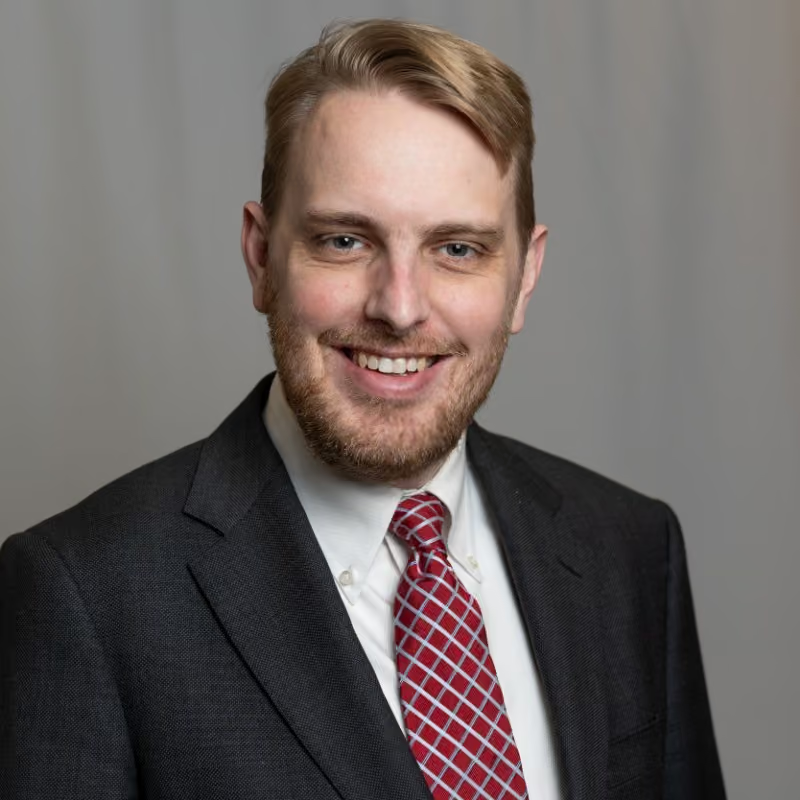
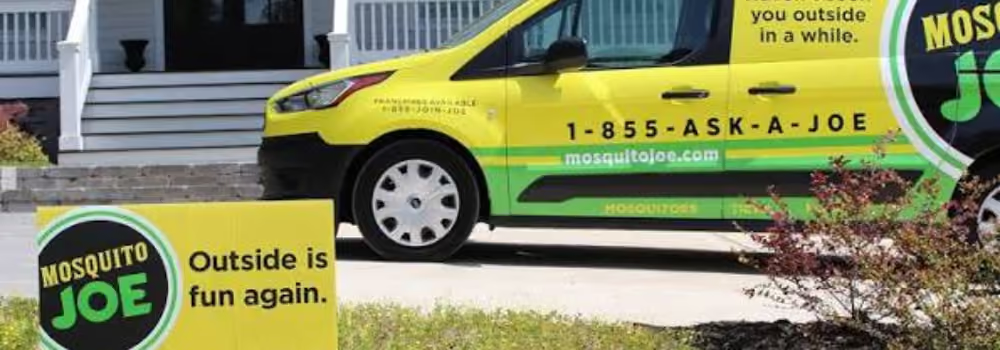
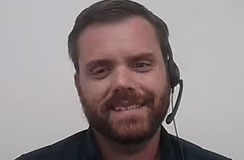
Host: Not every story in our world sorts neatly into win or loss. Some of the most instructive ones land somewhere in between, and today's is one of those Jesse Sundquist is back for his third appearance. You may recall Jesse's first interview came before he'd acquired anything. In his second, after he bought a Mosquito Joe franchise outside Trenton, N.J.
it was an existing territory with plans to buy more and build within the Mosquito Joe system. Three years on, Jesse's report is an honest and nuanced one. The business is roughly flat against where he started, which of course isn't the growth he had projected or hoped for. On the other hand, it now runs largely without him.
He hired a terrific GM, has only about $80,000 of his own money in the project, and today draws a mid five figures distribution for just a handful of hours a week. So as an investment, that looks like a good result against his original ambitions. It's still a work in progress. Much of our conversation is Jesse thinking out loud about why the business hasn't grown the way others in the same system have a question he sits with, candidly and without excuses.
Listen for that because success and failure in a small business are often harder to pin down than we'd like. One thread is his friend and another previous Acquiring Minds guest Neil Finneran, who started smaller than Jesse three years ago and is now one of the largest owners in the whole Mosquito Joe system. We we get into what set their paths apart. Neal came back for his own Acquiring Minds update, which will air in our very next episode.
So listen for that on Thursday. What comes through most today is that Jesse has no regrets. He got in the game, learned an enormous amount, and built experience that will serve him well for the rest of his business life. Indeed, his operational chops already demonstrated their value.
At the W2 he took earlier this year, Jesse ran operations for a startup that just had a nine figure exit. Here he is, Jesse Sundquist, owner of a Mosquito Joe franchise outside Trenton, New Jersey. The top line is the first number you see on any deal, and it's the easiest one to take at face value. But how a business generates records and sustains its revenue is where the real story lives.
In a webinar this Thursday, Derek Pitts and Chris Williamson of diligence firm Cane Crossing returned for their second Acquiring Minds webinar, this one a deep dive into revenue and what you should understand about it before closing. Among the topics you'll learn this how to conduct thorough revenue diligence, the differences between cash and accrual accounting and why they matter, industry specific nuances that can shape your analysis and how to evaluate the customer base and identify potential risks. Bring your questions. There will be time for live Q and A with Derek and Chris at the end and the webinar is the revenue deep dive.
What every searcher should understand before closing and it is this Thursday, August 20th, noon Eastern. Link to register is right at the top of this episode's show notes or on the Acquiring Minds homepage. Acquiringminds co. Welcome to Acquiring Minds, a podcast about buying businesses.
My name is Will Smith. Acquiring an existing business is an awesome opportunity for many entrepreneurs, and on this podcast I talk to the people who do it. Buying a small business sounds simple. Find a company, due diligence, Get a loan close.
In reality, you wear every hat just to get the deal done. And then the moment you close, you have to throw those deal making skills out the window and learn how to operate. You shouldn't have to rebuild this infrastructure from scratch, and you definitely shouldn't do it alone. That's why Walker Deibel created Acquisition Lab.
What started as an accelerator has expanded into a complete ecosystem for acquisition entrepreneurs. Over six years, the lab's 1200 members have acquired over a billion dollars in businesses. The Lab puts everything under one roof an active community, deal reviews, post close services, and a dedicated fund helping experienced operators buy larger businesses. If you're serious about buying a business, come see why Lab members have a 40% success rate.
Learn more in the show notes or at acquisitionlab.com/acquiring minds Jesse Sundquist welcome back to Acquiring Minds.
[00:05:29 - 00:05:30]
Guest A: Thanks Will. It's good to be here.
[00:05:31 - 00:06:33]
Host: Jesse, this is your third appearance. Your first interview was based on an essay that you'd posted on Search Funder. It was Reflections. After one year in the search, you had as yet at the time not bought a business.
Then you came back for a second interview after you had eventually acquired a business. It was a Mosquito Joe franchise, so it was an existing territory within the Mosquito Joe franchise system. It was a franchise resale. So you were pairing ETA and franchising and imagine buying more territories.
That second interview was three years ago now, already Scary. How time flies. And so today you're here to update us on how the entire project has gone. Always fun to speak with you, Jesse.
Great to have you back. Let's start with more detail than I just provided a reminder for the audience of your journey. Why did you search and why did you buy the business that you did? Yeah, sure.
[00:06:33 - 00:09:30]
Guest A: Happy to provide that context again. It's probably good for Me too. Just to sort of refresh my memory as to why I got into this in the first place, but I think my story really started in Covid, or slightly before COVID My wife and I were living in Brooklyn. We had two small kids, we were both working pretty demanding corporate jobs.
It was fine when the world was normal, but then the world changed and we had no daycare, no childcare. We're trying to take meetings from home, I'll watch the kids trade off living my in laws and it just wasn't a great situation. And you know, we kind of looked at my wife and I looked at each other and we're like, this isn't really what we want. While that was happening, I sort of like, I am always listening to podcasts and trying to learn new things and I came across a podcast talking about, hey, you can buy a business with little money down and returns more than the stock market.
And I was like, oh that's like pretty interesting, let me learn more. So I was sort of scratching that itch. On the ETA front. I did all the usual things, buy an HBS book, got on search funder, started talking to people, but I was a total like tire kicker.
But it was during COVID that, you know, while our expenses were low, live with in laws, my wife had a good job, I had a good job. I was like, you know what, if I'm going to make a run at this, I should attempt to do it full time because I don't think I'm going to make much progress trying to search while working because I just didn't have time during the day. So we made the big move for me to quit my job and search full time. And so long story on that is it took me probably 15 months before I found my business to buy.
I looked at everything, but geography was my number one criteria because having small kids being planted in New Jersey, I wasn't about to move and so I really needed to be local. Initially my local radius was about two hours, but I did one sort of site visit about an hour and a half away. And I said, forget that, two hours is too far, an hour is now my radius. And ended up founding.
The business that I bought was about 50 minutes away from my house, which doesn't sound too bad on the surface, but you know, which is, which is why I ended up buying it. But the reality of that is when you have small kids and your office day starts at 7:30 in the morning where guys are getting into the garage, it wasn't a trade off. I was willing to make to be at the garage every day at 7:30. I chose to stay home and like help get the kids out to school and things like that, which we can cover later.
But I wasn't open to franchising at first. About halfway through my search I ended up meeting, I did realize I had met a number of very successful multi unit franchise owners that were doing seven figure EBITDA businesses in a franchise network. So I was like, oh, maybe I should pay attention to these. The next one that comes by I'll take a look at or I'll be open to considering.
The first one I saw was Mosquito Joe and I ended up buying Sort of Fit. It was the minimum size threshold I was looking for and it sort of checked all the boxes of things that I was looking for. And you know, after searching for over a year I was like, if I can't buy this business, like I'm not serious about buying a business at all. And so there were no red flags that came up, went through the process and ended up buying it back in 2022.
[00:09:30 - 00:09:49]
Host: Thanks for that, Jesse. And 1.2 about your kind of loosening your filter and opening your mind to being a franchisee was that you also loosened your SDE threshold or, or, or floor, meaning you lowered it. Say a little bit more about that.
[00:09:50 - 00:10:36]
Guest A: Yeah, I think, you know, my initial floor is around $500,000 from an SDE perspective. And you know, within that one hour geography there just wasn't much, you know, but I found that when I lowered it to around 300 to 350, there was just a lot more businesses that fit in that sort of like smaller scale. And so part of the thesis was in a franchise network, once you get in, even if you're at a smaller scale, there will be opportunities to buy out other owners and grow pretty programmatically that way. I was very influenced at the time by a guy named Brian Beers, which I don't know if Brian's been on the podcast, but Brian has a whole ton of, you know, social media and he's now a friend of mine.
But you know, he's had a tremendous success in Midas. And I was like, oh, anybody can replicate this in any sort of like franchise network.
[00:10:37 - 00:11:19]
Host: Well, boy, are we going to want to hear how you now reflect back on that, that thesis. Brian Beers for everybody. You can look him up, he's all over the Internet as you said, Jesse. And you can find his Acquiring Minds interview.
But he's basically at, when I interviewed him he was in the mid-30s in terms of millions of revenue from across a holdco of Midas franchises, franchise systems in the Philadelphia area area. So he has really programmatically acquired quite a portfolio. And that was some years ago, so I'm sure he's even bigger today. Great.
Anything more to say about the thesis or why that business or what your plans were?
[00:11:20 - 00:12:38]
Guest A: I. I think the thesis on buying a business for me was, you know, with two working parents, one of us needed flexibility. And so on the one hand, it sounds funny, like, oh, a business owner, you have flexibility. Ha ha ha, like, but you do, you know, like, even if you're thinking about it all the time, like, you are the boss.
And so if you need to make your own schedule or do things in off hours, like, you can make that happen. And so that was the whole goal was to have me provide flexibility and my wife would, you know, stay in her corporate job. And that, you know, that absolutely was true. I think the business I ended up buying was maybe a little more flexible than I had anticipated because it was seasonal and we shut down on the off season.
And so I ended up having probably four months of like, literal downtime because we were closed and so there was nothing to do. And, you know, I wrestled with that a lot and trying to figure out, like, do I want to launch a second business or want to find something like cyclical off season, but it's only in the winter and what does that look like? And you know, never could figure anything out. A lot of other Mosquito Joe owners in particular, they hang Christmas lights, whether it's from their own company or with another franchise.
I kind of chose not to do that purposely. But, you know, other people do stay busy. But I ended up buying a seasonal business that was shut down for four months. And so I just ended up having some time off.
[00:12:38 - 00:12:46]
Host: Do you recall where we were at the end of our second interview? So kind of where. Where things stood, where your head was at, how you were feeling.
[00:12:47 - 00:12:53]
Guest A: I think if I remember correctly, we were. I was sort of like half or three quarters of the way through my first season. Is that right?
[00:12:53 - 00:13:01]
Host: That sounds about right. Yeah. You. I don't think you'd been in an off season yet, or maybe you bought in off season.
So you'd been through kind of half an off season or something?
[00:13:01 - 00:13:44]
Guest A: No. So I ended up buying in December and we launched in or we have trucks on the road starting in April. So the first off season was really just prepping for the season. I had to get licensed, I had to transition everything.
And you Know, being able to do that when there, when you weren't active was. Was nice to have that flexibility. The pesticide licensing process is. It's not rocket science.
It just takes time. A bunch of tests you have to study for and classes you have to take. So I was really busy with getting licensed and maybe didn't focus enough on the actual opening procedures. But, yeah, I was about 3/4 of the way for my first season.
I had acquired my second territory already. I covered that in the last episode, but I bought the second territory right after the first. So I launched the first season with two territories. And I was super bullish on the thesis then, right?
[00:13:44 - 00:13:47]
Host: It's like, hey, it was your adjacent territory, right?
[00:13:47 - 00:18:29]
Guest A: It was immediately next to me from owner who had mismanaged his territory. He just wanted out. He sold it to me on 100% seller financing, no money down. And so it was just like it checked all those boxes for things that I thought would happen that could happen.
So that's where we sort of withstood. I think I ended up finishing year one maybe down 2% on an aggregate basis compared to what the two territories did last year. And I was disappointed, but fine with that because there was a lot of things I did wrong at the beginning of the season because I focused so much on licensing, I didn't focus on preseason opening. And so I remember I spent so much time in April of last year on the scheduling and the routing and trying to confirm where people were going to start and all things that I could have done if I had better use of time in the off season.
So I was pretty bullish after year one. Year two, I maybe grew like 5% or something like that. So once again, modest growth, but at least some growth. And I was like, all right, not as much as I wanted to, but at least it's trending in the right direction.
I had also engaged in conversations with the other adjacent owner, who, um, he had three territories. This guy's 74 years old. Um, I knew he was going to transition at some point. I'd formed a good relationship with him.
I said, hey, if you're ever ready, like, talk to me. I'd like to buy your territories. Uh, he just wasn't ready yet. And so I still talk to him.
He will sell at some point. But we couldn't get a deal done at that point. It wasn't ready. Um, and then year three hit, and year three was really rough from a weather perspective.
Now, once again, I don't mean to just complain about the weather. It's out of my control. It is. But like other owners ended up doing fine in that year, but I ended up contracting about 7%.
And that was a really, really difficult pill to swallow because it's my first season of contraction, right. And I had this pro forma when I bought the business, I was going to grow 5 to 10% a year. And if I could do that and I could acquire more territories, like look what size business I could grow in five years time. And then to have a year of contraction and after year three in the aggregate, I'm down about 5% in the aggregate, you know, from when I bought it.
And I was just like, oh man, like this is really difficult. You know, it's really, really difficult. And I was trying to figure out like why. Because other owners were doing well, other owners were growing other owners in New Jersey even.
So it wasn't just like a New Jersey. My, my, you know, my, my weather or thing or anything like that. And so I just couldn't figure out why. And you know, I did a lot of reflecting on that.
I still don't know. Like, I don't think there's a silver bullet that I'm over overlooking or anything like that. I don't have a good reason as to why my performance was underperforming compared to others. I think the only thing I can sort of attribute it to is like it's, it's something I'm doing, I just don't know.
Or not doing. I just don't know what it is. I think the one thing though that is, you know, if I'm really honest about is the mosquito business. It's, it's very hands on, like mosquito Joe treats it as a local like family owned business.
They want you to be out there on home show. I've never done a home show. Right. They want you to be out there in their community.
I live an hour away. I don't live in my territory. And so it's like I never was going to like show up with donuts at the little league game that we sponsored on Saturday morning because that would just mean I have to trade time away for my family for this small business. And for me, like I made the choice not to do that.
Other owners are doing that. Right. So I think, you know, my biggest realization after year three was just, you know, I'm sort of treating this very hands on, community oriented business as like, as a side hustle. Side hustle is a little overdramatic.
But like I wasn't in the office every day like my, the way the business works is my guys show up at the office at 7:30, they're there 15 minutes, they get their routes, they stock their trucks, and then they're out by themselves the entire day. And so I didn't want to drive an hour to see my guys for half an hour and then sit in the office by myself or with one other person and then drive home and lose two hours of my day commuting and not being able to pick my kids up from the bus stop. So I was like, all this office stuff, I'll just do it at home. And so I would do that at home.
I would say maybe not half the time, but like a lot of the times the guys would come back finishing their route and the office would be empty and they would be responsible for cleaning their trucks, putting their stuff away, and then they would leave and the door would lock behind them. And I think from a, from a leadership and cultural perspective, like that's just not the right way to run a business or at least this type of business. And so I was sort of treating it like just an office job. And really it's not just a remote office job.
Right. Like you, there's a benefit of being like hands on and in person. So that was like the number one thing that, that I could think of that I was doing differently than other owners. And maybe why the, the business was suffering because of that.
[00:18:29 - 00:18:43]
Host: Let me pause you just because we're getting a little bit far away from a couple of details and we're going to want to, and we're going to want to unpack a bunch of this. Just a reminder going back to what you acquired the business for and what the numbers of it were when you acquired. Could you tell us?
[00:18:43 - 00:18:55]
Guest A: Sure. So the one territory I think it was doing, it was about, I want to say like $950,000 of revenue for one territory. And I bought it for about $800,000.
[00:18:56 - 00:18:57]
Host: And what was the SD?
[00:18:59 - 00:19:00]
Guest A: It was about 350.
[00:19:00 - 00:19:02]
Host: Okay. Right. So just over your floor.
[00:19:03 - 00:19:43]
Guest A: Yep. So just over my floor, I would say that 350, like, you know, it's, it's a very high margin. It's one of those things where it's like the wife was working in the business with the husband. She's not taking a salary, he's taking draws.
And so like that's one salary you have to sort of like replace, you know, like some of those typical, you may overlook in the diligence process. But yeah, it was very high margin, I think because the Owner was very hands on. And yeah, I got it for a fair price, a good price. I only put 10% down.
So reasonable debt service along the way as well. And then like I said, the second territory was 100% seller financing for very, very small amount.
[00:19:45 - 00:21:09]
Host: If you ask owners in the ETA and search community which insurance broker provides highest quality work, great outcomes, and has a practice dedicated to searchers and acquisition entrepreneurs, one name comes up again and again. Oberle. Oberle Risk Strategies has worked with hundreds of searchers over nearly a decade and is in fact led by a two time successful searcher, August Felker, which makes Oberle a specialty insurance brokerage for searchers by a former searcher. And if you've got a business under Loi, Oberle will provide complimentary due diligence on that business's insurance and benefits program.
An easy, no risk way to get to know August and the team at Oberle to take advantage. Check out oberle-risk.com that's o b e r l e-risk.com link in the notes. So just as we continue to talk and think about this as an investment compared to say acquiring real estate, which is not how most people get into eta and indeed not how you did, but it is still one way to assess this. You're all in on this 80 grand, basically 10% of your 800ish, or call it, you know, 80 something grand, right?
[00:21:09 - 00:21:10]
Guest A: Yep, yep.
[00:21:10 - 00:21:41]
Host: Okay. So financially that's what you are out of pocket. Now also years of your life. So three years of your life.
So we got to weigh that as well. But let's just remember that $80,000 number. Okay, great. And so when you're talking about year three and year three being down and disappointing, that's last year, 20, 25.
Correct. Okay, so what are you. Do you find yourself then at a crossroads? Are you thinking about getting out?
Where's your head at in terms of kind of the overall direction?
[00:21:42 - 00:24:33]
Guest A: Yeah, definitely was doing some soul searching and trying to figure out, you know, if I wanted to continue with this. Like on the one hand, like I'm not losing money, you know, I'm not putting money into the business. I'm taking a salary. Like I'm paying down debt.
Like, you know, it's a good sort of like ROI from an investment perspective, but like it's not enough to support my family. Like I said, my wife is the breadwinner, she's still working full time. So it's not enough to support my family. The business is struggling a little bit and so I Was a little hesitant about going out and buying more potentially and doubling down in this space.
And so I'm just trying to figure out what to do next. At that time, when year three was winding down, I sort of could see in the tea leaves where I was going to finish. A good friend of mine from college reached out to me and he was like, hey, I've. I started this startup, I raised some money.
We're really growing fast. Would you want to do some consulting for me? I just need some help. And so I started doing some consulting for him, mainly on the finance side.
And I just really enjoyed the work. It was very interesting. I was exercising a muscle of mine that I haven't done in a really long time, and I was just really enjoying it. About, I don't know, consulted with him for about six weeks, and then out of the blue, one day he is like, hey, would you ever want to come on board full time?
And I definitely was not ready to say yes then, but he's a dear friend of mine. His business was going really well. I knew if I said, look, you know what? I'm not ready now, but maybe in six months we can touch base on this again.
I knew the opportunity would be passed and his, like, who knows where it could be. And so I said yes. And so I made the decision right then to sell Mosquito Joe and work for, like, take this W2 job at a startup going forward. So that was probably, I think, October, November, timeframe listed the business for sale, started the W2 job.
I'm fine because there's no operations in the business now. And I just have some calls with the business broker that I hired to try to sell Mosquito Joe. But fast forward a few months and I don't have a buyer. The business broker that I used, he.
It was a former Mosquito Joe owner. He's also like a business broker for years. He knows the business inside and out. I think he sold.
He listed maybe six or seven Mosquito Joes last season, and mine was the only one not to sell. And so that was really disappointing. And I was staring down the prospect of my season starting in a couple of months. I can't, like, it has to sell in the off season, so I can't sell it during the season.
I also can't run it because I have a job. And so I'm gonna have to find somebody to, like, hire a gm basically, and have them run it for me.
[00:24:33 - 00:24:42]
Host: Jesse, let me pause you. When you talked about your wife being the breadwinner and the business not losing money but also not paying you a full salary. What were you taking home?
[00:24:43 - 00:25:03]
Guest A: Personally, I mean, there was always like cash in the bank that I could like draw from if needed. But I think from a salary draw perspective, I was probably taking like 150 out, I want to say. Okay, and which once again, that's not an insignificant amount of money, but it also was less than what I was making in corporate and not enough to support a family of five in New Jersey.
[00:25:03 - 00:25:33]
Host: Right. And, and not what you signed up to for to be earning. And the business was contracting somewhat. Do you think that the contraction of the business or the fact that it was not growing and in fact declining if slightly, was the reason that it didn't sell across?
Because the problem doesn't sound like it's the Mosquito Joe franchise network, broadly, because these other resales are all selling now. You have this great sample set of 6 or 7 by this broker. They all sold but yours. So what do you think that was?
[00:25:34 - 00:26:13]
Guest A: The down year definitely did not help. It definitely did not give buyers any courage. Right. And the broker told me, he's like, yeah, there's some people that are a little worried about a down year.
And so if I had another flat year, I think it would have been fine. Even if I showed 3% growth, I think it certainly would have helped the prospects. Um, but I think there's just, there's so many things that have to come together for a business sale to happen. And so, you know, some of it is timing the right buyer.
Like, you know, I spoke with one guy or one duo that was interested, but like one was going to work in a full time, one was going to be like the sort of like investor manager. But like there was just, it was too small for two people, you know, so that's not a fit either.
[00:26:14 - 00:26:19]
Host: Mosquito Joe is a pretty big franchise system. I mean, there's hundreds of territories, right?
[00:26:19 - 00:26:20]
Guest A: Yeah, yeah, 300 plus.
[00:26:21 - 00:27:05]
Host: 300 plus. And it's owned by Neighborly, the big private equity group that has a lot of brand name home services, franchise systems, networks. I would have thought, Jesse, that there would be, even if it's declining, that there would be operators in the network that would not be so scared off by a decline because they're such capable operators, they know the system so well that they can look at your business and identify what you were doing wrong and feel that they could fix it and probably try to drive a pretty good sale price from you since you were clearly looking to get out. So where do you think such.
Why do you think those types of people didn't show up. And also, by the way, it's not like you're in some really rural, hard to reach area. You're in what, an hour and a half outside New York?
[00:27:05 - 00:28:32]
Guest A: Yeah, my office is right outside Trenton, New Jersey, which is. Which is the capital. So I had one other owner that was interested, very interested. He was.
His territories were local. I think the way. Well, first off, there's no owners in Mosquito Joe that own an empire. Right.
I don't think anybody owns more than like five or six territories. So they're all pretty small. I think there is a licensing component in that. Like, every state is different.
And so if you own a Mosquito Joe in Massachusetts, you have different requirements than New York, than New Jersey, so than Pennsylvania. So it is a little bit. Once again, this is all solvable at scale. Um, but it's a little more difficult when you're at a subscale business to own territories in multiple states, because you'd need an operator on every location that has the right licensing criteria.
And then it just becomes expensive if you need somebody locally at every site. The one owner that I talked to pretty seriously, he. We got close. We had to get really creative.
We got close. But ultimately, like, it was just a. It was just a financing issue. And so the timing was sort of, like, wrong.
But I think that the biggest thing is the average Mosquito Joe owner is a husband and wife team in their 50s or 60s operating together. And so there's not a lot of people, like Neil Finneran, for example, that are looking to roll up and grow and scale a lot.
[00:28:32 - 00:29:34]
Host: You know, I've had a number of conversations, interviews, Jesse, where we talk about choosing in webinars, where we talk about choosing a franchise network if you're. If you're interested. Interested in programmatic acquisition and building an empire within a franchise network. And there's all these criteria that we discuss.
One thing I've never heard discussed, which you just kind of touched on, is what is the profile of the other owners in the system? How sophisticated, for lack of a better word, are they? Because that will be a tell of how liquid or not the system is. Because if it's.
If it's sort of more mom and pops, a lot of mom and pops, that can be great for you if you want to come in and they're boomers. You know, the profile, that's the kind of Midas profile, highly fragmented, you can come in and roll them up. But it's also like, if for some reason you want to get out, it may Be hard to get out because there aren't a lot of other active buyers in the system. Although we just heard that there is.
That there is a market for Mosquito Joe's. Your broker was able to sell whatever five or six of them.
[00:29:34 - 00:30:31]
Guest A: So, yeah, I don't want to. I don't want to confuse sophistication of the owners. Like, just because they're not looking to grow an empire doesn't mean they're sophisticated. I've met some incredible owner operators in the Mosquito Joe system.
And, like, that's my favorite part about owning the business is I say this all the time. Like, the owner network is an absolute cheat code, because these are people that are running the absolute same business as you. The same systems, the same technologies, the same struggles, and they're not competitive. And so they're more than happy to share their playbook, their best practices, everything that they're doing.
Like, I'm literally getting, like, text scripts that other owners are using that's increasing their prepaid campaigns. You know what I mean? Like, they don't care because we're all in the same boat. And so, like, I've.
I've really. I've learned more from the other owners that I have from corporate, and I, like, those are the best relationships that I've had is from the other owners. And so, like, there are some very savvy operators out there. And so I just don't want that to be, like, overlooked on because nobody's looking to, like, grow an empire, you know.
[00:30:31 - 00:30:50]
Host: Great distinction that just because there aren't empire builders does not mean unsophisticated. Noted. Okay, Jesse, great. Take us back to the plot.
So you have this job offer. You can't sell the business, and you got to do something because you're about to go from off season to high season. Pick us back up.
[00:30:51 - 00:34:47]
Guest A: Yeah, so I told the broker her, you know, and the broker was aware, too. I told the broker, I was like, look, it's now January 31st or whatever. Like, the season opens April 1st. I have to do all the hiring in March, you know, and our prepaid campaign happens in March.
And so now it's the end of January. I basically have one month to, like, find somebody to run it for me. Hugely terrifying prospect. And so we agreed to stop the business sale, and I had to move forward and try to find an operator.
And so, you know, I think I just posted it on. Indeed. I want to say I didn't hire it. I didn't post it as gm.
I posted it as, like, growth Manager or something like that. Like something of a little bit of a different like job title. Ended up getting like a pretty decent applicant pool actually. I was kind of surprised.
And it came down to these two individuals. And you know, my wife interviewed both of them because I wanted her perspective as well. She's hired a bunch of people. I also trust her immensely.
And she interviewed both of them, she liked both of them and she's like, you got to go meet both of them in person. So I won't go into details, but I met both of them in person. It still was a very difficult decision, but I liked both candidates, ended up going with one. And he's just worked out really well.
Like he's, he's, he picked it up quickly. He's hands on. He's there every day. He's.
Yeah, he's just, he's asking all the right questions. Like he came to the interview with like 15 questions for me about how to grow the business, what my margins were. There's like very like, you know, it was differentiated questions compared to the other person. Right.
And you know, part of why I had a good feeling about him was, you know, his, in his prior experience, he used to sell guns at Cabela's and he, he just had such a good judge of character by having to say yes or no to a firearm sale. And like the examples that he had from reading people on a firearm sale, I was like, oh man, like this guy is going to be able to hire technicians, I can tell, you know, and it's been true. You know, he's done a great job on the hiring front because of his past experience. Experience that like I never had.
Right. Like he's probably more thorough in the, in the interview process than I ever was, which is why I'm hiring him. But yeah, he's, he's really hit the ground running. He picked it up very quickly.
It was a lot of work in the May, sorry, March, April, May time frame. To get him up to speed training, we do our market, our annual marketing prepay campaign in March. Season starts in April. We had a bunch of rain in April like we always do.
So it was a lot of work then in addition to working at the startup. But we got through it and now like he's completely in control of the day to day operations. I probably work on the business. Like, I mean I'm checking in every day, I'm available ad hoc when needed, but I'm still like doing payroll on Saturday mornings.
I'm tracking my KPIs on a daily basis there's still like things like vehicle registrations and stuff like that that only I can do. So I'd say It's probably like five to at max 10 hours a week, probably less than 10 hours a week that I'm involved. And so from that perspective I'm entirely hands off and my GM is essentially running the show. So it's amazing.
From that perspective, however, the business performance hasn't increased like I expected it to with having the hands on operator. So once again I'm still sort of like struggling to figure out why. What are we doing wrong. I've connected him with the other owners, he's talked to them.
Our acquisition is still declining year over year. Even though we have somebody full time calling people back immediately. We're answering the phones, we're doing all the right things but the business is still flat to where we were last year. And last year was my down year.
And I was really hoping that this would be the 5 to 10% bump that I was expecting to show. Okay, we had a dip. I wasn't involved. Higher gm.
Now the business is stabilized and increasing and that story is just not there yet.
[00:34:47 - 00:35:28]
Host: And Jesse, this, this GM of yours also is, is growth oriented. So you also kind of have another brain on the problem. And he's right in there at the front lines, very operationally involved. So he can see things from the front lines and kind of still his brain, plus your brain still kind of can't crack the, hasn't been able to crack the code on growth.
Also if I could just call out that, it doesn't sound like you're remote ish management was the culprit either because now he's there every day and seeing the guys out in the morning and welcoming them back at night and closing down the shop. Right. So while I do recognize that that was likely a weakness in the business, it wasn't the culprit for lack of growth.
[00:35:29 - 00:36:57]
Guest A: Yeah, I mean that's, that's probably correct. That, that's a little surprising to me because that was, you know, what you were blaming yourself. Well, yeah, well, my expectation was having somebody hands on be better for the culture, better for the team, better for performance. Like guys are going to make less money mistakes because you can give them real time feedback when they come in and you know, and that hasn't really been the case.
I think the one thing that he's doing really, really well, which I think will pay dividends probably more next year than this year is he's focusing way more on Google reviews. Than I ever was. Like, I knew they were important, but like, when I was talking to him about Google reviews and the importance of them, he's like, have you ever just called up customers and asked them for a review? And I was like, no, it sounds so simple, but it just takes time.
And I wasn't gonna put the time on that. He's like, oh, I'll put up in a program that. And I would say we're getting one or two Google reviews a day completed now, just because he's tasking one of our CSRs to call 15 to 20 people a day and see if they're happy with their service, and if they are, ask them for a Google review. But he's also finding that when you call people up, ask for their services, they're gonna tell you how it is and there may be problems that they weren't telling you before.
And so that's our opportunity to sort of fix them. And so things like that, I never did. But it's the right thing for the business. And it may not show up in business performance right now, but I do think it'll pay dividends in the future.
And I think more happy customers is always going to lead to more referrals, but they may not come until next year.
[00:36:58 - 00:37:22]
Host: I have to say, Jesse, that sounds like a tactic that home services entrepreneurs talk about commonly how to farm reviews. And as consumers, we're all hit up for leaving reviews constantly. So. And there you were talking to the other owners and getting best practices from the other owners.
You said having access to the other owners is one of the great assets of being in a franchise system. That one never came across the radar in, in your conversations with the other owners.
[00:37:23 - 00:37:26]
Guest A: It did. I mean, it was just never got
[00:37:26 - 00:37:27]
Host: around to it sort of thing.
[00:37:27 - 00:38:33]
Guest A: Yeah, it was one of those things that's like, it's all about prioritization. And it was never something I prioritized. Like, my team was always like a little on the lean side. And I think the biggest thing was like, I, I didn't do much customer facing work.
Like, I didn't want people to know, like, oh, Jesse's the owner, let me just call him and I can get what I want. Right. Or I didn't want to like, call and say, hey, I'm the owner, how are you doing about your service? Because I didn't want to, I didn't want it to be about me.
Yes. And so I like, the only time I talked to customers is when my staff was out and we needed coverage or if there Was somebody angry that demanded to talk to the owner? Right. Well, my GM is not doing that.
He's picking up the phone and talking to owners, like, constantly. And he's also giving better instructions to our csrs. And so I think, like, that is a difference. And he's not talking about, like, I'm the owner.
He's just like, hey, I work in the office. How's your service going? You know, Yeah, I think we, we asked for a lot of reviews over text, but, like, that's really easy to ignore. I think when you're talking to somebody on the phone, you're like, hey, I'm going to send you a link right now for, for a review.
Would you be able to fill it out if I send it to you right now? They're like, yes. And then you do it. And then, you know, that increases your success rate.
[00:38:33 - 00:39:32]
Host: Another question about the lack of growth. The. One of the things that came up about the whole business model of spraying for mosquitoes is that the barriers to entry are really low. You basically, I guess you need licensing, but then you need some chemicals and a spray or.
And you can kind of hang a shingle and be in business. So a competitive business. And apparently also mosquito spraying, like, wasn't a thing 15 years ago, and now it's a thing. So in other words, every year it's kind of getting more and more mature as an industry that is more competitive.
So question is, why is your. Why is perhaps the reason that you weren't able to grow? Why is the answer not competition? And you'd say, you'd point to the other owners around the franchise, around the franchise network and say, well, they're not suffering from that.
Well, every geography is going to have different competitive dynamics. So, you know, maybe in whatever, some other geography somewhere else, it's just for whatever reason, less competitive than it. Than it is there in Trenton, New Jersey.
[00:39:32 - 00:40:57]
Guest A: I think competition is actually is a. Absolutely a factor. I just don't want to say, like, I just don't want to blame competition because other owners are doing well in New Jersey. And so, like, it's not only because of competition, I think.
I mean, there's. It's very nuanced. Mosquito Joe is still only outside pest control. We don't do anything inside the house.
We're not allowed to do anything inside the house. So we have a more narrow spectrum of things that we can treat. They're trying to increase that outside of the house. And so we're doing stinging insects, we're doing rodent repellents.
And we're doing a couple of other like outdoor type things. I've done very little of that sort of like cross sell. My GM is trying to do more, but it's just more operationally complex. And so you gotta have technicians that can actually like remove a bee's nest.
But some people are allergic to bees or some people don't want to, you know, remove bees nests, you know. And so I think once again you have to look at, would I rather take a one time $250 service for a bee's nest and have to plan my whole day around it, or would I rather do a, you know, an $80 mosquito spray that my guy can be in and out in 20 minutes? I can send anybody to do? So those are some of the things that we have to weigh.
And like I, I chose to, you know, focus on the core and the operationally simple. Other owners are taking on the complexity. They don't care. And I think like some people are having a lot of success with that.
[00:40:57 - 00:41:48]
Host: Okay, but so the snapshot of where you are today is that you have your GM in there and the business really is running itself. You're putting in somewhere between five and 10 hours, maybe a week, maybe closer to five than 10. So you have done the thing that we tell everybody on this podcast not to think they can do do, which is put in an operator and collect checks. No, I'm the collect checks, but I'm oversimplifying.
And of course you're a little exposed. If your GM quit or whatever, you're back to where you started. So that's, it's maybe not the most robust business in the world, but for right now, hour by hour for hour, it's, it's pretty good. And again, you did invest three, three years of your life in getting it to this point, but it is.
How much are you taking out of the business now, Jesse? With the, with the added burden of
[00:41:48 - 00:41:53]
Guest A: the GM, I think I'm like, I'm paying myself a W2 salary of like 60 grand a year.
[00:41:53 - 00:42:11]
Host: Okay, well 60 grand a year and you put in 80. So that's actually, you know, if we compare it to other investments, that's a, it's a great investment. Again, that's not why you got into this. But at the, at the same time, you know, cash on cash return looks pretty good.
How do you reflect on all of that?
[00:42:12 - 00:42:58]
Guest A: Well, before I reflect on all of that, I want to go back to something we talked about in the pre call with the gm and I think I would not have been able to just buy the business and hire GM from day one and then let him run it. Like I didn't know, like I wouldn't have known anything. I think I had to operate the business hands on for, I would say a couple of years before I knew enough to hire a gm. I think even after one year it's like you're just learning so much in the start and then you operate it.
And then year two is when you can actually take some of the lessons from year one and actually see some differences. And so I think I had to invest a couple of years full time before I could have been at the point to hire the right gm. And so I think that's a really important point. I don't want to be lost.
[00:42:58 - 00:42:59]
Host: Yeah, great.
[00:42:59 - 00:44:47]
Guest A: How do I reflect on it now? I'm at a good place. I'm at a really good place and there's one part of me that's like, oh, it's a great investment, I should never sell. But there's another part of me that's like even though it's only five hours a week and it's a good cash on cash return, like it's still just a part of my mind share and it will always be a part of my mind share as long as I hold it right.
Like I'm still checking the weather every day to see if my guys are going to go out or not. I'm still hearing about the customer complaints for my GM for when like he can't handle them. Right. And so I'm still sort of like terrified because I'm so single threaded with this GM that if he leaves mid season I'll be up a creek or that I'm not watching the finances close enough.
And so they're spending a bunch of personal stuff on their cars. I don't catch up till later and I lose 20 grand or whatever. And so those things still sort of haunt me. And so I'm very torn because on the one hand I love the idea of having a business and an investment and still working a full time job.
On the other hand, there's all this sort of inherent risk still there. Yeah. But I think the third sort of perspective is like I definitely underestimated how difficult it would be to have a W2 job and run a business. And I know a lot of people do it but like mentally I've really struggled in the past six months having to do both.
And so. And I think I just sort of realized like I can't do both. And so I either need like a more relaxing W2 job or I need to just have a business and not have a W2 job. I'm still trying to figure that out, but I think it's been a very recent realization, probably since we had our pre call, that I'm stretched very mentally thin and it's not good for me personally.
[00:44:48 - 00:46:09]
Host: Yeah, that's news to me. Jesse. Wow. Yeah, well, you're talking to the right audience.
Hint, hint, listeners. Running payroll, paying your bills, closing your books, and producing financials. These are critical tasks every business owner must do or oversee. But spending time on them distracts you from the leadership in growth work you want to do.
So let system 6 do it for you. Owned and led by a former Searcher, Chris Williams, System 6 is a leading outsourced finance team for hundreds of SMBs, including over 50 searcher acquired businesses. Chris, Tim and the System 6 team understand firsthand the challenges, the opportunities of jumping into a business as its new owner. So whether you own your business already or have one under LOI, talk to System 6 about how they can give you time back and improve your financial operations.
Mention acquiring minds and they'll provide a free review of your books and financial ops, a $500 value. Check out system6.com, link in the show notes, or email helloystem6.com the other thing
[00:46:09 - 00:46:55]
Guest A: that I would reflect on after I'm coming up on four years now, it's like, I don't regret it for a second. I'm so happy I did it. I'm happy I got in the game. I've learned a ton and I wouldn't trade that for anything.
And so it's like, I have no regret. I think if you just take a couple of factoids and say, oh, this guy bought a business and it's now contracted 5% since he's owned it. He must be terrible. That's one conclusion you can draw.
But I don't have any regrets. I'm not happy about the performance, but I have a lifetime's worth of lessons learned and calluses built and developed. And so I'm very happy for that. And like I said, I'm not going bankrupt.
I'm not putting money into business. I'm still taking money out. And so it's like no regrets.
[00:46:55 - 00:47:08]
Host: And you're so well set up for buying and operating a small business. Again, obvious question. So how do you reflect on ETA broadly and do you think you'll revisit it at some point in, in your career now that you've Got one under your belt?
[00:47:09 - 00:48:31]
Guest A: Yeah, I'm absolutely open to it. Again, I think like the, the W2 job at the startup is super interesting. I really like it. I think we don't need to cover it in this podcast, but we actually have just been acquired by a larger strategic and so I've now been through the acquisition process on the other side.
And so I was a part of the three man team that we just did a nine figure sale of our company. Right. And so like it's tremendous experience as well, you know. And so I think like having been a part of a couple buys and sells now, the startup has been great.
I love the ETA space. I think I'm very open to doing it again, but I think if I do it again and be hands on, it's got to be something that's super local in my town and so then I can be a part of the fabric of the community. I can take my kids to my shop or my office, talk to my neighbors about the type of work, things like that. Or I'm going to partner up and do something on a much bigger scale because going through the sales process of this startup and seeing the two founders, who I know both personally, but seeing the two of them go through the sales process together and what they achieve together, it's like there's so much you can, there's so many benefits to partnership if you have the right partner that, that has a lot of appeal to me of doing something on a larger scale with the right partner with a complimentary skill set.
[00:48:31 - 00:48:33]
Host: Yeah, yeah, for sure.
[00:48:33 - 00:48:34]
Guest A: Of course.
[00:48:34 - 00:48:39]
Host: Finding the right partner that, that, that's carrying a lot of water that, you know, easier said than done.
[00:48:39 - 00:48:40]
Guest A: Correct.
[00:48:40 - 00:49:10]
Host: So just to revisit a couple of the criteria of the acquisition, Jesse, so you've talked on geography. What about the buying, the size of business that you bought. So you went through the $500,000 SDE was your ceiling. You brought it down to 300.
That unlocked all these opportunities. You jumped at one. But I think you did bump up against the fragility or the constraints and the lack of resources of a very small business. Although you're, you're making it work now.
How do you reflect on size?
[00:49:11 - 00:50:22]
Guest A: Yeah, I mean I had to buy the size of business that I did to get into the game as soon as possible. Right. And so I'm glad that I did that. I just, you have to be eyes wide open that like it's a very difficult place to be in because you're not so tiny.
But you're also Subscale. And so like you either need to grow and scale as soon as possible and then hire out everything or you seem to be like comfortable with where you're at and roll up the sleeves and work 50, 60 hour weeks or whatever it takes as the owner operator. So I think I don't regret buying small, but I also had the benefit of my wife earning a salary that my family could live off of. And so it's like, I recognize it's a tremendous benefit and not everybody has that benefit.
But if I would say if your family is providing or dependent on you to provide and you buy in the small scale, like it's probably going to be really stressful because there's no guarantee that you can grow it quickly or grow it at all to order to be able to get to that earning level that you want. Yeah, but I, I think that, I think there's a lot of benefit of buying small to get into business ownership quickly.
[00:50:23 - 00:51:16]
Host: Yeah. And then how do you reflect thinking about kind of business buying going forward on this? One of your takeaways from this experience that like at least the Mosquito Joe world was the business development piece of, it was very hand to hand combat. It was kind of being part of the community growing that way.
You felt like you were a little, a little absentee. You wanted to, you, you, you ultimately felt like you should have been there for the guys in the morning to see them off and then to see them come back and so on and do stand ups and the rest of it. But even if you were willing to do that for your next acquisition, that's not a scalable model. You still would bump up against the ceiling if you had to do all of that.
So how do you reflect? How do you take your experience and think about like how could you have an empire of, of five or ten Mosquito Joes or some other blue collar home services business? Yeah.
[00:51:16 - 00:52:17]
Guest A: I mean, look, if I, if I was going to keep this business, I already have somebody running it. I could take whatever, you know, 60 grand salary or whatever I'm taking myself. That could be one income stream. I could come up with the money for a down payment, buy another small business, trade most of my profits to somebody else to run it for me.
And then if you have 50 grand coming from four companies, then you have a good salary. So it's still very operationally complex, but you could just make the trade off as like, look, I'm going to trade most of my profits to hire somebody to run it for me and then I'm just Going to have these small income streams, small diversified income streams from almost like a holding company model. I still think there's a lot of fragility in that because if you have, you know, if you have a staff of 10 and one of them is the PER. Is the GM and they leave, like somebody's got to step in to run it.
And is that person going to be you or is that person going to be somebody else? Do you have somebody else on staff that could step up and run it temporarily? It's just a very, very fragile model.
[00:52:17 - 00:53:05]
Host: Yeah. Yeah. It's interesting, Jesse. I mean, understanding that you're kind of at a, at a fork in the road, not really not knowing what you want to do, but it does.
I see a lot of kind of natural progr here. You went from owner operator up to your eyeballs. You kind of had a fetal position moment, if you will, earlier, earlier this year when you didn't know what to do with the business, found an operator who's great. Now you've got one or actually two territories that are kicking off to you.
Essentially passively, semi passively, 60 grand a year, you could, you, you know, and so you could kind of do what you just did and start building the empire. It would take some years, but in fact, you're kind of, you're kind of, you know, like from a distance doing the thing and it's going, it's going in the right direction to a certain extent.
[00:53:05 - 00:53:15]
Guest A: Yeah, but I mean, like I said, I've, I've struggled a little bit mentally the past six months with just like having a full time job and a business
[00:53:16 - 00:53:20]
Host: and I mean, you would have to leave the full time job. Correct? I don't mean to say you could do them both.
[00:53:20 - 00:53:42]
Guest A: No, correct. My full time job is, it's very, very demanding. It's probably more so than a. I don't, I don't know what a regular job is, but it's a very, very, I recognize it's a very, very demanding job.
Not all jobs are like this, but yes, I would have to do that. And if I wanted to retain this and then continue to build and grow, it would be possible. But yeah, I have, I have a good foundation here, let's put it that way.
[00:53:42 - 00:54:16]
Host: Yeah, let's close, Jesse, by a contrast. So when you came on for your second interview after acquiring the territory, I also had Neil Finneran on, who had also recently bought a Mosquito Joe franchise. You and Neil knew each other then. You've gotten to know each other even better now.
Neil's up in New Hampshire, New England. And Neil's had a very different outcome. He's now one of the biggest, if not the biggest, territory owner in the Mosquito Joe franchise. How do you contrast his outcome with yours?
[00:54:17 - 00:55:36]
Guest A: I mean, Neil is, Neil is kicking butt and I am so happy for him. It's been really fun to sort of like watch his journey. He, you know, he did an amazing job, you know, networking with the other owners and like, that's how he, like his last acquisition happened last off season in a very large, I think, two or three territories, but he just did a really good job networking with them. So he was like buyer of choice when it came time to sell.
But yeah, I think, I don't know if he said this, but he's told me once. He's like, I think I already own three territories. Mosquito Joe, he's like, I'm half pregnant. I might as well just go and continue to buy as many as possible.
And he's did it and now he's going to be one of the top owners in the system. And it's an incredible story. And I haven't stayed as close in touch with him this year since I haven't been operating. So I'm not exactly sure how he's figured out that multiple locations in different states and some of that stuff.
But I'm so happy for him. I think he's the first territory he bought or the first business he bought was a lot smaller than mine. And so Neil has started smaller than me three years ago and then is now leapfrogged me 3 to 4x. And so I think it's just another good success story to show sort of what's possible, you know?
[00:55:36 - 00:55:55]
Host: Yeah, yeah. But nothing jumps out at you as like the difference in what Neil did versus what you did. I mean, obviously he was able to get his hands on a big acquisition, so that vaults him to the TO in size. But aside from that, you didn't feel like there was anything materially different in how he was running his business versus how you were running yours?
[00:55:55 - 00:56:09]
Guest A: And I think, yeah, I don't, I don't think so. I think Neil was on site five days a week. I'm pretty sure. I'm not 100.
I don't know about that. But yeah, I don't, I don't know that there's anything that jumps out that like Neil did significantly different.
[00:56:10 - 00:56:45]
Host: So often success and failure in business is, is actually hard to, to pinpoint. And not that yours is a failure, but broadly in success and failure are the outcomes it's hard to put your finger on. Exactly. I mean, even you here, really pressing you, you're having a hard time putting your finger on exactly why it wasn't growing.
And in fact, you're still kind of trying to figure out why, how to make it grow. So sometimes these things are mysterious. We're going to have Neil on to hear about his update as well, so it'll be really interesting to try to tease out what the differences are. Really.
Anything to close with, Jesse?
[00:56:49 - 00:57:47]
Guest A: No, I think I would just say that I love your podcasts. I think you are very balanced in that, bringing the success stories and some of the struggle stories. And I think what I would just say is business ownership is really, really hard and there's no guarantee of success. And I love watching all the success stories and I'm not like, I wish I had a better success story, but I think I'm very content with where we're at.
I've learned so much and I'm so happy that I did it. And I think I just have more lessons learned for the next time because there's a good chance I'll do this again. And, you know, I've already started like on a very small level when I've already started like reaching out to brokers again for some things that I see locally just to sort of like exercise that muscle again. But it's so nice to be able to go to them now and say, hey, I'm an existing business owner that I purchased three years ago.
I'm looking into this business because of X, Y and Z. And so you have a little bit of like credibility built in now that I'm starting the broker outreach again.
[00:57:47 - 00:57:58]
Host: Well, we hear that all the time. As you know, being in the game is night and day difference in terms of how the broker community, the other owner, other owners respond to you and say you're feeling that.
[00:57:58 - 00:57:59]
Guest A: Yeah, 100%.
[00:57:59 - 00:58:27]
Host: Great. Well, Jesse, thanks for being such a good sport coming on and sharing. From where I sit, I know it's not the outcome you wanted, but having a real business that is paying you for not a lot of time, you've got optionality. You've learned a ton.
It's, you know, it's, it's something that you'll reflect back on as a really valuable experience in your overall business career. So I'll congratulate you on that. And thanks for coming back.
[00:58:27 - 00:58:30]
Guest A: Thanks, Will. Thanks for having me. Really enjoyed being here.
[00:58:30 - 00:59:14]
Host: Hope you enjoyed that interview. Don't forget to subscribe to the Acquiring Minds newsletter. We Send an email for every episode with an introduction to the interview, a link to the video version on YouTube, and soon key takeaways, numbers and more essentials for from the interview. For those of you who don't have time to listen or watch it, subscribe at Acquiringminds Co.
You'll also find all our webinars there on the website, both those we have coming up, and recordings of past webinars. At this point, There are over 30 webinar recordings, a wealth of information on all the technical nitty gritty of buying a business. Acquiringminds Co.

























































%20-%20thumbnail.avif)





%20-%20thumbnail.avif)


%20-%20thumbnail.avif)

.avif)



%20-%20thumbnail.avif)