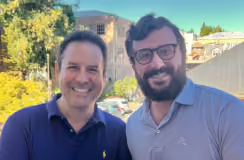
[00:00:00 - 00:06:20]
Host: Today is an update episode with a guest whose first interview has become part of the Acquiring Minds canon. Jeff Homer came on in May 2024 to tell the story of buying one music school in Louisville, Colorado, just a half a million dollars of revenue and turning it into a platform of 40 schools. That episode was called Art of the roll up. 40 businesses in four years.
Link in the show notes if you haven't heard it well. Two years on, Ensemble has 130some locations across music and dance, plus a set of adjacent businesses. Instrument rental, dance competitions, curricular products. Schools are now only about half the company.
Last year Ensemble crossed 100 million in revenue. Jeff expects to grow 50% or more this year, and the return for his earliest investors is measured in three digits over 100x. Now, numbers like that invite the obvious question, which is what any of it means for the rest of us. So Jeff and I spend the back half of the conversation on exactly that.
What's generalizable about his story and what is not. Listen for his framework for spotting an industry that will reward this strategy, and for his argument that you have to go live inside that first small acquisition, that the immersion is what makes everything downstream possible. We also get into a model that's taking shape which puts this path within reach of acquisition entrepreneurs, not just private equity. Consolidation used to be PE's domain.
It's now emerging as a real alternative to the SBA financed, self funded search. And if you want to understand how one of these works under the hood, Jeff is hosting an Acquiring Minds webinar next week, Tuesday, September 1st on exactly this architecture of an entrepreneurial rollup is what it's called. I've seen the slides. It's an incredible primer on this approach.
Register at the link in the show notes or as ever on our homepage acquiringminds.co okay welcome back to Jeff Homer, founder of Ensemble Performing Arts. Buying a business that requires licenses or operates in a regulated industry adds a layer of complexity to an acquisition. But if you understand the requirements, it can also create opportunity in a webinar Tomorrow, Tuesday, attorneys Bill Barlow and James David Williams return for another Acquiring Minds office Hours, this one on the licensing and regulatory issues you need to think through before closing. They'll cover how to identify the licenses and permits a business needs to operate, whether licenses are held by the company or by individual employees, and whether they can be transferred.
What happens when the seller or a key employee holds a license? The business depends on how licensing requirements can influence whether you structure the deal as an asset or stock sale and how to determine whether you're the right buyer for a regulated business. The webinar is Licenses and regulatory Issues when buying a business and it is tomorrow, Tuesday, August 25, noon Eastern. Link to register is right at the top of this episode's show Notes or on the Acquiring Minds homepage.
Acquiringminds Co. Then on Thursday, the New SBA Rules if you were on LinkedIn at all last week, you probably saw posts about this. Leading SBA loan broker Heather Anderson will walk us through the key changes that affect SBA business buyers the new minimum equity requirements, the new debt service coverage ratio requirements, new requirements for acquisitions with a purchase price of 3 million or more, the expanded seller transition period, and more. This is invaluable knowledge for the SBA business buyer and Heather is the expert to explain it.
The webinar is New SBA Rules, what Business Buyers need to Know and it is this Thursday, August 27, noon Eastern. Link to register is right at the top of this episode's show Notes or on the Acquiring Minds homepage. Acquiringminds Co. Welcome to Acquiring Minds, a podcast about buying businesses.
My name is Will Smith. Acquiring an existing business is an awesome opportunity for many entrepreneurs, and on this podcast I talk to the people who do it. Running payroll, paying your bills, closing your books and producing financials. These are critical tasks every business owner must do or oversee, but spending time on them distracts you from the leadership in growth work you want to do.
So let system 6 do it for you. Owned and led by a former Searcher, Chris Williams, System 6 is a leading outsourced finance team for hundreds of SMBs, including over 50 searcher acquired businesses. Chris, Tim and the System 6 team understand firsthand the challenges, the opportunities of jumping into a business as its new owner. So whether you own your business already or have one under LOI, talk to System 6 about how they can give you time back and improve your financial operations.
Mention Acquiring Minds and they'll provide a free review of your books and financial ops, a $500 value. Check out system6.com, link in the show notes or email helloystems6.com Jeff Homer welcome back to Acquiring Minds.
[00:06:20 - 00:06:22]
Guest A: Thanks Walt. It's great to be here.
[00:06:22 - 00:07:06]
Host: Jeff. Your first interview aired in May 2024, so over two years ago now. The title was Art of the 40 Businesses in 4 Years. It was a very popular episode, not only because of those big numbers, but it was an unlikely business.
Music, schools, and a very small business that ended up being your platform. You didn't really know it would be A platform when you got into it. But there were a number of angles to the story that just made it absolutely fascinating. Inspiring, educational.
So it has traveled. You're here, of course, to update us on what has happened since. But let's begin with a quick refresher on where things stood back then when we heard from you last. Sure.
[00:07:06 - 00:08:23]
Guest A: So that episode really just described my journey from one music school in Louisville, Colorado, to 40 music schools and starting to attract institutional capital for the first time and bringing on a family office investor to partner with me to grow the platform. So we crossed 40 schools in January of 2023. So that was when we were sort of giving the perspective on that journey. And since that time, we've continued at that pace.
So we've acquired an average of a school a month now, going on seven plus years. But a couple of exciting things have happened. We've branched out from doing music to also serving dance schools. So we're bringing the same sort of back office support and non classroom administrative interventions to help support our dance school portfolio.
And we've also started serving non schools, businesses, so other types of performing arts businesses, music instrument rental businesses, dance competition businesses, curricular products, those sorts of things, where they're also founded by really passionate product and student oriented people that could use a little back office help. So today's schools, it's only about half of what ensemble does, which is, you know, probably news to the listener of our last podcast, where all we did was music schools at that time.
[00:08:24 - 00:08:45]
Host: Great. Well, we're going to dive in more to that, Jeff. But before we do, let's get a little bit more context for those who missed episode one. So how was it that you ended up buying a music school and then growing so quickly?
And because it wasn't your intention necessarily to go roll up music school. So give us the very abbreviated version of that journey.
[00:08:45 - 00:11:36]
Guest A: Yeah, almost entirely by accident. So I was a career investor. I'd worked at large institutional investment firms in Boston and New York. I moved to Denver in 2018 where I landed at a family investment office, which seemed like a really cool seat and one that I'd be in for a long time.
The only problem, as I described it, was that I had too much time on my hands. I went from a New York private investing job where I was working a lot to a family office job where I was not. I think I gave a sort of ill fated quote on our last podcast that the difference between those two things is plenty to run a search in. If you're an ambitious person that wants to do a bit of a part time search while you're gainfully employed.
But I went out and looked for a side business. I was looking for a small business that I could get involved with for a couple of reasons. I was interested in getting out of the intangible nature of public markets investing, where I was curious whether the world was different in any meaningful way. Because I'd bought or sold a share of Google on behalf of the family that day, I was eager to interact with real people in my community.
I was attracted to small business for that reason. And so I did what you would now just straightforwardly call a self funded search. That was not what I called it at the time. I called it going and looking for a small business in the Denver metro because that's where I happened to live.
I wasn't as plugged into the ETA community and the drumbeat of ETA wasn't as loud back then as it is now, where when I go to the Denver ETA searcher meetup, there's 90 people in the room consistently. But anyway, so I bought this one music school in Louisville, Colorado, and I think the relationship that I had with that school is very much like the starting place for Michael Gerber's E myth, the book where the founder of this school was so focused on the product and the student experience and that had been her journey from music college to teaching to owning a studio, that there was an opportunity to bring complementary skills to the back office, the non teaching portions of the studio operations in terms of scheduling, software and customer acquisition and digital marketing and online payroll and just some of the very basic things of running a small business in 2018, 2019. So that was the intervention that I took in the first school. And I started to think that there would be many schools out there that would have this dynamic of being amazing and serving students in classrooms but needing support behind the scenes.
And so I started to think about creating a consolidation platform that would be that national back office that you could plug a really outstanding student experience into and get support on the administrative components that aren't the passion or priority of many of the founders in this industry.
[00:11:37 - 00:12:25]
Host: Well, in some ways what you just said there, Jeff, is the case for any business, really small business across industries. They're under teched, they're under professionalized, they have an artisan, the helm. And yet it's still easier said than done. And there are still certain industries where it seems like a natural thing to do what you did and ones where it seems a lot less likely in music schools Seems less likely even with optimizations that you brought back office support, whatever professionalizing in, in the ways that you did, one wouldn't think that it would end up being a very good business regardless, even with those improvements.
Give us some of the numbers around that and why that intuition was wrong.
[00:12:26 - 00:15:38]
Guest A: Yeah, I think there were really two trends that converged to make that assumption sort of incorrect. And I think what you're referring to is we have this conditioning in a lot of our communities that the arts are not self sustaining. Right. Your local civic orchestra requires donations to stay in business and sort of full butts and seats at a concert is not enough to have a profitable self sustaining arts enterprise.
And so one of the things that's really changed in the landscape is there's a lot of focus right now on youth enrichment categories. And music and dance education are youth enrichment categories. And so these are parts of the economy where parents are investing in their kids futures and they have high willingness to spend. They have, you know, very sticky long live customer relationships, good recurring revenue dynamics.
Like there's lots to like about these businesses. They're also really fun. Like they're great places to spend time because these are kids that are coming in and having experiences in disciplines that they're passionate about and they're led by teachers that are also really passionate. So I think the reason I chose music is I'm a musician.
That's my background. I still take a weekly piano lesson to this day. So I found this unique area of overlap where some searchers end up buying a vinyl plank flooring building products business. And I got to buy something that was really aligned with my passion.
And I think that's part of how this ended up going so far. But early on when I was approaching investors about ensemble, I had to overcome the objection that you're implying, which is why are you doing this thing that you're doing? And I no longer have that objection because there's such a tailwind in this youth enrichment category that it's now intuitive to most people why we're doing and why it's attractive. The other model that I had in my mind at the time was the most on trend consolidation strategy in the late teens, 2000 and tens was people buying and working with veterinary practices and dental practices.
And of course those weren't early or new ideas, but they were very on brand at that time. And I think in the most positive view, not all of them have gone well, obviously. And maybe later we'll talk a little bit about the pros and cons. Of consolidation as a strategy.
But the most positive view of the dental and veterinary rollups that have existed is you're working with these specialized service providers that really would like to spend their time seeing patients be the human patients or animal patients, and they would not like to spend their time running a practice. And so in, in many cases they've been, they've been, they've been sold a different vision of how they could spend their time and back to what they went to school for and what they are passionate about. And the idea of handing off the administrivia to a parent company or holding company that will then help them do some of those things better, faster and cheaper, you know, is really attractive to a generation of doctors in those two categories. And I think music teachers are kind of similar in that they'd rather spend their time with a student in a classroom and not running the music business.
And so that's another mental model that I had for why this might work. And what ensemble could offer a value to a local school is sort of help doing the things that weren't part of that, that passionate classroom experience.
[00:15:39 - 00:16:02]
Host: Two more things to say about that first acquisition of yours, Jeff. I think the other thing, as I recall, that you were surprised to find was how those, the pulling of those levers, the adding the tech, the turning on the digital marketing, the whatever, professionalization back office stuff really moved the needle. Surprisingly, there was a lot of meat on the bone to be had there. Do you recall say more about that?
[00:16:03 - 00:17:36]
Guest A: I do. I mean, it was very energizing. Right? So this is, this is the joy of being a beginner in almost anything is you start to make really rapid progress and that's energizing.
It's one of the fun things that we as adults rarely get to experience. I'm back at the piano again and making progress is fun, but it was in that first school. So the difference between a pen and paper schedule and having your lesson schedule on your phone and knowing ahead of time if your first student's not coming so you don't have to come in a half hour early. And just some of those small improvements compounded really quickly in terms of our ability to serve students, but also serve teachers, make our staff experience better.
And then going from primarily a word of mouth marketing strategy to having a robust digital modern strategy in a landscape of competing businesses that were also not on the cutting edge was really compelling in terms of the amount of student growth we were able to have, which is just such a positive thing for the whole ecosystem. Right Our teachers are more busy, they're happier, they're earning a living, there's more people in the building, the energy is there, the performances are more lively. Like there's lots of sort of self reinforcing benefits to having a larger student population at a school. And yeah, those early wins compounded really quickly and were part of the vision for, hey, this really worked.
Why don't we go try it again and see if there isn't another school or several out there that could benefit from what we've built here.
[00:17:37 - 00:18:43]
Host: Now the thing about it is, as well as that works, you go, you go to other markets, you find that there is a playbook here that you can repeat and there is a lot of optimization and value to be created and new business. You can grow revenue, but they're still going to fundamentally be pretty small businesses. And on a per unit, if you will, per location basis, they're never going to generate that much in terms of earnings. So the strategy only becomes really interesting at significant scale.
Part of the reason that you started moving quickly and started doing dozens, right, because a lot of this is going to sound very appealing to people. But that's an important thing to keep in mind. I think you see this a lot in franchise programmatic acquisition strategies, the minikes of the world, the midases. There are acquisition entrepreneurs in both of those franchise networks.
It's really interesting at big numbers, but your individual Midas or individual Meineke is not going to throw off that much in terms of earnings. You got to do a lot. Fair characterization.
[00:18:44 - 00:19:03]
Guest A: That's right. And that's where this went from being a side hustle that was going to be enriching and fun to being a main hustle. I didn't quit my day job until five locations and proof of concept was established and we had a bit of the playbook built and it was clear that we would be successful if we, if we sort of went aggressively in this direction.
[00:19:03 - 00:19:43]
Host: Okay, Jeff, let's so I, I, let's now hear about where things are, how you reflect on how far you've come and what it, what it means for other, for the listener and for other people in eta. And then we're going to circle back to kind of the overall journey here of doing an entrepreneurial roll up and how you're working as an investor with that now and how that model has evolved, perhaps partly because people were inspired by your story. So back to ensemble today. Can you give us a sense of scale, be it revenue, be it locations?
I know that there's there's a number of businesses under the Ensemble brand. Now, however you want to quantify scale today.
[00:19:44 - 00:20:48]
Guest A: Yeah, well, most excitingly we serve a couple hundred thousand students which is just a really fun, you know, starting to be statistically significant portion of the country that we're serving. But as of Today, this is July 2026, we have 130 some locations across both music and dance. So we've tripled the size of the business in the three years since we last spoke and then we've also built it on these additional parts of our portfolio. So we have the dance events businesses, the music instrument rental businesses, some of the other parts of our business that serve other studios.
So they provide coaching, curricular products, et cetera. And last year we had a fun milestone. We hit 100 million of revenue for the first time. So it's become a midsize business and one that's now sort of pushing into the middle market much more than the ETA landscape.
And yeah, across that time my role has changed very, very much and I'm sure that we'll talk more about that. But you know, I'm no longer flying to every school that we acquire and doing the integration myself and some of those things that I was doing at the time that we talked last 100
[00:20:48 - 00:20:52]
Host: million in revenue last year. And what are you on track for this year?
[00:20:52 - 00:20:55]
Guest A: We'll probably grow the business by 50% or more this year. Yeah.
[00:20:55 - 00:21:01]
Host: Okay. So on track for 150 million. And that first acquisition, the, the one in, in Denver.
[00:21:01 - 00:21:02]
Guest A: I don't.
[00:21:02 - 00:21:03]
Host: You said with the revenue?
[00:21:03 - 00:21:03]
Guest A: Yeah.
[00:21:03 - 00:21:14]
Host: Half a million. Yeah, half a million. So this has to be one of the self funded search hall of fame stories. Even though you didn't even self describe as a self funded searcher.
[00:21:14 - 00:21:15]
Guest A: Yes.
[00:21:15 - 00:21:15]
Host: At the time.
[00:21:16 - 00:21:24]
Guest A: Yeah, I wish. Yes. There's not great record keeping on this, but I think it's, it's certainly top five. Allowing for some other outliers that, that I'm not aware of.
[00:21:26 - 00:21:32]
Host: You actually had investors as, as you said. You, you kind of did the first five yourself I think. Proof of concept. And you went out and raised money.
[00:21:32 - 00:21:43]
Guest A: I had investors from, from the first set actually. But so, so different ones along the way. So from school 1, from school 5, from school 12, from school 40 different groups of folks.
[00:21:43 - 00:21:47]
Host: And how did those early investors do? I mean can you give us a MOIC?
[00:21:48 - 00:21:50]
Guest A: It would be in the 3 digits,
[00:21:52 - 00:23:29]
Host: 100x100x for those early investors. Very exciting. Buying a small business. Sounds simple.
Find a company, do diligence, get a loan, close in reality, you wear every hat just to get the deal done. And then the moment you close, you have to throw those deal making skills out the window and learn how to operate. You shouldn't have to rebuild this infrastructure from scratch and you definitely shouldn't do it alone. That's why Walker Deibel created Acquisition Lab.
What started as an accelerator has expanded into a complete ecosystem for acquisition entrepreneurs. Over six years, the lab's 1,200 members have acquired over a billion dollars in businesses. The Lab puts everything under one roof. An active community, deal reviews, post close services and a dedicated fund helping experienced operators buy larger businesses.
If you're serious about buying a business, come see why Lab members have a 40% success rate. Learn more in the show notes or@acquition lab.com acquiring minds so your role has evolved. We talked about this some on the pre call. You are and as you just characterize the business now as more of a middle market as opposed to a lower middle market business.
There are layers, there's middle management. Give us more color there.
[00:23:30 - 00:27:15]
Guest A: Yeah. So I mean when I, when I Look back to 2023, I was really performing three jobs for the business. I was the CEO insofar as a business with I think in 2022 we did 17 million of revenue. So insofar as a business with less than 20 million of revenue needs a CEO and it's not, that's not really a full time job but owning kind of the mission, vision, value, strategic direction of the business, that was a comport, you know, that was an important component of my job.
But it was not a full time job for that business. But I was the CEO. I was also the head of M and A. So I was leading corporate development top to bottom.
So I was doing still the majority of the sourcing but then everything beyond that in terms of negotiating deals, closing transactions, going and doing integration, personally flying to onboard every new school, every new teacher, those sorts of things. And I was also the regional manager for a huge set of those 40 schools. So when someone at the school had a problem, the next person they called in the majority of cases was me. And so I was getting a lot of, of phone calls, you know, at that moment in time for my printer's broken, my Internet does not working, I have a problem with my building, the weather is inclement.
Should we cancel? Should we not cancel? I was dealing with a lot of, of the very frontline components of the business. And what changed, you know, sort of from 2023 to today is I built a middle management layer to scale myself.
And to be totally honest, at that, at that time, I mean I was, I was dividing my time too finely and I wasn't doing a great job of serving the school. So I think they actually got a better experience once they got someone that was more dedicated to them at a more reasonable scale than I was. There's a picture of me from this era that I think is may perhaps a cautionary tale for aspiring roll up entrepreneurs, which is I was on my family's boat, so I was trying to get away for an afternoon out at a small lake cabin in Canada and I have the family dog in one hand, like I'm holding onto the dog's life jacket and the other hand I'm on the phone like I'm in the middle of the lake and the cell phone rings and like I pick it up because I was really, really deeply tethered to the business at that time. You know, the regional manager piece was the easier one to solve.
We, we promoted a bunch of folks. Now we have something like 12 regional managers that serve our 130 schools. And so there's, there's a lot more of them to support and help to navigate, help our location managers to navigate their experience of being part of ensemble. And then we hired a corporate development resource out of hbs, actually out of someone that took Rick and Royce's class and thought about whether ETA was something interesting for them and they decided to join something that was in progress other than pursue their own.
But they've been fantastic. And so that's allowed me to step out of not flying to every new school and every new integration that we need to be doing. And then over time we actually added a layer above that too, which is we have presidents that run each of the business units now. So schools used to be the entire business.
Now it's about half of our business by revenue. So there's a president that runs the schools business to whom those regional managers report support. Same thing for our music instrumental business, Same thing for our dance events business. Same thing for our business that serves other music and dance studios.
So there's like a quite, quite a senior level now where I think if you ask kind of who our executive team was in 2023, it was two people, myself and a COO. And today it's eight people and they're all accomplished executive, well paid folks that make running the business a lot more fun than it was when we were really grinding it out, you know, one after another.
[00:27:15 - 00:27:18]
Host: And so what does your role look like today then?
[00:27:19 - 00:28:26]
Guest A: Yeah, so, so what's left is actually those CEO pieces that I was doing before, right? So. So capital allocation is one of the most important parts of my job. I'm the person that is out there sourcing capital, new investment capital for ensemble and then deciding how it gets deployed in new acquisitions.
And then I'm still very much responsible for that mission, vision, values, and the overall culture and strategic direction of ensemble. And so looking out and thinking about where we should play, where we should not play, how we win. So a question that we often get is, you've expanded from music into dance. Are you going to do other things?
And that's an important question for me to answer. And what we've decided is that we're going to be specialists in music and dance and be focused on the performing arts. In contrast to some other youth enrichment roll ups that do gymnastics and swim school and sports and tutoring and karate and all these things. We want to be the world's leading expert in running music and dance schools.
And so we've decided to be very focused in that respect. And so that's an example of a strategic direction decision that we've made that sort of ultimately sits in the CEO seat.
[00:28:28 - 00:28:57]
Host: I heard you say something a couple minutes ago that being the CEO for a $17 million business back where you were about when we talked or in that time frame is not a full time job. You were doing much more than the CEO role. But that is yet another counterintuitive thing to hear about your story. Maybe it's about the definition of CEO, but why is a $17 million business being the CEO of that not a full time job?
[00:28:57 - 00:31:21]
Guest A: Because you're also doing other things that are way below the CEO pay grade. So I talked about the fact that I was doing three things right. I was the CEO, I was the head of M and A, which is a job that has a pay rate. And there's a regional manager, you know, a set of regional manager seats, which is a job that has a period.
I was spending a lot of time kind of working below my, you know, medical scope of practice, or like I was just not. I was not working at the high end of what I could contribute for the business because I spent a lot of time being the first call when someone's Internet wasn't working, et cetera. And so that's where I think there's an expectation, where one of the reasons that we built the business in the way that we did was back to the challenge you highlighted at the outset, which is that we're buying very small businesses. And so we could not afford a gold plated, luxurious set of corporate services.
We needed to be lean and scrappy and still support our schools effectively, but in a cost effective way because of the need to be proportional with what we invested at the parent company versus what we could support and sustain at the field level. And so one of my early rejections from an investor for Ensemble was someone that I, that I, that is a acquiring minds guest and that I looked up to very much and respected very much and took their rejection, you know, quite, quite hard when they told me that the units we were buying were too small and that we would never, we would never reach the type of scale we were hoping to because it would cost too much in overhead to manage them. And I didn't agree with that. But it, I turned it into sort of a North Star metric for Ensemble.
And I've always managed the business thinking about the ratio of our investment in corporate or parent company level shared services as a percentage of the profit that we generate in the field and making sure that that number is both healthy and showing some benefits of scale over time, meaning that ultimately it's declining as the business grows. And so that's, you know, that was a early lesson that became a guidepost for how to build and scale the business. But ultimately the journey that I went on was player to player, coach to coach. Right.
And at 17 million of revenue, I was very much still in the player coach seat. I was doing a lot of.
[00:31:21 - 00:31:40]
Host: And so Jeff, at $17 million in revenue still, the business is not profitable enough to have hired proper resources for these second and third roles that you were doing. Regional manager, for example, you needed to get even beyond that level of 17 million to be able to afford.
[00:31:41 - 00:31:41]
Guest A: Yeah.
[00:31:42 - 00:31:49]
Host: For people to take this off your plate. Because $17 million, you know, I assume that's $3 million of EBITDA or, or 2 to $3 million of EBITDA that
[00:31:49 - 00:33:09]
Guest A: can hire a few people of field level. Ebitda, sure. But if you're going to spend less than that of the parent company so that you can support some of the debt financing that you may have taken on to grow the business. But even if you do make, and maybe we were late in making the regional manager investment, but we would never have had a chief marketing officer at that size or spectrum or someone that was a really incredibly effective CFO within a great resume, like there's just, there are, there are rules that you need to grow well beyond that to have specialists in, at least in the at the level that I would, you know, do we have a VP Finance?
Yeah, sure we, we did and they were great, but we didn't have a cfo. And then so that meant that when we needed to make strategic decisions about finance, I was making them. And that, that's the business owner journey. Right.
And there are more fractional resources that exist today that, that are more helpful in getting access to some of these things to get the most impactful five hours a week of someone's time to help you make those decisions. But the business owner in a, you know, mid size, low eight figure revenue business I think is often making those kinds of, of calls and serving in those kinds of roles for the business. Yeah, yeah.
[00:33:09 - 00:33:43]
Host: And as you pointed out, especially in an ETA or roll up context where there's going to be a lot of debt, the founder of such a business who gets to 15 million probably doesn't have a debt payment on hanging over the business as well. So the nature of what you're doing today is much more kind of true CEO. Setting strategy, setting vision. Does this suit you or do you miss the old kind of scrappy operator days?
This is something that you talk about I think on panels where what size of business do you ultimately want to preside over? Acquisition entrepreneur.
[00:33:43 - 00:36:57]
Guest A: Yeah, yeah, you're right. It's one of, it's, it's in my view one of the least talked about differences between funded and self funded search is what size business do you want to go buy and what will that imply about your CEO experience? So before you think about economic differences between funded and self funded search, I think, I think thinking about the experiential differences is, is much more significant, but they are very different. I mean in the early days I knew almost every person that worked in ensemble.
I would go spend a significant amount of time at each of our schools. I knew the teachers by name, I knew all of the administrative staff. There were very few folks that worked for us that I didn't know personally and couldn't try to connect with and help them feel part of this larger thing that we were trying to accomplish. I now need to do that through other people.
Right. So I'm now a manager and a manager of managers and a manager of manager of managers. And it's a totally different skill set. It's required an extraordinary amount of growth from me and of me and I'm certainly not done and arrived on that yet.
My prior managerial experience was like managing investment associate analysts at large investment firms, which is a very different, which is a very different thing. I am enjoying it. Like, I am really still having a tremendously fun time doing this. And the challenge of getting out of bed every day and running the biggest company I've ever run is, Is still really fun for me.
And one that I'm excited about. And I'm. I'm bolstered in that by having really smart new colleagues that I didn't have before that we've sort of been able to add along the way, both through acquisition and by hiring folks. So it's much more of a team approach than it is an individual effort, which is much more fun and rewarding.
And then there's also some really exciting culture benefits when you start to build up those layers that I think we've come to appreciate. So in the old days, if we made an acquisition, I would go and I would introduce them to Ensemble and my vision for it and why I was there, and I would make them all kinds of promises about how their life would get better, and they would make a decision as to whether to trust me and see whether what I was saying was true or to. To have some skepticism. But now we're sending people that are telling a personal story instead.
They're saying, hey, I was acquired by Ensemble and it was really great for me and for my career and for my school. And now I'm going to be here to help guide you through that. And it's very different than having me make promises rather than having someone kind of offer testimony of their own experience. And so I think that layer of culture that gets built is really fun and exciting to see.
And I think Rick and Royce do a good job of highlighting this. But I think one of the primary benefits of the ETA path is being able to positively influence the careers of a bunch of people around you that just didn't have access to something higher octane when it was a small business. But being able to take some of the people that have a growth mindset and have skills and desire to do something bigger and have them come along on that journey with you is tremendously fun and rewarding.
[00:36:58 - 00:37:49]
Host: Well, Jeff, what a lot of people say about owning, running a business is that they that the strategy is the fun stuff. And so an argument against buying a small SBA style business is that you're really going to be blocking and tackling and be in the business, not on the business. And of course, the goal is always on the business, on the business, on the business, which means making the strategic decisions and not having to, you know, sweat out the minutiae on A day to day basis. And so that's where that in that sort of could be the purest definition of what the CEO does.
Vision and sort of branding of the business and then the highest level strategic decisions. Is it as good as it as it sounds? I mean, you're doing the funds, the stuff that everybody else kind of wants to be spending all their time on.
[00:37:50 - 00:41:10]
Guest A: Look, it is really fun. It is, in my view, more fun than the early days. I think also you can pass down problems that you've done 50 times to folks who are wrestling with them for the first time. And so they're fresh and exciting and rewarding to solve for those folks that are now in your middle management seat.
So there's also just sort of a natural growth there. But there are commensurately larger challenges that emerge as well. Right. So I am privileged to have a leadership team where five of the eight people on it have been CEO of something.
Right. Whether it was something we acquired along the way or a business that they founded. And so I'm in a room of folks that are used to being in charge and I'm in charge of that room. But I have to do so in a way that sort of is respectful and navigates that dynamic.
And sometimes I'm more successful than other times. But there's also sort of, when you have layers of management, there's effective filtering that happens, right? Problems get resolved at appropriate levels, but the ones that get through to you are really big problems and those still arrive on your desk. So there's still the same dynamic of you sit down on Monday morning and you have three or four things you'd like to get done for the week and then by 11am you're totally off track and you know, it's, it's different.
I would say one of my coworkers has a really good analogy that, that I like for this, which is that she was running a business that we acquired and she took an important executive role with ensemble on a go forward basis. And she says that she felt like her entrepreneurial experience of running a business with 4 million of revenue was that she was out on the open ocean in a speedboat. You know, she was small, she was nimble, she was going fast, she was, you know, doing her best to build the boat. But like the waves come and you, you get wet and she got off the speedboat onto like a cruise ship.
And it's not as nimble, it's slow, it's, it's lots of things, but you're no longer feeling the impact of each wave as it strikes the bow. You have a boat that you can steer with a longer time horizon towards a destination that is farther away and perhaps more of interest to you. And so that's a little bit like metaphor and whimsy. But there's real truth in that, in that the stability of a larger business allows you to look further out because you're not beholden to the loss of one customer, the loss of one employee.
Those are the day to day firefighting experiences of running a small business. And when you get to the place where that's no longer going to ruin your Monday, you do get to look out further and make more strategic plays. But also then the problems that when they do crop, the problems are more like icebergs than they are regular waves that you're going to encounter. And so look, I think Patrick Lencioni did a good job of framing leadership as an obligation, much more than a privilege in terms of it's an important job that I do for the business.
It's not a reward for the last five years of success that we've had. It's an obligation that I have to our team to continue to show up and push in a productive direction.
[00:41:11 - 00:41:19]
Host: And where are you taking the business, Jeff? What is the kind of the current Far Shore or North Star or where you're headed?
[00:41:19 - 00:42:18]
Guest A: Yeah, well, what we are doing is working. Our schools are having success joining our platform, retaining the local branding and local staffing that made them unique and really positive places of dance and music education. And our goal is to continue doing what we are doing. So we're still adding about one or two schools a month to our portfolio and our goal is to continue that.
We have set a target of having 250 locations by 2030. So we're really excited about that as a vision for the business. So you're kind of again, roughly doubling the business from here. And of course we have this new and exciting portfolio of non schools businesses where we're providing similar support and sort of national scale back end.
And there's lots of fun work that we're doing in that space too. So 250 schools by 2030, you know, tens of thousands of students that we're serving inside of those walls and a complimentary set of products and services that we can offer to make sure that we're giving them a really complete experience within the ensemble family of companies.
[00:42:18 - 00:42:56]
Host: Jeff, you and I had talked about rollups, private equity consolidation strategies, the reputation of those out there, the fact that they don't Always work. There are horror stories abound through, through the lower middle market and Main street businesses of private equity gone wrong. Seems like things are going well here. What do you think?
What are you careful about? Knowing that there are lots of examples of private, private equity doing this badly. What are you careful to, to avoid or, or, or, or leaning into doing right? How are you getting this right?
[00:42:56 - 00:46:21]
Guest A: Yeah, it's a really thoughtful question. I think there's a. There's probably three components to answering it. The first is the ownership model we've selected.
So unlike many consolidators where ownership is rolled at the subsidiary level. So if you're a vet that joins a, you know, a vet consolidator, you roll equity at your practice level and you retain an incentive to have your practice perform really well. And there's an orientation around kind of the next exit. Ensemble has chosen a partnership model where owners that are rolling equity roll it in the parent company.
So there's only one set of owners across the entire business. That ownership group is actually today the largest single owner of Ensemble, which is exciting. So there's real vested interest from folks that are from this industry and care deeply about its future and are helping to steer the business. So Ensemble is a partnership and one where I've been very fortunate to attract talented entrepreneurs that care deeply about this space and know much more about it than I do and are able to help us steer in a productive direction.
The second thing is I've then been really careful about the types of partners we've selected for investor capital. So I'm really clear when we talk to investors that we are a youth enrichment business and our first job is serving kids. And that's a really important job. And it's important not to get distracted by customer lifetime value and price elasticity and some of these sorts of things in terms of like we will make money and we will have a good result for everyone if we do a great job of serving, serving students in the classroom and providing those great experiences.
And we will not if we fail to do that right. So the framing the long term outcome as being the way that we will win both for the student and for the business, I think has been effective and we've been able to attract long term folks that are interested in playing that game over a long time horizon. And finally, I think we're fortunate that we are in an industry where the things that we can do as a large business are not extractive. They're not to cut costs or slash investment or raise prices or sort of you know, those sort of things we can do things that are intuitively positive for the business in terms of investing in customer acquisition, to have a larger roster of students to support a, you know, stronger base of teachers, et cetera, where we have really straightforward opportunities to grow the businesses that we've acquired in ways that are aligned with reasonable ways of creating value.
Right. Like serving more students, I think is a way that people are happy to see businesses be successful as opposed to some of the more financial engineering or extractive type strategies. And so because that has been so available to us, it's been really easy to stay disciplined and make sure that that's where our attention has been, has been focused and not on financial engineering or leverage or other sorts of things that we might have that have perhaps been distracting to, to other consolidators and other categories.
[00:46:23 - 00:47:51]
Host: The team at Pioneer Capital Advisory has started offering Perry pursue debt for SBA business buyers. That means they can help unlock up to $3 million of conventional debt on top of the $5 million limit of SBA 7 loans. So Pioneer can structure larger, more complex acquisitions. Listen to our story with Anika John from one of their clients who did just that, buying a $10 million business.
As a first time self funded searcher, the Pioneer team has closed more than 100 SBA loans averaging timelines well below industry standards. Founder and owner Matthias Smith and COO Valerie Stash bring over two decades of SBA lending experience. Matthias and Valerie have a full bench of analysts and associates who work your deals with them. A true deal team.
Not just a single point of contact. Visit pioneercap.com or click the link in the notes and let me just understand that last point. So it's the nature of the industry that has allowed you to given you this benefit and that's because the, the industry is less mature maybe than other industries that are consolidated or it has, there's just a lot of growth ahead of it. So it's, it's less about Red Ocean and more about kind of growing the pie.
[00:47:52 - 00:51:30]
Guest A: If I could sort of characterize for you the typical bread and butter acquisition that we make. It is a school that was founded by a teacher which is someone that was really focused on the, on the student experience, grew the business primarily by having a great reputation as a teacher and for attracting other great teachers to the, you know, to the, to the experience. This is another topic I talk to prospective searchers about is sort of this like J curve idea, right? That everything that sounds like low hanging fruit in a, in an ETA context like oh, oh my goodness.
This business doesn't have a CRM. They haven't invested in, you know, in, in SEO SEM, CRM, like, like all of these sorts of things have an upfront cost and a, and, and a delayed and a benefit that sort of accrues over time. And so the, the converse of that is that there just isn't, there's no fat to cut. Right.
These are businesses that have been run really lean by families that would otherwise have taken that money home to their, you know, to their kitchen table if, and so, so they're not, they're not run in a, in a profligate way. And I think especially when you're working at the lower end of the lower, of the lower market or kind of where eta, the sweet spot of eta, you're dealing with family run or, you know, sort of entrepreneur run businesses and almost never do they err in the direction of overinvestment. They almost always err in the direction of underinvestment. And so we are stepping into a situation where there are really attractive investment opportunities in the business where we can bring capital, technology, software, etc.
And get really positive ROI such that that's so much more interesting than pursuing a cutting strategy. And same with sort of the, because we're working at the low end of the lower market, we're often buying businesses for three to four times cash flow. Right. And so that means that we can get attractive returns to investors without using leverage or financial engineering or some of these things where we don't have to have a goofy structure to make a good outcome here.
Because the out of the box cash on cash return is attractive. And I think those are the pitfalls is when you start to look at examples where the primary driver was extractive price increases, where the primary driver was staffing redundancies, where the primary driver was financial engineering or leverage. And that was the how we're going to make money in other consolidating industries that failed. And I think where we say, hey, we're buying great businesses that have really strong recurring revenue that's driven by students having repeatable positive experiences in disciplines in which they're passionate.
And we inherit all these investment opportunities that have high inherent ROI and straightforward paths to grow the business, it's exciting to dig in against that. And it takes me back to the question you asked earlier was how did you get from 1 to 2? What was the motivating factor? And it was the compound early wins in that first business that led this to be more than just A side hustle.
For me it meant that that's where we invested our time and effort when we went to build the larger platform was on the things that were fun the first time. Um, you know, having the stacking the wins on, on better customer experience and better staff experience for, for people that came inside the door.
[00:51:31 - 00:52:38]
Host: You may have just answered my next question which is going back to the success you've seen so far and, and contrasting that with a lot of roll ups that, that don't perform as well or, or outright fail. How much? What I didn't hear you say is where this all started and I suspect that does play a big role in the success. Meaning that you bought a very small company and you were very involved and you were very involved for up to $17 million of revenue and beyond versus the traditional private equity acquisition consolidation strategy where there's a platform acquisition which is large ish.
And then there are tuck ins along the way. But, but that I guess the biggest point of contrast there would be just be the size of that first acquisition. Your quote platform, we should put it in quotes because it was hardly what we think of as a traditional platform acquisition was, was just this itty bitty little business that you got really involved in. I have to believe that all of this downstream success is related somehow.
[00:52:39 - 00:55:23]
Guest A: I think that's right. I think what you're describing is one of the, the bits of magic in the ETA strategy is getting the type, the caliber of entrepreneur into a size of business that would like almost never, those things would almost never overlap. Right. Where you have a really high performing searcher that's coming out of a top MBA program that is taking on a business of a size that would just never otherwise attract them as an employee, but will attract them as an owner.
And I think that's part of the rocket fuel of ETA is that when you immerse, when you have a high performing searcher that can sort of immerse themselves in a business that is disproportionately small relative to their skills, magic can happen. And it's fun to see across hundreds of episodes that you've done many versions of that story. We've bought some larger businesses over time. We've acquired some businesses that had tens of millions of revenue.
And I think we still took a similar approach to really getting invested there. And maybe that was because that was our DNA from starting really small. It's still my advice to aspiring consolidating entrepreneurs that like you got to go live in that first business for a variety of reasons, you'll learn a ton about the category that you're going to spend the next five, 10 years of your life in. You will be a much more credible sourcing in your sourcing conversations.
You'll be much more credible with other entrepreneurs in the category as you talk knowledgeably about their business. You'll be better at underwriting the business because you've lived it and you've sat at the front desk and you have a deep understanding of what's actually going on inside the P and L and being able to triangulate. And so I think it's definitely valuable to be able to immerse yourself in a business that is small relative to your abilities. And I think that is a.
As the world is coming down market, just generally people are buying smaller and smaller businesses, and what qualifies as a platform is getting smaller and smaller. I think that's a benefit where you're getting entrepreneurs that are spending time inside of much smaller businesses and are able to learn at a field level that you're right would not be possible if you were a private equity firm and you made an investment in platform company, and you expected that platform company CEO and management team to run a lot of that for you. And the reason I embarked on the CTA journey was to cut through that right, to not deal with management teams, but instead to go run a small business and interact with customers and employees.
[00:55:23 - 00:56:02]
Host: Jeff, you just said that you talked to ETA entrepreneurs. I said earlier that you're on panel, so you're visible out there. And part of that is that you're. You're making investments in this sort of strategy.
So for our final few minutes together, let's hear your thoughts on the opportunity set out there for would be Jeff Homers for people who are. Who want to do something similar, want to try to do something similar to what you've done, you invest in that, you think about that, you encourage that even so. So first, how generalizable is what you've built?
[00:56:02 - 00:59:22]
Guest A: Yeah, I think there's a lot of generalizable takeaway. I think if you were to abstract the ensemble story, I would go back to the Michael Gerber E myth sort of framing and sort of anywhere where you have a small business that was founded by someone that was a specialist in providing a service and where the growth of that business has pulled that entrepreneur out of providing that service and into managing the business, where they're now at a relative kind of comparative disadvantage. Right. They were.
They were among the world's best at providing the service. They're probably not among the world's best at managing the business. There's an opportunity for, for eta, I think, to be an attractive fit for that business because you can either get the owner back to doing the thing that they love to do or just onto their next part of phase of their life if that's, you know, if that's where they've gotten to from a retirement or relocation perspective. But I think that that story over and over and over again is an attractive one for eta, whether it's standalone acquisition strategies or consolidation strategies.
And one of the advantages of consolidation strategies is you can support that, that, that archetype of entrepreneur over and over and over again. Right. So what we did at Ensemble was we thought about what are the functions that an owner is performing inside a music or dance school? And then can we get corporate or parent company shared services stood up to essentially provide those same services on a fractional basis to the field and leave the field level staff just responsible for taking care of the people that walk through the door and great customer service.
And it made it so that we could have general managers instead of needing owners at the, at the field level. So just to say the next sort of thing about that, like in my view, owners of a small business are typically doing three things. They are the HR function for the business. They decide who works there and what roles they play.
Hiring, firing, you know, compensation, the org structure, et cetera. They're typically doing the entire revenue cycle management. They have their hands, you know, tightly on, on revenue collections, the bank account, payroll, disbursements, those sorts of things. So finance.
And they have their hands deeply in marketing, both because as the owner they have the most incentive to grow the business, but also because marketing tends to be a large line item. And there's this stigma around like, you know, I know half my marketing is wasted, I just don't know which half like. So there's. They want to be involved in growing the business both because they benefit from it, but also because it's a large expense and they want to have control over it.
So when we thought about what our shared services needed to look like, we needed recruiting and HR functions, we needed finance and payroll functions and we needed marketing functions. And that's where we started our shared services portfolio. And today that's 90 people and they do way more than that. But those are the things that we started standing up and centralizing and leaving the field level folks free to just like run a music school and serve students, serve teachers with the benefit of this national Scale back office that we put together, I think that's very replicable across a wide variety especially of service industries.
[00:59:23 - 01:00:21]
Host: That all makes a lot of sense, Jeff, but I still think that there was something about how small you bought in the industry in which you bought. I mean we all know about the home services roll up and if you can get to a certain size there's going to be some shared services and so on. But starting very small as you did in, in businesses that unit by unit like you're the, the person you tried to get invest to invest and declined counterintuitive businesses ones where. Where the individual business it's almost.
You have to consolidate to make a meaningful business. You can have a standalone, I guess you can have a standalone music school, you said you've now acquired some of those, but you can definitely have a standalone H Vac business that does a million and $2 million of, of earnings a year and not have to go out and consolidate aggressively to make an interesting business. But that was one of the features of your consolidation.
[01:00:21 - 01:00:21]
Guest A: Where.
[01:00:21 - 01:00:35]
Host: Where. And that that would be, as we talked about earlier, that would be a requirement if I wanted to roll up some leg legacy brick and mortar franchise thing like a, a minake, I'd need to set out from day one to, to get to 20 or 25 sort of thing.
[01:00:35 - 01:00:36]
Guest A: Yeah.
[01:00:37 - 01:00:39]
Host: So. So look at it through that lens, if you would.
[01:00:40 - 01:02:47]
Guest A: Yeah, well, so we've seen the invention of a financing solution to solve exactly that problem that, that I am deeply envious of and that did not exist when I was raising money for Ensemble, which is this, this committed capital vehicle. Right. So increasingly we're seeing entrepreneurs that are focused on rollups go out and instead of raising, you know, doing a self funded search or even a funded search to acquire a platform and then raising money for the platform from there they're going to investors in advance and saying here's a category that I'm interested and I think that I'm interested in and I think would benefit from a consolidation strategy. And I'd like to raise 10 to 25 million today with a plan to go buy 10 to 20 of these.
And so there's a few things that are happening there that are totally changing the game from consolidation viability perspective. The first is the ability to target smaller by compensating with repetition. I'm going to buy 10 much smaller businesses rather than one medium sized business. And the structure is set up out of the gate to allow for that.
There's a elimination of the path dependency risk which is if your goal is to buy 10 of something and you struggle digesting the second one, that's okay if you've raised money to buy 10 because you'll average out your learnings and you'll get better as you go. But if you've raised money deal by deal, that's going to be a big problem in terms of raising money for the third one when the second one is struggling. And so there's that advantage and then there's an increased interest in this qsbs tax advantage for getting all the equity in and out quickly initially and then perhaps using leverage on the back end. But there's sort of tax incentives that have been created or at least harnessed for the benefit of these strategies.
There's a brave new world in consolidations and it is folks raising committed capital vehicles to go start platforms to go start a platform rather than needing to acquire a platform, which I guess is the difference that you're driving it.
[01:02:48 - 01:03:45]
Host: Well and I think another difference is that a consolidation strategy historically was the domain of private equity and maybe even smaller private equity, kind of independent sponsor private equity. But independent sponsors are still buying much larger businesses, usually 2 and 3. And our average at Mines Capital, the average business that we invest in is $4 million of EBITDA. You bought a business with a hundred thousand, $150,000 of SDE.
And so the consolidation strategy, it feels like it's much more accessible to an eta, a searcher, an acquisition entrepreneur, somebody who might as you said otherwise, just buy an SBA financed business. So this path, which once was, as I said, the domain of private equity now feels like an individual acquisition entrepreneur might choose between do I do an SBA self funded search or do I do this committed capital roll up strategy Fair.
[01:03:45 - 01:05:54]
Guest A: Yes. And I think that's also a response to market conditions. I think, you know, the last Search Stanford search fund study showed that close rates for, for search funds are continuing to decline. It's getting more competitive to go buy a $4 million EBITDA business like the kind you're describing at Mines Capital.
I think generally speaking as, as data availability has gotten better, everybody that owns a $2 million EBITDA business is getting, you know, three emails a day from a broker and from an intermediary and, and whatever about would you like to sell your business? And so I think it's just gotten harder to find the 1980s center of the fairway ETA deal. And so one of the responses is to come down market like the whole rest of the world is doing and say There are still wonderful businesses with not 4 million but 400,000 of SDE that are out there. What's a way that I could come up with an attractive investment strategy based on that?
And consolidation strategies have been an answer to that question. I think the farther down market you go, the more intrinsic value I think you can find in consolidation strategies. Should Delta buy United and will that be good for consumers? Probably not.
But if I take a local music school and I plug it into a platform where all of a sudden it has the teachers in and out getting benefits and they're sort of like positive student facing economies of scale and resources that weren't there before, is that good for the world? I think there's a much stronger argument for that being true than there is farther up market. So I think you're taking jobs, meaning that the, that the entrepreneur seat in a very small business is really more, more of a job and less of a CEO owner type role. And you're turning it into, you know, something that can really be, you know, a fulfilling career for an eta.
For someone that's interested in eta, there
[01:05:54 - 01:06:23]
Host: is a lot to say about the, the actual architecture of doing this. And you are going to host a webinar on that very topic. The working title is Financing for Roll Up Entrepreneurs or Financing the Roll Up. And it is exactly about this.
You've done it. You are, as I said, you are investing in other entrepreneurs doing this. You've raised a fund or in the process of raising a fund to systematically invest in searchers doing this, correct?
[01:06:23 - 01:06:38]
Guest A: Yeah, we've done eight or nine platform deals with this very similar group of investors targeting again, consolidation strategies as, as a primary value creation lever. And yeah, we, we're looking to formalize that now.
[01:06:39 - 01:08:19]
Host: Great. Well, the registration link and the, and the, the, the date and so on will be publicized when we actually this episode, our conversation here airs. Jeff. So for the listener, you should definitely come to that to get really into the weeds.
I've seen Jeff's slides. It's going to be a really a fantastic session to, to, to get into the weeds and really understand this, this model deeply. I do have technical question about this approach and then I'll start wrapping this up. Jeff, just on this again for the kind of self funded searcher, who's the, who's the majority of the audience When I heard you say, you know, the Committed Capital vehicle, the evolution there, the, the, the, the that they're more common than they were.
You develop a thesis, you raise a bunch of money to go off and Do a consolidate consolidation strategy versus how, how would the self funded searcher think about doing that versus buying that first quote platform, that small business, that $400,000 SDE business themselves with an SBA loan and then raising capital, just the sequencing of things. Because presumably they'll be able to strike a better deal vis a vis their investors if they, if they're, they've already demonstrated their ability to close a business, to run a business, earnings in that business somewhat. They're already in the industry, they probably have access to deal flow. This is no longer a concept.
They've got their first one under their, their belt and maybe a year or two of experience. Any, any thoughts on the, the kind of, the sequencing of things?
[01:08:20 - 01:11:58]
Guest A: Yeah, I mean what you're describing in the latter was my experience, right. I had the benefit of, of immersing myself in the very first business, but it was one that put more risk into the platform for me. So I think if you were to sort of make a pros and cons list or sort of an order of operations list in a self funded search deal, you have the advantage of time to go pursue a variety of options. You're bringing a deal to market that investors can invest in or not.
And so there's no search risk or portions of the capital they're going to non operating portions. And that's why, and that's why self funded economics have always been better than funded economics. And so you can, you can cut a very attractive deal even, you know, even more so today in terms of the operator or entrepreneur's share of, of the future value that's going to be created by your investment in, in of time and effort in, in growing that small business. But when you come back to raise money to buy the second business, you still have a very small platform, if you will, right?
So you have the first business you bought that was a small business and you probably traded for three to five times cash flow and you have a second business that you're putting together and to get like the case for re rating, that platform is not especially strong. And so you're going to need to dilute yourself a couple of times in order to build the platform to a meaningful level. And a committed capital vehicle sort of cuts through that conversation and says we know we're going to need 10 of these to get to any kind of meaningful rerating, so let's just get the money invested first, we can figure it out. There's also a pretty significant advantage from a risk mitigation perspective.
I spoke about the path dependency earlier, but also the fact that most committed capitals do not use leverage as part of their initial set of acquisitions. So it's, it's committed capital, you know, it's there, you don't need a bank to fund it, but you also don't have a bank there if there's a wobble out of the gate. And so you can grow your way into a platform where you know what the overhead expenses are, you know what the profitability of the underlying assets are. And you can then go and take a seasoned portfolio out to a lender and say, here's what I actually have as opposed to here's what I think I'm buying.
And so you're almost trading off kind of certainty for the equity investors versus certainty for the debt investors and you get a better deal in both respects. So I think the self funded path, you can probably eke out more personal economics, but you take risk along the way of, you know, whether the, whether the platform grows and evolves in the way that you expect. In the committed capital case, you know, you get that you, you mitigate that risk and you also mitigate the, the leverage that you need to take on out of the gate. And you have one additional advantage which is there's more willingness if you, if your plan is to go build a, a platform, there's more willingness among your investors to have a little bit more platform resource, especially because again, you're not using debt as a primary financing strategy out of the gate.
So there's more willingness to have a commit, you know, to have a, a VP finance that maybe you can't afford. In the model that I was talking about earlier, like, you know, some, some starting to have those shared services resources like the regional managers that we talked about half an hour ago earlier in the journey, because one, you have capital and support for where you're going. But two, you don't have debt on the business at the start, so you have more flexibility around making some of those platform investments. So maybe you'll have a more enjoyable early consolidation experience than I had being on the very front line of the business.
[01:11:59 - 01:12:32]
Host: No holding the dog in one hand and the phone in the other while whilst out on the lake. Jeff, you did say that you're in Florida. I'm talking to you in a hotel room in Florida. This is your 91st flight of the year.
So, so I would be remiss if I didn't point out to the audience that a successful acquisition strategy also means traveling like crazy. Obviously you're, you're looking all across the country and rolling up businesses by the dozens. Care to respond to that reality of your personal life?
[01:12:33 - 01:14:22]
Guest A: Yeah, it's not for everybody. I think when we thought about regional versus national, we had to make a sort of pragmatic conclusion about we had goals in terms of how big we would grow and a time horizon over which we wanted to achieve that objective. And that just sort of necessitated a national footprint in order to have enough surface area for opportunities to present themselves. I think you could do a valuable consolidation strategy within a region.
There's many examples of them on your podcast. Actually, one of my favorite strategies, consolidation strategies that we have not talked about, that I think do have inherent value are businesses that have route density dynamics where you can do consolidation. You can have your technicians or whatever it is, spend more time doing work rather than driving from job site to job site. Those are businesses that I think make, you know, make sense intuitively for consolidation strategies.
And so those are inherently, you know, local or regional. So you don't need to put in 91 flights, you know, by, by the end of June or July every year. But to, to build this business, I had to, and I think I still get on the plane because I think it's important to be out there, you know, in front of the team and, you know, leading from the front on M and A that we're looking to do on, on team events that we're, that we're, that we're doing on events that we're producing for customers like. I, I just, I find value in, in being out there and, and, and experiencing that, but it means that, yeah, I, I, I would, I wish I had a dog, Will, but, but the dog wouldn't have a very good life.
So, so here we are. I, I'll have to save that for a different phase of my life to close us out.
[01:14:22 - 01:14:29]
Host: Jeff, any final reflections on what your story should tell us about ETA broadly as a path?
[01:14:29 - 01:16:16]
Guest A: That's a weighty question. I have had a tremendous amount of fun doing this, and I think I've had fun for a few reasons. One, we've had incredible success, more than I had any right to hope or expect, and that's been really fun. Two, I was able to do that in an industry that I was passionate about and care deeply about.
And it wasn't something that I adopted because I found it through a search and came to love it. I've loved this since I was 6 years old. And I get a tremendous amount of value of getting out of bed every day and knowing that that's what I'm going to work to do. And I've been very fortunate to build a great team that I enjoy working with and that are, you know, have added to my experience of being along the journey.
And I think there's probably something in there, you know, throughout, right, where the highs will always be, you know, be more fun than the lows. But on average, the average ETA result is good. And this is going to be a fun and rewarding path, I think generally more so than, you know, slogging it out in the middle ranks of a private equity firm or the middle ranks of a Fortune 500 tech company or whatever. That's what attracts people to ETA, is the promise of having impact, seeing that impact and participating in a reasonable share of that.
And so that part is fun. I think if you can align your search with your interest, you'll have more success for a variety of reasons, you know, from pre closing through post closing. And I think the most rewarding part of the journey for almost everybody is, you know, the people that, that come along along the way. So I think those are generalizable.
But look, I, I have the benefit of an incredible amount of survivorship and hindsight bias. So yeah, listen to the rest of the the Acquiring Minds catalog to get a more nuanced perspective.
[01:16:17 - 01:17:22]
Host: You are, Jeff, one of those episodes. I mean your first interview is in the canon and it's just one of the standouts of an exciting, inspiring outcome. So anybody who only listens to the Jeff Homer episode one is getting a misinformed view of the entire ETA set of outcomes. It's just really a neat story.
It's only gotten cooler since in these last two or three years. Congratulations on your success. Really great to see you kind of turn back around and invest in others doing the same thing behind you. And as I said, everybody watch for the webinar.
We'll email that out financing for roll up Entrepreneurs. So if you want more Jeff, or you really want to understand the strategy deeply, come to that, it's going to be a phenomenal sess. So link to that will be in the show notes of today's episode as well as on the the Acquiring Minds website. As always, Jeff Homer.
Congratulations and thanks for coming back.
[01:17:22 - 01:17:23]
Guest A: Thank you.
[01:17:23 - 01:18:07]
Host: Hope you enjoyed that interview. Don't forget to subscribe to the Acquiring Minds newsletter. We send an email for every episode with an introduction to the interview, a link to the video version on YouTube and soon key takeaways, numbers and and more essentials from the interview. For those of you who don't have time to listen or watch it.
Subscribe at Acquiringminds Co. You'll also find all our webinars there on the website, both those we have coming up and recordings of past webinars. At this point There are over 30 webinar recordings, a wealth of information on all the technical nitty gritty of buying a business. Acquiring Minds Co.
































































%20-%20thumbnail.avif)





%20-%20thumbnail.avif)


%20-%20thumbnail.avif)

.avif)




%20-%20thumbnail.avif)