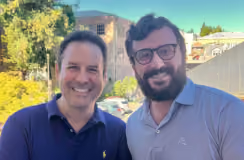
Host: Welcome to Acquiring Minds, a podcast about buying businesses. My name is Will Smith. Acquiring an existing business is an awesome opportunity for many entrepreneurs, and on this podcast I talk to the people who do it. My conversation today is with Nick Haschka of the Right Gardener. Nick and his partner acquired this indoor plant services business in 2017. If you don't know what indoor plant services are, neither did I. Their acquisition in 2017, it was relatively small, but they've subsequently acquired nine more small businesses in the plant space. So Nick's story is an awesome illustration of how an acquisition can change your life. Not only by making you a business owner, but by putting you on a path that leads to another acquisition and another and another. Until five years later you look back and you have, I hate to use the word, an empire of indoor plant businesses. It's so interesting. So here is Nick Haschka. Please enjoy the interview. Nick Haschka, thank you for joining me today on Acquiring Minds.
Guest: Thanks for having me. Good to be here.
Host: You acquired the right gardener in 2017. That alone would make for an interesting story. But what I really want to dive into today is how one acquisition has led to another and another and another. That's personally very enticing to me and I think too it will be to a lot of our audience as well. So by way of introduction, why don't we start with the story of that first acquisition, the Right Gardener, and then we'll get into how that has led you along this path of another nine acquisitions. So take us back to before 2017 and give us a quick snapshot of your professional history and then leading up to this acquisition. What's the story there?
Guest: Yeah, so I was born and raised in Minnesota to undergrad at mit, studied management, always had entrepreneurial and business interests, followed the trodden path of consulting, then going to a Fortune 500 consulting client, then went into startups like many my age have, and then found myself with a one year old, a job that was all consuming my life, and a startup company that was collapsing under my feet abruptly. That ended and unraveled and basically we failed the raise a Series B. And my now partner and I were in the same position of seeing our jobs disappear overnight and trying to figure out what we were going to do next. And so we kind of put our heads together and thought, oh, we'd really like to do something together, we'd like it to be somewhat entrepreneurial, but aren't really interested in something with a 1 in 100 chance of success. And that quickly got us looking into less speculative entrepreneurial pursuits. And we got the idea that maybe we could just buy something that somebody else has already de risked. And so we started looking for businesses to buy. And after not very long, after a few weeks, we started looking through listings. We came across a small plant company based in San Francisco. An owner who was a former kindergarten teacher, but had started and run that business for the last 30 years was ready to retire. And it really just fit the pattern of everything we were looking for, which is a business that is relatively simple and straightforward, Comfortable operating hours that could be compatible with Monday through Friday, 9 to 5, no real emergencies, no real after hours requirements, all of that. And we struck up a conversation with him and kind of presented ourselves and our personal and business histories and we're able to negotiate a deal to acquire the business from him so that he could retire.
[3:53] Host: Cool. Well, I want to dive into those details, but before we do, let me step back just a little bit. I just want to pick at the decision to acquire business at all a little bit here. You are an MIT grad. You're in the Bay Area, I assume. Have you said that business was. So you go from MIT to the Bay Area, join a startup kind of well worn path. It's quite an. Even though you've experienced this failure or the company you're working for failed and you're looking around at what to do next, there are other options that are entrepreneurial other than doing the VC, the 1 in 100 VC swing for the fences path. Maybe start something smaller, more conservative, something in tech. I feel like you chose a very unconventional path, which you and I both know makes a lot of sense and is actually really interesting once you start looking at it. But still, I'm in the Bay Area as well. In this environment and your contemporaries here, it was probably a head scratcher. So it sounds like you guys decided this, made this decision in a matter of weeks. Is that accurate? And just talk me through a little bit what your thinking was and did you have any issues of peer pressure or anything like that? Kind of the emotional element of making such a hard pivot in your career?
Guest: Yeah. So I think the job market was hot at the time, so getting a job was always sort of on the table as a. If this doesn't work out, like, there's plenty of jobs here. I mean, the unemployment rate in the county I think was 1.8%.
Host: Right.
Guest: Three phone calls. Right. You pretty much land a job somewhere doing something to put food on the table and pay the mortgage.
Host: Right.
Guest: So we had That, I mean, that was always there, and we didn't think doing this was going to make that go away. And then we're really intrigued by the idea of owning all the equity and doing something where you weren't like, slogging it out to find a profitable business model like you have to do when you start a company, regardless of how kind of low risk it is. You can do consulting, but at that point, you're trading your labor hours for dollars and there's nothing durable about it. There's no nest egg that you're creating in that pursuit. You're just basically trying to earn enough money that you can save some versus building a business. And sort of a recurring cash flow machine has both the real near term sort of you can buy yourself lunch with it and you can potentially earn at the same time or earn equity. That can be your retirement, your savings.
[6:21] Host: So now you find the right gardener. You find it where? You find it on Biz, Buy, Sell or another listing site.
Guest: It was on Biz by Sell. I was scrolling one night, I remember I was laying on the couch in the living room and I saw this business and it spoke to me, okay, it said, buy me. And I showed it to my wife and I showed it to my partner, and they gave me the initial sort of skepticism and set of contrarian questions that I'm used to. And it kind of survived a lot of the tests because I think one of our philosophies and I guess strategies is really putting these businesses through the ringer is like, what will it be like to own this? What will go wrong? What will bother you? What will drive you crazy? And our goal was to find one. That was a real short list because
Host: in the world that we're talking about here, you're buying a job, you're going to be operating a job, you're going to be in that business, at least for. In the medium term. The idea probably is eventually to extricate yourself from the business, but not initially.
Guest: Yeah. And you got to pass the test of would I hire me for this job? And if you're honest with yourself, that eliminates a lot of things from the list. Yep.
Host: Okay, cool. So what is the right gardener?
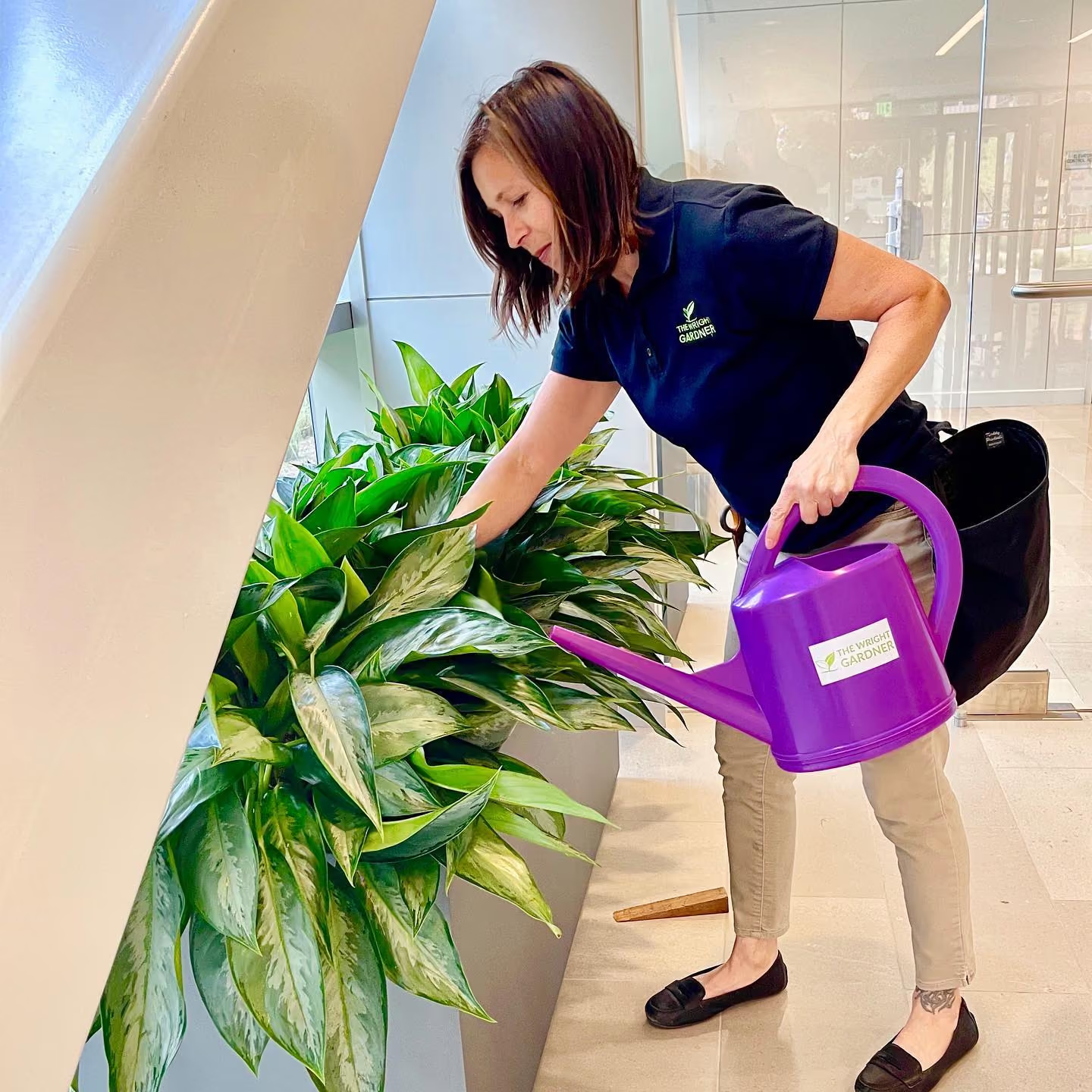
Guest: So the right gardener, at the time when we bought it, I think it was about 30 years running. We're close to 35 years now. And it was an office plant business. So they sell containerized office plants. So say you have a nice office in downtown San Francisco and you're on the 32nd floor and you walk into the Lobby, you might see a succulent bowl on the front desk, you might see a tall plant in the corner and maybe a couple of plants on some shelves. We will provide, we'll design, put that package that all up, install it. So put everything together and there's certain ways to install it and make it, you know, modular and live forever. And then we will maintain it over, over its life. As long as you're in that office and you want those plants there, we'll come and maintain them and make it so that you don't have to remember to water things and do all the things that you would need to do to keep everything looking great. And it sounds very simple and it is quite simple, but most office managers don't have the time to do that and they don't have the supply chain and just everything. All the finer details needed to keep a really professional and polished looking office plant insulation.
Host: This falls in the category of wow. It's just fascinating how many different types
Guest: of businesses there are immensely forgettable.
Host: Yeah. So tell me why, when you were lying on the couch there, this business jumped out at you.
[9:04] Guest: Yeah. So operating hours, the lack of a physical open location that you need to man. Because it's a field service business. So we go to our clients, we schedule that so we didn't have people walking in the door. It's really a very outbound business. It's very schedulable. I knew from past experience field services businesses are notoriously inefficient in terms of the amount of, of what you're paying for comprises a whole lot more than just the time while that person is physically present on site. It's the whole supply chain. It's the warranty, it's the insurance, it's the scheduling and the travel time and all of that. So I knew that a lot of those, those businesses, when run well, can really, really improve their efficiency. And so we knew that that was going to be a good area that we could actually improve the business.
Host: And you could tell kind of at first glance, or this was just your, an operating assumption for the entire category. You could tell with this particular listing that it had room for improvement.
Guest: I think really any field service business has that. And as long as you're paying attention and you're focused on the right things, like there's always room there, no matter, almost no matter how big you are. Because in any fragmented market, you're subscale. You're always subscale.
Host: Yeah.
Guest: Right. Until I have every floor of every building in San Francisco, I'M subscale. And I will always be able to do better in terms of, you know, my quote, I use wrench time as the kind of metric for that, of how much of the time that we are paying our people. Are they actually in an office servicing plants?
Host: Yeah.
Guest: And then, I mean, other things about it is like the. We liked the dynamics of kind of who pays, who benefits in terms of the office manager pays the bill, but they're spending, you know, their budget. We're relatively low on the totem pole in terms of budgetary priority, which means that while you're not getting a huge share of their wallet, you are also unlikely to get cut when times go bad because there's just not that much to squeeze. And sure, you may find situations where they'll forego plants that as a luxury altogether, but for the most part, like, keep it in a nice professional office in San Francisco. Like, you're probably going to have plants and you're probably going to pay somebody to keep them looking good. People don't get particularly mad about it if you screw up. So there's not a ton of risk. In general, people like what we do. They like our people, they like the interaction, they like the service. So just not a lot could go wrong. And there's, you know, not only so much, you know, reputational damage that you can incur by screwing something up. So we liked those as good features of a business that we were getting into for the first time, coming in as an industry outsider. And we felt that we had some skills that would be applicable and helpful that maybe hadn't been applied to this business and haven't been applied to most of the competitors.
[12:00] Host: I imagine the 30 year history was also very enticing.
Guest: Very enticing because that's. Yeah, we looked at the business kind of through the years and what happened this year and what happened that year. And I mean, really the only contraction was in 2000 when everybody in San Francisco contracted because the dot com bust. But for the most part, even through 2008, they were able to hold relatively steady, not take any, like, major crushing. It's not like there's a global pandemic.
Host: Okay, so what can you tell us about the size of, or the financials of the right gardener? Like, how big a company was it? How. How. What did its profit margins look like? Anything you can share there would be interesting.
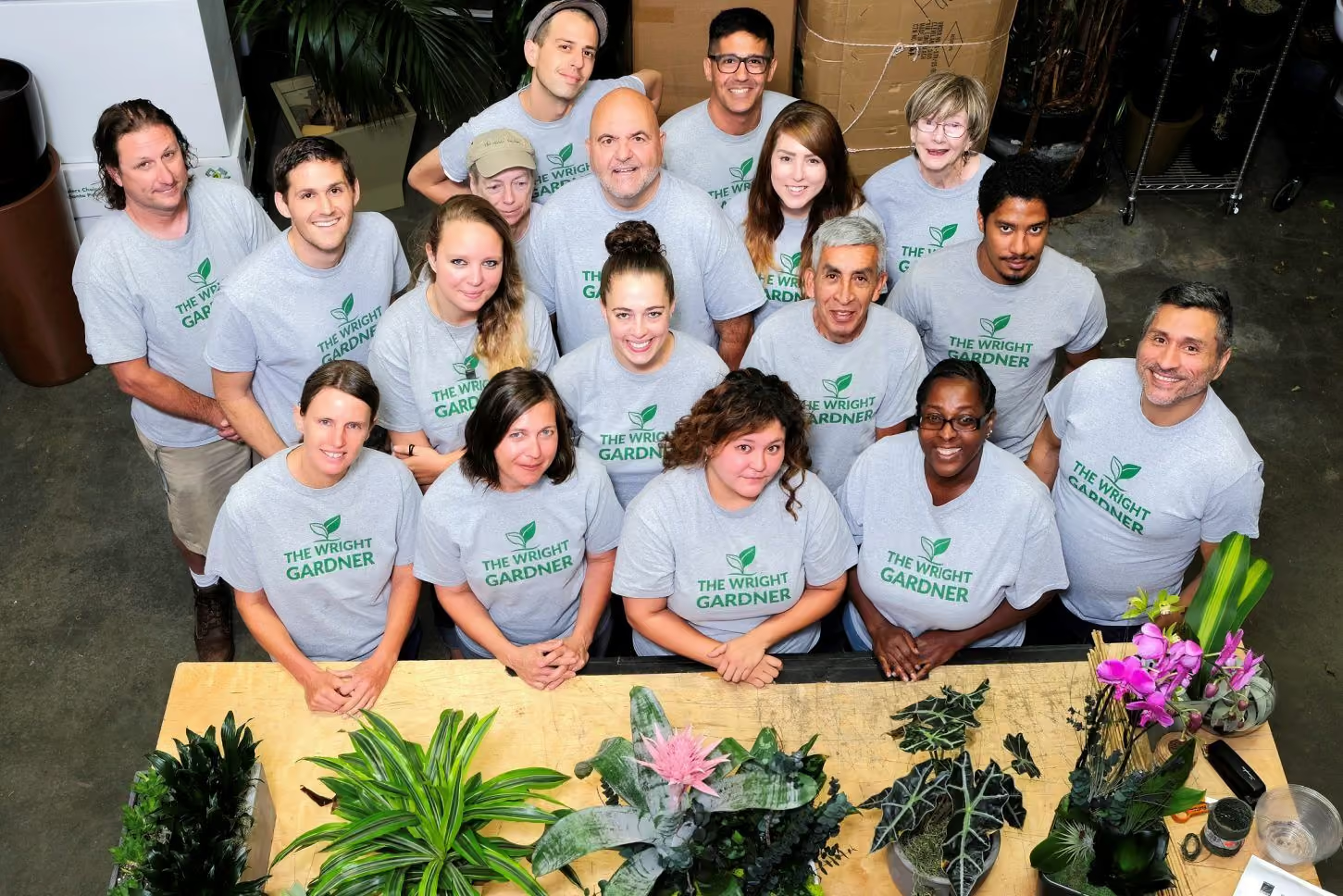
Guest: Yeah. So as with most plant companies, regional focus, strong presence in downtown San Francisco, modest presence in the East Bay, very sub. Modest presence in the South Bay with bigger, tougher competitors it was a couple of hundred accounts. Almost everybody was on recurring monthly service, 1 to 2 million. You know I'd say on the larger size for a plant company, but still by no means large like a pretty normal size for a plant company is about a million in revenue. Okay, we were a little bit above that. And then there are many, many small plant companies. But I'd say of the kind of that the names in every market you'll see probably a few million to two million dollar plant companies. And so we were kind of in the thick of the, of that. In a very fragmented market that was turning over quickly in the ownership base. Typical take home for an owner would be between, let's say for one that's pretty inefficient or run very passively, maybe like 15% and then for ones that are real tight and real cheap, maybe even like 35, 40%. And we were kind of middle of the pack on all those metrics. So I'd say we were, it was about 12 people total employees. The owner was, he was kind of full time ish, did some sales, did some design, but kind of had a management team in place. And none of the day to day business like truly depended on him being there every day. He was able to go on vacation for multiple weeks at a time and, and not suffer.
Host: Man, this really does sound like an ideal acquisition.
Guest: Yes. Yeah, it turned out, I mean no
Host: key man risk, pretty profitable, middle of the pack profitable. So you still have some opportunity yourself for upside once you get in there. And pretty nice margins for SMB service business. I mean if at the low end, at the underperforming end, you're at 15%, that's the high end for some industries.
Guest: Part of that is because it's fairly fragmented and small and there are a lot of owner operators and so you know, they save on, save on labor by doing some of this, doing a lot of stuff themselves. They generally don't invest in technology. There are a lot of them are run real old school and they kind of cap out at how big they can be because it's basically the number of places that the owner can remember and they just can't get that much bigger beyond that or they just can't get over that hump of creating the middle management layer because they're spending their own income on it. And a lot of owners, once you get comfortable in the six figures, that's enough to be comfortable but not enough to basically set aside a full salary to bring on a full time manager. It's too much of a step backward. And so a lot of companies just never make it there.
[15:25] Host: Yeah. Yeah, that's an interesting insight. Okay, and so can you talk to us about the terms of the deal? So it was doing a million to 2 million, and it was in the 20s ish margin. So what did the deal itself look like?
Guest: Yeah, so the deal reconstructed very intentionally to hit exactly down the fairway of what a typical SBA 7A acquisition loan would be the perfect financial solution for. So by that, I mean you take seller's discretionary earnings. We bought it a little, I think a little under a three multiple of sellers discretionary earnings. So three years of sellers earnings, we financed, I think six 65 to 70% with the SBA debt. So that all basically went to the seller at closing. There was a tranche of about 15% to of seller carry. So the seller carried a loan for five years at a rate that was about the same as the SBA. I think it was like 5, 5% or so. And then we had about the remainder in cash. So about at closing, by the time we funded working capital and expenses and stuff, net of the deal expenses, I think we ended up putting in about 20%.
Host: Okay, and explain to me just quick deal minutia. When you have seller financing for kind of such a relatively small sliver of 15%, why is that?
Guest: Is that there?
Host: Just to keep the seller kind of invested in the future of the business? Because that doesn't seem like it actually helps the deal get done that. That, I mean, in terms of financing, it's such a small piece. It doesn't get you across the finish line, really. So what's the deal there?
Guest: So the short answer is that the SBA and many SBA lenders just won't do it without it. They perceive there to be. They want to see some skin in the game from the seller. The seller. It's sort of a vote of confidence, but at the same time, it has to support the SBA's requirement that the seller make a full and complete exit from the business. The seller cannot have a residual equity interest in the business. And so that is the workaround.
Host: Okay, so we've talked about the right gardener, and that was just one acquisition. You have subsequently done nine more. Seven in indoor plant care, like the right gardener, and then two more in landscaping. So you're edging into kind of adjacent spaces. That is really interesting to me. So, but let's set the stage. Was this when you and your partner were like, what are we going to do? Okay, we're going to do. This is going to be our thing. Were you thinking you just do the one acquisition or did from the outset? Were you like, we're going to build a portfolio?
[18:09] Guest: I think we had the idea in advance. It was not a highly engineered five year plan to world domination or anything like that. It was truly a. We think the idea of buying a company is a good one. We think the returns look pretty good. We think we can probably find something where we could be above average operators. If we are right on all those things and we are able to successfully do that, we will probably want to do more. So let's put ourselves in the position where that is an option. And so really we've pursued continuous improvement and what I would call the adjacent possible throughout the entire course of this journey, and pursued it almost like our first acquisition was like our minimum viable product, if you were to start up parlance. And so, yeah, we would. We don't. We try not to get too over our skis or too ahead of ourselves and just bit by bit, you know, prove the next jump or the next move. I'd be lying if I said there was like a grand scheme of building a diversified, you know, national horticulture services company. I don't know. We're very far away from that. So right now we're a horticulture services company focused in Northern California.
Host: Okay, okay. And did you find that the acquisitions were coming to you? Like, where are all these deals coming from? What's your deal flow look like?
Guest: So the first add on was referred by the banker, actually that closed the SBA loan with us. He said, hey, I know, I just saw a deal come across my desk that I think this business is going to be going to market. Do you want to look at it? And I said, definitely. Even though we weren't ready for it, because we had only been in the operating seat for, at that point, four
Host: months, I was confident. Confident of you to be open to a second deal.
Guest: Yeah, yeah.
Host: I guess your MVP worked out well.
Guest: It was a forcing function. Honestly. It actually accelerated our get organized timeline because we had originally set in and we were going to like, let's not change too much too quickly and let's kind of watch and see how this thing goes and kind of get command of everything. And then once that came across and it's like, all right, it's time to get organized. Because if we're going to add another business that's, you know, at that point it was like maybe adding 40% on top of what we had just bought. But that actually really kick started our thinking of, man, there's probably a lot to do here. And it kind of woke us up to the idea that there's probably a lot of other businesses that look just like this that are going to be turning over. The silver tsunami was, was upon us.
Host: Yeah, yeah. So you're in your, in your own little corner of the universe in your narrow niche. You do see that phenomenon that there are a lot of these owners who are in their 60s, 70s, and they're ready to retire.
[21:03] Guest: Yep. And it was really happening quick because they all knew each other and they were seeding each other with, with the ideas of getting out. Right. So they knew. Oh, Matthew exited. Oh, so and so exited. It was sort of, it got traveled fast. Word was traveling fast. And so I think maybe some of how we've been able to source and just get our name out there, some of it was outbound. Like we built a list. I still find plant companies I've never heard of. Every time I spend concerted effort trying to find more plant companies and I, I make an outreach to the owner and usually it's, it's very soft, it's very passive. It's like, hey, I new to the industry and we'd love to get to know you. Here's how we got in. If nothing else, it'd be good to know, you know, somebody else who operates in the market. Maybe we can help each other trade accounts, you know, what have you help each other source stuff and that those have all been very productive discussions. And ultimately there's an exit timeline for everybody. And if as long as they're older than me, which is basically everybody, we'll probably get a chance to take a look.
Host: And can I ask how old you are, Nick?
Guest: I'm 35.
Host: 35. Great. So you started this when you were 31? 30 or 31, yeah. Cool. And so I want to hone in on something I heard you articulate on another podcast, the idea of buying small. And we've already touched on it at the top when you talked about your kind of mentor in this process. So give me the two minute on this concept of buying small as it relates to acquisition, entrepreneurship.
Guest: Yeah. So some of this is maybe market and timing specific in that there's so much money right now chasing so many deals and the lower middle market, private equity keeps going further and further down market in terms of how big of a company they'll consider. So that is one force in play here. There's also sort of the you have to figure out what your ambition is and what your risk tolerance is. And we wanted to do something that we were going to attach. I mean we're basically buying a job and so we wanted it to at least be a job that we would want to do. And at that point, you know, after just going through a very aggressive investor led business venture, you're trying to do something different than that and you know, gain some new experience and figure out what, you know, what do we learn from that? Because throughout my entire career has been a very meandering journey and trying to do different things and taking the best of what I like about them and kind of reformulating into different things. And so yeah, the idea of buying small, I think there's some advantages in that you can do the very incremental approach and not trying, you don't have to go try to create overnight success. And when you buy small, you have a little bit more control over the pace. You have a little bit more control over the lifestyle and how you execute and the decisions that you make. You have a lot of autonomy and control over schedule and you're not really beholden to anybody. There's nobody that's going to guilt trip you for not working hard enough or screwing up or what have you. It's like you kind of live with the consequences of your own decisions and you're not forcing the consequences of your decisions really on anybody else other than the people who report to you. But ultimately better treat them well or you'll lose them anyway.
[24:32] Host: Put some numbers behind this. When you say lower middle market, define that. And then when you say buying small, if you would define that both in terms of size of company and in terms of what an acquisition price might look like.
Guest: Yeah. So lower middle market private equity, I think, I mean as recently as like five years ago, I was hearing people say, oh my gosh, these lower middle market private equity guys are even buying businesses in the $2 million of, of EBITDA, free operating cash flow, whatever metric you want to use. So they'll dip down and do a deal that's $5 million, $6 million. Even more recently now I hear of more institutional, like players swooping down and doing a million or even 800,000 of earnings. So they're getting into check size or business sizes of 2, 3, 4 million. And so we kind of went bottom up and we said, well, how do we construct, how would, how does a business, how do you create a business like that? Well, it start in our view of you can, you can Eliminate the sort of cold start phenomenon by just buying one that is already at least creating a job for a pretty good job for one person, like an equity owner, and try to stitch some of those together. And once you stack enough of those together, you have something that is and would be deemed of institutional quality. But you have to start at that bottom. There's a floor I think you do. You don't want to buy a job that you wouldn't want or that doesn't pay enough.
Host: So by small we mean a business that sells for under 2 million or 1.5 million, is that.
Guest: Yeah.
Host: And so if it sells for 2 million or 1.5 million and we assume kind of middle of the road, 3x multiple, then it's generating half a million to $680,000 a year in profit.
Guest: Yep.
Host: Cool.
Guest: Okay, so that should, and that should be enough for you to make the six figures you would make if you're a business administrator and in the Bay Area, mind you. And that's probably different depending on regionally where you're at. But you know, you should be. You're going to make six figures kind of no matter where you go. If you look at all in comp. And so that provides enough buffer to make your keep and potentially reinvest a little bit and have a cushion.
Host: Yeah. Great. Okay. So as you started to say, you can also kind of buy a smaller company and then do it again and do it again and do it again and stack all of this revenue and stack all these acquisitions and then you wake up five years later and you actually have the size of a company that is in the lower middle market that private equity company might be interested in. Not saying that that's what you are interested in doing selling to pe, but all of a sudden you find yourself with an asset that kind of is in the lower middle market, but you didn't go there by just buying it directly. Very, very cool. So tell us a little bit about your acquisitions. We're just going to do some quick stats on your acquisitions. These nine acquisitions, can you give me a sense of the average and maybe median size if there's some outliers that skew the numbers of these acquisitions?
[27:37] Guest: Yeah, so most of them we haven't done anything at any point in our journey that's been more than 50% of revenue. So everything has been fairly small relative to the operating organization as it is. And obviously that's a moving target.
Host: It's getting bigger and bigger every year.
Guest: Yeah, but they've been as small as like a little over 100,000 in revenue. And it's hard to even measure profits because by that, when you're going down into that small, it's your own cost structure is more relevant than the target's cost structure because you're going to basically just subsume everything that they do. And the cost structure you subsume looks more like your own than theirs. So yeah, the average is only probably then a couple hundred thousand dollars of revenue and then few employees each. So two employees here, five there, six there. So yeah, just fairly nothing scary really. No bet the farm type moves because we have something that works and there's no reason to try to throw it on the roulette wheel. Sure, sure.
Host: I mean, your whole philosophy going into this was anti roulette wheel. So you continue with that. So you've done nine acquisitions, 10 in total. Is there a limit to this? Is there a ceiling to how many you can do by geography or by scalability or anything? I mean, talk to me about limiting factors.
Guest: So limiting factors. I'd say there's a few. The number one is scope of ambition. Like how big do you want to be? How far do you want to go? How fast do you want to go? Where are you willing to go? For us, I have three young kids and I prioritize lifestyle. I put a pretty tight box around things like being home for dinner and preparing breakfast and dropping kids off. So I don't want to wake up and a hotel ever unless I'm on vacation. And so that is somewhat limiting, at least while I'm day to day involved in the business. Certainly the silver tsunami, I'd say in the plant industry, we're on the back end. So most of the ownership has turned over in the market just in the last five years. There's not because you bought it all up. We got quite a few of them and there are a few others who have bought up a couple as well. So the ownership is getting significantly younger in our market. And the market is far less fragmented today than it was five years ago.
[30:08] Host: Interesting. Do you think that's the case with any other SMB industry? I mean, what are you hearing from your colleagues in other industries, if anything?
Guest: Yeah, I think it's different by industry. This industry, the owners can be quite old and still operate a functioning business because these businesses can be run somewhat past massively. So it's not crazy to see somebody in their mid-80s running a plant company. You won't find, I don't think anybody in their mid-80s running an electrical contractor. Yeah, it's too. Or a roofing company or some of these other contractor. Blue collar. More blue collar professions. Yeah. The. It just varies in terms of at what point do you age out and you just can't do it anymore because it's too technical, it's too nuanced, it's too. Too detailed. I think the more technical, the more nuanced, the more detailed, the younger that kind of age out horizon tends to be.
Host: Okay.
Guest: Just the demographics demand. You know, there's the baby boom started in the end of the late 40s, so there's just a lot of them.
Host: But there won't be forever. I mean, as you say, forever.
Guest: Yeah.
Host: The tsunami itself. I'd be curious actually where it is the entire. The aggregate bulge of baby boomers where they are in retirement. So. But back to limiting factors. So it doesn't sound like there's anything actually limiting you by the business model itself. I mean you could if you. If you so desired and you could find the acquisition targets. You could keep going right up and down California into Nevada and yep, sky's the limit.
Guest: And then I'd say adjacent industries too, and adjacent business models. Like there's a lot of stuff of services that we don't offer today. We could offer. There's services that were subscale on that we could try to go big on. Like we could we do holiday decorating, but it's a very small business on a standalone basis. If we wanted to make holiday decorating big, we could. Landscaping is. Is very vast. Yeah. In the landscaping business we're tiny relative to. I'd say even just other small players are way bigger than us in landscaping because we started real small landscaping. So.
Host: Yeah, I guess that's probably what I would have guessed about your industry, indoor plants, because I would have thought that it wouldn't be. There wouldn't be space for standalone companies that do it. I would have thought that it would be one of a myriad services offered by the landscaping company, by the. By the office buildings landscaping company.
Guest: The operation's so different. They're pretty. Honestly, they're not super. They're not super synergistic operationally. We run them under two different brands for that reason. If there was more overlap, we might consider consolidating under one brand. But I mean they're just. They're just two really different things.
Host: Interesting.
Guest: Different services hired by different customers generally. Okay.
Host: Are you getting better at acquisitions? You've now had a lot of practice. Are these. Is the friction getting less? Is your skill getting better?
[33:04] Guest: Yeah, I think We've got a pretty good acquisition playbook by this point. We can reuse everything from the prior acquisition. Each time we refine it a little bit, we get better at the messaging, we get better at. And we've done all asset purchases. We haven't done many stock deals and so that I'd say we're pretty good at those asset deals by this point. In terms of collecting the information, making it go seamless, mitigating risks and transition, that makes the value proposition to the seller a lot better I think because we're a skilled acquirer and we can provide references. If you are considering selling your business to us, I can give you a list of four or five people you could talk to and they'll tell you whether they think I'm a jerk or the best guy to work with ever or somewhere in between and they'll give you the real because at this point they do want to get their debt payments but that's about it. That's the only motivation they might have and that's not going to stop them from telling the truth.
Host: Yeah, yeah, I'm sure that's really compelling to potential sellers to you. So going back now to 2017, just quick side note, I mean this all seems like it's just working out extremely well. Did anything not work out? Did any part of your thesis not come to fruition or something you didn't see like it seems like this is kind of like been best case scenario all the way through.
Guest: No, I mean it doesn't. It's not without struggle. The HR is always hard. The skills that you just can't get until you operate a business are always hard because you're doing them for the first time. Right. Like running some of these small business systems. Some of them we had run through our startup, but others of them we hadn't. And learning to run lean and mean and run on a budget and try to, especially when you start small, like you're doing a lot of things yourself until you can grow into and earn the right to hire them out. And you have to pay close attention to, you know, especially if you're doing it with debt, you got to pay close attention to ensuring that you have that cash cushion and that you're meeting your debt service with and not staying up at night worrying about that stuff. So it does force you to operate in a certain way. That's going to be uncomfortable for especially for people who've climbed pretty high in their career. I get a lot of calls from people who have almost outgrown Our strategy, they became a partner at a consulting firm or a bank. And their core expertise is managing people and getting work done through others. And sometimes pursuing the talk that we've pursued would feel like a really big step back and potentially too far back to ever consider doing it our way.
Host: Yeah.
Guest: And there's nothing wrong with that. That's just, I think, a reality to be aware of. I actually like getting my hands dirty and like implementing systems and designing process and getting into the nuts and bolts of things. And so that doesn't bother me. I didn't feel like I was taking a step back.
Host: Yeah, yeah. And I will say I feel like acquisition entrepreneurship, SMB, Acquisition entrepreneurship. Maybe not for somebody who's solidly in the C suite and is kind of really at the upper echelons of their career or of their industry, but people maybe in the middle of their career. I feel like acquisition entrepreneurship is a great pivot for people in their 30s and 40s who just don't want to continue on the path they're on.
[36:18] Guest: Yeah, yeah, I think so too. And it will certainly get you some new skills because just operating in a small business environment, it's just very different than operating in a corporate environment where all the structure is there, the organization's there, the process is there, the technology is there. We actually looked for things where all that was kind of mostly not there or very kind of haphazard so that we could do what we do, which I think is organize and synthesize and turn into. Put a process in place that can be followed.
Host: Right. That's part of the opportunity for you. And what about, aside from the Mechanics of the SBA 7 loan specifically, but just the concept of acquiring a small business from a retiring owner, kind of surfing the silver wave, the silver tsunami, leaving aside your exact source of capital, whether or not you go sba, that concept of pivoting your career into being an SBA owner by acquiring a 30 year old business, how appealing and viable that is for prospective acquisition entrepreneurs?
Guest: I think it's appealing. I think you have to be the right Persona for it and you kind of got to know yourself and figure out what your advantages are. Right. Like, I think you want to put yourself in a position where you are pretty confident you're going to be above average and so find a business where the skills that you have will give you a good chance of being better than your predecessor.
Host: Yeah.
Guest: And a high degree of confidence in that because there'll. There will undoubtedly be some things that you're worse than your predecessor at because they survived for 30 years and you haven't. So but knowing what those are and knowing that those will actually move the needle. Right. Like if you're a marketing person and you're a really, really solid or excellent marketing person, I don't know that the plumbing business is going to help you. That's being good at marketing. Marketing is not the constraint to any plumbing business that I know. Right. So figuring out how your skills match with the needs and the points of scarcity of the business that you're looking at is important because there's got to be. To really make sure that you're a success, there's got to be a good fit.
Host: And what was it in your case with the right gardener?
Guest: Field operations delivering consistent, reliable quality at a scale that was previously impossible because there were just. There was too much to do to operate at that scale in a non chaotic haphazard way.
Host: So you had shops there.
Guest: Yeah, just organizing the service, organizing the service data, figuring out what to collect, how to collect, implementing, designing and building the systems that would allow us to deliver a very consistent and reliable service experience at a scale that just wasn't feasible for any of our predecessors.
[39:16] Host: So that's all I wanted to ask you for now, Nick, but I could. There's so much more we've talked about offline that. So maybe I'd like to have you back again but for now let's, let's call it. But why don't you tell people how they can find you online? You're active on Twitter as I said earlier. What's your Twitter handle?
Guest: Twitter is Ikhoshka N I C K H A S C H K A Great.
Host: And anywhere else the community that you run. Do you want to point people to that?
Guest: Yeah. If you're interested in being involved in the small business kind of owner operator community. I have a private network and that network is broken out further into circles of regional focus, of industry focus. And so people are kind of self organizing that and there's people are posting, sharing, engaging. There's now even some physical meetings have popped up in some markets and, and it's just a place where you're going to be around other people who are interested in doing this. This kind of work owning and operating small businesses. So and that's. I think the link is on my. Is on my Twitter profile. It's Operators MN co. Great.
Host: Operators MN Co. Great. Well Nick, thank you for doing this. Thanks for being transparent and sharing your insights. Really a cool story. From zero to to ten acquisitions in about five years or less. Like to have you back. Thank you. For now.
Guest: Thanks.
































































%20-%20thumbnail.avif)





%20-%20thumbnail.avif)

%20-%20thumbnail.avif)

.avif)




%20-%20thumbnail.avif)