[00:00:00 - 00:05:20]
Host: Search fund outcomes follow a distribution, and at the far right of that distribution live the spectacular ones. Today's guests are just such a right tail outcome. Courtney and Jonathan Dunn are a married couple who raised a traditional search fund together in 2019, when coupled search funders were even rarer than they are today. Three years later, Courtney and Jonathan bought Serbo, an electronic health records platform for cash pay medical practices like concierge medicine and longevity clinics.
How they landed on their thesis is a story. During the search, Courtney booked consults at fertility clinics, a way to get FaceTime with healthcare providers. One of those doctors who would later guide the couple through IVF pointed them toward cash pay medical practices and toward the very software they'd end up buying. We spent time on their deal structure.
They acquired the growthy SaaS business with no bank debt, unusual for a search deal. We hear why. We also learned how they used an earnout to resolve an uncomfortable retrade by their seller. Under the leadership of Courtney and Jonathan, Cerbo more than doubled from under 5 million of ARR to over 10 million and from 20 employees to 75 last year.
That growth culminated in a merger and a liquidity event that they describe as life changing. They're candid throughout about ivf, about the strains this path puts on a marriage, and about arriving on the other side. Now, with exhilarating optionality, here are Courtney and Jonathan Dunn, acquirers of Serbo. Some of the most eye popping outcomes on Acquiring Minds are roll ups.
You know what roll ups are, but do you really understand the mechanics, how they create value and how you might pursue one yourself, even starting with an SBA loan, Even if you're already in your business as owner with an SBA loan. Well, in a webinar tomorrow Tuesday, Jeff Homer will break down the architecture of a rollup and the financing strategies that make repeated acquisitions possible. Jeff's original interview on Acquiring Minds is a classic and his update episode aired just this past Monday so you may know his story. From buying a single tiny music school to building a platform of 125 plus locations.
Among the topics you'll learn tomorrow why fragmented industries can create compelling opportunities for rollups, how consolidation creates value as a platform grows, the different ways operators can fund the equity side of a roll up, how committed capital vehicles let you raise once and deploy across multiple acquisitions the role of debt from SBA and seller notes to conventional financing and delayed draw facilities and how your financing strategy has to evolve as acquisition cadence picks up. This will be an epic session, relevant even if you're starting with an SBA loan. This is going to be a masterclass on rollups from a guy who built one of the most successful ones I'm aware of in Searchland. The webinar is architecture of an Entrepreneurial Rollup and it is tomorrow, Tuesday, September 1, noon Eastern.
Link to register is right at the top of this episode's show notes or on the Acquiring Minds homepage. AcquiringMinds co. Welcome to Acquiring Minds, a podcast about buying businesses. My name is Will Smith.
Acquiring an existing business is an awesome opportunity for many entrepreneurs and on this podcast I talk to the people who do it. If you ask owners in the ETA and search community which insurance broker provides highest quality work, great outcomes and has a practice dedicated to searchers and acquisition entrepreneurs, one name comes up again and again. Oberle Oberle Risk Strategies has worked with hundreds of searchers over nearly a decade and is in fact led by a two time successful searcher, August Felker, which makes Oberle, a specialty insurance brokerage for searchers by a former searcher. And if you've got a business under loi, Oberle will provide complimentary due diligence on that business's insurance and benefits program.
An easy, no risk way to get to know August and the team at Oberle. To take advantage, check out oberly risk.com that's o b e r l e-risk.com link in the notes Courtney Dunn Jonathan Dunn, husband and wife welcome to Acquiring Minds.
[00:05:20 - 00:05:23]
Guest A: Thank you so much for having us. We're excited to be here.
[00:05:23 - 00:05:24]
Guest B: Excited.
[00:05:24 - 00:05:42]
Host: Courtney and Jonathan, your story is one of a partnered traditional search fund with a spectacular outcome. Many elements to your story. So let's dive right in beginning with some background on you each. Courtney, if you'd go first and then Jonathan, we'll go to you.
[00:05:42 - 00:06:16]
Guest A: Absolutely. So pre business school I have about a decade of experience in oil and gas. I spent a lot of time on rigs, drilling rigs in particular in the Gulf of Mexico and throughout the onshore within Shell. That was my previous company.
And then I met this guy Jonathan when we were in Pittsburgh, Pennsylvania together. Went to business school, did a partner thing. During business school, went to the University of Michigan where we learned about search.
[00:06:17 - 00:06:19]
Host: Great. Jonathan, your background?
[00:06:19 - 00:07:03]
Guest B: Yeah, one of the things about sharing our background is in many ways there's a lot of overlap. But I trust me, we're very different people in a lot of different ways. But I also have about 10 years of engineering experience in the oil and gas industry. My previous employer was Williams.
They do natural gas, transportation and processing and worked in a lot of engineering roles, whether that's on site construction, engineering, design. Traveled and worked in a bunch of different parts of the country. And as Courtney mentioned, our paths crossing Pittsburgh at that time, it was really popular. The Marcellus and Utica Shale development in that part of the United States.
And both of our companies independently were growing their footprint. And we both so happened to be in Pittsburgh at the same time because of that.
[00:07:04 - 00:07:08]
Host: Great. And then you ended up at business school together as well.
[00:07:09 - 00:07:24]
Guest B: Yes. So the step right before business school was we got married. Uh, so we met in Pittsburgh, got married, got engaged in 2014, 15, and then got married in 2016, and then went to business school the year after that.
[00:07:24 - 00:07:33]
Guest A: We were studying for the GMAT along with trying to plan our wedding around the same time. So it was super fun. Super fun.
[00:07:33 - 00:07:49]
Host: Well, well, as we'll hear, you guys tend to do relationship stuff and business stuff at the same time on two different tracks. A big theme of the story, I think. So then you end up at business school together. Is this where you learn about buying a business?
Search or carry on?
[00:07:49 - 00:08:54]
Guest A: Yes, absolutely. I was really intrigued by entrepreneurship and all that entailed. And so I thought for the two years that we were going to be in business school, try to learn as much as we could. So I was very exploratory.
I found myself joining different groups, and when there was any kind of business or subject matter that I had no idea about, I would bring it upon myself to jump in to a meeting for, like, the first 30 minutes. If it was interesting, stay, and if it wasn't, I would just leave. And so we were very fortunate to have Pacific Lake partners in particular come to our campus. This was before Michigan had an ETA club at all.
And so they were partnering with the private equity club at the time. So I sat in for 30 minutes, thought it was the craziest thing I had ever heard, but it intrigued me enough to sit in. And I told Jonathan after the meeting, I think this is something that could be potential for us. Maybe not necessarily just then, but I thought maybe down the line, this could have been something that we could have pursued together.
[00:08:56 - 00:09:02]
Host: And so from the very earliest moments of your exposure to it, you thought in terms of partnering together to do it?
[00:09:03 - 00:09:33]
Guest A: Well, I feel like within Search in particular, a lot of people said that their spouse was along for the ride, so I didn't necessarily know what that entailed just yet, but I knew if it was something that even he did by himself, that I would have to be supportive of it. So at that time, I did not know that there were couples that did search together, but I knew that if that was something that he decided to do, I could have participated, maybe from behind the scenes.
[00:09:34 - 00:10:00]
Host: Well, wise of you, because as we hear from so many interviews, the spouse, the partner needs to know what is being signed up for in a search. So even if they're not the frontline protagonist, entrepreneur doing the thing, their life is going to be completely affected. And so both parties are kind of involved in the process. And in a way.
And you seem to have perceived that 100.
[00:10:00 - 00:10:14]
Guest A: Absolutely. And I feel like that with any career, honestly, post business school, where there are people who are going investment banking, consulting, what have you, like, your spouse has to be down for the ride. If not, there could be an early exit from a relationship standpoint.
[00:10:15 - 00:10:22]
Host: Yeah, yeah. Jonathan, do you recall Courtney bringing the idea to you or at least, you know, kind of being like her discovery of it?
[00:10:23 - 00:10:44]
Guest B: Yeah, I believe it was a phone call, and it pretty much went the way that she just described it is. I think immediately after the session that she went, she gave me a ring and said, hey, I just heard something. I'm not sure if it's a scam or if it's a real thing, but it sounds like something you should look into because I think this might be a good fit for you.
[00:10:44 - 00:10:49]
Host: These Pacific Lake jokers are out here talking about paying you to buy a business.
[00:10:49 - 00:11:08]
Guest B: Yeah, yeah, yeah. It really was a weird proposition. Was the first time we had heard about it. And.
Yeah. So that I followed up. I think they had coffee chats either the next day or so, and I went and signed up for a coffee chat. And that's where our journey.
Yeah, our journey together started with learning more about the process.
[00:11:09 - 00:11:14]
Host: But you did not then promptly search. Right. There was an intermediate phase. What happens next?
[00:11:14 - 00:11:54]
Guest B: Yeah, so we learned that happened our first year at business school. And so by that time, we had internships set up. We both did investment banking in New York. I did M and A, and she did natural resources.
And so going into our internship, we kind of had this idea of a search. And coming back into our second year, we took the formal class that we had at Michigan. And through that class is where by the end of that class that semester, I have decided I wanted to pursue with going to search. And then there's a step in there which we can get to as far as when Courtney decided to.
Or we decided together that Courtney. It made perfect sense for Courtney to.
[00:11:55 - 00:11:55]
Guest A: For.
[00:11:55 - 00:11:56]
Guest B: For us to do this journey together.
[00:11:56 - 00:12:29]
Guest A: I will say I was not all in. In the beginning, I thought someone had to have a real job benefit to support the person following their dream. And then I got a little bit jealous. As Jonathan was having conversations with investors and with search CEOs, I would be listening in and I'd be like, well, wait, why does he get to have all of the fun?
I went to business school too. We've both sacrificed a lot. Maybe this is something that we should consider together.
[00:12:31 - 00:12:35]
Host: There was an investor that actually also nudged the two of you in that direction, right?
[00:12:36 - 00:13:22]
Guest A: Yes. We were at the booth call out conference and I was again there just as a supportive life, but I was like writing down notes, asking people questions. And this particular investor was sitting at our table and he thought, you know, have y' all considered doing a search together? And I was like, no, I need, like meet.
Somebody needs to have the real job. And he was like, there's. This is something that is reality and you should reach out to, you know, other partner search couples and see how they're doing because they've actually done quite well. And that's what the light bulb came off.
And we were driving from Chicago back to Ann Arbor. And in that four hour drive, I think that's when we make the decision we're going to do this.
[00:13:23 - 00:13:38]
Host: And you think the investor recommended that because he was looking at this precedent of these other stories and it seemed like a good combination of partners. So that's what he was thinking.
[00:13:38 - 00:14:08]
Guest A: I do think so. And then having the fortune of reaching out to the prior search couples, there weren't very many at the time that were doing a traditional search. They are some of the most inspiring people and encouraging people and pretty successful if I, if I do say so. And so I think there is something to be said about searching as a couple that kind of gives you a little bit of an advantage.
And we definitely leaned in heavily on that during our search.
[00:14:09 - 00:14:12]
Host: Can you drop some of the, some names of these other couples?
[00:14:13 - 00:14:24]
Guest A: Yeah, Sarah, Raul, Scott McKenzie, Brittany and Miles Collins. There's another Collins.
[00:14:24 - 00:14:25]
Guest B: I'm drawing a blank on them.
[00:14:25 - 00:14:49]
Guest A: Simone and Malcolm Collins as well. And then Patricia and Enrico. They're like the first, I believe, OG Canadian couple. They did business school together, got married.
They have a very interesting story as well. And Pat was my, my mentor. And so I've had the fortune of, you know, bending their ear a time or two. So it's been great.
[00:14:50 - 00:15:03]
Host: Great. That was great. Thank you, Courtney. You actually had an offer in hand at Apple.
Yeah, right. So. So not only this wasn't Sort of an abstract mental exercise. This was a very tangible fork in the road for you.
[00:15:04 - 00:15:31]
Guest A: Absolutely. I can remember getting that offer. They flew me to Cupertino and I was sitting there at the Apple headquarters and normally a normal person would feel very excited about getting that offer, but then I looked around and I was like, this isn't, this isn't my dream. It isn't.
Apple is an amazing company. I think I would have done well there. But ultimately, when I think about
[00:15:33 - 00:15:33]
Guest B: whose
[00:15:33 - 00:16:10]
Guest A: dream that was, that was a Steve Jobs dream come to fruition. And I thought, you know, with what we wanted to do just in the grand scheme of things, like we wanted to put our stamp on something and make an imprint. And I didn't feel like I could necessarily do that with Apple. And I thought we needed to, you know, do go our own path and do our own journey.
And that's what we decided to do. My parents thought I was crazy, by the way. I remember having that conversation with my parents and they were like, you don't turn down big tech. I said, well, this gal does.
[00:16:12 - 00:16:14]
Host: And look at you now.
[00:16:14 - 00:16:15]
Guest A: And now doing all right.
[00:16:16 - 00:16:24]
Host: Okay, great. So I recall. So you make the decision. And this was what year now?
2017.
[00:16:24 - 00:16:25]
Guest A: 2019.
[00:16:26 - 00:16:27]
Guest B: 18.
[00:16:27 - 00:16:29]
Guest A: Oh, 2019.
[00:16:29 - 00:16:29]
Host: Okay.
[00:16:29 - 00:16:30]
Guest A: We graduated in 2019.
[00:16:30 - 00:16:34]
Guest B: We graduated 19. But you turned down Apple in 2019. Oh, it was also in 2019.
[00:16:34 - 00:16:35]
Host: Okay.
[00:16:35 - 00:16:38]
Guest A: Or you know, end of 18. So you're right. Like December.
[00:16:39 - 00:16:42]
Guest B: We raised our search in like beginning of 2019.
[00:16:42 - 00:16:45]
Guest A: Yes, I forgot I was a busy lady in 2018. You're correct.
[00:16:46 - 00:16:52]
Host: We, we just got a little snapshot of how these two co CEO business partners work together. Thank you for that.
[00:16:54 - 00:16:55]
Guest B: Okay, so.
[00:16:55 - 00:17:10]
Host: So you had told me that raising the fund was actually one of the more difficult parts of this process. Seems like you'd been exposed to investors, you'd been getting encouragement, but when it actually came to raising the search fund, that was difficult.
[00:17:10 - 00:18:48]
Guest B: Yeah, I think for us, we went to Michigan, so it's not one of the top schools. I think if you kind of think of where a lot of the entrepreneurs tend to come from. And so we didn't have the alumni base that you have within the Stanford and the Harvard, which there are plenty of great entrepreneurs and there's some great investors who, who graduated from those institutions. But we just don't have quite the Michigan presence in the investor group.
That's changed a little bit over time. But at that time when we were searching, we didn't have that type of connection necessarily. So we did have to go out and meet a lot of people for the first time. Perfect example is with Stanford and Harvard specifically.
There are a lot of investors who go to campus for recruitment. Specifically did come to Michigan, which is how we learned of them there at the time. And so we had to go out and meet a lot of these investors. This was right before COVID had happened.
So we did a road show and went to the cities where these investors are and would have our meetings planned throughout the day and go to different parts of the cities for that. So it was a little bit of work, which I wouldn't say that people don't have to do even today. The environment, I think is a little bit different than it was in 2019 when we were raising. But there was a process we had to go through.
We had to get on the plane and meet people and have the coffee chats in person and the follow up calls, whether that was virtually or not. And so that wasn't a slam dunk necessarily, but we definitely did our work. We were told no, so we heard no throughout the process. But we had enough yeses for us to raise our fund fully funded and get off to start surging in August of 2019.
[00:18:49 - 00:20:15]
Guest A: And I'd say this was our first foray into, you know, asking people for lump sums of money. So it was a little bit nerve wracking. I think we've, you know, struggled a little bit in the beginning with our asks and didn't necessarily know the best way to communicate. A lot of times I think about it in the grand scheme of things, this is where I probably failed, if I'll be quite honest.
My nervousness was I don't look like these investors. How can they relate to me? This guy is pretty larger than life. It can be at times.
And so I thought if I just make myself really small and almost forgettable, they'll remember him and they'll give us money. And in the grand scheme of things, my investors would say that is not you or not like you and a little bit awkward. And so I am grateful for those that, you know, opted into our search and allowed me to feel comfortable enough to, I would say, show like who I really am and feel comfortable as we navigated down the path. So I think about that's probably like the worst part of my situation of where I did not necessarily flourish the most was during that, that period of time, now that I think about it,
[00:20:17 - 00:21:31]
Host: running payroll, paying your bills, closing your books and producing financials, these are critical tasks every business owner must do or oversee. But spending time on them distracts you from the leadership in growth work you want to do. So let system 6 do it for you. Owned and led by a former Searcher, Chris Williams, System 6 is a leading outsourced finance team for hundreds of SMBs, including over 50 searcher acquired businesses.
Chris, Tim and the System 6 team understand firsthand the challenges, the opportunities of jumping into a business as its new owner. So whether you own your business already or have one under LOI, talk to System 6 about how they can give you time back and improve your financial operations. Mention Acquiring Minds and they'll provide a free review of your books and financial ops, a $500 value. Check out system6.com, link in the show notes or email helloystem6.com and when you were getting no's, do you have any
[00:21:31 - 00:23:11]
Guest B: sense for why it runs the whole gamut of explanations and even part of that is there may not be an explanation as to why some people investors would reach out and respond to our outreach to kind of feel us out a little bit. Some of the responses you would hear is like hey, you were interesting. I just don't have any more money left in my fund to deploy at this time. Some people were very transparent of I just don't understand how a husband and wife team can work together.
So like for that reason I'm out. So there there were a lot of different reasons for that. I I do think some of it to Courtney's point as as she was telling that story and be reflecting on that time period, I don't think we were as polished as we were at the end of our process as we were at the beginning and that was probably some learning along the way. We where we had to as it was a new muscle we had to kind of figure out what does this look like the best advice that we got from investors in my view that who did not invest to us with us for their own reasons was we weren't leaving.
There was not a clear ask. Right. And that was even as I look back into it it's like what do you mean? I didn't leave the room with a clear ask of like will you invest in this in our fund that we're raising to pursue this path.
And we had those little nuggets along the way of that process where you could sit and research it all day every day. But until you're in the room sitting across from an investor kind of with the sweat underneath you and getting warm underneath here and all of that, what will you say and do? And the more that we did it, the better we got. Our story got refined, our ask got more clear.
We were just more crisp in that. And so some people probably said no to us early in that process when we just weren't as well refined.
[00:23:11 - 00:23:54]
Guest A: But I appreciate, I will say this, I appreciated the no's because they fueled us in a way and it wasn't like, well, part of me is like the Michael Jordan meme. I take everything personally. So there is like a personal component to it of, okay, you didn't pick me. But then I also used it as motivation of I can do really well and make you wish that you did.
And I think when I flipped it to that, when I have conversations with those investors, I think they would say, you know, if they could turn back time, they'd probably say something different and probably often. And so ultimately that was our goal and we used every no to help fuel our fire as well.
[00:23:54 - 00:24:35]
Host: Fuel your fire, also known as chip on shoulder, which is something I heard your husband describe you as having. It can be a great motivator. That. By the way, Jonathan, what your investors told you, that feedback of not asking, not making your ask clear, I think is a, I mean, I've heard that before in general in business.
I just think it's in pitching in general when you're, when you're a novice making a very clear ask whether you're selling something, selling yourselves, raising money, very easy to dance around it. And. And that's a total rookie, rookie error. Very tempting, I should say, to dance around it, but a rookie error.
[00:24:35 - 00:24:36]
Guest B: Great.
[00:24:37 - 00:24:58]
Host: Okay, you did raise. Let's. We got a lot of ground to cover, guys. Let's quickly hear just a couple elements of the search itself.
After you raised the search fund, Courtney, you had said to me that you do it the way you guys did it, then it would probably be very different. Now, let's just quickly hear that contrast. How would you characterize it?
[00:24:59 - 00:26:11]
Guest A: Yeah, absolutely. I think in this world where it's really easy to get email addresses and set up an email campaign, which is what essentially every searcher does, we were more in your face. Let's meet up. Let's grab a coffee.
We're gonna, you know, meet you at that conference that you're going to. We're going to pay to get in and we're going to talk to you, say, hey, I'm the person that's been sending you those emails. And I think that way more in your face. It's not really about the reply rates and all those things that everybody talks about.
It's about quality interactions. We weren't afraid to jump on a plane to drive to meet people. And I think that that ultimately helped us get our business acquired. And I think most of the searchers now just send emails and think that that's what it takes.
And I think it's more about the quality interactions. You have to meet people in person, you have to show them who you are, show a little bit of your personality. I think that's what's going to get a deal done. Especially now in this environment where everybody's kind of doing it behind the scenes.
[00:26:13 - 00:26:47]
Host: Yeah, I mean I feel like your approach is only more advisable today because people are even, you know, blasting out an email is even is only easier today and space is only that much more crowded, et cetera, et cetera. So yeah, okay, okay. But you did do the proprietary approach. Fundamentally you emailed, but then emailed plus human interaction, human connection.
And so you did, via this method, find a software business. Tell us about the business you found.
[00:26:49 - 00:27:36]
Guest B: Good, Go ahead. All right, so through our proprietary search we found Servo Cerbo is electronic health records, practice management and patient portal solution, which that's a pretty broad term. Some of the places you may have seen that are EPIC for hospital systems and ambulatory systems, but the niche that this software serves are cash based medical practices. And, and some of the terminology you may be familiar with are concierge medicine, integrative functional medicine, or even what's really popular now is longevity.
And so you'll see those types of clinics being formed. Typically they're independent medical practices between two to five primary providers, sometimes smaller, sometimes larger. But in our solution is purpose built for those types of clinics.
[00:27:38 - 00:27:52]
Host: Electronic medical records. Electronic medical record solution for this very niche sort of practice. Okay. And I heard, did I hear you mention epic, Jonathan?
[00:27:52 - 00:28:01]
Guest B: Yes, EPIC is a, I use that as an example of a system people may have heard of or seen in their everyday lives and they're engaging with the healthcare system.
[00:28:02 - 00:28:46]
Host: It's funny when I, when I told my father after we had our pre call about your success and your story, he was like, oh, that sounds like Epic. And I was like, what's epic? And so apparently Epic is apparently, apparently epic is this incredible success story. Still a private business.
Right. It's never gone public, but a total giant and is kind of the anchor of the what, the Madison, Wisconsin tech ecosystem at this point. Like it's just a. And then, and then I realized that my own, like my own portal for my, the hospital here, there's A little epic logo in the corner.
I was like, oh, I'm a customer. And I didn't even think about it. But it's a, it's a giant of a business. And so you all operate similar kind of business model, but in a narrow niche.
[00:28:47 - 00:28:52]
Guest B: Similar. Similar business model for the most part. Similar service, but for your niche, I'd say that way.
[00:28:53 - 00:29:02]
Host: Okay, great. And what was the interaction like with the sellers? What's sort of the backstory of the, the. Of the, of the business?
Servo.
[00:29:02 - 00:29:57]
Guest B: Yes. So it was founded at the time, 10 years from 20. 20, 22 or so. And founded by a husband and wife team, actually.
The husband created the software. He has a non technical background. His father ran a practice in the Northeast. And whatever solution they were using at the time really wasn't fitting and working for the workflows that the clinic needed.
And so he, his name's Ben Dapin, being the entrepreneur that he is, was like, well, I'll solve the problem. And created a software product, at least the first version of that. And over time, some of the providers that were at that clinic left and asked for a version of that software to use at their clinic. And he's then, since then revised and updated the whole application.
And it's grown since then almost completely through word of mouth up until the time that we first interacted with the seller.
[00:29:57 - 00:30:14]
Guest A: At that time, I'll say the husband wrote the code, the wife monetized it because he forgot to charge people for that said solution. And so that's when she jumped in and actually started being that business asset behind the scenes to help build subscriptions and do those sorts of things.
[00:30:14 - 00:30:24]
Host: Oh, behind every great man, Courtney, next to every great man, next to. Thank you. Thank you. Good correction.
But so a husband and wife team then as well?
[00:30:25 - 00:30:43]
Guest B: Absolutely. Relatively young, have two at the time. Their, their kids were like not in high school. So they had a young, young household, young family.
So we related a lot in that sense. At that time we were growing our family. And so it just was a really good relationship building throughout that whole process.
[00:30:44 - 00:30:47]
Host: And why were they receptive to exiting their business?
[00:30:48 - 00:31:28]
Guest B: Yeah, I think what we've seen and that it was not unique to that couple, but for many of the entrepreneurs who we would talk with during our search is, I think there's a point where they realize, well, two things happen. One, for this business to get to the next level, it may take a different type of person to run it. And then two, they have all of their net worth built up in something that's Ill liquid. So we also can solve that problem with them for them, with our investor base of bring some liquidity and then at the same time offering them to participate in the upside as we were very excited about the industry and that business gave an opportunity for them to also participate in that upside as well by rolling over semi Great.
[00:31:29 - 00:31:40]
Host: And what can you share about the size of business people number, finances, you know, number of clients, customer list, et cetera. Give us a sense of scope here please.
[00:31:41 - 00:32:45]
Guest B: Yeah, at the time they were sub 5 million in recurring revenue. They were very profitable actually very much a bootstrap type of model. So every dollar mattered and they were very, very judicious about spending from who they hired and what they purchased and spent money on. At the time when we acquired the business we were employees 19 and 20 and the businesses had great, great margins, great growth, 30, 40% year over year growth without doing much marketing.
Once again that the growth story or the origin story of growing through word of mouth has a lot of that's even to today the primary driver for the business. And it really speaks to the industry research that we did of understanding what are the pain points that clinics and customers in our space have and how is servo uniquely positioned to solve that in ways above and beyond a lot of the competition. And that's really what's fueled a lot of the growth then into today.
[00:32:47 - 00:33:03]
Host: One of the things that you perceived about the business was that it's a system of record. What does that mean in a software context? And first. Yes.
What does it mean? Police system of record.
[00:33:03 - 00:34:20]
Guest B: Yeah. So what's another example of a system of record? Something like a salesforce where this is the system that the users put all of their information into. And so in the clinical setting that's your patient records, your lab results come in, you can order prescriptions.
The medical history for a patient is in our system. So there's, there's multiple places where records come from. It's the interactions at a. When a patient's engaging with a provider.
There are the questionnaires that the patients provide in the past medical history and any other lab results or doctors notes that come from other third parties all into one place that allows the providers to engage with one system that's connected with a lot of other third party systems to where you don't have to click into one window and then click out of another window. It makes it really clean and simple in the way that our system is laid out, the way that our providers prefer to engage with their EHR. There's a lot of different versions of what EHRs look like. But over time, that's where we've settled on the way that the system even looks.
Just works very well with what our providers are looking to accomplish and how they want to run their practice and execute on their workflows.
[00:34:20 - 00:35:36]
Host: Great. And in the SaaS context, of course, SaaS prevents AI was the gold standard of kind of revenue quality and business model. I mean, it was just recurring contracts. Everyone wanted it and loved it.
But then the gold standard within the gold standard was a system of record SaaS because it's not just about contractual recurring revenue of a software utility. It's also software plus data. That business, that customer's data also lives in the software and all of the, and everything sort of orbits around it. So it's, it's even, it's even moer.
It's even more entrenched in the business. The idea that a customer is going to change switch providers would mean not only ripping out the software, but also migrating all this data. It's just a very enviable position in, in the customer's workflow to, to. To be living in.
So did you perceive all of that when you looked at the opportunity or is that something you've kind of come to realize as you became its, its leaders and owners?
[00:35:36 - 00:36:01]
Guest B: We definitely perceive that once we. The opportunity was a real opportunity and we came to that realization looking at other businesses that were not the system of record, that were attached to the system of record. And there's a different type of risk profile. They could still be great businesses, of course, but if I had to pick where in the value chain, I would prefer the system of record.
And we had that opportunity present itself with Serpo.
[00:36:01 - 00:36:25]
Host: Yeah, yeah. And you had mentioned Salesforce. And Salesforce really is sort of the platonic ideal of a system of record. I mean, like, you know, Fortune 500 companies, basically their core customer data is all baked into their.
Or stored by their Salesforce implementation. Very powerful. Can you share. Share what the valuation was and what the, the.
Yeah. What the acquisition looked like and how you structured it.
[00:36:25 - 00:37:12]
Guest B: Yeah. So we were, for the valuation, we were in like the 3-4x range for recurring revenue, which we felt was a fair price. And we were able to kind of get to that number with very much relationship building with the seller. To Courtney's point, we will hop on a plane and come talk with you and meet with you and meet with the seller, seller's family to get everyone comfortable kind of leading up to those conversations, which are very tough.
Conversations to have. Of course when you're talking about valuing a privately held business that's never gone to market before and dealing with sellers who are this is their their baby that they're that they're looking to sell or expose to a certain way and going through the whole diligence process and all of that.
[00:37:12 - 00:37:39]
Host: So the valuation, the total enterprise value was 3 to 4x you said of annual recurring revenue. So reminders for the audience that SaaS businesses then and now are sold on a multiple of of revenue, not EBITDA. You had said earlier the revenue the ARR was something 5 million or under. So three to four times that.
It sounds like a teensy in the teens of enterprise value. Fair to say.
[00:37:39 - 00:37:39]
Guest B: That's fair to say.
[00:37:39 - 00:37:40]
Host: Teensy. Great.
[00:37:40 - 00:37:41]
Guest A: Okay.
[00:37:43 - 00:37:53]
Host: Kind of makes it sound yeah the and and by the way, what did your investors say about this opportunity? Did they. Was everybody on board? What was the reaction?
[00:37:53 - 00:37:54]
Guest B: Did you want to take this?
[00:37:54 - 00:38:31]
Guest A: Yeah, everyone was really excited about it. It was in an industry that was I would say on the newer side they hadn't invested in something similar before. They invested in other EHRs. But in that niche everyone seemed pretty excited and there was a lot of momentum around it.
So we didn't have to go to outside investors to to actually get this deal done. We used that current group of investors that invested in the search. So that made it to compared to us raising our search fund to raise the equity for for this it wasn't. It was much easier
[00:38:33 - 00:41:14]
Host: you know. Enzo Technologies as one of the leading IT managed service providers serving the search consulting community led by Nick Akers, an acquiring minds guest who bought the 35 year old business. The team at Enzo regularly works with searchers and their acquisitions. And one feature of acquired businesses that Enzo is seeing over and over is the need to implement cybersecurity promptly during the transition.
So many acquired small businesses either have glaring vulnerabilities, lack security best practices or both. That step one to de risk the deal you just closed should be addressing these issues. INSO is your full service IT MSP for post close stability. They assess your target, surface the biggest risks in plain English and give you a day 1 through 30 plan to cut exposure, prevent downtime and even find cost takeouts like bloated telecom bills.
Check out enzotechnologies.com I N Z O or email Nick directly@nicknzotechnologies.com and just to underline your point Courtney about how raising the money for the or having your investors provide the equity to make the acquisition and how that was far easier than raising the search fund in the first place. Just for the audience who, who might not remember how the traditional search fund works. You raise this traditional search fund which is, you know, all that money is to kind of support you in your living expenses, deal related expenses while you find the business. And then once you find the business, you then go back to that initial set of investors and raise the millions of dollars to actually buy the business.
And there's always a question of all, are those investors going to provide you all the money you need? And it's a very strong signal when you can raise all of your equity, all of the equity that you need from that initial group of investors. Doesn't often always happen. In fact, I think it's probably pretty common that a search, a traditional search fund entrepreneur raises some but not all of the necessary equity from their initial group of investors and there's a gap and they need to go out into the wider market to fill that gap, which at Mines Capital we've done.
But anyway, point, point is that just further confidence in the acquisition when all of your investors wanted in on the deal.
[00:41:14 - 00:42:09]
Guest A: Good. Absolutely. I'd also just say that we, during that search, that two and a half years, we were very intentional about our investors getting to know more about us. Sometimes people get that initial, you know, bucket of money and then just, you know, heads down and they only reach out to investors when they find a deal.
We were very intentional about throughout those two and a half years making sure that our investor group got to learn a little bit more about us. Right. Because at the end of the day they're investing in you being the CEO and they have to be comfortable with you being the CEO of that business. I thought it was like two part.
The business had to be good. But then also we needed to show our investors that we would be good leaders and good stewards of their capital. And I felt like we were able to accomplish that by having additional touch points with investors through those two and a half years.
[00:42:09 - 00:42:26]
Host: Oh that, that's great. So, so takeaway for audience is regular updates, regular communication with your investors. Don't take their check and then just go heads down and they don't hear from you again until it's time to raise more money. Be be communicating all the while.
Great.
[00:42:26 - 00:42:27]
Guest A: Absolutely. Yeah.
[00:42:27 - 00:44:24]
Guest B: And I can give some, some background around the structure of it. And so our this opportunity we did course cash close, there was a seller note, there was an earn out and we'd had no debt. So we were, this could be, I Wouldn't say controversial, but maybe different than how many of our peers have financed their acquisitions is we went into this thinking of this is a software business. There's some, there are known unknowns and there are unknown unknowns.
And we decided to get, go through closing, not take any debt. And if we wanted to, we had the option in the future to take on debt if we needed to. So that just allowed us from the, from day one not having to be concerned about interest payments. And we can look at putting any excess cash back into the business for hiring, which is our biggest expense, of course, as a software business hiring.
And there were a lot of places where we needed to add talent to the team for that. Of course the trade off is equity is expensive relative to debt. And this is one of the things where in my view there's several examples of this, but this is one example where having investors where you have good relationships with who can give you different ways to think about solving a problem really helped us us going down the traditional search fund path like debt and using leverage was unknown. Like it was just like a standard thing that you do.
So that idea of not going that route, of not having debt as part of the closing structure to purchase the business was something we had to get comfortable with. But it was an idea and a perspective that one of our investors shared with us. And we listened to that, understood where they were coming from and thought that that was also a good approach for at least getting the deal closed and then thinking about doing something different with debt down the line if needed to, which we never did actually.
[00:44:26 - 00:45:13]
Host: Well, so I, I take the point that the, the thing about leverage is that yeah, you, you, you can, if you have the equity, you can buy the business with all equity and then put leverage on it later. It's not something you need to decide right. Then of course you have to have access to all that equity to make that happen. Even self funded searchers can think about their acquisitions that way.
Generally, self funded searchers are even less likely to have all the equity at their disposal. I digress. Okay. But I take that point.
But I still. What, what was the, what were some of the other reasons though that, that your investor suggested, suggested this? I mean, nobody likes debt payments, sure. So better to not have debt payments, but you could say that about any acquisition.
So. So to say more about how this investor or investors convinced you that going all equity made sense in this case,
[00:45:14 - 00:47:10]
Guest A: I think also you add another person that you have to answer to. Right? And this is a new. So we're in healthcare software, two industries that we're not 100% familiar with.
So we have to get hip to the industries that we, you know, they talk in different metrics, you know, there's, there's a bunch of different things that we have to learn. And on top of that create a relationship with the bank and get them hip hop to, you know, the terminology and things. And then if there's like an investment that we wanted to make, we almost potentially have to ask for permission for them to do it, depending on the cost. And these investors had these experiences with software companies before and it got a little contentious.
That was the word that was used. And so they thought what if we didn't have that level of contention with the banks? If we didn't have that, could we comfortably get by relatively unscathed? And we had all these plans, all those plans took money.
If we had leverage, there would be this extra rule if we can't dip into a certain amount of reserves. And that's the part where they, they thought if we didn't have to go that route, don't go that route, it would be a lot easier. And so we actually did ask for a little bit of a cash cushion. So yes, we didn't take debt, but we put some money on the balance sheet from investors to kind of help get us that kickstart that we needed.
And it just so happened that after four years we didn't even, or after three years we didn't even need to. We were on the verge of talking to some banks about making some growth plans, but we never even got around to it. So we were able to do a lot of what we needed just off of the cash flow of the business.
[00:47:10 - 00:48:23]
Host: Yeah, that was great. And so just to let me restate it to make sure I got it, the idea is that, you know, you bring in, if you, if you raise debt, that's, there's another party at the table, namely the lender. And the lender is going to require certain, you know, they're going to have certain covenants and governance and there's just one more person that's going to be able to yay or nay, perhaps decisions you want to make. And, and your investors had some pattern recognition here where that had gotten in the way.
That had been an impairment in previous software type businesses. I think, I think behind all of this too, correct me if I'm wrong, is that the business was growthy, right? This was one that was growing quickly. And so in a business that's growing quickly, it's less suited to debt.
Debt is best suited to a steady eddy business. As we all know, the total LBO model in a growth year business. That's why like you know, to take an extreme example, a sort of Silicon Valley startup, they don't take debt generally. It's all just sort of equity.
Okay. And sure enough, it proved. And then also ability to close. You can close more quickly just for the.
[00:48:23 - 00:48:24]
Guest B: Absolutely.
[00:48:24 - 00:48:35]
Host: Narrowly just looking at the transaction in front of you, you can close more quickly because you're, you don't have to go through all of the. Of the debt financing which is, which is sticky and takes a while.
[00:48:35 - 00:48:35]
Guest B: Great.
[00:48:35 - 00:49:01]
Host: Okay. And, and just how did that. So no debt. But what was the kind of the ratio of equity that you brought versus because your seller needed to provide?
I mean there was debt in the form of seller note. Right. So there was that debt, if we can call it that, and earn out. So, so, so, so tell us that ratio of your equity to their, the seller's piece.
[00:49:01 - 00:49:14]
Guest B: Do you recall or roughly I'd say. Let me know if this is if I'm answering the right question. I'd say it was like 9, 85, 90% our investors, maybe 10% equity that they roll.
[00:49:14 - 00:49:16]
Guest A: Is that I would say with the.
[00:49:16 - 00:49:16]
Host: Okay.
[00:49:16 - 00:49:28]
Guest A: With the original offer that we put down, there was no seller note, there was no earn out. That was what we used once there was a retrade that happened.
[00:49:28 - 00:49:41]
Host: All right, yes. Let me pause you then because we'll, we'll get to that. That's great. That.
That's it. I really wanted to spend time on that. So initially the first offer was basically they roll 10% roughly, you guys.
[00:49:41 - 00:49:42]
Guest A: Yeah, yeah.
[00:49:42 - 00:50:00]
Host: Okay. Okay, got it. Super. Okay.
The diligence process dragged. I mean it's always takes longer than we wanted to, but in this case it was pretty long. How long was it? And by the way, what was going on in your personal life contemporaneous to this diligence process?
[00:50:00 - 00:50:35]
Guest B: Yeah, I'll answer the first part if you can answer the second part. So the first conversation with the seller was in January 2021 and that was a video call. We were in Houston, they were in Portland, Oregon. We met with them several times afterwards we signed the loi, I believe in August.
So there was a gap from January to August. And then we closed August of 2021 and we closed in April of 2022. So from first contact January 2021 to close April 2022. And so during that time, yes, we
[00:50:35 - 00:50:45]
Guest A: were making a baby. And so I joke that it Took longer to get this deal done than for us to have a baby.
[00:50:45 - 00:50:49]
Guest B: So yeah, life happens.
[00:50:49 - 00:52:29]
Guest A: So I will say that along the search journey, one of the intriguing parts about it is I was willing to use my body in order to get in front of healthcare providers, which sounds crazy, I know, but I don't have any reason to meet with the doctor other than saying I'm a, I'm a prospective patient. And so that's what I would do. And so in the beginning, one of the partnered searchers that I mentioned ran a fertility clinic in Southern California. And so I was like, well, Texas is a good state.
Let me just dabble around these fertility clinics and see what I see. And so I was having initial consults with some fertility clinics and I bonded with one of them. They were already ended up being acquired. But my doctor was probably one of the best advisors that we ended up having.
He would tell me about his frustrations with the insurance industry and that he recommended like cash pay medical practices. Those were his friends that seemed to be the most content. And then I think further along during that journey, we ended up doing IVF with him actually. And he would spend like an extra, I mean he's retired now, thankfully, but he would spend like an extra 30 minutes with me after my appointments to say like, tell me about like your entrepreneurial endeavors.
And he would get really excited about that. And so he's the one that recommended cash pay medical practices and he's the one that recommended the software that serviced these cash based medical practices. Wow. And that is how we actually found serva, which is crazy.
[00:52:30 - 00:52:33]
Host: So he, he developed the thesis.
[00:52:33 - 00:52:37]
Guest A: He helped develop the thesis and helped develop a baby.
[00:52:39 - 00:53:14]
Host: Yeah, I, I had another couple on Ling and Leo Van Dybel who also went through the IVF journey during their search. And the parallels are, just jump out at you the kind of binary nature of, of it, you know, of, of, of finding, of either conceiving or finding the business to buy the ups and downs, the roller coaster, the how, how brutal, emotionally brutal, brutal that can be. Was that, was that kind of your experience or not so much or what?
[00:53:14 - 00:54:03]
Guest A: Absolutely. I will say, I joke and say that I have jabbed myself with needles in on a train, on a plane, on a bus, in a car, in a restaurant. Yes, I'm very good with injecting myself in random places of my body, I will say for sure. But I think one of those things for me in particular that I was able to do was separate that from the search and I think that that was really helpful.
Because you could probably drive yourself insane just through one of the processes or the other. And to do both around the same time, it can be mentally draining. But I feel like we were able to kind of fully separate that from the search and I think that that helped me get through it, to be honest.
[00:54:04 - 00:54:32]
Host: Well, I guess then the question is how, how do you, how do you compartmentalize? Because, you know, both of them are such all encompassing journeys. You're on the journey with your partner who's also experiencing both the search and the IVF in his way. So maybe that's just constitutional.
You guys are. You're able to do that. But it seems like really hard to, to not have the disappointment in A bleed into your productivity and B, and vice versa.
[00:54:33 - 00:54:55]
Guest A: Absolutely. I don't know who said it first. Someone said, choose your hard and I'm a big believer in that. And you know, for, for me in particular, I wasn't getting any younger and if we delayed it any further, there could have been real implications into us being able to have children.
And so I was like, well, I guess this is going to be my heart and we're going to do this.
[00:54:56 - 00:55:06]
Host: Yeah. So you were just basically kind of had decided it was. Yeah, when the decision is clear and strong, it makes action easier, I guess.
[00:55:06 - 00:55:06]
Guest A: Absolutely.
[00:55:07 - 00:55:19]
Host: Thank you for sharing. Courtney, you mentioned the retrade and we mentioned how this is a business that's growing very nicely. Those, those two things are related. Take us into that piece, please.
[00:55:20 - 00:56:36]
Guest B: Yeah, so we at, I think at the time we were planning to close in the next 45 days or so. So we were pretty late in the game from our view at that point. And we went and had dinner with the seller and he had some concerns. You could tell something was kind of not right or something was, was burning at him.
And it came out at the end of dinner actually that he felt like there needed to be some changes to the valuation. And so we walked away. Courtney and I talked about it, we talked to our investors about it, and then we added an earn out element to the structure of the deal that really got him, got the sellers comfortable, our investors got comfortable. Courtney and Jonathan, most importantly, also got comfortable with that approach.
And so we worked with a structure that as the business grew over the next time period, we would pay more money for the business over that time period. And everyone felt comfortable with that. So the seller felt that, hey, this is growing business, let's try to make some changes to the valuation. Which he did.
We felt comfortable with those changes and everyone was, was felt Good about the way that all worked out.
[00:56:38 - 00:57:41]
Host: Great that, that I love that story. It's such a good, just example of how you can. If your seller comes to you and tries to retrade. Meaning.
Meaning ask for more money for the business than they've originally agreed to. This is a way to handle it. So because the diligence was taking so long and because this was a business that was growing quickly over these eight plus months, the business was a bigger business. And so the seller understandably was like, hold on a second here, I'd like more money for that.
And the way you figured that out was seller will. Will provide a way for you to earn the additional money you want to. We're comfortable with that actually. Assuming the business continues to grow like it is.
And so that's what the earn out is for. If the business continues to perform, yes, we'll meet your number. But the business has to continue to perform. You cover your downside that the business doesn't continue growing so nicely, you don't have to pay.
But if it does, he gets that delta that he was looking for. Great, great structure.
[00:57:41 - 00:58:21]
Guest B: And I'll just add to that will that these are all difficult conversations to have. They're uncomfortable conversations. And as with most uncomfortable conversations, you don't know you're going to have them in the situations you find yourself in. But as I look back over all of these experiences, one thing I can say is that we still have a great relationship with the seller and their family.
And I think that really shows how we approach these difficult situations. We look for win wins. That's just kind of something that's core to us. It does not have to be a zero sum game in any stretch unless you want to play by those rules.
Those aren't the rules that we play by. And we were able to accomplish that. And everyone was. Was very pleased how that worked out.
[00:58:21 - 00:58:28]
Guest A: Or everybody left mad, which was a great tool of negotiation at the end of the day. So I think it still was.
[00:58:28 - 00:58:29]
Host: Wait, wait, what did you say, Courtney?
[00:58:29 - 00:58:57]
Guest A: I said everyone kind of left a little bit mad. I think ultimately the seller didn't from that dinner. Yeah, the seller didn't want an earn out, I'll say that. Just.
And it was like in order for you to get that amount, we're going to have to do that. So we didn't want to shell out more cash at the end of the day either. And so yeah, that's kind of a tip about negotiation, if you will. It's like if everyone leaves relatively unhappy, that's Probably a successful negotiation.
[00:58:57 - 00:59:15]
Host: Yeah. Isn't that. I love that little ironic take, but I tend to agree with it. If everyone.
Yeah. If everyone's grumpy about the negotiation is probably settled where. About where it should have the. And was there no seller note additionally.
And to cover that. To cover that additional money you wanted, because I remember you mentioned seller note,
[00:59:16 - 00:59:18]
Guest A: we may have upped it a little bit. We probably did.
[00:59:18 - 00:59:19]
Host: Okay.
[00:59:19 - 00:59:20]
Guest B: There was a solid note at the
[00:59:20 - 00:59:33]
Guest A: beginning, but I think it was a little. I think it became a lot more substantial after that because we didn't. We didn't want to go back to our investor base and ask for more cash. So we didn't have to do that ultimately.
So that was the win for us.
[00:59:33 - 00:59:53]
Guest B: Yeah. And the seller note worked well because at the time, interest rates were pretty competitive. I believe so. But it was a rate that that seller was able to continue to get some cash from the seller note.
And they were. That worked out great for them and what they were trying to accomplish at that point in their life. So that was something that as a tool, we were able to make part of the deal.
[00:59:54 - 01:00:38]
Host: Yeah. Yeah. Good reminder. I haven't actually made that point in a long time or haven't heard it in a long time that actually seller notes, we usually think of them as something the seller's not going to want.
But there is a way to. To position a seller notice something beneficial, which is sellers, like the income that the business has been generating for them. And even if they're about to have a liquidity event, it's a lump sum, and then they no longer have income. But if you make some of that a seller note, then they will continue to have a stream of income over the next number of months and years.
And that can be appealing to sellers. You, at some point, you had a little bit of doubt, Courtney. You went to one of your investors, this is taking forever, this diligence. And the investor said, what to you?
You said, should we do this? Should we still do this deal?
[01:00:38 - 01:01:08]
Guest A: Yes. That was one of the regular things that I would do with investors just to make sure we were on the right track. And this investor in particular told us, this is an amazing deal. Do not fuck this up.
I was like, okay, okay, noted. We're good. And that was also the point where we were telling this investor, hey, we're going to start engaging with some external positions, potential investors, just in case there's a gap. He was like, there will be no gap.
Oh. I was like, oh.
[01:01:08 - 01:01:09]
Host: Oh, great.
[01:01:09 - 01:01:12]
Guest A: Noted. We must have a really good deal.
[01:01:14 - 01:01:39]
Host: Great. Well, sure, it sure seemed to turn out that way. Let's turn to some of those themes of running the business. Reminder, you guys were employees.
17, 18, 18, 19, 19 and 20. 19 and 20. Okay, so it's a 20 person business when you arrive. How is it being a first time CEO?
What do you recall from that?
[01:01:39 - 01:03:14]
Guest B: The analogy you hear a lot is drinking from a fire hose. And it's every bit much of that, as the saying goes. I wasn't saying we struggle, but it was definitely a new motion. So you go from searching to operating and they're very different experiences.
You show up, you're the new CEO, it's been announced to the team, it's day zero and everyone's looking at you of like, well, who are you? And having to deal with all of that on top of all the diligence items that you have to start working on and making sure that you're working through that 100 day checklist and getting all those things in place. And so there's that part of it and then there's this, okay, now I'd have to really learn the business and get ingrained and understand in our view, every CEO has a different approach to this. But from the front line customer support, people answering the phone, to the engineers that are answering support tickets, how does this all work together?
Where are opportunities to improve? Where are places in the business that we need to hire? And you start all that very early. And so it's this whole discovery process of as if you're familiar with, as most people are with the search saying it's like, do no damage, do no harm, don't mess anything up.
And because we bought a growing business that did afford us some time and flexibility to not have to go in and make many tweaks early on and kind of observe, learn, take good notes, ask good questions, and then you can start to test things over earlier into your, in, in your tenure of running the business.
[01:03:14 - 01:04:28]
Guest A: I kind of laugh thinking about this. It's almost like the business is a house. And then like we bought the house and we realized we step in and everything is on fire. And I remember talking to an investor and I was like, there are just fires everywhere.
Like, what are we supposed to do? Like, I've got this problem, I've got that problem, I've got this problem. And he used that fire kind of analogy and he said, well, where's, where's, where's the biggest fire? Can we just focus on that one fire and isolate it?
Because that's what firefighters do ultimately. So, yes, I acknowledge that. There's the, you know, the primary bedroom is on fire, the kitchen is on fire, the living room's on fire. Which fire are we going to knock out first?
And then you can focus on the other ones. And then I was like, oh, okay, I think I can try to isolate that. But that was the hardest part for me, was trying not to do literally everything all at once. And the true unlock, I would say, is the people component.
Once we started getting people in there to help figure out what those fires are and help, like solve and put a fire out on their own, that's when that true unlock occurred.
[01:04:29 - 01:05:00]
Host: That sounds like a. I mean, that. That is kind of the power of scale or delegation or being an effective leader. A CEO is being able to kind of have people around you, be a good enough leader, whatever, to tell somebody, go solve the problem, and then they do it effectively.
How were. How was that a skill that you learned? Or did you. Did you just benefit from having good people already there?
How. How were you able to do that? That strikes me as something that takes a lot of listeners. Years.
[01:05:00 - 01:06:40]
Guest B: Yeah, I can take that, Courtney. There's a couple of things we did as I, as I look back, we started EOS implementing eos, which helps put the structure and framework around a business. And if you have a good EOS implementer, they help a lot of, okay, where are the gaps in the organization first? Where's the goal?
Where are you trying to go? And then how do you build out an organization to help accomplish that? What are your mission, your values? Which.
There was a version of that in place when we started, but we over time got the opportunity to create it for our own of what we wanted it to look like. We implemented top grading, which was the framework we use for evaluating employees and also hiring, which was very helpful for us, trying to get the right people in the right seats. But you got to get the right team through the door and try to reduce or ideally eliminate regrettable churn. For the most part.
We're all turn. Because you're just getting the right people through the door at the beginning. And then lastly, I'd say Courtney and I each have an executive coach that we work with individually, which helps, and we meet with that coach weekly. And that helps us take some of the busyness that happens in our brains.
And as Courtney talked about prioritization and working with a coach, it's kind of outside of the business and kind of give you an objective viewpoint of what Jonathan, you don't See it this way because you're in the forest, you're looking at the trees, like, let's stand out and look at the forest a little bit. And those three things, in my view, really helped us learn what being a CEO was, but also helped us become a better leader, communicate more effectively and clearly, and just deal with the stuff that getting kicked in the teeth every day as a CEO comes with and how to handle that.
[01:06:41 - 01:06:52]
Host: And did you implement those three things, eos, top grading, and your own coaches for each of you right out of the gate, or did you slowly figure out that those were things that needed to help?
[01:06:52 - 01:07:54]
Guest A: I think it was a slow. It was a slow build because like we mentioned, we didn't have the finances to do everything all at once. So we probably the. I would say we hired an executive team first and then you hire these people and then they're looking at you like, all right, like what is our tribute worth?
And I was like, okay, that's when eos came into play of helping us build our vision, our mission, vision, values, kind of create that North Star. And then I would say top grading was used to help find those. So top grading was first. I'll say top grading was first.
Then we hired our executive team. Once we had the executive team, then we had EOs because they helped us kind of put the mission, vision, values together and create that North Star that we told to the company. And then after that, once things settled out and we were able to afford an executive coach, then we were able to hire the executive coach to really take us to the next level.
[01:07:56 - 01:07:58]
Host: How much does an executive coach cost roughly?
[01:07:59 - 01:08:45]
Guest A: It depends on how much you have. I think there's a level of quality there with like levels of executive coaches and then how often you want to meet with them. There's some executive coaches that meet once a month or once a quarter. It kind of just depends on what you're able to afford and what, what you need.
I felt like for us in particular, with a high growth business, we, you know, meeting once a month was not going to kind of get us to where we needed to be. And so we are truly grateful to have James there for us literally once a week each. But the cost could be anywhere from 10,000 a year to 50,000 a year. Whatever you got, they'll take it 10
[01:08:45 - 01:08:48]
Host: to 50,000 a year. So a thousand to 5,000amonth
[01:08:51 - 01:08:52]
Guest A: could probably be more as well.
[01:08:53 - 01:09:11]
Host: Yeah, yeah, okay. Okay. And the executive team that you hired, who were. I'm not sure there's learnings here because it was, I'm sure, very particular to what your business needed.
But indulge me, who were the executive team members you, you hired first to build out your team when you got in there?
[01:09:11 - 01:09:20]
Guest A: Head of people, controller, head of customer success and cto.
[01:09:21 - 01:09:29]
Host: And were those decisions made just based on the, what you perceive to be the acute needs of the business?
[01:09:29 - 01:10:35]
Guest B: Basically. So two roles we did not say that we didn't hire were head of sales and head of marketing or kind of a growth person. So what can get overlooked, I, I think when looking back at this is we didn't really have a sales problem. And that's one of the, the great things about the opportunities.
Yeah, there were other structural things we needed to do. We had to get customer success right, we had to get engineering right. Of course, we needed to control our finance function, to pay attention, stay close on top of that. And our first executive hire actually was people.
And this is, as I look back over our experience, some advice that was given to us by a board member who's a former operator was ahead of people should be your first executive hire. For us, that at the time didn't make sense. As I look back over it, that was great advice because the majority of issues you're going to have in any business, and it's not specific to the small, medium sized business space, is most problems, if not all problems, are people problems in some way. And that's something we learned early on and became more, I have much more conviction about that approach now than I had early in our CEO tenure.
[01:10:35 - 01:10:46]
Host: Fascinating. And so the ahead of people, do they just magically take away all the people problems or what does that look like? That, that sounds like really valuable advice.
[01:10:46 - 01:12:10]
Guest A: I would say it's a true thought partner for all things people. Whether it's recruiting or, you know, we've got all these, we've built this team. I think at the time maybe it was 30 to 50 people. And I was like, we don't, like, we can't meet with these people.
We can't figure out like what the cadence should be of how they should be managed. Like, we need somebody to help us think about these sorts of things. And we just wanted to be like people driven and build a culture that like made us excited to go to work every day, but also like made the individual contributors excited to go to work every day. And we really challenged, like there were a lot of challenges.
I think in the very beginning that our head of people just like took off of our plate. That made my life in particular was like, so Much easier after that hire. There was like a true unlock of I don't have to have these scheduled meetings to talk about legal compliance things. And I was like, wow, this is so much better, so much easier.
And I wish that we would have hired him honestly a little bit sooner. I think that that could have been a lot more helpful. So thankful to Pete for recommending that, who was on our board, um, to recommend that first hire. I think we fought it a little bit, but ultimately listened to him and I'm so grateful that we did.
[01:12:11 - 01:12:22]
Host: Yeah, yeah. No, that. It's the first time I've heard that, but it. It makes a lot of sense.
Also, I guess the head of people is not just managing the current team, but also all of the recruiting. The.
[01:12:22 - 01:12:22]
Guest A: Yes.
[01:12:23 - 01:12:27]
Host: The people growth, figuring all of that out. That's also their charge.
[01:12:27 - 01:12:28]
Guest A: Exactly.
[01:12:28 - 01:12:54]
Guest B: And the last part too, that Courtney didn't quite get to, that they definitely were responsible for was overall culture of being an executive member, understanding what the culture we want to create, and then being the front line for the organization alongside us. Like we culture is very important to us as well. So it's very much a united front. But when kind of taking it to the next level of implement.
What does that mean here at Servo? That was our responsibility for executing on that vision.
[01:12:54 - 01:12:59]
Host: How did you find your head of people? A recruiter or.
[01:12:59 - 01:13:17]
Guest A: We used a recruiter combined with top grading. Yeah, we were very fortunate. I have no idea why he answered the call of wanting to be interested in us, but I am so glad that we. We were able to secure our head of people.
Just made things infinitely, like, easier.
[01:13:18 - 01:13:28]
Host: Great, guys. Okay, a couple more questions on the period of your ownership. By the way, were your titles co CEO? What were your titles?
[01:13:28 - 01:13:29]
Guest B: No, we actually.
[01:13:29 - 01:13:31]
Host: How did you position yourself to the organization?
[01:13:31 - 01:14:08]
Guest B: Yes, we positioned. My title was CEO and Courtney was president. And we felt the co CEO title can work in a variety of situations. We didn't feel that was the best title framing for us to where at least people could say, Jonathan is the CEO, Courtney's president.
That's what was facing the organization. I think over time people realize you go to Jonathan for these issues, you go to Courtney for those issues, and you don't try to play against each other. But we just kind of had our different parts of the business that we were over, and it worked very well for us. We didn't really cross paths unless we really needed to.
[01:14:08 - 01:14:24]
Host: I'm. You probably got this joke over your tenure, but I'm just thinking about the children who play mom and dad off each other. You know, ask mom if dad said no and vice versa or whatever it is. Does that dynamic happen when, when you're a husband and wife leading an organization?
[01:14:25 - 01:14:26]
Guest B: Not really.
[01:14:26 - 01:14:28]
Host: Courtney's nodding and you're shaking your head
[01:14:28 - 01:14:50]
Guest B: and maybe, maybe she dealt with it to where it was an issue. I don't feel as if I can't really remember if there were many times, maybe a handful of times where people would say kind of play that. But for the most part, Courtney's organization, she's the top of the hill. Jonathan's organization, I'm the top of the hill.
So there is no going to the other person because it's what they said it is.
[01:14:50 - 01:15:21]
Guest A: So there were times I will say there are some people on your team that would ask me stuff and I would ask, did you ask Jonathan? And they would say yes, but he didn't get back to me. And then that's when we would have conversations at dinner time to figure out so that they would at least have an answer. So it did happen.
Probably more for the people asking because Jonathan was so busy. So some people, if they didn't get his ear, they would get mine to, to get quicker. A quicker decision.
[01:15:21 - 01:15:26]
Host: Yeah, yeah. And. And what were your respective hills?
[01:15:26 - 01:15:26]
Guest A: Your.
[01:15:26 - 01:15:29]
Host: That you were responsible, your per. Your purviews.
[01:15:29 - 01:15:46]
Guest A: Yeah. Minus people and onboarding, customer support and billing originally. And then Jonathan's was finance and technology. I'll just use that as a.
All the coding stuff. I was like, yeah, you have. Have all of that.
[01:15:48 - 01:16:05]
Host: On that point of coding stuff. You guys are not developers and don't come from a computer science it sort of background. How was that learning curve? How was your credibility or lack thereof with the team?
Talk to us about that theme.
[01:16:05 - 01:17:11]
Guest B: Yes. On the technology side of things, as you mentioned, it's not my background, not Courtney's background. And we worked with, at the time we had one of our investors, had a technologist on the team who was part of the diligence and helped kind of with the early, early days of the engineering team. We eventually went out and looked for a technology leader to join the team, which we did that.
And that person did not work out for a variety of reasons, and then ended up having myself and a fractional CTO step in and run the management team for about a year as we looked for our next cto, which that was one of the more difficult times is where I kind of had to pivot into an engineering manager. So doing the standups, doing one on ones with the engineering team. And just leading that and having a leadership voice for that group. As we were looking for our full time cto, which we ended up getting a great CTO candidate to join our team.
And I didn't have to have that problem anymore because we had the, the right leader for where we were trying to go with the technology. And the team
[01:17:13 - 01:17:42]
Host: was so often in search. The entrepreneurs are coming from a different industry, don't necessarily have the, the background that the target acquisition is in. So I, I heard you say how you just kind of dealt with it, Jonathan, but was it, was it difficult? Did the team look at you guys and say, these aren't tech people or was it kind of just no more, no less difficult than what most searchers experience if they're coming from outside the industry?
[01:17:43 - 01:18:49]
Guest B: Our situation was a lot of management by walking around. And what we realized is that there were people looking for direction, looking for a different type of leadership than what was there before we joined the team. And it wasn't as much on can I help you troubleshoot this code? It was more of, hey, is someone meeting with me regularly, talking about my goals, talking about where I can be in this organization?
And that really is the gap that didn't exist at a really consistent level across the organization that on the engineering team specifically, not just the engineering team, I think the entire organization. That's something that we brought, that people really appreciated and kind of got on board with our plan and our vision. And I think if I had to pull the team of how they viewed us as a CEO and leadership, I think they'd think of us pretty favorably as far as how we showed up every day and how committed we were to the team and how we communicated the team. And really setting a vision of this is where we're trying to go, this is why it's important.
And them getting along the ride for us to climb that mountain.
[01:18:49 - 01:20:03]
Guest A: I would also say we are not afraid to make decisions and be wrong. And I think a lot of times within companies people are just looking for someone to say like yes or no. And at that time we were comfortable, you know, at less at the sub 5 million recurring revenue range to say, all right, let's try this. Okay, that didn't work.
All right, let's pivot and do that. And our developers were very excited to have someone to just give them that sort of direction. As Jonathan mentioned, the hard part was when you start growing and you're no longer at 5 million, you're at 10, the decisions get a little bit more nerve wracking. Because the dollars and cents get a lot bigger with that growth.
And that's when we said, okay, we really need to find someone to help us at these larger levels, really understand and know things. That when we make the decision, there's more information that we need to have and recommendations. And I think that's what building that executive team around us gave us that opportunity to be able to do.
[01:20:04 - 01:20:27]
Host: Yeah, makes sense. Yeah. Moving from a more swashbuckling, smaller small business, more entrepreneurial, to having to be much more strategic and careful in your decisions because there's just more, more, more at stake. Jonathan the walking around management by walking around.
Oh, by the way, we haven't said this. So this was an in person software business. This was not a remote business.
[01:20:28 - 01:21:09]
Guest B: It the time that Courtney and I came to the business, at that time, it was remote. And so this was 2021. So Covid in the Pacific Northwest was still more in lockdown than different parts of the country. So it was mostly remote.
If not, it was fully remote for a while, definitely through Covid, mostly remote. Prior to Covid, it was all in person. So they were, as with many businesses at the time, especially software businesses, transitioning from a fully remote to semi remote optional. And some people on the team had moved to different parts of the United States during COVID So that's where we became more of a remote company.
But at the time, majority of the critical mass of employees were employees.
[01:21:09 - 01:21:12]
Host: Land, but not. But working from home.
[01:21:13 - 01:21:13]
Guest A: Yes.
[01:21:13 - 01:21:15]
Guest B: Yes. A variety. Yes.
[01:21:16 - 01:21:20]
Host: Okay. And so when you said management by walking around, that was figurative.
[01:21:22 - 01:21:24]
Guest B: Thanks for clarification. Yeah, figuratively.
[01:21:24 - 01:22:16]
Host: And, and, but, but I think it's a, it's still, it's a such a great point because it sounds like they didn't necess. They weren't looking to you to be, you know, to know the tech, understand development. They weren't looking at you for the technical chops. They were looking at you for your leadership and for your support.
And so you so, so point for the audience is where you bring value to your technical employees. Even if you have no idea how to do what they're doing is, you know, you get their back, you listen to them, you provide an audience, you provide, you provide guidance and leadership. And, and that in that is probably actually more what they want from you than knowing how to code with their coding. And it, so it seems like that pattern worked just great for you.
[01:22:16 - 01:22:50]
Guest B: It did. I still had to learn a lot about technology, so I don't want to belittle that. There was a education through the fire on a lot. Just understand the terms.
And we were doing some technology changes that were transforming the business, so I had to understand that enough to want to make an ex. To make a decision as an executive, but also to just understand when people would come to me with issues and problems. What does that mean in the context and understand the context behind that. So definitely look for a leader, but not a leader who knew nothing.
A leader who knew enough but didn't have to get into the details.
[01:22:51 - 01:23:07]
Host: Okay, Courtney, we heard you say that one way that, you know, sometimes if. If they weren't getting through to Jonathan, they'd, you know, go through you to. To get to him, and then you. And then you mention it to him at dinner.
So. Dinner. The dinner table.
[01:23:07 - 01:23:07]
Guest A: What.
[01:23:07 - 01:23:21]
Host: What is the dinner table like during your CEO presidency of this business? Is the talking about the business following you around everywhere? Do you compartmentalize? What's all of this look like at home?
[01:23:21 - 01:24:58]
Guest A: Yeah, I. With a toddler, especially now, it's a little bit more hectic. I would call our lives more managed chaos, if you will. So that adds a little bit of fun there.
But, yeah, I would say we did not compartmentalize very well while running the business separately from search. I think we were just all in. And so, for the most part, we were always talking business. I think there was a part where it was exceedingly difficult.
We had moved from Houston, Texas, to Portland, Oregon, to be closer to the employees in the business. And that's when we didn't have, like, family or friends or we had to hire all of our help. And that's where it became a little bit more difficult to have, like, a date night. We.
Our date nights were with our daughter. The good thing was as. As a baby growing up, you know, a lot of times she'd be napping in a stroller. So if we would have a glass of wine, you know, we would be able to do that at a restaurant accordingly.
But it got a little bit difficult the older that she got, so that became hard. We did not come. I would say we did not compartmentalize very well. Like, there was the 9 to 5 of the business.
Then on top of that, there are probably a couple of extra hours that we would have to work. And so it'd be like, here's the baby. I gotta, you know, finish some things, and vice versa. That's what we got to do in the.
In the very beginning, especially before we had our executive team in place.
[01:24:58 - 01:25:12]
Host: Yeah. And do you feel like you just at this. At this point, In a journey, it's kind of brute force and it was fine. That's what you needed to do.
Or do you reflect back that, you know, you could have, you could have done it better or differently?
[01:25:13 - 01:25:13]
Guest A: Definitely.
[01:25:13 - 01:25:14]
Host: In other words, any advice?
[01:25:15 - 01:25:30]
Guest A: Yeah, I definitely feel like I could have done it better or differently or, you know, had some more trusted help involved. Having a small family being far away from home is exceedingly difficult, which is one of the reasons why we moved.
[01:25:30 - 01:25:31]
Host: So bringing in home help, like domestic help.
[01:25:31 - 01:26:40]
Guest A: Yes, you should have done that sooner. Helpful. I know a lot of people get au pairs. I think that's like a more cost effective solution, but that's someone physically living in your home.
So that's, you know that we had a nanny. We had a nanny in Houston for a little bit and she was really helpful, willing to work as many hours as we needed her to. When you moved to the Pacific Northwest, it's a little bit different. Like we had an amazing nanny, but she only wanted to work, I think, seven hours a day.
And so with that, you know, it becomes a little bit difficult because we don't work seven hours a day. We work more than that. And so we had to offset that with kind of the past. The baby, after she left, until our daughter got into daycare.
And the daycare wait list at the time were like a year long. So that took a bit, a bit of time to get some normalcy there. I would say spend the money for your sanity in any kind of way you can. We paid for the nanny for a little bit and I honestly now thinking about it, wish we would have paid for something outside of that to.
To be a little bit more helpful to us.
[01:26:40 - 01:27:23]
Host: Thank you for that. Yeah. I mean, juggling career and parenting is. Is hard enough.
Not being a president or CEO of a growing software business with all these investors breathing down your neck. So I can only imagine with the. With those added pressures. Difficult.
But yeah, good suggestions. Obviously everybody's budget is different, but if you can outsource, that stuff really helps. Okay, guys, we are wrapping up here, but want to hear about the end of the story. But before we do, anything more to say about just this theme of doing this with your partner.
The relational aspect here.
[01:27:23 - 01:30:29]
Guest B: Yeah, I'll take that one, Will. And so at the end of the day, we. Our relationship is what's most important to us. And having a family creates stress.
Running a business creates stress and shifts priorities. And I just want to highlight that it hasn't been all sunshine and rainbows. We definitely have had our struggles in our relationship and we work through that. We've had struggles in business and we work through that.
What's most important with the with a partnership, and I want to make sure the listeners hear this is with any partner. So let's remove the husband and wife part. But with a partner, the respect you have to have for one another is something that I didn't really realize what that meant. And what I'm getting at is that we both chose to go an entrepreneurial path, which means we didn't choose this path to be told what to do.
And that even means with one another to where, hey, look, this is our show, but this is my part in this show and I want to own that as an entrepreneur and I'm going to live with the consequences or the upside of that. And for her to look at me and say, okay, you go do that and I support you 100% and for me to do the same thing with her, even if I disagree where I think you should be more hard on this, or I think you need to be more clear on that, more so as a partner to support her. But when she makes a decision that definitely impacts her part of the business, that's her right to mate and I have to respect that for her. That's the partnership part.
Then there's the marriage part of, well, how does that impact when you go home at night and it's like, well, hey, Courtney, you said something that really didn't sit well with me. Do I, do I save the marriage and keep that to myself? Or do I speak up and say, hey, I have something? I just want to clear the air and share that as a moment for us to talk through, not to keep back resentment and kind of let things fester, which can be easier to do in a traditional partner non in the same household because you go home and have your own issues and vet however you want to in a marriage, everything is kind of there in the open.
And I'll say that our language and how we talk to each other, how we problem solve has morphed and evolved over time. So there are things early in our relationship because we got married and went straight to business school and then went to go buy a business. There are things in our relationship that we handle at a much better way today than the disaster of how we handled it five years ago. But that's just part of learning.
Even with running a business, there are things that I have a lot more conviction on how they should be done. I don't hesitate. I just. Experience has taught me this is the right way and that's the same thing.
Even with our relationship that we've improved over time, we still have a ways to go, of course. But I wanted to share that kind of a little bit behind the scenes that there are challenges with being married and going down this path. And we continue to work on that and make sure that we're keeping a good, we're monitoring that. Part of the busyness in our lives is kind of our connection and how we work together.
[01:30:30 - 01:31:34]
Guest A: I would also just say like pro tip, get a good therapist as well. I wouldn't say we did, but in the grand scheme of things, I think looking back, that's something that I would have done. Or like couples counseling. I think that there's an added value there just similar to how we have an executive coach to help us from a business lens.
Why not get help in whatever way that you can need help? So if it's with relationship with your partner, get a couple's counselor. If it's with just like the inner workings in your brain, talk to a therapist. I think that there's like mental health is obviously like a serious thing, especially within that community.
A lot of people don't talk to people about their problems, unfortunately. And I think people should. And so if you don't feel comfortable talking to an investor, if you don't feel comfortable talking to your partner or anyone, I highly recommend outsource pay for it if you, if you need it and it can help tremendously.
[01:31:34 - 01:31:44]
Host: So you're, you're advocating your own therapist, but then also, or, or were you saying strictly the couples, a couples counselor, couples therapy.
[01:31:44 - 01:31:58]
Guest A: If you can afford all of it, do all of it. But yeah, at least if you're doing like a partnered search, it might be worth doing some type of therapy with, within, with your partner or separate solo.
[01:31:59 - 01:32:15]
Host: Yeah. And preemptively not waiting until there's problems. Like you said, like the executive coach, have this person be an outlet from the start to just be absolutely minding stuff, venting, working through stuff. Great, great.
[01:32:15 - 01:32:16]
Guest A: Exactly.
[01:32:18 - 01:32:39]
Host: Okay. I have used the word spectacular to characterize your outcome. What, what can you tell us about the, the journey? So you're, you are about three years in when you start evaluating exit possibilities.
What does the business look like? Give us a snapshot of the business at that point in time.
[01:32:39 - 01:33:04]
Guest A: As I kind of mentioned before, you know, with a high growth business, we weren't this small sub 5 million AR business anymore. We gotten much 10 million. Yeah, we were over 10. Over 10 million for sure.
And I Felt like we were climbing this mountain and I made the mistake of looking down, as they say, and I got afraid.
[01:33:04 - 01:33:07]
Host: Wait, what is that? What does that mean? You got afraid? Say more.
[01:33:07 - 01:34:17]
Guest A: So I was talking about how easy it was to make decisions and then now there were some big moves that we felt like we needed to make and I got a little bit more nervous to, to pull that trigger. And that's how I say it's very similar to looking down. And I'm like, I feel like I'm clinching, you know, to the rocks and like I'm scared to move. And the board would tell us, well, what if we did something parallel?
I'm like, I not. And I'm afraid of heights. I am not moving. I am stuck.
I'm a little bit more of a nervous wreck. I'm second guessing literally everything. And that's when we thought, you know, this is a good opportunity for us to potentially either look into getting some debt, so to kind of ease the tension a little bit or, you know, I felt like we were a little bit of an anomaly from a growth perspective from a traditional search space, that we needed to find a, a better partner that was experienced in. In that type of thing.
Do you have anything to add to that?
[01:34:18 - 01:34:23]
Host: And so just for the audience. So you doubled revenue from. Or more than doubled.
[01:34:23 - 01:34:24]
Guest A: You were you more than doubled what,
[01:34:25 - 01:34:34]
Host: 5 or below ARR. Before. Now you're above 10 and your employees, what did that look like? You started with 19, 20 and you were at 75.
[01:34:35 - 01:34:36]
Guest A: Around 75.
[01:34:36 - 01:35:01]
Host: 75, yeah. Okay. And so, and so this. And after about three years, so this is.
Has the growth has continued. You're going gangbusters. And interestingly, counterintuitively, maybe even Courtney, this success has made you paralyzed. Not, not confident.
The stakes are higher now and you want to capture some of the value that you've created and not eff it up.
[01:35:01 - 01:35:07]
Guest A: Yes, exactly. That is the technical term. Okay.
[01:35:08 - 01:35:25]
Host: And so obviously that you know that that starts a conversation. You mentioned debt, but that's also like in any traditional search fund is partnering with private equity, partnering with a strategic. Some sort of liquidity event. Exit that that's the obvious place to start looking.
And it sounds like you did.
[01:35:25 - 01:36:56]
Guest B: Yes. So there's certain details I can't go into explained during this interview, but we did eventually merge with another EHR in the space, kind of a tangential competitor. It was a great opportunity, actually. We don't win, we don't really go after the same deals, but we're in a similar space kind of different end markets that we serve.
And that's been a great opportunity that happened last year, about summer or so of last year. And that's been a different change for us as well of merging with two businesses together that are great independent businesses that are now combined forces and we're able to share best practices and enter the market as a united front, which has been a great opportunity for, for all parties involved with that. And so last year, around Q4 of last year, we brought in a new CEO to run this bigger, more complicated business which we're all very excited about how this, what the opportunity looks like from that. And Courtney and I have moved into different roles on the team.
So I am now VP of partnerships and Courtney leads customer success and we've been doing that since I believe January is when it was announced internally to the team. In that role, we've hired a great executive team to run both products as we have combined the businesses now. And we're able to see what that looks like with this different level of leadership that you're bringing in, which has been a great experience for us as well.
[01:36:57 - 01:37:05]
Host: Great. And so to be clear, this was a liquidity event for the two of you, for your investors?
[01:37:05 - 01:37:06]
Guest A: Yes.
[01:37:06 - 01:37:27]
Host: This was effectively an exit. I mean you probably have, I know you can't speak about too much structure, but usually in something like this there's a rolled component. So you probably, yes, have equity in the new, in the new entity. But there was also a significant liquidity event and I think your investors were pleased, to put it mildly.
[01:37:27 - 01:37:28]
Guest B: Yes, they were very pleased.
[01:37:28 - 01:37:33]
Guest A: I'll say I was also very pleased. Okay.
[01:37:34 - 01:37:37]
Host: Okay. A life changing. A life changing outcome.
[01:37:37 - 01:37:37]
Guest B: Yes.
[01:37:38 - 01:37:39]
Guest A: Yes.
[01:37:39 - 01:37:59]
Host: Okay. And actually the 2026 Sanford Search Fund study recently came out. So we know the performance of this asset class. Well, it's been well documented.
Didn't one of your investors put you, Jonathan, in the rank you in terms of the outcomes overall?
[01:38:00 - 01:38:10]
Guest B: I'd say it's. I'd put it in kind of referencing the 2026 Stanford study. More of a right tail type outcome in that sense.
[01:38:12 - 01:38:38]
Host: I love that. That was kind of a right tail outcome. Good, good stuff. And in fact this was, this was so successful for the two of you that it prompts the question of like what to do with your.
Where to take your careers. You have a lot of optionality now for two partnered in life and in business successfully exited or successful outcome. Traditional search fund entrepreneurs.
[01:38:40 - 01:38:40]
Guest A: What.
[01:38:41 - 01:38:48]
Host: How do you think about what you do after an outcome like this? How are you, how are you thinking about It, Yes.
[01:38:48 - 01:39:58]
Guest B: We've actually spent quite a bit of time thinking about this, and we actually took the similar approach to our search is being really thoughtful about what that process is going to look like before deciding what's next. So getting at some point, having an opportunity to take some time away from the business, kind of completely unplug and let the motor wind down from the day to day of Cerbo, and then determining that process of us discovering what are opportunities we think are interesting, and then the discovery of learning about those opportunities before we decide what's next. I think Courtney and I have an itch, maybe some aspirations of buying another business and running another business, but we don't want to jump into that too early without taking the time of. Is that just what we.
The last thing we did, or is that the next thing we want to do? Being really thoughtful and introspective about that. So the answer to the question is we're going to figure out what our process is to figure out what next looks like, and that's really what we want to focus on. And wherever.
I feel confident that if we are very thoughtful about that process, wherever we end up, it's where we want to be and what we want to do. And we'll be super excited about that next phase once we figure that out.
[01:39:59 - 01:41:31]
Guest A: It's so funny doing this search thing. You have to have conviction around this is what the plan is going to be, and this is what the next two years are going to look like for searching, maybe five years for running the business, and then we'll see. My ultimate answer is we don't know. And I'm so excited to sit with that and breathe a little bit and explore and learn about all the opportunities that we have for the future.
And I feel like with now, with a little bit of money in our pocket, we have some cushion to be able to do that and relax and build connections that we've kind of may or may not have been able to build over the past couple of years because we've been entrenched in this business. So I'm very excited about meeting with our investors that we were able to build relationships with over the past five years, learn about what is out there that we don't know, and recalibrate. Maybe we'll, you know, do something together. Maybe we won't.
We don't know. And I say it with a smile on my face because I'm really excited about not necessarily being sure about what the future holds, because I feel like we've had to do that for so long there's been this hamster wheel. So I'm happy to be off of the hamster wheel. I'm happy to be able to take a breath and relearn and rebuild my relationship with this guy over here.
[01:41:32 - 01:42:27]
Host: Great, great note to end on. What a great place to be in life. Congratulations on arriving there. That sounds like a magical place to be.
The sense of possibility in your voice is, is infectious. So congratulations to the both of you. What an outcome. Speaking of the relationships you have with your investors, it was Ned Tomasovich who connected us.
Although, Courtney, you and I had met earlier on a panel, but it was Ned who got us together to do this. So thank you, Ned. And Ned was a recent guest on the pod. So we will provide links to your LinkedIn in the show notes, but you're findable enough online.
And yeah, thank you for coming on and sharing this. I know you've made the rounds on conferences and been out there, but hopefully this really broadens the reach of this fantastic story for you. So, Jonathan, Courtney, thank you guys very much.
[01:42:28 - 01:42:29]
Guest B: All right, thanks, Will.
[01:42:29 - 01:43:17]
Host: Hope you enjoyed that interview. Don't forget to subscribe to the Acquiring Minds newsletter. We send an email for every every episode with an introduction to the interview, a link to the video version on YouTube, and soon, key takeaways, numbers and more essentials from the interview. For those of you who don't have time to listen or watch it, subscribe at Acquiring Minds Co.
You'll also find all our webinars there on the website, both those we have coming up and recordings of past past webinars. At this point, There are over 30 webinar recordings, a wealth of information on all the technical nitty gritty of buying a business. Acquiringminds copy.


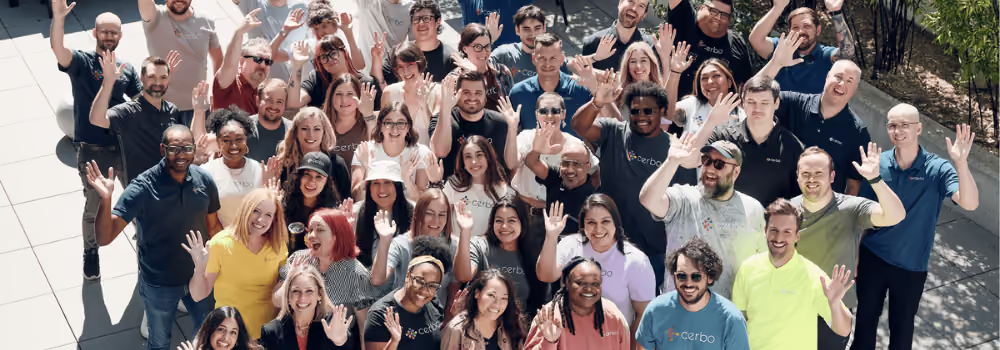


























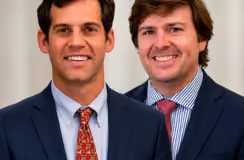




























%20-%20thumbnail.avif)





%20-%20thumbnail.avif)


%20-%20thumbnail.avif)

.avif)




%20-%20thumbnail.avif)










.avif)