[00:00:00 - 00:03:32]
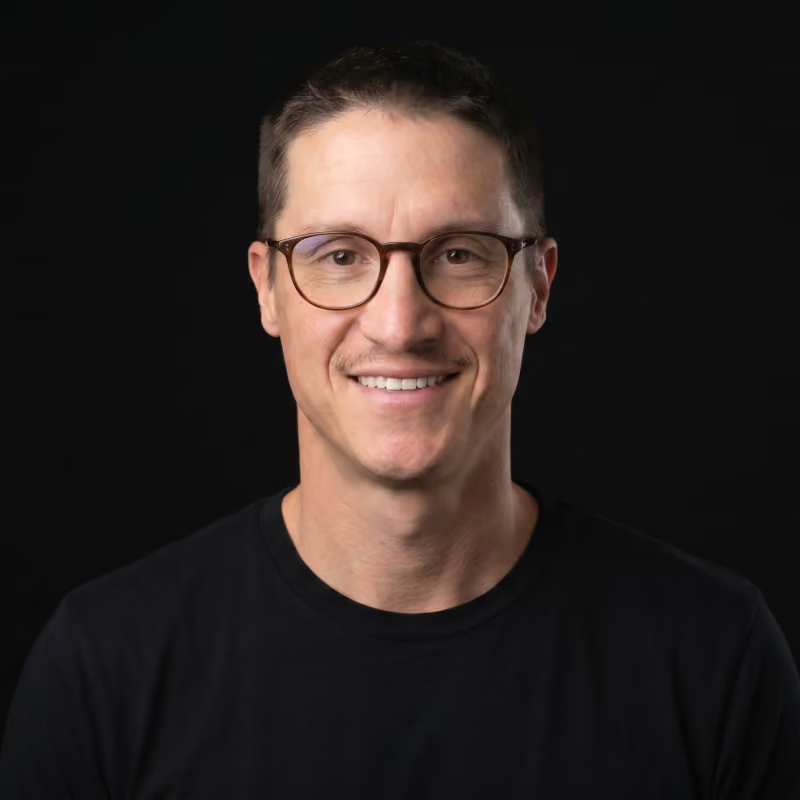
Host: Today's guest found his way to buying businesses not through a podcast or a book, but through Warren Buffett. Sujith Shankar spent 25 years as an automotive engineer, Honda, Fisker, Hyundai, Rivian, and twice watched startup equity evaporate. Most painfully when Rivian's blockbuster IPO put his paper worth at 1.5 million before the stock then crashed. That rug pull sent him deep down the value investing rabbit hole.
Every Berkshire shareholder letter since 1977. 200 hours of shareholder meetings, and it led him to a conclusion. Rather than build a nest egg to draw down, own something that produces cash flow. So about a year ago, Such set out to buy a business.
The first one he found on BizBuyCell, a boutique auto repair shop near his home in Orange county, turned out to be the one he bought. Listen for how he financed it. No SBA loan, but a HELOC from a credit union at a rate 3.5% below what the SBA would have charged. He kept his day job at Hyundai and paid most of that HELOC off within months.
Then came business two a body shop an hour away bought in a 5050 partnership with the seller. Yes, we discussed the risks of 5050 partnerships. It was this second deal that finally prompted Sujith to leave his W2 and step fully into his businesses. Sugit's frame for all of this is explicitly Buffett Circle of Competence Fat pitches Buy high quality businesses and hold them forever.
A mini Berkshire Here is Sujith Shankar, owner of an auto repair shop and a body shop in Southern California. Welcome to Acquiring Minds, a podcast about buying businesses. My name is Will Smith. Acquiring an existing business is an awesome opportunity for many entrepreneurs and on this podcast I talk to the people who do it.
Longtime Acquiring Mind sponsor Aspen HR is now part of Engage peo. Engage helps acquisition entrepreneurs, business buyers like you, take care of their new employees and build trust from day one, whether it's an asset or stock purchase. And Engage provides a turnkey solution for payroll and taxes, hr, admin and technology, employee benefits, retirement plans, workers comp, and more. They're also always a phone call away so you can receive HR guidance from licensed employment attorneys promptly as those inevitable people issues come up.
With Engage managing your people infrastructure, you as new owner of your business can focus on building relationships, operating the business and driving growth. To learn more, contact Jenny thier directly at jth j t h e a r@engagepeo.com or click the link in the notes. Sujith Shankar welcome to Acquiring Minds.
[00:03:32 - 00:03:37]
Guest A: Thank you all. Thanks for Having me over. Longtime listener, first time caller, I guess.
[00:03:38 - 00:03:58]
Host: Well, Sujith, you are a mid career engineer who began building a mini Berkshire Hathaway about a year ago. You started with an auto repair shop and an auto body shop. We're going to hear about both of those businesses. Let's get right into it.
Some background on you, please to begin. Sujith.
[00:03:59 - 00:05:10]
Guest A: Yep. Thank you. Will, my background, I was born in India, moved here in my early 20s and I'm 46 now. So I've spent more than 50% of my life in the States.
Spent 25 years in corporate America, almost all of it in the automotive world, mostly working for car companies. And from a personal side, I have, I'm married, I have a 15 year old son, Sammy and hobbies? Do a lot of mountain biking, cycling and such. I live in Southern California.
It's beautiful weather all the time, so allows me to do my, my sports. They were, they were the, the path that led me to eta. We can touch more on it, but was there were a couple of catalysts in my life that really got me down the rabbit hole of entrepreneurship, financial freedom, ETA and such. So I can touch on it a little bit down the road.
[00:05:10 - 00:05:21]
Host: Let's do that. But just quickly to get a feel of your resume. Not the play by play, but just rattle off the names of all of the big automakers that you've worked for, which we'll recognize.
[00:05:22 - 00:05:59]
Guest A: Sure. So in the mid 2000s I worked at Honda Research and Development. Later on I worked in a couple of hot startups, Fisker Automotive. Back in the day they were comparable to Tesla.
And then almost 50% of my career I spent at the Hyundai Motor Group, the Korean conglomerate. And then I also worked at Rivian, which is another hot startup now doing great things. So almost 80% of my career is within the automotive OEM market base.
[00:06:00 - 00:06:07]
Host: And all of this personal wealth building would have been moot if you had just chosen Tesla instead of Fisker way back then.
[00:06:08 - 00:06:10]
Guest A: Yes, very painful.
[00:06:10 - 00:06:12]
Host: Sorry. Picking at an old scab.
[00:06:14 - 00:06:15]
Guest A: Okay, yeah.
[00:06:15 - 00:06:24]
Host: So what were a couple of these inflection points in your own thinking about building generational wealth that happened to you in your corporate trajectory?
[00:06:25 - 00:09:06]
Guest A: Yeah. So there were a couple of times in my career where I worked for these hot startups I mentioned where I had a really, really good stock package, RSU package, and the first one was at Fisker Automotive back in 2010, 2011 time frame I had 120,000 shares of Fisker. They were all set to go IPO and you know, do the math. If they'd gone IPO for 10 bucks a piece, that's $1.2 million.
I was very ecstatic that, you know, something or the other is going to work out. And then they never went IPO because they had financial trouble. So that was very painful. I exited that and wanted stability in my life.
No longer wanted to be a part of startups, so that, that was the first one. I went to Hyundai at the time and then got the stability I was looking for. But then that bug in me about the IPO and RSUs and I'd missed the boat on Tesla. I had many opportunities to go to Tesla, as you alluded to earlier.
And Rivian happened back in 2021. So I went to Rivian right time, right place and the company went blockbuster IPO at that time, it was the largest IPO recorded in the US history in 2021. And my paperwork at that time was about $1.5 million because of the IPO when the stock peaked. But then within the next 12 months or so, everything crashed and burned.
The stock really wasn't worth much and it hasn't since recovered. So that was again very painful. And the inflection point you were referring to was. So those were some of the inflection points in terms of achieving the financial freedom.
And then it never materialized. The other piece of the inflection point, what I call the catalyst, was I mentioned about Rivian and I was a great part of the team that launched the Rivian truck and the suv. Spent most of my time at the factory in Illinois working 12 hour days and dedicated all of my career to Rivian. And then one day there was a mass layoffs and I was affected as a part of the layoff.
And that was really the catalyst for me that I really had to take a couple of steps back and evaluate what I'd done and how to go about it. And so I can touch more.
[00:09:06 - 00:09:23]
Host: Well, yeah, because that was a seminal moment in your thinking. Yeah. Well, how did you ultimately process this, that you had given so much of your life to this place, this cause almost. And then.
And then suffered a big bit of a rug pull.
[00:09:23 - 00:11:40]
Guest A: Yeah, so that's a good term, rug pull. That's exactly how I felt. And I, I had a month. I was pretty confident that I'd either be able to go back to my old job at Hyundai or I'd be able to find something given my skill set.
So that wasn't a concern. I also had the financial cushioning, if you will. So I wasn't concerned financially either. Plus I got a huge severance package from Rivian as well.
But that gave me the leisure or the luxury to take a month off, really ponder through what I wanted to do with my life. And also at that time, I really decided a very simple idea that, you know, I don't want anybody controlling my destiny. I should be in a position to always control my destiny. That was a very simple idea that came to me.
And then I started off a little bit with, you know, maybe the path to financial freedom was real estate. So I studied real estate quite a bit for a couple of months and then quickly arrived at the conclusion that it's not for me, it's not as lucrative as we think it is, partly because of the market conditions at that time and a few other things. So then for the last 10 years or so, I have been following value investing principles, mostly from Warren Buffett, but I was following more superficially, just basic ideas, nothing too deep. And that's when I concluded after my Rivian exit that I'm going to go back into the value investing principles, really break down the fundamentals and started with reading Intelligent Investor from Ben Graham and then just went all in on the value investing Buffettism and principles and read every single shareholder letter, 200 hours of shareholder meeting, listening to it.
And then I've read every single Buffett book I can, every interview I could. So that really, within six months or so, my knowledge started to compound. So did my, did my stock portfolio.
[00:11:40 - 00:12:09]
Host: Okay, let me hold on a sec there, Sujith, wait. So all of this, this Buffett deep dive is after the Rivian debacle. So in, in 2022, call it or three, 2023. Okay, and so it, and so separately, if one wanted to read slash listen to all of Buffett's annual letters, it's two, it's 200 hours of listening.
I've, I've never under quite understood the size of the, the corpus there.
[00:12:10 - 00:12:49]
Guest A: So the, the, the Buffett letters, I read them on the Berkshire Hathaway website. Each letter is about 20 pages, give or take. I read them all the way from 1977 to 2025 or 2026. The 200 hours I mentioned is the shareholder meeting.
So if you go to buffett.cnbc.com, you have the shareholder meeting that's only available since 1994. Okay, so I listened to six hours of shareholder meeting at times. You know, 30 years
[00:12:51 - 00:14:14]
Host: looking to secure an SBA loan to buy a business. Meet Pioneer Capital Advisory your go to partner for Sophisticated buyers who want deals closed quickly and on the best possible terms. The Pioneer team has closed more than 100 SBA loans, averaging timelines well below industry standards. Founder and owner Matthias Smith and COO Valerie Stash bring over two decades of SBA lending experience.
Matthias and Valerie have built a team that meticulously works your deal from underwriting to close. You'll have a full bench working on your behalf, sales associates who streamline onboarding, M and A financial analysts who craft investor grade lender decks, and an operations team that manages every step of the closing process with institutional level rigor. Pioneer is not a single person, but your true deal team. Visit pioneercap.com or click the link in the notes.
Okay Sujith. And so if this is going so well, you consider but dismiss real estate now you're public stock investing, you seem to know what you're doing. Why not just carry on? Well, with that, where does ETA enter the picture?
[00:14:14 - 00:15:16]
Guest A: My goal really was to continue in the path of investing, eventually start, I wanted to become a portfolio manager basically. So start my own fund, manage money for friends and family, use the Buffett framework of fee structuring, which is not like 2120 like the hedge funds do. So use the Buffett framework for the fees. And then that's what I wanted to do.
And there was nothing wrong with that approach. All my calculations, the math around it was basically leave my corporate job and then achieve financial freedom. And I was also strictly following the 4% retirement rule. So to answer your question, what led me to ETA is during the process I discovered my net worth really wasn't quite there.
I had 60% of my net worth ready for retirement, but I had another 40% to go and I was impatient.
[00:15:16 - 00:15:25]
Host: And so just, just for the audience, the 4% rule. Define the 4% rule and, and, and how it, how you were falling short of it at this time.
[00:15:25 - 00:17:35]
Guest A: The 4% rule is a simple math where you have a net worth and then you withdraw 4% of that year after year after year in perpetuity. And you should technically never be able to run out of money and the 4% you withdraw will be able to pay your expenses. So for example, if you have a 2.5 million net worth, you can withdraw 100,000 each year and then you should be able to pay off your expenses for the year. That's the calculation I had in mind.
I needed about 2.5 million. I was about 60% there, but I needed 40% more to go. And I was very impatient to sit and work in Corporate to achieve that 40%. So that's where, plus a lot of it was my 401k as well.
So I knew that I won't be able to withdraw that until I'm 59 and a half years old. So that was another piece of the puzzle. So during the process of just thinking and reading and researching, it occurred to me maybe the answer here is not really achieving a nest egg. And you take the pieces of the nest egg to pay for your expenses, but own something that produces cash flow, that pays your bills and more.
So that's where I arrived at the ETA conclusion is buy a business that produces cash flow. Buffett also does that, as you know, he buys private companies for the cash flow, takes the cash flow, invests in the market, stock market, he gets the insurance premiums, invests in the stock market. So he kind of the capital allocation works that way. So that's how the ball got rolling.
And then I started to think about what kind of businesses, how much cash flow, what would it take for me to really what kind of debt. And that's how really the ball got rolling for eta. I hadn't discovered at that time your podcast. So this was July, August of 2025.
[00:17:35 - 00:17:40]
Host: What did all the parameters of your goal then look like when it, when it really crystallized into a plan?
[00:17:40 - 00:19:59]
Guest A: Yep. So before, before really looking into eta, I kind of reverse engineered a little bit of what I wanted to do in terms of what kind of business did I wanted to buy. I didn't want her to go just blind into the acquisition entrepreneurship space, thinking, oh, whatever comes my way, I'm willing to buy. That wasn't the case at all.
I first thought, what's in my circle of competence? What is something that I really know and enjoy? And that's something that has sort of a recurring revenue nature to it and something that's disruption proof relative to AI and China competition, Amazon competition, various other market forces. And I concluded that at that point the answer for me was very simply something in the world of automotive services, essentially services business, I concluded that was more or less less prone to disruption compared to E commerce business or SaaS business or something like that.
So this was me navigating everything on my own. So my assumptions could have been totally wrong, I don't know. But that's how I concluded service businesses. And then I went into auto services business.
And then I started looking at. I didn't even know biz by sell existed. I just googled it. I said automotive businesses for sale.
And then I came across Biz Buy Sell clicked on the link. I found a company in Orange county, where I live, South Orange county. And then I looked at the financials that they shown in the ad listing on Biz Buy Sell. The company was on sale for $900,000 with ste of 300k.
So that for me, just looking at that, oh, okay, if I were to spend $900,000, I can get 300k, which was more or less within the ballpark of my total compensation in my corporate job. That really was exactly what I was looking for. And the math made sense to me. And that's when I went down.
That took a deeper dive into that business, essentially.
[00:19:59 - 00:20:26]
Host: Okay, but the idea was not just that you would replace your corporate income, Right? I mean you were, let's say you bought that business, which by the way did that very first business that you found on Biz Bicell. You over time presumably were going to want to be, be generating more than three more than just replacing your salary. Right.
It, I mean this be, this was, this was to become an entrepreneurial project where you grew a business. Right? Or not.
[00:20:26 - 00:20:27]
Guest A: Yep. Okay.
[00:20:27 - 00:20:27]
Host: Okay.
[00:20:28 - 00:21:57]
Guest A: Right. So that's exactly right. So my goal to clarify wasn't just to buy a business. So, you know, it's a replacement for my total compensation, but it more so gives me the financial resources and then gives me the time, which was the most critical thing.
Gives me the time to really go in and do what I wanted to do, which was really have a holding company of my own. And basically you touched on it, Mini Berkshire. That was my goal. Right.
What if I buy like Buffett says, buy high quality businesses over time and then have them as a part of your portfolio. Right. So that's what I wanted to do. I was agnostic to the industry over the course of time, but for now I was very much determined within the auto services business.
So for me the critical thing was the lack of time because of my demanding corporate job. I just didn't have the time to really do all the research. One of the things that affected me significantly was also at my job at the Hyundai Motor Group, we decided to go back full time into the office. 40 hours, 8 hours a day, 8 to 5 grand pre Covid work hours, hybrid, remote, was all gone.
So that took significant portion of my time away from my investing endeavors. And that was not okay for me. I felt like I was losing an edge.
[00:21:57 - 00:22:34]
Host: Okay. And so to be clear, just on your chronology, the Rivian, you're at Rivian, when it goes public, stock surges, then collapses. Your net worth surges, then collapses. And that's when you say to yourself, I need autonomy here.
And then you do your Buffett deep dive rabbit hole. And then you go back to Hyundai where you had been employed earlier. So when you actually buy your first business, you're working in Hyundai. I don't think we had filled in that detail.
Okay, great. So let's, let's hear about this, this first business, the, the one you saw on. On Biz by Sell, please.
[00:22:34 - 00:25:11]
Guest A: Yeah, so this was a very first, like I said, I Google searched it, came across this listing. I looked at the business. The price point was, you know, acceptable from a risk appetite standpoint. As a newbie, I didn't, didn't want to go buy a four, $4 million business, take a lot of risk.
So the $1 million ballpark is what I had in mind. So if this was 900k, which was totally acceptable for me, and I reached out to the broker, very good people, they sent me all the information. They sent me the P and L tax returns, everything I asked for, they sent it to me directly. And I looked at the P and L didn't look very appealing to me, primarily because they weren't making a lot of money.
So I just looked at it. I'm like, okay, not for me. Moved on. I found another business.
This was in a place called San Clemente down in South Orange County. Beautiful place. Went down there, checked the shop. This was a little bit smaller.
$600,000 shop. Looked at it, did not like it at all. There were many things wrong with the shop. Didn't feel comfortable.
On my way back, it just occurred to me, hey, the first business I looked at, it's on the way. Let me drive down the shop and look at what's going on with that. I drove down the shop. It was in a fantastic location.
The shop looked really nice on the outside. A glass building and everything. Not like the conventional repair shop you think of. So on my way back, I'm like this, everything checks out.
Why aren't they making a lot of money? So came back and then a couple of days later, I opened up the P and L again. And then they had marked up a few things on the P and L. Well, I have an NDA.
Well, so I can't reveal a lot of the details, but I will speak in general terms. They're marked up on the P and L for add backs and such. And that's when I was able to really, truly separate the profitability of the company from the revenues and the Expenses. That's when I figured out the company makes decent money and this is acceptable to what I'm looking for.
And then I reached out back to the broker and I said, I'd like to meet the, the seller and go see the shop. So they arrange for me.
[00:25:11 - 00:25:33]
Host: So what you had missed the first time is that there had been that they, you were just looking at their, at their P and L and weren't taking into account all the add backs. Right. Then when you took a second closer look, you saw that there was actually a lot of what you thought were just justified add backs.
[00:25:33 - 00:25:36]
Guest A: And that's a lot of it was justified add backs.
[00:25:36 - 00:25:41]
Host: And so the business was actually profitable. Much more, Much more than at first
[00:25:41 - 00:25:43]
Guest A: glance than I thought.
[00:25:43 - 00:25:43]
Host: Okay.
[00:25:43 - 00:25:44]
Guest A: Yep.
[00:25:44 - 00:26:36]
Host: Great. Was the fact that there were so many add backs concerning, you know, we, we in our world, we. This is a gray area. Small business owners in the US will often send a lot of personal expenses through their business.
And we as buyers and just in the culture, some of that is tolerated. But if it gets excessive or aggressive, it can seem unethical or otherwise. And a lack of ethics is its own negative signal when considering a business acquisition. You know, if a, if a, if a business owner is super aggressive with add backs or with what they're putting through their business, where else might they be cutting corners or behaving in a way that, you know, isn't ideal?
[00:26:36 - 00:28:14]
Guest A: Yeah, it was, it was concerning at the beginning. So I did my due diligence. Even before I met with the seller. I knew a few people who knew more than me about business acquisition and things like that.
So I spoke to them. And also a friend of mine had his brother worked in a bank doing SBA loans. So I called him and I asked him, hey, I have a business and this is the situation. He said, that's no problem.
In most of the cases they see, they do see ad backs and some of it, most of it is justified. So he gave me the assurance not to be heavily concerned about it. But I did my own research and I also used my critical thinking to really see if this falls unethical or this falls within the realm of just normal small business ownership practice, if you will. So I think it fell within the small business ownership practice for me more so than being unethical.
But it was all going to be more or less clear to me when I meet with a seller, during my interaction and during the early negotiation phase. So I kind of hinged all of it on just meeting with the seller, discussing, and if they Comes across where they're not willing to share much information or they're not being transparent or speaking with candor. I was going to walk away from it, so I hinged all on that.
[00:28:14 - 00:28:17]
Host: And none of that happened. You got none of that happened.
[00:28:17 - 00:28:42]
Guest A: These were good, good people. When I met with them, they were pretty. The first time I met with them, the seller was kind enough to meet with me for nearly four hours to sit and discuss everything. He answered every single question about the business.
And, you know, he took all the time to answer my questions, and I felt very comfortable about it.
[00:28:42 - 00:28:52]
Host: Tell us more about the business. You've. You've given us some numbers. If you could repeat those numbers, give us a sense of employee count, age, backstory of the business, et cetera.
Give us a picture here.
[00:28:52 - 00:31:24]
Guest A: Yep. So the business is located. Located in Laguna Niguel, California. Laguna Niguel is in south Orange County.
It's a pretty affluent neighborhood, and the business itself is fairly small. It's about 1.2 million revenue, a little bit less than 1.2. And the business is auto repair services, but very boutique, very specialized auto repair services. Most of the customers coming to the shop are not coming in for AC repair, oil change, brake change, things like that, although we do that as well.
This is mostly three brands combined into one. There's history behind it, but three brands combined into one. Two are mostly servicing European vehicles. BMW, Mercedes, Audi, Porsche.
So in Orange county and especially south Orange county, there's a significant density of luxury vehicles because it's wealthy, affluent. So you can see basically BMWs and Mercedes like Toyota Corollas. So that's one part of it. The second part of it is another brand that does servicing for Mercedes sprinter vans.
I think you've heard about. You've had an episode with the person about sprinter vans. So we are probably one of the top two in Orange county for sprinter repairs, which is really a complex repair. It's diesel.
Sprinters are notorious for having reliability issues. So that's where the moat for us comes from, is we specialize in repairing them. So also the other component, just the demographic side of things. Orange county also has.
In most of the US Sprinters are just commercial fleet. These H Vac companies and plumbing companies owning sprinter vans to, you know, carry their equipment. But in Orange county, actual, you know, people own sprinter vans. Consumers own sprinter vans because they go camping, they use them as, you know, their camper vans all go off roading and do things.
So there's a significant three or four times more than national average of Normal people having sprinter vans. So they are the ones bringing it as summer picks up they want to take their sprinter van out for to do outdoorsy things. So they bring it to our shop to get things fixed. That's how it works.
[00:31:24 - 00:32:25]
Host: Okay, so a differentiated repair shop, high end vehicles or European vehicles. A high end shop user experience. You visited it impressed you. That's what caused you to take a second look.
Does about a million to in revenue. You had said earlier that one of your criteria was recurring or recurring ish. This is obviously not recurring but it's. We assume it's reoccurring.
Happy customers come back with their vehicles again and again. So there's a lifetime value to to your customers. You can build on that reputation. Place probably already had a great reputation.
And what of Mr. Rivian, Mr. Fisker? What of the whole EV seismic change happening in the automobile market.
Anytime I have somebody on who bought a who who's bought an auto services business, it's obvious question to ask. Give us your your response.
[00:32:27 - 00:34:51]
Guest A: I think the the shift is going to happen. I think I'd be lying to myself if I say the change is not going to happen. But my calculations are it's not going to happen in the next five years. It's going to happen in the next 15 or so years.
I think the market that the transition doesn't happen in a linear fashion meaning it just doesn't go from internal combustion engines to ev. Although the last three years or so it did look like that was going to happen. It backed off. I think the transition in my opinion and my research is going to happen where consumers shift from ICE to hybrid and plug in hybrids.
Then there's a new technology coming in as EREV which is extended vehicle extended range electric vehicle erev. From there it's going to move into pure battery electric vehicle. To support that theory you also need significant breakthrough in terms of battery technology and in terms of charging infrastructure. Right.
That's what's going to happen. And all of this it's very complex. Buffett says too hard pile. I think it goes into the too hard pile because market forces dictate how these things move.
The price of oil is a big factor. Raw materials for the battery is another factor. So not all car companies can do what Elon Musk did. So that gave me the confidence that I think I have at least a 10 to 15 year Runway and coming in from the public equity world where I thought anything as 10 to 15 times price to earnings ratio was an appealing deal.
I was only talking about a 3pe with a private business purchase. Right. So that was very appealing to me. As long as I make my money back in three years, I think it's worth having the investment because I knew that the electrification is going to be another 10 to 15 year process.
And also you will have, you will still have about 10 to 15 million vehicles, units in operation, as we call it on the street. That still requires servicing and overhaul and things like that.
[00:34:51 - 00:35:33]
Host: Okay, so it's going to take longer than everybody thinks. But even if it happens on a pretty aggressive timeline, 15 years, call it 10, 15 years, there's going to be all the, all the existing ICEs out there are going to need to be serviced for some years after that. But even if that didn't happen, your investment logic was if I buy it for 3x, I get my money back in 3 years and I can enjoy 7 to 12 years of pure cash flow. Even if at, even if worse, worst case scenario, at that point the business loses all enterprise value at year 15, I still will have enjoyed 12 years of cash flow.
Okay.
[00:35:33 - 00:36:31]
Guest A: Right. There's one additional thing I'd like to add that was part of my thought process is to Your point, if 90% of the vehicles sold in the US market are electric vehicles, I don't think there's enough capacity for the dealers to handle 20 million vehicles every year. At that point, small shops like mine would transition from servicing internal combustion engines to electric vehicles. Although there's not much repairs to be done with electric vehicles, there's still battery replacement, you know, other sorts of repairs, tire, tires, brakes, right body creaks and whatnot.
So those type of repairs would still exist in small auto repair shops would transition from servicing ICE vehicles to electric vehicles. That's another opportunity that may happen as a part of the entire EV transition.
[00:36:32 - 00:37:54]
Host: Buying a small business sounds simple. Find a company, due diligence, get a loan close. In reality, you wear every hat just to get the deal done. And then the moment you close, you have to throw those deal making skills out the window and learn how to operate.
You shouldn't have to rebuild this infrastructure from scratch and you definitely shouldn't do it alone. That's why Walker Deibel created Acquisition Lab, which started as an accelerator, has expanded into a complete ecosystem for acquisition entrepreneurs. Over six years, the lab's 1,200 members have acquired over a billion dollars in businesses. The lab puts everything under one roof.
An active community deal reviews, post close services and a dedicated fund helping experienced operators buy larger businesses. If you're serious about Buying a business. Come see why lab members have a 40% success rate. Learn more in the show notes or@accentlab.com acquiringminds Back to the business itself, you said 1.2 million.
How are margins in a business like this?
[00:37:54 - 00:38:27]
Guest A: So given that this is in an affluent neighborhood, this is dealing with high end vehicles, sprinter vans combined, right. The margins are great. Anywhere between 25 in a good year you can go up to 27, 28% margins. That's primarily because of the competitive advantage we have relative to doing very complex repairs and sprinter vans and such.
So the margins are great. Can't complain about that.
[00:38:27 - 00:38:54]
Host: So quick math. 25% of 1.2 is the $300,000 that you had said you'd seen listed on the biz buy sell listing way back at the top. Okay. And so your plan here was to then if it was going to replace, effectively replace your salary.
Although actually the are you buying it with an SBA loan? Is that $300,000 coming out of the business or is half of that going to the SBA loan? What does the structure look like?
[00:38:55 - 00:41:42]
Guest A: So the structure. So again Will, I wish I had discovered you at this point, but I haven't. So at this point I'm still running blind trying to figure out how am I going to make this work. And I did have a decent market portfolio, about half a million dollars or so.
So that wasn't an issue. And I didn't want to take all, all my stock market portfolio interrupt compounding and then put them into buying a business that I didn't know may or may not work out. So that was too risky for me. So the way I kind of did this was I come from again, the Buffet ism, where debt for me is not a very leverage.
As you know, probabilistically speaking, leverage is the number one cause of any business to fail. So I kind of came from that notion where I don't want to have a lot of leverage. A little bit is okay, but not a lot of leverage. So what I did was I kind of structured in a way where I was willing to put about 3 to 400,000 of my personal wealth and then I was going to demand a seller note for two reasons.
One is to fill the gap financially. Two is to have some skin in the game. And now I was left over with another 400 or so K to buy this business which I didn't know what to do with. So this is where a few things came to mind.
My wife actually gave me a great idea that what if you do refinancing against our home. You know, homes in Southern California, fairly expensive. We had a $1 million plus equity in our home, but I had a very low interest rate, a 2.1% interest rate against my home. So I was not on board in refinancing to a 6 or 7%.
That's a very dumb decision. That's when along the process, I figured out heloc. HELOC was an option. I'd read about HELOC some time ago, then looked at it, and I realized that if I were to get HELOC, I can still keep my 2.1% mortgage rate and just refinance it against my equity.
And I wasn't refinancing all my $1 million equity, putting everything at stake. I only wanted $400,000. So that's how I kind of came. Filled the gap is 300 to 400k personal wealth, seller note, and HELOC to fill the gap.
[00:41:42 - 00:41:44]
Host: And so the. The seller note was about a hundred
[00:41:44 - 00:41:48]
Guest A: thousand, seller Note was about 120,000. Yeah.
[00:41:48 - 00:42:07]
Host: Okay. Into the HELOC. So the HELOC allows you to take equity out of the home, and that, of course, then becomes principal back onto your mortgage that you pay at the same rate that your existing mortgage is at.
[00:42:07 - 00:43:53]
Guest A: Yes, correct. So my mortgage rate, the 2.1% primary mortgage, is going to stay as is. The HELOC will be the new rate. So it'll be the new rate, it won't be the old rate.
So just to add another clarification here. Well, was. I knew about SBA at that point, and I'd spoken to the gentleman I mentioned who worked at a bank with sba. I'd spoken to him.
The issue I had with SBA was at that time, it was prime plus 2%. So essentially the prime was at 7.5% plus 2%. So I was looking at a 9.5 to 10% interest rate with NSPA loan and with HELOC, I also figured out this is good. Maybe your audience knows this, or they may not, but going through a credit union for HELOCs is significantly cheaper than any other place like JP Morgan or US bank or something like that.
So I discovered during my research process. So I went to a local credit Union. As for HELOC, they gave me a 6.6%, 6.62% HELOC rate, which was about three and a half percent cheaper than getting an SBA loan. And my thought process was, if I were to get an SBA loan, they would get a lien on my home anyway.
So I might as well just bypass that and just go with the heloc, which is going to be a lien on my home. But I'm not borrowing significant amount of money. So if things were to go south, I would still have my job to really pay off the loan. Okay, so that was my thought process.
[00:43:53 - 00:44:00]
Host: Okay, great. All right. So your plan was to keep your job then at this, at this point, keep the job?
[00:44:01 - 00:45:20]
Guest A: Correct. It was, it was a very simple math. Again, I had borrowed $400,000 against my HELOC. And you know, even though I did quite a bit of due diligence and had very high conviction with this business, I wanted to make sure there are no skeletons hidden in the closet after my purchase.
So I just didn't want to leave my job and the security of having a job and the pay. So I wanted to make sure that I at least have a six month, six month to a year overlap between my, my job and the business. So I checked with the seller that if I were to continue with my corporate job, can things run on its own. And the seller told me that it's been running like that for the last five years because he's been mostly absentee.
He comes in for half hour every day and that's about it. So he lived 10 minutes away. We come in 30 minutes a day and then leave. So he said that's no problem.
So that was great for me. So my thought process was I kind of keep my job for security as well as, you know, double dip on the profits plus the salary and then use that to pay off my heloc. That was the thought process. Faster.
[00:45:20 - 00:45:25]
Host: How much exactly did you envision being involved in the business while keeping your Hyundai job?
[00:45:25 - 00:47:32]
Guest A: Absentee ownership is not for everybody and it's potentially pretty dangerous in many cases. In my case, I think one of the things I mentioned about Mini Berkshire earlier and things like that, what I envision with my ownership of a business is really my strength really lies in business valuation, capital allocation and things like that. That's what I enjoy the most and that's what I'd like to pursue for the rest of my life. Operating a business is, you know, I know it's necessary, but not my strong suite.
That's why I look for companies where, you know, I want it to be turnkey. And then for the most part, I have competent people. I ensure there are competent people to run the business. I did stress test this during my due diligence process that how much of this can be can the business operate on its own?
Are there competent people, how they can do it? So I really went down deeper into that aspect because my goal wasn't there to go in and tell the technicians what to do on a daily basis or if they're stuck with the problem, to help them figure out the problem. That wasn't my strong speed. I am an introvert, I'm not a salesperson.
So my goal is never to pick up the call and answer customers questions, although I've done that. But that wasn't my strong suite. So I played knowing my weaknesses, strengths and weaknesses. I played it accordingly.
So in addition to that, coming from the automotive industry, I knew that I had layers of safety margin in terms of if something were to go wrong, I had the right people, I had my connections to bring in and operate the business. I knew managers, I knew people who were service advisors and you know, service managers who'd worked before. So I knew them how, how to bring them in place and let them operate my business as, as a, as a backup.
[00:47:33 - 00:47:34]
Host: As a backup.
[00:47:34 - 00:47:35]
Guest A: Well, this is if something.
[00:47:35 - 00:48:12]
Host: Yeah, I think I've only heard that that approach a time or two and from all my guests where the way of de risking key man risk in a small business is to, is to have people in your network available or hopefully available or at least have talked to them about their interest in stepping in and becoming your employee if the existing key man or key woman leaves or doesn't work out or what have you. And so that's exactly what you did. But just before the piece before where you also diligenced the people at the business, how did you do that? What did that diligence look like?
[00:48:12 - 00:50:21]
Guest A: I didn't diligence to people. That's a topic I will quickly share. The seller was very secretive about it. He didn't let me meet with employees and all my conversation was with the broker and the seller.
But I found ways to really stress test this by asking the same question different ways, really pushing the limits to get a truthful answer from them as to whether or not this can be operated, you know, absentee. So I had a really, as we progressed towards the due diligence and the final stages, I really had a really candid conversation with the broker and I explained to him what's at stake for me and I wanted his opinion. As we know, not all brokers are, you know, I don't want to generalize it, but I think you get the gist. Brokers, you have to take them with a grain of salt.
So in this particular case, the broker was fairly genuine and he was honest and he gave me his full take. And he assured me that at least for six months to a year, me being absentee will not be a problem. And he told me that don't do this for the longer term, but six months to a year should be okay. And the seller also offered me support that he's willing to come in and fill in the gap as necessary.
He lived 10 minutes away, so he was also going to come in and fill in the gaps. So that was. That gave me the confidence to really say. And I was.
The intention was never to be true absentee. Well, the intention was only to be semi absentee because my goal was to really start my day early at my job, leave at 4, 4:30, and then head straight down to the business and then be there for hour, hour and a half every day. So I will still be at the business. I knew end of the day what the day looked like, what did we close, what repairs were done, what the financials look like and such.
[00:50:21 - 00:50:22]
Host: Great.
[00:50:23 - 00:50:23]
Guest A: Okay.
[00:50:23 - 00:50:28]
Host: And so you were envisioning five to seven hours a week in the business.
[00:50:28 - 00:50:28]
Guest A: Correct.
[00:50:29 - 00:51:19]
Host: But keeping your day job. Just a personal question. You know, we heard you say how you poured yourself into Rivian and that, you know, you were, I guess at the plant that, that produced the trucks and SUVs. Did I hear you say?
And, and you know, that was. Sounds like it was very meaningful work. And you're, you know, you're. This one company is pushing forward the entire automotive industry like a, like a Tesla one.
The layperson might be more familiar with Tesla, but of course Rivian is also a huge name. Anyway, just the fulfillment piece or the mission piece. Was there any part of you that felt that he was losing something by going from that to running, running, owning a small business?
[00:51:23 - 00:52:32]
Guest A: Not really. I think when I, when I poured my, when I gave my sweat equity to Rivian. Right. You know, I have no hard feelings or anything like that.
Rivian is a great company. I may still buy their product. They make fantastic products. It just felt like for me, the theory or the process was I put the equity in the wrong place.
I gave my sweat equity to something that didn't financially help me, nor it helped me in my career process. Right. That's when I realized moving forward, all the equity I'm going to put should be towards myself. So that was really.
How do I achieve that was essentially doing something on my own where I put all my. I'm a very focused person when I go in on something, I really go in on something. Right. And that's how I decided that my focus moving forward should really be towards building my net worth generational wealth and, you know, having fun along the process.
[00:52:32 - 00:52:33]
Host: Right.
[00:52:33 - 00:52:34]
Guest A: Where I have a lot more control.
[00:52:35 - 00:52:44]
Host: Okay, tell us quickly how the transition goes into business. Number one, is it all as smooth as you had hoped?
[00:52:45 - 00:53:50]
Guest A: So I've heard almost all of your podcasts. Well, and I think this is fairly, I would say compared to some of the stuff I've heard from your guests, this was a fairly smooth transition. I'm not going to lie. They.
I did have a quasi fetal position moment the first. About three days before I took ownership of the business, the seller finally introduced me to the manager of the business. I took him to a nice restaurant to meet and greet. I thought it was going to be exchanging ideas, what my vision is, how do we go about this, all that.
I was completely blindsided. Five minutes into the conversation, we meet and greet. And then he gives me the download that the employees wanted to buy the business. They were never given a chance and they are pretty pissed about it and they don't know what's next.
The employees are thinking about quitting. The manager is thinking about quitting. And he tells me, nothing against you, you're a nice guy, but this is not an acceptable situation.
[00:53:50 - 00:53:51]
Host: Wow.
[00:53:51 - 00:55:17]
Guest A: Right. So that's why I say quasi fetal position moment. But I'm a very stoic person. I can problem solve my way into most problems.
So I calmly sat down and listened to what he had to say, gave him his time, and then I told him, look, you know, I don't know what happened. I don't, I don't have control on this situation. If you're willing to work with me and give me a chance to be the new owner, I'll take care of you guys. I said a very simple thing.
I'm not trying to get rich off you, I'm trying to get rich with you. So I said, if you do well as a business, I'm willing to take care of you. And I stand by my word to this day. So it took about a good two hours of back and forth.
And then towards the end of the day, he told me he's going to give me a chance, you know, he's going to really evaluate the situation, give me a chance to see if I really stand by my word. And then they're going to go from there. And he went and talked to them. The manager went and spoke to the employees and told the employees that, let's give this new guy a chance.
So the first couple of weeks I went into the shop, there was definitely quite a bit of, you know, awkwardness, anxiety and animosity all in, you know.
[00:55:17 - 00:55:19]
Host: Did you feel hostility directed toward you?
[00:55:21 - 00:56:24]
Guest A: No, I did not. I knew from the get go that I was dealing with very high quality people. These are good people, very high quality people. They were just hurt.
And, you know, I'm not trying to blame the seller either. They both had their point of view. And this is something I think for most ETA entrepreneurs, they're going to encounter this situation, which is the employees always think that they can own and operate a business. The seller's point of view here was just because you're good at something doesn't make you a business owner.
Business is a lot more complex. You need to be a Swiss army knife. You need to know finance, capital allocation, you need to know, you know, how to talk to customers, Sales and marketing, all of it. Right.
So that was the seller's point of view. Just because you're good at fixing cars doesn't make you a good business owner. The employee's point of view was we gave our heart and soul to this business and we could have totally done this, but we didn't get a chance. That was their point of view.
[00:56:24 - 00:56:32]
Host: In some ways. There's an interesting parallel to they felt rug pulled as you had experience feeling, correct?
[00:56:32 - 00:58:01]
Guest A: Yep. Yeah, yeah, absolutely. Yeah, they did. And I felt very empathetic towards them because these were very high quality people.
Not just as human beings, but they were also really high skilled people. And they, they could have, you know, really the skills they had. They can find a job anywhere. So for me, that was very important to make sure that I make them happy.
I keep them motivated and engaged in the job. So first couple of weeks was, like I said, awkward. And a lot of the awkwardness actually came from the fact that the seller stayed with me in the shop for the ownership transition. So every time, say, they saw his face, you know, they would really not be so happy.
So that's where it came from. And I recognized that all the hostility coming is not towards me, but towards the situation and towards the seller. And it was in my best interest to really separate that situation where after a couple of weeks I had to actually the seller wasn't willing to leave. It was this baby.
You know, baby boomers tend to get emotionally attached to the business. And he wanted to kind of like stay for another couple months or so. So I had to tell him, I think I got this. Please, you Know, relinquish yourself.
I did it strategically, but I had to tell him, you know, there's a lot of animosity here.
[00:58:01 - 00:58:10]
Host: He was. He wasn't bothered by that himself, going in every day and feeling. Feeling the bad vibes from his once loyal employees.
[00:58:11 - 00:58:40]
Guest A: Yeah, he was indifferent to that, or he never saw it because he'd come in and lock up himself in the office. So he never got to see them. So that was maybe, you know, not seeing them probably helped him. But end of the day, I witnessed the animosity where every time he was in the office, even though he wasn't interacting with them, I could see the animosity.
And for me, it was very important to really put an end to that and have a fresh start.
[00:58:40 - 00:58:49]
Host: And so were you able to accomplish that? He stopped coming in the employees. You did ultimately earn the trust of folks.
[00:58:50 - 00:59:41]
Guest A: Yes. So after a month, I gave my employees, because they directly started asking me, you know, why is this person coming in? You know, I don't think he should be in the shop. So it got to that point where I had to eventually tell my employees that I need him for about a month since purchase to really transition everything.
And then after a month, I will request him not to stop by the shop again. And that's what I did. And then, you know, again, you know, my intention is not to be cutthroat, but I told the seller, you know, you're welcome to stop by anytime. This is your baby.
And we're willing to, you know, bring you a car, and we'll service it at a discounted price. We'll help you out as much as we can. But coming in and sitting in the office and going through the financials or my computer is not acceptable. He was doing a little bit of that, too.
[00:59:42 - 00:59:43]
Host: How'd he take that?
[00:59:43 - 01:00:44]
Guest A: He didn't take it well. He did express his disappointment in many ways. But I communicated a little bit through the broker that this is a situation we're in, and I have to put an end to this. It's not personal.
I'm not doing this on purpose. I really value the sellers, you know, rather the friendship. Plus the relationship we had during the purchase process and post purchase, I value all of that. I'm still friends with him.
We still meet. He still comes to the shop. But I told him that. I told work through the broker to communicate that the dynamics are not what the seller thinks it is.
It's a lot worse. Therefore, it's in our best interest for him to relinquish everything and Move on with our lives. He didn't take it well, but I think he's over it now. He's back golfing now, so everything's good.
[01:00:44 - 01:01:32]
Host: Well, as you said, and as we always hear, the businesses or the babies of their boomer or any owner doesn't necessarily have to be somebody who's a business owner, but particularly somebody who's probably who's at retirement age and who has built a business over many years and for whom this exit is their last professional act. There's. There's a separation there that is emotionally heavy and complicated for them, so. Which I'm sure we'll all experience when we get there.
Okay, Sujith, we haven't heard about your second business, and a couple of the plot turns along the way. Let's hear about that one.
[01:01:33 - 01:04:14]
Guest A: So I think I'll preface this, Will. You know, I've heard a lot of your podcasts and you've touched on it many times, that a lot of owners think buying a business in a session is not the wisest thing to do because why don't you buy one business, get the grip on the business, understand it, own it for a while before buying the second business. I didn't dismiss that advice at all. It was more so my thought process was the first business turned out more or less to my due diligence.
You know, it was turnkey, as the seller said, there were no major skeletons in the closet other than the situation I earlier described with the employees and the seller, there weren't many. There's ebbs and flows in the business, but there weren't many challenges. It's a fairly good business and it's, it's doing well. My thought process was the.
Given that it took me about seven months to close my first business, I thought, you know, that was a standard process for any business. You know, you start looking at something and then it's going to take seven or eight months. And then the second business, I wanted to do an SBA loan, and I knew that SBA loan is a very slow process, so I just started to really kick the tires. That's what, that's what I was trying to do is I wasn't.
My goal wasn't to go buy another business right in six months after buying the first one, I was looking at many different options and I wanted to diversify a little bit. Maybe another auto repair shop was okay, but you know, something else, a slight diversification, you know, in case my theory about electrification and everything comes true down the road. I wanted to have Another plan. Plan B.
Right. So I was looking at H VAC and plumbing, and I talked to some of your guests on the show about H Vac and plumbing, and I was warned that it's extremely cutthroat and competitive and you spend. I spoke to Doug Johns. He was very kind to me and he actually educated me on some of the current situation with private equity involvement and many different things.
So I kind of decided to put a hold on the H Vac and plumbing side of things for now and then started to look into very fragmented businesses. Something boring and unloved and hated by everybody. Right, but
[01:04:16 - 01:04:19]
Host: that's a Mohnish para, I think. Yes.
[01:04:19 - 01:06:05]
Guest A: Yeah, okay. Unloved and hated. So I was looking at something very unloved and hated, but they were few and far between. So I did find a body shop business.
It was again in the $1 million ballpark. And then I reached out to the seller. Over the Memorial Day weekend, I went and met with the seller. This was a little bit outside my neck of the woods.
This was in Inland Empire. If you're not familiar with Southern California, Inland Empire is the inner part of la, which is about an hour inside of our east of la. So a lot of traffic going in that direction. Densely populated.
So this was an inland empire. Went to, met with the seller. I had a great conversation. I knew something right off the bat that there was a lot of similarities in our thought process.
And, you know, we could bring some synergy. Even though I was buying the business from him, we knew that there was something special here. We met for again, three to four hours, discussed a lot of things. And the seller's criteria was.
I asked him why you're selling. He was selling the business to relocate to Spain, so the island of Mallorca, to be specific. And he's a computer scientist who owned a body shop. So he's built many software companies, sold them, and he is a very private person.
So he owned a body shop because he knew that body shop are notorious to have good cash flows if you do it correctly.
[01:06:06 - 01:06:26]
Host: And sujith, just for the uninitiated, contrast a repair shop with a body shop. Anybody who has a car probably knows the difference, but tell us the. Define the difference there and then, and then give us kind of the pros and cons of each as a business. What's to like and dislike about each because they are often lumped together.
[01:06:26 - 01:08:55]
Guest A: I think most of your audience, general audience, would know the difference between a repair shop and a body shop. Repair shop is just maintenance and Service on your vehicle, repairs to engines and such. Body shop is when you get into a collision. When you get into an accident, you go through your insurance company or your customer pay to get your vehicle fixed.
Your bumper comes off, your bumper's damaged, your body's damaged, frames damaged and such. So this was heavily in my circle of competence, more so than the auto repair business because I am also a mechanical engineer. Body engineering is my specialty. So that's what I've spent 25 years of my life in.
Although that's more in the research and development and quality side. But I still knew everything from a technical side with the body shop. So that's the difference between a body shop and collision shop. Within the body shop scope, there are two types.
They are DRPs and independent. DRP stands for direct repair program. These are the big players you may have heard of Caliber Collision, Gerber Collision Crash Champions. So they have direct relationship with the insurance carriers.
So when you have an accident, you call the insurance company. By law they're not allowed allow you to tell you where to go, but they can give you choices of where you can potentially go. Okay, so there are anti steering laws that they can tell you you have to go to specific places. So DRPs with insurance carriers, I don't want to generalize it, but it's heavily controlled by the insurance company.
Therefore a lot of customers don't feel comfortable going to DRP shops because they may buy aftermarket parts. It's all about optimizing profits and somewhere customers may feel that the quality is compromised. Independents are basically non DRPs that essentially take the vehicle for repairs. Do the right repairs the correct way and then we still get paid by the insurance company.
But we don't take the approach the DRPs take. It's done with the correct repair procedure. So a lot of customers prefer going to independent because of that. And the law also protects us.
Anti steering law protects us. So that's where the difference comes from. So we are an independent shop.
[01:08:55 - 01:08:58]
Host: And sujith, what about kind of quality of revenue and business fundamentals?
[01:08:59 - 01:09:34]
Guest A: Yeah, the quality of revenue for collision repair shops. Most collision repair shops make definitely a lot more revenue. Probably double the size of auto repair shop because the average repair ticket price is much higher. In an auto repair shop, you come in for a small AC service and a brake job, it's $1,000.
Right. But if there's an accident, your bumper came off. Removing the bumper and adding a new bumper, painting it, finishing it, blending it, all that, that's four or five thousand dollars.
[01:09:34 - 01:09:36]
Host: Repair. Okay.
[01:09:36 - 01:10:20]
Guest A: So the average repair ticket is essentially three or four times more than I would say auto repair ticket. So the quality of revenue is great. And then the process is essentially customer walks in, we just take the insurance company information and then we take care of all the insurance coordination. We talk to the insurance, we submit an estimate, insurance approves it.
And once they approve it, we start the repairs. And then during the repair process we find additional things and then we do those documentation and we send a supplement. It's called a supplement. We send a supplement and then insurance companies typically approve that.
[01:10:20 - 01:10:31]
Host: And so between these two businesses, you know, if somebody were interested in the, in auto businesses broadly, which would you direct them toward or how should they think about it?
[01:10:33 - 01:10:41]
Guest A: I would put it this way. Between a well managed body shop and a well managed auto repair shop, I would buy a well managed body shop.
[01:10:41 - 01:10:43]
Host: And that's because of the higher ticket.
[01:10:44 - 01:11:13]
Guest A: Correct? Higher ticket and higher margins. And going back to our discussion about, you know, secular growth versus secular decline, automotive maybe perhaps over the, the 20 year Runway, it's in secular decline, for example. Right.
But with, with the body shop operations, the only challenge for the body shop operation over time is autonomous vehicles. Right.
[01:11:13 - 01:11:15]
Host: Because they'll get into, they'll get into fewer crashes.
[01:11:17 - 01:12:10]
Guest A: They'll get into fewer crashes. But one can make the argument that in the cars today we have something called adas, Advanced driver assist systems, the sensors and the safety features. Right. So cars are generally safer.
So one can make the argument that body shop may be a declining business because cars are generally safer. Right. But the data shows otherwise. I think Buffett has touched on this through the GEICO operations.
The cars are generally safer, it's true, but because of all the safety features, the average repair costs are significantly higher. Back in the day, when you have a bumper damage, you just replace the bumper and paint it. Now you have to replace the sensors, you have to calibrate the sensors, you have to do a lot more work. Therefore the ticket price is even higher.
[01:12:10 - 01:12:13]
Host: Okay, so it cancels out or roughly cancels out.
[01:12:13 - 01:12:14]
Guest A: Yeah.
[01:12:14 - 01:12:15]
Host: Okay.
[01:12:15 - 01:12:51]
Guest A: And I also think electrification may happen faster than autonomous vehicles, in my opinion. Oh really? Oh, I mean we do have Waymo and we do have, you know, self driving cars. I mean, Tesla FSD for example, is, it's huge.
It's huge. But that becoming mainstream in the next 10 years or so. I don't know about that. Meaning completely driverless cars going through regulatory approvals and all that.
I'm not sure about that.
[01:12:52 - 01:13:10]
Host: Okay, great. Back to the business. Number two, The Body Shop, your owner was this interesting guy who was a computer scientist, had sold businesses, and this sounds like it was an investment for him. It was not something that he was not an acquisition entrepreneur.
He bought this business as an investment.
[01:13:10 - 01:14:43]
Guest A: He wanted something cash flows. I think from what he shared with me, he has a high net worth and then he's set for retirement. But again, net worth doesn't mean much. Right?
It's cash flows. Those are his words. So it's all about cash flows for him. So he owned Body Shop because of the cash flow.
He understood Body Shop business because some of the software work he had done was within the Body Shop side of things. He had developed an algorithm to help with the part sourcing and things like that that eventually got acquired by a company. So that's where he comes from, is he understood the Body Shop operations and he wanted this business for cash flow purposes. Now, going back to how this transpired, I met with the seller and I spoke to him and then I told him, he asked me, how do you plan on purchasing this business?
And I told him, look, I don't have a lot of liquidity at the moment, therefore I would still go through an SBL loan. Right. Um, and remember, well, I mentioned earlier that I wanted to work at my job and continue to get the, the profits from my first business to pay off my. I was very diligent with that.
So I almost paid all of my. Within the four or five month time frame between my pay, my wife's pay, and the. The profits coming from the business, I pretty much paid off my.
[01:14:43 - 01:14:46]
Host: You paid off $400,000 in a few months?
[01:14:46 - 01:15:02]
Guest A: Pretty much, I would say about $300,000. I had about 80 or $100,000 left. And that was a combination of my pay, my wife's pay, and the profits coming from the business. And also diluting my stock portfolio between the three.
[01:15:02 - 01:15:05]
Host: Okay, diluting your stock portfolio, meaning you sold some of your assets.
[01:15:06 - 01:16:16]
Guest A: Sold. Okay. Correct. Okay.
And the reason behind that is, again, you know, I always look at opportunity cost. And the way I determined this was for me personally, I got very concerned about the AI. I don't want to say bubble, but the valuations in the market today and the data shows we may be in a bubble very similar to the dot com bubble. And for me it was more of the A dollar I invest if, you know, I compare it to the opportunity cost.
And I had multiple sources of income streams. If I were to take the stock market dollar, put that into the business, the businesses produce cash flow And I thought, given the AI bubble, it was a superior strategy to take my stock market and pay off against the heloc, which in turn helps me produce more profits from the business, because the money is not going towards the loan. Therefore, I keep the cash flows, because.
[01:16:16 - 01:16:27]
Host: Okay, it makes sense, because. But. And so this is where you arrived, because earlier you'd said you didn't. You.
You. You specifically did not want to interrupt the compounding of your stock portfolio.
[01:16:27 - 01:16:36]
Guest A: Yes, I still regret that. Oh, I still regret that. Because Charlie Munger, Warren Buffett's partner, says the worst thing you can do is interrupt compound.
[01:16:36 - 01:16:40]
Host: Right. Or time the market, which is what you were kind of doing.
[01:16:40 - 01:17:37]
Guest A: Time the market. Right. Yeah. Yeah.
So you're right. But I think again, when I looked at what was a superior strategy, either going through the motion of a market correction and, you know, my portfolio dropping by 20, 30, 40%, or taking that money and just reinvesting in the business and which gives me the profits at this point, I know it's a 25% margin if coming out of my business. So the 25% return on my investment, rate of return was sufficient for me to decide I'm going to take my chances and, you know, dilute my portfolio and go that route. So only time will tell which strategy is correct.
But that's. I felt. You know, probabilistically speaking, I think I felt my strategy was a little bit correct. Only time will tell.
[01:17:37 - 01:17:44]
Host: Great. Well, I just had to press you on it. Okay, so just. So you.
Okay, so you say to. So you say to the owner, I'm not that liquid right now.
[01:17:45 - 01:19:07]
Guest A: I'm not that liquid. I have about 300k, and then rest will be SBA loan. And then he says to me, SBA is too slow. I'm willing to.
I want to relocate as fast as possible to Mallorca. What can we do? And I tell him, if the fastest way you want to kind of sell this business and move on, rather than selling the business, why don't we partner? You know, give me 50 stake in the business.
You keep 50%. I give him the proposition that you relocate to Mallorca. I'll run the body shop for you. So he basically says, nah, that's not.
I don't like that. You know, it gets complicated. Just that I don't want to do that. I said, okay, no problem.
We discuss a few other options. And then, you know, I leave the place. A week goes by. He gives me a call back after a week, and he said, I've been thinking about this what you said.
I think you're right. Partnering may bring a lot more synergy. You come from the body, technical side of things. You also own a repair shop.
You understand business, you understand the technical side. I have the know how in insurance side. This, that. So it may bring a lot of synergy.
So let's talk more is what he says.
[01:19:07 - 01:19:11]
Host: And your offer to do this would also have meant you, you quit Hyundai.
[01:19:11 - 01:19:12]
Guest A: Hyundai quit Hyundai.
[01:19:12 - 01:19:13]
Host: Correct.
[01:19:13 - 01:19:13]
Guest A: Yes.
[01:19:13 - 01:19:14]
Host: Okay, sorry, go ahead.
[01:19:15 - 01:19:52]
Guest A: So then we discussed the details, deal structuring. It was very simple. He was super smart, extremely smart individual, very kind. And we talk about it.
We pretty much come to terms within one or two conversations that partnering is the way to go. 5050 equity. And then he told me, whatever you have liquid, bring it on. The rest I will just carry through a seller note and then I'll give you 50% ownership in the business.
So that's how we structured it.
[01:19:52 - 01:19:59]
Host: Wait, sorry, whatever. But you were only paying him for half the enterprise value, obviously for your 50%. Okay.
[01:19:59 - 01:20:17]
Guest A: So the business was listed for 1 million. But when I had spoken to him, we talked about 900k and then. So my share would be 450. Right.
And then I had 300k liquid. So I was short of 150k. And then.
[01:20:17 - 01:20:18]
Host: Which he seller financed.
[01:20:19 - 01:20:32]
Guest A: Which he seller financed. But the revenues of the business was essentially normalized over five years. It's about 2 million and 20% margins.
[01:20:33 - 01:20:52]
Host: So it's a $400,000 business, SDE business. Did I do that right? Yeah, $400,000 business, SDe business and enterprise value of 900,000. So that seems like a generous multiple is my math, right?
[01:20:52 - 01:20:56]
Guest A: Yeah, it's a generous multiple. Correct.
[01:20:56 - 01:21:01]
Host: And did this have to do with his, his eagerness to do a deal so that he could move.
[01:21:02 - 01:21:14]
Guest A: Correct. And that's exactly what it is. He did tell me that, that the business is probably worth more, but he's structuring it to, you know, he's priced to sell basically.
[01:21:14 - 01:21:32]
Host: And what of your salary now? So the business is going to replace your Hyundai salary. I mean, in other words, your negotiation with him probably now includes negotiating what? Your, your take home salary will be out of the business too, right at the outset.
[01:21:32 - 01:23:09]
Guest A: So we didn't, we didn't negotiate that. And the reason I didn't negotiate that was because of the generous multiple he was giving me. Correct. So I, I knew that easily I was buying, you know, my portion of the enterprise value being over 6,700k.
And the other aspect, the missing aspect here was the business is capable of making 2.5 to 3 million revenue. The 2 million normalized over the last three years was actually there was some structural issues with the business relative to performance of the business because of the manager of the business not being fully engaged and things like that. So the part of the challenge for me to come in was to really operationalize things, implement a process. And my deal with him was really to.
My goal was never to fully manage the operations. As I mentioned, my goal is never to be an operations manager. My conditions to him was I'm willing to come step in for three to six months and then implement a lean manufacturing process, bring a management structure and do all of that and then put the business more or less in cruise control. Then I step away from it and then I manage my business in Laguna Niguel and then the Inland Empire business, both businesses, time and time of half the time each and then possibly go and acquire more businesses.
[01:23:10 - 01:23:21]
Host: But you are the first line of defense if there's a crisis or the GM that you ultimately put into the body shop business quits or what have you. The expectation is that it's your problem to solve.
[01:23:22 - 01:23:23]
Guest A: My problem to solve.
[01:23:23 - 01:23:37]
Host: Correct. And also he's comfortable with the idea that you're going to build out a portfolio, you're going to buy other businesses. So this, this will be. This will be getting a lot of your attention initially, but that attention will taper over time significantly.
[01:23:38 - 01:24:11]
Guest A: Right. And also I think one of the things we talked about with my partner, his name is Alex. Alex basically told me that if, you know, if we were to pull this through to get to 2.53 million revenue and we will be able to do more acquisitions, we will be able to potentially acquire more body shops or other businesses, fragmented businesses, what have you. We should be able to potentially do that.
[01:24:12 - 01:24:13]
Host: So in other words.
[01:24:13 - 01:24:16]
Guest A: And he has the financial resources to make it happen faster.
[01:24:16 - 01:24:56]
Host: Exactly. In other words, in this partnership you've also found a capital provider for future acquisitions. Yeah, well, it sounds like there's a lot of possibility there, but it also sounds risky. Right.
We're told admonished never to do a 5050 partnership. Right. Let alone with somebody we just met. So.
So int. I'm. I'm struck sujith that you, you are very strategic and thoughtful about how you allocate capital. But I'm seeing your appetite for risk go up here in recent years.
[01:24:58 - 01:26:50]
Guest A: Yeah, I think the one of the way I kind of mitigate those risk will is really look at the normalized. This is coming from a public Equity analysis background. You know, I really look at the, the, the PNL and the tax returns to validate the, the quality of revenue for one thing, break down the unit economics, another thing. And then it's also within my circle of competence as well.
So I knew that end of the day I used to say this, whether with my repair shop or at the body shop, as long as there's a lift in the body shop world, it's more not so much in a repair world, it's the lift. Right. As long as you have a lift and technicians, you know, you can, even if the business goes to zero, you can recover from there because you have cars. You just have to do more sales and marketing to bring vehicles in, start all over again.
Same thing with the body shop is as long as there's a frame rack and a paint booth, you can really recover from zero, essentially because theoretically speaking at least. Right. Because you know, you can get a new paint booth access. If I were to go start a body shop today in California, I can't get a new paint booth access because of environmental laws, emission laws and such.
So my, my thing was I verified the documentation, the PNLs, the tax returns for the business and normalized over three to four years and to see if it makes sense the breaking down the unit economics. And then after that, you know, just first principles thinking that end of the day, if all hell breaks loose, if I have a paint booth and a frame rack, we can rebuild this. Yeah, that's.
[01:26:50 - 01:27:03]
Host: And in fact that those assets represent moat as well, so further strengthen the business. And so what's the real estate angle here? Does in either cases is the real estate owned? You didn't mention real estate at all, so I guess not.
[01:27:03 - 01:29:03]
Guest A: Yeah, no, no real estate. With my first business I did check to see. So when I was going through the due diligence couple of months after I figured out the ETF framework, I came across your podcast and that was a game changer for me because that's where you know, SBA 504 versus 7A. This that all came into, you know, the picture.
And that's when I asked my, asked the seller if there was potential to buy the real estate. So I can do this through SBA504. But the landlord wasn't interested in selling. They were a partner of four or five brothers and sisters and not everybody could come to an agreement to sell the real estate.
So plus it's, it has an adjoining business. So my business was in 51% occupancy, so that was another angle. So it wasn't going to happen. Same thing with the real estate at the body shop.
It's leased as well. Since you brought real estate, the one thing my partner Alex and I envisioned to do is there's a shop next door in the body shop that used to be an automotive mechanical repair shop that closed down. So we do plan on expanding our services. We plan on leasing that area and potentially adding more services.
We haven't figured out if we are going to do mechanical repairs. If you're going to do ADAS calibration, the advanced driver assist system calibration, or we're going to do other sorts of services, glass and tint and, you know, glasswork and such. But we are in the process of discussing with the landlord to expand our operations at the body shop because the body shop business do a lot of sublet work. So if you can in house that sublet work, then it's just easier in terms of insurance approvals.
Also helps us increase our processing times and such cycle time.
[01:29:03 - 01:29:09]
Host: And Sujith, you have now left Hyundai. Hyundai, yes. Okay. And when did you do that?
[01:29:09 - 01:30:01]
Guest A: Yeah. So we closed on the business June 30th. And the reason to close on June 30th was we wanted to have the books clear for the second half of the year under the partnership. And after I purchased a business, Alex and I talked more deeply and then it was appropriate for me to leave and step in and focus on the body shop operations.
So I gave my two week notice at Hyundai. They were very kind to me. I was prepared that they're going to walk me out. But they were very kind to me.
They asked me to do two weeks, give my notice. They gave me a going away party. They took care of me even though I broke the golden shackles. I felt I broke the golden shackles in very, very, very good terms.
[01:30:02 - 01:30:25]
Host: Okay. You actually had co workers, I don't know if it was at Hyundai or from previous jobs that were really intrigued by your decision here. Often we hear from Acquiring Minds guests that everybody in their circle is scratching their head at the decision to go off and buy a small business. In this case, it sounds like people were actually excited by what you're doing.
Say more about that, Correct?
[01:30:25 - 01:31:48]
Guest A: Yep. So this was a total surprise to me. I never anticipated this. My expectation was when I share with my co workers.
I worked at Hyundai more than half my professional career. So I'd been there a long time and I knew a lot of people. It was like family to me. And when I shared with People I thought, you know, I anticipated a normal reaction that, hey, good luck to you, or something on the lines of why would you leave a nice corporate job, cozy corporate job to go do something blue collar or something like that.
But to my surprise, it was completely different. I inspired so many people and many people came to me and they wanted me to walk me through or walk them through how I went about this, how this all came through. How did I get the conviction? You know, wasn't I scared?
You know, the questions they were asking me told me that I was able to inspire many, many people, just not within my Hyundai circle alone with the friends and family and such. It was turns out that the path I took inspired a lot of people, and that alone was very heavily inspirational for me to go and, you know, spread the word, really, to tell more people that, you know, if I can do it, you can do it sort of thing.
[01:31:48 - 01:32:21]
Host: And here you are. And hopefully, you know, this, this podcast will be circulated. This interview. I wonder what, I wonder what is different here.
That. That went counter to both of our intuitions that people were so positive in their reaction. As I said, usually people are not. And the acquisition entrepreneur has to, has to encounters a lot of resistance and, you know, raised eyebrows at their decision.
I, I just. It's a, it's a rhetorical question. I wonder what was different in your case or in the case of your. All your co workers.
[01:32:22 - 01:33:17]
Guest A: I think, I think people feel the burn. I think two, two important things. One is everybody feels that they're either tied. Tied with golden handcuffs.
Handcuffs or you know, I think the, the post Covid era, we know we were all remote, then went hybrid and then went full time into the office. It's a difficult adjustment for people to go through because. Not because people want to be in the comfort of their own home and work, but also the family situation with kids, aging parents, or we just got used to a certain way and getting used to going back to the pre Covid type of work schedule has been very difficult adjustment. So people don't like it.
And that's one part of it. The other part of it is people do realize that they work extremely hard, but it's really not building anything other than just a payroll coming every other week. Right.
[01:33:17 - 01:33:19]
Host: But there's nothing new in that. That's always been the case.
[01:33:20 - 01:34:05]
Guest A: Yeah. Yeah. To that point, I don't know the answer. I think just the independence probably is one part of it.
The freedom being in. A lot of people told me this, which I think is a common theme is you are your own boss, right? I think in many cases people end up in a situation where they possibly don't admire their boss or they feel like they're stuck in a situation where they're locked in a situation where they have no growth, no opportunities, just continue to do the same thing, boring work all day, every day. So I don't know.
Again to your point, this is nothing new.
[01:34:06 - 01:34:31]
Host: Maybe, maybe it was you Sujith. It was, you know, if it was, you know, you were somebody they respected, maybe they, you were somebody they thought would be a lifer. You know, just no indication that you'd set off and do this, you know, doing it mid career. So maybe it was the combination of the decision and that it, you know, that it came from you and their esteem for you and their thought that you'd be around forever was part of it.
[01:34:31 - 01:35:21]
Guest A: I think that's fair to say primarily because I was always a very high performer. Even after owning the business and you know, running the business part time, I was still very engaged in my work and I was set for growth in my business, in my corporate life. They were talking about my promotion and such to upper management. So I think I was possibly heavily respected for my knowledge and the skills I brought to the table.
So I think you touched on it. Well, that was possibly one of the things they thought I'm looking to become the next big guy in the company, achieve the corporate ladder, climb the corporate ladder and such. And then I just threw out something so random in their lives and they got very curious.
[01:35:21 - 01:36:03]
Host: Great. Well good for you for having the courage to do it. Last question for you Sujith. Why don't you reflect for us on basically the project so far.
You know, your two businesses is into your Berkshire Hathaway vision. But also maybe you didn't say this to the audience but you said it to me in a pre call tying this all the way back to where you started. You had told me that when you, your where you were born in India was a very, very, there was a lot of poverty. So you'd seen up close how hard life can be.
So it's been quite a trajectory for you. Why don't you close us out on how you reflect on, you know, all those, all these elements.
[01:36:04 - 01:38:10]
Guest A: Right. So I, I grew up in the 80s and the 90s and India is not what the India you think today it is. Although India is still a developing country today, back then it was much more underdeveloped. Right.
And the hardship was unbelievable at that time. I'm not talking about the stuff you see on tv, like in Africa or rural parts of India. It wasn't like that. I had a great life with loving parents and family and such, but we didn't have.
The problems we had were not first world problems. We had to work for everything. It was heavily competitive, even at school. Academically, things are extremely competitive.
And the path we had was very simple. It's black and white. You go to a good college, you graduate, you find a job, you make it. If you don't make it, then life's gonna be extremely hard.
You have to do random odd jobs and you're not gonna make it. It was as black and white as that. So for me, I think, you know, going back to many people, that, that, that stays with them. I think for Charlie Munger and Warren Buffett, the Great Depression was a big, a big, big catalyst in their life.
And they still think in those terms, Great Depression life. For me, it was the same thing. It's that growing up in the 80s and the 90s with the hardship made me value everything in life quite a bit. I realize how lucky I am to live in, in the US and, you know, I have great appreciation to be in this wonderful country and, you know, the opportunities that come as a part of living in this country and such.
So that was a part of it. And that's what gave me the drive, I think, I think when you go through that level of hardship, it gives you the drive to do whatever it takes to, you know, figure out a problem and problem solve it. And that that's what I'm gonna figure out, a problem and problem solve it. Yeah.
[01:38:10 - 01:38:35]
Host: And thank you for that. Sujith is exactly what I was curious about. And then finally, on the mini Berkshire Hathaway project, you've got two businesses now. You're, you've quit your job to run them.
Do you feel that this vision is as real and accessible as ever? How big could this get? Do you want to get? Take it as big as possible.
Is that not, like, where is this going now that you're, you're, you're a year into it?
[01:38:37 - 01:40:43]
Guest A: Yeah. So the mini Berkshire project has, you know, ulterior motive, and the ulterior motive is really to achieve sort of generational wealth. And the reason I want to achieve generational wealth is essentially use the same model Buffett did, which is, you know, give it back to the society. So I have no intention.
I'm already happy in life. I have disposable income. And I also seriously believe, beyond a certain point, I Don't think money makes you any happier. So I figured that out.
I think my goal is to really achieve the generational wealth and go do something, give it back to the society, have some sort of a charitable endeavor or something like that. So the goal is very real and I'm willing to put my effort into it, no question about it. But I would still be very patient and not make impulsive decisions. Everything I do is very rational and basically wait for a fat pitch that may be one fat pitch a year, that may be one fat pitch every five years.
I'm a very patient guy. So I'll wait for the fat pitch and continue to repeat, rinse and repeat. The framework I've put together, I've learned from all your guests, from your show, from the world of Buffett and Munger and Mohnish Babhrai. So it's a culmination of all that putting to use.
And I think I can do it again. I have no set rules, no set dollar value. If I can get to a million dollar EBITDA with all my businesses, I'd be very happy. But the goal is to really continue to buy very, very high quality businesses with durable competitive advantages and keep them forever.
My goal is never to sell companies to private equity or this or that. Just live with the cash flow and when possible, give it back to the
[01:40:43 - 01:40:59]
Host: society and giving it back to the society in retirement. Or maybe just when the cash flows become so excessive, just start routing some of those cash flows to finance or who knows, you'll cross that bridge when you get there sort of thing.
[01:40:59 - 01:41:47]
Guest A: No, I know already. I think giving it back at retirement is probably the answer, simply because I want compounding to work its magic as well. So the compounding takes time. As you know, time is what really makes the compounding work.
So over time, when I get to a certain point where I feel like Chuck Feeney, I think, I don't know if you know Chuck Feeney, but he used to be. Chuck Feeney wrote a book called the Billionaire who Wasn't. He built these duty free shops around the world. He had several billion dollars worth of net worth and he gave it all back.
And before he died, he had $10,000 in the bank and he lived in an apartment in San Francisco.
[01:41:47 - 01:41:48]
Host: Oh, wow.
[01:41:49 - 01:42:08]
Guest A: So that's really my inspiration. Give it back before I'm gone, back to the society. That's life worth living. And to do that, it's a lot of reading and thinking and execution of strategy.
It's not easy, but I think I have the framework and the focus to do it.
[01:42:08 - 01:42:21]
Host: You know, interesting. I haven't heard you mention, in terms of your influences, some of the big names in our world of acquisition entrepreneurship who are building Holdcos, the Chen Marks of the world. Are you. Have you come across those episodes yet and do they serve as a model?
[01:42:21 - 01:43:50]
Guest A: I have, Yeah, I have. But I think my model is going to be a little bit different than that simply because, like I said, what I look for is this is maybe I'm too immersed or my thinking is similar to the Buffetisms, which is I wait for a fat bitch. I don't really look for just any acquisition. It has to be a good acquisition and they are few and far between.
So that's where, I mean, I'm not just looking at the financials of the acquisition. That's one part. Right. There are other components to an acquisition, the integrity of the seller.
Right. You can't make a good deal with a bad person. Right. Even if the business is pretty solid.
I think I just heard the podcast with the two landscaping companies, Edgar Galindo. Yeah, yeah. In Dallas and Austin. That's a classic example.
Right. So you can make a good deal with a bad person. So it's a combination of having good economics of the business, dealing with good people, and then some sort of a durable moat with the company. So finding that is a needle in the haystack.
So that that's where I think it's going to take me a long time. I was lucky enough to find the second business, but with third business or more as a part of my portfolio may take a long time. Or they may. If I'm lucky, I may be able to find a fat pitch that I'm willing to go all in on.
[01:43:50 - 01:44:13]
Host: Well, as one other pattern that you've no doubt heard on Acquiring Minds, once you're in the game as a business owner, opportunities tend to find themselves to you at least certainly faster than when you're on the outside looking in. So you may find that the opportunities, the fat pitch, come sooner than you think. We shall see. You will let us know.
Sujith Shankar, thanks very much for coming on Acquiring Minds.
[01:44:13 - 01:44:15]
Guest A: Thank you all. Thanks for having me over. Yep, appreciate it.
[01:44:16 - 01:45:03]
Host: Hope you enjoyed that interview. Don't forget to subscribe to the Acquiring Minds newsletter. We send an email for every episode with an introduction to the interview, a link to the video version on YouTube, and soon, key takeaways, numbers and more essentials from the interview. For those of you who don't have time to listen or watch it, subscribe at Acquiring Minds code.
You'll also find all our webinars there on the website, both those we have coming up and recordings of past webinars. At this point, There are over 30 webinar recordings, a wealth of information on all the technical nitty gritty of buying a business. Acquiringminds copy.






















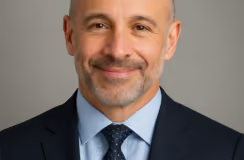























%20-%20thumbnail.avif)




%20-%20thumbnail.avif)

%20-%20thumbnail.avif)
.avif)




%20-%20thumbnail.avif)