Host: If you're looking to raise money from investors for your self funded acquisition or you're considering investing in this asset class yourself, listen closely to this roundtable with three self funded search investors. Nicholas James of mindscapital, my partner Tony Cappert of workbench Capital and Adam Borse, an investor in both self funded and traditional search, were the panelists on a recent Acquiring Minds webinar. The conversation was so rich and wide ranging that I thought it deserved being a proper episode of the podcast. Here is but a sampling of the many topics discussed how these investors evaluate self funded searchers how they think about searchers with no experience in their target acquisitions industry do you really know what you're getting yourself into and your need to demonstrate that you do? Embracing the suck in your need to demonstrate that you can what's more important, operational chops or finance chops? Self funded deal terms where they've been and where they're going are terms too favorable for searchers. The rise of offering self funded investors a put option so there's a well defined path to getting their money out of your deal. The needle you need to thread when pitching investors off Putting assumptions to avoid making in your financial model the risk reward profile of investing in self funded search versus traditional search funds or independent sponsor deals. As an investor myself now via Mines Capital, I realize how stark the difference in worldview is between investors and acquisition entrepreneurs. Hopefully this conversation sheds light on investor thinking, something that hasn't gotten a lot of attention and which I would like to remedy going forward. Also, I encourage you to pair this episode with last week's SBA Lender panel. Between that panel and this one, you will learn a ton from those who direct capital in our space, be it equity or debt. Please enjoy this roundtable with Nicholas, James, Tony Cappert and Adam Borse. Announcements next Thursday, August 29 Attorneys James David Williams and Bill Barlow, whose entire practice is devoted to business acquisition, return for Legal office hours. A webinar this month's topic is the main legal diligence issues that arise during a transaction. There are over 10 very specific issues that James, David and Bill see time and again when working with entrepreneurs buying businesses, and they're going to walk us through how to handle those issues. As always, there will be ample time to answer all legal questions related to buying a business, not just those related to legal diligence. So come get any legal question you have about your deal or your target or your search Answered by James, David and Bill next Thursday, August 29, noon Eastern Link to register for the webinar is right at the top of this episode's show. Notes. Welcome to Acquiring Minds, a podcast about buying businesses. My name is Will Smith. Acquiring an existing business is an awesome opportunity for many entrepreneurs, and on this
[3:51] Guest 2: podcast I talk to the people who do it.
Host: An SBA loan broker, as opposed to a direct lender, doesn't work for a particular bank. Instead, the broker pairs you with the right SBA lender for your deal based on industry terms risk thresholds, then helps you navigate the process better than many lenders themselves do. Matthias Smith of Pioneer Capital Advisory is just such a broker. Matthias worked at two of the country's top 10 SBA lenders, so he's been on the inside of the SBA process and knows well the pitfalls and hurdles and how to avoid them. He struck out on his own to laser focus on the ETA and search space. Our niche is his niche. You'll see Mathias at all the ETA conferences. He's closed over 30 search deals since starting Pioneer in May of 2022, including some acquiring Minds guests. To learn more and get in touch, go to PioneerCapitalAdvisory.com or click the link in the notes welcome everyone to this panel with three self funded search investors. My name is Will Smith, I'm the host of the podcast Acquiring Minds and over the next hour we are going to pull back the curtain to learn how self funded searchers see the world. How they evaluate searchers and deals and targets, their views on the space overall, their thoughts on investor terms, operational experience of the searcher or lack thereof, deal breakers and much more. Even if you don't expect to raise money from investors for your self funded deal, you're going to learn a lot today. But of course, especially if you do expect to raise money or if you're interested in investing yourself in search deals, pay close attention. This is going to be a meaty rich hour of your time. I'm really excited for it. Let us turn now to introductions and get right to it. I'm going to have each of you panelists introduce yourselves and talk about your investing activity specifically in our space. Adam, let's go to you first. Adam Borse, tell us about yourself please.
[6:13] Guest 3: Thanks Will. Adam Bors, based in Annapolis, Maryland, Local Marylander, went to the Naval Academy, played lacrosse, submarine officer, transitioned into a publicly traded energy company in Bethesda, Maryland that did my MBA at Kellogg in an executive format, worked for a lower middle market independent sponsor for about six years buying distressed businesses and that kind of gave me the confidence and the tool set to acquire my own business. I bought one of the largest commercial furniture installation companies in the Mid Atlantic in 2019 and then I did an add on to that business earlier this year and I'm fairly active in the search fund space as an investor previously with Riviera Capital and via a couple different investment vehicles in the self funded space.
Host: Thank you Adam. And for anybody who wants more about Adam and his story of buying Delta, the company that he just mentioned, he also was a guest in Acquiring Minds. Nicholas James, tell us about yourself please.
Guest 4: Hi everyone. Great to be here. I'm Nicholas, I'm from Norway. If you were wondering about my accent, I was on Acquiring Minds in June last year if you want to hear the extended story. But the short version in the interest of everyone's time, is that I have been a searcher and independent sponsor for almost nine years and more recently turned to be an investor in other searchers and independent sponsors through Mines Capital where I partner with Will and we invest equity checks into acquisitions led by searchers and sponsors. If you want to learn more about me, you can also follow me or connect with me on LinkedIn.
Guest 2: Great.
Host: And I will provide links to to everybody's LinkedIn and their company pages or fund pages here in a sec. Tony Capper, last but not least.
Guest 2: Yeah, thanks Will and good to good to see everybody. Quick background on me. I was a venture backed software guy so I built and sold a SaaS CRM business selling to real estate brokerages and agents that company's called Contactually. Sold that just before the pandemic and then started dabbling in real estate, buying a bunch of cabins and cottages outside of D.C. where I live and turned that into a vacation rental investment fund and a sister property management business. So we've grown that for a few years called Blue Maple. We've got 80 properties now, still buying a couple a month and candidly that was going really well and I really enjoyed the idea of building a profitable property management business. But I started investing in other small businesses and other search search deals and I quickly found that I loved it and decided to form a small fund doing that at a little more scale. So let's go Workbench Capital. We've done about 26 deals now in the last three years and we're looking for great search deals consistently but modestly growing profitable businesses, 1 to 5 million of EBITDA our typical checks like 250k. Learn more about me and us@workbench.com Anyway, thanks guys.
[9:17] Host: Great. Thank you Tony. Looks like there's a, there's some kind of concentration of search investor human capital here in the D.C. area. I'm in Arlington. Tony, you're in Montgomery county and Adam, you're up in Annapolis. Right. So we're all, we're all here. Nicholas, you're a little bit further away in Norway currently, but in Florida generally.
Guest 3: Great.
Host: Tony, let's start off. I want to go back to you and the first question for I want to hear everybody's opinion on this was in our pre call. This got very interesting. Very quickly what we, what as investors you're looking for in the Searcher. There are a lot of people who come to this space all the way from the, you know, freshly minted MBA on up to the mid career person and beyond. So what kind of profile do you like bringing you deals?
Guest 2: Yeah, I mean the, the I think I'll start with the type of investing like what I consider to be a conservative investment or one that I love, which I think pairs with the type of searcher.
Guest 4: Right.
Guest 2: I like to invest in a deal, a business that's fairly small and the deal is very levered. Right. So it's a, so it's a 1 to a couple million of EBITDA, up to 5 million of EBITDA. Because it's relatively small, you can typically buy it with an SBA loans. There's a lot of debt on that transaction and the only way I would do that or if there's a lot of debt is if it's a business that's been very consistent in how it's operating. Right. It's been profitable for a while. It's not like a turnaround story. And because all of that's true, I think someone who's, you know, not as experienced but still has some operating experience tends to be who I love. Right. So ideally it'd be someone who has some operating experience, has ideally run some sort of blue collar related business, blue collar industry, but not looking, you know, don't have to be super seasoned, super experienced. Ideally they're looking to go and run a business that's, you know, it's not, it's not something that they're going to have to reinvent the wheel. I would say that the turnoffs and we can explore this in more depth. You know, I think a lot of these businesses, they're not like the sexiest things in the world and they're quite difficult. They're small and they're with a lot of blue collar teams, blue collar employees. If you don't have that experience or you don't have it in, in some flavor.
Guest 4: Right.
Guest 2: Your parents, your, your parents had a small business, you were exposed in that way or you worked with some sort of blue collar team in the past. I'm really skeptical that you're going to be successful or want to run a business like that as an example. There's different flavors of that, but yeah, it's somebody who's.
Host: Who.
Guest 2: Yeah. Who can frankly get shit done in a very small team or company.
Host: And quick follow up to that. So the theme of going from a white collar environment to running a blue collar business and team and being in a blue collar environment comes up again and again and again. I never tire of asking it with the guests, but the reality is the reason it comes up so much is because so many people entering this space or doing a self funded search don't have blue collar experience.
[12:18] Guest 2: Yeah. So.
Host: So for those folks who simply don't have it and are just kind of diving in. Not ideal. And is that a deal breaker for you or say more because having blue collar experience and buying a blue collar business is, is actually a profile that's quite rare, at least in my guests.
Guest 2: Yeah, sure. I think there's, I mean, I think there's a couple different slices to think about. The one is, do you want to run this business? The second is will you be successful at running this business? Right. And I guess the, the third is to what degree might you be successful? But you're sort of like you have no experience and so you're going to be successful maybe despite the fact that you have experience or despite the fact you've died before. I think the former is not talked about enough. And so I don't want to skip over that point. I think if you don't have experience working with people without a college education, for example, or you don't have experience working in a warehouse or in my case, I run a vacation rental property management company with properties in West Virginia. They're folks that are very different from the people I work with in my last software business. They, you don't have experience doing that, you may not enjoy it. So that's sort of the, the, the eyes wide open I'd want someone to go into because if you buy a business and you don't enjoy it and you've brought on equity investors along for the ride, you're probably not gonna, it's, it's at best gonna be just a painful experience for you to try to like navigate this through. And at worst, you're kind of pissing off everybody, your team, your investors, et cetera. That's sort of the first and, and then the other question is like, will you be successful if you haven't done it? I, you know, there are indicators that one could be successful without having run a business like that that I'm trying to look for.
Guest 3: Right.
Guest 2: So you know the classic examples like Adam's case, right. Adam was an officer in the military. And Adam, I think you were deployed, if I remember right. Whether you are or not. Regardless, you probably, if, if you worked with folks who are sort of enlisted members in the military, they kind of have a similar blue collar like personality or model. And I think a lot of those, you know, ex military officers, they may not have run a small blue collar business, but they understand what it's like to work with sort of a blue collar type employee as an example. So that's. That that can be a strong indicator. Again, I've talked to a couple folks where they have more of a finance background, but they'll say, you know, in college I started this XYZ business and you know, this one guy had like a, a moving, a small student led moving company, right. So they would like pack people's homes up, box them up and they hired other people to do that with them. It's like, okay, you've got a little bit of a flavor for what it's like to run a small business. That gives me some confidence that you're not totally naive going into this. So those are some signals at the end of the day. Yeah, I'm just trying to get a sense. Or is this someone where this acquisition is not just a spreadsheet exercise? And is this someone who has the ability and the grit and the will to work in something that isn't the sexiest thing in the world all the time? That's my point. And so the more you can demonstrate that by coming across as a real genuine person who's not, you know, artificially approaching the process, I think the better we came across.
[15:26] Guest 3: We came across a couple different examples at Riviera and even recently looking at some of Tony's deals where I'm an investor. The people that have the great undergraduates, top MBAs and candidly white collar business experience. I find that a lot of those people matriculate into traditional search funds because they're going to buy a larger, more sophisticated type business. The people that aspirationally want to be self funded searchers. To echo what Tony said, if you have small business experience, which I did and I was in the Military. I was very comfortable and confident buying a business like that. So if you don't have the direct managing a $20 million revenue P& L but you're in the military, a lot of top MBAs who want more autonomy and want to take more risk with the self funded rep, they're comfortable doing that even though they may have never run a business themselves. The other side of the coin is as far as like a bottom line upfront deal breaker for me when I talk to self funded searchers is they don't want to run the business and that's where jumping down to maybe the middle of the cheat sheet. Well yeah, I don't think people sometimes searchers don't fully understand the difference between an independent sponsor and a self funded searcher. I actually recently screened an individual's investment deck and she was branding herself as like a hoko and I'm like but you've never run a company, you've never bought one business. And trying to help her think about how am I going to perceive to investors in doing an acquisition knowing she's going to need capital. You should brand yourself in the sector. You have experience, you should brand yourself as I'm going to buy one really good business with an SBA loan. If that model deviates from there into a larger independent sponsor where you need to bring on non SBA debt, do that later. But to do all those things at the beginning I think is difficult. And the last thing I'll say is when the people bringing deals to Tony and to Nicholas and to me in saying I want to be a self funded searcher but I'm going to bring in a general manager that's a red flag. It's ultimately an owner operator model. If you, if you just want to be the owner you have to look for a different, a different structure and if that structure puts you into like an independent sponsor but that those individuals typically have meaningful transaction experience and or they've built a really detailed investment thesis and a lot of times they have both and, and that's how they have success in building like, like a whole co model buy and builds, et cetera.
Host: August Felker is a two time successful searcher first with a traditional search fund. The second time around he did a self funded search. Today August runs Oberly Risk Strategies, an insurance firm with a dedicated practice group for searchers and acquisition entrepreneurs like you. If you've got a business under Loi Oberle will provide complimentary due diligence on that business's insurance and benefits program. A Great. No risk. Way to get to know August and team. They love helping searchers. They've worked with hundreds. Oberly is a specialty insurance brokerage for searchers by a former searcher. Check out oberly-risk.com O B E R L E- risk.com link in the show
[18:44] Guest 4: notes, if I can chime in.
Guest 2: Yeah.
Guest 4: Here are five things that would excite me when I'm talking to a new searcher. The first thing is what Adam touched on there. If they have deep vertical niche expertise, they really know what they're getting into. That is great. We're about to commit to a deal I think pretty soon here with a sponsor who has been a decade in this particular vertical and he has been specifically looking for a deal in that vertical. And now he's found something that he has vetted. So he has a whole network within that he knows the capital providers in that space. Very compelling, very easy to say yes to. And he just has so many more strings to play on. So, number one, deep vertical niche expertise. Number two, I like to see skin in the game. And there are two forms of skin in the game. Personal guarantee is one. It's not my favorite. My favorite is money. And not rolled in closing fees, but actual dollars from their own pocket going into the deal. This is, you know, and I say this because money coming from your pocket has an opportunity cost because you can invest it somewhere else or use it on your personal life. A personal guarantee has some legitimacy as well. For sure, they're definitely on the hook. But there are some drawbacks to that as well that I can visit on later. The third thing I like to see is that the searcher, when talking about their deal, that they're reflective and, and resourceful about how they're approaching it as opposed to salesy. When you're raising money for a deal, you're inevitably in a little bit of a conflict of interest because on one hand, you are trying to diligence this target that you have under ly. You're trying to negotiate with the seller that you can't pay a single dollar more. But on the other hand, you're trying to sell it to investor investors as the best deal that you've ever seen and best target that you've ever come across. So this is an inherent conflict of interest that any sponsor will have to deal with. And at some point, when they're pretty deep into the diligence, some of them go into the mistake of being more salesy than reflective. They've kind of lost sight a little bit on their fiduciary duty to also be a diligence guy. The fourth thing I really like to see is that they're on the same wavelength as me. They're switched on, they're tuned in. It's hard to define exactly what this means, but let me give you an example of someone who wasn't switched on. A few weeks ago I talked to a prospective searcher. He was looking at some deals. He didn't have them under LOI yet, but he wanted to get my take on how to raise capital. So hey, I have this deal that has $700,000 of EBITDA, you know, when I have it under LOI, do I look up like the pension funds and endowment to raise equity. And to that I had to say, no, that's not the route you have to go. You probably have to find high net worth individuals to support a deal like that. And then he asks me, okay, whereabouts do I go finding them, right? So this is telling me a person who doesn't really know how to go about doing this, not resourceful. And the fifth thing that I really like to see is referrals. Oftentimes a deal comes in from someone I trust and they will say, I know this searcher. That's always a really good starting point. If I don't know the searcher already, I will try to triangulate or get some referrals, especially if I get serious about it, just to verify their background and that they are great to work with.
[22:13] Host: Great. Thank you for those, Nicholas.
Guest 2: Nicholas. I love the specificity with that list, by the way. And just to piggyback on the salesy point, I think you're articulating stuff that I'm implicitly doing, but I haven't written down in like a bulleted list like that. I think that tension of diligencing and selling is like a really important distinction I would say in terms of a deal breaker or a distrust creator that I see is any point at the end of the day, as a minority investor in these search deals, you have to fully trust the operator, right? Because you're going to have majority control over everything, right? Over everything about the business. And we're kind of along for the ride as investors. I mean there's the. They're the board. The board will have some input, but it's modest in terms of what they end up doing. So whenever I feel like I'm being sold something that is, isn't totally true, it really puts me on edge and it's easy for me to try to describe it as like, oh, you know, it's, you know, there's time to get the deal done. They're kind of overselling but, but like when that starts to add up it, it'll kill the deal. As an example, I've had many people tell to me in the raising, take your example, Nicholas raising 700k of outside capital and 600 of that's already committed. And I'll say, oh, that's great. Well, I know a lot of the investors you space like who's already on board. If you can't share a name with me, that's like a red flag. But maybe you can make the argument, oh, they just don't want me to say. When people say that that's already like you're probably lying. But then when you share that name with me, there's a good chance that I do know them. And I'm going to just ask like hey, not to ask to double check but to ask like hey, what did you like about this deal? Like what are you seeing that's different from me? And in a lot of those situations I'm surprised the number of times where like I didn't commit to this deal yet I'm interested, I didn't commit. And so just don't oversell. I think it's really reasonable to say, hey, you know what, I've been talking to a lot of investors. I've got 600k. That's like I think the investors are really interested. I've got no hard commits yet. But I'm pretty, I'm pretty convinced we're going to get this deal done the next couple weeks. Like I'm really fully committed. Like that's a really reasonable thing to say. It still, you know, gives a sense of like things are moving, I've got lots of commitments, quote unquote. But you're not overselling. And then when you make that, that person say Bob's already on board and Nicholas is already on board. It's going to feel so much more genuine when I have the conversation. So little things like that and like there's little threads beyond like you know, like the revit historicals, the customer churn rate. Like it's again, when you're overselling little numbers it really puts a bad taste and I'm not done deals because of that.
[24:41] Host: And of course in decks for deals there should be a risks page where you searcher are outlining explicitly the things that concern you about the business and how you'll mitigate those risks. But you know that is absolutely needs to be there and it's an opportunity for you to lean into transparency and explain how you're thinking about it. And obviously it's a great exercise for you the searcher because you need to be as cognizant as possible of all the risks and indeed how you will address them when you get, when you become owner. Before we leave the blue collar topic all I you know buying blue collar businesses is kind of taken over search. The vast majority of my guests buy those types of businesses. It's not the only business in existence of course there's E commerce, there's at marketing agencies which we see a lot of mines capital just invested in one. There are white collar businesses. I have a couple interviews that I've done that are in the queue coming soon that are white collar businesses. Does that change all of this stuff that we've talked about this kind of operational deficit that many self funded searchers come to this space with? Let me, let me, let me ask you a pre question Tony. How many white collar, how many searchers that you've invested in have bought white collar businesses?
Guest 2: Yeah, I was trying to do that when you were just saying it. I certainly have invested in deals like that. Two SaaS deals. Two SaaS deals that was off the bat and then a couple that were like niche like niche electronics sales and distribution. So may to piggyback. So I've done a few. It's at least a quarter probably maybe 20% and I think it lends itself to someone obviously who doesn't have as much that blue collar experience. I think what I have liked is when it's a repeatable if it's a recurring sales model and I in the searcher if it's more sales driven and the searcher has a lot of sales experience like I've worked with some mid level sales managers or people who have built sales teams, scaled sales teams. I kind of like that with that profile. Like I'm thinking of this niche electronics distributor in Canada that I just invested in. It's like a relatively young guy, no blue collar experience but has like technical experience and is a really good salesperson and very coachable. And I was like oh I could see this person going, implementing and scaling a sales process in a highly recurrent revenue recurring revenue sales process like that. That feels natural to me. It felt like a good fit and he felt like he was going in eyes wide open.
[27:04] Guest 3: One way to, one way to articulate this point Will is to just because on the blue collar topic, just because it's a simple business doesn't mean it's a simple business to run, right? Like think about the businesses that I bought, like commercial furniture installation. Like it's incredibly simple. Like you're putting metal together with pieces of plastic with fabric panels and you think oh my God, it's just somebody puts their button a seat and they put their laptop on desk. It's extremely simple. But the supply chain and the macroeconomic dynamic and the government where we are, it's extremely complicated. And I didn't have any sector experience per se, but the tactical wherewithal that I had from having been involved in about eight transactions and working in three of them doing like little things like running payroll, building incentive plans, interfacing with customers, building, you know, all the things that I think sometimes get overlooked on the traditional search fund side because they have such a broad investor support group. Whereas on the self funded side like Tony and Nicholas, just assume that if you have to roll up your sleeves and do those tactical things you're going to be able to do. But those little tactical things are extremely difficult if you've never done them before. So again, back to the earlier comment about like I think Tony and underwriting things for workbench. If the deal was brought under good investor terms without high customer concentration and directionally 3 to 5 years restor historical financials like a history of profitability, he's 100% underwriting the person. Which puts you into the conversation around intangibles. Which is why I mentioned the better thing, which is why I like college athletes, which is why you like the people who you know they're going to like great grind and win and sell. Those are the people you really want to back.
Guest 4: I wonder on the question of white collar versus blue collar businesses, a lot of the appeal of search is that you have someone with an MBA or professional services background or at least some strategic background that makes them, you know, smarter than the average person out there that they can bring that skill set into a business, into a business that has previously maybe not had had enough of that. But when you go into a blue collar business that is typically true. You're replacing an owner who was blue collar. And you need some kind of tactical way to replace all of the blue collar elements in that. But then you're kind of layering on top of that the white collar we have investors we can protect to M and A and roll up strategies. We have a strategy for a five year vision. We know how to put together a budget so there's a value add there Versus if you take over a white collar business, you're stepping into the shoes of someone who is white collar already, who's probably 10, 20 or 40 years older than you and you're allegedly going to then grow the business at a faster pace than them. So I think that's where having deep vertical industry expertise comes into play even more.
Host: More so I would say yeah, it's a great point. It's, it's like the gap between what you searcher can bring to improve this business is going to be likely wider with a blue collar business than with a white collar business. So there's more, going to be more levers to pull more improvements to make. Even though Adam, as you say, does. Just because they're simple businesses doesn't mean they're simple businesses to run or to manage. Tony, going back to something you said at the very top and I think relevant to what Adam just said, the types of deals you really like, I guess when, when the searcher maybe isn't quite as strong as you'd like to see if the deal is, that can compensate. So you're kind of looking at the pack you're looking at as a package and if one is weak and one is strong, they can, they can help raise the overall appeal of the package. Right.
[30:50] Guest 2: To some, to an extent. I mean it's, it's a three legged stool, right. There's this, there's the opera, the searcher slash operator who's actually running this business. There's the company and then there's the deal structure and the terms and they're all different and related. I would say if it's a bad operator, it doesn't really matter how good the business is or the terms because I'm not confident they're going to be successful running the business or if I don't trust them right, like that they're going to do something that's shady to the investors. I would say a stellar operator and a stellar business. Then less than great investor terms and less than great structure like that's probably the one that's easiest to give up, right? Much to maybe the chagrin of all the other investors in the world, Nicholas and Adam included. Instead of like, I'm more inclined to accept slightly worse terms if it's like truly an exceptional business that's been growing 20% for the last seven years, right. Like with a great operator and it's what the reality is most of the time it's an operator that's, that's, that's called an A minus. B plus and it's a business that's A minus, B plus, however you want to define that. And so then the terms have to compensate for it for that risk of the fact that you've got this maybe less proven operator with a business that's got some hair on it. That's just the vast majority of deals.
Guest 3: And I was just thinking about, I'm looking at Tony's list. I mean he knows the deal. I'm thinking of the very first deal that he did. It's even the smallest check size, looked to be very capable operator, big experience, P and L, Harvard Business School. And this person basically started telling everybody in the business to go screw themselves day one. And the most important person of business quit and the business is basically collapsed as a result. And I did a talk at Kellogg earlier in the year about 100 day plan. What do you do as a CEO? And I always tell them do nothing. Like don't do anything the first hundred days. You know, unless something's fundamentally wrong. Just sit on your hands. How hard that is to do. It just goes back to like I love the three legged stool approach that Tony talks about, but I still think that it's, it's the person, it's the people and that ultimately is what gets you more or less comfortable with the
Guest 2: other two legs of the stool. Yeah. Adam, to your point about the. You're right, there was the operator issue. There's also just as a side point, as someone who's invested in these deals for three and a half, four years now, SBA debt, which is how a lot of this debt is done in this space, it's not fixed interest rate debt, it's floating interest rate debt. The deal that I did two, three years ago, the businesses that were acquired two or three years ago, but interest rates were low, that debt service is now doubled.
[33:27] Guest 4: Right.
Guest 2: Like the interest rates have floated up high. These businesses are being crippled. And a lot of the time buy this like high debt amount, it's a much higher rate. And so it's been interesting to see how the searchers have responded to that, who acquired those business perform a couple years ago. And I think it underscores the point we've all been making, which is someone who is scrappy and who's going, who's coachable and can, who quickly take the new realities that they're handed and pivot. It's just that that resourcefulness is so necessary for these types of small businesses.
Host: And Tony, do you feel like you, you, you called it with, with your selection of sponsors that the people that demonstrate that you thought would have the coachability, the grit have, I think have proved it.
Guest 2: Yeah, I mean, I think it's underscored in my mind even more. It's sort of like any inkling I have that you cannot operate and pivot and be scrappy, that's just a deal breaker for me. I just, I believe it in my bones that you need, I mean, Adam's been saying that this whole conversation. Any inkling that, you know, you're somewhat above the people in the business that you're buying or that this is like a little bit of you're gonna be, you're gonna play business versus run this nitty gritty 900k bit of business, like that's. I'm just not gonna do that deal.
Guest 3: And, and let's be clear, I don't know if Nicholas or Tony disagrees. Running multiple businesses. Like I, I felt like when I bought my first business and even when I was working in the business for an sponsor, I really wanted to, I really wanted to work in the company. I wanted to like be an employee, like do all the things that every employee was doing. But like after I kind of got six months into it, I realized I don't want to work in the company, I want to run the business. And I do think that you can be a successful self funded searcher, run the business, but not work in the company and be successful. But you can't, you have to do, you have to do at least one of the two or both of the things and you can't really have to embrace the suck because I think that the perception of self funded searchers. I remember when I knew a lot of the 2023 Wharton Grads last year and I remember going in there, choosing their track panel and how did we frame the conversation? And I always frame it around that brought this up, I think in my podcast with you earlier this year. Will is risk profile economics and then what do you know how to do? And I think the, I think the what do you know how to do thing tends to, tends to get overlooked a lot in these, in these self, in these self funded structures.
[36:04] Guest 4: But I think if I can interject here a little bit, I think a lot of the cases that excite me have an element of if we do nothing beyond what is already in place, here is where we'll end up. Right? And if that's a good place, then the question is, okay, is the sponsor gonna mess it up or proclivity to do something that will take Us derail us from the path that is already pretty good. And if the answer to that is no, then you can just build excitement from. Okay, well here are the things they can actually do on top of that. Now, in terms of what they will actually do, it's hard to predict. Bain came out with their annual M and A study here a few months ago and they looked at the last two decades of private equity investing and granted this is not search, but large cap private equity. But they essentially said there are three value drivers. It's operational excellence. So improving the business, essentially it's expanding the multiple which goes up and down with the market and then it's doing M and A, so, so building the business through buying. And essentially it showed that in the last 10 years, 50% of the value creation had come from multiple expansions, 50% of value creation had come from rollups and literally 0% of the value creation had come in the large cap private equity world from improving margins and improving these businesses. And so that's harder to, it's very easy to talk, to talk or. But not so easy to walk the walk even for the largest and most proven private equity shops out there. So what I look for is downside protection. I want to see a searcher who's not going to mess it up, who is switched on and gets it. And then if they have the chutzpah to improve the business, they have the chops. That's all great, that's gravy. And we of course hope they can do that because that's where the big return lies.
Host: You know, it's, it's so interesting because I feel like the searchers that I talk to, the thing that intimidates them the most is, is doing the deal and learning the model and the kind of, the finite hard financial aspects of this. If of course they don't have a financial background, which many searchers do, but many searchers do not. And it is, I think we're all, we're saying this and implying this that there is in general an underestimation of, of that it's the operational know how or ability or ability to learn that is much more important and frankly harder to learn. And it just, I mean I just, I'm remembering a conversation I had at MIT ZTA conference where somebody who, who was considering search, they had all this operational experience, they'd basically been the turnaround CEO manager for other private equity shops and gone in and done the very hard work of rallying teams and making hard decisions and managing, managing, managing Multiple times successfully. And he was intimidated about doing his own search because he didn't really know the financial aspects of doing the deal, of putting together the model and so on. And I just said to him I felt like he had the chops of all people in the room, he had the chops to be a successful searcher. The model stuff, the doing the deal stuff is much more learnable than the years of experience that he accrued doing all this hard operational stuff.
[39:30] Guest 3: That's the irony here, is like, you know, I'll just go down to the bottom part of our pre call, like hope is not a strategy. And I think the aspirational dynamic of self funded searches is exceptional right now. Meaning people think just because I can build a financial model, which by the way, building a financial model on a $1 million EBITDA business, that SBA loan, like it's not very complicated, that stuff is very easy to learn how to do, how to structure an LOI with a little bit of advice from somebody like Nicholas and Tony's very easy to do. But like I'll just echo a point we talked about in February. The experience of the operator in a blue collar business, becoming a self funded searcher is not that important. If nothing goes wrong, customers stay the same, employees stay the same. If those things don't go wrong, you really don't have to have that experience. My point was always over a 10 year period, which let's just call it, that's the whole period for an investment fund or one of these businesses. It's not good every year. I don't care how good the business is, it's not good every year. My businesses that I bought now too, over a 10 year period, they look great, but guess what, like they didn't do that great during COVID they didn't do that great during the 08 economic crisis. Like there are real things that happen to businesses and if you don't know what the hell you're doing, you don't know how to change your workforce, change your facility space, talk to customers like lead and manage the business appropriately. You can put your business in the gutter very, very, very quickly. And I think that's why I really value the basic level of operating skill sets in a blue collar or a lower middle market company. When you're aspiring to be a cell phone searcher, you can't just think you can do it and it just like snap your fingers in your and you basically make 3 million bucks in two years. It doesn't work like that. You can't perceive success and assume it's easy. Everybody who's on your podcast who have had success at some point in their success story, it was really hard. You have to embrace that suck dynamic of being an entrepreneur in this model, in my opinion.
Host: Guys, I want to go ahead, I
Guest 2: just want to briefly say well and to your point about like for a searcher who's got tons of ops experience and no deal experience is an end is intimidated. I mean I think there's a couple paths there that one should potentially explore. The one in the partnered search historic. At least in traditional search, the partnered searchers have on average better returns than solo searchers in every study that Stanford's put out. That's always been the case. That's a consideration. Two, there are these various boot camps or consultants you can hire, you're going to pay money and or give up equity to do it. That could make sense if it's basically standing between you and pursuing this type of thing. But three, and this is kind of reading between the lines of what Adam was just saying, I suppose the person who, who is not willing and able to be scrappy enough to just read the resources and talk to the people to sort of figure out, you know, how do you put together an LOI and who's the attorney I can hire and how do I build a basic financial model to acquire the business. Like maybe you're not gonna, this is like really dug in cheek. It's like may, may maybe you're not gonna be that successful running a small business. Cause like that level, it's not particularly, it's not rocket science. There's lots of good resources out there in search funder and various podcasts and people you can talk to, you can figure it out. So yeah, I don't know. That's lots of options guys.
[42:47] Host: I want to turn the conversation to deal terms, something that people audience member searchers are always very curious about. But also I just think it's important that we have that we revisit some of the philosophical discussion that we had on the pre call about these terms. The terms of self funded search versus the other flavors of search that you as investors capital allocators might invest in. I'm going to turn it, I'm going to turn it to my partner Nicholas first. Nicholas, talk to us about how you feel about self funded search terms today. Yeah, as an investor, broadly, however you want.
Guest 4: First of all, I don't love that you and Adam keep bringing up we had a pre call because I want to come across as super spontaneous. But putting that aside, self funded search terms are aggressive. Normal private equity, I mean on the fund level is 2 and 20. Independent sponsors are typically fairly close to that. Traditional searchers are fairly close, close to that. And then comes in self funded searchers with a carry model that I've seen cases a few years ago now, but as high as up around 90% I think I see more of 60, 70, maybe 75% today. So it's come down. The cost of capital has gone up for the searchers, but they're still very aggressive. And so when I say this isn't great, well, all else equal, if you consider an independent sponsor deal where the carry is 20 or maybe 30% in an upside scenario and a self funded search deal that has 75% carry, of course it's going to be much cheaper. Like as Tony said, he said it's a three leg stool. I actually have a fourth leg which is the market that we're playing in here, nor the industry. But anyway, the terms matter, you know, all else equal, the terms really matter. And I question also the long term view that searchers take on being overly aggressive. Because if you can get away with 85%, fine, I understand the draw to the lowest cost of capital. If you can do it, then great. If things go well, you're going to benefit. And not even mentioning, oh, if you lower your cost of capital, you might get some smarter investors on board. Just disregard that. There are many ways to find smart people to help you along the way if you have a profitable business. But what about the taste in the mouth, right? So if you are at 85%, just lower that for instance to 70%. So you think about that as a searcher, you're going from 85% to 70%. I mean this is a marginal change at the end of the day if things go well. But for this investors, you actually doubled their returns right there, just going from giving them 15 to 30%. So you're already really setting them up for a lot more success than if you were more greedy. And I think what I've seen over the last few years is that terms are coming down that carry, it's going to morph towards sponsors over time. I think the exception, the reason this has been allowed to go on in my mind is that when you have a deal that is extremely highly levered and you need 400k of equity to close the deal, you can essentially find that equity with friends and family who are, you know, not sophisticated investors. They mostly invest because they want to sponsor you and support you and they're just excited to be on for the ride. But when you're a portfolio investor and you want a portfolio that does three or four times, recognize that your portfolio is going to have a few losers and that then means that your winners or all, all the others in your portfolio needs to exceed that 3 to 4x range, right? So if you're looking for 4 or 5 times MOIC on your investments and you only get 2% of the upside, if you're one of the minority investors, it's going to be really hard to get there. So yes, they can show a nice irr, but it's going to be hard to get the real exciting upside. So you might get the 2 or 3x. I'm being a little unstructured here in my approach but I feel it's aggressive and I think it's a short term view. Most searchers I know, they want to do deals, they want to do multiple deals and just coming down 5, 10, 20 percentage points. If that gets you the right people in the door, if that gives you a good taste for everyone in the cap table, great. And you don't want investors are taking a lot of risks with their money. To walk away with a 2 1/2x return and you pocket 10 million, why don't you instead take 7 million for yourself and give them a 5 or 6x return? It's kind of just feel so much better for everyone and it's still a big win and then you go on and do your next deal with the same investors.
[47:44] Guest 3: One of the things that I'm constantly pressure testing as I'm investing capital and if I have a pot of money right now, I would say about 10% of it is going into self funded deals via Tony and workbench and maybe 90% is going to more traditional search fund lower middle market private equity. If I'm thinking about alternative investments into
[48:08] Guest 2: lower middle market private equity.
Guest 3: So I'm investing 10 times the amount of money in things that aren't self funded searches. The answer is why? Well, you're a self funded searcher, Adam. Why don't you just put more money in the model you have success in and it's like the quote you put in the cheat sheet. Well, it's like I'm the self funded searcher guys. Like I have 80, 90, 100% of the deal. I'm going to 10 to 15 times my money most of the time. My investors, which I only have one on the first show, it's my dad, he's gotten a 5x in five years without an exit which is I would say unusually high. Most of the deals that Tony screens like the irrs look great because with the leverage profile you can return the invested capital back super fast. But you, I believe the moic, the real mark on the self funded deals are going to take longer on average than traditional search funds because the board, the search, the traditional search fund structure is driving exits because there's outside investors that are institutional funds and they have, they have finite lives in their funds. The self funded world where we are don't necessarily have those restrictions. So I believe the moist could be 3, 4 or 5x Nicholas's point on these self funded deals but I believe they're going to take longer. So I don't believe that's an Apple to Apple comparison. If you're, if you're comparing returns for a self funded deal versus a traditional search. And so to all the people listening, if you are the searcher and you can get a 10 year amortized SBA loan and you can put none of your money in and earn 80% or $50,000, you are going to get an extraordinarily high return. But your investors, unless you exit in that five year window commensurate with a traditional search fund, you're not going to give investors that four to five times as a Standford study represents in my opinion.
Host: And let me just weigh in here now having been the host and interviewed so many self funded searchers and essentially been an advocate for them and wanting that, you know, the more a guest of mine kept of their equity even while raising money, the better the more I celebrated it. Now working with Mines Capital and seeing such a cross section of deals all the time, it is to see things through the investor lens is so important because yeah you are coming to investors with the self funded model and saying to them all these other people who are doing this, independent sponsors, traditional search funds, the searcher or sponsor as we'll call it, the protagonist here, the one raising the money is basically just asking for 20, 25, 30, 35% in there. And in the case of independent sponsors they're often more experienced, they're often a better bet as a, as a person, as a sponsor and you're asking to keep 80%. So I'm just reinforcing what Nicholas said at the very top. It is remarkable when you just line these things up and compare them. The self funded searchers who have less experience are asking for three and four are expecting because the market is giving this to them. So I don't blame them. But is, is, is expecting or asking for three times or more what these other, these other searcher sponsor vehicles see the protagonist protagonist getting the search response are getting. Tony?
[51:21] Guest 2: Yeah. I want to put some numbers to. I think the questions that people have often when they mean terms. I think there's really three things that we're, that we're talking about here. The one is what's the preferred return you're going to issue to your investors? The second, probably the most important is how much equity, what share of your company you're going to give up to investors relative to how much of the acquisition price is going to be, is going to need to come from investors. Right. So it's going to buy a lot like what's the mix of debt versus equity, how much you give out of the, of the equity to the investors. And then the last is kind of adverse point around like when are you going to sell this business? And what sense do I have that I'm actually going to exit this business in a reasonable amount of time? If it takes 15 years to sell the business, that's going to drive down your irr. Right. First on the, on the press, just to put the numbers to it, average preferred return right now is about 10%. Preferred return is essentially like for every 100k that you're rating from investors, every year that goes by, you're going to pay them an additional 10%. 10k until you pay that money back. That's what the, the pref means. You're doing less than 8%. You're so out of market that you're going to, you're going to. People are going to question that, you know, what the hell you're doing.
Guest 3: Right.
Guest 2: So, so don't do that. Don't set it less than 8 and 10 is the norm. I see 8 to 15%, the percent of equity. That's the point that Nicholas was sort of harping around. And to what degree, you know, searchers, what should they get is the question. The way I think about it, I think it's slightly different from where I've been taking this conversation. I think about A, historically, how has the business been growing and B, how levered is the business? And I want to just like walk through some math. Most almost never am I looking at a business that's been growing greater than 20% for the last 10 years. Those businesses, they don't, they don't really exist. Some exist, you see them, but it's not, it's very rare. Typically A business has good years and bad years and it kind of bumps around a little bit and then, and typically there's not a lot of financials.
Guest 3: Right.
Guest 2: So you're looking at really three or four years of financials and people are trying to say, oh, it's been a 20% CAGR for the last three years. It's like, yeah, well show me the last 10. But it like the average thing I'm seeing is a business is growing like 10% annually historically for like a reasonable amount of time. If your business has been growing 10% annually, your investors are always looking for this like 35ish percent IRR 5, 6, 7 years out. So there's just no way to get, if you're going to assume that business that's been historically growing 10% is going to keep doing that. And by the way, that's I think a really a realistic underwriting to say whatever the business has been doing historically, let's just assume it keeps doing that. In the base case, you're not going to magically improve it dramatically. The only way to get your Investor return of 35% if the business has only been growing 10% is if you are essentially giving them a lot more equity in the business. They're sharing in the debt that you're taking on the business. It's like, I don't think I'm explaining this extremely well, but essentially say you're, you're buying a business with 80% debt. So 20% of the transaction price is coming from equity investors. Right? The, your investors have to share in that leverage with you. They need to own a lot more than 20% of the business because if the business has been growing 10% historically, they like and only, the only way they're going to get a higher return is if they own more of that business. Right? So every percent growth, it's, it leads to more percent return for the investors. I hope, I hope that makes sense. So that's, that's the basic reason why you need to give more equity to investors relative to the equity maybe amount that you're raising from them. For every 10% that you're raising from investors, you need to probably be issuing at least 2x that. Right? Because they need to share in that leverage. And frankly it's, it's also commensurate with the risk that a lot of debt, right. The prison has a lot of debt service. The investors are sitting behind that debt service. Right. It's inherently more risky. That's part of the equation. Nicholas, you were going to Say something.
[55:12] Guest 4: No, I was just going to agree fully with you. And it's called lbos for a reason, leverage. And some searchers forget the L and just reward you for the buyout and then you don't get, I mean the L is what juices the returns and it's also what enhances the risk. And you are the one at the highest risk when you're putting in the most junior capital being on the equity design. One other thing I don't like when searchers do is when they juice up the IRR in their model by having very early and aggressive dividends. The ideal scenario for me is a five year horizon, no dividends. And at the year five you get to 30 to 35% IRR based on assumptions I can believe in. But if you provide a lot of dividends in year one and two, that will really dramatically change the IRR. And so they'll come to me and say, oh, IRS 40% IRR. And my question back is, well, what if it doesn't come through in exactly this way in the first 12 months? Because a lot of things can happen in 12 months. Now when you have five to seven years, you'll put your fingerprints on it and it'll be stabilized and it's easier to see how that will work out. But if the IRR depends on the timing in the first six to 18 months, that's just, you know, a magician. A magician playing around with model. A lot harder to believe in.
Guest 2: Yeah. To speak back on that point, three things to never do in the modeling in my opinion, in a base case scenario, never assume the business is going to grow a lot more dramatically than it has. Step one, two, never assume whatever multiple you buy the business at, you're going to sell it at a higher multiple in the base case, don't assume it. Like there's a lot of reasons to think that that might happen. It shouldn't be assumed in the base case. And three, to Nicholas's point, don't assume you're going to return a lot of capital early to investors. It artificially inflates the irr. And in fact about EBITDA margin, which is sort of the tied to this point, a lot of, you know, searchers think and it sort of makes sense, you're buying this blue color business a lot of the time or any business, you've got an operator who hasn't been somewhat asleep at the wheel or haven't been managing it super effectively. I'm going to be able to run this business so much more efficiently. That EBITDA margin is going to improve very quickly. The reality is you're taking cash that the operator hasn't historically been investing in the business and you're not just going to try to hit the base case, you're going to try all these other things to get the business to grow more rapidly in the future. And so you're actually going to see a hit in ebitda. Margins are going to get worse for at least several years until they get better. And so whenever I see a model that shows improvement in EBITDA margin from the get go, it tells me you're looking at this model through too much rose tinted glasses and or you're returning cash early to investors. Same idea, right? You're taking that cash and reinvesting it. You're not returning it early to investors. So don't do those things in the base case because it tells me that your, your forward looking model is, is not actually that conservative. And here's the reality. Everyone shops a deal that says oh we're going to hit like 35, 40% in the base days. But then I look at the assumptions and the assumptions aren't base case assumptions, they're, they're upside assumptions. And so when I revise them it's like no, that IRR is not 35%, it's more like 25. That's already,
[58:24] Guest 4: I heard four points to your list but it was really good. So it's worth repeating. You said keep in a base case, keep revenue growth flat, keep margins EBITDA margins flat, keep exit multiple flat and don't be aggressive with dividends.
Guest 2: That's right, keep the growth flat. The percent growth, if it's been growing 10%, don't assume it will grow faster than 10%. That's what I mean.
Guest 3: Tony, do you believe when you see the base case model from the self funded searchers, do you actually consume that we're going to sell the business in five year dynamic or are you kind of like, yeah, let's look at what the MOIC is and if we don't sell, what's the real return to investors?
Guest 2: Yeah, I'm glad you brought it up. I never assume it's going to resell in five. I think that's, I just think it's not realistic. It's like, it's like you buy a business, you're taking a year or two to like get the kicks out. You finally feel like you got your sea legs, you're like two or three and then it like takes a while to actually shop and close the deal, right? So you're really talking, you're effectively running the business for two years before you sell it. Like I was thinking, I think seven more realistic, you know that 35% IR I'm talking about at five years. I'm typically then looking at, well, what's the IRR at seven years? And like that's probably more like closer to 30. That's where you get your four plus X MOIC. But to your point of what I wanted to bring up, there's the pref, there's the percent you're sharing of equity with investors and then the timeline on resale. I have been really beating the drum very strongly recently in the last two years. I think deals need to have a put option in them for the investors. And what I mean by that is because investors are minorities, right? Like we, we don't have the ability to really dictate much of anything in the business and we sit behind all this debt. Like at the end of the day, what's going to affect our return as investors is when the business sells, right? And we need as investors confidence that it's going to sell. You're going to resell or will at least be able to resell our position in the business to you at some point in the future. And so put option language I think is very fair that a lot, the majority of deals that I'm doing now include essentially say at year five or seven, we're going to hire an independent third party to do a valuation of the business. And assuming that the business has a level of EBITDA that it could afford to buy back the investors, the business is obligated to buy the investors back who choose to sell their shares back at whatever that independent third party valuation is. And so it gives equity investors confidence that they're not just sitting along for the ride. If you choose to run this business for 20 years, right, that's going to destroy likely whatever percent return, whatever IRR we're going to get. And a lot of investors like me who are investing from a small fund, we need liquidity in five to seven years, right? We can't be along for the full ride. So the ability to resell our share to the business is critical. So I, yeah, like I said, the majority of deals that I'm doing now have that. I think it's, it's fair for everyone. I think the mechanism I outlined is becoming the standard and I'd highly recommend you include it.
[1:01:28] Host: And another benefit of it is, is it, it just the what you're signaling to the investor that first of all that you are kind of progressive in your terms and you're paying attention to what's going on in the market and that you have their kind of goodwill. It's a good, it's a show of good faith and that you really are thinking about their interests as you know at the outset rather than just trying to kind of squeeze as much as
Guest 2: you can out of the deal. Totally.
Host: Tony, I want to two follow ups. The concept of sharing leverage that you were, that you gave us a little bit on a minute ago.
Guest 2: Yeah.
Host: To be clear, that's the step up we're talking about.
Guest 2: Yeah, that's right.
Host: I don't think you use the word
Guest 2: step up because people just throw it as like oh, investors have X step up. I think understanding the mechanic behind it is what I was trying to convey. But yeah, people call that the investor step up. Right.
Host: Okay. And on the, your list that Nicholas liked and I did too of you know, what not to do in your model to your, to juice your base case, even doing, even keeping things conservative and not oversell, not, not juicing it as you said, the base case should still demonstrate 35% IRR. So we're looking at 35% IRR base case without any of that good stuff, without a lot of growth or whatever. And this is a good exercise for the searcher like if they can't meet that threshold just in the base case without being overly optimistic about, you know, whatever it is growth then that is a signal to themselves that maybe the business isn't, the target isn't as strong as they think.
[1:03:00] Guest 3: I don't know if I'm unique in like my thinking guys but because Stanford has such well established data, I always compare searcher returns and self funded and their approaches to traditional search funds because the data is so robust like you've got, I don't know if it's 40 years or 35 years of data. So we were discussing like what's interesting about the 2024 Stanford study. I'm like, well the fact that the overall return profile has gone down a little bit. I think the hold period is interesting which tells me that more funds have flooded into the market and maybe they're trying to drive IRRs higher and they're less concerned about NOICs because that's what
Guest 2: you'll get with a shorter hold period period.
Guest 3: But if I'm a self funded searcher presenting an investment deck to like Nicholas and Tony, I just think that if you're looking at what's my probability of acquiring under a self funded structure? And then if I acquire, what's my probability of success? Do we think it's reasonable to metric yourself against traditional search funds? I certainly do. So if the probability of failure is 35% in a traditional search fund, are you more or less likely to fail as a search run, a self funded model? Well, I would argue you were more likely to fail, meaning not acquire business. And then if you acquire, if the percentage of traditional search firms that acquire over 30% of them basically are full or partial loss, do you think your percentage as a cell phone searcher is higher? Low? Well, I think that one gets a little bit gray, but I would argue that it's certainly not any, it's certainly not any lower than that. Now that can mean different things to different people. Does it mean that you are in bankruptcy? No, because the default rate on SBA loans is only what like 1 or 2%. But a lot of searchers, I don't know what the number is, will enter into this no man's land where they're not in bankruptcy, but they basically struggle until they pay the loan off 10 years later. And I think those data points are going to be really interesting to layer into the success of the self funded model. But to round out my point, I don't think it's unreasonable as a self funded searcher when you build a model to assume you're going to sell a business faster at the same rate as a traditional search fund. I just, that's one thing that I'm constantly like pushing on and like trying to understand. Like am I going to put more money into self funded structure? And it's like if dollar for dollar I do more deals myself, that's the best use of my capital, but it's also the most amount of my time. So if I'm simply an LP is itself versus traditional. Well, I need the data to come back to me to tell me that I can get the same or higher return as traditional search funds.
Guest 2: I'll stop, yeah, to unpack those numbers. I think about that very much the same from a portfolio construction perspective, the reason why the IRRs need to be so high in the base case on the individual deals is because again, put some numbers to that Stanford data. In traditional search, when someone buys a search deal, despite the fact that this was a profitable business been around for years, 25% of the time the money is not fully returned to investors. So 25% of the time not fully returned and another, another 23% of the time it's less than 2x. So like half the deals return less than even a turn of the investor's money. And so as a portfolio you should expect like I'm expecting low teen, sorry, low low 20% IRR on all the deals that we do. And I'm assuming that you know, a quarter of the deals that we do we don't get any money back or very little money back from. That doesn't mean that you're not going to meet your debt service as a searcher.
[1:06:30] Guest 3: Right.
Guest 2: Because as Adam's saying, they can sort of eke out. You can eke out forever running a business instead of meeting debt obligations but not actually returning money to investors. But that's, that's, that's what's, what's driving this type of faith based behavior.
Guest 3: It also, by the way, just to
Guest 2: underscore the point, we're kind of playing a little bit like doom and gloom or there has to be high return. Like I actually think that of this group I'm probably the most liberal in terms of if it's a really great business that does have really high historical growth and you're buying it at a great multiple. So it's reasonable to assume that you'd sell it the same. If not like in the upside, you can imagine expansion. I am comfortable taking a small minority of equity as collectively as the investors. But those deals are just very rare. Most deals you're going to give up 30, 40, 50% of your business to bring in outside investors because of everything I'm talking about in order to hit that 30% IRR.
Guest 3: That's why I don't think the aggregate portfolio of self funded searchers will beat
Guest 2: an aggregate portfolio of traditional search funds.
Guest 3: Nicholas made the comment that self funded deal terms basically cap the investor upside because you're only going to own a couple percent as an investor you can't offset the losses, losses at the rate that's Tony's talking about. Which is why the Agrib portfolio can probably get into the high teens pretty easily. But it's maybe low 20s, very hard to get in that mid 30 number that traditional short runs are because of the way the equity is structured. If you look at the dispersion of acquisition and then make money, don't make money. There's this big section about like greater than 10x. Those basically don't exist for investors. And self funded deals, which is one of Nicholas's points and he made last week and I think it's a really, really good one. The flip Side of that is I'm still very excited to get a portfolio of 27 businesses, of 30 businesses or 40 businesses. That's going to basically double what the stock market is doing because that's the cost of capital. The allocation of investor capital into a public equity market versus a private equity market. Said differently, it's still a really good return. But to make ultimatum statements that today self funded deals are better returns than traditional search funds. I don't agree with it.
Host: Well, it's, it's, it's a bit early too, isn't it? I mean we, we don't have. It is none of these in the aggregate. There haven't been enough, There has been enough time. Nicholas, this point that we all keep referring back to, that there is capping. You can't see tremendous upside in a self funded, an investor in a self funded deal. Can you just explain why if, even if it gets a little mathy, why can I not see a 10x on my money by investing in a self funded deal?
[1:09:11] Guest 4: Well, let's try. So I, I invested in a deal some time back personally And I invested 25,000 I believe. And in exchange for that 25,000, I own 1%. Exactly, pretty much. And so this is a highly levered business, all of these things. Self funded deal. I think the searcher retained 65%. Maybe if I remember correctly. But okay, so I think there's a reasonable pathway for me to return my capital and maybe even get a decent return. But let's see if we can walk through the math. So the acquisition was about 5 million, mostly debt. The equity portion was maybe 7 or 800,000. And so let's say he doubles EV, which is a big accomplishment. I mean we are talking about 2xing that half of all search deals do less than 2x in equity multiple. Right. So doubling EV is much more than 2x the equity. But let's just assume that in this case HE2X, it's over five years. So the EV goes from 5 million to 10 million. The debt is paid down. So that's 4 million, which leaves about 6 million for the, for the investors and the searcher. And off that 6 million I get 1% which is 60,000. So my equity here has gone then from 25,000 to 60,000, which is a little bit better than 2x1 to EV. That 2x if you. And the math will play out the same if the EV goes from 5 million to 20 million, yes, I get maybe 5x my money. But getting a 4x EV and four in five years, that's, that's a huge, huge accomplishment. And that's what we're talking about, the lpo. It relies on the L, right? I mean you want to leverage and honestly it's the same in, in home buying. You know, I, 10 years ago I bought a house for a million $800,000 mortgage, $200,000 equity, sold it for 1.8 two or three years ago. So I did a 5X on my money. It went from 200 to 1 million but the EV, so to speak, went up 1.8X. So I got a huge benefit from the L in my leveraged home buying. And that's how most Americans get rich, right? It's true real estate and home buying, but that's the whole point of private equity. These are illiquid investments. They are risky. A lot of them fail. You don't have control as a minority investor. So you need the risk reward. Has to. Since the risk is high and illiquidity is high, you have to have a high reward. And the reward is not only how do we get to a 30% IRR with early payouts or how do we get you to 2 1/2 x. No, it's here is your pathway to get 5 or even 7 or 8 times your money if things go well. Like this is. Yes, this is the base case, but here's the upside scenario. I want to see the upside scenario for base or self funded searchers. And that's where I argued you're not getting enough of the upside.
[1:12:27] Guest 3: The other thread to pull on, and I agree with everything Nicholas said is like if you're looking at, and maybe just because it's, it's easier if you think about the blue collar businesses that have been around for a long time. Like, like my business doesn't have any recurring revenue. It's purchase order, it's all contract. Right. And there's, there's, there's a market and there's a history of X amount of revenue being able to be generated depending on how you run the business operation, a certain amount of EVA and that can go up and down. If you acquire new customers, you have a bigger warehouse, you have a bigger, a bigger team, you can grow EBITDA a little bit faster that maybe the existing owner wasn't willing to do, which is what kind of happened in my example. But if you look at like white collar businesses that have a high percent of recurring revenue, maybe they're software, maybe they're just a business that has recurring revenue. The ability to scale those Businesses is going to be a lot, a lot more executable than a smaller self funded deal and a blue collar deal and you're going to get even multiples which is why you get these 10x deals in traditional search funds and you may get one or two in, in self funded. So I, I think it's really important to understand Nicholas's math and then why it it you either can or cannot do that under, under the self funded
Host: structure nature of the types of businesses that are being acquired in the aggregate. So you see SaaS acquisitions in traditional, you don't see it in self funded.
Guest 3: It's virtually, it's virtual. It's not virtually impossible to two or three times the EV of the business you buy in a self funded deal. I'm pretty confident that's where I am. But to the investor themselves it's just not that really they don't get the benefit you do. So I think we should do what we've been doing Will which is call it what it is. Don't be the self funded searcher selling something that's completely unrealistic, unexcutable because guess what? I don't care. As an investor you can get to a 10x. I actually want the things that Tony's talking about because I have an expectation that the before there was going to be X irr xmyc and I have an expectation about how fast I'm going to get my money and what that looks like. It's similar, it's just different than a traditional search fund and I'm perceiving at it as not as good right now and if there's more data to tell me it's better then I'll put more money into it. Simple as that.
Guest 2: Yeah, I, I think, I mean I saw you interview guys on, on the like can you, you definitely can get 10Xs in this space. There's two levers that are going to drive that. One, if they can grow the business a lot faster than it has historically and two, are you going to resell the business at a greater multiple than what you bought it? That will happen some of the time in some of your deals and that's what's going to lead to the 10x the percent ownership that an equity like the actual percent that I own or that equity investors own is, is not. That isn't the signal. The signal in my opinion is the ratio of the percent the owned of owned by equity relative to the sort of proceeds of the deal. Like how much essentially are they sharing like this is a lever deal, it's an LBO. So like if it's 99% lever and I own 10%, then any modest increase in growth is going to tremendously benefit me as an investor. Like I'm giving that like specious example just to demonstrate the point. Like, like. Well, let's not overlook the fact that the biggest difference between these deals is that they're a lot more levered than traditional search. Right? Traditional search is maybe it's like 50% levered. These are, I think, and I don't,
[1:15:52] Guest 3: I don't fully agree with that. I don't. Let me augment what you said. I agree that the debt to equity ratio is higher but mathematically if you and I was kind of pushing pressure testing this last week, if you look at a five year conventional loan on a traditional search fund and you look at a 50% leverage ratio, which is what it would normally be, you take a million dollar business and you basically reduce the cash flow from a million to 500,000 just because you have a 90% LTV in a self funded SBA loan because the term is twice as long, the leverage profile is effectively the same. You take a million dollar business, turn into 500,000. The difference in the two structures is the equity check. That's what ultimately allows the 20% to continually be offering because you can still get a very good return on only owning 20% of the common because you're only writing like a 5 to 700,000 hour equity check. But I think the consistent theme here is if you even make it marginally better, you won't have people like me complaining that the return isn't going to be as good unless you sell the business in five years. I think that's all we're really trying to say. But I mean I've seen deals even recently get done at 90% because the searcher was showing a 20% growth which Tony, you'd probably hate. And then he's showing an exit with two extra turns of EBITDA multiple expansion and he's showing like a 40% return. So of course investors are going to take 10%. But I think that the devils are in the details. I think to Nicholas's point, why take another 10%? Because there's a little bit of an emotional like oh, you kind of screw the investor, but they still did the deal. When the reality is you're still going to own 60, 70%. You're going to make, in that example, you're going to make 10, 15 plus million dollars and investors are Going to have a good return. So I think it like a rounding comment for me is like I think it's a balancing act. I'm going to continue to invest in money in businesses that I did myself but as far as like allocation of like alternative capital into lower middle market I'm really excited to see not only the data on the outcomes but I think there will eventually be data on failures which I'm really, really, really interested. And even as I pulled like Lisa Forest at you know, at Live Oak who has the the most the largest SBA portfolio out there, they don't have data on what I just said. They only have data on default. They don't have data on people who pay their loans every month for 10 years. And that owner operator made on a $50,000 for 10 years which is fine but that's probably not why people on the call are getting into the model.
[1:18:20] Guest 2: Yeah, I think, I think the ultimately what makes what keeps me awake at night is the path to liquidity like actually reselling the minority investments in the businesses is way more difficult. It's murkier than when you have a traditional search with a board with teeth that is actually forcing a transaction and that's what's going to drive down the moex ultimately drive down the MOI C
Guest 3: the irrs how many deals and that's
Guest 2: what I'm trying to control for with the put option. But like it is the biggest concern
Guest 3: in that how many deals if you look at 10 deals this week Tony, how many of those deals are presenting put options?
Guest 2: I know they almost maybe 2 in 10 will start with it. I like to think that I and a handful of other investors have really tried to help make this the norm because I honestly think it's fair. Two thirds, no three quarters of the deals that I've done in the last year have had them ultimately because I think ultimately the searchers that end up getting deals done at least with me recognize that it's like fair for everyone to have this type of line of
Guest 3: sight and are you expecting that the searcher and let's just say in an 8020 scenario is personally buying out the investors out that put it value X at three times.
Guest 2: Yeah, well the company the company is rebuying assuming that it always structured has three elements to it. It's at a certain time threshold. Typically it's five or seven years. It's at a, at a we, we like peg an EBITDA an actual EBITDA dollar value such that the business has the cash to do it it's based on historical and business and what we're expecting it to grow up. And that's based in the, in the valuation at which the, where we're selling is through a third party. And there's always a clause like, look, if, like sometimes there's nuance around like, you know, if, look, if the valuation comes back super high that it might actually trigger that we have the ability of the message to resell, but the business actually doesn't have the money to buy it. Well, then there's a note that's issued and the note has a predetermined interest rate and it has to be repaid in a certain number of years. But again, it just gives. I think it's, I think it's just so helpful. I think it's helpful for the raise because you end up raising money from more quickly because you're like taking that rebuttal off the table. You end up bringing investors to the table who are a little more sophisticated like Nicholas and me and Adam, who can be helpful. I think it's fair, it's alignment and it allows you. A lot of searchers I talk to, they have at least in the back of their mind this idea of wouldn't it be awesome to run to have like a holdco of multiple businesses that I just own for cash indefinitely? Well, great. Or I'm giving you a path by which you could fully own the business or buy out your investors. So, so yeah, I, I, I think it is becoming more of the norm. It's certainly the norm for my deals.
[1:21:01] Host: And remember, Go ahead. The last thing here, Adam, we got
Guest 3: to start wrapping up the pref sounds really great. I mean, even on traditional search, which sounds really great, it doesn't mean anything unless you resell the business. It means absolutely worthless. So we as investors see like an 8% pref is like, well, I'm going to make no less than 8% of my money, which is a percent higher than the stock market, which means I'm only getting, I'm always getting more than a 2x somewhere in the mid twos. It doesn't mean anything unless the business resells. So I think Tony's point about these additional structure terms are becoming increasingly important.
Host: And Tony, I was the very last thing you said there I think is also good for searchers to hear where a lot of searchers do entertain this, this project is something they're going to do indefinitely. They're not necessarily signing up for pri. They don't, they're not private equity types where they want to exit in seven years. They want to do this for the duration. They love the idea of building something for 20 years. But frankly and to your yet other point about kind of honesty and transparency they can't say that in a deck to investors like oh I want to own this forever because for obviously because then the investor doesn't get their money back. So this put option is a way also of a. A way for you self funded searcher to say this is something I may want to do for decades being fully transparent about this and here is how you can still invest and I can get you out. That currently doesn't really exist. If if Nicholas and I see a deal and the searchers like I want to hold this forever, that's a deal breaker. I mean we don't even, we don't even go beyond that and there are a lot but in point being there are a lot of searchers that's that is their vision. They want to hold it forever.
Guest 2: So just a people you'll put it in the question and address it. That does not mean that you that there should be a call option in like there's a big distinction. The investors should have the ability to resell their position and it gives us a path to liquidity. The investors should not be forced out of the deal at a predetermined point because as that's that that speaks to the what Nicholas was referring to earlier of like capping upside. It's like the business is doing super well. All right. Like, like so no. So whoever asked the question. I never see a put and call combined. The put option is to align the fact that the investors have like very little control over the outcome and it gives us some line of sight that we could have outcome. I think it's. It's the job of the operator. If you, if you truly do want control your business fully make that worthwhile to. To your investors and buy them out at like but you and have that conversation. Sell them on that goal if you want to wholly on the business. We should not be obligated to have to resell it to you guys.
Guest 4: We're over.
Host: Well over. This was such a fantastic conversation. I knew it would be. Any closing thoughts that any of you just needed to. We're not going to go around and do a round of closing but if there's something that somebody needed to say
Guest 3: now all I only answer in here is there's no market for distressed deals with the sba.
Guest 2: Okay. It'll never get underwritten. So agreed. Which you know big, a big seller now can solve for that. But that's, that would make me skeptical like part of the reason. What I like is when there's a good SBA lender involved, they're doing a lot of diligence. Right. If that can't get underwritten by an SBA lender, there's inherent risk to that business, I think.
[1:24:17] Host: And one just kind of thing that crystallized as we were talking about all of this. Despite the fact that you investors, there are challenges with a self funded model being on the investor side of the table. I think all of this reinforces sources that the self funded model is a great deal for searchers. I mean it is such a strong model if you can, if you can make it happen. There are perils and so on. But, but I think a big takeaway here for the searchers is while it might be hard to get a deal invested in by really savvy investors who have portfolio strategies and so on, I mean, Adam said it explicitly like the bet, the best side of the table to be on as a self funded searcher is to do your own self funded search deals. It's a really, really good deal. And the terms are in flux. They're getting a little bit, they're, they're coming more to the investor side as, as Nicholas pointed out too. So it just reinforces that point. Panelists, what a great job. Thank you so much for saying yes to doing this. We'll have you back. We'll do it again.
Guest 4: Sam.


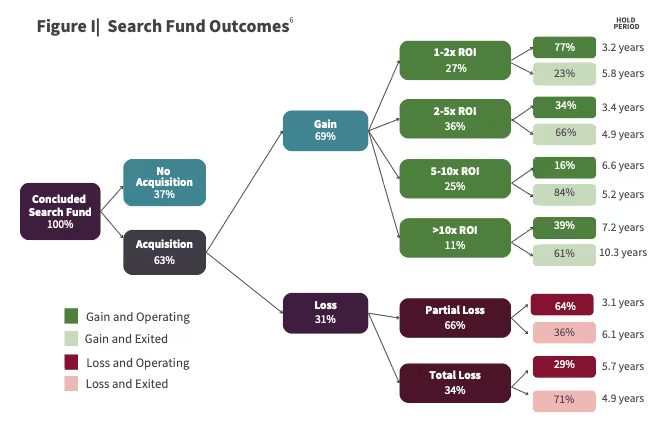






































































%20-%20thumbnail.avif)





%20-%20thumbnail.avif)



%20-%20thumbnail.avif)

.avif)




%20-%20thumbnail.avif)